The JWest capital campaign’s goal of raising $161 million is only possible with the generous spirit and foresight of community members who rally to this generationally important project. Daniella Givon and Bernard Pinsky’s gift is an example of bringing the future JWest campus closer to reality.
Bernard Pinsky and Daniella Givon’s gift is an example of bringing the future JWest campus closer to reality. (photo from Bernard Pinsky and Daniella Givon)
Both joined the Jewish Community Centre of Greater Vancouver (JCC) immediately after settling in Vancouver in 1979. Givon, who grew up in Israel, found friendship and community by joining Israeli folk dancing and becoming involved with Canadian Hadassah-WIZO. Pinsky, a lawyer who grew up in Winnipeg, got to know the JCC by working out in its gym. He noticed how JCC activities and just being around the JCC brought community members together in meaningful ways that sparked and fostered increased community participation.
“I realized that the JCC is a critical connector and gateway to deeper involvement in the Jewish community,” he said.
Pinsky began his local volunteer work with the Canadian Jewish Congress in 1981 and, over the ensuing 44 years, served in leadership roles for many Jewish organizations, including the Jewish Federation of Greater Vancouver, the Centre for Israel and Jewish Affairs’ national board and Beth Israel Synagogue. Today, he is board chair and director of the Ronald S. Roadburg Foundation, one of the lead donors to JWest.
Givon served as Vancouver regional president for Canadian Hadassah-WIZO and took leadership roles in the Jewish Museum & Archives of British Columbia and the Cherie Smith JCC Jewish Book Festival.
Pinsky and Givon, children of Holocaust survivors, continue a legacy of community involvement in their respective families. Givon was inspired by her mother’s many years of leadership in the parent-teacher association of her Israeli school and her grandfather’s participation as a board chair of his moshav’s governing council. Pinsky recalled how his grandfather headed the Zionist Federation of Manitoba, among other leadership positions.
“It’s inconceivable to me to imagine our community without a JCC, and our building is tired,” Givon noted. “A tired, crowded building attracts a limited number of people.”
Pinsky agreed that the JCC is in need of replacement.
“Right now, things are squeezed into pre-set spaces that restrain increased participation,” he noted. “The new JWest will have more space for Jewish organizations, flex spaces for more programming and an expanded daycare. We’ll be able to offer more programs that attract young families, which is a crucial way to build for the future.
“And it’s not just the Jewish community that uses and will continue to use this important facility,” he said. “Former BC premier Christie Clark sent her son to the JCC daycare. I became friends with Terry Yung, who is a current MLA, and his wife, Sarah Kirby-Yung, a city councilor, because we met at the JCC. They’ve been very connected to and helpful for the Jewish community.”
With just $19 million left to raise to achieve the $161 million target, JWest is poised to break ground in early 2026.
JWest recently submitted its development permit application with a new JCC as pictured here. In line with the guiding principle of responsibly using community funds, the design maximizes efficiency, with an increased number of multi-purpose spaces. For example, the JCC auditorium and theatre have been combined and will feature a state-of-the-art, automated, retractable seating system. Operating as a campus, the JCC and King David High School will be more integrated, with greater cross-sharing of spaces.
Visit JWestnow.com to learn more and share the link to get others excited about the project. The newly updated site includes a detailed look at the project and construction timeline, fresh renderings of the JCC, a list of the donors to date, news articles and information on the project team.
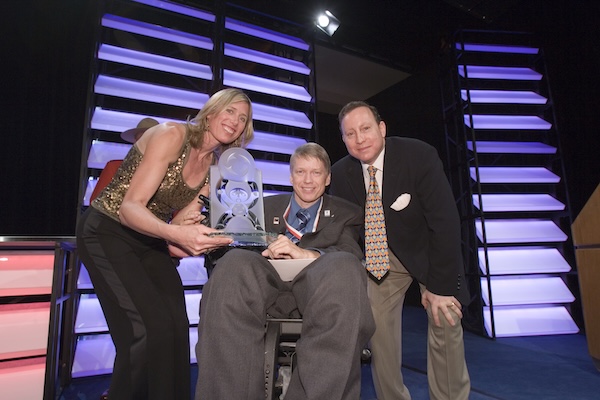
Left to right: Champion rower Silken Laumann, then-Vancouver mayor Sam Sullivan and Courage to Come Back chair Lorne Segal. Sullivan, who broke his neck in a skiing accident when he was 19, has since founded many nonprofits, held various public offices, and more. He received the first-ever Special Courage Award, in 2006. (photo from Coast Mental Health)
This year’s Courage to Come Back Awards, which took place May 7 at the Vancouver Convention Centre, celebrated four people for having overcome great adversity and giving back to their communities. First as an attendee, and then as chair of the awards for 20 years and counting, Lorne Segal knows firsthand the inspiration these award recipients offer.
“I was inspired by the incredible stories of resilience and recovery that define the Courage to Come Back Awards,” Segal told the Independent. “From the beginning, I was moved by the courage it takes to not only face adversity, but to come through it with strength and purpose. The opportunity to support mental health through this powerful platform felt both meaningful and necessary.”
Segal, who is president of Kingswood Properties Ltd., is legacy chair of the annual awards event and co-chair is Eric Carlson, core founder and chief executive officer of Anthem Properties.
Segal took on the role of chair because he “believed deeply in the mission and saw the potential for the awards to grow and reach more people.
“I’ve stayed,” he said, “because of the lives it touches – both those we honour and those who are inspired by them. Each year brings new stories, new hope and a renewed sense of purpose. It’s been one of the greatest privileges of my life.”
This year’s awards were given out in four categories and the recipients were Stanley Price (addiction), David Chalk (mental health), Louisa Bridgman (medical) and Omar Bseiso (young adult).
Price overcame childhood trauma, addiction and gang involvement, and now works in addictions and recovery, as well as being a volunteer with KidsPlay Foundation. Chalk, who hid that he couldn’t read until his 60s, has become an AI expert and entrepreneur – he is currently developing an AI-trained platform that will help others build literacy. Bridgman, a disability rights activist, lives with cerebral palsy, and has faced childhood abuse and systemic discrimination. Bseiso has faced poverty, as well as physical and mental health challenges, and gone from being a struggling student to a University of British Columbia scholarship recipient, with the goal of becoming a doctor.
“The awards shine a spotlight on hope and recovery, challenging stigma and encouraging conversations about mental health and other challenges,” said Segal. “They remind people that they are not alone. By celebrating those who have overcome incredible odds, we inspire others to keep going – and we build a stronger, more compassionate community.”
Segal himself has been changed by his involvement with the awards.
“It’s made me more empathetic, more grateful and more aware of the quiet strength people carry,” he said. “Being surrounded by such resilience has profoundly impacted how I see the world and how I approach adversity in my own life. It has grounded me and continually reminded me of the importance of kindness and perseverance.”
And it’s a family endeavour.
“It began 27 years ago when my parents, Joe and Rosalie Segal, attended the first Courage to Come Back Awards and were inspired to help found the Joseph and Rosalie Segal and Family Health Centre at Vancouver General Hospital,” said Segal. “My wife Melita and our children, Matthew and Chanelle, have supported me every step of the way – attending from a young age and sharing courage stories in their own lives. Their belief in this cause has made my work all the more meaningful.”
Lorne and Melita Segal at the 2018 Courage to Come Back Awards. (photo by Alex Law from Coast Mental Health)
The cause is mental health in general, but also Coast Mental Health specifically. The Courage to Come Back Awards raise money for the organization.
“Coast Mental Health is one of the quiet pillars holding up those who often feel unseen,” Segal explained. “In the broad landscape of mental health care, we often think first of hospitals, doctors and medication – the primary care that is essential and often life-saving. But what happens after that first step toward healing? Where does someone go when they leave the hospital but still need support, still need connection, still need hope? That’s where Coast Mental Health steps in.
“Coast is not just a service – it is a sanctuary,” he said. “It offers that vital second tier of support: stable housing, meaningful training, compassionate community. It provides a roof over someone’s head, but also restores something far less tangible and even more precious – dignity. With job training programs, resource centres and drop-in spaces where a kind word and a warm hand can change the course of someone’s day, Coast wraps its arms around people who are trying, day by day, to come back.
“Mental health recovery doesn’t happen in isolation, and it doesn’t end at the hospital door. Coast Mental Health understands that healing is holistic. It happens in the safety of a home, in the encouragement of a support network, in the pride of a new job and in the trust of a human connection.
“This is the quiet, essential work of Coast Mental Health – and it is work that changes lives,” Segal said. “It is not just about surviving. It is about returning to life with dignity, with purpose and with courage.”
There have been so many memorable Courage to Come Back moments for Segal over the last two decades. “There are countless,” he said. “Standing ovations for recipients who once struggled to leave their homes, families reunited in tears and the thunderous applause of a community coming together. But perhaps the most memorable moments are the quiet ones: personal notes from recipients saying, ‘You helped me believe in myself again.’”
Lorne Segal has chaired Coast Mental Health Foundation’s Courage to Come Back Awards for 20 years. (photo from Coast Mental Health)
Under Segal’s stewardship, the annual event, which began in 1999, has grown to be Western Canada’s largest gala, with more than 1,700 people attending. It has raised more than $27 million for mental health and celebrated 153 British Columbians. But its success wasn’t guaranteed.
“One of the greatest challenges the Courage to Come Back Awards faced was simply staying alive in its earliest days,” said Segal. “I still remember stumbling across the event 27 years ago – not really knowing where I was going or what to expect. I sat down at a table, noticed a Kleenex box in the centre, and quickly understood why it was there. The stories I heard that evening moved me to tears. These weren’t just stories– they were everyday miracles. I walked out of that room thinking: everyone needs to hear this. Everyone needs to feel this hope.
“But, at the time, there were only a few hundred people in the room. The organization was struggling, and the idea of shutting the doors on the awards was very real. There simply wasn’t enough awareness, enough support or enough belief that it could become more.
“That night lit a fire in me,” he said. “I started telling everyone I knew – sharing the stories, the impact, the emotion. And, slowly, over the years, the event grew.”
As for what keeps him involved, Segal said, “Because it matters. Because it changes lives. Because I’ve seen firsthand the power of sharing stories of resilience, the ripple effect of one person’s courage igniting another’s hope. For two decades, I’ve had the privilege of helping shine a light on individuals who prove, year after year, that no matter the hardship, comebacks are possible. It’s not just about honouring the brave – it’s about showing others what’s possible. And that purpose, that impact, keeps me coming back, too.”
The work gives back more than it takes, he said. “In a world full of noise, the Courage to Come Back Awards are a rare and powerful reminder of what truly matters: resilience, humanity and hope.”
To learn more about the impacts of the awards, which are presented by Wheaton Precious Metals, visit coastmentalhealth.com.
Camp Solomon Schechter’s Spark event in Vancouver on May 4 honours the Siegel family’s generational connections to the camp.(photo from campschechter.org)
Once again, Camp Solomon Schechter (CSS) is hosting one of its three annual Schechter Spark events in Vancouver – on May 4, at the Tap & Barrel Bridges location on Granville Island.
The fundraising and community-building events hosted by the camp each year run simultaneously in Vancouver, Seattle and Portland – the camp’s main hub cities. This year’s Schechter Spark will honour three families – one tied to each location – who have generational connections to the camp. In Vancouver, former Beth Tikvah and Beth Israel spiritual leader Rabbi Howard Siegel, Ellen Siegel and their growing family will be celebrated.
Rabbi Siegel, originally from Spokane, Wash., first attended CSS in 1961, when it was located on Whidbey Island. His experiences there led him down a path toward the Conservative rabbinate, a Jewish family and a life of Jewish service that took him to Vancouver, as well as many communities in the United States. In 1968, he convinced his then-girlfriend, Ellen Kushner, to join him as a camp counselor. The couple returned again to CSS in 1970, this time at its new (and current) Tumwater, Wash., location – Howard as educational director and Ellen as camp nurse.
Ellen Siegel credits the camp for helping her perfect her independence as a health practitioner, while Howard Siegel built his future rabbinate under the mentorship of Portland’s Rabbi Joshua Stampfer and Vancouver’s Rabbi Wilfred Solomon.
The Siegels’ three children also attended CSS and their oldest daughter, Ronit, began her relationship with husband Tadd Berger while they were summer staff together in the 1990s. Naturally, they sent their three children to CSS, and all three have been both campers and staff.
The Seattle and Portland Sparks will recognize the Schiller families and Atkins families, respectively, with more than 500 participants expected to attend between the three locations.
“As we celebrate another year of impact, Spark is a time to honour our past, celebrate our present and invest in our future,” said CSS executive director Zach Duitch. “We look forward to gathering with our beloved community to share stories, laughter and our collective commitment to Jewish camping.”
Camp Solomon Schechter has been a cornerstone of Jewish life in the Pacific Northwest for more than 70 years. Spark endeavours to embody the spirit of camp, bringing its values to life through an evening of joy, generosity and togetherness.
Schechter Spark in Vancouver is a free event with online registration, and will include appetizers, drinks and a few camp-style special presentations. For more information or to register, visit campschechter.org/spark or contact Leah Conley, lconley@campschechter.org.
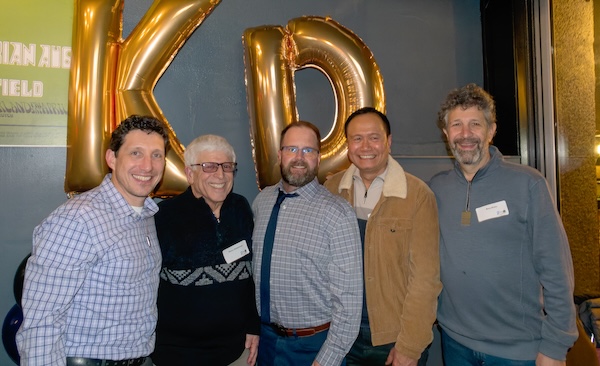
Left to right: Head of school Seth Goldsweig, former head of school Perry Seidelman, deputy head of school Alex Monchamp, head custodian and building manager Jess Sabado and former head of school Russ Klein at a February gathering of alumni to celebrate 20 years of KDHS on Willow Street. (photo from KDHS)
On May 14, with a party at Congregation Beth Israel, King David High School celebrates 20 years since it opened its doors on Willow Street.
“It’s a real blessing,” said KDHS head of school Dr. Seth Goldsweig about having a Jewish high school in the community.
“Study after study shows that the most effective way to develop and maintain Jewish identity is to go to Jewish day school,” he said. “Our students can continue to develop their Jewish identities and turn into the Jewish leaders of tomorrow.
“We have a high school that stands up to the other amazing independent schools in the area,” he added. “This means that students can have a top-notch Jewish education combined with a rigorous and enriching academic experience. They get the best of both worlds.”
Goldsweig is KDHS’s third head of school, having started the position last fall, after Russ Klein retired. Klein was at the helm from 2008 to 2024.
“In this job, I found a community that I didn’t know I had,” Klein told the Independent last year, as his tenure was winding down. “That was beyond special. I really do think of this job, this position really, as a gift.”
Klein had taken over the position after Perry Seidelman retired.
In 2001, Seidelman was hired as principal of Vancouver Talmud Torah High School – one of the iterations on the path that led from Maimonides High School, which was started in the 1980s, to KDHS. With 30 years prior experience and his approach to education, he was a key to the successful establishment of King David.
“Without Perry, there would be no school,” Larry Goldstein, president of the Jewish high school during the transition period, says in The Scribe’s Jewish Education in BC issue. “It’s as simple as that. Perry gave the credibility to other parents.”
“With growing interest in the school, a decision was made to build a permanent structure with financing from the Diamond Foundation,” Seidelman writes in The Scribe, which is the journal of the Jewish Museum and Archives of British Columbia. “It was to be built on a property at the southeast corner of 41st Avenue and Willow Street, directly across Willow Street from the Jewish Community Centre. Extensive discussions were held with the JCC administration, as intentions were to use the JCC for some programs, notably the JCC gymnasium for PE classes and the Norman [& Annette] Rothstein Theatre for drama productions.”
As enrolment grew, Alex Monchamp, who had been a teacher at the high school since its Maimonides days, was hired as vice-principal, according to The Scribe. Monchamp now holds the title of deputy head of school.
“I joined King David in July 2001,” Monchamp told the Independent. “I’d only been living in the city for a few months, and I saw a small newspaper ad for a small independent school looking for a half-time English and drama teacher. It was my first teaching job in BC!”
When asked why KDHS has proven successful, while previous versions of the high school struggled, Monchamp said, “I think the main turning point was the year I started, and the school had its biggest Grade 8 class, which I think was 25 or 26 students. Those connected to the school and who were vital in its foundation and ongoing viability made a real concerted effort to engage with the community and make a case for the importance and need for a sustainable Jewish high school. However, the real risk, the real investment, was when those Grade 8 families, and the families that came after, invested their most important resource – their children – in our school.
“When our families started to see that need and started to trust in the school, it allowed the school to grow and become more stable,” said Monchamp. “Stability turned into slow but steady growth, to more students, more teachers, and then our home on Willow Street. However, the building itself did not cement our future – it was also the school’s investment in good leadership and dedicated teachers that secured the future we enjoy today.”
Then-student Nicole Grubner and Gordon Diamond at the 2005 inauguration of the KDHS building on Willow Street. (photo from KDHS)
When Monchamp joined the high school, there were fewer than 70 students, programming was limited and there was no permanent school building, he said. Growth has occurred in multiple areas.
“There are obvious measures, like our student population is over 270 students, we have a vibrant arts program, a strong athletic program and our programming offers our students many ways to explore what they know, what they can do and who they’ll become,” said Monchamp. “All of that happens because we continue to have a team of outstanding teachers and dedicated adults who work extremely hard.
“The ultimate measure is not where our students go to university, the grades they earn or even how many of them are in the building each day,” he added. “There are bigger schools, there’s no shortage of kids going to university and no one is ever going to care what your math mark was in Grade 10. The true measure is that our students discover and develop their capabilities, figure out who they are and what it means for them to be Jewish in this world. In a world of uncertainty and change, our students have the capability to adapt and grow and the values and foundation to be a good person.”
KDHS’s director of development, Esther Mogyoros, who has worked at the school for the past 11 years, echoed Monchamp’s belief that there is more than one component to the school’s growth.
“Over the years,” she said, “King David has grown not only in student enrolment but also in its physical presence, thanks to the expansion of the east campus, made possible by the generosity of the Diamond Foundation and our supportive community. Our reputation has been built on a strong foundation of chesed programs, regular volunteer initiatives, and active participation in celebrations and community events. We take pride in nurturing students who not only excel academically but also continue their educational journeys and give back to the community long after graduation.”
Both Mogyoros and Monchamp said the best part of their jobs is when they connect with others.
“Connecting with students, parents, grandparents and the community at large,” said Mogyoros. “Building relationships and sharing my passion for Jewish education, Israel and the importance/impact of King David in the community.”
“The best part is when I can connect with a student, chat, find out more about them and then, if I can, find ways that I can support them,” said Monchamp. “It doesn’t happen nearly enough in a typical day, but I love it when it does.”
One of Monchamp’s standout moments at the school is when KDHS would take the Grade 9 students to Washington, DC, every spring to visit the US Holocaust Memorial Museum.
“We’d spend a full day at the USHMM, which is a lot, and our students always came away with information or artifacts they hadn’t encountered before and at times it was very emotive,” he said. “The trip also included a day at many of the Smithsonian Institution museums. It was always a treat to watch the kids see real historical items, like the Wright brother’s plane, the ruby shoes from The Wizard of Oz or Prince’s guitars. History is always more relevant to kids if they can get up close to it and connect to their own stories and memories.”
Over the past 20 years, there have been challenges, notably, the pandemic.
“There was so much unpredictability and an immeasurable amount of learning we had to do on the fly,” said Monchamp of that time. “Despite the numerous challenges, it is moments like that which demonstrate what our school is all about. The overarching goal was what it has always been: putting our students first. And when that was our guiding principle, we figured out the rest…. It was also vital that our families trusted us. Before, during and after COVID, we have consistently demonstrated to our families that we take our role in their children’s growth very seriously and that we always perform in ways that support and benefit their growth.”
“Throughout those difficult years,” said Mogyoros, “our school’s resilience and compassion shone through – not only in maintaining academic standards but also in supporting one another emotionally during a time of unprecedented uncertainty.”
Monchamp hopes the school continues on its current path, becoming “a student-centred learning environment.
“Learning is an active experience and is most successful when students are actively engaged and can apply what they know and can do to their own experiences and contexts,” he said. “We have already seen the tremendous benefit of this shift. It’s what is keeping our school competitive and on par with other Vancouver independent schools and it’s setting up our students for their future successes.”
The King David High School Class of 2019 celebrates graduation. (photo from KDHS)
“Our goal,” said Mogyoros, “is to empower students to be confident in their identities, excel in their chosen paths, and take pride in their Jewish heritage, traditions and love for Israel. We strive to inspire them to make a meaningful difference in the world around them.”
JWest is central to the high school’s future. The three-phase development project at 41st Avenue and Oak Street will see the construction of a much-expanded JCC, a new home for KDHS and two residential towers.
“Having a new building where we can continue to develop our programming, where we can engage our students and where we can host real ‘home games’ in our own gym in front of as many students and parents as possible is incredibly important,” said Monchamp. “The school is still very young and a new facility will allow it to continue to shape its identity. Additionally, our community can continue to take pride in the school and all of the many interconnected Jewish organizations in the city. I think the symbolism of one large, proud hub for the Jewish community sends not only a very strong message, but, more importantly, a unified message, one which the community can use as a foundation for its future.”
Mogyoros agrees.
“A larger campus will open doors to more programs, providing students with enhanced opportunities for learning, creativity and personal development,” she said. “We are especially excited about the addition of more space and new sports fields, which will enrich our athletic and extracurricular offerings and foster a vibrant, dynamic environment for our students.”
“We want to see the school continue to grow,” said Goldsweig. “Next year, we will be the biggest we have ever been. So many families have chosen to give their kids a Jewish high school education. We are so appreciative and hope that many more continue to make the same decision.”
The head of school says he has been warmly welcomed into the community, with Friday night dinner invitations every Shabbat, “an amazing staff,” a board that “has been supportive every step of the way,” and parents who “are dedicated to the success of the school and their children.
“The most impressive group of all has been the students,” Goldsweig said. “They are so inspiring, and I know our future is in good hands.”
To attend the May 14 gala, participate in the silent auction (which launches April 29), buy raffle tickets or donate to King David High School, visit goldenthreadgala.com.
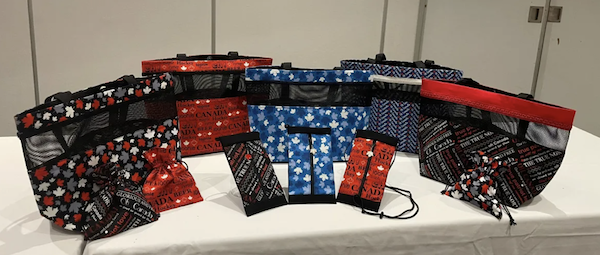
Tikun Olam Gogos’ O Canada! bags proclaim dedication to the ethic of improving the world in friendship with other nations, raising much-needed funds for grandmothers in sub-Saharan Africa who are raising their grandchildren due to the HIV & AIDS pandemic. (photo from Tikun Olam Gogos)
As proud Canadians and fundraisers for the Stephen Lewis Foundation Grandmothers to Grandmothers Campaign, Tikun Olam Gogos have launched a special edition line of O Canada! tote bags – determined to respond to the threats American tariffs pose to Canada, and to the suspension of USAID, which is devastating to the Gogos’ partner organizations in Africa.
According to Stephen Lewis, “Lives will be lost. Our best contribution at this perilous moment is to attempt to replace the resources that America has expunged.”
Tikun Olam Gogos’ response to the White House is to raise more funds by intensifying its efforts to handcraft and market its O Canada! line of large tote bags, zippered and drawstring pouches.
Tikun Olam Gogos (TOG) is part of the Greater Vancouver Gogos, which includes about 20 Gogo groups across the Lower Mainland. Gogo is the Zulu word for “grandmother” and tikkun olam is Hebrew for “repair of the world.” TOG is a volunteer group of grandmothers and grand-others (non-members who help out the group periodically) in Vancouver that was founded in May 2011 and is sponsored by the Sisterhood of Temple Sholom. Its mission is to raise awareness, build solidarity and mobilize support in Canada for grandmothers in sub-Saharan Africa who are raising their grandchildren due to the HIV & AIDS pandemic.
In 14 years of operation, Tikun Olam Gogos has raised more than half a million dollars for the SLF Grandmothers to Grandmothers Campaign. With its partners in Africa reeling from the withdrawal of other international programs, TOG is more determined than ever to fulfil its motto: “we will not rest until they can rest.”
Priced at $50, just $5 more than TOG’s original signature totes, the O Canada! bags proclaim dedication to the ethic of improving the world in friendship with other nations. So, wear your maple leaf and your heart proudly on your O Canada! tote. You are telling the world “Canada cares.”
To order your O Canada! tote bags, zippered pouches and drawstring pouches, visit tikunolamgogos.org or call Joyce Cherry at 604-261-5454.
Anat Gogo, executive director of Tikva Housing Society, speaks at the opening of Susana Cogan Place, Sept. 13, 2023.(photo by Alina Ilyasova)
Tikva Housing Society’s annual fundraising campaign starts March 3 and runs to March 9. While the society has increased its capacity over the years, the demand for its services continues to outpace its resources.
“The need for affordable housing within the Jewish community remains urgent, with 691 people currently on the Jewish Housing Registry, which Tikva maintains in partnership with Jewish Family Services,” Anat Gogo, executive director of Tikva Housing Society, told the Independent. “Among those on the registry, there are 103 families, which includes a total of 179 children who are currently without stable homes.”
This is the case, despite Tikva Housing having expanded its reach and impact within Vancouver’s Jewish community.
“While rental prices have started to stabilize after two years of unprecedented increases, affordability remains a pressing issue, and the need for Tikva’s services continues to grow,” said Gogo.
Currently, Tikva manages 168 housing units and provides stable housing and financial support to 374 individuals – 260 adults and 114 children – across seven properties and through its Rent Relief Program, said Gogo.
“To better support tenants and provide more direct management, Tikva has brought property management in-house for two of its properties,” she added. “This recent change is in addition to two other sites that are managed in-house and three properties where we provide tenant-relation services.”
Tikva recently raised the maximum Rent Relief Program subsidies from $750 to $828 per month for individuals and couples, and from $1,200 to $1,330 per month for families.
“This increase is in alignment with Canada Mortgage and Housing Corporation guidelines, which define the average rents in Metro Vancouver,” explained Gogo. “Our passionate and dedicated team continues to grow, and we have brought on new staff to ensure our tenants receive the support they need. We’ve also enhanced our volunteer board and committees made up of professionals with expertise in real estate, development, finance and the nonprofit sector.”
This year’s fundraising campaign aims to raise $100,000 to help address the growing housing affordability crisis, said Gogo, noting, “The challenge of affordability is not limited to low-income families. Increasingly, two-parent households that were once able to manage market rents are now struggling to keep up. There is also an ongoing need for affordable housing close to Metro Vancouver’s Jewish amenities and community resources.
“Rising costs, financial instability and security concerns due to rising antisemitism have contributed to a growing number of community members reaching out to Tikva Housing for housing options,” she said. “This campaign is an opportunity for our community to come together and ensure that more individuals and families have access to safe, stable and affordable housing.”
Since 2011, Tikva’s Rent Relief Program has helped hundreds of community members facing temporary financial crises stay in their homes, said Gogo. “Expanding this program is the primary focus of our annual fundraising campaign, as it provides urgent, critical financial assistance to individuals and families who are paying market rent but are at risk of losing their housing due to unexpected financial hardship.”
Both the Rent Relief Program and Tikva’s properties are at maximum capacity.
“The only way Tikva can address our community’s housing insecurity is through donor generosity,” said Gogo. “Donations are crucial to help us achieve our mission to provide access to innovative and affordable housing solutions.”
To support Tikva Housing Society’s annual fundraising campaign, visit tikvahousing.org or call 778-998-4582.
Sara Ciacci, z”l, was a passionate advocate against domestic violence, establishing ASTEH, an emergency shelter for women escaping abuse. (photo from JFS Vancouver)
Sara Ciacci, z”l, is, in many ways, an urban legend – a name synonymous with impact, compassion and transformative change in our community.
Ciacci dedicated her life to fighting food insecurity, most notably co-founding the Jewish Food Bank in 1984. She was also a passionate advocate against domestic violence, establishing ASTEH (Alternative Short Term Emergency Housing), an emergency shelter for women escaping abuse. And JFS Vancouver has recently honoured Ciacci’s extraordinary impact by renaming ASTEH to Sara’s House, a tribute to her unwavering commitment to empowering women and building their resilience.
A survivor of domestic violence herself, Ciacci deeply understood the fear, shame and stigma that women and children face when escaping abuse. Her firsthand experience drove her determination to create a safe space where Jewish women and their children could find refuge and rebuild their lives.
Sanctuary for women, children
Sara’s House is a community-based housing facility providing security, stability and support to Jewish women and their children fleeing violence or at risk of homelessness. With the guidance of JFS counselors and care managers, women are empowered to explore their options and make decisions that lead to a safer, more hopeful future.
Over the years, Sara’s House has been a haven for dozens of women and their children. One such story is Abby’s.
When Abby first walked into JFS, she was overwhelmed with fear and desperation. Fifteen years into her marriage, a sudden violent shift forced her to confront the emotional, verbal and financial abuse that had been present from the start. She never thought she would find herself in this situation.
Abby recalled a comment from JFS executive director Tanja Demajo.
“Tanja told me she felt I had a very good chance of getting out of the abuse and I was a good candidate for ASTEH housing,” said Abby. “By the end, I felt overwhelming relief. It was the life preserver I needed to get out.”
A lasting tribute
JFS Vancouver is profoundly grateful for Ciacci’s legacy of dedication, empathy and action. With the renaming of ASTEH to Sara’s House, her vision of providing a haven for women and children will live on, inspiring future generations to continue the work of protecting and empowering those in need.
Community support helps sustain Sara’s House and the life-changing services it provides. To learn more or to contribute, visit jfsvancouver.ca/donate.
An artistic rendering of JWest’s new Jewish Community Centre of Greater Vancouver, as seen from 41st Avenue. (image from Federation)
JWest has submitted the development permit application to the City of Vancouver for the first building of the planned community hub, the new Jewish Community Centre of Greater Vancouver (JCC) at the corner of 41st Avenue and Willow Street.
The design for a six-storey community centre is now being reviewed by the city after consultation with city planners. Rezoning for the site was approved in 2018 and includes a new JCC, a new King David High School and residential towers. Once completed, the hub will provide both housing and amenities for the expanding Oakridge neighbourhood.
The new JCC will be a 200,000-square-foot, state-of-the-art, multigenerational community centre on what is currently the JCC parking lot. The centre will include expanded childcare, services for seniors, arts and cultural spaces, and amenities for all Vancouver residents. More than 20 not-for-profit organizations are expected to call the centre home. In particular, the Vancouver Holocaust Education Centre, the largest Holocaust-based museum in Western Canada, will double in size to meet the growing demand for anti-racism education.
This is Phase 1 of the two-phase project. Phase 2 will include mixed-use rental housing, with units offered at or below market value and open to Jews and non-Jews.
While JWest is a community-led initiative that is Jewish at heart, it will benefit everyone. At $450+ million, it is also the most extensive project in the history of the Jewish community in Western Canada. And fundraising is proceeding apace, with keystone grants from the Government of Canada, the Government of British Columbia, the Diamond Foundation, the Al Roadburg Foundation, the Ronald S. Roadburg Foundation, and dozens of community-minded individuals and families bringing the vision into reality. The plan is to break ground within 13 months.
BC members of Team Canada U16 Junior Girls Volleyball sell donuts to raise funds to travel to Israel next summer. (photo from Maccabi Canada)
Young volleyball players and their families are calling on the community for assistance to send their team to Israel for the 2025 Maccabiah Games next July.
Team Canada U16 Junior Girls Volleyball includes 10 athletes, including four from Vancouver, five from Toronto and one from Winnipeg. The team is fundraising to cover the expenses, which amount to almost $10,000 per participant.
“These girls are devoting themselves to bringing their best game to the Maccabiah Games next summer,” said Roman Pereyaslavsky, the team manager. “It is not only a powerful goal for them, but the celebration of international athletic competition in Israel next year is also a huge message of solidarity with the people of Israel at this time of unprecedented challenge.”
The girls and their parents do not underestimate the hurdles they face in raising the funds to make the trip to Israel possible.
“Traveling to Israel and competing as Canadian representatives with Jewish girls from around the world is a massive dream,” said Liel Lichtmann, a Richmond Grade 10 student and member of the national volleyball team. “We are fundraising every way we know how and we are confident we can make this happen. We hope our community will make our dream a reality.”
The Krell, Lewis, Kallner and Singerman families are excited their gift will help in the creation of an expanded Vancouver Holocaust Education Centre. (photo by Rachel Topham)
The JWest capital campaign cabinet is grateful to Dr. Robert and Marilyn Krell and their families, Shoshana and Shawn Lewis, Simone and Howard Kallner, and Michaela and Matthew Singerman, for supporting the redevelopment of the Jewish Community Centre of Greater Vancouver site. The individual gifts from each of the four couples reflect two generations equally committed to building a strong Jewish future in Vancouver.
The Krell family has deep roots in Vancouver. Marilyn’s Polish grandfather, David Davis, who arrived in 1909, was one of the founding members of Congregation Schara Tzedeck. Robert, born in Holland, was hidden during the Holocaust and, after reuniting with his parents, arrived in Vancouver at age 10, in 1951. Both Robert and Marilyn were influenced by their parents’ involvement in the synagogue and a variety of Jewish organizations.
“Vancouver is where I became a Jew,” said Robert, who participated in Habonim as a child and became actively involved with the Canadian Jewish Congress as an adult. In 1971, he and Marilyn were married by Rabbi Marvin Hier, who was Schara Tzedek’s rabbi at the time. The couple raised their three daughters, Shoshana, Simone and Michaela, in a traditional Jewish home where Shabbat was always celebrated. The Jewish values that began at home were reinforced at Vancouver Talmud Torah, Camp Hatikvah and at the JCC.
Robert, a founder of the Vancouver Holocaust Education Centre (VHEC), mobilized the survivor community from a concept in 1983 to a reality in 1994, when the centre opened as a museum and educational institute that ignited Shoah learning in British Columbia and beyond. The Krell daughters grew up witnessing the VHEC board meetings in their living room and attending award ceremonies that recognized their parents’ contributions to a variety of Jewish organizations.
“Through their actions and deeds, they taught us that you give when you can and volunteer when you can,” Simone said.
Now with children of their own attending local Jewish institutions, the Lewis, Kallner and Singerman families have assumed leadership roles in the VHEC, VTT, Schara Tzedeck, Jewish Family Services, Jewish Federation of Greater Vancouver and the Jewish Community Foundation. As they saw their parents’ commitment to support JWest, they knew they were also ready to answer the call to help build a new infrastructure to support the future of the region’s Jewish community.
“We are excited to contribute to such an important and pivotal project that will be utilized and cherished not just by future generations of our Jewish community, but of the greater community as well,” said Michaela.
Her sisters expanded that idea by saying, “The JCC has played a role for five generations of our family and it shapes many of our fondest memories.”
The family is excited that their gift will also assist in the creation of an expanded Vancouver Holocaust Education Centre, an institute close to their hearts and lives. Founded with a mandate of Holocaust-based anti-racism education, the VHEC welcomes more than 25,000 students, educators and members of the public each year.
While it plays a crucial role in conveying the ongoing relevance of the Shoah, this teaching museum has long been challenged by a small footprint and its limited visibility in the lower level of the JCC. JWest will protect the legacy of the VHEC by significantly increasing its square footage and visibility. The new VHEC will be visible from West 41st Avenue and will feature state-of-the-art exhibit space for permanent and rotating exhibits. It will also have dedicated research and programming space to facilitate workshops that enhance learning and engagement. Its prominent location in the JWest campus’s Arts & Culture Centre will ensure that the VHEC remains a vital presence in the community well into the future.
“The VHEC was at the forefront of our upbringing and experience and it’s a highlight to see it being incorporated as an important component of JWest,” Simone said.
Shoshana echoed those sentiments. “It’s exciting to envision the future JCC as a hub that will encompass so many important institutions,” she said. “We want a safe space to house our next generation of Jewish institutions, so there’s an urgency for us to support this project as a commitment to the future of our children, our grandchildren and the community at large.”
Alex Cristall, chair of the JWest capital campaign, had this response to the gift: “With five generations of active involvement in Vancouver’s Jewish community, the Krell, Davis, Kallner, Lewis and Singerman families continue to demonstrate the depth of their commitment through their gifts and volunteerism. Their generous gifts to JWest will secure and revitalize our Jewish institutions and we are deeply grateful for their support of this project.”
As one of the largest capital projects underway in Vancouver, JWest is only possible with the support of donors and the encouragement of the community. In the coming months, the JWest capital campaign cabinet will continue to update and advise community members on the campaign’s progress and on opportunities to contribute to its philanthropic goal of $161 million.
For a full list of JWest donors, visit jwestnow.com.