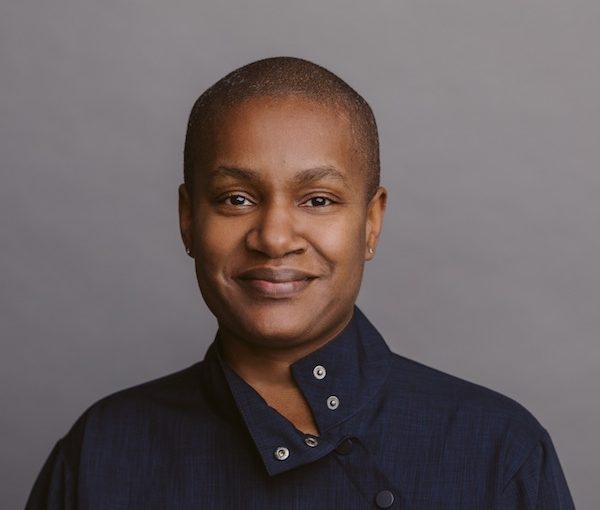
Green party leader Annamie Paul lost her bid for a seat in Toronto Centre. (photo from annamiepaul.ca)
Annamie Paul, the first female Jewish leader of a Canadian federal party, saw her hopes crushed Monday night as the Green vote plummeted across the country and she badly lost her bid for a seat in Toronto Centre. Paul came fourth in the riding, taking less than 9% of the vote. Her party lost one of its two British Columbia seats but, in their only bright spot, picked up a new riding in Ontario.
Having been kneecapped by internal party clashes in the lead-up to the election call, Paul was in an unenviable position, leading a party that had tried to oust her in a battle sparked by, or at least nominally blamed on, Paul’s moderate call for restraint during the Israel-Hamas conflict last spring.
Paul was not the only leader disappointed on election night. While politicians painted the outcomes in sunny terms, no one got much of what they wanted. After a $600 million election in the midst of a pandemic, the big picture in Canada’s political landscape is almost unchanged. With minor adjustments expected as mail-in ballots are counted, the Liberals and Conservatives are almost exactly where they were when the election was called.
Most prominently, reelected Prime Minister Justin Trudeau failed in his gambit to turn his minority into a majority government. The expense, resources and dangers of a pandemic election were rewarded with a nearly identical outcome as the last election.
Likewise, Erin O’Toole, who led his Conservatives to an almost identical result, will face discontent over his attempts to pull the party to the centre. Had the strategy worked, he would have been dubbed a genius, but failure will almost certainly unleash the wrath of his party’s right flank, which was largely thrown under the bus after O’Toole won the leadership on a slogan that depicted him as the “true blue” candidate, the more right-leaning of the two front-running options.
Jagmeet Singh, leader of the New Democrats, and Yves-François Blanchet, leader of the Bloc Quebecois, both appeared to resonate with their target constituencies, but, when the votes were counted, their electoral fortunes were only mildly improved. Maxime Bernier, leader of the People’s Party, lost his bid for a seat in Quebec and, while his party’s surprisingly strong showing in parts of the country, particularly on the Prairies, may have hurt the Conservatives, it left his own candidates empty-handed.
Several B.C. ridings remained too close to call at press time, including Vancouver Granville. Liberal Taleeb Noormohamad was about 200 votes ahead of New Democrat Anjali Appadurai as mail-in ballots were being counted. Despite polls showing Liberals falling behind in the province, the party appears to have held all its seats and even picked up both Richmond ridings. Steveston-Richmond East is a swing riding that has returned to the Liberal fold after a two-year interregnum. But, while few observers thought Richmond Centre was in play, Conservative incumbent Alice Wong is marginally behind Liberal Wilson Miao.
There were only two known Jewish candidates in British Columbia. In Nanaimo-Ladysmith, Conservative Tamara Kronis remains about 1,000 votes behind New Democrat Lisa Marie Barron at press time, a margin that will be a steep climb to overcome with just mail-in ballots remaining. The riding was watched nationally, as it was one of just two Green seats in Parliament. Paul Manly, who has a history of anti-Israel activism, fell to third place in a tight race. In West Vancouver-Sunshine Coast-Sea to Sky Country, New Democrat Avi Lewis placed a respectable third, with about 26% of the vote in one of Canada’s wealthiest ridings, while Liberal incumbent Patrick Weiler held on against a comeback effort by former Conservative MP John Weston.
Much has been made of the challenges facing Canadians as the country engages in its 44th federal general election while still in the grips of a pandemic. For Jewish voters, the succession of holidays in the weeks leading up to the Sept. 20 election makes scheduling events like community forums with candidates extra confounding.
Nevertheless, the Centre for Israel and Jewish Affairs (CIJA), along with partner agencies, will present a number of events across the country. Here in Metro Vancouver, there will be a virtual town hall on Sept. 14, 4 p.m., co-presented, as is tradition, with SUCCESS, the United Chinese Community Enrichment Services Society. Topics addressed will include racism and hate crimes; seniors’ care; post-pandemic economic recovery; immigrants and refugees; safe and healthy communities; and the sustainability of charitable and nonprofit organizations.
Two days earlier, on Sept. 12, a Richmond-focused virtual town hall will take place at 5 p.m., co-presented by CIJA and the Kehila Society of Richmond.
Tucked in between, on Sept. 13, is a national town hall, presented virtually from Toronto, again hosted by CIJA, this time in partnership with The CJN. All events are accessible from the website cija.ca/election.
Locally on Sept. 13, there is an all-candidates meeting on seniors issues for the ridings of Vancouver Granville and Vancouver South, co-hosted by Jewish Seniors Alliance. To register for it, visit jsalliance.org.
CIJA also has released a federal issues guide, outlining what it considers to be priorities on matters of domestic and foreign policy.
Among the recommendations is a request to supplement the Security Infrastructure Program, which provides funds to enhance security at institutions such as synagogues and community centres, with a program modeled after the Community Security Trust in the United Kingdom, which trains volunteers to provide patrols, situational awareness and threat prevention.
The guide urges amending the criminal code to make Holocaust denial an indictable offence and developing a standardized national social studies curriculum on antisemitism and the Holocaust.
The document, which is downloadable from the CIJA website, calls on the next government to address online hate through education and enforcement, including a social literacy campaign to “sensitize Canadians to the potent role social media plays in bullying, harassment, intimidation, dissemination of hate, and threats.” It calls for reestablishing provisions in the Canadian Human Rights Act to combat hate speech and strengthening Canadian tax laws to prohibit charities from promoting or inciting antisemitism or violent extremism.
The foreign affairs section calls on the government to ensure that Canadian humanitarian aid to Palestinians “goes where it is intended” and to oppose one-sided United Nations resolutions singling out Israel. It also calls on the government to demand that the Palestinian Authority stop the “paid to slay” program that rewards terrorism. It also calls for putting pressure on Iran until it “demonstrates meaningful improvements in comes into full compliance with its international obligations.”
Other CIJA recommendations include:
Implementing the United Nations Declaration on the Rights of Indigenous Peoples “as an important step toward truth and reconciliation.”
Putting pressure on Eastern European countries “that have evaded their responsibility to pass meaningful restitution laws” for Holocaust survivors and their descendants.
Strengthening immigration and refugee policies particularly to support those targeted for their identity, such as Christians and Yazidis in Iraq, LGBTQ2+ people in Chechnya and Iran, and Rohingyas in Myanmar.
Reintroducing the question about religion in the census “to prevent continued underreporting of Jewish Canadians.”
Ending the three-month celibacy requirement for LGBTQ2+ blood donors.
The Canadian Jewish Political Affairs Committee (CJPAC) is also busy during the campaign.
CJPAC engages “Jewish and pro-Israel Canadians in the democratic process” and helps community members build relationships within the Canadian political arena. Their website, cjpac.ca, has links to all major political parties, as well as links to volunteering and getting involved in campaigns. There is a final volunteer training webinar available at noon Pacific time on Sept. 13.
For information on your riding, where to vote and a list of candidates, go to the Elections Canada website at elections.ca.
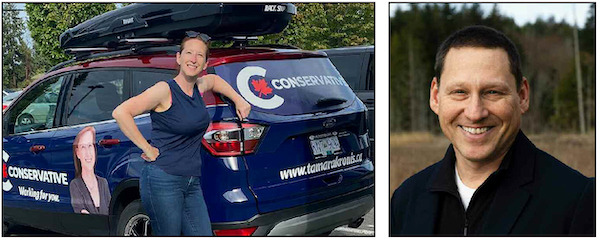
Jewish community members Tamara Kronis (Conservative party) and Avi Lewis (NDP) are running in the upcoming federal election. (photos from candidates)
British Columbia’s comparatively small Jewish community has produced a number of senior political figures, including the province’s first Jewish premier, Dave Barrett, and the current minister of finance, Selina Robinson, and minister of environment and climate change strategy, George Heyman. In this federal election, there appear to be just two candidates in British Columbia who are Jewish.
Tamara Kronis is the Conservative Party of Canada candidate for Nanaimo-Ladysmith. The riding is being closely watched by national observers as it is home to one of only two Green party MPs. Paul Manly, the incumbent, once sought an NDP nomination but was rejected by the party, apparently due to controversy over his positions on Israel and Palestine. While the other Green MP, former leader Elizabeth May, is seen as safe in her riding of Saanich-Gulf Islands, Manly appears to be in (at least) a three-way race with Kronis and New Democrat Lisa Marie Barron. Michelle Corfield is the Liberal candidate.
Kronis is a lawyer and heads a jewelry manufacturing and retail business. Until last month, she was associate chair of the Ontario Human Rights Tribunal and an independent director of Toronto Hydro. Earlier in her career, she served as director of advocacy for EGALE Canada, the national LGBTQ+ organization. She was a trial assistant at the International Criminal Tribunal for the former Yugoslavia.
Across the water and across the spectrum, Avi Lewis is the New Democratic Party candidate in West Vancouver-Sunshine Coast-Sea-to-Sky Country. A scion of Canada’s left-wing dynasty, Lewis is the son of journalist Michele Landsberg and Stephen Lewis, a former Ontario NDP leader and Canadian ambassador to the United Nations. His grandfather, David Lewis, was the leader of Canada’s NDP, from 1971 to 1975.
Avi Lewis is a journalist and activist who recently produced and co-wrote the Emmy-nominated animated short film about the Green New Deal, Message from the Future, with U.S. Representative Alexandria Ocasio-Cortez.
Lewis co-authored “The Leap Manifesto,” which was “a call to action on climate and inequality that was launched by an historic coalition of Indigenous leaders, unions and environmentalists, and signed by more than 50,000 Canadians,” according to Lewis’s website.
Lewis has an uphill climb. The riding, which straddles some of Canada’s wealthiest voters and the disparate communities along Howe Sound, has back-and-forthed between the Liberals and Conservatives in recent years. It is held by two-term Liberal MP Patrick Weiler, who is beating back a challenge from former Conservative MP John Weston. In 2019, the NDP candidate came fourth, well behind the Green party.
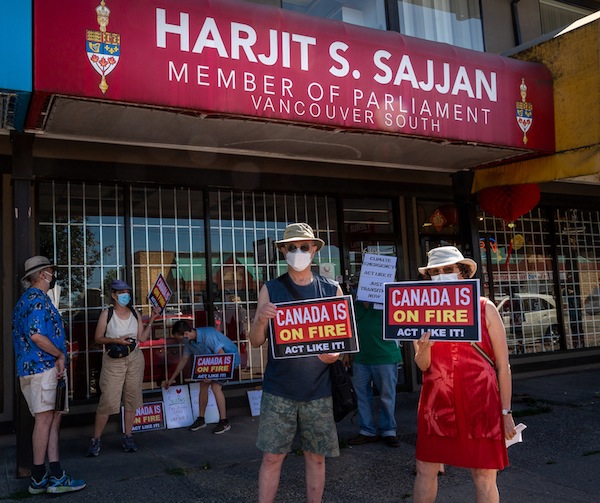
Or Shalom members Lorne Malliin and Marianne Rev organized a demonstration at the office of Harjit Sajjan, federal minister of national defence and MP for Vancouver South. (photo from Lorne Mallin)
The heat dome that sent much of British Columbia into an unprecedented spell of sweltering weather, followed by wildfires that have destroyed vast swaths of western North America, including the B.C. town of Lytton, and extreme weather events like Hurricane Ida have put climate and the environment at the top of many people’s priorities. With the federal election now days away, all federal parties have honed their pitches to voters on issues of the environment.
Jewish activists have been vocal on these issues recently, reflecting the growing realization that impacts of climate change are not a remote future potential but an immediate and measurable phenomenon.
Marianne Rev, a member of the tikkun olam committee at Or Shalom synagogue, was one of many Jewish people who participated in a series of demonstrations at the offices of scores of members of Parliament on July 29. With her friend and fellow Or Shalom member Lorne Mallin, Rev organized an event at the office of Harjit Sajjan, federal minister of national defence and MP for Vancouver South. Other local demonstrations took place at the offices of Vancouver Quadra MP Joyce Murray and North Vancouver MP Jonathan Wilkinson, who is also the federal minister of environment and climate change.
“It was part of an action organized by 350.org,” Rev told the Independent. The organization 350.org was founded in 2008 to build a global climate movement and was so named because 350 parts per million is the safe concentration of carbon dioxide in the atmosphere. (Concentrations are now 414.6 parts per million.)
“I’ve been increasingly involved in climate action, political action, climate justice,” said Rev, a retired physician.
While she was told in advance that Sajjan would not be available to meet on July 29, Rev was disappointed that, when her group of about 25 activists arrived at the office, it was closed. Nevertheless, she and a small group of others met with the minister on Aug. 9.
“We had an excellent meeting,” she said. “There were two very specific asks.”
Her group, as well as those participating across the country, asked MPs for a moratorium on all new or expanded production and transporting of fossil fuels, including the Trans Mountain Pipeline expansion. Second, they demanded a “just transition” away from fossil fuels to allow workers in those industries to shift to other sectors.
Rev said the response her group got from Sajjan was voiced by Wilkinson in the media.
“He blurted out the party line, which, shockingly, Wilkinson repeated many times over on the morning of the ninth, when the [Intergovernmental Panel on Climate Change] put out their report saying that we are code red for humanity,” she said. “[The government says] that we need the TMX to fund the transition to renewables. As such, it’s completely false.… It’s totally fallacious political B.S. that has been put out on the population for decades. Renewable energy is free. It’s not free to get there, but wind and sun is free.”
Rev gives credit to Adam v’Adamah, one of British Columbia’s pioneering Jewish environmental groups, and said that the environment and climate are logical concerns for Jews.
“Jews have always been very interested and driven regarding social justice, and the environment and climate are very much climate justice issues,” she said.
Rabbi Dan Moskovitz, senior rabbi at Temple Sholom, concurs.
“I’ve been involved with [environmental issues] informally for my entire life, but formally, as a congregation, three years ago we launched an initiative to make clear that the climate and the environment is a Jewish issue,” he said. “I see it in very religious terms in the sense that we are commanded to be guardians of the earth, stewards of the earth. So, it’s a mitzvah, a religious obligation, to be good stewards of the earth. I challenged my congregation to join me in that effort and I challenged our Jewish community and they’ve responded, to put this on our community agenda, to see this as a pressing concern for the Jewish community and for the Jewish people. The Jewish Federation has an environmental task force now. We have been talking with CIJA [the Centre for Israel and Jewish Affairs] to get it on their list of priorities and to get the politics out of it and to see it for what it is, which is an existential threat to this world that we are commanded to be caretakers and stewards of.”
As Jewish voters ponder their ballot choices, Moskovitz has some thoughts.
“Rhetoric is lovely and nice and, for the most part, all the campaigns, as I hear them, say basically the right things about the environment,” he said. “But who is doing something or who is in a position to do something? The time for talking is over.… If you don’t do what you’re preaching or praying for, then it’s just noise and we can’t afford more noise because, if we’ve seen anything over this past summer, with the fires here and in the States, and, as we saw the impact of what staying home during the early part of COVID did for our environment in allowing it to rest and to have its own sabbatical year … we can see that we can’t keep using and abusing this God-given gift, which is the world we live in. We are just renters here. We don’t own it.”
The leading federal political parties have pledged their support to the redevelopment of the Jewish Community Centre of Greater Vancouver. Kailin Che, the Conservative Candidate for Vancouver Granville, issued a release Sept. 1, saying that a Conservative government would commit to the redevelopment of the facility. The Conservative campaign did not commit to a dollar amount.
The federal Liberals also made a commitment. Taleeb Noormohamad, the Liberal candidate in Vancouver Granville, announced the next day that a reelected Liberal government would contribute $25 million to the project – the same contribution that the province has committed to and the amount JCC officials requested.
The entire project is budgeted at $427 million, including $155 for a new community centre, childcare spaces and seniors care and $272 million to construct 500 to 600 units of mixed-use rental housing. The new centre is estimated for completion in late 2024 and the housing component is anticipated in 2027-28.
Oct. 21, 2019, seems like a lifetime ago, doesn’t it? That was the date of the last Canadian federal election. Since then, it’s been a world of endless uncertainties and instability.
The Jewish community has witnessed levels of antisemitism that haven’t been seen for decades. Hate crime numbers are way up. The aura of anti-Israel sentiment, especially following the conflict earlier this year in Gaza, has created an environment that has many feeling unsafe and anxious. The silence of many within the political sector has been cause for concern. On top of all of this, the havoc of the COVID pandemic is still felt daily.
Let’s be real: people are upset and worried. The past 22 months since the last election have presented incredible challenges to our well-being and shown that nothing is guaranteed. The Canadian Jewish community has demonstrated its resilience and fortitude but there is a lot more to do, especially when it comes to elections. We’ve seen firsthand what an important role the government plays in our lives, especially regarding the pandemic, so it’s vital that we extend our efforts more effectively in the political realm.
The Jewish community makes up less than 1.1% of the population and is concentrated in just a handful of ridings – 10 out of 338. That’s only three percent. Our numbers are continuing to decline. In politics, relationships matter. If we limit ourselves to involvement in only three percent of ridings and three percent of candidates, we are at a major disadvantage when it comes to our community and the things we care about.
To ensure our voices are heard, members of the Jewish community must continue to build relationships and educate MPs in ridings from coast to coast. This starts with political engagement, and it starts with each of us. As Rabbi Tarfon said, “It is not your duty to finish the work, but neither are you at liberty to neglect it.”
The good news is that we have the tools to get engaged so we can work beyond the local ridings where we vote. While the Canadian Jewish Political Affairs Committee (CJPAC) does not engage in or facilitate lobbying and advocacy, we do act as a concierge, helping members of our community to get engaged politically.
Another important factor is that change is inevitable with elections. In 2019, 98 first-time MPs (27%) were elected, 60 of whom were in ridings that flipped seats. A third of those 60 MPs defeated the second-place finisher by less than five percent of the vote. As for this election, at the time we wrote this, 26 incumbents had decided not to run for reelection. Many more ridings will change hands. This means that, no matter which way the election goes, our community will need to build new relationships with new parliamentarians.
We can jumpstart that process. Community members like you can volunteer and acquaint yourselves with candidates from beyond your own riding and across the country. Every campaign is in dire need of volunteers, and even just a few hours can be a huge help. Often just a few more volunteers can make the difference between winning and losing a race. Plus, the appreciation for a volunteer’s work – no matter how big or small – is something that’s not easily forgotten.
There is, of course, one element that’s changed the game with this election: COVID. While it’s still possible to engage in traditional methods of volunteering – door-knocking, handing out literature in the community, putting up lawn signs or working in a polling station – understandably, some are hesitant to participate under pandemic circumstances.
But fear not: there are many physically distanced ways to volunteer, including from your own home. And you don’t have to be politically experienced to do it. All you have to do is raise your hand and show up. CJPAC will connect you to the campaign of your choice.
For those who feel more comfortable with a bit of instruction, CJPAC’s team makes it simple by training you on the basics of campaign volunteering. You can volunteer in your local riding or in one of the other many ridings where a strong Jewish presence is absent. Perhaps that means traveling 20 to 30 minutes away from your home or simply making phone calls from your couch for a candidate in a more remote part of the country.
The first step is to sign up at cjpac.ca/volunteer, and CJPAC will connect you with the campaign or candidate of your choice.
As Jews, we are committed to community service and contributing to the greater society. While it’s been a rough several months, we don’t have to stand alone. It doesn’t matter what party you align with: it’s vital to the health and safety of the Canadian Jewish community to build relationships with all parties. We can accomplish that together by getting engaged.
Jeffrey Feldmanis chair of the Canadian Jewish Political Affairs Committee and Mark Waldman is the executive director of CJPAC. This op-ed was first published on thecjn.ca.
Canadian elections do not generally pivot on issues of foreign affairs. Yet, the split screen image Sunday of Justin Trudeau calling a federal election juxtaposed with images of the Taliban seizing control of Afghanistan was a stark one. Canada left Afghanistan in 2014, having joined an international coalition after 9/11 to attempt to bring the terrorists who found free rein in that country to heel.
The remaining American forces were slated to leave this month, with U.S. military officials candidly acknowledging that their departure would almost certainly result in a Taliban revival. They were wrong only about the timing. Estimates were that it might take the fundamentalist Islamist sect weeks to take back the country. It took mere days.
The implications for Afghan citizens are bleak. Desperate Afghans were hopelessly clinging to U.S. military aircraft taxiing on the runway at Kabul airport. Afghan women will, based on prior experience under the Taliban, become some of the most oppressed in the world. There are also expectations of violent retaliation against anyone and everyone who, in the past two decades, “collaborated” with Western forces. The possible scenarios for Afghan people are horrible to envision.
And the implications go beyond the borders of that country. Optimists, such as they may be on this subject, say that the 20-year Western engagement in Afghanistan has not been for naught. The United States captured Osama Bin Laden and has not experienced another 9/11-type terror attack in that period, though whether Americans are actually safer, with other forms of domestic extremism and violence on the rise, is another question. Regardless, in a region with so much instability and contending factions, the Afghan situation further disrupts an already deeply troubled part of the world.
We may not immediately see the consequences of what is happening halfway around the world, but already domestic politics are being affected by the developments. Canadian military planes are rescuing interpreters and others who assisted our forces when they were in Afghanistan. There are calls for Canada and other Western places of refuge to accept more refugees from what seems destined to become a theocratic dystopia. But we cannot, apparently, save the entirety of the Afghan people and their country from the grips of their oppressors. Western powers held the Taliban at bay for 20 years but understandable domestic pressures to put a halt to “endless wars” inevitably brought us to this point.
This week’s election call comes amid a conflagration much closer to home as well. British Columbia is seeing wildfires and weather events unlike anything we have witnessed before. The hypothetical impacts of the climate emergency have gotten very, very real for Canadians with any sense of cause and effect. Appropriately, opinion polls suggest that Canadians view climate and the environment as a top – if not the top – issue as they ponder for whom to cast their ballots.
One problem with democracy is that those who seek public approval are disinclined to tell voters things they do not want to hear. Canadians (and other earthlings) need to understand that this crisis demands that our leaders impose potentially painful policies that will impact our emissions-producing lifestyles. We say we need to address the climate emergency, but will we be so enthusiastic when it impacts our own pocketbooks and comfortable routines?
One might imagine that scenes of the province on fire might make voters look seriously, finally, at a political party with the climate as its No. 1 priority. But the Green Party of Canada has been in turmoil since the Israel-Hamas conflict last spring. Annamie Paul, the Jewish, Black leader of the party, has been fighting an internal battle against insurgents in her own ranks. We hope that her voice will be heard and that all parties will take this existential issue with utmost seriousness.
The continuing pandemic will play a role in this campaign as well – both as Canadians assess the achievements of our government during the crisis and, more immediately, in the way candidates and campaigns pursue votes while adhering to safety protocols. The parties should be judged on what kind of COVID recovery plan they propose, and how they intend to follow through on supporting the most vulnerable Canadians through this health, economic and social crisis.
Whatever issues are important to you, this is the time to make your voice heard. Consider reaching out to your local candidates. Discuss your concerns with them. Volunteer for or contribute to their campaign if you like what you hear – consider connecting through the Canadian Jewish Political Affairs Committee. The Centre for Israel and Jewish Affairs distils information about various party platforms and policies. Our country and our world face urgent issues. An informed, active electorate is the key to ensuring that our elected officials reflect the concerns that matter most to us.
Prior to the Six Day War, which took place 54 years ago this month, the pages of this paper were filled with foreboding and ominous news of enemy militaries amassing adjacent to Israel’s borders. The very next issue was triumphal and jubilant – the war already had ended.
Such is one of the challenges of publishing a weekly newspaper. When a war only lasts six days, it presents difficulties for a journal that comes out every seven. Since the beginning of the pandemic, we have been on a twice-monthly publishing schedule, adding to the challenges of bringing you news in a time of fast change.
Of course, as regular readers know, we recognize our limitations and strengths and, as the internet has made information accessible 24/7, we have adapted to provide thoughtful, contextualizing essays and ideas, complemented by coverage of local events that only we can deliver.
Still, commenting on events that are subject to rapid flux remains a reality. This week, as we go to press, many or most observers assume that Naftali Bennett will soon replace Binyamin Netanyahu as Israel’s prime minister. Netanyahu continues to insist that such a new government represents something undemocratic. Indeed, his choice of language has been incendiary, and the imagery employed by some of his supporters veers into the realm of the demonization that we saw in the lead-up to the assassination of Yitzhak Rabin. Whatever his political objectives, Netanyahu should beware not to lead Israel down a path of “scorched earth,” as Bennett warned this week.
Bibi seems to be taking a page from the playbook of his ally Donald Trump, who emerged again recently to rehash his lies about stolen elections and assorted nonsense, including his imminent reinstallation in the White House. While scarily huge swaths of Americans (Republicans mostly, of course) believe that Joe Biden is not the legitimate president, we have more trust in the intelligence of Israeli voters to know that whoever is prime minister by the time the dust settles is there by due process.
If, as seems likely, Netanyahu is replaced, do not expect to hear the last of him. Again, like his friend in Florida, Bibi is clearly not done yet. He has been defeated before and returned to hold the position, becoming the country’s longest-serving leader.
Perhaps the biggest variable will be whether his Likud party stands behind him, as Trump’s Republican base has apparently stood by their man. Already, Yuli Edelstein, Netanyahu’s health minister, has said he would challenge Bibi for the party leadership should they lose power.
If successful, Edelstein, or any alternative Likud leader, would almost certainly cause an immediate tectonic shift in politics. That’s because the binary in that country’s politics is now cemented as “pro-Bibi” and “anti-Bibi.” With anyone but Netanyahu at the helm, some of the right-leaning partners in the new, broad coalition would likely look afresh at a deal with the party that has, by a large margin, the most seats in the Knesset.
Netanyahu may yet pull another rabbit out of his hat before Bennett can take his place. More likely, we are about to see a political shift that will see Netanyahu out but not down. That is, he seems to have enough capital to remain a major player in Likud and Israeli politics in general. The corruption case currently proceeding against him may affect that, but it has done little so far to dislodge his defenders.
If, as smart money has it, Netanyahu is unseated in the next few days, we will truly see a new era in Israeli politics. But we would caution that such a new era will begin with a time of flux. The new coalition is unwieldy and may not hold. Netanyahu has been the centre of gravity for Israeli politics for a very long time. In his absence, everything changes.
Our next issue is June 25. We promise this: plenty will have changed by then.
With 13 parties in the Knesset – and several of those umbrellas encompassing a variety of factions – patching together a coalition will be a challenge. It may not be possible at all, meaning Israelis would see their fifth election within a little more than two years.
Whatever pileup of strange bedfellows eventually manages to form a government, one particular possibility should be especially disconcerting.
To enhance their chances of passing the electoral threshold, three far-right parties united under the banner of Religious Zionism and succeeded in taking six Knesset seats. The Religious Zionist party, led by Bezalel Smotrich, seeks to annex all (or part, depending on which faction you listen to) of the West Bank and adheres to a familiar litany of Israeli far-right policies.
For this round of elections, they partnered with another small faction, called Noam, whose platform ostensibly seeks to create a halachic theocracy. In practical terms, the party is obsessed with homosexuality and seeks to delegitimize LGBTQ+ Israelis and roll back legal protections and equality. In addition to attacking gay people, the party has equated Reform Jews with Nazis and Palestinian terrorists who “want to destroy us.”
The third rail in this extremist triumvirate is Otzma Yehudit (Jewish Power), which is a descendant of the outlawed racist party Kach, led by the American-born fanatic Rabbi Meir Kahane, who was assassinated in 1990.
When Kahane was in the Knesset, before a law was passed to bar overt racists from elected office, all other members of the assembly would walk out when he rose to rant against Arabs. In an eerie echo of the Nuremburg Laws, Kahane sought to legally prohibit sexual relations between Jews and non-Jews, among other far-reaching extreme positions.
An indication of the shifts in Israel’s body politic over the decades is evidenced by the fact that the incumbent prime minister, Binyamin Netanyahu, worked behind the scenes to get these small extremist factions to cooperate in order to reach the electoral threshold. While previous prime ministers – and every other member of the Knesset at the time – refused to listen to the hateful rhetoric of Kahane, this prime minister helped ensure his ideological successors would be represented in the Knesset.
It is bad enough that these ideas will be given a legitimacy they do not deserve by mere dint of their advocates being members of the Knesset. As a small rump of crazed zealots, they should be ignored and shunned. Instead, they will play a central role in the determination of who (if anyone) forms the next government.
It is worth recalling an incident in Austria, in 2000, when the xenophobic, racist and arguably neo-fascist Freedom Party, led by Jörg Haider, entered into a governing coalition in that country. The government of Austria to which Haider belonged was sanctioned and condemned by governments worldwide and other member-states of the European Union ceased cooperation with Austria’s government.
While the Abraham Accords have reduced Israel’s diplomatic isolation dramatically, the country still faces unjust judgment in the court of global opinion. If a new governing coalition includes a segment of enthusiastic homophobes, misogynists, racists and ethno-religious supremacists, a universe of denunciation would rain down on the country. And rightly so.
In what may be an irony of historical proportions, that ugly scenario could be prevented by another stunning development on the other end of the political (and ethno-cultural) spectrum.
A new Arab party, called Ra’am, has bolted from the conventions of the Arab political sector and adopted a pragmatic approach. Rather than the purely oppositional stands taken by the other Arab parties for decades, Ra’am seems prepared to play the game that small Jewish parties have excelled at. In a fractured political culture, the tail often wags the dog. Ra’am, led by Mansour Abbas, seems to understand the opportunity this presents. Strangely, this Arab religious party could find common cause with Jewish religious parties on issues like funding for parochial education and other community needs (as well as its apparently virulent hatred of homosexuality).
As the horse trading begins in earnest this week to patch together a quilt of some ideological consistency in the Knesset, Ra’am is sitting in one of the most enviable positions of potential power, possibly able to extract all sorts of treasures out of a leader desperate for their crucial four votes. The only thing they have explicitly ruled out is any situation that would enable groups like Religious Zionism, Otzma Yehudit and Noam.
How ironic it would be if Israel were saved from its own worst angels by an Arab political party that learned its capacity for power from watching the fringe elements on the other side of the Knesset.
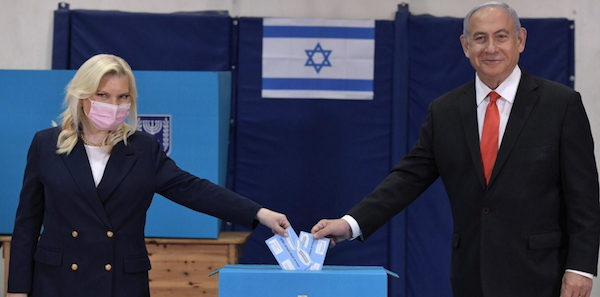
Israeli Prime Minister Binyamin Netanyahu and his wife, Sara, vote on March 23. While the prime minister’s party won the most number of seats in the Knesset, he will still struggle to form a government. (photo from IGPO)
Israeli Prime Minister Binyamin Netanyahu makes a stunning deal with lawmakers to abandon his post and replace Reuven Rivlin as president of the country when the president’s term expires later this year. An agreement to pardon Netanyahu around corruption charges he currently faces is part of a deal that leads to Netanyahu ending his run as the country’s longest-serving leader. With “King Bibi” finally in a sinecure of symbolic eminence, the polarized Knesset manages to cobble together a coalition and stave off the fifth round of elections in two years.
This was one of the most fantastical possibilities mooted in a webinar presented by the Centre for Israel and Jewish Affairs (CIJA) March 25, just two days after Israelis voted in the fourth of a series of elections during a two-year period of instability.
The panelists were CIJA’s chief executive officer Shimon Koffler Fogel and Adir Krafman, the agency’s associate director for communications and analytics. They sifted the entrails of the convoluted election outcome.
While ideological schisms divide Israeli politics, as does the secular-religious divide and other fractures, Fogel and Krafman concurred that the elephant in any discussion of the next Knesset is Netanyahu. CIJA is a nonpartisan organization and Fogel emphasized that the panelists, and moderator Tamara Fathi, were not advocating any outcomes, merely commenting on possibilities.
And the possibilities are almost endless. The vote sent 13 parties into the 120-seat Knesset. Some of these are not even parties, so much as umbrellas under which different factions coalesced for electoral purposes, so the mosaic of the chaotic chamber could refract in countless ways. But, while there are myriad permutations of possible coalitions and strange bedfellowships, Fogel, Krafman and most commentators in Israel and abroad think the most likely outcome is a fifth election. That is how difficult it would be for either side to patch together 61 members of the Knesset to govern.
Krafman presented graphic evidence of the challenges the pro- and anti-Netanyahu factions face in reaching that magic number. The pro-Bibi side likely has 52 dependable seats; his opponents probably have 57. That means an anti-Netanyahu coalition could form with the support of Naftali Bennett’s Yamina party, which holds seven seats. For Netanyahu to eke out 61 seats would require the backing not only of Bennett but also of the four seats won by the Arab party Ra’am. Such a partnership would be historic and would have been almost unthinkable in the recent past. But Netanyahu of late has been making amenable noises toward Arab Israelis in general and to the Arab parties in particular. However, even if the prime minister and his unlikely allies in the Arab sector made a deal, it could upend the consensus on the other side, as some on the right would probably balk at joining a coalition that includes Ra’am.
Ra’am is one of the big stories of the election. Exit polls indicated the party would not make it over the 3.25% threshold to win any Knesset seats. That created a scenario where Netanyahu and his probable allies were seen as almost certain to form a government.
But, as actual counting took place through the night and into the morning, it became clear that Ra’am would cross the minimum support for representation. Instantly, the calculations shifted.
If Ra’am were to enter a coalition government, or even if it merely supported a government from the sidelines, it would be a turning point in the role Arab parties play in Israeli politics. Ra’am has already upended conventional Arab approaches to politics. The umbrella of Arab parties, recently running under the banner of the Joint List, has always played a spoiler role. They are oppositionist and anti-Zionist groups that are as much protest movements as conventional political parties.
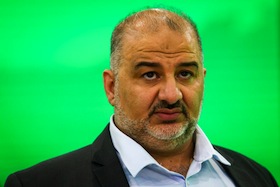
Ra’am leader Mansour Abbas has put his party into a potentially advantageous position. (photo from hamodia.com)
Perhaps learning a lesson from the outsized power of small, right-wing and Jewish religious parties, Ra’am adopted a more pragmatic and transactional position than their former allies in the Arab bloc. The leader, Mansour Abbas, has not ruled out supporting a coalition or playing a role in government. Like smaller Jewish parties, he would be expected to come to coalition discussions with a shopping list of demands, such as more funding for projects and programs that benefit his constituents.
Ra’am’s success makes it an unqualified winner in the election sweepstakes. Fogel and Krafman discussed other winners and losers.
“The first loser, I think, is Netanyahu,” said Fogel. “Despite his party winning the most number of seats, 30 seats out of 120 in the Knesset, [he] is still not able to form a government.”
That might have been survivable if other parties that are Netanyahu’s likely backers did not also come up short.
“The other two losers are other right-wing parties,” Fogel added. Naftali Bennett, whose Yamina took seven seats, and Gideon Sa’ar, whose New Hope party took six, had hoped to siphon off a larger chunk of Likud’s votes.
“Both of them really failed to do that, winning only a handful of seats,” said Fogel.
It is a profound statement about tectonic changes in Israel’s ideological fault lines that the Labour party, which took seven seats, and another left-wing party, Meretz, which took six, are viewed as having had a good night. In the days leading up to the vote, there were questions whether either party would overcome the minimum threshold. The Labour party was the indomitable establishment political party for the first three decades of Israel’s existence.
Another loser, Fogel said, was Avigdor Lieberman and his Yisrael Beiteinu party. Lieberman is a right-wing but avowedly secularist politician. He ran a campaign promoting separation of religion and state and against Charedi privileges. His message may have backfired: while turnout was down overall from the last election, Charedi voters turned out in greater numbers, possibly in reaction to Lieberman’s message.
The discussion turned again to what may be the most likely path for a right-wing government, which could be the exit of Netanyahu. There are centrist parties, Fogel said, that do not have issues with Likud policies so much as they do with the prime minister personally. With him gone, a bloc of anti-Bibi members might engage with Likud under a new leader and form a centre-right coalition.
As unlikely as this scenario might be, it would stave off another unsavoury development.
Any hope of forming a Netanyahu-led coalition probably depends on support from the extremist grouping called Religious Zionism. This new umbrella of racist, misogynistic and homophobic extremists, which holds six seats, would taint any coalition as the most far-right government in Israel’s history. (Click here to read this week’s editorial.)
Whatever happens – whether someone can manage to hammer together a government, or whether exhausted Israelis will trudge to the polls for a fifth time – there are serious issues facing the country.
“There are some pretty daunting challenges out there,” Fogel said. “Most especially on the economic side. We see that some other countries have already begun to emerge [from the pandemic] with a fairly robust recovery. Israel isn’t there yet…. There is a sense of urgency that they do have to get an Israeli government in place that is going to be able to effectively address these issues and it’s not clear that the election result will offer that to Israelis, so I think it makes a situation, if anything, more desperate.”