Help for BGU students

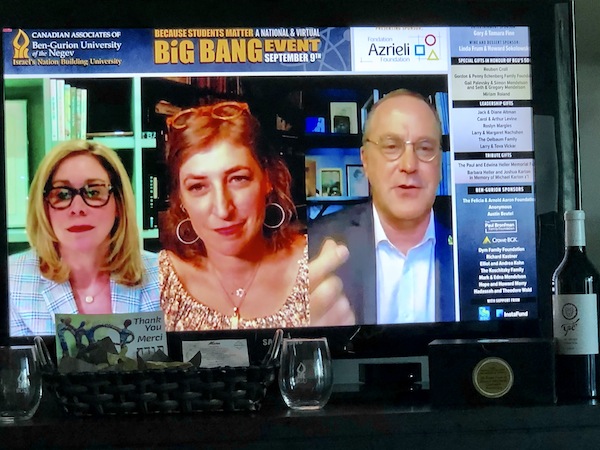
Left to right, Senator Linda Frum, actor Mayim Bialik and BGU president Danny Chamovitz participated in the virtual Big Bang event, hosted by Canadian Associates of Ben-Gurion University of the Negev on Sept. 9. (photo by David Berson)

On Sept. 9, the Canadian Associates of Ben-Gurion University of the Negev hosted its first national virtual gathering. The Big Bang Event to “save the class of COVID-19” was an urgent move to support the university’s 20,000 students.

With many students having lost their jobs in the sudden economic slowdown, they are unable to fund their tuition or even their basic needs. Rather than forfeiting a generation of leaders to financial hardship, BGU launched a student assistance program in July, with the goal of raising $6 million for 6,000 individuals.

While it is Israel’s newest university, BGU is a leader in academic research and technological development. With three campuses, it is credited as a trailblazer in both the humanities and the sciences – nanotechnology, robotics, cybersecurity, Israel studies, Jewish thought, neuroscience, medicine, business and management – addressing some of the world’s biggest problems, such as drought and hunger. The university’s reach is local as well as international, serving the immediate community in the Negev, including both the immigrant and indigenous Bedouin populations.

BGU was founded in 1969, following the vision of David Ben-Gurion, Israel’s first prime minister. Ben-Gurion sought to establish a university which would act as a “source of moral inspiration and courage, rousing people to a sense of mission: noble, creative and fruitful.” He believed that the Negev Desert would be critical to the future of the new country – the desert covers 60% of the country, and Ben-Gurion saw it becoming an economic, academic, scientific and cultural hub.

The Big Bang Event featured guest speaker Mayim Bialik, well-known for her roles in the 1990s show Blossom and, more recently, in her award-winning role as Amy Farrah Fowler in Big Bang Theory. In addition to acting, Bialik earned a doctorate in neuroscience from the University of California, Los Angeles, in 2007; her dissertation examined the role of oxytocin and vasopressin in obsessive-compulsive disorder in adolescents with Prader-Willi syndrome. A mother of two, Bialik is also an accomplished writer and musician.

Quirky, vivacious and searingly intelligent in her remarks, watching her speak at the Big Bang Event brought to mind the Yiddish proverb, “The heart is small and it embraces the whole wide world.” Bialik spoke from the heart, telling the audience about her own family story and the genesis of her Jewish identity. She spoke about her heritage, how she raised her children and how she carries her Jewish identity into her professional life in a fireside chat-style with Canadian Senator Linda Frum.

Also speaking at the event was BGU president Danny Chamovitz, who addressed the audience from his home in Israel at what would have been 2:30 a.m. his time. Chamovitz was in isolation, having recently returned from Europe, and, following the event, he did indeed test positive for coronavirus, but has since made a full recovery.

Chamovitz described his office’s emergency response to the pandemic. Members of the university community were invited to submit proposals and, as a result, more than 70 initiatives are in progress, including the development of tests for COVID-19 that drastically reduce turnaround times.

“Across the country, more than 380 households purchased tickets and more than 800 people watched the program,” said David Berson, CABGU regional executive director, in a recent email interview. “We have raised over $1.3 million with 50% of that being raised locally. In our region, 83 households purchased tickets and more than 200 people watched the program.”

In addition to raising money, he said, “The event was a great success motivating many new people to support CABGU. It has set the bar, the gold standard, for how to properly execute a national virtual event. Regarding the campaign itself, the rate of unemployment in Israel is 50% for the under-34 age bracket. By the opening of the academic year on Oct. 18, more than 5,000 students had applied for support from this student assistance fund. Where we had been fearful that enrolment would drop because of the financial impact of the pandemic, it turns out that enrolment for undergrad studies increased by 32%. The funds raised have been vital in creating accessibility for so many students hit hard by this unprecedented situation.”

While the Big Bang audience was scattered from coast to coast, a warm ambience was created locally, with hand-delivered baskets of sweet and savoury delicacies: quiches and bourekas, as well as exquisitely decorated handmade chocolates, from Café FortyOne; and BGU wine tumblers and a bottle of red wine.

The local business sponsor was Instafund and Instafund’s Adam Korbin, who was the Metro Vancouver chair of the event, thanked Bialik at the end of the program.

“We were very fortunate to have dozens of local sponsors for the event,” said Berson. “Details of the sponsors can be found on our website, bengurion.ca.”

Regional board chair Si Brown “was thrilled with the generous response from and participation of our local community,” Berson added. “Since reestablishing CABGU in Metro Vancouver seven years ago, it has been gratifying for me to watch how our community has slowly and surely begun to embrace this young and dynamic Israeli university in the Negev.”
Explore Torah’s secrets

“People tend to read biblical stories like they do mythology,” said Chabad Richmond’s Rabbi Yechiel Baitelman, one of the local Rohr Jewish Learning Institute (JLI) instructors. “Our course invites participants to look deeper and discover the underlying themes and relevant life lessons these stories were designed to convey.”

Baitelman is talking about a new six-session JLI course called Secrets of the Bible: Iconic Stories, Mystical Meanings and Their Lessons for Life, which starts Nov. 4, 7:30 p.m. The course will be offered both in-person, to a limited audience, at 4775 Blundell Rd., in Richmond (following COVID-19 restrictions), and online via Zoom. All classes – which are one-and-a-half hours long – will be recorded on Zoom and accessible online for six days after each class. For Vancouver Islanders, the course will be presented by Chabad of Nanaimo, 5450 Oceanview Terrace, in Nanaimo, starting Nov. 3, 7 p.m.

The course presents a unique way of reading the stories of Adam and Eve and the Tree of Knowledge, Noah and the great flood, the lifelong feud between Jacob and Esau, Joseph’s multicoloured coat, the golden calf, and Korah’s rebellion. For each of these stories, three questions will be answered: What is the deeper meaning behind the story? How does it shape the Jewish worldview? What wisdom does it hold for us today?

Throughout the six sessions, Secrets of the Bible explores major life themes, including human subjectivity and bias; the underpinnings of relationships; negotiating spiritual growth with practical impact; why inspiration is fleeting and how to make it last; understanding equality and privilege; and navigating parallel spiritual and material life paths.

Secrets of the Bible is designed to appeal to people at all levels of knowledge, including those without any prior experience or background in Jewish learning. This course is open to the public, and attendees don’t need to be affiliated with a particular synagogue, or other house of worship.

“These biblical stories come alive as their deeper meanings and insights are revealed. They hold the key to life lessons for us all,” said Baitelman. “I encourage you to sign up for this thought-provoking course that’s sure to deepen your understanding of Judaism and enrich your life. You are welcome to try the first class for free with no obligation.”

To register and for more information about the Chabad Richmond course ($95/person or $160/couple), call 604-277-6427 or visit chabadrichmond.com/jli. For the Nanaimo course ($95/person or $152/couple), call 250-797-7877 or visit jewishnanaimo.com/secrets.html.

Unpacking Israel education

Dr. Noam Weissman, senior vice-president of OpenDor Media. (photo from OpenDor Media)

King David High School is one of 50 Jewish high schools worldwide participating in Unpacked for Educators, a series of educational videos and podcasts on Israel created by OpenDor Media with the goal of providing a nuanced, thoughtful and thorough approach to Israel education.

“Theirs is high-quality material available for free, and usually those two things don’t go hand in hand,” said Rabbi Stephen Berger, head of Jewish studies at KDHS. “OpenDor Media is passionate about education and Israel and we are blessed to be able to work with them.”

The videos, approximately 10 minutes each, deal with a wide range of material that ranges from lighthearted topics like falafel, Eurovision and hip-hop music to contemporary conflicts, terrorism and the Israeli settlements. The goal is for educators to select the subjects they want to address with their students and use the videos and podcasts as points for discussion, debate and engagement.

“For years, Israel education has been behind other education, so our goal here was to sandwich nuance with love and to educate rather than indoctrinate,” said Dr. Noam Weissman, senior vice-president of OpenDor Media. “We want our students to end their sentences with question marks, to foster curiosity and deepen exploration by showing multiple sides to an issue. We love Israel and, yes, it’s complicated and nuanced, with lots to debate. We have to allow our young people to make up their own minds and deliver good education.”

OpenDor’s mission is to change Israel education the world over and make Jewish and Israel education available and accessible to everyone, regardless of their location. Other participating schools are in South Africa, Australia, the United Kingdom, Israel, Hungary and the United States. In Canada, KDHS is among six participating schools.

OpenDor is working on increasing the number of podcasts and videos in its repertoire, and hopes to reach a point where Jewish schools, of all religious denominations, can be unified about how to engage their students with Israel education. To that end, in terms of sharing resources and improving pedagogy, Weissman said, “We make a whole suite of videos and podcasts you can pick from, so, if you don’t like one, pick another. We’re not telling schools what to teach – we’re trying to help them develop tools for how to teach.”

That’s a great resource at KDHS, Berger said. “Sometimes, our teachers don’t know all the information either, and these videos help our educators develop professionally. The videos are there to spark thought, and then to stop, explain and discuss with students. It’s not a movie. What OpenDor is doing is so well needed.”

Weissman said Seth Rogen’s opinions on the Israel education he received growing up in Vancouver are telling. “The Seth Rogen fiasco is another example of a Jew going through an educational institution and saying, ‘they did a disservice to me,’” he said, referring to a conversation between Rogen and Marc Maron in an episode of Maron’s WTF podcast in July. In that podcast, Rogen stated that he was “fed a huge amount of lies about Israel my entire life.”

“I don’t blame Seth Rogen, but I think the Jewish community needs to look inwardly and ensure Israel content and education is accessible to everyone,” Weissman said. “Israel education is at the point where we as a field know how to do this well. We have the resources, confidence and context to make a nuanced experience possible for all students.”

The videos and podcasts are targeted at ages 18 through 34. They are freely available on YouTube and are an educational resource for Jews of any age seeking to understand events in Israeli history. For more information, visit opendormedia.org.

Lauren Kramer, an award-winning writer and editor, lives in Richmond. To read her work online, visit laurenkramer.net.

Contemplating walls

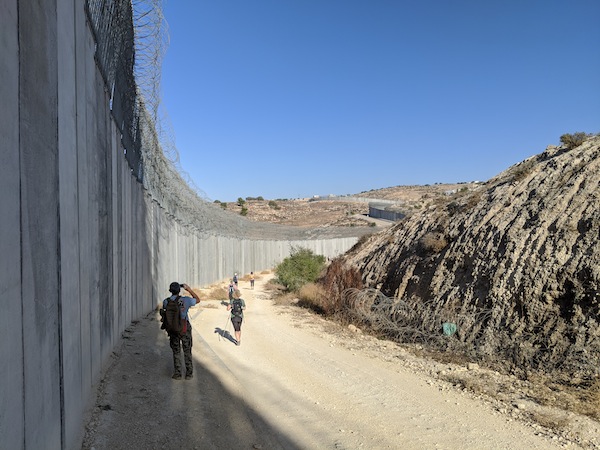
The separation wall, Bayt Mirsim. (photo by Kevin Keystone)

In this three-part series, the author recounts some of his experiences on Masar Ibrahim Al-Khalil, the Path of Abraham the Friend, in the West Bank, which he visited in 2019. The articles have been adapted from a few of the letters he wrote home to family. The events and people described are real but, for reasons of privacy, the names are fictitious. To read Part 1, click here; for Part 2, click here.

Today was our last day on the trail. After many late nights of parlour games, beers and anticipation, we were tired. One of our fellow hikers, Felix, had to stop periodically: the soles of his shoes had worn through, he could feel the tiny stones biting underneath. Uncharacteristically, he was in pain, but he muscled through.

We descended into a valley, dotted with pale green brush, reminiscent of our first days on the trail. The valley opened into expansive views of olive groves, steppes cut into the hills, tidy rows of trees buttressed by stone walls. It could have been Tuscany but was the Middle East, with a warm breeze and soft, popcorn-shaped clouds overhead.

Admiring the scenery, I thought of what lay ahead. I would be spending tonight in Jerusalem. It was a place I hadn’t been since my Birthright trip eight years ago. My rabbi had once invited me on a congregational tour of Israel, in recognition of my service to the synagogue, but I turned it down. A friend rightly pointed out that, as an Arab Muslim, he couldn’t visit the Holy Land as readily as I could. In solidarity, he suggested I shouldn’t go. That seemed fair, so I didn’t. But here I was, so close to Jerusalem and the Wailing Wall. How could I not go?

* * *

It was a hot day on my Birthright tour. We weaved our way through the Old City, through its various souks and alleyways, to arrive at a platform high above the Wailing Wall plaza. Our guides wanted us to see it there first for a clear, unobstructed view. It wasn’t busy, just another day in Jerusalem at the Wall and the holiest site in Judaism. The wide-open plaza was sleek and clean, the great stone wall standing pink and golden.

We descended towards it, and I could feel the heat. I was dehydrated and a bit dizzy. Our guides released us and we ambled forward, dazed, in the wall’s general direction. A man stopped me and asked if I wanted to put on a prayer shawl. I did. He asked me if I wanted to lay tefillin. I had never done it before. He helped me. “Repeat after me,” he said. “Baruch atah Adonai …” as he wrapped the leather band around my forearm.

Prepared, I approached, pulled in by the wall’s gravity. I slipped off my sandals to stand on the ground with my bare feet. I pressed my hand to the mottled stone and closed my eyes. “Baruch atah Adonai,” I began. Strangely, I felt both heavy and light, a yearning and also a surrender. I said the Avot v’Imahot, the prayer that recognizes our descent from Abraham and Sarah, tracing us back through the generations. I didn’t know, then, how important that moment and that prayer would be.

When I was finished, I slipped on my sandals and stepped away.

* * *

“This might be the most beautiful day on the trail,” said Jane, a soft-spoken homeopath, a Mancunian and longtime friend of fellow hikers Eve and Oliver. Her husband George was in business software. He regularly meditated.

She was right. I was worn out but had to agree. It was beautiful. Picturesque, even. Idyllic. We pulled over, as we had during our first week, to have coffee with olive harvesters and help them rake the trees. A young mother with her toddler, husband and parents: harvesting is so often a family affair. Hospitable as ever, much coffee and tea was poured and drank, olives collected, tobacco rolled, puffed and exchanged. We waved our goodbyes – shukran, aleykum salaam – and continued on.

A stretch of valley gave off onto a final stretch of orchards and, as I clambered over the low stones, I looked up and saw the separation wall. From a distance, the 25-foot concrete wall, scrawled with barbed wire, rose through the canopy of the trees. Hesitatingly, I walked towards it, tracing its contour in my mind. In some parts of the West Bank, the barrier is composed of giant slabs of concrete dotted with military towers; in others, it is coiling pyramids of barbed wire or electrified fence bordered by wide swaths of sand to detect trespassers. Here, it is rebar and cement, two-and-a-half storeys high, and cuts through olive groves and the hills around it. I pressed my hand to it; it was cold and abraiding. I closed my eyes and said a prayer for a future without it.

photo - Dawn at the Dead Sea
Dawn at the Dead Sea. (photo from Kevin Keystone)

* * *

Compared to the West Bank, downtown Jerusalem feels like another planet. I spent that night in a small apartment hotel off Jaffa Street, a few blocks from the Old City. It was a one-bedroom suite with a fully equipped kitchen and three-piece bathroom. The water was hot, the shower had walls and a showerhead, and I could drink the water. It was unlike many nights on the Masar.

Jaffa Street reminded me of places like Vienna or Vancouver: the pavement was so clean you could eat off of it. The pedestrian walkways alongside were spacious and wide, paved with smooth and even slate-gray tiles. The streetcars were sleek and punctual. Art galleries and museums, ornamental lights and public transportation, urban and urbane. First world versus developing; moneyed versus struggling. The contrast was deeply uncomfortable.

My friend Marta and I wound our way through the narrow, dreamlike alleyways of Nakhalat Tziyon, the walls lined with thick slabs of golden Jerusalem stone. A playful breeze danced through the trees. We stopped for lunch at a picturesque café, complete with colourful outdoor seating and painfully handsome servers. The food was delicious and expensive; we ordered hummus that came with falafel and sweet lemonade.

“How is this real?” I asked her.

“I know,” she said. “It’s shocking.”

After lunch, I returned to the place I had been many years before. I followed the signs in the Old City, the pull magnetic, feeling a mix of dread and anticipation. I saw it first as before, from above, the top of the staircase leading down to the Kotel.

Few tourists were out today, just the heat and people praying. Orthodox tradition dictates separating the genders; indeed, on the women’s side, a fraction the size of the men’s, Torah scrolls are still officially prohibited. Today, the women’s side was packed, the men’s side dotted with the odd worshipper. At the tefillin tent, an old man shawled me in his tallit. A red-headed, black-hat wearing Charedi named Isaac helped me with the tefillin. He looked about my age, or a few years younger. In another life, I wondered, would I have been him?

“Did you do this yourself?” he asked, pointing to the forearm I had already bound.

“I did,” I said. For a month, in the intervening years, I had done it every morning. “I just can’t remember how to do the hand part.”

“I can help,” he said. Isaac said many things: about God, what God wanted, the prayers I could say at the Wall. “Sometimes, you might feel like the worst Jew ever,” he said. I didn’t. I never felt that way. I wasn’t a “good Jew” or a “bad Jew,” I was just Jewish.

“Say a prayer for all your loved ones, then say a prayer for yourself,” he said. “Then maybe you’ll say a prayer for me, too.”

Blocks of stone peppered with bits of paper: the wall hadn’t changed, but I had. I pressed my hand to it, feeling its soft, pockmarked face, and closed my eyes.

* * *

I’m home now, in Canada, and wonder about my travels. I came back “with eyes wide open,” as my rabbi had prayed: to the painful, joy-filled and resilient lives of the Palestinians I met. I think about the separation wall and the Kotel, how they’re connected and what it meant to pray at them, different but related prayers. If the Wailing Wall is part of us as Jews, then perhaps its future and our spiritual liberation is bound together with the separation wall. Perhaps the Kotel will never truly be honoured until we bring down the separation wall. As I contemplate the stories of our freedom from bondage, I’m reminded of the idea that our liberation, spiritual and otherwise, is bound up with the liberation of others.

Kevin Keystone is a Toronto-based freelance writer, editor and researcher. When not hiking long-distance trails, he can be found reading, spending time with friends and family, or with his beloved partner, Aaron. His writing has been published in the Literary Review of Canada, the Jewish Independent and Good Old Boat. For this series, he thanks the guides and staff of Siraj (the Masar Ibrahim Thru-Hike tour operator), the host families and locals he met along the way and his fellow hikers, as well as friend and editor Matt O’Grady.


School year has begun

Head of school Russ Klein welcomes back King David High School students. (photo from facebook.com/kdhsvancouver)

Metro Vancouver’s five Jewish day schools are officially in session – student orientation began the week of Sept. 8. But, while the schools are working hard to create a “normalized” and consistent atmosphere for learning, the new procedures set in place by the Ministry of Education’s Back to School program will likely take a bit to get used to.

In July, the Ministry of Education announced new guidelines for class sizes and safe attendance as it prepared to return students to the classroom. Elementary and middle school cohorts are limited to 60 persons each, while high school learning groups are capped at 120 students. The province requires masks to be used at middle and high schools whenever social distancing cannot be maintained.

King David High School’s head of school, Russ Klein, acknowledged that having to wear a mask at school may be awkward for many. As well, the two-metre social distancing requirements will, at times, be difficult, forcing students to study on their own, rather than buddying-up for group assignments. That means, said Klein, “you are also then reducing opportunities for group work. You’re not facing the kids together, you are not sitting them in bunches,” methods that have often proven to be effective approaches in large classrooms. Teachers, he added, “really like to help their kids and needing to stay six feet away from them at all times changes how you help somebody and how you interact with them.”

Many schools began implementing changes to classrooms, common rooms and lesson plans last school year when it became evident that social distancing would affect how classes were taught. Rabbi Don Pacht, who oversees the Vancouver Hebrew Academy daily operations, said the move to a brand-new building last spring helped with that transition.

The larger building, he said, “gives us a very desirable ratio of space per student. Keeping distance between learning groups and allowing for distance between desks will be easily achieved.”

Like other schools in the area, VHA has also implemented see-through “sneeze guards” and other preventive measures to reduce chances of transmission. “We have also invested in Plexiglass screens and additional hand sanitizing stations throughout the school,” said the rabbi.

Vancouver Talmud Torah began making changes to the curriculum last school year as well. Jennifer Schecter, who serves as the communications and admissions director for VTT, said the speed with which the school began implementing changes to address the coronavirus threat appears to have paid off.

“Our retention was at an all-time high this past year because I believe parents value our product and the sense of community we provide more now than ever. This is a testament to our faculty’s superb skill in pivoting and offering a robust remote learning program last spring,” Schecter said.

Technology plays an oversized role in teaching modules this year. All of the schools the Jewish Independent spoke with said they are prepared for a return to remote learning, should it occur.

“Every single faculty member has a VTT-issued MacBook Air to use at school and at home and each classroom is equipped with screencasting technologies,” said Schecter. “Our IT department is incredibly responsive, knowledgeable and stays ahead of the curve with respect to tools that can facilitate instruction, especially if VTT needs to go remote again.

“Last year, we put a solid infrastructure in place that allowed us to pivot quickly to remote learning,” she said. “We will be able to lean on this structure this year. Teachers are planning in anticipation of a potential shift to remote and will be acquainting their students with many of the same tools they did last year, such as Google Classroom.”

Meira Federgrun, who runs Shalhevet Girls High School, said students are outfitted to work either in-class or at home, when necessary. “All our students have personal laptops … and, in case students are self-quarantining/isolating, they have that as a resource to Zoom into classes on their regular schedule.”

KDHS’s Klein said teachers and administration are also preparing for increased absenteeism. “Because, when people are not feeling well, they are supposed to not come to school. And that could be the student or the teacher,” he said.

According to the B.C. Centre for Disease Control, children in this province have a lower rate of infection than adults. Still, preparing for the chance that some students may have to study from home while they are quarantining has required some out-of-the box thinking when it comes to lesson planning.

“Managing to keep the educational program uninterrupted and keep students that are absent in the educational flow, I think that’s going to be the challenge,” Klein said.

Pacht said parents will be expected to keep the school informed about students’ health status on a regular basis. “We know that there is stress on the parents as well,” said Pacht. “There will be questionnaires, waivers and health checks. If a child has as much as a sniffle, they will not be allowed to attend school until seen by a healthcare professional.”

Provincial COVID-19 health and safety guidelines require schools to maintain daily health checks for all students, staff, administrators and visitors, and parents’ participation with that process helps reduce the chance of an accidental infection at school.

Pacht added that the students’ sense of safety is important, too, as they adjust to this new environment. “This will be stressful for students, too, and we will focus on social and emotional support for students,” he said. “They will have to adapt to a new way of experiencing school (again!), and we want to ease that transition.

“I know that if we work together we can provide an exceptional experience for our children.”

image - Dr. Lara Aknin says kids may need extra support this year to prepare them for new learning experiences
Dr. Lara Aknin says kids may need extra support this year to prepare them for new learning experiences. (photo from sfu.ca/vpresearch/Research50/abundance.html)

Dr. Lara Aknin, a social psychologist at Simon Fraser University, said kids may need extra support this year to prepare them for new learning experiences.

“Helping kids feel safe and secure during the pandemic is important as we return to school this fall,” she said, offering the following research-proven ways to help young students gain confidence in today’s “new normal” classroom.

  1. Encourage gratitude. “The pandemic has exacted a large toll on many,” said Aknin. “When possible, try reflecting on what you are grateful for.” Help students “focus on what’s good, rather than what’s lost.”
  2. Be kind and help others. Research has shown that we feel good when we help others. It can be as simple as donating tzedakah to a special charity or comforting another student, she said, “but finding ways to help others can make you feel grateful and boost your mood.”
  3. Maintain a daily routine that kids can follow. Doing so provides predictability and structure during challenging times.
  4. Keep up that exercise regimen. It’s a known fact that exercise helps boost serotonin and elevate mood. Aknin pointed out that exercise doesn’t have to be a workout. It can be a dance party, a family stroll after dinner or a favourite game.
  5. And don’t forget to socialize. “Distant socializing,” even when it’s virtually or two metres apart, reinforces kids’ social connections with their friends, extended family, schoolmates and new acquaintances,” said Aknin. “[Ensuring] physical distance from others doesn’t mean we should cut off all contact with others. Find creative ways to stay connected and have meaningful contact with friends and family with Zoom, FaceTime, or distanced visits outside.”

Jan Lee’s articles and blog posts have been published in B’nai B’rith Magazine, Voices of Conservative and Masorti Judaism, Times of Israel, as well as a number of business, environmental and travel publications. Her blog can be found at multiculturaljew.polestarpassages.com.

***

New Hebrew school opens

B.C. Regional Hebrew Schools, run by Lubavitch BC, has launched a new Hebrew school for elementary students in the East Vancouver area. The Mount Pleasant location will be Lubavitch BC’s third school in the Lower Mainland.

“This program has been created uniquely for children who attend public school or non-Jewish private schools, and aims to present a comprehensive curriculum, including Hebrew language, reading and writing; Jewish pride and sense of community; Jewish holidays and customs,” said a press release announcing the opening. Rabbi Dovid and Chaya Rosenfeld serve as the directors for the three schools in the Lower Mainland. Riki Oirechman will be the new school’s principal.

Classes will take place Wednesdays, 3:45 to 5:30 p.m., at Mount Pleasant Neighbourhood House, accompanied by a complimentary kosher meal.

The organization said it is abiding by all COVID-19 protocols and, as such, asks that parents understand they will not be able to accompany their children inside during classes or drop-offs. Parents can inquire about classes by calling 778-878-2025 or emailing vancouvercgi@gmail.com. The class schedule can be found at ganisraelbc.com.

– JL


Riders raise funds for STEM

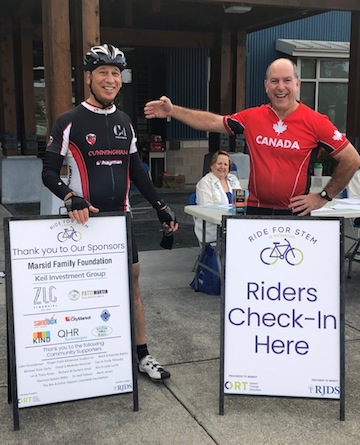
In back, left to right, are Marshal Stern and Mel Moss. In the front are, left to right, some members of the ORT committee: Marie Doduck, Mary Tobin, Bess Hirsch, Lane Stein and Beverly Pinsky. (photo from ORT Vancouver)

photo - Left to right, event co-chairs Mel Moss, representing ORT, and Jeff Topp, representing Richmond Jewish Day School
Left to right, event co-chairs Mel Moss, representing ORT, and Jeff Topp, representing Richmond Jewish Day School. (photo from ORT Vancouver)

ORT Vancouver and Richmond Jewish Day School co-sponsored the Aug. 23 Ride for STEM (science, technology, engineering, math). They are the first Vancouver Jewish organizations to hold such an event and the donated funds are designated to students so that they have the opportunities that arise from the knowledge and skills that STEM education can provide.

ORT’s goal is to bridge the gap between ability and opportunity by providing state-of-the-art education both locally and around the world. World ORT reaches 300,000 children who benefit from STEM education in 37 countries, including here in Canada.

photo - Riders prepare to head out
Riders prepare to head out. (photo from ORT Vancouver)


Community milestones … Green Thumb & Klein

Patrick McDonald will hand the artistic reins of Green Thumb Theatre to Rachel Aberle in January. (photo from Green Thumb Theatre)

After a distinguished 32-year tenure, Patrick McDonald recently announced that he will be stepping aside as artistic director of Green Thumb Theatre at the end of 2020. After several seasons working closely with McDonald, Green Thumb’s associate artistic director and award-winning theatre artist, Rachel Aberle, will assume the role, effective Jan. 1, 2021.

McDonald has led Green Thumb Theatre since 1988. The theatre organization, which was founded in 1975, tours to schools and other venues across the country and internationally. McDonald’s dedication to placing youth engagement and artistic integrity on an even plane has underpinned the organization’s mission of providing socially engaged professional live performance to young people, regardless of geographic or economic status.

“I am proud of how, as a company, we have stayed to course over the last three decades continuing to create new, engaging and challenging work about the issues young audiences are dealing with,” said McDonald. “ I am especially proud of the number of scripts we have brought forward that are now a part of the growing canon of theatre for young audience scripts produced worldwide.”

As performing arts organizations across the globe face uncertainty and calls for innovative programming, McDonald is confident he is leaving the theatre in good hands, stating: “Rachel Aberle, in collaboration with general manager Breanne Harmon and our current staff, will, without doubt, continue this legacy and meet the current challenges head-on. They are ready, and they will do well.”

Aberle, who made her professional performance debut with the company, has penned two critically acclaimed plays for the organization. Her play Still/Falling, which explores themes of adolescent mental health, premièred in 2015 and has been performed more than 180 times across North America and received a Jessie Richardson Theatre Award for significant artistic achievement. The Code, which explores themes of consent and cyberbullying, premièred in 2018 and was recognized with a Jessie Award for outstanding production, the Sydney J. Risk Prize for outstanding original script by an emerging writer, and was included on Tapeworthy blog’s Best of Stage 2018 – selected out of almost 200 shows worldwide. Aberle has held the position of associate artistic director with Green Thumb since 2017.

“I am humbled and honoured to be asked to serve as Green Thumb’s next artistic director,” remarked Aberle, who is a member of the Jewish community. “I have grown up at Green Thumb, under the mentorship and guidance of Patrick McDonald. During these difficult times, I take this role on with a deep appreciation of the complex challenges the company faces. I believe that now, more than ever, young people deserve opportunities to explore the struggles they face on a daily basis. This is the work that Green Thumb has always done, and work that I am excited to continue to do.”

During his tenure, McDonald has commissioned more than 50 new plays from emerging and established playwrights, and has directed more than 75 productions. He has been recognized for his work, including the 2009 Jessie for career achievement and, in 2013, the Vancouver Mayor’s Arts Award. In addition to the school touring program, McDonald established mainstage production partnerships with more than 20 arts organizations nationwide and internationally.

“We are humbled to have worked with Patrick and marvel at his creativity and tenacity in moving youth theatre forward,” said Cheryle Beaumont, chair of the board. “With a long and committed history with Green Thumb and a wealth of experience to bring to her new role, we are most pleased to welcome Rachel Aberle to the position of artistic director this coming January.”

Harmon, said, “Patrick’s long history at Green Thumb has seen him mentor hundreds of emerging artists, administrators and playwrights, offering endless opportunities and truly elevating theatre for young people across the country. He will be leaving Green Thumb with a strong legacy.”

Looking to the future, Harmon, who is also a member of the Jewish community, added, “Rachel is passionate, knowledgeable and a true champion of ensuring young voices are represented truthfully. I look forward to our new partnership.”

***

photo - Alison Klein
Alison Klein

Alison Klein has been accepted to the master of arts, interdisciplinary studies, in the faculty of humanities and social sciences at the University of Athabasca. The focus of her learning is disability and how services are offered to persons with disability in Canada. She plans to use her studies to inform her work on The Self Advocate, her podcast featuring people with cognitive disabilities who advocate for themselves.

Seeking to understand views

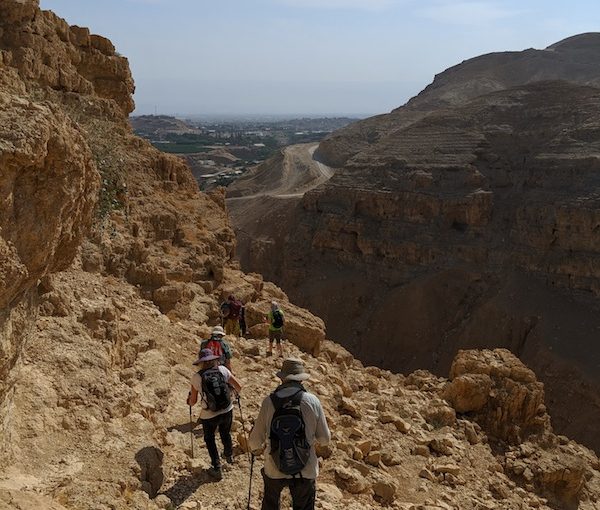
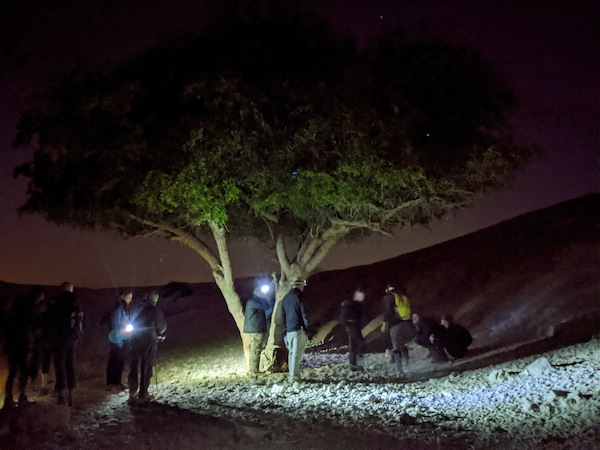
Descending into Jericho through “the Grand Canyon of the Middle East.” (photo by Kevin Keystone)

In this three-part series, the author recounts some of his experiences on Masar Ibrahim Al-Khalil, the Path of Abraham the Friend, in the West Bank, which he visited in 2019. The articles have been adapted from a few of the letters he wrote home to family. The events and people described are real but, for reasons of privacy, the names are fictitious. To read Part 1, click here; for Part 3, click here.

Tuesday was, by far, the hardest day of the trail. We climbed and descended two mountains: 1,500 feet up, 1,400 feet down; 1,000 feet up, 1,200 feet down. It’s 10 feet to a storey, so divide by 10 and think of them as flights of stairs, except that they’re rocky paths strewn with slippery rubble and spiky brambles.

Shrubs aside, Monday and Tuesday were thorny for other reasons. Our guide, Ismail, seemed very friendly. Jolly, with a wide smile and open face, he spoke English well and with a quirky British accent. He was nearly 40, married, had one young child and another on the way. He’s been a hiker and guide for a long time: trained at university, he is an expert in local fauna, flora and history. When a member of our group fell and cut his arm, Ismail was right there with bandages and fracture assessments. There was no question: he was a professional.

Ismail, though, had a satirical sense of humour, which, given the political landscape, was risky. He explained the settlers’ justification for occupying land in the West Bank. “They say that God gave it to them,” he said. The relevant verse from the Torah bubbled up in my memory. “Go forth from the land that I will show you, and I will make of you a great nation,” goes Genesis 17. I knew it because I had chanted it for my bar mitzvah.

“If God gave it to them, what did God give to us? Nothing?” Ismail said. He was smiling, but wasn’t joking. “If they get this, we’ll take Spain. We don’t need to do archeological digs – our mosques are still there to prove it.” I chuckled along with the group, appreciating the irony. But I stood back, polishing my sunglasses.

“They say they are special,” he continued, “that they are ‘the chosen ones,’ but what does that mean? That they are made of gold and jewels, while the rest of us are mud?”

“And I will take you to be my people,” God says to Abram, also Genesis 17. “And I will make my covenant with you and your descendants and through all the generations.” This idea of “chosenness” has been interpreted, reinterpreted and, at times, even rejected in our history: Reconstructionist Jews, for example, changed the relevant lines of the Aleinu prayer. Thinking of ourselves that way certainly hasn’t done us any favours. But, still, Ismail’s comments stung a little.

Writing this, I suppose his humour was a bit like my dad’s: irreverent and occasionally tasteless. I had never been offended by my dad’s jokes; his topics were largely inconsequential to me. Here, with so much at stake, it was hard to not feel Ismail’s satire more deeply. I wanted to tell him I was offended, but part of me resisted.

Sue, on the other hand, had no problem speaking up. That evening, we gathered around to discuss plans for the next day. “Tomorrow,” Ismail said, laying out a map, “will be the hardest day on the trail. There are three options: we can either hike the whole day; stop halfway and take a car; or stop near the end and take a car.” We all agreed we’d hike the whole day. Sue sat back against the bench.

“Are you OK?” he asked her. “You looked scared.”

“I’m not,” Sue replied. “I’m fine.”

“Are you sure?” he insisted. Sue was in her 70s: it seemed like he was singling her out because she was older, and possibly because she was female. “I am sorry if I scared you.”

“I’ve walked a thousand miles before,” she cut in. “I’m not scared.”

Eve laughed and said to Ismail, “Sue’s fine. It’s the two of us,” referring to her husband Oliver, herself, and their combined lack of hiking experience, “that you should be worried about.”

After the route was settled, Sue pulled Ismail aside. She pointed out to him the ageism and sexism implied in his doubting of her abilities. She was brisk; he was deeply apologetic.

“It’s fine,” she said, when he didn’t stop apologizing. “You apologized. It’s over. Howard and I fight, we apologize, it’s done.” After another round of reassurances and with parting words to the group, Ismail left for the night. I congratulated Sue on standing up for herself.

“Well, I’m an old lady,” she laughed. “I don’t have an issue speaking my mind.”

“Yeah,” I said, smiling. “Howard said you don’t take shit from anybody.” She laughed again. “But, still,” I said, “good for you for saying something.”

“Thank you, Kevin,” she said, looking at me. Even with her fortitude, I wondered if it had cost her to say something. Maybe, in some ways, it always does. “I appreciate it,” she said.

photo - A rest break, at 3 a.m., hiking to catch sunrise over the Dead Sea
A rest break, at 3 a.m., hiking to catch sunrise over the Dead Sea. (photo by Kevin Keystone)

* * *

The next day, I found myself quietly pleased at Ismail’s dressing down from Sue. Somehow it felt vindicating; even if I couldn’t find the words to speak my mind, at least someone else did.

“Before we start,” he said, “I need to show you something.”

He turned his smartphone to us and pressed play. The footage was of a road tunnel with an exit at the far end and a truck askew, blocking the way. There was shouting and then a hand flicking angrily towards a young man, yelling at him to walk. He did, with his back to the camera, one hand raised in surrender, the other halfway, awkwardly carrying a backpack. He couldn’t have been older than me. He kept walking, slowly, towards the truck and the tunnel exit. Just before he reached the truck, a shot fired. He cried out and sank to the ground.

Israeli Channel 13 News leaked the video – of an Israel Border Police officer shooting a Palestinian in the back with a rubber bullet, along with text messages sent by the shooter’s fellow officer, who had bragged about the shooting to his girlfriend. “I’m a pro, don’t you think?” he wrote.

This act of violence earned the shooter a removal from the police force. She was sent back to the Israeli army to finish her compulsory service. A year after the footage was discovered, the police internal investigations unit still hadn’t pressed charges. The apparent impunity is shocking. Compared to this, my grievances seemed trivial.

“Do you ever take Israelis on this hike,” someone asked Ismail.

“No, we don’t. We can’t, it’s too risky,” he said. “If something were to happen, if one of them gets hurt, we would all be in big trouble. Their government would say it is our fault, and we would have many, many problems.

“There are Jewish that come on the Masar,” he said. I wasn’t sure if he avoided looking at me. “We know; we don’t ask. But we will not take Israeli; we can’t.”

As the day wore on, I worked up my nerve to talk to him. I rehearsed my opener and hiked up beside him.

“So, what are your plans for after the hike,” I asked.

We didn’t talk about anything important, but it felt important to talk. I had time after the hike and didn’t have plans. I asked his advice on where I should go. I also asked him what I should say at the border if stopped.

“Just talk about the Abraham Path, how we’re all children of Abraham, peace, these kinds of things,” he said. “They like that.”

“Do you believe it?” I asked him.

“No,” he said. I tried to hide my disappointment. “You know,” he continued. “It isn’t the Jewish, it’s the Zionists. They are crazy, they think they are super-human. Every time the people are coming together, they want to separate, to make them apart. As long as this is the case,” he said, “I don’t think there will be peace.”

* * *

At lunch, I lay down to rest, settling in the shade of an olive tree. In the breeze, the leaves revealed twin shades of green, one on each side: rich, verdant forest green and pale, suede sage. There were no olives on this tree: likely, they had been recently picked. The absence they left made way for a cottony, afternoon light to filter through. As I nodded in and out of sleep, I caught glimpses of the sky. It was blue and clear.

Zionists come in many varieties, but I knew the ones Ismail was referring to. The imprecision of his language didn’t change the point. Yitzhak Rabin wasn’t assassinated by a Palestinian; he was assassinated by a Jew. A fanatical religious Zionist, a fervent supporter of the settlements and a deep-seated opponent of the peace process. Ismail didn’t have a problem with Jews, he had a problem with fanatics. That, I could get behind. I felt the same way.

Kevin Keystone is a Toronto-based freelance writer, editor and researcher. When not hiking long-distance trails, he can be found reading, spending time with friends and family, or with his beloved partner, Aaron. His writing has been published in the Literary Review of Canada, the Jewish Independent and Good Old Boat.

Jewish diversity exists

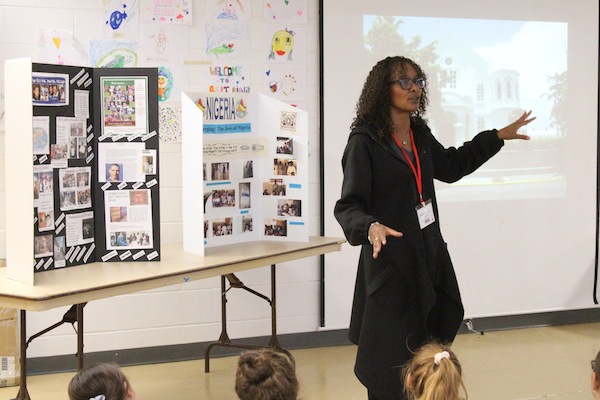
Rivka Campbell, a co-founder of Jews of Colour Canada, speaks at a school event. (photo from JOCC)

The spirit of openness and inclusion that many Jewish organizations express in their literature and social media posts is frequently not felt by Jews of colour, according to several members of the community.

Jews of colour, who are said to represent about 12% of the overall Jewish community, constitute a broad spectrum of people, including those of African, Middle Eastern, East Indian, Asian, Indigenous and Latin American descent, yet they are vastly underrepresented in congregation attendance, on organizational boards and throughout the community as a whole.

Rivka Campbell, a co-founder of Jews of Colour Canada (JOCC), says the unwelcoming feeling happens immediately upon entering a Jewish institution. She refers to it as the “question or questions” that are asked: Do you know this is a synagogue? What made you decide to visit? When did you convert?

“These are not the sorts of questions that most Jews who attend a synagogue or other places associated with Judaism have to answer, and it is really none of anybody’s business,” Campbell told the Independent.

In a recent Jews of colour webinar run by Moishe House Montreal, participants relayed numerous negative and often disturbing experiences, some of which caused them to distance themselves from Jewish circles.

“I have withdrawn from synagogue life and gone into online mode,” Deryck Glodon, Campbell’s JOCC co-founder, stated. “I don’t want to be in a position where people make you feel uncomfortable or unwelcome. People don’t know that Jewish diversity exists.”

Another participant mentioned a rabbi who once told him to choose between being black and being Jewish. Yet another recalled several untoward remarks made in Jewish settings about Filipino people, which happened to be part of this person’s heritage.

“It’s driving many Jews of colour away from any involvement within the broader community,” noted Campbell, who is executive director for Beit Rayim, a Conservative synagogue and school in Richmond Hill, Ont.

Campbell, the sole Canadian recipient of the Union of Reform Judaism’s JewV’Nation inaugural fellowship – a leadership development program – has had numerous encounters with misconceptions. She is often asked if she is Ethiopian. Once, at a Kiddush, she had to explain to someone that being a person of colour does not correspond to a fondness for fried foods.

A noticeable thread during the Moishe House webinar was the wide disparity between the progressive causes supported by Jewish leaders and the experiences of people of colour within the community.

Many Jews of colour feel that, despite some good intentions by Jewish organizations, there are always those moments when they have to prove who they are, when they just want to be, Campbell explained. The hope, she said, is that, one day, Jews of colour won’t have to spell out what Jewish diversity is.

“Rabbi Abraham Joshua Heschel’s solidarity with Dr. Martin Luther King happened 55 years ago – we need to do something now and not rest on our progressive laurels,” she said. “Nor should we forget that Rabbi Heschel was not universally praised from within the Jewish establishment for his civil rights stand.”

As for what clergy and lay leaders can do, Campbell pointed to the resources found on Union of Reform Judaism website regarding diversity, equity and inclusion for all members of the community.

For the broader community, she said, “It is not a big deal to be welcoming. Treat me the same as anyone else. You have to see me as a Jew first. ‘Shabbat Shalom’ should flow off the tongue as easily with me as anyone else.”

She continued, “Our diversity as Jews of colour adds to the diversity of Judaism. This can be turned into a very positive thing.”

On this hopeful note, in 2017, Campbell started work on a documentary that shares several stories of people from various backgrounds within the Jewish community and is designed to show the richness therein. Its objective is “to discuss how we are starting to embrace our differences and how we can do a better job of celebrating our diversity.”

Campbell’s first involvement with Jews of colour groups began at the time social media was gaining momentum. After locating ones on Facebook, she found their focus to be American-centric. In 2012, she started her own Facebook group, A Minority Within a Minority: Jews of Colour, a Canadian-focused group.

The need to move beyond Facebook ensued and, together with Glodon, she started a website and reached out to “people in the real world to have gatherings and lunches.”

“The aim was to have an in-person connection, to do things like teaching, research and advocacy,” said Campbell. The group was incorporated as a nonprofit and, at some point, she would like it to be a charitable organization.

JOCC hopes to expand its presence outside of Ontario and Quebec, and would like to have more exposure in British Columbia. Campbell spoke at Beth Tikvah

in July.

For more information about Jews of Colour Canada, visit jewsofcolour.ca or their Facebook page, facebook.com/joc.canada.


Sam Margolis has written for the Globe and Mail, the National Post, UPI and MSNBC.

Jewish genes and cancer risk

photo - Amy Byer-Shainman
Amy Byer-Shainman (photo from BRCAinBC)

With the growth of ancestry services like 23andMe, we are more aware than ever of our genes and how important they are. What we may not know is how our Jewish ancestry puts us and our children at greater risk for health issues.

Join BRCAinBC for a virtual event Oct. 1, at 7 p.m., to learn about your Jewish genes and the tenfold increased risk for Jewish people for certain cancers, including breast, ovarian, aggressive prostate cancer, pancreatic cancer and melanoma. Not only will you learn more about your risk, but you will learn where and how you can get tested and what you can do to prevent cancer.

photo - Matt Seaton
Matt Seaton (photo from BRCAinBC)

BRCAinBC is a group of individuals concerned about the effect of the BRCA genes on the Jewish community in British Columbia. The project was born out of the realization that many members of the Jewish community are not aware of the risks of carrying the BRCA genes and the risk of genetically linked cancers – BRCA 1 and 2 is the code for variant mutations of two genes known to increase the lifetime risk of several serious cancers in both women and men.

Your Jewish Genes: A Virtual Learning Event will feature speakers from across North America, including Amy Byer-Shainman, aka “the BRCA Responder,” and author of Resurrection Lily: The BRCA Gene, Hereditary Cancer and Lifesaving Whispers from the Grandmother I Never Knew; Matt Seaton, peer navigator with FORCE (Facing Our Risk of Cancer Empowered); as well as members of the B.C. Cancer Agency’s Hereditary Cancer Program and High Risk Clinic, including Dr. Rona Cheifetz, surgical oncologist, and Allison Mindlin, genetic counselor.

photo - Dr. Rona Cheifetz
Dr. Rona Cheifetz (photo from BRCAinBC)

For more information about BRCA genes and BRCAinBC, visit brcainbc.ca. To register for the Your Jewish Genes event, go to yourjewishgeneswebinar.eventbrite.ca. Tickets are by $1, $18 or $36 donation towards the BRCAinBC bursary program, which supports access to genetic testing for Jewish people in British Columbia. No one will be turned away for lack of funds.