More important than ever

“This summer, the grounds of Camp Hatikvah will echo with laughter, song, and the spirited expressions of Jewish and Israel pride”: Liza Rozen-Delman, camp executive director. (photo from Camp Hatikvah)

For decades, Camp Hatikvah has been a cornerstone of the Jewish community, serving as a summer haven where traditions are cherished, friendships blossom and identities are proudly embraced. It has always been more than just a recreational retreat; it has been a powerful catalyst in shaping the future leaders of the Jewish community.

Developed in the aftermath of the Holocaust, Hatikvah was created to produce proud, happy Jewish youth who were committed to the rebuilding of the Jewish people and a homeland in Israel. As a 1949 article in the Jewish Western Bulletin (the predecessor of the Jewish Independent) stated, Camp Hatikvah provided early participants with a “place where they could live and express themselves as Jews, unhampered with fear of others and free from the out-of-place feeling that is so often a part of North American Jewishness.”

Today, as we witness a disheartening resurgence of antisemitism, the original mission of Camp Hatikvah seems to be as important as it was at the time of the camp’s creation.

“The need for a space where children can feel safe, embrace their heritage and express their identity without reservation is, once again, vital” said Liza Rozen-Delman, the camp’s executive director. “I am devastated by the current state of the world, but we are dedicated to rising above it and playing a critical role in combating hate.”

The camp’s leadership recognizes the need to renew its dedication to its original mandate, emphasizing that, in the face of external threats, the camp becomes not only a refuge but a dynamic force in cultivating resilience and unity.

“In response to the current crisis, this summer promises to be a rallying point for Jewish pride, a resolute stand against the hate we have seen, and a celebration of every aspect of who we are as a people,” said Joanna Wasel, board president.

As they begin preparing for summer, Rozen-Delman explained that the camp staff are gearing up to create an immersive experience that fosters a sense of pride, belonging, and love for all things Jewish. Through carefully curated activities and the camaraderie that comes from being part of a supportive community, campers will leave with not just memories of a fun-filled summer but also a strengthened sense of identity.

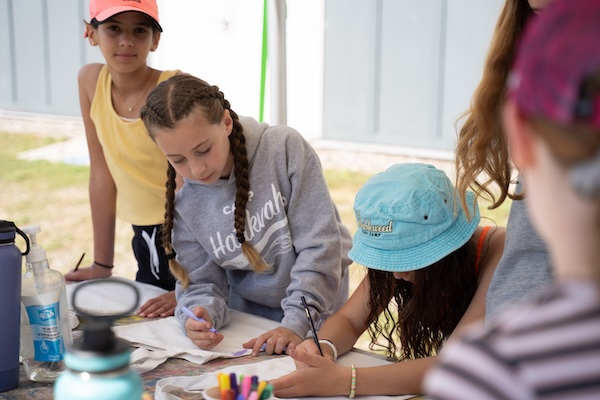
photo - Kids working on a project at summer camp
Kids working on a project at summer camp. (photo from Camp Hatikvah)

Camp Hatikvah also plans to intensify its Israel programming this summer in an effort to empower its campers with a more profound understanding of the Jewish state’s history and culture but, most importantly, its necessity. In a world where misinformation and delegitimization about Israel is rampant, Camp Hatikvah is determined to ensure that its campers and staff are equipped to advocate for the right of the Jewish people to live in peace and security in a homeland of their own.

“This summer, the grounds of Camp Hatikvah will echo with laughter, song, and the spirited expressions of Jewish and Israel pride,” said Rozen-Delman. “From the youngest to the oldest, everyone will be encouraged to stand tall, speak loud, and embrace every aspect of who they are.”

The importance of Camp Hatikvah extends beyond the traditional camp experience; it is a cornerstone for fostering resilience, unity, and an unapologetic celebration of one’s identity. Camp Hatikvah continues to play a pivotal role in creating a space where yet another generation of Jewish youth feel not only safe but truly at home. 

– Courtesy Camp Hatikvah

Encouraged to be oneself

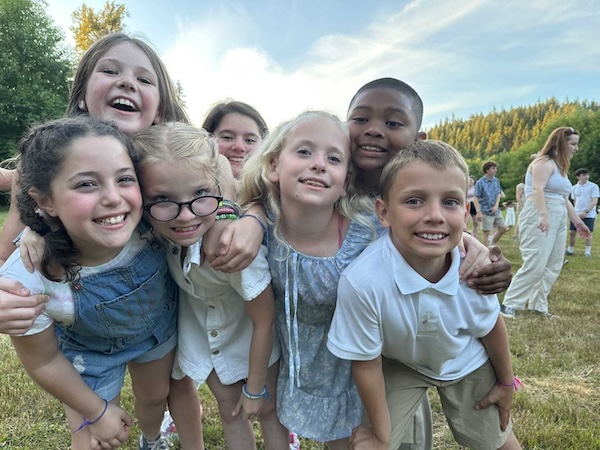
Lifelong friends can be made at summer camp. (photo from Camp Kalsman)

Fun is in all that we do,” Rabbi Ilana Mills, director of URJ Camp Kalsman, told the Independent. “Our staff creates dynamic programming that lets campers laugh and play in a way that doesn’t happen anywhere else. Where else can you spend a day with your friends and your evening doing messy night with a slip-n-slide, water balloons, shaving cream, and more?”

Summer camp is a unique experience for children and young people, for campers and counselors. While fun is at the forefront of programming, so is learning. In the case of Jewish camps, there is the added element of Shabbat observance and other elements of Judaic practise and values.

Looking at the example of Camp Kalsman, which is located north of Seattle, one can see the breadth of activities summer camp can offer. A typical day at Kalsman includes singing, pool time, prayers, and activities that range from canoeing and kayaking on the lake, to climbing the camp’s tower and/or high ropes, to farming or gardening, to painting or having a cook-out.

The camp has chugim (electives), which usually run three to four days, and campers do a project during them, said Mills. “Campers will get to rank their choice from a list of options and we do our best to give campers their choices,” she said. Chugim includes such things as pottery, embroidery, hiking, water aerobics, yoga or soccer.

And older campers have “Sababa Time,” said Mill. “Sababa Time is an hour each day where older campers get to choose their own activities from a number of creative options that changes each day. Those might include volleyball, board games, outdoor cooking, or spa days.”

The camp schedule also carves out free time for campers.

“Life is so busy and camp is as well. Free time enables campers to choose what they need on any given day,” said Mills. “Whenever we have free time, we have options for campers to choose which option best fits their needs.  Some campers need to get energy out, so they play basketball or go to the pool. Others may need down time, so they may read a book in the trees. Campers use free time to relax, recharge and have fun in a manner that best suits them. Recreation can be a time to re-create, to rejuvenate.”

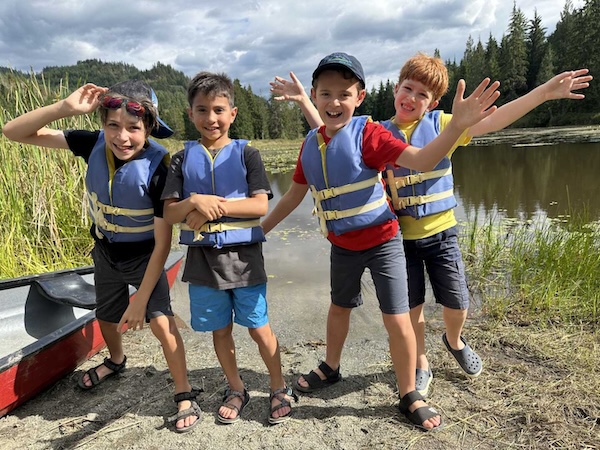
photo - Kids at Camp Kalsman get ready to take a canoe out onto the lake
Kids at Camp Kalsman get ready to take a canoe out onto the lake. (photo from Camp Kalsman)

In addition to obvious practices, such as the celebration of Shabbat and group tefillah (prayer), Kalsman tries to impart Jewish values and culture throughout activities.

“We design our programs to foster a holy community through connection between campers, between campers and staff and between campers and the larger community,” said Mills. “We believe connection is important on every level, so our cabins do cabin time every night to form connections and, every week, we have all-camp programs, where campers of different ages can get to know one another. When we eat, pray and sing together, we connect to the larger community.”

Camp Kalsman ends each night in siyum, “a special closing prayer where we pray Hashkiveinu and Shema using a special tune written just for Camp Kalsman,” said Mills.

When asked what summer camps in general – and Jewish camps specifically – can give kids that schools can’t, Mills shared a quote from a 10-year-old camper, who said, “Kalsman lets me take off all the masks I have to wear at school and really be me.”

“At Kalsman, our campers know that they are valued, honoured and supported for who they are,” said Mills. “Camp enables kids to be kids, to be free, and to have fun in a way that they don’t get anywhere else. It frees them of the burdens of school and competition and allows them an outlet to be part of a great community. Kalsman campers disconnect from their devices and connect to a larger, holy community. Campers learn independence and problem solving, they learn they can make mistakes and how to manage mistakes in a safe environment. Camp is the place where kids can explore who they want to be in the world.” 

Writing in praise of neoteny

Campers being silly at Rockbrook Camp for Girls. (photo from rockbrookcamp.com)

Today, the word of the day is neoteny. It’s really a term from evolutionary biology, but it describes the retention of childlike attributes in adults. You might think of a grown-up who has a “baby face,” or is generally “cute.” When you are talking about these kinds of physical features, we tend to think it’s a good thing to have “young looking skin” or the “energy of youth,” for example. Neotenic people are usually attractive. Being neotenous is mostly considered a good thing.

But what about personality traits, attitudes or approaches to the world? What about these ways of being childlike? Think about what life is like as a child. The world is magical, full of curiosities, almost always kind and wondrous. As kids, we spend so much time being creative and playing. We feel so many more things – joy, excitement, anticipation, and the broad sensuous world around us. All of this probably makes it so easy to make friends (“Come on! Let’s play!”).

You’ve also noticed what usually happens when we grow up. We get serious, we latch on to patterns of behaviour, we get scared, we feel the need to protect what we believe, we accept responsibilities and feel pressure to perform and “be” someone in particular. As adults, we spend almost all of our time, mostly alone, working to stay organized and fighting opposing forces. We’re all too consumed by those adult things we’ve grown to accept as important, and it ain’t easy.

photo - Kids at Rockbrook Camp for Girls with soapy hair
(photo from rockbrookcamp.com)

It’s no surprise to see that being an adult overpowers those childlike traits. Sadly, to grow up often means losing touch with what we used to be, those aspects of being human we loved as kids. As adults, we have a harder time feeling what makes the world wonderful, a harder time making friends, and a much harder time playing and having fun. Of course, there are exceptions to this, but that’s the point. They are exceptions. And that’s too bad.

Let’s remember the value of being childlike even as adults.

Let’s be joyful as we’re responsible.

Let’s be curious when encountering opposing beliefs.

Let’s be friendly and playful, cooperative and excited about learning new things.

Let’s strive to foster our innate neotenous instincts.

Bringing this back to camp.… Summer camp is a place where kids can really be kids. It’s a special time when they are encouraged to play, make friends, be creative and explore the world around them. Separate from the forces of home and school (which are fundamentally about forming “adults”), camp provides a wonderful opportunity to strengthen our “kid selves.” It celebrates and fosters the neotenous traits. Camp is a joyful break from all that training, and that’s a big part of why it’s so fun.

Maybe we could say…. Camp helps you learn how to be a really great kid so that, later in life, you’ll be a really great (happy, satisfied, remarkable) adult.

Camp’s power to strengthen these “kid traits,” I suspect, will be a big part of that success. 

Jeff Carter is director of Rockbrook Camp for Girls, which is in the western part of North Carolina. For more information, visit rockbrookcamp.com.

The omission of antisemitism

Many Jewish students are worried to go to campus in view of threatening and hateful messages and even open hostilities at some Canadian campuses. These are taking place within a wider context of antisemitic incidents in the wake of the eruption of the Hamas-Israel war.

The silence of some Canadian universities in addressing antisemitism, in particular when considered alongside otherwise active approaches toward equity, diversity, inclusion, decolonization (EDID) and racial justice needs to be explicitly addressed.

Legal action has recently been filed against some Canadian universities for failing to address antisemitism.

Anti-Palestinian racism, antisemitism

I’m an education scholar whose work centres on equity, diversity, inclusion, decolonization and anti-racism.

My engagement in this work has been shaped by my own background migrating to Canada from Israel 12 years ago. My graduate studies in Jewish history, with focus on Holocaust memory, made me attuned to injustice.

My migration was informed by concern my children wouldn’t be able to grow up without absorbing the racism against Palestinians that is pervasive in Israeli society. I now fear that my children, and students, will be absorbing antisemitism.

Antisemitism in society at large, on campus

Antisemitism — the prejudice, hatred, and oppression of Jews and one of the oldest forms of racism — is an ongoing concern in Canada.

There has been work at some post-secondary institutions to consider how EDID frameworks need to address antisemitism and also Islamophobia and anti-Palestinian racism both in the context of Israel and Palestinian issues and in the everyday.

But many EDID frameworks — both of specific institutions, and larger guiding frameworks — do not explicitly address these problems. For example, the Federation for the Humanities and Social Sciences’ 2021 “Charter on EDID,” which states the need for “a more resolute effort to achieve [EDID] in our disciplines [and] fields of inquiry,” mentions categories of race, ethnicity and does not name antisemitism.

Addressing covert and explicit discrimination

Because racism and discrimination are often covert in higher education institutions, EDID initiatives focus on creating systemic and institutional changes in all levels and aspects of institutions, including through policies, leadership, hiring, curriculum and student experiences. But this frame is also applied to specific discrimination cases and complaints in higher education.

Universities’ equity, diversity, inclusion and decolonization initiatives are emerging and should rightfully comprehensively respond to specific forms of racism and discrimination. For example, in 2020, work on the Scarborough Charter on Anti-Black Racism and Black Inclusion in Canadian Higher Education was launched and multiple universities have since signed it, pledging “shared recognition of the realities of anti-Black racism.”

Focus on decolonization

Inspired by the Truth and Reconciliation Commission and its 94 Calls to Action, decolonization and Indigenization of Canadian higher education plans have become central for conceiving EDID work.

For example, the second part of the Social Sciences and Humanities Research Council’s Igniting Change 2021 report, from the Advisory Committee on Equity, Diversity, Inclusion and Decolonization, focuses on “Principles, Guidelines, and Promising Practices of Decolonization.”

In Canadian universities, an EDID focus on issues of decolonization and racism is important, given histories and legacies of colonial oppression, racism, exclusion and marginalization affecting Black, Indigenous and people of colour in Canada.

Yet this focus, in specific institutional approaches to EDID, fails to address and at times downplays the history of antisemitism and its ongoing reality in Canada.

Whiteness and Jews’ ambivalent racialized status

Several factors have contributed to this. The majority of North American Jews self-identify as white. “Whitening” allowed white-passing Jews to become part of a white Christian mainstream in ambivalent ways.

This process has reduced Jewish heritage to simply a religious/faith affiliation, even while Jews remain vulnerable to pernicious white supremacist and antisemitic beliefs about Jewishness being “in the blood.”

No doubt, it is complex to identify Jews as a category under “race,” since such a categorization is reminiscent of Nazi ideology. On the other hand, if we understand race as a social construct, the absence of naming antisemitism in EDID frameworks is deeply problematic.

Tools to acknowledge antisemitism

This prevents scholars and educators from acknowledging the historical, institutional, ideological and cultural underpinnings of antisemitism.

Academics working on anti-racism issues trying to bring up antisemitism are often told this is not part of the EDID agenda.

A report by a senior adviser on antisemitism at the University of Toronto’s medical school described how instances of antisemitism were dismissed as political activism against Israel, protected under academic freedom even while this activism was rife with antisemitic dog whistles (such as seeing Jews as “controlling the media” or “owning the university.”)

This conflation points to EDID settler-colonial discourses that position Jews as white colonial forces.

This framing fails to acknowledge the historical, cultural, and spiritual ties of Jews to the land of Israel and also erases the reality that Jews both in Israel and in diasporic communities globally are not a uniform ethnic group. For example, about half of the Jewish population of Israel are “Mizrachi”, descendants of Jews from the Middle East and North Africa.

Not about shielding Israel from critique

Addressing the complexity of Jewish identities doesn’t mean justifying Israeli state politics or shielding Israel from critique.

Critiquing Israel is not antisemitism. Many Jewish and Israeli scholars have strong criticisms toward Israeli politics, just as many Jews object to the killing of civilians in Gaza, and support “free Palestine.”

CBC news video announcing the death of Canadian Israeli peace activist Vivian Silver who was killed in the Hamas attacks.

Unpacking history and current events is important for EDID work.

But portraying Jewish peoples as the embodiment of colonial oppression is an antisemitic trope that legitimizes hate and violence.

Antisemitic tones, slogans in political calls

Antisemitism was seen after Oct. 7 when some academics publicly celebrated the Hamas massacre as a form of decolonizing and liberation, while victim-blaming those murdered and kidnapped.

Colleagues shared video with me of people at University of British Columbia marching and chanting “there is only one solution: Intifada revolution.” For many Jews, this chillingly evokes the “final solution.”

In other protests, demonstrators have carried signs saying: “Keep the world clean,” portraying a trash can with a Star of David in it.

Including all experiences

The failure of EDID to address antisemitism makes Jewish students targets of microaggression and hate on campuses.

Universities must aim to create educational institutions in which all lived experiences are included.

A good way to address antisemitism would be for specific universities and the higher education sector to launch a task force. In so doing universities would also need to address hard political conversations surrounding Israel and settler colonialism. Universities have tended not to address this because of complexity, but this can no longer be avoided.

Jewish students should not be made to feel less than or illegitimate as they attend university. We have a responsibility to condemn and actively address antisemitism as part of our commitment to EDID.The Conversation

Lilach Marom, Assistant Professor, Faculty of Education, Simon Fraser University

This article is republished from The Conversation under a Creative Commons license. Read the original article.

Students to learn of Holocaust

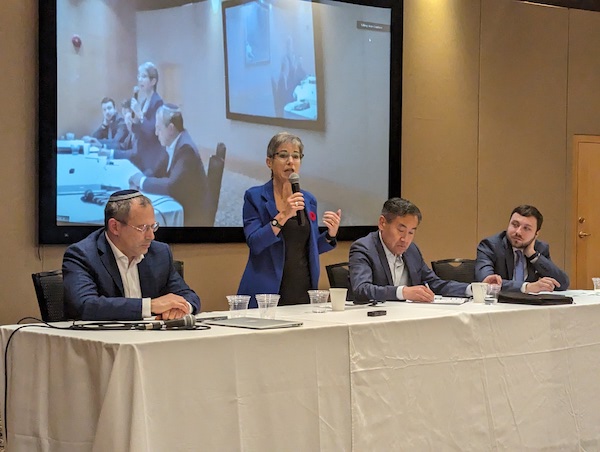
BC cabinet minister Selina Robinson speaks Nov. 5 at Schara Tzedeck Synagogue. Other panelists at the B’nai Brith Canada event that day were, left to right, Schara Tzedeck’s Rabbi Andrew Rosenblatt, BC United MLA Michael Lee and Aron Csaplaros, BC regional manager for B’nai Brith. (photo by Pat Johnson)

British Columbia is to become only the second province in Canada to mandate Holocaust education in the school curriculum. In a surprise announcement at the Jewish Community Centre of Greater Vancouver on Oct. 30, BC Premier David Eby was flanked by Jewish community leaders and survivors of the Holocaust when he said that Grade 10 students will be required to learn about the Holocaust, beginning in the 2025-26 school year.

Until now, it was possible for a student to graduate from the school system in British Columbia without ever having encountered the subject. Teachers have discretion to include the Holocaust in social studies classes and an elective on genocide is available in some schools, but there was no universally mandated requirement for learning about the Shoah. Ontario recently instituted mandatory Holocaust education at the Grade 6 level, becoming the first province in the country to make the subject compulsory.

Speaking at an event on Nov. 5, BC cabinet minister Selina Robinson recounted how the milestone decision unfolded. She credits former BC education minister (now minister of transportation and infrastructure) Rob Fleming with launching the idea in 2018. Fleming came to Robinson and asked if she knew that Holocaust education was not mandatory.

“Just like many, many others, I was surprised to learn that,” said Robinson. “He started the ball rolling.”

The COVID pandemic derailed the plans, as educators and administrators struggled to simply deliver learning to kids.

It was while reading Vancouver author Marsha Lederman’s book Kiss the Red Stairs that Robinson, who is the province’s minister of post-secondary education and future skills, wondered what had happened with Fleming’s idea.

“So, I picked up the phone and I called Rachna [Singh, the current minister of education] and then I called Rob Fleming and then I called a couple of my other colleagues who had an interest in seeing this move forward,” she recounted. “And then I called the premier and I said, David, this project that we started is moving at a snail’s pace and this needs to get done. We cannot wait any longer. I want to give kudos to our premier, to David Eby. He said, I’m on it.”

Robinson was speaking at Schara Tzedeck Synagogue on Sunday as part of a panel on antisemitism and Holocaust education organized by B’nai Brith Canada. Numerous members of the legislature, as well as mayors, councilors and school trustees from around the province joined the event virtually. Robinson’s fellow panelists were BC United MLA Michael Lee and Schara Tzedeck’s Rabbi Andrew Rosenblatt. Aron Csaplaros, BC regional manager for B’nai Brith Canada, moderated, with senior leaders from B’nai Brith beaming in from Eastern Canada.

From Robinson’s post-COVID jumpstarting of the Holocaust education planning, things leapt forward, she said.

“It really moved, I would say, from June until probably the beginning of September, at lightning speed – and anyone who’s ever had to work with government knows that nothing ever moves at lightning speed,” Robinson said. “So, I want to give kudos to our partners at the Vancouver Holocaust Education Centre and CIJA [the Centre for Israel and Jewish Affairs] and [the Jewish Federation of Greater Vancouver] for coming together and working in partnership. I know that B’nai Brith is new on the scene [in BC] and this is a very important piece, but I also think it’s really important to recognize those that have been working … for a number of years to make this happen.”

The timing of the announcement, in the weeks after the Oct. 7 terror attacks in Israel and in the midst of a massive spike in antisemitism worldwide, was coincidental. The issues, though, are related.

Robinson said the provincial government has been vigilant in monitoring antisemitism and potential for violence in British Columbia. She credited Minister of Public Safety and Solicitor General Mike Farnworth for spearheading the response.

“He called me every single day from Oct. 7 for about 10 days, to report in to me about what was happening on the ground,” she said. In addition to her official role with advanced education, Robinson said she is known among colleagues as “the Jew in the crew,” as the provincial elected official who is most publicly visible in her Jewishness.

On Nov. 1, Robinson convened a meeting of the heads of the 25 post-secondary institutions in the province.

“I got agreement from all 25 presidents that they would do everything within their power to make sure that everyone felt safe on their campuses,” she said. “I don’t think solving that is going to be an easy task, but it’s absolutely a requirement of all of them, because, in this province and in this country, we believe that everybody has the right to be who they are and to feel safe and, if it’s not happening, then we need to fix it.”

A bipartisan love-in that has been going on between Robinson and Lee, who represents Vancouver-Langara (the provincial constituency that includes many of Vancouver’s Jewish institutions and residents), continued Sunday in the obvious respect and affection between the two MLAs despite party lines. Lee made the news last week after rising in the house to give a personal tribute to Robinson’s strength as a leader who is Jewish in this challenging time and Robinson reciprocated kind words at the B’nai Brith event.

“Michael Lee has been a steadfast supporter, not just in this particular situation,” she said. “But also [to me] as a Jewish person who is having her own experience as a Jew around what is happening.”

Robinson spoke emotionally about the impacts of current events on her family, which includes her Israeli soon-to-be son-in-law, who became a permanent resident of Canada at the end of September.

Making Holocaust education a mandatory part of the province’s education curriculum has been a dream of the people at the Vancouver Holocaust Education Centre since the organization was founded, in 1994, according to Nina Krieger, the VHEC’s executive director.

“I think stars aligned and David Eby acknowledged Selina Robinson as being a key driving force in this initiative,” Krieger told the Independent.

A process of consultation will now begin and Krieger expects her agency will be central to that work, identifying and providing resources to help craft the new curriculum, which is likely to be a component of the Social Studies 10 learning outcomes.

“Certainly we bring a wealth of experience and a roster of programs and resources and best practices that will be relevant to the curriculum development process,” she said. “We are also poised to work with the minister of education to play whatever role is needed for that process. Also, we know the implementation and resource tools and training that teachers are going to need will be really important as well, so we’re looking forward to supporting the province and the teachers directly with that.”

The Jewish Federation and CIJA will continue to be engaged with the planning for mandatory Holocaust education. Both organizations issued statements after the announcement Oct. 30.

“When left unchecked, antisemitism culminates in some of the darkest chapters in human history. By learning from the Holocaust, we honour the memories of its victims and, we hope, contribute to preventing future tragedies,” said Ezra Shanken, Federation’s chief executive officer. “Today’s announcement shows the BC government’s commitment to creating a safer society for all.”

“Education is key to ensuring that our children learn to combat hate and that the Jewish community can live in a safer province,” said Nico Slobinsky, CIJA’s vice-president for the Pacific Region. “We look forward to working with the BC government on implementing mandatory Holocaust education in our province’s K-12 curriculum.”

At Sunday’s event, Marvin Rotrand, national director of B’nai Brith’s League of Human Rights, speaking virtually from Montreal, noted that 15 US states have some form of mandatory Holocaust education – and early indications from studies in those jurisdictions indicate a decrease in hate crimes not only toward Jews but other groups as well.

A call for toughness

Rabbi Dr. Michael Berenbaum spoke at Congregation Schara Tzedeck on Nov. 5. He said: “We can’t raise a generation that is scared of being Jewish.” (photo from kolotmanagement.com)

The mood at Congregation Schara Tzedeck was solemn Sunday night, Nov. 5, when parents, grandparents and students from the Jewish community gathered to listen to Rabbi Dr. Michael Berenbaum, an American professor who is considered one of the world’s preeminent Holocaust scholars. Berenbaum came to discuss the importance of campus conversations, and specifically how to handle the critics of Israel who are voicing their support of Palestinians vociferously on college campuses throughout Canada and the United States.

Until the Oct. 7 terror attacks, Berenbaum said, our children had never known serious difficulty as Jews. “They’ve had the privilege of living in the greatest time to be Jewish, maybe in the history of the Jewish people,” he said. “Now, we’re asking our kids to toughen up, because they’re now going to face difficulty, pain, anguish and danger – physical or intellectual – for being Jews. This is our test of the hour, and it comes with the shattering of easily held assumptions about Jewish life.”

The Oct. 7 pogrom, he said, was worse than the 1906 Kishinev pogrom and worse than Kristallnacht in 1938 in terms of the number of Jews killed and the vehemence with which they were killed. “We believed Israel was founded to protect its people from these pogroms, and yet we were not safe.”

Berenbaum said it is crucial for Jewish students to be armed with accurate knowledge so they can counter the anti-Israel rhetoric they hear on campus. That means refuting claims that Israel is committing genocide. “Understand that this is war, and it has both direct and collateral consequences,” he said. “You cannot deal with war at this point without significant civilian casualties. While Israel is taking significant steps to avoid that, it’s unavoidable.” He noted that, since March 2011, the conflict in Syria has claimed the lives of 500,000 people – “and the rest of the world has heard nothing about this.”

On the claim that Israel is “occupying Gaza,” he clarified that Israel left Gaza in 2005, displacing 8,000 settlers so that Gazans would take control of their lives. “Israel is the only country in the world who has sacrificed land for normalization. We gave up Sinai for normalization with Egypt, and the reason the invasion happened now was because it appeared Saudi Arabia would establish a certain kind of peace with Israel,” he said. “Normalization represented a danger to the lateral forces in the region and that’s why this broke out now.”

On the claim that “Jews are colonizers,” he noted that Jews have never forsaken their connection to the land of Israel, and that there have been five cities with a permanent Jewish settlement in Israel. “When they came to Israel, they settled and worked the land, which is the opposite of colonization,” he said. “They didn’t take its resources and export it elsewhere.”

He noted that Palestinians were offered a state in 2000 and again in 2006, and they turned both opportunities down. “The Palestinians have never lost an opportunity to lose an opportunity, because their leadership is weak and corrupt,” he said.

There are a few things we can do now to ensure we are strong, he continued. One is to educate ourselves on the history of the state of Israel and Zionism. Another is to ensure we have solidarity by reaching out to one another.

 “These are not easy times and we need Jewish toughness and resilience,” said Berenbaum. “We can’t raise a generation that is scared of being Jewish. I want our Jewish students to be proud, tough and confident enough to accept the animus that will come their way, but to have the human capacity to respond to it.”

He ended his talk by calling Jews the “canary in the coalmine. You want to know if a society is healthy? See how it treats its Jews. We’re living in a world that’s fundamentally unhealthy, but it’s important to remember that we have many friends, we are not alone. We have to cultivate and respect those friendships, and not take them for granted.”

The events of Oct. 7 precipitated an earthquake, he added, “and the ground won’t settle for awhile. But earthquakes give the opportunity to build in a different way. We are in for a tough and difficult time, which will demand the best of us. But I fundamentally believe we have it in us to rise to the occasion.”

Lauren Kramer, an award-winning writer and editor, lives in Richmond.

Efforts to reduce fake news

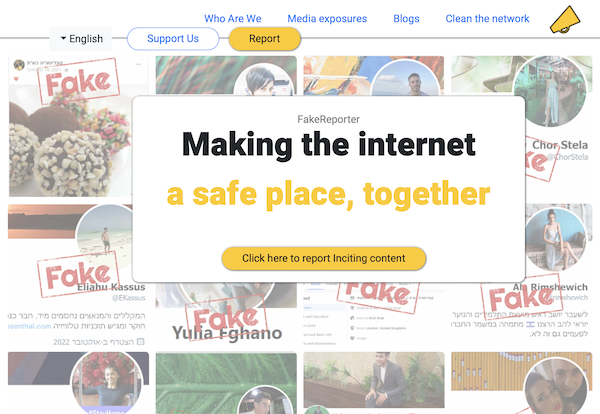
People can report misinformation and hateful material at FakeReporter.net.

In a world where misinformation and disinformation are coming at us in unprecedented volumes, an Israeli organization is working literally around-the-clock to flag, correct and eliminate online falsehoods – and they depend on ordinary people to inform them of lies that need addressing.

Achiya Schatz, co-founder and chief executive officer of the group FakeReporter, spoke virtually at a Nov. 2 event organized by Canadian Friends of Hebrew University of Jerusalem and Congregation Beth Israel.

“We try to leverage crowd wisdom in order to make the internet a safer place,” said Schatz.

The challenge goes far beyond reducing misleading information online, he said. The very survival of democratic societies is at stake.

“If we do not have the capacity to distinguish what’s true from what’s false,” he said, “then, by definition, the marketplace of ideas doesn’t work and, by definition, our democracy doesn’t work.”

FakeReporter’s work is painstaking. An on-call team of thousands of volunteers are connected by WhatsApp and other communication tools. When a report of unverified information comes in, it is channeled to an appropriate individual or team to investigate. They will contact government officials, military spokespeople or others who might be able to confirm or debunk the information. They post their findings on social media, disseminate it to conventional media outlets, especially those that may have spread the falsehoods, and report it to the social media or other platforms where it appears.

While the “fog of war” around the conflict between Israel and Gaza is an obvious source of fake news that keeps FakeReporter teams hopping, equally insidious efforts are fomenting internal strife in Israel.

“Arab citizens of Israel have been heavily attacked,” Schatz said of anti-Arab propaganda targeting citizens of Israel online. Posts have aimed to make Jewish Israelis believe that Arab Israelis are a threat. Photos of Arabs allegedly stalking Jewish homes and businesses turned out to be, after investigations by FakeReporter, tradespeople scoping a roofing project and municipal workers going about their business, for example. The messages, from unidentified sources, have the potential to create civil unrest inside the country amid ongoing conflicts with external terrorist groups on multiple fronts.

On the global level, FakeReporter is responding to a barrage of war-related and more routine anti-Israel material online. In response, taking the nomenclature and vision of Israel’s Iron Dome air defence system, Schatz said, his group is creating what strives to be an invincible defence against online incitement.

“We created a Digital Dome,” he said. “It’s an operation that, in one place, anyone can report hate speech, [content] glorifying terror, Hamas supporters and, generally, violence online on Meta, Google, LinkedIn and TikTok.”

The form for people to fill out is at DigitalDome.io, and the organization’s website is FakeReporter.net.

While there is an unlimited number of comparatively minor falsehoods, Schatz said his group is dedicated to confronting some specific and convoluted conspiracy theories that are going viral. Like the fantastical theories that emerged after the 9/11 terror attacks in the United States, the Oct. 7 attacks have spawned what Schatz calls the “traitors among us” conspiracies, in which Israeli security agencies are alleged to have masterminded, or at least participated in, the attacks, as a cover to attack Gaza.

While his organization is busy assessing and confronting the mass of misinformation and disinformation, individuals can do their part by consuming information critically, Schatz said.

To spot fake news, he said, several questions can narrow the field.

“Can I trust the person who wrote and distributed the news?” he said. “Is what I’m reading an opinion or a fact? Does what I’m reading make me feel rage? This question will help you understand that you are seeing something that maybe you should question.” If the “news” you saw in one place is not reported anywhere else, be very suspicious, he said.

The spread of false information is exacerbated by unwitting individuals who share what they find online.

“Before you spread anything forward, you should just breathe for a moment, look at it again with critical thinking and that would do half the job,” he said. “Don’t just spread news through WhatsApp groups and Telegram groups.”

If you find something that glorifies or promotes violence, that is racist, antisemitic or likely untrue, don’t send it to friends, send it DigitalDome.io, he said.

There are other things to consider in determining whether an item might be fake news.

“Many times, information is real but it’s not in the context,” said Schatz. A photo of a bombed building may be real, as opposed to Photoshopped. But what is purported to be in Gaza is often discovered to be from wars in Syria, Ukraine or elsewhere.

The FakeReporter team uses multiple strategies to assess the veracity of photos.

“We can recognize the vehicle,” he said, “we can geo-locate the area, understanding where it is in the world, and we can look for the information online and see, [was it] maybe published before?”

The problem is global and Schatz said governments and social media platforms must work together – or, as in the case of European legislation, governments can impose severe financial penalties on companies that do not speedily react to reports of false or dangerous information on their sites.

The European Union’s Digital Services Act makes it the responsibility of large online information companies to police and remove hate speech, disinformation and cyberbullying, as well as unsafe or illegal retail products, such as sham or life-threatening pharmaceuticals. Other countries could replicate Europe’s legislation, said Schatz.

“What is beautiful about the EU is that they have had a few countries come together and they used their power against big tech [in ways] small countries cannot,” he said. “Israel cannot do anything about it.… Even if we do pass a law, why would Facebook or Twitter care about the law that we passed? They don’t care. That’s a huge problem. What I think Canada and other countries should do is adopt what is happening in the Digital Services Act in Europe and then it’s much easier for the tech companies and for the country, because it’s just replicating what they already can do.”

All the examples Schatz used to this point were addressing the source of misinformation and disinformation. Societies also must sensitize the targets of this content by giving individuals the tools to assess what they see and hear.

“Finland, for example, understood the disinformation coming from Russia is a national threat to them,” he said. “So, they created programs, first for kids and then grown-ups, in digital literacy and information literacy and they are teaching … how to consume information.”

Dina Wachtel, Western region executive director of Canadian Friends of Hebrew University, opened the online event. Rabbi Jonathan Infeld of Congregation Beth Israel introduced Schatz and offered reflections on the topic.

Schatz warned that disinformation is at an inflection point, likely headed for an exponential increase thanks to artificial intelligence, while global responses to the problem are embryonic.

“We’re still learning,” he said. “We’re still adapting. Digital and information literacy is something that is still in its baby steps.”

Learning opportunities

While a report this spring by the New York-based Jewish Education Project showed a decline in Jewish supplementary education in North America over the past 15 years, participation in after-school and weekend educational programs in British Columbia is on the rise.

Since the 1990s, the Jewish Federation of Greater Vancouver has provided small grants to local supplementary schools; at present, it funds 11 programs. And, in 2015, Federation convened the Jewish Education Task Force to look into the state of part-time education.

“Through this work, we recognized the importance of focusing on innovation and change to attract a new generation of families,” said Shelley Rivkin, Federation’s vice-president of local and global engagement. “We were able to provide innovation grants and professional development opportunities for supplementary school educators to learn new and diverse ways to offer Jewish education. More importantly, we expanded the definition of fundable supplementary schools to include Shabbat, family and Hebrew literacy programs.”

According to Rivkin, while the Jewish Education Project report brought attention to the fall in enrolment elsewhere (see jewishindependent.ca/drop-in-jewish-learning), Federation’s experience has been that enrolment here has either remained stable or grown in the last few years.

“We have seen significant gains in supplementary school enrolment in both the regional and emerging communities, where families are seeking opportunities to connect with other Jewish parents and provide opportunities for their children to have Jewish experiences,” Rivkin said.

For example, BC Regional Hebrew Schools, operated through Chabad and funded in part by Federation, has become an important part of building Jewish community life in places like Langley, Coquitlam and Whistler. Likewise, programs directed toward Hebrew-speaking families, which have a broader focus on Israeli culture, are attracting new families who are looking for different content.

“We have seen all of our supplementary school providers adapt and change in response to changing demographics. All offer a range of activities utilizing innovative teaching methods and engaging content to appeal to a diverse group of children and their families,” Rivkin said.

The same is true for the Lower Mainland, where Federation notes that supplementary schools are making a difference as well.

“The Jewish Federation’s Supplementary School Grant helps us in many ways,” said Noga Vieman, education director of Congregation Har El in West Vancouver. “First, we believe that every child in every Jewish home deserves an enriching Jewish education and experience. The grant helps us keep the program reasonably priced, and offers us the opportunity to create scholarships for those in need, so that financial challenges will not prove a barrier to getting quality Jewish education and becoming part of the Jewish community.”

The grant also helps Har El provide its teachers with fair compensation, allowing the North Shore Jewish centre to attract and retain quality educators with a passion for working with children and building the future of the Jewish community in the region.

Further, part of the grant Har El receives is dedicated to funding classroom assistants to help increase inclusion.

“In our program, this money goes towards paying for an education assistant for a child who is blind, and also for teens who help children with different learning abilities, and who need personal support during class,” Vieman said. “This helps to create intergenerational connections, and keeps the teens involved in the community past their own education in our program.”

At the Peretz Centre for Secular Jewish Culture, the Federation grant has been used for Pnei Mitzvah, its secular humanist program for youth aged 10 to 14 that focuses on the Hebrew language, Bible stories, Jewish holidays and Jewish culture.

“We have been growing the program in recent years and have expanded it province-wide through an online cohort,” said Maggie Karpilovski, executive director of the Peretz Centre. “This growth would not be possible without Federation’s funding. It allowed us to attract expert teachers and innovate the delivery model so that it is accessible to more Jewish families throughout the region. As we are the only secular Jewish humanist organization in BC, and the Jewish community is spread out quite widely, it is important for us to make our programs accessible.”

Jen Jaffe, school principal at Temple Sholom, confirms the value of Federation’s financial support. “The grants allowed us to become more accessible to students of varying learning needs,” she said.

At Temple Sholom, the funding has been used to contribute to the school’s madrichim program and create a “learning hub” space for students with needs including sensory materials and furniture. The space is used each time school is in session.

“We need to celebrate these successes,” said Rivkin, “and applaud the educators and parents who are ensuring the survival of part-time Jewish education.”

To donate to Federation’s annual campaign, visit jewishvancouver.com.

Sam Margolis has written for the Globe and Mail, the National Post, UPI and MSNBC.

Survivors a cautionary tale

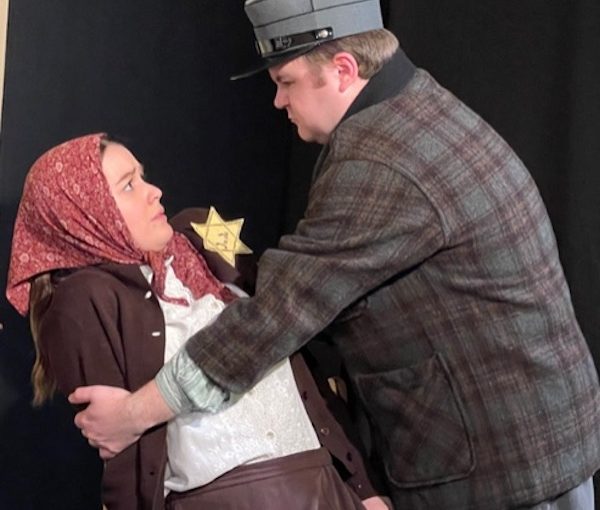
On Oct. 29 at the Phoenix Theatre in Victoria, there will be a one-night-only performance of Wendy Kout’s play Survivors, which is touring schools this month. (photo by Peter Nadler)

In light of the success of last year’s pilot tour, the educational play Survivors is touring middle and secondary schools throughout Vancouver Island this month. And, with the support of the University of Victoria, there will be one public performance of the play this month: at the Phoenix Theatre, Oct. 29, 2 p.m. Last year’s public shows sold out.

Following the mistaken honouring in Parliament recently of Ukrainian-Canadian Yaroslav Hunka, who fought in a Nazi unit during the Holocaust, there should no longer be any doubt about the ignorance of the history of the Holocaust. This conclusion is further supported by the existence of monuments in Canada that honour Nazi veterans who were members of the Galicia division of the SS in Ukraine. Furthermore, Canada’s Governor General Mary Simon has apologized for the Order of Canada given to Peter Savaryn in 1987. Savaryn was chancellor of the University of Alberta and president of the Progressive Conservative Party of Alberta in the 1980s – he also served with the Waffen-SS, a voluntary Nazi unit in Ukraine during the Second World War.

A 2019 study done by the Azrieli Foundation, Yad Vashem, the United States Holocaust Memorial Museum and the Claims Conference revealed Canadians’ lack of knowledge of this period in history. For example: 62% of millennials did not know that six million Jews were killed in the Holocaust and 22% of millennials hadn’t heard or were not sure if they had heard of the Holocaust. Nearly one-quarter of all Canadians believe that substantially fewer than six million Jews were killed (two million or fewer) during the Holocaust.

History shows that when it comes to racist attacks and xenophobia, Jews are often the “canary in the coal mine.” Holocaust awareness and education could not be more timely or important. “We’re not just telling history,” said Survivors playwright Wendy Kout. “We’re telling history as a cautionary tale for the present and the future.”

Survivors explores hatred, the capacity to survive and thrive, and serves as a call to consciousness of the present challenges. Combining history with life lessons, the audience is guided through a time when hatred was normalized. The audience is both uplifted by the survivors’ triumphs and inspired to take action against present and future racism.

The play tells a chronological history of the Holocaust through the personal prism of experience, interweaving the stories of 10 Holocaust survivors, four of whom were still alive when the play premièred in New York in 2018. Though each has a unique story, all the survivors “went through this horror and came through the other side to build meaningful, contributing, beautiful lives,” said playwright Wendy Kout.

The Victoria production of Survivors will be touring throughout the four Western provinces for the next few years. For more about those tours and the organizations collaborating on them, visit jewishindependent.ca/theatre-that-educates and holocausttheatre.com. For tickets to the Oct. 29 matinée at Phoenix Theatre, go to eventbrite.ca.

– Courtesy Victoria Theatre Productions

CJPAC bridges engagement

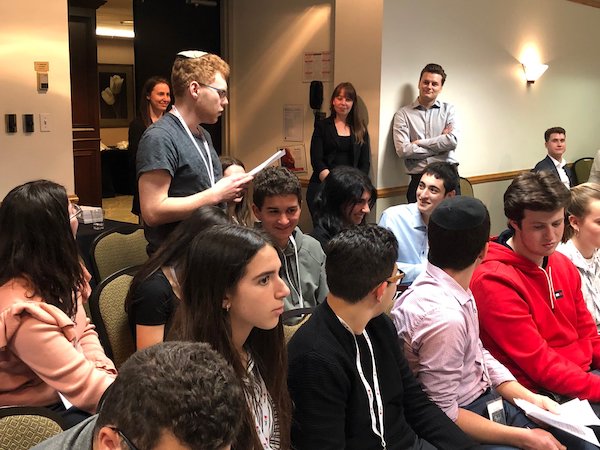
Avishai Infeld speaking during a mock question period at CJPAC’s Generation: Student Leaders Program. (photo from CJPAC)

When it comes to making a mark in Canadian politics, waiting for elections is a thing of the past. The Canadian Jewish Political Affairs Committee (CJPAC) is a bridge to meaningful political engagement, and the year 5784 is a perfect opportunity to jump in.

For Vancouverite Avishai Infeld, CJPAC kindled his political curiosity. “CJPAC ignited the spark of political interest that I long had,” he said.

Drawing from his participation in several CJPAC programs, Infeld added, “It showed me just how accessible yet valuable political engagement can be.”

CJPAC is a national, independent, multi-partisan organization with offices in British Columbia, Ontario and Quebec. It is committed to involving Jewish and pro-Israel Canadians in the democratic process.

“When you think ‘CJPAC,’ think volunteering and campaigning,” said Kara Mintzberg, CJPAC’s director for the B.C. region. “During elections, we’re like a political concierge. We help connect community members to candidates and campaigns of their choice.”

Yet, CJPAC’s role extends beyond elections, building relationships between politicians and the community year-round. The nonprofit also molds Canada’s future political leaders through innovative, hands-on programs.

Sarah Warsh, a product of CJPAC’s national Generation: Student Leaders Program, speaks highly of its transformative impact. “Growing up in Nanaimo, B.C., connecting with CJPAC was an invaluable experience,” she said.

Tailored for Jewish students in grades 10 through 12, the program features regular virtual and in-person sessions, cultivating political knowledge and skills. “Generation was the turnkey that immersed me into politics, multi-partisanship and the Jewish community,” said Warsh, who went on to participate in CJPAC’s flagship Fellowship Program for post-secondary students, where, each year, CJPAC equips 50 of Canada’s top, pro-Israel, politically engaged students with the tools to win campaigns.

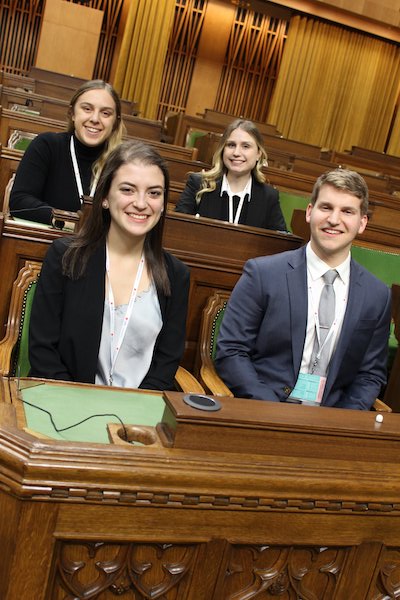
photo - Sarah Warsh (top left) in the House of Commons while participating in CJPAC’s Fellowship Program
Sarah Warsh (top left) in the House of Commons while participating in CJPAC’s Fellowship Program. (photo from CJPAC)

Since 2006, more than 500 of Canada’s brightest have graduated from the Fellowship Program, with more than one-third assuming roles in political offices across the country, including Warsh. She credited CJPAC for jumpstarting her career in a national political party, a federal political leader’s office and a premier’s office. “The decision to get involved with CJPAC was one of the best I’ve made,” she said.

Both programs send participants to Ottawa for multiple days to meet with politicians, strategists and staffers.

“Thanks to everything I gained from CJPAC,” said Infeld, “I have volunteered on campaigns in Canada, served on an MP’s youth council, and now work as the Hillel Montreal advocacy coordinator.”

For those acquainted with politically inclined students in high school or post-secondary education, applications for CJPAC’s Fellowship Program close Sept. 12, while the Generation program applications are due by Oct. 6.

But, even if you’re not a student or don’t know one, there’s still a chance to engage – attend CJPAC’s inaugural B.C. ACTION Party. Save the date for May 16, 2024, and get ready to celebrate political engagement with Jewish and political communities.

To learn more, visit cjpac.ca. For specific inquires, reach out to Mintzberg by email (kmintzberg@cjpac.ca) or phone (604-343-4126).

– Courtesy CJPAC