To heal a fractured campus

Last November, I interviewed my grandmother for an oral history project – one I had been meaning to do for a long time – about her experience surviving the Holocaust. As the grandson of two Holocaust survivors, I can affirm the reality of intergenerational trauma. Yet, as I listened to her story, I realized she was teaching me valuable, timeless lessons which the University of British Columbia community can apply on campus. That is why I am obligated to share her story – so that we avoid repeating the mistakes of the past. 

My grandmother was 13 years young when her parents and most of her family were taken away from her and deported, either to be shot on their way to Bergen-Belsen or exterminated in the gas chambers of Auschwitz. My grandmother, my safta (as I call her in Hebrew), was a little girl, orphaned, vulnerable and left all alone. She had every right to be bitter and resentful, to identify herself as a perpetual victim and to rightfully blame the Nazis for her suffering. But she did not.

She could never forgive nor forget the evil perpetrated by the Nazis. However, with this in mind, she had to move on with her life. The way she redeemed tragedy was not to define herself as the victim of the past, asking, “Who did this to me?” but rather by taking responsibility for the future, asking, “Given these circumstances, how can I help to put this situation right?”

This is the greatest eternal lesson I have learned from my grandmother and all the Holocaust survivors I have met: never internalize a victim mentality. Otherwise, you will not only become consumed with hate but also enslaved to the past. As the late chief rabbi Lord Jonathan Sacks once said, “To be free, you have to let go of hate.”

My grandmother took the negative energy and elevated it toward a higher purpose: toward marrying my grandfather, toward raising a family, toward giving back to her community. Her all-encompassing identity, attitude and purpose in life has been not based on the hate of others. Rather, her identity is based on the love of her fellow Jews, of being grateful for her heritage and everything else she had. 

“No one can make you feel inferior without your consent,” Eleanor Roosevelt once said. There was one thing from my grandmother that even the Nazis could never take away: her will to be proudly Jewish. 

UBC campus today

For my grandmother, the Hamas massacre that took place on Oct. 7, 2023, triggered painful memories from the Holocaust. “Never again,” the lesson we learned from the six million Jews murdered, has now become “ever again.”

The amount of toxic hate I have seen on my campus (and other universities as well) since Oct. 7 has been both disheartening and overwhelming. From disrespectful comments on social media posts, to provocative posters on campus demonizing the other side, to verbal and physical harassment of students, there is a small, yet vocal, minority of students who create a highly flammable atmosphere on campus. 

At UBC, I have witnessed students chanting the phrase “globalize the intifada,” a term that has historically been used in the context of the Israeli-Palestinian conflict not for “peaceful resistance,” but for terrorizing Jews with suicide bombings, shooting attacks, stabbings and other means of armed violence. I have witnessed students blacklisting other students because they do not agree with their opinions. I have witnessed students rudely spamming hateful comments (which are now taken down) on UBC’s social media page to take advantage of International Holocaust Remembrance Day to push a political message. When I hear that “hate has no place on campus,” I unfortunately continue to observe the opposite.

This is the reason why I dropped my Middle East studies minor. Every time I walked into the classroom, the negative energy was palpable. I was walking on eggshells bringing up my Jewish identity or even mentioning the word “Israel.” Every day, I had to hide my kippa under my hat so that my classmates with different viewpoints would not identify me as Jewish and publicly shame me. In short, I did not feel welcome.

At a university, a safe space should not be a place where you are protected by those with whom you agree from those with whom you disagree – that is called groupthink. Rather, a safe space should be a place where you make space for those who disagree with you so that each can listen to the other with respect.

Whether or not you agree with Israeli, Jewish, Palestinian, Arab, Muslim or any other claims, there is no justification whatsoever to scream, silence or slander those with whom you disagree. Right now, the university needs more civility and calm for all students. 

Yes, we must acknowledge that there are significant casualties on both sides of the conflict. Yes, we must acknowledge each other’s suffering. At the very least, we can all agree that every human life is sacred with equal dignity.

While we cannot control external circumstances halfway across the world from us, we can control how we respond to it. We can choose to wallow in misery and demonize the other (asking “Who did this to me?”), or we can take action to recognize each other’s suffering and elevate it to something positive (asking “Given these circumstances, how can I help to put this situation right?”).

Now, how do we do that?

Listening, not labeling

Opening yourself up to someone whose colour, culture, class or creed is different from yours can seem daunting. In an age of echo chambers, filtered media and narrowcasting, we all have a tendency to tune in to that which aligns only with our own viewpoint, while tuning out others. However, it is precisely the people not like us that make us grow. 

From clubs tabling on campus to classmates sitting next to you, there are plenty of opportunities to actively seek out diverse perspectives. We need to learn how to listen for the sake of learning, not labeling.

If one has a monopoly on the truth, then why bother listening to others? Because, as a mystical Jewish saying goes: “A full vessel cannot receive.” It is only by acquiring humility, the sense of opening ourselves up to something beyond ourselves, that we realize our own perspective is merely one finite fragment of an infinitely fractured truth. Thus, I’ve reflected on three ideas worth sharing.

First: there is no justice for any person or people without listening to the other side.

Second: true peace, in our relationships with others and toward ourselves, comes as a result of active listening.

And third: in the words of C.S. Lewis, “Humility is not thinking less of ourselves, but thinking of ourselves less.”

Listening to the other is the first step toward recognizing the “dignity of difference.”

The antidote to hate

Hate, like COVID-19, is a virus. Viruses do not distinguish between different types of people, but rather fester and grow into an infectious force that threatens us all. Historically, for example, the Nazi regime may have started with targeting Jews, but it didn’t end with Jews. Nazis also targeted Roma, Sinti, LGBTQIA+, people with disabilities and political dissidents. Hate knows no bounds. 

With this in mind, I offer three practical suggestions for what each of us can do on an everyday level to bring more hope to campus – and perhaps other places.

First, take a moment to unplug your AirPods or headphones. Just do it! Whether it’s while sitting on the bus or walking on campus, withdraw from your isolated world for five minutes and acknowledge someone you don’t know by saying hello with a genuine smile. Give them your full, undivided attention and start a friendly conversation. Humanizing starts with acknowledging the other.

Second, take a class from a perspective you have never heard from before. I am a history major. I had never considered taking an environmental history course before simply because I was not interested. But it is precisely for this reason that I am taking the course. Now, I realize how I could see my preexisting knowledge and interests from a new, oblique angle I would never have seen otherwise.  

And third, follow social media accounts of people with different viewpoints from your own. Just like our earbuds, we are constantly using our phones. Every time we open Instagram or Twitter, we are training ourselves to focus on our interests and are quick to judge other accounts as not worth our time. Instead of judgment, be curious and interact with accounts to train yourself to learn from others, not label them.  

We are first and foremost a community, of students and professors, of friends and family, of human beings with human emotions. Divided, we are more susceptible to hate. United, however, we have the potential to become force multipliers of hope over hate.   

Each one of us should ask ourselves: Are we taking actions to further fracture our world, or heal it?

If we are to heal our fractured world, we must first recognize that each and every one of us has the power and influence to turn negative energy into positive energy, just like my grandmother did. If she could continue to spread light after going through the darkest chapter in human history, how much more so can every one of us dispel the darkness of hate by becoming beacons of light in our communities at UBC and elsewhere.

It all starts with one positive thought, one friendly compliment, one good deed. 

It all starts with you. 

Eitan Feiger is a fourth-year history student and the vice-president and treasurer of the University of British Columbia’s Chabad Jewish Student Centre. This article was originally published in the Ubyssey.
Fostering many skills

For the second year in a row, Richmond Jewish Day School hosted a STEAM-J Night for its families. The event involves an interdisciplinary approach, integrating knowledge, methods and perspectives from multiple disciplines – science, technology, engineering, arts and mathematics – all through a Jewish lens. 

As part of the STEAM-J Night, which took place Jan. 30, children in RJDS’s Early Learning Centre focused on exploring trees through art. The Early Learning Centre emphasizes a play-based philosophy and an emergent curriculum tailored to children’s interests. Inspired by Tu b’Shevat and the kids’ fascination with printmaking and tracing shapes, participants compared the lines on their hands with the lines on leaf veins. Using ink pads, each child created palm prints, observing the uniqueness of their own hands.

image - a portraitThe kindergarten and Grade 1 class explored various methods to learn Hebrew vocabulary. By combining Hebrew with art, students designed and created a game where Hebrew letters corresponded to pictures they drew. They then invited their parents and guests to participate and test their Hebrew knowledge. Additionally, the children crafted clay dioramas depicting the components of an Arctic biome. During this process, they learned about how animals adapt to changing weather and the climate.

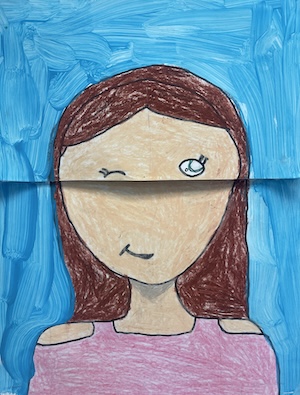
image - artwork of a portrait whose head opens up to reveal things important to the artist
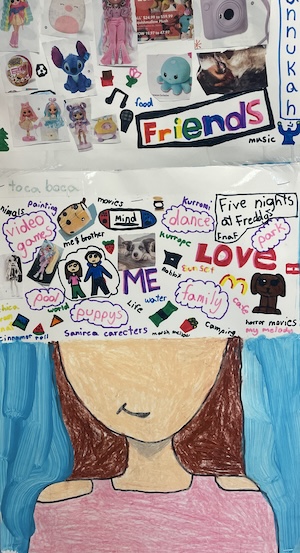
Among the many projects on Richmond Jewish Day School’s STEAM-J Night was one in which the Grade 3 and 4 class painted self-portraits with a top part that lifts up so that people can see some of the students’ favourite aspects of life. (photos from RJDS)

The Grade 3 and 4 class learned a song written by an Israeli children’s author called “All About Me” and performed a dance to go along with it. Inspired by the same song, the students painted a self-portrait with a top part that lifts up so that people can see some of their favourite aspects of life, their individuality. They then put their graphic design skills to the test and created a PowerPoint presentation about early explorers and their contributions to the world. For their final STEAM-J project, the students put on their engineering hats and created a 3D scene with animal crossings built into different cityscapes to help wildlife thrive.

The upper grades demonstrated their learnings by taking their favourite games, such as Bingo and Rummikub, and translating them into Spanish. The goal of this project was to strengthen Spanish vocabulary, interaction, creativity and group work. They also honed their graphic design and research skills by creating digital comic strips on Jewish history, focusing on a Jewish prophet or king. They learned about Newton’s Laws of Motion through a hands-on activity where they demonstrated the centre of gravity by making a balancing heart. They experimented with their completed hearts by adjusting wooden skewers and clay balls to take the hearts from a balanced to unbalanced state and back to the centre of gravity point again.

A multi-disciplinary approach to education can help bridge the gap between different subjects and build students’ confidence in an increasingly complex and technologically advanced world. By integrating insights from the STEAM fields with Jewish culture and identity, students can develop a versatile skill set that fosters critical thinking, creativity and adaptability. 

– Courtesy Richmond Jewish Day School

Knishes and relationships

My kids came home asking about knishes. Did I know how to make them? Where do we buy them? I thought this was weird. I asked for more information. 

Their school resource teacher and International Baccalaureate coordinator, Ms. T, plays an important role in their lives. She does lunch time enrichment clubs, coaches sports, and her responsibilities include supporting kids with disabilities, and the IB program. When I say that I’m not sure how she does it all, one of my kids springs up out of his seat, showing how she crouches in front of a computer in one office, typing madly. Then he dashes across the kitchen to indicate her rush to the next office, to crouch at another desk. She is, simply, everywhere.

This is when I learned that Ms. T said knishes were not, in fact, everywhere. In Winnipeg, people buy these ethnic foods from synagogues who cater, a Jewish deli or bakery. Due to a strange confluence of events, two Winnipeg synagogues are under renovation currently and without their usual catering kitchens. Other sources for knishes apparently hadn’t worked out. As a result, one of our favourite teachers was bereft of knishes.

As a kid in Virginia, I experienced knishes in two ways: one involved a street cart vendor when visiting New York with family members. The other came from a frozen packet from a far away kosher grocery store in Maryland. I’d never made one at home. I’d never considered it. It wasn’t eaten frequently in my house. Winnipeggers eat them more often. Of course, since moving here, I have, too, but I don’t miss them when they aren’t around.

I was thinking about our relationships with knishes, teachers and community recently, when I took a class from My Jewish Learning on the Hadran prayer, taught by Rabbi Elliot Goldberg. What’s that? Funny you should ask. When a person finishes studying a tractate of Talmud, they recite this prayer. I’d never heard of it until I started studying Talmud daily. When we got to the end of the first tractate, I learned that, when one finishes this kind of thing, there is a siyyum, a celebration of one’s completion of study. I’d never heard of a siyyum as a kid at a Reform congregation. When I first attended one as an undergraduate, it seemed like something that I would never be involved in. I remember an awkward party at the Jewish Living Centre with stale cookies, juice and cheers about the gawky guy with glasses who had finished studying … I’m not sure what. In a siyyum, there’s food, there’s a public teaching of something you’ve learned, and the community cheers you on. 

With the start of the pandemic, my own siyyum events have been online, usually through My Jewish Learning. There’s no food on Zoom, so that aspect of the celebration is muted, as is the cheering and crowd. Nonetheless, I have grown to love these events. It’s an hour that I pull out of my day at random, whenever it’s held online, and even during remote school or summer break or whatever, it’s “Mom’s siyyum time.” I’m learning with rabbis online via an iPad, even while making peanut butter sandwiches for lunch or hiding from the whole household to concentrate. It’s cerebral. It’s a shared learning community. It’s oddly emotional.

The first time I heard the Hadran prayer read, I cried. I found myself wondering what was wrong with me, but this class spelled out why it feels meaningful. The Hadran is usually said after studying a seder (order) of Mishnah or a tractate of the Babylonian Talmud, but sometimes it is said at a rabbinical school graduation, a Jewish high school graduation. It’s an acknowledgement. It starts with, “We will return to you, Tractate X (whatever tractate you’re studying), and you will return to us; our mind is on you, Tractate X, and your mind is on us; we will not forget you, Tractate X, and you will not forget us – not in this world and not in the next world.” The prayer goes on to talk about the blessing and value of studying Torah, and the hope that our descendants will have the same opportunities. It’s well worth a read. (Look up “Hadran” on sefaria.org.)

The entire text creates emotional ties and intellectual relationships. I’m connected to the mysterious 10 rabbis from long ago and to unknown great-grandchildren in this text. I’m connected to a cycle of learning and a return to sacred study. I’m grateful for the opportunity, and mindful that it takes work to study, even if it’s a holy endeavour. It’s a prayer that acknowledges that readers have relationships with texts, which mimics what I learned in graduate school about some literary theory, too. That long-ago English professor taught that, when we read novels or newspapers, our life experience, reading skills and emotions bring half of the meaning to the words in front of us. We’re in relationship with texts, just like we’re in relationships with our teachers and communities.

We had an afterschool Reach for the Top trivia tournament to attend with Ms. T. I knew what to do. I figured it out in advance. I made potato knishes. As we hopped out of our car, my twins recognized Ms. T’s bright blue Jeep. They rushed towards her, with carry-out containers full of potato knishes.

I joked, saying, “Who makes knishes?! They come from a cart in New York City!” With a sombre smile, she said, “My baba.” Her grandmother used to make her knishes. Oh. I gave a flip response, saying, “OK! I’ll be your baba now.” She put the knishes in the car and we went off to the three-hour tournament. Ms. T rushed out later. That night, she sent me an email of thanks, saying it made a delicious snack when she headed to her next meeting. 

We’re in a cycle of relationships in life, with lots of connections. A siyyum is an opportunity for us to celebrate and acknowledge hard work with a closure ritual. The Hadran tells us that “we will return” to a beloved text or, perhaps, to a beloved teacher.

The trivia tournament might not be Talmud. The knishes aren’t always round, or even necessarily knishes, but the connections between text, teachers, generations of learning, eating and love are real and they’re part of making Jewish meaning, too. A siyyum’s ritual of completion is always linked to food and a sense that we’re part of a bigger family and cycle of life. We return to you – whether it’s a knish made with love or a tractate of Talmud. 

Joanne Seiff has written regularly for the Winnipeg Free Press and various Jewish publications. She is the author of three books, including From the Outside In: Jewish Post Columns 2015-2016, a collection of essays available for digital download or as a paperback from Amazon. Check her out on Instagram @yrnspinner or at joanneseiff.blogspot.com.

Exploring past, present

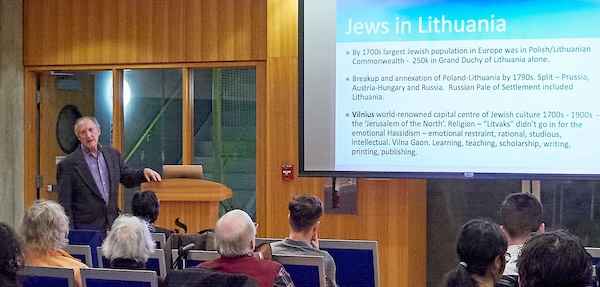
During Hillel BC’s Holocaust Education Week, Drs. Gene Homel (pictured above) and Rachel Mines offered Unheard Echoes, a program on Jews in Lithuania. (photo by A. Jaugelis)

Unheard Echoes, a program on Jews in Lithuania, was held Jan. 29 during Hillel BC’s Holocaust Education Week on the University of British Columbia campus. Dr. Gene Homel, an historian, and Dr. Rachel Mines, a Yiddishist and English instructor, spoke about the past and present experiences of Litvaks, Jews with roots in the region of Lithuania.

Homel began by introducing Lithuania, a liberal democracy in the North Atlantic Treaty Organization (NATO) and the European Union, currently in the news because of possible threats from Russia’s attack on Ukraine. He explained that Jews have been a key, productive part of Lithuania since at least the early 1300s, when they were invited by nobility to settle in these territories and were granted a charter to run their own affairs in their own communities. By the 1700s, the largest Jewish population in Europe was in what was then the Polish-Lithuanian Commonwealth, occupying much of Eastern Europe. The partition of Poland in the late 1700s absorbed the region into imperial Russia.

Vilnius, now Lithuania’s capital but then in the Russian empire, was known as “the Jerusalem of the North” for its role as a world-renowned centre of Jewish learning, culture and publishing. However, poverty and Russian conscription motivated many Jews to emigrate in the early 20th century to North America,  South Africa and elsewhere.

In 1918, with the First World War winding down, Jews joined the successful push for an independent Lithuanian state. While the restored Polish state, which now included Vilnius, slid into enhanced antisemitism in the 1930s, the much smaller Lithuanian state avoided pogroms and other extreme manifestations of antisemitism. Lithuanian Jews and Christians lived side by side in relative peace.

The 1939 pact between Nazi Germany and the communist Soviet Union divided Eastern Europe between the two tyrannies, and the Soviets forcibly annexed and Sovietized Lithuania and the other two formerly independent Baltic states, Latvia and Estonia. Mass deportations of Baltic peoples to Soviet Siberia included many Jews, who comprised an estimated 7% of Lithuania’s population but 10% of the deportees.

Nazi Germany’s invasion of the Baltics and the Soviet Union in mid-1941 initiated the Holocaust in Lithuania. Of the 220,000 to 250,000 Jews there, 95% were murdered, most in the early stages of Nazi occupation and control.

Lithuanian historians and researchers agree that, while most Lithuanians were passive bystanders, some thousands (the exact number is unknown) were (by degrees) active collaborators with the Nazis. Homel pointed out that collaborators were active in almost all other European countries, and there were some Lithuanians, such as Catholic clerics, who served as rescuers of their Jewish neighbours. More than 900 Lithuanians have been recognized by Yad Vashem as Righteous Among the Nations, and there were doubtless many more.

In 1944, the Soviets returned to the Baltics, robbing Lithuania, Latvia and Estonia of their independence, and costing many people their freedoms and their lives. Decades later, the fall of Soviet Communism – Lithuania was the first Soviet republic to declare its independence in 1990 – led to a revival of Jewish culture and institutions, as the Soviet Union had not only suppressed religious and cultural expression but denied or downplayed the Jewish Holocaust in the areas it controlled.

Homel discussed a particularly sensitive issue in Lithuania’s history of wartime Nazi occupation, since there was some overlap between those who were both anti-Soviet partisans from 1944 to the early 1950s (thus nationalist heroes) and Nazi collaborators. Recent published research on Lithuanian collaboration in the Holocaust has caused a stir of controversy, raising the problems of a competing sense of victimhood and of definitions of genocide. This can be seen as a sort of zero-sum game.  Collaboration has been a contested issue in other countries’ histories, of course, for example France and, notably, Poland.

That said, the Lithuanian government has accomplished much by way of justice since the restoration of independence. Shortly after that time, in May 1990, the government issued a declaration condemning “without reservation the genocide perpetrated in Lithuania against the Jewish nation … and notes with sorrow that among the executioners who served the occupiers there were also citizens of Lithuania.” The declaration also stated that there would be no toleration for any expressions of antisemitism, and that all bodies of government and citizens should “create the most favourable conditions for the Jews of Lithuania….”

Four years later, the government created the annual Sept. 23 National Memorial Day for the Genocide of Lithuanian Jews. Commemorations are held in schools and other public and governmental institutions. The prime minister recently joined a march to Paneriai, a site of mass murder of Jews and non-Jews during the Nazi occupation. The Vilna Gaon State Jewish Museum includes five sites, one being the “Green House” Holocaust museum. In 2011, Lithuania committed to pay 37 million Euros over a decade in compensation for Jewish communal property seized during the mid-20th century, and recently the government passed a bill to transfer another 37 million euros. Rescuers have been honoured in the country, as well as by Israel’s Yad Vashem. International teams of archeologists are working on a project to recover Vilnius’s historic Great Synagogue, which was utterly destroyed by the Soviets in the 1950s.

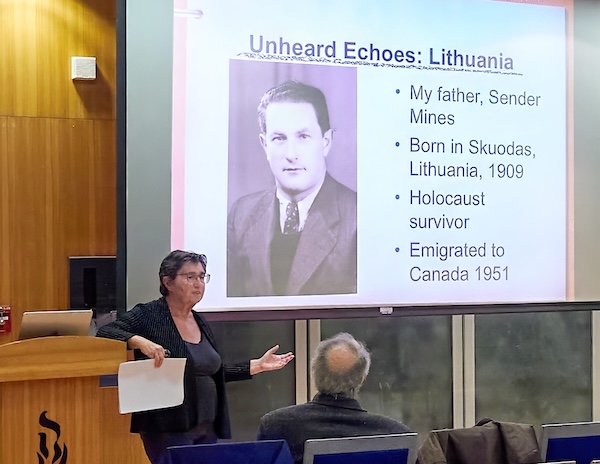
Mines followed Homel’s presentation with a more personal view of Lithuania, based on her reconnection with her Litvak roots, and her experiences with the non-Jewish Lithuanian community both in Lithuania and in British Columbia. She detailed her father’s family life in Skuodas, a lively and thriving town near the Latvian border, which, prewar, had many Jewish-owned enterprises. His relatives once owned a productive boot and shoe factory in town. In 1936, her father, Sender, moved to Kaunas, then capital of Lithuania, and married. In 1941, Sender and his family were imprisoned in the Kaunas ghetto. That winter, Sender was deported to Latvia and forced into slave labour in several Nazi ghettos and concentration camps. As a survivor, he emigrated to Canada in the early 1950s, where he remarried and started a second family.

photo - Dr. Rachel Mines presented a more personal view of Lithuania, based on her reconnection with her Litvak roots, and her experiences with the non-Jewish Lithuanian community both in Lithuania and in British Columbia
Dr. Rachel Mines presented a more personal view of Lithuania, based on her reconnection with her Litvak roots, and her experiences with the non-Jewish Lithuanian community both in Lithuania and in British Columbia. (photo by A. Jaugelis)

Mines and Homel have visited Lithuania a number of times in the last 16 years or so, including a Yiddish summer program at Vilnius University. They found a warm, welcoming reception in Skuodas, where the local museum featured a display on the town’s Jewish population, including Mines’s father. Locals took them to sites of interest, including the Jewish cemetery and Holocaust memorials, which date back many decades, to when the country was still under Soviet occupation. In 2015, Mines was invited to Skuodas to address high school students and adults during that year’s commemoration of the Holocaust in Lithuania. As she learned more about her father’s origins, Mines created a bilingual website on the town, shtetlshkud.com, as a genealogical and historical resource.

Both Mines and Homel are members of the board of directors of the Lithuanian Community of British Columbia (LCBC), which welcomes Litvaks and acknowledges the Jewish contribution to Lithuanian history and culture. The last two years, the LCBC has commemorated Lithuania’s National Memorial Day for the Genocide of Lithuanian Jews, first at the Peretz Centre for Secular Jewish Culture and then at the Italian Cultural Centre. LCBC’s website is lithuaniansofbc.com. 

– Courtesy Gene Homel

Supporting one another

On Jan. 22, Jewish Seniors Alliance, as part of its Empowerment Series, presented a lecture by Dr. Honoré France. An educator, artist, writer, therapist and consultant in the field of mental health, France explored the early history of seniors peer support, which is based on the concept of seniors helping seniors. 

Grace Hann, trainer and supervisor of Senior Peer Support Services at JSA, co-hosted the Zoom event with Andrea Krombein of South Vancouver Seniors Network, which co-sponsored it. About 60 seniors participated. Gyda Chud, past president of JSA, welcomed everyone.

In her introduction of France, Hann said she uses his writings in the JSA’s peer-support training program. She noted that France has presented his ideas on training in many countries and has been involved with peer support since the late 1970s, when he moved to Victoria. He was influenced by the works of Viktor Frankl, as well as work done in a hospital in Paris, where a doctor and a former patient began a program to help patients by using recovered patients as volunteers. Much research has been done in this area, she said, and it has been shown that paraprofessionals can be as effective as therapists.

France has written a book on peer counseling and peer support. As well, he said, Frankl’s book Man’s Search for Meaning and Erik Erikson’s eight stages of life (of psychosocial development) are still being used by therapists. Communication and listening skills are of prime importance in peer counseling, he said, and Hann pointed out that silence, as well as mirroring back what the client has said, are useful in opening communication and forming a bond between the volunteer counselor and the senior. Two volunteers, Marie and David Kirkpatrick, said they had learned from the training provided by Hann and Charles Leibovitch, senior peer support services coordinator with JSA, and through contact with clients.

France also discussed some of the myths about aging. For example, we are just as mentally fit at age 80 as at age 20, he said, but our reaction times are slower. To keep healthy, we need to exercise both the body and the mind, he said.

Chud thanked France for his comments and his work, noting how effective it has been in JSA’s peer support training program. Comments and questions included Margot Beauchamp on the connection between isolation, loneliness and general health, and Larry Shapiro said volunteering should be first on any list of things seniors should be doing.

A new training session for peer support will begin on March 1 and those interested should contact the JSA office. The next Empowerment program will take place in March, with the Jewish Museum and Archives of British Columbia. More details will soon be available at jsalliance.org. 

Shanie Levin is a Jewish Seniors Alliance Life Governor. She is also on the editorial committee of Senior Line magazine.

Critical thinking a vital skill

As a 20-something in the mid-1990s, I taught high school English. Part of my course load was a collaborative Grade 10 World Civilizations course that I co-taught with a social studies teacher. One day, I flippantly advertised our next assignment to a room of 16-year-olds, saying, “Oh, hey, we’re going to start reading Candide by Voltaire next week! You’ll love it! It’s full of sex, drugs and violence.”  

To my surprise, many of those students talked to their parents. I received a flurry of concerned phone calls, messages and emails. Parents were worried about the curriculum. In the end, my explanations were successful. Yes, it’s true that Candide is probably rated R, but this fantastical satire was first published in 1759. It’s a famous classic, it’s definitely “literature,” with lots of intrigue and ideas we can learn from – and, oh yeah, it’s not true. 

Literature teachers often speak of the great truths found in the classics, but fiction isn’t “the truth.” It’s complicated to untangle, and that’s why we study it to develop our critical thinking skills. In our multi-discipline history and English course, we had opportunities to discuss how history evolved, how we could examine primary sources to draw conclusions, and more. Literature was just a part of our opportunity to read and analyze important texts.

All this came to mind recently when some antisemitic posts came my way via social media concerning the Talmud. People started quoting the Talmud and inferring from brief quotations that Jews did all sorts of evil things. This was something of a modern blood libel approach; using brief snippets out of the huge body of law and literary work to condemn an entire ethnoreligious group. What followed was both a lot of nonsense and some deep belly laughs from Jews and scholars who study Talmud. Now, if you want to understand this text, buy all the tractates of the Babylonian (and don’t forget the Jerusalem) Talmud. You’re looking at a several-thousand-dollar purchase, which you can’t read unless you know Aramaic and Mishnaic Hebrew, as well as Rashi script, to read his commentary.

In recent years, Sefaria, an online database, has offered access to Talmud and many other Jewish texts, both in the original and in translation, for free. It’s been a tremendous gift and democratization of these ancient texts. However, having access doesn’t mean you have understanding. Like reading Candide for the first time, it’s helpful to have a teacher, some historical context, and lots of support to aid in your comprehension. These online X commenters, taking short rabbinic quotes out of context, had no idea what they were talking about. In many cases, the Talmud’s rabbinic musings explore arbitrary legal situations that never happened in order to explore and define the minutiae of Jewish law.

Also online, I saw others bemoaning how learning historical “facts” seemed solid and unquestionable – dates and events – but that, with modern events, it seemed hard to define what had happened and what was true as compared to misinformation. This anecdotal experience is common but it’s misleading. It takes a long time to establish a common narrative around a historical event, and “the winners” of war or political events create their version of history. Using multiple primary sources, as well as multiple historians’ accounts, helps learners see how historians lend their biases to their interpretation of what happened. We only get a full picture of “what happened” through exploring many perspectives from multiple sources. Even then, it’s hard to know if the history we’ve learned is “true,” or not.

Developing a mature understanding of literature and world events requires us to be critical thinkers. As F. Scott Fitzgerald wrote in 1936, “… the test of a first-rate intelligence is the ability to hold two opposed ideas in the mind at the same time, and still retain the ability to function.”

I’d say that, often, intelligent people explore complex political, historical, social or literary scenarios that hold multiple opposing ideas at once. But this kind of learning takes time and energy. It does not happen automatically. Our society loves binaries, where we get a quick yes/no answer.

My kids aren’t in high school. Yet, as a parent, I look forward to the day they come home excited about a “mature” literature assignment full of “sex, drugs and violence.” Each new milestone achieved fills me with hope. This year, for the first time, I have two kids who skate on their own, and I don’t always have to lace them up. At the same time, we’re trying to get to complex, but age-appropriate understandings of the Hamas-Israel war. We explore what is happening along with how the media depicts the situation. Who shapes our understanding of what’s happening? How? Most difficult is exploring the questions around whether anyone “wins” in a war when there is so much suffering involved. 

The world is complicated. We can use literature and ideas for enjoyment, but also as tools to help think about big issues. Thinking critically about complex issues is a sign of intelligence and maturity. We must cultivate this skill. I hope it’s something my kids achieve as those long-ago high school students did. 

Critical thinking is also a lens through which to examine the multiple simplistic social media and news narratives we’re facing every day. One can ask why the description of an event is so simplistic or who is consistently blamed in the narrative. Often, a short take on Talmud doesn’t demonstrate a deep understanding. A news article that fails to include the back story isn’t going to cut it. A view that always blames only one country – Israel – or one ethnoreligious group – Jews – might be similarly flawed.

Developing our thinking skills enables us to understand complexity. It also helps us discern an argument’s flaws. Let’s nurture smart thinkers so they can recognize and discard the nonsense, misinformation and hate that pops up so frequently now online and in the news. 

Joanne Seiff has written regularly for the Winnipeg Free Press and various Jewish publications. She is the author of three books, including From the Outside In: Jewish Post Columns 2015-2016, a collection of essays available for digital download or as a paperback from Amazon. Check her out on Instagram @yrnspinner or at joanneseiff.blogspot.com.

Remembering, learning

Hillel BC’s Holocaust Education Week takes place on campus at the University of British Columbia Jan. 29-Feb. 2. Every day of that week, there will be something going on to attend and learn from, including the exhibit from Yad Vashem called Shoah: How Was It Humanly Possible?, which will be on display the whole week.

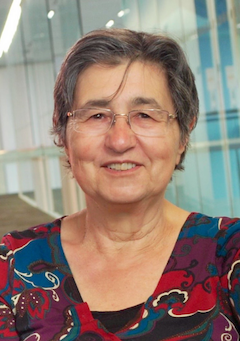
photo - Rachel Mines
Rachel Mines (photo from Hillel BC)

Jan. 29, 6 p.m.: Unheard Echoes: Jews in Lithuania Before, During and After the Holocaust. Presentations about the Jewish connection to Lithuania throughout history, focusing on the Holocaust, by Rachel Mines and Gene Homel, two members of the Lithuanian community. Register at forms.office.com/r/s4uAFqv8gc.

Jan. 30, 6 p.m.: Unheard Echoes: The Far Reach of the Holocaust in Asia. Ryan Sun is a PhD candidate in the department of history at UBC, working with Prof. Leo Shin and Prof. Richard Menkis. His transnational project expands the geography of Jewish exile outside Europe and beyond Shanghai, and onto the British colonies of Hong Kong and Singapore. He is particularly interested in Jewish refugees’ ship-bound experiences, how transiting colonial port-cities and encountering local inhabitants informed their understanding of “the Orient,” as well as how these ship-moments disrupt the standard narratives of the Holocaust and survivor testimonies. Register at forms.office.com/r/aQx4LG2Fhi.

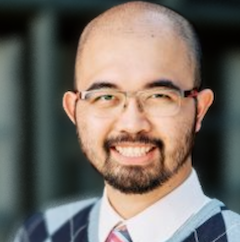
photo - Ryan Sun
Ryan Sun (photo from Hillel BC)

Jan. 31, 5 p.m.: In a partnership between Hillel, brothers of the AEPi chapter of Vancouver and Chabad UBC, there will be a reading of the names of those who were murdered in the Holocaust. Meet at Hillel, then walk over to the fountain at the main mall, where the reading of the names will begin at 5:30 p.m. The reading can also be joined online, live on Hillel BC Facebook and Instagram, as well as the Instagram page for AEPi. 

photo - Marie Doduck
Marie Doduck (photo from Hillel BC)

Feb. 1, 5 p.m.: A Fireside Chat and Q&A with Survivor Marie Doduck & Dr. Lauren Faulkner Rossi. Marie (Mariette) Rozen Doduck was born in Brussels, Belgium, in 1935. She immigrated to Canada in 1947 as a war orphan with three of her siblings and settled in Vancouver. She is actively involved in Holocaust education and is a cofounder of the Vancouver Holocaust Education Centre. 

Rossi is currently researching child survivors of the Holocaust, the significance of their memoirs to Holocaust studies and the shared language of trauma among child survivors of different genocides.

Register at forms.office.com/r/1MtRu24BWT.

Feb. 2, 5 p.m.: Students-only Shabbat Dinner with Honoured Guests: Holocaust Survivors will feature a candlelighting ceremony and survivors spread out among the dining tables with students. Students can register at forms.office.com/r/ayufQr3Zmy.

For more information or help with the registration links, email info@hillelbc.com or call 604-224-4748. 

– Courtesy Hillel BC

Learning, living coexistence

Hand in Hand (Yad b’Yad) is a group of Israeli schools where Jewish and Arab students learn together. Its co-founder, Lee Gordon, was in Vancouver last month (photo from Hand in Hand)

Lee Gordon, co-founder of Hand in Hand (Yad b’Yad), a group of Israeli schools where Jewish and Arab students learn together, spoke at Vancouver’s Or Shalom Synagogue and met with members of the community at large last month.

“We are always eager to have more friends and supporters for what Hand in Hand is doing, especially in the current very dark situation in Israel and in Gaza,” Gordon said in an interview with the Independent. “Hand in Hand is a beacon of light in a place where coexistence is not widespread enough.”

Gordon, who first moved to Israel in the 1980s, launched Hand in Hand with Amin Khalaf in 1997. The first classes started in September 1998 with 50 students on two campuses, in Jerusalem and in the Galilee. Today, there are more than 2,000 students, who study in Hebrew and in Arabic, on six campuses throughout Israel.

The bilingual schools were established to combat the threat posed to Israel by growing social alienation and lack of trust between Jewish and Arab citizens. Education, in the view of Hand in Hand’s founders, was – and still is – instrumental in changing this.

Gordon, who lived in Israel for 20 years before returning to the United States, became involved in Jewish-Arab dialogue while pursuing a master’s degree in social work from Hebrew University. Though the university was integrated, he observed, there was not a great deal of interaction between Jewish and Arab students, aside from weekly dialogues in which Gordon and others from the two groups would engage on campus.

While those meetings were clearly a step in the right direction, he felt they were lacking. “Dialogue is superficial. People can have lovely feelings afterwards but don’t see each other again,” said Gordon, who is currently the director of American Friends of Hand in Hand. 

Later, when working on a fellowship project through the Mandel Institute, Gordon spent time looking at schools in Israel and analyzing what makes them succeed or fail. In the backdrop was the reality that the school system in Israel is completely segregated, even in mixed communities, such as Jerusalem and Tel Aviv.

“I started building a rationale for a school being a wonderful venue for bringing Arabs and Jews together, because it is not just for one hour a week. Once students are in school, they are there all day, all week, all year, and have a chance to truly get to know the other,” Gordon said.

Realizing that he needed an Arab partner for his goal of creating an integrated school to reach fruition, Gordon was introduced to Khalaf, an educator whose hope was for his children to grow up feeling as equals in Israeli society.

Hand in Hand was officially registered in spring 1997 and, for a year, Gordon and Khalaf scouted the country, trying to locate an ideal spot to start the school.

“We knew we wanted one in Jerusalem but also wanted a backup,” said Gordon. “We settled on an area in the Galilee where the Jewish and Arab towns are close together.” 

When the first schools opened in fall 1998, the primary challenges consisted of hiring teachers, raising funds and recruiting Jewish students.

“We knew Arabs, as the minority, would flock to our schools, it would be seen as a step up for them,” said Gordon. “Jewish parents would be more of a struggle. We wanted our schools to be accredited and not be viewed as boutique, esoteric schools lacking legitimacy.”

photo - Hand in Hand kids
(photo from Hand in Hand)

Though never without obstacles, as the schools grew each year, it became easier to recruit new parents because Hand in Hand presented an attractive educational possibility – students were learning two languages in a vigorous academic environment, they were happy and the class sizes were smaller.

Even today, Gordon admitted, Hand in Hand still has to work harder to recruit Jewish parents, particularly after the Hamas attacks on Oct. 7.

“This is the worst war of the four since Hand in Hand has been in existence,” he said. “Jewish families often know someone who was killed or taken hostage, and many of the Arab families have relatives in Gaza.”

While there were concerns that Jewish families might withdraw their children from classes following the attacks, that has not happened yet.

“Bringing people together is really the only way there is any hope of this conflict ending because it is not happening on political levels,” Gordon said.

Multiple researchers have shown that there are many benefits from bilingual education, such as more empathy, better academic performance and improved engagement. Beyond those benefits, Jewish and Arab students at the Hand in Hand schools develop close friendships, which start through childhood sleepovers, birthday parties and play dates. Moreover, adults have formed long-lasting bonds with one another.

“Many parents have spoken of how they have been transformed by the experience,” Gordon said.

Hand in Hand schools are public, recognized and overseen by the Israeli Ministry of Education, and open to all parts of the Arab and Jewish populations in Israel. Government funding is supplemented by philanthropy and parents’ fees.

Besides Jerusalem and the Galilee, Hand in Hand operates schools in Haifa, Jaffa, Kfar Saba and Wadi Ara.

For more information about Hand in Hand, visit handinhandk12.org. Canadian residents can make a tax-deductible donation to Hand in Hand through the Jerusalem Foundation of Canada, 1-877-484-1289. 

Sam Margolis has written for the Globe and Mail, the National Post, UPI and MSNBC.

Focus during distracted times

As a freelancer, I often find interesting work opportunities that don’t pan out. I spent time in December applying for an editor gig that involved editing summaries of literature to provide students with educational support. I used to think these supports were “cheating,” using these kinds of guides, but now I know differently. Students with special needs deserve access to these stories. I recognize that every student has the right to learn, read great pieces of literature and access education, even if they struggle along the way. So, I dutifully filled out the form, sent off my CV and submitted an application. One application question irked me. “What’s your favourite piece of literature and why?”

Two things bothered me. One is that this response had a word limit on the form, so nobody could wax eloquent about whatever they chose. The second thing is that, as someone in mid-life who reads voraciously, I thought it was ridiculous to ask what someone’s all-time favourite was. I couldn’t possibly name only one, but I thought about it. I’ve been reading Talmud daily for about four years. I must like it. Further, it has helped me gain a lot of insight into the ancient world, and reflects further on ancient cultures, law systems and storytelling.

I tried to fit this into the form, but I had reservations. The organization had a big “We do not discriminate” statement on its page but, after Oct. 7, I wondered if I was risking something to say that the Babylonian Talmud was my current favourite. My concerns might have been warranted. On Dec. 25, in the morning, I received a vague form email telling me my application hadn’t been successful. My household laughed about the timing of the form letter. What were they indicating? That Jews should work as usual on Christmas, a North American statutory holiday? Or that my choice of literature was so egregious they couldn’t wait for a business day to reply? Perhaps something else about my qualifications didn’t meet their needs. It’s best not to work for a place that isn’t a good fit. Although this part-time gig had great potential, I wasn’t a contender. That’s OK.

This experience made me reflect on my lifelong relationship with reading. I’ve always loved to read. One of my undergraduate majors was in comparative literature. A  favourite moment during my graduate work in English education came when the professor put different things on a table and asked us to list which things were “literature.” The professor included newspaper articles, fiction and nonfiction, plays and song lyrics, advertisements, and more. Her point was that we often couldn’t predict what piece of writing would stand the test of time. Further, all of us would have different answers to this question about how to define literature and its meaning. She was right.

Since Oct. 7, I’ve had a hard time focusing. For a long time, I couldn’t read a book. Don’t get me wrong – I’ve been glued to the news and social media, reading many articles and much political analysis. I listened to completely “fluffy” fiction audio books as I cooked but, eventually, I had to stop renewing a book I’d checked out from the public library. It was nonfiction, a book about the US Great Migration called The Warmth of Other Suns, by Isabel Wilkerson. It was well-written and engaging. I felt like apologizing to the author. I couldn’t focus enough to remember the various narrative threads or finish it.

Later, on Dec. 25, I managed to complete reading On the Way Home, the short diary of Laura Ingalls Wilder, which recounted her trip from South Dakota to her new home in Mansfield, Mo., in 1894. This brief chronicle transported me, giving me a window into travel during a period of US history that I could only imagine. Was it literature? Perhaps, because it worked the way literature should. I spent time in my imagination in a different place and time. It offered a brief respite. Perhaps it’s the start of being able to focus on reading again? I can only hope.

I wondered why I’d made it through this (admittedly short) volume I’d found at a neighbourhood Little Free Library. It made me reflect on what aspects of literature are valuable and what allows us to focus on it. Perhaps it’s about escape or the imagination. Maybe it helps us learn about relationships, history and culture.    

Four years ago, I resolved to start Daf Yomi, reading a page of Talmud a day, on Jan. 5. It was my birthday and close enough to the start of the secular new year to be a “resolution” that truly stuck. After four years of reading a page a day, I am still immersed in this experience. Even though I read mostly in English, and barely skim the surface of each page, I’d argue this is a good read. I’ve learned a lot, but it has taken work and research to make meaning. Sometimes, I have to struggle with finding connections with the rabbis who lived 2,000 years ago. Even as the rabbis struggled with practical issues, I sometimes have to read commentaries and make a leap to figure out how the issues applied then as compared to today. 

Great literature is about history and context, as well as mystery, and it’s all there, wrapped up for us like a big gift in Jewish literature. Religious texts like Torah and Talmud, as well as all the other Jewish stories that came afterwards, add meaning and depth to our lives. Surprisingly, I haven’t had trouble focusing on these narratives.

Here, too, is another lesson that literature is teaching me – we Jews are a small people but have incredibly rich literary and spiritual resources. As Israel struggles physically with war, these texts remind me what we’re fighting to maintain. Doing the work to understand these texts offers us so much history, context and tradition, I’m grateful to have the opportunity. It’s the least I can do when so much is at stake. 

Joanne Seiff has written regularly for CBC Manitoba and various Jewish publications. She is the author of three books, including From the Outside In: Jewish Post Columns 2015-2016, a collection of essays available for digital download or as a paperback from Amazon. Check her out on Instagram @yrnspinner or at joanneseiff.blogspot.com.

Pride in being “just a Jew”

There is an age-old question that frequently nags at us along our journey of life: “Who am I?” I’ve struggled with it, and perhaps you have as well. When you ask yourself “Who am I?” you probably start by listing superficial things about yourself. In my case, I’m from Argentina, I play music, and people say I have a great sense of humour. Even though I always knew who I was on the surface, a deeper layer eluded me. There is still more to learn about myself.

When I was young, well, younger than now, I constantly pressed my father with the similar question that was scrambling in my head: “Who are we?” I was trying to find a simple way to get my answer, to avoid spending my own time navigating the question so I could do something (seemingly) more productive, like playing video games. I figured that, by asking my dad, I may very well be who he is, given I’m his son, an extension of him, in many ways. But, every time, my father would reply in the same cryptic way and always with a smile on his face: “Son, we are Jews.”

I was never quite able to comprehend why he couldn’t just give me a plain answer, rather than that infuriating, puzzling and annoying explanation. I was not going to give up and, with my insistent character, I continued asking. I posed the question from different angles, wanting him to elaborate, but he would just say, “Uriel, it’s simple. We are Jews. You and I are solely Jews.”

When my dad couldn’t satisfy my curiosity, I turned to my school’s rabbi, Rabbi Stephen Berger. When I asked Rabbi Berger, his answer was just as confusing and mysterious. He kindly stated that he could not provide me with the answers I sought; I had to embark on this road of self-discovery myself, with the help of my loved ones. Then, about halfway through the year, he introduced me to StandWithUs Canada, an organization that would help me better understand who I was by putting me in touch with other Jewish teenagers from around the world.

I now realize why I couldn’t access a fast-food solution to a philosophical question. I finally found the answer I’d been seeking.

Last August, as I joined 190 of my peers from high schools throughout the United States and Canada at the StandWithUs conference in Los Angeles, I found myself on a path leading to enlightenment that has reshaped my understanding of Jewish identity. The sessions were informative and interesting, but it was when we reached the segment focusing on what Jews were before the dark chapters of persecution during the Holocaust – they were highly contributing members of society, and more – that everything started to click.

A single statement truly hit home: Jews have been forcibly expelled from about 109 countries throughout history. It was a stark reminder that, regardless of our accomplishments and contributions, we would always be seen as “Just a Jew.” It became clear that the essence of being Jewish transcended any specific occupation or societal role. We are a resilient and diverse community with a history of triumphs and tragedies. 

This knowledge instilled a sense of pride in my identity, not as a limitation but as a source of strength and unity. Thanks to StandWithUs Canada, I learned that, at the end of the day, embracing who we are, with all our complexities and contributions, is a powerful testament to the enduring spirit of the Jewish people. I felt a sense of pride but a pride that could be taken away from me at any moment. This is when I decided to become a more invested member of the community by being on the board of NCSY, the Orthodox Union’s youth group.

Talking to politicians and people who can truly make a difference became an essential component of my advocacy. I understood how dialogue and education could change people’s perspectives. 

My aim in sharing the history of the Jewish expulsions and the resilient spirit of our community is to raise awareness and foster understanding. My tool against bigotry and ignorance is teaching. I am committed, every day, to teaching people about the rich history of the Jewish people.

Uriel Presman Chikiar is in Grade 12 at King David High School and is a board member of NCSY.