New JFS scholarship fund

Fay and Ken z”l Golden, whose support has allowed Jewish Family Services to offer two education scholarships. (photo from JFS)

Thanks to the generosity of Fay and Ken (z”l) Golden, Jewish Family Services Vancouver has introduced the Fay and Ken Golden Annual Scholarship fund, aimed at supporting the educational endeavours of individuals entering accredited post-secondary institutions.

“We are delighted to support the educational aspirations of Canadian students through the Fay and Ken Golden Annual Scholarship Fund,” said the Goldens. “Education is a cornerstone of personal and societal growth, and we hope these scholarships will empower talented individuals to pursue their academic dreams.”  

JFS will offer two scholarships yearly, each valued up to $2,500. These funds will be disbursed as a one-time lump sum per academic year, providing financial assistance to qualified recipients.

The 2024 application period started May 15 and goes until June 30. Successful applicants will be notified no later than Aug. 1, 2024.

To be considered for the Fay and Ken Golden Annual Scholarship Fund, applicants must meet the following requirements:

• Be a Canadian citizen or a permanent resident of Canada.

• Be 40 years old or younger at the time of application.

• Be a first-time post-secondary student.

• Have an annual household income below $60,000.

• Currently be attending or planning to enrol in a post-secondary academic program provided by an accredited, certified educational institution in Canada. 

This yearly scholarship fund embodies JFS’s commitment to fostering education and opportunity within the community. JFS is grateful for the Goldens unwavering support and belief in education. For application instructions, visit jfsvancouver.ca/golden. 

– Courtesy Jewish Family Services

Pushing back against antisemitism

With antisemitism rising in British Columbia, professionals from three sectors – health care, post-secondary education and K-12 schools – have started organizing so incidents of hatred in their workplace are challenged at every opportunity.

The Jewish Academic Alliance of British Columbia and the Jewish Medical Association of British Columbia have launched in the past few months, while BC Teachers Against Antisemitism has grown more active since the Hamas terror attacks on Oct. 7, 2023.

“Antisemitism is reaching crisis levels in BC, and we are proud to be able to support the important work of these newly formed groups at this critical time for our community,” said Ezra Shanken, chief executive officer of the Jewish Federation of Greater Vancouver.

“I am in awe of all of our community members and allies who are stepping up to address what is a clear crisis at workplaces across the province – particularly since employees are uniquely positioned to address workplace issues with their employers,” noted Nico Slobinsky, vice-president, Pacific Region, Centre for Israel and Jewish Affairs.

“We have seen an incredible increase in worrying activities – from terror-affiliated organizations like Samidoun setting up an encampment at UBC to teachers making inappropriate comments towards Jewish students in the classroom, to troubling behaviour in our healthcare system. Yet, we have seen little by way of new activity by government,” said Slobinsky.

“The rise of antisemitism inside health care has been chilling. In a profession dedicated to healing people, we’ve witnessed hateful words and actions that have some fearing for their safety,” said Sharon Gershony, clinical instructor, pediatric nuclear radiologist, BC Children’s Hospital. “The Jewish Medical Association of BC is a supportive community for Jewish physicians, trainees and allied healthcare professionals. Together, we will create safe workspaces by confronting antisemitism with engagement, education and promotion of respect and greater tolerance.”

“Post-secondary institutions across BC have been a focal point of antisemitic activities and actions, some of these threatening the safety of faculty, staff and students. There is no place for this in BC,” said David Silver, a University of British Columbia professor who is helping form the Jewish Academic Alliance of BC. “By bringing together Jewish professors, educators and staff from across campuses, the Jewish Academic Alliance of BC will work to ensure that hate is confronted and campuses are again a place where Jews can feel safe.”

“Since Oct. 7th, some horrible things have happened in classrooms and in schools – to teachers and students alike, who have been singled out because they are Jewish and only because they are Jewish,” said Ginaya Peters, founder of BC Teachers Against Antisemitism. “We have had to become more active and will continue to push back against the hatred and discrimination and create a safe learning environment for all.” 

– Courtesy Jewish Federation of Greater Vancouver

Community milestones … Rabbi Carey Brown

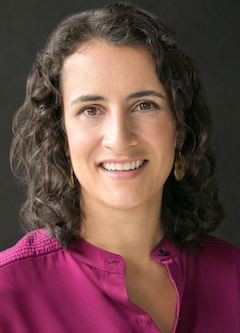
photo - Rabbi Carey Brown of Temple Sholom
Rabbi Carey Brown of Temple Sholom (photo from templesholom.ca)

Rabbi Carey Brown of Temple Sholom will be part of the next cohort of Shalom Hartman Institute’s Rabbinic Leadership Initiative (RLI).

The intensive three-year fellowship program immerses North American rabbis of all denominations in the highest levels of Jewish learning, equipping them to meet contemporary challenges with ever-increasing intellectual and moral sophistication. It is one of the few structured frameworks for ongoing rabbinic study, enrichment and intellectual leadership training. In addition to rigorous study, the program fosters a deep sense of community for diverse rabbis in an environment of open dialogue, collaboration, peer-learning and personal support. The next cohort begins next month.

Waldman’s 2024 Human Library

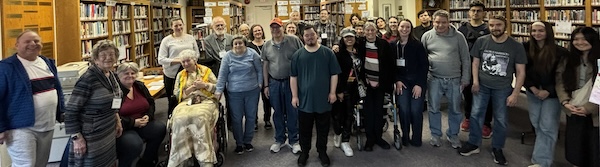
Participants in the Human Library event at the Isaac Waldman Jewish Public Library on April 7. (photo from Waldman Library)

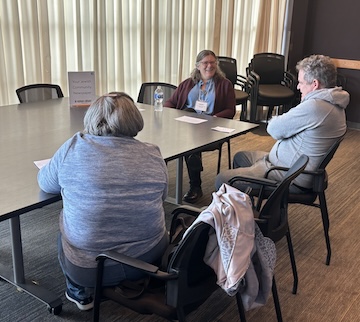
photo - Jewish Independent publisher Cynthia Ramsay (inset, middle) was one of the “books”
Jewish Independent publisher Cynthia Ramsay (inset, middle) was one of the “books.”  (photo from Waldman Library)

The Human Library event at the Isaac Waldman Jewish Public Library on April 7 drew a diversity of “human books” (volunteers who shared some of their life experiences) and readers (people who came out to learn about those experiences). Titles included Police Officer; Coping with Dementia: A Mother/Son Story; More than just MS; Brain Cancer Survivor; Your Jewish Community Newspaper; and Partners in Care. Books and readers gathered at the library, had snacks and shmoozed, before participating in three separate reading sessions over the course of the afternoon. The purpose of the event is to connect one-on-one or few-on-one with individuals from different cultural backgrounds and lifestyles, celebrating our differences and fostering understanding.

Mitzvah to return lost items

During the winter and spring in Winnipeg, sometimes one sees a child’s toy or a colourful mitten attached to a tree or hedge along a sidewalk. These are lost items. The neighbourly thing to do when you see something in a snowbank or on the packed snowy sidewalk is to pick it up and prop it up at adult eye level. It helps others. Maybe it will stop toddlers’ tears. 

Our household found somebody’s bike lock key last fall. This was harder to post. We took a piece of paper and wrote “Is this your key?” on it in large capital letters. Using clear tape, we attached the key and the sign to a powerline pole. A long time passed. One day, someone finally found their key. Relieved, we took down the sign.

I’ve been studying the Babylonian talmudic tractate of Baba Metzia, which covers civil law, including the rules around how to deal with lost items. It examines details that I often ponder. For instance, if a person finds an inanimate object, it has different obligations attached than if one finds an animal. We must return lost animals. If we don’t know how to return them, the finder must care for the animal, including feeding and watering the animal. If the animal’s upkeep is a burden, provisions exist for selling the animal and keeping the money to compensate the person who lost their animal. The particulars can be complex.

I became interested in a category that isn’t easy to describe – an object that isn’t alive or animate but still needs care. Things like books, which, in the days of the Talmud, were scrolls made of parchment made from animals. The finder had to rotate the scrolls occasionally to maintain them until they could return them. The finder couldn’t use the scrolls for study in a way that might cause undue wear on these hand-scribed texts. 

Another thing in this category, in Bava Metzia 29b, says: “If one found a garment, he shakes it once in thirty days and he spreads it out for its sake, to ventilate it, but he may not use it as a decoration for his own prestige.” As someone who makes and cares for natural fibre textiles (handspun and knit sweaters, for instance), I understood this immediately. Clothing wasn’t mass produced then. There were no factories. Everyone used spindles and spun and wove clothing. It wasn’t fast fashion. Clothes took skill and a lot of time to make. So, if someone found a garment, he knew its value. It wasn’t disposable. He must keep it well-aired, to be sure it was clean and cared for, and not attracting destructive pests like moths. Since he didn’t own or make it, he also couldn’t use the garment himself. 

Bava Metzia also explores when someone loses a garment and “despairs” of its return. That is, when one gives up entirely on getting it back.

For anyone who has seen images of the destroyed cars, homes and belongings left after Oct. 7 on the kibbutzim in southern Israel or from the Nova festival, these details hit hard. Some Israelis from these areas escaped with their lives but have “despaired” of ever getting back what they lost, they don’t want to return and try to reclaim things. Others asked for help or sifted through the remains of their homes to find precious items. Still others have managed to return home to their belongings and restart their lives.

This despair and reclamation reminded me of my in-laws and their stories of displacement after the Second World War. Their possessions, buried or left behind years earlier in Poland, were impossible to claim. Non-Jews had moved into their homes and taken their things. After four years in five different displaced persons’ camps, my father-in-law, his sisters and parents moved to the United States. Decades later, my husband’s grandmother would describe her family’s bakery in Mezritch and what they lost. Even in her despair, there was an acknowledgement that she worked daily to let go of that loss, and be grateful for a new, rich life for her family. 

This family refugee story, of loss and rebuilding, contrasts sharply with the UNRWA concept of intergenerational Palestinian refugee status. As Jewish communities have been forced to move over thousands of years, we have, perhaps, been lucky to have these talmudic guidelines, now 1,500 to 2,000 years old, on how we can claim lost items and how we can accept loss and move on. As we tell the Passover story, we remind ourselves of the many times our people have had to leave everything behind and start again. 

Teaching how to navigate lost items starts young. A PJ Library book sent to our children, called Sara Finds a Mitzva, helped us with this. Sara, the protagonist, follows through with the mitzvah (commandment) to return lost items when she finds a toy duck. She tours her Orthodox New York City neighbourhood to find the duck’s owner. My kids loved this book and its beautiful illustrations, which offered glimpses of my mother’s childhood, as well as taught a valuable lesson.

We also work with our children to help them understand that sometimes things go missing, and how to move on. After all, we say, it’s just a thing. People matter more than things. With war on our minds, we must focus on what counts most. I am praying for the safe return of the Israeli hostages. We cannot fall prey to despair – our tradition teaches that, when we despair, we have given up hope of an eventual return. Further, we must make sense of a situation where thousands of Israelis have lost their physical belongings but must now make a new life for themselves. Across the border, there are civilians in Gaza who must also rebuild their homes and lives after the war.

It’s one thing to study the rabbis’ ancient debates as an intellectual exercise. It’s another thing altogether to return pets and livestock, find belongings, and make new households amid this destruction. We have a history of past loss that offers guidance, as those affected by war are physically finding their way through this difficult experience. 

We must work together to find new paths after loss. Even if it’s familiar territory, as Jews, it doesn’t mean it’s easy. Perhaps each of us, like Sara in the children’s book, can be lucky and find something – whether it’s physical or intangible. Then we, too, can do the mitzvah of returning lost things, and observe Passover, too. Creating a joyful holiday after trauma also offers a third mitzvah, that of tikkun olam, or “repairing the world” – bringing a bit of joy back to someone who needs it. 

Joanne Seiff has written regularly for the Winnipeg Free Press and various Jewish publications. She is the author of three books, including From the Outside In: Jewish Post Columns 2015-2016, a collection of essays available for digital download or as a paperback from Amazon. Check her out on Instagram @yrnspinner or at joanneseiff.blogspot.com.

The joys of making matzah

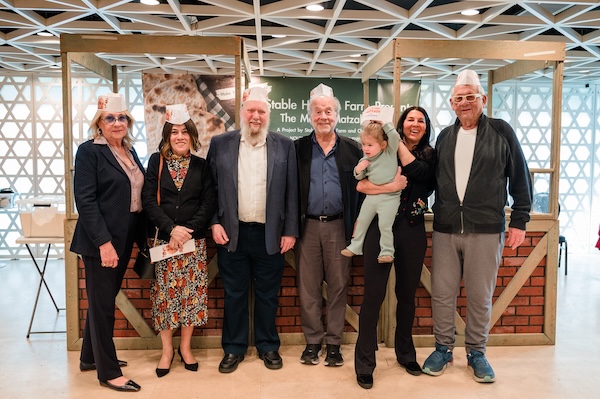
Left to right: Joanne Belzberg, Henia Wineberg, Rabbi Yitzchok Wineberg, Arnold Silber, Tammi Kerzner and Syd Belzberg. (photo by Yaletown Photography)

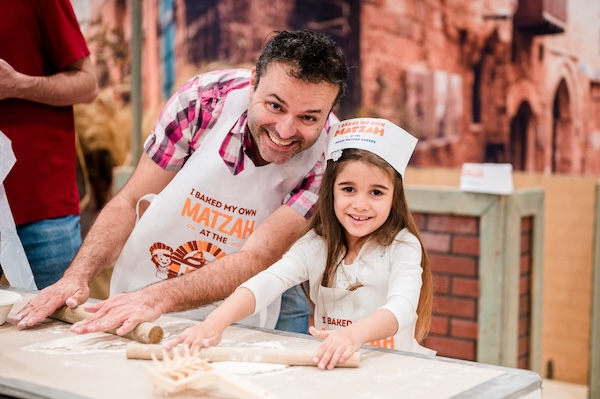
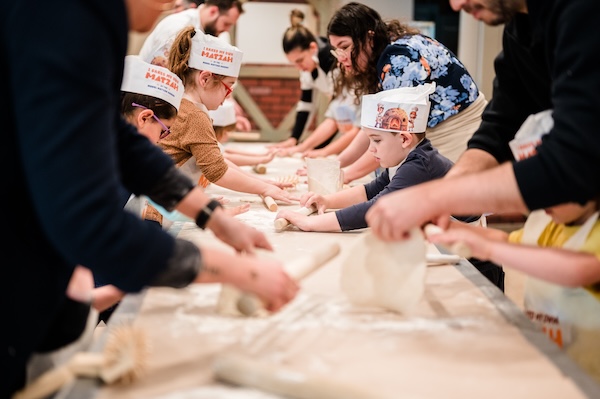
For more than three decades, the Model Matzah Bakery, organized by Chabad Lubavitch in British Columbia, has offered a unique and interactive Passover experience for thousands of participants. What started in the early 1990s has blossomed into an event anticipated by children, high school students, adults and seniors alike.

The hands-on program immerses participants in the ancient tradition of making matzah, a significant element of the Jewish holiday of Passover. From separating wheat kernels to baking the final product, attendees go through each step of the process, gaining a deeper understanding of the cultural, spiritual and historical significance behind this unleavened bread.

One of the highlights of the Model Matzah Bakery is its emphasis on participation. Everyone is invited to roll up their sleeves and get involved in every aspect of the process. We begin by separating wheat kernels from the chaff, a task that connects us with the agricultural roots of this ancient practice. Next, we grind the kernels into flour, followed by meticulous sifting to ensure the purity of the ingredients. As the flour mixes with water, laughter and excitement transform the process into a joyful communal experience. With expert guidance from volunteers, participants roll out the dough, making sure to create holes to prevent leavening. And all of this must be completed within a strict time limit of 18 minutes, after which the dough may begin rising, which will create chametz, leaven, which is not permitted during Passover.

This year, the Matzah Bakery got an upgrade as it partnered with Stable Harvest Farms. Not only did participants get to make matzah for Passover using locally grown, organic wheat, Stable Harvest Farms is also offering the chance for children to experience the process from farm to seder table – literally. Two family days will be hosted at the farm, where families will plant and then harvest their own wheat, which they will then use to create matzah for next Passover. Save the dates: May 12, a special Mother’s Day celebration, where the wheat will be planted, and Sept. 8, a pre-Rosh Hashanah experience, including harvesting the wheat and setting aside for Passover 2025/5785.

“Chabad is known for their innovative approach to Jewish education,” said one educator from a local Jewish day school. “This kind of hands-on, start-to-finish project will guarantee that the children remember the joy and excitement of the holiday for years to come.”

While initially designed for children, the Model Matzah Bakery has evolved to welcome participants of all ages. High school students and educators find themselves drawn to the program as an engaging way to learn about Jewish traditions, while adults and seniors appreciate the opportunity to celebrate their cultural heritage. This year, for the first time, children with special needs had their own opportunity to visit the bakery.

“It’s not just about making matzah; it’s about connecting with our heritage in a tangible way,” said Rachel Cohen, a long-time attendee of the Model Matzah Bakery. “The experience of being part of something so ancient yet so relevant to our lives today was truly special.”

Rabbi Dovid Rosenfeld, director of Lubavitch BC, which organizes this project, emphasized the importance of preserving and passing on these traditions to future generations. “Our goal isn’t just to teach about matzah making, but to create lasting memories and connections to our shared history through positive Jewish experiences,” he explained. “When participants left here, they took with them not just matzah, but a sense of belonging and pride in their heritage.” 

– Courtesy Chabad Lubavitch BC

King David head retires soon

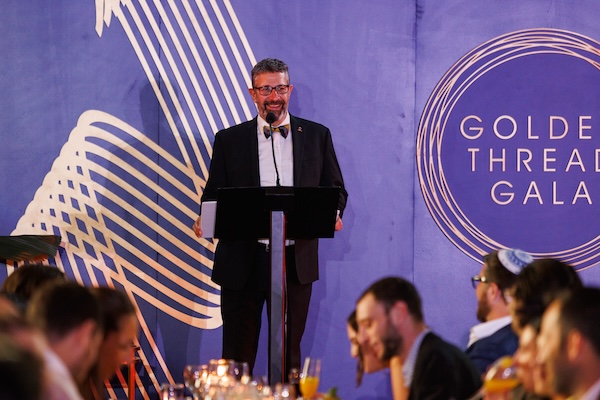
King David High School principal Russ Klein at the school’s 2023 Golden Thread Gala fundraiser. About to retire, this year’s event will celebrate his 16 years of service. (photo from  KDHS)

Russ Klein stepped into the role of head of school at King David High School for a two-year temporary stopgap when Perry Seidelman retired in 2008. This June, he retires after 16 years at the helm.

“This job has just been a gift,” Klein said, before clarifying: “It hasn’t been a job.”

Klein was a vice-principal at Prince of Wales Secondary, in the Vancouver public school system, and was on track to become a principal when the position at KDHS opened. One of the teachers at PW was on the search committee to hire the new King David head of school and asked Klein – hounded might be a more appropriate term – to consider the role.

“I told him a number of times, using choice language, what I thought of that idea,” Klein recounted recently in his corner office at the school.

Finally, Klein consented to meet the search committee’s director, who convinced him to tour the school. He was suddenly interested.

Klein’s superiors at the Vancouver School Board thought a two-year stint as principal at an independent school would be good experience before returning to the public system, and a deal was struck.

“I thought I was in and out,” he said. “I thought I was coming because they needed someone. They knew I had a two-year contract. That’s what I signed.”

The King David experience, though, changed his life.

“When the Vancouver School Board invited me back to be a principal at one of our local Vancouver schools, I had to think long and hard about it and I realized I didn’t want to leave,” said Klein. “I had joined a community that was so different than anything I had experienced before. 

“In this job, I found a community that I didn’t know I had,” he said. “That was beyond special. I really do think of this job, this position really, as a gift.”

Klein, who was divorced, found not only professional fulfilment at King David, but personal, too. At the school, he met Deborah Youngson, a King David parent, and they have been together for 13 years.

“Deborah is the gift that keeps on giving,” he said. “She is just simply unbelievable. She has managed to help me through the highs and the lows of this job because I could not have done it on my own. Believe it or not, it may be a small school and it may be a small Jewish community, but there’s a lot of pressure that one feels and trying to look like the pressure isn’t impacting you when it really is, is not always so easy. But having a person who understands and is supportive made the biggest difference in the world.”

There are many tangible and intangible measures of success in the education field. The year Klein started, the Grade 8 incoming class had 18 students. This year’s Grade 8 intake was 65. Total school population has risen to 270 from fewer than 140.

“That’s very pleasing for all of us because the whole goal is to provide a Jewish education for as many Jewish students as we can,” he said. “That’s the mission.”

As the only Jewish high school in town, King David has an obligation to reach the widest swath possible, he said.

“We need to be able to provide as much of an education as we can from secular to, let’s say, a more traditional family,” Klein said, noting they use the term pluralistic Jewish school. “We also describe ourselves as a community school. We are open to everyone. We want everyone to be here. We are not a religious school – I will just clarify that with people – but we are a faith-based school.”

Among the advances during Klein’s tenure has been the solidifying of the Judaics department and the requirement for all students to participate in that component. He cites as a point of pride the annual Grade 8 trip to Israel – though global events have hampered that tradition in recent years.

Taking Grade 8s to Israel is rare, he said, as most Jewish schools in North America wait until students are a bit older. Klein thinks getting kids to Israel as early as possible is invaluable.

Dorin Eilon-Heiber, the school’s Hebrew coordinator and Judaic studies teacher, organizes the Israel trip and she and Klein have now accompanied more than 500 students on the journey.

“That’s probably one of the biggest satisfactions I have,” he said, laughing that it’s hardly a vacation. “But it was a privilege.”

The school had previously taken students on Israel trips but when Klein arrived they began taking the Grade 8s.

“It was considered young and we even had pushback here in taking them [at that age],” Klein acknowledged. However, the impact on the students throughout their high school experience is profound, he said. “I would ask [students], why do you come to a Jewish day school? And the kids don’t know. To be honest, many of them know they’re Jewish, [but] they’ve never been to Israel, they don’t know anything about Israel. My goal was to take them in Grade 8, let them fall in love with Israel and – you know how teenagers are, puppy love, etc. You go to Israel in Grade 8 and it is one of the most special moments you have in your life. We take them to meet Israelis, to spend time in Israeli homes and, literally, they fall in love.

“And then they have four more years to understand why they are actually at a Jewish school or why they’re learning Hebrew or why the history that they are learning is meaningful,” he said. “I just think it changes the conversation for them.”

Then worldwide events intervened. COVID prevented the annual excursion in 2020, 2021 and 2022. By 2023, the only students who had been on the school trip to Israel were in Grade 12. “So, last year, we were able to organize with our Israeli sister school, Har Vagai, two trips,” said Klein. “We took one in October with our Grade 10 students and we took one in March with our Grade 11 students, trying to catch up.”

Doing two trips was too stressful on the school and stressful on the Israeli hosts. “So, we decided at that point that this year we would move the trip to Grade 10 because we couldn’t catch up to get back to Grade 8,” he said.

There were plans to take the students just after Pesach this year. “And then, of course, Oct. 7 happened and we’re not going to Israel in Grade 10 this year,” Klein said. The sister school, located just outside the Vancouver partnership community of Kiryat Shemona, in the Galilee Panhandle, is mostly evacuated due to attacks from Hezbollah in southern Lebanon.

“They are all in hotels and other places and it’s a terrible situation,” said Klein. “Dorin and myself and our spouses are heading to Israel in a few weeks and we’re going to visit our sister school, take them our love and presents, and we’re also going to take our alumni in Tel Aviv and Jerusalem out for dinner, offer them our love and support and just say, hey, we’re here with you.”

Klein credits the entire KDHS team for everything he has accomplished over 16 years, but especially for stepping up during COVID.

Managing education during the pandemic may have been easier for independent schools, being able to navigate separate from a massive bureaucracy, said Klein. Within two days of shutting down in March 2020, King David classes were completely online. Unlike public schools, students were back in classes, with extensive protocols, at the beginning of June. 

In addition to the immediate issues of a deadly pandemic, there have been conflicting ideas about vaccines, masks and the broader needs and solutions in dealing with it. Klein credits parents and staff with superb resilience and patience.

There was a loss, though, of some of the social factors. Relationships between school staff and parents were less robust than before the pandemic simply because face-to-face contact was reduced, he said.

COVID has not been the only difficult time. 

“The lows are tragic moments, when alumni passed, parents passed,” he said. “Of course, most recently, with the loss of Ben Mizrachi in Israel at the Nova Music Festival [on Oct. 7]. Those are really hard, especially to try and lead when you are feeling as heartbroken as everybody else. Those lows are pretty clear.”

Klein calls the past 16 years “the most meaningful in my life,” bringing him back into a community he had mostly left behind. 

“I went to Talmud Torah [elementary school], I was part of the Jewish community in Vancouver. I had my bar mitzvah at the Beth Israel and, then, like a lot of people of my generation, I did not participate,” he said. “I went to Israel in my 20s a couple of times, spent time on kibbutzim and had that experience and fell in love with Israel, but I wasn’t living any religious life or any traditional life whatsoever. When I came to the school, my whole life changed, and I had community and that was a gift.”

As for retirement, Klein has planned not to plan.

“Very intentionally, I am not making a plan,” he said. “I’ve got tension and stress that needs to ooze out of me and it’s going to take a period of time for me to get to know myself again in a different way, without being in a position, to be able to feel relaxed and to not worry every time my phone pings.”

When school reconvenes in September, he and Youngson will be on their way to London to board a cruise to Iceland. Beyond that, he has only one commitment.

Klein’s father, Emerich, who passed away last year, was a survivor of Auschwitz.

“I will totally offer my services to VHEC [the Vancouver Holocaust Education Centre] to see if I can do some storytelling for them so I can bring that message,” said Klein. “But that is actually the only thing that I have thought I will definitely want to offer my services for.”

Diane Friedman, co-chair of the King David board, lauds Klein’s 16 years of accomplishments.

“Russ has overseen the transformation of King David into a strong, lively and inclusive Jewish high school,” Friedman said.

She credited Klein, and the King David team during his tenure, with adding an accelerated math and science program, annual school retreats, and an outdoor education program. 

“Russ also built up the Judaics program, making it compulsory for all students with no exceptions – it is who we are – focusing on service and volunteerism,” she said. “Russ recognizes that, while our students’ academic achievements are noteworthy, student achievement is so much more than academic marks.”

Under Klein’s leadership, Friedman noted, King David also became a Canadian Accredited Independent Schools member school, which attests that the institution follows national standards and best practices.

“Russ has been a true guiding light for King David,” she said. “He exemplifies the principles and traditions of Judaism, with a sense of purpose, fairness and kindness. Russ has fostered unity and belonging to a point where the King David community is a family … everyone says so, starting with the students and including staff and families. Russ has an open-door policy and strives to create an environment where every student feels welcome and valued.”

Friedman acknowledged the support the school has received from the Diamond Foundation, which owns the land on which KDHS sits and helped fund renovations and the addition of custom modular units on the campus during Klein’s tenure. 

While Klein is set to retire before the dramatic development of JWest breaks ground – a project that will ultimately see the school move into the new community hub on the site of the Jewish Community Centre of Greater Vancouver – Friedman credits Klein for collaborating on that project to ensure the long-term stability of the school.

“While seeing Russ off to retirement is bittersweet, we are excited for the future of King David and we look forward to welcoming Dr. Seth Goldsweig as our new head of school this summer,” said Friedman.

Klein’s years of service will be the focus of celebration at the Golden Thread Gala May 22. Information and tickets are at goldenthreadgala.com. 

Pride despite facing hatred

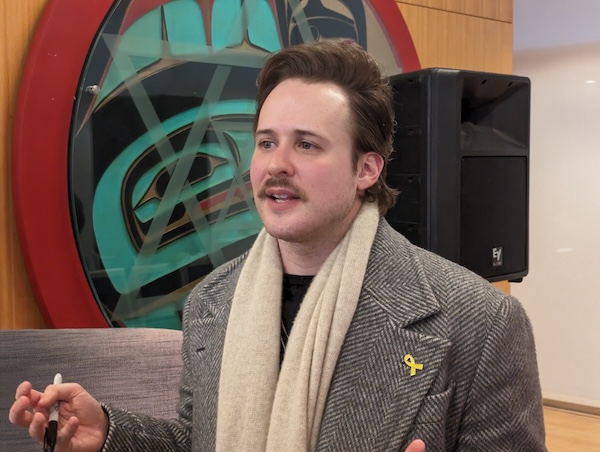
Ben Freeman (photo by Pat Johnson)

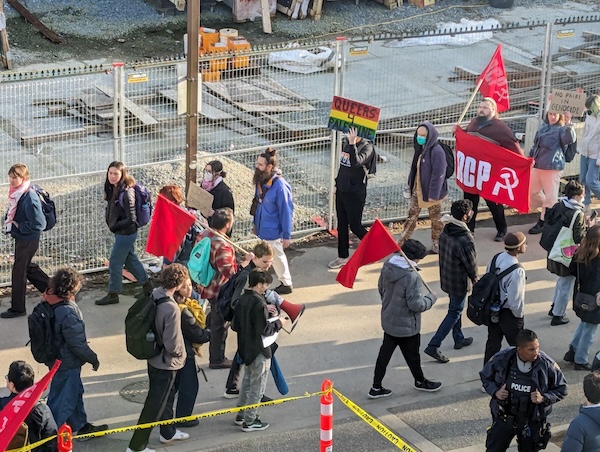
A couple of dozen loud and aggressive protesters accosted people arriving to an event at Hillel House at the University of British Columbia March 13. One masked woman raced up and screamed into the faces of those arriving. Another shoved her phone, presumably filming, into the faces of those trying to enter. Marchers, carrying communist banners and flags, screamed “You are on the wrong side of history!”

Inside, a packed audience listened to gay, Jewish, Scottish writer and activist Ben Freeman contextualize the state of world Jewry since Oct. 7. The author of Jewish Pride: Rebuilding a People and Reclaiming our Story: The Pursuit of Jewish Pride, in conversation with Vancouver media personality Shane Foxman, spoke while, throughout the entire presentation, the dull roar of protesters screaming provided background.

“We need to understand very, very clearly that we have done nothing to deserve that rabble outside,” Freeman said. “It is not our fault. This is their problem and not ours. Jew-hatred is a non-Jewish problem. We need our non-Jewish friends and allies to set up on the task of dismantling it. We have other work to do.”

Jews, of course, fight antisemitism, he said, but it is up to non-Jews to defeat it.

“This [protest] is not a commentary on Israel or Zionism,” he said. “This is an expression of Jew-hatred. We need to understand that.”

It is not only Jew-haters who try to separate diaspora Jews from Israel, said Freeman. Many Jews fall into the trap as well. The accusation of dual loyalty is a tool to dissuade Jews from expressing their natural connection to the land of Israel, he said.

“The canard of dual loyalty has led some Jews to say, ‘No, no, no, no, I’m not connected to Israel. I’m an American or I’m British or I’m Canadian’ or whatever the case may be,” Freeman said. “The reality is we are the diaspora. That word gives us a really incredible clue to the aspects of our identity. If we are in the diaspora, Israel is our home. You can be Canadian and Jewish, you don’t need to choose. That is what the non-Jewish world tries to make us do. They try to make us choose. Are you Canadian or are you Jewish? That’s the message that we get, you have to choose. But you don’t.”

He recounted a conversation with his dermatologist, a Briton of Pakistani descent, who said he was “going home” to Pakistan on vacation. 

“I said, oh, wonderful, were you born there? And he said, no, I was born here,” recalled Freeman. “And I thought, yes! You get it. And he’s allowed [to visit what he calls home], but somehow we are told we are not allowed.”

Freeman argued succinctly that it’s time Jews stopped fearing accusations of divided loyalties.

“I do have dual loyalty,” he said. “Suck it.”

In addition to refusing to succumb to false accusations, Freeman argued that Jews need to set boundaries on personal and professional relationships. 

“After Oct. 7, I spoke to Jewish friends who were in relationships with non-Jewish people and they said, oh, it’s hard, because my partner isn’t sure how they feel about Israel,” Freeman said. “My jaw kind of hit the floor. We have to have bottom lines. We have to have boundaries. There should be conversations we are willing to have and conversations we refuse to have. Each of us will make those ourselves but recognizing that Israel has a right to exist, Israel has a right to defend itself, that should be a bottom line. And I think I would encourage all Jews, whether it’s in romantic relationships, whether it’s in friendships, to be able to prioritize yourself, to be able to centre yourself and create those boundaries. We are not accepting half-assed empathy or friendship.” 

Probably all Jews have had difficult conversations with friends and others in recent months, he said, and Freeman urges a little more resistance.

“I say to my friends in those situations – it’s a little bit arsey, to be honest, but I am so done with being a nice Jew – I say to them, let’s be really clear before we have a conversation about Israel: I know more about this than you do, so don’t come for me. Have some respect. Not only is this my work, but I’m a Jew. That should be respected. And then, I care more about this. My friends are people in the world who might see a headline, they might see a tweet by those bozos outside, and they get enraged and inflamed. They can’t point out which river or which sea. We care deeply, we think about it.”

photo - As author Ben Freeman spoke at Hillel House at the University of British Columbia, the dull roar of protesters provided background
As author Ben Freeman spoke at Hillel House at the University of British Columbia, the dull roar of protesters provided background. (photo by Pat Johnson)

Ignorance should be challenged and invitations to learn extended, he said. “But there will be those who are malicious,” he added. “There will be those who think that we are bad, evil Zionists, we’re colonizers, we’re white oppressors and we are murdering the Indigenous people, we are committing genocide. There are people who believe those things and, if they do, those people are not interested in a conversation, so we block them…. They’re not worth our time. They’re not worth our energy. We’re not dealing with those people.” 

He admits, though, this can be easier said than done. All the hatred can get into one’s psyche.

“I’m the author of books about Jewish pride. I’m very proud to be Jewish. I love Israel,” said Freeman. “And there have been flickers of weakness in the past five months, when I have been weighed down by what is happening in the diaspora, what happened in Israel and what is said to me online and you do think, Are we the bad guys? What is happening? No. We are not. We have a right to be in that land. We have a right to defend ourselves. We need to make the world understand crystal clearly that you do not get to murder Jews and get away with it. Jewish blood is not cheap. We will defend ourselves and we have a country to do that. We lost our sovereignty.… We are not losing it again.”

Tight security ushered attendees out a back door and away from the still-chanting protesters circling the front of the building. 

Ever-evolving notions

In a March 3 webinar, Rabbi Dr. Nachshon Siritsky reflected on understandings of the Divine and gender, exploring some of the ways that Judaism’s most ancient teachings can be relevant in current discussions. Their Zoom talk was part of this season’s L’dor V’dor: From Generation to Generation lecture series hosted by Victoria’s Kolot Mayim Reform Temple.

photo - Rabbi Dr. Nachshon Siritsky spoke on March 13 as part Kolot Mayim Reform Temple’s L’dor V’dor lecture series
Rabbi Dr. Nachshon Siritsky spoke on March 13 as part Kolot Mayim Reform Temple’s L’dor V’dor lecture series. (photo from Kolot Mayim)

Siritsky discussed the kabbalistic understanding of creation and humanity, which, they said, describes a process of progressive emanation, revelation, incarnation and embodiment. Whereas the standard concept of history, in the Western mind, is as a straight line of evolution, Jewish time is circular and cyclical, Siritsky explained, returning to the same points again and again, whether they be holidays or the weekly Torah portion.

More deeply, this is manifested in restorative practices such as teshuvah, which can be seen as forgiveness or returning to oneself. In other words, God works with people in completing the work of creation, and this happens through how we channel that light and energy into this world. “I firmly believe that the more we can reconnect with our ancestral wisdom that is contained in kabbalah, Jewish mysticism and tradition, the more we can work to liberate ourselves and realign with the larger rhythms of the universe,” Siritsky said.

Kabbalah, they explained, describes how there are two different ways that God’s energy flows through humans. It can flow through masculine and feminine aspects and each of us contains elements of both. Thus, our goal is to be in alignment with all the different ways in which God flows through us.

“The reason we were put on this planet was to complete the work of creation. When we do that, then we build within ourselves. The act of building is holy, but God dwells inside of us, not inside of our buildings,” Siritsky said. “The goal of our traditions, according to the rabbis, is this notion of making a place within our bodies for God to be present and to be expressed and to able to be articulated and shine forth back into the universe.”

Siritsky spoke about the notion of gender fluidity in Judaic texts. According to the rabbi, the Talmud identifies eight genders. “All eight of these are just the ways in which humans exist on this planet,” said Siritsky. “So, anyone who says that non-binary, agender or intersex doesn’t exist or is not Jewish is not fully speaking from the ancestral traditions of the Talmud and of our rabbis through the generations.”

Citing other theologians, Siritsky said we are always evolving in our understanding of who we are and what we know, and that we must make space to acknowledge that our spiritual understandings are also on that same path.

“Each of us, as we grow into ourselves and this world, we are always having to discard beliefs or understand them in new ways in that cyclical way that promotes healing and God’s progressive emanation into the universe and into ourselves,” they said.

Siritsky next addressed the use of they/them pronouns, arguing that, since the Talmud states that God speaks in human language, then we have to be constantly reinterpreting, re-translating and re-understanding what that language is in each generation – what is true in one generation may not be true in another.

“Ultimately, it leads us to this: we are created in the divine image and, when we see God in one another, we will know God,” Siritsky said, adding that the topic of gender diversity is not a new one in Judaism or other spiritual practices, and that binary thinking is not a Jewish way of thinking.

Siritsky pointed out that our understanding of God and gender is continually evolving, reflecting the ever-changing landscape of society and culture. “By exploring this evolution, we can better appreciate the richness and complexity of Jewish spirituality,” they said.

Siritsky is spiritual leader of the Reform Jewish Community of Atlantic Canada, serving all four Maritime provinces. Ordained by Hebrew Union College-Jewish Institute of Religion, they are also a board-certified chaplain with Neshama: Association of Jewish Chaplains, a social worker with advanced training from the Postgraduate Centre of Mental Health, and a doctorate in ministry and pastoral counseling with a focus on burnout in healthcare workers. 

The final talk in the 2023/24 L’dor V’dor series will take place April 7, 11 a.m., on Zoom. Cookbook author and food writer Bonnie Stern will, together with her daughter, Anna Rupert, present a talk titled Don’t Worry Just Cook: A Delicious Dialogue on Intergenerational Jewish Cuisine. Register for the free webinar at kolotmayimreformtemple.com.

For more information about Rabbi Siritsky, visit rabbinadia.com. 

Sam Margolis has written for the Globe and Mail, the National Post, UPI and MSNBC.

Making meaning in diaspora

“We’re planning a family event in June.” That’s how I start nearly every contact with vendors while trying to arrange it. Sometimes, I say a “party with family and friends.” I avoid saying b’nai mitzvah. It’s just easier and safer.

One of my twins has a locker at junior high near a student who uses her body as a sign of protest. “Free Palestine” is written on her cheek. Other days, messages are emblazoned on a sweatshirt. My kid says she seems to stare at him, but I recommended he just stay away, don’t stare back, and don’t cause any kind of confrontation. “Do you know this person?” I ask him. “No,” he says, “she doesn’t know us.” What he meant is perhaps more obvious to us now – he doesn’t think she knows we are Jewish.

The transition from a bilingual Hebrew/English public elementary school to a junior high where Jewish kids are few and far between has been a big one. To my surprise, it went smoothly, but, over time, the ramifications have become clear. We knew our kids would figure out that we were, in fact, a small minority in Canadian culture. In elementary school, they would choose surprising moments to discuss Jewish things or use words in Hebrew with people at the dentist’s office or on public transportation. At first, our explanations about how people were different, with various religions and backgrounds were confusing. In their minds, they still believed everyone was Jewish.

On one hand, I loved that they didn’t have to learn to code-switch as early as I did. Code-switching is a way to describe how we switch between dialects, languages or personae in different settings. That is, a person might speak one language at home and another at work. In Jewish settings, one might use what linguists call “Jewish English,” English interspersed with Yiddish or Hebrew or other Jewish languages. At home, we might be encouraging someone to “daven at shul” with friends. We might shout “Dai, maspik!” (“Stop, enough!”) when someone misbehaves. In public, we might say “go to services” or “Behave yourself!”

Some people say that learning this kind of nuance takes maturity, but that doesn’t always ring true. I knew, by age 5 or 6 when my ethno-religious identity needed to be kept to myself. During times of extreme antisemitism, children were forced to keep this hidden, or even not told they were Jewish until old enough to manage the information. Giving my kids this extended time of safety felt like offering them a special oasis, a honeymoon that I missed.

Years ago, I worked with an editor and writer who shared with me that she had a Jewish background, although she was adamantly secular. I often felt the need to code-switch with her, as something made me feel like I was “too Jewish” for her comfort level. Since Oct.7, things have changed. She has become public in her Jewish identity, speaking out against antisemitism. Recently, she has been reading history and research for a book-length project. Today, she said, reflecting on an historic “golden age” for Jews in Polish history: “There is no safety in America now just because it’s been a golden age for my lifetime.” Yeah, I responded. I know.

Everyone copes differently. On social media and among friends, some dig into their Jewish identities. They’re consistently posting about their Jewish pride or activities and asking others to do so as well. One local friend who regularly attends synagogue told me that, if anything, this war has made her want to “do Jewish” even more, so she’s physically attending more services and gatherings than she had previously. Others decide to keep their kids home from school on days where there might be safety issues or have stopped attending anything at all connected with the Jewish community. They keep a low profile. Being loud and proud isn’t their way.

I have seen all these approaches (and many variations) from the Jewish people I know. And there are the minority Jewish viewpoints, too, on the political right and left. Those who claim more of an affinity with their progressive causes than with Jewish ones are often vocal on social media and at pro-Palestinian protests, either finding ways to disown their background or use their Judaism to explain their activism. Some particularly outspoken ones demonstrate, at least to me, that they don’t have a solid grounding in Jewish history and tradition, particularly as it relates to Israel, but instead embrace narratives around colonialism and apartheid instead.

Lately, I have been longing to ask where these “land back” Canadian Jewish activists live, if not in homes on occupied land taken from Indigenous communities. If homes here are on occupied ground, where do they believe it would be acceptable for Jews to live? I wonder how they mesh these theories with their everyday lives, or the archeological, historical and literary references to the Jewish past.

Living in grey areas of nuance is exhausting. There are so many references in Jewish texts to back this up. We have, after all, been struggling with these identity issues for millennia. We’re the ethnic group for whom the Greek word of “diaspora” was invented. Yet, this is one time where more evidence seems pointless. For those of us who feel this discord and disconnect, it’s not news. For others, who either manage to live wholly in the Jewish world or outside of it, these retellings of history aren’t useful. So many people have made their place, and it’s not in the margins of subtlety.

There’s no one response that suits. For me, I understand the value of having a rich interior and family life. The moment I’m absorbed in braiding challah and reciting the blessing blocks out some of this noise. Although I’m alone, it’s meaningful spending that small moment to send love and prayers for the hostages, the Jewish community and my family. I knit sweaters for ever-growing twins, anticipating their big birthday ahead this spring. I fall deep into intellectual arguments online, or into gazing at a pileated woodpecker whose rat-a-tat vibrates throughout the neighbourhood.

Finding one’s authentic self, the comfort zone where all the discord falls away, offers a brief respite. As we meet this complex moment in time, finding small outlets of escape can enable us to keep on going. Perhaps this is about good mental health or, as generations before us have explained, it’s nothing new. It’s about making a meaningful life in a diaspora, amid struggle. 

Joanne Seiff has written regularly for the Winnipeg Free Press and various Jewish publications. She is the author of three books, including From the Outside In: Jewish Post Columns 2015-2016, a collection of essays available for digital download or as a paperback from Amazon. Check her out on Instagram @yrnspinner or at joanneseiff.blogspot.com.