Ways to defy dementia

Dr. Allison Sekuler of Toronto’s Baycrest Centre for Aging and Brain Health Innovation. (photo from baycrest.org)

On June 5, National Council of Jewish Women Canada (NCJWC) welcomed Dr. Allison Sekuler of Toronto’s Baycrest Centre for Aging and Brain Health Innovation as the featured speaker in the Zoom webinar titled Defy Dementia: Learn How to Reduce Your Dementia Risk.
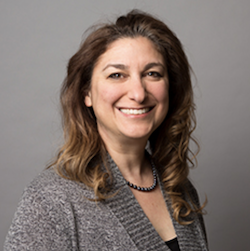
photo - Dr. Allison Sekuler of Toronto’s Baycrest Centre for Aging and Brain Health Innovation
Dr. Allison Sekuler of Toronto’s Baycrest Centre for Aging and Brain Health Innovation. (photo from baycrest.org)

Sekuler is the Sandra A. Rotman Chair of Cognitive Neuroscience at Baycrest’s research institute and the president and chief scientist at the Baycrest Academy for Research and Education. She is known for her foundational research in perception, cognition and brain function, as well as her clinical and translational work on age-related sensory and cognitive decline. She is the inaugural Canada Research Chair on Cognitive Neuroscience and has received numerous national and international honours, including being named one of Canada’s Top 100 Most Powerful Women by the Women’s Executive Network in 2019.

The recent webinar began with an introduction from Monica Simon, chair of NCJWC’s ageism committee. Then, with the help of AI-generated images, Sekuler presented attendees with an optimistic view of what she hopes the future holds. “We want to see a world where every single person is living a life of purpose, fulfilment and dignity,” she said.

Baycrest is at the forefront of a new field called predictive neuroscience for precision aging – an individualized approach that examines one’s brain, body and environment to detect the best ways to prevent the onset of dementia or delay it for as long as possible. This approach not only encompasses the pre-diagnosis stage, but helps medical professionals and loved ones navigate caring for someone with dementia. 

“If you think about what precision medicine has done for cancer, that’s what we want to do for aging, brain health and dementia,” said Sekuler.

Through innovations in predictive neuroscience, the Baycrest team is working toward a goal of no new cases of preventable dementia being diagnosed by the year 2050 – currently, 750,000 Canadians are living with dementia, and that figure is expected to more than double by 2050.

“What we want to do is nip that in the bud as much as possible,” Sekuler said, acknowledging that, while they cannot entirely eradicate the condition, they can do more to decrease the risk for those who do not already have dementia. Research suggests that, if the onset of dementia can be delayed by even five years, the prevalence of the condition can be decreased by 50% worldwide, she said.

While there are several risk factors – such as age, sex and genetics – that cannot be controlled, Baycrest’s Defy Dementia program raises awareness of the lifestyle changes people can make to reduce their dementia risk and improve their cognitive health.

“At least 40% of the risk factors for dementia are things that we can change by changing our lifestyle,” said Sekuler.

On the podcast Defy Dementia, co-hosts Sekuler and Jay Ingram, one of Canada’s leading science journalists, cover a different risk factor every month. Each episode features a guest with lived experience with dementia and an expert on the risk factor under discussion, such as stress, sleep, diet, exercise and environment.

There are currently 12 episodes available on the website defydementia.org, or any streaming platform. Many episodes have accompanying infographics and minute-long videos summarizing the topic at-hand, also available on defydementia.org.

“Whether you like to listen to things, read things, watch things or look at things, we’ve got you covered,” Sekuler said.

Sekuler gave a high-level overview of the risk factors, sharing how each correlates to one’s dementia risk and what one can do to manage them. She reminded attendees that genetics are not the be-all and end-all, but, rather, a piece of the puzzle that can often be counteracted by managing the risk factors.

Regarding sensory loss, Sekuler explained how strains on one’s hearing and/or vision can negatively impact cognitive abilities. She pointed to tools such as Baycrest’s free online hearing test and the importance of regular check-ups for hearing and vision loss. Further, she explained that loneliness has been proven to increase dementia risk by 50%, and that social engagement in any form is key to maintaining cognitive health. She emphasized that a healthy balance of diet, exercise and sleep helps, as does lowering stress as much as possible and embracing opportunities to try new activities and learn new things.

Sekuler also turned the group’s attention towards the vital role of caregiver. She shared that “one in every two people” will assume this role, if they do not get dementia themselves. However, caregivers often sacrifice a healthy diet, proper sleep and social engagement, she said, making them six times more likely to develop the condition. Sekuler stressed that “a caretaker cannot take care of someone else if they are not taking care of themselves,” and that inviting more professionals, caregivers and loved ones into the equation lessens the burden on one individual and may be a saving grace for that person’s health.

During the question-and-answer period, which was moderated by NCJWC’s Rochelle Garfinkel, Sekuler was asked what organizations like NCJWC can do to fight dementia. She highlighted the importance of sharing information and resources widely, and encouraged involvement in dementia research wherever possible. As well, she said, promoting tools like Baycrest’s online cognitive assessment test to “get your baseline” – as one would do with a regular vision test – is crucial for early detection. 

According to Sekuler, when it comes to protecting your cognitive health, “everyone can make these changes. You don’t have to be perfect, but you do have to start somewhere.” 

Alisa Bressler is a graduate of Queen’s University in Kingston, Ont. She is an avid reader and writer and will be pursuing a master’s of journalism at Boston University in the fall. Bressler is a member of the Vancouver Jewish community, and was the inaugural Baila Lazarus Jewish Journalism Intern.

Teaching the spirit of Israel

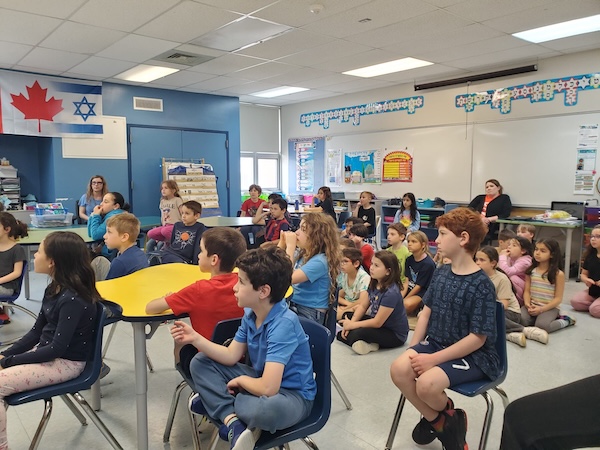
Kayemet LeYisrael – Jewish National Fund activities in Winnipeg took place at Brock Corydon school, Gray Academy (above) and Herzliya Synagogue. (photo from KKL-JNF)

A variety of educational and experiential activities conducted by teams from the department of Zionist education in the diaspora, part of the education division at Kayemet LeYisrael – Jewish National Fund, took place in Jewish communities around the world during “National Month,” which includes Memorial Day, Independence Day and Jerusalem Day. Activities took place at schools, kindergartens, Sunday schools, synagogues, Jewish organizations and elsewhere in 16 countries, including Canada.

photo - A Kayemet LeYisrael - Jewish National Fund activity at Brock Corydon school in Winnipeg
A Kayemet LeYisrael – Jewish National Fund activity at Brock Corydon school in Winnipeg. (photo from KKL-JNF)

In Canada, teams conducted activities in Toronto, Windsor and London, Ont., and in Winnipeg, Man. Activities included a virtual art and graffiti tour of Tel Aviv-Jaffa, lectures on life in Israel post Oct. 7, a Kites for Hope event, and activities for children about Independence Day. 

photo - Kayemet LeYisrael - Jewish National Fund at Herzliya Synagogue
Kayemet LeYisrael – Jewish National Fund at Herzliya Synagogue. (photo from KKL-JNF)

“Activities organized with the envoys from Israel were incredibly meaningful to our communities here in Canada,” said Yifat Bear Miller, KKL-JNF envoy to Canada. “As we are distant from Israel here in Canada, such activities fostered a deep connection to Israel, Judaism and the current situation in the region.” 

– Courtesy Kayemet LeYisrael-Jewish National Fund

Victoria’s Walk to Remember

On May 25, members of the Rwandan community in Victoria held a Walk to Remember, in memory of the victims and in solidarity with the survivors of the 1994 Rwandan genocide. (photo from Victoria Rwandan community)

This spring, members of the Rwandan community in British Columbia have been commemorating the 30th anniversary of the Rwandan genocide. On May 25, a group in Victoria held the Walk to Remember in memory of the victims and in solidarity with the survivors of the 1994 genocide, also known as the genocide against the Tutsi. 

Afterwards, a ceremony was held at Camosun College’s Gibson Auditorium. Throughout the event, called Kwibuka30, speaker after speaker, most of whom told their stories in Kinyarwanda, the national language of Rwanda, recalled members of their immediate families who were killed during that horrific period. (Kwibuka is the word for “remember” in Kinyarwanda.)

In the organizers’ words, the event was intended to offer “blessings for continued courage and resilience to remember and unite,” and express their desire to “renew our resolve to pursue the transformation of tragedy into triumph.”

Anselme Hategekimana, one of the leaders of the Rwandan community in Victoria, stressed the importance of remembering. “Remembering is an expression of an enduring love for those we’ve lost during the genocide against the Tutsi. Remembering makes us better citizens, as we do everything we can to combat hate speech, exclusion and any type of discrimination.”

Among those in attendance were the children – many of whom are now in their late teens and early 20s – of Rwandan genocide survivors. Hategekimana said he and other survivors were encouraged to see young people take leadership in the march and commemoration.

“Due to social media, young people are now more informed and can understand the consequences of bad governance and intolerance,” he said. “These young people are the leaders of tomorrow, and we are pleased to see more and more engaged young people for the cause of peace and understanding.”

From April 7 to July 19, 1994, Hutu militias in Rwanda killed members of the Tutsi minority. Hundreds of thousands of people were massacred – estimates vary from 500,000 to more than one million – in a 100-day period, which also included the killing of moderate Hutus and members of the Twa population.

The killings were preceded by decades of stigmatization, marginalization and dehumanization and fueled by hate speech. By the early 1990s, Rwanda’s population was 85% Hutu and 14% Tutsi. At the time, Hutu extremists within Rwanda’s governing elite blamed the Tutsis for the country’s social and economic problems. 

In October 1990, civil war broke out when a Tutsi rebel group, the Rwandan Patriotic Front, invaded the country from Uganda. Extremist Hutus held the Tutsis in Rwanda responsible for supporting rebel forces from another country.

The civil war, which ended with the signing of a peace agreement in August 1993, did not appease the anger of extremist Hutus, who took to the airwaves to dehumanize the Tutsis further, referring to them as “cockroaches.”

In April 1994, a plane carrying Rwanda’s president, Juvénal Habyarimana, a Hutu, was shot down by a missile as it tried to land in Kigali, the country’s capital. Though it is unknown which group fired the missile, extremist Hutus used the downing of the plane as a reason to massacre Tutsis. Militias, equipped with machetes and trained by the Rwandan government, launched a killing spree – which to this day still shocks because of its rapidity and size – taking the lives of thousands of people each day.

Though some schools in British Columbia cover the Rwandan genocide, Hategekimana believes it would be beneficial to incorporate the subject in the high school curriculum to educate youth to be more tolerant and learn from the tragedy.

“Having a memorial monument dedicated to the victims of the genocide against the Tutsi will also help educate more Canadians,” he said.

Thirty years later, Rwanda, geographically one of the smallest countries in Africa, stands out as a model of prosperity, with one of the fastest-growing economies on the continent. A post-genocide government pursued a policy of “unity and reconciliation” and maintained a focus on economic growth.

As Hategekimana sees it, Rwanda had hit its lowest conceivable point and the only choice was to rebuild and rise. He credits Paul Kagame, the president of Rwanda since 2000, for being a visionary leader who came at a crucial time.

“Paul Kagame has been God-given. You may like him or not, but what he has done for Rwanda is indisputable: the empowerment of women, free health care, anti-corruption measures, peace and economic prosperity. Rwandans see themselves as capable citizens able to take their future in their own hands,” Hategekimana said.

Today, tourism in the country is booming, including luxury hotels, and the #visitrwanda hashtag even appears on the jersey of English soccer powerhouse Arsenal. Kigali boasts a new convention centre and a new stadium to host professional basketball games.

Tech startups have also abounded, as has collaboration with Israeli companies. Netafim, a Tel Aviv-based precision irrigation firm, has teamed with the Rwandan government to develop farming in land that was previously unsuitable for agriculture. In 2014, Israel’s Energiya Global invested in a solar power plant project in Rwanda. 

Regarding the horrors of 1994, Nina Krieger, the executive director of the Vancouver Holocaust Education Centre (VHEC), offered these words to the Independent, “As we mark the 30th anniversary of the genocide against the Tutsi in Rwanda, we reflect on the significance of bearing witness to atrocities and the enduring power of survivor testimony. 

“At the VHEC, we understand the critical role these narratives play in educating future generations and preventing such horrors from reoccurring. The resilience and courage shown by the survivors of the Rwandan genocide inspire us to continue our mission of Holocaust education, underscoring the universal necessity of compassion, remembrance and the commitment to justice.” 

In the 2022 commemoration of Kristallnacht presented by the VHEC at the Jewish Community Centre of Greater Vancouver, keynote speaker Liliane Pari Umuhoza, a child survivor of the Rwandan genocide, told the crowd it was important to remember what happened, to preserve the memories of victims and survivors for future generations. 

Umuhoza added it was crucial to learn from history and create awareness. Yet, she continued, it was not enough.

“What matters the most is how we use that history to create a better world,” she said. “It’s our duty, not only to remember but also to remember with purpose.” 

Sam Margolis has written for the Globe and Mail, the National Post, UPI and MSNBC.

Small wins amid gloom

The rescue of four Israeli hostages from Gaza last week and their reunions with their loved ones is a bright spot amid much dismal news – though there remain 120 hostages whose reunions with their families we dream of and hope will happen soon.

This rescue has been a source of tempered joy for Israelis and others. In a time of tragedy and despair, these moments are worth appreciating. Amid the relief, we mourn the life of the Israel Defence Forces officer who died from wounds received during the operation and we mourn the lives of the many innocent Gazans lost. Holding this tension is weighing mightily on many of us, knowing that placing hostages among civilians is a deliberate and overwhelmingly cruel strategy of Hamas.

Closer to home, we are not without bleak news, but neither are we bereft of hopefulness.

The arson attack on Schara Tzedeck Synagogue two weeks ago is deeply troubling and scary. The outpouring of support and empathy from so many is a silver lining. Clergy, elected officials, multicultural community leaders and ordinary folks have expressed solidarity with Schara Tzedeck and the broader Jewish community.

A few less monumental but hopeful items crossed our desks recently.

The Vancouver Comic Arts Festival, which had earlier canceled the participation of artist Miriam Libicki, issued an apology for their actions – and announced that “the vast majority” of individuals who had perpetrated Libicki’s banning had resigned from the organization’s board.

Suffice to say, this is not the foremost news story this year. But it is surprisingly uplifting when a glimmer of common sense emerges where intolerance had once prevailed.

Libicki had been canceled ostensibly because she had served, once upon a time, in the Israeli army. IDF service was also the excuse used when inspirational speaker Leah Goldstein, a BC resident, was canned from an International Women’s Day event in Ontario in March. 

Assertions that an artist (or performer or whoever) is being excluded because they served in a military that we see every day in the news engaged in a tragic conflict may seem legitimate, or at least not quite as blatant as, say, posting a sign that reads “No Jews allowed.” Notably, though, no such litmus test, to our knowledge, has ever been applied to any artist (or whoever) in Canada based on their service in any other national armed forces – and, given the diversity of our country, we can be pretty much assured that we have citizens who have served in many of the world’s most tyrannical and nasty, even genocidal, militaries.

Other excuses to ban Jews or pull Jewish- or Israel-related work from events, exhibits, performances, etc., have also included enough plausible deniability to steer just clear of indisputable antisemitism.

Goldstein’s cousin, local photographer Dina Goldstein (it’s sadly becoming a family affair), was recently removed from a group exhibition. In this instance, the gallery claimed financial considerations were the deciding factor.

Then there are cases where venues pull an event or performer based on security concerns, as the Belfry Theatre in Victoria did with their scheduled performance of the play The Runner. They had reason to fear violence – the theatre was vandalized amid the controversy. But cancelations based on security concerns, as valid as they may seem, give an effective veto to those who are potentially violent.

In the shadow of the Belfry decision, The Runner was pulled from the PuSh Festival in Vancouver, the stated reason being that another artist threatened to pull their work from the event if the play was mounted. 

In addition to cancelations, there is plenty to raise alarm bells about anti-Israel bias in the public education system, as well, as we are forced to outline in discouraging detail elsewhere in this issue, with the BC Teachers’ Federation making some controversial decisions. But, again, here some reason prevails, though not from the BCTF.

The Burnaby school district took what it called “immediate action” when it became known that elementary students had been given an exam question asking them to make a case for and against the existence of the state of Israel. We could fill volumes with outrage about the unmitigated nerve of a teacher thinking this was a legitimate subject for grade sixers (if it was on the exam, one can only imagine what the same educator said in the classroom) but let’s take some solace that there were reasonable people in a position of authority to respond when this became public.

In further good news in the education realm, on June 1, the University of British Columbia’s Vancouver Senate soundly rejected (by a vote of 49 to 16) a motion urging the university to cut ties with institutions in Israel.

In challenging times, it is even more necessary to acknowledge and celebrate small victories and acts of decency. It is an act of individual and communal resistance to remain hopeful and steadfast in pursuit of peace and justice. 

BCTF’s Nakba motion

“An important part of our work as teachers is to create safety for our students within our classrooms and schools. Globally and locally, we are hearing how increasing rhetoric and hate speech in communities are threatening safety and belonging. With this in mind, a motion was brought forward, and passed by delegates at the BCTF annual general meeting in March,” writes BC Teachers’ Federation president Clint Johnston in the May/June 2024 issue of Teacher magazine.

He goes on to share the motion, which was: 

“That the Federation:

“1. continuously lobby the Ministry of Education and Child Care to include, where applicable, the following as part of the Grades 6-12 Socials and History curricula until it gets added to the elaborations:

“a. The Nakba 

“b. The 1948 Arab-Israeli War

“c. Military occupation of Gaza and the West Bank. 

“2. have the Federation president acknowledge through the next Teacher magazine that these events are essential to understanding the history of Palestine and Israel in the President’s Message.”

In fulfilling his part of the motion, Johnston writes in Teacher about classrooms being “where students develop or question their understandings of world events. Starting these conversations and teaching complicated histories is a difficult task. Teachers need support to approach the historical context of present-day conflicts in their classrooms. It’s important that the Ministry of Education and Child Care, school districts and community partners come together with teachers to create the supports and resources we need to teach challenging world events.”

At press time, none of the President’s Message that deals with the AGM motion could be found on the Teacher website. There, only the first half of the message was posted – in which Johnston talks about the edition’s feature on “societal attitudes toward disability justice and excellence,” and inclusion in schools.

The BCTF did not respond to multiple emails and phone calls from the Jewish Independent for comment on the motion, which was passed at the BCTF’s AGM March 16-19 at the Hyatt Regency Hotel. While the organization’s communications person briefly added the JI to the BCTF’s media list, the paper apparently was removed from that list after inquiring if the receipt of a press release on an unrelated topic meant that answers to the JI’s questions about the AGM would be answered. There was no response, nor has the JI received any further BCTF press releases.

The Jewish Independent found out about the BCTF motion in early April not from the BCTF, but from two other sources: a group called Parents for Palestine, claiming the vote a victory for their own campaign to have the Nakba (Catastrophe) – the term used by many Palestinians and others to describe the creation of the state of Israel and the 1948 war – added to the BC curriculum, and from a Jewish parent, asking people to “Reject political propaganda in schools’ curriculum.”

Parents for Palestine and the groups Teachers 4 Palestine BC, Independent Jewish Voices (Vancouver, Victoria and University of British Columbia), Canada Palestine Association-Vancouver, BDS Vancouver-Coast Salish Territories, Samidoun Palestinian Prisoner Solidarity Network (which in 2021 was designated a terror group by Israel for its ties to the Popular Front for the Liberation of Palestine), Labour for Palestine Vancouver & Victoria, Palestinian Youth Movement Vancouver, and Freedom from War Coalition have started a petition on the Action Network called “Demand That the Nakba Be Added to the BC Curriculum.” Those groups (minus BDS Vancouver-Coast Salish Territories) also have online an open letter to Minister of Education and Child Care Rachna Singh, where organizations and individuals can add their name.

“As a Jewish parent whose grandparents were Holocaust survivors, I believe my children need an education that equips them with the knowledge and tools to build a future where genocide is no longer possible,” says parent Tamara Herman, a member of Independent Jewish Voices, in the Parents for Palestine press release. “Our kids will be confronted with the future impacts of the genocide that Israel is currently committing in Gaza. Receiving a partial history of the creation of Israel that includes the Holocaust but erases the Nakba robs them of the knowledge and tools they need now and in the future.” 

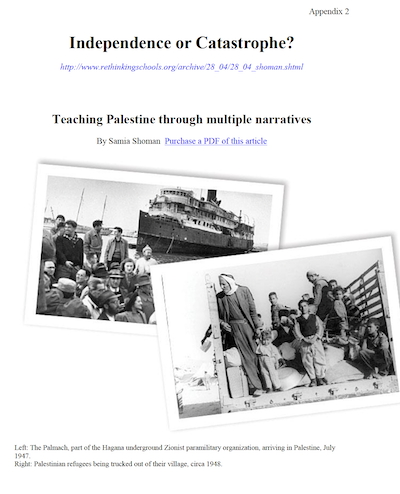
image - A page from the BC Teachers’ Federation Israel-Palestine classroom resource, called The Israel-Palestine Conflict: Searching for a Just Peace
A page from the BC Teachers’ Federation Israel-Palestine classroom resource, called The Israel-Palestine Conflict: Searching for a Just Peace.

Vancouver parent Masha Kleiner’s petition on change.org reads, in part, “The role of a teacher in a child’s life is paramount and should not be used to advance any political agenda. By introducing such a change to the curriculum, it has the potential to increase targeted hatred of specific children thus creating an unsafe learning environment.”

In the press release she sent to the Independent, Kleiner, who was born in the Soviet Union, writes, “It is not a coincidence that I chose to raise my children in Canada. I wanted my children to grow, internalize and embrace the fundamental Canadian values of safety, diversity, tolerance and freedom. These values are core to Canadian society and they stem from all orders of life, first and foremost, education.

“This is why, as a parent, I couldn’t remain silent when I encountered the motion to add teaching of ‘Nakba and occupation’ to the school curriculum in BC. This motion goes against everything that Canada stands for. This motion is not only harmful on many different levels, but it also exposes dangerous manifestations in the existing curriculum.”

Kleiner is concerned that the BCTF motion and “the polarizing and isolating political agenda it brings into classrooms will create an unsafe and even hostile environment. This motion is not educating students about specific historical events and perspectives; it introduces a one-sided, politically motivated, biased narrative that is being used to target and marginalize particular students or groups.

“The history and the conflict in the Middle East is one of the most complex and multifaceted topics in the history of modern conflicts,” she continues. “Its roots are grounded in millennia of history as well as religious and cultural bedrocks of numerous societies. It is deeply intertwined with recent and modern political and military powers and other conflicts. What’s more, it is a highly sensitive, controversial and even disruptive topic that affects people’s lives all over the world.” 

The original motion presented at the BCTF AGM had only two points: 

“That the Federation: 

“1. acknowledge that the Nakba and the Israel war of independence are significant historical events that are essential to understanding the Israel-Palestine conflict.

“2. make a recommendation to the Ministry of Education and Child Care to include the Nakba and the Israel war of independence as part of the social studies and history curricula.”

The amendments were added on the day of the vote, which took place March 18. A 56-44 majority passed the amended motion, according to a teacher who was at the AGM.

This teacher, who asked to remain anonymous, questioned the value of the motion, noting that teachers could already include the subject in lessons. They said that, while the Nakba could be added to the list of sample topics in the curriculum, that still wouldn’t make the teaching of it mandatory.

image - The Israel-Palestine Conflict: Searching for a Just Peace coverThere is a resource available for teachers already, which was developed by the BCTF in 2016. Called The Israel-Palestine Conflict: Searching for a Just Peace, several sections are objectively biased, notably regarding the history of the region. Just two examples: Jews’ right to the land isn’t acknowledged, only that Palestinians lost their homeland; and the fact that hundreds of thousands of Jews were forced to flee Arab countries isn’t mentioned, only that “700,000 Palestinians were driven or fled from their homes and became refugees and many villages were destroyed.”

The teacher thought that the AGM motion was made, in part, as a reaction to the provincial government having made Holocaust education a mandatory part of the curriculum. At this point, the province has no plans to follow suit with the Nakba.

“I’m leaving it to the teachers,” Singh told CBC in a May 2 interview. “I feel that they are fully equipped and they have the professional judgment on how to assess their student population and how to impart these lessons. This is what my expectation is, that every child is feeling safe in their schools.” 

BCTF nixes antisemitism efforts 

A group of public school teachers who are pressing for resources and  supports to help educate about antisemitism and the Holocaust have been rejected by the provincial teachers’ union.

The recently formed Holocaust and Antisemitism Educators Association was informed earlier this month that their application for recognition as a provincial specialist association has been rejected by the relevant branch of the BC Teachers’ Federation.

Provincial specialist associations (PSAs) support the development of teaching resources and host professional development sessions on specific subject areas. They receive funding from the BC Teachers’ Federation (BCTF) to do so.

The Holocaust and Antisemitism Educators Association (HAEA) was created in response to the Government of British Columbia’s decision last October to make Holocaust education a mandatory part of the BC curriculum.

Eyal Daniel, the president of the HAEA, said he is shocked by the decision and is hoping the BCTF executive will reverse it. 

“The letter I received said that we should work with other PSAs – which is confusing because the formation of our group was specifically supported by the relevant PSA, the social studies group, as being important and necessary,” Daniel said in a media release.

Ginaya Peters, the founder of BC Teachers Against Antisemitism, expressed dismay. 

“I am trying to comprehend this and am failing,” she said in the same release. “When the Vancouver Holocaust Education Centre tells the BCTF that our PSA is needed in order to implement the mandatory Holocaust curriculum that they are helping to develop, they are literally ignoring the voices of experts in the field, and they are denying us the resources to teach the topic properly.”

Ezra Shanken, chief executive officer of the Jewish Federation of Greater Vancouver, said the decision seems to confirm reports heard by members of the Jewish community recently.

“We have heard a number of disturbing rumours in the past few weeks about people fighting against the formation of this teachers’ specialist association – including that people believe that antisemitism isn’t related to the Holocaust,” said Shanken. “If this is their rationale, it is a form of Holocaust denial and flies in the face of what we have been told by Premier David Eby and his minister of education.”

“The HAEA has told me that they met every single requirement to be recognized by their union, and that no one can remember a time when a PSA that met every requirement was turned down,” said Nico Slobinsky, vice-president of the Centre for Israel and Jewish Affairs.

screenshot - A social media post shared by the Anti-Oppression Educators Collective, a provincial specialist association of the BC Teachers’ Federation, which mentions Samidoun, which is linked to a listed terror organization and has organized events that glorify the murders and rapes that took place on Oct. 7
A social media post shared by the Anti-Oppression Educators Collective, a provincial specialist association of the BC Teachers’ Federation, which mentions Samidoun, which is linked to a listed terror organization and has organized events that glorify the murders and rapes that took place on Oct. 7. (image from BCTAA)

Jonathan Dyck, the chair of the BCTF Provincial Specialist Association Council, informed the HAEA of the decision last week, following a meeting of the council where the decision was taken June 4. According to the HAEA, he provided no rationale for the decision to recommend that resources and recognition not be provided to HAEA but was “strongly of the opinion that they would like to find ways to help members of your association feel valued and included.”

In a separate statement, BC Teachers Against Antisemitism lamented the absence of any explanation for the rejection.

“We are confused by the BCTF’s statement … as the statement fails to give any indication why a PSA dedicated to developing teaching resources and professional development around soon to be mandatory Holocaust education was rejected.

“As well, as of today there are no teaching resources available on the Holocaust or antisemitism available on the BCTF’s TeachBC site.”

In a series of social media posts on the BCTF’s X (Twitter) platform, the union outlined the standards aspiring PSAs must meet – but did not indicate any areas where the HAEA had fallen short.

“The tweets listed all the conditions which must be met for a PSA to be approved by the PSA council,” BC Teachers Against Antisemitism said in their statement. “The HAEA met these conditions, yet the council refused to recommend that the PSA be approved. The only condition not met was approval by the PSA council. This is surprising as no one can remember a PSA that met all the criteria ever being turned down before.”

The suggestion that the Holocaust and antisemitism educators instead work with existing PSAs is problematic and perplexing, they wrote, because the BC Social Studies Teachers Association recommended that the new PSA be approved, as did the Vancouver Holocaust Education Centre. Moreover, antisemitism has not been addressed by any other PSA. In fact, BC Teachers Against Antisemitism accuses the Anti-Oppression Educators Collective of promoting antisemitism, including by sharing posts on social media that include mention of Samidoun, which is linked to a listed terror organization and has organized events that glorify the murders and rapes that took place on Oct. 7.

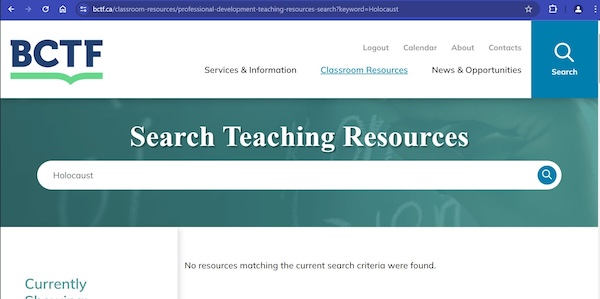
Confounding matters further, the statement on BCTF’s website regarding the PSA vote, and antisemitism and Holocaust education, says, “It is our understanding that the council determined that existing PSAs already can and do support the proposed work.” However, separate searches of BCTF’s website for classroom resources on antisemitism and the Holocaust yield the results: “No resources matching the current search criteria were found.”

screenshot - search for Holocaust on BCTF website yields no resources found“The arguments that the HAEA work with existing PSAs to create Holocaust and antisemitism materials seems to fly in the face of established BCTF practices,” the BCTAA statement states. “The BCTF cannot present a valid reason for denying the approval of our PSA dedicated to helping educators deliver critical lessons on the Holocaust and antisemitism. We ask the BCTF to reverse its decision so we can move forward like other established PSAs and work with likeminded colleagues on supporting educators in BC.” 

– Information from Centre for Israel and Jewish Affairs, Jewish Federation of Greater Vancouver, BC Teachers Against Antisemitism and BC Teachers Federation

Tea unites, entertains

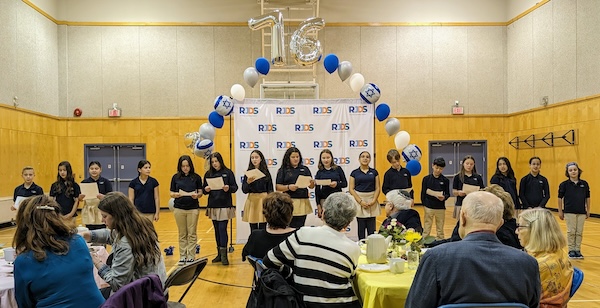
Richmond Jewish Day School students at the school’s annual  Garden Tea Party, which took place May 22. (photo from RJDS)

On May 22, Richmond Jewish Day School (RJDS) welcomed community members to its annual Garden Tea Party.

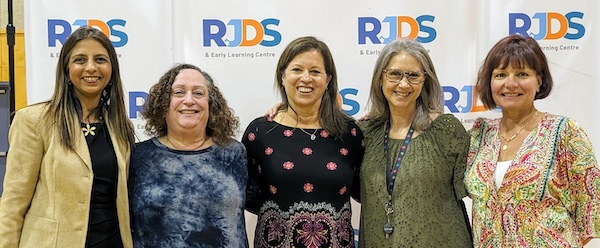
photo - Sabrina Bhojani, Lynne Fader, Joanne Robinson, Reesa Pawer and Toby Rubin
Sabrina Bhojani, Lynne Fader, Joanne Robinson, Reesa Pawer and Toby Rubin. (photo from RJDS)

The event began with a welcome from the head of school, Sabrina Bhojani, followed by a d’var Torah from one of the Grade 7 students. There was entertainment provided by other students. The school’s Israeli dancers took all their hard work from the performances at the community’s Yom Ha’atmazut celebration and Festival Ha’Rikud and performed a show-stopping dance! 

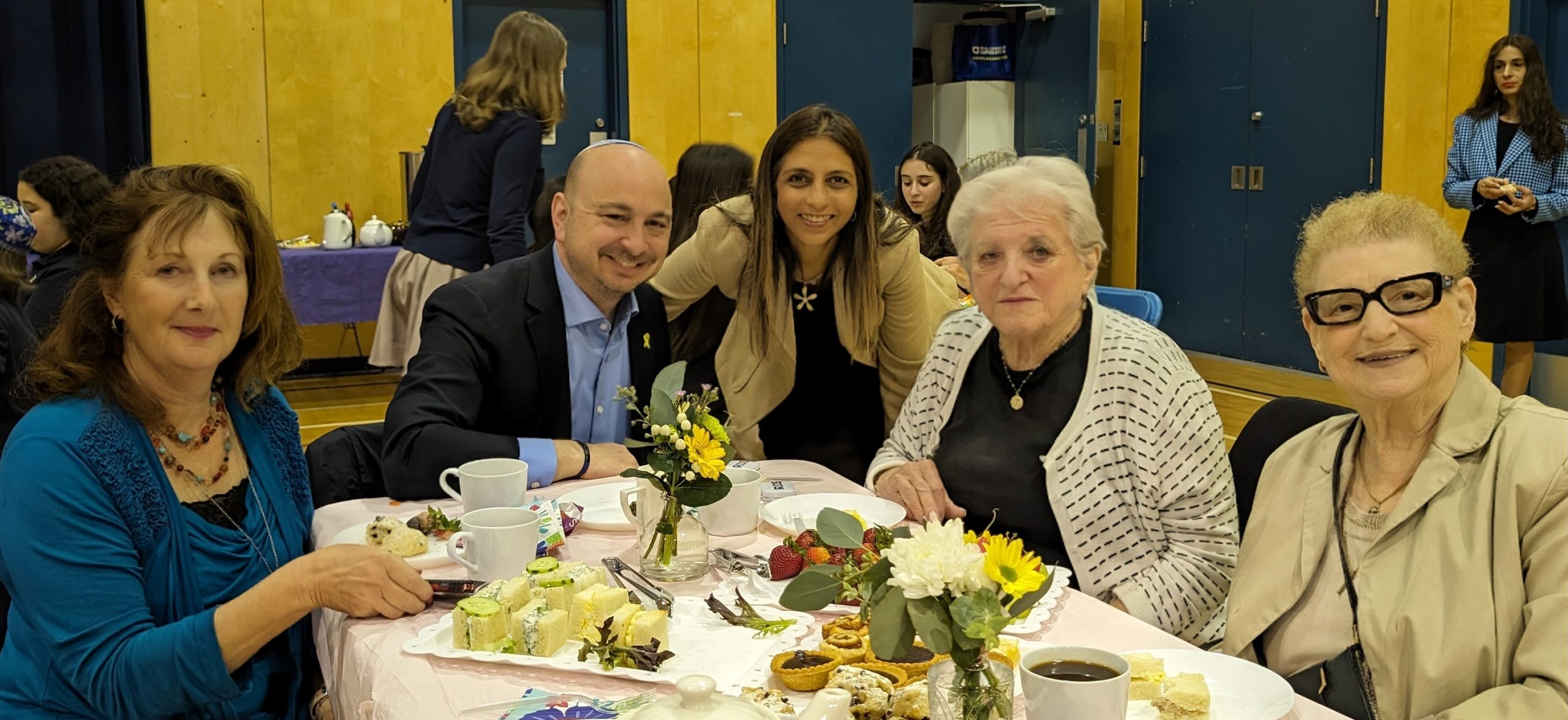
photo - Cindy Rozen, Ezra Shanken, Sabrina Bhojani, Lola Pawer and Andi Strausberg
Cindy Rozen, Ezra Shanken, Sabrina Bhojani, Lola Pawer and Andi Strausberg. (photo from RJDS)

The entire tea was hosted by RJDS’s senior students, as they led community members to their seats, and served the tea and treats. The Kehila Society of Richmond and Joanne and Gary Robinson sponsored the event.

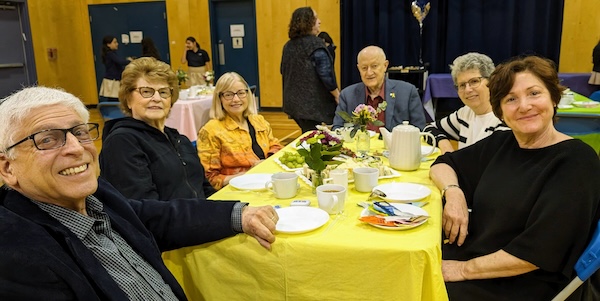
photo - Perry Seidelman, Marie Doduck, Phyllis Johnson, Dr. Peter Suedfeld, Shelley Seidelman and Marcie Flom
Perry Seidelman, Marie Doduck, Phyllis Johnson, Dr. Peter Suedfeld, Shelley Seidelman and Marcie Flom. (photo from RJDS)

The tea was a testament to the rich tapestry of experiences, talents and perspectives within the Richmond community. RJDS acknowledges its interconnectedness with the community and recognizes community members’ invaluable contributions to the school’s vibrant environment. Amid sipping tea and engaging in conversation, the power of connection and intergenerational exchange was evident, as was a sense of unity and belonging. 

– Courtesy Richmond Jewish Day School

So many choices to be made

The late afternoon, right after school or summer camp, is go time for many parents. These are the moments where my twins have every kind of need, from taking off their outside gear and emptying lunch bags to signing permission forms, getting help on projects, and more. It is a period of chaos, usually with a desperate need for snacks as well as dinner preparation, all rolled up. There are days when things are calm, sure, but there are other times when I savour my last moments of quiet at 3:25 because from 3:35 until 6:30 or so, after dinner, I am a whirlwind doing Marathon Mom work.

Our public junior high this year presented us with Mega Options activities for the last few days of school. While the various options were hyped to students in advance, only whispers of this made it home. So, on an average Monday afternoon in June, my kids told me to be sure to open the special Mega email fast, as all the best activities would fill up. At 4:30 on the button, my inbox told me about the many Mega Options I would need to hurry to fill out to meet my twins’ expectations.

There were so many choices: Métis sash-weaving and historic cemetery trips, Inuit printmaking and Indigenous storytelling, Euro-style soccer tournaments, Pickleball, phone photography, kinesiology and nutrition lab field trips to a university, and more. There were bike treks, orienteering, the list went on. The selection was huge. Not every outing had a description or information. Some choices came with big fees. Others were free.

It was a huge rush to decide. We watched some activities fill up even as we tried to sign up – and, with twins, we had to sign up twice. In the end, my more social kid called one of his close friends. On the other end of the phone line, I heard his mom, a teacher I am friendly with, coaching him through. It was a great solace to know I was not alone in sorting through this!

Within moments, both my twins were signed up, with their friend, for one day of board games, outside games, and baking bannock and eating together. The other day was reserved for going to Assiniboine Park, Winnipeg’s version of New York City’s Central Park, and always a fan favourite. I emailed the other mom afterwards. “Sheesh!” she replied. “That was stressful – lol.” It was. She was completely right. The Mega Options format left me strung out and worried. Did we make the right choices? What does “A day at Assiniboine Park” mean? There was no description. What do we parents need to provide? Lunch? Money? Rides?

After the decisions were made and the activities secured, I was relieved. The fun warm weather choices our boys made were free, easy and uncomplicated. Sure, it wasn’t going to be a big learning experience, but the decisions were made. We no longer had to dwell on the choices themselves. 

After stepping back, I realized that these late afternoon blitzes are so hard because they can be unpredictable and disorderly. There are multiple tasks thrown at parents at once, when we’re not necessarily at our best energy-wise. Both flexibility and preparedness are necessary. There’s no telling if today I’ll have to be a math whiz, an event planner, or a custodian, cleaning up after a kid is sick in the hallway. (Hey, it happens.)

The skills required to manage the late afternoon rush aren’t just relevant to kids. As adults, and as Jewish people, we are often offered “Mega Options” when it comes to making choices. We don’t have one specific menu item at restaurants, nor do we have a single kind of Jewish ritual, religious life or home observance. We face tons of choices every day. Further, while the pandemic narrowed some options, the post-pandemic world has vastly increased them. When our usual routines are disrupted, we’re forced to evaluate what we’ve done all along. Is streaming a religious service easiest?  Are we healthy enough to attend in person? What is the COVID protocol (or non-protocol) these days, even as the virus still circulates? Sometimes, we crave situations where the decisions are just made for us, even as we know it would be better to make up our own minds instead.

This was our world before Oct. 7. Afterwards, the choices became even larger. Now, questions of safety and freedom from harassment also come into play. We choose whether to wear anything identifiably Jewish when out on the street. We question if we’ll feel safe attending this Jewish venue. Is attending this graduation/parade/campus/event going to force us to deal with protesters or hate speech? Then there’s: Are we still safe, wherever we live? Should we be considering a move to someplace safer? Is there somewhere safer? 

We could pretend that all these choices are a part of the modern age, but we know from Torah study, the many debates of the Talmud and Jewish history that the act of making choices is an essential part of what it means to be Jewish. From the first, we were shown hard choices and real consequences: from Leviticus 10’s Nadav and Abihu, who chose to sacrifice “strange fire” and were struck down for it (a bad choice, apparently), to Deuteronomy 30:19, which summarizes a long list of choices we can make, concluding, “I have put before you life and death, blessing and curse. Choose life….” 

The Mega Options presented to celebrate the end of school is nothing when compared to big decisions in life. One could just shrug it off as no big deal – but life is a series of little choices, one after another, that can affect everything. Survivors of major disasters often explain how they “just missed” the accident because they felt sick, woke up late or forgot to make their lunch. Historically, Jewish refugees described how they left at a moment’s notice, with only a suitcase, or just the clothes on their backs.

We don’t always know which choices are the big ones, or the good ones. Some of the best choices result in happy, long-lasting results, like meeting one’s life partner, discovering a passion or skill, or experiencing an amazing natural event like a meteor shower or the Northern Lights. Here’s to hoping our choices are easy and small ones, and that these options lead to all positive things. Here’s to celebrations, miracles and good deeds this summer – may we all have more “mega” pleasant choices ahead. 

Joanne Seiff has written regularly for the Winnipeg Free Press and various Jewish publications. She is the author of three books, including From the Outside In: Jewish Post Columns 2015-2016, a collection of essays available for digital download or as a paperback from Amazon. Check her out on Instagram @yrnspinner or at joanneseiff.blogspot.com.

Groundbreaking May 26

Kineret Tamim Academy founders Dr. Elior and Leah Kinarthy. Kineret Tamim is Victoria’s first Jewish day school. (photo from Chabad)

Kineret Tamim Academy, just steps from the Chabad of Vancouver Island’s Centre for Jewish Life and Learning, is now officially an independent school.

Easily reaching the 10-student minimum before any classes could be taught, Kineret Tamim is looking forward to enrolling more students when it opens in September. The school will be kindergarten to Grade 2 at the start, but hopes to expand to more grades in the future.

For many local Jewish parents and grandparents, the need for a day school has been pressing. Victoria is the fastest-growing Jewish community in Canada, with a population of 4,385, according to the 2021 census (up from 2,630 a decade earlier). 

“The fact that, for the first time in the 160 years of Jewish history in Victoria, the first Jewish day school is opening is a testimony to the growth of Jewish life on Vancouver Island,” said Rabbi Meir Kaplan, the director of Chabad of Vancouver Island. 

“Victoria is now a destination for families who would like to raise their children in a community with robust Jewish education,” he said. 

Chabad of Vancouver Island was established in September 2003 when Kaplan and his wife, Chani, arrived in Victoria. At first, the living room of their home was used as the shul and children’s play area. Their programs, and the interest they drew, expanded over the years and more space was needed to accommodate the community. On Aug. 24, 2016, the Verrier Family Chabad Centre for Jewish Life and Learning was opened. 

“Rabbi Kaplan has been a mover and shaker, and his wife, Chani, has also been a major reason the school is happening,” said Leah Kinarthy, an active member of the local Jewish community and president of Jewish Family Services Vancouver Island. “The preschool she runs is incredible. Having a successful preschool is a major requirement for the Tamim Academies to support a new school opening.”

Kinarthy and her husband, Elior, were instrumental in enabling the school to become a reality and Leah Kinarthy will serve on the school’s board. Cathy Lowenstein, who was head of Vancouver Talmud Torah for 17 years, is now a professional advisor who helps launch private schools and works to establish them as certified independent schools in the province – she was also pivotal in bringing Kineret Tamim into being.

Principal Kristen Lundgren, who holds a bachelor’s of education specializing in French immersion and French second language instruction, has 27 years of experience in childhood education. Hebrew and Judaic studies will be taught by Viviana Finkelstein, who has taught elementary Hebrew for more than 30 years.

“The school has an incredible headteacher/principal and a Judaic/Hebrew teacher,” said Kinarthy. “It’s a community school that will be a unifying force for quality Jewish education for our children and grandchildren. Opening a Jewish day school was our lifelong dream; now is the time to make our legacy a reality.”

Kineret Tamim will offer secular education, with both French and Hebrew immersion, along with Judaic studies. The organizers of the school stress their objective is to facilitate the “unbounded potential” and “innate desire to learn” within every child.

Further, they aim to “prioritize long-term social-emotional and spiritual health in order to fulfil our mission of developing kindness, self-efficacy and purpose in each student.” This approach, they believe, will enable students to make their own positive imprint on the world.

photo - Kineret Tamim Academy is run under the auspices of Chabad of Vancouver Island, which is led by Rabbi Meir and Chani Kaplan
Kineret Tamim Academy is run under the auspices of Chabad of Vancouver Island, which is led by Rabbi Meir and Chani Kaplan. (photo from Chabad)

The school will be inclusive. Every Jewish child, regardless of background, affiliation or level of observance, will be able to attend. No Jewish child, their website states, will be denied a Jewish education due to financial circumstances. All students must wear a uniform. Kineret Tamim has partnered with a security company to ensure the safety of children and staff. 

The school is part of Tamim Academies, an international organization of schools, and is one of many located around the world. The name stems from Tomchei Temimim, the first formal yeshivah system of the Chabad-Lubavitch movement, which was founded in 1897 in Russia by Rabbi Sholom Dovber Schneerson. Each student was referred to as “tamim,” pure, perfect or complete – the assumption being that each child is inherently holy and good, with “wholeness” being the foundation of the education model.

For several years, Chabad of Vancouver Island has been operating CTots, a licensed early childcare centre, situated on the upper level of the Centre of Jewish Life and Learning on Glasgow Street. Kineret Tamim Academy will be located on Quadra Street.

The Chabad centre in Victoria is one of two on Vancouver Island. There is also Chabad Nanaimo and Central Vancouver Island, which launched in January 2015.

On Lag b’Omer (May 26) at 4:30 p.m., there will be a groundbreaking for Kineret Tamimn Academy, coinciding with a community barbecue. The event will take place at the CTots Adventure Park. Admission is $10 for adults and $5 for children. Sponsorship is $180.

For more information, or to apply, visit tamimvictoria.org. 

Sam Margolis has written for the Globe and Mail, the National Post, UPI and MSNBC.

A new generation of leaders

Howard Kallner is being honoured at Schara Tzedeck’s MOSAIC gala on June 4 (photo by kenneth88/wikimedia)

“I have been very lucky in my life to be surrounded by lifelong volunteers and builders of community, both my parents, my in-laws and multiple other role models, and it just seemed natural to volunteer and be involved,” Howard Kallner told the Independent.

Kallner is being honoured by Congregation Schara Tzedeck at MOSAIC, the synagogue’s annual gala, on June 4.

“The first thing that came to my mind was discomfort,” said Kallner about finding out he was being recognized. “I was hesitant to accept because there are so many long-time shul volunteers, donors and community-builders who would be deserving of being honoured.”

Kallner has been a part of the congregation since he was 13 years old.

“My family had emigrated from South Africa when I was very young and their synagogues in South Africa were very similar to Schara Tzedeck,” he explained. “My parents, and now my family, have been members for over four decades. On my wife’s side, her great-grandfather, David Davis, was a founding member of Schara Tzedeck, and her grandfather, Charlie Davis, was a past president.”

photo - Howard Kallner
Howard Kallner (photo from Howard Kallner)

For his part, Kallner was on the board for seven years before becoming president. He served three years as president and three more as past president, for a total of 13 years. He was serving as president when the pandemic hit.

“When the COVID pandemic hit, we needed to pivot immediately to online programming, online services where applicable, continue live services with restrictions and make sure our community members, particularly our vulnerable ones, were connected and taken care of,” he said of how his role was affected. “One of the programs that came out of this was Shabbat in a Box. We recognized a need amongst our members and others in our community and delivered over 450 meals a week at the height of the pandemic. For the Jewish holidays, we were delivering over 650 meals accompanied by holiday-specific items so they could celebrate the holidays.

“Additionally, Schara Tzedeck, being an Orthodox synagogue, could not have Shabbat services online,” said Kallner. “With the exception of a few weeks when the government would not allow any public gatherings, we continued services in person with some significant modifications. When limited to 50 people per gathering, we moved services outside, in a tent in our parking lot. At times, services were held in sub-zero temperatures, with most attendees wearing ski jackets, toques and gloves. For the High Holidays that year, we had nine services a day for a maximum of 50 people. We had to find three sets of Torah readers, shofar blowers and leaders of the services.

“While, during COVID, it was undoubtedly the hardest I worked as president of the shul, it was also the most rewarding,” he said.

Now officially “just” a member and supporter of the synagogue, Kallner continues to be part of the Schara Tzedeck Cemetery Board and is a governor of the Jewish Community Foundation, as well. 

“Giving back to a community that has given me and my family so much was very important,” he said. “With different experiences in my life and my relatives’ lives, including immigrating to a new country with little means and losses during the Holocaust, strong Jewish institutions ready for whatever the world would throw at them seemed crucial, and I wanted to do my part.”

Schara Tzedeck’s senior spiritual leader, Rabbi Andrew Rosenblatt, described Kallner as representing the beginnings of a new generation of leadership. At the time Kallner was getting involved, said the rabbi, “There weren’t a lot of people in their 40s who were stepping up to the highest levels of leadership at Schara Tzedeck.”

Kallner helped take the synagogue from being a 20th-century organization into being a 21st-century organization, said Rosenblatt. 

”The backbone of an Orthodox synagogue, certainly in the Pacific Northwest, certainly in Vancouver, is people who have come from much more traditional Jewish communities,” he explained. “For example, Schara Tzedeck has a lot of Holocaust survivors. These are people who came from very traditional Eastern European communities, but you could also have people from Winnipeg or Toronto or Montreal, New York, those places you associate with very traditional, very committed Jewish communities. For a long time, we were able to be a community of people who grew up in that kind of tradition, but there was a recognition at Schara Tzedeck that we needed to be able to be a place which translated to people who did not have that kind of traditional upbringing.”

Kallner had the analytical, organizational and people skills to help the synagogue do that, said Rosenblatt, highlighting Kallner’s leadership during the pandemic. 

“He was practically a paid member of the staff at that point, in terms of generating and developing policy,” said the rabbi. “He was involved in helping us make sure that we were operating on the next level. And he also understood that our organization had to be structured in a way where we could have the manpower to be able to do that, and that outreach. Part of that was that the information technology had to be updated.”

Describing Kallner as “a very humble person but also very hard working,” Rosenblatt said, “one of the things that he was strongest at was helping us transition into a place where we were reaching out more…. One of the programs we developed under his watch was Shabbat in a Box. There were some pre-iterations before that, but it came to its full maturity under him.”

Among the other programs that will benefit from the funds raised at MOSAIC are the synagogue’s education initiatives, some of which reach beyond the shul to the broader Jewish community, such as the series Rosenblatt gave on the history of the Marranos.

“I recognize,” he said, that “one of the great sources of inspiration in Jewish identity is Jewish history.”

Since the Oct. 7, 2023, terror attacks and the subsequent war, his education efforts have been more focused on Israel.

“When Oct. 7th hit, and people started to hear immediately just garbage about colonialization, I realized that there was just so much that people didn’t know or understand,” he said.

The Zionist story most of us have been taught is the inspirational one, he said. “Not that it’s wrong, it’s just not complete, and all histories have complexities. I didn’t want people to be caught flat-footed on these things and be surprised by them.”

He gave the example of a sign he saw on an overpass on the way into Whistler Village recently.

“It says there can be no peace on stolen land. And I’m thinking to myself who stole the land from whom? At what point do you decide that the land belongs to someone? Are you willing to say that 638 is where we’re going to start everything, when Omar ibn al-Khattab conquered Jerusalem, is that the right time? Should we ask ourselves when the Abbasids or the Fatimids or the Umayyads, which one of them? Were the Ottoman Turks? Which one becomes the real owner? At what point do you decide that these things happen? People don’t know – maybe now they do more, but certainly on October the 8th they didn’t know – when was Israel first called Palestine, when did Muslims come to Jerusalem, when were Jews forced out, which empires conquered it … what really happened at Deir Yassin, what were the stages of the War of Independence, what happened? These things, there are a lot of resources on them … and, I thought, Jews didn’t know these things – not to mention that there are libraries full of evidence on Jewish indigenous life in Israel that is far, far older than anything having to do with the name Palestine, and I wanted Jews to be able to know that. I wanted Jews to be able to articulate it. I want Jews to understand a stronger connection to Israel. And I think that has been something that has been a real value added to people’s knowledge base.”

The congregation has several individuals who have gone to do military service in Israel. “They are primarily Israelis who are here for various purposes, as shlichim [emissaries] or for educational reasons, and we’ve had real success in having them share their experiences and stories over the past number of months,” said the rabbi.

These types of programs have been a priority, said Rosenblatt, “to make sure that our community really stays close and understands the nuances and the issues. Every time we have the opportunity to give further insight, we do that.”

One of the people from Schara Tzedeck who has gone to serve was Assistant Rabbi Ishay Gottlieb. “He’s a major in the reserves in the IDF, and he left on Oct. 9th and wasn’t really back until the beginning of January,” explained Rosenblatt. “You’re essentially funding a staff member, like many Israeli organizations [are having to do], but there’s lots that had to be compensated for in that context.

“In some ways,” added Rosenblatt, “we’ve doubled our programming – run a regular program plus an Israel program. Not that we’re that different from the other synagogues [in that respect] but everything costs money and this is part of a case for giving. Since Oct. 7th, we really have been prioritizing the connection with Israel.”

He said, “When you walk into Schara Tzedeck, we want you to feel like you’re in a little embassy of Israel in this building. And participating in MOSAIC means that’s what you’re doing, you’re helping to support that – you’re helping to support a branch of Am Yisrael that is in Vancouver.”

To attend MOSAIC, RSVP by May 28 to 604-736-7607 or rachael@scharatzedeck.com.