Skip to content
  • Home
  • Subscribe / donate
  • Events calendar
  • News
    • Local
    • National
    • Israel
    • World
    • עניין בחדשות
      A roundup of news in Canada and further afield, in Hebrew.
  • Opinion
    • From the JI
    • Op-Ed
  • Arts & Culture
    • Performing Arts
    • Music
    • Books
    • Visual Arts
    • TV & Film
  • Life
    • Celebrating the Holidays
    • Travel
    • The Daily Snooze
      Cartoons by Jacob Samuel
    • Mystery Photo
      Help the JI and JMABC fill in the gaps in our archives.
  • Community Links
    • Organizations, Etc.
    • Other News Sources & Blogs
    • Business Directory
  • FAQ
  • JI Chai Celebration
  • JI@88! video

Recent Posts

  • Sharing her testimony
  • Fall fight takes leap forward
  • The balancing of rights
  • Multiple Tony n’ Tina roles
  • Stories of trauma, resilience
  • Celebrate our culture
  • A responsibility to help
  • What wellness means at JCC
  • Together in mourning
  • Downhill after Trump?
  • Birth control even easier now
  • Eco-Sisters mentorship
  • Unexpected discoveries
  • Study’s results hopeful
  • Bad behaviour affects us all
  • Thankful for the police
  • UBC needs a wake-up call
  • Recalling a shining star
  • Sleep well …
  • BGU fosters startup culture
  • Photography and glass
  • Is it the end of an era?
  • Taking life a step at a time
  • Nakba exhibit biased
  • Film festival starts next week
  • Musical with heart and soul
  • Rabbi marks 13 years
  • Keeper of VTT’s history
  • Gala fêtes Infeld’s 20th
  • Building JWest together
  • Challah Mom comes to Vancouver
  • What to do about media bias
  • Education offers hope
  • Remembrance – a moral act
  • What makes us human
  • המלחמות של נתניהו וטראמפ

Archives

Follow @JewishIndie
image - The CJN - Visit Us Banner - 300x600 - 101625

Art transcends our lives

Art transcends our lives

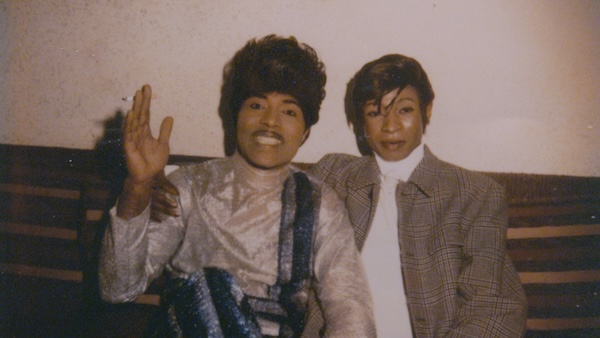
Little Richard, left, and Jackie Shane. A still from the film Any Other Way: The Jackie Shane Story, which closes the DOXA Documentary Film Festival on May 11. (image from NFB and Banger Films)

An incredible voice, a charismatic performer, a unique human being. Yet, most of us have never heard of Jackie Shane, a rising R&B star in the 1950s and ’60s, who appeared to disappear in 1971.

Michael Mabbott and Lucah Rosenberg-Lee’s feature-length documentary Any Other Way: The Jackie Shane Story closes the DOXA Documentary Film Festival on May 11 at Simon Fraser University’s Djavad Mowafaghian Cinema. In addition to Toronto Jewish community member Rosenberg-Lee, who may attend the festival, Winnipeg Jewish community member Toby Gillies is coming to Vancouver with co-director Natalie Baird for the May 10 screening of their short, Don’t Let the Sun Catch You Crying, which also takes place at SFU’s Djavad Mowafaghian Cinema.

An R&B legend

A Banger Films and National Film Board of Canada co-production, Any Other Way mixes animation and real-life footage, using Shane’s music, recorded phone conversations between Mabbott and Shane, as well as other interviews, photos and the sole recorded performance of Shane to tell the transgender artist’s story. And it’s a fascinating story, from her leaving her home of Nashville, because of safety concerns, as a queer person, to being a musician in a traveling carnival, to leaving the carnival for Montreal, then leaving Montreal for Toronto, where she immediately felt at home. 

By 1963, Shane was a sensation. Her recording of “Any Other Way” was a hit, even though radio stations in Toronto at the time generally did not play Black music – people called CHUM Radio so much they had to play the song and it rose to #2. Shane was invited onto The Ed Sullivan Show but turned them down because they wouldn’t let her perform with makeup, dressed as she wanted; she didn’t do American Bandstand, saying it was a racist show. Shane chose not to do other shows or tour. She recorded her one live album in Toronto.

But not being able to be her true self took its toll and Shane walked away from her success in 1971, changed her name and moved. “I chose Los Angeles because I wanted to feel something else,” she says in the film.

For family reasons, she eventually had to return to Nashville, where she became a recluse, only emerging in 2016 for a reissue of her songs. Nominated for a Grammy in 2018, she was ready to tour, but died in 2019, before that could happen.

Among the treasures found in Shane’s storage unit was an autobiography she had handwritten, as well as unreleased recordings. 

“Those discoveries … were incredible,” said Mabbott in an interview on the NFB website. “After Jackie passed away, we started working with her family, who didn’t know that Jackie existed, and then inherited her incredible archive. As they were discovering who Jackie was, we were understanding her through her jewelry and tapes. What was also born out of that is the family’s story, which was a slightly unexpected creative approach.

“Hearing the family talk about her, learn about her legacy and describe what it meant to them was obviously very personal but also really universal. This is a family that lived blocks away from her, didn’t know she was there and missed out on having her. I think that a lot of us feel that loss and that translates in all sorts of ways.”

Happy imaginings
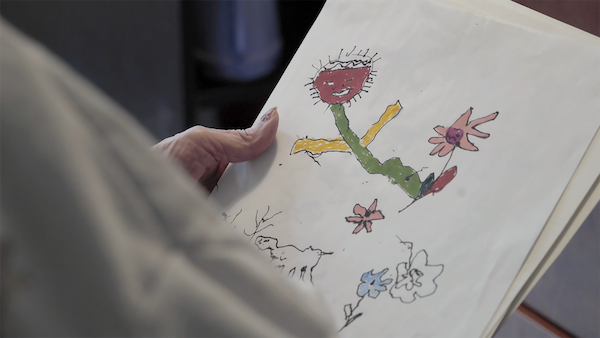
image - A still from the short Don’t Let the Sun Catch You Crying, co-directed by Toby Gillies and Natalie Baird, which screens May 10 at SFU’s Djavad Mowafaghian Cinema, as part of this year’s DOXA festival.
A still from the short Don’t Let the Sun Catch You Crying, co-directed by Toby Gillies and Natalie Baird, which screens May 10 at SFU’s Djavad Mowafaghian Cinema, as part of this year’s DOXA festival. (image from NFB)

The NFB short film Don’t Let the Sun Catch You Crying also explores loss. The PR material describes the seven-minute work as a “meditation on love, grief and imagination,” which “celebrates life and the transformative ability of art to elevate and transcend us.” 

Featuring Edith Almadi, the short uses Almadi’s artwork and words to spur contemplation of the bonds people form, and what it’s like to lose a loved one. In this case, Almadi is recalling her son, who recently died. 

“I fly with him,” she says, and she feels happiness. In the animation of Almadi’s artwork, we see her son fly to the moon and beyond, with fairies, butterflies and other creatures. Not only is she with her son in her art, but also with everyone she loves. In her imagination, she is totally free.

“Our initial motivation for interviewing Edith was to save memories for ourselves – we find the way she speaks fascinating and poetic,” write Gillies and Baird in a directors’ statement. “When Edith looks at her drawings, she sees her memories and fantasies. She is able to escape her physical circumstance, through entering her marker and watercolour worlds.”

Gillies and Baird have led an art program at Winnipeg’s Misericordia Health Centre since 2014, and that’s where they met Almadi, a Hungarian immigrant in her late 80s, who uses a wheelchair.

“In our time knowing Edith, she has always loved sharing her outlook publicly,” the directors write. “As we have developed the film, we have shown Edith our progress along the way. She says, ‘That’s me’ and ‘That’s all I have to give’ proudly. Facilitating art-making in this personal care home has allowed us to meaningfully connect with many people in their last stages of life. As directors, this film gives us the opportunity to share this one particular experience of intimacy found through collaborative art-making.”

DOXA runs May 2-12. For tickets and the full festival lineup, visit doxafestival.ca. 
Format ImagePosted on April 26, 2024April 26, 2024Author Cynthia RamsayCategories TV & FilmTags aging, Banger Films, death, documentaries, DOXA, Edith Almadi, history, imagination, loss, Lucah Rosenberg-Lee, Michael Mabbott, Natalie Baird, National Film Board, NFB, R&B, Toby Gillies

Community milestones … Rabbi Carey Brown

photo - Rabbi Carey Brown of Temple Sholom
Rabbi Carey Brown of Temple Sholom (photo from templesholom.ca)

Rabbi Carey Brown of Temple Sholom will be part of the next cohort of Shalom Hartman Institute’s Rabbinic Leadership Initiative (RLI).

The intensive three-year fellowship program immerses North American rabbis of all denominations in the highest levels of Jewish learning, equipping them to meet contemporary challenges with ever-increasing intellectual and moral sophistication. It is one of the few structured frameworks for ongoing rabbinic study, enrichment and intellectual leadership training. In addition to rigorous study, the program fosters a deep sense of community for diverse rabbis in an environment of open dialogue, collaboration, peer-learning and personal support. The next cohort begins next month.

Posted on April 26, 2024April 26, 2024Author Community members/organizationsCategories LocalTags Carey Brown, education, Judaism, leadership, Rabbinic Leadership Initiative, Shalom Hartman Institute, Temple Sholom
Waldman’s 2024 Human Library

Waldman’s 2024 Human Library

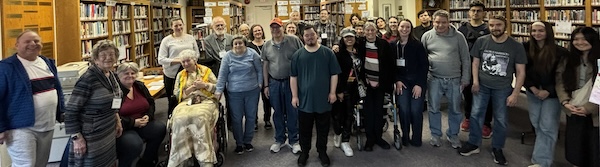
Participants in the Human Library event at the Isaac Waldman Jewish Public Library on April 7. (photo from Waldman Library)

photo - Jewish Independent publisher Cynthia Ramsay (inset, middle) was one of the “books”
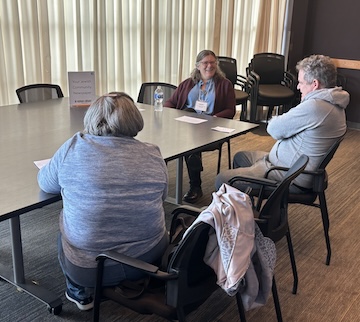
Jewish Independent publisher Cynthia Ramsay (inset, middle) was one of the “books.”  (photo from Waldman Library)

The Human Library event at the Isaac Waldman Jewish Public Library on April 7 drew a diversity of “human books” (volunteers who shared some of their life experiences) and readers (people who came out to learn about those experiences). Titles included Police Officer; Coping with Dementia: A Mother/Son Story; More than just MS; Brain Cancer Survivor; Your Jewish Community Newspaper; and Partners in Care. Books and readers gathered at the library, had snacks and shmoozed, before participating in three separate reading sessions over the course of the afternoon. The purpose of the event is to connect one-on-one or few-on-one with individuals from different cultural backgrounds and lifestyles, celebrating our differences and fostering understanding.

Format ImagePosted on April 26, 2024April 26, 2024Author Cynthia RamsayCategories LocalTags education, Human Library, Waldman Library
יוצאי איראן בטורונטו ארגנו כנס נגד אנטישמיות

יוצאי איראן בטורונטו ארגנו כנס נגד אנטישמיות

גם יוצאי איראנים בוונקובר תומכים בקריאה לחמאס לשחרר את בני הערובה (רוני רחמני)

 המועצה של מוסלמים נגד אנטישמיות ארגנה במרכז טורונטו כנס מיוחד לאור העליה בגל האנטישמיות נגד יהודים. באירוע של הארגון הבינלאומי שמושבו בטורונטו השתתפו למעלה מארבע מאות איש. הארגון מחויב להיאבק בטרור בקיצוניות, כולל אנטישמיות נגד יהודים

המשתתפים הביעו את תמיכתם ביהודים במלחמה נגד תופעת האנטישמיות שהולכת ומתגברת בעת הזו, לאור המלחמה של צה”ל בעזה מול ארגון הטרור של החמאס. באירוע דנו בדרכים השונות להילחם באנטישמיות בתוך הקהילות השונות. בין המשתתפים היו חברת הפרלמנט מטעם המפלגה השמרנית של קנדה, מליסה לנצמן, הפרשן בנושאים הפוליטיים זוהדי ג’אסר, הסופר רהיל ראזה, חבר מועצת עיריית טורונטו גולדי ג’מארי ומנכ”לית המועצה של המוסלמים שריל סאפריה. מרבית הפעילים במועצה של המוסלמים נגד אנטישמיות הם יוצאי איראן שעזבו את המדינה עם עלייתו לשלטון של חומייני

חברי המועצה והאורחים בכינוס ציינו שיש לבצע תוכנית פעולה מהותית הכוללת שישה חלקים. ובהם: דרישה מהחמאס לשחרר את כל בני הערובה שהוא מחזיק בעזה מאז השבעה באוקטובר, להסיר את המימון של ממשלת קנדה לסוכנות הסעד של האו”ם – אונר”א. וכן להכריז על חייל משמרות המהפכה האסלאמית האיראנית כישות טרור. עוד הוזכר בכינוס כי יש להרים את הקול ולבקר את אלה המשבחים את האנטישמיות, הג’נוסייד של החאמס והזוועות המיניות שביצע ארגון הטרור בשבעה באוקטובר בישראל. אורחי הכנס הזכירו כי על המוסדות השונים ברחבי העולם ובהם האו”ם לנקוט עמדה חד משמעית נגד האלימות המינית הבלתי ניתנת לערעור שנעשתה לנשים, ילדים וגברים על ידי מחבלי החמאס – בשבעה באוקטובר. זו בעייה חמורה בחברה האנושית שלנו שיש הרואים בפעולות אלו של החאמס כהתנגדות לכיבוש. עוד הוזכר כי האשמה לאירועי השבעה באוקטובר מוטלת בעיקר על שלטון האייתולות באיראן ועל קהילות מוסלמיות במדינות שונות שמעודדות אנטישמיות ללא הפסק

ארגון מועצת המוסלמים נגד אנטישמיות מציין כי האנטישמיות היא תופעה ייחודית נפוצה, שינאה מתמשכת וקטלנית שנכנסה למסגרות תרבותיות, דתיות ופוליטיות שונות ומרובות בכל רחבי העולם. לפי סקרים אחרונים, רעיונות ותחושות אנטישמיות מאומצים כיום בדרגות שונות על ידי כרבע מאוכלוסיית העולם

ארגון מועצת המוסלמים מכיר באיום המיוחד הנשקף מן העליה המטאורית של האנטישמיות העולמית במאה העשרים ואחת. לעתים קרובות רצח או חיסול בכוונה תחילה או בביטוי, הוא מייצג שילוב חסר תקדים של הזנים המוכרים יותר של אנטישמיות המקודמים באידיאולוגיות ימין קיצוני, שמאל איסלאמיסטיות. האנטישמיות נחשבת על ידי מומחים לרעילה הרבה יותר מסך חלקיה, התפשטות האנטישמיות העכשווית הואצה על ידי הגלובליזציה והופעת הטכנולוגיות של המאה העשרים ואחת

ארגון מועצת המוסלמים תומך בהגדרה הבינלאומית לזכר השואה של האנטישמיות. הגדרה זו היא המקובלת ביותר בעולם לאנטישמיות והיא אומצה ואושרה על ידי ארבעים ושלוש מדינות כולל קנדה

מועצת המוסלמים מחויבת לפעול עם קבוצות דומות כדי לאתגר את האנטישמיות בכל מקום שבו היא עלולה להופיע. הארגון ימשיך ביוזמות חינוכיות, חקיקתיות, ומדיניות להשיג את המטרות שלו. כמוסלמים מכל הקשת המוסלמית והפוליטית, הארגון יהווה, יגייס ויזרז קול מוסלמי מובהק להתמודד עם האנטישמיות, שהשתרשה עמוקות ונותרה    אתגר קשה בעולם המוסלמי הרחב. הארגון יתמוך במאמצים של ארגונים מוסלמים במדינות בעלות רוב מוסלמי ובמקהלה הולכות וגוברת של מנהיגים, סופרים ותיאולוגים מוסלמים אשר נטלו על עצמם יוזמות להתעמת עם האנטישמיות, שהורשתה לחגוג בקהילות. אנו כמוסלמים נתעמת עם התופעה וקידום המערכתי של האנטישמיות על ידי קיצונים איסלאמיסטים מכל הסוגים, שעבורם הדמוניזציה ושנאת היהודים הם עמוד מרכזי באמונתם

Format ImagePosted on April 25, 2024April 25, 2024Author Roni RachmaniCategories עניין בחדשותTags conference, Council of Muslims Against Antisemitism, fighting terrorism, Iranian expats, Oct. 7, Toronto, טורונטו, יוצאי איראן, כנס, להיאבק בטרור בקיצוניות, מועצה של מוסלמים נגד אנטישמיות, שבעה באוקטובר
The strength of community

The strength of community

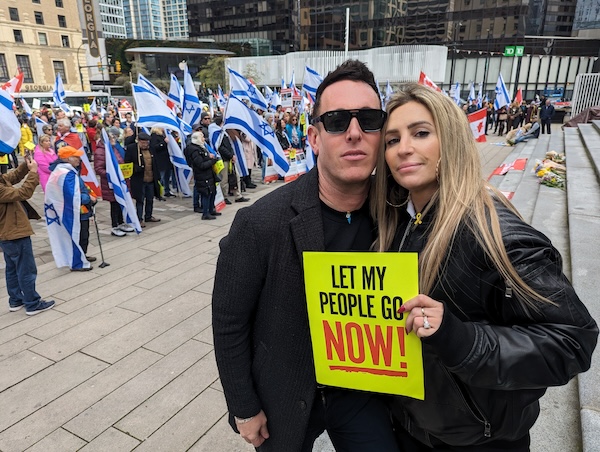
Shai DeLuca and Alexandra Smith flew in Sunday from Toronto to address Vancouver’s weekly vigil for Israeli hostages on the six-month anniversary of the atrocities committed on Oct. 7. (photo by Pat Johnson)

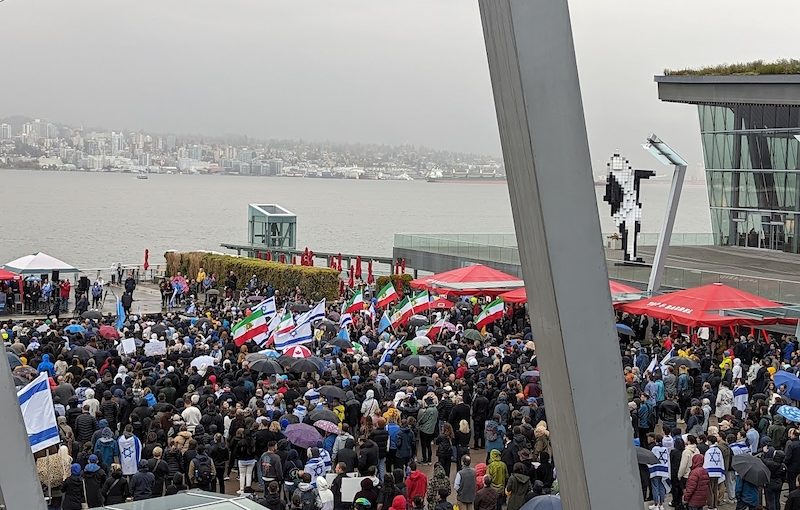
Unity, defiance and determination were the overriding messages at the community rally Sunday, April 7, marking six months since the atrocities of Oct. 7.

“Our hearts are heavy with the weight of loss and sorrow,” said Michael Sachs, regional director of the Jewish National Fund of Canada. As Israelis were called up for service at the start of that war, another battle began in the diaspora, he said.

“Jews worldwide were drafted for a different, yet related, war,” said Sachs. “In the wake of Oct. 7, we witnessed a disturbing and radical rise in antisemitism and Jew-hatred right here in Canada.”

Canada today does not resemble the Canada of Oct. 6, he said, as anti-Jewish ideas and actions have “emerged from the alley and are now openly displayed on our streets and threatening the very fabric of our society.

“We should always draw strength from the resilience and courage of the survivors,” Sachs said. The souls of those murdered that day, he said, live on “in our commitment to build a world with compassion, justice, that will triumph over the cruelty and ignorance that we are seeing.

“The brave soldiers, of all faiths, who have made the ultimate sacrifice in defence of Israel – we mourn you and we will never forget you,” said Sachs.

The Jewish response to evil is goodness, he said.

“In the face of their darkness, let us shine our light on them by rejecting forces of division, and continue to embrace the power of the unity of our community and our amazing allies,” he said. “Let us stand together, hand in hand, to be the hope and strength to the families of those held hostage. Let us show the world that our Zionism – not the Zionism that they have created – our Zionism, our love of Israel, is stronger than any hate they can throw at us.”

Aron Csaplaros, BC regional manager of B’nai Brith Canada, recalled his own family’s history.

“For hundreds of years, we have overcome expulsions, pogroms, massacres,” he said. “During the Holocaust, my grandmother spent months hidden in a dark basement, constantly hearing the footsteps of Nazi officers walking above her head, knowing that she could be found and murdered at any minute. But she, like Jews have done throughout our history, survived. She is here today standing in the crowd and we, the Jewish people, are still here, stronger and more united in our resolve than ever.”

He reiterated the demand of the weekly events, that the hostages be released, and added that Hamas should accept its defeat and unconditionally surrender to facilitate a new era of peace between the Palestinian and Israeli people.

“We will never stop fighting those who wish to destroy us,” Csaplaros said. “And we will not stop fighting to defend our indigenous homeland, the land of Israel.”

Until the hostages are released, he said, “We will not stop rallying. We will not stop marching. We will not stop advocating and we will not stop calling on our elected leaders in government to act until every single one of our brothers and sisters held hostage is safely returned.”

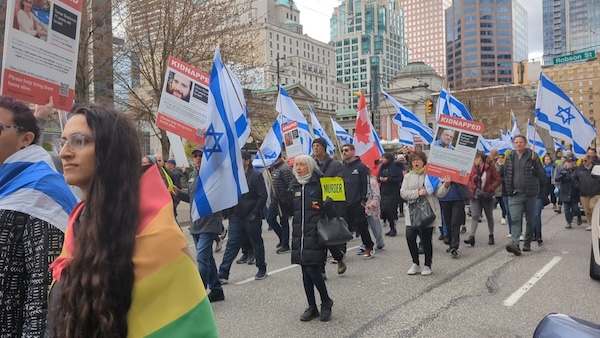
photo - Calls for the return of the hostages being held by Hamas rang through the streets of Vancouver Sunday
Calls for the return of the hostages being held by Hamas rang through the streets of Vancouver Sunday. (photo by Pat Johnson)

Shai DeLuca, an interior designer who lives in Toronto and Israel, is a familiar face to audiences of Toronto’s CityTV and Global television. During the Hamas war in 2014, he pivoted to being a voice for Israel and has led battles against anti-Zionist campaigns in Toronto. He said he was nonchalant when he awoke to alerts on Oct. 7. But, as he and his husband took refuge in a shelter, he realized this was not routine.

“I have lived through enough attacks, hundreds upon hundreds of Hamas rocket attacks throughout my life, to know that this felt different,” said DeLuca.

Soon, Israeli phones were lighting up with push notifications, videos and images showing murder, rape and other atrocities. 

“It was from numbers we did not recognize,” he said. “Only later did we find out that these were targeted push notifications from Hamas.”

Last week, DeLuca was back in Israel and visited the site of the Nova music festival, where hundreds were murdered. The site is about 15 minutes from his family home.

He spoke with Rotem, a young woman who had been a vocal advocate for reconciliation between Israelis and Palestinians. She had spent 30 hours in a safe room with her children before the terrorists gave up and sought out easier prey.

That day, Rotem told DeLuca, was “the day that I realized they really don’t care who we are.”

“A Jew is a Jew,” she told him. “They want us all dead.”

Many of Israel’s most avid peace activists lived on the kibbutzim that were attacked.

“The belief that one day we would have peace with our neighbours wasn’t something she could foresee anymore and that was heartbreaking to see,” said DeLuca. “She had strived to work toward a better tomorrow for all and was met with the worst massacre of the Jewish people since the Holocaust, on her community specifically…. A community that employed Gaza workers and worked daily to build bridges. That bridge no longer exists, she said, they torched it.”

Now, in the diaspora, Jews are faced with what DeLuca equates to the antisemitic marches of the 1930s and ’40s.

“We have never been able to depend on others,” he said. “Our history has proven that.… The difference today, unlike times past, is that we have our home to go to. While the hate marches we see repeatedly across cities and across countries call to deny the existence of the only indigenous home the Jewish people have ever known, they continue to prove why its existence is so very important.”

Alexandra Smith, director of End Jew Hatred Canada, came with DeLuca from Toronto on a delayed flight, arriving just in time for the event. 

“Today, we are called upon not only to demand the immediate and unconditional release of those unjustly held, but to reaffirm our commitment to each other as members of a shared community, a shared nation, a shared destiny and, indeed, a shared humanity,” said Smith.

“Starting on Oct. 8, for many in the Jewish community, the open, brazen, unashamed Jew-hatred exhibited on college campuses and on our streets came as a terrible shock and a deep sense of betrayal,” she said. “But, for those of us who have been working in this space for a length of time, it came as no surprise. Antisemitism has always been there, only hidden under wraps. It took a war in the Middle East for it to rear its ugly head. It’s not an exaggeration to call this a profound crisis. In moments of crisis, however, the strength of a community is seen not only in its leaders but in the spirit of its people. Unity is our beacon of hope. Shoulder to shoulder, regardless of backgrounds, beliefs and life experiences, we embody the resilience that has helped communities throughout history overcome adversity.”

Rabbi Andrew Rosenblatt of Congregation Schara Tzedeck chanted El Moleh Rachamim, invoking the name of Elad Katzir, a hostage whose body was recovered by Israeli soldiers the day before the rally. Rabbi Susie Tendler of Beth Tikvah in Richmond said the prayer for the hostages. 

Format ImagePosted on April 12, 2024April 10, 2024Author Pat JohnsonCategories LocalTags Alexandra Smith, Aron Csaplaros, Israel-Hamas war, Israeli hostages, Michael Sachs, Oct. 7, rally, Shai DeLuca
Diverse & happy show

Diverse & happy show

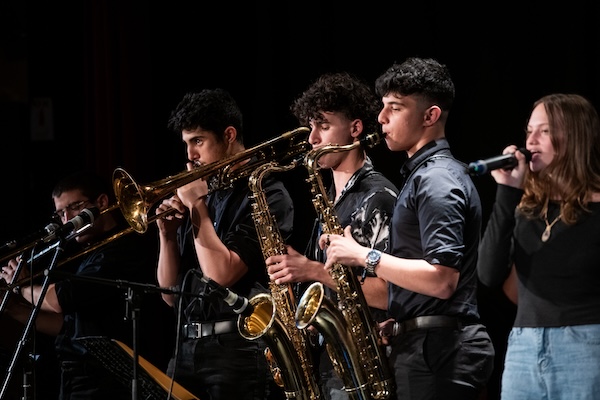
Members of the Clore & Roll Ensemble will perform in Vancouver on May 13. (photo from Clore Centre)

Every year, it is sobering to experience the transition from Yom Hazikaron, the day of remembrance for Israel’s fallen soldiers and victims of terrorism, into Yom Ha’atzmaut, the celebration of Israel’s Independence Day. This year, it will be even more so. And it will be especially poignant, given that the musical group headlining the local community gathering on May 13 is an ensemble from Kfar Blum, a kibbutz in the Galilee Panhandle, in northern Israel, where some 60,000 people have been evacuated because of the threats posed by Hezbollah in Lebanon.

The Clore & Roll Ensemble is an initiative of the music school of the Clore Centre for the Performing Arts, which also has a dance and theatre school. The centre was established in 1996 and approximately 1,000 students (which include adults) study there. They come from kibbutzim and moshavim in the area, as well as Druze and Arab towns.

“I’m glad to say that the conflict doesn’t get inside the centre,” Telem Chorin, chief executive officer of the Clore Centre and director of the ensemble, told the Independent. “Music is an international language and also an emotional language that connects people,” he said.

While the Clore Centre’s offerings remain afterschool programs, the centre has played a more important role in students’ lives since the Oct. 7 terror attacks that led to the current war.

“For some kids, the Clore is like a second home,” said Chorin. “Because, for some students, it is a more stable place than the hotel they were evacuated to, or the school that is currently closed or working partially.”

Despite being displaced, ensemble members have been coming together weekly to practise for the show in Vancouver. Rehearsals are at the centre.

“Last week, we had matriculation exams in dance and, during April and May, we will have matriculation exams in music playing,” said Chorin. “It is interesting to see how committed the students are to performing arts subjects even in such a period, and how much effort they have to invest – time, long journeys, sometimes even risking [their safety] and coming to Kfar Blum, even though it is relatively more dangerous here than in their homes or the hotels they have moved to. This shows how important it is to them and how much they don’t give up on it despite everything, and maybe even this is what keeps them ‘sane’ amidst all the chaos currently prevailing in the north.”

Some members of the ensemble have been playing together for more than five years in different capacities, but the group that is coming to Vancouver has only been playing together for the past three months, said Chorin. Due to the war and the evacuations, the group had to rebuild. “We’ve added additional musicians to the band so that you will have an amazing show!” he said.

Coming to Vancouver are Menachem Ofri (17, singer), Yaron Shir (18, singer), Kachtan Aviv (17, flute), Maman Moria (17, alto saxophone), Moyal Ido (17, tenor saxophone), Shem Tov Ido (19, trombone), Kovesh Gil (24, drums), Primor Adi (17, electric guitar), Fitzer Tal (16, piano) and Deutscher Goni (16, bass guitar). Also coming are Ziv Greenberg (music director), Ferry Stefan (dance teacher and dancer), Malki Smadar (administrative manager) and Kashri Noam (technical manager). 

“Ofri, Ido Shem-Tov, Aviv and Noam were evacuated from their homes, and they are coming from all over the country to the rehearsals at the centre – sometimes, under rocket attacks!” said Chorin, who will join the band in the performance, on clarinet. 

“Some of the students have already appeared in Edmonton and Calgary,” he said. “I have performed in Edmonton, Calgary, Windsor and Hamilton, but this is my first time in Vancouver and I am very excited! Some of the students were in Vancouver on student exchanges with their schools in Israel.”

Of what it means for the Clore & Roll ensemble to play a Yom Ha’atzmaut concert in the diaspora, Chorin said, “It is a great pride and honour to represent the state of Israel in general, and the Upper Galilee in particular, in such a show, on the eve of Independence Day, in a challenging time like now.”

The ensemble will present a wide-ranging repertoire.

“We are going to play modern Israeli songs (Idan Raichel, Mizrachit [Israeli pop]), classic Israeli songs and also some songs in English,” said Chorin. “A very diverse and happy program.”

“Bringing the Clore ensemble serves as a reminder of the unbreakable bond we share across borders,” said Dafna Silberstein, associate director of Israel connections and partnerships at the Jewish Federation of Greater Vancouver. “It is also an amazing opportunity for the ensemble of teens and young adults to take a break from what they have been through for the past six months. And, for us, it feels like it is exactly what we need this year: coming together as a community united for and with our brothers and sisters in Israel.”

Jewish Federation has supported the Clore Centre as part of the Coast-to-Coast Federations’ Collective and independently, “as the centre is in our partnership region of Kiryat Shmona and the Galilee Panhandle,” explained Silberstein.

“We have wanted to bring the Clore ensemble for awhile now, to showcase the impact our support has had on its students and have been waiting for the right opportunity,” she said, noting that it is “with mixed emotions” that Oct. 7 created that opportunity.

“This year, the commemoration of Israel’s 76th Independence Day holds an even deeper meaning and significance,” said Silberstein. “It is an opportunity to stand together in solidarity and celebrate our shared values. Considering the spike in antisemitism, the need for community unity has become more important than ever.”

For tickets ($18) to the May 13, 7:30 p.m., concert at Congregation Beth Israel, as well as information about other Israel@76 activities, visit jewishvancouver.com/israelhere. 

Format ImagePosted on April 12, 2024April 11, 2024Author Cynthia RamsayCategories LocalTags Clore & Roll, Clore Centre, conert, ensemble, Israel Independence Day, Jewish Federation of Greater Vancouver, music, Yom Ha'atzmaut

Don’t leave. Engage!

Anthony Housefather has decided to remain in the federal Liberal caucus. Housefather, member of Parliament for the Quebec riding of Mount Royal, is one of only two Liberals to have voted against the NDP motion last month that called for a ceasefire, an end to Canadian military trade with Israel, as well as other positions about Israel and the current conflict.

As discussed in this space last issue, the New Democratic Party motion had some of its rough edges sanded down in order to make it palatable to almost all Liberal MPs. The rest of the House of Commons voted predictably. Conservatives unanimously opposed the motion, which they viewed as biased against Israel. The Bloc Québecois and the Green party sided with the NDP.

The daylong negotiations over amendments to the motion were a face-saving effort by the Liberal government to avoid the embarrassment of a serious schism in their caucus over foreign policy. In the end, a less inflammatory motion was passed.

Housefather, who is Jewish and represents a riding that has one of the largest concentrations of Jewish voters in Canada, was joined on the government side in opposing the motion only by Ontario Liberal MP Marco Mendocino.

Housefather was open about his frustration. Anyone who has found themselves in a place where they do not feel welcomed, based on their core identity, can certainly appreciate his feelings of isolation. However, we are pleased that he has decided to remain in the Liberal caucus.

Crossing the floor and joining the Conservatives, which he had said he was considering, would not have been advantageous to Jewish and pro-Israel voters. Since the administration of former prime minister Stephen Harper, at the latest, the Conservative party has been perceived as overwhelmingly pro-Israel. This approach has been welcomed by many Jewish Canadians.

However, this reality means that, were Housefather to switch parties, he would become just another pro-Israel voice in the Conservative caucus. By staying where he is, he will be a necessary voice for Israel and the Jewish community in the governing party. In an announcement a week ago, he said the prime minister has asked him to lead the government’s efforts in fighting antisemitism. This effort needs as much multi-partisan support as possible.

Anyone who has had difficult conversations with friends or family in recent months understands the emotional burden of being a voice for Israel in this challenging time. This, however, makes Housefather’s presence in the Liberal party that much more important.

We face a similar challenge at the provincial level. With the firing of Selina Robinson from cabinet, and her subsequent withdrawal from the governing New Democratic Party caucus, the Jewish community’s most outspoken ally, liaison and voice is gone from the government side of the legislature. Neither Robinson, who now sits as an independent, nor George Heyman, the other Jewish New Democrat in Victoria, are seeking reelection. It is entirely possible that the Jewish community will not have any community members in the next legislature.

This is not to say we do not have friends there.

Michael Lee, the MLA for Vancouver-Langara, has been a steadfast ally of the Jewish community and a stalwart presence at the weekly Sunday rallies for the Israeli hostages. Recently, when he addressed that audience, he went to lengths to warn against making Israel a political football. A community that can be taken for granted by one party and written off by another will find itself unrepresented in the halls of power. Lee reassured Jewish British Columbians that they not only have friends on the opposition side of the house, but in the governing NDP as well.

We know that there are allies for Israel and the Jewish people in the provincial NDP. It is a symptom of a larger concern that some of these people feel constrained around expressing that solidarity fully because of segments of their own party who would almost certainly single them out for that support.

As Robinson herself told the Independent last issue, she has friends and supporters in the caucus – but she wouldn’t mention them by name for fear of putting a target on their backs. This is a serious problem, of course. But it is better to have quiet allies than no allies at all. Their presence can potentially moderate extreme elements in their party. Were they not there, restraining impulses might be minimized.

As we approach a provincial election this fall, and a federal election at some unpredictable date (remember, there is a minority government in Ottawa) Jewish Canadians and allies of Israel should not abandon the parties that include voices with alternative views. We should, like Housefather has chosen to do, make sure our voices are heard in all of Canada’s diverse political venues. 

Posted on April 12, 2024April 10, 2024Author The Editorial BoardCategories From the JITags allyship, Anthony Housefather, antisemitism, governance, House of Commons, Israel, Liberal Party of Canada, Michael Lee, NDP, politics
Isolated, tired, disappointed

Isolated, tired, disappointed

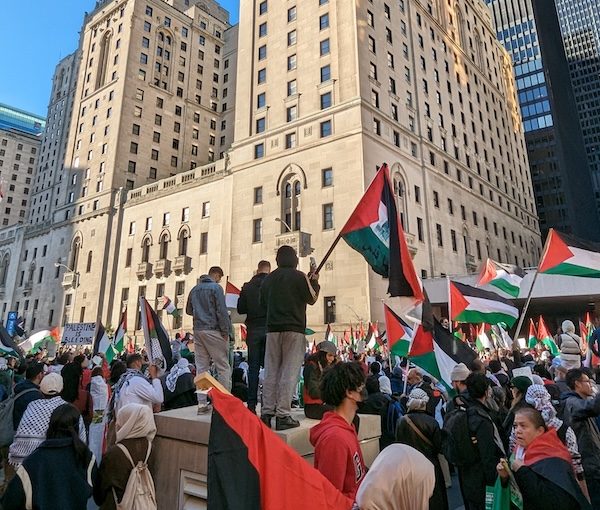
A “Toronto for Palestine” protest Oct. 28, 2023. In the last six months, across Canada, such protests have often featured calls for violence against or the death of Jews. (photo by Sikander Iqbal)

In the past six months, protesters have targeted Jewish community buildings and synagogues in Montreal and the Toronto area. Jewish student group Hillel has also been a prime target for anti-Israel and anti-Jewish sentiment at Canadian universities, including in Vancouver. Similar protests caused the Art Gallery of Ontario to cancel an event with the Canadian and Italian prime ministers over security concerns. A man in Vancouver was charged with hate-related crimes over the defacing of Israeli hostage posters. 

These are just a few examples of organized anti-Israel protests, often with calls for violence against or the death of Jews, on the streets and campuses across the country. Much of this activity is met with silence or borderline anti-Jewish remarks from many elected officials and leaders.

Trans and queer rights are also under attack in Canada with the premier of Alberta’s recent announcement of sweeping new anti-trans policies and Saskatchewan Premier Scott Moe’s use last year of the notwithstanding clause in the Charter to push through a law requiring parental consent for children under 16 who want to change their names or pronouns at school. 

The confluence of these events and the ongoing need to carefully navigate the intersectionality of their identities has left many queer Jews feeling isolated, tired and disappointed.

Queer communities in Canada have long trended toward a pro-Palestinian point of view, often reflected in clashes over whether certain Jewish groups should be allowed to march in pride parades, Aviva Rathbone, board chair of JQT, a Vancouver-based Jewish queer and trans organization, told the Independent.

“Right now, what it means is that many of the Jews in the queer community, especially Israelis, but also Jews who would maybe call themselves Zionists or who feel complex about the situation in Israel and Gaza, are not welcome in queer communities,” she said.

“I did not know there was such thing as an anti-Zionist Jew until I moved to Canada,” said Ari Fremder, a 33-year-old who works in Vancouver’s animation industry. Fremder is originally from Zimbabwe.

As a trans person who is also autistic and introverted, Fremder said, they don’t leave their house very often anymore because of the anti-Jewish protests, posters and stickers – that frequently incite violence against Jews – in their neighbourhood.

They used to go to local queer events but said they don’t feel safe anymore, as many groups are pro-Palestinian and openly state Zionists are not welcome.

“I feel a lot safer being queer in the Jewish community than I feel safe being Jewish in the queer community,” said Jessie, a 21-year-old student and environmental activist in Ontario, who asked not to use their real name.

As one of few Jewish queer people in Halifax, Schuyler H. Smith said they are facing “more hate” than they’ve ever faced in that city.

The 33-year-old diversity consultant agreed that it’s more comfortable to be part of a Jewish than a queer community right now. They will, often with trepidation, reach out privately when they see antisemitic comments and remarks from queer community members, to try to dispel myths about Jews as white colonialists or as non-indigenous to Israel, for example.

Smith hopes one-on-ones can make people think twice before posting negative comments or memes about Jews.

Anti-trans policies in Alberta and Saskatchewan, attacks and protests at drag queen story times and other “parental rights” actions across the country are also taking a toll on members of the LGBTQ2S+ community.

“I’m scared, honestly, for young trans people who need this care and are being interfered with by politicians,” said Cas Allen, a 21-year-old university student in Victoria who says access to hormone blockers changed his life when he was 15.

Ezra, a 39-year-old trans teacher in Calgary, who prefers not to use his real name, said the government is pushing a lot of misinformation, but he’s heartened by the pushback from the queer community.

He’s committed to being a visible queer influence in his school, which has a high number of new Canadian immigrants.

“If there were any queer kids in the class, they could see themselves reflected,” he said, “and [I can give] them a safe adult to confide in [while] they decided who they are.”

Allen, who grew up in a religious Jewish family in Alberta, said since he transitioned, he has “recreated” his queer Jewish identity “from the ground up” but he’s once again finding it “complicated and messy” to reconcile both those parts of himself.

He said he feels isolated and unable to talk about his feelings regarding Israel and his Jewishness to the LGBTQ2S+ people he knows. He said the only person he can really confide in is his twin sister.

Queer spaces on university campuses tend to be very pro-Palestinian and are forcing students to choose between their Jewishness and being queer, said Rabbi Seth Goren, executive director of Jewish student group Hillel Ontario, which has a presence at nine universities in the province.

“I think that’s a choice that queer Jewish students shouldn’t have to make,” he said.

Many Jewish students feel like there is no place where the conflict isn’t swirling around them, added Rabbi Kylynn Cohen of Hillel BC. She said she’s had to help students who, after Oct. 7, couldn’t go to classes because of the anti-Jewish rhetoric, both from student groups and in classrooms.

Cohen said she sees more Jewish students hanging out in the Hillel building on the University of British Columbia campus, seeing it as a safe space. Many queer students have told her they go to straight bars to unwind now rather than congregating in gay spaces.

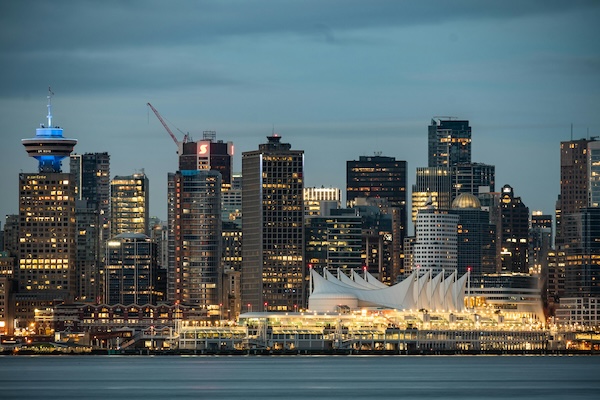
photo - Vancouver skyline at night
From Vancouver to Halifax, many queer Jews are feeling unsafe and isolated because of the increase in anti-Jewish and anti-trans sentiment since the Oct. 7 Hamas terror attack on Israel and the ensuing Israel-Hamas war. (photo by Maximilian Ruther / Pexels)

Many student-run groups and education-related unions have come out with strong anti-Israel statements. Six Canadian universities are facing class action lawsuits over anti-Jewish hate speech, threats against Jewish students on campus, and the silencing of Jewish voices. 

There are also dozens of reports of Jewish students being shouted at, punched and spat on by anti-Israel protesters at universities across the country. Ontario student Jessie said, even though they’re at a university with a large Jewish population, there is constantly an “uncomfortableness” between their two intersecting identities.

Like many LGBTQ2S+ Jews, their stance on Israel is multi-faceted but they said they’re frustrated and have lost friends in the queer community who aren’t open to the nuances of how different Jewish people are feeling or to seeing the Jewish community as anything other than homogenous “white settler colonialist[s].”

Jessie wears a Star of David necklace but said they now often hide or remove it, including during their local drag king performances at which other performers have made pro-Palestinian tributes. They say they’d be “canceled” if they shared their support for the hostages or Israeli citizens during a show.

“There’s no space even for me to mourn or to acknowledge my feelings and what’s happening,” said Jessie.

There are, however, some Jewish queers for whom the past few months have been a time of solidarity and community building.

Non-binary Toronto artist Sadie Epstein-Fine said they are Jewish but were raised as an anti-Zionist. They’re a member of a group called Jews Say No to Genocide, whose membership is almost all queer Jews. Since Oct. 7, they say they’ve been “entirely surrounded by queer Jews” in a busy, activist environment.

They admit to looking white and acknowledge the privilege that brings, also recognizing that antisemitism is on the rise but saying they’ve been fortunate not to have felt it personally.

“We’re more concerned about Palestinian safety than we are about our safety,” Epstein-Fine said of their group members.

Beyond campuses, the past six months have seen bomb threats and attacks against Jewish schools and businesses, as well antisemitic graffiti and a rising number of other hate crimes aimed at Jews across the country. Police forces in some cities have enlarged their hate crimes units and set up hate-crime reporting centres in Jewish areas.

Darren Sukonick, 53, a Toronto businessman who has been involved with Jewish charities and community groups for decades, said he was surprised and disappointed at how widespread and swift anti-Jewish sentiment was across Canada after Oct. 7. He said he never thought he’d ever experience levels of hate like he’s seeing now.

“It was like being on a hike, turning over a log and seeing all this vermin crawling out from under it. That’s what it felt like,” he said.

On the other hand, Sukonick said many non-Jewish friends have reached out and shown support.

Calgary teacher Ezra said he frequently hears racist and hate speech about Jews, but not aimed at him, from his Grade 7 students. When he hears it, he addresses it with the kids in an effort to get them to see different points of view.

Sometimes, it’s easier to get out of bed and deal with all the negativity being hurled at both the trans and Jewish communities, said Ezra. Other days, he said, it takes a greater toll on his mental health. 

Gail J. Cohen is an award-winning Toronto-based writer, editor and communicator.

Format ImagePosted on April 12, 2024April 10, 2024Author Gail J. CohenCategories NationalTags anti-Israel, anti-trans sentiment, anti-Zionism, antisemitism, LGBTQS2+, queer
Egypt faces many struggles

Egypt faces many struggles

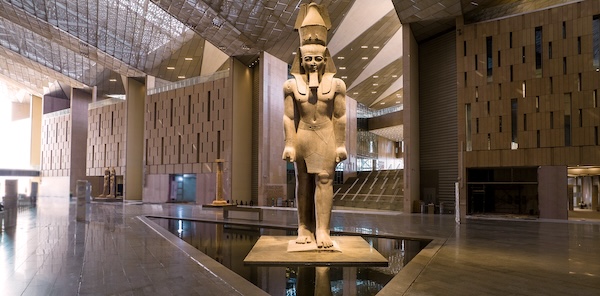
Twenty years in the making, Egypt’s Grand Egyptian Museum is in a soft-opening period, with a section of the 81,000-square-metre site open for limited guided tours. (photo from Grand Egyptian Museum)

In biblical times, the Patriarch Jacob led his family to Egypt, the granary of the ancient Near East, to escape famine in Canaan. By the Roman era, the Nile River Valley and Delta – enriched by the Nile’s annual flooding with alluvial mud – had become the breadbasket of Rome. King Herod built an artificial harbour at Caesarea to facilitate the crucial maritime shipment of wheat to the imperial capital. Today, the once fabulously wealthy country is an economic basket case.

President Gen. Abdel Fattah el-Sisi and his military-industrial kleptocracy blame the country’s high birth rate for the inability to feed Egypt’s burgeoning population of 110 million people. Taking a page from Keynesian economic theory, the regime – which toppled Islamist leader Mohamed Morsi in a 2013 coup d’état – has triggered a free fall of hyperinflation and devaluations while building mega-projects to stimulate the country’s broken finances.

The country’s annual rate of inflation soared to 36% in February, the Central Agency for Public Mobilization and Statistics (CAPMAS) said on March 31. The Egyptian pound, called the guinea, traded at 20 to the American dollar as recently as 2020. Now, one needs 52 to buy a greenback in the flourishing parallel market. In the past 24 months, a crippling shortage of foreign currency has caused prices of goods and commodities to more than triple, forcing low- and middle-income Egyptians to further tighten their belts.

The result? Strained services, a bloated bureaucracy, a huge government budget and a staggering deficit.

Compounding the economic misery, Hamas’s Oct. 7 attack on Israel and the resulting Israel-Hamas war in Gaza have driven away tourists from the land of Pharaonic wonders and spectacular coral reefs. Houthi rockets targeting shipping in the Red Sea have shrunk revenue from the Suez Canal, which is down 40% this year versus the same period in 2023. And Russia’s invasion of Ukraine two years ago has driven up wheat prices and made subsidized bread – a staple for most Egyptians – more costly.

Notwithstanding Egypt’s inability to repay its current foreign debt of about $165 billion, el-Sisi’s immediate financial problems were eased in recent weeks thanks to a bailout, more than $23 billion provided by the International Monetary Fund (IMF), the World Bank and the European Union.

At the same time, the United Arab Emirates launched a rescue plan to prop up its ally through the Ras el-Hekma deal announced last month. The vast real estate project envisions a new city on the barren shores of the Mediterranean Sea near the site of the pivotal Second World War battle of El Alamein. It was concluded in exchange for $24 billion in cash liquidity and $11 billion in UAE deposits with the Central Bank of Egypt, which will be converted into Egyptian pounds and used to implement the project, reported Reuters.

Where then has Egypt invested, or perhaps squandered, its largesse?

One expensive pet project has been to expand the quasi-governmental Egyptian Railway Authority’s network of standard-gauge train tracks. The system, the oldest in the Middle East, dating back to the 1854 line between Alexandria and Kafr el-Zayyat on the Rosetta branch of the Nile, now extends across 10,500 kilometres. A further 5,500 kilometres are currently in construction, including high-speed lines from Alexandria west to Mersa Matruh, Cairo south to Aswan, and Luxor east to Safaga via Hurghada.

Equally ambitious are plans to expand the country’s clogged highways. Transportation Minister Kamel al-Wazir, who took over the accident-plagued portfolio from Hisham Arafat following the 2019 Ramses Station train disaster, in which 25 Cairenes were killed and 40 injured, plans to complete 1,000 bridges, tunnels and flyovers this year.

Key to the plan to clear Cairo’s traffic woes is to complete an ambitious, shimmering new capital 50 kilometres east of the megalopolis, whose population is estimated to be more than 22 million people. The so-far-unnamed New Administrative Capital, under construction for nearly a decade, is located just east of the Second Greater Cairo Ring Road. It includes more than 30 skyscrapers, the most striking of which is the 77-floor Iconic Tower – the tallest building in Africa. Equally noteworthy are the 93,000-seat soccer stadium, the Fattah el-Aleem Mosque, accommodating 107,000 worshippers, and the Nativity of Christ Cathedral, which has room for 8,000 Copts.

To date, 14 ministries and government entities have relocated to the New Administrative Capital, but the city remains a largely lifeless white elephant with few residents.

Apart from these vast infrastructure projects, Egypt has been burnishing its cultural heritage. In 2022, the Ministry of Tourism and Antiquity launched the Holy Family Trail, stringing together some 25 stops along the celebrated route that Jesus, Mary and Joseph took to escape King Herod’s wrath. Last year, the government restored the medieval Ben Ezra Synagogue in Fostat (Old Cairo), the home of the Cairo Geniza. The long-delayed Grand Egyptian Museum in Giza near the Pyramids is scheduled to officially open this summer – though no date has been announced.

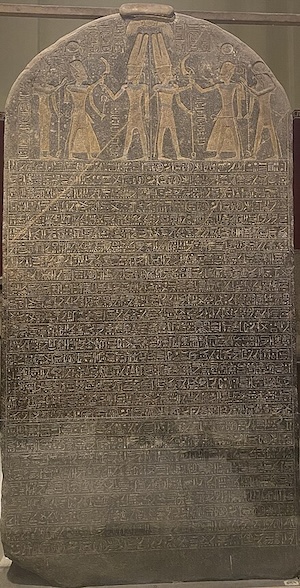
photo - The top part of the Merneptah Stele, inscribed by the New Kingdom pharaoh, dated around 1208 BCE. Line 28 reads: “Israel is laid waste – its seed is no more”
The top part of the Merneptah Stele, inscribed by the New Kingdom pharaoh, dated around 1208 BCE. Line 28 reads: “Israel is laid waste – its seed is no more.” (photo from Grand Egyptian Museum)

Twenty years in the making, the GEM is currently in a soft-opening period, with a section of the 81,000-square-metre site open for limited guided tours.

Touted as the largest archeological museum complex in the world, the GEM will house more than 100,000 artifacts. It will showcase the treasures discovered in the tomb of Tutankhamun in 1922. Other highlights will include a restoration centre, an interactive gallery for children and the Khufu Boat Museum.

King Tut’s funerary possessions had been on display at downtown Cairo’s Egyptian Museum in Tahrir Square, a hopelessly inadequate leftover from Britain’s colonial rule. There, a decade ago, I wandered in sensory overload gawping at the Aladdin’s Cave of Wonders. As if guided by divine providence, or perhaps Ra or Isis, I stumbled upon the Merneptah Stele – a three-metre-high piece of black granite inscribed by the New Kingdom pharaoh, dated around 1208 BCE, which was discovered in Thebes in 1896 by archeologist Flinders Petrie. Line 28 reads: “Israel is laid waste – its seed is no more.”

For me, it symbolizes the cold peace Israel and Egypt have enjoyed since 1979. Though few Israelis would wish to repudiate that historic agreement, many share the sentiment of Eitan Haber, the confidant of former prime minister Yitzhak Rabin, who said: “The Egyptians don’t like us and – why deny it? – we don’t like them.” 

Gil Zohar is a writer and tour guide in Jerusalem.

Format ImagePosted on April 12, 2024April 10, 2024Author Gil ZoharCategories WorldTags culture, economics, Egypt, financial crisis, infrastructure

Cultural constellations

Lindsey Tyne Johnson has a new show at the Zack Gallery: The Irish Mazzaroth & Hebrew Spelled Backwards. It comprises two separate parts.

Hebrew Spelled Backwards debuted at the Kamloops Art Gallery in 2023. It is a series of illustrations in which the artist explores her Jewish heritage.

“When the show finished in Kamloops, the Zack Gallery director contacted me,” Johnson told the Independent. “But the show had only seven pieces, and the Zack Gallery is large. It needed more art.”

At about the same time, Johnson decided to delve deeper into her ethnic roots. “My mother’s family were Irish Jews,” she said. “Not a usual combination. I went to Ireland in February 2024 to find out more.”     

She was fascinated by what she discovered. “Jews appeared in Ireland in the 1500s,” she shared. “Later, antisemitism forced many of them to leave, but they came back again. Then, there was a wave of Jews who came to Ireland and Northern Ireland from Russia in the beginning of the 20th century – they were escaping pogroms. Someone tricked them, sold them tickets to New York, but delivered them to Ireland instead and kicked them off the ship there. Some persisted in traveling to America, but others settled in Ireland. And then, there were the Jewish children escaping the Holocaust in Europe, Ireland took them in.”        

When Johnson visited the Irish Jewish Museum in Dublin, she found a number of her ancestors. “Their names were all written up in the Book of Irish Jewry there,” she explained. “The museum staff asked me if I wanted my name to be added to the new edition of the book. Of course, I said yes.”

The second part of the show, Irish Mazzaroth, started taking shape in her mind while she was in Ireland. The 12 black and white illustrations on the gallery walls reflect Johnson’s take on the zodiac’s traditional imagery. Mazzaroth means constellations in Hebrew.

Both Jewish and Irish lore have a long record of zodiac interpretations, from Greco-Roman mythology to the Zodiac Wheel, the centrepiece of the sixth-century mosaic at Beit Alpha in Israel. 

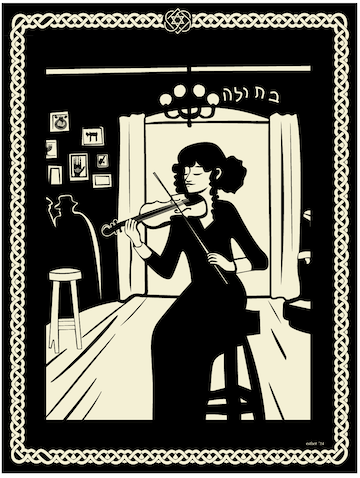
image - “Virgo” by Lindsey Tyne Johnson, part of Johnson’s solo exhibit at the Zack Gallery until May 9
“Virgo” by Lindsey Tyne Johnson, part of Johnson’s solo exhibit at the Zack Gallery until May 9.

Johnson, a young Canadian artist, has succeeded in meshing seamlessly Celtic symbolism and Jewish mysticism into a series of computer illustrations that are uniquely hers. 

“I started the first one in January. I finished the last one just before the show,” she said. “Each one is a well-known astrological sign, and each involves some aspects of both Jewish and Irish culture.” 

Every illustration is a whimsical little story, a playful tale that connects all earth cultures to one another. The images are clean and austere, uncluttered by unnecessary details. The twin girls in Gemini smile at the viewer. In front of them are Shabbat candles and a challah. Behind them, a leafy tree rises in the Irish countryside. Their quiet joy is unmistakable. 

On the other hand, the lone girl in Scorpio is solemnly considering the riches of ancient books in the famous Old Library in Trinity College in Dublin. She seems breathless with excitement at the abundance of choices in front of her, her braid curling up defiantly like a scorpion’s tail. The Jewish thirst for knowledge is given form in the context of the historical Irish library.

In another famous location in Dublin, the Temple Bar pub, Johnson features, in Virgo, an Irish Jewish woman playing a fiddle, merging lively Jewish klezmer and Celtic tunes.

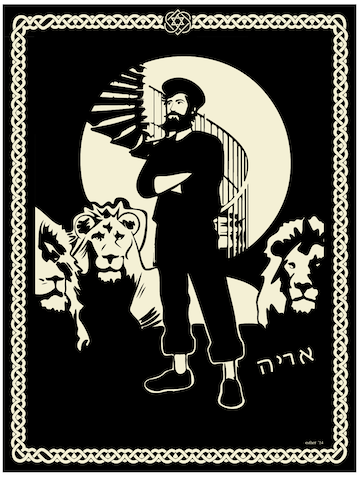
image - “Leo” by Lindsey Tyne Johnson
“Leo” by Lindsey Tyne Johnson.

In Leo, the backdrop is grimmer. It depicts the Crumlin Road Gaol, hinting at the political strife in Ireland, while the man in front reminds us of the story of Daniel and the lions. “One of my distant relatives worked as a prison guard there,” Johnson said. 

The frames of every illustration are identical: a rounded rectangle of Celtic knots, tied together at the top by a Magen David, which also emphasizes the affinity of two cultures.

The Irish Mazzaroth & Hebrew Spelled Backwards is on display at the Zack Gallery until May 9. To read more about Johnson and Hebrew Spelled Backwards, go to jewishindependent.ca/artfully-exploring-heritage. 

Olga Livshin is a Vancouver freelance writer. She can be reached at [email protected].

Posted on April 12, 2024April 10, 2024Author Olga LivshinCategories Visual ArtsTags culture, Hebrew Spelled Backwards, heritage, Ireland, Irish Mazzaroth, Judaism, Lindsey Tyne Johnson, Zacl Gallery

Posts pagination

Previous page Page 1 … Page 90 Page 91 Page 92 … Page 667 Next page
Proudly powered by WordPress