Skip to content
  • Home
  • Subscribe / donate
  • Events calendar
  • News
    • Local
    • National
    • Israel
    • World
    • עניין בחדשות
      A roundup of news in Canada and further afield, in Hebrew.
  • Opinion
    • From the JI
    • Op-Ed
  • Arts & Culture
    • Performing Arts
    • Music
    • Books
    • Visual Arts
    • TV & Film
  • Life
    • Celebrating the Holidays
    • Travel
    • The Daily Snooze
      Cartoons by Jacob Samuel
    • Mystery Photo
      Help the JI and JMABC fill in the gaps in our archives.
  • Community Links
    • Organizations, Etc.
    • Other News Sources & Blogs
    • Business Directory
  • FAQ
  • JI Chai Celebration
  • JI@88! video

Recent Posts

  • Eby touts government record
  • Keep lighting candles
  • Facing a complex situation
  • Unique interview show a hit
  • See Annie at Gateway
  • Explorations of light
  • Help with the legal aspects
  • Stories create impact
  • Different faiths gather
  • Advocating for girls’ rights
  • An oral song tradition
  • Genealogy tools and tips
  • Jew-hatred is centuries old
  • Aiding medical research
  • Connecting Jews to Judaism
  • Beacon of light in heart of city
  • Drag & Dreidel: A Queer Jewish Hanukkah Celebration
  • An emotional reunion
  • Post-tumble, lights still shine
  • Visit to cradle of Ashkenaz
  • Unique, memorable travels
  • Family memoir a work of art
  • A little holiday romance
  • The Maccabees, old and new
  • My Hanukkah miracle
  • After the rededication … a Hanukkah cartoon
  • Improving the holiday table
  • Vive la différence!
  • Fresh, healthy comfort foods
  • From the archives … Hanukkah
  • תגובתי לכתבה על ישראלים שרצו להגר לקנדה ולא קיבלו אותם עם שטיח אדום
  • Lessons in Mamdani’s win
  • West Van Story at the York
  • Words hold much power
  • Plenty of hopefulness
  • Lessons from past for today

Archives

Follow @JewishIndie
image - The CJN - Visit Us Banner - 300x600 - 101625

Rabbi chosen as a fellow

Rabbi chosen as a fellow

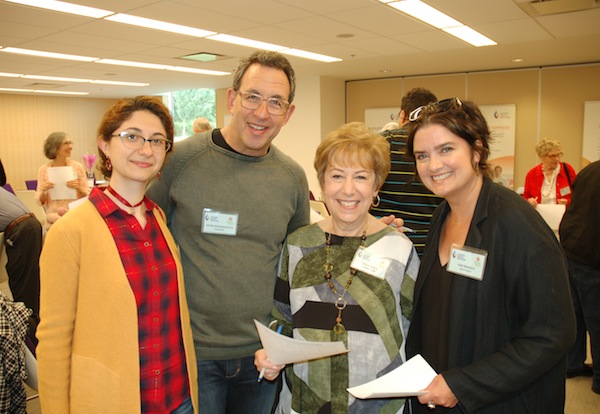
Rabbi Susan Shamash began a fellowship with Rabbis Without Borders this month. (photo from Susan Shamash)

“Rabbis Without Borders addresses borders within Judaism,” said Rabbi Susan Shamash, one of two Canadian rabbis who began a fellowship with Rabbis Without Borders (RWB) this month. “The fellowship aims to span denominations and to break down barriers between rabbis of different denominations, so that they can cross the borders and collaborate.”

While at a Shabbaton led by RWB when she was a rabbinical student, Shamash became interested in the Clal fellowship. Established in 1974 by Rabbi Irving Greenberg and Elie Wiesel, Clal’s “mission has been to help prepare the Jewish people for the unprecedented freedom and openness of North America,” notes the announcement of Shamash’s acceptance into the competitive program, which began in 2008.

Shamash told the Independent that RWB tries to develop rabbis who are able to think and work outside the box while working inside specific communities. Although based in the United States, Clal welcomes Canadian rabbis to its fellowship and, this year, Rabbi Denise Handlarski of Toronto’s Oraynu, a secular humanist congregation, was also accepted.

Shamash completed her rabbinical training in January 2017, obtaining semichah (ordination) from Aleph: Alliance for Jewish Renewal, after a decades-long career as an administrative law judge. Shamash received semichah with four others at that year’s Ohalah conference in Boulder, Colo., from a large number of rabbis, 10 of whom signed her certificate. Her training was overseen, as are all Aleph rabbinic trainings, by a committee of three. In her case, it was Rabbi Victor Gross, Rabbi Hanna Tiferet Siegel (one of the founders of Vancouver’s Or Shalom) and Rabbi Laura Duhan Kaplan (formerly spiritual leader of Or Shalom, now on the faculty of Vancouver School of Theology).

Shamash has been involved with Or Shalom since it started and counts the founding teachers, Siegel and her husband Daniel, among her mentors, as well as Duhan Kaplan, who is delighted to have her aboard. “As a longtime member of the RWB network, I’m delighted that Rabbi Susan Shamash will join us,” Duhan Kaplan told the Independent. “We need more Canadian voices like Rabbi Susan, willing to creatively address emerging issues in our religious and cultural life.”

“I am excited to join Rabbi Laura Duhan Kaplan and [Or Shalom] Rabbi Hannah Dresner in bringing the deep wisdom of this fellowship to Metropolitan Vancouver,” said Shamash.

“I went into law school because I needed a professional skill, and it was a wonderful and rewarding career,” she explained. “I met Rabbi Daniel Siegel while at school – he was a Hillel director at the time and just founding Or Shalom. I learned a lot under his and Hanna Tiferet’s mentoring.”

Although Shamash enjoyed her judicial career, she said she is deeply satisfied with her transition to a second career. “In some ways, I came home, even though I really loved the law,” she said. “I might have become a rabbi for my first career but, at that time, it was not at all encouraged [for a woman]. I was very interested in the study and the prayer life as a kid.”

Primary areas of interest for Shamash include interfaith ceremonies and outreach to underserved Jewish communities, both of which she thinks the fellowship will help equip her for. “The fellowship will inform the work that I do with interfaith families or marriages between observant Jews and unaffiliated Jews or non-Jews, as well as working with people who want some Yiddishkeit for ‘hatching, matching and dispatching,’ as they say, the cycles of life, but want that outside of synagogues and institutions,” she said. “I would also like to take Judaism [beyond] the Lower Mainland and bring Jewish experience to smaller communities in B.C.”

She said there is a lack of diverse offerings for Jews outside of major urban centres, and she would like to help fill that gap.

Shamash currently teaches Talmud at Or Shalom, where she delights in making the study available to people who might otherwise not have access to it. She is hoping, over the years to come, to collaborate with others in the Jewish community to increase the options for serious adult yeshivah-style learning for the non-Orthodox.

Matthew Gindin is a freelance journalist, writer and lecturer. He is Pacific correspondent for the CJN, writes regularly for the Forward, Tricycle and the Wisdom Daily, and has been published in Sojourners, Religion Dispatches and elsewhere. He can be found on Medium and Twitter.
Format ImagePosted on June 29, 2018June 28, 2018Author Matthew GindinCategories LocalTags ALEPH, Judaism, Or Shalom, Rabbis Without Borders, RWB, Susan Shamash
Around the world in 382 days

Around the world in 382 days

Naomi Steinberg has toured the world with Goosefeather and is now working on a book of her travels. (photo from Naomi Steinberg)

Naomi Steinberg’s Goosefeather started in 2011. “It began with interviewing my French maternal grandfather in Paris before he died,” she said. “I wanted to know how he had helped my Jewish grandmother survive the Second World War and why he was a collector of maps, weights and scales. Given his work with the metric system, I also thought it would be interesting for us to talk about measurements in general.”

Fascinated by her grandfather’s story, the kernel of Goosefeather was born. “I made him a promise that he would see the final result,” she said.

She immersed herself in research. “Measurements are extremely important to humans,” she said. “We measure everything, but we have to realize that no measurement is 100% accurate; we have to accept that…. As I went deeper into it, I wanted to know how we measure the truth. What is the truth? What is reality? Same as when measuring length and weight, measuring reality can’t be 100% accurate. We have to accept this area of the unknown. We have to let ourselves ‘not know.’ We have to let everyone just be.”

The show that emerged out of her research is a multifaceted tale involving maps of places and relationships, measurements of physical elements and of abstract concepts. “How should we measure the space between me and another person? Between me and the planet?” she asked herself. “It soon became clear not only that I had a complicated story to tell, I also had an entertaining show that wanted to be on the road…. Goosefeather was going adventuring and I would be going around the planet, by land and sea, carrying a performance with me. As I journeyed, I would be carrying my own prime meridian in the form of presence. I had hypothesized that if, with this, I charted the space-time between myself and others, I might be guided in a good way.”

As the show was still coming into form, Steinberg’s grandfather was dying in a hospice in France. In 2013, she visited him in the hospice one last time and showed him the first draft of Goosefeather. “I shared with him all my ideas, and he said I got it ‘correctly.’ For a man obsessed with measurements, that was a high praise.”

The first performance of Goosefeather occurred in 2014 in Vancouver. (For a short review, see jewishindependent.ca/storytellers-excel-at-fringe.) But Steinberg needed to take it on the road. “I knew the show should travel like a Canada goose, all around the world,” she said. “I love traveling. I have a nomad soul, and I value my experience as a traveler, but I care very much about the environment. I didn’t want to just take a plane. You don’t experience your travels fully when you fly. It should be closer to the ground, slower, so I could stop and perform.”

In November 2014, she left Vancouver for California, where she boarded a cargo ship heading to Australia, which started her journey around the world. “It was easy,” she said. “The cargo companies sell tickets. They often have a couple cabins vacant – an owner’s cabin and a pilot’s cabin. That’s where I stayed on the cargo ships.”

She also performed Goosefeather on the first ship, as a Christmas gift for the sailors. When the captain asked her for a repeat performance, she bartered: a show for a phone call to her father, who celebrated his birthday while she was on the water.

It took her 21 days to reach Australia. From there, she took another cargo ship to China. Her further travels – by boat, bus and train – included Japan, Russia, Belgium, France, Switzerland, the United States and, finally, back to Canada. The entire trip took 382 days.

In every country, she performed Goosefeather, facilitated workshops and participated in creative collaborations. In every country, she stayed with friends. “I came back with $100. I lived in a cash economy for over a year and I fully supported my journey with my shows and workshops,” she said. “In the entire time I was away from home, I only paid for a hotel for seven nights.”

Despite the crazy itinerary, she didn’t prepare all her stops beforehand. “Sometimes, I didn’t even know where I would spend the night when I arrived in a city or a country, but I always found friends,” she said. “I researched storytelling organizations on the internet. I put my scheduled countries on my Facebook page and asked my friends for help. They asked their friends, and the word spread around the world like a goose feather. Everywhere, people wanted to see my show. I got contacts in every city and country. Everywhere, people wanted to help.”

Even the language barrier in countries like Japan and Russia didn’t deter Steinberg. She can perform Goosefeather in either English or French, and she always found a translator when she needed one.

“In Japan, they asked me to perform for children, and I created a special show for them: a Kamishibai show.”

For Steinberg, a professional storyteller, a storytelling tradition like Kamishibai is extremely compelling. According to Wikipedia, “Kamishibai is a form of Japanese street theatre and storytelling popular during the Depression years and the postwar period … until the advent of television.” Storytellers would travel from town to town, performing on “street corners with sets of illustrated boards … narrat[ing] the story by changing each image.” Some consider Kamishibai to have influenced manga and anime.

“For my first Kamishibai show, the adventures of a little goose feather, a talented 8-year-old drew the illustrations,” said Steinberg. “It was a big success. Now, I perform it with the pictures created by a wonderful Japanese artist, Shiho Oshita Beday.”

Currently, Steinberg is busy writing a book, a travelogue of her journey around the world with Goosefeather. She aims to publish it next year. To learn more, visit goosefeather.ca.

Olga Livshin is a Vancouver freelance writer. She can be reached at [email protected].

****

Note: This article has been edited to reflect that Steinberg’s total journey took 382 and not 386 days.

Format ImagePosted on June 29, 2018May 28, 2020Author Olga LivshinCategories Performing ArtsTags family, Goosefeather, Naomi Steinberg, storytelling, travel
Negev Dinner helps Israeli children

Negev Dinner helps Israeli children

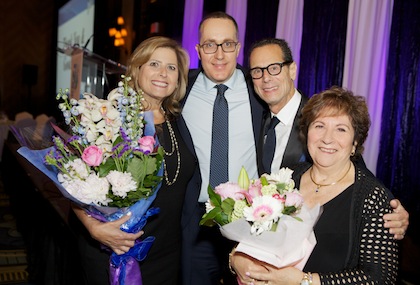
Left to right: Ilan Pilo, Michelle Pollock, Dr. Neil Pollock, Wendy Eidinger Spatzner and David Goldman. (photo by Robert Albanese)

Vancouver supporters of the Jewish National Fund (JNF) gathered in their finery at the Four Seasons Hotel Vancouver on June 3 to celebrate Israel’s 70th birthday and pay tribute to philanthropists Neil and Michelle Pollock.

Michelle Pollock is a former lawyer, the immediate past president of the board of the Jewish Community Centre of Greater Vancouver, and has co-chaired the Jewish Federation of Greater Vancouver annual campaign’s women’s division for six years, as well as supporting Jewish education, among many other causes. Dr. Neil Pollock is chief surgeon and medical director of Pollock Clinics. He has undertaken teaching missions to Rwanda, Congo and Haiti, as well as being involved in philanthropy at home and abroad.

photo - Bernice Carmeli, dinner co-chair, with Ilan Pilo, David Goldman and Ilene-Jo Bellas
Bernice Carmeli, dinner co-chair, with Ilan Pilo, David Goldman and Ilene-Jo Bellas. (photo by Robert Albanese)

JNF Pacific Region president David Goldman welcomed the crowd – who had to pass a few dozen protesters on their way into the hotel – and introduced the evening’s emcee, Michael Nemirow, a friend of the Pollocks, who is also involved in various community organizations and activities. “I’ve done the math, and we have around 11 hours of speeches and entertainment for you this evening, but we’ll try to compress it into three,” Nemirow said, eliciting laughter from the crowd.

After Maurice Moses led the audience in O Canada and Hatikvah, B.C. Lt.-Gov. Janet Austin took the stage. She praised JNF for its work in the “restoration and preservation of the Jewish homeland,” which covers everything from ecological to social to security initiatives. Austin also commented about the Pollocks, highlighting Neil Pollock’s work in Rwanda to prevent the spread of HIV.

Galit Baram, consul general of Israel for Toronto and Western Canada, focused her remarks on the 70th anniversary of Israel, “the only democracy in our region, a bastion of democracy.” She described its strengths in the areas of human rights, medicine, multiculturalism and technological innovation. She said Israel is led by people “both on the right and on the left who love their country with all their hearts” in the face of multiple existential threats. “We rely on our friends who share common values, and Canada, our ally, is among them,” she said.

photo - Honourary chairs Jodi and Alex Cristall
Honourary chairs Jodi and Alex Cristall. (photo by Robert Albanese)

“The success of Israel did not happen in a vacuum,” said Baram, citing JNF as a key organization in supporting the state, one in whose name every Israeli has a tree planted. She also spoke of JNF’s contributions in a multitude of activities, including supporting soldiers with post-traumatic stress disorder and her “personal favourite,” the building of a protected playground in Sderot in an area that has suffered shelling from Hamas and other militant groups. Baram thanked Canadians for the warm welcome and open arms with which Israeli diplomats are welcomed in the country.

After Hamotzi, chanted by the Kollel’s Rabbi Avraham Feigelstock, Ilene-Jo Bellas, former president of the JNF Pacific Region (2012-2015), was presented with the JNF Bloomfield Award by local shaliach Ilan Pilo. He described Bellas as an indefatigable servant for Israel who “bled blue and white,” a portrayal she affirmed as fact after taking the podium.

The video on the work of the JNF was introduced by JNF Canada president Wendy Eidinger Spatzner, who explained that the First Zionist Congress established a fund to purchase land in Israel and that this fund became JNF. She talked about JNF’s extensive work to “build the infrastructure of Israel,” noting that it affects the daily lives of “pretty much every Israeli citizen.”

photo - Honourary chairs Jodi and Alex Cristall
Honourary chairs Jodi and Alex Cristall. (photo by Robert Albanese)

Rabbi Dan Moskovitz then led everyone in Birkat Hamazon, before Vancouver TheatreSports performed a series of improv skits centred on the Pollocks’ life as a married couple.

The keynote speaker of the dinner was Doron Almog, a former major general in the Israel Defence Forces, who received the Israel Prize for lifetime of achievement. He discussed his role as founder of ALEH, the charity for children with developmental disabilities that the Pollocks chose to support with monies raised from the evening.

Almog spoke on the theme of commitment, as experienced throughout his life and in the work he has done for children. He shared the story of the death of his brother, a tank operator who died after being injured, left behind by his fellow IDF soldiers. Almog subsequently swore to never leave behind an injured soldier.

Almog’s son Eran, who was named after his fallen uncle, was born with a combination of autism and developmental problems, and a psychiatrist told the family that he would probably never speak, remaining at the cognitive age of an infant. “This son became the greatest teacher of my life, he taught me more than anyone about life, about commitment,” said Almog.

After his son died, Almog went to see how children like Eran are treated “in the only Jewish state in the world.” What he saw horrified him: “The first thing you saw is the stink; distorted, terrified faces; shameful things. What the hell are these places, why are they being punished more?”

photo - Keynote speaker Maj. Gen. (Res.) Doron Almog, founder of ALEH, right, with local businessman and philanthropist Gary Segal
Keynote speaker Maj. Gen. (Res.) Doron Almog, founder of ALEH, right, with local businessman and philanthropist Gary Segal. (photo by Robert Albanese)

Almog discovered that such children were objects of shame in Israeli society. Golda Meir, prime minister of Israel from 1969 to 1974, had a granddaughter with Down syndrome who, as an adult, gave interviews to the press, said Almog. In these interviews, he continued, “she said, ‘Golda never visited me, Golda never loved me, Golda told my mom, “Never mention the prime minister of Israel having a retarded granddaughter.”’ Yigal Alon [deputy prime minister of Israel, 1968-1979] had a beautiful child who, at age 5, was taken away from the kibbutz she was born in and sent away to Scotland and he never spoke about her. And inside me I heard my son screaming, ‘My dear father, I will never complain to the media, you can send me away to Scotland and never speak of me, but, if you do that, you do not deserve even the title of “father” or even the title of human. I am the ultimate test of commitment,’ he said to me, the echo box of your bleeding brother.”

After Almog left the military, he established the village of ALEH, “a paradise where the children can have a full life. We broke the walls of stigma and shame and stereotypes.”

ALEH Jerusalem, a multi-service home for children with disabilities, now receives help from more than 450 volunteers from all over the world. Some of them, said Almog, are children of Nazis, who say they are coming as atonement for Hitler’s decision to kill people with disabilities. “The social chain is always measured by its weakest link,” said Almog, receiving a standing ovation.

After a video explaining more about ALEH, there was a video tribute to the Pollocks introduced by their children, Josh, Elliot and Shoshana. The Pollocks said a few words, after which Goldman and Pilo wound up the celebration.

Matthew Gindin is a freelance journalist, writer and lecturer. He is Pacific correspondent for the CJN, writes regularly for the Forward, Tricycle and the Wisdom Daily, and has been published in Sojourners, Religion Dispatches and elsewhere. He can be found on Medium and Twitter.
Format ImagePosted on June 29, 2018June 28, 2018Author Matthew GindinCategories LocalTags ALEH, children, health, inclusion, Israel, Jewish National Fund, JNF, Negev Dinner, Pollock
Celebration and call to action

Celebration and call to action

More than 130 people joined the Chai Tea celebrations June 10. (photo by Alan Katowitz)

“Life is not measured by the number of breaths you take, but by the moments that take our breath away.”
(Rabbi Abraham Twerski)

The Chai Tea celebration on June 10 brought together 135 people to support the work of the Jewish Seniors Alliance and to honour Serge Haber on his 90th birthday.

Educator and writer Matthew Gindin emceed the event, which took place at the Peretz Centre for Secular Jewish Culture. Shelley Rivkin of the Jewish Federation of Greater Vancouver emphasized Haber’s effectiveness in bringing the issues of seniors to the fore in the Jewish and general communities, while Grace Hann, coordinator of JSA’s peer support services (with Charles Liebovitch), described Haber as a visionary who created the program because of his love and commitment to seniors. She told the story of a woman, alone, sick with cancer, who had lost both her eyesight and hearing. Peer support services provided her with three levels of support: a peer counselor, a driver and a friendly telephone caller.

JSA coordinator Liz Azeroual and her assistant, Rita Propp, joined Hann and Liebovitch for a tribute to Haber to the tune of “This Land is Your Land.” Music by Dave and Julie Ivaz filled the room, and Julie Ivaz read a summary of Haber’s biography, which was accompanied by a slide show of some of his life experiences. The musicians then serenaded Haber with a medley of his favourite songs.

Ken Levitt, president of JSA, emphasized the importance of “reinventing oneself,” both in terms of venue and occupation. Haber is a prime example: from being a pharmacy student in Romania, to surviving the Holocaust, to reaching safety in Cuba and then, with the help of an uncle, settling in Montreal in 1950 and coming to Vancouver in 1978. Here, Haber ran Kaplan’s Jewish delicatessen from 1981 until 2000. During that time, he began working with seniors – JSA started as a subcommittee of Federation – and he continues to be productive and active.

At the Chai event, Haber recited the prayer, “Blessed art thou, O Lord our God, King of the Universe, for giving us life, sustaining us and enabling us to reach this season.” His wife Elinor passed away seven years ago; they had been married 57 years and have three children, Wanda, Geoffrey and Stephen. Haber has five grandchildren and one great-grandchild. He acknowledged with affection his friend and partner Sheila Gordon, who supports all his endeavours.

Haber lamented that, whereas JSA is in the business of prevention, the government is mainly concerned with responding to the urgent needs of seniors. A public program of prevention would prolong healthier lives for seniors, he said, and eliminate the expensive costs associated with sickness and mental decay.

The 70 volunteers who work with 175 seniors at JSA are not going to be enough, said Haber. “Sometime, somewhere in your life, rich or poor, you’ll need the services of JSA,” he said.

Throughout the afternoon, tickets were drawn for donated door prizes. The 50-50 draw was won by Carole Kline, who donated the money back to JSA. The grand prize of a night at the Grand Villa Casino Hotel was won by Julia Wallstrom.

Helene Rosen and Marie Doduck were the co-conveners of the Chai Tea. Their efforts and work were acknowledged along with that of Gyda Chud and Propp. Delightful portrait caricature drawings by artist Katie Green were available all afternoon. Gala Catering served up the sandwiches and cake. It was a memorable afternoon.

Tamara Frankel is a member of the board of Jewish Seniors Alliance. Shanie Levin, MSW, worked for many years in the field of child welfare. During that time, she was active in the union. As well, she participated in amateur dramatics. She has served on the board of the Jewish Federation of Greater Vancouver and is presently on the executive of JSA and a member of the editorial committee.

Format ImagePosted on June 29, 2018June 28, 2018Author Tamara Frankel and Shanie LevinCategories LocalTags JSA, seniors, Serge Haber
On death and dying

On death and dying

Rabbi Laura Duhan Kaplan, director of inter-religious studies at Vancouver School of Theology. (photo from Laura Duhan Kaplan)

“Most of the world’s religions speak of dying to self,” said Dr. Eloecea, a Christian psychotherapist speaking at the Inter-Religious Conference on Spiritual Perspectives on Death and Dying at the Vancouver School of Theology May 22-24. “If we can do this before the time death approaches, suffering is greatly diminished for ourselves and for those around us.”

“Dying to self” refers to giving up egotism and self-centred attachments. Eloecea’s words echoed a theme that appeared in many of the sessions I attended, which was that of a holistic spiritual path of surrender and humility that unites life and death.

Rabbi Dr. Laura Duhan Kaplan, formerly of Or Shalom Synagogue and now director of inter-religious studies at VST, discussed how she had been spurred by reading Plato to take a closer examination of Jewish views of death and the afterlife. “Plato said living well is preparing for death. But what is death?” she asked.

Duhan Kaplan explained how the texts of kabbalah offer accounts of a soul’s journey after death. The soul travels through stages of physical, emotional, intellectual and spiritual purification, she said. According to Duhan Kaplan, this account of the afterlife is based both in kabbalistic theories of the soul’s development and glimpses of higher consciousness by current spiritual seekers. As Duhan Kaplan presented them, these texts are a guide to a lifetime of self-reflection, humility and non-attachment.

The stages of the soul’s ascent after death are tied to the rituals and rhythms of the traditional Jewish year of mourning that follows the death of a loved one, she said. “When I decided I would research Jewish views of the afterlife I had no idea I would discover what I did.”

Duhan Kaplan spoke of the dreams and spiritual experiences she had after the deaths of her father, mother and mother-in-law. She said the stages of her parents’ journeys offered particular gifts that related to their stages of spiritual ascent in the next worlds. The movement from the shivah period through the year of saying Kaddish to the yahrzeit and Yizkor corresponds to the soul’s difficulty in letting go, the emotional purification, the visit to the lower Gan Eden, the “paradise of understanding and good deeds,” and then the return to the storehouse of souls to merge with the divine. This description captures just one thread in the rich tapestry of connections Duhan Kaplan wove.

Other teachers at the conference presented different lenses through which spirituality relates to death. Acharya S.P. Dwivedi, poet and interfaith activist, presented the traditional Hindu view of karma, reincarnation and freedom from rebirth through non-attachment and identification with the transcendent self (atman). Dwivedi described how in the Hindu view the jiva (individual soul) moves from birth to death, experiencing happiness or suffering in accordance with the good and bad actions it commits, until finally it finds its true identity with the atman – the innermost self that is one with all of existence – and lets go, returning to its source and not again being reborn.

Syed Nasir Zaidi, Muslim chaplain at the University of British Columbia, discussed the importance in Islam of confronting and making peace with death. “Death should be our strength, not our weakness,” Zaidi said, emphasizing how thoroughly internalizing the reality of our own death and ceasing to fear it can enrich our spiritual path. Zaidi pointed out that, according Rumi, it is death that gives value to life, making it precious. Zaidi also explained that, in Islam, peace with death is accomplished through confident submission to God’s will in a life of virtue and acceptance of life’s unfolding as an expression of God. “Abraham told his children they should not die before becoming Muslims,” Zaidi said. “Obviously, this doesn’t refer to being members of the religion of Islam, but rather to having submitted to God, which is what being a muslim [submitted one] means.”

Some presenters offered specific practices. Eloecea shared a series of meditations aimed at producing positive thoughts to change the state of the brain, to shift from the egotistical self and its entrapping habits. Lynn Mills, a PhD student at Trinity College in Dublin, Ireland, Skyped in to present a liturgy for people in the early stages of Alzheimer’s, which consisted of psalms and prayers to be recited in their presence. This had two parts: the first was a morning liturgy for every day, the second a way to celebrate the person’s life before memory loss prevents them from knowing friends and family and remembering the stories they share.

A variety of other topics were covered. Mark Stein, a Jewish chaplain, tackled the issue of what to do when non-Christians (or anabaptists, who only baptize believing adults) are called upon to give baptisms for sick or stillborn children. Can a Jew baptize a child? Should they? Stein spoke of the need for chaplains to support people in these extreme situations. He spoke of the transformation this could cause in a chaplain, leading them not only to embrace a pragmatic flexibility but to an openness – seeing God’s work as something also happening beyond one’s own religion.

One recurrent issue was medical assistance in dying, about which there was a panel discussion moderated by Duhan Kaplan on the opening night of the conference. Rabbi Adam Rubin of Congregation Beth Tikvah spoke as a member of the panel. He noted the lack of a consensus about medically assisted dying across Jewish traditions, but affirmed a few core teachings. “First, because of the infinite preciousness of every life, we’re commanded to do everything we can to preserve life,” Rubin told the Independent. “Second, we must do everything we can to attenuate suffering. Some traditional rabbinic authorities hold that this imperative means that one can give a level of pain-killing medicine (morphine, for example) that might even endanger the life of a patient, in order to reduce the patient’s suffering. In addition, some authorities allow the removal of life-sustaining machines or apparatuses if they extend suffering, in order to allow the normal course of physical decline to take place. This is a tricky and controversial subject within Jewish tradition,” he said, “but the general idea is that there’s a place for ‘allowing nature to take its course’ if it is likely to reduce suffering. All of that said, there is a (rare for Judaism!) consensus in traditional Jewish law that it is absolutely forbidden to take one’s own life or to assist in taking someone else’s life.”

Rubin warned of the dangers of simplistic notions of consent or decision-making that don’t take into account the full range of pressures and emotional factors that might influence a person’s decision. “People are not robots, making ‘clean,’ rational decisions in a vacuum,” he said. “So, my approach, and my take on Jewish tradition, is that we must fight the things that might lead to someone wishing to end their life.”

In addition to the talks and panels, there was an afternoon session for musical and meditative reflections on the first day of the conference. Jewish music ensemble Sulam (which contains both Duhan Kaplan and her husband Charles Kaplan) performed, as did the Threshold Singers; the music was followed by Zen priest Myoshin Kate McCandless giving a presentation on meditation and chant in support of end-of-life care.

The keynote event of the conference, which was open to the public, was called We Die Alone and Yet We Don’t. It was a conversation with Dr. David Kuhl, facilitated by Duhan Kaplan. Kuhl is a professor in the department of family practice in the faculty of medicine at UBC. He helped design and develop the palliative care program at St. Paul’s Hospital, and is known for his 2011 book What Dying People Want: Lessons for Living from People Who Are Dying.

Matthew Gindin is a freelance journalist, writer and lecturer. He is Pacific correspondent for the CJN, writes regularly for the Forward, Tricycle and the Wisdom Daily, and has been published in Sojourners, Religion Dispatches and elsewhere. He can be found on Medium and Twitter.

Format ImagePosted on June 29, 2018June 28, 2018Author Matthew GindinCategories LocalTags death, dying, Eloecea, interfaith, Laura Duhan Kaplan, Mark Stein, spirituality, Vancouver School of Theology, VST
So many community milestones

So many community milestones

This year, Jewish Federation honoured, for the first time, an organization outside of the Jewish community. The inaugural recipient of the honour was the Vancouver Police Department.

***

At its annual general meeting June 19, the Jewish Federation of Greater Vancouver honoured four volunteers: Alex Cristall, Judi Korbin, Judith Cohen and Courtney Cohen. It also honoured, for the first time, an organization outside of the Jewish community – the Vancouver Police Department.

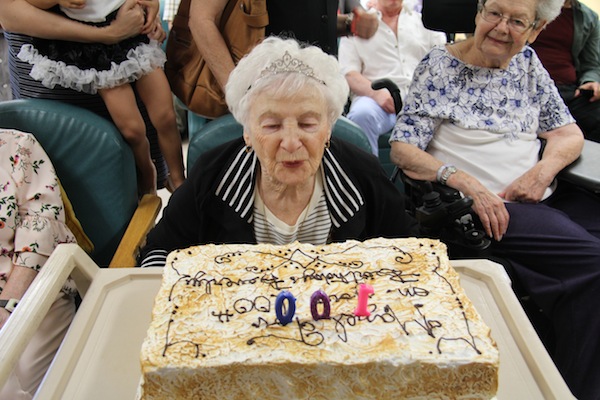
On June 18, L’Chaim Adult Day Centre celebrated its first 100th birthday, with program participant Beverly Klein.

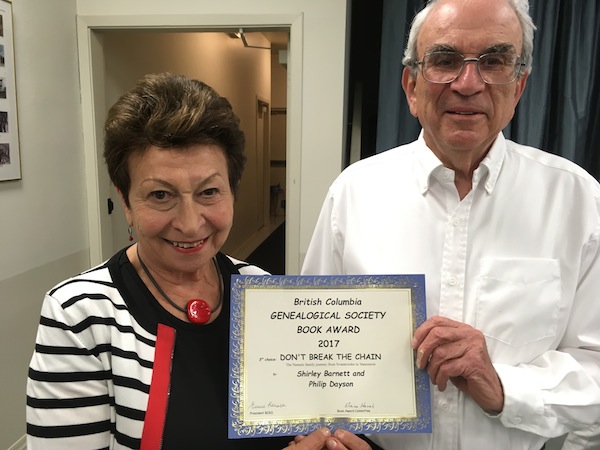
On the evening of June 13, siblings Shirley Barnett and Philip Dayson were honoured with the B.C. Genealogical Society Book Award.

On the evening of June 5, Jewish Family Services held its first annual Volunteer Appreciation Event, celebrating the dedicated volunteers of JFS and the Better at Home program.

Louis Brier Home and Hospital has successfully achieved accreditation with exemplary standing from Accreditation Canada. 

Among the B.C. Civil Liberties Association’s Liberty Award winners on May 17 were Ken Klonsky, for excellence in the arts, and Peter Klein, for excellence in journalism.

***

At its annual general meeting June 19, the Jewish Federation of Greater Vancouver honoured four volunteers.

Alex Cristall was presented with the Harry Woogman Award, which recognizes a volunteer who leads consistently and conscientiously by example and has long-standing and diligent campaign involvement. Cristall is the outgoing annual campaign chair. His dedication and commitment to leadership excellence has made an enormous impact on Federation and the community as a whole.

Judi Korbin was given the Arthur Fouks Award, which honours leaders who demonstrate dedication to the goals and principles of Jewish Federation and who provide outstanding leadership to the annual campaign. Korbin is the outgoing chair of Federation’s endowment program, the Jewish Community Foundation, and is a past chair of the annual campaign.

The Kipnis-Wilson/Friedland Award went to Judith Cohen. As a past volunteer chair of women’s philanthropy, Cohen is no stranger to philanthropic work. She draws the inspiration for her community involvement from having grown up seeing her parents “pour their time and energies into the Jewish community.” She received the Kipnis-Wilson/Friedland Award from Jewish Federations of North America for demonstrating the highest ideals of leadership and involvement.

The Young Leadership Award was presented to Courtney Cohen for her extensive volunteer work with many Jewish organizations around Greater Vancouver. Just two examples among many are her involvement in Federation’s Axis program for young Jewish adults as the co-chair of the leadership development pillar, and her founding of Rose’s Angels, a care-package project created to honour her grandmother.

This year, Jewish Federation also honoured, for the first time, an organization outside of the Jewish community, with the first recipient of the honour being the Vancouver Police Department.

“Our Federation has had a long and valued relationship with the department and our staff have been able to count on their assistance and intervention during crisis situations and high-profile events attracting protesters, as well as being willing to provide education and training to our communal professionals on an as-needed basis,” said Bernard Pinsky, chair of Federation’s community security advisory committee, in presenting the award, which was accepted by Deputy Chief Lawrence Rankin on behalf of the VPD.

Pinksy expressed Federation’s “appreciation to constables Ryan Hooper and Dale Quiring for their support over the years,” and said Federation was looking forward “to a continued positive relationship with Constables James Hooper and Jacqueline Abbot.”

In introducing the video created for Federation’s 30th anniversary, board chair Karen James thanked “Jonathan and Heather Berkowitz, whose experience editing the Federation Magazine for many years was invaluable to this project, as well as past Federation president Sondi Green, whose father, Arthur Fouks, was a founder of our Federation, and Al Szajman, chair of our marketing and communications resource group for their work on this project.”

***

photo - On June 18, L’Chaim Adult Day Centre threw a party for Beverly Klein’s 100th birthday
On June 18, L’Chaim Adult Day Centre threw a party for Beverly Klein’s 100th birthday.

On June 18, L’Chaim Adult Day Centre celebrated its first 100th birthday, with program participant Beverly Klein. Four generations of her family, friends, fellow program participants, L’Chaim board members, staff and volunteers, as well as Jewish community leaders, threw a party at L’Chaim to commemorate her reaching this milestone.

Knowing her love of music, she was honoured with the musical talents of Allison Berry, who performed classics from the 1940s. Beverly was delighted to receive congratulations and warm wishes from Prime Minister Justin Trudeau and the Queen’s representative, the governor general of Canada, Julie Payette.

Ezra Shanken, chief executive officer of the Jewish Federation of Greater Vancouver, spoke about Beverly and said that she didn’t look a day over 40, to which she replied, “Hey, I like this guy!”

A much-loved program participant since 2013, the birthday girl was born in Poland near Warsaw in Meserich, and was one of 11 children. A story treasured by her children is Beverly’s childhood memory of preparing for Shabbat by “building a floor” and “doing the stove” – her home’s dirt floors had to be swept and pounded down, and Beverly would pile up the bricks for the oven, which was then whitewashed. Her family immigrated to Canada in 1929 with only the clothes on their backs, which were sewn from potato sacks. During the Second World War, Beverly came to Vancouver to spend time with her sister Ruby, and she met her husband Dave. They married and had two daughters and a wonderful life together.

Beverly continues to live in her own home because of the love and devotion of her family. The Turnbulls – Wendy, husband Steve and boys Ryan and Gavin – and the Blonds – Arlene, husband Les and children Amanda and Ben – are all devoted to their mom and bubbie.

Both daughters Arlene and Wendy gave heartfelt speeches at the birthday party. Arlene said, “It’s very reassuring to families to know that their loved ones have a safe place to go where they are not only stimulated but treated like family.” Wendy said, “L’Chaim remembers that older people deserve respect for a lifetime of achievements and all that they are today. The sheer joy with which the staff planned Beverly’s party touched all of us.”

The L’Chaim Adult Day Centre strives to improve the quality of life of its participants by providing a caring and stimulating group experience for those who might otherwise be socially isolated, while also providing support and respite for care-giving families and friends. It is funded in part by Vancouver Coastal Health, Jewish Federation of Greater Vancouver, the Jewish Community Centre of Greater Vancouver and private donations from the larger community.

***

photo - Shirley Barnett and Philip Dayson
Shirley Barnett and Philip Dayson

On the evening of June 13, siblings Shirley Barnett and Philip Dayson were honoured with the B.C. Genealogical Society Book Award. Barnett and Dayson were recognized for their book Don’t Break the Chain, which describes the journey of Abraham and Toba Nemetz from Svatatroiske in Ukraine to Vancouver and points in between.

Fleeing from pogroms in 1922, Abraham and Toba began a new life in Canada. One of the pages in Don’t Break the Chain outlines how their family of nine children grew into 196 descendants. Family trees and portraits – both individual and group – are part of a fascinating picture of a family whose lives became an important part of both the Jewish and general communities of Vancouver.

In her acceptance of the award, Barnett said that, while researching the book, numerous family members (known and previously unknown) were reached with 100% cooperation from all of them in helping to compile information for the book. The title comes from Ben Dayson, Barnett and Dayson’s father. Although he married into the family, because of his belief in the value of family ties, Ben Dayson often “ended his conversations and speeches with the sentence, ‘don’t break the chain.’”

Barnett thanked the Jewish Museum and Archives of British Columbia for their support and rich accumulation of archival material. For more information, interested readers may access nemetzfamily.ca or the Jewish Museum at jewishmuseum.ca.

Congratulations to Shirley Barnett and Philip Dayson for being honoured by the B.C. Genealogical Society, who recognized the positive impact of their family and this book on the history and development of our province.

***

photo - Left to right are Mariam Harutyunyan, Dr. Mark Rosengarten, Linda Glick and Kim Branch. Harutyunyan and Branch are Better at Home volunteers. Rosengarten and Glick are JFS volunteers
Left to right are Mariam Harutyunyan, Dr. Mark Rosengarten, Linda Glick and Kim Branch. Harutyunyan and Branch are Better at Home volunteers. Rosengarten and Glick are JFS volunteers.

On the evening of June 5, Jewish Family Services hosted more than 70 people at its first annual Volunteer Appreciation Event. It was a wonderful opportunity to celebrate the dedicated volunteers of JFS and the Better at Home program, a government-funded service for seniors managed by United Way and administered by JFS. The guest speaker, Dr. Rotem Regev, presented on the value of human connection, empathy and the power of giving back.

Richard Fruchter, chief executive officer of JFS, spoke about the commitment of volunteers to the agency, describing “volunteers as the life-blood of JFS.” It was volunteers, he said, who founded the Jewish Family Welfare Bureau of Vancouver (JFS’s original name) when it opened more than 80 years ago to assist the poor and elderly living in Vancouver, and to help resettle new immigrants fleeing antisemitism in Europe.

“Your commitment to uplifting lives, for our clients and community, is an example for us all,” Fruchter said. “By stepping up to help, offering your time, skills and resources, you are the reason we can meet more of the needs in our community and accomplish the work that we do.”

There are more than 170 people who volunteer regularly through JFS and Better at Home, and some have been serving for more than 15 years. JFS’s youngest volunteers are in grades 7 and 8 from Vancouver Talmud Torah and King David High School who help regularly at the Jewish Food Bank.

JFS volunteers are responsible for a wide range of work. They support the Jewish Food Bank at the Peretz Centre; seniors lunches and outreach services, such as grocery shopping, visiting and driving to and from appointments; English-language practice for newcomers to Canada; interviewing skills for job seekers; mental health outreach; and administrative support in the office. Chanukah helpers, Passover hampers, Rosh Hashanah activities and Project Isaiah are all programs that rely almost entirely on volunteers. For many individuals and families, these Jewish holiday programs are the only connections they have with their Jewish heritage.

For more information on volunteering with JFS, contact Ayana Honig at [email protected] or call 604-226-5151.

***

Louis Brier Home and Hospital has successfully achieved accreditation with exemplary standing from Accreditation Canada.

Accreditation Canada is an independent, not-for-profit organization that sets standards for quality and safety in health care and accredits health organizations in Canada and around the world. Louis Brier Home and Hospital voluntarily participated in accreditation because it believes that quality and safety matter to residents and their families/significant others. Improving the quality of care is a continuous journey – a journey to which Louis Brier is fully committed.

As part of the Qmentum program, the home and hospital has undergone a rigorous evaluation process. Following a comprehensive self-assessment, external peer surveyors conducted an on-site survey during which they assessed the organization’s leadership, governance, clinical programs and services against Accreditation Canada requirements for quality and safety. These requirements include national standards of excellence; required safety practices to reduce potential harm; and questionnaires to assess the work environment, resident safety culture, governance functioning and client experience. Results from all these components were considered in the accreditation decision.

The accreditation survey team spent four days at Louis Brier, and reviewed a total of 19 required organizational practices (ROPs), 216 high priority criteria and 295 other criteria for a total of 551 criteria. The accreditation surveyors determined that the Louis Brier successfully met 100% of the ROPs and 100% of the criteria evaluated.

“I am very proud of everyone at Louis Brier Home and Hospital,” said Dr. David Keselman, chief executive officer. “Our staff worked and continue to work incredibly hard to make sure we meet the needs of our residents in every possible way, helping them and their loved ones maintain optimal health status, control and dignity every day, every time. Receiving exemplary standing from Accreditation Canada is a real testament to the changing culture and focus at Louis Brier Home and Hospital. Accreditation Canada standards and requirements will continue to guide us into the future as we continue to evolve and continuously improve our practices and care delivery efforts.”

He added, “I will, of course, be remiss if I do not mention the ongoing support and generosity of the LBHH and WR [Weinberg Residence] and the [Louis Brier Jewish Aged] foundation boards, without whom this journey may not have been as smooth or possible.”

***

The B.C. Civil Liberties Association’s Liberty Awards recognize outstanding achievements to protect and promote human rights and freedoms in Canada. Among the 2018 award winners were Ken Klonsky, for excellence in the arts, and Peter Klein, for excellence in journalism.

Klonsky, co-author of Dr. Rubin Carter’s Eye of the Hurricane, is a former Toronto teacher and writer now living in Vancouver. He is a director of Innocence International, the organization conceived by Carter to help free wrongly convicted prisoners worldwide. His artistic works call readers to action to defend civil liberties and improve the justice system. His art and advocacy on behalf of those who have been wrongfully convicted has contributed greatly to the advancement of human rights in Canada and internationally.

Klein is a journalist, writer and documentary filmmaker. He has been a producer for the CBS newsmagazine 60 Minutes since 1999, produces video projects for the New York Times and writes columns regularly for the Globe and Mail. He is the founder of the Global Reporting Centre, a nonprofit organization dedicated to reporting on neglected global issues and innovating the practice of global journalism. His record of groundbreaking broadcast journalism exposing human rights abuses around the world deserves to be celebrated. His efforts are empowering the next generation to continue to hold the powerful to account.

The other 2018 Liberty Awards were Miranda Hlady (youth or community activism), Stockwoods LLP (legal advocacy, group) and Dr. Pamela Palmater (legal advocacy, individual). Hassan Diab, Rania Tfaily and Don Bayne, on behalf of the Hassan Diab Support Committee, were recognized with the Reg Robson Award, which is given annually to honour substantial contributions to the cause of civil liberties in British Columbia and Canada.

Format ImagePosted on June 29, 2018June 28, 2018Author Community members/organizationsCategories LocalTags accreditation, BCCLA, Beverly Klein, birthdays, civil liberties, genealogy, Jewish Family Services, Jewish Federation, JFS, L'Chaim, Louis Brier, Philip Dayson, Shirley Barnett, volunteers
Mystery photo … June 29/18

Mystery photo … June 29/18

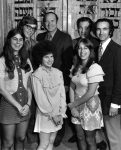
Beth Israel Synagogue, 1972. (photo from JWB fonds, JMABC L.09793)

If you know someone in this photo, please help the JI fill the gaps of its predecessor’s (the Jewish Western Bulletin’s) collection at the Jewish Museum and Archives of B.C. by contacting [email protected] or 604-257-5199. To find out who has been identified in the photos, visit jewishmuseum.ca/blog.

Format ImagePosted on June 29, 2018June 28, 2018Author JI and JMABCCategories Mystery PhotoTags Beth Israel, history, Jewish museum, youth
קנדה מעוניית לרכוש מל”טים

קנדה מעוניית לרכוש מל”טים

איתן, מטוס ללא טייס על בסיס הרון טיפי, חיל האוויר הישראל, יום העצמאות 2017. (צילום: MathKnight and Zachi Evenor)

התעשייה האווירית (תע”א) של ישראל משתתפת במכרז חדש של הצבא הקנדי שיפורסם במהלך החודשים הקרובים, לאספקת מטוסים ללא טייס (מל”טים) שהיקפו נאמד בלמעלה ממיליארד דולר. בתע”א החליטו לחבור לצורך ההשתתפות במרכז עם חברה הקנדית אל.3 מאס (שמושבה בקוויבק) לאספקת טכנולוגיות, תקשורת, אינטגרציה של מערכות והשבחת מטוסים. החברה הקנדית היא זו שתוביל את הההצעה המשותפת למכרז.

המכרז של הצבא הקנדי נועד לאפשר רכישת מל”טים גדולים כולל המערכות הנלוות, במהלך ארבע השנים הקרובות. המל”טים הגדולים מתאימים לקנדה בשל שטחה הגדול ומזג האוויר הקר השורר בה במרבית עונות השנה. הצבא הקנדי מעוניין ברכישת כלי טיס מסוג זה בעיקר לטיפול בהברחות מעבר לקנדה (בדרך כלל מדובר בסמים ובכלי נשק), וכן להגן על נתיב אזור השיט הצפוני (המחבר בין האוקיינוס האטלנטי לאוקיינוס הפאסיפי). המל”טים יוכלו לשמש את הצבא הקנדי גם במשימות אזוריות ורחוקות בהשתתפות צבאות נוספים.

מול ההצעה של קבוצת תע”א ואל.3 מאס צפוייה להתמודד הצעה אמריקנית של ג’נרל אטומיקס, הנחשבת למתחרה קשה של התעשייה האווירית הישראלית. עם זאת, יתכן ולאור התקררות ביחסים בין קנדה לארה”ב, בשל התנהלותו של הנשיא דונלד טראמפ, לא מן הנמנה שהצבא הקנדי יעדיף הצעה משותפת קנדית-ישראלית על זו האמריקנית.

יצויין כי הצבא הקנדי שכר בעבר מל”טים קטנים (במשקל 1.2 טון) מתע”א. מל”טים אלה פעלו בשטחי אפגניסטן ולאחר מכן הוחזרו לתע”א.

קמפיין להחרמת מוצרים מארה“ב לאור התבטאויותיו של טראמפ נגד קנדה

אזרחים קנדים התחילו להתעורר סוף סוף ולהשיב מלחמה כנגד ההתבטאויות החמורות של נשיא ארצות הברית, דונלד טראמפ, כנגד בקנדה, שהתגברו מאוד בשבועות האחרונים.

הקנדים החליטו לראשונה לנהל קמפיין להחרמת מוצרים מארה”ב הנמכרים בחנויות השונות בהן ברשתות השיווק, בחנויות למכירת אלכוהול. כן מדובר על החרמת רשתות אמריקניות הפועלות בקנדה כמו מקדונלד’ס, וולמרט וסטארבקס. במקביל יציאה לחופשות בארה”ב תוחלף בחופשות מקומיות בקנדה, או במקומות אחרים בעולם. הקמפיין זוכה לגיבוי נרחב ברשתות החברתיות. אזרח מקומי בשם סקוט צ’מברלין, רכש מוצרים בסופרמרקט כאשר אף אחד מהם לא מיוצר בארה”ב. הוא העלה לרשת תמונה של סל המוצרים וכינה את את מה שקנה “סל ללא טראמפ”.

ראש ממשלת קנדה, ג’סטין טרודו, הגיב במהלך הדיונים בפרלמנט על הקמפיין החדש נגד ארה”ב. טרודו אמר בין היתר: “בימים האחרונים יש אווירה פטריוטית בקנדה”. כל שנותר הוא לקוות שקנדים רבים יצטרפו אל הקמפיין החשוב ויחרימו מוצרים אמריקנים בעידן טראמפ.

הבנק הקנדי סקוטיה בנק פרסם תחזית כלכלית קודרת לאור מלחמת הסחר – עליה הכריז טראמפ. לפי התחזית טראמפ במעשיו יגרום להשפעה שלילית על הכלכלות של ארה”ב, קנדה ומקסיקו. בינתיים נרשמות ירידות בבורסות של צפון אמריקה שאינן אוהבות בלשון של המעטה את מה שטרמפ עושה, ומה שהוא עושה זה בעצם לערער את הציבות הכלכלית בכל העולם.

בממשלה הקנדית לא מבינים כיצד יוטלו המכסים החדשים של טראמפ על יצור מכוניות בקנדה. הרי בהליך יצור והרכבת המכוניות הן עוברות בין ארה”ב לקנדה, בן שש לשבע פעמים. גורם בממשלה הקנדית שאל האם המכס יוטל על המכוניות בפעם הראשונה, השנייה, השלישית, הרביעית, החמישית או השישית?

טראמפ מתברר מתחיל לגרום נזק גם לחברות טכנולוגיות אמריקניות, לאור החלטתו לאכוף מכסים חדשים בין היתר על סין. המניה של אינטל למשל נפגעה קשות מהתנהלותו של טראמפ, כיוון שהכנסותיה בסין הסתכמו אשתקד בלא פחות מ-14.8 מיליארד דולר.

Format ImagePosted on June 27, 2018June 26, 2018Author Roni RachmaniCategories עניין בחדשותTags aerospace, army, Canada, economic outlook, Trump, UAVs, United States, ארה"ב, התעשייה האווירית של ישראל, טראמפ, מל"טים, צבא, קנדה, תחזית כלכלית
Growth, change at Yaffa

Growth, change at Yaffa

Avie Estrin at Vancouver Yaffa Housing Society’s new laneway house. (photo by Pat Johnson)

Fred Dexall used to live in a group home in Kerrisdale. “I didn’t like it there,” he recalls. “The problem is they were very unfriendly. Everybody [kept] to themselves.”

When the Vancouver Yaffa Housing Society opened the first home for members of the Jewish community with mental health issues, in 2001, Dexall was the first resident. He remains there today.

“I’m happy here,” he said. There is more freedom to do one’s own thing than in the “dictatorial” group home he left, he said. Plus, the residents enjoy a Jewish lifestyle, celebrate the holidays, have Shabbat dinners on Fridays, attend the Bagel Club on Mondays and participate in other aspects of Jewish communal life. Every day, volunteers shuttle kosher meals from the kitchen at the Louis Brier Home and Hospital for Yaffa residents.

“Some of us have other disabilities besides mental illness,” said Drexall. “I have epilepsy and it’s all looked after.”

The organization is in the midst of a significant expansion. The house where Dexall has lived for 17 years is operated by Yaffa under a lease from the Vancouver Resource Society, a nonprofit providing accessible housing to people with disabilities, which owns the home in a quiet south Vancouver residential neighbourhood.

In 2010, Yaffa bought the house next door, welcoming more residents. Now, a sparkling new two-storey laneway house has just been completed behind the second home and renovations are taking place on the two houses to further increase capacity. Yaffa also has five units in a 51-unit building in Dunbar, which offers more intensive 24/7 care for residents. In an agreement with the Coast Foundation, B.C. Housing and the City of Vancouver, Yaffa has perpetual lease of these five spaces in return for funding a kosher kitchen in the facility.

Avie Estrin, the president of the society, is carrying on a family tradition. His parents, Aaron and Tzvia Estrin, were among the founding members of the Vancouver Yaffa Housing Society and Aaron was pivotal in raising the capital to launch the residential facility and purchase the second home. Their collective passion comes from firsthand recognition of the need. Avie Estrin’s brother, Marc, is a resident.

“I think it was front and centre for us because we had the awareness that many people – most people – simply aren’t privy to,” said Avie Estrin. “You see what people go through and the reality is, there was no other option. Remarkably, even though mental illness has been around forever, there was simply nothing in the Vancouver Jewish community to address it. Montreal had Jewish mental health housing facilities, Toronto had facilities. Vancouver had nothing.”

An ad hoc group of families came together to form the Vancouver Yaffa Housing Society, with no organizational support at the outset.

“We had to do something and it was meeting after meeting after meeting in somebody’s private home and, ultimately, they did make it happen,” said Estrin. “Once it got a little bit of momentum, then there was a little bit more attention. It got the ball rolling, but those first few years were very much uphill.”

Now, the facilities house 13 people. With the completed laneway house and upcoming renovations to the unfinished basement in the second house, the organization will welcome five more residents.

With 13 people in the south Vancouver homes, plus five in Dunbar, that makes 18, Estrin noted, “which is chai, which, again, is quite significant to us.”

photo - Avie Estrin outside of Yaffa’s new laneway house
Avie Estrin outside of Yaffa’s new laneway house. (photo by Pat Johnson)

Estrin said that, even with this expansion, the organization is only making a dent in the demand. With a rule of thumb that 10% of the population has a mental illness and half of those are acute, the Vancouver Jewish community, he estimates, probably has about 1,200 people who would meet Yaffa’s criteria for residency, which is based on DSM-IV Axis 1: “Schizophrenia, manic-depressive, things like that,” Estrin said.

He acknowledges the organization’s limits.

“We are doing what little we can,” he said, “and you might say, ‘well, it’s a little,’ but I would respond by saying something is better than nothing.” With the increase in capacity to 18, he reframed his response: “At this point, I would suggest to you that more is better than something.”

One of the other things the renovation project will ameliorate, Estrin hopes, is the gender imbalance. Because the nature of Yaffa House is a collective living model, there have been logistical challenges in mixing genders.

“By happenstance, we’ve become kind of an all-guys facility as things stand right now and it’s not because there are less women out there who are affected. There is an equal number of them,” he said. As the redevelopment continues, plans will incorporate accommodations for women, adjacent to the men’s accommodations, but with added privacy.

To complete the development and to support daily operations, Estrin is making a call for support, not only financial – though he stresses that is most welcome – but also for volunteers who can fill various capacities either as members of the board or in helping out at the homes.

For more information, visit yaffahouse.org.


Format ImagePosted on June 22, 2018July 2, 2018Author Pat JohnsonCategories LocalTags affordability, Avie Estrin, housing, mental health, Yaffa Housing
Improvisation on the edge

Improvisation on the edge

Martin Gotfrit co-created Real Time Composition Study, which is part of this year’s Dancing on the Edge. (photo by Paula Viitanen)

To celebrate its 30th year, this July’s Dancing on the Edge festival will feature more than 30 performances, including Real Time Composition Study by Rob Kitsos, Yves Candau and Jewish community member Martin Gotfrit.

“We are three artists with varying interests in dance, sound-making and music, etc., who are exploring creating abstract work spontaneously within the confines of a set space and time,” Gotfrit told the Independent in an email interview. “The work is entirely improvised but, since we’ve been rehearsing (i.e. meeting and exploring movement, sound and light) for 10 months, we have been building an awareness of each other in the space and of our collective efforts. We also work with large conceptual ideas, as well as simple structures, to make it all a little more coherent. The work is not intentionally narrative but words and themes can occasionally emerge.”

Gotfrit not only performs in Real Time, but is its composer. He has numerous recordings to his credit, and has received much recognition, via awards and grants, for his work. Among his affiliations, he is associate composer, Canadian Music Centre; founding member, Canadian Electronic Community; and member, Guild of Canadian Film Composers. He has served two terms as director of the School for the Contemporary Arts at Simon Fraser University and been associate dean and dean of SFU’s faculty of communication, art and technology.

“I’ve just retired after 37 years at SFU as a professor in music and administrator,” he said. “I’ve been performing for a very long time in a variety of ensembles and in many different contexts. As a composer, I’ve created music for film, as well as for new media, theatre and dance performances. I’ve also had the opportunity to move on stage occasionally in those contexts as well. If I had to summarize what I do, I’d say I’m an improviser who has worked in many different forms.”

Gotfrit is part of the Vancouver band Sulam (which means ladder in Hebrew), where he contributes his guitar, mandolin and vocal talents.

“I’m quite active in my synagogue (Or Shalom) and, for more than a decade, I’ve been a part of the band of the monthly Hebrew chanting event Chanting and Chocolate,” he said about his other community involvements. “I returned to be more actively involved in Jewish life as my kids approached bar mitzvah age. I found many like-minded souls at Or Shalom.”

Gotfrit met Kitsos when he started working at SFU, and Candau when he joined the school as a graduate student. About how and when Real Time Composition Study came into being, Gotifrit said, “Rob and I had worked together in the past and we share a love of improvisation and a similar esthetic. We both find Yves’ work very interesting and compatible with our interests. We three started meeting weekly in September of 2017. The work has evolved in many surprising ways since then. For example, when we began, I was sitting off stage playing the music live. As time went on, I began to move more into the centre of the movement space as Yves and Rob (a professional drummer himself) began to take on other roles as well.”

As to what he plans on doing now that he is retired, Gotfrit said, “In addition to playing a wide variety of music with a number of groups (and practising of course), I’m studying to be a pilates instructor. I’ve been a practitioner for almost 40 years. I’m currently interning at the Vancouver Pilates Centre.”

Real Time Composition Study is part of EDGE Seven, July 13, 7 p.m., and July 14, 9 p.m., at Firehall Arts Centre, as is Pathways, by Jewish community member Noam Gagnon (Vision Impure). Other community members involved in Dancing on the Edge this year include Amber Funk Barton (the response.), Gail Lotenberg (LINK Dance Foundation) and Vanessa Goodman (in MascallDance’s OW!). The festival runs July 5-14. For tickets and the full schedule, visit dancingontheedge.org.

Format ImagePosted on June 22, 2018June 19, 2018Author Cynthia RamsayCategories Performing ArtsTags dance, DOTE, film, Firehall Arts Centre, Martin Gotfrit, music

Posts pagination

Previous page Page 1 … Page 355 Page 356 Page 357 … Page 650 Next page
Proudly powered by WordPress