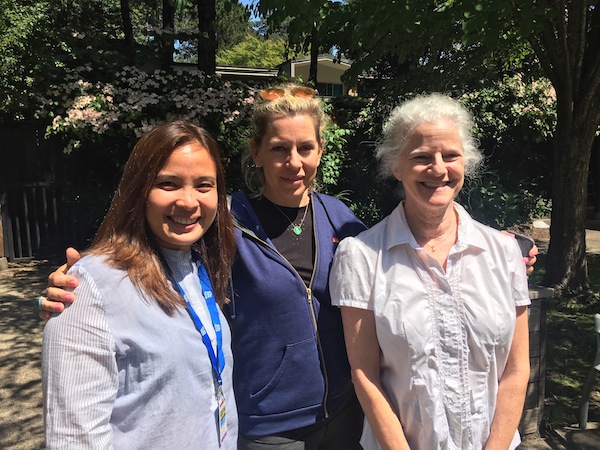
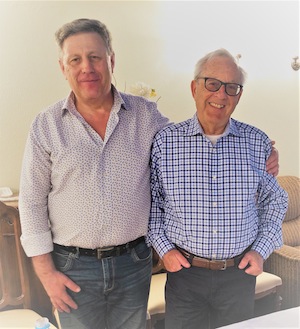
Left to right: Nicole Encarnacion, Ruthie Shugarman and Lisa Ford. (photo from Louis Brier Home and Hospital)
This summer, the Louis Brier Home and Hospital celebrated the transformation of part of its outdoor space into a place of beauty and quiet.
On the morning of June 30, the wider community came out to support the Louis Brier Home and Hospital’s community of residents living with dementia. The special care unit, which is home for 17 residents who live with severe dementia, has its own outdoor space for the residents and their families. Dubbed the “secret garden,” this space has been tended by residents’ families and, now, thanks to the vision and support of local realtor Ruthie Shugarman, it received a major overhaul.
The project was spearheaded by former master gardener Lisa Ford, who visits her mother, Laura Ford, a five-year resident of Louis Brier, several times a week. Since her mother moved into the special care unit two-and-a-half years ago, Ford has been planting and caring for the space. With Shugarman’s help, the private courtyard has become a welcoming space for families to spend time together with dementia-friendly design components recommended by the Louis Brier’s nursing lead, Nicole Encarnacion.
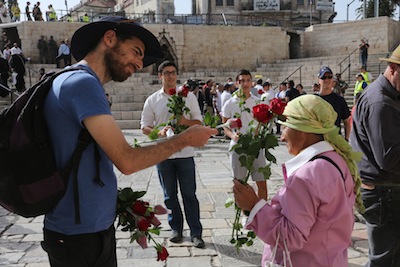
One of Tag Meir’s annual events is Flowers of Peace. Participants hand out roses on the streets of the Old City in Jerusalem on Jerusalem Day. This year, they gave out some 2,000 flowers as a message of peace to Muslims and Christians in the city. (photo from Tag Meir)
To counter what Tag Meir head Gadi Gvaryahu described as incitement by radical settlers through Tag Mechir (Price Tagging), Tag Meir (Light Tagging) was formed.
Tag Meir, which started in 2011, is operated by members of the same segment of religious Zionistic Judaism that started price tagging (attacking Palestinian property and people) in 2009. Members of Tag Meir started visiting victims on both sides of the conflict in an effort to show solidarity and repair physical and psychological damage.
Today, Tag Meir is supported by many organizations and institutions in Israel from all segments of Jewish society – secular, Reform, Conservative, Orthodox and ultra-Orthodox Jews – coming together to stand against hate and intolerance.
Though he now lives in Rehovot, Gvaryahu still considers Jerusalem home. He is the eighth generation of his family to live there.
Gvaryahu was deeply affected by the assassination of Yitzhak Rabin and the fact that the killer had come from his segment of religious Zionism, Kippot Srugot (Knitted Kippot). He decided he had to put his passion for helping animals aside – he is a farm animal behavioural researcher by training – to find ways to mend Israeli society.
“I decided it’s about time to be more involved in public business – not politics, but more education,” said Gvaryahu. “Me and a few other families initiated a synagogue, an Orthodox synagogue in Rehovot, named after Yitzhak Rabin.”
Gvaryahu realized there was something wrong with the education system when he received a call from the head of his son’s yeshivah, demanding his son apologize for an outburst.
“Six months after Yitzhak Rabin’s assassination, a famous rabbi came to my son’s school,” recalled Gvaryahu. “He said that now, with Rabin dead, all his bad things were forgiven. And he didn’t even mention that he was murdered. He just treated him like someone who’d sinned a lot, talking to the whole synagogue, like 400 students, including the head of the synagogue … and they were all silent, except one person – my son.
“My son said, ‘How dare you say that? He just passed away! And, how dare you say that he has sins? He was killed, murdered!’ Then, he left the room, crying.”
When the rosh yeshivah called, Gvaryahu commended his son’s actions and said, “This rabbi should apologize. I’m not going to ask my son to apologize.”
Eventually, they consulted a leading rabbi who declared that Gvaryahu’s son “did a wonderful job and there’s no reason for him to apologize.”
It was at that point that Gvaryahu decided they needed to start their own school.
The first time that Israelis heard the term “Price Tag” in the context of payback was in December 2009. It was dubbed so by a small group of extreme right-wing West Bank settlers who had begun indiscriminately attacking Palestinians.
Gvaryahu explained the psychology behind it: “Something happened to us by Palestinians, by the army, by politicians, whatever … someone will pay the price. The thinking is, we don’t care that you’re innocent, we don’t care that you are Christian, Muslim…. You’re not Jewish, you’ll pay the price. We’ll burn, damage your mosque, your house, your car, your olive trees, and that’s called, ‘Price Tag,’ happening almost daily in the West Bank. Most of them, we don’t hear about. But, after a terror attack by Muslims, unfortunately, we have a bunch of them in the last two months … there’s been attacks by extreme settlers.”
While Tag Mechir destroys, Tag Meir aims to rebuild and bring light. “So, we call the people, the victims, in hospitals, villages, wherever, mosques, monasteries or churches, and we create a solidarity visit,” said Gvaryahu.
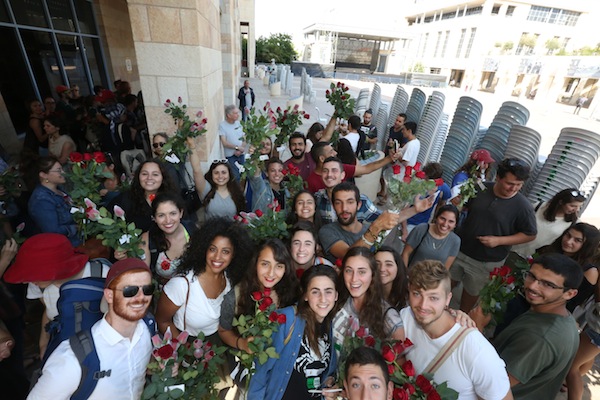
Flowers of Peace volunteers on Jerusalem Day. (photo from Tag Meir)
“Over the years, we’ve gained many, many Jewish, Christian and Muslim friends, and that’s very important. It’s important, because it’s a correct response to that crime, because they want to create terror or fear, especially among Muslims and Christians. So, those visits strengthen the relationship between Jews and Muslims and Christians. We have three Facebook pages – one in Hebrew, one in Arabic and one in English – with 35,000 followers.”
People in Israel not connected to Tag Meir have started solidarity visits by themselves, aiming to mend fences with Palestinian neighbours. “First, you know, I’m happy about Tag Meir,” Gvaryahu said about this development. “Second, that they get that this is the right way to respond to a hate crime or a price tag attack – it’s wonderful. It’s what we want to happen.
“This isn’t something that can be solved quickly. It’s education. We try to educate society, especially the Zionist society, we hope.”
This year, due to the rise in Tag Mechir attacks, Tag Meir held an education symposium on Sept. 10 at the Van Leer Jerusalem Institute, near the home of the president of Israel, Reuven Rivlin. Among the speakers were the former head of the Israeli security agency, Shin Bet, Yaakov Peri, senior rabbis from different segments of society, and the mother of one of the Jewish victims of terror, Sarah Rosenfeld.
“Her son [Malachi Moshe] was murdered and she will give her strong condemning opinion about ‘price tag,’” said Gvaryahu prior to the symposium. “When we came to visit the Rosenfeld family, she said that, if Malachi would be with us, he would join Tag Meir.
“This is very unique about Tag Meir, that we visit both settlers and victims of Tag Mechir on the Palestinian side. It’s not that pleasant an activity sometimes, but we feel it’s very important.”
One of the yearly events Tag Meir hosts is a flower giveaway called Flowers of Peace. They go out into the streets of the Old City in Jerusalem on Jerusalem Day and hand out roses. “This year, we spread 2,000 flowers all over the Old City,” said Gvaryahu. “It’s a symbolic act, sending a message of peace to Muslims and Christians in Jerusalem.”
While Gvaryahu said 40% of the people in Jerusalem are Muslim, Jerusalem Day is only celebrated by the Jewish population. He said some of the songs that are traditionally sung must irritate the Muslim population. “Unfortunately, we don’t celebrate it, in our opinion, in the right way,” he said. “We just march with Israeli flags from West Jerusalem to the Western Wall through the market. Not all the songs are horrible, but a few of them are. So, this is our response. We march with Flowers of Peace.”
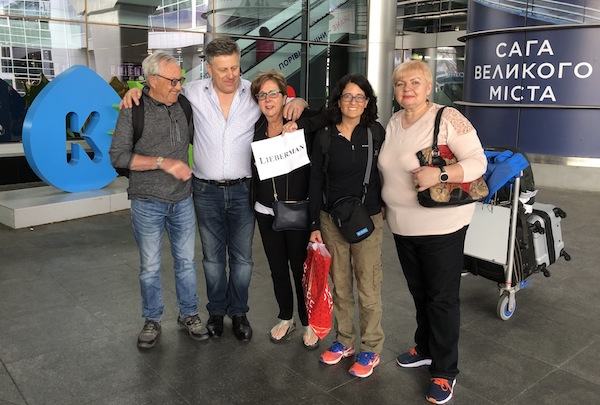
Left to right: Lucien, Grisha, Carole, Leanne and Svetlana at the airport in Kyiv, Ukraine. (photo from Carole Lieberman)
My husband Lucien, our daughter Leanne and I recently traveled to Kyiv, Ukraine, to meet Lucien’s first cousin and his family for the first time.
History has an interesting way of unfolding. Lucien’s father was one of 10 children born in Russia. The oldest daughter Sophie immigrated to Canada in 1912, to marry a farmer living in Rumsey, Alta. In 1923, Lucien’s grandparents, along with four of their children, including Lucien’s father Leo, made the cross-Atlantic journey from Russia to Alberta. Sadly, in 1927, their daughter Lucy, for whom Lucien was named, ended her life there at age 25 and, in another tragedy, their daughter Sophie, mother of five young children, was widowed.
Shortly after these tragedies, their daughter Manya chose to return to Russia on her own. And, in 1928, the grandparents were determined to return to Russia. And so, in November of that year, two brothers – Leo Lieberman, 33, and Sam Lieberman, 29 – embraced at the Calgary CPR station. Sam was escorting their parents back to Russia. Since their parents were in their 60s and were considered elderly, they could not manage the trip on their own. Sam expected to return to Canada once their parents were settled in Kharkov, but he never did. The brothers’ last words were about Leo’s new winter coat. “Leo, I like your coat. Where I am going you can’t find such a coat.” So, the brothers exchanged garments. They did not meet again until 1966, when Leo and his wife Clara went to the Soviet Union to try and find family.
Cousins Grisha, left, and Lucien. (photo from Carole Lieberman)
Lucien grew up in Calgary aware that his parents had both left large families in the Soviet Union and that the Second World War had devastated those families. Sam’s story was tragic. He worked in Moscow in the 1930s as a translator. When the war came, he was taken into the army and survived four years in combat roles. He was wounded and, in 1946, he was arrested, charged and tried for the offence of being “anti-social to the regime” and sent to the Gulag, where he laboured for 10 years in a camp beyond the Arctic Circle. After Stalin’s death, Sam was discharged and allowed to return to his city of last residence, Chernivtsi in the Ukraine. There, at the age of 57, Sam married a younger woman and fathered a son, Gregory (Grisha).
The next generation of family in Canada always knew about Uncle Sam and Cousin Grisha. We had heard that Grisha lived in Madagan, which is closer to Anchorage than to Moscow. Decades passed without any contact but finally, in 2016, we learned that Grisha, his wife Svetlana and their two children were living in Kyiv, the capital of Ukraine. We met our new cousins on Skype in 2017 and began to catch up on decades of this lost connection.
Grisha and Svetlana’s son, Stanislaus Lieberman, is married to Natasha, has a 2-year-old daughter and is a lawyer in Kyiv. Their daughter,
Tatiana Lieberman is known throughout Ukraine as Tina Karol. (photo from Carole Lieberman)
Tatiana Lieberman, affectionately called Tinotchka, is known throughout Ukraine as Tina Karol (tinakarol.com). Tina is a renowned singer who represented Ukraine in the 2006 Eurovision competition at age 21. She is the “face of Ukraine,” with billboard ads throughout Kyiv for Huawei and many cosmetic companies, and has the largest fan club in all of Ukraine. Her 10-year-old son Veniamin attends school in England and returns to Kyiv frequently. Tragically, Tina’s husband, Eugeny Ogir, who was her manager, died in 2013 at the age of 33, shortly after being diagnosed with an aggressive form of cancer.
Grisha speaks a reasonable amount of English and, thanks to Google Translate, we communicated well. We came to feel very close to our cousins after many Skype visits and plans were made to visit. There was no discussion – they insisted that we stay with them in their apartment so we would really get to know one another. It certainly was not our custom to stay with people we had never met in their two-bedroom, 1.5-bathroom apartment for eight nights but the visit was incredibly memorable and very special. Days before our arrival, Svetlana wrote that “they were trembling with anticipation.” We felt the same.
Our daughter Leanne, a teacher and a published author, met us at the airport in Kyiv. We were welcomed at the airport with a “Lieberman” sign and the warmest hugs and happiest tears. Throughout the visit and several times every day, Grisha would grab Lucien, hug and kiss him, saying, “You are my dear cousin.” Despite the 18-year age difference, there was a very strong cousin connection between the two men, cemented further by the traditional home-cooked Ukrainian food that we were so generously fed each day. We awoke to the smell of kreplach, borscht, haluptsi, cheese latkes and potato pancakes prepared by Svetlana and we enjoyed eating delicacies such as forshmuk, a chopped white fish salad. It was food that was so reminiscent of what Lucien’s mother had prepared for him when he was growing up in Calgary. We all laughed together when we were offered barbecued “kitchen.”
Our entire week was planned in advance and included not only family visits and meals, but a visit to a wonderful Ukrainian folk dance show at a huge auditorium where we were seated in the president’s box, welcomed with a champagne reception and presented with traditional Ukrainian outfits for Vishivanka, all arranged by Tina. Tina’s driver took us to a 26-acre monastery for a private tour and we were taught how to make varenikes in a private master class at lunch.
We gained a good sense of Tina’s personal life when we visited her stunning home and gardens, complete with a 24-hour armed security guard. Tina’s fans adore her and swarm her when they see her out in public.
Kyiv is a stunning city, with the Dneiper River running from north to south. The climate is warm in spring and the air is often beautifully fragrant with the scent of acacia trees, stronger in the morning and in the evening when we all strolled along the river. It has beautiful kashtana (chestnut) and lilac trees and a number of impressive bridges and lookouts. There are many parks, huge squares and an excellent subway system, accessed with the longest imaginable escalators. Like so many cities, it has far too much traffic (propka).
Tina arranged a private guided tour of Babi Yar for us with an English-speaking local woman. Babi Yar is now a beautiful treed park approximately a kilometre square in the northwest outskirts of Kyiv. On Sept. 29, 1941, Nazi troops rounded up Kyiv’s 34,000 strong Jewish community and massacred them all within 48 hours. Victims were shot and buried in the ravine. The Nazis then rounded up the local Romany people and residents of mental hospitals and extended the killing. During the two-year Nazi occupation, more than 100,000 bodies were dumped into the Babi Yar ravine. When the Red Army recaptured the city in 1943, there were only 80,000 people in Kyiv, one-tenth of its former population.
Lucien, left, and Grisha at Babi Yar. (photo from Carole Lieberman)
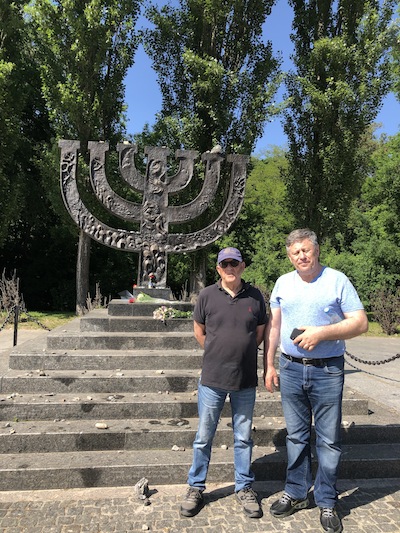
Today, there is little evidence of a deep ravine, only undulating terrain. There are numerous monuments, some remembering the many children killed, several with Hebrew inscriptions, and a beautiful bronze wagon, which depicts a typical Roma caravan. After the dissolution of the Soviet Union, the Ukrainian government invited the state of Israel to erect a monument, which was done in the form of a large menorah. Babi Yar is possibly the most prominent site representing the Holocaust in the former Soviet Union.
During the week that we were in Kyiv, a new president was sworn in. With Svetlana, we watched the televised inauguration of President Volodymyr Zelenskiy, a 41-year-old former comedian and the first Ukrainian president with a Jewish background, and we loved seeing Svetlana proudly sing the national anthem, in tears.
We visited Maidan, the central square of the city, saw the parliament buildings and surrounding Marinsky Park. We toured a fascinating military museum, visited an old synagogue and were taken to the famous opera house, where we thoroughly enjoyed seeing the ballet.
Every day was full of memorable moments. We spent several evenings sharing family photos – it was fascinating to see photos of us from the 1970s and ’80s, which were mailed to them by my in-laws and other relatives before we lost contact. We laughed, hugged, cried and shared stories, always with “Grishinke” grabbing and kissing “Lucienke” and proudly saying, “you are my cousin.” Together Grisha and Lucien enjoyed shemiskes, aka sunflower seeds, that only people who were raised by siblings would enjoy the same way.
We celebrated our last night together at a beautiful restaurant overlooking the river and marveled that the restaurant, like many other quality restaurants, had an excellent playroom where Stanislaus’s daughter Vesta played while we dined.
When we finally hugged everyone goodbye and thanked them for a visit that exceeded every expectation, Grisha responded, “I am the son of Sam.”
In 1951, after spending five years in the Gulag, a fellow prisoner was released and Sam asked him to please send a letter to his brother Leo informing him that he was still alive, giving him the address – Leo Lieberman, Calgary, Alberta, Canada. When the man was able to mail the letter, he omitted “Calgary” and the letter ended up in the Edmonton post office. The letter was sent to a Mr. Lieberman in Edmonton by a caring employee and was subsequently forwarded to Leo Lieberman in Calgary.
Carole Lieberman, a longtime Vancouver resident, is originally from Montreal. She is a mother of three, grandmother of four, and has enjoyed selling Vancouver real estate for almost 30 years.
The author took refuge from the perils of the streets by joining a kibbutz as a volunteer. (photo from Victor Neuman)
In this eight-part series, the author recounts his life in Israel around the time of the 1973 Yom Kippur War. The events and people described are real but, for reasons of privacy, the names are fictitious.
Before the War: Part 1
“The bomb shelters can no longer be used as discotheques.”
It was Oct. 6, 1973. Gidon, our kibbutz commander, was announcing that we were under attack and giving us our preparation instructions, including the immediate clearing out of bomb shelters for use in the event of air attack.
Syria had overrun the Golan defences and Egypt was pouring into the Sinai. I was in disbelief over the whole thing. Last year, I was writing my master’s thesis, analyzing Hawthorne’s The Scarlet Letter. Now I could be writing something more like Warfare: A Tourist’s Guide. How had my life gone so abruptly from pondering literature to pondering existence?
There’s an expression Israelis use: “I could sell you.” In other words, you are ripe for the plucking and I could easily take advantage.
When I arrived in Israel on my first trip, in 1968, I was totally pluckable. No knowledge of Hebrew. No knowledge of the country. No tour group guide to protect me. All I had was my curiosity about this country that had recently achieved a stunning victory in the Six Day War. I think that event had caught the attention of many like myself, and there was a huge influx of tourists and volunteers to visit this remarkable place.
I was bought and sold in the streets of Tel Aviv. Simply buying a prickly pear fruit was fraught with fraud.
“One-and-a-half lira please,” the street vendor told me. I paid him and started walking away. Then an Israeli stepped up to the stand.
“One-and-a-half lira please.”
This time, the buyer was having none of it. “Yes, one-and-a-half lira, but you’ll take 75 grush.” Leaving no opportunity for a response, he paid what he wanted and took the fruit. I had just paid double for the same thing.
At another time, I tried to be smarter. I needed to change my German marks into Israeli money. I was aware there was a black market for foreign currency and the street usually offered better rates than the bank. It didn’t take long to find a dealer. They can smell a tourist a mile away. One came up to me asking if I had foreign currency to change. I asked him what rate he was offering for German marks. He gave me a number that sounded pretty good and we agreed on a transaction. I handed over the Deutschmarks – he could have bolted but he was an older guy and I figured I could outrun him if I had to.
He took my money and began counting out Israeli currency. I thought there was something odd about the way he wrapped the money around one finger as he flipped the bills and counted them out to me. Later, when he was long gone, I recounted what he gave me and found I was several bills short. He had flipped the bills so that he had ended up counting the same ones twice and giving me less than we had agreed upon. In the end, I was “sold” again and had even less than I would have gotten at the bank.
You never really lose at these things because they always come with lessons. In most cases, you win some and you learn some. The only time you really lose is when misfortune befalls you and you’re sleeping through class.
I took refuge from the perils of the streets by joining a kibbutz near Haifa as a volunteer. Kibbutzim are basically communal societies where all wealth, housing and equipment are owned by the collective. Material perks like TVs or stereos are doled out on a seniority basis. No one – even those running the place – has any real power over others or more wealth than others. The top jobs are considered something to be avoided. You have all the responsibility and headaches of administering the mess without any particular rewards. In my experience, a kibbutznik generally takes the top job when it is their turn in the rotation and they simply can’t get out of it. Socialism in its purest form and no commissar overlords.
Kibbutz life was good. Nobody tried to rob me and, in return for picking grapefruit and oranges, I got accommodation, food, Hebrew lessons and free tours of the countryside. Sometimes, on my days off, I went further afield.
One of those forays was particularly memorable. My girlfriend, Suzanne, was a kibbutz volunteer from Paris and together we decided to attend Independence Day celebrations in Jerusalem. We booked a hotel room in the Arab quarter of Jerusalem’s Old City and thought about our plans for the evening. The debated options were hanging out in the room or going to the cinema to take in a movie that was a modern American take on Romeo and Juliet. Romance won the day and we left for the movie. The movie was mediocre. Things back at the hotel were less so.
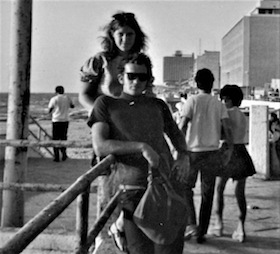
Victor Neuman and his then-girlfriend, Suzanne, in Tel Aviv. (photo from Victor Neuman)
When we got back, we were met by police and the hotel manager. The manager apologized for the inconvenience but we were being moved to another room and could we please collect our luggage from the original room. The sight of our old room was amazing. It was all sparkly. The windows were gone and every horizontal surface was covered with dust. Someone had set off a bomb in the alleyway outside our room.
You might think that a bomb blast would send great shards of glass flying across the room. A blast close by doesn’t. Instead, it pulverizes the glass into a fine dust and that’s what is blown across the room. Objectively speaking, the room looked beautiful – like a fantasy bed chamber decorated in fine diamonds. In reality, we were shaken, as we carefully swept the glass from our bags and began hauling them to our new room on the opposite side of the hotel. It was nice. It had windows.
And the movie? We upgraded its rating from mediocre to fantastic.
Suzanne and I had different travel plans and, after Jerusalem, she traveled to be with friends on a kibbutz north of Hadera. I was concerned that I didn’t have enough money to fly home if the need arose. I was also learning very little Hebrew from the kibbutz we had been on and it was getting annoying needing Suzanne to translate for me wherever we went. When we parted, I headed south to find work in Arad, hoping I could make some serious money and learn Hebrew by some kind of immersion method.
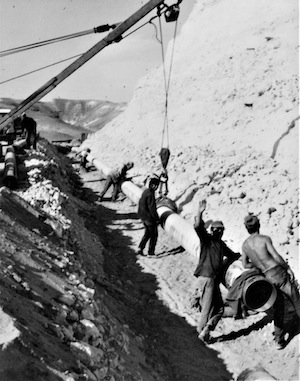
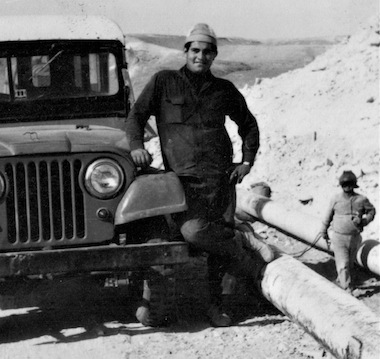
The immersion was profound. I was plunked down in an environment where nobody spoke English. The Arad employment office put me on a crew building a pipeline that would take Dead Sea chemicals to a refinery in Tishlovet. The crew consisted of central European Jews, Israeli Arabs, some local Bedouins and an assortment of thieves, bastards and criminals who were probably one step ahead of an Israeli SWAT team. One of them stole my camera (a beautiful Zeiss Ikon that my father had gifted me) and an assortment of items from all of the crew. We were put up in a motel and, the day the thief quit, he still had the key to the motel room. He made the most of it.
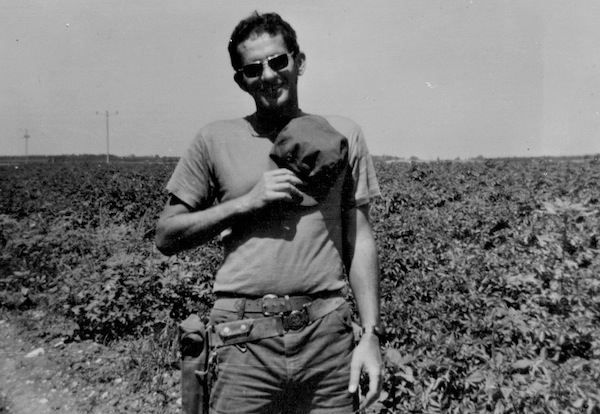
The crew on which the author worked, building a pipeline that would take Dead Sea chemicals to a refinery in Tishlovet. (photo from Victor Neuman)
On the job, I was low man in the pecking order. I had to fetch tools when yelled at and woe to me if I didn’t understand what was being asked for. With this bunch, everybody knew only enough English to swear, and little more. I was sworn at in English, Arabic, Romanian, Hungarian, Polish and Hebrew. It was somewhat typical of what I heard in other parts of the country. Israelis have a knack for adopting the choicest insults from all the languages they encounter. Understandable when you come down to it. Spoken Hebrew was basically invented by linguistic scholars around the time the state was created. They had the difficult task of updating ancient Hebrew to cover things like helicopters and toaster ovens. They didn’t spend a lot of time thinking up swear words. Israelis had to improvise and they did a fine job of it.
The upshot was that, in two months on the pipeline, I learned more Hebrew than in a year of kibbutz Hebrew school. I was getting pretty fluent and I had a good ear for the accent. I began to find that, when I spoke, I was often being mistaken for a Sabra. And, as a bonus, I could swear like a sailor.
* * *
Living in Arad, I now had a decent amount of money rolling in from my work. I decided to take an offer from a guy I’ll call Bad Lennie. Bad Lennie was a South African Jew who had immigrated to Israel with his brother, Good Lennie. Good Lennie lived in one part of Arad with his girlfriend; Bad Lennie had his own apartment. When the two of them were in the same room, I noticed Good Lennie seemed somewhat embarrassed around his brother and often cringed when his brother rambled on about his life in South Africa. In time, I found out that he had good reason to be embarrassed.
Bad Lennie was between jobs and needed money, so he offered me a chance to share his flat if I split the rent with him. I couldn’t pass up the chance to leave behind the den of thieves that were my pipeline crew, so I moved in with Bad Lennie.
Bad Lennie had some disturbing fantasies. He had undergone some military training in his home country. He had a lot of stories to tell me about his time in the military. According to him, he was a top-notch officer in command of hundreds of blacks. His favourite story was of the day one of his men questioned his authority in front of the others. Bad Lennie calmly walked up to the offending black soldier and put a bullet in his head. After that he never had trouble with the others. He told me many stories with pretty much the same theme. The den of thieves was starting to look better to me.
Bad Lennie had a revolver. I found out about it one day when he had this huge grin on his face and told me to feel under his arm. I wanted to pass but he grabbed my hand and stuck it in his armpit.
“What do you think? It’s a gun!” What did I really think? He was wearing a holstered gun under a turtleneck sweater! Not a bad James Bond look except that his turtleneck quick draw was going to need some work. I knew he was an idiot but now I was beginning to wonder how dangerous a one.
Bad Lennie pestered me to get him a job on the pipeline so I did. He lasted three days. On the third day, he came up to me and said, “Watch this.” Then he proceeded to go up to our Arab foreman and swear a blue streak at him in English. He turned back to me with that same stupid grin on his face. “It’s OK. The bugger hasn’t a clue what I’m saying.”
I had been on the pipeline long enough to know different. Everybody in this bunch was fluent in Swearese. Bad Lennie was fired. He still seemed confused about why but he was a goner nevertheless. And his problem became my problem. Bad Lennie was getting half the rent money from me but it was not enough and he started borrowing my money. I saw no chance of getting repaid because Bad Lennie now had no job. He spent most of his time hitting on his brother for money and going to the cinema in Beersheva to watch the latest Western. After coughing up a fair amount of cash, I cut him off. Then he offered to sell me some of his coffee table books on Israel. Truth be told, they were beautiful books but I was still living out of a backpack and couldn’t see myself schlepping all that weight.
I said, “No thanks.” He looked pissed but I didn’t care.
One day, I returned from work and walked through the door of our flat. There was Bad Lennie standing kitty-corner across the room with his gun pointed straight at my head. I just froze. I felt a powerful urge to say something but nothing came to mind. Then he pulled the trigger and there was this loud “snap.”
“It’s empty,” and he was grinning again. “I’m just kidding around. I wasn’t really going to shoot you.”
The Arab foreman of the pipeline who fired Bad Lennie after Bad Lennie swore at him. (photo from Victor Neuman)
I decided then and there that I had made enough money and my Hebrew would suffice. Bad Lennie’s gun was empty but I was sure he kept bullets somewhere. It was time to get out of Dodge. On the day I decided to leave, I left the job site early and headed for the apartment. I knew Lennie wasn’t around because they were playing a new Western at the cinema. I grabbed all my things and stuffed them in my bag. There was a little room left, so I grabbed Bad Lennie’s books and stuffed them in my bag as well.
Lastly, I wrote him a note: “Hi Lennie, I’m leaving town to go to a kibbutz in the north. Take care and best of luck. P.S. I’ve changed my mind about your books. I’ll buy them after all. Just deduct what they are worth from the money you owe me and we’ll call it even. Cheers.” Then I headed for the nearest road out of Arad and started hitchhiking north. It was a bit nerve-wracking. I wasn’t sure who would show up first – my ride or Bad Lennie. I was in luck. My ride came first and I was on my way to join Suzanne.
As I mentioned, Suzanne and I had met at our previous kibbutz, near Haifa. She was Jewish and, like me, had come to Israel to check it out and become a volunteer. She was a huge fan of Leonard Cohen and, as a consequence, had a real thing for dark, brooding, handsome Canadians. All I had going for me was the Canadian thing and, happily, she settled for that. For me, the trigger was her incredibly sexy French accent. It was like listening to music.
She also spoke her mind entirely with nothing held back. Tears or laughter came at the drop of a hat and you were never in doubt about what she thought or how she felt. It was a raw honesty of emotion that took some getting used to but, once you did, it was exciting in a scary kind of way. The ride was bumpy but never ever dull. And nothing frustrated her more than people suppressing their feelings. Once, when I was being particularly uncommunicative, she booted me in the rear to try to get me past it. I don’t recall if it worked but, after that, if I felt withdrawn, I made sure I was sitting down.
Suzanne worked in the children’s house and I had a steady job in the banana fields with a guy named Lev as my boss. Banana life was good but there came a time when I worried that I was spinning my wheels. I wasn’t sure I wanted kibbutz life forever and I thought I had the beginning of a career back in Canada. I had a BA in English literature, after all. It had to mean something. I felt I needed to return to Canada and see what I could make of my life there. I was in a dark, who-am-I kind of mood. When I told Suzanne I was going home, she was angry.
“I won’t be the one left behind,” she told me.
Before I knew it, she was on a plane bound for Paris and I was sitting in the middle of a very empty room. Worse than empty. The life had gone out of it. To my surprise, I actually wept. I never realized until then how much I would miss her. Typical of me. Why not save steps? Burn the bloody bridge while you’re still standing on it.
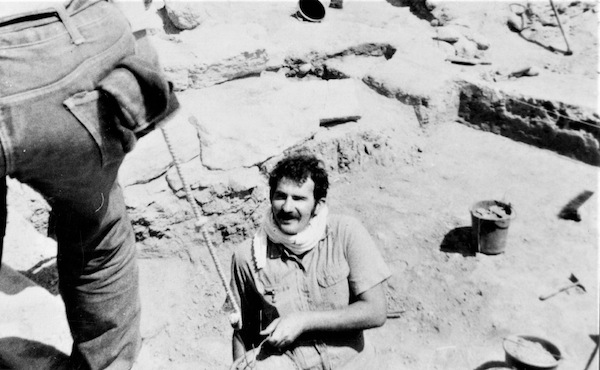
I couldn’t bear that empty room and so, in the time I had left before going home, I joined an archeological dig in the Negev near Beersheva. The work was hot, dirty and finicky. We had to move a lot of dirt to get down to the Iron Age town we were looking for and, at that point, the work had to be much more careful. Every find was scraped, brushed clean, surveyed for location, photographed and, finally, removed to our storage room at the base of the hill.
In the summer of 1969, the author worked on an archeological dig. Here, he passes up a bucket of dirt for disposal. In the background, partially covered with a rock slab, is a Bedouin grave dating to the Middle Ages. (photo from Victor Neuman)
I was particularly proud of finding an intact Iron Age kiln, circa 700-600 BCE – basically, a three-foot-wide, clay-walled cylinder standing on its end. I carefully brushed and excavated the kiln to its base, always careful to leave the dirt in the centre as support for the walls. After three days of clearing the outside of the kiln and the floor around it, I was told it was time to take it down and go deeper. It had been photographed, measured and catalogued and now it had to be removed. Strangely, my fellow volunteers had all dropped their tools to come and watch me take a pickaxe to the kiln. Not sure what was going on, I swung the pickaxe and buried it in the centre of the kiln. There was a horrible sound of glass breaking.
“Crap!” I thought. “I’ve just destroyed some 2,600-year-old glass artifact that was situated in the middle of my kiln.” Everybody who had gathered round gasped loudly in horror. Feeling disgraced, I dejectedly began pulling out bits of glass. But there was something peculiar. The glass had a colour that was unlike any ancient glass I had ever seen. In fact, it looked a lot like.… “Alright,” I said, “Who buried the frigging beer bottle in my kiln?”
Aside from the pranks, we did a lot of good work and, by the end of the season, I was standing on the streets of ancient Beersheva where Abraham once walked.
When the dig ended for the summer, it was time to go home. My first trip to Israel was over. I returned to Canada in 1970, got an MA in English literature by May 1972 and, damn me, I still didn’t want to teach. I was no further ahead in knowing what I wanted to do. Also, I missed the kibbutz. I decided to go back to Israel later that year. My thinking was that I’d spend some quiet time there deciding about my future. I didn’t realize that I’d have to do my contemplating in the middle of a war.
Victor Neumanwas born in the former Soviet Union, where his family sought refuge after fleeing Poland during the Second World War. The family immigrated to Canada in 1948 and Neuman grew up in the Greater Vancouver area. He attended the University of British Columbia and obtained a BA and MA with majors in English literature and creative writing. Between 1968 and 1974, he made two trips to Israel, one of which landed him on a kibbutz at the time of the 1973 Yom Kippur War. Upon his return to Canada, he studied survey technology at BCIT and went on to a career of designing highways for the Province of British Columbia. When he retired, he reconnected with his roots in creative writing and began writing scripts for Vancouver Jewish Folk Choir concerts and articles for the Jewish Independent. Neuman and his wife, Tammy, live in southeast Vancouver and enjoy the company of friends, their extensive extended family and their four sons.
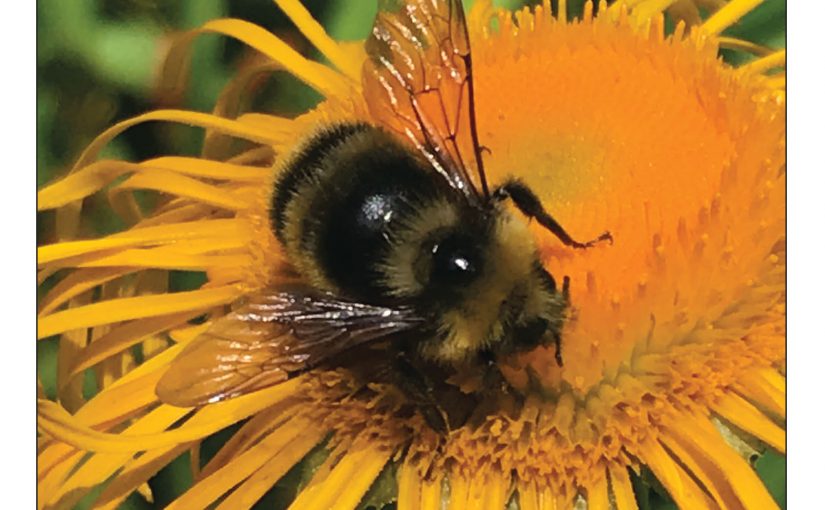
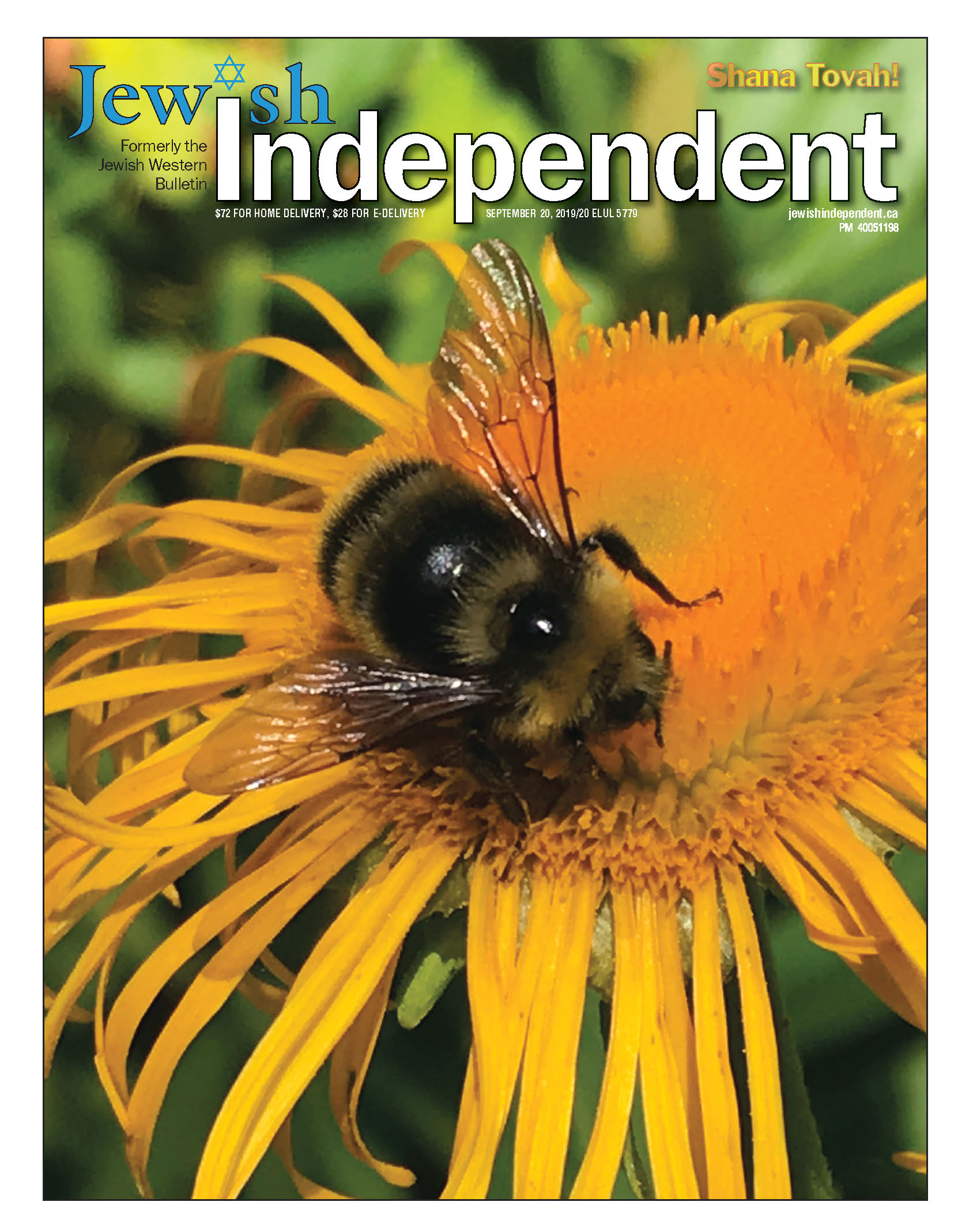
This year’s Jewish Independent Rosh Hashanah cover photo features a bumble bee on a heartleaf oxeye daisy flower – it was taken in Saanich, B.C., by David Fraser. Many native bumble bees are in decline, a concerning trend given the role they play in pollination of plants, including many food crops. Pesticides, habitat loss and introduced bee parasites and diseases are thought to play a role in this decline.
Apples are one of the main symbolic foods we eat on Rosh Hashanah, as we wish for a sweet year, with the help of some honey. Apples are the fruit of choice for this wish perhaps because Rosh Hashanah coincides with the sixth day of creation, when humans – Adam and Eve – were created and they ate the fruit (apple) of the Tree of Knowledge in the Garden of Eden. It could also be that apples symbolize the relationship between God and the Jewish people, as poeticized in the Song of Songs, or that the Zohar (kabbalah) describes paradise as a holy apple orchard.
Regardless of the reason for the fruit selection, apple production is dependent on bees and other pollinators. It would be fitting then for us to wish for more than a sweet, fruitful year, when we are dipping our apple slices into honey. We might consider our role in the decline of not only the bumble bee populations but of the environment at large, and what we can do to reverse it.
There’s no denying that food is an insanely large part of Jewish life. Whether we’re cooking it, eating it or writing about it, our lives inexorably orbit around it. It’s true that most religions celebrate their holidays, at least partially, through food. But we Jews have taken the concept to nosebleed-worthy stratospheric heights. If someone tells you their son is becoming bar mitzvah, our first question is not “Which shul?” but “What are you serving?” A bris? We don’t ask: “What time?” but rather, “What can I make?”
It’s not that modern-day Yiddishkeit revolves around food, but it kinda does. I’m fully aware that we’re supposed to focus on blessing and elevating the food we eat, since it is meaningless on its own. From a religious perspective, food is merely the vehicle to give us the strength to do mitzvahs and study Torah. I get it. But how can you ignore the deliciousness of a rock-star chicken soup or a melt-in-your-mouth brisket?
When you pair Rosh Hashanah and food, what do you get? Pure joy. And maybe a little indigestion, if there’s excess onion and garlic on the guest list. We all know that the High Holidays are a time to relax with family, eat lovingly prepared meals and go to shul. And, while shul is certainly important, for some, the highlight is the food.
From many years of observation, I’ve deduced that there are three main contenders at the Ashkenazi Rosh Hashanah table: matzah ball soup, brisket and gefilte fish. And maybe chicken. Or salmon, if you’re a true Vancouverite. Anything else is considered “alternative.” Seriously, when was the last time someone served tofu or sunomono at Rosh Hashanah dinner? Asked and answered.
Being firmly entrenched in the carnivore camp, I decided I’m going to make a pot roast for Rosh Hashanah this year. Being a pot roast virgin, until recently I knew next to nothing about this cut of meat or how to cook it. How did I get to be 63 years old without knowing these things? Rhetorical question. Anyway, I did what any self-respecting Accidental Balabusta would do – I Googled it. I found a recipe from the Food Network by Ree Drummond, called Perfect Pot Roast! I followed the recipe religiously (OK, minus the sheitel), except I made a mini-roast (one-and-three-quarter pounds) in case I screwed it up. And I used beef blade roast, which is the same as chuck roast, apparently. I cooked it at 275˚F for two-and-a-half hours. It turned out as scrumptious as something a bubbe would make. Only better. Modesty, wherefore art thou?
Over the years, I’ve heard gossip about pot roast: that it calls for a cheap, tough cut of meat (true); that it’s not really a Jewish cut of meat (see Snobbery 101); and that only goyim eat it (see Racism 101). I’m living proof that pot roast is a very Jewish thing. And, excuse me if I brag, but my newfound pot roast is beyond delicious. Or, to use the vernacular, a mechaye.
I feel compelled to mention something a little odd at this juncture. When I brought my first pot roast and took it out of the package, I noticed it had heavy twine wrapped around it. I wondered whether I’d purchased the B&D variety by mistake. Googling the twine part set my mind at ease. I mean, who wants to serve a kinky Rosh Hashanah pot roast?
Call me clairvoyant or, on second thought, don’t (that’s really not a Jewish thing), but I think you might be chomping at the bit for this recipe. Wait no longer. Allow me to introduce you to the Perfect Pot Roast by Ree Drummond. BTW, it calls for a Dutch oven, but any deep, covered roasting pan will do just fine. (Don’t feel bad, I had to Google Dutch oven, too.) Go ahead, cook it and tell me if this doesn’t taste Jewish.
PERFECT POT ROAST
Salt and ground black pepper One 3-5 pound chuck roast (same as beef blade roast) 2-3 tbsp olive oil 2 whole onions, peeled and halved 6-8 whole carrots, peeled and cut into 2-inch pieces 1 cup red wine (doesn’t need to be anything fancy) 3 cups beef broth 2-3 sprigs fresh rosemary 2-3 sprigs fresh thyme 2-3 potatoes, peeled and cut into pieces
Preheat oven to 275˚F.
Generously salt and pepper the roast.
Heat the olive oil in a large fry pan or Dutch oven over medium-high heat. Add the halved onions to the pot, browning them on both sides. Remove the onions to a plate.
Throw the carrots into the same fry pan or Dutch oven and toss them around a bit until slightly browned. Set aside the carrots with the onions.
If needed, add a bit more olive oil to the fry pan or Dutch oven. Place the meat in the fry pan or Dutch oven and sear it for about a minute on all sides, until it is nice and brown all over. Remove the roast to a plate.
With the burner still on medium-high, use either red wine or beef broth (about one cup) to deglaze the fry pan or Dutch oven, scraping the bottom with a whisk. Put the roast back into the Dutch oven (or deep, covered roasting pan) and add enough beef broth to cover the meat halfway.
Add in the onions and the carrots, along with the fresh herbs. Add potatoes, too (optional).
Put the lid on, then roast it.
The original recipe says to roast a three-pound roast for three hours or a four-to-five-pound roast for four hours. I personally don’t think this is nearly time enough. When I cooked two two-pound roasts in a single roaster at once, it took six-and-a-half hours to cook. The roast is ready when it’s fall-apart tender. I think the longer you cook it, the more tender it gets. It’s hard to screw this up, unless you undercook it.
Important note: don’t get too close to your Dutch oven when you lift the lid during cooking or you’ll get what I call the “pot roast facial.” I’m not sure your pores will appreciate all that meaty steam. But who am I to say? Just don’t blame me if you get third-degree facial burns. Bon appetit! Or, eat it and weep. From joy, that is.
May you all have a happy, healthy, prosperous and peaceful New Year!
Shelley Civkin, aka the Accidental Balabusta, is a happily retired librarian and communications officer. For 17 years, she wrote a weekly book review column for the Richmond Review, and currently writes a bi-weekly column about retirement for the Richmond News.
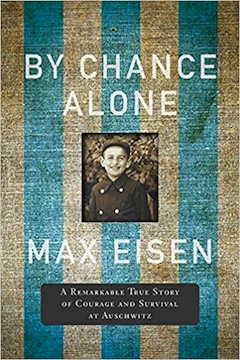
As public opinion surveys continue to tell us that vast numbers of people know little or nothing about the Holocaust, it was encouraging that Max Eisen’s memoir, By Chance Alone, became CBC Radio’s Canada Reads 2019 choice, bringing this wrenching narrative to many more eyes and ears.
Born in Czechoslovakia in 1929, Eisen enjoyed a childhood filled with shenanigans and idyllic summer excursions to his maternal family’s farm – until the Nazi invasion of his country, in 1938.
“At 9, I didn’t fully understand what was taking place, but I noticed the rising tensions in my hometown,” he writes.
Eisen’s father’s friends assembled at their home to listen to a major address by the Führer on a crystal radio. “All of us understood basic German,” he writes. Hitler’s words, “Wir werden die Juden ausradieren” – “We are going to eradicate all the Jews of Europe” – clarified for the young Eisen the import of the moment.
While traumas befell the family from then on, it was in the night after the first seder in 1944 that the worst of the family’s catastrophe began to unfold.
At 2 a.m., after the family had settled into bed after what Eisen calls their “last supper,” a neighbour arrived at their property urgently insisting that the family hide in the forest because he had overheard gendarmes saying that they would gather all the Jews in the vicinity the next day. Because it was Passover and the Sabbath, Eisen’s grandfather declared that the family would not travel. At 6 a.m., gendarmes forced their way into the home, gave the family five minutes to pack a bundle and be ready to depart their home.
The complicity of bystanders before, during and after the Holocaust permeates the book.
“On both sides of the road, the townspeople jeered and cursed at us as we passed. Many were looking out the windows of the Jewish homes they now occupied.… Many townsfolk who bought goods on credit from Jews like my grandfather were happy they wouldn’t have to pay the money back. Our deportation was an economic windfall for them.”
In the chaos of arrival at Auschwitz, Eisen had no idea of the seriousness of the separation of himself, his father and uncle from the rest of their family. The three would be the only ones to survive the first selection.
The everyday “indignities and deprivations” they had experienced before quickly turned to horrors. The forced labour he endured, long shifts of excruciatingly exhausting work on starvation rations, was fatal to those less strong.
His father and uncle were moved to another barracks and, after selection one day, Eisen could not find them.
“I ran to a fenced off holding area where the SS kept the selected prisoners until they were ready to transport them to Birkenau to be gassed.… My father reached out across the wire and blessed me with a classic Jewish prayer…. The same prayer my father once uttered to bless his children every Friday evening before the Sabbath meal. Then he said, ‘If you survive, you must tell the world what happened here. Now go.’”
At one point, when Eisen let down his guard and relaxed for a moment, an SS guard delivered a blow with the butt of his gun on the back of Eisen’s head. The nearly fatal attack put Eisen in the camp’s infirmary, which proved one of the chances that led to the book’s title. A surgeon, a Polish political prisoner, assigned Eisen the job of cleaning and running the operating theatre. Although the responsibilities he was forced to undertake and the things he witnessed were appalling, the comparative comfort of the job may have saved his life.
As the Nazi regime was on its last legs, “the SS ceased distributing rations and the water system was shut down,” Eisen writes. “I woke up to the smell of cooking meat.… Several inmates sat around a small stove and watched as a pot boiled. I could not imagine how they had acquired meat, but when I crawled to the latrine where the cadavers were stacked, I noticed that some of the bodies were missing pieces from their buttocks.”
On May 6, 1945, the camp was liberated, but the term lacks much meaning in the context. Everything and everyone Eisen knew was destroyed. When the Americans provided food, a stampede of starving people led to deaths by trampling. Those who got food suffered ruptured stomachs and many died on the spot.
After overcoming a nearly fatal bout of pleurisy, Eisen faced yet more incarceration. After the communist takeover of Czechoslovakia, his plan to find freedom abroad was dashed. Because he came from the eastern, Hungarian-speaking part of the country, he tried to obtain phony Hungarian ID and join a mass of Hungarian refugees passing through to the West. Discovered, he was imprisoned for a year.
When finally released, Eisen was given 24 hours to get out of his native country. Eventually, he made his way to Canada where, since the 1980s, he has educated school kids and others about the Holocaust.
“It is in this way,” he writes, “that I have fulfilled my final promise to my father: telling the story of our collective suffering so it will never be forgotten.”
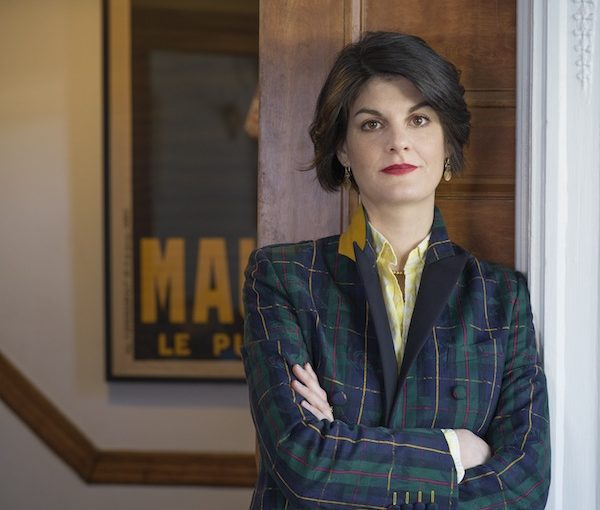
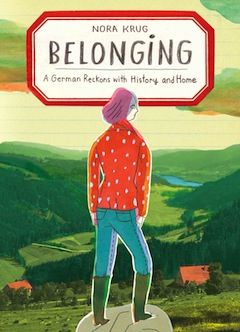
Nora Krug’s Belonging offers a thoughtful and artistic exploration of identity and history. (photo by Nina Subin)
Nora Krug’s Belonging: A German Reckons with History and Home (Scribner, 2018) opens with a page made to look like it’s written in pencil on yellow graph paper. The illustration of a bandage takes up half the page, which is ostensibly “From the notebook of a homesick émigré: Things German.” Entry No. 1 is about Hansaplast, a type of bandage created in 1922 that Krug associates with safety, her mother having used it, for example, to stop Krug’s knee from bleeding after a roller-skating accident at age 6. “It is the most tenacious bandage on the planet,” writes Krug, “and it hurts when you tear it off to look at your scar.”
Belonging is the written and illustrated account of what happens when Krug decides to rip off the Hansaplast and examine the scars left by the history of her family – which had only been related to her in vague terms – and her country of birth, Germany. It is a creative and engaging memoir about Krug’s efforts to define for herself and reclaim for herself the idea of Heimat, tarnished by the Nazis’ use of it in propaganda.
Heimat can refer to an actual or imagined location with which a person feels familiar or comfortable, or the place in which a person is born, the place that played a large part in shaping their character and perspective. Krug’s exploration of identity comprises archival research, interviews with family members and others, and visits to her mother’s and father’s hometowns – Karlsruhe (where Krug grew up) and Külsheim, respectively.
Alternating with the narrative of her discoveries are several notebook entries, on a range of items, from bread to binders to soap, which are both points of pride, as they are quality-made items, and metaphors. For example, Persil is “a time-tested German laundry detergent invented in 1907,” which Krug uses. However, she writes, “Some referred to the postwar testimonials written by neighbours, colleagues and friends in defence of suspected Nazi sympathizers as Persil Certificates. Persil guarantees your shirts to come out as white as snow.”
As well, Krug includes pages “From the scrapbook of a memory archivist,” which present odd and sometimes disturbing arrays of items found at flea markets on her research trips to Germany. These include Hitler Youth trading cards, a letter from the front containing a lock of hair and photographs of soldiers petting or holding various animals, mostly dogs.
But the main intrigue of the book comes from what Krug shares as she persists in her research, asking questions and scouring documents. She wants to find out all she can about her family’s involvement in the Holocaust, in particular that of her maternal grandfather, who died when Krug was 11, and her paternal uncle, who was drafted at 17 and shot and killed at age 18, before her father, a postwar baby, was born; her father was named after the brother he never knew. Despite her efforts, many of Krug’s questions remain unanswered.
At the end of Belonging, it’s not even clear if Krug – who readers find out early on married into a Jewish family – feels any less guilty or any more secure in her self and in her past. But she does manage to start the healing process on some family rifts. And she highlights a couple of steps towards healing that she witnesses in Germany. For example, of Külsheim – which had, in 1988, the 50th anniversary of Kristallnacht, abandoned a proposal for a memorial plaque where the synagogue once stood, before it was burned down the night of Nov. 10, 1938 – she writes: “Plans are made to restore Külsheim’s old mikvah, and a memorial stone is erected where the synagogue used to be, ‘as a manifestation of sadness and shame,’ Külsheim’s new mayor says on the day it is installed.”
The book ends as it began, with a notebook entry. No. 8 is Uhu, “invented by a German pharmacist as the first synthetic (bone-glue-free) resin adhesive in the world, in 1932.” Despite its world-record strength, which is why Krug imports it to repair everything from the soles of her shoes to broken dishware, Uhu “cannot cover up the crack.”
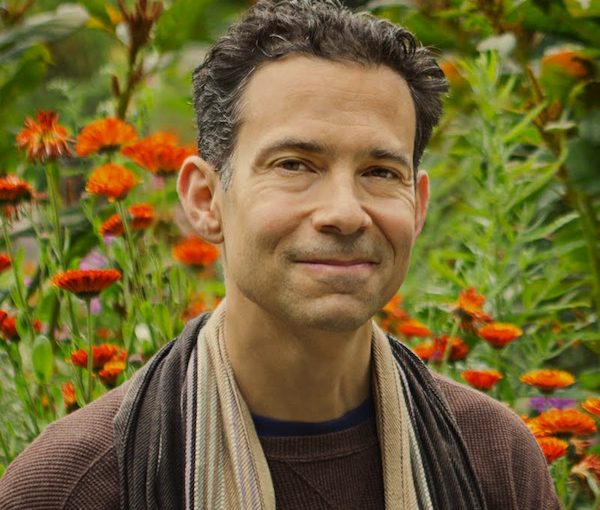
Oren Jay Sofer believes that, with nonviolent communication, a person can learn “how to identify what is most important to you and what’s more important to someone else … and, then, how to come up with more solutions and ideas for complex situations.” (photo from Oren Jay Sofer)
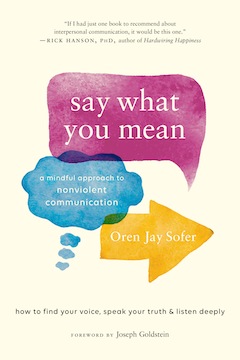
Oren Jay Sofer, author of Say What You Mean: A Mindful Approach to Nonviolent Communication, took a longer route to finding his connection to Judaism. “Probably,” he said, “most of it was because the teachings weren’t really available for me growing up – the more mystical or spiritual teachings of Judaism.”
The Buddhist practice of meditation resonated with Sofer. Then, he happened upon Dr. Marshall Rosenberg’s practice of nonviolent communication. Through learning about it, Sofer gained an accessible and practical complement to the inner transformation of meditation. “The two really started to work together in a synergistic fashion – in my personal transformation, in my relationships and in my direction in life,” said Sofer. “That, over time, led me to the work I’m doing today.”
A couple of years ago, Sofer was approached by a publisher about writing a book on his practices. He jumped at the opportunity to share what he had learned from integrating meditation practice, nonviolent communication and other concepts through Dr. Peter Levine’s work of somatic experiencing, a way of healing trauma through the nervous system.
“I was getting feedback [from students] that there was something unique about bringing these systems together, that people found really helpful,” said Sofer. “So, I wanted to reach more people, to write it down in a way that other people can go through this sort of progress of learning that I’ve put together – that could be of great benefit to them personally and for our society, in terms of the kinds of divisiveness and polarization people are experiencing around the world in so many places.
“I wanted to reach more people and help them have the tools to have more meaningful conversations in their life,” he added.
Sofer has found that communication and mindfulness are effective vehicles for aligning one’s life with one’s values, insofar as the choices we make, the work we do and the conversations and relationships we have.
This way of communication is accessible to anyone, no matter what age, religious belief, race, gender, or otherwise. “It’s for anyone who wants to improve their communication and have better conversations – parents, employees, supervisors, spiritual seekers, students, anyone – that is something I find so powerful and gratifying about this work, that it unites us as human beings,” said Sofer.
“We all communicate. And, we do it pretty much all day long in every area of our life. Even when we are alone, we have that inner voice going. So, the audience isn’t limited in any way, because we all depend on communication in our lives and it’s one of the things that determines our happiness. I really see this as a life skill that’s important for everyone.”
According to recent research conducted by Shawn Achor and others, the social relationships and connections we foster are one of the greatest predictors of long-term happiness, as well as of many different health markers. And, the quality of our relationships, to a large degree, is determined by our communication skills.
The book is set up rather like a field guide of how to communicate and converse. So, it’s not the kind of book you will read over one weekend or week. It is one you can read over several months, taking a few pages at a time, with exercises and principles interspersed throughout to work on and absorb.
“You can’t learn to swim by reading a swimming manual, right?” said Sofer. “You need to get into the water. You can’t learn to communicate from a book. You have to do it. But, the book can tell you how to do it in a way that you’re running experiments that will give you the information you need to figure out what will work best in your life and relationships. It’s really meant to be applied in a step-by-step way. And, it takes people through a whole arc of training with specific foundations to integrate into their lives.”
The book’s first foundation is to “Lead with Presence,” which Sofer views as an essential prerequisite for any effective conversation or meaningful relationship.
“We need to be here to have more self-awareness if we’re going to navigate the complex terrain of human interaction with any skill or clarity,” said Sofer. “So, there’s a whole section about what it means to have more self-awareness, how to cultivate it and how to bring it into our relationships and conversations.
“And, there are all kinds of practices, skills and pointers – everything from pausing, to developing more embodied self-awareness, to developing what I call ‘relational awareness,’ which is the capacity to be not just aware of yourself, but of the other person, space and energy between you.
“Then, the book looks at our intentions, which is a huge component of human interaction, happening beneath the words. Our non-verbal communication is, to a large degree, shaped by our intentions.”
With the goals of building the kind of goodwill, trust and collaboration that lead to more satisfying connections, Sofer guides the reader through a self-reflection about their habits, training, family, culture and society, to help them determine which parts need improvement.
“There are many different stories I tell about the power of intention in conversation,” he said. “The third section really looks at how we navigate conversations themselves – in terms of where we place our intentions, how we say what we really mean, how we know what we mean, how we come to more clarity about ourselves about what’s happening, and how we hear others more clearly, even when they’re speaking to us in ways that are critical.
“This section is really where the training in nonviolent communication comes in, looking at the mechanics of the conversation, how to become more skilful, how to identify what is most important to you and what’s more important to someone else … and, then, how to come up with more solutions and ideas for complex situations.”
According to Sofer, one of the roots of violence stems from our relationship to emotional and psychological pain, and the views and beliefs we hold about their origins.
“If I believe that you caused my pain, then there is a very short distance to the assumption that you deserve to be punished or to have retribution, being the cause of my pain,” said Sofer. “In nonviolent communication, we differentiate between the cause and the stimulus. Obviously, we affect one another in this world. We stimulate pain, but we don’t directly cause it. This is a very radical concept in many ways for people to take in.
“When we examine it, we start to see the truth of it, which begs the question if anyone can actually make you feel some way. And, you know, two different people will respond to the same event completely differently. One person will respond completely differently on two different days.
“So, the nonviolent component, in one way, is pointing to this link between our language and our willingness to use physical violence to accomplish our aims or meet our needs. When we think and speak in ways that are connected to our shared humanity, one of the aims of nonviolent communication is that violence no longer makes sense, as we’re in touch with a deeper layer of our existence.”
Sofer also speaks about the origins of nonviolent communication as a tool to create social change, noting “Without transforming our outlook, interactions and consciousness, it’s impossible to transform our society for the better.”
Sofer’s book, Say What You Mean: A Mindful Approach to Nonviolent Communication, is sold by many vendors, but there is a free gift offer when it is purchased from the author’s page, orenjaysofer.com/book.
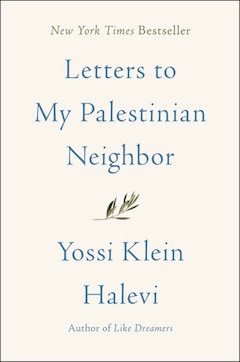
Yossi Klein Halevi’s Letters to My Palestinian Neighbour is recently out in paperback. (photo by Ilir Bajraktari / The Tower)
Yossi Klein Halevi grew up in the right-wing Zionist youth movement Betar, the ideological stream of Ze’ev Jabotinsky and Menachem Begin. As a youth, he wore a silver outline of the land of Israel “as we understood it” that included not only the West Bank but also the area that became the kingdom of Jordan, which the British had severed from historic Palestine. As he’s aged, he’s emphatically mellowed.
His book Letters to My Palestinian Neighbour, recently out in paperback, is, he writes, “an attempt to explain the Jewish story and the significance of Israel in Jewish identity to Palestinians who are my next-door neighbours.”
He lives in the French Hill neighbourhood of Jerusalem and repeatedly throughout the book reflects on how he is face-to-face with the division between their places.
Each chapter – essay, really – begins with “Dear neighbour.”
“From my apartment, I can just barely see the checkpoint you must cross – if you have a permit at all – to enter Jerusalem.” He talks about when, “before the wall was built, before so much else that went wrong, I tried to get to know you.”
In 1998, he set out on a pilgrimage into Islam and Christianity, a religious Jew “seeking not so much to understand your theology as to experience something of your devotional life. I wanted to learn how you pray, how you encounter God in your most intimate moments.”
During those comparatively placid times, he recalls, Israelis made little effort to accommodate their neighbours.
“For many years we in Israel ignored you, treated you as invisible, transparent. Just as the Arab world denied the right of the Jews to define themselves as a people deserving national sovereignty, so we denied the Palestinians the right to define themselves as a distinct people within the Arab nation, and likewise deserving national sovereignty. To solve our conflict, we must recognize not only each other’s right to self-determination but also each side’s right to self-definition.”
Klein Halevi made aliyah from the United States in 1982. Now a senior fellow of the Shalom Hartman Institute – “Israel’s preeminent centre for pluralistic Jewish research and education” – he co-directs the institute’s Muslim Leadership Initiative, is the author of numerous books and is a prolific commentator and former contributing editor of the New Republic. He has made the book’s Arabic translation available to download for free.
He argues that each side must be allowed to define themselves.
“So who are the Jews? A religion? A people? An ethnicity? A race?… That question impacts directly on our conflict. It goes to the heart of the Arab world’s rejection of Israel’s legitimacy as the nation-state of the Jewish people,” Klein Halevi writes. “Even Palestinian moderates I’ve known who want to end the bloodshed tend to deny that the Jews are an authentic nation. So long as Palestinian leaders insist on defining the Jews as a religion rather than allowing us to define ourselves as we have since ancient times – as a people with a particular faith – then Israel will continue to be seen as illegitimate, its existence an open question.”
He acknowledges that the problem occurs on both sides.
“Some Jews continue to try to ‘prove’ that Palestinian national identity is a fiction, that you are a contrived people. Of course you are – and so are we. All national identities are, by definition, contrived: at a certain point, groups of people determine that they share more in common than apart and invent themselves as a nation, with a common language, memory and evolving story. The emergence of a nation is an inherently subjective process.”
But he attempts to disabuse Palestinians and Arabic readers of the idea that Israel can be overcome.
“I’ve often heard from Palestinians that, just as the Ottoman Turks came here and left, and the British came here and left, so, too, will the Zionists one day leave. That analogy ignores Zionism’s singular achievement. None of those invaders founded a thriving society, let alone a sovereign state. They eventually went back to their own homelands. More than anything else, I need you to understand this: the Jews succeeded where the Crusaders and the Ottomans and the British failed because we didn’t merely come here. We returned.”
This sense of destiny is evocatively expressed when Klein Halevi writes about the War of Independence.
“Our side began the war with three tanks and four combat planes. And we were alone. That, as it turned out, was a crucial advantage, because desperation forced us to mobilize our entire society for a war of survival. If your side had prevailed, few if any Jews would have been left here. As a result, the Jews fought with such determination that only a handful of our communities fell. There was nowhere left to run; we’d reached the final shore of Jewish history.”
But the author makes an effort to acknowledge some of the harsh realities of that victory and the subsequent Israeli control of Palestinian areas and its effect on people. He recalls a moment during a call-up during his reserve service.
“A chubby teenage Palestinian boy, accused of stone throwing, was brought, blindfolded, into our tent camp. A group of soldiers from the border police unit gathered around. One said to him in Arabic: ‘Repeat after me: one order of hummus, one order of fava beans, I love the border police.’ The young man dutifully repeated the rhymed Arabic ditty. There was laughter.… That last story haunts me most of all. It is, seemingly, insignificant. The prisoner wasn’t physically abused; his captors, young soldiers under enormous strain, shared a joke. But that incident embodies for me the corruption of occupation. When my son was about to be drafted into the army I told him: there are times when as a soldier you may have to kill. But you are never permitted, under any circumstances, to humiliate another human being. That is a core Jewish principle.”
He acknowledges his pain over an eventual partition that would, for example, see the Jewish holy city of Hebron as part of an independent Palestine. But, he says: “The only solution worse than dividing this land into two states is creating one state that would devour itself. No two peoples who fought a 100-year existential war can share the intimate workings of government. The current conflict between us would pale beside the rage that would erupt when competing for the same means of power. The most likely model is the disintegration of Yugoslavia into warring ethnic and religious factions – perhaps even worse. A one-state solution would condemn us to a nightmare entwinement – and deprive us both of that which justice requires: self-determination, to be free peoples in our own sovereign homelands.… If Jaffa belongs to you and Hebron belongs to me, then we have two options. We can continue fighting for another 100 years, in the hope that one side or the other will prevail. Or we can accept the solution that has been on the table almost since the conflict began, and divide the land between us. In accepting partition we are not betraying our histories, neighbour; we are conceding that history has given us no real choice.”
Near the end, Klein Halevi reflects that some simple human goodness could have made a massive historic difference.
“Israel is a restless society of uprooted and re-rooted refugees and children of refugees, and the dark side of our vitality is a frankness that can easily become rudeness, the antithesis of Arab decorousness. Israelis often don’t know how to treat each other with respect, let alone those we are occupying. We are a people in a hurry to compensate for our lost centuries of nationhood, a people that doesn’t pay attention to niceties. Sometimes I think that, if only we’d known how to show your people simple respect, so much could have been different here.”
The new paperback edition includes an epilogue of “letters” in response to his neighbourly missives. Some, the author admits, are predictably harsh, dismissive and threatening. But many are long, thoughtful and inspiring. Klein Halevi has started a conversation. It is invigorating and heartily recommended to be a part of it as a reader.