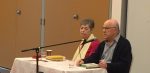
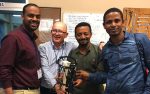
Shanie Levin and Al Stein opened the JSA Empowerment series season Nov. 30. (photo from JSA)
The first Jewish Seniors Alliance Snider Foundation Empowerment Series session of the 2018/19 year was on the theme of “Renewing and Reinventing Yourself as an Older Adult.” Held on Nov. 30, it was co-sponsored by the JSA and the Sholem Aleichem Seniors of the Peretz Centre for Secular Jewish Culture.
Thirty-five “older adults” gathered to listen to stories on the “Reinventing Yourself” theme, read by Al Stein and me. Gyda Chud, JSA vice-president and SAS coordinator, introduced the session by speaking about the goals of JSA in advocacy, education, information and peer support services. She emphasized the aim of JSA’s motto, “Seniors Stronger Together,” before welcoming the readers.
I shared that it had not been easy to find Yiddish stories translated into English that corresponded to the theme, so Al and I had to look to stories written in English by Jewish writers.
Al began with a short parable from Roman times about a 100-year-old man who was still planting trees. I continued with a story by Grace Paley called Goodbye and Good Luck, which is set in New York in the 1930s – an older woman describes her colourful life to her niece.
Al’s next story was by a Canadian Jewish writer, Jack Ludwick, which was about an older woman who is constantly drawn back to the area of Montreal where she grew up and spent her early married years. The session closed with my reading a short section from Sholem Aleichem’s Menachem Mendel.
A discussion about the pleasure and the purpose of passing on stories to the next generation followed, and then Gyda thanked everyone and invited all to tea, coffee and cookies in the lounge.
The second session in the Empowerment Series will be the film A Song for Marion (Unfinished Song), on Jan. 16, 11 a.m., at the Jewish Community Centre of Greater Vancouver with the JCC Seniors. For more information, call the JSA office, 604-732-1555, or Lisa Quay Cohen at the JCC, 604-257-5111.
The Peretz Centre sponsors a program called Exploring Jewish Authors (in English) on the second and fourth Saturday mornings of each month, as well as Reading Yiddish Authors in Yiddish on the first and third Wednesdays of the month at 11 a.m. For more information, call the Peretz Centre office, 604-325-1812.
Shanie Levin is an executive board member of Jewish Seniors Alliance and on the editorial board of Senior Line magazine.
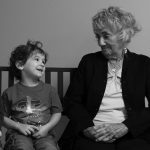
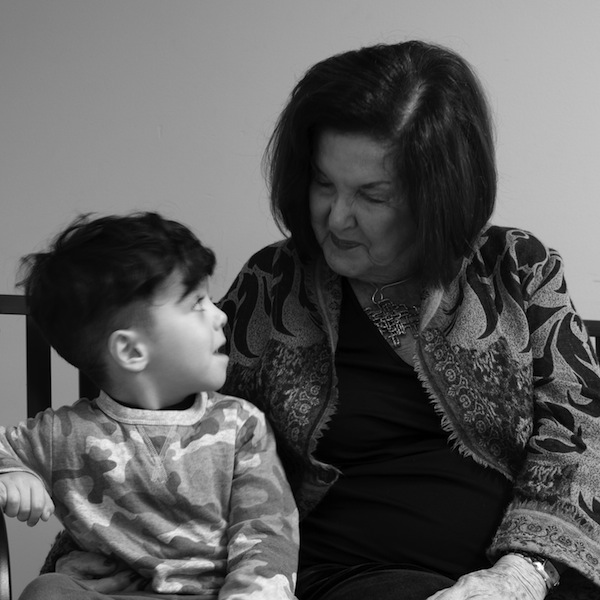
Isabella: What do you do that makes you very happy?
Connor: I like to play with my mommy.
Isabella: Well, if you find something that makes you happy, that’s what you should do.
(photo by Jocelyne Hallé)
***
As part of the Jewish Community Centre of Greater Vancouver’s celebration of its 90th birthday, the centre brought together its members who are age 90 and better with children from the Karen and Gary Simkin Family Child Development Centre Preschool.
Preschool director Jennifer Trickett and her staff helped the children create and practise questions that they were curious about to ask the seniors. Questions covered such topics as “What games did you like to play when you were a kid?” and “Do you get hugs from your children?” The children also sang songs.
In addition to being interviewed by the children, the JCC members enjoyed a complementary brunch, and free portraits courtesy of Jocelyne Hallé of Jocelyne Hallé Photography.
The JCC has 25 members who are age 90 and over, most of whom are at the centre multiple times a week to exercise, socialize, learn and play. For more information about special membership pricing for adults age 65-plus, contact membership director Alexis Doctor at 604-257-5111.
***
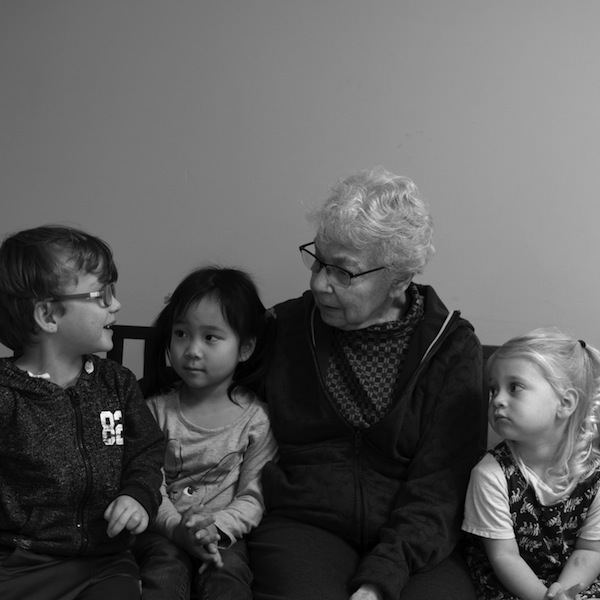
Gloria: Where do you live?
Joyce: I live in a condominium.
Gloria: Well, I live in Vancouver.
Joyce: Me, too.
Shiloh: Do you come here in the car?
Joyce: I came in a car today. My daughter drove me.
Shiloh: My mommy drove me!
Asher: Do you live in space?
Joyce: Sometimes I think I do! But, mostly in Vancouver.
(photo by Jocelyne Hallé)
***
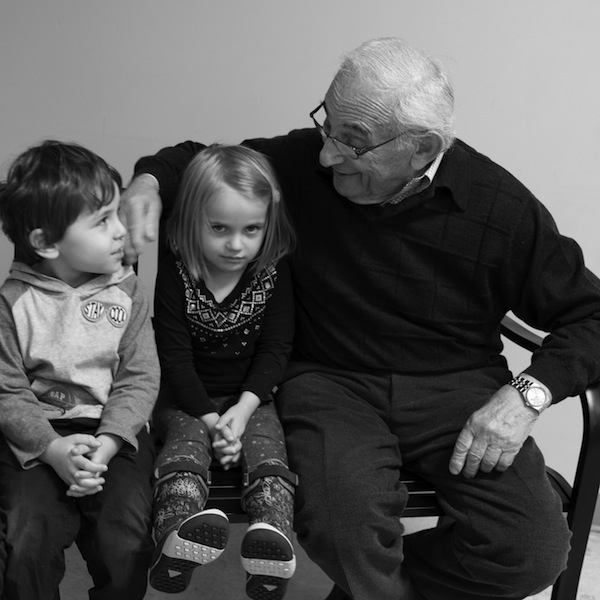
Sam: Do you ever hug your grandchildren?
Danny: Yes, very big ones, they’re even kissing me, too.
(photo by Jocelyne Hallé)
***
Milo: What did you like to play when you were little?
Left to right: Inbal Krayes, Morris Kahn, Sylvan Adams and Dr. Ido Anteby at the Israel Aerospace Industries facility in Yehud, Israel. (photo from SpaceIL)
On Nov. 19, SpaceIL announced that Canadian billionaire and businessman Sylvan Adams, who brought the Giro d’Italia Big Start cycling race to Israel this year, joined the project to land the first Israeli spacecraft on the moon and contributed $5 million to the organization.
Adams announced his contribution as part of a special tour that took place at the Israel Aerospace Industries (IAI) MBT Space facility in Yehud, where the spacecraft is being assembled. Also attending the tour were SpaceIL’s president Morris Kahn, SpaceIL chief executive officer Dr. Ido Anteby and other senior IAI officials, including IAI vice-president of space operations Inbal Krayes.
Adams, who was celebrating his 60th birthday, said at the event that “this contribution to strengthening the Israeli space program, and encouraging education for excellence and innovation among the younger generation in Israel, is the best gift I could have asked for.”
He added: “I believe that sending the first Israeli spacecraft to the moon will inspire Israeli schoolchildren to take up STEM studies and think about space exploration, and especially to believe that everything is possible.”
Since SpaceIL’s establishment in 2011, the mission of landing an Israeli spacecraft on the moon has become a national project embodying educational values. Adams joins a group of donors who have contributed to the project, including Dr. Miriam and Sheldon Adelson, Sammy Sagol, Lynn Schusterman, Steven Grand and others.
Kahn, a businessman and philanthropist, took it upon himself to lead the project and bring it to its completion, donating $27 million and serving as the project’s president. He regards its completion as his personal mission.
“We are in the final stretch,” said Kahn, “and I believe that his [Adams] joining will help us raise the remaining money to complete our ambitious mission.”
“The teams of SpaceIL and IAI are making great progress in a series of tests and trials being carried out at IAI’s space facility,” Anteby said. “At the same time, we are stepping up activities to promote scientific and technological education in the state of Israel, ahead of launch.”
In October, SpaceIL and the Israeli Space Agency announced a collaboration with NASA that would enable SpaceIL to improve its ability to track and communicate with the spacecraft before, during and after landing on the moon.
IAI, which is the home of Israel’s space activity, has been a full partner in this project from its inception. Over the years, additional partners from Israel’s private sector, the Israeli government and from academia have joined as well. The most prominent among these are the Weizmann Institute of Science; Israel Space Agency; the Ministry of Science, Technology and Space; the Israeli telecom firm Bezeq, and others.
The same week of Adams’ donation, Ofir Akunis, Israel’s minister of science, technology and space, visited the IAI facility where the spacecraft is being built, after the ministry announced an additional NIS 7.5 million ($2.66 million Cdn) in support for the project.
“The moon mission is one of great national pride. There is a short time before the spacecraft’s launch, and I have no doubt all Israelis will feel great joy when the spacecraft blasts off,” Akunis said. “I am a great believer that the landing will be one of the highlights in the history of the state of Israel, and the educational activity we are doing around the mission sets the foundation for engineers who will work in the field of space and science in the next decade.”
SpaceIL was the only Israeli contestant in the international Google Lunar XPRIZE competition. To win the first prize of $20 million, the participants were required to land an unmanned spacecraft on the moon. The competition ended officially with no winner on March 31, when Google announced that it would no longer sponsor the competition.
After succeeding in raising the critical funds to continue its activity, SpaceIL announced that it was determined to continue on its mission and to launch its spacecraft, regardless of the competition. Concurrently, the nonprofit is continuing its efforts to raise the funds necessary to complete this mission.
SpaceIL aims to set in motion an “Apollo effect” in Israel: to encourage the next generation of Israeli children to choose to study science, technology, engineering and mathematics (STEM) and to change their perception of these subjects; to generate a sense of capability, and to allow them to dream big dreams even in a small country.
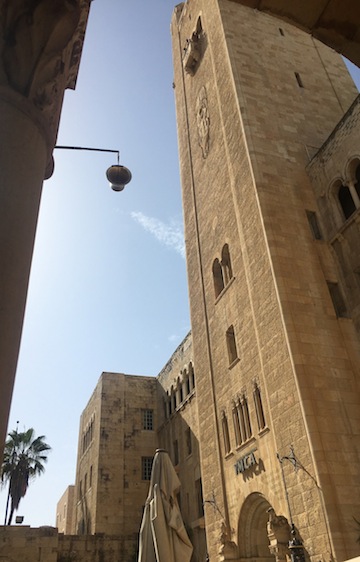
The new bell being lifted to the top of the YMCA tower in Jerusalem. (photo by Ashernet)
YMCA’s new bell. (photo by Ashernet)
Ever since the YMCA opened on King David Street in Jerusalem in 1933, the building, designed by Arthur Lewis Harman (of New York’s Empire State Building fame), has been a famous landmark; in particular, its iconic tower has been part of the city’s landscape. The tower contained a carillon of 35 bells made by the British bell foundry Gillett & Johnston in the early 1930s. It is the only carillon in the Middle East, but there was one note – in other words, a bell – missing from it. A recent anonymous donation made it possible for the YMCA to order the missing bell from the Royal Eijsbouts foundry in the Netherlands and, in a precisely managed operation earlier this week, a large crane raised and placed the new, 36th, bell into its place in the tower.
חברמפלגתהדמוקרטיתהחדשהצ‘רליאנגוס: “פייסבוקאיבדואתהאמונהמצדהקהילההבינלאומית.” (צילום: Marc DeMouy)
הוועדה הבינלאומית למאבק במידע מוטעה התכנסה לאחרונה בלונדון לדון בהתנהלות העסקית של פייסבוק, לאור מחדליה הרבים בתחום אבטחת מידע ופרסום מידע מוטעה בבחירות בארה”ב ובמקרים רבים נוספים. בוועדה חברות תשע המדינות הבאות: קנדה, בריטניה, צרפת, בלגיה, אירלנד, ברזיל, ארגנטינה, לטביה וסינגפור. יצויין כי לוועדה אין שום סמכות להטיל קנסות, סנקציות או עונשים, אך פעילותה מראה שיתוף פעולה בינלאומי נדיר, מול ההתנהלות הכושלת של פייסבוק. רבים רואים בכך תמרור עצור נוסף לחברה האמריקנית שמעשיה נבחנים היטב היטב כיום.
חברי הוועדה כעסו מאוד שמייסד פייסבוק והמנכ”ל מארק צוקברג, בחר שלא להופיע בפניהם לדיון המיוחד – מה שמראה עד כמה הוא מעדיף שלא לענות ישירות על שאלות קשות, הקשורות במישרין ובעקיפין בהתנהלות של פייסבוק, המעוררת ביקורת הולכת וגוברת ברחבי העולם. לאור כך שלא הגיע לדיון, אמר חבר בוועדה, נציג המפלגה הליברלית הקנדית נתניאל ארסקין-סמית: “זה מאוד מצער שצוקרברג לא נמצא כאן היום איתנו. אני חושב זה מלמד יותר מכל על אי קבלת האחריות מצידה של חברת פייסבוק ומנהליה. פייסבוק מאבדת את האמון של רבים”.
מבקריה הרבים של פייסבוק מציעים לחברה – מפעילת האתר החברתי הפופולרי בעולם שלא לסמוך יותר מדי על העובדה, שכשני מיליארד איש מחוברים אליו. אם פייסבוק תמשיך לתנהל כמו שהיא מתנהלת עד כה, רבים יתנתקו מהאתר שלה. כך הם חוזים.
במקומו של צוקרברג הופיע בפני הוועדה סגן הנשיא של פייסבוק לתחום המדיניות ריצ’רד אלן. במשך למעלה משלוש שעות הוא נחקר וענה על שאלות קשות וספיציפיות של חברי הוועדה. הם אמרו לו במפורש כי לפייסבוק יש כיום השפעה מאוד שלילית על ההליכים במדינות דמוקרטיות. החברים ציינו כי פייסבוק לוקחת כיום חלק פעיל בהפצת מידע חדשותי מוטעה (ראה את פרשת הבחירות האחרונות בארה”ב בהן ניצח דונאלד טראמפ את הילרי קלינטון. לדעת רבים פייסבוק עזר רבות לקמפיין של טראמפ בהפצת מידע כוזב נגד קלינטון, שהגיע מכיוון הרוסים). בנוסף החברה עושה שימוש רב במידע רגיש מאוד של המשתמשים הרבים של פייסבוק. החברים בוועדה הדגישו כי הגיע הזמן שפייסבוק תתן דין וחשבון על מעשיה ומחדליה הרבים. כך אי אפשר להמשיך. חלק מהם שאלו האם אי פעם הגבילה פייסבוק את הגישה של מפתחי האפליקציות השונות להשגת מידע על המשתמשים הרבים אם הם רכשו אצלה פרסום בפלטפורמת המובייל. אלן אמר מצידו כי פייסבוק לא נוהגת ולא נהגה לבצע עסקות חליפין שכאלה. הוא הוסיף עוד שפייסבוק מבינה היטב את הצורך בהנהגת רגולציה חדשה. אלן: “אכן פגענו באמון הציבור שלנו לאור מספר פעולות שעשינו. החמצנו מספר דברים והגבנו באיחור לבעיות שנוצרו”.
עם סיום הדיונים בלונדון אמר הנציג נוסף של קנדה בוועדה הבינלאומית, חבר המפלגה הדמוקרטית החדשה צ’רלי אנגוס: “פייסבוק איבדו את האמונה מצד הקהילה הבנלאומית”. חבר אחר בוועדה אמר כי הגיע הזמן להפעיל סנקציות קשות נגד פייסבוק ואף לפרק את החברה, המחזיקה בין היתר גם בוואטסאפ ואינסטגרם.
מי שכינס את הדיון המיוחד, חבר הפרלמנט הבריטי דמיאן קולינס, ציין כי לידיו גיעו מסמכים פנימיים של פייסבוק כולל אימיילים (משנת 2014), מהם עולה כי כבר אז נשאלו השאלות כיצד החברה העניקה לרוסים את הפלטפורמה שלה. כאמור הנושא הרוסי רגיש מאוד לעניין החקירות נגד הקמפיין של טראמפ, לאור מעורבותו כביכול בהשפעה על תוצאות הבחירות בארה”ב.
The University of Manitoba is now accepting applications for its interdisciplinary master’s degree in human rights. (screenshot)
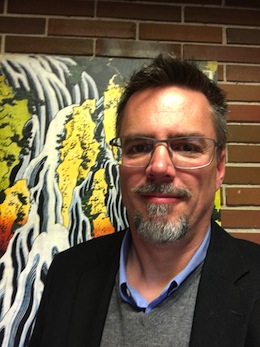
The first interdisciplinary human rights graduate degree program in Canada will be starting soon, spearheaded by the director of peace and conflict studies at the University of Manitoba, Dr. Adam Muller, who helped design it.
The new degree will be the first of its kind in the country. Offered by the faculty of law at the U of M, it will train students for careers in human rights work in collaboration with the university’s faculties of arts, education and social work, as well as the Centre for Human Rights Research. Up until now, students wanting an interdisciplinary education in human rights law, theory and qualitative research methods had to go to the United States or Europe.
“We’re going to be training generations of students to serve domestically and abroad in a way that’s deeply inflected by rights, culture and ideas of dignity and social justice that, I think, in some ways, is uniquely Canadian and importantly Canadian,” Muller told the Independent.
“It’s worth noting that, when South Africa transitioned from an apartheid to a post-apartheid state, and they needed to rewrite their constitution, and particularly their charter of rights and freedoms, they drew upon the Canadian model and used Canadian jurists to assist in that drafting process.”
Dr. Adam Muller spearheaded the new human rights program. (photo from Adam Muller)
Muller spent the first nine years of his life in South Africa. His family emigrated from there in the late 1970s in the wake of the Soweto Uprising, for political and other reasons. In addition to his position at the U of M, he is also the first vice-president of the International Association of Genocide Scholars.
Most of his work is about representations by artists of mass violence and atrocity, said Mueller. “So, I’m particularly interested in photographers, but also painters, musicians … people who try to give shape to unimaginable violence with the view of educating people about it.”
While there are other master’s of human rights programs in Canada, this is the first interdisciplinary master of human rights program in the country, said Muller.
The program will be housed in the faculty of law for a number of reasons, he said, the main one being that the language of human rights is first and foremost a legal language.
While other aspects of the program will look at the philosophical, sociological and anthropological discourses, Muller said, “There are different cultural inflections on the idea of human rights, partly because of the [perspective] that human rights practitioners have – an idea of a universal moral subject, which is complicated when you look at it anthropologically. Not all communities around the world share the same moral presuppositions, so those differences matter in terms of the understanding of global rights culture.”
While students will be encouraged to be human rights champions and advocates, the aim is that they not be so in a naïve way. “We want them to actually understand that human rights can be seen by other people as potentially unwelcome, super-impositions of a Western frame of reference over indigenous ways of thinking about the relationship with a person to the group,” said Muller.
In learning about what happened in genocides such as the Holocaust, students in the program will also be taught the continuing implications. For example, Muller wants the master’s students to go into the German studies class and learn, not just about the Holocaust, but about why it still matters in the German context today.
One of the unique aspects of this interdisciplinary program is that the courses available to students will vary from year to year, depending on what is being offered by the different faculties that have agreed to open up their classes to MHR students.
“We expect there to be, for example, considerable coverage of indigenous issues, just because there is a lot of that kind of work going on at the U of M,” said Muller. “We fully expect the MHR students to be both interested in and to become cognizant of the kind of debates surrounding human rights and indigenous people in the Americas.
“What we have is, I think, a healthy elasticity, in terms of the actual curriculum of the program,” he said. “So, there are three required courses, and then three courses students will be able to select from a vast range of options made available.”
Applications are now being accepted through the Centre for Human Rights Research at the U of M for admission in September 2019. It is not a prerequisite to have a degree in human rights.
Since the goal is to train students to become human rights professionals, the program will offer a practicum component for those students who prefer a hands-on approach.
Belle Jarniewski, who recently took on the role of executive director of the Jewish Heritage Centre of Western Canada and is probably most known for her work at the Holocaust Education Centre, which is an integral element of the JHCWC, is one of the scholars who was asked to review the MHR program proposal.
Belle Jarniewski of the Jewish Heritage Centre of Western Canada was one of the scholars who reviewed the master’s in human rights program proposal. (photo from Belle Jarniewski)
“I was quite honoured that Adam asked me to be one of the people across the country to review the proposal for the program and to submit a recommendation,” said Jarniewski. “I think that it’s very exciting to have a post-graduate human rights program offered. One of the things that I really like about it is that it really allows people to work in or concentrate on different areas of human rights.
“Certainly, I think human rights have always been important. But, in this particular time, where human rights are being abused in so many different countries, and where the mere understanding of what human rights are is being clouded, I think that a program such as this, that will produce scholars in this area, is of extreme importance.”
Jarniewski said Winnipeg is the perfect place to host such a program, with the Canadian Museum for Human Rights being in the city.
“Winnipeggers don’t fully appreciate the importance of it,” said Jarniewski. “When I go overseas, this museum has put us on the map. I think it’s just a logical city to host such a program, given that we have this wonderful museum, and our ability to access it for research purposes, as well as the ongoing work that they do in hosting lectures.
“I’m thrilled that this is happening, that it’s happening in Winnipeg, and that Winnipeg is taking on an important role in the area of human rights.”
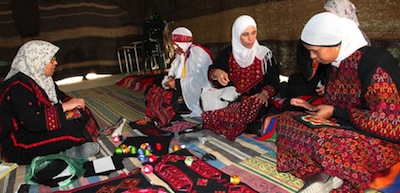
In Lakia, Israel, there are 160 women throughout the village who are responsible for designing and developing embroidery materials. (photo from Michelle Sitbon)
Our trip took us to the southern part of Israel, where we traveled to Beersheva. There is a small sign along the way, that you can miss quite easily, and it says Lakia. Lakia is one of the many Bedouin villages in this part of the country.
The Bedouins are a group of nomadic tribes who have lived in the Negev Desert for hundreds of years. Their heritage can be traced back to the traders along the ancient Spice Route, which happened to cross this region. Most traditional Bedouin hospitality experiences include camel riding, Bedouin food and staying inside a Bedouin tent overnight. However, in the village of Lakia, you are probably not going to find any of those things.
When you stop there, you are in for quite a different and unexpected experience. We arrived in Lakia in the middle of a hot summer day at the end of July and our main goal was to visit the Desert Embroidery. As we drove along the unpaved roads of the village, we quickly realized that Lakia might be small, but the Embroidery was extremely difficult to find. There was no sign telling us which direction to go, even though it is a tourist attraction.
When we finally found our destination, we got out of our vehicle and were warmly welcomed by Naama Al-Sana. She is the Bedouin woman who today runs the Desert Embroidery, and also founded the place together with other women from the community in 1996.
As we entered the visitor centre, we saw a display of beautiful art that was recently made by the local women. These women create the art in their homes in between their chores, and they use the money they earn from it to help support their families.
We were invited to sit inside a beautiful and colourful hand-woven tent, while Al-Sana offered us traditional Bedouin coffee that was scented with local spices. She was excited to hear that we had come all the way from Vancouver, as she has a sister who is currently in Canada, studying at the University of Toronto. Her sister often gives lectures about women in the Bedouin society, as a way to keep the history of this region alive.
The Desert Embroidery doesn’t offer the typical Bedouin tent experience, which includes being served a traditional meal. Instead, you will have the chance to contribute to the empowerment of Bedouin women in your own way. When you participate in one of the workshops or purchase any of their artwork, you will be actively improving the life, health and education of Bedouin women.
The Desert Embroidery was known as the Association for the Improvement of the Status of Women when it first began. The business has grown tremendously over the years and there are now 160 women throughout the village who are responsible for designing and developing embroidery materials. They also provide worker training and product marketing, and there is another group of women who work part-time to provide quality control checks on the products.
The system is very well organized. The women visit the Desert Embroidery twice a week to collect embroidery materials, drop off their finished items, learn about new patterns and designs, and participate in educational workshops and lectures. All of the women are allowed to choose how many hours they work, and they are paid by what they are able to produce within that time. A few of the women have chosen to preserve the traditional jewelry-making that was done by previous generations. They spent time learning how their mothers and grandmothers made jewelry and are now creating their own jewelry to include in the Desert Embroidery collection.
With the help of the Desert Embroidery, Bedouin women in the Negev create the art in their homes, and use the money they earn to support their families. (photo from Michelle Sitbon)
The Desert Embroidery is continuing to achieve its goal of providing employment and income for Bedouin women while empowering them and improving their self-confidence. More than 40 different artistic products can be found on display in the visitor centre, as well as other collaborations that help generate revenues for their work. An example of one of those collaborations is with Kibbutz Gan Masarik, which assists with strengthening the coexistence of Bedouin and Israelis.
The Desert Embroidery is also currently involved in improving the education and health of Bedouin children. And they want to expand to other Bedouin communities within the Negev, so that all Bedouin women can achieve economic independence. There are still so many challenges that women face in Bedouin society and this group is trying to help every woman overcome them.
The main reason I chose to visit Lakia was that I wanted to learn about this destination and the work that the Desert Embroidery is doing. My goal is to share what I have learned and to take other travelers to Lakia, so that they can see it firsthand. Of course, such activities aren’t only being done in the Negev region. In the northern part of the country, in the Galilee region, Israeli and Arab women also create traditional artwork to create a change in the lives of women.
I have made a visit to Lakia part of my itinerary in an upcoming small group tour to Israel, because I believe that travel can support and strengthen local communities. Since I am a travel agent who creates itineraries that are art-oriented, this is a perfect way to show everyone that they can appreciate art while making a difference in both children’s and women’s lives.
In the Mishnah Torah, Rambam organized the different levels of tzedakah, or charity, into a list from the least to the most honourable. Sometimes it is known as the “Ladder of Tzedakah.” The highest form of charity is to help sustain a person before they become impoverished, by offering a substantial gift in a dignified manner, by extending a suitable loan or by helping them find employment or establish themselves in business. These forms of giving allow the individual to not have to rely on others.
Projects such as those led by the Desert Embroidery can be found around the globe in places like Jordan, Mexico and Canada. When we travel, we know the many ways in which we benefit. However, I believe we should also try to find ways to benefit others as we travel, even in small ways. We should become more involved with local communities and support them in respectful ways that will, among other things, help them preserve their tradition and art.
Michelle Sitbon is an art travel adviser who organizes small group tours to Israel among other art-related destinations around world. For more information, visit yourartvoyage.com.
Vancouver’s Dr. Carol Herbert, professor emerita of family medicine and adjunct research professor of pathology at Western University, was awarded an honorary doctor of science, honoris causa (DSc), at the Oct. 24 afternoon session of Western University’s 312th convocation. Herbert served as dean of the Schulich School of Medicine and Dentistry from 1999 to 2010. A pioneer in developing services for sexually assaulted adults and children in British Columbia, she was co-founder and co-director of the Sexual Assault Service for Vancouver from 1982 to 1988.
She spoke to graduates at the convocation, asking them to keep in mind one acronym: PROP (privilege, responsibility, opportunity and passion).
“Acknowledge your privilege. While you have been diligent in your studies, the fact that you and I are here today is evidence of our privilege,” she said.
With privilege, there is a responsibility to give back, she added. Graduates must reflect on what they have been given and remember to pay it forward and embrace opportunities to help others. “Be as passionate about ensuring the success of others as you are about yourself. Start small, but start contributing to your community.”
Herbert reminded graduates of the difficulties women in science continue to face today. “I want to encourage women scientists to hang in there,” she said, to juggle a career and family, to look for workplaces that support them and their complex lives, and to seek mentors. She encouraged all to work towards a level playing field in which women have equal opportunities.
Vancouverite Deborah Katz has won the 2018 Vine Award in the category of children’s literature. Of Rare is Everywhere (Miss Bird Books), which Katz wrote and illustrated, the award jury said, “Fun, exciting and such a different take on difference and diversity for our small children.”
The Vine Awards honour the best Canadian Jewish writers and Canadian authors who deal with Jewish subjects in four categories – fiction, non-fiction, history and children’s/young adult literature – each with a prize of $10,000. The 2018 jurors – Beverley Chalmers, Joseph Kertes and Lee Maracle – reviewed 59 entries this year.
The Koffler Centre of the Arts announced the 2018 winners at an awards lunch at the Windsor Arms Hotel in Toronto. The other winners were Laurie Gelman for Class Mom (Henry Holt and Co.) in the fiction category, Julija Šukys for Siberian Exile: Blood, War and a Granddaughter’s Reckoning (University of Nebraska Press) in the non-fiction category and Hugues Théorêt for The Blue Shirts: Adrien Arcand and Fascist Anti-Semitism in Canada (University of Ottawa Press) in the history category.
***
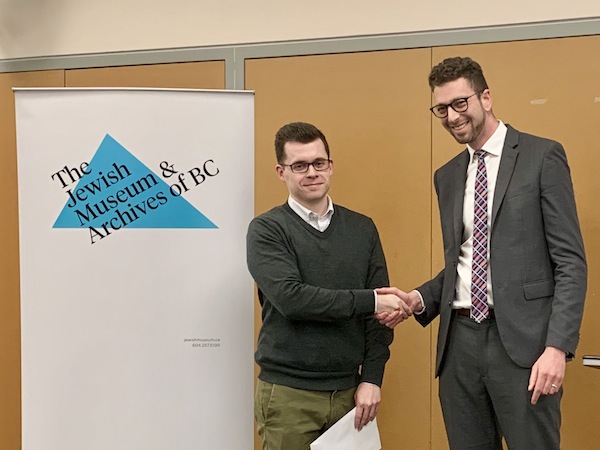
Nathan Lucky, left, and the Jewish Museum’s Michael Schwartz. (photo from JMABC)
The Jewish Museum and Archives of British Columbia awarded the inaugural B.C. Jewish History Research Prize to Nathan Lucky, for his article “British Columbia newspaper responses to Jewish persecution in Europe, 1938-1939: A call for refugees and a cause for civilization.”
This undergraduate essay explores relations between the Jewish community press and the mainstream press in British Columbia. It demonstrates the ways in which Jews in the province were alert to world affairs and worked to impact Canadian policies of immigration in response to unfolding tragedy abroad. Juxtaposing reporting and editorials published by the Jewish Western Bulletin (the predecessor of the Jewish Independent) with those of contemporary non-Jewish publications, the author documents the shifting waves of public discourse as new information arrived from Germany and Austria. The article makes substantial use of the B.C. Jewish Community Archives, particularly the Jewish Western Bulletin Collection, and it demonstrates how future scholars might also incorporate the collection, and the archives more broadly, into their research.
The prize was awarded on Nov. 21 at the annual general meeting of the Jewish Historical Society of British Columbia. Following the AGM, guests gathered to hear a lecture by Lucky, summarizing his research. This award and lecture will be an annual tradition of the JMABC in the coming years.
***
Breanne Harmon (photo by David Cooper)
Breanne Harmon (née Jackson) has been appointed general manager of Green Thumb Theatre, which has been bringing live theatre to young audiences for 40 years. Before taking on the role of general manager at Green Thumb, Harmon worked as the tour and education manager for two years.
Born and raised in Richmond, Harmon has trained and worked in theatre for most of her life. She graduated with honours from the University of British Columbia with a bachelor of fine arts in theatre production/design, where she was the recipient of the Norman Young Scholarship for Theatre and the Dean of Arts Scholarship, while also completing the fine arts program in visual arts at Langara College. At UBC, she was a member of the Jewish Students Association at Vancouver Hillel and sat on the Hillel board as alumni representative after graduation.
Harmon has worked as a stage manager, production manager and arts administrator for various companies across Canada, including the Shaw Festival, Arts Club Theatre Company, National Arts Centre, and Chemainus Theatre Festival, among many others. She has sat on the Jessie Richardson Theatre Awards Society board, the GVPTA’s Theatre Engagement Project Steering Committee, the Jessie Richardson Theatre for Young Audiences and Large Theatre juries and was a stage management mentor with the Cultch’s Ignite program.
She is also the very proud mother to her 1-year-old son.
Students in grades 6 and 7 hand out sandwiches on the Downtown Eastside Nov. 15. (photo from RJDS)
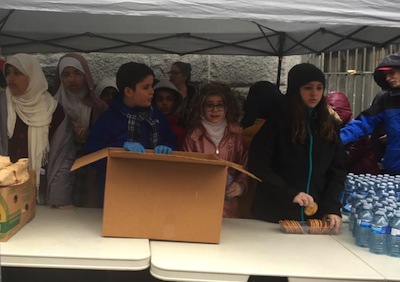
On Nov. 15, 60 students from Richmond Jewish Day School and Az-Zahraa Islamic Academy went to the Downtown Eastside to meet the people in the neighbourhood and hand out food that had been prepared earlier.
Students in grades 6 and 7 hand out sandwiches on the Downtown Eastside Nov. 15. (photo from RJDS)
“The students, staff and administration of Richmond Jewish Day School have always been committed to doing what we can to improve the lives of those less fortunate among us,” said Reesa Pawer, student life coordinator at RJDS. “One of the ways we have done this is by actively participating in a week of Random Acts of Chesed.”
As part of Random Acts of Chesed Week, Grade 6 and Grade 7 RJDS students worked together with their neighbour school, Az-Zahraa, to put together 700 bags of food and more than 500 sandwiches.
Prof. Mark Eidelman, director of the pediatric orthopedics unit at Rambam’s Ruth Rappaport Children’s Hospital, second from the left, with African colleagues at the Black Lion Hospital in Addis Ababa. (photo from Rambam Medical Centre)
Dozens of doctors from Ethiopia and neighbouring countries recently participated in a practical course, the first of its kind, which trained them to fix pediatric orthopedic deformities. The course, held for the first time in Africa, was led by Prof. Mark Eidelman, director of the pediatric orthopedics unit at Rambam’s Ruth Rappaport Children’s Hospital.
Fifty doctors participated in the four-day course. Some of them had already completed their internships, while others were still interns. They attended lectures about different treatment types, attended workshops and participated in surgeries. The Black Lion Hospital in Addis Ababa, Ethiopia, hosted the course, which was sponsored by CURE International. CURE is a nonprofit organization that assists children in developing countries suffering from medical issues, in cooperation with POSNA, the Pediatric Orthopedics Society of North America.
The Ethiopian hospital’s pediatric orthopedic services are directed by two doctors from England who relocated to Ethiopia several years ago. The doctors created the course in order to give treatment tools to local medical teams dealing with one of the most common problems in the country.
“Against the backdrop of genetic diseases and problems, and especially since there is a great lack of knowledge, infrastructure and treatment capabilities with regard to pediatric orthopedic deformities, there are many people in Ethiopia with problems that are taken care of in other countries at much earlier stages,” said Eidelman. “In Israel, like in many other Western countries, they know how to diagnose problems … and treat them in a timely manner. This helps these patients to enjoy a higher quality of life and prevent their conditions from deteriorating. Now, for dozens of local doctors, there are tools and knowledge to help their patients.”
Joining Eidelman on this recent mission were two doctors from the United States: one who was Eidelman’s teacher, Prof. John Herzenberg, a senior doctor in the field from Baltimore; and Prof. Christof Radler, who is also renowned in his field.
According to Eidelman, the main problem in training African doctors is the difficulty of traveling to the United States to receive training there. “The institutions in Baltimore are considered the best in the field in terms of training and teaching, and the city hosts the leading conferences and courses,” he said. “Unfortunately, most of these doctors don’t manage to secure entry visas for the U.S. and, as such, are denied access to this information. This is the reason why we decided to bring the training to them. At the end of a successful course, we decided to continue with this initiative and, in the near future, I’m supposed to return to Ethiopia in order to train additional doctors.”