Born 79 years ago, in New York, to Frieda and Frank Lifshitz, immigrants from Belarus, Ralph Lifshitz, better known as Ralph Lauren, has become a universal household name.
The youngest of four siblings clothed in hand-me-downs, the fashion legend never imagined becoming a designer – he did, however, yearn to be the next Joe di Maggio or Cary Grant. His favourite pastimes were sports, listening to the radio, watching TV and movies. And it is from these influences that his dream to design clothing came.
At 16, Lifshitz switched to the name Lauren after experiencing years of ridicule. At the same time, he embraced and embellished his own sense of style, buying oversized and rugged clothing from the army surplus store because he liked how they made him feel, and had an aspect of originality. His preference for military-style clothing predated his draft to the American army, in which he served two years. It was in the army that his respect for the uniform further developed and he incorporated the style into many of his subsequent designs.
In the years that followed, Lauren began working by day for a buying company while studying at night. It was during this period that he had the idea of making ties from scraps, and making and selling his unconventional ties turned into a profitable side business.
While working for men’s fashion house Brooks Brothers, Lauren tried to get them to sell his ties, but to no avail. Moving on to work for tie manufacturer Beau Brummell, an upscale men’s brand, Lauren’s potential started to be realized, as he acquired a “drawer” in their showroom of the Empire State Building to sell his flamboyant ties. In 1967, Lauren started the label Polo, the name reflecting his love of sports, and his creations’ international and sophisticated vibe. Lauren sewed on each label, together with his new bride, Ricky. He also made all the deliveries himself, to the likes of Neiman Marcus and Bloomingdales. During the first year, Polo made $500,000. The young Jewish boy from the Bronx’s design career was on its way.
By 1968, Lauren was making his own suits, which were, once again, offbeat; not what his colleagues were wearing. Lauren believes that fashion is all about playfulness, expressing one’s individuality and not conforming to one look. He has held this belief through his many years in the industry, and it has no doubt provided the foundation of what he has built into a multibillion-dollar empire.
Maartje Verhoef walking the Ralph Lauren spring-summer 2015 fashion show. (photo by Christopher Macsurak)
Lauren’s classic innovations include making women feel that wearing a tuxedo was sexier than a gown; turning tailored men’s shirts unisex; and transforming American folk art (patchwork) into fashionable sweaters, coats and dresses, borrowing from cowboys’ attire the rich colour of turquoise, fringed jackets and boots.
Lauren’s talents did not end at the design table. He used the platform of advertising unconventionally, working with real people, not models, in ads that covered multiple pages to tell a story through his clothing’s many different looks and fabrics. This creative approach was developed in part with photographer Bruce Weber.
Lauren has outfitted Wimbledon players, won the Coty Award for both women and men’s wear, opened the first freestanding store in Europe by an American designer, and established a home collection. Other highlights include being the costume designer for Woody Allen and Diane Keaton in the Oscar-winning movie Annie Hall, and creating a men’s and women’s fragrance in 1978 that is still emblematic. Upon receiving a lifetime achievement award in 1992, presented to him by actor Audrey Hepburn, he said, “I don’t design clothes, I design dreams.”
Ricky, Lauren’s wife of more than five decades, is one of his muses. Her elegant and natural style has been a continuous inspiration for him and it is her sense of self that he tried to emulate in his clothing designs. Together, the couple built the Ralph Lauren brand not only as a fashion domain but as a family business, operated with their two sons and daughter.
In addition to his material and creative successes are Lauren’s contributions to philanthropic causes. Among them, Lauren and cancer surgeon Dr. Harold P. Freeman founded the Ralph Lauren Centre for Cancer Care in Harlem, N.Y., in 2000, with the resources of the Polo Ralph Lauren Foundation and the Memorial Sloan Kettering Cancer Centre. The residence, care and support facility’s mission is “to fight health disparities in the community … [and] become a beacon for quality, dignity and accessibility in cancer care.”
Ariella Stein is a mother, wife and fashion maven. A Vancouverite, she has lived in both Turkey and Israel for the past 25 years.
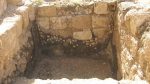
The mikvah at Herodian, which was apparently built during the Second Temple period (530 BCE and 70 CE). (photo by Deborah Rubin Fields)
The Dark Ages weren’t given their name for nothing. After the collapse of the Roman Empire, sanitation virtually disappeared. During the Dark Ages – also referred to as the Middle Ages or the medieval period – few people bathed regularly. What did they do? Those who could, or were so inclined, covered up body odour with perfume.
Progress does not always move in a forward direction – the older, classical civilizations bathed far more than did medieval Europe. In the non-Jewish ancient world, the earliest unearthed bathing and plumbing systems date back nearly 6,000 years to the Indus River Valley, in today’s Pakistan. There, archeologists excavated copper water pipes from the ruins of a palace, as well as the remains of what appears to be a superbly constructed ritual bathing pool at Mohenjo-daro. And, in a find dating 3,000 years later, archeologists found a pottery pedestal tub on the island of Crete that measured five feet long.
By instituting a practice of daily bathing, the Romans improved the general level of sanitation. Baths, moreover, functioned not just to raise the level of hygiene, but also provided opportunities to socialize, to exercise, to read and, importantly, to conduct business. From 500 BCE until 455 CE, Roman public baths were common. Moreover, privately owned Roman baths were quite luxurious, often taking up a whole room. The comprehensive sewage system of the baths consisted of lead and bronze pipes and marble fixtures.
Now, note this contrast: until the 1800s, most water pipes in the United States consisted of no more than hollowed-out trees, and the first cast-iron pipes in the United States were imported from England. Only in 1848 was a U.S. plumbing code enacted, with the passage of the National Public Health Act. In 1883, both the Standard Sanitary Manufacturing Co. (now the American Standard Co.) and the Kohler Co. began adding enamel to cast-iron bathtubs to create a smooth interior surface. Kohler advertised its first claw foot tub as a “horse trough/hog scalder [which] when furnished with four legs will serve as a bathtub.” Kohler began mass-producing these tubs, as they were recognized as having a surface that was easy to clean, thus preventing the spread of bacteria and disease.
To give additional perspective, consider this finding: after the First World War, the United States experienced a construction boom, and bathrooms were fitted with a toilet, sink and bathtub – but, even in 1921, only one percent of American homes had indoor plumbing.
Since antiquity, Jews have maintained a relatively high level of sanitation, due in part to the prescribed hand-washing ritual before eating and to the religious practice surrounding the mikvah, or ritual bath. In Israel, the oldest discovered mikvah dates back to the Second Temple period, more than 2,000 years ago. In recent years, archeologists discovered Europe’s oldest mikvah – in Sicily’s ancient Syracuse, it goes back to the Byzantine period, or the fifth-century CE.
But two important questions need answering: how do we know bathing was so important and what is a mikvah? The Babylonian Talmud, Tractate Berakhot 57b, provides this insight: though anointing (oil) and bath (water) do not enter the body, the body benefits from them. Moreover, in Tractate Sanhedrin 17b, we learn that scholars were forbidden from residing in cities that did not have public baths.
Historically, municipalities often barred Jews from bathing in their rivers, and Christians blocked Jews from using public baths. Moreover, there was a fear that Jewish women might be molested in a general public bath. So, there was a need to construct separate facilities, and Jews built bathhouses, many with mikvot close by. Thus, Jews began to link the concept of the mikvah with physical hygiene.
Significantly, the mikvah was never a monthly substitute for a bath or shower. In fact, Jewish law calls for immersion only after one has bathed or showered. Oceans, rivers, wells and lakes, which get their water from springs, can usually serve as a mikvah. The common thread between these bodies of water is that they are natural sources. To traditional Jews, they are derived from G-d. As such, they have the ability to ritually purify.
A human-made mikvah must be built into the ground or built as an essential part of a building. There are two pools: one that contains collected rainwater and the other, the actual immersion pool, is drained and refilled regularly with tap water. The pools, however, share a common wall with a hole that permits the free flow of the water, so the immersion pool also receives rainwater.
When the Temples stood, the high priest immersed in the mikvah at prescribed times. But, today, when there is no Temple, for the Orthodox, the mikvah serves the following four functions: a woman uses the mikvah after menstruating and after giving birth; immersion in a mikvah marks the final step in converting to Judaism; before beginning to cook and eat from them, Jews use the mikvah to immerse new pots, dishes and utensils; and the mikvah is also used to prepare a Jew’s body before his or her burial. Men go to the mikvah before their wedding and before Yom Kippur, and many Chassidic men use the mikvah before each Shabbat and holiday.
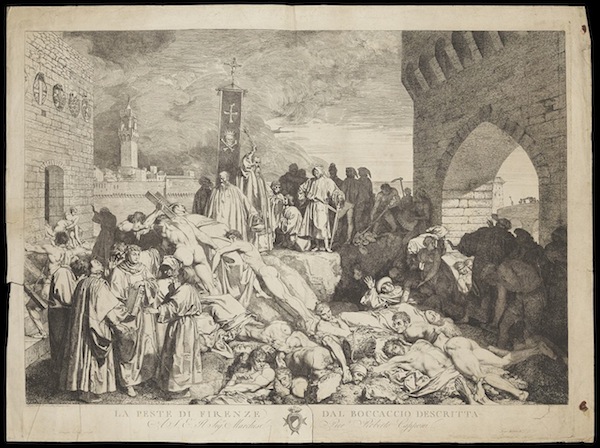
Giovanni Boccaccio’s “The plague of Florence in 1348.” (photo from wellcomecollection.org)
It is speculated that up to 60% of the general European population died of the Black Death. There are no statistics as to how many Jews died of the plague, so it is hard to actually say that Jewish bathhouses or the Jewish practice of hand washing or other sanitation prescribed by Jewish law kept Jews safer than the general medieval public. Two points, however, may be stated with certainty:
In a number of instances, European Jews were blamed for the Black Death. As a consequence, beginning in November 1348 in Germany, Jews were massacred and expelled from their homes. In February 1349, 2,000 Strasbourg Jews were murdered. Six months later, Christians wiped out the Jews of Mainz and Cologne. By 1351, 60 major and 150 smaller Jewish communities had been eliminated.
Even today, comments on the subject need to be scrutinized for possible antisemitic motives.
As for today, in the Western world, there seems to be an obsessive amount of soap bars, soap liquids, no-soap cleaners, hand wipes and wet wipes. Can one over-clean? Yes.
In an interview with Global News earlier this year, Dr. Anatoli Freiman of the Toronto Dermatology Centre explained the negative consequences of excessive showering or bathing. “The skin can dry out,” he said. “But the message is, after the shower or bath, you need to pat yourself dry and moisturize to seal it.”
Prof. David Leffell, chief of dermatological surgery at Yale School of Medicine, gives these guidelines about keeping clean. “You don’t want to do the Lady Macbeth thing, where you’re scrubbing and scrubbing,” he told businessinsider.com. “The purpose of showering is to eliminate dirt.” This can be done, he explained, in less than a few minutes by focusing on the grimier parts of the body (armpits and groin) and not overdoing it with soap elsewhere. He advised using warm, not hot, water; aiming for a three-minute shower; and moisturizing while the skin is still damp.
Deborah Rubin Fields is an Israel-based features writer. She is also the author of Take a Peek Inside: A Child’s Guide to Radiology Exams, published in English, Hebrew and Arabic.
Each Matana gift box focuses on a different vendor. (photo from thematanashop.com)
Matana, a subscription box company from Israel, has a new mission-driven brand and vision. Formerly called Blue Box, Matana, the Hebrew word for gift, signifies the mutually beneficial exchange between the artisans, whose products are included in each box, and the recipients. Since its launch, the company has delivered more than 2,000 boxes with products from dozens of Israeli small businesses.
With a mission to highlight the unique flavours and textures of Israel while giving Israeli artisans a global platform to showcase their products, Matana features a selection of one Israeli vendor’s products in each box, along with a postcard that shares the vendor’s story. Israeli vendors include small enterprises, family-run farms, kibbutzim, social initiatives and young entrepreneurs. Boxes include products that range from Shalva Tea, locally foraged teas packaged by adults with special needs; to Kuchinate baskets, which are woven by African refugee women; to Sindyanna olive oil, which is created by Jewish and Arab women working side-by-side; to Rusty’s Nut Butters and Treats, a woman-led business.
Israeli vendors include small enterprises, family-run farms, kibbutzim, social initiatives and young entrepreneurs. (photo from thematanashop.com)
“Every day, I am inspired by the ingenuity of Israel’s artisans working in nature and blending traditional with modern techniques on an ancient land,” said Matana chief executive officer Emily Berg. “Their products are handcrafted with purpose and passion, and tell the rich and multi-faceted story of Israel. We are thrilled to support Israeli artisans and, through them, to share Israel’s diverse fabric with the world.”
A Toronto native who moved to Israel in 2012, Berg developed the idea for Matana when her then-boyfriend, now husband, was called to serve in reserve duty in Gaza in Operation Protective Edge in 2014. During the tense time, Berg wanted to find a way to showcase Israel’s many sides to a global audience while supporting Israel’s artisans, whose businesses suffered during the conflict.
“My fiancé was called to reserve duty and was basically gone from the first until the 40th and final day,” Berg told the Independent in an interview in 2016. “It was a very quiet period. People were not going out much. And, it was the first time I was able to really reflect on my life, purpose and future here.”
The company was initially called Blue Box as a tribute to the Jewish National Fund’s blue-and-white tzedakah box that she’s known since childhood. (See jewishindependent.ca/jnf-inspires-entrepreneur.)
Due to the business’s success and the high demand for the boxes, the company has transformed from a one-woman show operated out of Berg’s own Tel Aviv-Jaffa living room to include new partners Elad and Maya Borkow, who run the logistics department from a warehouse in Ramat HaSharon.
Matana (thematanashop.com) offers several subscription options, including a new seasonal quarterly box that features products from several different vendors. The next shipment is scheduled for Dec. 12.
עמותת ידידות טורונטו תומכת בסטודנטים מהמגזר החרדי בישראל ומעניקה להם מלגות בשווי של עד שלושה עשר אלף ש”ח. המלגות מיועדות לסטודנטים חרדים בגילאי 20-40 שנמצאים בשנה הראשונה של התואר הראשון. תאריך הגשת הבקשות יסתיים ב-5 בחודש דצמבר, מספר המקומות מוגבל ואין צורך בשום פעילות חברתית התנדבותית לקבלת המלגה. התשובות יוענקו לסטודנטים שהגישו את הבקשות למלגות לפי מצבם הסוציו- אקונומי.
עמותת ידידות טורונטו עוזרת במלגות לסטודנטים חרדים כדי “ליצור אליטה אקדמית מקצועית רחבה באיכות ובכמות, התורמת רווחתה הכלכלית של החברה החרדית ולפיתוחה של הכלכלה הישראלית”. המלגות מיועדות לגברים ונשים המעוניינים לרכוש תואר אקדמי במוסדות המובילים להשכלה גבוהה בישראל. זאת כדי להעניק “מעטפת תמיכה וליווי במסלול הלימודים האקדמי, החל בשלבי ההכוונה ובחירת תחום הלימודים, ועד להשתלבות מיטבית בשוק התעסוקה”. תכנית החרדים באקדמיה פועלת ליצירת מסלולי לימודים ייחודיים ובעלי ישימות תעסוקתית גבוהה לחרדים.
תוכנית חרדים באקדמיה פועלת מזה שש שנים ובוגריה השתלבו בהצלחה בשוק התעסוקה המקומי. המלגות מיועדות לסטודנטים הלומדים בכל אחד מהמוסדות האקדמיים המוכרים בישראל (ומתוקצבים על ידי המוסדות להשכלה גבוהה). היקף המלגות נע בין ששת אלפים ש”ח ועד שלושה עשר אלף ש”ח. בין התנאים המקדימים להגשת הבקשות למלגות: על המועמדים להיות בגילאים המתאימים, להציג תחום הלימודים הנחשב לפורץ דרך (כמו חרדים לרפואה וחרדים לפסכולוגיה), עליהם להיות בעלי רצון ומוטיבציה גבוהה לקבל ליווי בתחום פיתוח הקריירה.
לפרוייקט תוכנית חרדים באקדמיה שותפים בין היתר: המשרד לפיתוח הפריפריה הנגב והגליל, אינטל, מבחר (מכללת בני ברק האקדמית), עמותת מרפא לנפש (מרכז סיוע ושיקום), אוניברסיטת בר-אילן, הלשכה המרכזית לסטטיסטיקה, המרכז האקדמי לב, האוניברסיטה הפתוחה, האוניברסיטה העברית וחברת מלאנוקס טכנולוגיות הישראלית (המתמחה בפיתוח ייצור של מוצרים ורכיבים למערכות תקשורת).
עמותת ידידות טורונטו (מיסודה של קרן פרידברג הקנדית) פועלת להעצמת אוכלוסיות מהפריפריה החברתית בישראל. תחומי העניין העיקריים של העמותה הם: ילדים, נוער וצעירים בסיכון, חילוץ מעוני של אוכלוסיות חלשות וטיפול רגשי, זהות יהודית, שיפור תדמית ישראל בעולם, חינוך, רווחה, בריאות ורפואה. העמותה מפקחת כיום על יותר ממאה ועשרים פרויקטים שונים.
קרן פרידברג עוסקת ברווחה ובצדקה ועזרה למי שנפגעו בעימותם צבאיים בישראל. ממשרדי הקרן ממוקמים ברחוב הביי שטורונטו – שם פועלת קבוצת פרידברג המתעסקת בתחום הפיננסי. את הקרן מפעילים ומנהלים אלברט פרידברג, ננסי פרידברג ויעקב פרידברג. הקרן תורמת ועוזרת לעשרות ארגונים ופרוייקטים שונים בקנדה ובישראל. סך הכל התרומות שלה נאמד ביותר מארבעים וארבעה מיליון דולר בשנה. כ-52 אחוז מהתמיכות מיועד פרוייקטים לרווחה, כ-41 אחוז לפרויקטים לחולים ונזקקים וכ-2 אחוזים לאזורי אסון.
חברת כריית המטבעות הדיגיטליים ביטפארמס מבקשת להיסחר בבורסת טורונטו
חברת כריית המטבעות הדיגיטליים הישראלית ביטפארמס הנסחרת בבורסת ת”א, מבקשת להיסחר גם בבורסה של טורונטו. בימים אלה הוגשה טיוטת תשקיף לנציבות ניירות הערך של מחוז אונטריו – במסגרת רישום מניית החברה למסחר בבורסה של טורונטו. ביטפארמס מעוניית לחשוף את פעילותה למשקיעים נוספים מחוץ לישראל, ובשלב זה טורונטו על הקו, לאחר שרישום מניית החברה למסחר בנסד”ק של ניו יורק לא צלח.
מנכ”ל ביטפארמס אומר: “קנדה נחשבת למובילה בתחום טכנולוגיית בלוקצ’יין וכן בנושא מטבעות דיגיטליים. אנו פועלים ומנוהלים מקנדה ולכן יש לנו יתרונות פוטנציאליים להיסחר בבורסה של טורונטו. הרישום בשתי הבורסות ת”א וטורונטו יכול להביא גם להפתחת דמי הניהול ושכר הטרחה, הנובעים מתפעול ודיווח בתחומי שיפוט שונים”.
University of Ottawa’s Prof. Jan Grabowski delivered the Rudolf Vrba Memorial Lecture at the University of British Columbia Nov. 15. (photo by Pat Johnson)
Jan Grabowski, a University of Ottawa professor who is a leading scholar of the Holocaust, delivered the annual Rudolf Vrba Memorial Lecture at the University of British Columbia Nov. 15 – the same day he filed a libel suit against an organization aligned with Poland’s far-right government.
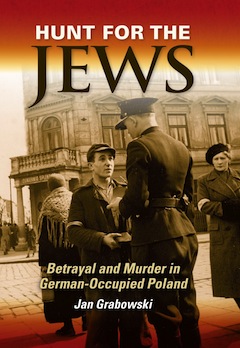
The Polish League Against Defamation, which is allied with the country’s governing Law and Justice Party, initiated a campaign against Grabowski last year, accusing him of ignoring the number of Poles who saved Jews and exaggerating the number of Jews killed by their Polish compatriots. Grabowski’s book, Hunt for the Jews: Betrayal and Murder in German-Occupied Poland, won the 2014 Yad Vashem International Book Prize for Holocaust Research. An English translation of an even more compendious multi-year analysis undertaken by a team of researchers under Grabowski’s leadership will be published next year. His Vrba lecture provided an overview of some of the findings in the new work. It is a harrowing survey that brought condemnation from Polish-Canadians in the Vancouver audience.
The new book, which does not yet have an English title, is a work of “microhistory,” Grabowski said. Holocaust studies is one of the fastest-growing fields of historical research, he said, partly because it got off to a slow start and really only picked up in the 1980s. Much of the written work being completed today is in the area of survivor memoirs, second- and third-generation experiences, including inherited trauma, and “meta-history,” the study of the study of the Holocaust.
“This assumes that we actually know what has happened,” he said. Grabowski maintains there is still much primary research to be done. “We are still far away from knowing as much as we should about this, one of the greatest tragedies in human history.”
There are millions of pages of relevant historical documentation almost completely untapped – primarily in provincial Polish archives, police records and town halls – that spell out in detail the often-enthusiastic complicity of Poles in turning on their
Jewish neighbours. By combing through these previously ignored records, Grabowski and his co-authors have amassed evidence of widespread – and eager – involvement of Polish police and other Poles in assisting Germans to identify, hunt down and murder Polish Jews.
The work has been met with official condemnation. Earlier this year, the Polish government adopted a law that would expose scholars involved in the study of the Holocaust to fines and prison terms of up to three years. The criminal component of the law, including imprisonment, was rescinded after international backlash, but the atmosphere around Holocaust inquiry in Poland remains repressive.
Grabowski said that the “explosion of right-wing extremists, xenophobia and blatant antisemitism” in Poland is related to the “undigested, unlearned and/or rejected legacy of the Holocaust” – the fact that Polish society has, by and large, refused to acknowledge the wounds of the past or to deal with its own role in the extermination of three million of its Jewish citizens between 1939 to 1945.
The concept of microhistory, which is the approach Grabowski’s team uses, is not local history, he said, “it is an attempt to follow trajectories of people.” He instructed his researchers to focus on the exact day, often hour by hour, when liquidation actions took place in hundreds of Polish shtetls and ghettoes. To do so upends a conspiracy of silence that has existed for decades.
“Why the silence?” he asked the audience. “There were three parts to the silence. One was the Jews. They were dead. They had no voice … 98.5% of Polish Jews who remained under German occupation, who never fled, died. You have a 1.5% survival rate for the Polish Jews. So, the Jews couldn’t really, after the war, ask for justice, because they were gone.”
The communist regime that dominated Poland for a half-century after the war was viewed not only as a foreign power inflicted on Poles from the Soviet Union, Grabowski said, “but, more importantly, as Jewish lackeys – that was a term that was used.
“So, it wouldn’t really stand to have trials of those accused of complicity with the Germans for murdering the Jews,” he said. “That would only confirm the widespread accusations that the communists were here doing the Jewish bidding.”
The third factor in the silence were the interests of Polish nationalists, whose ideology is inherently antisemitic, and who are the dominant political force in the country today.
Hunt for the Jews won the 2014 Yad Vashem International Book Prize for Holocaust Research.
While clearly not all Poles were collaborators, it would have been impossible for almost anyone in the country to claim ignorance of what was happening.
“Mass killing was taking place in the streets,” the professor said. Researchers found bills of sale charging city officials for the sand municipal workers needed to cover the blood on sidewalks.
“When you say that blood was running in the streets, it’s not a metaphor, it’s just a description of what really happened,” he said.
In some ghettos, as many as half the Jewish population was killed on the day of the action, with massive participation from Polish society.
“One area more, one area less,” he said. “Usually between 10 and 20% of Jews were slaughtered simply in order to frighten the remaining 80% to go to the trains, to be herded to the trains,” said Grabowski.
In Poland’s smaller communities, centuries of Jewish and Polish social, commercial and civic interactions did not result in camaraderie – on the contrary.
“The deadliest places of all [were] small shtetls, small towns, where anonymity was not available when the authorities were not far away,” he said. In one instance, a Jew in hiding heard his neighbour assure the Nazis he would return with a hatchet to help them break into the hiding place seconds before the door was axed down.
In another example, Grabowski described in minute detail the atrocities committed by Germans, Poles and Ukrainian recruits in Węgrów, a town in eastern central Poland with a Jewish population of about “10,000 starving Jews who have been terrorized for nearly three years and now the final moment has come.”
Rumours of liquidation swirled for months, as Jews fleeing neighbouring communities brought narratives of destruction. In the day or two before the liquidation, wives of Polish military and other officials rushed to their Jewish tailors, shoemakers and others craftspeople to obtain the items they knew would soon become unavailable.
“With mounting panic, people started to prepare themselves for a siege,” said Grabowski. “They built hideouts to survive the initial German fury, they started to seek out contacts on the Aryan side of the city, looking for help from former neighbours, sometimes friends and former business partners.”
On the eve of Yom Kippur in 1942, Polish officials in the town were instructed to assemble horses, wagons and volunteers. A cordon of Nazis and collaborators surrounded the city at intervals of no more than 100 metres.
The mayor of the town wrote: “Jews who woke up to the terrible news ran like mad around the city, half-naked, looking for shelter.” The same leader noted that, when the Germans demanded he produce volunteers to help with the task of rounding up their Jewish neighbours, he feared he would not be able to meet their needs.
“Before I was able to leave my office, in order to assess the situation and issue orders for the removal of the bodies,” the mayor testified, “removal of the bodies had already started. There were carts and people ready. They volunteered for the job without any pressure.”
For Jews, the Germans were to be feared, but their Polish neighbours were also a threat.
“The greatest danger was not associated with the Germans, but with the Poles,” said Grabowski. “Unlike the former, the latter could easily tell a Jew from a non-Jew by their accent, customs and physical appearance.”
Poles were rewarded with a quarter-kilo of sugar for every Jew they turned in.
“The searches were conducted with extreme brutality and violence … the streets were soon filled with crowds of Jews being driven toward the market square, which the Germans had transformed into a holding pen for thousands of ghetto inmates,” he said.
On the streets, “the cries of Jews mixed with the shouts of the Germans and the laughter of the Poles,” according to an eyewitness.
“All of this was done in a small town where everybody knows each other,” said Grabowski. “It’s not only the question of geographic proximity, it’s social proximity. These people knew each other.”
People were taking clothes, jewelry and other possessions from the dead bodies. A husband would toss a body in the air while the wife pulled off articles of clothing until what was left was a pile of naked cadavers.
“They even pulled out golden teeth with pliers,” said Grabowski. A court clerk responded defensively to accusations that the gold he was trying to sell was soaked in human blood. “I personally washed the stuff,” he protested.
The prevalence in the Polish imagination of a Jewish association with gold partly accounted for the actions.
“This betrayal, due to widespread antisemitism and hatred of the Jews, was combined with the seemingly universal conviction that Jewish gold was just waiting to be transferred to new owners,” Grabowski said. “The myth of Jewish gold was so popular and so deeply rooted among Poles that it sealed the fate of [many Jews].”
The historical records indicate many Poles saw no need to cover their collaborationist tracks. Police and others who took it upon themselves to aid the Nazis without pressure defended their actions.
One policeman, after the war, depicted the killing of Jews as a patriotic act, one that saved Polish villagers from the wrath of the Nazis, who would have learned sooner or later about Jews in hiding and who then, he claimed, would have burned down the entire village.
As efficient as the Nazi killing machine was, Grabowski contends it could not have been as effective without the enthusiastic complicity of so many in Poland and other occupied countries.
“It was their participation that, in a variety of ways, made the German system of murder as efficient as it was,” he said.
With trepidation, Grabowski and his fellow researchers followed the documents and met with people in the towns. They would review documents from a 1947 trial, for instance, then go to the village in question.
The entire village would be conscious of its war-era history, he said. And the people who are, decades later, ostracized by their neighbours are not those who collaborated in the murder of Jews.
“The person that is ostracized is the family who tried to rescue the Jews, because they broke a certain social taboo and it still visible 75 or 76 years after the fact,” he said.
“Every time I present a speech to a Polish audience, the question of Polish righteous is presented as if it is a fig leaf behind which everyone else can hide.”
In the question-and-answer session, Grabowski shut down a persistent audience member who identified as Polish and who took exception with Grabowski’s research, arguing that Poland has more Righteous Among the Nations at Yad Vashem than any other country.
“Every time I present a speech to a Polish audience, the question of Polish righteous is presented as if it is a fig leaf behind which everyone else can hide,” said Grabowski, who was born and educated in Warsaw. “The thing is, do you know how many Jews needed to be rescued? Poland had the largest Jewish community and using today Polish righteous as a universal and, let’s say, fig leaf behind which situations like I described here can be hidden is absolutely unconscionable. I protest against any attempt to overshadow the tragedy of Jewish people [with] the sacrifice of very, very few Poles.”
While Poland’s far-right government removed the mandated jail sentence for anyone found guilty of “slandering” Poland or Poles with complicity in Nazi war crimes, acknowledging the participation of Polish collaborators in the Holocaust remains a civil offence and Holocaust scholars in the country – and in Canada – face death threats and intimidation.
In introducing Grabowski, Richard Menkis, associate professor in the department of history at UBC, paid tribute to Rudolf Vrba, a Slovakian Jew who escaped Auschwitz and brought to the world inside information about the death camp, its operations and physical layout. Vrba, with fellow escapee Albert Wetzler, warned in 1944 that Hungarian Jews were about to face mass transport to the death camps. The news is credited with saving as many as 200,000 lives.
Vrba migrated to Canada and became a professor of pharmacology at UBC. He died in 2006.
The Vrba lecture alternates annually between an issue relevant to the Holocaust and an issue chosen by the pharmacology department in the faculty of medicine.
Courage in Motion 2018. (photo from Beit Halochem Canada)
More than 100 Canadian cyclists participated in the recent Courage in Motion (CIM). The fundraising ride, now in its 11th year, has grown steadily in popularity over its first decade and, this year, like many before, was sold out.
The CIM initiative of Beit Halochem Canada, Aid to Disabled Veterans of Israel, welcomed cyclists from across Canada, joined by some Americans and Israelis. From Oct. 22-26, the visiting cyclists rode alongside Israeli veterans with disabilities on four fully supported routes, taking them through southern Israel’s archeological landmarks and its landscapes.
With the fundraising drive open until Dec. 31, it is expected that Courage in Motion 2018 will raise approximately $850,000. Cyclists’ efforts enabled members of Zahal Disabled Veterans Organization/Beit Halochem to participate in the ride and will also fund programming at Beit Halochem Centres in Beer Sheva, Haifa, Jerusalem and Tel Aviv, which provide individualized therapies, specialized sports rehabilitation training and cultural arts and family-oriented programming.
Lisa Levy, an avid cyclist and national executive director of Beit Halochem Canada, is the founder of Courage in Motion. “I’m pleased that the ride was, once again, sold out,” she said. “It’s evident that our cyclists embrace the aspect of riding alongside those who are directly helped by their efforts. This year, we’re incredibly proud that more than 120 wounded Israeli veterans participated due to the fundraising by our 110 Canadian riders. We are also gratified that many of our Canadian participants feel that they get more out of the experience than the disabled veterans.”
While many cyclists return year after year, several others were new to Courage in Motion 2018. Two of these first-time participants are internationally renowned sports figures.
Toronto-born Keith Primeau was a National Hockey League centre, playing 15 seasons (1990–2005) with various teams. He co-wrote Concussed! Sports-Related Head Injuries: Prevention, Coping and Real Stories (2012) and is now based in New Jersey.
CIM also welcomed cycling champion Eon D’Ornellas. Born in Guyana and having immigrated to Canada, D’Ornellas represented both countries during his career, winning numerous medals. He has owned D’Ornellas Bike Shop in Scarborough, Ont., for 30 years and, in 2011, he suffered a stroke during a club training ride. Like Beit Halochem members, he knows the challenges in reclaiming his life after serious medical trauma.
All Courage in Motion participants enjoyed group activities following each day’s ride, including a night walking tour of Jerusalem and an evening with members of Beit Halochem, who shared their personal stories of tragedy and triumph. Next year’s CIM takes place in Israel Oct. 27–31. Registration is expected to open in March.
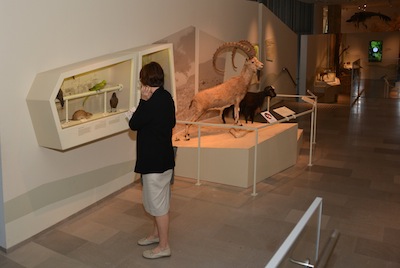
The displays at the Steinhardt Museum of Natural History educate visitors on natural history, as well as current-day environmental issues. (photos by Ashernet)
Just over a year ago, the Steinhardt Museum of Natural History opened the doors of its purpose-built structure on the campus of Tel Aviv University. The 100,000-square-foot building contains more than five-and-a-half million specimens from every corner of the world, educating visitors in every aspect of natural history.
At the same time as the museum serves to educate visitors about specific specimens, the various exhibits and presentations are a reminder of the frailty of the planet and the responsibilities of all humankind to act responsibly to preserve all the species above and below the waves. It also calls on us to try and decrease the pollution that is degrading natural life and depleting the world’s oceans and natural habitats, such as its rain forests and rivers. Israel is not free from such degradation.
It is not just the quantity of exhibits and specimens at the museum that makes it special, it is also the presentation of the material. (photo by Ashernet)
It is not just the quantity of exhibits and specimens at the museum that makes it special, it is also the presentation of the material. As well, there are dozens of friendly, informed museum staff who are only too happy to talk with visitors.
In one sense, the museum has depressing overtones. Many of the species of wildlife that once were found in the region can no longer be seen in their natural surroundings. Visitors are also reminded that fish stocks in the Mediterranean have been depleted over the past 20 years by some 50% due to pollution. In addition, the opening of the Suez Canal has meant that many species of marine life from the Red Sea have ventured into the Mediterranean, via the canal, and wreaked havoc on the Mediterranean’s natural balance.
The museum also shows the harm being caused to the environment by other human actions. For example, it highlights in various ways, including specially prepared film presentations, the danger posed by plastic waste.
The museum presents the history of a world that is unquestionably millions of years old. There are no huge prehistoric animal models exhibited, but there are clear references to the age of dinosaurs. Also, life-size models show the development of humans through the ages. Presumably not wanting to offend anyone’s religious sensibilities, the museum would nevertheless be remiss not to give some scientific explanation for the skeletal remains of both the people and animals that lived on these shores many millennia ago. It is also a sad fact that many animal species of more recent times have been eliminated – because of over-hunting or, in some cases, like the Golan vultures, being almost completely eliminated by farmers poisoning them to protect their flocks.
Throughout the museum there are many opportunities to interact with exhibits that demonstrate or define a particular aspect of nature; for example, comparing a monkey’s hand and its mobility with that of a human. All of the exhibits are clearly explained in Hebrew, Arabic and English.
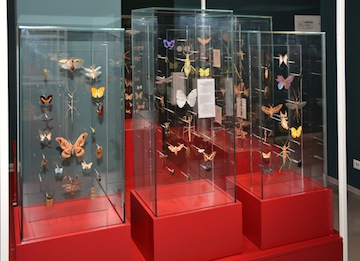
the museum has a definitive collection of live insects, which are featured in 17 terrariums, as well as almost three million insect samples. (photo by Ashernet)
In addition to the models of creatures and the animals that have been prepared by taxidermists, the museum has a definitive collection of live insects, which are featured in 17 terrariums, as well as almost three million insect samples. This is the largest collection in the museum and includes several types of insects new to science. This provides an interesting opportunity to learn about worlds to which most of us don’t have access.
Among the myriad items in the museum’s collection are those of a 19th-century German zoologist and Catholic priest, Ernst Johann Schmitz, who lived in what is now Israel. Included in the Schmitz collection is the last known bear in the region, from 1916; an Asiatic cheetah from 1911; and the last crocodile from the Taninim River in central Israel. All the species have become extinct in the country.
Nowadays, there is no active hunting of local mammals or birds – the local animals on display are animals that died in nature and have been collected by the Israel Nature and Parks Authority.
Dioramas and interactive displays are located across five floors that are connected by sloped ramps. The curators hope that the museum will increase understanding and knowledge of the natural world. Just as Israel displays its unique archeological treasures, the curators in this museum want to draw attention to Israel’s unique natural history. Despite its small area, Israel has both forests and deserts. The Dead Sea – the lowest point on earth – is within an hour-and-a-half’s drive from the Hula Valley and its collection of migrating birds.
The building of the Steinhardt Museum of Natural History, the National Centre for Biodiversity Studies at Tel Aviv University – to use its full name – was possible mainly because of a donation of some $40 million by American philanthropists Judy and Michael Steinhardt.
חוסיין עלי סומדייה :סוכן המוסד לשעבר זכה בערעור בבית המשפט – בקשתו לקבל אזרחות קנדית תידון שוב. (צילום מחוסיין עלי סומדייה)
הסוכן הכפול לשעבר של עיראק, ולאחר מכן של המוסד, חוסיין עלי סומדייה (53), שגר בהמילטון שבמחוז אונטריו ומנסה למנוע את גירושו בשנית לתוניסיה, ניצח בבית המשפט הפדרלי. בהתאם להחלטת השופט (בפסק דין שפורסם בשבוע עבר) רשויות ההגירה ידנו שוב בבקשתו לקבל אזרחות קנדית. כך שיוכל להמשיך ולגור כאן לבקשתו.
בשנת 2005 גורש סומדייה לראשונה לתוניסיה שם הוא עונה לטענתו ולבסוף הצליח לברוח שוב לקנדה. לכן הוא לא מבין כיצד השלטונות ההגירה הקנדיים כל כך נאיבים ולא מבינים מה יעלה בגורלו אם יגיע למדינה ערבית כשלהי, לאחר ששימש מרגל של המוסד הישראלי.
בשנות ה-80 סומדייה גר באנגליה ושימש סוכן כפול של מנגנון הביטחון הסודי העיראקי לשעבר (המחובראת) ולאחר מכן סוכן של המוסד. הוא יליד עיראק ומחזיק גם באזרחות של תוניס כיון שאביו נולד אביו שם. האב חוסיין סומדייה ששימש שגריר עיראק בבלגיה תחת שלטונו של העריץ סאדם חוסיין.
סומדייה שמנסה כאמור בכל כוחו למנוע מהשלטונות הקנדיים את גירושו בשנית לתוניסיה, הגיש ערעור לבית המשפט הפדרלי של קנדה. זאת, לאחר ששרותי ההגירה הפקיעו כבר את תושבות הקבע הקנדית שלו. כשהכוונה בשלב השני בעצם היא לגרשו שוב לתוניסיה. עתה כאמור התקבל הערעור שלו ורשויות ההגירה יאלצו לדון שוב בעיינו. השופט איוון רועי מציין בפסק דינו כי הליך בדיקת המקרה של סומדייה על ידי רשויות ההגירה, היה לא הוגן כלפיו ולא נתאפשר לו לטעון את כל הטענות שבידו לפני קבלת ההחלטה. ולכן התיק חוזר לדיון בפני רשויות ההגירה.
“הסוכן הכפול” סומדייה הגיע לקנדה לראשונה בשנת 1990 לאחר שברח מהשלטון העיראקי וביקש כאן מקלט מדיני. שלטונות ההגירה לא הסכימו שהוא ישאר בקנדה בטענה שיש סבירות גבוהה שבעבודתו כסוכן, חשף לא מעט אנשים למעשי עינויים ואולי אף להוצאה להורג. ובעצם מדובר לכן בפשעים שהוא ביצע נגד האנושות. לאחר שנים של הליך משפט ארוך שכלל ערעורים רבים מצדו שנדחו אחד אחרי השני, סומדייה גורש לתוניסיה בשנת 2005. לאחר כשנה הוא הצליח לברוח מתוניסיה לאלג’יריה עבר להולנד והציג לשגרירות הקנדית בהאג מסמכים מזוייפים, לבקשת מקלט מדיני בקנדה. הוענק לו דרכון חרום וכך טס הוא בחזרה לקנדה בשנת 2006. מאז ועד היום בעצם שוב עניינו נדון בבית המשפט, בזמן שרשויות ההגירה מסרבות להעניק לו תושבות קבע, לאחר שעשה שימוש במסמכים מזוייפים לחזור לקנדה.
פני כשנתיים (ב-2016) רשויות ההגירה החליטו לבדוק שוב את תיק של סומיידה, בין היתר בטענה שלא כל המידע שנמסר להם היה מדוייק. הרשויות הגיעו למסקנה שבאקלים הפולטי הנוכחי לא יעונה לו כל רע בתוניסיה, ואף אחד לא יזכור את עברו. זאת בין היתר, לאור העבודה שתוניסיה לא משמשת עוד הבסיס של הארגון לשחרור פלסטין. סומדייה לא וויתר והגיש כאמור ערעור על עמדת רשויות ההגירה. הוא ממשיך לטעון כל הזמן כי כאחד ששיתף פעולה עם ישראל נשקפת לו סכנת חיים ממשית, אם יחזור למדינה ערבית כלשהי. הוא מוסיף: “המילה המוסד היא המילה מפחידה ביותר והשנואה ביותר בעולם. כל אחד יודע שמי שקשור למדינה היהודית, יעשה לו לינץ’ על ידי ההמון ברחובות של כל עיר ערבית אליה יגיע”.
במשך כשלושים השנים האחרונות הספיק סומדייה להתחתן כבר שלוש פעמים ויש לו שלושה ילדים. הוא גם מחזיק בעסק עצמאי לשיפוצים באזור המילטון והסביבה.
On Nov. 7, members of the Kalkman family – left to right are Danielle, Victoria, Matthew, Peter and Bonnie – received the Righteous Among the Nations award from the consulate general of Israel in Toronto and Western Canada and the Canadian Society for Yad Vashem, on behalf of Dirk and Klaasje Kalkman. (photo by Rhonda Dent Photography)
One night in the Dutch village of Moordrecht, the call went out: the Nazis were doing a round-up. In a round-up, the Nazis would surround a neighbourhood and then search house by house for those they hunted: Jews, resistance fighters and others they deemed enemies. Wim Kalkman’s family rushed to prepare for their arrival: two Dutchmen who refused to work as forced labour building battlements for the Nazis were taken through a trap door under the carpet in the living room. The really dangerous guest of the family, however, was hidden in plain view. Tanta Ina, they called her, saying she was an aunt who had fled the battle zone on the coast to find refuge with the family.
Tanta Ina was not related to the Kalkmans, however. She was a Jewish woman, the widow of a Dutch-Jewish nobleman who the family had been urged to protect by Reverend Henk Post, the brother of Dutch resistance fighter Johannes Post and a fellow clergyman to Wim’s father, Dirk.
Dirk Kalkman, a pastor in the Dutch Reformed Church, and his wife Klaasje, had taken Catharina Six tot Oterleek-Kuijper in and given her a new identity. They hid her, with the help of their four children, from 1943 to 1945, at great personal risk. On that fearful night, the Nazis did not discover the two Dutchmen or Tanta Ina, who sat on the couch with the rest of the family while they were all interrogated. When a Nazi soldier asked young Wim if the family was hiding anyone, he broke into a gale of nervous laughter, which confused the Nazis, who also began laughing. Fearful of Wim’s sister, who was suffering from diphtheria, the Nazis rushed their search and left.
This was the story that was told to Wim’s son, Peter, and his grandson, Matthew, both of whom were in Vancouver Nov. 7 to receive the Righteous Among the Nations award from the consulate general of Israel in Toronto and Western Canada and the Canadian Society for Yad Vashem, on behalf of Dirk and Klaasje Kalkman.
Righteous Among the Nations are non-Jews who assisted or sheltered Jews during the Holocaust, often at the risk of great peril for themselves and families. The project was established by Yad Vashem in 1963 and to date has granted the award to more than 26,000 people. It had been Wim Kalkman’s lifelong dream to see his parents honoured for their heroism, as Matthew Kalkman told those gathered at the Rothstein Theatre for the ceremony.
After Peter Kalkman read his father’s account of that terrifying night and told the story of his grandparents’ protection of Tanta Ina, Matthew Kalkman gave an emotional speech, often through tears, about the importance of his great-grandparents’ actions to his own life. He said he had first connected with the reality of what his great-grandparents had done when he visited the Anne Frank Museum in Amsterdam.
When his grandfather Wim died in 2014, they discovered a note expressing his dying wish that Wim’s father be honoured. Matthew took up the task personally and, together with researchers in the Netherlands, was able to find definitive evidence of what happened in the Kalkman household so many years ago.
The award was given to the Kalkmans by Consul General Galit Baram on behalf of the state of Israel and by Josh Hacker on behalf of the Canadian Society for Yad Vashem. Liel Amdour, a classical guitarist born in Israel, played two pieces of music that embodied hope and rebirth, and Dr. Ilona Shulman Spaar, education director of the Vancouver Holocaust Education Centre, and Salomon Casseres, president of the Jewish Community Centre of Greater Vancouver, also spoke, as did Karen James, the chair of the Jewish Federation of Greater Vancouver board. All of the speakers touched upon the importance of remembering the heroes of the Holocaust as inspirations in the current times of resurgent nationalism, racism and xenophobia.
Casseres, who has Dutch ancestry, also stressed the relevance of the Kalkmans’ story for himself, as a descendant of Dutch Jews who survived the Holocaust. “In Hebrew,” he said, “we say kol hakavod, which means ‘all the respect.’” In Dutch, he added, “A hearty thank you for your family’s deeds of heroism.”
Matthew Gindinis a freelance journalist, writer and lecturer. He is Pacific correspondent for the CJN, writes regularly for the Forward, Tricycle and the Wisdom Daily, and has been published in Sojourners, Religion Dispatches and elsewhere. He can be found on Medium and Twitter.
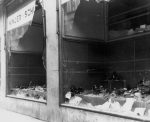
Kristallnacht, which took place 80 years ago this month, saw hundreds of synagogues burned, Jewish-owned businesses destroyed, 100 Jews murdered and 30,000 incarcerated. (photo from commons.wikimedia.org)
Kristallnacht, which took place 80 years ago this month, was the “Night of Broken Glass” that saw hundreds of synagogues burned, Jewish-owned businesses destroyed, 100 Jews murdered and 30,000 incarcerated. The state-sanctioned pogrom was staged to look like a spontaneous uprising against the Jews of Germany, annexed Austria and occupied Sudetenland. It is frequently seen as the beginning in earnest of the Holocaust. According to Prof. Chris Friedrichs, who delivered the keynote address at the annual Kristallnacht commemorative evening Nov. 8, global reaction to the attack, which took place on the night of Nov. 9-10, 1938, sent messages to both Nazis and Jews.
“The world was shocked,” said Friedrichs, professor emeritus of history at the University of British Columbia. “Newspapers in the free countries of Europe and all over the Americas reported on these events in detail. Editorials thundered against the Nazi thugs. Protests took place. Demonstrations were held. Opinion was mobilized – for a few days. But soon, Kristallnacht was no longer front-page news. What had happened was now the new normal in Germany, and the world’s attention moved elsewhere. And this is what the Nazis learned: we can do this, and more, and get away with it. Nothing will happen.
“And the Jews of Germany learned something too,” said Friedrichs, himself a son of parents who fled the Nazi regime. “By 1938, many Jews had emigrated from Germany – if they could find a country that would take them. But many others remained. Much had been taken away from them, but two things remained untouched: their houses of worship and their homes. Here, at least, one could be safe, sustained by the fellowship of other Jews and the comforts and consolations of religious faith and family life. But now, in one brutal night, these things, too, had been taken from them. Their synagogues were reduced to rubble, their shops vandalized, their homes desecrated. Nothing was safe or secure. The last lingering hopes of the Jews still living in Germany that, despite all they had suffered at the hands of the Nazis, they might at least be allowed to live quiet private lives of work and worship with family and friends, collapsed in the misery of fire, smashed glass, home invasions, mass arrests and psychological terror on Nov. 9, 1938.”
Friedrichs’ lecture followed a solemn procession of survivors of the Holocaust, who carried candles onto the bimah of Congregation Beth Israel. The evening, presented by the Vancouver Holocaust Education Centre (VHEC) and Beth Israel, was funded by the Jewish Federation of Greater Vancouver annual campaign, with support from the Robert and Marilyn Krell Endowment Fund of the VHEC and the Azrieli Foundation, which provided every attendee with a copy of Dangerous Measures, the memoir of Canadian Joseph Schwartzberg, who witnessed Kristallnacht and fled Germany with his family soon after.
“We are gathered tonight in the sanctuary of a synagogue,” said Friedrichs, who retired in June, after 45 years of teaching and researching at UBC. “A synagogue should indeed be a sanctuary, a quiet place where Jews can gather, chiefly but not only on the Sabbath, for prayer, worship and contemplation. Recent events have reminded us only too bitterly that this is not always the case.
“Our minds are full of mental images of what happened in Pittsburgh less than two weeks ago, but I invite you to call up a different mental image,” he said, taking the audience back to the time of Kristallnacht. “Think of a synagogue. Just a few days earlier, on the Sabbath, Jews had gathered there, as they have gathered in synagogues for 2,000 years, for prayer, worship and fellowship with other Jews. But now, suddenly, in the middle of the night, a firebomb is thrust through a window of the synagogue. As the window glass shatters to the floor, the firebomb ignites a piece of furniture. Within minutes the fire spreads. Soon the entire synagogue is engulfed in flames. It is an inferno. The next morning, the walls of the synagogue are still standing, but the interior is completely gutted. No worship will ever take place there again.”
Friedrichs paused to note that some in the audience would recall a similar attack that destroyed Vancouver’s Reform synagogue, Temple Sholom, on Jan. 25, 1985. He recounted the reaction of police and firefighters, civic leaders and the general public, who rallied around the Vancouver congregation at the time, and compared that with the reactions of non-Jews in Germany and the territories it controlled at the time of Kristallnacht.
“Police and firefighters are on the scene,” Friedrichs said of the situation during Kristallnacht. “But the firefighters are not there to put out the blaze. They are there only to make sure the fire does not spread to any nearby non-Jewish buildings. The police are there only to make sure no members of the congregation try to rescue anything from the building.
“The next morning, crowds of onlookers gape at the burnt-out shell of the synagogue. Some of the furnishings and ritual objects have survived the blaze, so they are dragged out to the street and a bonfire is prepared. But first, the local school principal must arrive with his pupils. Deprived of the opportunity to see the synagogue itself in flames during the night, when they were asleep, the children should at least have the satisfaction of seeing the furnishings and Jewish ritual objects go up in smoke. Most of those objects are added to the bonfire, but not all. Not the Torah scrolls – the Five Books of Moses, every single word of which, in translation, is identical to the words found in the first five books of every Christian Bible. No, the Torah scrolls are not added to the bonfire. They are dragged out to the street to be trampled on by the children, egged on by adult onlookers, while other adults rip apart the Torah covers to be taken home as souvenirs.
“And now consider this: events like this did not happen in just one town,” Friedrichs said. “The same things took place in hundreds upon hundreds of cities and towns throughout Germany and Austria, all on the very same evening and into the next morning. There were minor variations from town to town, but the basic events were exactly the same, for it was a nationwide pogrom, carefully planned in advance.”
Prof. Chris Friedrichs (photo from VHEC)
Friedrichs, who devoted 25 years to serving on the organizing committee of the Kristallnacht commemorative committee, including eight as president, reflected on the history of Holocaust remembrance in Vancouver, including the decision to single out this date as one of the primary commemorative events of the calendar.
“Why should we commemorate the Shoah at this particular time in November?” he asked. “Consider this: 91 Jewish men died on Nov. 9th and 10th, 1938. Yet, on a single day in the busy summer of 1944, up to 5,000 Jewish men, women and children might be murdered in the gas chambers of Auschwitz on one day. Why not select some random date in August 1944 and make that the occasion to recall the victims of the Shoah? Why choose Kristallnacht?”
The earliest Holocaust commemorations in the city, he said, citing the work of local scholar Barbara Schober, was an event in 1948 marking the Warsaw Ghetto Uprising.
People who had founded the Peretz School in Vancouver, in 1945, hoped to preserve the memories and values of the East European Jewish culture, which had been almost totally wiped from the map, he said. “Yet, rather than focus on the six million deaths, their intention was to honour those Jews who had actually risen up to fight the Nazi menace – the hopeless but inspiring efforts exemplified above all by the heroic resistance of the Warsaw Ghetto fighters who used the pathetically meagre supply of weapons they could find to resist the final liquidation of the ghetto by the Nazis in the spring of 1943,” said Friedrichs. “That effort failed, but it was not forgotten.”
This event continued, with the support of Canadian Jewish Congress, into the 1970s, he explained.
“There was an emerging concern that Jews should not just recall and pay tribute to the victims of the Shoah,” said Friedrichs. “The increasing visibility of the Holocaust denial movement made it apparent that Jews should also make their contribution to educating society as a whole – and especially young people – about the true history of what had happened. Prof. Robert Krell and Dr. Graham Forst undertook to establish an annual symposium at UBC at which hundreds of high school students would learn about the Holocaust from experts and, even more importantly, from hearing the first-person accounts of survivors themselves. It was in those years, too, that the Vancouver Holocaust Education Society was established to coordinate these efforts. The survivor outreach program, through which dozens of survivors of the Shoah in our community spoke and continue to speak to students about what they experienced, became the cornerstone of these educational efforts. Their talks are always different, for no two survivors ever experienced the Shoah the same way, but the ultimate object is always the same – not just to teach students what happened to the Jews of Europe between 1939 and 1945, but to reflect on the danger that racist thinking of any kind can all too easily lead to.”
But this was education, he noted, not commemoration.
“With the decline of the Warsaw Ghetto event in Vancouver, the need to commemorate the Shoah came to be filled in other ways. One of those ways was the emergence of the Vancouver Kristallnacht commemoration. The origins of this form of commemoration lie right here in the Beth Israel congregation. In the late 1970s, members of the Gottfried family who had emigrated from Austria in the Nazi era, now members of Beth Israel, proposed that their synagogue host a commemoration of Kristallnacht.”
Friedrichs spoke of the burden carried by each of the survivors who carried candles onto the bimah moments earlier.
“You might think that a candle is not very hard to carry, but, for each one of these men and women, the flame of the candle has reignited painful memories stretching back 70 or 80 years, to a dimly remembered way of life before their world collapsed,” he said. “These men and women survived, and sometimes a few of their relatives did as well, but all of them, without exception, you’ve heard this before, had family members – whether parents, grandparents, uncles, aunts, siblings, or cousins – who were murdered. One could not reproach these men and women if they had chosen to stay home on a night like this. But, instead, they are here.
“Many of these men and women have done more, even more, as well,” he continued. “For many of them have done something for years and continue to do so even now: to speak of their experiences to students in the schools of our province. To stand in front of two or three or four or five hundred students of every race and every heritage and describe life in the ghetto or the camp or on the death march or the anxiety of living in hiding and being pushed into a basement or a closet every time some unwanted visitor arrived – this is not easy. But there is a purpose. The young people of our province are barraged with images and messages and texts telling them that people of certain religions or races or heritages are inferior and unwanted members of our society. They must be told just what that kind of thinking can lead to. No textbook, no video, no lecture can do the job as powerfully as hearing a survivor describe exactly what he or she experienced during the Shoah.”
Corinne Zimmerman, vice-president of the VHEC, welcomed guests and introduced the candlelighting procession. Cantor Yaacov Orzech chanted El Moleh Rachamim, the memorial prayer for the martyrs. UBC Prof. Richard Menkis delivered opening remarks and Helen Pinsky, president of Beth Israel, introduced Sarah Kirby-Yung, a Vancouver city councilor who read a proclamation from the mayor. Nina Krieger, executive director of the VHEC, introduced Friedrichs. Beth Israel’s Rabbi Jonathan Infeld provided closing remarks, and Jody Wilson-Raybould, minister of justice and member of Parliament for Vancouver Granville, sent greetings on behalf of the Government of Canada.