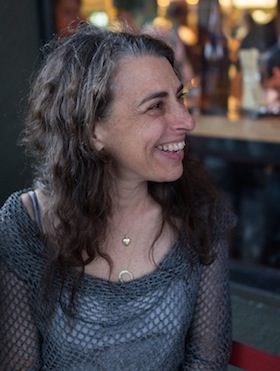
Left to right are Megan Laskin, Sherri Wise, Karen James, Jane Stoller, Jeannie Smith, Alyssa Schottland-Bauman and Sharon Goldman. (photo from Jewish Federation)
For the past 14 years, the Jewish Federation of Greater Vancouver has organized a women’s philanthropy event called Choices. The evening is meant to inspire women to understand the power of their tzedakah and to feel part of the community. On Sunday, Nov. 4, in Congregation Beth Israel’s Gales Family Ballroom, the informal consensus in the room of more than 500 women was that Choices exceeded its objectives.
One of this year’s achievements, according to event co-chair Jane Stoller, was that there were 50 first-time attendees. Stoller explained that a table of Hillel BC students had been sponsored and there were new faces from Federation’s young adult program, Axis, in the crowd. In addition, she said a record number of Israeli women were among the new attendees.
As for the featured speakers this year, both not only spoke movingly, but they also tied in Federation as an important component of their respective stories.
Sherri Wise is a dentist who lives and works in Vancouver. She survived a triple bombing on Ben Yehuda Street in Jerusalem on Sept. 4, 1997.
Wise described the sequence of events that led her to be at a café on a beautiful sunny day and what transpired after three Palestinian terrorists each blew themselves up in the immediate vicinity. Wise was seriously injured, with more than 100 nails embedded in her limbs and second- and third-degree burns on many areas of her body. After recounting the details of this tragedy, Wise was able to focus on some of the positives that arose from the horror. “Someone from Jewish Federation in Vancouver contacted Federation in Jerusalem and a kind woman named Trudy came every day to visit me.… I never even learned her last name,” she said.
Wise said she has managed to get on with her life not only with the help of her parents and the Jewish community, but also by making a decision not to harbour anger or hatred toward those who injured her, killed seven and injured 200 others. “Those men were born innocent babies and they were taught to hate – what chance did they have?”
Wise has since helped craft, advocate for and see enacted the Justice for Victims of Terrorism Act. This bill includes deterrents to those who would support terrorist organizations financially and materially, and grants rights to Canadian victims of terrorism. Wise imparted a message of healing, gratitude and finding a way to make a positive difference.
Jeannie Smith, the daughter of Irene Gut Opdyke, was the second speaker. Opdyke, who passed away in 2003, saved the lives of 12 Jews in Poland during the Holocaust and was recognized by the Israeli Holocaust Commission as one of the Righteous Among the Nations. Smith recounted many details of her mother’s story to a captivated crowd.
At the age of 17, Gut was forced to work in, among other places, the home of a high-ranking German officer stationed in Poland near her hometown. Prior to “keeping house” for this officer, she had worked in a laundry facility at a German officer’s camp. When she learned that she would be relocated to a villa in the town and that the Jews of that town would be liquidated, she managed to smuggle the group of Jews she had worked with in the camp’s laundry into the basement of the villa.
Eventually, the officer discovered the hidden Jews but, for a variety of reasons – none of them altruistic – he did not turn them in. As the Soviets approached and the Germans fled Poland, the 12 Jews, one of whom was pregnant, fled to the forest and joined the partisans.
There are many more twists and turns to Gut Opdyke’s story, but she ended up in California, where she married an American man who was the only person in the United States who knew anything about her painful and heroic past. Gut Opdyke was moved to begin speaking about her experiences only after she received a random call from a Holocaust denier. For the rest of her life, she was a Holocaust educator who shared the story her daughter, Smith, shared with the women at Choices.
Smith expressed gratitude toward the Jewish Federation of Portland because they paid for her father to live out his life in the Jewish seniors home once he developed Alzheimer’s. Commenting about Federation, she said, “One person can make a difference, and an organization can make a mighty difference.” She concluded with what she said her mother used to end her speeches with as well: “Every day we have an opportunity to be kind, to stand up for what is right and to go against what is wrong. We can be the difference in someone’s life.”
Both Wise and Smith received standing ovations for their heartfelt stories of love and resilience.
Leanne Hazon was one of the first-time attendees at the event. Having lived in Toronto for the last 18 years, the Richmond native returned to Metro Vancouver earlier this year for work.
“I thought the whole event was amazing!” she said. “It had such a nice vibe and feeling of community, very warm and welcoming. And the speakers were exceptional…. Sherri Wise’s message of forgiveness was so powerful and Jeannie Smith’s story about her mom was very moving.”
For more information on Jewish Federation and its annual campaign, visit jewishvancouver.com.
Michelle Dodekis a freelance writer living in Vancouver.
On Remembrance Day, Nov. 11, a small group of Jewish community members gathered in the Jewish section of Mountain View Cemetery to commemorate Canadians who have served in the armed forces. Organized and led by Rabbi Steven L. Nemetz, a member of the Royal Canadian Legion Branch 179, the ceremony was attended by more than 30 people, including children, nieces and nephews, and grandchildren of men and women who served in the Allied armed forces. Many attendees brought with them wartime photos of their uniformed family member(s).
The 100-bell Bells of Peace ceremony marked 100 years since the end of the First World War. Each person present at the memorial was invited to step forward to ring a ship’s bell after the announcement of their name and the name, relation and rank or service of their fathers, uncles, aunts, and other relatives.
Kaddish was recited. “Last Post” was played by a cadet trumpeter and a piper played the lament, which recalls the end of battle, and “Amazing Grace.” The commemoration opened with O Canada and concluded with Hatikvah.
Inside the caterpillar shelter, an orange line indicates where one can safely stand beyond the range of flying shrapnel. (photo by Gil Zohar)
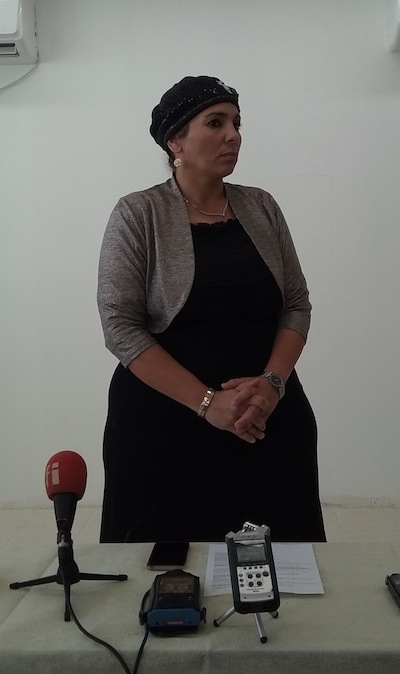
Miri Asulin personifies the contradictions of those who live in Israel’s cities and settlements bordering the Gaza Strip.
The 41-year-old mother of seven and principal of a brand-new elementary school in Ashkelon’s southern suburbs, 15 kilometres from the coastal enclave, commutes from her home in nearby Sderot, where she has been living for 26 years since she married. Until the barrage of 40 rockets fired from Gaza on the Sabbath of Oct. 26-27, she had dutifully and quietly followed Home Front Command orders. Though no one was killed in that bombardment, for Asulin it was the straw that broke the camel’s back.
Miri Asulin, mother of seven and principal of a brand-new elementary school, hosted the media recently to talk about the impacts of the rocket and mortar attacks from Gaza. (photo by Gil Zohar)
Addressing a pool of journalists in an air-conditioned classroom in her fortified building – the week before this Monday’s attacks from Gaza, which included more than 300 rockets or mortar bombs that day alone – Asulin asked that we not mention the name of her school since she has not received permission from the Ministry of Education to host the media. But she is unwilling to risk holding the interview outside on a pleasant fall day, lest a Colour Red rocket alert siren begin wailing.
“After 17 years [of rocket fire], I decided not to be quiet any longer about what is happening to us in Sderot and the south,” she began. “An attack on any Jew is an attack on all the Jewish people.”
What was it like that Shabbat as the sirens went off?
“The children were screaming,” she recalled. The worst part, she said, was the feeling of helplessness in the face of a “merciless enemy. We worship life. They worship death. One side has to be defeated.”
She said, “I’m no longer willing to remain silent. I’m not a politician or a cabinet member. I’m a mother.”
Asulin has witnessed the creeping paralysis of post-traumatic stress disorder. “Children have reverted to [being] bed-wetters, afraid to go to the bathroom alone. We’re going to have a generation of IDF soldiers who are traumatized,” she warned.
Ninety-four percent of Sderot’s children have PTSD symptoms, she said.
Mental health professionals treating PTSD say the best strategy for coping with psychological warfare is to maintain one’s daily routine. But those professionals urging resilience are themselves vulnerable and suffering from chronic burnout.
Asulin couldn’t sleep all night following the rocket barrage. “My body is in trauma,” she said. “I’m in shock.”
“With a snake, you cut off its head,” she said. Calling for reprisal attacks, she urged the Israeli government to kill 10 Hamas terrorists for every rocket fired.
***
As visceral as Asulin’s trauma is, Sderot itself shows few signs of the 25,000 Qassam rockets and mortars that have targeted the city and nearby kibbutzim for 17 years, killing 56 people. The city of 26,000 has no shattered glass, no bomb craters and no burned-out buildings. Superficially, Sderot looks green and prosperous.
Alon Davidi was reelected mayor in the Oct. 30 municipal elections, reflecting the satisfaction – or the apathy – of Sderot’s populace.
“Sderot is one of the most bombarded cities [in the world] since World War II,” according to Noam Bedein, the founder of the Sderot Media Centre. To his abiding frustration, there is no military solution to the rockets fired intermittently from Gaza, he said.
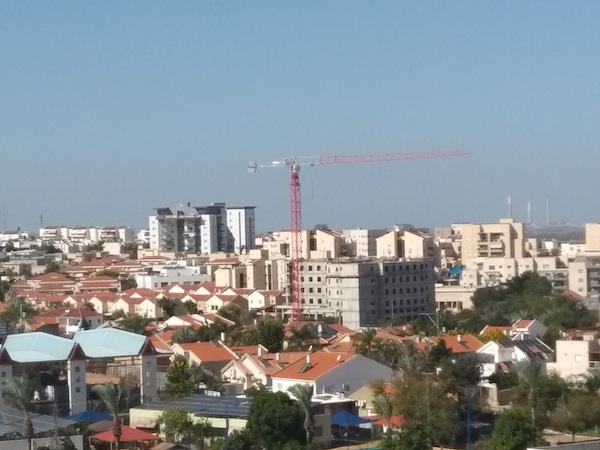
Sderot’s growing skyline. (photo by Gil Zohar)
Paradoxically, Sderot has been experiencing a construction boom in recent years, he explained. Founded in 1952 as a dumping ground for new immigrants from Morocco, the development town struggled in obscurity even as newcomers arrived from the Soviet Union, Ethiopia and India. The turning point came in 2013, he said, when the rail line opened, linking Sderot and nearby Ofakim and Netivot with Tel Aviv and Beer Sheva. Attracted by low real estate prices and tax benefits, tens of thousands of people have relocated to the former development towns and nearby communities. Construction cranes, new shopping malls and a burgeoning skyline of high-rise apartment towers reflect the wave of commuters who flock to Sderot’s underground train station. Two thousand apartments have been purchased in Sderot since the 2014 war. The population is projected to double in the coming years, to 50,000 people. Relatively few families abandon Sderot, in part because the value of their homes won’t allow them to purchase equivalent housing in the more expensive centre of Israel.
Everywhere in the city, bomb shelters have sprouted like mushrooms after a rain, making Sderot the bomb shelter capital of the world. Hoping to lower the odds in the game of Russian roulette, the ubiquitous reinforced concrete structures have been strategically placed so that one can race to a shelter anywhere in the 15 seconds notice that the siren provides. Every bus stop has an adjoining shelter.
A colourful concrete caterpillar crawls through a playground. There are no steel doors. Bedein explained that the precious seconds it takes a child to pull open a heavy door could mean the difference between life and death. Inside the caterpillar shelter, an orange line indicates where one can safely stand beyond the range of flying shrapnel.
***
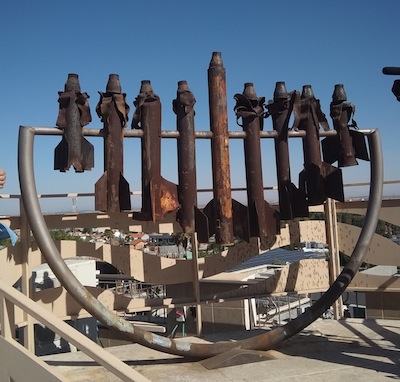
A chanukiyah, made from Qassam rockets, at Sderot’s Hesder Yeshiva. (photo by Gil Zohar)
Rabbi Ari Katz, the director of public relations at Sderot’s Hesder Yeshiva – where soldiers combine religious studies with army service for five years – has broad perspective on the rockets targeting Sderot. Originally from Chicago, he lived in Gush Katif until 2005, when the Israeli government uprooted the 8,000 Jews living in the Gaza Strip. It was that unilateral disengagement, followed by the 2007 Hamas takeover of Gaza from the Palestinian Authority, which created the conditions for the current rocket campaign, he said.
“We’re in a standing pattern, waiting to see what will be,” he said. Standing on the roof lookout point, which offers a panoramic view towards Gaza, one kilometre away, he proudly pointed to the new construction edging towards the frontier.
“They see the cranes,” he said, referring to the people of Gaza. “They think we’re crazy.”
Israeli President Reuven Rivlin addresses a group of local residents in a protected space in the northern Negev city of Netivot on Nov. 13. (photo by Ashernet)
On a tour of the city, Netivot Mayor Yehiel Zohar told President Reuven Rivlin about how buildings there are protected and about the events of the previous 24 hours. Rivlin also heard details about the work of the psychological and mental support services in the city, and the help given to children and the population as a whole after Monday’s missile launches from Gaza. “We are all under attack, under fire, whose aim is to disrupt our daily life,” said Rivlin. “Your strength gives us all strength. I have said in the past and I will continue to say, the area around Gaza is part of Israel. When the sirens are screaming here, we hear them in our hearts in Jerusalem, Tel Aviv and all over the country.” The president then visited one of the shelters in the town. In meeting local residents, he repeated appeals to follow the Israel Defence Forces’ orders.
Bennett and Sally Shaywitz co-founded the Yale Centre for Dyslexia and Creativity. (photo from the Shaywitzes)
One out of five people has dyslexia. Yet, even with this many people affected, not every school tests for it. This can lead to feelings of self-doubt and frustration for the child who has dyslexia but doesn’t know it. Parents and teachers may also become frustrated and the result can be children losing confidence in themselves.
Sally and Bennett Shaywitz, both academic physicians, say there is a simple test available for anyone to use to see if they have dyslexia.
Bennett Shaywitz was chief of child neurology at Yale for approximately 40 years, before stepping down a couple of years ago to devote all of his energy to dyslexia. “I’m the Charles and Helen Schwab Professor in Dyslexia at Yale,” he said. “Charles Schwab is very philanthropic and very dyslexic, so I’m very fortunate that I’m his name share.”
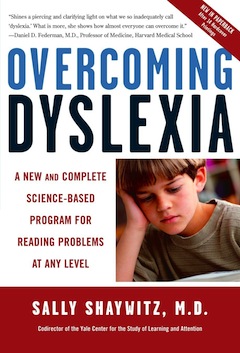
“Together, Bennett and I founded the Yale Centre for Dyslexia and Creativity,” Sally Shaywitz told the Independent. “I also wrote the bestselling book on dyslexia, called Overcoming Dyslexia.”
It all began when she was asked by Yale to work with children with learning disabilities, as none of the other faculty wanted to do it. “They thought it was beneath them,” she said. “I said, ‘Sure, I’ll do it part-time.’ And then I became intrigued with these children I saw who weren’t reading and whose parents were beside themselves and very worried. So, I began looking into it. Bennett was studying more basic science in attention. He got intrigued, so we worked together.”
As the research progressed, she discovered that there were many children who had problems with their reading yet seemed bright.
“Also, when I looked into it, they were studying children in schools and things, but there wasn’t a general study of a large population,” she said. “So, I started with the Connecticut Longitudinal Study. What differentiates that study is that it’s of a population, we work with a population statistician. We selected children from all over Connecticut and broke it into 14 towns. We invited all the children in kindergarten and, lo and behold, 95% of the ones we invited actually participated. That study is still going on. We are seeing those same people, about 375 of them, as adults, as 40-year-olds.”
The study started with 455 kids and 20% turned out to have dyslexia, while the schools had been under the impression that hardly any students were dyslexic.
“It taught me a lesson that I testified to the U.S. House of Representatives and the U.S. Senate,” she said. “It was that, to be counted, you had to be identified. Schools are not identifying kids, so they didn’t think they had any. Our data is very strong, and it goes along with data from the federal government that they’ve collected over the years. Dyslexia involves one out of five people – and we also discovered that it affects girls as well as boys.
“People used to say that it was just boys. What happens when people say that is that they only study boys. What we were able to do in the longitudinal study is we made up different instruments and validated them. One was a teacher instrument…. What we found was that, when boys and girls were tested, there were virtually equal numbers. But, when you ask the teacher about the child’s behaviour in class, they would say, oh, the boys were rowdy, pulling the girls’ hair, playing across the room, etc. And, the girls, they are so well behaved, but they never read a word. So, it was the boys that were sent for evaluation, because the teachers wanted to get them out of the room.
“We were able to show that dyslexia affects not only boys, but girls as well,” she said. “And, also, that it is persistent. It doesn’t go away. This study has made many major advancements.”
The Shaywitzes also found that, while, with non-dyslexics, reading and IQ are connected, with dyslexics, that correlation does not exist. This was in line with the very first description of dyslexia, in 1896, when a British physician referred to a young man who would have been the smartest in the class, if not for reading.
“People at the turn of the century really got it. They understood it,” said Sally Shaywitz. “But, over time, people stopped understanding it – deciding that, if you’re really smart, you can’t be dyslexic. So, what we were able to demonstrate is that, in fact, you can be very smart as well as dyslexic. The definition incorporates that dyslexia is an unexpected difficulty – unexpected, in that you can be very bright and yet read at a much lower level.”
The Shaywitzes said, due to such misconceptions, testing should be done as early as possible, around Grade 1.
“We developed a screener, called the Shaywitz Dyslexia Screen,” said Sally Shaywitz. “We gave it to Pearson Publishers, who I’ve worked with, wanting to involve teachers, as they know the child best and have mostly been ignored in a lot of these processes.
“There’s a kindergarten, Grade 1, Grade 2 or Grade 3 screening that has about 10 lead questions that the teacher responds to on a tablet. It takes five to seven minutes to get an answer as to whether or not the child is at-risk or not at-risk. You don’t have to test a kid and pull him out of his class or anything like that.
“So, the boys and girls start school and the parents say, ‘Oh, you’re gonna love it. You’ll learn to read. It’s going to be so much fun.’ Then, children enter school, waiting for this magical moment, and it doesn’t come. And, when they are called on to read aloud in class, the other kids giggle and make fun of them … and the teacher says, ‘How can you not know that?’ The kids lose confidence in themselves and begin to believe they are not very smart. That’s why children need to be screened and identified as at-risk very early on.”
Schools are way behind, she said. “Not every school identifies children with dyslexia.”
While the symptoms might improve, the person will always be dyslexic, she said. But, by identifying kids who have dyslexia early, parents and teachers can help the kids overcome their dyslexia in various ways.
The Shaywitzes have developed one tool, called the Key of Strength Model: Dyslexia and Creativity.
“They have almost an isolated island of weakness surrounded by a sea of a higher level of cognitive functions like reasoning, problem solving and critical thinking,” said Sally Shaywitz. “So, you want to identify the weakness and intervene. And, you want to identify the strengths and make sure kids can connect them.
“If they are not identified, they don’t know how smart they are and teachers mistakenly say, ‘Why don’t you try harder? Why didn’t you do that? Why didn’t you do your homework?’… things like that.
“In the case of dyslexia,” she said, “we have enough knowledge to do better. So, rather than a knowledge gap, we have an action gap. They have to implement the knowledge we have. It’s amazing that, in the 21st century, there is still so much misunderstanding of dyslexia that is harming so many.”
For more information on universal screening, dyslexia and more, visit dyslexia.yale.edu.
שרתהחוץשלקנדהכריסטיהפרילנדניפגשהעםנשיאהמדינהראובןריבלין. (צילום: Mark Neiman, GPO)
שרת החוץ של קנדה כריסטיה פרילנד קיימה ביקור בישראל לפני כשבועיים, שנחשב למוצלח מבחינת שתי המדינות. מדובר בביקור ראשון של השרה פרילנד בישראל. זאת מאז נכנסה לתפקידה בחודש ינואר אשתקד (עת החליפה את סטפן דיון), בממשלה הליברלית של ראש הממשלה הנוכחי ג’סטין טרודו.
פרילנד קיימה בישראל שלוש פגישות רשמיות. היא ניפגשה עם ראש הממשלה בנימין נתניהו. לאחר מכן עם נשיא המדינה ראובן ריבלין. ולבסוף עם יושב ראש הכנסת יולי אדלשטיין. השרה הקנדית קיימה אף ביקור בכותל המערבי.
לאחר הביקור בישראל כמתוכנן שרת החוץ הקנדית ביקרה גם במחנה פליטים פלסטיני, וכן היא ניפגשה עם שר החוץ של הרשות הפלסטינית ריאד אלמלכי. יצוין כי הביקור הרשמי בישראל של שרת החוץ לא זכה לדיווחים נרחבים במיוחד בתקשורת המקומית. בישראל כנראה מתייחסים עדיין לקנדה כאל מדינה שולית כבעבר. ובכך מתעלמים מעליית קרנה של קנדה בעולם בעיקר נוכח העומד בראשה טרודו. עוד שוכחים בישראל את העובדה שבקנדה יש כיום את אחד הריכוזים הגדולים ביותר של יהודים בעולם.
פרילנד ציינה בצער את הפגיעות ביהודים הגרים בקנדה. היא אמרה בסוגייה הקשה הזאת את הדברים הבאים: “אני מצטערת להגיד שהיהודים הם הקבוצה הפגיעה ביותר כיום בקנדה מפעילות של פשעי שנאה. בין אם מדובר בוונדליזים, גרפיטי, תעמולה של שינאה או תגובות גיזעניות ברשת”. השרה הוסיפה כי בניין הג’ואיש קומיונטי סנטר באזור הבחירה שלה בטורונטו, קיבל איומים על פצצה שכביכול הוטמנה בו בשנה שעברה.
בנושאים המדיניים אמרה פרילנד: “לגבי מה שקורה בגבול עם עזה זו תזכורת לכולנו כמה הביטחון שם שברירי, ושצריך לעבוד יחד ולחתור לשלום ביחד. אנחנו תומכים בזכות של ישראל לחיות בשלום במזרח התיכון”. לדברי שרת החוץ ישראל וקנדה ירחיבו את שיתוף הפעולה בנושא מלחמה בטרור.
פרילנד הודיעה עוד בפגישה עם ראש ממשלה כי קנדה מתעתדת להעביר כסף במזומן לרצועת עזה, כדי לתרום לשיפור המצב הכלכלי שם. בפועל מדובר על מיליוני דולרים שקנדה תעביר לרצועת עזה. פרילנד אמרה בנושא: “קנדה נענתה לבקשה בנושא של שליח האו”ם למזרח התיכון ניקולאי מלדנוב, אשר הסביר כי ברצועה יש מחסור במזומנים וזה מאוד מקשה על קיום מסחר”. נתניהו מצדו אמר כי ישראל אינה מתנגדת לכוונת קנדה לעביר מזומנים לרצועת עזה, אך ביקש להדגיש כי יש לדאוג לכך שהכסף לא יגיע לידי טרוריסטים ולא לידי אונר”א.
בפגישה עם הנשיא אמרה שרת החוץ הקנדית כי הביקור מהווה הזדמנות להעמיק את קשרי הידידות בין שתי המדינות, וכן לשוחח על האתגרים עימם מתמודדות כיום הדמוקרטיות השונות ברחבי עולם. הנשיא ריבלין אמר לשרה כי יקיים בשנה הבאה ביקור גומלין בקנדה. על כך הגיבה פרילנד: “אני שמחה ונרגשת מביקורך ואנו מצפים לקבל את פניך בברכה”.
בפגישה עם יו”ר הכנסת אמרה פרילנד: “היחסים החמים בין שתי המדינות אינם צריכים להיות מושפעים מפוליטיקה. טיב היחסים בין קנדה לישראל הוא אסטרטגי. עבדנו קשה ואנחנו שומרים על כך בהצלחה”. שרת החוץ אמרה עוד כי אוכלוסיית היהודים בקנדה היא השלישית בגודלה בעולם, והקהילה היהודית בקנדה פעילה ומשפיעה מאוד במדינה”.
קנדה וישראל החליטו בעקבות הביקור של שרת החוץ הקנדית בישראל, לקדם מספר פרוייקטים משותפים. ובהם: אישרור אמנת הסחר החופשי המעודכנת, קידום שיתוף הפעולה בטנכנולוגיה, בסחר, בחלל, בתעופה ובביטחון הסייבר. ובמקביל לשתף פעולה עם מדינות שלישיות כמו עם מדינות אחדות באפריקה.
The Jewish Federations of North America held its annual General Assembly this year in Tel Aviv Oct. 22-24. (photo by Pat Johnson)
The Jewish Federations of North America held its annual General Assembly in Israel, as it does every five years, Oct. 22-24. This time, for the first time, the convention met in Tel Aviv. The event was marketed with the theme “We need to talk,” the provocative title suggesting that the meetup would frankly confront the many points of contention between Israelis and Diaspora Jews.
By the time about 2,500 delegates, including a sizeable number of Israelis, arrived at the conference centre, the theme had shifted from the ominous pre-romantic-breakup phrase to the more upbeat “Let’s talk!” Delegates talked among themselves and listened to a plethora of speakers, including Israel’s president, prime minister, leader of the opposition and other elected officials, heads of civil society organizations, a recipient of this year’s Israel Prize and leading figures in the Federation movement.
While some observers – including the organization Am Echad, which placed a full-page ad in the Jerusalem Post – said the conference did not reflect the diversity of demographics or opinion in Israel, Jewish Federation of Greater Vancouver chief executive officer Ezra Shanken refuted the criticism.
“I think that we’re never going to have a shortage of people who want to criticize our gatherings,” he said. “I don’t believe that that is actually accurate. When I look around the room, I see kippot on people’s heads, I see people coming from the Modern Orthodox side of the community and I see people coming from the liberal side of the community. We have made an effort, in Jewish Federations of North America and the Jewish Federations of Canada and our Federation, to dialogue with as wide of a group as we can. I think there is a lot of diversity here.”
Ezra Shanken, chief executive officer of the Jewish Federation of Greater Vancouver, said the conference organizers, and federations generally, strive to include the broadest spectrum of Jewish demography and opinions. (photo by Pat Johnson)
A two-and-a-half-day conference provides an intensely limited time to address, let alone resolve, the range of issues on the table. Topics included broad issues like the stalled peace process, treatment of Eritrean and Somali asylum-seekers in Israel and a Nation State Law that some say undermines the democratic nature of the country. There are also a host of issues that cause friction directly for North American Jews, including the reversal of the promised egalitarian prayer space at the Western Wall, and Orthodox control of lifecycle events in Israel, which negates Reform and Conservative members, who make up the preponderance of North American Jews. If anything, the GA in Tel Aviv was the beginning of a conversation, or the widening of a conversation already in progress.
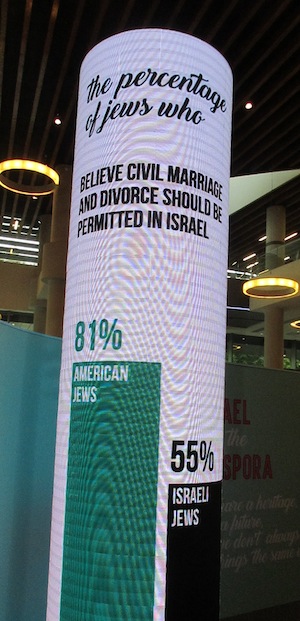
Some of the divisions were illustrated in public opinion poll results that were projected throughout the convention centre. The percentage of American Jews who believe that non-Orthodox rabbis should be permitted to officiate at Jewish ceremonies in Israel is 80%, compared with 49% of Israeli Jews. Fifty percent of Israeli Jews believe in God “with absolute certainty,” compared to 34% of American Jews. Among Israeli Jews, there is 85% support for the decision by the United States to relocate its embassy to Jerusalem, compared with 46% among American Jews. Support for the existence of a mixed-gender prayer area at the Western Wall stands at 73% among American Jews, compared with 42% of Israeli Jews. Among Jewish Israelis, 42% believe that Jewish settlements in the West Bank improve Israel’s security, compared with 17% of American Jews. Sixty-one percent of American Jews believe that Israel and an independent Palestinian state can coexist peacefully, compared with 43% of Israeli Jews.
Jerry Silverman, president and chief executive officer of Jewish Federations of North America, illustrated some of the lines of divergence.
“As North Americans and Israelis, we ask very similar questions. But each through a different lens,” he said. “North Americans may ask, after nearly a century of unwavering support, do Israelis really think our opinions should not be considered when it comes to policies that affect us? Israelis ask, why should anyone other than Israelis have a say in the decisions of our democratically elected government? North Americans, we may wonder how Israel can claim to be the nation state of all Jewish people when it doesn’t recognize the value of Jewish practice of 85 to 90% of Jews living outside of Israel. Meanwhile, Israelis feel that, well, we live here, so what makes you think you have the right to define what it means to be Jewish in the Jewish state? How is it possible, North Americans may ask, that the chair of the board of Brandeis [University] or a student from Florida are questioned or prevented from entering Israel because of their activism and views? Is this a democracy, or isn’t it? Israelis ask, what gives anyone the right to question our security decisions when we are the ones under constant threat?
“These are just a few of the questions of two proud communities who have learned to thrive in two very different environments; two members of one family who operate in their own political realities, where North Americans are seeking validation, empathy, partnership and understanding from Israel and Israelis who are living in a sovereign state have largely been insulated from a global conversation about Jewish peoplehood. I don’t have all the answers to all these questions, but I can tell you this – we will only find the answers if we start asking the questions to each other and if we really start working together.”
One after another, speakers acknowledged the challenging differences between the two communities, which together make up more than 85% of world Jewry, and then accentuated the commonalities.
“We are not strategic allies,” said Reuven Rivlin, the president of Israel. “We are family…. We don’t have shared interests. We have shared faith, a shared history and a shared future – and a very bright one. It may not be easy to have the truly honest conversation, but this is, I believe, what needs to happen.”
Rivlin suggested a “reverse Taglit,” a Birthright-like program for young Israelis to travel to Diaspora communities, summer camps and schools.
Danna Azrieli, who, with Israeli high-tech entrepreneur and philanthropist Marius Nacht, co-chaired the assembly, has a personal history suited to facilitating a conversation between the two communities. Born and raised in Montreal in a Zionist family, she made aliyah 18 years ago and now heads her family’s business operations in the country, Israel’s largest commercial real estate enterprise. She was born in June 1967, at the time of the Six Day War.
“My mother tells the story of how, when she was giving birth, the radio was on and the doctor would be listening to the news from Israel between contractions,” Azrieli said.
“We have come to this ‘let’s talk’ conversation about our future together from very different starting points,” she noted. “For example, how do we as North Americans begin to understand what we perceive as backward thinking, when women are not allowed to pray at the wall? And yet, the prime minister reneged on the Sharansky Compromise because of the pressure exerted by religious extremists. As a North American, you are probably asking, how could he have done that? Some of you, and I know a few, might go even further and ask, why should I support a country that does not support the way I practise my religion?” On the flip side, she acknowledged the fears of religious Israelis, who see any diversion from tradition as a step toward assimilation and extinction.
“Since I come from the real estate world, I’m going to use an image of an arch,” she said. “An arch is two sides pressing together. North American Jewry and Israeli Jewry are like two sides of an arch. We need each other. We need to push against each other to stay strong. By leaning into each other, by providing each other with the right amount of resistance and the right amount of support, we will have the strength to withstand the pressure from all sides. But one side of an arch cannot stand without the other. The art is to find the right amount of resistance, the right amount of pressure and the right amount of dependence and independence to ensure that our two sides will always remain strong vis-a-vis one another.”
Organizers didn’t hide the disagreements between Israelis and Diaspora Jews. (photo by Pat Johnson)
She acknowledged the differences over policies, but tried to differentiate this from core support for the state of Israel.
“We don’t give up when we disagree with our leaders,” she said. “Don’t walk away because your liberal sensibilities are insulted. Don’t assume that nothing can change. Things do change, just painfully, slowly, incrementally, and with all of our help. Help by continuing the dialogue. Help by infusing your children with a love of our heritage. Let’s celebrate the good. I am not suggesting that we ignore the things we disagree with. I am simply suggesting that we remember: it’s a marathon, not a sprint.”
Isaac Herzog, the former leader of the opposition who recently became head of the Jewish Agency for Israel, said the growth and successes of modern Israel could not have been forecast.
“No one could have imagined that, 70 years later, [Israel’s] population would increase more than tenfold, its GDP would grow more than fiftyfold, its share within the Jewish world would grow from six percent to 45% and that Israel would become what a great country it is today.”
Herzog, a grandson of Israel’s first chief rabbi and the son of a president, added: “Israel is not the only Jewish marvel in the last 70 years. You, too, North American Jewry, are a marvel. The saga of North American Jewry is one of the most exhilarating and inspiring success stories of the modern era and your success is evident not only in your high level of education and income, and in the fact that the number of Nobel Prize winners that you’ve got are over 120, but because your success is palpable in the fact that you are organized, committed and energetic. You donate more than any other group in society, both locally and globally, and your success is manifest in 3,500 congregations, in 150 federations, in 350 JCCs and countless organizations and foundations that you’ve created together into a beautiful, unique civil society.”
He spoke of the historical bonds between the two communities.
“You nourished us ever since we were a helpless newborn,” Herzog said. “We were, we are and we shall always be reliant on one another. Our alliance is profound, is heroic and is eternal.”
He added: “I see the growing rift between our communities and am shaken to my core. In Israel, there are those who shamefully refuse to recognize the great non-Orthodox Judaism of North America and, in North America, there are those who disavow the centrality of Israel in Jewish life.
“Ironically, in this, the first era in our history when the external existential threats we have faced are greatly diminished, we ourselves are endangering our own existence. It is up to each and every one of us sitting here together in this hall to look into the eyes of our young generations and see where did we go wrong. The obligation we all share is to listen to their pains, to listen to their questions and to listen to their frustrations and ask ourselves, how can we do it better? We must dare to think anew, dare to act differently.”
Herzog called for a renewed dedication to the Hebrew language.
“Our first act should be to find a common language,” he said. “When I say common, I mean both literally and figuratively. We have a rare and sacred national treasure: the Hebrew language, the language of the Bible and the state of Israel. For all of us to be able to speak to one another and listen to one another and to debate, discuss and delight one another, we must return to our national heritage and treasure. We must enable every young Jewish person in the world to learn Hebrew.”
He called on the government of Israel to allocate funds for a program that teaches Hebrew all over the world.
“From here on, it will be every young Jew’s birthright, wherever he or she may live, not only to visit this historical homeland, but to learn the language of the Jewish people,” said Herzog. “Hebrew can be a common denominator of all Jews from all streams of Judaism – a beautiful language can serve as a tool for unity.”
Other ideas being mooted, he said, include a Jewish “peace corps” that brings Diaspora and Israeli Jews together for tikkun olam projects around the world, and inviting thousands of young Jews from around the world to Israel to participate in groundbreaking “startup nation” technology projects.
As head of the Jewish Agency, Herzog promised to “reach out to all of you to advance hundreds of faction-crossing, stream-crossing, continent-crossing dialogues under one common tent. Israelis will learn to appreciate and know the magnificent civilization of world Jewry, while world Jewry will learn to appreciate the achievements of Zionism and the beauty of Israeliness. Reform and Conservative Jews will learn to cherish Jewish orthodoxy and Orthodox Jews will learn to respect the Reform and Conservative. We shall learn from one another and learn to appreciate one another and endeavour to resolve our internal differences through a new Jewish dialogue. All that I ask of you is not to despair and not to give up. Indeed, let’s talk.”
American political commentator and writer Ben Shapiro addressed more than 900 people at the Faigen Family Lecture, which was held at Congregation Schara Tzedeck on Oct. 30. (photo by Jocelyne Hallé)
More than 900 people came out to hear conservative commentator and writer Ben Shapiro give this year’s Faigen Family Lecture, which took place at Congregation Schara Tzedeck on Oct. 30.
Saul Kahn began the evening by reading the names of the 11 Jews murdered at Tree of Life synagogue in Pittsburgh a few days earlier. After a moment of silence, Vancouver Hebrew Academy head of school, Rabbi Don Pacht, recited a prayer for those who were killed. The security presence at Schara Tzedeck was notable, from every attendee being checked at the entrance to several guards within the sanctuary.
In introducing the lecture, Kahn explained, “Almost a decade ago, Dr. Morris Faigen, of blessed memory, created the Faigen Family Lecture Series in partnership with Rabbi Pacht and the Vancouver Hebrew Academy. This endeavour arose from their mutual love of Israel, a shared concern for the mindset of the modern Jew in North America and a desire to help influence the next generation.”
Kahn thanked VHA’s Teagan Horowitz and office staff, Rochelle Garfinkel and the Schara Tzedeck staff, Dr. Jeffrey Blicker, “for his instrumental role in bringing this event to fruition,” the Jewish Federation of Greater Vancouver for help with the additional security and “Gina Faigen and the Faigen family for their appreciation of how very vital it is to have a program such as this that supports an open and meaningful exchange of ideas.”
Pacht linked the lecture’s importance to Jewish tradition, noting how the word cherubs (in Hebrew) appears only twice in the Torah. In Exodus, it appears when God is explaining to Moses how the Mishkan (Tabernacle) is to be constructed: the cherubs (“angels with childlike faces”) are set above the holy ark. However, in the beginning of Genesis, when Adam and Eve are expelled from the Garden of Eden, God places cherubs to guard the entrance. “Interestingly,” said Pacht, “here the word is translated differently. It’s translated, by Rashi, as ‘angels of destruction.’” One explanation – from Rabbi Moshe Mordechai Epstein, who was head of the talmudic academy in Slabodka, Lithuania – is that, “as parents, as educators, we have a responsibility to take the next generation, to cultivate within them, the ideas and the ideals that we hold most dear. If we are successful in our endeavour, they are cherubic, they are the angels with childlike faces. Unfortunately, if we’re not successful, there’s an entire different pathway that may lay before them.”
Among the values that need to be imparted, said Pacht, are the centrality of Israel and the moral values as laid out by the Torah. Free speech and open debate, he continued, are “most dear to us.” He put them among the ideals we have “from our parents and our grandparents, and we want to see that passed on from generation to generation.”
This generational aspect was picked up on by Gina Faigen with humour in her welcoming remarks. She said she sometimes wonders, “because I’m a lot more liberal than my late father was, if he didn’t create this event in part so that, on at least one day a year, I would have to listen to somebody who shared his views. It’s definitely something I have come to appreciate more as the years go by. My father was passionate about ideas, about intelligent discourse on Israel, and he created this lecture series to ensure a space in Vancouver for a conservative and pro-Israel perspective. I know he would be really excited by tonight’s speaker, Ben Shapiro.
“For those of you who share these views, we hope to continue to provide a place for you here,” she continued. “And, for those of you who may not share all of the speaker’s views, it’s great that you’re here open-minded and part of this conversation.”
Blicker – who suggested Shapiro as a potential speaker after he and his family heard him at a Passover event in Henderson, Nev., more than three years ago – introduced Shapiro. Among other things, Shapiro is a lawyer, editor-in-chief of DailyWire.com, host of the podcast The Ben Shapiro Show, and author of seven books.
Shapiro addressed his critics right off, admitting that he does “sometimes phrase things in an intemperate fashion or spoken too hastily or out of anger or even, on occasion, over the course of a 17-year career of writing things, I’ve written stuff that I disagree with and that I think is immoral. It’s my job to hear those critiques, it’s my job to respond to those critiques in good will and in the spirit of self-betterment, and I’ve tried to do so repeatedly in different places and I look forward to doing so in the future, as well as tonight, that is my job. It’s also the job of my critics to keep an open-mind and not to mistake a political viewpoint for objective righteousness or to slanderously mislabel people like me bigoted or racist – that is unjustified, unjustifiable and hypocritical.”
Given what had happened in Pittsburgh, Shapiro decided to speak about his planned topic – the future of the state of Israel – in connection to global antisemitism. He described three general types of antisemitism.
• Right-wing antisemitism – “in this view, the presence of an independent Jewish community is a threat to national identity.”
• Left-wing antisemitism is “based on hierarchies of power.” Therefore, “when you see an imbalance in life and inequality in life, that is inherently due to inequity, so, if you see two people in a room and one guy has five bucks and one guy has one buck, that means the guy with five bucks somehow screwed the guy with one dollar. Left-wing antisemites, in terms of group politics, see the Jews as the people with five dollars. The Jews are simply too powerful and, thus, they must have participated in exploitation and egregious human rights violations.”
Shapiro offered his take on how intersectional theory would rank the groups whose “opinions should be taken most seriously because they have been most victimized by American society: LGBT folks are at the top, then it usually goes black folks, then Hispanic folks, then women, then Asians, then Jews, then, at the very bottom, white males.” In this framework, since Jews and Israel are relatively successful, they must have done something terrible, “be responsible for the ills.”
• Radical Islamic antisemitism “is the most traditional form of antisemitism – not Islamic, but religious antisemitism.” This is the belief, said Shapiro, “that the religion of Judaism itself is to blame for the problems in Western society. The history of religious antisemitism obviously, goes back thousands of years and it spans a wide variety of religions.”
Today, he said, “Islamic antisemitism has been combined with a sort of Nazi-esque racial antisemitism, which is why you see textbooks in the Palestinian Authority referring to Jews as the sons of pigs and monkeys, and it’s also been combined with a sort of intersectional antisemitism … Jews are successful because they are somehow damaging other people and, also, they happen to be a terrible religion.”
For Jews in the United States and, to a lesser extent, in Canada, Shapiro said right-wing antisemitism is probably the biggest threat, “as we saw in Pittsburgh. There has been a spate of such violence that has been consistent throughout my lifetime.” He said, “The thing that folks don’t understand if they don’t live in the Jewish community is that every single person in the Jewish community is one degree removed from some sort of tragedy of this kind.”
However, he said, for Jews worldwide, radical Islamic antisemitism is the biggest threat. “Whether it is Jews who are living under the possibility of an Iranian nuclear [regime], whether it is … Jews living under the threat of Hezbollah rockets, whether it’s Jews living under the possibility of kidnapping along the Gaza border or whether it is Jews living under the possibility of being murdered while walking the streets in France, whether it is Jews being threatened with the possibility of murder in Malmö, Sweden, whether it is Jews being threatened with murder in London. Islamic antisemitism and the rise of that antisemitism throughout Europe is deeply dangerous to Jews across the world.”
“The thing that folks don’t understand if they don’t live in the Jewish community is that every single person in the Jewish community is one degree removed from some sort of tragedy of this kind.”
There are two main perspectives on antisemitism, said Shapiro. One is that antisemitism is not another form of racism, but is unique – that it comes from a “conspiratorial mentality that the Jews are behind everything bad and, therefore, the Jews must be annihilated.” The second view is that “antisemitism is not unique, it’s not an age-old virus, it’s no different really than anti-black racism or anti-Native American racism or sexism or homophobia…. That means we have to treat the death of a Jew in Efrat at the hands of a terrorist differently than we treat the death of a Jew in Pittsburgh at the hand of a white supremacist because these two Jews scan in different areas of this intersectional pyramid,” said Shapiro. “These two Jews are not equivalent. They are not being killed for the same reasons. The Jew being killed in Pittsburgh is being killed because that Jew is a victim. The Jew being killed in Israel may or may not be being killed because of victimology. It’s possible that that Jew was being killed because of Israeli settlements or some such [reason].
“The second view, as you might imagine, I believe to be deeply troubling, counterproductive and helpful to antisemitism.”
In Shapiro’s opinion, this latter, more troubling view is mainstream on the political left in the United States and in Europe. When a Jew is murdered in certain areas of Israel, he said, “we are supposed to take into account the territorial claims of Palestinians as though that justifies the murder of a civilian who happens to be living in Efrat. We’re supposed to pretend that the dispute is merely territorial and not a symptom of a broader underlying antisemitic disease. When a Jew is murdered in Pittsburgh, then we’re allowed to talk about antisemitism.” This is why, he said, Jews can be excluded from women’s marches and antisemitism can be tolerated, if the Jews in question rank lower than the antisemite in the intersectional hierarchy.
While Israel holds a high position in the world, it is under threat from forces that we refuse to call antisemitism, he continued, citing several examples, such as the numerous votes against Israel at the United Nations. Criticism of Israel is legitimate, he said, but holding the country to a higher standard than any other nation is antisemitic, “and that has been the standard to which the world has held Israel.”
He called wanting to boycott, divest from and sanction Israel “antisemitic in the extreme…. The stated goal by many of those pressing BDS is to destroy the state of Israel…. Not a single person pushing BDS has ever condemned the Palestinian Authority for insisting on a fully judenrein state, a state completely free from every single Jew. Israel allows – and should allow – millions of Arabs to live within its borders, millions of Muslims to live within its borders, that is a good thing. Israel is a multicultural, multi-ethnic democracy. The same is not true of any of the nations facing down Israel, and yet Israel is facing down boycott, divestment and sanctions for saying that we can build an extra bathroom in East Jerusalem. No other nation would tolerate this sort of nonsense. This is targeted hatred and nothing less.”
So, what is our mission, given these realities? “Well, number one, to stand up to antisemitism wherever we see it, on left and on right,” said Shapiro, whether it is coming from our allies or our enemies. “This is not a partisan issue nor should it be. And, our other mission is also the same as it ever was, which is to spread light. What we’re watching right now in American politics and, I think, Western politics more broadly, is a fragmentation of certain eternal and true values that used to undergird a civilization. Those basic values of faith and family and those values of tolerance and openness within the bounds of recognition of certain central individual rights, that’s all fragmented. And whenever society fragments, antisemitism starts to seep through the cracks. As the Tree of Life synagogue name attests, the only way to fight back against all of this is to cling to that Tree of Life, is to cling to the Torah.”
The attack on the Tree of Life synagogue was not just an attack on Jews but on civilization, said Shapiro, “because Judaism, Jews, we stand at the heart of Western civilization…. The only proper response is the same response Jews have given throughout time: to fight back, to fight darkness with light, to fight untruth with truth and fight death with life.”
Ben Shapiro responded to 22 questions at the Faigen Family Lecture on Oct. 30. (photo by Jocelyne Hallé)
After a standing ovation for his remarks, Shapiro responded both to questions submitted in advance by event sponsors and then to questions from an open mic. In total, he responded to 22 questions, which ranged from the political to the cultural, from economics to education, tort law to religion. Several of the questioners identified themselves as being Christian, many as fans.
One of the first questions was the language Shapiro uses around transgender issues. “When I’m talking about transgenderism,” he said, “the contention of folks in the political realm is that transgenderism is not, in fact, a mental illness; that, in fact, gender identity disorder or gender dysphoria, whichever DSM [Diagnostic and Statistical Manual of Mental Disorders] you choose to use, 4 or 5, that that particular disorder is no longer a disorder, it’s actually just an expression of gender identity that has no bearing whatsoever on mental health. That’s a lie, and it’s a damaging lie. And, when a society blinds itself to the realities that gender and sex exist, it is less likely to pursue policies that alleviate the pain of a lot of folks and it’s also less likely to pursue policies that have any realities extant on the ground.”
In a few responses, Shapiro differentiated between his use of language in dealing with people one-and-one versus in the political arena or on social media, noting in particular that Twitter is meant to be a more fun space, where you don’t have to be nice. He also talked about his general wariness of government intervention and offered pretty standard conservative views on immigration, economic migration, free speech and abortion.
When asked by the mother of a 14-year-old boy who brought Shapiro’s views into their liberal household about Shapiro’s portrayal at times of the left as monolithic (and unprincipled) and whether it was “part of the game, like [you do] on Twitter?” he responded, “No, it’s political shorthand.”
However, he added, he does try to distinguish between the left and liberals. For example, “when it comes to free speech, I think the left wants to crack down on free speech and I don’t think liberals do. I think liberals are happy to have open and honest debates; they just disagree with me on the level of government necessity in public life. Listen, every individual has different political viewpoints and people self-describe in different ways … but, as a generalized worldview, if I’m hitting the target, when I say the left, 85% of the time, that’s good enough for ditch work. In politics, you’ve got to cover too much ground to break down every single constituent of a particular group. Now, is it an over-generalization? Of course. But politics operates on generalizations, so do our everyday conversations.”
Yuli-Yoel Edelstein, speaker of the Knesset, addresses delegates in the parliament’s Chagall Hall. (photo by Pat Johnson)
Before the General Assembly of the Jewish Federations of North America began on Oct. 22, a local delegation, headed by Jewish Federation of Greater Vancouver board chair Karen James and chief executive officer Ezra Shanken, toured Vancouver’s partnership region, the Upper Galilee Panhandle, which includes Israel’s most northerly communities.
Shanken said that a “mirror” volunteer board of community members from across the panhandle region has been created, including people who are sourcing projects, bringing them in and deciding, along with funders from Vancouver, which critical projects within the region will receive support.
“Those can be everything from a kitchen that we just opened that’s helping developmentally challenged individuals learn cooking skills, or we are looking at education programs … really trying to lift up the north,” he said.
The periphery in Israel has always faced more challenges than the centre of the country, Shanken added. Trying to rebalance that situation, he said, involves engaging the people in the partnership region to take ownership of the projects funded from Canada.
“One of the great things that we saw was the graduation of [the first cohort of] something called Galilee Up, which is something we’ve been working on,” he said. “It’s a leadership development program where we looked around the table and said, who’s going to be the great volunteer leaders of tomorrow?”
More than 20 individuals with leadership potential, mostly younger adults in the early stages of their careers, have been brought together, participating in courses at Tel Hai College. On the Vancouver group’s October visit, the cohort pitched concepts that could help improve the region.
Shanken also celebrated the reopening of a medical centre in Kiryat Shmona, for which Vancouverites had advocated alongside residents of the panhandle.
“This was a huge, huge win for us,” he said.
Democracy in Israel
Speaker of the Knesset Yuli-Yoel Edelstein assured delegates that the health of democracy in Israel is strong.
“Purposely misquoting great American author Mark Twain, I can say that the rumour of the demise of Israeli democracy has been slightly exaggerated,” he told a special evening plenary held in the Knesset’s Chagall Hall. “Israeli democracy has been strong, is strong and will be even stronger.”
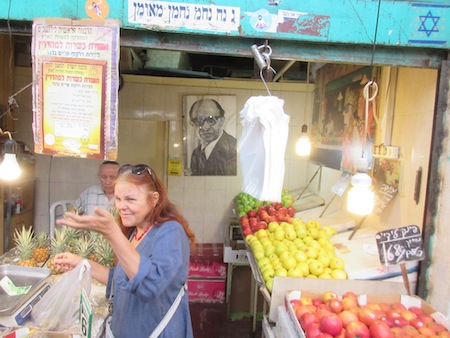
Politics and produce mix at Mechane Yehuda market in Jerusalem. (photo by Pat Johnson)
He encouraged Diaspora Jews to write, email and telephone members of the Knesset with their concerns.
At the same event, Tzipi Livni, leader of the opposition, offered an alternative view, warning that the Nation State Law undermines the democratic leg of the “Jewish, democratic state.”
She said that her opposition to the law is not based on what is in the law, but what was left out. Israel’s Declaration of Independence states that Israel is a Jewish nation, but guarantees equal rights for all its citizens.
“When the state of Israel was established,” she said, “all the Jewish leaders signed – we’re talking about socialism, communism, revisionism, Charedim – they decided, this is a moment in which they should put aside all the differences and say that Israel is being established as a nation state for the Jewish people, but also giving equal rights to all its citizens.”
This assurance is missing from the Nation State Law, she said.
“And it’s not that somebody forgot it,” she stressed. “It was part of the discussion here. I wanted to add in the first article of this bill: keeping Israel as a Jewish, democratic state. The answer was no. Let’s refer to the Scroll [Declaration] of Independence. The answer was no. I said, let’s have equality. The answer was no. Israel is a democracy and we will keep Israel as a democracy, but, frankly, this is a challenge now.”
Livni added that Diaspora Jews who spend a certain amount of time every year in Israel should have the right to vote in Israeli elections.
“Our decisions as an Israeli government affect your lives as well,” she said.
Trauma experts thanked
Stacy Kagan, the vice-mayor of Parkland, Fla., fulfilled a lifelong dream of visiting Israel, but acknowledged she never envisioned it would be under such circumstances. Kagan was at the General Assembly to thank Israeli emergency responders for stepping up after the mass murder at a high school in her city last February.
“In the days following the shooting at Marjorie Stoneman Douglas high school, grieving and in shock, we received an outpouring of support from across the country, across the world and Israel,” she said. “Within days, experts from the Israel Trauma Coalition were on the ground in Parkland. They were training our local counselors, who were there themselves and unprepared to address the impact of a large-scale attack that terrorized our local residents. The team from the Israel Trauma Coalition was nothing short of incredible. Their experience was invaluable.
“Today, I stand before you not only as an elected official, but as a Jewish woman who has always wanted to visit Israel,” she said. “I’ve dreamed of this but never made it until now. I never could have imagined that I would be here under these circumstances. As a Parkland resident, I come here to express my appreciation to the Israel Trauma Coalition, the entire Federation movement and the people and government of Israel for standing with us. This was our time of need. You showed up. You gave us strength and you taught us how to be resilient. As a wife, a mother and a consoler to those families and children that were taken by this horrible tragedy, I am here to say todah. Thank you so much from the bottom of my heart.”
Personal reflections
Danna Azrieli, co-chair of the General Assembly, spoke of the Zionism of her childhood, which was mixed with the intergenerational trauma of being a second-generation Holocaust survivor.
“I struggle with anxiety and fear that an enemy may lurk in a place I don’t expect,” she said. “I am always vigilant. I’m the graduate of a 95-day outdoor leadership training course, just in case, one day, I will have to survive in a forest. And I hope that my overactive antennae that work overtime all the time and have deeply psychosomatic effects on my health will save me if ever, one day, I am faced with an unexpected horror in a restaurant or dance club.”
Since moving to Israel, she has witnessed brutality on both sides, she said.
“I have been within six metres of a terrorist running down the main street of the city where I live,” Azrieli told the plenary. “I saw his knife. I saw him sweat. I heard the sirens because he had just stabbed a 70-year-old lady in the coffee shop on the corner. And I also saw the total abandonment of morality, the bestiality, that overcame my Jewish neighbours when they ran the terrorist over with a car and hit his legs with a stick as he was face down at the bus stop while they were waiting for the police to arrive. I am a product of all of these things.”
Canada’s ambassador
Deborah Lyons, Canada’s ambassador to Israel, delivered an address that repeatedly brought the audience to laughter and their feet. Citing the Federation movement’s commitment to helping people in North America, Israel and throughout the world, she said, “Your goals are nearly interchangeable with those of the Canadian government.”
She said, “We both are committed to supporting the most vulnerable around the world … regardless of background. And we both are strongly supportive of Israel, its future and a deepening, closer relationship with Canada.”
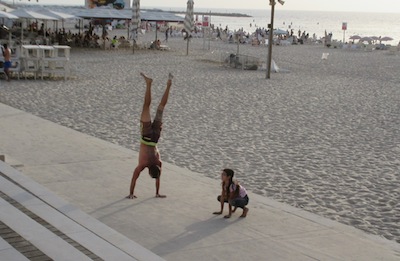
Exercising on the beach helps keep Israelis healthy. (photo by Pat Johnson)
Both federations and the Canadian government are facilitating cultural and economic missions to Israel to strengthen connections, especially in the business sector. In recent months, Lyons said, Canada’s governor-general, prime minister and a large number of senior cabinet officials have traveled to Israel.
“Our international leadership is perhaps best demonstrated by our recent partnership in rescuing White Helmet volunteers in Syria, one of the best moments of my career,” she said.
Along with allies, “Canada and Israel answered the moral obligations to ensure the swift evacuation of 422 members of this incredibly brave civil defence group, and their families. It was the support from Prime Minister [Binyamin] Netanyahu and, in particular, the incredible professionalism and heart of the IDF that brought that evacuation about.”
The ambassador added that combined efforts include batting antisemitism.
“Canada has worked alongside Israel to produce an internationally accepted working definition on antisemitism and we will continue to work with Israel to combat this ill everywhere – wherever, whenever,” she said, adding that Prime Minister Justin Trudeau will officially apologize for Canada’s turning away of the refugee ship MS St. Louis in 1939.
She reiterated Canada’s support for a negotiated peace between Israelis and Palestinians and spoke personally about her experiences living in Israel for two years now.
“It’s a complicated, invigorating and empowering place that can touch every emotion and challenge every belief,” she said. “It’s filled with energy, with incredible vitality and with endless warmth. I come from Canada – I know warmth when I feel it.… It’s simply very alive here.”
Wrenching stories
The most emotional presentation of the General Assembly was delivered by Miriam Peretz, winner of the 2018 Israel Prize for lifetime achievement and special contribution to society, whose story of the price Israeli families pay for the security of the nation had audience members sobbing. Earlier this year, Education Minister Naftali Bennett delivered the news of the award to her by arriving at her front door, the same door where, a decade ago, officers arrived to deliver, for the second time, the worst news a mother can receive.
“Ten years ago, on the eve of Passover, three angels knocked on my door,” Peretz said. “They didn’t bring with them the prophet Eliyahu. Rather, they were the bearers of terrible news. My second son, Eliraz, a deputy commander of Battalion 12 of Golani – a father of four little children, the biggest was 6 years old, the littlest was 2 months old; she didn’t know her father – he was killed fighting the terrorists in the Gaza Strip.
“As soon as I saw who was outside my door, I ran. I shut the door. I shut the window so no one could enter,” she recounted. “When they finally came in, I begged them and asked them, please don’t say the word, don’t deliver the news. Just let me [have] my son for one more minute. Because, as long as you don’t say this horrible news, my Eliraz still lives for one more minute. It has to be a mistake, I explained, for I had already paid the ultimate price of our country’s survival. A dozen years earlier, my firstborn, Uriel, an officer in a special unit of Golani … was killed fighting the Hezbollah in Lebanon. And, if it’s not painful enough, my dear husband, unable to bear the loss of Uriel, died five years after of a broken heart.
“So it was the eve of Passover and we were gathered to the seder without Uriel, without Eliraz, without Eleazar, my husband,” she continued. “And we read … we cried when we read in the Haggadah, l’dor v’dor, in every generation they rise up to destroy us…. There is no mother in Israel that wishes her children to be a combat soldier. When we have these children, we only pray to Hashem to let them be alive, to keep them healthy, but not to be soldiers. And my children, every time, when called upon to defend our nation, they did not hesitate. They said simply, Ima, it’s our turn.”
Peretz spoke of her childhood in Morocco and how, one night, her father told the family that “this night we will meet the Moshiach, the Messiah. I asked my father how he looked? And he said he will come with an open shirt, with shorts and with sandals. This is the shaliach of the Jewish Agency.
“They took us from the alleys of this place in Morocco to this country,” she said. “When we arrived to Haifa, I saw my father kneeling and kissing the ground when he said the Shehecheyanu. I didn’t understand the behaviour of my father and I never imagined that, one day, I will kiss this earth twice, like my father, when it covered the bodies of my children on Mount Herzl.”
She said that, after the death of her second son, she asked: “What can I do with this grief and sorrow? I can continue to sleep on my bed, to cry about my destiny, to blame the government, the IDF – this is not my way. I chose to continue and to hold the life. I chose to look outside … to see all this land and ask myself, every day, what can I do to be worthy of them? They gave their life for me. I didn’t want to waste my life, because life is not how many years you are here. It’s what you do with this minute that God [has] blessed you.”
Peretz has devoted the years since to comforting bereaved families and wounded soldiers.
“She did not choose the circumstances of her difficult life,” Bennett has said of Peretz, “but chose to live and revive an entire people. She is the mother of us all.”
“It’s not only my personal story,” Peretz told the General Assembly. “It’s the story of this land. It’s the story of faith and hope. It’s the story of the price that we pay for the existence of this state.”
Or Shalom’s Rabbi Hannah Dresner is both the first woman and the first Jewish Renewal rabbi to be elected head of the Rabbinical Association of Vancouver. (photo from Or Shalom)
“I grew up in a household of many amazingly powerful spirits,” Rabbi Hannah Dresner of Or Shalom Synagogue told the Independent. “My parents’ circle of friends loomed larger than life.”
Dresner has memories of playing ping-pong with Jesse Jackson, making paper dolls with Abraham Joshua Heschel and being read bedtime stories by Elie Wiesel. Her father, Samuel Dresner, was a rabbi and a renowned scholar of Chassidic thought. He was a close personal disciple of Heschel, who is widely regarded as one of the most important theologians and Jewish ethicists of the 20th century.
Dresner, herself an artist, dancer and academic for years before heeding the call to become a rabbi, walks softly and carries a big soul. Since coming to Vancouver to head Or Shalom after Rabbi Laura Duhan Kaplan stepped down from the pulpit to take on a role at the Vancouver School of Theology, Dresner has made waves by bringing a new range of creative programming to the shul. Events have included a dance troupe performing an interpretation of a Chassidic tale to live jazz music, a Shabbaton on Jewish wisdom about the afterlife, and guest Rabbi Benay Lappe teaching how to queer the Talmud.
Most recently, Dresner has again broken new ground in Vancouver, by being chosen head of the Rabbinical Association of Vancouver. She is both the first woman to hold the position and the first Jewish Renewal rabbi.
The Jewish Independent spoke to Dresner just days after she had convened her first meeting as chair. She said she was heartened to see that her election was a comfortable choice for the mainly male membership of the RAV – Rabbi Carey Brown is also a member – and an exciting opportunity for her to serve both her own shul community and the wider Vancouver Jewish community.
“I see this as a way for Or Shalom to be more visible as a legitimate part of the Jewish community of Vancouver, to bring our own sensibility to fostering kinship between rabbinic colleagues, and an opportunity for myself to serve the Jewish people,” she said.
So far, Dresner – who said she is very much still learning the ropes of the RAV – has innovated by introducing a session of group Torah study into the association’s meetings.
Rabbi Hannah Dresner (photo from Or Shalom)
Dresner is known for combining traditionalism and progressive Judaism, including a commitment to “deep ecumenicism,” an openness to the wisdom not just of the different denominations of the Jewish community but the different religious traditions of humankind. This is what drew her to the Jewish Renewal movement founded by Reb Zalman Shachter-Shalomi. Renewal is known for its embrace of both traditional liturgy and observance and Torah study with feminist, ecological and ecumenical perspectives.
She said, “My job here [at Or Shalom] is to really nurture the historic members and create a space that is bold and fresh and open and willing to embrace our contemporary thoughts and needs, and to be truly inclusive; to nurture the old and to welcome and open as many portals as possible.”
Before becoming a rabbi, Dresner went to Barnard College to study dance and art then taught at the Ramaz School in New York. She went to graduate school at the University of Chicago and got her master’s in fine arts, becoming an exhibiting painter at a blue-chip gallery, with a career as a working artist while teaching in MFA programs. Her longest tenure was at Northwestern University for 10 years, where she was tasked with inventing new undergraduate courses across the arts.
When Dresner got married and had children, she felt the need for a prayer space tolerant of young mothers, a community in which to raise kids. She founded the Lomdim Chavura, which some quipped stood for “lean, mean davening machine.” The group met on Shabbat mornings and co-parented – they “birthed each other’s babies into life, and doula’d community members into death as well,” said Dresner.
“It was spiritual improvisation,” she said, noting that the chavura regularly gathered to experiment with new forms of expression. It was within that space that Dresner became interested in leadership and discovered davening and ritual as new spaces for her creative expression. She began seeing Jewish communal life as another way of being an artist in the world.
“Everything was woven together in our communal life,” said Dresner. “We made sukkot out of gourds or sunflowers. Ritual life was part of gardening, was part of cooking, was part of life and dance and art.”
Dresner said her discovery of the seamlessness of those things made her transition into the rabbinate very natural. “It is about translating those family expressions into a larger family,” she said.
Dresner had begun studying Chassidic texts while still an MFA advisor, to feed her soul and connect again with the spiritual milieu of her childhood. “We used to study the Sefer Ba’al Shem Tov every Shabbat afternoon,” Dresner said of her early childhood immersion, “and we sang niggunim until dark and then made Havdalah.”
Dresner’s study of Chassidus gradually blossomed into studying for the rabbanut. “I’m not really in rabbinical school,” she told herself. “I’m just taking these classes.”
Dresner was eventually ordained as both a rabbi and mashpia ruchanit (spiritual counselor). She has been two different kinds of CLAL fellow, in the Rabbis without Borders and Clergy Leadership Incubator programs.
During her rabbinic studies, Dresner was close with Daniel Siegel, the founding rabbi of Or Shalom, and she was excited when a job opening arose at the synagogue. “Coming here to the congregation that he founded had a lot of meaning to me and I had a lot of respect for Laura, the previous rabbi, as an intellectual as well,” said Dresner.
In 2001, Dresner had gone to Berkeley with husband Dr. Ross Andelman to focus on integrating their families. They made a deal: she had left her dream job and moved for him, and he would repay the favour after the kids had graduated high school. Once Dresner was ordained as a rabbi with ALEPH, Andelman, who is known in the Or Shalom community as “the rebbetz” (a play on the traditional name for the rabbi’s wife, rebbetzin) was true to his commitment and left his job as medical director of a county mental health system in Northern California to come here. “He’s a man who acted on his feminism,” said Dresner.
One of Dresner’s first calls to public duty as head of the RAV came on Oct. 28, when she led the vigil remembering the victims of the Pittsburgh massacre, which claimed the lives of 11 Jews.
Matthew Gindin is a freelance journalist, writer and lecturer. He is Pacific correspondent for the CJN, writes regularly for the Forward, Tricycle and the Wisdom Daily, and has been published in Sojourners, Religion Dispatches and elsewhere. He can be found on Medium and Twitter.