Skip to content
  • Home
  • Subscribe / donate
  • Events calendar
  • News
    • Local
    • National
    • Israel
    • World
    • עניין בחדשות
      A roundup of news in Canada and further afield, in Hebrew.
  • Opinion
    • From the JI
    • Op-Ed
  • Arts & Culture
    • Performing Arts
    • Music
    • Books
    • Visual Arts
    • TV & Film
  • Life
    • Celebrating the Holidays
    • Travel
    • The Daily Snooze
      Cartoons by Jacob Samuel
    • Mystery Photo
      Help the JI and JMABC fill in the gaps in our archives.
  • Community Links
    • Organizations, Etc.
    • Other News Sources & Blogs
    • Business Directory
  • FAQ
  • JI Chai Celebration
  • JI@88! video

Recent Posts

  • BGU fosters startup culture
  • Photography and glass
  • Is it the end of an era?
  • Taking life a step at a time
  • Nakba exhibit biased
  • Film festival starts next week
  • Musical with heart and soul
  • Rabbi marks 13 years
  • Keeper of VTT’s history
  • Gala fêtes Infeld’s 20th
  • Building JWest together
  • Challah Mom comes to Vancouver
  • What to do about media bias
  • Education offers hope
  • Remembrance – a moral act
  • What makes us human
  • המלחמות של נתניהו וטראמפ
  • Zionism wins big in Vegas
  • Different but connected
  • Survival not passive
  • Musical celebration of Israel
  • Shoppe celebrates 25 years
  • Human “book” event
  • Reclaiming Jewish stories
  • Bema presents Perseverance
  • CSS honours Bellas z”l
  • Sheba Promise here May 7
  • Reflections from Be’eri
  • New law a desecration
  • Resilient joy in tough times
  • Rescue dog brings joy
  • Art chosen for new museum
  • Reminder of hope, resilience
  • The national food of Israel?
  • Story of Israel’s north
  • Sheltering in train stations

Archives

Follow @JewishIndie
image - The CJN - Visit Us Banner - 300x600 - 101625

Category: TV & Film

Pink Rabbit opens festival

Pink Rabbit opens festival

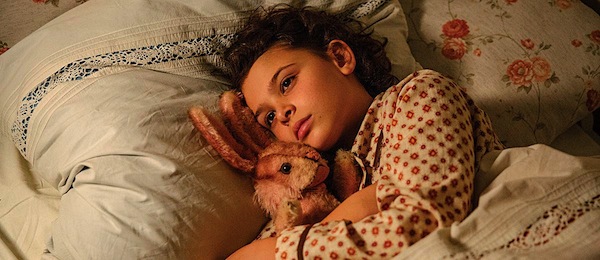
Riva Krymalowski as Anna, in the film, which opens the Vancouver Jewish Film Festival Feb. 27. (photo from betacinema.com)

The Vancouver Jewish Film Festival opens the night of Feb. 27 with the film When Hitler Stole Pink Rabbit, which offers a peek at a pivotal event in writer and illustrator Judith Kerr’s life.

Kerr passed away just under a year ago, at her home in London, England, at the age of 95. She had dozens of children’s books to her credit, including The Tiger Who Came to Tea and Mog the Forgetful Cat; Mog became a series, ultimately totaling 17 picture books.

Born in Berlin, Kerr and her family – parents and older brother – fled Germany in 1933, in the days leading up to the election that brought Hitler into power. Her father, Alfred Kerr (né Kempner), a journalist and writer, was a vocal critic of the Nazis even at that time and was warned that the police were about to arrest him. The story of the family’s journey to Switzerland, then France and, ultimately, England, is told in the children’s book When Hitler Stole Pink Rabbit, which was published in 1971.

The film, obviously, is based on that book, and it captures the fear, excitement, frustration and other feelings experienced by the family as a whole, but mainly by 10-year-old Judith – named Anna in both the book and film. We see that Anna copes, in part, by drawing and colouring pictures of disasters, such as a shipwreck or an avalanche. She, her brother and parents are close, thankfully, as they are uprooted more than once and the family unit is the only constant in their lives.

When Hitler Stole Pink Rabbit is both charming – the family’s interactions – and disturbing, in that the family is fleeing a danger that killed millions. It also raises current-day issues of what it means to be a refugee. Anna and her brother Max are given one night to pack. They are allowed one toy and two books. Anna’s choice of her stuffed dog over her pink rabbit gives the story its name.

For more on the film festival, visit vjff.org.

Format ImagePosted on February 14, 2020February 21, 2020Author Cynthia RamsayCategories TV & FilmTags children's books, Holocaust, Judith Kerr, memoir, movies, When Hitler Stole Pink Rabbit
Jewish films span the globe

Jewish films span the globe

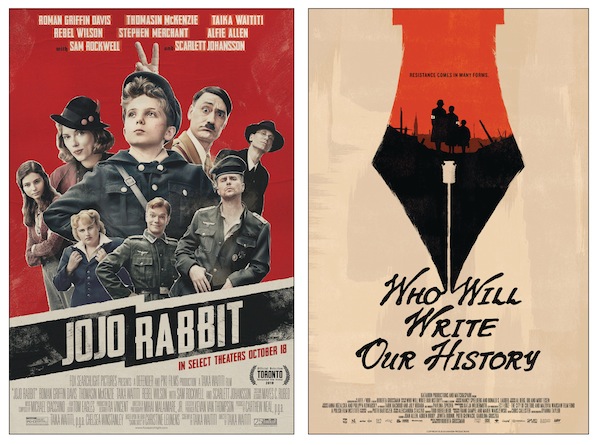
Taika Waititi’s Jojo Rabbit and Roberta Grossman’s documentary Who Will Write Our History were two standouts in Jewish film last year.

Last year was a busy one, but not a great one, for Jewish-related movies. There was plenty to see, but only a couple films – Jojo Rabbit and Uncut Gems – broke through the clutter to make an impact.

While Jewish characters were front and centre in high-profile TV shows – The Marvelous Mrs. Maisel, The Kominsky Method and Broad City – in movies, they were largely relegated to glorified cameos, such as Al Pacino as old-school agent Marvin Schwars in Once Upon a Time in Hollywood and Alan Alda as menschy divorce attorney Bert Spitz in Marriage Story.

Jewish artists and celebrities were, as always, exceedingly popular among documentary makers. Sammy Davis, Jr.: I’ve Gotta Be Me, televised on PBS’s American Masters, and Ask Dr. Ruth led the parade, which included less-widely-seen portraits of singer-songwriter Leonard Cohen (Marianne and Leonard: Words of Love) and actor Anton Yelchin (Love, Antosha).

Picking a Top 10 was a bit of a challenge for 2019. Here are the films that left a mark.

Jojo Rabbit: The most ambitious and audacious film of the year was made by a Maori Jew from New Zealand. Taika Waititi, the director of Marvel’s Thor: Ragnarok, radically adapted Christine Leunens’ novel into a sharp satire of Nazi racism and groupthink that garnered the San Francisco Bay Area Film Critics Circle Award for best screenplay.

Who Will Write Our History: My only criticism of Jojo Rabbit is that it didn’t convey the depth of the Holocaust’s horror. Roberta Grossman’s artful documentary about the men and women in the Warsaw Ghetto who secretly amassed an archive of documents and diaries that would survive (if they didn’t) fills in a missing historical chapter for people of all ages. (See jewishindependent.ca/a-different-kind-of-resistance.)

Prosecuting Evil: The Extraordinary World of Ben Ferencz: The last surviving U.S. attorney from the Nuremberg trials has an impeccable memory, a spotless moral compass and enormous gravitas. This terrific doc serves as an inspiring counterpoint to Matt Tyrnauer’s slick biography of another Jewish lawyer from New York, Where’s My Roy Cohn?, who lacked an iota of integrity.

Uncut Gems: What makes Howard run? Jewelry hustler and compulsive gambler Howard Ratner (Adam Sandler, impressively manic) races around New York City to keep his increasingly angry debtors at bay. En route, Benny and Josh Safdie’s nerve-jangling drama rips the Band-Aid off black-Jewish relations.

Mike Wallace is Here: Avi Belkin examines another iconic New York Jewish character, the penetrating TV journalist who made 60 Minutes essential viewing, entirely through archival TV footage. It is one of the smartest and best documentaries of 2019.

Synonyms: Nadav Lapid’s abrasive, semi-autobiographical drama about a self-loathing young Israeli army veteran’s effort to shed his identity in Paris won the Golden Bear for best film at the Berlin International Film Festival. It is painful and revealing, with some flashes of humour.

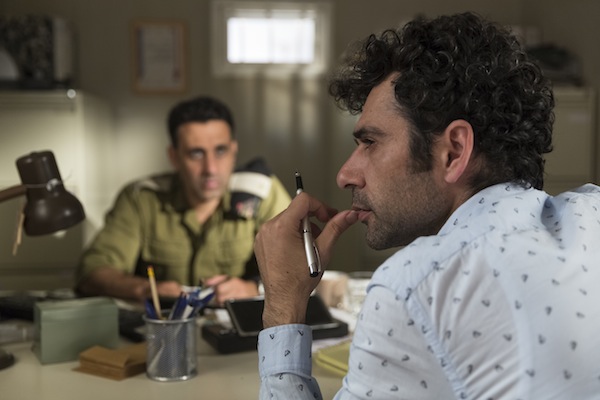
Tel Aviv on Fire: Sameh Zoabi’s clever comedy about a Palestinian soap opera writer trying to navigate the demands of his bosses and an Israeli checkpoint commander was one of nine (!) films with Jewish themes among the official submissions for the best international film Oscar.

Transit: German director Christian Petzold transposed Jewish novelist Anna Seghers’ 1944 story of refugees trying to flee France to an enigmatic time and place that has echoes of both the past and the present.

To Dust: Shawn Snyder’s debut feature explores the grief process through a Chassidic cantor (Geza Rohrig of Son of Saul) who wrangles a community college science professor (Matthew Broderick) into his obsessive investigation into how his wife’s body will return to dust. Meanwhile, his sons worry that he’s possessed by a dybbuk.

Fiddler: A Miracle of Miracles: A crowd-pleasing, by-the-numbers doc about the historical (shtetl life) and literary (Sholem Aleichem) roots, creative development and enduring cross-cultural popularity of the Broadway musical Fiddler on the Roof. Formulaic, but Jewish through and through.

Some of the best films of the year won’t open in North America until 2020. The Ophir Award-winner Incitement powerfully dramatizes the life of Yitzhak Rabin’s assassin, leading up to his irreparable act. Roman Polanski’s well-reviewed portrayal of the Dreyfus affair, An Officer and a Spy, has opened across Europe but awaits a North American distributor (a long shot given the likelihood of protests and boycotts).

Czech director Vaclav Marhoul’s harrowing adaptation of Jerzy Kosinski’s Second World War-set novel The Painted Bird is also on European screens, with a U.S. release likely now that it was shortlisted for best international film. In that eventuality, look for it during its brief run – and on next year’s Top 10 list.

Michael Fox is a writer and film critic living in San Francisco.


Format ImagePosted on January 24, 2020January 22, 2020Author Michael FoxCategories TV & FilmTags culture, movies, Top 10
Jacob Samuel records album

Jacob Samuel records album

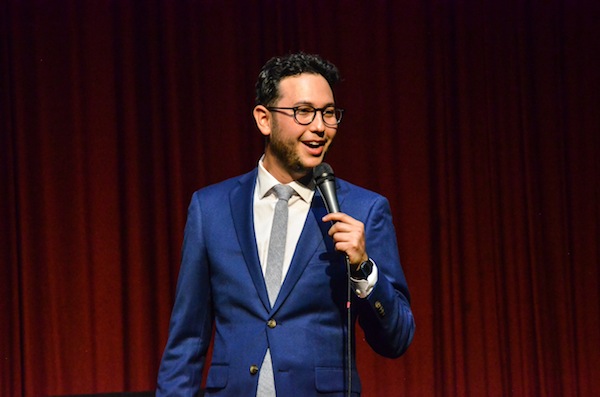
Jacob Samuel is at Yuk Yuk’s Vancouver Dec. 27-28 to record his debut stand-up comedy album. (photo from Jacob Samuel)

Jacob Samuel’s headlining performances at Yuk Yuk’s Vancouver Dec. 27 and 28 are special – Samuel is recording his debut stand-up comedy album live.

“I have complete freedom content-wise, and I am trying to record an album that has 45 minutes of the best jokes possible,” Samuel told the Independent. “I’ll mainly be recording jokes from the act I’ve honed over the last five to six years in venues throughout Canada. Part of my act has jokes about being Jewish and Judaism that I’m very proud of because they challenge stereotypes people may have about Jewish people as opposed to confirming them.”

The last couple of years have been productive for Samuel.

In 2017, he was part of the television taping at the Winnipeg Comedy Festival and he made his first appearance on CBC’s The Debaters. Since then, he has appeared two more times at the Winnipeg Comedy Festival and has returned to The Debaters, as well.

In 2018, he made his debut at the Just for Laughs Festival in Montreal and he was featured on JFL Northwest’s Best of the West Compilation album last year. In total, he has now taped five sets for Canadian TV and has performed even more times on CBC Radio.

“This summer,” said Samuel, “I got booked to go to the Just for Laughs Festival in Montreal for the second time, back-to-back. I went to perform on the Hasan Minhaj Gala. The galas are taped for TV in the 3,000-person theatre at Place des Arts.

“Getting on a JFL gala is the most coveted spot in Canadian comedy because those are the biggest shows at the festival. Every year, only a dozen or so Canadian comics get that opportunity.

“JFL Montreal, by the way, is the biggest comedy festival in the world – the entire comedy industry is there. So, when I was there, I was able to connect with 800 Pound Gorilla, an American Record label (based in Nashville) for comedy, and I told them I was doing a gala and wanted to record an album soon and, luckily, they were interested in signing me.”

Success entails doing harder gigs and carries the pressure to produce material at a faster pace, said Samuel, but he seems to be keeping things in perspective.

“I’m in my early 30s now, so the main thing in my life is that I enjoy getting home and going to bed earlier more than I use to. I don’t stay up late hanging out and drinking with other comics as much after shows. Not that I was ever a big partier, but it’s just nice to admit you like being in pajamas now.

“I also met my girlfriend/partner through comedy and we’ve been living together for a year-and-a-half now. So, I do a lot of writing by bouncing ideas back and forth with her. I have many more jokes now about being in a long-term relationship. My partner is not Jewish and did not know many Jewish people growing up, so it’s been interesting observing what she thinks about Jewish culture. I took her to her first Passover seder last year. On the way there, she asked me what it would be like and I said, ‘It’s hard to describe but tonight will be the most excited you’ll ever be to eat a hard-boiled egg.’”

Samuel recalled his early days in comedy.

“When I did my first open mic, I just wanted to see if I could physically do it,” he said. “I did not intend to become a comedian but, somehow, I got hooked and kept going. I’m starting to close in on 10 years and it’s weird to think about because, in some ways, comedy still feels like such a new thing. Having said that, when I look at very old videos, I cringe. I keep a hard copy of some of my earliest jokes in a drawer just to remind myself how far I’ve come (those jokes were very bad).”

When asked how his comedic content, delivery or style has changed since he began, Samuel said, “In short, it’s gotten a lot better. Part of learning how to do comedy is trying a lot of different types of jokes and seeing what works for you. So, now, I have a much better idea of what my ‘style’ is. Also, after countless professional club gigs, five TV tapings and several radio appearances, I’m a much stronger performer than I used to be. I’m able to do more complicated bits of material and I can now take ideas that used to be too abstract or subtle and make them work. I now have way fewer jokes about being single and way more jokes about things like carrot cake and moths.”

In addition to stand-up, Samuel is also a talented cartoonist, even having his work published in The New Yorker. While this aspect of his creative life has been put on the backburner for the last few years, he said, “I’m still cartooning but I’d like to put more time into it after this album.”

Other than that, he said he doesn’t have any other major projects planned at the moment.

“I’d like to do a second album in a few years, when I have more material. In the meantime,” he said, “I’ll keep trying to return to Canadian festivals and TV and radio. My partner and I would also like to do more sketch writing. Maybe I’ll submit to write for Canadian TV.”

Tickets for the live album recording shows Dec. 27 (8 and 10:30 p.m.) and Dec. 28 (7 and 9 p.m.) are on sale at yukyuks.com/vancouver.

Format ImagePosted on December 20, 2019December 18, 2019Author Cynthia RamsayCategories TV & FilmTags comedy, Jacob Samuel, Just for Laughs, television, Yuk Yuk's
Living’s Jewish aspects

Living’s Jewish aspects

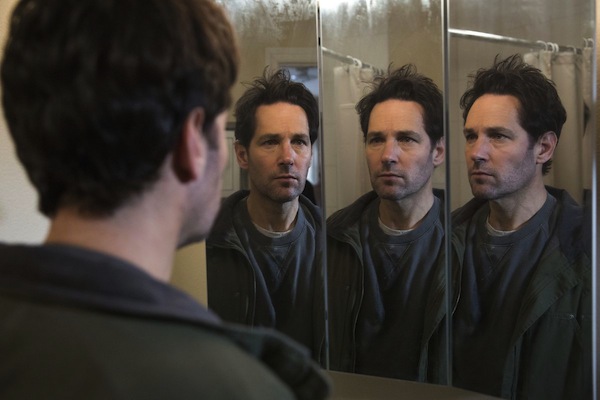
A still from the Netflix show Living With Yourself, co-starring Paul Rudd.

As the secular New Year approaches, many people make resolutions, in an effort to become a better person. What if there were a shortcut? What if, for a tidy sum, you could be transformed, virtually overnight, into the person you’ve dreamed of being?

This the conundrum posed by the Netflix show Living With Yourself, an eight-part series released in late October, starring Paul Rudd and Aisling Bea, who play spouses Miles and Kate Elliot. Rudd is also one of the executive producers.

The premise is this: Miles, a shlub discontent with and disconnected from his wife, and suffering career ennui, discovers a “spa” that offers a treatment to improve his charm and confidence. For a small fortune, they promise, a “new you.” And so, a shlemiel enters and a gentleman exits. Just one problem: [spoiler] it’s actually a cloning lab and, unbeknownst to Miles and Clone Miles, the two men exist and, later, each must contend with the other in his life.

Rudd’s 25 years of movie experience includes Ant Man, Anchorman, Knocked Up, 40-Year-Old Virgin and Clueless. On television, he played Mike Hannigan in Friends and appeared in Reno 911, among other things.

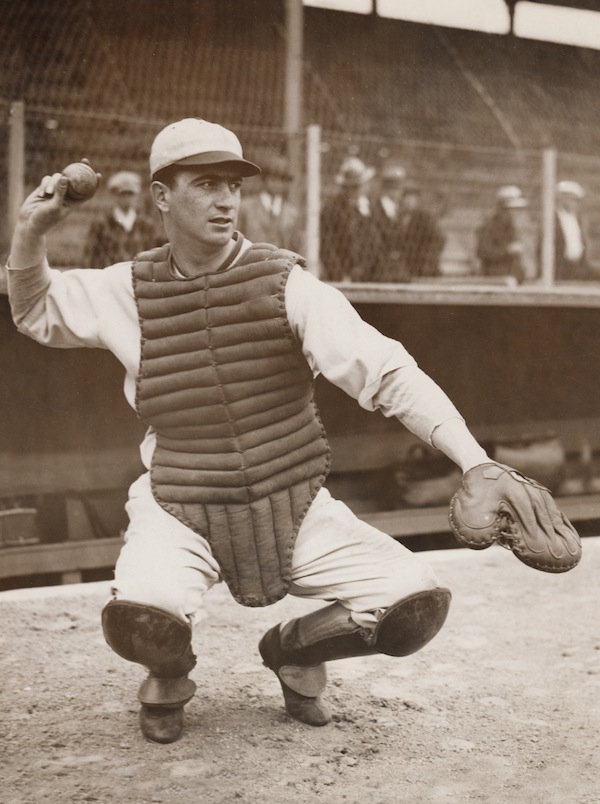
The New Jersey-born actor hasn’t been shy in publicly discussing his Jewish identity. He kibitzed a bit about his Jewishness in an interview segment of Between Two Ferns. In an episode of Finding Your Roots, he found out that his grandfather, Davis Rudnitsky, fought the Nazis, only to return home to England to face antisemitism. In 2017, Rudd played his first (overtly) Jewish character, Moe Berg, in the biopic The Catcher Was a Spy, about a baseball player who joins the Second World War effort as an undercover agent.

In Living With Yourself, there is one explicit Jewish moment, when a Holocaust survivor tells Miles an off-colour anecdote about the Shoah, involving pork. But there are also hidden Jewish themes. For example, envious of a colleague’s extraordinary success in the office, Miles is spurred by the prospect that his technological makeover could help him outperform this coworker. Though Judaism has no problem with someone being motivated to accomplish because of another’s success, the Torah warns against jealousy. The ninth commandment is one obvious caution against such sentiment: “Thou shalt not covet.” Another is Joseph’s brothers (Genesis 36), who, enraged with jealousy, sell Joseph into slavery. In a sense, Miles and Clone Miles are like brothers, and they develop petty and spiteful jealousies, wanting the best of both worlds, but not able to have it.

If only Miles initially had derived fulfilment and was grateful for what he had, he wouldn’t be in this much trouble. Ethics of Our Fathers (Pirkei Avot) (4:1) advises just that: “Who has wealth? The one who is pleased with his lot.” The meaning isn’t limited to “wealth” of materials, of course, but the wealth of blessings that are bestowed upon us, including, for most of us, our loved ones, our safety, our employment and access to the necessities of life.

Notably, though, Miles versus Clone Miles is illustrative of the yetzer hara (good inclination) and the yetzer hatov (bad inclination) at battle with each other. Interestingly, neither character is completely good nor bad, but a combination, reflecting the real, complicated, human condition, where we have both inclinations competing inside us.

Often, we are able to convince ourselves of the nobility of our decisions – that is, find a good reason for our perhaps less-than-good action; explain away the importance of a choice’s potential harm. Paradoxically, the yetzer hatov has a sneaky side. To explain this, author and radio host Dennis Prager often cites the late Rabbi Wolfe Kelman, former head of the Conservative rabbinate. He once told Prager that he had his yetzer hara under control, but his yetzer hatov “always got him into trouble.”

Rarely do ordinary people wake up each morning and strive to make another human miserable. Still, we must wrestle with our “other” selves, overcome our justifications and egos, to make principled choices. Every day is a lesson in living with ourselves.

Dave Gordon is a Toronto-based freelance writer whose work has appeared in more than 100 publications around the world.

Format ImagePosted on December 20, 2019December 18, 2019Author Dave GordonCategories TV & FilmTags culture, Judaism, Living With Yourself, Netflix, Paul Rudd, television, Torah
Jewish film festival moves

Jewish film festival moves

Robert Albanese, executive and artistic director of the Vancouver Jewish Film Centre. (photo from Vancouver Jewish Film Centre)

Community members who associate November with grey skies, falling leaves, American Thanksgiving and, in recent memory, the Vancouver Jewish Film Festival, can now cross the last item off the list. In 2020, the VJFF will be presenting films from Feb. 27 to March 8 instead.

The VJFF, the longest-running Jewish film festival in Canada and one of the longest-running film festivals in North America, will feature a collection of 32 offerings from 14 countries – including many Canadian premières – addressing current, varied and sometimes controversial subjects.

photo - Robert Albanese, executive and artistic director of the Vancouver Jewish Film CentreThis new annual time period is the most popular season for Jewish film festivals. Of the more than 200 international Jewish film festivals, the majority present films in March. In Vancouver, this will mean warmer weather and less rain.

The move to March also permits the Vancouver Jewish Film Centre (VJFC), the society which oversees the festival, to raise funds at the beginning of the calendar year. Moreover, members of the festival staff believe they will have an opportunity to select from an even wider pool of relevant and available films.

Robert Albanese, who was brought in as executive and artistic director of the VJFC in 2010, highlights the past decade of growth the festival has had in the community, and its impact. He is adamant when it comes to the relevance of film and motion pictures in modern culture.

“Film is the most engaging art form of our era … film accesses and engages the broadest community,” he told the Independent.

“We provide Jewish continuity and an awareness of Israel beyond the front page through storytelling in today’s visually oriented world. It is vastly important to have a visible presence of our culture out in this media-centric world,” he added.

Albanese stresses that the VJFF seeks to engage with the broader community by offering the very best film stories it can find. Three of the international films scheduled to screen in March have been submitted by their respective countries to vie for the Best Foreign Film Award at the 2020 Oscars. In spite of Vancouver’s relatively smaller population, the VJFF has consistently been ranked as one of the top 10 Jewish film festivals for the past several years.

Albanese’s name has been ensconced in the minds of local film aficionados for more than three decades. Before coming to the VJFC, he was a general manager for Cineplex Entertainment for 15 years and served as director of exhibitions for the Vancouver International Film Festival for 10 years. Albanese also helps in the selection process for other Jewish film festivals, such as the one held in Victoria in early November.

According to Albanese, the VJFF aims “to showcase the diversity of Jewish culture, heritage and identity through film.” This can be seen in a quick glance at last year’s program which, as festival-goers might recall, included films on an array of topics, such as The Syrian Patient, about wounded Syrians brought to Israel for treatment; Heading Home, a documentary on the Israeli national baseball team; and Chewdaism, a full-length film on Jewish Montreal and its eateries from internet stars Jamie Elman and Eli Batalion of YidLife Crisis fame.

In addition to the annual festival and other events, the VJFF presents films on the last Tuesday of every month. The November film – on Nov. 26 at 1 p.m. – will be The Invisibles, a 2017 German docudrama following the lives of four Holocaust survivors. The monthly screenings take place at the Peretz Centre for Secular Jewish Culture, where the VJFC office is located, and admission is by donation.

The 2020 festival’s opening film will be held on the evening of Thursday, Feb. 27, at the Rothstein Theatre in the Jewish Community Centre of Greater Vancouver, and will be followed by a hosted reception in the centre’s Wosk Auditorium. The festival then moves to Fifth Avenue Cinemas, screening films from Feb. 28 to March 5. For its conclusion, the festival returns to the Rothstein Theatre, with films March 6-8 and special closing day celebrations March 8.

There are presently openings at the VJFC for volunteers to help with film research and selection, event planning, distribution of promotional materials and assistance at the festival, among other tasks. Volunteers receive complimentary tickets based on the number of shifts worked.

The full list of 2020 films will be available in early January on the VJFF website (vjff.org) and elsewhere. The 2020 festival is rolling back admission prices, with passes for $144 for all films, a five-film package of $60 for adults ($50 for students and seniors) and individual tickets at $15 for adults ($12 students/seniors). Tickets for gala events are $25 and an annual VJFF membership card is $2.

Sam Margolis has written for the Globe and Mail, the National Post, UPI and MSNBC.

Format ImagePosted on November 22, 2019November 19, 2019Author Sam MargolisCategories TV & FilmTags Robert Albanese, Vancouver Jewish Film Centre, VJFF
Stand! opens on Nov. 29

Stand! opens on Nov. 29

Marshall Williams as Stefan Sokolowski and Laura Slade Wiggins as Rebecca Almazoff fall in love in the movie musical Stand! (still from the movie)

The film Stand! comes out in Cineplex theatres across Canada on Nov. 29. Locally, it will play at SilverCity Riverport Cinemas in Richmond. The story of how the independent film got to the big screen is as interesting as the movie itself. And both it, and the musical on which it is based, started with a simple conversation.

The idea for the musical Strike! came over a deli sandwich in 2002. Then-Winnipeg Free Press editor Nicholas Hirst suggested to Winnipeg composer, producer and writer Danny Schur that there might be some musical-worthy drama found in the Winnipeg General Strike of 1919. Schur – who already had two full-scale musicals on his CV – followed up, coming across a photo of Ukrainian-Canadian Mike Sokolowski, who was killed by one of the “special police” – the actual police force, who sympathized with the strikers, had been fired and replaced with thugs – in what is now known as “Bloody Saturday,” June 21, 1919. Being Ukrainian-Canadian himself, Schur was hooked.

He wrote 18 songs and the script for the musical Strike! by 2003. A workshop of it at the University of Winnipeg connected Schur to director Anne Hodges and writer Rick Chafe, who helped get the production ready for its première – first an abridged version, an outdoor show in 2004; then the full version in 2005. (Chafe is also co-writer of the film with Schur.)

“The idea for the movie first sprang from a conversation I had with Jeff Goldblum in 2005,” Schur told the Independent in an interview. “He was sitting beside me at the Winnipeg world première (he was in a relationship with our Winnipeg female star [Catherine Wreford], whom at that time had a Broadway career). After seeing the musical, he stated, ‘Big story, big ideas, it would make a great movie.’ And I thought, ‘If Jeff Goldblum says it will make a great movie, that must surely be the case.’ I naively believed it would take two or three years to come to fruition and it took 14. Shows what I knew!”

Those years would be filled with adapting the musical from stage to screen, raising the large amount of money needed to film a movie, casting the roles, finding a director, finding a production company, etc., etc.

The considerations in translating the stage production to film were legion, said Schur. “First, some songs had to go, because the average number of songs in a movie musical is eight; the stage show has 18. Some of the cuts were obvious – because some of the actors we cast were not singers. In all cases, it was a matter of what served the story best. What works on stage does not necessarily translate to screen. Rob [Adetuyi] was extremely helpful in this regard, having as much experience as he does with film.

“But the biggest change to screen was Rob’s doing: to make the film more diverse. Emma, the black maid, was a conscious change to reflect history better and have a more diverse film. So, too, was the case with the character of Gabriel [a Métis soldier who served in the war].”

When Adetuyi, the director of Stand! (whose mother is Jewish, as it happens), changed the maid character from being Irish to being a black woman who had fled racist violence in the United States, Schur wrote a new song, “Stand,” which became the title of the film.

Sokolowski is one of the main characters in both the musical and film. He and his son, Stefan, are struggling to earn enough money to bring the rest of their family to Canada from Ukraine. Among their neighbours are Jewish siblings Rebecca and Moishe Almazoff, the latter of whom is based on a real person. (Moishe Almazoff is the pen name for Solomon Pearl.)

Amid the harshness of life and their bleak future, Stefan and Rebecca fall in love. Schur told the JI that he based the interfaith romance on that of his aunt and uncle, “she the Christian, he the Jew.” Of course, the couple’s relationship isn’t welcomed by their families and respective communities. And, of course, the poor living and working conditions, the labour unrest, the threat of deportation and the violence are not conducive to love.

In a neat turn, the making of the film has led to changes in the musical.

“I always say, musicals are never written, they’re rewritten,” explained Schur. “So, where, before, the movie was substantially different from the stage musical, we have now edited the stage version to reflect the movie. So, now they’re pretty close. Having said that, the stage play has more songs.”

The music is certainly one of the highlights of the film. In this regard, and also another of the Jewish connections to the production, Schur noted, “Gail Asper is the hugest supporter of the movie, having invested in the stage show and the movie, and she convinced Montreal’s Sharon Azrieli to do the same. Sharon, who is an opera singer, sang the closing credit song, ‘Change,’ which I wrote for her.”

As for the feat of getting an independent movie a national release, not to mention deals for distribution in the United States and Japan, Schur said, “This is a truly indie release; in other words, there is no distributor involved. We went to Cineplex and said, ‘We have an audience. Please give us some screens.’ Where Cineplex could have given us a token, small number of screens, they provided screens from sea to shining sea, which is a testament to their belief in the film. I cannot say enough good things about the good people at Cineplex for giving us our chance to make a stand, especially in the midst of so busy a late fall season.”

Stand! showtimes and tickets are listed at cineplex.com/movie/stand.

“The movie is a unique opportunity to take the experience of the Jewish community in Canada circa 1919 and apply the lessons of the era to today, be those lessons for the community itself, or the broader community of immigrants,” said Schur. “In an era where discrimination is on the rise, the movie is a metaphor that teaches us that ‘love thy brother’ is the best way forward.”

Format ImagePosted on November 22, 2019November 20, 2019Author Cynthia RamsayCategories TV & FilmTags Danny Schur, film, general strike, history, musical theatre, Winnipeg
When Chabad turns up

When Chabad turns up

A still from The Rabbi Goes West: one of Chabad-Lubavitch Rabbi Chaim Bruk’s goals is to see a mezuzah on the door of every Jewish home in Montana.

In their documentary The Rabbi Goes West, filmmakers Gerald Peary and Amy Geller have succeeded in a difficult task – providing a balanced, respectful and entertaining glimpse into what happens in a state with a small, minimally affiliated Jewish community when Chabad-Lubavitch arrives.

A branch of Chassidism, Chabad-Lubavitch was started some 250 years ago in White Russia, in what is now Belarus. After the Holocaust, the movement began its outreach in earnest, trying to reach non-religious and unaffiliated Jews almost literally everywhere in the world. There are now approximately 5,000 Chabad emissaries in more than 90 countries.

While emissaries may receive some seed funding to start a new centre, they must raise their own funds to stay active. In 2006, Chabad Rabbi Chaim Bruk ventured from Brooklyn, N.Y. – Chabad headquarters is in Crown Heights – to Bozeman, Mont., to scout it out. Encouraged by the growing population and the amount of tourism, Bruk returned to Crown Heights to get the OK to set up a centre there. Given the green light, he and his wife Chavie did just that in 2007. The rabbi’s goal? To ensure that every one of Montana’s 2,000 Jewish families has a mezuzah on their door. One of the ways in which he makes headway on this task is by traveling all over the state, asking safe-looking strangers (who are the vast majority, he says) whether there are any Jews in the area and then, when he finds them, boldly introducing himself and his purpose.

As charming and open as Bruk seems, his presence, the ultra-Orthodox Judaism to which Chabad adheres and the movement’s expansionist mission – two more Chabad centres have opened since the Bruks arrived – are not universally welcomed by the Montana Jewish community. The Rabbi Goes West includes interviews with fellow rabbis Francine Roston (the first Conservative woman rabbi to lead a large congregation), who came to Montana from New Jersey in 2014; Allen Secher (co-founder of Chicago’s first Jewish Renewal congregation), who came to Montana after he retired in 2000 but retook the bimah when he found out he was the only rabbi in the state at the time; and Ed Stafman (a former trial lawyer), who came to the state from Florida. The film also includes commentary from local Jews from all four congregations.

While Bruk has limited involvement with the other congregations and rarely, if ever, joins their events – he contends that most of them violate some aspect of Judaism, such as the laws of kashrut, for example – the Jewish community does unite, along with other religious and secular groups and individuals in the state, when faced with neo-Nazi threats and cyberattacks.

The Rabbi Goes West is a documentary well worth seeing, both for its content and the way in which that content is presented. Sponsored by the Vancouver Jewish Film Centre, it screens at the Vancouver International Film Festival Oct. 7, 6:30 p.m., at Cinémathèque, and Oct. 8, 11:30 a.m., at International Village 10. For the full festival lineup, visit viff.org.

Format ImagePosted on September 20, 2019September 17, 2019Author Cynthia RamsayCategories TV & FilmTags Chabad, Chaim Bruk, documentary, Judaism, lifestlye, Montana, Vancouver International Film Festival, VIFF
Survivor dances duet of life

Survivor dances duet of life

Éva Fahidi, in front, and Emese Cuhorka in a still from The Euphoria of Being, directed and written by Réka Szabó.

Éva Fahidi was 18 years old when she and her family were taken to Auschwitz. The men and women were separated. The women’s selection committee cut the line after Fahidi: “I went one way, and my whole family the other way. It was over. We are talking about a fraction of a moment, when one didn’t even have the faintest idea of what was really happening.” Forty-nine members of her family were murdered, including her mother, father and sister.

Fahidi tells this part of her story as dancer Emese Cuhorka, covered from head to toe in a black leotard, moves around her, expressing with her body some of what Fahidi is expressing verbally. This is but one of many moving scenes in The Euphoria of Being, written and directed by Réka Szabó. The Jewish Independent has chosen to sponsor the documentary’s screening at this year’s Vancouver International Film Festival, which runs Sept. 26-Oct. 11.

Szabó had heard Fahidi give a talk in Berlin, and she had read Fahidi’s memoir, The Soul of Things. She wrote to Fahidi about wanting to make a performance about her, with her it in. The almost-90-year-old Hungarian Holocaust survivor responded positively: “Every person should possess some form of healthy exhibitionism,” she says in the film. “I have more than is needed, so I don’t have any excuses.”

Cuhorka reminds Szabó of Fahidi. From this resemblance came the concept of a duet. At one of the first rehearsals, Fahidi shows Cuhorka what she’s able to do physically. “And, from the outside, it is like seeing an entire life at once,” says Szabó, as she watches them move together.

photo - Réka Szabó
Réka Szabó (photo by Dusa Gábor)

The documentary covers the three-month period prior to the October première of what would become Sea Lavender. The work is the collaborative creation of the three women and, while what we are shown of the final result is powerful, it is the process and the bonds formed by the women that have the most impact, and give the film its inspirational quality.

Fahidi is remarkable. She is smart, spirited, well-spoken and endearing. When she talks about her Holocaust experiences, it is as if she is reliving them; her eyes look unfocused, her body appears heavier, her anger remains. She says her family should have left Hungary in 1935. “But my poor father, he couldn’t see beyond his nose,” she says. So proud was he of what he had built, he couldn’t leave it behind and only go with the clothes on his back. “This is the eternal tragedy,” she says, “that you don’t see things for what they are when you see them. Absolute idiocy.”

The film then cuts to a photo of the family – her parents, sister and her – as Fahidi describes the way in which she imagines them being gassed. She talks about a documentary she saw on Zyklon B, how it was first tried on geese. Such factual expositions lay raw the depth of her grief.

Yet, when Szabó asks Fahidi to list some of the things that helped her survive, Fahidi remarks that you have to appreciate and value the fact that you’re alive. “The fact that you exist, in itself, is euphoric,” she says. Hence, the name of the documentary and of the choice of “the flying chair duet” as the final scene of the performance. In discussing the nature of tragedy, Fahidi concludes that it’s no use thinking about it because you always end up in the same sad place. “Meanwhile,” she says, “you live happily.”

Seeing Cuhorka and Fahidi work and perform together is delightful – the two really do bear similarities, and their mutual respect is evident. The closing text of the film notes, “At the age of 93, Éva is still performing regularly. So far, we have staged 77 performances of Sea Lavender in numerous cities, such as Berlin, Budapest and Vienna.” While it is too much to hope that the show will come to North America, it is satisfying to know of the project’s life-changing effect on Fahidi, who, apparently, “can’t imagine being alive and not performing the piece anymore.”

The Euphoria of Being screens Sept. 27, 12:30 p.m., at International Village 8, and Oct. 3, 7 p.m., and Oct. 4, 10 a.m., at Vancity Theatre. For tickets, visit viff.org.

Format ImagePosted on September 13, 2019September 10, 2019Author Cynthia RamsayCategories TV & FilmTags dance, documentary, Emese Cuhorka, Éva Fahidi, Holocaust, memoir, Réka Szabó, survivor, Vancouver International Film Festival, VIFF
Filming faith on No. 5 Road

Filming faith on No. 5 Road

Stills from the NFB’s Highway to Heaven: A Mosaic in One Mile. Richmond Jewish Day School is one of the institutions featured in the short film, which screens at this year’s Vancouver International Film Festival.

The National Film Board short Highway to Heaven: A Mosaic in One Mile, written and directed by Sandra Ignagni, is visually striking. For the most part, it lets the images do the talking, communicating more about cultural diversity than words could.

Part of this year’s Vancouver International Film Festival, Highway to Heaven introduces viewers to the multiple faith groups and institutions along a mile-long section of No. 5 Road in Richmond, which includes Richmond Jewish Day School. In the 17-minute documentary, this strip of road – which has been called “Highway to Heaven” – appears both full of colour and action, as well as remote and removed, not just geographically but with chain link fencing and other security measures.

“We share a world grappling with ethnic and racial tensions, religious xenophobia and violence,” writes Ignagni in her director’s notes. “Such realities are not limited to the world’s conflict zones – they are a part of everyday life, even in the most advanced democracies such as Canada. It was in this context that I was drawn to the peculiar landscape of No. 5 Road … where multiple cultural and religious groups share a short stretch of suburban road. I was curious about how groups pitted against each other in so many corners of the world appeared to be living relatively peacefully with one another, and in very close proximity, in an ordinary Canadian suburb.”

image - Still from the NFB’s Highway to Heaven: A Mosaic in One Mile: classroomIn showing the beauty of the area – both in landscape and in cultural acceptance – Ignagni also captures some of the tensions that exist. The camera jumps from a lush orchard to a mansion mid-construction to a for-sale sign in front of what seems to be part of a forest. In one scene, which looks like it was filmed at RJDS, police in full gear – bulletproof vest and holstered weapons – address RJDS and Az-Zahraa Islamic Academy students, introducing themselves so that the kids should feel comfortable going to the police if they have a problem. The police then referee the kids in a game of ball hockey – boys against the boys, girls against the girls – throwing in questions about boundaries and other issues for the kids to consider.

Referring to the police presence on the road, Ignagni writes that it could “be variously interpreted as bridge-building, protection or surveillance. I learned that, for more than one decade, the Richmond Jewish Day School did not have an exterior sign for fear of antisemitic attacks against its schoolchildren. And, in recent years, the secular residential community that surrounds No. 5 Road launched a major campaign opposing the proposed expansion of a Pure Land Buddhist temple, using the pejorative moniker ‘Buddha Disneyland’ to describe the proposed building in local media and public debates. The mere fact that zoning by-laws have ordered these communities – the majority of which play a critical role in new immigrant and refugee resettlement – to the fringe of suburban land is also ripe for reflection.”

The minimal use of narration or interviews in the film was a deliberate choice. To do otherwise, Ignagni notes, “would be an exercise in public relations, reducing complex issues to soundbites and polemics. Instead, I wanted to make a film that would at once capture the remarkable – because it is truly remarkable – diversity on No. 5 Road, as it actually exists, while gesturing to some of the unresolved issues that underlie Canadian multiculturalism. The film is, therefore, constructed as a ‘mosaic’ – defined by writer and activist Terry Williams as ‘a conversation between what is broken.’”

image - Still from the NFB’s Highway to Heaven: A Mosaic in One Mile: classroomWhile she doesn’t rely on words to tell this story, sound plays an integral role in the film: calls to prayer, monks chanting, different languages being spoken (and not translated), kids playing, school bells ringing.

“My film invites audiences to sit with what is unknown, different, raw or only partially visible,” says Ignagni. “To me, a mosaic captures perfectly the subtle tensions one finds on No. 5 Road, where custom and ritual, language and cultural diversity are practised under surveillance cameras and behind locked doors and gates. In making this film, I am asking audiences to look with open eyes and hearts – with a spirit of curiosity – at themselves and their neighbours, and simply reflect on multiculturalism as an unfinished project in need of attention in Canada and around the world.”

In addition to RJDS and Az-Zahraa, the list of participating neighbours includes the Evangelical Formosan Church of Greater Vancouver, India Cultural Centre of Canada/Gurdwara Nanak Niwas, Kingswood Pub, Lingyen Mountain Temple, Mylora Executive Golf Course, Royal Canadian Mounted Police (Richmond detachment), Thrangu Tibetan Buddhist Monastery, Trinity Pacific Church, and Vedic Centre.

At VIFF, Ignagni will participate in one of a series of panel discussions presented by Storyhive on Totally Indie Day, Sept. 28, at Vancity Theatre. She will be on the hour-long panel called Not Short on Talent: The Rise of the Short Form Documentary, which starts at 3:45 p.m. For the full film festival lineup, including, eventually, the not-yet-listed screening time of Highway to Heaven – which was an Official Selection at this year’s Toronto International Film Festival – visit viff.org.

Format ImagePosted on September 6, 2019September 4, 2019Author Cynthia RamsayCategories TV & FilmTags interfaith, National Film Board, NFB, Richmond Jewish Day School, RJDS, Sandra Ignagni, Vancouver International Film Festival, VIFF
The search for a friend

The search for a friend

Finding Fukue follows Jessica Stuart’s journey to Japan to find her childhood friend.

screenshot - Finding Fukue follows Jessica Stuart’s journey to Japan to find her childhood friend
(screenshot)

To what lengths would you go to find a childhood friend whose letters stopped coming decades ago? When online searches proved fruitless, Vancouver-born, Toronto-based musician Jessica Stuart headed back to Japan, and her journey is recorded in the CBC Short Docs film Finding Fukue, which was produced with Real Stories. Since posted to YouTube last November, the charming and moving documentary has been viewed more than 3.6 million times to date.

“When I was 9 years old, my parents got English teaching jobs and moved us all to Japan for a year,” shares Stuart as the film starts. Among the images we see are clips of home movies from that year, 1988. “I was a blond kid, and that made me of interest to all the Japanese people because they had never really seen a blond-hair person before,” she says. “They would point at me or my sister, touch my hair, talk at me; I didn’t understand anything yet. The day after we arrived, I went to school for the first time and then that was crazy. I didn’t feel that anyone was interested in getting to know me, except for one person, and her name was Fukue, and we became best of friends.”

The Stuarts – Wendy, Ron and daughters Fiona and Jessica – settled in Saku, then a small rural village with no foreigners. Now, however, Stuart has to start looking for her friend Fukue in a city of 100,000 people. She visits the elementary school they attended and gets a yearbook, where she gets Fukue’s father’s name and an address from the year 2000, but this leads her to a new development, where she and her translator (for the more complex encounters) meet some women who remember her family but can’t help with finding Fukue.

At Saku City Hall, a press contingent meets Stuart and she gets the word out on television and in print. Finally, a clerk at City Hall manages to find a phone number for Fukue’s sister, who connects the two friends. The reunions – first by phone and then in person – are quite emotional. The two fall into a familiar comfort and get reacquainted. They have kept in touch since.

The approximately 21-minute film can be found at youtu.be/ZVlZMOB-Sq0.

Format ImagePosted on June 28, 2019June 26, 2019Author Cynthia RamsayCategories TV & FilmTags Canada, CBC, documentary, friendship, Fukue, Japan, Jessica Stuart

Posts pagination

Previous page Page 1 … Page 10 Page 11 Page 12 … Page 24 Next page
Proudly powered by WordPress