Skip to content
  • Home
  • Subscribe / donate
  • Events calendar
  • News
    • Local
    • National
    • Israel
    • World
    • עניין בחדשות
      A roundup of news in Canada and further afield, in Hebrew.
  • Opinion
    • From the JI
    • Op-Ed
  • Arts & Culture
    • Performing Arts
    • Music
    • Books
    • Visual Arts
    • TV & Film
  • Life
    • Celebrating the Holidays
    • Travel
    • The Daily Snooze
      Cartoons by Jacob Samuel
    • Mystery Photo
      Help the JI and JMABC fill in the gaps in our archives.
  • Community Links
    • Organizations, Etc.
    • Other News Sources & Blogs
    • Business Directory
  • FAQ
  • JI Chai Celebration
  • JI@88! video

Recent Posts

  • BGU fosters startup culture
  • Photography and glass
  • Is it the end of an era?
  • Taking life a step at a time
  • Nakba exhibit biased
  • Film festival starts next week
  • Musical with heart and soul
  • Rabbi marks 13 years
  • Keeper of VTT’s history
  • Gala fêtes Infeld’s 20th
  • Building JWest together
  • Challah Mom comes to Vancouver
  • What to do about media bias
  • Education offers hope
  • Remembrance – a moral act
  • What makes us human
  • המלחמות של נתניהו וטראמפ
  • Zionism wins big in Vegas
  • Different but connected
  • Survival not passive
  • Musical celebration of Israel
  • Shoppe celebrates 25 years
  • Human “book” event
  • Reclaiming Jewish stories
  • Bema presents Perseverance
  • CSS honours Bellas z”l
  • Sheba Promise here May 7
  • Reflections from Be’eri
  • New law a desecration
  • Resilient joy in tough times
  • Rescue dog brings joy
  • Art chosen for new museum
  • Reminder of hope, resilience
  • The national food of Israel?
  • Story of Israel’s north
  • Sheltering in train stations

Archives

Follow @JewishIndie
image - The CJN - Visit Us Banner - 300x600 - 101625

Category: TV & Film

When Jews Were Funny promises less and more than it delivers

When Jews Were Funny promises less and more than it delivers

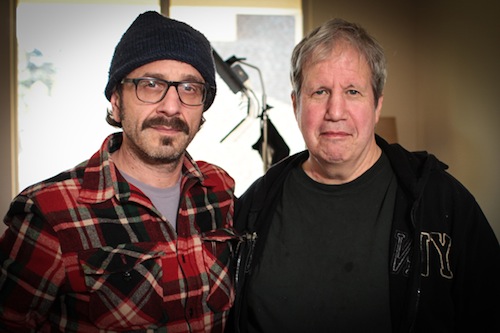
Director Alan Zweig, right, and Marc Maron. (photo from Sudden Storm Entertainment)

When Jews Were Funny is a seemingly straightforward title that promises both less and more than Alan Zweig’s unexpectedly provocative documentary delivers.

The Toronto filmmaker’s stab at closing the book on American Jews’ enormous contribution to 20th-century comedy is funny ha ha, all right, but the laughs are more of the chuckle variety than outright guffaws. At the same time, the film is also a tad funny-weird, shot through with a personal streak that’s disarming and discomfiting in equal measure.

Yet, when all is said and said – there’s no doing in this film, only talking – When Jews Were Funny is oddly satisfying. Zweig may be seeking answers but, instead of a mood of finality, his film has a catalytic effect. It invites every Jewish viewer to weigh in – personally and anecdotally, emotionally and sociologically – on the sources and state of Jewish humor on the long road from immigration to assimilation.

Zweig achieves this unusual level of reflection by structuring When Jews Were Funny so that it feels like its viewers are party to a succession of conversations. Instead of buffeting the viewer with punchy sound bites delivered via rapid-fire cutting between interviewees, he serves up chunks of real-time interaction.

It would normally be the smooch of death for a talking-head documentary to linger at length on the faces of its interviewees. But when they include Shecky Greene, Ed Crasnick, Howie Mandel, David Steinberg, Judy Gold, Gilbert Gottfried, Bob Epstein and Stewie Stone, we await with anticipation the next insight, witticism or off-the-wall remark.

image - When Jews Were Funny posterParadoxically, and somewhat perversely, Zweig doesn’t lead with his best material. To the contrary, he makes the risky and self-effacing choice of opening with Shelley Berman, who’s baffled into near-silence by Zweig’s earnest questions.

A legendary figure, Berman saw himself as a comedian who had to appeal to everyone – he didn’t do “Jewish” material. So, while it’s factually accurate to call him a Jewish comic and he takes pride in being Jewish, he doesn’t see himself as a purveyor of Jewish humor. So, he asks, what does Zweig want from him?

At first, it seems that Zweig is on a quixotic quest to identify and define the qualities of Jewish humor, and Berman represents an awkward, inauspicious beginning, but we’re intrigued by a filmmaker who showcases his own pratfall – in the crucial opening minutes, no less – rather than leaving it on the editing room floor.

Things improve for Zweig (and the audience) from here, and we’re treated to a variety of incisive analyses, off-the-cuff musings and entertaining meanderings from comics who span three generations. They pinpoint various characteristics of Jewish humor, from clever wordplay to an off-centre worldview to droll melancholia (which, depending on your perspective and the joke in question, might express defiance or fatalism).

The bottom line? “Jews own comedy,” declares Steinberg, speaking more directly and less diplomatically than most of his peers. “I’m proud to say that’s true.”

As a form of proof, and for classic straight-ahead laughs, Zweig intersperses brief, delectable clips of Alan King, Rodney Dangerfield, Harvey Stone, Henny Youngman and Jackie Mason performing on The Ed Sullivan Show in the mid-1960s. This was the golden age of Jewish stand-up, when Borscht Belt vets found mainstream success, and it coincided with Jews across America transitioning from outsiders to insiders.

The viewer gradually realizes, however, listening to Zweig question and interact with his subjects, that he is propelled less by ethnographic interest than by some nagging personal dilemma. Almost imperceptibly, When Jews Were Funny begins to feel like a first-person documentary in which we continually hear but never see the protagonist (that is, the filmmaker).

Zweig desires reassurance that the bittersweet experience and restless personality that drove so many wonderful Jewish comedians is not disappearing.

It’s not giving too much away to say that Zweig remembers the joy of growing up with extremely funny uncles (never aunts) and grandparents, and frets that his young daughter will never know “old Jews.” He desires reassurance that the bittersweet experience and restless personality that drove so many wonderful Jewish comedians is not disappearing.

A few interviewees call Zweig on his not-so-hidden agenda, pointing out good-humoredly that even his angst-fueled inquiry is uniquely Jewish.

“Look at you,” says the New York stand-up comedian Modi. “We got a camera crew to discuss your Judaism. It’s so self-obsessive. What goy, what Christian in the world is running around now with a camera crew, ‘Talk to me about being Christian!?’ No one cares.”

When Jews Were Funny taps into a large reservoir of affection and tenderness, which is not the first thing you’d expect to encounter with urban Jewish performers. Perhaps the film’s generous heart explains its award for best Canadian documentary at the Toronto International Film Festival last fall, since there’s nothing innovative or especially adroit about the filmmaking.

That generosity extends to the audience. Zweig’s implicit concerns about the future of Jewish identity evoke, and include, our own. And what could be more Jewish than a large plate of jokes with a side order of gnawing doubt?

JI readers can get $1 off the digital download of the film, which screened last fall in both the Vancouver International and Vancouver Jewish Film Festivals, at whenjewswerefunny.com by using the discount code JEWISH.

Michael Fox is a San Francisco film critic and journalist.

Format ImagePosted on June 27, 2014August 27, 2014Author Michael FoxCategories TV & FilmTags Alan Zweig, When Jews Were Funny
Fading Gigolo’s Jewish notes

Fading Gigolo’s Jewish notes

Woody Allen, left, and John Turturro in Fading Gigolo. (photo from Millennium Entertainment)

“My big thing was to not have him wear khaki pants and an army coat,” said John Turturro with a broad smile. “And I got him out of that. I said, ‘That’s not in my color scheme. I’m an Italian director.’”

This dash of bravado might sound pretentious, or even ludicrous, on paper. But when it comes from a tall, impeccably groomed man in an elegant blue velvet suit (double-breasted, blue shirt buttoned to the top, no tie), it seems perfectly reasonable.

For his fifth feature behind the camera, Fading Gigolo, the renowned actor and filmmaker solicited ongoing (and ruthless) feedback from another New York icon, Woody Allen, during the lengthy screenwriting process. Allen accepted a rare acting assignment in the film, hence the discussion of his costume.

Allen plays a newly retired Manhattan bookstore owner who, in need of money, convinces his friend, floral arranger Fioravante (Turturro), to provide sexual services to affluent women. Murray claims a fee for arranging the liaisons, which take Fioravante in an unexpected and ultimately poignant direction.

photo - John Turturro in Fading Gigolo.
John Turturro in Fading Gigolo. (photo from Millennium Entertainment)

Fading Gigolo starts out as a slightly absurd sex comedy and deepens into a mature, empathetic study of big-city loneliness against a backdrop of cross-cultural and ethnic identity. The crucial relationship in the film is between Fioravante and Avigal (French actress Vanessa Paradis), an astute mother of six and the widow of a Chassidic rabbi. Sex isn’t part of the equation, but Dovi, a protective and covetous neighborhood Satmar watchman (a touching Liev Schreiber), can’t know that.

“I met all these people who’ve left the [Satmar] community” in the course of his research, Turturro said in a recent interview at a San Francisco hotel. “They’re like the strays of the community. They gather in this place, people who left and people who hadn’t left who just went there to see what was going on.”

Paradis got to know one woman in particular who had left the Satmar community and explained the various directives, such as keeping her hair concealed under a wig.

“All these things are made up by men,” Turturro declared. “Women didn’t make these rules. And, to me, that says it all.”

Fading Gigolo is unambiguously respectful toward observant Jewish practice, while inviting us to empathize with a woman trying to reconcile autonomy and conformity.

“Avigal’s not looking to escape,” Turturro explained. “She’s just looking to receive.”

Fading Gigolo climaxes with a religious trial where Murray is confronted with the query, “Are you proud to be a Jew?” It’s the question we’ve long wanted Allen to answer onscreen and, at that moment, it’s difficult not to conflate the character and the actor.

Turturro’s experience of Judaism goes well beyond growing up in New York and now living in the Park Slope neighborhood of Brooklyn. His wife is Jewish and his son went to Hebrew school, and Turturro confides that he’s spent a fair amount of time in Reform synagogues. He has played several Jewish characters onscreen, most famously in the Coen Brothers’ Miller’s Crossing and Barton Fink, and immersed himself in the life of Primo Levi to portray the Italian-Jewish Holocaust survivor in Francesco Rosi’s The Truce.

“If you’re raised a Catholic, you realize there’s not a debate that goes on,” Turturro said. “And, if you’re raised a Jew, there’s a debate that goes on. And I really like that. Therein lies one of the greatnesses of Judaism.”

At Allen’s behest, Turturro brushed up on Isaac Bashevis Singer’s short stories while he wrote the Fading Gigolo screenplay. But, after all his various and diligent research, certain things came down to intuition – and style.

“I only chose Satmar because I liked the hats the best,” Turturro said. “I don’t want the Borsalino. I’m Italian. It’s an esthetic choice, understand. That’s how it goes with me. The hat dictates. That’s it.”

Fading Gigolo is playing at Fifth Avenue Cinemas. It’s rated R for some sexual content, language and brief nudity.

Michael Fox is a writer and film critic living in San Francisco.

Format ImagePosted on June 6, 2014August 27, 2014Author Michael FoxCategories TV & FilmTags Fading Gigolo, John Turturro, Satmar, Woody Allen
Film spotlights dance as a way to forge peace partners

Film spotlights dance as a way to forge peace partners

Dancing in Jaffa follows dance instructor Pierre Dulaine as he teaches 11-year-old Israelis and Palestinians. (photo from Tiara Blu Films)

Going back at least as far as 2001’s Promises, most recent documentaries that have opted for an optimistic slant on the Israeli-Palestinian situation have centred on children. The next generation, to be sure, is the universal embodiment of hope. But betting on today’s children to solve a problem down the road is tacit acknowledgement that today’s adults aren’t up to the task – or so those who see the Mideast glass as half-empty might say.

Both perspectives are skillfully interwoven in Dancing in Jaffa, a nuanced, feel-good study of cross-cultural fence-hopping in which the best traits in human nature vie with street-level realities.

The movie’s motor is world-champion ballroom dancer and teacher Pierre Dulaine, who returns to his hometown after many years with the self-proclaimed goal of giving something back. Perennially dressed in a starched shirt and tie, and fluent in Arabic, English and French, the grey-haired Dulaine is a cosmopolitan alien in a working-class town.

The indefatigable Dulaine is a lifelong proponent of partnered dancing as a way to develop social skills and self-confidence but, in Jaffa, he’s determined to apply his pedagogy to an even greater good. His plan is to teach merengue, rhumba and tango to 11-year-olds at various schools, culminating with young Jewish and Palestinian Israelis dancing together in a public ballroom dance competition.

“This is how you learn to work with another person,” Dulaine offhandedly remarks to one child while correcting his form. It’s a lovely sentiment, one that will gradually sink in after the student has become comfortable with the steps and can actually look at and interact with his or her partner.

There’s an unpredictability and bumpiness to Dulaine’s mission, at least initially, that negates the comforting formula that some viewers will expect. Most of the kids are shy, embarrassed and downright resistant to engaging with the opposite sex, even without the Islamic prohibition on touching someone of the opposite sex. (None of the Jewish kids are Orthodox.)

While boys will be boys and girls will be girls, Dulaine perseveres with firmness, as well as affection. Progress in the classroom can be hard to discern, however, so the film provides glimpses of the home lives of three children to suggest their individual blossoming.

Hilla Medalia, the prolific Israeli-born producer and/or director of such documentaries as To Die in Jerusalem and Numbered, again displays her talent for gaining access, winning trust and crafting small, revealing moments. The most memorable are political rather than interpersonal, and occur on the street rather than in someone’s home. The arrival in town of an intentionally intimidating group of right-wing Israelis chanting some variation of “Jaffa for the Jews” provides buzz-killing evidence that conciliation is not everyone’s goal.

An illuminating sequence contrasting the observance of Independence Day at a Jewish school with its description as the Nakba (Catastrophe) at a Palestinian Israeli school likewise underscores Medalia’s preference for presenting reality rather than peddling fantasy.

In this regard, she and Dulaine are perfectly in step. He was four years old when he left Jaffa with his Palestinian mother and Irish father during the War of Independence, and he’s chagrined but not surprised when his request to re-enter his family’s old home is summarily rejected by the Jewish owners.

Consistent with the theme that the future is more important than the past, Dulaine’s presence in the film steadily diminishes. We, and he, are left with the satisfaction that individual children have grown and glimpsed possibilities they couldn’t have imagined. A small victory, perhaps, compared to a lasting resolution to the ongoing conflict? Even a pessimist wouldn’t have the chutzpah to call a child’s transformation a “small victory.”

Dancing in Jaffa, in Hebrew, Arabic and English with English subtitles, played at the Vancouver Jewish Film Festival in November 2013 and has yet to have a Canadian release date scheduled. It’s on a limited release in the United States. The film currently has a rating of 100 percent on Rotten Tomatoes.

Michael Fox is a writer and film critic living in San Francisco.

Format ImagePosted on May 2, 2014May 2, 2014Author Michael FoxCategories TV & FilmTags Dancing in Jaffa, Hilla Medalia, Pierre Dulaine
Carl Sagan’s Cosmos finds new life

Carl Sagan’s Cosmos finds new life

Carl Sagan with Viking. (photo by Jet Propulsion Laboratory)

Carl Sagan fans old and new have been gazing at their televisions in awe as host Dr. Neil Degrasse Tyson’s resurrection of the science epic Cosmos takes them on a journey from the Big Bang, to microscopic one-celled organisms, to the ascent of man, to beyond the stars and planets. The return of Cosmos – which launched in March and runs for 13 episodes on the Fox network, ending June 2 – provides an opportune time to remember Sagan, the show’s Jewish creator.

An American astronomer, astrophysicist, cosmologist and author, Sagan was born to into a family of Reform Jews. According to science writer William Poundstone, author of Carl Sagan: A Life in the Cosmos, Sagan’s family celebrated the High Holidays and his parents made sure that he knew Jewish traditions.

“Both of his parents instilled in him this drive to get ahead in America, and that is something he kept all his life,” said Poundstone in an interview. “It may have been one factor in this idea that he not only wanted to be a successful astronomer, but [also] to write books, to become a celebrity and an entrepreneur. His mother particularly instilled that in him.”

Read more at jns.org.

Format ImagePosted on April 25, 2014August 27, 2014Author Robert Gluck JNS.ORGCategories TV & FilmTags A Life in the Cosmos, Carl Sagan, Neil Degrasse Tyson
Noah channels God’s wrath and humankind’s fallibility

Noah channels God’s wrath and humankind’s fallibility

Russel Crowe is Noah in Darren Aronofsky’s latest film. (photo from Paramount Pictures)

An earnest amalgam of free-association Bible story, dire disaster movie and family melodrama, Noah is a more thoughtful and provocative movie than one has any right to expect. Sure, it’s ludicrous and ponderous at times and embellished with gratuitous special effects, but it also succeeds in prodding the viewer to reflect on his or her behavior toward others and relationship to God.

Darren Aronofsky, a Brooklyn Jew by birth and upbringing, has concocted a sporadically inspired film with enough fodder for a month of sermons. It’s a compelling saga up until the great flood, when key plot elements collide with enough force and absurdity to sink an ark. Metaphorically speaking, that is. After all, the species (plural) must go on.

In terms of contemporary resonance and relevance, the film’s depiction of religious absolutism pushed to the point of tyrannical self-righteousness – in the name of God, of course – neatly undercuts the inclination by zealots of any faith to claim Noah as gospel.

I remember Noah as a mild-mannered super-carpenter and reluctant zoologist in my Hebrew school classes of yore, but you don’t cast Russell Crowe to play a guy grappling with internal and existential dilemmas. His Noah is a decisive survivalist who doesn’t hesitate to kill to protect his family or to fulfil God’s plan.

Aronofsky’s Noah can only infer and deduce that plan from the occasional wondrous sign or disturbing dream, aided by his sage, Merlin-esque grandfather, Methuselah (Anthony Hopkins). Aronofsky and co-writer Ari Handel resist the temptation – and the arrogance – of having God speak directly to Noah.

We have no doubt, though, that Noah is the last true believer in the Creator, as the Lord is referred to throughout the picture. Indeed, he has a real talent for channeling God’s merciless fury. In this regard, Noah is reminiscent of Moses, who was up to the task of meting out vengeance – or justice, in the vernacular of the film – when the time came.

That association aside, Aronofsky’s most Jewish picture remains his mystical black-and-white debut, Pi, in which Handel has a cameo as a kabbalah scholar. It is much more difficult to discern a Jewish sensibility in Noah than it was (to summon another biblical adaptation) to detect Mel Gibson’s deep-seated antisemitism in The Passion of the Christ.

photo - Noah's Ark in the film Noah
Noah’s Ark, pictured here with its master builder and his son, is based on interpretations of what the biblical vessel may have looked like. (photo from Paramount Pictures)

The most jarring element in Noah from a Jewish perspective is the presence of angels, called “Watchers” and manifested as angry, hulking, walking, talking rock piles. Punished by God for trying to intervene on behalf of Adam and Eve, the Watchers decide to help Noah – and, by extension, serve their Creator – build the ark and then repel the hordes who desperately attempt to board when the hard rain starts a-fallin’.

At a crucial moment, the Watchers are redeemed for their sacrifice and return to the heavens like Roman candles. Polls report that a majority of Americans believe in angels, so for some viewers this sequence will mark the emotional high point of the movie.

Amid the concessions to visual effects-driven miracles, Noah manages to convey the nasty, brutish world of the Bible. At the same time, it demolishes Noah’s cloak of absolute good to demonstrate that no person is devoid of flaws and fallibility.

The film does not, alas, evoke the strength and power of the Bible’s matriarchs, for its female characters – Noah’s wife Naameh (Jennifer Connelly) and a young girl (Emma Watson) saved and raised by the family who grows up to be Shem’s love interest – are given little to do in the second half except cry, shriek and sob.

The biggest obstacle to a visual rendering of Noah’s mythic saga, though, is that we know how the reboot of civilization turned out. We’re living it. So the optimistic rainbow at the end of Noah has all the credibility and gravitas of a Hallmark commercial.

Whether we see the modern world as the inevitable manifestation of human nature in all its glories and depravities or as a technologically supercharged Sodom, Noah makes us ponder the fate of the world as a function of our interdependence as well as our individual morality. Should we fear God’s anger and another flood, or (as the movie hints) is a self-inflicted die-off from environmental destruction just as likely? Either way, Noah represents a powerful admonition to humankind.

What’s intriguing about a repeat apocalypse is that it would be a communication from a God who’s been silent for centuries. The power of Noah, one could say, is to remind us that every cloud has a silver lining.

Michael Fox is a writer and film critic living in San Francisco.

Format ImagePosted on April 11, 2014August 27, 2014Author Michael FoxCategories TV & FilmTags Ari Handel, Darren Aronofsky, Emma Watson, Jennifer Connelly, Noah, Russell Crowe
Films offer glance at Bedouin life

Films offer glance at Bedouin life

A still from the movie Voices from El Sayed.

When one is a Bedouin living in southern Israel, ironies seem to multiply with regularity. Two relatively recent Israeli-made films bring this incongruous life into sharp focus.

In the first, Voices from El Sayed: A Snail in the Desert (2009, documentary), director Oded Leshem examines a minority within a minority – a special needs Bedouin group. In the second, Sharqiya (2012, drama), director Ami Livne focuses on an Israeli Bedouin who, although he has spent his young adult life protecting other Israelis – first as a soldier and then as a security guard – faces eviction from his land because the Israeli authorities do not acknowledge it as his.

Leshem focuses on both the social and technological challenges facing the deaf members of the El Sayed Bedouin. In an understated but convincing manner, Leshem makes this point: for people who are deaf, this Bedouin tribe is both heaven and hell.

Leshem presents a lot of information in his 75-minute film. For starters, he unearths this nugget: the El Sayed have the highest concentration of deaf people of any community in the world. Estimates are that this desert community located northeast of the Negev city of Be’ersheva has 3,000 tribal members and, of this number, 125-150 are deaf. Intra-marriage is high – 65 percent of El Sayed’s couples are somehow related – so deafness is, therefore, more often transmitted from generation to generation. Almost every family has a deaf family member.

In this village, deafness is acknowledged as a fact of life. Not only is it considered normal, but everyone in the film – hearing and deaf – knows and uses sign language. At first glance, deaf community members appear totally accepted and functioning comfortably within the group. There is always someone with whom to converse – but in which language does one communicate?

According to Leshem’s film, language is one of the major social challenges facing Israel’s minorities. The film notes that the older deaf members of El Sayed converse in their own form of signing: El Sayed Bedouin Sign Language (EBSL). A number of the younger members, however, have studied in schools outside the community. These schools fall under the jurisdiction of the Israeli Ministry of Education, so these Bedouin study Israeli Sign Language (ISL). In addition, these same young students learn to read and write in Hebrew, rather than in Arabic, their mother tongue.

There is no school for the deaf on tribal land: children are bused to a school in Be’ersheva. But not every deaf child attends or has attended this facility. As the audience learns, some young adults studied in the centre of the country. However, on the positive side, the film explains that Be’ersheva has a special early childhood class for the hearing challenged, which is taught by traditional Bedouin teachers.

The deaf young adult tribal members who speak in the film want to marry deaf partners. But in this strongly paternalistic society, their parents still have a lot of say in marital matches. Some of the hearing parents want their marriage-age children to break what they see as a chain of deafness, so they are interested in having their deaf offspring pair off with hearing mates.

Not only are there parents who want to alter the course of future generations, but there are those trying to improve the life of their offspring in the present. The movie depicts one set of hearing parents who decide that one of their children will be the first El Sayed member to undergo a cochlear implant.

The good news is that the Israeli health-care system will cover the cost of the surgery and the implant itself. But, as viewers soon grasp, this family faces many other obstacles. The first several months following surgery entail regular and frequent trips back to Be’ersheva’s Soroka Hospital. During these hospital visits, the parents learn how to encourage their toddler to listen in everyday situations. Both the mother and father accompany the child to the hospital. There, they work with a Hebrew-speaking professional staff. The father speaks and reads Hebrew fluently, but the mother does not. No Arabic translator is provided. This point is critical as, at home, the mother has the huge task of ensuring that all the other children participate in the training.

No less significant is the hospital staff’s lack of awareness of the overall situation in El Sayed. While Leshem’s camera reveals that high-tension wires stand in close proximity to the village, the film’s narrative discloses that El Sayed is not hooked up to the national grid. There is no electricity, except for the generators that power the village. Just as the hospital staff comes to terms with the family’s difficulty in keeping all the implant parts properly charged, so the audience grasps just how challenging this procedure is for this family.

El Sayed lacks what most Westerners would consider basic utilities or services. For the dispersed Bedouins living in areas of southern Israel, which successive governments have classified as “unrecognized,” not having electricity or running water is a common situation. Nowhere is that brought home more clearly than in Livne’s drama Sharqiya.

photo - a still from Sharqiya
A still from Sharqiya.

The story of Sharqiya centres around two brothers and the wife of one trying to live on family land. The land appears fairly inhospitable. Family members live quite minimally in one-room tin huts, serviced by a temperamental generator. In the barren surroundings, one brother herds a small number of goats, while Kamel Najer, the other brother and main character, works as a security guard in Be’ersheva’s central bus station.

Westerner viewers might wonder why it is so important to keep this undeveloped plot of land, especially when Israeli authorities offer compensation for leaving it. Coming from a Western society, it is also hard to get one’s head around the notion of inheriting land without documentation. But this is exactly what the Najer brothers claim: their family has lived on the land for generations.

In the film, viewers watch the authorities stand by, waiting to destroy the Najers’ homestead, as Kamel packs up cherished memorabilia from his army service. We witness this young Israeli Bedouin – who has felt enough sense of belonging to hold on to his army pictures and banners – have his living space made not just unfit, but non-existent. Livne makes it clear that if Israeli society does not appreciate the irony of this situation, it will not understand that such treatment puts the fragile foundation of Israel’s democratic structure at risk of collapse.

When the human and humane element is missing – as depicted by the Israel Land Authority’s tractor leveling the family’s meagre housing and corral – the cracks in society’s foundation deepen. The frustration and the disappointment do not fade out: in the closing shot, they are inscribed on Kamel’s face.

Deborah Rubin Fields is an Israel-based features writer. She is also the author of Take a Peek Inside: A Child’s Guide to Radiology.

More on the Bedouin

The following links are to position papers or websites of some of those involved in Israeli Bedouin affairs.

From the Israeli government: mmi.gov.il/static/HanhalaPirsumim/Beduin_information.pdf

From Jewish National Fund: www.kkl.org.il/eng/about-kkl-jnf/kkl-jnf-in-public-discourse/kkl-jnf-conferences/kkl-jnf-european-leadership-conference/kkl-jnf-position-bedouin

From a few nongovernmental organizations:

• adva.org/uploaded/NegevEnglishSummary.pdf

• dukium.org/eng/wp-content/uploads/2011/06/NCF-CounterClaims-Dec10.pdf

• acri.org.il/en/category/arab-citizens-of-israel/negev-bedouins-and-unrecognized-villages

Format ImagePosted on February 7, 2014April 16, 2014Author Deborah Rubin FieldsCategories TV & FilmTags Ami Livne, Bedouin, Oded Leshem, Sharqiya, Sign Language, Voices from El Sayed

Posts pagination

Previous page Page 1 … Page 23 Page 24
Proudly powered by WordPress