Skip to content
  • Home
  • Subscribe / donate
  • Events calendar
  • News
    • Local
    • National
    • Israel
    • World
    • עניין בחדשות
      A roundup of news in Canada and further afield, in Hebrew.
  • Opinion
    • From the JI
    • Op-Ed
  • Arts & Culture
    • Performing Arts
    • Music
    • Books
    • Visual Arts
    • TV & Film
  • Life
    • Celebrating the Holidays
    • Travel
    • The Daily Snooze
      Cartoons by Jacob Samuel
    • Mystery Photo
      Help the JI and JMABC fill in the gaps in our archives.
  • Community Links
    • Organizations, Etc.
    • Other News Sources & Blogs
    • Business Directory
  • FAQ
  • JI Chai Celebration
  • JI@88! video

Recent Posts

  • Sharing her testimony
  • Fall fight takes leap forward
  • The balancing of rights
  • Multiple Tony n’ Tina roles
  • Stories of trauma, resilience
  • Celebrate our culture
  • A responsibility to help
  • What wellness means at JCC
  • Together in mourning
  • Downhill after Trump?
  • Birth control even easier now
  • Eco-Sisters mentorship
  • Unexpected discoveries
  • Study’s results hopeful
  • Bad behaviour affects us all
  • Thankful for the police
  • UBC needs a wake-up call
  • Recalling a shining star
  • Sleep well …
  • BGU fosters startup culture
  • Photography and glass
  • Is it the end of an era?
  • Taking life a step at a time
  • Nakba exhibit biased
  • Film festival starts next week
  • Musical with heart and soul
  • Rabbi marks 13 years
  • Keeper of VTT’s history
  • Gala fêtes Infeld’s 20th
  • Building JWest together
  • Challah Mom comes to Vancouver
  • What to do about media bias
  • Education offers hope
  • Remembrance – a moral act
  • What makes us human
  • המלחמות של נתניהו וטראמפ

Archives

Follow @JewishIndie
image - The CJN - Visit Us Banner - 300x600 - 101625

Byline: The Editorial Board

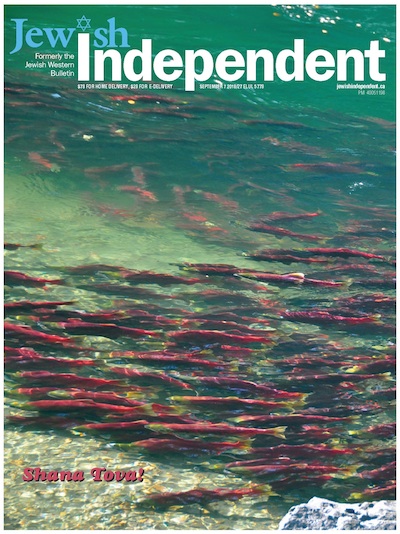
About the Rosh Hashanah 2018 cover art

About the Rosh Hashanah 2018 cover art

The print edition’s cover photo of the salmon run on Adams River by Leah Ramsay was taken in 2010 at Tsútswecw Provincial Park, near Kamloops, B.C. Formerly named after conservationist and author Roderick Haig-Brown, the park was renamed Tsútswecw this past June.

photo - Rosh Hashanah 2018 coverTsútswecw (pronounced choo-chwek) translates to “many rivers” and the park, established in 1977, encompasses the spawning beds of the sockeye, chinook, coho and pink salmon. Every fourth year is a “dominant” run, with millions of salmon returning – 2010, when this photo was taken, was a dominant year, as is 2018. In honour of the occasion, there is a festival held at the park, called Salute to the Sockeye, which runs this year from Sept. 28 to Oct. 21.

One of the symbols of Rosh Hashanah is the fish head – “we should be the head and not the tail.” There are the themes of creation, rebirth and renewal, as well. In the run, the salmon return from the ocean to their natal stream to spawn, after which most die, their bodies providing nutrients to the vegetation and animals, and the lifecycle begins anew. This all happens in British Columbia from September through November.

“Seeing one of the peak years of the Adams River sockeye run had been a desire for many years and it didn’t disappoint,” said Ramsay. “Even non-hardcore nature nerds are impressed – it is such a huge mass of life all moving to the same goal.”

Format ImagePosted on September 7, 2018September 6, 2018Author The Editorial BoardCategories Celebrating the HolidaysTags British Columbia, environment, photography, salmon
Shana tova on West Boulevard

Shana tova on West Boulevard

photo - The Spectacle Shoppe’s display window, side view
(photo by Cynthia Ramsay)

The Spectacle Shoppe’s display window. (photo by Cynthia Ramsay)

Once again, Leo Franken has made the Spectacle Shoppe’s display window on West Boulevard in Vancouver eye-catching for the holidays. Passersby on Sunday afternoon, when these photos were taken, voiced their appreciation of his efforts and the Rosh Hashanah message – “Happy New Year!”

Format ImagePosted on September 7, 2018September 6, 2018Author The Editorial BoardCategories Celebrating the HolidaysTags Leo Franken, Rosh Hashanah, Spectacle Shoppe

Opening Pandora’s box

Maxime Bernier quit the Conservative party last week, at the precise moment that Conservatives from across the country were gathering in Halifax for their national convention, preparing for the federal election that is 13 months away.

Canadian political history would suggest that the former cabinet minister’s departure and his promise to form a new federal political party will be little more than a footnote in the history books when all is written.

The ostensible point of division between Bernier, who came a very close second to Andrew Scheer in last year’s Conservative leadership contest, is supply management. Supply management is an agricultural policy that limits supply in an attempt to stabilize prices so that Canadian farmers can make a decent living. It’s the reason we pay what we do for cheese, milk and poultry and it is prefaced on the understanding that the few extra dollars we pay weekly keeps the agricultural sector viable.

Bernier, who lambasted his former party over the issue, is correct. Support for such meddling in the economy is antithetical to conservative economic values. But it is an oddly Canadian consensus by which parties across the spectrum essentially accede to the status quo for political, if not policy, reasons. Opponents of Bernier in last year’s leadership race expressed fears that his opposition to supply management would undermine the Conservatives precisely where they are most popular: in rural Canada.

If less interventionist economic policies become the basis for Bernier’s new political party, it is hard to imagine how it will catch fire among Canadian voters. From a political standpoint, such a platform seems like a loser from the gate.

But there is a potential wild card in this scenario. Though he skirted the subject during his news conference last week, Bernier’s recent social media statements play to xenophobic, anti-immigrant sentiments. This, far more than economics, has the potential to get the attention of Canadian voters.

The Liberal government under Prime Minister Justin Trudeau likes to be associated with openness and a welcoming diversity, which contrasts nicely with developments to the south. But a recent poll suggests Canadians may not be as settled on this approach as some of us would like to believe.

The poll asked whether Canadians believed that there are too few, too many or the right number of immigrants to Canada. Overall, 18% of Canadians said there are too few immigrants coming to Canada, while 38% said there were too many and another 38% said the numbers were about right. The poll’s breakdown by party label indicates just how divisive this discussion could become. Only 12% of self-declared Liberals said that Canada has too many immigrants, while 73% of Conservatives hold that position.

Canadians, to an extent, have avoided opening a Pandora’s box in the form of a national discussion about immigration, perhaps happy in our complacency and self-image as a welcoming place. If Bernier’s new party – or, indeed, if the Conservatives – see an opening, we may be about to lift the lid somewhat on this issue.

If Bernier decides that he has nothing to lose and something to gain from upsetting accepted wisdom, it won’t necessarily prove a winning formula for his new party. However, if, by raising these topics, he forces other parties to articulate more specifically the generalized approach to multiculturalism and diversity that we take for granted, we may be headed for a reckoning on immigration, diversity and openness.

The election of Doug Ford as premier of Ontario suggests that populist messages are not anathema to Canadian voters. The Quebec provincial election, now underway, may very well provide a test case for some of these ideas that challenge our cherished notions of diversity.

When voter turnout hovers around the 50% mark, mobilizing one’s political base can be as crucial as convincing the undecided. If suspicion of outsiders appears likely to excite an identifiable core of the electorate, ambitious politicians will certainly consider how they might benefit by exploiting it.

Confronted by a heckler in Quebec last week, the prime minister shut her down by dismissing her as racist. It turns out, she may well be. But she also may not be the voice in the wilderness that some, including the prime minister, would like to believe. These people, too, will demand to be represented in Parliament and in the national discussion.

The rest of us, then, will need to have more than happy axioms and comforting self-satisfaction if we are to successfully defend diversity, inclusiveness and the social and economic value of new Canadians.


Posted on August 31, 2018August 29, 2018Author The Editorial BoardCategories From the JITags Canada, Conservatives, elections, immigration, inclusion, Justin Trudeau, Maxime Bernier, politics

Impacts of nation-state

Canada’s identity has evolved dramatically since the Second World War. First, the country’s self-image changed from an Anglo orientation as a member of the British Empire-cum-Commonwealth to a concept of “two founding nations,” which included the recognition of bilingualism and biculturalism as pillars of our identity. No sooner had that change been digested than we broadened the definition of Canadianness to incorporate multiculturalism and then, very belatedly, we have recently come to recognize the important place of indigenous Canadians and to attempt to reconcile our peoples with the history of injustice and cultural genocide perpetrated against First Nations.

Not all countries are given to this sort of evolving self-identity. Israel, in very different ways but over the same period, has struggled to define itself in a manner that reflects both its founding premise and its demographic and cultural realities. For several decades, the country has debated the question “who is a Jew?”; a riddle that goes to the heart of the nation’s identity in part due to the Law of Return, which grants citizenship to any Jew. But the place of non-Jewish citizens – both in the state of Israel and, more problematically, in the territories occupied in 1967 – has confounded the country as it struggles to be both a democratic country and one particularly founded as the homeland of the Jewish people.

This matter was brought to a head (again) recently by a law passed by the Knesset dealing with the country’s Jewish identity.

In practical terms, the “nation-state law” has little impact. If an Israeli didn’t follow the news, they would probably not notice any change in their daily life. The law is mostly symbolic. It enshrines the Jewish calendar as official, declares Jerusalem the country’s capital, codifies what was already the practical reality in terms of Jewish iconography in Israeli national symbols, such as the Star of David on the flag and the menorah on the national shield. But, it also explicitly downgrades the Arabic language, mother tongue of 22% of the country’s population, from official language to one with a “special status.” That doesn’t mean that Arabic (or English) will be erased from street signs or other official places, but it is a calculated poke in the eye to the country’s largest minority population – people who have struggled for decades to adapt themselves to their status as non-Jewish citizens of the Jewish state.

Critics, particularly on the left, have condemned the law as the triumph of Jewishness over democracy in the continuing struggle over the country’s identity as a Jewish and democratic state. Some claim that the accusation of “apartheid” has now been proven and codified. Competing New York Times op-eds by Ronald Lauder, head of World Jewish Congress, and Naftali Bennett, Israel’s minister of Diaspora affairs, took diametrically opposing positions on the law.

The law’s enemies perhaps did themselves no favours during a mass rally in Tel Aviv nearly two weeks ago, when Palestinian flags were prevalent and some participants seemed to be promoting a one-state resolution.

The controversy is the culmination of several years of debate over the law, or variations on the theme. Prime Minister Binyamin Netanyahu defended the final bill, which passed the Knesset overwhelmingly.

“We enshrined in law the basic principle of our existence,” he said. “Israel is the nation state of the Jewish people, that respects the individual rights of all its citizens. This is our state – the Jewish state. In recent years, there have been some who have attempted to put this in doubt, to undercut the core of our being. Today we made it law: this is our nation, language and flag.”

The prime minister’s words are accurate enough. He acknowledges the fundamental and perhaps irreconcilable tug between “the nation state of the Jewish people” and one that “respects the individual rights of all its citizens.” And he is correct that the law enshrines what was already the de facto reality.

He is also not far off the mark in stating that some have tried to put in doubt Israel’s identity as a Jewish state – there are calls in the Middle East and elsewhere for a unitary state between the Mediterranean and the Jordan River, a concept that would effectively eliminate Jewish national self-determination. Yet, this is perhaps the most specious of Netanyahu’s arguments. Yes, there are those would see the Jewish state destroyed. But these voices are no more mainstream nor prevalent than they have been in recent years.

The law is red meat for Netanyahu’s core supporters and those to their right. It is a provocation – and an unnecessary one – that even the prime minister claims has no real, practical impact.

However, it does have an impact – and one that is perhaps not unintended. The law makes non-Jewish citizens of Israel feel isolated and demoralized and it strengthens the case of those inside and outside Israel who condemn the country for inequality and favouritism.

Posted on August 24, 2018August 22, 2018Author The Editorial BoardCategories From the JITags Israel, law

BDS’s lacrosse to bear

Before a soccer match with Maccabi Tel Aviv last week, the Hungarian football team Ferencváros Torna Club paid tribute to István Tóth in what is being heralded as a meaningful move against a creeping antisemitism that has permeated the European sporting world among other spheres.

Tóth was a Ferencváros Torna player and coach in the 1940s before joining the anti-Nazi resistance and saving hundreds of lives, including Jews who he helped escape detention and probable death. Tóth was captured and executed in 1945.

Last week’s game in Budapest was dedicated to Tóth’s memory.

North Americans who were swept up (or bemused) by global soccer mania at the height of the World Cup last weekend can almost appreciate the depths of feeling the sport evokes in much of the world. National feelings – and other high emotions – understandably permeate fan expressions. What is more baffling from afar is the manner in which antisemitism has seeped into the culture of European sport. Among other manifestations, fans from some teams will ridicule or intimidate those of opponents by implying the players or their supporters are Jews. In one instance, fans plastered a town with images of Anne Frank in the opposing team’s uniform. Elsewhere, fans suggested the opponents lacked foreskins. It’s difficult to wrap one’s mind around: that accusations of Jewishness have been used as a tool of intimidation on a playing field. The closest analogy, perhaps, might be the example more common in North American sports, in which opponents are accused of homosexuality. But, with Europe’s history of antisemitism, and the alarming growth of extremist politics across the continent, this hints at a deeper problem. This is why the Budapest event, which was coordinated with the assistance of World Jewish Congress, was as significant as it was. It was an official statement against antisemitism in sport and a testament to a hero of the Holocaust era.

Meanwhile, in a sports competition some distance away, a variant form of political activism, not unrelated to antisemitism, was playing out.

The BDS movement has been trying to isolate Israel in social, economic and cultural spheres. Athletes from Iran and countries with other Israel-hating governments have thrown matches rather than legitimize the Zionist entity, or athletes have refused to shake hands with Israeli competitors. There are even groups urging a boycott of the next Eurovision song contest because, as Israel’s Netta Barzilai was the 2018 victor, Israel will be the host country for next year’s round.

The latest attempt at a boycott, though, comes with a happy ending – and a Canadian twist.

The Iroquois Nationals lacrosse team recently arrived in Israel to participate in the World Men’s Lacrosse Championships. Soccer may be “the world’s game” and hockey may be where many Canadians’ invest our emotional energies, but lacrosse is, officially, our national game. (In a bow to popular demand, Parliament some time ago declared hockey our national “winter” sport and lacrosse our national “summer” sport, but details.) While many Canadians have an almost religious devotion to hockey, the Iroquois refer to lacrosse as “the Creator’s Game.”

The Iroquois team arrived at Ben-Gurion airport with indigenous passports. A few years ago, the team was forced to forfeit their games when the host country, the United Kingdom, refused to accept their travel documents. Israel, on the other hand, welcomed the Iroquois passports after interventions from the Government of Canada and the Canadian embassy in Israel.

While diplomats and respected figures like Irwin Cotler intervened to help, the BDS movement tried to prevent the team from attending. It was a particularly nasty effort, since the Iroquois invented the game. It may have been in this very fact that the BDSers smelled a potential symbolic victory, no matter how offensive the impact would have been on the individual players and the tournament more broadly had the First Nations team – one of the sport’s powerhouses – been excluded. And, as is often the case with the BDS movement, their success would have hurt Arabs as much as anyone. The Iroquois Nationals will lead a coexistence lacrosse clinic for Arab and Jewish young people.

There is a history of friendship, however unlikely, between the Iroquois and Israelis, both indigenous in their homelands. Earlier this year, the Seneca Nation, one of six groups that comprise the Iroquois Confederacy, celebrated Yom Ha’atzmaut, Israel’s Independence Day, issuing a proclamation stating that “the Seneca Nation and the state of Israel share in common a passion for freedom and a willingness to fight for and defend our sovereignty and our shared right to be a free and independent people.”

The lacrosse tournament, which brings together 46 teams in the largest-ever such event, culminates this weekend. It may not elicit the rapturous fandom we saw last weekend in the World Cup. But we certainly have our sentimental favourites.

Posted on July 20, 2018July 18, 2018Author The Editorial BoardCategories From the JITags antisemitism, Holocaust, identity, Israel, lacrosse, soccer, sports

Redefining antisemitism

An Illinois congressional district leans so heavily Democratic that no serious figures contested the Republican nomination for this fall’s midterm elections. As a result, an avowed Nazi has become the official Republican standard bearer in the suburban Chicago area.

The issue is not that he stands a hope of winning. He doesn’t. The critical test is the degree of unanimity with which the mainstream body politic of the United States comes together to condemn the candidate and reject the normalization of his positions. So far, results are tepid.

Some GOP figures are advising voters not to cast a ballot in the race, which seems like bad advice in a democracy. Others are saying, simply, “Don’t vote for the Nazi,” without suggesting voters support the Democrat. When asked if he was urging Republicans to support the Democrat in the district, Illinois Governor Bruce Rauner simply said, “No.”

We have been seeing far too many examples of Americans putting party over country and humanity recently. President Donald Trump has been able to get away with his worst excesses only through the support of a Republican Congress.

Nevertheless, for whatever limits partisanship puts on bulwarks to bad things, most Americans agree Nazism is bad and should be condemned.

A more ambivalent reaction is taking place in the United Kingdom. The British Labour party has been embroiled for some time in a very serious internal conflict around antisemitism. Senior party figures, including MPs, have uttered (or expressed on social media) things that any “woke” person would recognize as founded on antisemitic premises. In some cases – including in a “closed” Facebook discussion group of which party leader Jeremy Corbyn was a part – the most medieval and unequivocal stereotypes, accusations, conspiracies and Jew-hatred have gone unchallenged.

Members of the party have been kicked out after being subjected to internal party investigations for antisemitic rhetoric. But some have been allowed back in and others have been let off without any censure, even after expressing what the most casual observers would recognize as unacceptable attitudes toward a minority group.

A reckoning has been coming. So, in an effort to set some ground rules, a party committee adopted a definition of antisemitism last week that will serve as the measuring stick in upcoming investigations around whether party figures have or have not engaged in antisemitic rhetoric or behaviour.

The party based their new rules on the standards created by the International Holocaust Remembrance Alliance (IHRA) – criteria that have attained a degree of consensus as perhaps the most conclusive definition we can hope to develop for something as amorphous as antisemitism. The guidelines have been adopted by governments and quasi-governmental agencies worldwide, including Britain’s, but the Labour party thought the guidelines could use some improvements – and so they made their own tidy edits.

The Labour party’s red pen took out references that assign antisemitic intent to the equation of Zionism with Nazism. They deleted the parts where the IHRA says that antisemitism includes accusing Jewish people of being more loyal to Israel than their home country. Under the new Labour party rules, it’s OK to say that Israel’s very existence is racist. Holding Israel to a higher standard than any other countries is also fine with the party.

In short, the Labour party retrofitted the definition of antisemitism to comport with the attitudes and actions of their members, instead of forcing their members to adhere to international standards that reject antisemitism.

The new rules also put the onus on the victims to prove intent, which is almost unprovable. In effect, a Labour member can say whatever they wish – “ZioNazi” is a favourite, it seems – as long as they declare that their intent was not antisemitic. For whatever else this represents, it is a betrayal of a core tenet of the global progressive movement: that those who experience discrimination are the ones who get to define it.

As disturbing as the antisemitism crisis in U.K. Labour is – especially as Theresa May’s Conservative cabinet is imploding and a new election could come any day – it is an important moment for addressing left-wing antisemitism throughout the West.

It is one of the first formal, structured discussions we have seen in Western countries around the issue of defining, identifying and censuring antisemitism within mainstream political discourse. It is not a good thing that it is necessary, but it is good that the necessary discussion is taking place.

Of course, this could go (at least) two ways. Labour could experience a backlash over their efforts to redefine antisemitism to their political benefit, realize that they are far outside acceptable discourse and undertake a genuine correction. Alternatively, they could stick with their highly problematic definition of antisemitism, leave their substantial problem of institutional anti-Jewish bias in place and still win the next U.K election. In which case, they will have moved the goalposts of acceptable discourse in dangerous new directions, with implications that go far beyond Britain.

Posted on July 13, 2018July 11, 2018Author The Editorial BoardCategories From the JITags antisemitism, Britain, elections, politics, racism, United States

Neighbourly relations

The lineups at local border crossings to the United States over the Canada Day long weekend suggest rhetoric about Canadians avoiding visits to our neighbour have been largely overblown. We may be repulsed by the Trump administration’s treatment of would-be refugees, especially children, but cheap gas, cheese and milk – as well as the plethora of delights at Trader Joe’s – mean many of us just can’t stay away.

Ironically, it is partly because our dairy products are so expensive – because of our supply management system – that the U.S. president is raging at Canada in the first place and why we amped up our tariffs July 1 in a trade war Trump launched.

At the same time, most of us know that our immediate neighbours are much like ourselves. The places we are most likely to drive to – Bellingham, Seattle and smaller centres dotting the American Pacific coast – are inhabited by some of the most liberal voters in that country. These are not places where Trump bumper stickers or MAGA caps are widely prevalent.

Likewise, if we jump on a plane, the destinations we choose tend to be similar in attitudes: the beaches, amusement parks or golf resorts of Southern California, the wine country of Northern California, oases in Arizona that are likely to have as many Albertans as native-born Arizonans. Punishing businesses in these locations because their president has xenophobic views doesn’t seem particularly sensible.

On the other hand, we might have more reticence about stepping out of these familiar spots. We might rethink road-tripping across the country; that generations-tested means of memorable family bonding, backseat battles and boredom. Almost anyone who has traveled through rural America returns with stories of salt-of-the-earth kindness and folksy friendliness. Yet, knowing that some counties in the most picturesque parts of the United States voted for Trump – and still support him by huge margins – one might be forgiven for looking askance at the family in the next booth at the roadside diner. What is behind the smiles and extroverted affability that can turn so mean in the ballot box and when responding to public opinion polls about immigrants and minorities?

Leaving aside whether we would feel personally comfortable in some locations, there is the larger issue of whether Canadians should boycott American products. On social media this week, you can find suggested product choices that make it easier to buy Canadian instead. It’s a matter of individual choice whether this is a productive use of energy, but, if it makes people feel better and helps the Canadian economy in a time of challenge, it seems like a fine enough gesture.

It is notable, though, to compare the nascent cross-border boycott to the BDS movement against Israel. Admittedly, the U.S.-Canada clash is mere weeks old, while the Israeli-Arab conflict has been in high gear for seven decades, giving sides more time to organize. But, while a significant number of Canadians seem to think that a boycott of Israeli products, ideas and people is a legitimate tactic, it is doubtful that a similarly organized movement will coalesce around the idea of boycotting Americans.

Some BDS supporters have maintained that their boycott targets Israeli “policies,” although the founder of the movement, Omar Barghouti, has no qualms about his position that Israel should cease to exist as a Jewish state. In any event, how bad would American “policies” need to become before BDS advocates devoted their substantial energies to boycotting U.S. products? Certainly we are unlikely to see a Canadian consensus that suggests a total economic, cultural, academic and social boycott of America, as the BDS movement promotes with Israel. It would be impossible, of course, given the interconnectedness of our countries, but the question remains: Why do some take the hard line with Israel but not with other countries?

Indeed, consider the approach held by most people, even those who are likely to support BDS: with North Korea, Iran and anyone else with whom we have not insubstantial differences, the consensus approach is engage, mediate, negotiate. It’s the approach we are pursuing with the United States on one hand, while retaliating with tariffs on the other. Yet, when it comes to Israel, in economic matters, academic interactions, sporting competitions and every level of human interface, a sizeable group demands that we make Israel an international pariah, isolate it in every way, exclude it from the global community. What can that possibly be about?

Posted on July 6, 2018July 5, 2018Author The Editorial BoardCategories From the JITags antisemitism, boycott, Canada, economics, racism, travel, United States

The pot talk we need

Last week, Prime Minister Justin Trudeau announced that marijuana would become legal in Canada on Oct. 17. He had intended that it should be legal this Sunday – Canada Day. But the Senate, rousing itself from obsolescence just long enough to throw a wrench in the plans, delayed passage of the pot legalization bill until this month, making implementation by Canada Day impossible.

This may not seem like a particularly relevant topic for a Jewish newspaper editorial, but substance use is just as relevant in our community as it is in any. A few years ago, a panel discussion took place at Schara Tzedeck Synagogue on the topic. Prof. Raphael Mechoulam, a chemist and expert on marijuana’s medicinal uses visiting from the Hebrew University of Jerusalem, and Dr. Kathryn Selby, a University of British Columbia clinical professor in pediatric developmental neurosciences, took opposing sides.

Mechoulam said that cannabidiol (CBD), a component in marijuana, may have medical uses “in almost all diseases affecting humans.” However, little scientific research has been done.

Cannabinoid receptors are abundant in several regions of the brain, including those where movement control, learning and memory, stress, cognitive function and links between cerebral hemispheres occur. CBD can also impact appetite, blood pressure, cerebral blood flow, the immune system and inflammation. It can, in some cases, reduce or eliminate seizures and cancerous tumours.

But Selby raised an issue that has gone almost entirely ignored throughout Canada’s national discussion about marijuana legalization.

Marijuana can have deeply deleterious effects on the brains of adolescents and young adults, altering the brain’s structure and function in lifelong ways. The development of the human brain continues into the 20s, Selby said, and the prefrontal cortex, where judgment and executive functions occur, is the last to develop – thus the most likely to be affected by intensive marijuana use.

Longer-term impacts of marijuana use by adolescents have been shown to correlate with schizophrenia later in life and a 50% to 200% increase in psychoses among heavy users. Daily marijuana use during high school has been correlated with a 600% increase in depression and anxiety in later life.

Selby recommended that marijuana use, if undertaken at all, should be “as late and as little as possible.”

During the national discussion around this issue, much concern was expressed about the ability of law enforcement officials to identify and measure marijuana impairment among drivers. Almost no discussion was devoted to the effects of marijuana on developing brains.

Part of the reason for delaying legalization until October was to allow provincial and municipal governments to prepare for the related distribution, legal and other public policy issues legalization raises. While criminal law is a federal issue – marijuana legalization is on Ottawa’s plate – it is the provinces that determine where, how and to what consumers the “product” may be marketed. In Alberta and Quebec, the age will be 18; in the other provinces, 19. (Most provinces have made the decision to create equal ages of majority for alcohol and marijuana purchase.)

Alcohol has its own harmful impacts on the bodies of young (and older) people, but marijuana may have particular harms on the development of adolescent and young adult brains.

Once the brain is fully developed, by the mid-20s, the dangers of permanent damage by marijuana use are significantly reduced. This scientific evidence – not the fairly random legal decision to permit consumption at age 18 or 19 – should perhaps have received more attention than it has. Given that it did not, it now falls to parents, grandparents, trusted adults and educators to share with young people the potential harm heavy marijuana use has for adolescents and young adults.

It is time Canada moved away from prohibition and towards a compassionate model that reduces and minimizes the harm that stems from fear and a lack of evidence-based policies. Fear-mongering is a waste of time – and marijuana’s positive impacts can’t be denied.

However, for those of us with young people in our lives, a good approach is to model the moderate use of all substances, to leave open lines of nonjudgmental communication (however hard that is) and to demonstrate for one another how to make wise and healthy choices. Sharing information in a rational way and asking young people to avoid heavy use or to delay if possible is the least we can do. It is our hope, too, that pot companies will temper their impulses to capitalize on every opportunity and avoid marketing edibles made to appeal to children and teens so that we’re not fighting an uphill battle. Healthy communities with resilient kids are a group effort.

Posted on June 29, 2018June 28, 2018Author The Editorial BoardCategories From the JITags Canada, children, health, legalization, marijuana, politics, science, teens

Stand up, be counted

Canada’s behaviour at the United Nations last week is being analyzed and found wanting by many Canadian Zionists. Canada abstained from a vote on a resolution that condemned Israel in a one-sided manner for the recent violence at the Gaza border.

The four-page resolution denounced the “excessive, disproportionate and indiscriminate force by the Israeli forces.” The resolution passed 120-8, with 45 countries, including Canada, abstaining.

An American amendment that would have condemned Hamas for sending rockets at Israeli targets was defeated 78-58, with 26 abstentions. Canada voted in favour of the failed amendment.

According to Canadian Jewish News, Canada’s ambassador to the UN, Marc-André Blanchard, said the abstention was due to the resolution’s failure to explicitly name Hamas.

“Hamas has been oppressing Palestinians. Hamas and other terrorist groups have been inciting violence and hatred and this should be clear in the resolution. The resolution explicitly names Israel, while failing to name any other groups involved,” Blanchard said.

The question, then, is why Canada did not vote against, rather than abstain, as Shimon Koffler Fogel noted.

“Ironically, Ambassador Blanchard’s explanation of the vote made the most compelling case for why Canada should have joined with the U.S., Australia and Israel in voting against the resolution,” said Koffler Fogel, chief executive officer of the Centre for Israel and Jewish Affairs.

The larger issue is that the United Nations, created with such idealism and optimism after the Holocaust and the Second World War, has become beholden to ideological blocs dominated by dictatorial regimes. In a world with no shortage of humanitarian catastrophes, the General Assembly’s time and resources are wasted with obsessive attention on Israel.

Additionally sad is that the superb, irreplaceable work done by so many subsidiary agencies of the UN suffers by association with the actions of the General Assembly.

Some have suggested, in light of the UNGA silliness, that democratic countries should withdraw and form their own alternative UN-type organization. Whatever value that might have, walking away is not the right choice. Canada and other countries with common sense foreign policies should remain as a voice of reason.

Which is all the more reason why our choice to remain silent on the latest anti-Israel resolution is the wrong one. If we are going to serve as best we can in a flawed assembly, the least we can do is stand up and be counted.

Posted on June 22, 2018June 19, 2018Author The Editorial BoardCategories From the JITags anti-Israel, Gaza, Hamas, Israel, terrorism, UN, United Nations

Horror at the border

While American elected officials posted pious family-friendly Father’s Day messages on social media Sunday, about 2,300 children remained incarcerated by the U.S. government’s Immigration and Customs Enforcement branch, stolen from their parents at the southern border with Mexico.

The families are migrants from throughout Central America and the idea of tearing children from their parents is dubbed the “nuclear option” for discouraging illegal migration into the United States. Once the families are divided, children and adults begin separate legal journeys. Some parents are being deported while their children remain behind. One infant was snatched from its mother while breastfeeding.

The boys are being held in a repurposed Walmart. No one outside government knows where the girls are.

President Donald Trump, whose administration implemented the inhumane policy, blames Democratic lawmakers for the situation, in keeping with his pathological dishonesty.

Inevitably, social media is making rampant comparisons with the Holocaust. In an age when the Nazi era is invoked just about every time a disagreement arises, this parallel remains troubling. As distasteful as the analogy is though, it does reflect a laudable desire to scream injustice in the loudest way.

“We are better than this,” critics say, or “This is not America,” both of which defy the evidence. As awareness increases about this horror, if Americans are not rallying on the streets in every city and town, we will know whether this is America or whether they are better than this.

Posted on June 22, 2018June 19, 2018Author The Editorial BoardCategories From the JITags children, civil rights, immigration, Mexico, politics, Trump

Posts pagination

Previous page Page 1 … Page 25 Page 26 Page 27 … Page 49 Next page
Proudly powered by WordPress