Skip to content
  • Home
  • Subscribe / donate
  • Events calendar
  • Business Directory
  • FAQ
  • News
    • Local
    • National
    • Israel
    • World
    • עניין בחדשות
      A roundup of news in Canada and further afield, in Hebrew.
  • Opinion
    • From the JI
    • Op-Ed
  • Arts & Culture
    • Performing Arts
    • Music
    • Books
    • Visual Arts
    • TV & Film
  • Life
    • Celebrating the Holidays
    • Travel
    • The Daily Snooze
      Cartoons by Jacob Samuel
    • Mystery Photo
      Help the JI and JMABC fill in the gaps in our archives.
  • Community Links
    • Organizations, Etc.
    • Other News Sources & Blogs
  • JI Chai Celebration
  • JI@88! video

Recent Posts

  • SFU honours Gloria Gutman
  • Lifting people’s spirits
  • Wedding a ray of light
  • Indigeneity and Zionism
  • Rule of law broken: councilor
  • Football and its roles
  • The burden of defence
  • Fish Café returns after fire
  • All right in what goes wrong
  • Nuns & mermaids at TUTS
  • Camp offers holiday retreat
  • Students and mentors inspire
  • Once-in-a-lifetime trip
  • 100 dancers, one heart
  • Money for the sciences
  • What “Jewish food” means
  • Have a cookie, schnitzel too
  • Federation now across BC
  • Israel fighting for its existence
  • Deal strengthens Iran
  • Patriotic belonging diminishes
  • A campaign to engage
  • Upstanders’ first live event
  • Responding to Carney
  • Having your own home
  • Music a family tradition
  • Musical to warm heart
  • Community milestones … June 2026
  • Sharing her passion for Israel
  • Or Shalom reopens its doors
  • JFS from past to future
  • Need holistic approach
  • Sharing stories, advice
  • Journalist shares fears
  • Skills to live together
  • Road to independence

Archives

Follow @JewishIndie
image - CJN box ad Rockowers 2026

Byline: Rebeca Kuropatwa

Mobile legal services

Mobile legal services

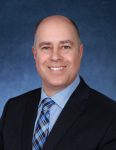
About five percent of Adam Brosgall’s legal practice is dedicated to offering mobile services. (photo from Adam Brosgall)

While providing mobile legal services is only a small portion of what lawyer, notary public and commissioner of oaths Adam Brosgall does, it distinguishes him.

“Most people manage to make it into my office, but some clients have special circumstances that require me to visit them,” Brosgall told the Independent.

Practising law since 1999, Brosgall – who grew up in Vancouver and is quite involved in the local Jewish community with his wife and their two young children – opened his own firm in 2010. His office is located on Howe Street, right across from the Vancouver Law Courts.

“One of my main focuses is international business transactions, helping people with their overseas legal matters,” said Brosgall. “If a client needs to send a contract, agreement, power of attorney or other official documentation from Canada to another country, each document needs to be properly legalized. This obscure legal procedure is also known as ‘Apostille certification.’ I prepare their documentation and make sure it’s processed properly through various government entities, consulates and embassies in Vancouver, Toronto or Ottawa.”

Brosgall often deals with the Israeli consulate in Toronto and their embassy in Ottawa. “As there’s no Israeli diplomatic mission in Vancouver, a lot of people who don’t want to travel to Toronto or Ottawa to deal with their legal issues will retain me to handle their affairs,” he explained.

Since starting up his own firm, Brosgall has noticed a need in many communities for mobile legal services. Quite often, the clients for these services are elderly people who are home- or hospital-bound.

“Sometimes, they might need to prepare a will, a POA [power of attorney] or a representation agreement for personal care,” said Brosgall. “These are the three major documents people should get done as they age, ensuring everything is in order. If they haven’t done that, often their younger relatives will call me and ask me to come to their house, a care home or hospital.

“People give me the information I need over the phone or by e-mail. Then, I prepare all the documents in my office and make sure everything is perfect. I then take everything to the client, along with my seals, stamps and various payment methods.

“I offer a very seamless service. After I receive their instructions, I take care of everything – I visit them, take the documents with me and notarize their signature while I’m there…. I work very carefully behind the scenes but, from the client’s perspective, it seems instantaneous. When I leave, they have everything they need.”

Brosgall’s mobile services are also offered to businesses that need documents signed by multiple people in one office. In these situations, Brosgall can save a business a substantial amount of time by visiting their office, as opposed to each individual needing to travel to his office.

“Sometimes, actors who are very busy and are staying in a hotel in Downtown Vancouver can’t take time off from the set,” said Brosgall. “Their manager or assistant will call me and say they need me to come to their hotel and meet them in the lobby at a certain time, so they can sign some kind of contract the film studio or agency needs the actor to sign.”

According to Brosgall, anything that he can do in his office, he can also do at a remote location.

The term notarization can mean two things – witnessing a signature or preparing a certified copy of a document. In the first instance, Brosgall witnesses on-site the signing of a document and puts his stamp and seal on it to signify that he saw it being done and that the parties involved understood the document. In the latter instance, when people need to have a certified copy of something, such as their passport or driver’s licence, he said, “I just make a photocopy while I’m at the office or they provide me with copies and I’ll compare them to the original and certify it’s a true copy.”

The mobile service comes with a fee that is dependent on distance, time spent away from the office and the nature of the documentation. The mobile service fee is added to Brosgall’s standard document processing fee.

Brosgall advertises his service on Google using Adwords, and also publishes articles on his website, which are then picked up by Google and other search engines.

“So, if you Google ‘mobile notary in Vancouver,’ my website will be at the top or close to the top of the page, and people call,” he said. “And, when people call, I’m always very helpful and responsive.”

He also promotes his services “the old-fashioned way,” he said. “I attend different hospitals and nursing homes and such. Whenever I am there, I speak to the social workers, the nurses or the staff and leave my business card. Quite often, it will be the nursing home or the hospital that will recommend my services. In this way, people hear of me by word-of-mouth.”

Some cases are more urgent than others, of course. “Some people are in a rush because their relative might be at the end of life and there can’t be any delays,” said Brosgall. “Those, I give my full attention, because I want to make sure things are done quickly. I get their info and circumstances from their relatives and draft their documentation that same day. Then, I’ll usually head out to meet them the next day.”

There have been times, he said, when “someone calls me at noon and I’m at the hospital at three. I prioritize things and, if they want the whole family to be around, I adjust my schedule to accommodate everyone.”

With a busy international legal practice, Brosgall said his mobile service only represents about five percent of his business, but fills a need and helps the community.

“Although it’s a relatively small portion of my law practice, when I do get out of my office, I often find myself in all sorts of interesting situations and environments,” he said. “I’ve worked with movie stars while they’re working out in gyms, business leaders in corporate boardrooms … elderly people in long-term care or at home…. The list goes on and on.

“Sometimes I feel less like a lawyer and more like a social worker, psychologist or family counselor when I’m on my mobile visits. People often reach out to me in extremely urgent and critical situations. A solid understanding of the law, excellent communication skills, thorough preparation and good bedside manners all go hand in hand.”

For more information, visit vancouvernotary.biz, call 604-685-2326 or e-mail [email protected].

Rebeca Kuropatwa is a Winnipeg freelance writer.

Format ImagePosted on February 10, 2017February 8, 2017Author Rebeca KuropatwaCategories LocalTags Adam Brosgall, lawyer, legal services
The complexities of terrorism

The complexities of terrorism

Dr. Tami Jacoby, associate professor at the University of Manitoba, has been studying Middle East politics and international relations for nearly 20 years. (photo from Tami Jacoby)

Dr. Tami Jacoby, associate professor at the University of Manitoba, has been studying Middle East politics and international relations for nearly 20 years. She not only shares her expertise with students at the university, but the broader community as well, via books and lectures. She is currently teaching an eight-week class at Winnipeg’s Rady JCC called Terrorism and Political Violence.

After working toward her undergrad degree at the Hebrew University, Jacoby finished her studies at U of M. She then went back to Hebrew U for her master’s degree in political science and international relations. At that time, Jacoby made aliyah and started a family and life in Israel. Later, she moved to Toronto to do a doctorate in political science at York University. She eventually returned to Winnipeg, where she currently resides.

While doing her PhD, Jacoby traveled back and forth regularly between Canada and Israel, and did field work in Israel, conducting interviews and research on women’s protest movements.

Over the years, Jacoby has written several books, including Women in Zones of Conflict: Power and Resistance in Israel (McGill-Queen’s University Press, 2005). Using the framework of “a case study of three women’s political movements in Israel: Women in Green, the Jerusalem Link and the lobby for women’s right to fight in the Israel Defence Forces,” the book, according to the publisher’s description online, “challenges the traditional view, which suggests a natural connection between women and pacifism, based on the feminine qualities of caring, cooperation and empathy.”

“What I did was a number of years of interviews and research on women’s protest movements … and the book that came out was a book on the diversity of feminism in Israel, but as a level of extremism,” Jacoby told the Independent. “I was interested in how women in one national context could have such radically different views on the same things, like feminism, the Arab-Israeli conflict and just run-of-the-mill party politics.”

One of the interesting things Jacoby found was that many women on the left were interested in things like dialogue with the Palestinians about a two-state solution, and feminism. In contrast, right-wingers’ idea of dialogue with the Palestinians was through protest, the media and policy.

“They were very driven by their fear of not only losing the state of Israel, but of losing their identity as Jews, as Israelis,” said Jacoby. “And the left-wing portion of the Israeli women’s movement was very interested in dialogue with Palestinian women. They wanted to get together with them and have cultural programs and social events. They wanted to listen to and get to know the stories of Palestinian women, to be able to walk in their shoes and completely understand them.”

The class that Jacoby is teaching at the Rady JCC – which started last week and runs to March 21 – looks at terrorism in Canada and the legal and political/social aspects of it.

“This class I’m teaching at the JCC is, in a sense, piggybacking on other research and teaching that I’m doing right at the moment,” she told the Independent before the course began. “So, I’d assume the people in the class will be interested in the kind of terrorism that Canada and Israel deal with…. But the class takes a step back and looks at the phenomenon of terrorism as a philosophical and structural issue….”

While Jacoby is teaching the class, she is also a student of sorts, as she is interested in hearing what people have to say.

“People have a lot to say and it’s not just off the cuff; it’s substantiated by empirical evidence and anecdotes that are based on experience,” she said. “What I try to do is open a little window on something that I’ve been very heavily researching … and open a discussion about things that people may not have thought of before … so people can bring things to the table and we can work to enlighten ourselves about the topic.”

Touching a little on what will be examined in the course, Jacoby said, “One of the things I’ve come to realize about terrorism is that it has a particular dynamic to it, no matter where it is and what period of history it is in. And that is, you have a small group of people trying to terrorize, make afraid, a large group of people … so they start to feel their life is untenable and then pressure the government to act. That’s the case with literally every terrorist group, regardless of their philosophy, background or tactics. That’s the logic of terrorism. I’m interested in seeing how case studies fit into that logic.”

Another topic will be how to pair counterterrorism with policies like multiculturalism, democracy and liberalism.

“The human tendency is to look for people who might look like them, causing a whole range of Islamophobia, antisemitism, racism and xenophobia,” explained Jacoby. “These are the kinds of problems not specific to any one particular form of terrorism, but that fuel a broader understanding of terrorism in general.”

Jacoby sees political violence like terrorism as a way in which people express themselves at the extreme end of the spectrum. “Political violence is quite broad,” she said. “It could be something quite innocuous, like threatening someone or inciting someone to violence … or, it could be throwing a fist or a bomb, or using nuclear weapons as a scare tactic.”

The Middle East will likely be discussed in terms of the ongoing cold war between Iran and Saudi Arabia and their backers, as well as both American and Russian policies.

“One thing that people seem to not understand nowadays is that people may oppose a terrorist group’s tactics, but they may also support the underlying goals … which can be quite honourable,” said Jacoby. “For example, terrorists might use violence to press their point about Muslim victims in the Middle East, [while] a moderate person might say they are against and shocked by the high casualty rate of Muslim victims. There are a lot of divisions out there, of which terrorists only represent a very small group … [an] active, vocal, radical, but miniscule, minority. While we may not like the tactic, many people may support the ultimate goals, which include justice and peace. The reason we can’t see the ultimate goals is because terrorism destroyed them … [and] in the end, makes it worse.”

As for possible solutions to terrorism, Jacoby said it “is one of the most difficult tasks to respond to.”

She explained, “I would say this: the effect of terrorism is more psychological than anything else. Fewer people die from terrorist attacks every year than from faulty wiring or furniture falling on them when they sleep. But, because of the media and the dramatic nature of its coverage of terrorism (pervasiveness, images, taboos, fear), people spend more time worrying about terrorism than any other more concrete and actual danger to their lives. My suggestion is we, as a society, need to be more ‘comfortable’ with the psychological discomfort that comes with terrorism. We must continue to be vigilant, but also live our lives to the fullest so that the terrorists won’t ultimately win.”

Rebeca Kuropatwa is a Winnipeg freelance writer.
Format ImagePosted on January 27, 2017January 26, 2017Author Rebeca KuropatwaCategories WorldTags Canada, Israel, terrorism
Inspiring Jewish connection

Inspiring Jewish connection

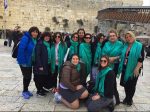
The recent Toronto Jewish Women’s Renaissance Project group in front of the Western Wall in Jerusalem. (photo from Nicole Pollak)

In its flagship program, Momentum, the Jewish Women’s Renaissance Project (JWRP) provides Jewish women and men, typically mothers and fathers, with a free journey throughout Israel (airfare is not included).

The trips – the women’s and men’s trips are separate – are designed for people who are not shomer Shabbat (Shabbat observant). As well, 90% of participants must have children at home under the age of 18, and participants must be physically and emotionally healthy.

Rebbetzin Lori Palatnik founded JWRP in 2008. Since then, it has become an international initiative bringing thousands of women and hundreds of men to Israel each year from 19 different countries.

“The goal is that the women have 10 incredible, uplifting, inspirational days together … and then go home and bring that back to their families and communities,” said Toby Bernstein of the Chabad Romano Centre in Richmond Hill, Ont.

Bernstein led a group of women on the program in December 2016, noting, “We decided to do this trip to encourage some of the women in our community to be more connected to Judaism.”

Bernstein took with her 10 women, “women who come to synagogue services, a couple Hebrew school moms [and] a couple preschool moms.”

These women joined 250 others from the United States, Canada, Russia, Greece and England.

“It was an inspirational trip, because there were classes every day [about] what it means to be a Jewish mom, a Jewish wife, to be a Jew altogether … what’s the purpose of life,” said Bernstein. “It got a lot of people thinking, so it was inspirational. Even me, who grew up with all of this, grew from [the trip] and gained new insight, new inspiration…. It was beautiful to see the women growing and taking it all in.”

One of the participants was Nicole Pollak, a business owner in Toronto along with her husband, Aaron; the couple has a 3-year-old, Sydney.

Pollak went on the trip with both of her sisters after her younger sister, Melissa Jacks, who sends her children to the Chabad Romano Centre, was invited to join by Bernstein.

“My sister came to me and said that Chabad Romano is going to be running a JWRP trip and asked if me and our older sister, Allyson Theodorou, were interested in going,” said Pollak. “We applied, and all three of us went on this trip together.

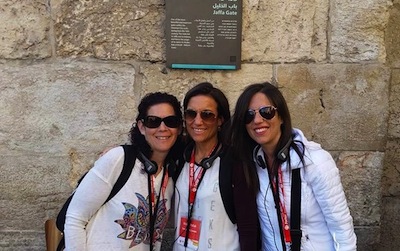
photo - Left to right, sisters Allyson Theodorou, Nicole Pollak and Melissa Jacks during a tour of the Old City, outside Jaffa Gate
Left to right, sisters Allyson Theodorou, Nicole Pollak and Melissa Jacks during a tour of the Old City, outside Jaffa Gate. (photo by Megan Epstein)

“We thought it would be an amazing experience to do this together, and to learn more about Judaism and Israel,” she said. “And I, personally, have been studying with a rabbi for about eight years. So, I really liked the idea that it was an educational trip to teach us more and give us more insight into Judaism and the religion, and thought it was a good opportunity to get some Jewish inspiration.”

Before leaving, Pollak had to do what she could to ready her daughter for her absence. “From an emotional standpoint, preparing my daughter that I was going to be away for that amount of time was very difficult for a 3-year-old,” said Pollak. “I don’t think she has a concept of time – 10 days, for her, could be 10 hours, 10 minutes or 10 weeks … [so it was hard to tell] her that I’m going away and what that means and that I’ll be calling her every day. Preparing for the trip on my end, it was not really that difficult. It was just a matter of packing and organizing.”

Pollak’s husband was very supportive of her going on the trip. When Pollak became anxious about leaving, it was her husband who helped push her through it.

“There were a couple of times where I contemplated whether I was even going to go. I thought it was going to be too stressful for the family for me to be gone,” said Pollak. “My husband was the one who said, ‘I support you whether you want to go or if you don’t want to go, but I’d be very disappointed if you didn’t go. I think that would teach our daughter we don’t do things because we’re afraid, instead of showing her to do what we want – to learn, to have an adventure or explore life. He was pushing me to go because he thought it would be an incredible opportunity to go to Israel, learn and spend that time with my sisters.”

From the moment Pollak arrived at the airport, she could feel the camaraderie of the women traveling, all with similar feelings about leaving home, and she began focusing on the trip and getting as much out of it as she could.

Each day of the program in Israel involved one or two discussions, lectures, lessons and classes, sightseeing and tours, and the opportunity to see something cultural or religious in the region. For Pollak, the learning was the best part of the experience.

“One of the things we learned was that there are three major mitzvot for a Jewish woman: lighting Shabbat candles, making challah and going to the mikvah,” she explained. “We had the opportunity to light Shabbat candles and to participate in a challah-making class. And, on our visit to Tzfat, we visited a mikvah and had a tour.

“One of the things they talked about is, if you’re a secular Jewish woman and you don’t have a lot of religion in your life, you should start with lighting Shabbat candles. My older sister, Allyson, had never lit Shabbat candles in her house in her whole life and she’s been married 18 years. In Israel, she bought Shabbat candles and, last Friday night was the first time ever she lit them in her house. That’s pretty amazing.”

As for challah-making, the sisters have committed to getting together sometimes on Friday nights and making challah for Shabbat. As for the mikvah mitzvah, Pollak plans to investigate it more before deciding whether she wants to make it a part of her life.

With respect to the sightseeing, visiting the Kotel was a major highlight for Pollak, especially after having had a class about prayer before going in a spot overlooking the wall.

“I heard a lot of people saying … they don’t know how to pray, they don’t know what that means,” said Pollak. “People will often go to the wall and pray for world peace or for their entire family to be happy or healthy. They pray for these big things because they think that, when you talk to G-d, that’s what you ask for – big things.

“Something they emphasized in that class was that praying is not about just big things, it’s about little things, too; it’s that we should pray about everything. You can pray that you want your little son Johnny to do well on his math test. You can pray that you hope that your daughter wins that award, or that next week your haircut is going to be great. The message was, pray for what’s important to you.”

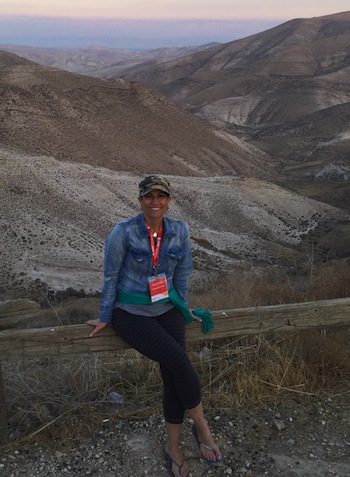
photo - Nicole Pollak at Eretz Bereshit, overlooking the Judean Desert
Nicole Pollak at Eretz Bereshit, overlooking the Judean Desert. (photo by Allyson Theodorou)

Another class that hit home for Pollak was one about judgment and perspective. In it, a story was shared that she has been telling people ever since. It was about a little girl who is standing in the kitchen with her mom, holding two bright red apples, one in each hand.

“She says to her mother, ‘Mommy, do you want one of my apples?’” said Pollak. “The mother says, ‘Yes, I do.’ So, the little girl proceeds to take a bite of one apple and then takes another bite from the other apple. The mother stops and thinks to herself, ‘Oh, you little brat.’ Then, the little girl puts her hand out to her mother and says, ‘Here, Mom. This one is sweeter.’

“That story really hit home and depicted that we judge based on what we see and not on what really is. I realized that it’s easy for us to judge based on what we think is happening. That story took me through the trip and really made me stop in my tracks every time I looked at someone or if I heard a story and judged what was going on with that person.”

Once back in Toronto, Pollak thanked G-d for the life that she has. She also discovered that her husband, mother-in-law and friends really stepped up and looked after her life while she was away. Her husband, she said, “appreciated me more, just like I appreciated him more when I came back.”

As a result of the trip, Pollak has decided to find ways to live her life with more intention and more appreciation for her marriage, focusing on the positive things in her life, as well as understanding the responsibilities of being a Jewish woman in one’s home.

“I think coming back made me realize that I have a responsibility bigger than I thought from a spiritual standpoint and that I’m going to live and work to do more of that,” she said.

A Vancouver JWRP group is being formed under the auspices of Vancouver Torah Learning Centre for a July 17-24 trip to Israel. For more information, contact Devorah Brody via e-mail at [email protected] or visit jwrp.org.

Rebeca Kuropatwa is a Winnipeg freelance writer.
Format ImagePosted on January 27, 2017January 26, 2017Author Rebeca KuropatwaCategories IsraelTags Israel, spirituality, Vancouver Torah Learning Centre, women
Opinions from the streets

Opinions from the streets

Corey Gil-Shuster has split his time between Canada and Israel for 28 years now. (photo from Corey Gil-Shuster)

Corey Gil-Shuster is an Ottawa-born and -raised Jew who spends a great deal of his time and energy asking people their opinions regarding the Middle East conflict – and doing so on camera. He has his own channel on YouTube, called the Ask Project.

Gil-Shuster has spent the last 28 years splitting his time between Ottawa and different places in Israel. He first went to the Jewish state in the 1990s for a study-abroad program at Tel-Aviv University.

At the time, Gil-Shuster said he was just happy to find “a good, safe place to travel and then, from there, to travel to other places. Then, when I was here in Israel, actually I didn’t like it very much. It was very different than I expected. I found it too chaotic…. It took me about six months to get used to it. Once I did, I started to fall in love with the place.”

In 1995, Gil-Shuster met his now-husband, Yaron. The couple later adopted a child.

Gil-Shuster said he has found Israelis to be fairly open to discussing homosexuality, and noted a level of acceptance or openness that he has not found in Canada. Even strangers in Israel have felt very comfortable asking him questions about being gay, and he has used the opportunity to educate them about the topic. On more than one occasion, once that initial question has been broached, people have invited him over for dinner to ascertain how they can move to Canada, make a good living and buy a big house.

“I found Israel refreshing,” said Gil-Shuster. “I kind of enjoyed that, because it put me in control as opposed to the opposite – at least the early 1990s in Canada – being gay with straight people in control of whether you’re accepted.”

As he acclimated to Israeli society, Gil-Shuster found himself getting into debates about how Israelis really feel about the situation in the Middle East.

“I thought, well, I have a video camera, so why don’t I just go out my front door and ask random people on the streets to answer some questions?” he told the Independent.

What Gil-Shuster initially found was that, while people had their opinions, they were not interested in asking questions themselves or in listening.

“All these people are either pro-Israel or pro-Palestinian, and they are sure they know everything about Israel,” he said. “But, nobody could come up with a question to either confirm their ideas or give the opposite of what they think. Finally, somebody said something about how Israelis won’t accept a one-state solution. Great, I’ll take that and ask that as a question. I asked neighbours, the guy who sells me fruit and veggies, and another grocery store guy.”

Gil-Shuster had to do on-the-spot translation of the comments from the street interviews. “I would translate as they were speaking Hebrew,” he said. “I put it together. I had seven or eight people and I put it in a film. I learned to edit, but I didn’t cut anything out, and I put it on YouTube.”

In no time at all, Gil-Shuster understood the power in simply letting people share their views – “how much power that can have to go against what mainstream media puts out, whether that’s Canadian, American, Israeli or Palestinian. Every country’s media has a certain narrative they want to say. They have a story they’re trying to sell to their people, and they have to frame the conflict within that.”

To make his videos more objective, Gil-Shuster started to venture further than his backyard in Tel Aviv. He began traveling the country asking people for their opinions. Regardless of what they said, he made a point of not cutting or editing the videos – even if racist or horrible comments were made that didn’t conform to his views.

That doesn’t mean he keeps silent, however. He allows himself the right to make sarcastic comments as he feels the need, noting, “It keeps me more interested. I try to make it very objective … I try to figure out, as much as possible, where they’re coming from. If their question is, ‘Why don’t you all just get along,’ I’ll reply quite naively insofar as what my follow-up questions are … thinking that’s kind of where they’re coming from.”

Gil-Shuster has been doing this for the past four years, with a growing following that comprises a mix of pro-Israel and pro-Palestinian fans and many others in between. He provides a variety of views and topics to keep people watching.

When he has to travel for work, doctor appointments or other reasons, he brings his camera along, stopping to speak with people along the way. Jerusalem and Haifa are a couple of his favourite places to do this, as he is more likely to encounter both Israelis and Palestinians.

In general, he has found Palestinians to be more open to talking, though some are fearful and only want to be interviewed if he will agree to conceal their face. Typically, in these situations, he works with a translator.

“When I first started out, my hope was to use these videos as a forum for creating peace in some way, to create a dialogue between Israelis and Palestinians,” he said. “For me, it’s about understanding. But, quickly, I realized that very few Israelis and Palestinians are interested in having a dialogue – at least, not in a public way.”

Some people get mad at Gil-Shuster, feeling he is doing something purposefully against one group or another. In contrast, he gets a lot of messages from people in the Middle East saying, “Thank you for showing me a different side of the conflict. I always had a feeling I was being lied to.”

“These are the emails I like the most,” he said. “You don’t have to like what somebody says, but I’m hoping they’re humanized as a group.”

When asked about how the project has changed his views, Gil-Shuster said he no longer thinks peace is possible.

“Israelis are tough-talking, but are willing to compromise to a certain degree. Palestinians are very open to other people in some ways, but, it’s very black and white for them. It’s all … the land was stolen by foreigners who shouldn’t be there, and that there’s no solution until they leave. Maybe someday they’ll get a leader who’ll be brave enough to tell them what reality is, but they don’t have those kinds of leaders. They always deal with Israel … [with the view that] for now, we can benefit from it, but it’s all ours, so we will get it back someday.”

To date, Gil-Shuster has created more than 500 videos. They can be found at youtube.com/user/coreygilshuster, and he encourages viewers to suggest questions.

Rebeca Kuropatwa is a Winnipeg freelance writer.
Format ImagePosted on January 27, 2017January 26, 2017Author Rebeca KuropatwaCategories IsraelTags Israel, Israeli-Palestinian conflict, peace
BBC’s advocate in the West

BBC’s advocate in the West

Ryan Bellerose, left, in Jerusalem with Michael Dickson of Stand With Us. (photo from Ryan Bellerose)

Ryan Bellerose is not the first Métis to stand with Israel, though he might end being one of the most influential, as he works to increase B’nai Brith Canada’s presence and advocacy voice in Alberta and British Columbia.

Based in Calgary, Bellerose became BBC’s advocacy coordinator for Western Canada just over four months ago. Like many Métis of his generation, he was raised Roman Catholic but, later in life, found his way back to indigenous spirituality and decided that Catholicism was not for him.

“I try to worship the creator the way Cree people do, rather than the way white people do,” he told the Independent.

Growing up, Bellerose read about Israel and felt a kinship with Israelis insofar as the struggles they have endured concerning their ancestral land and rights. The Métis here in Canada have had less success with similar struggles, he said.

That’s how his connection to Israel started, said Bellerose. “On top of that, on my mother’s side, my great-grandmother was really pro-Israel. She grew up in Norway during WWII. She was very pro-Israel, because she was very anti-Nazi Germany.

“She would drink Manischewitz wine everyday at 4 p.m. As a kid, I asked her one time why she drinks it, because she’d always make a face when drinking it. She told me, ‘I drink this because it shows the world that the Jews didn’t die and that the Nazis lost.’”

It would not be until Bellerose was in university that it became clear in his mind why he, himself, was pro-Israel. A Jewish friend at the University of Alberta helped him see just how similar the Métis and Jewish narratives are.

“I didn’t realize she was Jewish and I used to hang out with her a lot,” recalled Bellerose. “She’d always invite me over for dinner at her house on Friday. They weren’t super-observant Jews, but they still lit candles and had Shabbat dinner. They didn’t eat meat on Friday … all things that my family did, too. So, I just thought that they were super-Catholics, and I told my grandma that my friend is totally super-Catholic and that she’d love this girl.”

What Bellerose did not yet realize at the time was that his friend was being bullied at the U of A to a degree he had never seen before. Growing up in northern Alberta, Bellerose had experienced a lot of racism and prejudice, but nothing, he said, like these verbal attacks on his friend.

“What was a shock to me was this girl – blond-haired, blue-eyed, who played on sports teams and was super-smart academically – was being bullied to the point that she was considering suicide,” said Bellerose. “We’d be walking across the quad at the U of A and someone would yell, ‘Baby killer!’ I just always assumed they must be yelling at someone else or maybe even yelling at me, because there’s no way they would be yelling at her.”

This occurred a few times before Bellerose learned that his friend had participated in several pro-Israel events and that it was some very anti-Israel U of A students who were shouting such slurs at her.

“It’s one of those things that … it’s very difficult for a rational, moral human being to even wrap their heads around…. I think that’s why a lot of Canadians don’t understand the depth of this,” said Bellerose.

“It’s simply because she used to wear an IDF T-shirt and she was Jewish. So, I mean, the excuse would be anti-Zionism, but the truth is that it is antisemitism.

“I’m supposed to be one of her close friends and, yet, I had absolutely no idea what she was going through. I should be more sensitive than that as a Métis person who has experienced that kind of thing. It really bothered me that I didn’t see it. That was when I decided that I’m not going to stand there and be quiet when this kind of stuff happens.”

Soon after, in 2002, Bellerose was on his way to his football locker when he encountered an “apartheid wall” in his way. It was made out of papier-mâché and cardboard, and had bloody handprints on it. As the wall was blocking his way, Bellerose asked politely if they could move it. A female student responded to him, “Now, you understand the persecution the Palestinians deal with on a daily basis.”

Bellerose said, “I looked at her and said that my [Métis] people were still allowed to be killed in 1939 in Canada … that nobody will do anything about that … so don’t lecture me about oppression. I lost my cool with her and said that they should either move the wall or I would. They didn’t, so I walked over and ripped it down. I was angry, so I flipped their table over. They had a bucket of propaganda and I kicked that over.”

Fast-forward about 10 years, and Bellerose has joined Calgary United with Israel. He began his involvement helping organize events on a volunteer basis, while working full-time. During his spare time, he would argue with antisemites in comment sections of published articles, but eventually realized that he would be able to get his message out a lot more quickly if he educated influential people instead, on both sides of the conflict.

Bellerose said many people in the world, out of ignorance, believe that the Palestinians are on the side of complete right in the conflict, painting Jews as occupiers as opposed to people returning to their homeland.

“That’s literally how this whole idea that the Palestinians are the native people and the Jews are the white European colonizers came about…. That’s how it was spread so easily,” said Bellerose. “Arabs flipped that narrative…. If I allowed the argument that the Arabs are indigenous to the land of Israel, then I might as well turn around and say that white people are now indigenous to Canada. A lot of native people don’t understand that until you literally put it into those terms.”

Bellerose has a fairly significant following on social media, partly because he used to play football and partly because he is a sometimes controversial personality who makes people uncomfortable. B’nai Brith Canada began following Bellerose, too, and was especially impressed with his imploring Jews to be proactive in their advocacy and unapologetic.

“I firmly believe that the biggest part of this problem is that, a lot of times, until recently, Jewish advocates were kind of taught not to talk about the settlements,” said Bellerose. “I’m here to talk about the good things about Israel. Of course, the truth is there’s a lot to criticize – but there’s so much more to be proud of.”

When BBC hired Bellerose, he could hardly believe he would be paid to do what he loves doing and would do anyway.

“I tell people that I’m going to be more professional, swear a little less,” he quipped regarding his role with BBC. But, he added, B’nai Brith itself has become “less apologetic, more proactive … a little more in your face.”

Bellerose especially likes working with young adults, as he strongly believes there are many young people who are not connected with their identity because they don’t really understand it.

Bellerose is also working hard to build bridges between aboriginals and Jews. “I think that, by building these bridges, eventually we can help you and you can help us, and it will make the world a better place,” he said. “This is best done through what I call ‘relationship advocacy.’ Instead of going out and telling everyone how wonderful Israel is and how wonderful Jews are, I think it works much better when Jewish people invite somebody for Shabbat. The moment they see you as a human being and not an abstract concept, you build a relationship with that person. And, when that person has a relationship with you, they are way more likely to stand up for you, way more likely to actually get involved.”

Rebeca Kuropatwa is a Winnipeg freelance writer.
Format ImagePosted on January 13, 2017January 11, 2017Author Rebeca KuropatwaCategories NationalTags advocacy, B'nai B'rith, First Nations, Israel, Western Canada
Hoping to revive Dead Sea

Hoping to revive Dead Sea

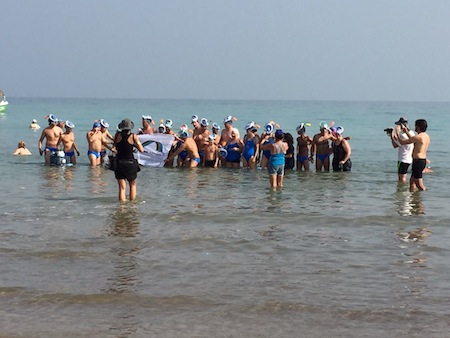
Twenty-five swimmers from around the world crossed the Dead Sea on Nov. 15. (photo from EcoPeace)

On Nov. 15, some two dozen swimmers made the seven-hour trek across the Dead Sea, starting from the Jordanian side and swimming to the Israeli.

The demise of the Dead Sea is not news. According to the group EcoPeace Middle East – a Jordanian, Palestinian, Israeli environmental peace-building organization – the sea has receded by 25 metres in the last three decades and has lost a third of its surface area. Yet, hope remains.

The recent event’s initiator and a participant swimmer, Oded Rahav, stated in an EcoPeace press release, “If it’s possible to do the impossible, like swimming across the Dead Sea, then it’s possible to save the Dead Sea. We are not just interested in raising awareness, but creating real action to benefit the Dead Sea.”

Co-sponsoring the event with EcoPeace was Tamar Regional Council in Israel.

“A group of Israeli swimmers approached EcoPeace last spring with an idea to do a first-ever event – to swim across it [the Dead Sea]!” said Mira Edelstein, project coordinator of EcoPeace’s Jordan River Rehabilitation and Save the Dead Sea projects. “Not only were they looking for an idea to follow their previous success in topping a Guinness record – swimming from Cyprus to Israel – they also sought a way to raise awareness about the need to save the Dead Sea.

“They, naturally, turned to EcoPeace, as we’re the only regional environmental organization in the Middle East working on the issue of the rehabilitation of the River Jordan, which is in direct correlation with saving the Dead Sea. We gladly took on co-organizing the event and worked hard to make it happen, especially in getting permission from the Jordanian army to ‘sail’ across the border in the middle of the sea, starting from the Jordanian side.”

photo - The Dead Sea swim team
The Dead Sea swim team. (photo from EcoPeace)

There were 25 swimmers from all over the world who participated, including from Israel, Palestine, South Africa, New Zealand, Greece, Spain and Denmark. They had to swim with a full-face snorkeling mask because of the water’s extreme salinity and they also had to adapt their swimming style because of the water’s high density. It was a life-risking venture and the swimmers were accompanied by a medical team, as EcoPeace notes in the press release: “A drop in the eye causes severe irritation, and chance swallowing of its water can be fatal if not treated immediately.”

The event generated an unprecedented amount of media attention and EcoPeace hopes this will help its ongoing efforts to get local decision-makers to take action on the issue.

“We’re also being approached by several other organizations to do other cross-border events – bicycle event, music event, art event, etc. – and we’ll review all of them to see which is more feasible and which will give us the best results,” said Edelstein, who was born and raised in New York and made aliyah in 1993. She now lives in Gan Yavne, which is near Ashdod. She joined EcoPeace in 2004.

“Personally, as an environmentalist but also a general nature lover, the Dead Sea is such a pearl of nature with so many unique qualities found nowhere else on this earth, that it would be a tragedy to lose it,” she told the Independent. “This is a man-made catastrophe and we must work as hard as possible to reverse it.”

Edelstein explained that the threats to the Dead Sea are coming from two directions.

“First is from the north,” she said. “Historically, the main inflow to the Dead Sea has been the Lower Jordan River. And, with the diversion of more than 95% of the Jordan River’s water by Israel, Jordan and Syria, leaving a meagre five percent to reach the Dead Sea … no wonder the Dead Sea is shrinking – by more than a metre a year.

“EcoPeace is working extremely hard to rehabilitate the Lower Jordan River back to at least a third of its historic flow, not only for the river’s own integrity – this is the holy Jordan River! – but we’re doing this for the Dead Sea as well.

“Second is from the south – from both Israeli and Jordanian mineral industries. These industries are using the most simple, antiquated, water-intensive technology to harvest minerals from the Dead Sea: evaporation. Unfortunately, both industries have no incentive to change their extraction technology, because they do not pay a penny for the amount of water they use.”

EcoPeace is working to change this; however, discussions about extracting minerals using systems based on desalination technologies (reverse osmosis) have come to a standstill, as they cost money, while evaporation is free.

“They claim they are studying them (these technologies), but have concluded that they’re very expensive,” said Edelstein. “Our point is exactly that – that until they will be forced to pay for the amount of water they use, any kind of change will be expensive.”

With the Israeli mineral industry’s contract with the state on its last leg, Edelstein is hopeful that a new contract will include putting a price on the Dead Sea’s water.

“EcoPeace is working very hard to get a bill passed through the Israeli parliament wherein the Dead Sea Works [part of the company ICL Fertilizers] will need to pay for the amount of water they use,” she added.

“Both of these actions together, that EcoPeace is working on, will help stabilize the Dead Sea. The Dead Sea will not yet be completely saved or restored, but we understand we first need to halt its destruction and [then] to work on stabilizing it.”

While there was a plan to draw water from the Red Sea to the Dead Sea, the original mega-project, which the World Bank was studying for more than a decade, has been deemed unfeasible. The present-day Red Sea-Dead Sea canal project “is different than the original one,” said Edelstein. “This project is based on a water swap between Israel and Jordan, which also includes a component for Palestinians to get more water from Israel.”

With both the Jordanian and Israeli governments working closely, mainly on furthering the canal project, EcoPeace applauds the joint efforts, but does not see the project as the solution.

“I do believe that the Dead Sea is high on the public agenda,” said Edelstein. “It’s not difficult to find information on the issue. Our website is being upgraded and we’ll soon have updated information to share, but recent news articles are a good place to begin.”

For more information about EcoPeace, which was formerly called Friends of the Earth Middle East, its Dead Sea and other projects, visit foeme.org.

Rebeca Kuropatwa is a Winnipeg freelance writer.

Format ImagePosted on January 13, 2017January 11, 2017Author Rebeca KuropatwaCategories IsraelTags Dead Sea, environment, Israel
Illness, not weakness

Illness, not weakness

Can We Talk About … event committee, left to right: Karen Dana (event co-chair), Jenn Ritter (event co-chair), Harriet Zimmer, Rietta Floom, Einat Paz-Keynan (JCFS staff), Meytal Lavy (JCFS staff), Michael Landsberg, Sherry Lercher-Davis, Randee Pollock (JCFS staff), Danita Aziza (JCFS board chair), Pam Vine, Tara Greenberg and Jill Atnikov. (photo from Jewish Child and Family Service Winnipeg)

On Nov. 3, as part of Jewish Child and Family Service Winnipeg’s series Can We Talk About …, TSN celebrity Michael Landsberg spoke about Darkness and Hope – Depression, Sports and Me.

Landsberg has suffered from anxiety for as long as he can remember, and depression for the past 18 years.

“In 2009, I spoke about it publicly for the first time,” Landsberg shared with those gathered at Shaarey Zedek Synagogue. “I told everybody I knew. I just hadn’t used the platforms available to me to discuss it [until then], because I didn’t think it was relevant to anyone’s life.

“One day, when I was, by chance, interviewing someone who had suffered from depression, I asked him about it. I commented that I, too, had suffered. The next day changed my life.”

Landsberg received emails from people saying that the interview had been the first time they had heard two men discussing their struggles with depression; in particular, without sounding embarrassed or seeming weak.

“Because of that, they said their lives were changed,” said Landsberg. “Since that moment, I’ve tried to do exactly the same thing over and over again in as many venues as I can, including in Winnipeg.”

Landsberg tries to find ways to bring the topic to the fore whenever he feels it’s appropriate or thinks he has the opportunity to make a difference, whether it’s a public talk he’s headlining or a discussion on radio, TV or the internet.

“Every time I say I suffer from this illness and I’m not ashamed, embarrassed or weak, it changes someone’s life,” he said. “My coming out gave a purpose to this illness. It allowed me to take this poison that’s been inside me, that’s detracted from my life…. It allowed me to help someone else … so my poison is someone else’s medicine. That makes me feel good and makes me feel like I have a place in the world other than the one I was occupying before.”

According to Landsberg, before going public, his level of contribution to society was neutral, like most people’s. But, since coming out and talking about how his depression makes him feel and how it robs his self-confidence and self-esteem – yet he’s not ashamed of it – he’s no longer neutral.

“I think what I have to share most of all is me,” he said. “The more deep I go, the more details I give, the more of my struggles – not just that I’m struggling, but how my struggles feel – the more valuable it is to someone else. You want people to say, in the audience, ‘That’s me.’ And ‘Oh my gosh. My husband has that illness and I never knew that’s what was going on in his head. I understand better now.’

“I think we’re in a time now when every person is really deciding what side of history they’re on. Do you want to be on the side of history that’s changed the way we deal with mental health or do you want to be on the other side? I try to encourage people to get on the right side of it.”

Landsberg has always been a sharer and encourages others to share their struggles. As there is a deep sense of hopelessness and loneliness when it comes to depression, he said it is critical to encourage others to listen and realize they are not alone with the illness.

“More so than any event than I’ve ever been to, I was riveted and was really grabbed by several of the questions [posed to me in Winnipeg],” Landsberg told the Independent. “They weren’t so much questions as they were statements about audience members’ own situations.

“If you have a good night and you do it the right way, and there’s an audience that’s engaged that way, you’ll hear stories that have never before been shared – empowering people to share.

“My analogy is always, what I’d really like to do, is to have everyone in Canada who suffers from this illness [get together] – in the basement of a synagogue or a church, where Alcoholic Anonymous meetings take place – and [have] each of us draw from the collective strength and, at the same time, make deposits into that strength. When you turn to someone for help, you ultimately give them strength just by asking for it. That’s the spirit we felt in Winnipeg.”

One female audience member shared that she has had cancer and that it has come back, adding that she has suffered from depression for 15 years. Landsberg recalled, “She said, ‘You know, I have to be honest with you, I’ll take the cancer over the depression.’

“Also, an army veteran shared that he served in the army for 12 years and that, when he returned to Canada, there were 13 of them in his army group who had served and that, now, there are only two – the other 11 took their own lives. He said, ‘I was in the closet, so to speak, and felt desperately alone and unable to reach out. I watched a TV show you [Landsberg] did two years ago and thought, wow, if he can share, I can, too.’

“That’s enough reason to keep doing this for the rest of my life – just the knowledge that doing something that’s so easy for me, takes no effort, is a joy, [is helping]. To get up on stage and use my struggles for someone else’s benefit … it’s so easy, yet the payoff can be so massive.”

When it comes to helping a loved one who suffers from depression, Landsberg said one should start by admitting they cannot fully understand, as they have never had the disease. Then, they should ask their loved one what they want from them.

“That’s a huge thing – telling me what not to do,” said Landsberg. “The second thing is to reduce guilt. Many of us who have this illness like to please those around us. But, when we’re sick, we lose that ability, because we’re not ourselves – we can’t. I feel terribly guilty when I’m not the person I want to be.

“The people around me aren’t living their lives better because I’m there. Quite the opposite. I feel terrible that I’m actually worrying them, that I’m actually making the room worse because I’m in it. But, if you reduce my guilt, it will make a difference.”

As for someone who discovers they have the disease, Landsberg suggested education, as the more one knows about one’s illness, the more they can be an advocate and fight.

“Then, establish the thought that I will fight for my happiness,” he said. “And that’s incredibly difficult to commit to because the illness takes the life, the drive, out of us. It makes us apathetic. It makes us really incapable of doing stuff, or highly challenged to do stuff.

“If you commit to fighting for your happiness, that’s a big step. If you commit to sharing, that’s a big step. Sharing is incredibly difficult for most people because they feel shame and embarrassment. They feel like their illness is a weakness.

“You can overcome that, to some extent, by educating yourself. When you go on the internet and Google ‘depression’ and get five billion hits, you realize that 10% of the population right now may be feeling similar to you.

“People take their lives – 4,000 every year in Canada, 40,000 in the United States, and there are 25 attempts likely for every ‘successful’ suicide … that means 100,000 suicide attempts. We know there’s at least 10 to one that think about suicide, but don’t attempt it; suicide becomes appealing to them and plays out over and over in their brain.

“If you start realizing you’re just like a million other people in this country, then you’ll realize this is a sickness, not a weakness. All of these people, people that take their lives because they’re in so much pain, that’s not weakness.”

Landsberg added that speaking with someone who you know is struggling with depression is the easiest way to start sharing and healing, as you know they will not judge you and that they understand you.

“Winnipeg people liked what I did, so they went home with something,” said Landsberg. “But, I think I went home with more. I took away more than I left. What I took away were stories from people who I felt privileged to listen to…. I just loved it.”

For more information, visit sicknotweak.com.

Rebeca Kuropatwa is a Winnipeg freelance writer.

Format ImagePosted on December 23, 2016December 21, 2016Author Rebeca KuropatwaCategories NationalTags depression, health, JCFS, Michael Landsberg, TSN, Winnipeg
A leader by example

A leader by example

Janice Middleman, left, Rabbi Shaul Osadchey and Bobbie Osadchey, with Florence Middleman in the foreground. (photo from Rabbi Shaul Osadchey)

While it is becoming more commonplace to see people reach the age of 100 in fair health, it remains rare that an individual reaches the age of 110. So, Florence Middleman has beat the odds. And one person in particular has helped her achieve this milestone – her daughter, Janice Middleman.

Florence’s parents moved to eastern Canada at the turn of the last century. At the time, Alberta was vying to become a province. “They went east and recruited, and asked my grandparents and many others to be homesteaders,” said Janice. “As they stayed on the land a certain length of time and worked the land and raised animals, the land would become theirs.

“So, my grandparents came to Alberta and were homesteaders for quite awhile. It was during the dry-land period. There were many dust storms. At some point, they had to put the animals in the house and had to stay in the shelter on the hill they’d built for the animals – to protect themselves and the children from the dust storms.

“After a period of time, they moved to a small town near Edmonton, called Daysland. My grandfather, Max Goldberg, was a tailor. He made the red jackets for the Mounties, as well as everybody else’s clothes.

“My grandmother, Molly, was a midwife and spoke many languages. She delivered all the babies in the town and also accompanied the doctor on his rounds, as many people were immigrants who couldn’t speak English. She translated, so he could treat them.”

Florence was about 19 when the family moved to Edmonton and opened a store. She married Harry Middleman, who had moved from Montreal to Edmonton during the First World War. Janice was their only child.

The family moved to Calgary. While she lived in Toronto during her university years, Janice returned to Calgary afterward to be close to her parents. She took more university courses in Calgary.

When Harry passed away in 1985, Janice moved in with Florence. She found a flexible job she could do from home, while also caring for her mom, as there was no other family in the city.

Florence had four brothers who all passed away many years ago. Janice likes to describe her mom as having won the gene pool by living so long. “She’s got a tremendous spirit, plus the marvels of medicine as well,” said Janice.

Florence worked until the age of 68 as a librarian at an elementary school. She would have continued working and the library tried hard to keep her on, but, at the time, there was a law in place that you had to retire at the age of 65.

“When she did retire, she took a nap every day,” said Janice. “She has just a very, very good attitude. Besides working and helping to support our family, she volunteered at shul, Hadassah, the Red Cross and the Cancer Society – just to name a few.

“She had an interest in everybody, in Judaism, a belief in God, and kept a kosher home. She had an interest in the world. She appreciated everything and the beauty of nature, and appreciated children, animals and people in general. She still does.

“She always had a lot of friends. Regrettably, most of them are gone now, but she always had a lot of friends. She realized how important it was to give to the world. That’s also part of Judaism, to make the world a better place.”

When asked about her keen interest in child welfare and education, Florence said, “I worked at Glamorgan elementary school, including their library and the rest of the school, and bonded with the students. I was well liked by the children and got to know their likes and dislikes, their needs for education and their quality of life.

“One boy was Jewish and asked me if the library had any Jewish books. There were none in the library, so I brought some from home for him to read. He was very happy to have them.”

Janice added, “After that, my mother was very instrumental in inspiring the school to have multicultural books in their library. It spread to all the schools after that, a great deal due to her influence.”

Florence shared that some of her most-loved reading includes many “biographies, books on Judaism and prayer … biographies on artists, politicians like Abe Lincoln, history, art books, history of art, Canadian history, and all different countries.”

Janice noted, “She was and still is interested in countries and how they got where they are. She has a great love for literature, like Shakespeare, Dickens and William Blake. Also, my mother has written and continues to write our family history, as well as short stories and poetry.”

Florence had this to say about the most-treasured people in her life, such as her daughter, Janice: “I keep good people around me who care about other people, care about doing good works and doing good things in the world. My parents contributed greatly to the town of Daysland.”

As to whether she has any words of wisdom she would like to impart to readers, Florence said, “Keep on going. Surround yourself with good people who have good thoughts and care about their families, friends, the world, who care about contributing to the world and making it a better place and doing good work.

“Volunteer,” she added. “Give to charity when you can. Enjoy Judaism in any manner you are able. Give your time to your friends. Listen to them when they need you. Have a positive attitude. Be optimistic. Be grateful for what you have – your health, family, friends, home, food on the table and clothes on your back.

“Don’t think of the past or what you don’t have. Enjoy every moment, the moments you are in. Keep liking everyone. Don’t forget to thank people in your lives, in your family, and to appreciate everything you have.

“And take time to be good to yourself,” she concluded. “Take a nap every afternoon to refresh yourself. Be good to everyone. Be good to your family and friends. Don’t forget to thank God everyday for everything you have. Before Friday, during the week, don’t forget to be grateful to God and to everyone for everything in your life.”

Rebeca Kuropatwa is a Winnipeg freelance writer.
Format ImagePosted on December 16, 2016December 14, 2016Author Rebeca KuropatwaCategories NationalTags aging, Winnipeg
Advance in treatment

Advance in treatment

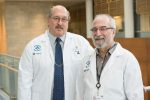
Dr. Mark Freedman, left, and Dr. Harold Atkins. (photo from Ottawa Hospital)

A Canadian research team led by Dr. Mark Freedman and Dr. Harold Atkins at Ottawa Hospital has managed to reverse severe multiple sclerosis (MS) using a patient’s own stem cells.

Freedman is a professor of neurology at the University of Ottawa, a senior scientist at the Ottawa Hospital Research Institute and the director of the Multiple Sclerosis Research Clinic.

“Considering the fact that, when I got into this business, no one even knew what MS was, then, following that, they didn’t know what to do with it, there were certainly no treatments available,” Freedman told the Independent. “So, we had to gain an understanding of some of the processes involved…. We’ve since come up with therapies that have been very effective in dealing with the disease.”

According to Freedman, “MS is a condition that refers to very specific immune system irregularity where, instead of being the defence of the body, the body mistakenly believes that the lining (called myelin), the insulation of the wires of the central nervous system, contains something foreign and proceeds to reject it. This rejection is going to live as long as the body believes the myelin is foreign or that foreign parts exist in it … which means, it’s a lifelong disease, as the immune system will continue to attack the myelin.”

Freedman went on to describe the immune system as an army in our body that is both there to protect us from foreign bodies, like viruses and cell mutations, such as cancer, and is also there to help us heal.

The problem is, in cases where the immune system turns on healthy body cells, Freedman said, “If you can’t identify who the bad guys are in the army – that’s been the attempt in the last 20 to 30 years – then you have to decide whether or not to hold back the entire army. If you do that, you take away protection from the body.

“We’ve always been caught between a rock and a hard place by allowing the army to function, [but] trying to at least curb its function when it comes to attacking the brain. All the therapies that have been developed, more or less, try to handcuff the army a little bit and prevent it from attacking the central nervous system.”

In trying to distinguish the good guys from the bad, researchers have found that each individual’s MS presents unique good guys and bad guys; not only different ones but at different times.

Freedman and his team wanted to find a way to eliminate the entire immune system with a mix of chemotherapy drugs, enabling them to start fresh, using a patient’s stem cells. “What if we flushed out the entire army and built in a brand new one?” he proposed. “This, theoretically, would not have the same mistakes, where it believes the central nervous system myelin is foreign and will attack.

“What we found out was, in fact, that, regardless of the genetic makeup of the individual, the disease ceased once we replaced the entire immune system. The trick was to do what no one else had done.”

The treatment starts by extracting stem cells from the patient and cleaning them, ensuring there is nothing remaining with the same cell mixture that may carry over the disease once the stem cells are replanted.

After killing off the entire immune system, which, Freedman pointed out, “of course has some dangers associated with it,” he said, “technology allows us to do that with success. After that, very quickly, patients settled down. They no longer had MS attacks and, over many years, their body started to heal.”

In a sense, Freedman and the team created a reset button for the immune system.

“Having a competent immune system that no longer attacks the central nervous system and can actually heal, we saw that, in our patients, it wasn’t just a short-term phenomenon,” he said. “We followed them for more than a decade.”

Freedman believes that anyone with MS can benefit from the procedure, with the important cautionary caveat that, as the procedure is complex and has risks, someone with a mild case of MS who can be treated with currently available therapies might not want to have it done.

“For some people, the risk is not necessary,” said Freedman. “But, for other patients who have disease that is quite aggressive and not easily amenable to treatment, these are the patients who should probably go this route.”

Freedman and his team are continually looking for ways to reduce the toxicity of the treatment, while also looking for ways to determine which patients are more likely to recover well. “In the meantime, we continue to use the treatments for patients who we deem early enough to respond to the treatment, at a stage that it will offer them some help,” he said.

“Unfortunately, everyone with MS comes out of the woodwork when you say you’ve got something … people who have been in wheelchairs for 25 years wanting to be signed up, as they feel they have nothing to lose. Well, you have your life. You could lose that. We aren’t ready to jump on such patients, as it could be inappropriate.”

Freedman advised that patients first speak with their neurologist, who hopefully understands their disease and can advise them whether or not this is a treatment they should consider.

“It’s not something that a patient can decide on their own,” said Freedman. “This isn’t a treatment that’s for sale. We want to help people who can be helped. We apply treatments to people who are likely to benefit and who are unlikely to be harmed.”

Rebeca Kuropatwa is a Winnipeg freelance writer.
Format ImagePosted on November 18, 2016November 15, 2016Author Rebeca KuropatwaCategories NationalTags health, multiple sclerosis, stem cells
Mixing of cultures, religions

Mixing of cultures, religions

Helen Kim and Noah Leavitt, authors of JewAsian, will be at the Jewish Book Festival on Nov. 28. (photo by Matthew Zimmerman Banderas)

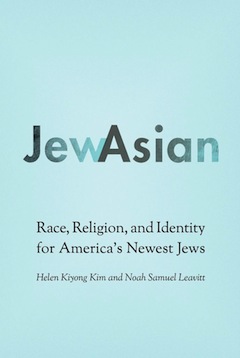
The recently published book JewAsian: Race, Religion and Identity for America’s Newest Jews by Helen Kim and Noah Leavitt was crafted out of a seven-year study of 39 mixed couples, as well as their own successful marriage. The couple will be in Vancouver later this month to share their findings at the Cherie Smith JCC Jewish Book Festival.

For Kim, who was born a few years after her parents moved from Korea to the San Francisco Bay Area in the late 1960s, finding a Korean guy to date was a virtual mission impossible, so looking outside the community was accepted.

“My mother was totally fine with it, in large part because she’d thrown away her expectations that I marry somebody Korean a long, long time ago,” said Kim of her marriage with Leavitt. “I think, in part, because I grew up in a community that was predominantly white with very few people of color, I think she quickly realized that, demographically speaking, it was probably going to be unlikely I’d meet, date and eventually marry someone of the same ethnic background as me.”

Leavitt, who is of American Jewish origin, said, “My mom was super-excited about the fact I had met somebody I was so smitten with. She and Helen, early on, established a great rapport that has continued ever since. I think my mom just had an expectation that I’d settle down with somebody I really loved, who I was challenged and inspired by, and saw that in Helen … so she was excited.”

Leavitt grew up in a household that was somewhere between the Reform and Conservative denominations. He went to a Jewish community Sunday school growing up that was housed at Cornell University and he had his bar mitzvah at Ithaca College through their Hillel.

Kim and Leavitt met in 1997 and both were drawn to the complexity of their Jewish-Asian mix, an interest that increased with the births of their children.

“This was the era where, I think, we started to see a lot of interracial pairings, dating and marriages,” said Kim. “And it was also right before the U.S. census gave multiracial individuals the option of choosing more than one race on the census … really, an interesting time, demographically speaking, where the context around us was contributing to our thinking about how common are pairings like ours and maybe other interracial or Jewish-not Jewish pairings.”

Leavitt and Kim contacted a number of universities that were repositories of large-scale demographic studies. They were aware that the study of intermarriage to that time had been focused on interfaith marriage, but had not delved into how interracial marriage factored into the larger picture.

The couple reached out to the Institute for Jewish and Community Research. Through this connection, they were able to do an initial recruiting of couples with whom to speak for their book. In the end, their study included 39 couples from the San Francisco Bay Area, Los Angeles and Orange County, and from the New York and Philadelphia metropolitan areas.

book cover - JewAsian“We focused there, in part, because of the high percentages of individuals who identified as Jewish and Asian,” said Kim. “Then, there was the likelihood and demographic reality that interracial marriages are taking place predominantly in those areas … with the West Coast having, by far, the highest rates of interracial marriages.”

“We had a lot of people volunteer to be part of the survey and what we made a decision to do was to try to find the most expansive look at Jewish-Asian combination that we could,” said Leavitt.

Within the 39 couples, one was gay and three were lesbian, with the remainder being heterosexual. The study also included a second set of interviewees who were young adults that were children of Jewish-Asian households.

“The first thing by far that I think was quite surprising that we found was that, for the couples as well as the adult kids, they are definitely Jewish – not just in terms of the self-identification perspective, but in terms of some strikingly traditional religious practices,” said Kim. “So, the couples we interviewed were in the midst of or had created homes where there was a lot of traditional Jewish religious practice – everything from observing Shabbat consistently, to consistent synagogue attendance, to kids becoming bar or bat mitzvah, to children going to Jewish day schools.

“Then, for the adult kids we interviewed, they affirmatively claimed they were Jewish. But, they also talked about having been raised in traditionally religious households and communities that, to a great extent, mirrored what we were finding with the couples we interviewed.”

While only six of the racially Asian individuals had converted to Judaism, the overwhelming majority of couples celebrated Jewish religious events and cultural tradition alongside Asian ethnic traditions.

“There was neither a conflict of religion nor a blending of religions,” said Kim. “It was more of a cultural hybrid, but steeped in Judaism as the religion of the household.”

“I would go broader and say that, for the most part … we didn’t really hear too many stories about conflicts related to religion overall,” added Leavitt. “There were a few examples where the non-Jewish partner had a religious or spiritual practice that they adhered to, but it was something they did on their own and didn’t bring into the household.”

Both Kim and Leavitt said the findings were representative of their own Jewish-Asian mix. “Judaism, for me, is a religion and a cultural tradition that is easier for me to instil in my family,” said Kim. “I, as a second-generation child of an immigrant family, did not grow up with a lot of Korean ethnic and cultural traditions.

“Through the adult kids [in the study], it was reinforced repeatedly that you have to expose [them to the culture], no matter what your comfort level as a parent, no matter your knowledge as a parent. The kids really appreciated when the parents went all out in terms of trying to expose them to a particular culture or ethnicity, though they themselves as parents were afraid they might not do it right.

“So, I think just hearing from the kids and imagining my own kids in 10 to 15 years was kind of affirming to me, [that I just need to] try as much as I possibly can. The kids will end up picking up things here and there and will then, on their own, become curious and want to learn on their own. That was reassuring for me.”

“I had a lot of the same reactions,” said Leavitt. “For me, when Helen and I decided to make a commitment to this project, it was fairly close in time to when we were also starting to think about having our own family. When we got this investigation underway, our son Ari arrived. As a first-time parent, I had a lot of worry and anxiety about a household that seemed to combine so many different kinds of traditions, cultural heritage markers and, to some extent, religious differences. I think I had a lot of worry about the ability of all those things to be in a household together … in part, because I didn’t have an upbringing where there were lots of differences within the household. So, I had a lot of fear about that.

“One of the things I’ve been liberated by, in working on this project and having two children arrive, is there is a lot of flexibility and resilience in households. Where even something may seem like a long list of differences, the people inside that household are able to find ways where things can come from different directions, but meet at the same point.”

Kim is excited about coming to Vancouver, especially to have the opportunity to speak with a non-American audience, “to understand how it is that they think about these different dimensions of identity, tradition, culture and religion, as a way of getting out of our predominantly U.S.-focused lens. I’m really looking forward to that comparative perspective.”

Leavitt said, “I think the chance to be in as diverse, global and multicultural a city as Vancouver … maybe there are lots of households coming together with this mix of Jewish-Asian backgrounds in Vancouver. I think this may propel us to continue researching more in this international comparative way.

“Helen and I feel very fortunate to have been working on this project at a time in the U.S. when the exploration about the diversity of the Jewish community in our country is really something that is front of mind for so many congregations, synagogues. We aren’t the same people we were years ago.”

“If we are acknowledging that this is what American Judaism looks like,” added Kim, “what then is the responsibility we have in regards to action based on the changes in the demographic and how do we act based on how we’ve changed?”

Kim and Leavitt are on a panel with Daniel Kalla on Nov. 28, 6 p.m., at the Jewish Community Centre of Greater Vancouver. For more information, visit jccgv.com/content/jewish-book-fest.

Rebeca Kuropatwa is a Winnipeg freelance writer.

Format ImagePosted on November 11, 2016November 11, 2016Author Rebeca KuropatwaCategories BooksTags continuity, culture, intermarriage, interracial marriage, JewAsian, Judaism, religion

Posts pagination

Previous page Page 1 … Page 16 Page 17 Page 18 … Page 31 Next page
Proudly powered by WordPress