Skip to content
  • Home
  • Subscribe / donate
  • Events calendar
  • Business Directory
  • FAQ
  • News
    • Local
    • National
    • Israel
    • World
    • עניין בחדשות
      A roundup of news in Canada and further afield, in Hebrew.
  • Opinion
    • From the JI
    • Op-Ed
  • Arts & Culture
    • Performing Arts
    • Music
    • Books
    • Visual Arts
    • TV & Film
  • Life
    • Celebrating the Holidays
    • Travel
    • The Daily Snooze
      Cartoons by Jacob Samuel
    • Mystery Photo
      Help the JI and JMABC fill in the gaps in our archives.
  • Community Links
    • Organizations, Etc.
    • Other News Sources & Blogs
  • JI Chai Celebration
  • JI@88! video

Recent Posts

  • SFU honours Gloria Gutman
  • Lifting people’s spirits
  • Wedding a ray of light
  • Indigeneity and Zionism
  • Rule of law broken: councilor
  • Football and its roles
  • The burden of defence
  • Fish Café returns after fire
  • All right in what goes wrong
  • Nuns & mermaids at TUTS
  • Camp offers holiday retreat
  • Students and mentors inspire
  • Once-in-a-lifetime trip
  • 100 dancers, one heart
  • Money for the sciences
  • What “Jewish food” means
  • Have a cookie, schnitzel too
  • Federation now across BC
  • Israel fighting for its existence
  • Deal strengthens Iran
  • Patriotic belonging diminishes
  • A campaign to engage
  • Upstanders’ first live event
  • Responding to Carney
  • Having your own home
  • Music a family tradition
  • Musical to warm heart
  • Community milestones … June 2026
  • Sharing her passion for Israel
  • Or Shalom reopens its doors
  • JFS from past to future
  • Need holistic approach
  • Sharing stories, advice
  • Journalist shares fears
  • Skills to live together
  • Road to independence

Archives

Follow @JewishIndie
image - CJN box ad Rockowers 2026

Byline: Rebeca Kuropatwa

Getting through menopause

Getting through menopause

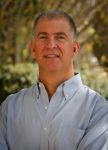
Harriet Berkal unveils the secrets of menopause. Berkal began the support group Menopause Matters after experiencing a lack of help when she went through that stage of life. (photo by Manny Berkal-Sarbit)

Medical advocate Harriet Berkal recalls eagerly anticipating going through menopause, imagining it to be a fabulous life stage without having a period every 28 days or so.

“Now, if I could go back and have my periods and not go through this other nonsense, I would say, give me my periods back,” Berkal told the Independent.

Berkal works as an executive financial consultant for Sarbit Advisory Services in Winnipeg and has been struggling with menopause-related issues for the past seven years. She has leaned from experience that there is next to no help out there for dealing with the effects of menopause, and this has led her to take matters into her own hands and create a support group.

“One problem with this issue of menopause is, if you complain to a physician about something like weight gain, a symptom of menopause, they bundle everything you say after that behind that carriage,” said Berkal. “So, my GP missed the fact that I had a thyroid condition, because it was thrown into menopause – the same way that people get thrown into the irritable bowel syndrome (IBS) or the fibromyalgia hole … where anything you complain about is automatically assumed to be related to that, when it might not actually be.”

Menopause symptoms for many women include hot flashes, night sweats, migraine headaches, bladder infections, gastroesophageal reflux disease, lost libido, and painful intercourse. There are also some very rare reactions, such as feeling as though you have bugs crawling all over you, and emotional depression or anxiety, which are also related to hormonal fluctuations.

While typically menopause begins in one’s 50s, it can start in one’s 40s, where the cycles become more erratic, and, in some cases, even earlier, from induced conditions via cancer treatments, for example.

As Berkal searched for solutions, she decided to share the information she gathered with other women undergoing menopause. She approached Winnipeg’s Jewish Child and Family Services (JCFS) about starting up a learning and support group.

The idea was welcomed and the group was called Menopause Matters. Some 20 women meet once a week for five weeks to learn about different approaches to dealing with menopause symptoms and management.

“Most of the primary group are those in the throes of menopause and who aren’t functioning well,” said Berkal. “We had about 18 at last week’s meeting. It was an emotional meeting. There were some people who were extremely – not just frustrated with the system, but at the end of their rope. They don’t know who to turn to, what to do. We provide them, each week, with a different speaker and go through the whole gamut of solutions from traditional to non-traditional.”

Some education is provided by the clinic Vitality Integrated Medicine, which is run by a former pharmacist. Participants are informed about drug interactions, different kinds of tests to help determine actual lacks in their systems, and three different kinds of estrogen. According to Berkal, what often happens is that menopause-affected women consult their doctors and are told they need estrogen, and then they just take whichever one is prescribed.

Recently, Menopause Matters participants had a guest speaker who is an acupuncturist discussing stress control and how it affects hormones, and various acupuncture relaxation techniques that could help. “She brought needles and tried them out on some people,” said Berkal. “People were appreciative of that approach.”

Another scheduled guest speaker at the time of Berkal’s interview with the Independent was gynecologist Dr. Maggie Morris. She was to speak “about mainstream methods for dealing with things like Premarin estrogen application.”

Berkal’s personal experience with conventional medicine in general is that its practitioners are uncooperative from the moment she mentions that other approaches will be presented.

“The pharmacies have these ready-made solutions,” she said. “They aren’t one-size-fits-all solutions in my mind. We’re trying to provide people with a range of different solutions and methods to cope with this. One solution doesn’t do everything. You don’t want to mask symptoms. You want to get to the root. Everyone’s jockeying for position here and everyone has different approaches, so you should try figuring out what system fits you the best.”

Another speaker booked to address the support group is to talk about the importance of exercise, while another will highlight a treatment called Mona Lisa Touch, which involves the use of a laser inserted into the vagina to stimulate vaginal collagen production.

“It rejuvenates the tissue in the vagina without hormones, so you can get increased libido and increased moisture,” explained Berkal. “It helps create a better balance of health in the vagina.

“Many women get bladder infections, because the bladder and the vagina are closely linked. And, if you don’t have the right environment in the vagina, which is decreased because of menopause, you can end up with UTIs [urinary tract infections] … which I had probably 10 of last year before I started treatment.”

When Berkal underwent menopause, she said, “It was a pretty extreme and exacerbated reaction. Mood swings are a very big issue. Last week, there were several women in the group who said, ‘Does anyone feel like they’re going crazy?’ Almost everyone raised their hand.

“Hormones are so powerful. When they are working great, that’s great. When they are depleted, you are left with a shell of a body, susceptible to bone loss, memory fog, you think you’re getting the early stages of Alzheimer’s … but really, you’re not.”

Berkal believes that integrated medicine is the right direction and, in fact, integrated clinics are popping up in many places.

“But, the fact that I couldn’t find a menopause support group was mind-boggling,” said Berkal. “I approached the Mature Women’s Clinic at the Victoria Hospital and asked if they would start a support group. They said ‘no.’

“Why would they not want to help women in need? Yet, when the pharmaceutical companies sponsor a forum for one of their gynecologists to speak, they get thousands of women to come down who are in dire need of help … but they are only giving one approach.”

Shelley Levit, a social worker at JCFS, was very receptive to the integrated approach Berkal described, and the concept of letting women choose for themselves what they want to pursue.

Berkal hosted a Menopause Matters free, five-week support group from Sept. 15 to Oct. 13, via JCFS.

“We call it ‘the Sisterhood of Sharing,’” said Berkal. “Sharing is deeply required in order to feel camaraderie and kinship with these other women who really have no one else to talk to. It wasn’t intended to be targeted at Jewish women specifically. It’s like cancer – not specific to any ethnicity.”

Berkal wants to see if the group would be receptive to having partners and spouses join, so they can be present and hear from other women.

Rebeca Kuropatwa is a Winnipeg freelance writer.
Format ImagePosted on November 11, 2016November 11, 2016Author Rebeca KuropatwaCategories NationalTags health, menopause, Winnipeg
Making a life in Israel

Making a life in Israel

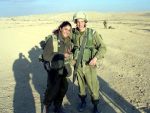
Emily Rose and Aviv Eisenstat in the Israel Defence Forces’ officer’s training school in 2008. (photo from Emily Rose)

When Emily Rose, 28, moved to Israel almost 10 years ago, her plan was to serve in the Israel Defence Forces and then return to Winnipeg. It didn’t happen quite as planned.

Rose was born in Odessa, Tex., and grew up in Winnipeg. Taking a similar road as many Jewish kids in the city, Rose studied at Gray Academy of Jewish Education (GAJE).

“The Winnipeg Jewish community is truly saturated with role models for social justice and it had a major impact on me growing up,” said Rose. “I grew up watching my aunt, Faye Rosenberg, who works for our Jewish community, help bring hundreds of Jews to Winnipeg from Argentina, where they suffered from antisemitism, and watching my best friend’s dad work tirelessly in court to help victims of residential schools receive compensation from the government.

“Winnipeg is an incredibly Zionist and supportive community,” she added. “The longer I am away, the more I appreciate what a wonderful community it really is.”

When Rose was 14, she went to Israel on a Jewish Federation of Winnipeg Partnership 2000 (or Gesher Chai) trip, which sent 10 high school students from GAJE to their sister school, Danziger, in Kiryat Shmona.

She fell in love with the city and the people. “My host family had three sisters and I was thrilled because, up until then, I only had big brothers. And, I remember writing to my mom, ‘Now I have three sisters!’ on the first night. I realized at that point that all my new friends in Israel would be going to the army soon and I remember thinking I had the responsibility to do that as well.”

This is what led Rose to move to Israel at the age of 18, starting with a mechina (a pre-military program) in her first year there.

She lived in Sde Boker in southern Israel and volunteered as an English teacher’s aide in an unrecognized Bedouin village. “Can you think of anything more polar opposite to a very cold Winnipeg, Man., than the middle of the Negev Desert?” she quipped.

“Your first year in Israel is always the most challenging, I think. There were a lot of tears. I was the only foreigner in the program, so I had to learn Hebrew very quickly. But, the program itself was also very intense, because we had classes every day and political tours and hikes every month.”

Something Rose was especially thrilled about in Israel was getting to sleep outside. As a child, she eagerly anticipated going to summer camp for canoe trips and sleeping under the stars.

“When you see the stars in the Negev, you really think it’s got to be the best seat in the house,” said Rose. “And, that first year, my roommate used to wonder why I’d always drag my sleeping bag out of our room to sleep outside.”

The next year, Rose joined the IDF as a lone soldier and served as a combat fitness officer. She recalled that some of her trainees used to call her “M&M,” as she was “hard on the outside, but sweet on the inside (and very small).”

She added, “My first job was training infantry soldiers on a combat training base where I worked with a unique battalion of Druze soldiers. The soldiers I worked with spoke Arabic. This really sparked my interest in the language, which is why I studied Modern Standard Arabic (MSA) in school.”

Today, Rose serves in reserve duty in Jerusalem’s Homefront Command. Her job is to communicate with the civilian population in Jerusalem during times of emergency.

A few years after her IDF service, Rose volunteered at the Michael Levin Centre for Lone Soldiers, which helps soldiers before, during and after their service. At the centre, the first thing she was asked to do was to tell those thinking about joining the IDF “don’t.”

Rose explained, “If we couldn’t convince them not to, then we’d help them as much as we possibly could. Nobody told me not to join the IDF, but also no one would have been able to convince me not to. And, the day I joined, I remember I wasn’t nervous – I just knew it was the right decision.

“I also didn’t plan on staying. I thought I’d serve for two years and then return to Canada. Here I am, almost 10 years later.”

After the army, Rose took Middle Eastern studies (along with MSA) at Hebrew University of Jerusalem. She still lives in Jerusalem, where she recently started writing for the Times of Israel.

Just prior to that, she was an editor at Israel National News, where, she said, she mostly wrote the breaking news but also covered longer form stories. “A few weeks ago,” she said, “I broke a story with exclusive footage of a former Australian minister who got caught in a firefight clash between Kurdish forces and ISIS in Iraq.

“The plight of the Kurdish people is an issue that is very close to my heart. I jumped at the chance to write about it. I’m also so proud to say I come from Winnipeg, [as] our Jewish community sponsors Operation Ezra, bringing Yazidi refugees safely to Canada.”

When on leave from the army a few years back, Rose returned to GAJE to speak to the students. When she visited Winnipeg this past summer, some community women stopped to say hello to her and her mom. “One of them told me that her grandson was going to be a lone solider, an IDF paratrooper, this fall … and she said that I’d spoken to him when he was in high school,” said Rose. “That was very nice, like coming full circle.”

Currently, Rose is working on a short story collection, a novel and three plays.

Her first play was presented at the JCC Berney Theatre in Winnipeg in 2006, the year she graduated high school. Called Radyo, it is about a group of high school kids in Kiryat Shmona who run their local high school radio station during the Second Intifada.

“The second play is a children’s musical I wrote called Don’t Touch the Glutch, which was performed as a part of the Next Wave of Musicals Festival in Montreal and then at the Centaur Theatre children’s series in 2013. It’s about a boy who gets lost in the zoo on a school field trip and discovers that the zoo has a whole host of strange creatures that only come out at night. My brother wrote the music and lyrics and I wrote the book. The show has an anti-bullying theme, because it’s a topic we both feel very strongly about.”

When asked about her feelings about Israel, Rose quoted Rabbi Abraham Isaac Kook: “The truly righteous do not complain about evil, but rather add justice; they do not complain about heresy, but rather add faith; they do not complain about ignorance, but rather add wisdom.”

She added, “Israel is in everything I write, in some form or another, and, though I may not always succeed, I try my best to contribute justice, faith and wisdom with my words.

“For now, I love reporting the news as it happens. Israelis, and those who care about Israel, want to stay informed and I feel privileged to be working with a team that is very committed to keeping our readers updated at all times.”

Rebeca Kuropatwa is a Winnipeg freelance writer.

Format ImagePosted on November 11, 2016November 11, 2016Author Rebeca KuropatwaCategories IsraelTags aliyah, IDF, Israel, journalism, Winnipeg
Unique rabbinical road

Unique rabbinical road

Sandra Lawson is studying at Reconstructionist Rabbinical College. (photo from Sandra Lawson)

Sandra Lawson, an African-American lesbian who converted to Judaism after being raised in a secular home, is now studying to be a rabbi at Reconstructionist Rabbinical College, in Wyncote, Penn.

Born in St. Louis, Mo., Lawson’s dad was in the military, so the family moved around a lot, though mainly stayed in the Midwest. Her dad was a military recruiter and career counselor.

“My dad was raised a Christian, but I really had no religious upbringing when I was a child,” Lawson told the Independent. “I knew about Jesus, and we would occasionally get invited to church, but there really was no religion in our house.

“On my mom’s side, we had a back story of an ancestor who was Jewish. Like folklore, it really meant very little to me until I started on this Jewish path myself.”

This path began when Lawson was an undergraduate student and needed another class to graduate. The only course available at the time was one on the Hebrew Bible, which Christians refer to as the Old Testament. The teacher was a Christian academic from Kenya.

“When I got to the class, the teacher told everyone they needed to get a Bible for the class,” said Lawson. “But, he said to not get a King James version, as, he said, it’s a bad translation.

“This class opened my mind a little bit to the Bible as a piece of literature. He made the Bible acceptable for me. It wasn’t a book to be feared. Years later, I have a Jewish girlfriend and her sister invites me for Shabbat dinner. I thought, I like this. It’s really cool. I shared with my girlfriend at the time that an early ancestor was Jewish, but that I know nothing about Judaism.”

From that first Shabbat dinner, Lawson went to her girlfriend’s family home every Friday night.

“They weren’t Orthodox,” said Lawson. “They were just a modern family that would stop everything for Shabbat. It was really cool. I loved the ritual. I loved how open the family was. I loved how they accepted and treated me.”

Around this time, Lawson met Rabbi Joshua Lesser of the Reconstructionist Congregation Bet Haverim in Atlanta. Lesser hired Lawson as his personal trainer and, over the course of the two or three years she worked in that capacity, their friendship evolved and he invited her to his shul.

“I was hesitant,” admitted Lawson. “I shared with him the story of my great-grandfather. Eventually, I did go and I fell in love with the community – not necessarily Judaism, at the time – but I loved the community. That’s how I got interested.

“I started going to services regularly. The community has straight people, gay people and kids but, mostly, it is a space where I felt like I could be myself – something I’d never experienced before in a religious community.”

Lawson went on to learn more about Judaism and, in 2003, she told Lesser she was thinking about converting. In the conversion classes she took, the teacher helped her see a broader view of Judaism.

“I loved the class,” said Lawson. “I loved learning about the Jewish calendar and reading the Bible again, as a piece of literature. I loved learning about Jewish history.”

After about a year of studies, the class was over. And, on Oct. 13, 2006 – the day before her 35th birthday – she converted to Judaism.

Lesser asked Lawson to be a congregational representative on the board for the gay members of the synagogue. A year later, when gay marriage was a hot topic in the presidential election debate, Lawson took her stance a bit further.

“It was sort of funny, because I didn’t know anyone in my gay life who was even thinking about trying to change marriage laws,” she said. “We were all just happy that we could be legally gay. Josh [Lesser] asked if I wanted to join the gay and lesbian task force, as they were coming to Atlanta to do some training. I was like, sure. And he’s like, the good thing about it is, they need more diversity. They need more black and brown voices on these issues.”

Lawson later joined a clergy-based group working on the issue. This group, according to Lawson, was all over the map as far as sexual orientation and most everything. But, what they did agree on was that the state had no business legislating what you did behind your own closed doors.

“The more I started to do volunteer work, the more I realized I wanted to have a more powerful effect, more ability to effect change … that I would need the title of rabbi … and here we are today, as I work on becoming one,” said Lawson.

“Obviously, I’m different. There aren’t a lot of rabbis that look like me. I think being on the edge of the fringes of Judaism allows me to be more flexible or more creative in the things I do.”

One of the required classes that Lawson took last year was on entrepreneurship and thinking outside of the box. During that time, she was approached by the Jewish owner of a local vegan café she went to often, asking if she would be willing to lead services at the café on Friday evenings.

“I went back to class and told my teacher about it,” said Lawson. “I wrote it up as a grant … so I had the grant to lead services at this Lansdale café (outside Philadelphia).”

They have been running services at the café for months now. Every Friday, Lawson shows up with two vegan challot and grape juice. Arnold (the café owner) sets up the place and invites friends and customers to stay for the service.

“Every time, we’ve had at least a minyan,” said Lawson. “It’s been a lot of fun. People can show up as they are, with their sandals, their shorts. We sing. We do a little Torah and welcome the Shabbat.

“People come because they want to see what’s happening in the café … I think it was last week, Arnold had a flautist there, and people came to hear this guy play the flute. Also, I think, in May, there was a couple there who were not Jewish, but they had been taking a Christian class on Judaism. The class was finished, they saw this service and came to learn more about Judaism.”

Next on Lawson’s mind is leading services outside. “I don’t know how I’m going to pull it off yet,” she said. “Right now, I’m in this stage of trying to get a lot of buzz around different ways that people can do Shabbat.

“My dream, I don’t know when it will happen, is to have a Shabbat morning service in the future, in a park. I’m someone who, I see God in nature a lot. To be running in the woods, when the sun is coming up, is the best way for me to pray in the morning. I know a lot of people could connect their Judaism to nature. I haven’t quite figured it out yet, but I hope to.”

Lawson is set to graduate rabbinical school in 2018.

Rebeca Kuropatwa is a Winnipeg freelance writer.
Format ImagePosted on November 11, 2016November 11, 2016Author Rebeca KuropatwaCategories WorldTags Jewish life, Judaism, Reconstructionist, spirituality
The process of integration

The process of integration

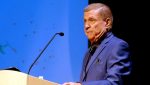
Dr. Solly Dreman (photo by Rebeca Kuropatwa)

With the large numbers of refugees and immigrants making their way to Winnipeg and elsewhere in Canada, Winnipeg Friends of Israel invited Dr. Solly Dreman, a Winnipegger who moved to Israel in 1964, to speak on the topic.

In the Sept. 19 lecture at the Asper Jewish Community Campus, Dreman drew from his own experience and expertise, using the work he did, along with colleague Dr. Ava Shinar, on immigration in the 1990s to illustrate an optimal way of integrating immigrants into Israeli society, which could be applied to other countries.

“I did the workshop with her over a decade ago, but the implications are certainly relevant to the contemporary problems occurring in the world today, and to immigrant and refugee populations all over the world,” said Dreman.

“Immigration is widely recognized as a stressful event which increases psychological vulnerability,” he explained. “Researchers have noted that adolescent immigrants … we know that many terrorists are in that age group … constitute an extremely high-risk population. In adolescence and late adolescence, there’s a need to cope with profound physical, psychological and social transformations. And, in those adolescents who have become immigrants and [are] in a strange and often unwelcoming environment, the uprootedness and difficulties in establishing a solid base of identity and meaning could have disastrous results. Indeed, the violence evident today in such places like Paris, Nice, Brussels, Orlando, San Bernardino, as well as Tel Aviv and Jerusalem, testifies to this. Youth confronted with a strange environment and difficult economic conditions, as well as lack of purposefulness in their lives, often latch onto causes and groups that implement terrorism and violence in the international community.”

Dreman also discussed other issues.

“In the 1990s,” he said, “with the collapse of the Soviet Union, there was a mass exodus of over a million Soviet Jews to Israel. Soviet students comprised about 10% of the student body at Ben-Gurion University. They were competing for limited resources, such as dormitory space, scholarships and, eventually, opportunities for employment.

“There were many negative stereotypes and attitudes prevailing between the native Sabra students, who were born in Israel, and their Soviet counterparts. As far as the stereotypes that Israelis had toward the Russians, well, they often viewed them as manipulative, clannish and corrupt … while the Russian students perceived the Israelis as loud, aggressive and uncouth.

“The Russians, in that first year of the workshop, we also heard some terrible things they had to say about the Ethiopians, referring to them as subhuman, subspecies, monkey-like, etc.”

With the extreme alienation between Sabras and the immigrant students – to the point of outright violence and fist fights – Dreman needed to find ways of reducing tensions and bringing understanding, cooperation and solidarity between the groups.

He said it was important to create an atmosphere where each group could participate in an evolving melting-pot culture, where each side would begin to listen to and understand the other. As such, he and Shinar created a two-credit academic course that eventually became a four-credit, year-long course because of its popularity.

“So, students were given an award for their participation and for completing course assignments,” said Dreman.

He explained, “The syllabus described it as being designed to help students learn about their family and individual transitions in the face of such phenomena as birth, adolescence, illness in the family, divorce and death … but with a particular emphasis on aliyah immigration.”

Normative aspects of immigration and transition were discussed in an academic context, so participants could then discuss their own experiences in a non-threatening atmosphere and place those experiences in an appropriate context, in an effort toward understanding what they themselves were going through.

At first, due to the Israelis’ fluency in Hebrew and the Russians’ more reserved manner, the Sabras monopolized the class. But, after a few sessions and with a little prompting, the Russians became much more comfortable and vocal.

“What we wanted to do was create an evolving identity,” said Dreman. “Emphasis was placed on joining the new culture, but space should be provided for the immigrant representatives to give expression to their culture of origin, needs and expectations. On the educational level, awareness workshops should be introduced in citizenship classes in elementary schools, high schools and colleges. It is also critical that government and volunteer groups work together to help promote immigrant absorption.”

Dreman recognizes that the work they did in Israel had many atypical factors working in its favor, but said the attitude of creating a type of melting pot should yield a good result in most cases. As well, while the workshops had some factors going for them, like participants with a common Jewish identity, working with young adults (18-to-24-year-olds) posed challenges that are less common with older immigrants, such as extremism and radicalization.

Dreman wanted to be very clear in differentiating between immigrant and refugee populations, noting the difference “between immigrants who want to immigrate and refugees who are exiled and may not necessarily want to.

“The purpose of our workshop was to make the hosts and the new immigrants understand where the other person is coming from, to create a merging of cultures and understanding in order to ease the process of assimilation,” he said. “I think the beautiful thing is that it was based on reciprocity. It was very successful. In the workshop, at the beginning, people hated each other. At the end, almost all had befriended people from the other group.

“If people knew that the immigrants had a real desire to be part of the hosts’ community, I think there’s a lot of opportunity for mutual understanding,” he added.

According to Dreman, the setting also plays a significant role. “In one of the projects we did, we sent kids out in one of the groups to interview Israelis – native Israelis – concerning their attitudes towards Russians. We sent them to a marketplace, a competitive marketplace with pedlars. And, another group, we sent to interview Israelis in Dizengoff Centre, which is upper-class…. How did the native Israelis describe the Russians in the marketplace? ‘Swindlers, crooks, gamblers, prostitutes, bastards.’ What about in the centre? They described them as ‘wonderful, contributing to the nation,’ and so on.

“In Europe and North America, if somehow they could take select groups of people who host immigrants and let them have that encounter and spread the gospel – ‘Hey, they aren’t that bad,’ that sort of thing – there is no reason it would not be successful.”

Rebeca Kuropatwa is a Winnipeg freelance writer.
Format ImagePosted on October 28, 2016October 27, 2016Author Rebeca KuropatwaCategories NationalTags immigration, Israel, refugees

Genetic testing and privacy

Genetic testing can save lives. So, why isn’t everyone getting it done? It turns out that companies are using the information from the tests to discriminate against applicants.

While this is by no means a Jewish-specific issue, the National Council of Jewish Women of Canada (NCJWC) and the Centre for Israel and Jewish Affairs (CIJA) are taking the lead in urging the federal government to legislate against this discriminatory practice.

“At NCJWC, our goals are for education, service and social action,” said Sharon Allentuck, the organization’s national president. “Social action includes writing to MPs, senators and the prime minister … [about] genetic testing and insurance denial.”

Genetic testing has been high on NCJWC’s list of priorities for the past 25 to 30 years and it continues to be – not just with respect to concerns over insurance companies’ actions, but also to increase public awareness of the importance of genetic testing.

In Winnipeg, for example, a clinic is held every three to four years in conjunction with Health Sciences Centre geneticist Dr. Cheryl Greenberg. While, in the past, the main focus was on Tay-Sachs, the list keeps getting larger, as geneticists like Greenberg discover new gene connections. At the moment, the list stands at seven to eight different Jewish genetic diseases being studied.

By getting a test done, one can be aware of a possible genetic problem that might affect oneself or one’s children, if a person has children with another carrier of the same disease. This knowledge can provide people with peace of mind when choosing a partner.

So far, though, this knowledge has come with a cost. When people apply for insurance, they are asked to disclose the results of their genetic testing.

“It came to our attention that insurance companies said to some people, ‘You’ve been tested, genetically. You have certain predispositions. Sorry, but we’re going to deny you insurance,’” said Allentuck. “It’s against human rights, it’s discriminatory. Canada is the only G7 country that allows this to happen. And so, legislation [Bill S-201] preventing that discrimination was passed through the Senate and now it’s in the House of Commons. We are asking our members and are working with CIJA to encourage [Jewish community] members to contact their members of Parliament to ensure the legislation passes.”

CIJA adds on its website, “We encourage provincial legislatures to pass complementary legislation, with a specific focus on employment and insurance.”

For more information, visit NCJWC’s website or Facebook page. Allentuck encouraged readers to become NCJWC Facebook friends in order to stay regularly updated on this and other important topics.

“This isn’t a Jewish issue,” she said. “But that doesn’t mean that Jewish people can’t have a say in it.”

Rebeca Kuropatwa is a Winnipeg freelance writer.

Posted on October 28, 2016October 27, 2016Author Rebeca KuropatwaCategories NationalTags Bill S-201, genetic testing, privacy
Donating his wish to others

Donating his wish to others

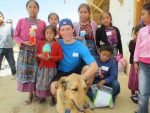
Matthew Boroditsky with some of the children he met at Project Somos. (photo Matthew Boroditsky)

In life, we all face hurdles – and how we react to these trials can come to define us. This story exemplifies that.

Three years ago, Matthew Boroditsky was told he had Hodgkin’s lymphoma, a relatively rare form of cancer, accounting for about 0.5% of all cancers and 15% of all lymphoma cancers diagnosed. Approximately 900 people are diagnosed with Hodgkin’s lymphoma in Canada each year, and it is more frequently found in males than in females, and in people between the ages of 15-39 and older than 55.

Boroditsky was born in Chicago, moving to Vancouver with his family at four months old. At age 17 – on Oct. 13, 2013 – he was diagnosed. After completing high school at St. George’s and once the disease was under control, he moved to Hamilton, Ont., to study at McMaster toward a bachelor of health sciences degree.

Thinking back, Boroditsky recalled, “I had just returned to school for my Grade 12 year after playing in a hockey tournament over the summer months, when things quickly changed for me. All of a sudden, my life was put on hold, as the only focus became on fighting this disease over the next eight months of my life. During this time, I never truly understood the magnitude of influence this experience would have on my life.”

The importance of health and how much we take our good health for granted was something that especially struck Boroditsky during this time. Just as he and his family began settling into the treatment schedule, they were approached with the opportunity to be granted a wish by the Children’s Wish Foundation.

“This was a unique and intriguing opportunity, one that I did not take lightly,” said Boroditsky. “It was quite overwhelming when I first fully realized the vast possibilities associated with this wish. After several days of thought, I felt sure I wanted this wish to be one I could look back upon many years later. I wanted to make a wish that could serve as a constant reminder to not only me, but to the greater community, about the importance of gratitude, hopefully sharing a small bit of what I learned through my experience. Thus, I came to the conclusion that I would like my wish to be a giving wish.”

Before his diagnosis, in March 2013, Boroditsky and several classmates visited Project Somos, which is located in a southern Guatemalan community as part of a service-learning experience. An eco-sustainable alternative community for at-risk mothers and children, it arose, among many other factors, because of rising poverty and poor access to education and medical care in the region.

photo - A plan for the clinic designed by Project Somos
A plan for the clinic designed by Project Somos. (image from Matthew Boroditsky)

In line with Project Somos’ commitment to environmental sustainability, a 960-square-foot medical clinic is in the planning stages. It is to be built with earthquake resistance in mind and will feature solar hot water and electrical power.

“The people in rural areas, such as Chivarabal – where Project Somos is located – often don’t have the money to cover transportation to a medical clinic,” said Boroditsky. “If they do manage to get to a free clinic, they might not be able to afford the medication prescribed…. Even generic drugs are prohibitively expensive. There aren’t many systems in place for long-term health conditions and preventative care is completely lacking.

“Realizing the limitations and the precarious situations people find themselves in, the tragic lack of what we, at home, would consider basic simple care, sparked the idea of constructing a medical clinic on site.”

When the idea was first conceived, Boroditsky was not fully aware of how this could be done. But, when he went to Children’s Wish and started discussing with them how he wanted to use his wish, they helped translate his dream into a reality.

“I wanted my wish to make a difference in this world and to continue to help the people of Guatemala for many years to come, trying to parallel the philosophy of Project Somos in its recognition of the importance of sustainability,” said Boroditsky. “The people at Children’s Wish have been, from the very beginning, extremely supportive surrounding the initiative and did everything they could to help make it become a reality. Children’s Wish is truly a remarkable organization that I’m proud to have been able to work with.”

And so, nearing the end of his treatment, in partnership with Children’s Wish, Boroditsky has directed the initial funds into the medical clinic for Project Somos.

But, the planning of a medical clinic and neighborhood house at the Project Somos site has been challenging and Boroditsky, friends and family are continuing to fundraise. In that vein, they will be holding an event next month – on Oct. 13 at St. George’s School.

“We are planning to celebrate the continued progress and success of the project that we hope will make a big difference in the lives of others who are less fortunate,” said Boroditsky. “The event will be centred on learning more about how this project came to be and hearing from a few inspirational speakers who have personally moved me into action.

“Life has a funny way of evolving,” he added. “I never would have even imagined I’d be involved in a project like this so far from home. I feel we have an obligation as a global community to help each other, and I know that many of you reading this feel the same way.

“I feel optimistic and excited to make a difference in the lives of so many. With the help of Children’s Wish and many supporters … we’re getting closer to seeing this wish become a reality.

“Never underestimate the power you hold in helping to make good things happen,” he said. “Please help us by donating directly to the medical clinic project or by coming to our event to help make this giving wish come true.”

To read more about Boroditsky’s story, see “Letter from Matthew Boroditsky: A Giving Wish” at projectsomos.org. For more information on the project and fundraiser, visit facebook.com/helpingadreamcometrue. (A tax receipt for donations will be issued by the Compassionate Fruit Society, a nonprofit for Project Somos.) To buy tickets to the Oct. 13 event, which takes place 7-8:30 p.m., at St. George’s School, 4175 West 29th Ave., visit matthews-wish.eventbrite.ca.

Rebeca Kuropatwa is a Winnipeg freelance writer.
Format ImagePosted on September 30, 2016September 28, 2016Author Rebeca KuropatwaCategories WorldTags Children’s Wish Foundation, Project Somos, tikkun olam
Words have power to heal

Words have power to heal

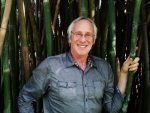
Mark Waldman has been working with neuroscientist Dr. Andrew Newberg for almost two decades, including on their latest book, Words Can Change Your Brain. (photo from Mark Waldman)

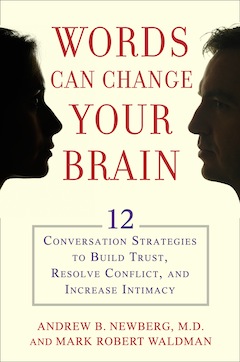
According to Dr. Andrew Newberg, neuroscientist at Thomas Jefferson University, and Mark Robert Waldman, communications expert, in their book Words Can Change Your Brain: 12 Conversation Strategies to Build Trust, Resolve Conflict and Increase Intimacy, one “single word has the power to influence the expression of genes that regulate physical and emotional stress.”

Waldman and Newberg have been collaborating for almost two decades, and have written 14 books about relationships and neuroscience. They have also published many neuroscientific papers and journal articles exploring how different forms of spiritual practice and positive thinking affect the brain.

“This particular book was my idea, because I’d been working on a form of dialogue practice going back to about 1993,” said Waldman of Words Can Change Your Brain.

“A very well-known ancient Jewish meditation is to gaze at a candle until you feel that you and the candle become one … so you and the candle become the sense of united fire or energy,” he said. “You can do the same thing by focusing in on your breathing. You immerse yourself in the cool air coming into your nose, the warm air exhaling, feeling the rising and falling of your chest. When your mind wanders, you simply come back to your breathing as a training mechanism for learning how to stay in the present moment.”

All of these mindfulness practices, said Waldman, have been well documented as having many benefits – from helping lower anxiety, physical stress and emotional stress, to equipping people with better control of their emotions and raising their self-awareness and social awareness.

Waldman suggested starting by bringing mindfulness into daily activities, like eating.

“If you were to slow down and pick up a small piece of food, and hold it on your tongue and savor that one piece of food, you would discover all kinds of different flavors and sensations that we’re not normally conscious of,” he explained. “If you apply mindfulness to eating, you end up eating less and enjoying your food more. This has become an activity that’s been integrated into weight-loss programs and programs to help people interrupt eating disorders like bulimia.”

In 1993, Waldman and Newberg began asking themselves questions like how often are we aware of the words we speak, of the feelings behind those words, of how those words affect the person we are speaking to; how often do we take the time to really savor and pay attention to what the other person is saying, their facial expression, their tone of voice?

They started to develop what they dubbed “dialogical meditation,” which eventually morphed into “compassionate communication.”

book cover - Words Can Change Your BrainAfter more than 20 years of research into what speaking mindfully means, they began working on Words Can Change Your Brain, which includes all their new research findings.

“Some of what we discovered, based on many different types of neuroscientific studies, is that the slower you speak, the more the listener’s comprehension’s increases,” said Waldman. “Their body also relaxes when you speak more slowly. And, with less physical tension, there’s more ability to be socially connected and engaged with the other individual.

“As our research unfolded, we recognized a very important neurological fact – that, consciously, we can only be aware of about seven to 10 words at a time. So, we created what we called a ‘communication game.’ We have people sit down and face each other and we ask them to speak very slowly and briefly, just one sentence. While they are doing so, we want them to experience what those words actually feel like. Then, they pause after speaking one sentence briefly. They pay close attention to the other person’s face and tone of voice while they speak … and you go back and forth like this.

“What we discovered from the very first time we did this experiment in 1993 is that 25% of those in the room, after doing this slow speaking and listening exercise, had tears rolling down their faces.”

Participants in this process were paired with people they did not know and they were not told what to say in their one sentence. The researchers found that, even when they conducted this experiment in a room with 1,500 people, within four to seven minutes, many people found themselves experiencing profound, intimate dialogue.

“They had to let the other person listen deeply to that one sentence and respond,” said Waldman. “So, we were keeping people in the present moment, grounded, not just in the thoughts they had that we are normally trying to turn into words, but to pay attention to the other person’s facial expression and tone of voice.”

Waldman went on to explain that, when it comes to communication, of the seven different elements of effective communication, words are Number 7. Number 1 is facial expression, followed by tone of voice, body language and the emotional or mental state you are in.

“So, the more relaxed you are, the more you’re actually in the present moment, the more the other person can understand what you’re saying, be affected by what you’re saying,” said Waldman.

The research found that, when participants closed their eyes and recalled a pleasant memory, visualized someone they greatly love or an event that brought them great satisfaction, 90% of them had a half-smile on their faces.

Waldman described this as a “Mona Lisa smile that, when other people see it, it triggers the trust centres in the person’s brain. You neurologically trust someone who has this Mona Lisa-like smile.”

Waldman believes that this research lends itself well to teaching managers, salespeople, teachers and those just entering the dating world. “What would happen if you slowed your speaking down and listened more closely, if you maintained that small half-smile on your face?” he asked. “As you speak, you can generate better intimacy and stimulate more collaboration and cooperation.”

Words Can Change Your Brain also documents that one single negative word triggers a dozen different stress neuro-chemicals in the brain, while spoken positive words have very little effect on the brain.

“So, the brain is designed to encode into memory every negative thought, feeling and event that we have, yet it doesn’t really do that with positive experiences,” explained Waldman. “However, if you have a brain that is filled mostly with negative memories, you’ll become chronically anxious and, eventually, chronically depressed.

“When we bring in the research of Barbara Frederickson and learn that, in relationships and in business, if you deliberately increase what she calls, ‘your positivity ratio,’ to five-to-one or to seven-to-one, for every negative thought or feeling you have … if you deliberately generate another five, six or seven positive thoughts or images … that’s how you begin to build a brain filled also with positive memories. You’re creating a form of neurological optimism. And, it turns out, these types of positive mindfulness exercises are some of the best ways to eliminate anxiety [and] depression and build more self-love and self-compassion. If your positivity ratio falls below three-to-one, you can predict very accurately that a relationship is heading toward divorce or that a company is heading toward bankruptcy.”

As Waldman presented their discoveries to the business world, he was reminded that, in this world, almost no one will give you more than 10 to 60 seconds. Most people cannot do a five-minute meditation, he said.

But, Waldman found that, if people download the mindfulness talk on their phone or computer and are willing to take 10 seconds to do one mindful yawn when they hear the alarm ring – simply notice how a yawn feels – there can be benefits.

“We have over 43 documented studies that show that yawning is one of the fastest ways to slow down an overly stressed brain,” said Waldman. “In fact, a dozen yawns or so can temporarily alleviate symptoms of Parkinson’s, epilepsy, migraines, what have you. So, yawning is the fastest way to alleviate mental stress.

“We ask a person, once an hour, to take 10 seconds to do one mindful yawn…. Take 20 seconds to do one mindful stretch, recall one pleasant memory…. Think about one single word, a value word, that you want to anchor yourself in for the next hour, something like ‘confidence,’ ‘focus’ or ‘calmness.’”

Thinking of Judaism’s role in all of this, Waldman said, “I think, for me, Judaism gave me the framework to question, challenge and think deeply about everything, which is just one of the most thrilling spiritual states I find for myself. I think this is how Judaism has influenced me in the past and continues to guide me in the present.”

Rebeca Kuropatwa is a Winnipeg freelance writer.
Format ImagePosted on September 30, 2016September 28, 2016Author Rebeca KuropatwaCategories BooksTags health, mindfulness, neuroscience
Planting seeds of wellness

Planting seeds of wellness

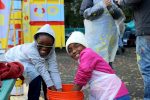
Young community members in Harlem participate in the painting of a shipping container inside of which fresh produce is grown. (photo by Nick Smith)

Seed Street, a hydroponic farming venture and food-justice initiative that grows fresh produce inside shipping containers, arrived in Harlem in the summer of 2015. It was brought there by Leigh Ofer and Hannah Bronfman.

The idea came from an environmental justice class Ofer took in college, as well as Bronfman’s deep ties to the Harlem community and her advocacy for healthy living and positive body image.

“Even with time and less financial stress than a family, it was still expensive and challenging to eat and live healthy with so much misinformation out there … I was confused and searching for sustainable ways to live and eat healthfully while living in a big city,” said Ofer. “Women, in particular, in our modern-day society, can be so disconnected from our bodies. I felt a tremendous sense of disillusionment with the current food system and anger at how deep-seated interests have infused our system with toxic Franken-foods.”

Ofer believes this issue is at the heart of America’s health crisis. “It’s really impossible to eat well, to feed your mind, body and soul,” she told the Independent. “Growing up in Israel, in an agricultural society, eating healthy was a by-product of living. You don’t think about it. But, in the U.S., it takes jumping through hoops just to eat healthy – a total polar opposite on the spectrum.

“This was having a profound effect on me. I felt it in everything – my skin, my well-being, my energy, but I count myself as one of the lucky ones. If I was having a hard time eating and living well, how was a young family managing? I felt a deep sense of obligation to do something about this.”

When Ofer was searching for solutions, she came across a new development in agriculture. Cutting-edge farmers and technology geeks were building hydroponic farms inside shipping containers. The idea immediately resonated with Ofer, partially because of her family background in shipping.

photo - Leigh Ofer checks out the Seed Street hydroponic farm in Harlem
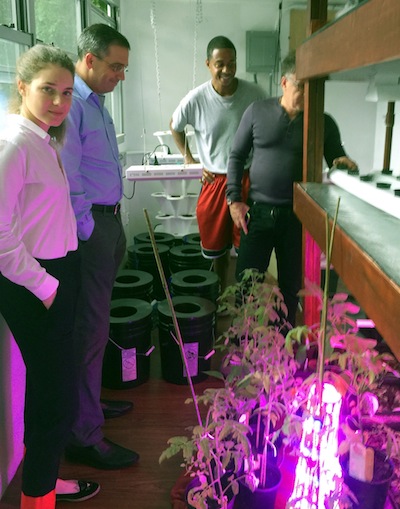
Leigh Ofer checks out the Seed Street hydroponic farm in Harlem. (photo from Seed Street)

“It was a no-brainer to transform freight containers into highly productive urban farms using the latest technologies and minimal resources to reconnect urban communities to fresh food,” she said. “It made perfect sense, harnessing the power of new technology to revitalize urban neighborhoods, introduce farming jobs and reeducate a community about where food comes from.”

When Ofer met Bronfman a couple of years after having come across this idea, the two decided to take a leap of faith together and go for it. With limited resources, they kicked things off with one container. It landed at their community partner’s yard – the Children’s Aid Society – in July 2015, and they have been growing tomatoes, leafy greens, herbs, peas and cucumbers ever since.

“We are retrofitting freight containers with hydroponic growing technology and bringing the farm back to the city,” said Ofer. “You can put these farms almost anywhere. Each farm container has a very high yield, equal to about an acre of traditional farming and using 90% less water and 75% less fertilizer. All you need is an electrical outlet to hook up to and a water supply. We had a plethora of tasty, healthy veggies in our last harvest.

“We got started by partnering with the Children’s Aid Society at their central Harlem location,” she explained. “We piloted our grow farm in their backyard playground a little over a year ago. In January, we launched the volunteer-run youth development urban farming program, serving 60 youth from central and east Harlem. Our proprietary Grow, Move and Create program engaged the youth three days a week in healthy activities, such as yoga, hydroponic farming and entrepreneurship.”

The program was successful and involved the community and especially kids, who learned by doing how foods grow and the different ways food can be eaten and enjoyed. Community members participated in planting, harvesting, managing the farm stand and creating recipes for the fresh produce they brought home, not to mention yoga. At the end of the modules, the kids shared a presentation with the parents – a business plan, a recipe book or yoga stretches, depending on their group’s focus.

Heading into 2016, Ofer said there were three pillars she and her team wanted to address with the program: accessibility of fresh, healthy food; sustainability; and the sharing of knowledge and information.

“Most importantly, in order for us to be successful, we needed to address the issue of economic security,” she said. “We believe you can fill lettuce bags all day long, but if people don’t have access to good food, a base sense of financial security and practical knowledge about food and health, it’s going to be useless.”

For the second phase of the Seed Street urban farming initiative, the focus was shifted to economic development as a more effective way of empowering community members and improving food justice, by providing food education and nutrition information.

“Basically, what we’re doing is increasing opportunity for a community to have economic independence and helping them to take ownership of their health and nutrition,” said Ofer. “We want to ensure our model is not just another organization out there that does community gardening. We want it to be one that addresses the inequities and is also functional, taking needs of the community into account and including community stakeholders in the planning, growing and harvesting of foods and ideas.”

Seed Street is currently evaluating technology suppliers and sites for the commercialization of five to six container farms in Harlem. They are strengthening their partnerships and learning, through collaboration, the best ways to partner with other local youth development, food-justice, employment, and health and wellness advocacy programs.

The container farms operate year-round, allowing continuity in education and providing ongoing employment for the operator, unlike an outdoor garden that closes for winter.

“When I started the project, my dream was to build farms in Israel and Palestine, because I could visually see that it would be a beautiful way to bridge two sides and actually grow produce together and work on a shared initiative together,” said Ofer. “My dream continues to evolve, but I clearly envision us creating a model for collaboration and conflict resolution.”

Rebeca Kuropatwa is a Winnipeg freelance writer.

Format ImagePosted on September 23, 2016September 21, 2016Author Rebeca KuropatwaCategories WorldTags food justice, Harlem, hydroponics, Seed Street, tikkun olam, urban farming
Dialogue heads east

Dialogue heads east

Belle Jarniewski (fifth from the left) is one of the co-founders, with Sumera Sahar (fourth from the left), Perry Kimelman and Dr. Rory Dickson of the Muslim-Jewish Dialogue Group of Winnipeg. (photo from Belle Jarniewski)

Started in Winnipeg last year after a visit from Rabbi Shaul Osadchey of Calgary’s Beth Tzedec, Belle Jarniewski and Perry Kimelman believe that a local dialogue group with Muslims and Jews will do a lot of good for both communities.

Jarniewski is chair of the Freeman Family Foundation Holocaust Education Centre, a position she has held since 2008. And, just recently, she began a two-year term as president of the Manitoba Multifaith Council, the first woman and the first Jewish person to hold that position.

“The Manitoba Multifaith Council had brought in Rabbi Shaul Osadchey of Calgary for its Multifaith Leadership Breakfast in 2015 and I was intrigued to hear how successful he had been in his own interfaith dialogue work and to hear how well he had reached out to the Muslim community there,” she told the Independent.

Jarniewski approached her synagogue with the idea of seeing if she could work with them to hold the kinds of events with which Osadchey had seen success, but received little interest. So, she decided to start a group independently of an institution.

photo - Belle Jarniewski
Belle Jarniewski (photo from Belle Jarniewski)

“Perry and I are also members of the Arab-Jewish Dialogue Group, which discusses (primarily) the Arab-Israeli conflict, but seems to eschew any real discussion of religion,” she explained. “Both of us have been active in interfaith work for quite some time and have many connections to wonderful people. We felt that was something that was missing. Once we realized that both of us had long been interested in starting just such a group, we put our heads together to see what would be the best way forward.”

Of course, to get the idea off the ground, they needed a Muslim partner or two. They found a perfect match in Sumera Sahar, a member of the Canadian Council of Muslim Women (CCMW). The second Muslim co-convener they found was Dr. Rory Dickson of the University of Winnipeg’s department of religion and culture. And, with that, the four set out to build membership, which is now a balanced mix of almost 40 Jews and Muslims (by invitation only). Members have been proposed by other members, as well as by the conveners.

“It is important that those who join are interested in dialogue with each other, are interested in religion and culture – our own and each other’s – and accept the very few rules we have imposed upon ourselves,” said Jarniewski.

These rules, she said, include “no discussion of politics – there is already another group established for that very reason – and, as well, both groups decided early on that we preferred not to involve clergy. If someone wishes to join, they must be referred through a member.

“We also have a closed group discussion through our private Facebook page, which seems to work very well. The ages of our members are from university through … well, I don’t ask … I would say in the 60s.

“The diversity of religion streams and origins of both Jewish and Muslim members contributes to some wonderfully rich discussions,” she continued. “The group is all about learning about each other’s religion and culture and each other, and getting to know one another. For far too long, Muslims and Jews have had, at best, a polite relationship with each other, but haven’t really gotten to know one another and learned just how much our two religions have in common.”

The group has held a number of evening get-togethers, learning about Sharia and halachah side by side. “The word Sharia evokes, for most Westerners, the most extreme form of Islamic law,” said Jarniewski, “but we learned that Sharia is far more complex than this simplistic interpretation.

“One night, we had Dr. Ruth Ashrafi talk about the role of women in Jewish law and Drs. Rory Dickson and Ahmet Seyhun lecturing on family law in Islam. On another night, we had a great discussion about halal and kashrut.

“At our very first meeting, one of our Jewish members, who hails from Iran, recited a Muslim prayer in flawless Arabic. What an icebreaker that was!”

Sahar told the Independent this group “is an important initiative and much needed, given the popular and often-unchallenged notion that somehow Jews and Muslims are historical and natural adversaries.”

Sahar is an executive member of CCMW’s Winnipeg chapter, the co-coordinator of a community food bank serving Arabic-speaking refugees and has recently been invited to sit on the board of the Manitoba Multifaith Council.

The core objective of the Muslim-Jewish dialogue group is that Muslims and Jews get to know one another directly without the filter of religious or political organizations. Sahar contends that most, if not all, group members believe that the group is a crucial step toward countering antisemitism and Islamophobia and, most importantly, to bridging communities.

Like Jarniewski, Sahar has made good friends and formed a much better understanding of the similarities both religions share, not just religiously, but also as minority religious communities.

“Being a minority community has its challenges, and both Jews and Muslims share similar anxieties and concerns,” said Sahar. “We share the struggle of gaining acceptance and inclusion without losing our religious values and identity. We are also subject to the question of representation – who speaks for us?

“Both communities are pluralistic and diverse but, as is the case with most minority groups, we are often represented in the media and popular discourse as a single voice. I was struck to learn that this issue is as much a source of frustration for the Jewish members of the group as it is for the Muslim members.”

The dialogue group has provided a platform to discuss such issues and suggest some strategies to overcome them. The convenors are pleased to see the sincerity with which group members have engaged with one another and are hopeful in their potential to build understanding.

“I feel that it is more important than ever to speak up when unfortunate statements are made in these rather difficult times that attack Muslims and Islam,” said Jarniewski. “These statements are generally mired in stereotypes and ignorance. It is important that our community realize they are received in the Muslim community in the very same way that the Jewish community is hurt by antisemitic comments.”

Jarniewski is well aware that, across Canada, there are Jewish-Muslim groups such as the one in Winnipeg who are coming together to engage in dialogue. “Little by little, groups such as ours will have a very positive effect,” she said.

Jarniewski quoted Catholic priest and Swiss theologian Hans Küng: “No peace among the nations without peace among the religions. No peace among the religions without dialogue between the religions. No dialogue between the religions without investigation of the foundation of the religions.”

Rebeca Kuropatwa is a Winnipeg freelance writer.

Format ImagePosted on September 23, 2016September 21, 2016Author Rebeca KuropatwaCategories NationalTags dialogue, interfaith, Islam, Judaism, peace
Should God be put second?

Should God be put second?

For Donniel Hartman, putting God second is a way of maintaining a religious life and faith in God, but without God undermining our responsibility to our fellow human beings. (photo from Donniel Hartman)

Donniel Hartman, an Orthodox rabbi and president of Jerusalem’s Shalom Hartman Institute, an educational powerhouse dedicated to invigorating Judaism, has recently published his second book. It is called Putting God Second: How to Save Religion from Itself (Beacon Press, 2016).

“Religious people very often argue that religion is fine and that the only problem is that religious people are flawed and are distorting our religious life,” Hartman told the Independent. “Yet, the people who harm, maim and hurt in the name of religion come armed with chapter and verse. They seem to be quite accurate about their religious life. And atheists make similar arguments. The only problem with atheists is they seem to get something wrong as well; they argue that there’s nothing valuable in religion.”

Hartman thinks there is something missing in this discourse, which he explores in this book: queries like, what about religion can be powerful, profound and constructive, and might the issue simply be that people are getting it wrong?

“The idea that I was testing for 10 years – that was researched, taught about and thought about – was that religion suffers from an internal autoimmune disease wherein it attacks its own goals,” said Hartman.

“Religion has noble goals,” he contends, and is not only a source for evil, as some atheists say. “I think religion is, in fact, trying to produce kind individuals. There’s something inherent within the system, which can cause it to underachieve and fail to meet its aspiration. In short, the cause of that autoimmune disease is God – in particular, when God is put first.

“The idea is that monotheism creates a being of such transcendence and scope that when God enters the room, it shifts the human consciousness away from their moral responsibility for other people.”

book cover - Putting God SecondFor Hartman, putting God second is a way of maintaining a religious life and faith in God, but without God undermining our responsibility to our fellow human beings.

“This one transcendent God is something that I feel human beings have great difficulty assimilating into their system, into their lives, and that God has a potential to warp our consciousness,” said Hartman. “I call it ‘God intoxication,’ wherein everything else becomes unimportant.

“It’s the encounter with God that can create this distortion. Who is more important, a human being or God? Human beings will again distort that message because, when it gets instilled into their minds, what can possibly be more important?

“We see religious people, in the name of faith, harming, judging and insulting people, showing a lack of tolerance, pluralism – the same people who could, in their everyday lives, act decently, kindly. The minute religion is in the equation, there’s potential for it to get distorted,” he said.

“God intoxication is not a flaw within religion, it’s embedded in the idea of monotheism. Some people argue we should get rid of God. My book tries to reestablish a life of faith. It doesn’t say to get rid of God or to put God 14th or 15th. At the end of the book is when you put God second, but you put God’s will first toward developing a religious life with God that immunizes us from this autoimmune disease.

“One of the essential concepts in the book,” he continued, “is how you treat other human beings – this being the core of how we assess the value of our lives. I think there is a very profound spreading of faithlessness precisely because of the consequences of what God seems to bring to humankind. My goal in putting God second is to help more people establish a deeper relationship with God, one with a God they can respect…. If God needs to be first, people feel it’s a God they don’t want to believe in. I believe that the language of putting God second is what will enable a language of faith to be far more pervasive within our modern community and the modern world.”

Hartman hopes that Putting God Second will reach a diverse readership. “The target audience,” he said, “is thoughtful people searching for a decent world and a meaningful religious life, and I hope this book will be conducive to moving us in the right direction. Most importantly, I like to help people and, if this book is too upsetting for you, just put this book second, it’s not meant for you…. I hope there’s a broad range of people that, through this book and this religious language, can try connecting with it, both with God and with their tradition.”

Hartman, who was born in the United States and spent 11 years in Montreal, is currently working on a Hebrew translation of the book.

Rebeca Kuropatwa is a Winnipeg freelance writer.

Format ImagePosted on September 23, 2016September 21, 2016Author Rebeca KuropatwaCategories BooksTags Judaism, religion

Posts pagination

Previous page Page 1 … Page 17 Page 18 Page 19 … Page 31 Next page
Proudly powered by WordPress