Skip to content
  • Home
  • Subscribe / donate
  • Events calendar
  • Business Directory
  • FAQ
  • News
    • Local
    • National
    • Israel
    • World
    • עניין בחדשות
      A roundup of news in Canada and further afield, in Hebrew.
  • Opinion
    • From the JI
    • Op-Ed
  • Arts & Culture
    • Performing Arts
    • Music
    • Books
    • Visual Arts
    • TV & Film
  • Life
    • Celebrating the Holidays
    • Travel
    • The Daily Snooze
      Cartoons by Jacob Samuel
    • Mystery Photo
      Help the JI and JMABC fill in the gaps in our archives.
  • Community Links
    • Organizations, Etc.
    • Other News Sources & Blogs
  • JI Chai Celebration
  • JI@88! video

Recent Posts

  • SFU honours Gloria Gutman
  • Lifting people’s spirits
  • Wedding a ray of light
  • Indigeneity and Zionism
  • Rule of law broken: councilor
  • Football and its roles
  • The burden of defence
  • Fish Café returns after fire
  • All right in what goes wrong
  • Nuns & mermaids at TUTS
  • Camp offers holiday retreat
  • Students and mentors inspire
  • Once-in-a-lifetime trip
  • 100 dancers, one heart
  • Money for the sciences
  • What “Jewish food” means
  • Have a cookie, schnitzel too
  • Federation now across BC
  • Israel fighting for its existence
  • Deal strengthens Iran
  • Patriotic belonging diminishes
  • A campaign to engage
  • Upstanders’ first live event
  • Responding to Carney
  • Having your own home
  • Music a family tradition
  • Musical to warm heart
  • Community milestones … June 2026
  • Sharing her passion for Israel
  • Or Shalom reopens its doors
  • JFS from past to future
  • Need holistic approach
  • Sharing stories, advice
  • Journalist shares fears
  • Skills to live together
  • Road to independence

Archives

Follow @JewishIndie
image - CJN box ad Rockowers 2026

Byline: Rebeca Kuropatwa

Hebrew school in Okanagan

Hebrew school in Okanagan

Left to right, reciting the Four Questions at the Okanagan Jewish community’s Passover celebration: Adarah Challmie, Ben Levitan, Jordan Spevakow, David Spevakow, Samara Levitan, and Kate Spevakow. (photo by Misty Smith)

Kelowna’s Jewish community may be small, but it’s poised for growth. The latest development: an expansion of its Hebrew school’s curriculum.

Led by the family of David and Natalie Spevakow, who moved to Kelowna from Calgary some 13 years ago, Hebrew classes were first provided last year. Now, more Jewish content will be added to the lessons, as well.

At the moment, the Spevakows are spearheading this task. Parents lead classes every Monday after school, with kindergarten to Grade 3 first, followed by grades 4-to-7. The parents rotate each week, teaching the kids about Jewish traditions and the Hebrew language, prayers and blessings. Currently, there are 14 students in total (two of whom are Spevakows).

“Trying to have a Jewish life in a small community can be a challenge,” said Natalie Spevakow. “I would say our congregation at the Okanagan Jewish Community Centre is about 100 members, but only 25 to 30 are active members.

“We have a visiting rabbi who comes once a month, Rabbi [Shaul] Osadchey from Beth Tzedec congregation in Calgary. We set this up to bridge the gap with our communities, and that’s been wonderful. With us having young families, we’ve all decided that it’s important that we get together, and we wanted to build a Jewish community for ourselves and our kids.”

The Spevakows are looking to hire a part-time teacher to start in September and work through June. They are searching for a creative, energetic person knowledgeable in Hebrew and the Jewish traditions to teach children ages 4 to 14. The position involves two hours of teaching a week, plus preparation time, and the teaching material is provided. In addition to an hourly wage, the teacher would receive a free annual family membership to the Okanagan JCC. (Interested readers should call Anne at the OJCC, 250-862-2305.)

“All of our parents just want our kids to be with other Jewish children and get a sense of what it is to be Jewish,” said Spevakow.

“We also try to get together with our Hebrew school every few months for a potluck,” she added. “When we have the visiting rabbi come, we do a potluck with the rabbi and do services with our children and our families as well. We make that a time to get together and bring the community together.”

photo in Jewish Independent - Dressed for Purim, left to right: in the front row, Bria Tizel, Anderson Parnes, Kate Spevakow, Ryder Golbey, Skyla Golbey and Chase Golbey; in the back, Jordan Spevakow, Abbey Parnes and a friend, and Adarah Challmie
Dressed for Purim, left to right: in the front row, Bria Tizel, Anderson Parnes, Kate Spevakow, Ryder Golbey, Skyla Golbey and Chase Golbey; in the back, Jordan Spevakow, Abbey Parnes and a friend, and Adarah Challmie. (photo by Natalie Spevakow)

As of now, all the children involved in the school are Canadian-born, but there are Israeli-born children who will be joining classes when they come of age. The class curriculum is a combination of programs that the Spevakows sourced online with guidance from Osadchey. Parents are encouraged to take material home to practise during the week.

“The learning works better if they do take stuff home,” said Natalie Spevakow. “I know, for the little guys, they’re just learning the Hebrew letters and can repeat the words they learned…. We try to make it hands-on and more fun for them.”

Looking ahead, Spevakow feels that the Jewish community is growing, anticipating that one day it will be big enough to warrant more frequent visits from Osadchey.

“But, right now, with our smaller numbers, it’s very difficult for us to finance having a rabbi here all the time,” she said. “As is, we’re making it work, getting our kids educated and getting the resources we can.”

The older students are learning to lead Friday night services, with the goal of having them lead a service by May 2017, and then again, have them lead a service with Osadchey.

“We’re not on our own, trying to make things up on our own,” she said. “It’s just a matter of people making time for their kids, so the program works. I think all the parents recognize they want this for our kids and are willing to put in their time.

“We used to do it on weekends, but, with so many of us really big into skiing, it wasn’t working out. So, weekdays are definitely working better for us.”

They also recognize there may be some older members of the community who may be interested in helping with classes, so they hope to bridge the gap and find ways to bring them in, too.

“There’s something to be said about a small community, in that you really get to know all your members,” said Spevakow. “They truly do become an extension of your family. You realize that anything you’d like to see happen, things that, in a larger community you might have taken for granted because it’s available, in a small community may not exist yet…. Connecting on a deeper level with the people in our community, figuring out the assets that each can bring to the table, has really benefited our community. Knowing everyone’s faces really helps.”

Rebeca Kuropatwa is a Winnipeg freelance writer.

Format ImagePosted on August 19, 2016August 18, 2016Author Rebeca KuropatwaCategories LocalTags continuity, education, Hebrew, Judaism, OJC, Okanagan
Overlapping exhibits

Overlapping exhibits

“Girl with Flower” by Esther Warkov, 1964, acrylic on canvas. (WAG collection; gift of Arthur B.C. Drache, QC, G-98-296; photo by Leif Norman)

Russian-born Jewish artist Marc Chagall (1887-1985) was a modernism pioneer. So much so that Pablo Picasso proclaimed that, when Henri Matisse dies, “Chagall will be the only painter left who understands what color really is.”

In the early 1920s, Chagall left Russia for Paris. In 1941, he escaped France and reached safe haven in New York. He returned to France a few years after the end of the Second World War.

“This sense of displacement Chagall feels throughout his life is reflected in his works, often featuring characters who hover over the earth…. Even if they’re lying down, they’re sort of levitating,” said Andrew Kear, Winnipeg Art Gallery (WAG) historical Canadian art curator. “There’s a sense of rootlessness to his work that’s quite interesting, and it’s reflected in his later work, too. By the 1940s – an important time for Chagall – he loses his first wife, his first love really, Bella, to cancer in or around 1944 … and is absolutely distraught.”

In an exhibition overseen by Kear, WAG has brought in the exhibit Chagall: Daphnis & Chloé from the National Gallery of Canada (NGC). It will be in Winnipeg until Sept. 11.

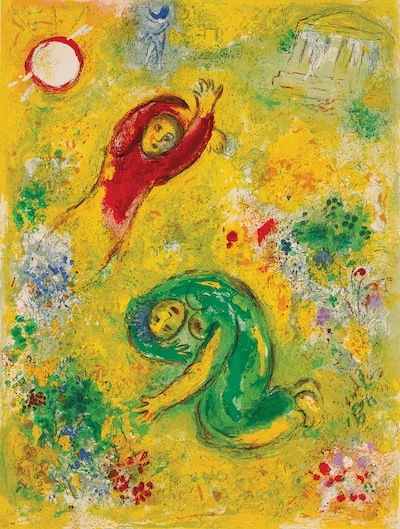
The exhibit, the latest NGC-WAG collaboration, features 42 lithographs, widely considered the crowning achievement of the artist’s career as a printmaker. The series depicts the semi-erotic tale written by the ancient Greek poet, Longus. Through fanciful compositions and bright hues, Chagall expresses the pastoral idylls of the young goatherd Daphnis and the young shepherdess Chloé on the island of Lesbos.

At WAG, there is also a complementary mini-exhibit called Chagall & Winnipeg, which tells the little-known tale of friendship between Chagall and former WAG director Dr. Ferdinand Eckhardt through letters, photographs and works of art.

image - Marc Chagall, “The Trampled Flowers / Les fleurs saccagées” (detail), circa 1956-1961, printed in 1961
Marc Chagall, “The Trampled Flowers / Les fleurs saccagées” (detail), circa 1956-1961, printed in 1961. (NGC/MBAC, Ottawa; gift of Don de Félix Quinet, Ottawa, 1986, in memory of Joseph and Marguerite Liverant)

“In addition to sketching out the story, this second exhibition … include[s] a number of paintings by Chagall that we’ve borrowed from the NGC and the Minneapolis Institute of Art,” said Kear.

In addition to these two Chagall exhibits, WAG is featuring Winnipeg Jewish artist Esther Warkov in an exhibit that includes her work from the 1960s to the 1980s. It runs until Oct. 16.

Born in 1941, Warkov did not do that well in school, but there was a lot of family pressure to succeed. By chance, she discovered jewelry making as a young teen, which, in turn, exposed her to the world of fine art. She eventually studied art at the University of Manitoba.

Today, Warkov is one of Manitoba’s most distinguished artists. This current exhibit highlights a celebrated and defining period of her work, which was forged in Winnipeg’s North End. Her stylized motifs reveal the clear influence of the eastern European immigrant community’s Jewish folk art roots.

“Although abstract painting was the most common form of contemporary art in the 1960s and 1970s, Esther really bucked the trend,” said Kear. “She was very interested in the human figure, representational drawing/painting, and in paintings that tried to convey a story. It’s this kind of point where she really outlines nicely with Chagall. Chagall’s paintings are very much recalling memories and tell[ing] a story.”

Warkov’s work during this featured period was large-scale and multi-paneled. “It’s not just a painting on one canvas,” said Kear. “It’s multiple canvases that are sort of cobbled together, in a way, to make almost loose grids. Her work is narrative, seems to tell a kind of story, but you’re not sure what the story is. It’s very whimsical and draws a lot on memory.

“I had the pleasure of meeting her for the first time a couple weeks ago,” he added. “I was curious about how she paints, or went about making these works. Apparently, she very rarely started with a coherent plan. She would start with one canvas and do an image on it. That would lead into another image that she’d tack on this other canvas next to the original one, to build the … visual story. But, it was a story she was making up as she went along. I thought she would plan it out first, but that’s not how it went down apparently.

“She’s got a wild sense of humor and great wit, which are really reflected in the titles of her works, [which] are often very long.”

WAG director and chief executive officer Stephen Morris said, “When we installed the exhibition a few weeks ago and we had the works up – many of them painted 40 to 50 years ago – they were as fresh, relevant and dynamic, I think, as the day they were painted. They reference so many interesting stylistic developments, but I’d also say they reach into the heart of who Esther is – someone who has lived in the North End for years, exposed to not just the Jewish culture, but also to Jewish folk art and eastern European traditions … that whole interesting development in terms of painting which you see in her work.

“Esther also brings people into interesting scenarios with her paintings and, in the composition, it can be a little unnerving, a little jarring. But, there is, with both her and with Chagall, a surreal aspect. So, while they’re painting recognizable images and motifs, the way they’re composed takes us back a bit and actually twists things. Some call it ‘the dream,’ others something else. Regardless, it’s delightful and one could see an overlap between the artists in terms of imagery.”

Morris enjoys being able to “bring cultures and ethnicities together.” He said having a famous Russian artist like Chagall next to Warkov, “who, in a way, had a much more regional impact, I think it’s interesting. I love the fact that a visitor can walk between Chagall and Warkov and, yes, they know they’re in a different space, in a different time, with a different artist, but they’ll also see connections.”

Of those connections, Morris pointed to how Warkov’s “roots overlap with Chagall’s roots, in terms of her life, faith and culture.”

The Chagall exhibit is set up in a series of small spaces to highlight the story of Daphnis and Chloé – visitors walk through it in a chronological way. Warkov’s work is displayed in one large gallery and visitors are surrounded by her canvases.

Also at WAG this summer are several permanent galleries, as well as a major retrospective of Winnipeg artist Karel Funk, who, Morris said, “is at the height of his career.”

Rebeca Kuropatwa is a Winnipeg freelance writer.
Format ImagePosted on July 22, 2016July 19, 2016Author Rebeca KuropatwaCategories Visual ArtsTags art, Chagall, Daphnis and Chloé, WAG, Warkov, Winnipeg

Judaism beyond shul

Despite being unsure about God, Lawrence Hoffman embarked on his journey as a student in a New York rabbinical school nonetheless. The now-longtime rabbi has since authored more than 40 books and has been teaching at the Hebrew Union College in New York since 1973.

HUC is a seminary for Reform rabbis and cantors. Hoffman teaches courses in liturgy, worship, ritual, spirituality and theology – and, increasingly, synagogue transformation.

The synagogue transformation endeavor has Hoffman traveling constantly, both addressing congregations throughout North America and as a consultant aiding in transformation issues.

photo - Rabbi Lawrence Hoffman
Rabbi Lawrence Hoffman (photo from huc.edu)

In 1995, Hoffman began to suspect that synagogues were not keeping up with the changes in North Americans’ views of religion and that, as a result, they were in for some hard times.

“This was already evident the generation prior, the generation after the baby boomers,” said the rabbi. “I became convinced that synagogues needed to become what I came to call ‘spiritual and moral centres for the 21st century.’

“I co-founded something called Synagogue 2000 … investigating how synagogues might transform themselves into this kind of synagogue. It would involve a new kind of spiritual affirmation and a focus on what a spiritual mission might be for the synagogue … what synagogue life might become for the new century.”

After experimenting with these concepts via Synagogue 2000, Hoffman began traveling from place to place to help synagogues undergo the process. This has become his main passion.

As the rabbi teaches at a Reform seminary, most of his current work is with Reform congregations, but he has worked across the spectrum. “After all,” he said, “the impact of the environment and the new age is felt equally across the ranks of all synagogues.”

A recent visit to Winnipeg’s Temple Shalom was part of Hoffman’s initiative to spread the word and help communities that would otherwise not be able to afford his normal rates as a scholar-in-residence.

Hoffman – who is originally from Kitchener, Ont. – included the stop in Winnipeg on his way to a Western Canadian vacation with his wife.

“All my life, I wanted to see Western Canada and never had, and I decided it was time,” he said. “I realized I hadn’t seen Winnipeg after having arranged the vacation out West. I knew there was a small synagogue [Temple Shalom].… I phoned them, offering to come to Winnipeg and give them a lecture and meet the community…. In return, they were willing to show me around and host me.”

The rabbi spoke briefly at the synagogue during the erev Shabbat service on May 27. His topic was Authentic Jewish Spirituality. He returned the following evening to speak again.

“The idea was to investigate what might be a kind of Jewish spirituality that would go deep into Jewish text and practice,” said Hoffman. “A lot of people think that spirituality is equivalent to meditation, silence retreats, yoga … all of which is fine … and there are Jewish versions of that, which I applaud, but I think there are forms of Jewish spirituality that are connected more deeply with things that are consistently found often quite uniquely in Judaism, as a series of sects, practices, Jewish traditions, a deep way of looking at Jewish spirituality.”

Hoffman believes we are living in the third revolution, with the first having brought rabbinic Judaism and the second having been the development of modern denominations. This current revolution, according to Hoffman, is courtesy of technology, the baby boomers and other general changes with respect to religion in North America.

“I explored the new revolution we are living through, the excitement of it, and the opportunities and positive nature of what might result,” said Hoffman of his talks in Winnipeg. “We ended up with well over 100 people, which was quite amazing to me. In fact, I was able to see, through them and through the people who were kind enough to host my wife and myself, the vitality of the Jewish community in Winnipeg in a way that I never would have anticipated.

“The Temple Shalom Jewish community, at the moment, doesn’t have a full-time rabbi, so services were actually led by lay people, but they did a spectacular job. I was very impressed.”

Hoffman spoke about what he means when he says transformation – that, until recent years, most Jews would not have moved into a town without joining a synagogue, referring to this as “a Jewish civic duty.” But, today, Hoffman said, “What’s happening in the new world is that people like that don’t necessarily belong to a synagogue anymore. They associate the synagogue with what they call ‘religion,’ saying they are not religious. Instead, they say, they’re spiritual. Spirituality is rising and the claim that people are not religious is rising, as well.

“Synagogues need to transform themselves into places of serious Jewish identity through identification, this search for meaning … [in] so far as people can find meaning in synagogue and they don’t just join for their kids, because they think it’s the Jewish thing to do, then synagogues will do well.”

The actual transformation, Hoffman conceded, is a serious, difficult task that does not occur overnight.

“People were very interested in what I had to say, finding it exciting to be living in a moment of opportunity,” said Hoffman. “Not all of them saw it as a moment of opportunity. Many felt it was a difficult moment. For example, intermarriage is rising – some people see that as almost a death to Judaism. In my perspective, it’s just the opposite. I think it’s an enormous opportunity for us to reach so many new people. If people actually are intermarrying and then coming to synagogue with their spouse, it’s a wonderful opportunity. I think people were intrigued by the possibility and by my optimism.”

According to Hoffman, many synagogues are growing rapidly via Jews by choice.

Another issue that was discussed was how young people are not coming to synagogue, but how this is changeable. It’s just that, at the moment, they do not see a reason to attend, said Hoffman.

“The problem that people have when they say, ‘I’m not religious’ – and I’m talking largely about people who aren’t in the Orthodox camp – is that they assume that religious means keeping all of Jewish law,” he said. “They know they don’t do that, so they assume they’re not religious, but they may be religious in other ways. They may do this, but not that. They may show up on Yom Kippur. They have their own way of keeping Judaism, so it would be wrong to say they are not religious.

“Secondly, a lot of people think that to be religious means to belong to the institution. I talk about a deeply understood sense of being religious, in a spiritual sense … a sense in which Judaism, as a religion, provides meaning for people’s lives.

“One has to reevaluate what we mean by religion and help people find a way to associate with Judaism’s depths to give their life meaning and direction,” said Hoffman.

Ruth Naomi Livingston, a member of Temple Shalom’s board of trustees and a past president, was one of the Hoffmans’ hosts.

“I was raised in a secular Jewish home, but had a very religious grandfather who lived with us,” said Livingston. “I identified as Jewish by culture, rather than by religion. The topic [discussed by Hoffman] that resonated most with me was when he explained the basic differences between Judaism, Christianity and Islam. They are Hellenistic religions and are faith-based. To be a good Christian, one must believe in Jesus as a God; not to do so makes one a bad Christian or not one at all.”

Livingston came out of the experience feeling energized and empowered to follow the teachings handed down from her grandfather about the need for action in fixing the world to be a good Jew.

Of Hoffman specifically, Livingston added, “He was the most passionate and dynamic speaker I have ever seen. He had the crowd of about 90 people in the palm of his hand. There were people from a variety of synagogues present as well as several non-Jews.”

Rebeca Kuropatwa is a Winnipeg freelance writer.

Posted on July 1, 2016June 29, 2016Author Rebeca KuropatwaCategories NationalTags Judaism, Lawrence Hoffman, spirituality, synagogue
Film on Jewish burial process

Film on Jewish burial process

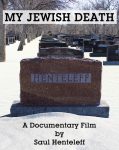
If you have ever wondered what will happen after your death – when your soul leaves your body but you have not yet been buried – a new film by Saul Henteleff walks you through precisely that experience.

The 30-minute documentary My Jewish Death was screened at Winnipeg’s Limmud festival on March 13. In the film, Henteleff plays a recently deceased person who is taken through the steps of a mock tahara, the Jewish ritual wherein the chevra kadisha (burial society) prepares the body for its final rest. Tahara is done by volunteers and is the main focus of the movie.

The film, which took 10 years to make, includes interviews with several local rabbis, as well as the executive director of Winnipeg’s Chesed Shel Emes, Rena Boroditsky, who was present at the Limmud event, along with Henteleff, to answer questions.

photo - Saul Henteleff’s documentary shows how a chevra kadisha prepares a body for burialy
Saul Henteleff’s documentary shows how a chevra kadisha prepares a body for burial. (photo by Rebeca Kuropatwa)

When asked how it felt to play the role of someone who has died, Henteleff said, “I felt very well taken care of. I also think about the filmmaking … everything is broken down into steps. It’s, thankfully, pretty continuous from beginning to end, but we’d start and stop and reshoot. I tried to hold my breath. There are a few things going on there. More so, I had a chance to reflect on it as the edit was coming together.”

When asked if the film changed him, Henteleff replied that he was very skeptical about the whole concept before he started. “When I heard Rabbi [Neal] Rose talking about the afterlife, there were things about it that I just found to be ridiculous. As I was going through the process and the power of these things, that’s when my mind changed and my feeling about the whole thing shifted.

“These are things we hold as a community – I’m Jewish – that we identify with. I saw the value or importance and the respect that it carries: sand on the eyes, the pieces of clay sprinkled on the eyes and groin. These things have been going on for centuries … if we take it seriously, it’s very important.”

Many attendees expressed their gratitude for the film having been made and described it as a “must-see film for Jews.”

In the documentary, it is explained that men are buried with a tallit (prayer shawl) supplied by the deceased’s family, while women are generally not.

While Boroditsky assists in the tahara in the film, in reality, only men perform this ritual for men. “There was some artistic licence taken for the film,” she said. “Normally, we have women who look after women and men who look after men.”

At the screening, Henteleff shared that he was trained before the making of the film and has been volunteering with the chevra kadisha for three or four years now. He also said there were a number of people who were not comfortable with him undergoing the ritual.

“It’s pretty controversial, even when we have a conference and we do a demonstration,” said Boroditsky. “Should we do a demonstration on a live person even though we don’t wash her? Should we cover her face? To do tahara on a live person, not everyone felt comfortable with that. This film is one of a kind.

“The basics of tahara are the same. Around the world, it’s trans-denominational – Reform, Reconstructionist, Orthodox – the basics of tahara are the same…. Some of the prayers may be different, depending on who is doing it and the outfit might be different; one more piece, one less. This is one of the things in Judaism that is universal and very similar all around the world.”

Any Jewish person being buried in one of the four main Jewish cemeteries in Winnipeg must have the ritual performed. People who are buried at the Temple Shalom cemetery at Chapel Lawn have the option of having tahara done at the Chapel Lawn funeral home by trained members of Temple Shalom.

As for the casket, Boroditsky said, “A kosher casket is made from wood with no metal pieces, and usually has rope handles. It’s held together with dowels and glue, no nails. So, that can be what they would call a plain pine box.

“In Toronto and Montreal, where it is more of a commercial funeral home, they offer … a full range of caskets. In every other community outside of Toronto and Montreal – Calgary, Edmonton, Winnipeg and Vancouver – we have a choice of one casket. Our caskets are $550, to keep things as low cost as possible.”

In the case of infants less than 30 days old who have passed away, there is no tahara required. Boroditsky speculated the reason for this as having to do with the fact that, back when the rules were made, infant mortality was very high.

“If you mourned a year for every child, people wouldn’t have been able to live,” said Boroditsky. “Certainly now, the Conservative movement and Reform movement have developed rituals for services for infants, for stillborns and for babies. There has been some movement in that.”

My Jewish Death will be distributed widely in coming months. The trailer is available on YouTube.

Rebeca Kuropatwa is a Winnipeg freelance writer.
Format ImagePosted on June 24, 2016June 22, 2016Author Rebeca KuropatwaCategories TV & FilmTags death, Henteleff, tahara
Many benefits of fair trade

Many benefits of fair trade

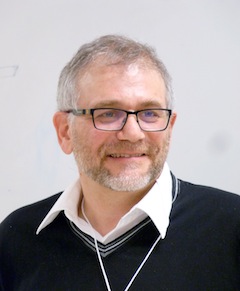
Zack Gross on the way to see some fair trade sugar cane in Peru. (photo from Zack Gross)

According to Zack Gross, there is child labor and slavery associated with the production of chocolate, sugar and coffee – as well as with other commodities, from sport balls to clothing, crafts and carpets.

Gross, who is the fair trade outreach coordinator at the Manitoba Council for International Cooperation (MCIC), was speaking at a fair trade event held on May 29 by the Women’s League of Congregation Etz Chayim and the Winnipeg chapter of the National Council of Jewish Women (NCJW) at the synagogue.

MCIC is a coalition of about 40 international development organizations funded by both the provincial and federal governments, which helps support its member organizations’ overseas projects and educates Manitobans about global issues.

Gross grew up in Winnipeg and attended I.L. Peretz Folk School, where he was first introduced to social justice issues. He has worked in the anti-poverty field internationally for nearly 50 years. He is the current president of the Canadian Fair Trade Network, a national organization based in Vancouver, and, last fall, Fair Trade Canada honored him with a lifetime achievement award.

At the Etz Chayim event, Gross spoke about the growing fair trade market, including that it has recently become more mainstream and now has many items that are kosher-certified.

“Much of my work is making presentations to interested audiences, but I also meet with local businesses, government representatives, and any others who can help to increase fair trade purchases and procurement,” he said.

Fair Trade Manitoba is a program of MCIC. “We also have a Fair Trade Winnipeg steering committee, which is working with City Hall toward Winnipeg becoming a ‘fair trade city,’ a designation Brandon and Gimli in Manitoba have already reached,” said Gross.

“Fair Trade Manitoba began as a collaboration of people involved in local schools, unions, faith groups and NGOs who share a vision of creating a better world. Manitoba is seen as a leader in fair trade. Earlier this year, we organized a national conference that attracted over 350 people and, last month, we had 13 people, including my wife and myself, travel to Peru to visit fair trade co-ops (producers and processors).

“But also, in a less sensational way, fair trade can help poor farmers find new markets and make more money, so they can have schools and clinics in their communities, can use better environmental methods in their production, can use safer equipment and can contribute more to their local and national economies.”

Fair trade can also help create economic opportunities for women and youth who have no capital, he said.

“When people are shopping – what we call ‘voting with your dollars’ – they should look for the fair trade label when buying coffee, tea, sugar, chocolate, tropical fruits and many other products,” said Gross, who advised that consumers visit cftn.ca/products-companies for more detailed information.

He also suggested people make their schools, campuses, faith groups, workplaces and events fair trade, and referred those interested in doing so to fairtrade.ca.

Yelena Maleyev was a key member of the local NCJW in putting this event together.

“We are passionate about educating the public about global issues that affect us locally, like child slavery and human trafficking,” she said. “The Women’s League shares our passion for organizing educational events, so it was a perfect partnership.”

At a local event last year, NCJW focused on increasing awareness of human trafficking and child slavery. This year’s event continues that effort, as fair trade can reduce the incidence of both.

“There is a need for fair trade purchase decisions in our daily lives to ensure we reduce our harmful footprint on the world,” said Maleyev. “Keep in mind that purchasing fair trade not only helps the environment, it provides humane working conditions for those in the supply chain, ensures a living wage for the workers, does not allow for exploitation of women and children, and yields sustainable growth in the economies where these companies are located.

“The goal of ending child slavery goes hand in hand with the global goals of abolishing extreme poverty, protecting our environment and supporting women and families in the developing world. Children are the most vulnerable citizens of our world and, to protect them, we must ensure we do not support corporations that exploit them. If we, as consumers, make conscious purchase decisions daily, we can directly impact the economic sustainability of ethical corporations.”

About the Etz Chayim event, Gross said, “Ultimately, what struck me was a comment by one attendee … ‘Anyone who knows their Torah should be a strong supporter of fair trade.’ Amen to that!”

Rebeca Kuropatwa is a Winnipeg freelance writer.


Format ImagePosted on June 17, 2016June 16, 2016Author Rebeca KuropatwaCategories NationalTags fair trade, MCIC, NCJW, poverty
Raising awareness of abuse

Raising awareness of abuse

Earlier this year, Winnipeg’s Jewish Child and Family Services (JCFS) premièred the short film Not in My Family, to raise awareness on the topic of elder abuse.

JCFS executive director Al Benarroch greeted the approximately 150 attendees that filled the Berney Theatre of the Asper Jewish Community Centre on Feb. 13.

“This film serves as a springboard for discussion and to help educate groups on how they might handle the issue of elder abuse,” said Benarroch. “It also provides a lot of valuable resources available in our community. Along with the film, we’ve created a kit with a booklet that provides information and also a discussion guide with some specific questions to be used following the viewing of the film. We envision this package having widespread application as a tool for organizations and professionals who work with seniors, who are educators, and other community professionals in regular contact with seniors, either individually or in groups.”

Developed by the JCFS, the project was funded by the Government of Canada’s New Horizons for Seniors Program. The 13-minute video is available from the World Elder Abuse Awareness Day Manitoba website (weaadmanitoba.ca/resources.asp?t=4), as is the accompanying resource guide.

Following the screening was a panel discussion with Jamie Kinaschuk from A & O Support Services for Older Adults Inc.; Sharon Tod, chair of the elder law section of the Manitoba Bar Association; and Dara Maternick, coordinator of Prevent Elder Abuse Manitoba.

“Every situation is different,” said Tod. “So, you have to tailor the answer to the particular problem. It’s an excellent resource to have a lawyer that you trust. The other thing I will urge you to do is make sure you have everything in place early on in the process. I’m talking about powers of attorney. Because, if you do it while you are fully competent and can assess properly who is the best person(s) to be your attorney, that is way better than what we often see in my profession, which is someone who is already in the early stages of dementia and in a vulnerable position who is then talked into appointing someone as their attorney … who is the exact wrong person for the job.”

According to Canadian research, between four and 10% of seniors are subject to some form of abuse. In addition to that, experts believe that, for every report of elder abuse, there are another four cases that are never reported. Most of the seniors who reach out for help say they are being financially abused.

Maternick said the best way to deal with the problem is through a team approach that respects the individuals and their choices. “We are proud to be here today in partnership with the JCFS to launch this valuable resource,” she told attendees. The film and its guide were highlighted at World Elder Abuse Awareness Day (June 15) events.

As Benarroch opened the discussion for audience questions, an elderly woman asked how to deal with abuse by home-care workers.

Kinaschuk suggested contacting her case supervisor, saying that, if she fails to get somewhere with that route, she can always call their supervisor. Benarroch advised that she contact the JCFS to have their social workers help guide her through the process of launching a complaint if need be.

Another audience member shared his situation. “My father’s been taken for $95,000 in the past two years, sending money to Jamaica and Dubai,” he said. “While he has been talking about giving me power of attorney, he has the full capacity to do it himself. Where would I go with that?”

Tod suggested that the son talk to his father’s lawyer, and then went on to share a story about one of her own clients. “He was at a stage where he was vulnerable, but competent, so we couldn’t force him to do things he didn’t want to,” she said. “So, I sat down with him and his son. We had a discussion.

“It’s difficult to talk about, because he was embarrassed that he had been taken for this money. But, we did, we sat down and talked about it and, ultimately, what we did was, he agreed voluntarily that his son would take over his affairs under the power of attorney, and the son took a number of steps to prevent the father from being contacted by these scam artists again.”

The steps, according to Tod, included the son changing his father’s phone number to unlisted, having all of his father’s mail redirected to his home and ensuring that his father had access to only one bank account with a limited amount of money in it, so that, if he was taken advantage of, at least the loss would be limited.

In another situation, Tod was appointed with the power of attorney, to prevent a son from threatening his mom for money. “Now, when the son came to her, she could say that she doesn’t know where her bank is anymore, that he would have to talk to her lawyer,” said Tod.

Tod spoke about capacity and how difficult it can be to determine, pointing out that it is part of a lawyer’s responsibility. “Before we have people sign documents, we have to make sure we are comfortable that the clients understand what the documents mean,” she said. “But, there are different capacity tests for different legal documents that you sign.

“It’s even difficult for doctors to determine someone’s capacity. Some doctors say someone has capacity while other doctors disagree. It also depends on the specific thing you’re looking at. People may have fairly good cognitive function, but their judgment may be impaired.”

Family members or social workers usually end up making these determinations and, if there are concerns, a doctor should be consulted.

Kinaschuk pointed out that, when the abuser is a family member, it catches one off guard. “You don’t expect a family member to be the abuser, so your guard isn’t up,” he said. “In this case, in the film, the grandson is telling grandma, ‘No, you’re wrong, you didn’t give me the money.’ And, she’s like, ‘Maybe I didn’t.’”

Even when an abuse situation is identified, Kinaschuk added, it is still very difficult to take action, as the victims come up with excuses for their abusers. “They’ll say things like, ‘He or she is having a tough time. They just need a little help until they get a job.’ And, it goes on and on. We provide support, discuss options and help them recognize what’s going on, but it is up to them to take it further.”

According to Maternick, it takes a lot for people to reach out for help. “The type of circumstance for elder abuse will be different for everybody,” she explained. “It becomes very difficult to answer these questions because you need to dig into the situation to understand what’s happening. There’s complexity with all these issues.”

Maternick suggested that a good place to start is by calling the senior support line. “The reason that line is so important is because it allows you to access information and resources to better understand what your options are,” she said. “There is no single answer that’s going to apply to every situation.”

In British Columbia, the Jewish Seniors Alliance can be reached at 604-732-1555 and a list of where to go for help, including for instances of abuse, is available at jsalliance.org/resources/where-to-go. Among the contacts listed by the JSA is the B.C. Centre for Elder Advocacy and Support’s elder law clinic (604-437-1940 or via bcceas.ca).

Rebeca Kuropatwa is a Winnipeg freelance writer.
 

Format ImagePosted on June 17, 2016June 16, 2016Author Rebeca KuropatwaCategories NationalTags dementia, elder abuse, seniors

Healing one’s self, the earth

Born to Ukrainian Orthodox survivors of the Holocaust, Dr. Eva Pip knows all too well the long-lasting effects of war. Her parents were imprisoned in labor and concentration camps as punishment by the Nazis for harboring Jews on their farm.

“My mother was never a fully functional human being again,” said Pip. “She had a number tattooed on her arm that she was always trying to conceal. She felt that, if someone saw it, they’d think less of her. Her greatest fear was of being sent back.

“She had terrible nightmares for the rest of her life. At least once a week, she would scream in her sleep, as though she was being murdered. I’d have to run to wake her up. She had a lot of old injuries and scars, and an improperly healed collar bone and breast bone.”

photo - Dr. Eva Pip
Dr. Eva Pip (photo from Eva Pip)

Pip’s mother came to Winnipeg by train from Halifax. Her mother did not choose to come to Canada; it was simply where that week’s ship from Germany happened to have been bound. The previous week’s ship went to Australia.

Several years later, Pip’s mother was able to sponsor her husband to come to Canada. He could not get out of Germany when the war ended and the forced labor camp in which he was held was disbanded, as he was wounded and not yet medically fit to be cleared to come to Canada. He finally came in 1949.

Pip was born the next year though her parents never wanted a child. The war had taken the humanity and warmth from them and they found it difficult to cope with basic daily life.

“In many ways, both of my parents were like children,” said Pip. “They could not make decisions, they could not take proper control of their lives, they constantly lived in some past world before the war had happened.

“There must be thousands and thousands of these silent casualties that are not recorded or even recognized. This damage did not stop with the people who personally experienced war atrocities. It affected their children, too, such as myself, who grew up in essence without parents to love and nurture them, to teach them, to respect them as human beings that they have brought into the world.

“My parents never once hugged or kissed me. We had very little food to eat. Often, we ate out of garbage cans. My mother made my clothing out of scraps and bits because she could not afford to buy me anything. My father did not want to support us, although he lived with us.”

Pip’s father worked as a painter for a billboard company, Universal Signs, which was owned by Max Gardner – who was Jewish and who Pip said took pity on her family – until he retired at the age of 66.

“The Gardners were our benefactors,” said Pip. “They gave us their old furniture for our home and did many kind things to help us out. They almost adopted me.

“Our next door neighbors on Manitoba Avenue in Winnipeg’s North End happened to be the parents of Dr. Harry Medovy [a well-known pediatrician and academic]. Although he had already left home long before we arrived, his mother was very kind to us and often shared her home-made Jewish holiday food with us.”

Later on in life, Pip has, in turn, helped out with various Jewish women’s and seniors organizations.

Growing up in a home that did not encourage friendships, Pip developed a very rich interior life, and found empathy and compassion for other beings in her North End environment.

“I developed a passion for nature, for the earth, and felt incredible sadness at what was happening to our environment,” she said. “I felt the hardships of the creatures around me that had even less than I did. I could feel their voicelessness and powerlessness from those who could kill on a whim and who were unmoved by the suffering and injustice we inflict on the companion spirits God gave us to accompany us during our brief time on this earth.”

This view led Pip to her career choice. She wanted to speak for those who could not and to raise awareness of how damaging and destructive people’s actions are for our planet.

Regarding any desire to have a family of her own, Pip said, “You cannot miss something that you have not had. I have lived alone all my life. The advantage of this is that spiritual development becomes a much more important life path, without the distractions of family and its problems and demands.

“My work became my family. I obtained my PhD from the University of Manitoba in 1977. At that time, being a woman in science was hard. I was able to go to university only because the National Research Council supported me with scholarships. I worked very hard and got good grades.”

Pip taught at the U of M for three years before transferring over to the University of Winnipeg, where she has been teaching for 37 years. This year, Pip is retiring, though by no means does she intend to spend her days resting. She plans to continue writing and publishing pieces on the environment and working in her large rural garden.

Pip grows most of her own food because she knows it will be clean and free of chemicals.

“I’ve always loved tomatoes,” she said. “That interest has grown into my trying to preserve heritage varieties, as these are rapidly disappearing and are an irreplaceable part of our collective culture. I also grow heritage potatoes and heritage varieties of flowers, giving away much of what I cannot eat. I also harvest wild foods on my land.”

Instead of having a cottage, which Pip views as harmful for the environment, she buys land of ecological value and donates it to wildlife preservation institutions. She has donated most of her land to the Manitoba Habitat Heritage Corporation.

“I hope there is never such a monstrous exhibition of human cruelty and vice in our world again [as was the Second World War],” said Pip. “I hope we never again have millions of damaged human beings in the aftermath. I hope we can make peace with each other, that we can recognize that we are all equal, that we do not look down on each other and pretend we are better, that we do not rob each other of our right to life and right to God, and that we make peace with our Mother Earth.

“For these things to happen, human nature needs to change, our values and our dollar worship need to change. I fear that it will be too late by the time we and our leaders realize this. When it is time for me to hand in my dinner pail, I wish to face God and feel confident I have done a good day’s work.”

Rebeca Kuropatwa is a Winnipeg freelance writer.
Posted on June 17, 2016June 16, 2016Author Rebeca KuropatwaCategories NationalTags environment, habitat, Holocaust, war
Interfaith volunteering

Interfaith volunteering

Among her volunteer work, Heather Fenyes started Think Good, Do Good with her cousin. (photo from Heather Fenyes)

Heather Fenyes is a full-time volunteer. She is actively involved in Saskatoon’s Jewish community, as well as with a number of organizations on the national Jewish scene. In 2011, she and her then nearly retired cousin, Jan Gitlin, started the organization Think Good, Do Good to create opportunities for people to engage in acts to improve their community.

A teacher by education, Fenyes has spent many years volunteering at the local Hebrew school, at Agudas Israel Synagogue. “We’re a pretty small community and we punch way above our weight class,” she told the Independent.

“Even when I do things with respect to the Jewish community, while Think Good, Do Good is absolutely non-political, there is spill-over in both directions,” she continued. “Because things I care about aren’t compartmentalized, so the kinds of philosophies we work with, with respect to coexistence, apply to what I want for Israel and what I want in Think Good, Do Good, and in my own community.”

As Fenyes’ kids were growing older, she recognized they were probably going to leave Saskatoon once they finished high school. Unless she created something more tangible to keep herself busy, it would be a difficult time.

“My Judaism tells me that we’re not bound by thoughts, but compelled toward to action,” she said. “We have to do good things. I’ve always wanted to work with that philosophy. I’ve always been a passionate believer in social justice and collective responsibility and, frankly, good deeds.”

Fenyes decided a good place to begin was to pay a visit to Judge David Arnot, head of the Saskatchewan Human Rights Commission, explaining to him that she wanted to find a way to work with him as a volunteer.

That initial meeting has resulted in some annual activities that incorporate Muslim-Jewish outreach, Holocaust education and school events that often revolve around Raoul Wallenberg and the concept of “the power of one.”

“We have an annual Holocaust memorial event in which we reach out to 2,000 students over a period of time,” said Fenyes. “I’m married to a refugee whose family escaped Budapest in 1956 during the revolution, after having survived the Holocaust.”

Fenyes has been spending a lot of time in classrooms, leading various lessons on citizenship, reminding students that, with all of our rights come just as many, if not more, responsibilities.

“I do a lot of conversations in classrooms about the things we take for granted and the things we are responsible for,” she said. “Part of this is just for the lesson itself, and a part of it is with the hope that teachers get this new curriculum, for K to 12 classes, in the very near future.”

For the past three years, on March 21, which is International Day for the Elimination of Racial Discrimination, Gitlin and Fenyes have chosen 250 elementary students who they work with on citizenship and take them to the university campus – with their Think Good, Do Good buttons on – to speak with students in the halls. “They approach university students and ask if they have done something good today,” said Fenyes. “I learn infinitely more from these K to 12 students than I teach them.”

While teaching one of the classes, Fenyes met a young student who said he was from Gaza. Fenyes suggested they talk about hummus. “I have a lot of friends from the Middle East and we have an ongoing discussion about who makes the best hummus,” she said.

“This young man was enthralled and we had this adorable, non-substantial discussion about hummus … and the teacher was standing looking anxious in the corner…. She said to me about a week later, ‘You cannot believe what happened Heather. Not long before you’d been in the classroom, this young man had been telling me about his family’s discomfort with Jewish people and his strong negative feelings towards Israel. When you left the classroom, he had a change.’ She said if she hadn’t seen it herself, she wouldn’t have believed it.

“He approached the teacher and shared how moved he was by having met me and asked to write a paper … and, it was on coexistence or getting to know our neighbors … something completely opposite to the things he’d been saying before.

“You know how we say, ‘To save one life’? I’m not saying that at all, but, if I changed one young man’s way of thinking, that’s a world.”

Fenyes is very aware of the immigration statistics in Saskatchewan and the challenges they pose. “If we don’t create some infrastructure and have conversations like you and I are having right now, and set up educational opportunities, we are going to be another failed example,” she said. “It’s not just that we need to do it because it’s the right thing to do. We need to do it because, otherwise, we’re going to live in a different kind of community.”

This understanding really hit home when Fenyes’ son received a death threat while studying at Western University. Fenyes did not need that wake up call, but it did remind her of why she was in classrooms and making connections with people of all faiths.

Fenyes said they have learned from experience that, if the Jewish community alone puts on events such as the annual Raoul Wallenberg program – which this year took place on Feb. 5 – they do not have the same impact. Therefore, they have given the Catholic and public schools the mandate to organize the event. This year’s program featured a young man who was born in Congo and lived in Kenya before immigrating to Saskatoon as a refugee; he just graduated from high school last year.

“In a city where we have two separate systems, the Catholic and the public school systems work together,” said Fenyes. “The superintendents from each have been meeting, which is a great image and reality, to plan this event. One year, it’s in a Catholic high school. The next year, it’s in a public one.”

On another front, Fenyes is looking forward to finding ways to work with the Centre for Israel and Jewish Affairs.

“I think that what we are doing in Saskatoon as a city and community is really impressive,” she said. “I hope we can infect others with some great kind of ailment – Think Good, Do Good. My kids tease me that I live my life with rose-colored glasses. They might mean it as an insult, but I take it as a compliment.”

Rebeca Kuropatwa is a Winnipeg freelance writer.
Format ImagePosted on June 10, 2016June 8, 2016Author Rebeca KuropatwaCategories NationalTags Fenyes, interfaith, Saskatoon, tikkun olam, volunteerism
Museum tries to instil hope

Museum tries to instil hope

Canadian Museum for Human Rights researcher and curator Dr. Jeremy Maron discussed some of the issues the museum faced in deciding what to exhibit. (photo by Rebeca Kuropatwa)

The Canadian Museum for Human Rights (CMHR) in Winnipeg is one of the newest museums on the block. Dr. Jeremy Maron, a CMHR researcher and curator, discussed some of the issues the museum faced in deciding what to exhibit. The March 4 brown-bag lunch meeting at the University of Manitoba was open to students and the general community.

Maron’s main work at the museum is on the fourth floor, an area dedicated to the Holocaust. Displays on three perimeter walls take a case study approach, emphasizing themes closely related to the Holocaust as well as universal human rights.

“The first theme we look at is the abuse of state power,” he said. “This wall explores how Nazis used and deployed instruments of state power, such as the police, judiciary, laws and regulations, and even education to undermine human rights … and acquiring total dictatorial control of German society, promoting their racist and antisemitic ideology, targeting Jews and other specific groups for social exclusion and persecution, ultimately culminating in genocide.”

photo - Dr. Jeremy Maron makes a point at a March 4 meeting in Winnipeg
Dr. Jeremy Maron makes a point at a March 4 meeting in Winnipeg. (photo by Rebeca Kuropatwa)

Maron said the modern nation state, in its ideal sense, is supposed to be the guarantor of human rights. But, in reality, the centralized power of the modern state very often sets the stage for it to be the worst violator of human rights.

“The case of Nazi Germany is a good example of the centralized power and the capacity for it to be mobilized toward the violation of human rights, rather than protection,” he said. “There are many other stories in the museum in which state power is also being utilized in such a manner.

“The second thematic wall in this gallery … moves on to look at persecution and targeting of specific groups in Nazi Germany. This wall explores the increasing intensity of systematic oppression under the Nazis.”

According to Maron, the Allies did not fight the Second World War specifically because they were trying to save the Jews in Europe. However, their winning of the war ended the Nazi massacre of Jews, which continued nearly up until the day of the Germans’ surrender.

“Another exhibit, from which we try to draw human rights connections, is a large digital study table in our Breaking the Silence gallery, also on level four,” said Maron. “This gallery looks at breaking the silence specifically as a human rights act.”

Human rights violations are always accompanied by silence, distortion, justification, minimization and denial, he said. Perpetrators want to hide their crimes; victims who survive may feel scared for themselves or their families, or feel ashamed; witnesses and bystanders often look the other way, so the cycle continues.

The goal of the CMHR is to encourage people to speak out about these violations, to drag the violations out into the light of day and pursue justice, recovery and reconciliation, he said.

“This particular exhibit, Breaking the Silence … looks at a wide scale of human rights violations, putting an emphasis on how people have responded to them in order to break silence,” said Maron. “We tried to place the emphasis of the human rights response in this particular case. It’s a question of focus that tries to adopt a forward-looking perspective, rather than one that is trying to wholly examine the past in and of itself.”

While some visitors feel that the message and exhibit is too watered down, Maron said this was necessary to a certain degree, as the museum’s main focus is to educate and not to horrify or shock.

“It’s not just a sense of sensitivity we think about, it’s also a question of a fact,” said Maron. “Sometimes, when confronted with material that is explicitly horrific, even for someone like myself who has worked on this material extensively, it almost can shock you into silence as it overwhelms you. I think back to when I was doing my master’s in 2005. I went on a Holocaust commemoration tour [and] we toured Auschwitz. After you go through the gas chambers and you see the walls and the showerheads, you get back on that bus and you are just beaten down. You are sitting there and the guides are trying to debrief and talk, but no one wants to talk because they are beaten down.”

While the CMHR does not back away from the truth or gloss over troubling aspects, they choose to visualize these histories differently, he said. One of the concepts the museum is designed to highlight is that everyone’s actions are the result of choices, and that the consequences of these choices are not inevitable.

“That’s not to say that there are not constraints on choices,” said Maron. “If you’re in the midst of a particular human rights catastrophe and you do something like hide a potential victim in your attic, it’s very possible that you might be targeted as well. So, there are constraints on choices in certain historical circumstances. But, it’s still important to consider that these are choices and actions, and what happens isn’t inevitable. Some objects in the museum speak to some of the less obviously consequential choices that individuals might have made that allowed the Holocaust to be perpetrated on that scale.”

While Maron understands that it’s impossible to know for sure what a single individual could have done, with his display, he hopes to create a deep and meaningful reflection for CMHR visitors and, especially, students.

How to convey a history of conflicts accurately without reigniting tensions is another challenge the museum has taken into consideration, by using careful word choices and avoiding blanket statements. But, maybe the most important aspect and aspiration for the CMHR is ensuring that visitors leave with a sense of hope.

“This hope is not a naive hope that everything is going to be OK, but that … hope is possible as long as we promote the human rights of everyone, and the idea that hope is possible if people are willing to make hard choices and take action,” said Maron. “So, again, we hope our visitors leave with the idea that change is possible if people are willing to do something, while silence and acquiescence is the ally of rights violations.

“Until atrocities are recognized and acknowledged, until people believe action is possible, cycles of violations will continue. Such cycles, we hope, our museum, in some small part, can help improve by inspiring a lot of hard work and devotion by our visitors, who may become dedicated human rights advocates and defenders.”

Rebeca Kuropatwa is a Winnipeg freelance writer.

Format ImagePosted on June 3, 2016June 1, 2016Author Rebeca KuropatwaCategories NationalTags Canadian Museum for Human Rights, CMHR, Holocaust, human rights, Maron, Nazi, Winnipeg
Revealing psychiatry

Revealing psychiatry

Dr. David Goldbloom (photo by Ksenija Ho)

It was not that long ago that seeing a psychiatrist meant that people saw you as unstable or abnormal in some way. While societal views on many things have broadened, the stigma of mental illness remains. So, how do we go about changing these perceptions? According to Dr. David Goldbloom, a psychiatrist at the Centre for Addiction and Mental Health in Toronto, this is something achievable in baby steps. And a step he has taken is to publish a book that not only looks at his patients’ experiences, but his own.

Goldbloom originally hails from Montreal.

“I come from a long line of pediatricians. If heredity was going to play any kind of role or environmental influence, you might think I would have ended up in that field.”

But Goldbloom’s father-in-law was Nate Epstein – a well-known figure in Canadian psychiatry. Epstein was formerly the chief of psychiatry at the Jewish General Hospital and, later, the founding chair of the department of psychiatry at McMaster University. “My exposure to him at close range was a formidable influence in terms of my ultimate career decision,” said Goldbloom.

The complexity of psychiatric illness in terms of its biological, psychological, social and cultural aspects, which requires one to think broadly about solutions to sufferers’ problems, drew Goldbloom to the field. And, during his career, he has written many books targeted to medical professionals, but only recently did he choose to write a book explicitly geared to non-professionals.

“It’s a very different kind of writing,” he said. “I would say it’s much tougher than writing a textbook. I wrote it with Dr. Pier Bryden. She and I cooked up the idea together.

“It was driven by a wish that we shared to make psychiatry better understood by the general public – not reducing it to some cartoonish stereotype. People who have mental illness themselves or those who treat them, we always thought there was a measure of curiosity in the general public about what the reality is versus the Hollywood or TV depiction.”

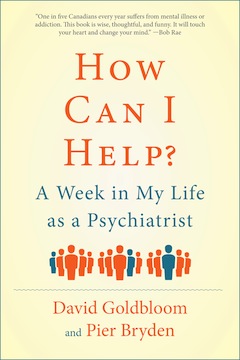
book cover - How Can I Help? A Week in My Life as a Psychiatrist How Can I Help? A Week in My Life as a Psychiatrist uses, as its title says, one week in Goldbloom’s professional life as its narrative framework. While Bryden is also a psychiatrist, she does not feature in the book.

In How Can I Help?, Goldbloom and Bryden explore the world of psychiatry, and talk about how it intersects with Goldbloom’s personal life, as they know that people are curious about how health professionals deal with the inevitable sorrows and joys of working in the field.

The book “contains some very real stories of real patients with their real names used with their real permission,” he said. Other patients described in the book are fictional composites, “masterfully disguised.”

Goldbloom himself is more revealed. “We felt, if these individuals were going to be candid and courageous enough to talk about their own experience, then I had better match them in terms of talking about my own reactions, including my reaction to the very real suicide of one of my patients.”

While Goldbloom said this was not the only time in his 30 years of practice that he has experienced a patient’s death, both he and Bryden felt that this one instance was particularly poignant. They also took the opportunity to write in more general terms about the impact of suicide on physicians.

“One of the other things the book does is use the events of the week to springboard into some of the larger issues within psychiatry,” said Goldbloom. “It’s not just a narrative, but it looks at some of the historical [elements], controversies, stuff like that.

“Whereas most people think of a psychiatric practice as being set in a secluded, private office, with somebody coming in Tuesdays at four to talk about themselves in a manner interminable, the reality of acute psychiatric care in a modern hospital is very different.”

According to Goldbloom, possibly the first thing a reader might be struck by is the variety of different settings in which they find him. He consults in his office, of course, but also through videoconferencing to reach distant areas, in emergency rooms and acute care units, as well as out in the community.

Readers will be able to learn of the varied roles psychiatrists in Canada play, and Goldbloom hopes the book will highlight the breadth of experiences – the professionals’ as well as the patients’.

When asked if another book project is on his radar, Goldbloom said, “I have to wait and see how the first book does. It’s encouraging that it was on the bestseller list, within a week of its publication, in the Globe and Mail and the Toronto Star … but, you know, it’s early days yet.”

How Can I Help? is available in most major bookstores, as well online via Amazon and Indigo.

Rebeca Kuropatwa is a Winnipeg freelance writer.
Format ImagePosted on May 20, 2016May 18, 2016Author Rebeca KuropatwaCategories BooksTags Bryden, Goldbloom, mental health, psychiatry

Posts pagination

Previous page Page 1 … Page 18 Page 19 Page 20 … Page 31 Next page
Proudly powered by WordPress