
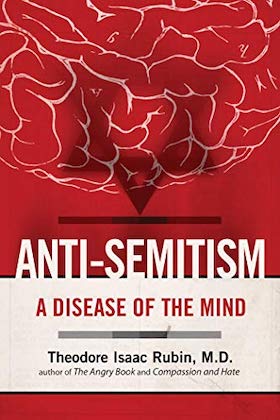
Next month marks the centenary of the birth of a psychiatrist whose work on antisemitism deserves a fresh reading. Theodore Isaac Rubin was born 100 years ago April 11. He died at 95, in February 2019. His 1990 book Anti-Semitism, A Disease of the Mind: A Psychiatrist Explores the Psychodynamics of a Symbol Sicknessposited that bigotry against Jews may be a mental disorder.
Rubin had a sprawling career, writing fiction and nonfiction. His 1961 novel Lisa and David, a love story of teenagers with severe mental illnesses, was made into a film the next year and garnered two Academy Award nominations. But Rubin’s work, in addition to his clinical practice in New York City, was primarily devoted to psychology and self-help, including weight loss. He has been credited with coining the term “comfort food.”
Rubin attributed antisemitism to “symbol sickness.” Human beings use symbols to represent objects in the world and to communicate how we feel through these symbols – love and hate being among the most familiar. Symbol sickness occurs when a symbol becomes so divorced from its original meaning that it takes on a distorted or pathological sense. Antisemitism can occur when the objective meaning of “Jew” is imbued with projections from the mind of a person we would call antisemitic.
“The symbol tends to take on increasing importance, and this can and often does reach a state in which there is obsessional preoccupation with it,” he wrote. “In projecting inner conflict to, let us say, Jews, what really happens is that Jews – the symbol – are assigned roles representing aspects of one’s own conflicts.”
Rubin saw envy and feelings of exclusion as central to antisemitism, particularly the idea of a people who the spectator perceives as inferior yet are, in theological terms, “chosen.” The perception that these “inferior” people have little or no interest in him can lead the antisemite into frenzies of rage.
“Even as [the antisemite] denigrates the Jews, he envies what he sees as separateness, clannishness and exclusivity,” he wrote. “He believes that Jewish lack of interest in him, let alone winning him over, is a form of rejection. His reaction to rejection is enormous self-hate and projected self-hate. He rejects and despises the Jew, salving his own hurt pride and disguising his secret admiration and envy. He further embroiders the disguise, twisting envied Jewish characteristics into threatening ones. Thus, he sees Jewish commonality and cohesiveness as arrogance and unwillingness to meld and cooperate with the larger society. Even more, he sees Jewish cooperation and lack of missionary zeal or their desire to assimilate as secretive, cabal-like machinations.”
Perceptions of Jewish achievement can be similarly problematic.
Jews “had to cooperate in order to survive,” wrote Rubin. “They connect the past, present and future, and connect to each other. They profit from the wisdom and experience of forefathers and the group. This makes Nobel Prize cooperative efforts possible. This also makes them the envy – often the malignant envy – of the self-disenfranchised (from self, others, and past and future) antisemite to whom they become prime objects of projected self-hate. The Jew is an intense cooperator. The antisemite’s philosophy confuses commitment, dedication, intense interest, involvement and optimism with sick competition.”
Waiting for the Messiah – who never arrives – is a lesson in the process of postponement of gratification, Rubin argued, offering a reason for collective success – but rational explanations are not accepted by an antisemite. “To the antisemite, Jewish achievements are not seen in this light at all. They are seen as the result of slimy manipulation and cabal-like insider cooperation, designed to frustrate non-Jews.”
For people who are oppressed by political leaders, theology, daily drudgery or any other factors, antisemitism offers a scapegoat. Jews are a symbol of freedom – even when they are oppressed by dictatorial regimes or violent neighbours – merely because they exist outside of the majority society.
 Rubin goes to some lengths to address Christian antisemitism and how it may fit into his thesis of anti-Jewish bigotry as a mental disorder. Rubin suggests that Christians who traditionally have accused Jews of deicide are not expressing hatred for the perceived annihilation of their deity, but the opposite. Jesus the Jew, in the Christian narrative, is the conscience-giving entity, paralleling the role of Judaism as the wellspring of ethical monotheism.
“The Jew is hated for being a conscience-giver rather than a Christ-killer,” according to Rubin. “Even as they kill the hated conscience-giving part of Jesus symbolized by the Jew, they brag about love for Jesus and Christian brotherhood.”
The antisemite may venerate the loving, compassionate aspects of Jesus, but struggle against the strictures imposed by moral and behavioural principles that accompany the theology.
“I believe that rabid antisemites who have convinced themselves of the historical delusion that Jews killed Christ unconsciously really admire and envy them for doing so,” Rubin added. “They also are secretly grateful to the Jew for providing them with a symbol to which they can displace that hatred. Hating Jesus directly is terrifying indeed and threatens overwhelming guilt, unbearable self-hate and eternal damnation. Calling Jews ‘Christ-killers’ supports shaky identifications with Jesus and even more so with his teachings. This helps convince the victim that, as the Jews killed Christ, the hater of Jews loves Christ.”
Similarly, the ethical constraints that are inherent to most religions – but which a Christian might associate with the Jewish origins of their own theology – might lead to not only a lashing out against their own church or clergy, but a messy effort to improve one’s own self-worth by “proving” the moral failure of the followers of the antecedent religion.
“To be Jewish is to be righteous, ethical in the world,” Rubin wrote. Identifying and emphasizing examples of Jewish moral failing is a form of self-redemption, he argues. If the Jews, the apparent fountainhead of Christian morality, can be proven as hypocrites, one’s own shortcomings may seem less corrupt.
Like the bogeyman under the bed, the antisemite is terrified of a monster of their own creation.
“The antisemite assumes that he is hated by the Jew at least as much as he hates the Jew,” Rubin wrote. “He must keep the Jew powerless and in sight at all times and, if possible, obliterate him, because the secretive creature of secret cabals may have special powers, powers derivative of the God of the Old Testament.”
Jewish reverence for life – exemplified in the toast “l’chaim!” – may be another source of resentment for people who are taught that their reward will come after death.
“To the Jew the greatest courage is not related to death but rather to life. To live and to live an ethical, caring life is a courageous way of life,” wrote Rubin. “The antisemite and all bigots are essentially joyless, life-denying, disconnected, auto-digestive people.”
There may also be a foundation of misogyny in antisemitism, Rubin suggested, with Judaism portrayed as the “mother religion” of Christianity.
As a representation of motherhood, he wrote, Jews “then offer an easy target for displacement and projection. Hatred for the mother is repressed to the unconscious and projected to Jews on the conscious level. This projection would be fed by any disturbed relationship with parents or authority.”
Additionally, peace is traditionally symbolized as feminine and war as masculine. The Jewish quest for peace – “shalom!” – is juxtaposed with, to offer just one example, the Crusades, and Jews’ perceived passivity in the face of centuries of oppression may be interpreted as a feminine docility by those who esteem masculine aggression. (The inversion of this, in recent decades, through the perception of Jewish aggression in the form of Israeli military actions, could be seen as an eruption of envy or outrage over a people who “don’t know their place.”)
Lashing out at others as a response to (real or perceived) internal shortcomings may be a desperate response to perceived shaming, according to Rubin. “The saddest is a person whose feelings are blunted and even deadened,” he wrote. “This means that inflicting pain is a last-ditch attempt to have feelings vicariously oneself. Coupled with bullying tactics, the infliction of pain makes the sadistic bully feel momentarily alive and potent. This is compensation for feeling powerless, helpless and dead.”
Rubin’s assessments rest on the idea that the perpetrators of antisemitism are bullies who perceive themselves as bullied. This is a fundamental way that antisemitism differs from most forms of discrimination or bigotry, which tend to position the perpetrator as superior to the victim. An antisemite often imagines Jews as believing they are superior to others, which leads the antisemite to feel driven to bring Jews down a notch.
When Rubin wrote his book, in 1990, antisemitism, at least in North America, was largely believed to be a fact of history. Since it came roaring back, a decade later, we have struggled to explain and contain it. We generally fall to sociological explanations and Rubin’s unique approach – a psychological explanation – is an important one to help understand a phenomenon that, to be frank, we really have no firm consensus about how to confront.

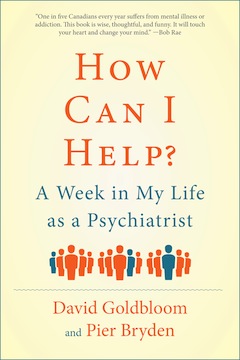 How Can I Help? A Week in My Life as a Psychiatrist uses, as its title says, one week in Goldbloom’s professional life as its narrative framework. While Bryden is also a psychiatrist, she does not feature in the book.