


Young community members in Harlem participate in the painting of a shipping container inside of which fresh produce is grown. (photo by Nick Smith)
Seed Street, a hydroponic farming venture and food-justice initiative that grows fresh produce inside shipping containers, arrived in Harlem in the summer of 2015. It was brought there by Leigh Ofer and Hannah Bronfman.
The idea came from an environmental justice class Ofer took in college, as well as Bronfman’s deep ties to the Harlem community and her advocacy for healthy living and positive body image.
“Even with time and less financial stress than a family, it was still expensive and challenging to eat and live healthy with so much misinformation out there … I was confused and searching for sustainable ways to live and eat healthfully while living in a big city,” said Ofer. “Women, in particular, in our modern-day society, can be so disconnected from our bodies. I felt a tremendous sense of disillusionment with the current food system and anger at how deep-seated interests have infused our system with toxic Franken-foods.”
Ofer believes this issue is at the heart of America’s health crisis. “It’s really impossible to eat well, to feed your mind, body and soul,” she told the Independent. “Growing up in Israel, in an agricultural society, eating healthy was a by-product of living. You don’t think about it. But, in the U.S., it takes jumping through hoops just to eat healthy – a total polar opposite on the spectrum.
“This was having a profound effect on me. I felt it in everything – my skin, my well-being, my energy, but I count myself as one of the lucky ones. If I was having a hard time eating and living well, how was a young family managing? I felt a deep sense of obligation to do something about this.”
When Ofer was searching for solutions, she came across a new development in agriculture. Cutting-edge farmers and technology geeks were building hydroponic farms inside shipping containers. The idea immediately resonated with Ofer, partially because of her family background in shipping.
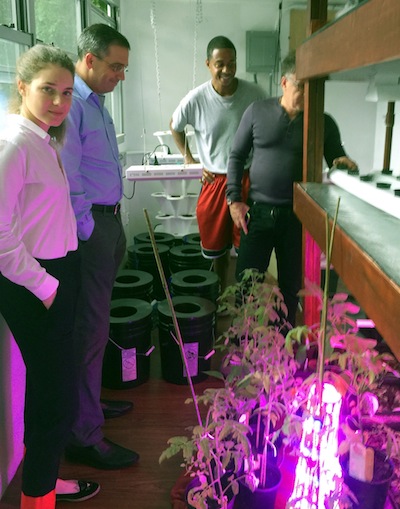
“It was a no-brainer to transform freight containers into highly productive urban farms using the latest technologies and minimal resources to reconnect urban communities to fresh food,” she said. “It made perfect sense, harnessing the power of new technology to revitalize urban neighborhoods, introduce farming jobs and reeducate a community about where food comes from.”
When Ofer met Bronfman a couple of years after having come across this idea, the two decided to take a leap of faith together and go for it. With limited resources, they kicked things off with one container. It landed at their community partner’s yard – the Children’s Aid Society – in July 2015, and they have been growing tomatoes, leafy greens, herbs, peas and cucumbers ever since.
“We are retrofitting freight containers with hydroponic growing technology and bringing the farm back to the city,” said Ofer. “You can put these farms almost anywhere. Each farm container has a very high yield, equal to about an acre of traditional farming and using 90% less water and 75% less fertilizer. All you need is an electrical outlet to hook up to and a water supply. We had a plethora of tasty, healthy veggies in our last harvest.
“We got started by partnering with the Children’s Aid Society at their central Harlem location,” she explained. “We piloted our grow farm in their backyard playground a little over a year ago. In January, we launched the volunteer-run youth development urban farming program, serving 60 youth from central and east Harlem. Our proprietary Grow, Move and Create program engaged the youth three days a week in healthy activities, such as yoga, hydroponic farming and entrepreneurship.”
The program was successful and involved the community and especially kids, who learned by doing how foods grow and the different ways food can be eaten and enjoyed. Community members participated in planting, harvesting, managing the farm stand and creating recipes for the fresh produce they brought home, not to mention yoga. At the end of the modules, the kids shared a presentation with the parents – a business plan, a recipe book or yoga stretches, depending on their group’s focus.
Heading into 2016, Ofer said there were three pillars she and her team wanted to address with the program: accessibility of fresh, healthy food; sustainability; and the sharing of knowledge and information.
“Most importantly, in order for us to be successful, we needed to address the issue of economic security,” she said. “We believe you can fill lettuce bags all day long, but if people don’t have access to good food, a base sense of financial security and practical knowledge about food and health, it’s going to be useless.”
For the second phase of the Seed Street urban farming initiative, the focus was shifted to economic development as a more effective way of empowering community members and improving food justice, by providing food education and nutrition information.
“Basically, what we’re doing is increasing opportunity for a community to have economic independence and helping them to take ownership of their health and nutrition,” said Ofer. “We want to ensure our model is not just another organization out there that does community gardening. We want it to be one that addresses the inequities and is also functional, taking needs of the community into account and including community stakeholders in the planning, growing and harvesting of foods and ideas.”
Seed Street is currently evaluating technology suppliers and sites for the commercialization of five to six container farms in Harlem. They are strengthening their partnerships and learning, through collaboration, the best ways to partner with other local youth development, food-justice, employment, and health and wellness advocacy programs.
The container farms operate year-round, allowing continuity in education and providing ongoing employment for the operator, unlike an outdoor garden that closes for winter.
“When I started the project, my dream was to build farms in Israel and Palestine, because I could visually see that it would be a beautiful way to bridge two sides and actually grow produce together and work on a shared initiative together,” said Ofer. “My dream continues to evolve, but I clearly envision us creating a model for collaboration and conflict resolution.”
Rebeca Kuropatwa is a Winnipeg freelance writer.



