
Skip to content
  • Home
  • Subscribe / donate
  • Events calendar
  • Business Directory
  • FAQ
  • News
    • Local
    • National
    • Israel
    • World
    • עניין בחדשות
      A roundup of news in Canada and further afield, in Hebrew.
  • Opinion
    • From the JI
    • Op-Ed
  • Arts & Culture
    • Performing Arts
    • Music
    • Books
    • Visual Arts
    • TV & Film
  • Life
    • Celebrating the Holidays
    • Travel
    • The Daily Snooze
      Cartoons by Jacob Samuel
    • Mystery Photo
      Help the JI and JMABC fill in the gaps in our archives.
  • Community Links
    • Organizations, Etc.
    • Other News Sources & Blogs
  • JI Chai Celebration
  • JI@88! video

Recent Posts

  • Federation now across BC
  • Israel fighting for its existence
  • Deal strengthens Iran
  • Patriotic belonging diminishes
  • A campaign to engage
  • Upstanders’ first live event
  • Responding to Carney
  • Having your own home
  • Music a family tradition
  • Musical to warm heart
  • Community milestones … June 2026
  • Sharing her passion for Israel
  • Or Shalom reopens its doors
  • JFS from past to future
  • Need holistic approach
  • Sharing stories, advice
  • Journalist shares fears
  • Skills to live together
  • Road to independence
  • Cutting grass with scissors
  • Zionism as a solution
  • Deceit, desire & the divine
  • Reclaiming sacredness
  • Creative project ideas
  • Summer squares and cobbler
  • Thou shalt … summer commandments
  • Legal help for students
  • Revisiting myth of Lilith
  • Wrong person rebuked
  • Canada’s mixed messages
  • Questions for museum
  • Symposium on antizionism
  • Making soccer political
  • CJPAC lauds Pulver’s impact
  • City recognizes Vrba’s legacy  
  • Organ donation saves lives

Archives

Follow @JewishIndie
image - The CJN - Visit Us Banner - 300x600 - 101625

Byline: Joanne Seiff

Mitzvah to return lost items

During the winter and spring in Winnipeg, sometimes one sees a child’s toy or a colourful mitten attached to a tree or hedge along a sidewalk. These are lost items. The neighbourly thing to do when you see something in a snowbank or on the packed snowy sidewalk is to pick it up and prop it up at adult eye level. It helps others. Maybe it will stop toddlers’ tears. 

Our household found somebody’s bike lock key last fall. This was harder to post. We took a piece of paper and wrote “Is this your key?” on it in large capital letters. Using clear tape, we attached the key and the sign to a powerline pole. A long time passed. One day, someone finally found their key. Relieved, we took down the sign.

I’ve been studying the Babylonian talmudic tractate of Baba Metzia, which covers civil law, including the rules around how to deal with lost items. It examines details that I often ponder. For instance, if a person finds an inanimate object, it has different obligations attached than if one finds an animal. We must return lost animals. If we don’t know how to return them, the finder must care for the animal, including feeding and watering the animal. If the animal’s upkeep is a burden, provisions exist for selling the animal and keeping the money to compensate the person who lost their animal. The particulars can be complex.

I became interested in a category that isn’t easy to describe – an object that isn’t alive or animate but still needs care. Things like books, which, in the days of the Talmud, were scrolls made of parchment made from animals. The finder had to rotate the scrolls occasionally to maintain them until they could return them. The finder couldn’t use the scrolls for study in a way that might cause undue wear on these hand-scribed texts. 

Another thing in this category, in Bava Metzia 29b, says: “If one found a garment, he shakes it once in thirty days and he spreads it out for its sake, to ventilate it, but he may not use it as a decoration for his own prestige.” As someone who makes and cares for natural fibre textiles (handspun and knit sweaters, for instance), I understood this immediately. Clothing wasn’t mass produced then. There were no factories. Everyone used spindles and spun and wove clothing. It wasn’t fast fashion. Clothes took skill and a lot of time to make. So, if someone found a garment, he knew its value. It wasn’t disposable. He must keep it well-aired, to be sure it was clean and cared for, and not attracting destructive pests like moths. Since he didn’t own or make it, he also couldn’t use the garment himself. 

Bava Metzia also explores when someone loses a garment and “despairs” of its return. That is, when one gives up entirely on getting it back.

For anyone who has seen images of the destroyed cars, homes and belongings left after Oct. 7 on the kibbutzim in southern Israel or from the Nova festival, these details hit hard. Some Israelis from these areas escaped with their lives but have “despaired” of ever getting back what they lost, they don’t want to return and try to reclaim things. Others asked for help or sifted through the remains of their homes to find precious items. Still others have managed to return home to their belongings and restart their lives.

This despair and reclamation reminded me of my in-laws and their stories of displacement after the Second World War. Their possessions, buried or left behind years earlier in Poland, were impossible to claim. Non-Jews had moved into their homes and taken their things. After four years in five different displaced persons’ camps, my father-in-law, his sisters and parents moved to the United States. Decades later, my husband’s grandmother would describe her family’s bakery in Mezritch and what they lost. Even in her despair, there was an acknowledgement that she worked daily to let go of that loss, and be grateful for a new, rich life for her family. 

This family refugee story, of loss and rebuilding, contrasts sharply with the UNRWA concept of intergenerational Palestinian refugee status. As Jewish communities have been forced to move over thousands of years, we have, perhaps, been lucky to have these talmudic guidelines, now 1,500 to 2,000 years old, on how we can claim lost items and how we can accept loss and move on. As we tell the Passover story, we remind ourselves of the many times our people have had to leave everything behind and start again. 

Teaching how to navigate lost items starts young. A PJ Library book sent to our children, called Sara Finds a Mitzva, helped us with this. Sara, the protagonist, follows through with the mitzvah (commandment) to return lost items when she finds a toy duck. She tours her Orthodox New York City neighbourhood to find the duck’s owner. My kids loved this book and its beautiful illustrations, which offered glimpses of my mother’s childhood, as well as taught a valuable lesson.

We also work with our children to help them understand that sometimes things go missing, and how to move on. After all, we say, it’s just a thing. People matter more than things. With war on our minds, we must focus on what counts most. I am praying for the safe return of the Israeli hostages. We cannot fall prey to despair – our tradition teaches that, when we despair, we have given up hope of an eventual return. Further, we must make sense of a situation where thousands of Israelis have lost their physical belongings but must now make a new life for themselves. Across the border, there are civilians in Gaza who must also rebuild their homes and lives after the war.

It’s one thing to study the rabbis’ ancient debates as an intellectual exercise. It’s another thing altogether to return pets and livestock, find belongings, and make new households amid this destruction. We have a history of past loss that offers guidance, as those affected by war are physically finding their way through this difficult experience. 

We must work together to find new paths after loss. Even if it’s familiar territory, as Jews, it doesn’t mean it’s easy. Perhaps each of us, like Sara in the children’s book, can be lucky and find something – whether it’s physical or intangible. Then we, too, can do the mitzvah of returning lost things, and observe Passover, too. Creating a joyful holiday after trauma also offers a third mitzvah, that of tikkun olam, or “repairing the world” – bringing a bit of joy back to someone who needs it. 

Joanne Seiff has written regularly for the Winnipeg Free Press and various Jewish publications. She is the author of three books, including From the Outside In: Jewish Post Columns 2015-2016, a collection of essays available for digital download or as a paperback from Amazon. Check her out on Instagram @yrnspinner or at joanneseiff.blogspot.com.
Posted on April 12, 2024April 10, 2024Author Joanne SeiffCategories Op-EdTags Bava Metzia, education, Hamas terror attacks, Israel, loss, mourning, Oct. 7, Talmud

Making meaning in diaspora

“We’re planning a family event in June.” That’s how I start nearly every contact with vendors while trying to arrange it. Sometimes, I say a “party with family and friends.” I avoid saying b’nai mitzvah. It’s just easier and safer.

One of my twins has a locker at junior high near a student who uses her body as a sign of protest. “Free Palestine” is written on her cheek. Other days, messages are emblazoned on a sweatshirt. My kid says she seems to stare at him, but I recommended he just stay away, don’t stare back, and don’t cause any kind of confrontation. “Do you know this person?” I ask him. “No,” he says, “she doesn’t know us.” What he meant is perhaps more obvious to us now – he doesn’t think she knows we are Jewish.

The transition from a bilingual Hebrew/English public elementary school to a junior high where Jewish kids are few and far between has been a big one. To my surprise, it went smoothly, but, over time, the ramifications have become clear. We knew our kids would figure out that we were, in fact, a small minority in Canadian culture. In elementary school, they would choose surprising moments to discuss Jewish things or use words in Hebrew with people at the dentist’s office or on public transportation. At first, our explanations about how people were different, with various religions and backgrounds were confusing. In their minds, they still believed everyone was Jewish.

On one hand, I loved that they didn’t have to learn to code-switch as early as I did. Code-switching is a way to describe how we switch between dialects, languages or personae in different settings. That is, a person might speak one language at home and another at work. In Jewish settings, one might use what linguists call “Jewish English,” English interspersed with Yiddish or Hebrew or other Jewish languages. At home, we might be encouraging someone to “daven at shul” with friends. We might shout “Dai, maspik!” (“Stop, enough!”) when someone misbehaves. In public, we might say “go to services” or “Behave yourself!”

Some people say that learning this kind of nuance takes maturity, but that doesn’t always ring true. I knew, by age 5 or 6 when my ethno-religious identity needed to be kept to myself. During times of extreme antisemitism, children were forced to keep this hidden, or even not told they were Jewish until old enough to manage the information. Giving my kids this extended time of safety felt like offering them a special oasis, a honeymoon that I missed.

Years ago, I worked with an editor and writer who shared with me that she had a Jewish background, although she was adamantly secular. I often felt the need to code-switch with her, as something made me feel like I was “too Jewish” for her comfort level. Since Oct.7, things have changed. She has become public in her Jewish identity, speaking out against antisemitism. Recently, she has been reading history and research for a book-length project. Today, she said, reflecting on an historic “golden age” for Jews in Polish history: “There is no safety in America now just because it’s been a golden age for my lifetime.” Yeah, I responded. I know.

Everyone copes differently. On social media and among friends, some dig into their Jewish identities. They’re consistently posting about their Jewish pride or activities and asking others to do so as well. One local friend who regularly attends synagogue told me that, if anything, this war has made her want to “do Jewish” even more, so she’s physically attending more services and gatherings than she had previously. Others decide to keep their kids home from school on days where there might be safety issues or have stopped attending anything at all connected with the Jewish community. They keep a low profile. Being loud and proud isn’t their way.

I have seen all these approaches (and many variations) from the Jewish people I know. And there are the minority Jewish viewpoints, too, on the political right and left. Those who claim more of an affinity with their progressive causes than with Jewish ones are often vocal on social media and at pro-Palestinian protests, either finding ways to disown their background or use their Judaism to explain their activism. Some particularly outspoken ones demonstrate, at least to me, that they don’t have a solid grounding in Jewish history and tradition, particularly as it relates to Israel, but instead embrace narratives around colonialism and apartheid instead.

Lately, I have been longing to ask where these “land back” Canadian Jewish activists live, if not in homes on occupied land taken from Indigenous communities. If homes here are on occupied ground, where do they believe it would be acceptable for Jews to live? I wonder how they mesh these theories with their everyday lives, or the archeological, historical and literary references to the Jewish past.

Living in grey areas of nuance is exhausting. There are so many references in Jewish texts to back this up. We have, after all, been struggling with these identity issues for millennia. We’re the ethnic group for whom the Greek word of “diaspora” was invented. Yet, this is one time where more evidence seems pointless. For those of us who feel this discord and disconnect, it’s not news. For others, who either manage to live wholly in the Jewish world or outside of it, these retellings of history aren’t useful. So many people have made their place, and it’s not in the margins of subtlety.

There’s no one response that suits. For me, I understand the value of having a rich interior and family life. The moment I’m absorbed in braiding challah and reciting the blessing blocks out some of this noise. Although I’m alone, it’s meaningful spending that small moment to send love and prayers for the hostages, the Jewish community and my family. I knit sweaters for ever-growing twins, anticipating their big birthday ahead this spring. I fall deep into intellectual arguments online, or into gazing at a pileated woodpecker whose rat-a-tat vibrates throughout the neighbourhood.

Finding one’s authentic self, the comfort zone where all the discord falls away, offers a brief respite. As we meet this complex moment in time, finding small outlets of escape can enable us to keep on going. Perhaps this is about good mental health or, as generations before us have explained, it’s nothing new. It’s about making a meaningful life in a diaspora, amid struggle. 

Joanne Seiff has written regularly for the Winnipeg Free Press and various Jewish publications. She is the author of three books, including From the Outside In: Jewish Post Columns 2015-2016, a collection of essays available for digital download or as a paperback from Amazon. Check her out on Instagram @yrnspinner or at joanneseiff.blogspot.com.

Posted on March 22, 2024March 21, 2024Author Joanne SeiffCategories Op-EdTags antisemitism, code-switching, education, Israel-Hamas war, mental health, Oct. 7, terrorism

Knishes and relationships

My kids came home asking about knishes. Did I know how to make them? Where do we buy them? I thought this was weird. I asked for more information. 

Their school resource teacher and International Baccalaureate coordinator, Ms. T, plays an important role in their lives. She does lunch time enrichment clubs, coaches sports, and her responsibilities include supporting kids with disabilities, and the IB program. When I say that I’m not sure how she does it all, one of my kids springs up out of his seat, showing how she crouches in front of a computer in one office, typing madly. Then he dashes across the kitchen to indicate her rush to the next office, to crouch at another desk. She is, simply, everywhere.

This is when I learned that Ms. T said knishes were not, in fact, everywhere. In Winnipeg, people buy these ethnic foods from synagogues who cater, a Jewish deli or bakery. Due to a strange confluence of events, two Winnipeg synagogues are under renovation currently and without their usual catering kitchens. Other sources for knishes apparently hadn’t worked out. As a result, one of our favourite teachers was bereft of knishes.

As a kid in Virginia, I experienced knishes in two ways: one involved a street cart vendor when visiting New York with family members. The other came from a frozen packet from a far away kosher grocery store in Maryland. I’d never made one at home. I’d never considered it. It wasn’t eaten frequently in my house. Winnipeggers eat them more often. Of course, since moving here, I have, too, but I don’t miss them when they aren’t around.

I was thinking about our relationships with knishes, teachers and community recently, when I took a class from My Jewish Learning on the Hadran prayer, taught by Rabbi Elliot Goldberg. What’s that? Funny you should ask. When a person finishes studying a tractate of Talmud, they recite this prayer. I’d never heard of it until I started studying Talmud daily. When we got to the end of the first tractate, I learned that, when one finishes this kind of thing, there is a siyyum, a celebration of one’s completion of study. I’d never heard of a siyyum as a kid at a Reform congregation. When I first attended one as an undergraduate, it seemed like something that I would never be involved in. I remember an awkward party at the Jewish Living Centre with stale cookies, juice and cheers about the gawky guy with glasses who had finished studying … I’m not sure what. In a siyyum, there’s food, there’s a public teaching of something you’ve learned, and the community cheers you on. 

With the start of the pandemic, my own siyyum events have been online, usually through My Jewish Learning. There’s no food on Zoom, so that aspect of the celebration is muted, as is the cheering and crowd. Nonetheless, I have grown to love these events. It’s an hour that I pull out of my day at random, whenever it’s held online, and even during remote school or summer break or whatever, it’s “Mom’s siyyum time.” I’m learning with rabbis online via an iPad, even while making peanut butter sandwiches for lunch or hiding from the whole household to concentrate. It’s cerebral. It’s a shared learning community. It’s oddly emotional.

The first time I heard the Hadran prayer read, I cried. I found myself wondering what was wrong with me, but this class spelled out why it feels meaningful. The Hadran is usually said after studying a seder (order) of Mishnah or a tractate of the Babylonian Talmud, but sometimes it is said at a rabbinical school graduation, a Jewish high school graduation. It’s an acknowledgement. It starts with, “We will return to you, Tractate X (whatever tractate you’re studying), and you will return to us; our mind is on you, Tractate X, and your mind is on us; we will not forget you, Tractate X, and you will not forget us – not in this world and not in the next world.” The prayer goes on to talk about the blessing and value of studying Torah, and the hope that our descendants will have the same opportunities. It’s well worth a read. (Look up “Hadran” on sefaria.org.)

The entire text creates emotional ties and intellectual relationships. I’m connected to the mysterious 10 rabbis from long ago and to unknown great-grandchildren in this text. I’m connected to a cycle of learning and a return to sacred study. I’m grateful for the opportunity, and mindful that it takes work to study, even if it’s a holy endeavour. It’s a prayer that acknowledges that readers have relationships with texts, which mimics what I learned in graduate school about some literary theory, too. That long-ago English professor taught that, when we read novels or newspapers, our life experience, reading skills and emotions bring half of the meaning to the words in front of us. We’re in relationship with texts, just like we’re in relationships with our teachers and communities.

We had an afterschool Reach for the Top trivia tournament to attend with Ms. T. I knew what to do. I figured it out in advance. I made potato knishes. As we hopped out of our car, my twins recognized Ms. T’s bright blue Jeep. They rushed towards her, with carry-out containers full of potato knishes.

I joked, saying, “Who makes knishes?! They come from a cart in New York City!” With a sombre smile, she said, “My baba.” Her grandmother used to make her knishes. Oh. I gave a flip response, saying, “OK! I’ll be your baba now.” She put the knishes in the car and we went off to the three-hour tournament. Ms. T rushed out later. That night, she sent me an email of thanks, saying it made a delicious snack when she headed to her next meeting. 

We’re in a cycle of relationships in life, with lots of connections. A siyyum is an opportunity for us to celebrate and acknowledge hard work with a closure ritual. The Hadran tells us that “we will return” to a beloved text or, perhaps, to a beloved teacher.

The trivia tournament might not be Talmud. The knishes aren’t always round, or even necessarily knishes, but the connections between text, teachers, generations of learning, eating and love are real and they’re part of making Jewish meaning, too. A siyyum’s ritual of completion is always linked to food and a sense that we’re part of a bigger family and cycle of life. We return to you – whether it’s a knish made with love or a tractate of Talmud. 

Joanne Seiff has written regularly for the Winnipeg Free Press and various Jewish publications. She is the author of three books, including From the Outside In: Jewish Post Columns 2015-2016, a collection of essays available for digital download or as a paperback from Amazon. Check her out on Instagram @yrnspinner or at joanneseiff.blogspot.com.

Posted on March 8, 2024March 7, 2024Author Joanne SeiffCategories Op-EdTags cooking, education, Judaism, lifestyle, relationships, Talmud

Speaking up for safe spaces

Although I have been doing Daf Yomi (studying a page of Talmud a page a day), I fell asleep a few days ago before I could finish learning my page of Talmud. I was worn out. And it was a page particularly relevant to my life.

Bava Kamma 99 talks about the value a craftsperson brings to the raw materials. For instance, if a customer brought wool to be dyed but something went wrong and the dyer made a mistake, the dyer would owe the customer the value of the wool. The value of the craftsperson’s enhancement is a different, additional calculation on top of the raw materials’ value. The skill and artistry that the craftsperson brings to their craft has economic value, which is part of what this tractate of Jewish law covers. 

I’m a maker. I create lots of things, from baking bread to making labneh and many homemade family meals. I can make jams and pickles. I’m a hand spinner. I also dye yarn. I knit and design things. I even occasionally weave. I sew clothing, too, if in an elementary way. I appreciate it when I read about how a craftsperson adds value to raw materials in a Jewish text because it’s personally relatable. It shows that, in a time when everything was handmade, the rabbis valued the skilled work involved to make functional and sometimes beautiful things.

Since I had to study the rest of page 99 before heading on, I did half of that page and the next on the same day. Bava Kamma 100a talks about how teachers “go beyond” – not just in how they teach Torah, but in how they do mitzvot (commandments) and help others. Even though I trained as a teacher long ago, nobody’s an expert at everything. I teach some things, like hand spinning, and not others. I’m not able to “go beyond” as a sewing teacher, for example, and, instead, I searched for someone who could teach my kids.

My kids took sewing classes and attended sewing camp for two summers at a studio nearby. The small business owner was warm and inviting. It seemed to be a safe place. When she asked people to write blog posts for her, I did. It didn’t pay much but I thought it was a good community business, promoting slow fashion and reuse.

As many people were, I was in shock after Oct. 7. I didn’t immediately see anything concerning about this business, as it felt like it was “mostly” about sewing. Then, eventually, I began to realize that, in fact, there was an increasing trickle of activism on this social media feed. Like many Canadian progressives, this was part of a wider theme. Nothing was expressed in solidarity with the hostages or those who died on Oct. 7. Rather, the business began acknowledging and amplifying Palestinian influencers, posting participation in a raffle for the Red Crescent and posting ceasefire comments.

Every time I ask questions of someone I know – Why are you posting this? Do you support the right to a democracy to protect itself? – the exchanges, often disappointing, take an enormous amount of energy. Being brave and speaking out is tiring with so much antisemitism circulating.

I finally got up the nerve to ask the business owner … why are you posting about this, what does this activism about Israel and Gaza have to do with your small business? Are you Israeli or Palestinian? Are you an activist about a lot of things beyond slow fashion? If so, where is your outrage about Nigeria, Sudan, Syria, Uyghurs…?

In response, she did say she wanted all the hostages released, but she had never posted that publicly. Instead, she had reposted images promoting a tatreez (Palestinian embroidery) class. Fine, I thought, this aligned with her sewing business – but the image posted showed the outline of Israel with Arabic on top that read “PALESTINE” across the whole country. It erased Israel altogether.

I engaged via social media messaging, but saw it wasn’t likely to help. She asked, well, what do you want me to say? I suggested one could choose to be an ally of people you taught or worked with, or could choose to listen and to not amplify only one side. She didn’t choose either of those options. Instead, she decided to take down my writing from her site. I’d suggested that she could remove my name, if she chose, as it was her prerogative, that she’d bought my writing and owned it. 

She then made things clear, saying it was “Only Jews who told her to ‘shut up’ or ‘stay in her lane as a Canadian.’” She said plenty of Jews aligned with her beliefs … although, based on the polls, I responded they were likely a minority. I suggested maybe only those Jewish customers brave enough to say something had spoken up.

I was initially sad to lose this community connection. I could have unfollowed this person without this discussion. My kids would never have taken another class. I’d never do business with her again. The depth of her concerning opinions wouldn’t have been revealed. 

By exposing this small businessperson’s attitude, I learned more about what was “out there” in the local makers’ community. This included a willingness to lose business and relationships with students and clients who feel uncomfortable with these views. 

I struggle sometimes to create a positive sewing lesson environment for my kids at home. However, there’s a different outcome here. I might grow as a person from “adding value to raw materials” as a craftsperson, to teaching more. This was something I could do. I falsely hoped that, if I tried hard to communicate, build bridges and connect with this person, things would change. But I need to continue learning and growing, too. Even this negative experience might have positive potential for growth.

When telling my family about the experience at the dinner table, my twins surprised me by saying, “Well, what took you so long? We could never go back there again.” Indeed, sometimes we give intolerant people too many chances to rise to the occasion, to become upstanding people. In this case, my kids knew the way before I did. 

Joanne Seiff has written regularly for the Winnipeg Free Press and various Jewish publications. She is the author of three books, including From the Outside In: Jewish Post Columns 2015-2016, a collection of essays available for digital download or as a paperback from Amazon. Check her out on Instagram @yrnspinner or at joanneseiff.blogspot.com.

Posted on February 23, 2024February 22, 2024Author Joanne SeiffCategories Op-EdTags antisemitism, daf yomi, lifestyle, Oct. 7, Talmud

Small but staying visible

A new novel blurb for Tilda is Visible by Jane Tara just arrived in my email inbox. I haven’t read it yet, but its premise is familiar. Publisher’s Lunch describes it as a book “about a successful woman who wakes up one day to discover her ear is gone, the next day her nose; she is diagnosed with a condition whispered about around the globe – as some women age, they start to disappear; she finds a renegade doctor, other diagnosed women, as well as a blind man who might see her more clearly than anyone ever has.”

The plot reminded me of an anecdote I heard. Since a person in a position of authority at work must be impartial, any outward expressions of her Judaism or feelings about the war remain mostly off-limits as a “boss.” An admin assistant proudly hangs a Ukrainian flag, but an Israeli flag is out of bounds. The boss feels that the current situation and increasing antisemitism make her feel smaller. Her recent solution? She put up a piece of tape on her door with a handwritten number. She does this to recognize how long Israeli hostages have been held in Gaza. This idea, started by hostage Hersh Goldberg-Polin’s mother, Rachel, helps people show a visible sign of concern about the hostages. It’s a small way to stay visible during a difficult time.

Older women often experience the feeling of becoming smaller. As women age, their earnings can decrease, despite job seniority or wisdom. If a woman doesn’t dye her hair or “keep up” appearances, others comment that she is “past her prime,” as if worth is only wrapped up in appearances or fertility. Despite recent legal or financial protections, many older women’s financial worth depends directly on a higher-earning male partner.

Many Jews describe a similar feeling of “becoming smaller” after Oct. 7. Politicians pair antisemitism and Islamophobia when discussing discrimination and hate, but the numbers aren’t equivalent. In Canada, the Jewish community is a minority and, in terms of population, substantially smaller than the Muslim community. Jewish community members describe choosing not to shop in areas where they used to feel safe or trying to avoid conflict in places where protests take place. Protesters may hold Jewish Canadians somehow responsible for the Gaza war. 

There have always been security concerns, but now when a Jewish event happens, organizers include information about security provisions. We are a small group, forced by circumstance to become smaller to protect ourselves. Our worth and safety as citizens feels tied to the majority’s interest in keeping minorities from harm.

For some, it’s a new and restrictive feeling. However, social media clips of Israeli soldiers singing “Gesher Tzar Me’od” show that this isn’t new. These words, which come from Rabbi Nachman of Breslov, with music written by Ofra Haza, are “The whole world is a narrow bridge and the main thing is not to be at all afraid.” 

Rabbi Nachman lived from 1772 to 1811 in Ukraine and founded the Breslov Hasids. He was the great-grandson of the Baal Shem Tov, who started Hasidism. During his lifetime, Rav Nachman traveled to Israel, moved within Ukraine, and struggled with tuberculosis. Although he died at age 38, his teachings remain vibrant. While this song is old, the message remains contemporary.

One way to understand the feeling of becoming smaller or narrower is to look at Jewish texts that embrace the concept. Psalm 118:5 says, “From the narrow place I called out to you [G-d], G-d answered me from a wide space.” Another translation ends, “the Lord answered me and brought me relief.” The word for Egypt, Mitzrayim, holds within it this idea of a “narrow space.” How eerie that soldiers, heading south into Gaza, towards Egypt, reminded themselves of this.

Continuing the metaphor, when leaving Egypt, Moses took the people into the wilderness, which is seen as a big, uncharted territory. Diving into the unknown is scary. New endeavours feel this way, whether it’s something dangerous like a war or something less worrying, like starting something new or entering an unfamiliar place.

We’re often encouraged that, if we dive in and move beyond our anxieties, we will have great opportunities ahead. Surely Rabbi Nachman’s efforts to help people seemed novel in his time. He taught through niggunim, wordless melodies. He encouraged his followers to embrace uninhibited prayer, personal conversations with the Divine, and to fulfil the mitzvah of always being joyful. To those who just go to services and follow along, or who don’t pray at all, it all might feel a little ecstatic and weird.

Yet, getting beyond a narrow place or being made to feel small can sometimes result in something bigger and better ahead. Whether you make yourself bigger through prayer, protest, quiet signals (like masking tape numbers), getting out into nature and the world or singing, you are finding a bigger space for yourself. When I simply take a walk with my dog and pause to see the prairie landscape, to greet neighbours and be greeted, I feel momentary narrow places dissipating. In contrast, when we think of the truly small spaces where Israeli hostages spend their time, our feelings of being diminished in the diaspora may not feel as pressing.

We choose to see others and be seen when we consider wider possibilities or the wilderness ahead. Being acknowledged and “seen” for our contributions helps everyone. It scares away our inhibitions to make it past the narrow spaces and into a better time. Right now, advocacy through law helps some fight hate and discrimination. Some, like the Israel Defence Forces, physically fight. Others might bide their time in scary, smaller spaces to get to a safer space, a place full of potential, ahead.

When we’re afraid, our breathing becomes shallow. We get less oxygen to our brain. We think less clearly. Rabbi Nachman and Ofra Haza may not have known the biology behind why singing would open up our souls. Surely, those deep singing breaths help us take on bigger, harder things. Those deep breaths, like experiencing the outdoors in nature, offer us more power to conquer our fears. When we sing out, we also become visible. Our voices, even as a minority in the diaspora, may be heard. 

Joanne Seiff has written regularly for the Winnipeg Free Press and various Jewish publications. She is the author of three books, including From the Outside In: Jewish Post Columns 2015-2016, a collection of essays available for digital download or as a paperback from Amazon. Check her out on Instagram @yrnspinner or at joanneseiff.blogspot.com.

Posted on February 9, 2024February 8, 2024Author Joanne SeiffCategories Op-EdTags antisemitism, Israel-Hamas war, Judaism, lifestyle, Oct. 7, Rebbe Nachman

Critical thinking a vital skill

As a 20-something in the mid-1990s, I taught high school English. Part of my course load was a collaborative Grade 10 World Civilizations course that I co-taught with a social studies teacher. One day, I flippantly advertised our next assignment to a room of 16-year-olds, saying, “Oh, hey, we’re going to start reading Candide by Voltaire next week! You’ll love it! It’s full of sex, drugs and violence.”  

To my surprise, many of those students talked to their parents. I received a flurry of concerned phone calls, messages and emails. Parents were worried about the curriculum. In the end, my explanations were successful. Yes, it’s true that Candide is probably rated R, but this fantastical satire was first published in 1759. It’s a famous classic, it’s definitely “literature,” with lots of intrigue and ideas we can learn from – and, oh yeah, it’s not true. 

Literature teachers often speak of the great truths found in the classics, but fiction isn’t “the truth.” It’s complicated to untangle, and that’s why we study it to develop our critical thinking skills. In our multi-discipline history and English course, we had opportunities to discuss how history evolved, how we could examine primary sources to draw conclusions, and more. Literature was just a part of our opportunity to read and analyze important texts.

All this came to mind recently when some antisemitic posts came my way via social media concerning the Talmud. People started quoting the Talmud and inferring from brief quotations that Jews did all sorts of evil things. This was something of a modern blood libel approach; using brief snippets out of the huge body of law and literary work to condemn an entire ethnoreligious group. What followed was both a lot of nonsense and some deep belly laughs from Jews and scholars who study Talmud. Now, if you want to understand this text, buy all the tractates of the Babylonian (and don’t forget the Jerusalem) Talmud. You’re looking at a several-thousand-dollar purchase, which you can’t read unless you know Aramaic and Mishnaic Hebrew, as well as Rashi script, to read his commentary.

In recent years, Sefaria, an online database, has offered access to Talmud and many other Jewish texts, both in the original and in translation, for free. It’s been a tremendous gift and democratization of these ancient texts. However, having access doesn’t mean you have understanding. Like reading Candide for the first time, it’s helpful to have a teacher, some historical context, and lots of support to aid in your comprehension. These online X commenters, taking short rabbinic quotes out of context, had no idea what they were talking about. In many cases, the Talmud’s rabbinic musings explore arbitrary legal situations that never happened in order to explore and define the minutiae of Jewish law.

Also online, I saw others bemoaning how learning historical “facts” seemed solid and unquestionable – dates and events – but that, with modern events, it seemed hard to define what had happened and what was true as compared to misinformation. This anecdotal experience is common but it’s misleading. It takes a long time to establish a common narrative around a historical event, and “the winners” of war or political events create their version of history. Using multiple primary sources, as well as multiple historians’ accounts, helps learners see how historians lend their biases to their interpretation of what happened. We only get a full picture of “what happened” through exploring many perspectives from multiple sources. Even then, it’s hard to know if the history we’ve learned is “true,” or not.

Developing a mature understanding of literature and world events requires us to be critical thinkers. As F. Scott Fitzgerald wrote in 1936, “… the test of a first-rate intelligence is the ability to hold two opposed ideas in the mind at the same time, and still retain the ability to function.”

I’d say that, often, intelligent people explore complex political, historical, social or literary scenarios that hold multiple opposing ideas at once. But this kind of learning takes time and energy. It does not happen automatically. Our society loves binaries, where we get a quick yes/no answer.

My kids aren’t in high school. Yet, as a parent, I look forward to the day they come home excited about a “mature” literature assignment full of “sex, drugs and violence.” Each new milestone achieved fills me with hope. This year, for the first time, I have two kids who skate on their own, and I don’t always have to lace them up. At the same time, we’re trying to get to complex, but age-appropriate understandings of the Hamas-Israel war. We explore what is happening along with how the media depicts the situation. Who shapes our understanding of what’s happening? How? Most difficult is exploring the questions around whether anyone “wins” in a war when there is so much suffering involved. 

The world is complicated. We can use literature and ideas for enjoyment, but also as tools to help think about big issues. Thinking critically about complex issues is a sign of intelligence and maturity. We must cultivate this skill. I hope it’s something my kids achieve as those long-ago high school students did. 

Critical thinking is also a lens through which to examine the multiple simplistic social media and news narratives we’re facing every day. One can ask why the description of an event is so simplistic or who is consistently blamed in the narrative. Often, a short take on Talmud doesn’t demonstrate a deep understanding. A news article that fails to include the back story isn’t going to cut it. A view that always blames only one country – Israel – or one ethnoreligious group – Jews – might be similarly flawed.

Developing our thinking skills enables us to understand complexity. It also helps us discern an argument’s flaws. Let’s nurture smart thinkers so they can recognize and discard the nonsense, misinformation and hate that pops up so frequently now online and in the news. 

Joanne Seiff has written regularly for the Winnipeg Free Press and various Jewish publications. She is the author of three books, including From the Outside In: Jewish Post Columns 2015-2016, a collection of essays available for digital download or as a paperback from Amazon. Check her out on Instagram @yrnspinner or at joanneseiff.blogspot.com.

Posted on January 26, 2024January 24, 2024Author Joanne SeiffCategories Op-EdTags antisemitism, Candide, critical thinking, education, Israel-Hamas war, literature, social media, Talmud, Voltaire

Focus during distracted times

As a freelancer, I often find interesting work opportunities that don’t pan out. I spent time in December applying for an editor gig that involved editing summaries of literature to provide students with educational support. I used to think these supports were “cheating,” using these kinds of guides, but now I know differently. Students with special needs deserve access to these stories. I recognize that every student has the right to learn, read great pieces of literature and access education, even if they struggle along the way. So, I dutifully filled out the form, sent off my CV and submitted an application. One application question irked me. “What’s your favourite piece of literature and why?”

Two things bothered me. One is that this response had a word limit on the form, so nobody could wax eloquent about whatever they chose. The second thing is that, as someone in mid-life who reads voraciously, I thought it was ridiculous to ask what someone’s all-time favourite was. I couldn’t possibly name only one, but I thought about it. I’ve been reading Talmud daily for about four years. I must like it. Further, it has helped me gain a lot of insight into the ancient world, and reflects further on ancient cultures, law systems and storytelling.

I tried to fit this into the form, but I had reservations. The organization had a big “We do not discriminate” statement on its page but, after Oct. 7, I wondered if I was risking something to say that the Babylonian Talmud was my current favourite. My concerns might have been warranted. On Dec. 25, in the morning, I received a vague form email telling me my application hadn’t been successful. My household laughed about the timing of the form letter. What were they indicating? That Jews should work as usual on Christmas, a North American statutory holiday? Or that my choice of literature was so egregious they couldn’t wait for a business day to reply? Perhaps something else about my qualifications didn’t meet their needs. It’s best not to work for a place that isn’t a good fit. Although this part-time gig had great potential, I wasn’t a contender. That’s OK.

This experience made me reflect on my lifelong relationship with reading. I’ve always loved to read. One of my undergraduate majors was in comparative literature. A  favourite moment during my graduate work in English education came when the professor put different things on a table and asked us to list which things were “literature.” The professor included newspaper articles, fiction and nonfiction, plays and song lyrics, advertisements, and more. Her point was that we often couldn’t predict what piece of writing would stand the test of time. Further, all of us would have different answers to this question about how to define literature and its meaning. She was right.

Since Oct. 7, I’ve had a hard time focusing. For a long time, I couldn’t read a book. Don’t get me wrong – I’ve been glued to the news and social media, reading many articles and much political analysis. I listened to completely “fluffy” fiction audio books as I cooked but, eventually, I had to stop renewing a book I’d checked out from the public library. It was nonfiction, a book about the US Great Migration called The Warmth of Other Suns, by Isabel Wilkerson. It was well-written and engaging. I felt like apologizing to the author. I couldn’t focus enough to remember the various narrative threads or finish it.

Later, on Dec. 25, I managed to complete reading On the Way Home, the short diary of Laura Ingalls Wilder, which recounted her trip from South Dakota to her new home in Mansfield, Mo., in 1894. This brief chronicle transported me, giving me a window into travel during a period of US history that I could only imagine. Was it literature? Perhaps, because it worked the way literature should. I spent time in my imagination in a different place and time. It offered a brief respite. Perhaps it’s the start of being able to focus on reading again? I can only hope.

I wondered why I’d made it through this (admittedly short) volume I’d found at a neighbourhood Little Free Library. It made me reflect on what aspects of literature are valuable and what allows us to focus on it. Perhaps it’s about escape or the imagination. Maybe it helps us learn about relationships, history and culture.    

Four years ago, I resolved to start Daf Yomi, reading a page of Talmud a day, on Jan. 5. It was my birthday and close enough to the start of the secular new year to be a “resolution” that truly stuck. After four years of reading a page a day, I am still immersed in this experience. Even though I read mostly in English, and barely skim the surface of each page, I’d argue this is a good read. I’ve learned a lot, but it has taken work and research to make meaning. Sometimes, I have to struggle with finding connections with the rabbis who lived 2,000 years ago. Even as the rabbis struggled with practical issues, I sometimes have to read commentaries and make a leap to figure out how the issues applied then as compared to today. 

Great literature is about history and context, as well as mystery, and it’s all there, wrapped up for us like a big gift in Jewish literature. Religious texts like Torah and Talmud, as well as all the other Jewish stories that came afterwards, add meaning and depth to our lives. Surprisingly, I haven’t had trouble focusing on these narratives.

Here, too, is another lesson that literature is teaching me – we Jews are a small people but have incredibly rich literary and spiritual resources. As Israel struggles physically with war, these texts remind me what we’re fighting to maintain. Doing the work to understand these texts offers us so much history, context and tradition, I’m grateful to have the opportunity. It’s the least I can do when so much is at stake. 

Joanne Seiff has written regularly for CBC Manitoba and various Jewish publications. She is the author of three books, including From the Outside In: Jewish Post Columns 2015-2016, a collection of essays available for digital download or as a paperback from Amazon. Check her out on Instagram @yrnspinner or at joanneseiff.blogspot.com.

Posted on January 12, 2024January 11, 2024Author Joanne SeiffCategories Op-EdTags books, education, literature, Oct. 7, reading

Torts and the Jewish holidays

I’m that grown-up who jumps to catch a kid who is about to fall off a playground slide, even if the kid isn’t mine. I’m saying, “Hey, be careful!  You don’t want to hurt your bum,” or whatever concern is applicable. Some feel I’m overprotective. Rather than using unkind words like “hovering,” I prefer “proactive worrier.”

I felt isolated with this habit. Then I got to know the contractors for our home renovation better. The brothers who worked for us were also parents. They did everything possible to keep kids, dog and parents safe as they worked on the house with us living in it. The older brother, the electrician, would spell out exactly which hazards he was trying to avoid. He would close a door, put up a sign saying “Please stay out” or another proactive way to avoid problems. The day they installed a big new bathtub was a good example. After caulking it, the tub was filled with water to weigh it down and create a good seal. We knew the kids and dog would be very tempted to check it out – we imagined kids falling in in their clothing, playing with rubber duckies, a dog jumping in and flooding the room. We strategized how to keep everyone away from the tub until the caulk hardened.

I was surprised when I started studying Bava Kamma, a Babylonian talmudic tractate dedicated to civil law, particularly the law of damages and compensation owed. In “fancy” legal vocabulary, this is tort law, which “provides damages to victims in compensation for their losses.” The rabbis of the Talmud thought through these issues. They used examples from their day. They talked about oxen that gored, camels that fell (and caused a stumbling block) and other unpredictable situations. I’d heard sermons where people laughed about this level of detail, but my brain returned to those playground moments. Perhaps others don’t take these examples seriously because they’ve never interacted with large, stubborn livestock or a fussy, heavy toddler or two.

Here’s an example of a question posed in a baraita in Bava Kamma 29: “If one’s jug broke and he did not remove its shards, or if his camel fell and he did not stand it up, Rabbi Meir deems him liable to pay for any damage they cause. The rabbis say that he is exempt according to human laws, but liable according to the laws of Heaven.” So, the understanding is, if you create a dangerous situation, you’re obligated to clean it up. If you don’t clean it up, you’re still responsible for it. You’re guilty even if you don’t owe money as compensation.

Examples like these keep popping up. This tractate is a Jewish rabbinic lesson in taking responsibility for our actions. How might something we do harm someone? What if it’s an accident, like dropped pottery? What if you purposely left broken glass or pottery that could harm others?

This ancient rabbinic text can seem dry, as law texts might be, but also relevant. In the last few days, many communities have started to use law as an excuse to exclude public acknowledgement or celebration of Hanukkah. Moncton, N.B., made a name for itself in this way. A Hanukkah candlelighting has been customary there for 20 years. Suddenly, this year, the mayor and council felt it interfered with the separation of church and state. They canceled the event, although Moncton City Hall decorates with angels, a Christmas tree and wreaths. A last-minute petition with many opposing voices succeeded in forcing a new vote that overturned this decision, so the menorah and candlelighting were reinstated.

Other communities wrestling with this include Williamsburg, in my home state of Virginia. Organizers there suggested that a menorah lighting couldn’t be allowed unless it was under a “ceasefire now” banner. In Britain, a London town council reversed their decision to cancel a public menorah lighting after an outcry. Back in Canada, in Calgary, Alta., the mayor canceled her attendance at the city’s public menorah lighting. 

Suddenly, the rabbis’ detailed discussions in Bava Kamma make more sense. Their debates explore when someone is wronged by accident, and if they owed compensation. However, they also include the question of responsibility when someone is wronged “on purpose.” For example, when a government uses the law to suppress a minority religious observance, like Hanukkah. When this kind of action takes place, it does harm. It does harm beyond whether Jews are legally allowed to light a hanukkiyah in a public place. The message it sends causes bigger damage and fear. 

After all, if Jews in Canada or the United States aren’t allowed to publicly celebrate their religious rituals, it feels unsafe to be Jewish in these places. Where is it safe? Most Jews would then think about Israel as being the place where it’s truly safe to be Jewish. The people who want to withdraw public observance of Jewish traditions due to the Israel/Hamas war send a message to Jews living in North America – it’s not OK with them to have a Jewish homeland in Israel. It’s also not OK with them for Jews to observe their religion openly here. They probably missed the irony, as their message is that it’s especially not OK when the Jewish holiday is about religious freedom.

Laws about compensation for damages can sound uninteresting. It becomes more intriguing when imagining an unsafe play structure, a broken piece of pottery or a camel that won’t budge. It gets even more pertinent – and uncomfortable – when the law is used to keep us from celebrating our religious traditions freely, in public, without fear, in a democracy.

While Hanukkah is ending, it’s still the time of year when many indulge in more sweets and tortes than we’d planned. Sadly, it’s a different kind of tort this year, one where we consider how to compensate for the potential loss of religious freedom. 

Joanne Seiff has written regularly for CBC Manitoba and various Jewish publications. She is the author of three books, including From the Outside In: Jewish Post Columns 2015-2016, a collection of essays available for digital download or as a paperback from Amazon. Check her out on Instagram @yrnspinner or at joanneseiff.blogspot.com.

Posted on December 15, 2023December 14, 2023Author Joanne SeiffCategories Op-EdTags Chanukah, Hanukkah, Judaism, law, lifestyle, politics, religious freedom, Talmud
Growing and sharing our inner light

Growing and sharing our inner light

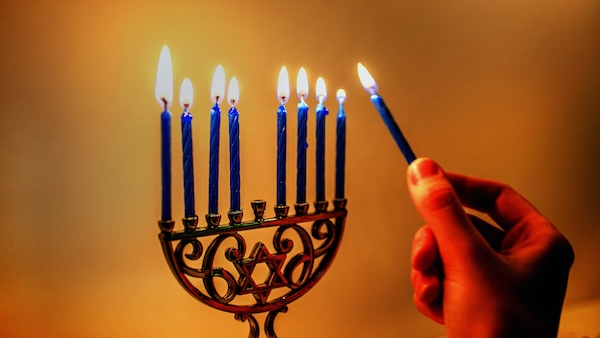
If we fear “advertising” our identities, we should do everything we can to maintain our inner light and self-worth in trying times. (photo from PxHere)

Years ago, my husband lost both his grandmother and his great aunt. Several years apart, he traveled to the Lower East Side in New York to attend their funerals at the same funeral home. There was a rabbi there who officiated at both funerals. This rabbi told the same story twice. Perhaps he had only the one funeral teaching, but my husband remembered it. This rabbi suggested that a famous rabbi taught that the worst of the plagues against the Egyptians was darkness. Why was darkness the worst? It was all encompassing, overwhelming, and seemingly permanent. No one knew if the sun would ever return. This rabbi used this to talk about death, but the metaphor stayed with us.

Despite our efforts to find the source for this story, we couldn’t track down its origin. While looking for it, I thought about darkness and what we can learn from it as we celebrate Hanukkah this year.

There are parallels between the Hanukkah story and our current struggles. Before Oct. 7, Israelis were distracted by potential changes to their court system and very divided politically. While that political turmoil didn’t disappear in the face of the massacre and the war, Israelis have immediately united in the aftermath to work together. Israelis I know have said that it isn’t the government that is taking care of those who are displaced, but rather nongovernmental organizations and volunteers from every corner of Israeli society. Israelis are cooking meals for soldiers, for moms managing as single parents for long periods of time, and for those who have been evacuated or made homeless by the conflict. Israelis and the Jewish people worldwide have also worked together as a people to take care of one another.

The military conflict of Hanukkah is a story of division and unity. There were Jews at this time, around 200 BCE, who had become increasingly assimilated and Hellenized. They cooperated with the Seleucid Empire. There was societal upheaval. Others were more traditional in practice and offended by the changes made by more “liberal”-minded Jews and King Antiochus. The Maccabees represented the traditional or more orthodox Jewish tradition. They rose up against King Antiochus’s pagan practices and the more assimilated Jews who had adapted to Hellenistic practice.

We know now that the Maccabees won these battles. They rededicated the Temple in Jerusalem. This is a military victory and a story around religious or national liberation. The rabbis tried to focus the religious observance on the miracle of the light (the “ner tamid,” the holy flame in the Temple that should not go out) rather than on the military situation. However, we wouldn’t have Hanukkah without these historical cultural conflicts or the Maccabees’ wars.

The historical details of this struggle are in the books of the First and Second Maccabees, which describe the Hanukkah story. While there are many references to the holiday in the Mishnah, the detailed story has been maintained through the Catholic and Orthodox churches, which kept First and Second Maccabees as part of their Old Testament. Protestants don’t include these books in their bibles. We study these texts to understand Hanukkah, but they don’t hold any official status in Jewish tradition.

This, too, has a parallel to our modern experience. While we know our traditions around Hanukkah, some of the context comes from many historical texts preserved by others. During this war against Hamas, we are being forced to defend ourselves against antisemitism, and also to defend the existence of the state of Israel. The worldwide Jewish community doesn’t have to use our personal experiences to educate others about this. The historical contexts for understanding both antisemitism and the need for the existence of the state of Israel are embedded in world history. Learning about the historical roots of Christian antisemitism in Europe or in the dhimmi law of Islamic empires is part of the greater history. Information about when the Romans conquered Israel and destroyed the second Temple can be found in multiple sources, including on the Arch of Titus in Rome. The creation of the modern state of Israel in 1948 is also part of a much broader historical context.

The rabbis chose, in creating the rules around the holiday of Hanukkah, to focus on light and miracles rather than military victories. Rabbi Lord Jonathan Sacks (z”l) wrote in “8 Short Thoughts for 8 Hanukkah Nights” about the ways in which the light is emphasized. His fifth short thought focuses on Maimonides’ teaching about how to fulfil the mitzvah of Hanukkah. Maimonides teaches that lighting candles on Hanukkah is precious and that one must sell something or borrow to fulfil this commandment. Yet, if one finds Shabbat is coming and you have only one candle? Light it for Shabbat. In this case, Maimonides teaches: “The Shabbat light takes priority because it symbolizes shalom bayit, domestic peace. And great is peace because the entire Torah was given to make peace in the world.” Sacks suggests that, “in Judaism, the greatest military victory takes second place to peace in the home.” He points out the great victory is a spiritual and not military one.

For Israel today, too, the great victory must be the notion of continuing to pray and negotiate for peace while also navigating difficult military situations.

Sacks makes several points that could be articles on their own, but the ones I felt most drawn to remain relevant. The Hanukkah candles should be lit so that people can see them outside, but if one is afraid of inviting hate, it has long been taught that it is OK to light the candles indoors, out of public view. Still, we are meant to be public about our “light” more generally and fight for it, if necessary. If we fear “advertising” our identities, we should do everything we can to maintain our inner light and self-worth in trying times.

Finally, Sacks discusses a story in the Talmud in which Rav and Shmuel, third-century rabbis, disagree over whether you can use one Hanukkah candle to light another (if you lack an extra candle, a shamash, the helper candle, that is used to light the other eight candles). Rav suggests that you may not, as this might diminish the light of the first candle. Shmuel disagrees, and halachah (Jewish law) follows Shmuel, who teaches that you can use one Hanukkah candle to light another because it helps the light grow and brings us more light. Using your light to enlighten others is the best practice.

I bumped into a rabbi I admire who lives in Winnipeg, where I live. We were each dropping off kids at a Jewish youth group activity. He wore a ball cap, as he was “off duty.” I thanked him for his contribution to a news article about the war and local protests, and he responded, “These are dark times.”

Like the plague of darkness in Egypt, we don’t know exactly how or when things will lighten. We need Hanukkah’s message and rituals to offer that light. Maybe we won’t put our Hanukkah candles on public display this year, but we can draw wisdom and comfort from our long history and rabbinic teachings. These teach us to reach deep to find the messages of hope, faith and peace from a story about a war. This time around, we need to act individually like Hanukkah candles. We can lend our inner lights to volunteer, to speak out, to support others and to kindle others’ lights during a hard time. Even during times of war and hate, we can be the light. 

Joanne Seiff has written regularly for CBC Manitoba and various Jewish publications. She is the author of three books, including From the Outside In: Jewish Post Columns 2015-2016, a collection of essays available for digital download or as a paperback from Amazon. Check her out on Instagram @yrnspinner or at joanneseiff.blogspot.com.

Format ImagePosted on December 1, 2023November 30, 2023Author Joanne SeiffCategories Celebrating the Holidays, Op-EdTags Hanukkah, history, Jonathan Sacks, lifestyle, politics, Talmud

Universities have obligations

My mom left Brooklyn, NY, to attend Cornell University in the early 1960s at age 16. Among other things, women students had nighttime curfews. This type of legal responsibility or intervention, called in loco parentis (in place of a parent), was common, but, by the time my mother graduated, in the mid-1960s, times had changed. Curfews became a thing of the past.

When I got to Cornell in the 1990s, some things were the same. Cornell impressed upon its new students that “actions have consequences” and that “with rights and privileges come responsibilities.” That is, you were privileged to be there. If you did something stupid, you were held responsible. All this hit me while watching North American college campuses’ turmoil since the Oct. 7 Hamas massacre of Israelis.

I have a front row seat to the drama. My husband is a professor in Manitoba. Between the two of us, we have six degrees from five different universities. We’ve got insider knowledge. I watched some of the behaviour on campuses with horror during the first days after the attack, including seeing Dr. Russell Rickford, a Cornell professor, speak of his “exhilaration” in response to Hamas’s actions. I’m not listing all of the concerning antisemitic events that continue to occur at North American universities. We’re all seeing it on social media and the news.

The first good news I read was from an article written by Rob Eshman in the Forward, which covered Dartmouth University’s response. Dartmouth is a small school. Its academic experts on the Middle East collaborated quickly. On Oct. 9, they announced two public teach-ins, with expectations of a small crowd. Hundreds attended, and there were thousands of YouTube views. What’s the primary responsibility of a university? To educate and encourage students to be critical thinkers. Dartmouth rose to the challenge.

There are other universities following this educational approach, with mixed results. Some universities don’t have the academic firepower or the will to provide an appropriately diverse panel of experts. Some attempts have been derailed by harassment or protest. Other institutions have made poor educational efforts by platforming only one side (usually the pro-Hamas/genocide/apartheid side) of the conversation.

Most professors are evaluated for their performance and tenure on several measures: teaching, research and service. To do these aspects of their job, many feel that free speech is essential and that, while the university employs them, the administration may not hamper their speech as it pertains to teaching or research. Since early October, many professors have felt stifled when expressing their political views, particularly when it comes to anti-Israel political rhetoric about the war.

I recently read a Canadian university faculty union’s stance. The document stated all members had a right to academic freedom and free expression and the union would defend that. However, that right comes with “the responsibility to respect the rights and freedoms of others” and “does not confer legal immunity from hate speech and other violations of the law.” It also doesn’t protect a professor from criticism or condemnation from others.

This document reminds academic professionals what I was taught as an undergraduate: actions have consequences, and they must take responsibility for any consequences that may occur.

Many Jewish students are being physically harassed, verbally assaulted and intimidated on college campuses. Some universities are trying to take action. Cornell had a situation where a student made death threats towards Jewish students at the kosher dining hall. The FBI was quickly involved, the student was arrested. Soon after, the president of the university and the New York State governor sat down to eat in that dining hall with students. Rickford, the professor who spoke out about the Hamas attack as an exhilarating sign of liberation, is now on leave.

Other US universities have responded with less force. Some, like George Washington University, suspended student groups who used pro-Hamas rhetoric. Others, for example, MIT, have suspended students who participate in violent or disruptive protest from all non-academic activities. There are efforts to offer antisemitism education and awareness at some universities. Hillel, the Jewish student organization on many American and Canadian campuses, offers support and advocacy for struggling Jewish students.

Universities now also face legal action when they fail to protect Jewish students. The US Department of Education is opening investigations of antisemitism (and Islamophobia) at US schools such as Cornell, Columbia, Cooper Union, University of Pennsylvania and Wellesley College. There’s a lawsuit being brought against McGill in Montreal, with support from B’nai Brith Canada, and the University of British Columbia, York University, Toronto Metropolitan University and Queen’s University have had class action lawsuits filed against them for alleged antisemitic incidents.

Where does this lead? Consider again the notion that actions have consequences. In some widely circulated video clips, university students or professors scream obscenities and tear down posters of kidnapped victims of the Hamas attack. Some cover their faces; others sneer at the camera. Sometimes, a student is seized by regret later and begs others not to post the images. These choices, caught on video and distributed online, may affect students’ careers forever – and I think that’s OK.

Yes, university students are often (but not always) still adolescents. Perhaps, according to the research, their brains are still developing and they have poor impulse control. But they are also adults in our society. These are people who legally drink, drive, vote and fight in wars. These students are old enough to work, marry and have kids. With all these rights and also the privilege of attending university, they have the responsibility to behave appropriately. Think you might be embarrassed to be caught vandalizing posters of missing persons? Don’t do it.

University leadership and professors have an important role to play “in loco parentis.” It appears many have forgotten this. Students attend universities to get an education, to become critical thinkers and to contribute to leading and shaping our future society. They deserve more than “free speech” from their teachers. They need to learn multiple perspectives, history and policy, and that includes understanding nuance.

While most universities no longer impose curfews or other restrictions, professors owe it to their students to be mentors and role models. Professors should be upstanding community members beyond academic research and teaching. They should behave with integrity. The obligation to do service means different things in various academic disciplines, but, in every case, professors shape the next generation’s professionals beyond giving exams and classroom lectures. Teaching students how they should behave, with compassion and respect for others, matters.

Don’t get me wrong, it’s OK to speak out. Academic freedom is important, but universities have an obligation, too. They should expect students to behave with dignity and respect for the law, even when speaking out. Alumni can pressure universities to do better, as can lawsuits.

There’s no “one size fits all” answer. However, we should expect that every student should have access to education without discrimination. All students – Jewish and non-Jewish – deserve nothing less.

Joanne Seiff has written regularly for CBC Manitoba and various Jewish publications. She is the author of three books, including From the Outside In: Jewish Post Columns 2015-2016, a collection of essays available for digital download or as a paperback from Amazon. Check her out on Instagram @yrnspinner or at joanneseiff.blogspot.com.

Posted on November 24, 2023November 23, 2023Author Joanne SeiffCategories Op-EdTags antisemitism, free speech, law, racism, university campuses

Posts pagination

Previous page Page 1 … Page 5 Page 6 Page 7 … Page 21 Next page
Proudly powered by WordPress