
Skip to content
  • Home
  • Subscribe / donate
  • Events calendar
  • Business Directory
  • FAQ
  • News
    • Local
    • National
    • Israel
    • World
    • עניין בחדשות
      A roundup of news in Canada and further afield, in Hebrew.
  • Opinion
    • From the JI
    • Op-Ed
  • Arts & Culture
    • Performing Arts
    • Music
    • Books
    • Visual Arts
    • TV & Film
  • Life
    • Celebrating the Holidays
    • Travel
    • The Daily Snooze
      Cartoons by Jacob Samuel
    • Mystery Photo
      Help the JI and JMABC fill in the gaps in our archives.
  • Community Links
    • Organizations, Etc.
    • Other News Sources & Blogs
  • JI Chai Celebration
  • JI@88! video

Recent Posts

  • Or Shalom reopens its doors
  • JFS from past to future
  • Need holistic approach
  • Sharing stories, advice
  • Journalist shares fears
  • Skills to live together
  • Road to independence
  • Cutting grass with scissors
  • Zionism as a solution
  • Deceit, desire & the divine
  • Reclaiming sacredness
  • Creative project ideas
  • Summer squares and cobbler
  • Thou shalt … summer commandments
  • Legal help for students
  • Revisiting myth of Lilith
  • Wrong person rebuked
  • Canada’s mixed messages
  • Questions for museum
  • Symposium on antizionism
  • Making soccer political
  • CJPAC lauds Pulver’s impact
  • City recognizes Vrba’s legacy  
  • Organ donation saves lives
  • Theodore’s March premiere
  • A healing Shabbaton
  • Supplying healthy food
  • A chime of metal tags
  • Yellowknife seder a first
  • Ishai energizes, unifies
  • A Lag b’Omer to remember
  • Expanding the healing
  • Hannah Senesh – a unique hero
  • Community milestones … May 2026
  • Деньги до зарплаты на карту Займ до зп онлайн за 5 минут 2026
  • Микрокредит онлайн в Казахстане Микрозайм в Акшамат

Archives

Follow @JewishIndie
image - The CJN - Visit Us Banner - 300x600 - 101625

Byline: Joanne Seiff

Remembering gratitude

My family sat outside a museum, sharing snacks with some family friends. Their family’s preschooler offered us freeze-dried mangoes. My boys, great fans of fruit and veggies, had a mixed reaction to this novelty. As my twins ate their apples, I asked where they got these freeze-dried things.

“Oh,” our friend rolled her eyes. “I couldn’t live without Trader Joe’s.”

We had just returned from a trip to visit family in northern Virginia, near Washington, D.C. This is where I grew up, but it has changed enormously. It’s much more crowded, busy and wealthy than it was when I was a kid. It’s true that if you brave the traffic, you can buy nearly anything in its stores. Sometimes, I’m dazzled by the huge number of choices there. It’s a wide array of fresh, prepared (and sometimes even healthy) food. It’s sometimes expensive, but choice isn’t limited.

We have plenty of choice in Winnipeg, and I’m especially happy in the summer here. Whenever I can make them, I eat salads every day (a habit courtesy of spending a year on kibbutz in Israel) and we eat lots of fresh, local foods. Even so, the choices available in a very big, affluent metropolitan area can be overwhelming. When I expressed my amazement to one of my brothers, he said that, of course, I could get anything if I just ordered it from Amazon.

I didn’t get into the details of Amazon’s smaller selection in Canada, the huge distances and smaller population in our country, or the expense of doing this. I just nodded and indicated that, if we needed mango, I’d just get a fresh one.

Why is this issue in a Jewish newspaper? Our liturgy, the prayers and blessings we say at services, include multiple ways to be grateful. We’re grateful for food, for being able to get up in the morning, for not being sick, for being who we are, for peace … the list is a long one. To be honest, most people seem to say these things by rote. However, if you do go through the prayers and think about them, it’s a series of pretty meaningful things.

Teaching kids to be grateful has offered me a chance to remember to be grateful, too. When my husband and I model a “thank you, Mommy or Daddy, for this nice meal you made,” my kids learn to say thank you, too.

There are the more rare prayers – for rainbows and seeing the queen – but there’s also often a chance to say the Shehechiyanu, which is for joyous occasions and new foods. One of my boys nearly crowed the Shehechiyanu on this trip as he sat at the dinner table with all his grandparents with him at once. Then, without prompting, both boys thanked their New York City relatives for driving to see them, too.

It’s remarkable how easy it is to forget to be grateful. We often take things for granted. For instance, isn’t it amazing to have accessible fresh food that one can afford? We don’t have to go far to find Canadians who are hungry, or who live in remote places and don’t have this option.

What about clean water? Electricity? Internet? Affordable housing? The list could go on. It is a Jewish thing to acknowledge gratitude for what we have. It’s also a Jewish thing to do our best to give to those less fortunate and who need help.

It’s said that travel is broadening – and it sure is, I ate a lot on our trip! It also helps us see our daily experiences and lives better. My parents’ neighbourhood in Virginia is full of “tear downs” – perfectly decent, smaller houses that are purchased, demolished and a new “custom” home built in its place. Sure, the 1950s-era home might be dated, but the constant building, improving and affluence of the area means that old farmland becomes subdivided and all the farm stands disappear. The newly built urban homes, within a short walk of where I grew up, start selling at more than $1 million US.

So, some might say, “What’s wrong with having more? How about spending money if you have it? Doesn’t everybody need a bigger house?” (Or freeze-dried mangoes?) Practising the traditional art of reciting these prayers, the ones that encourage gratitude, help us be better at thanking G-d, our families and our communities for what we have. Reciting a prayer might remind us that being able to buy a fresh mango is a pretty good thing on its own. Even further, being grateful for what we have received might encourage us to help others with less.

It’s true that some people have more money and, therefore, can afford to spend it – but how many bedrooms and bathrooms does your family really need? Wouldn’t it be better to spend some of it on helping others have one meal a day? Housing? Clean water? Educational opportunities?

Sometimes thinking “small” – about square footage or fancy foods, for instance – really means thinking big, and helping taking care of many more in the world who have a lot less.

Joanne Seiff, a regular columnist for Winnipeg’s Jewish Post and News, is the author of a new book, From the Outside In: Jewish Post Columns 2015-2016. This collection of essays is available for digital download, or as a paperback from Amazon. See more about her on joanneseiff.blogspot.com.

Posted on July 21, 2017July 19, 2017Author Joanne SeiffCategories Op-EdTags environment, gratitude, Judaism, tikkun olam

It takes work to be your better self

Ever had one of those days? Or weeks? When things just fall to pieces around you? Sometimes it’s just stuff – a plumbing disaster or a flat tire. Sometimes it’s an interaction with another person that is so miserable that it ruins your day. For me, at least, those emotions of anger, hate, shame and embarrassment can completely knock me down into a bad place. It’s only natural, but it takes a lot of inner work to get myself on the right track.

I think of this as an inner struggle, which I am sure many of us have. It’s so hard not to take out your negative feelings on someone else. That’s why I think the Torah portion for last week, Balak (Numbers 22:2-25:9), is interesting. It’s not an easy text to study. There’s a lot in it, which is quickly summarized by the reformjudaism.org Torah study website as follows:

“Balak, the king of Moab, persuades the prophet Balaam to curse the Israelites so that he can defeat them and drive them out of the region. However, Balaam blesses the Children of Israel instead and prophesies that Israel’s enemies will be defeated. (22:2-24:25)

“G-d punishes the Israelites with a plague for consorting with the Moabite women and their god. The plague is stayed after Pinchas kills an Israelite man and his Midianite woman. (25:1-9)”

This summary contains some detail, but skips the part where G-d stops Balaam in his tracks and keeps him from cursing Israel. It involves a talking donkey. (This is definitely a portion that you should re-read if you have forgotten it.) The donkey refuses to budge because an angel, sent by G-d, blocks its way. Balaam, a prophet, ends up blessing the Israelites, instead of cursing them, because he can speak only what the angel says he will put in his mouth. G-d tells Balaam what to say.

Is Balaam really a changed man when his curses become blessings? Is someone so filled with hate and curses able to turn things around for good? Or is this amazing blessing that he offers only happening because the Almighty intervenes?

I have a hard time believing in a personal form of the Divinity that pops down and fills our mouths with blessings. Some people do have that kind of faith, and believe that the right thing will arrive, heaven-sent, to save the day. For me, this portion is perhaps about something else.

Balak and Balaam are filled with hate and prejudice when they see the Israelites, who are in some sense, refugees. They are the “other” – strangers who are passing through, and many people find reasons to fear or hate the “other” in their midst.

Yet, just like those days when we have inner struggles, we need to have our better selves win out over feelings of negativity. Sometimes we can rise above our fear, anger or other feelings. When we do, sometimes we can observe the beauty of someone or something that is different and special. We can learn from that new experience.

I’m always knocked out by the beauty of Balaam’s blessing. Whenever I sing “Ma Tovu” – “How beautiful are your tents, Oh Jacob, Your dwelling places, Israel” – which comes directly from this Torah portion, I feel the awe and wonder in the words. Rashi points out that the tents were placed so that their door flaps faced outwards. Even though in the encampment everyone was close together, they were able to maintain a sort of tidy privacy, and a space for separate families by placing their entrances away from one another.

I’ve felt overwhelmed by the hate speech, terrorism, starvation and war that are happening around us. Yet, sometimes, we see a little hope in the media reports. There are amazing people of all faiths who rise up to help. There are even people who capture a terrorist or criminal but conquer their own yetzer hara, or evil inclination, manage to find their best selves and keep that person from harm until the police arrive.

Why does this portion begin with a curse that turns to a blessing, and end with a plague and punishment? I have a hard time with this sort of literal punishment, but it seems like a powerful metaphor. Perhaps it is a way of reminding us that even when we are tempted, and struggle with curses and acts of violence, we must find our best selves and behave morally. We must offer blessings to others. We have to open ourselves up to the “other.” We can learn from and admire their ingenuity. We also need to stick to our beliefs, and guard against being led astray. We can avoid that part inside ourselves that seeks to do harm, and try to help others control that urge to harm, too.

In a practical, positive sense, most Canadian Jews are lucky, our communities are diverse, full of newcomers and people who have been here generations – we are from all over the world. We can open ourselves up to enjoying a diversity of Jewish customs, practices and ideas that enrich our institutions and celebrations. Further, we can enjoy the diversity of the wider community, which is also intensely rich.

We can be different than those who seek tit-for-tat vengeance. Tempted to fight back during a negative exchange, or to cut someone off in a fit of road-rage? Step back.

Think about that talking donkey. Imagine if your car did that to you! Smile. Be the better person. You have that yetzer hatov, the good inclination, right there. Let it out. Be a blessing.

Joanne Seiff, a regular columnist for Winnipeg’s Jewish Post and News, is the author of a new book, From the Outside In: Jewish Post Columns 2015-2016. This collection of essays is available for digital download, or as a paperback from Amazon. See more about her on joanneseiff.blogspot.com.

Posted on July 14, 2017July 11, 2017Author Joanne SeiffCategories Op-EdTags Balaam, Balak, Torah, yetzer hara, yetzer hatov

Good relationships matter

My parents, married 52 years, have a long-standing joke. Sometimes, they would go out and everything would be a disaster. We’d be in the neighbourhood pizza joint and someone would throw up. Or, one kid would spill something sticky all over somebody else. There would be a fly in the soup. We’d have a fight. The car would break down. We’d have an encounter with a terribly nasty person. Then, my mom would turn to my dad, poke him, and say, “Listen, Seiff, if this were a first date, I’d never go out with you again!”

Sometimes we’d all laugh but, often, we’d turn away with a wry smile, because that was all we could manage. Later, we knew it would be funny, because we didn’t base everything on that one outing … but sometimes people do! How often does one bad (Jewish) encounter ruin a first date, a first visit to a new synagogue, a networking opportunity? How can we salvage these awful experiences?

In the Torah portion B’midbar (Numbers 1:1-4:20), which we read last month, there’s a lot of census-taking and numbers. This isn’t counting every person, but those who can fight when assembling a military. There’s order in this parashah, so we understand that a strong army, or even a strong society, needs to be well-organized and administered. We need leaders, as mentioned in Numbers 1:16. Rashi points out that the elected ones, the chieftains of their tribes – “These were those called of the congregation; those who were called upon for every matter of importance that happened in the congregation.” We read edah as a tribe, but it can also mean a social or ethnic group (Yemenite Israelis, for instance) or a congregation.

Numbers matter, and good administration matters – but it isn’t all that matters. When Dr. Ron Wolfson came to visit Winnipeg in April as the Shaarey Zedek Synagogue scholar-in-residence, he asked a group of lay leaders and Jewish professionals, “How many Jewish people live here?” Immediately, there was an undercurrent of talk. Indeed, how many of us are in Winnipeg? My next thought was – does it matter?

In the same Torah portion of B’midmar, Nadav and Abihu are mentioned, in Numbers 3:4. However, because they offered “alien fire” (an unacceptable sacrifice) in the Sinai, they were struck down. Others were counted in their place. Nadav and Abihu made one bad mistake. They had one bad encounter (one bad date?) with the Almighty. That’s all it took for them to be killed and knocked out of Judaism forever.

It takes many positive encounters to reinforce a relationship. So, a Jewish person needs repeated positive experiences in a Jewish community to keep coming back. Some shake off a bad experience or two with a smile, joke or laugh. However, it depends on the person, and what happened. It can take “one bad date” to be turned off forever.

Wolfson described how small things make a huge difference in how we relate to one another. Greeting someone with a smile, offering them a warm participatory musical experience, some honey cake or a hug can make all the difference. These things aren’t expensive. They aren’t hard to do – but for some reason, many congregations still resist any change at all, even if it’s an entirely positive community-building shift that costs little or nothing to implement.

A joke followed. What does it say above the ark, the aron hakodesh, at your congregation? At Shaarey Zedek, it says, “Know before whom you stand.” Wolfson said that all shuls probably should have a different tag line – “But we’ve always done it this way.”

If you are entirely satisfied with how things go in your Jewish community, by all means, don’t change a thing. Keep doing what you’re doing. However, if you’re not satisfied? If your children don’t want to join, or the membership is declining, or people aren’t volunteering or contributing to your organization in the way you’d like, you need to stop and ask if the way you’re doing things is really working. Is your approach still relevant? Is it inclusive? Does it create positive encounters that matter?

B’midbar teaches us that numbers and administration matter – but only if you have committed members or people to count. Negative experiences can strike us down (like Nadav and Abihu) or just be a bump in the road, if you have a healthy long-term relationship. I was struck, at the end of a whole weekend of this Jewish learning and enrichment, by how energized some participants were with many good ideas for the future.

At the same time, I encountered those who said, “Thank you, but …” and wanted to say how they disagreed, what was wrong and what wouldn’t work here. Have you ever found that kvetching – without offering solutions – makes positive change?

Ever read the children’s book Stone Soup? A motivated, positive community can feed many people with a stone, some old vegetables, and maybe a stewing hen. Throw in some donations of flour and yeast and you have bread. It’s not expensive. It’s not hard to do. Yet, one must consistently ignore the naysayers while doing it. Are we willing to step up and make suggestions for building good, long-term Jewish community relationships?

Good. Bring your old carrots and dried up root veggies. Our skills and Jewish congregations can make something delicious together. Inexpensive solutions, kindness, smiles and constructive suggestions welcome. Let’s build our numbers by welcoming folks to the table with what we’ve got. Even a humble soup tastes better, or a song sounds richer, when we make it and sing it ourselves.

Joanne Seiff, a regular columnist for Winnipeg’s Jewish Post and News, is the author of a new book, From the Outside In: Jewish Post Columns 2015-2016. This collection of essays is available for digital download, or as a paperback from Amazon. See more about her on joanneseiff.blogspot.com.

Posted on June 23, 2017June 21, 2017Author Joanne SeiffCategories Op-EdTags community, relationships

Obligation to be hospitable

Imagine, for a minute, that you’re throwing an open house for a children’s sports team. You’ve invited a lot of people. You don’t know them all. Yet, you’re the host. It’s a beautiful, sunny, warm day. You’ve set up your yard for a party. The lemonade and cookies are out, the welcome banner is flapping in the breeze.

As people drift up your sidewalk, you see they’re nervous or ill at ease. “Welcome!” you say, and your family smiles at them. “Come on in. Join us.” You offer them food and drink. Then, you ask guests gentle, kind questions. “How long has your kid been playing soccer with our team?” or “Where does your kid go to school?” “Have you met our dog?” and so on.

Before long, you’ve learned new things about these strangers. You’ve made a few connections. As other people join the party, you lead a parent, Gabriel, over to talk to Morley, who shares Gabriel’s interests in dog training or hockey. You help all these people to relate to one another. Then, they can begin friendships. Soon, they will be hosting the next encounter – for their new friends and acquaintances.

Many people are rusty at this kind of face-to-face socializing. In the social media age, we “friend” people online long before we meet in person. We’re more likely to chat online than we are to approach strangers in person. It’s a cultural shift that can make people feel more awkward and self-conscious when they actually get together in person.

If you’ve never moved from one community to another, you’ve got family and friends built in – people who likely knew you in kindergarten or as a teenager with acne. These are longtime friends. You don’t have to do any work to know them. Why bother meeting new people?

Because we’re obligated as Jews to be hospitable. It’s our obligation to make new connections with others! (Both Jews and non-Jews.)

I recently heard a great story about a Passover seder. A young Jewish woman from Indiana was studying and working in London, and alone for the holiday. She followed the Twitter feed of London-based CNN reporter James Masters. He tweeted and asked if anyone needed a seder to attend. Samantha Gross, an intern with the Evening Standard, responded. She thought he was offering to find her a spot somewhere at a community event. Instead, he and his wife picked her up and brought her home to a Pesach table with grandparents and the kind of family love and embrace that really moved her. (To tears, although she claimed it was the horseradish!)

A Winnipeg congregation, Shaarey Zedek, is sponsoring a special speaker next week named Dr. Ron Wolfson. I could claim that I’d read everything he’s written (not true). I could boast that my mom has taken classes with him (true) and that he’s spoken at my parents’ Virginia congregation (true). I could mention that he’s collaborated with Rabbi Larry Hoffman (true) who came to speak at Winnipeg’s Temple Shalom recently (true), and whose daughter went to summer camp with me long ago (true). However, none of that background or Jewish geography matters.

What matters is that Dr. Wolfson is coming to Canada to speak – and it’s well worth reading his books or finding a way to hear him in person. Why?

What he teaches is a profoundly Jewish message. It’s about building relationships and connections that might be new, and take work. For many Jews, going to shul is like going home – most of the people there are your family and friends, you’ve known them forever. It takes no work to relate to them. However, our society is transient. There are a lot of newcomers at every congregation. We need to do both the right thing and the Jewish thing, and practise “audacious hospitality.”

What’s that? Well, in Genesis 18:1-18, there’s a story that is uniquely ours. Abraham and Sarah are in their tent when three strangers walk by. Abraham rushes out to them, welcomes them in and, with Sarah, he helps them wash and offers them food and hospitality. Abraham knows what it is to be a traveler and to be hot, tired and hungry. He knows that he should reach out, it’s the right thing to do.

The strangers (angels) bring messages to them. One is that even though they’re old, Sarah will have a child and Abraham will become the patriarch to a great and populous nation.

The message is clear. It’s incumbent upon us to be like Abraham and Sarah, and like Masters’ family, too. We need to welcome others, build real relationships with them, and offer them our (Jewish) hospitality. This may make all the difference. Will we be Abraham’s “great … nation” or lose Judaism to assimilation?

Ten years ago, I was invited to participate in an interfaith “green” religious service. The interim Anglican priest who ran the service bumped into me at the farmers market a few days later. I thanked her for the opportunity, and invited her to my Shabbat table. That was her very first dinner invitation in Bowling Green, Ky., and the start of many more happy hours at my table and hers. We are still good friends. She told me that it figured a Jewish person would be first to “invite her in,” as Abraham and Sarah did.

This pastor (and friend) both reminded me and taught me more about my obligation to be hospitable as a Jew. Abraham knew how to do this. It’s high time we did, too.

Joanne Seiff, a regular columnist for Winnipeg’s Jewish Post and News, is the author of a new book, From the Outside In: Jewish Post Columns 2015-2016. This collection of essays is now available for digital download, or as a paperback from Amazon. See more about her on joanneseiff.blogspot.com.

Posted on April 21, 2017April 20, 2017Author Joanne SeiffCategories Op-EdTags hospitality, Judaism, Ron Wolfson, Torah

The work is not solely ours

Music is an amazing tool for learning. When I was a kid, I learned a lot of Jewish music. It wasn’t choir music, or strictly for prayer. No, I learned “everything” Jewish through music. I sang parts of Pirkei Avot (Sayings of our Fathers), Israeli pioneering songs from kibbutz life, Torah verses, Israeli pop songs and commercials, and even, yes, a lot of liturgy.

It happened on autopilot. I wasn’t forced into anything. There was no strong emphasis on performance. It was “Naaseh v’nishmah,” “We will do and we will hear.” (Exodus 24:7) When you participate and enjoy singing, sometimes the words sink in. I remember my mom putting on records (of Jewish music) and I’d roll around the living room rug, listening and singing.

When Christian classmates were busy memorizing Bible verses to earn rewards at church, they’d ask me how many I could recite. I had no idea what to say. “Oh,” I’d say, “We don’t do that.” We did do that, I realize now, but it was so intuitive, so much a part of our daily experience, that I never even noticed what was happening. I knew the words, in Hebrew and English. I understood them, but I never thought of it as reciting religious text. It was part of a summer camp song session, or a regular Sunday at religious school, or in the prayers we sang at services.

Years later, I still have that musical memory bank. It comes in handy. Recently, exhausted and stressed, I was able to sing along without thinking when someone introduced a new tune at services. It might have been new to others, but I’d heard it before. I also used this treasure trove to dig up something I needed to think about – work/life balance.

Rabbi Tarfon said the day is short and there’s a lot of work, and the workers are lazy and the reward is great and the master of the house is pressing – it’s not your responsibility to finish the work, but neither are you free to desist from it. (Pirkei Avot 2:15)

I remembered the whole quote by hearing a bit of the tune in my head. Suddenly, I was singing to myself on the street as I walked to an errand. I went home to look it up on sefaria.org, an online nonprofit that offers open-source access to Jewish texts.

The bigger issue that I wrestled with was that of work and community involvement. How much is enough? How can we decide where to invest our time and why?

I don’t think of myself as a big volunteer, but lately I’ve become overwhelmed. I had to reduce my volunteer load. Managing my work, household, kids, community commitments and health felt like too much. Only one thing might need more time – an extra freelance job, a couple kids sick with viruses or a volunteer gig – and the whole tower of cards will tumble.

As a relative newcomer to Canada, I cannot call up a family member in the neighbourhood or a longtime friend to bail me out. Our extended families are far away. Although some friends might be able to help, they, too, are caring for kids, juggling jobs, etc. It’s my observation that many newcomers feel this way. The process that recruited them to Canada felt very positive, but after that? It can be a daily struggle. It’s hard to find a place in a community where long-established families have strong roots.

So, what does Rabbi Tarfon have to do with this? Well, this song helped me realize that, while I felt deep responsibilities towards my commitments, I couldn’t “finish them” on my own. I could work, volunteer and try to help, but our effort has to be a communal one. It’s not all my personal responsibility – and if my health or family’s well-being is at stake, that has to come first.

Bringing a good attitude to the work we do is important. We can’t all be like the curmudgeons on the Muppets. Those grouchy men are the ones who sit in the balcony, scowls on their faces, as they criticize all the other Muppets who put on the show. Instead, we need to each do our share, because the grouchy puppets in the corner aren’t contributing.

We have to stop ourselves when our efforts to contribute become too much, too taxing and risk our well-being. When we start criticizing everyone else? It’s time for a break – because we aren’t finishing all that work by ourselves, in any case.

What we are doing is contributing to a whole, healthy (Jewish) community. And, if you keep reading, Rabbi Tarfon says, “If you have learned much Torah, your reward will be much.” This is an interesting circular argument. The rabbi suggests we work hard, and we do our share. Then we’re rewarded for our learning. Guess what? My reward for stepping back from volunteering was more time to study Rabbi Tarfon’s wisdom. I learned it again – and now offer it to you. That’s a sign of a healthier work cycle.

Joanne Seiff, a regular columnist for Winnipeg’s Jewish Post and News, is the author of a new book, From the Outside In: Jewish Post Columns 2015-2016. This collection of essays is now available for digital download, or as a paperback from Amazon. See more about her on joanneseiff.blogspot.com.

Posted on March 31, 2017March 31, 2017Author Joanne SeiffCategories Op-EdTags Judaism, Pirkei Avot, work-life balance
Eight rungs of tzedakah

Eight rungs of tzedakah

Little Free Libraries are open 24/7 in cities across Canada. (photo by Josie Tonio McCarthy)

Have you heard of the Little Free Library movement? It’s a way for neighbours to exchange books. Throughout Winnipeg, Vancouver and other cities, there are little freestanding houses, a little bigger than a birdhouse. If you have a book you no longer want, you can leave it. If you’re looking for a book to read? You can take a book whenever you want. These Little Free Libraries are open 24/7.

Walking to our closest Little Free Library has become an important destination for me and my twins. It’s free, good exercise, and encourages our love of reading and learning. My twins often argue over which book to donate. Our house is overflowing with books. In order to take home a new storybook, we have an “even-exchange” policy.

Recently, I read on the National Public Radio (NPR) website about a similar U.S. movement, but, instead of books, the little house is a food pantry for the hungry. One family calls theirs a “blessing box.” Others call it a “little free pantry.” Sometimes, only one family stocks it with food, diapers or toothpaste. Sometimes, a whole neighbourhood takes part. The article mentioned that, in one neighbourhood, most of the food is taken between midnight and 7 a.m.; in another, the food comes and goes continuously. It’s a way of helping others anonymously. You don’t have to face someone at a food bank to admit your family is hungry and cannot afford food.

When I read this, I wanted to build one of these little food pantries right away, but then realized that, in a cold Canadian climate at this time of year, canned food or other stuff won’t do well outdoors. Even if that freestanding unheated food pantry doesn’t work out right away, the concept still made me want to do better than I’d been doing.

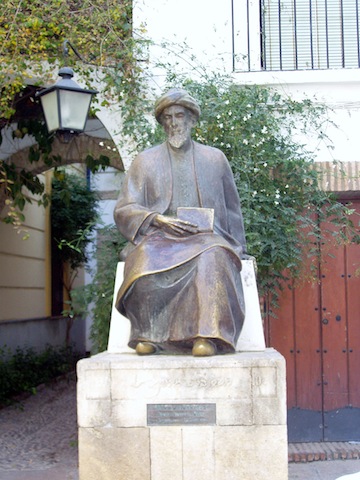
photo - Amadeo Ruiz Olmos’ statue of Maimonides stands in the Jewish Quarter of Córdoba, Spain. Maimonides compared tzedakah to a ladder with eight rungs, each of which you climb bringing you closer to heaven
Amadeo Ruiz Olmos’ statue of Maimonides stands in the Jewish Quarter of Córdoba, Spain. Maimonides compared tzedakah to a ladder with eight rungs, each of which you climb bringing you closer to heaven. (photo by Howard Lifshitz via commons.wikimedia.org)

I thought about a worksheet I’d used to teach religious school, maybe 20 years ago. I can’t find that piece of paper anymore but I remembered the point. It was about Maimonides’ ladder of tzedakah (justice, or charity). Maimonides (Rambam), a great Jewish scholar and teacher in the 12th century, lived in Spain and Egypt. I borrowed the following summary from the Jewish Teen Funders Network website, to remember the details.

Maimonides believed that tzedakah is like a ladder. It has eight rungs, from bottom to top. Each step you climb brings you closer to heaven.

1. The person who gives reluctantly and with regret.
2. The person who gives graciously, but less than one should.
3. The person who gives what one should, but only after being asked.
4. The person who gives before being asked.
5. The person who gives without knowing to whom he or she gives, although the recipient knows the identity of the donor.
6. The person who gives without making his or her identity known.
7. The person who gives without knowing to whom he or she gives. The recipient does not know from whom he or she receives.
8. The person who helps another to become self-supporting by a gift or a loan or by finding employment for the recipient.

To put this tzedakah approach into practice requires work. Many of us are stuck on the first five rungs of the ladder. I’m going to skip the first two rungs, because, while many of us may have only achieved this level, I’m going to act like we’re better than that. Right?

For instance, our membership dues to a synagogue or other Jewish organizations are acts of tzedakah, but usually of the third-rung kind. (If we could afford to donate more, we sink below No. 3.) We occasionally may get up to No. 7, when donating to a food bank. If you decide to “sponsor” something in the community and your name is pasted all over the event, that’s No. 5. It means, for instance, that while you do not know who ate the kiddush lunch you sponsored, everyone who is there knows your name. So, while some do this to celebrate a special event with their community, others do this named sponsorship because they like the attention. It’s tzedakah, sure, but it’s also about ego.

We could change the way we do our “tzedakah” business. We could push our Jewish community higher up Maimonides’ ladder. Here are some ideas.

Instead of “name in lights” sponsorship, we could donate anonymously to support a community meal, event or service. This could perhaps allow an organization to sponsor a free event. Maybe a congregation could have a nicer kiddush lunch on a Saturday or have an oneg on a more regular basis. It could boost the financial situation of an essential community function, like operational costs (heat, lights, water?), educational events, building renovation or maintenance. It could raise the salary of someone who works for the Jewish community. It could create new employment for someone in our community. It could offer a loan or gift to someone who needs a step-up to begin supporting himself or herself.

Ach! I hear you saying. I’m no moneybags. I can’t pay for someone’s salary. Fine.

If these sound too hard, lower your goals. Could you consistently offer a small amount of money or time when asked to help? Could you pay membership dues early? Could you donate food to the food bank every time you grocery shop? Maybe empty the change from your pockets every Friday afternoon to put in a pushke (collection box)?

Making a difference and working your way up that ladder can start small. It can be as simple as being gracious about donating. What about volunteering time or thanking others who donate? Many of us have the capacity to climb this metaphorical ladder. Shall we ascend those rungs together?

Joanne Seiff, a regular columnist for Winnipeg’s Jewish Post and News, is the author of a new book, From the Outside In: Jewish Post Columns 2015-2016. This collection of essays is now available for digital download, or as a paperback from Amazon. See more about her on joanneseiff.blogspot.com.

Format ImagePosted on February 10, 2017March 31, 2017Author Joanne SeiffCategories Op-EdTags charity, Little Free Library, Maimonides, tikkun olam, tzedakah

Posts pagination

Previous page Page 1 … Page 20 Page 21
Proudly powered by WordPress