Skip to content
  • Home
  • Subscribe / donate
  • Events calendar
  • Business Directory
  • FAQ
  • News
    • Local
    • National
    • Israel
    • World
    • עניין בחדשות
      A roundup of news in Canada and further afield, in Hebrew.
  • Opinion
    • From the JI
    • Op-Ed
  • Arts & Culture
    • Performing Arts
    • Music
    • Books
    • Visual Arts
    • TV & Film
  • Life
    • Celebrating the Holidays
    • Travel
    • The Daily Snooze
      Cartoons by Jacob Samuel
    • Mystery Photo
      Help the JI and JMABC fill in the gaps in our archives.
  • Community Links
    • Organizations, Etc.
    • Other News Sources & Blogs
  • JI Chai Celebration
  • JI@88! video

Recent Posts

  • SFU honours Gloria Gutman
  • Lifting people’s spirits
  • Wedding a ray of light
  • Indigeneity and Zionism
  • Rule of law broken: councilor
  • Football and its roles
  • The burden of defence
  • Fish Café returns after fire
  • All right in what goes wrong
  • Nuns & mermaids at TUTS
  • Camp offers holiday retreat
  • Students and mentors inspire
  • Once-in-a-lifetime trip
  • 100 dancers, one heart
  • Money for the sciences
  • What “Jewish food” means
  • Have a cookie, schnitzel too
  • Federation now across BC
  • Israel fighting for its existence
  • Deal strengthens Iran
  • Patriotic belonging diminishes
  • A campaign to engage
  • Upstanders’ first live event
  • Responding to Carney
  • Having your own home
  • Music a family tradition
  • Musical to warm heart
  • Community milestones … June 2026
  • Sharing her passion for Israel
  • Or Shalom reopens its doors
  • JFS from past to future
  • Need holistic approach
  • Sharing stories, advice
  • Journalist shares fears
  • Skills to live together
  • Road to independence

Archives

Follow @JewishIndie
image - CJN box ad Rockowers 2026

Byline: Gil Zohar

Parshat Shelach Lecha

Parshat Shelach Lecha

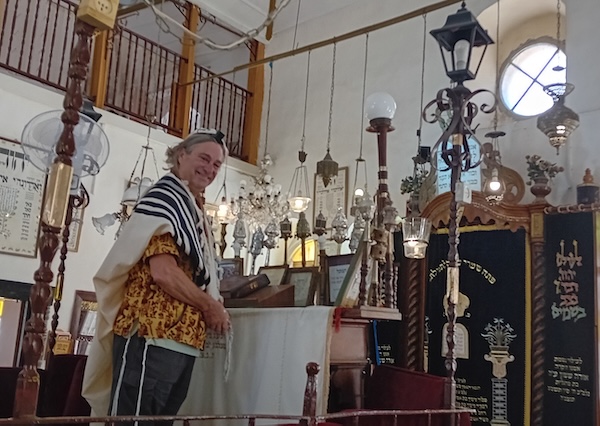
On June 21, at Ohel Yitzhak in Nahalat Shiva, Gil Zohar celebrated the 57th anniversary of his bar mitzvah. (photo Gil Zohar)

Man plans, God laughs, goes the Yiddish aphorism. For the last half year, I have been diligently learning the trope of Parshat Shelach Lecha (the Torah portion meaning Send for Yourself) to celebrate the 57th anniversary of my bar mitzvah, which I had when I was a boy in Toronto. My wife Randi and I had planned a kiddush at the historic Beit HaRav Kook synagogue near our home in downtown Jerusalem. We are members there, and enjoy the leadership of Rabbi Yitzhak Marmorstein, formerly of Vancouver’s Or Shalom. Alas, the war with Iran started. In accordance with the Home Front Command orders against large public assemblies, the shul closed. And so, we considered canceling the simchah.

While all but Jerusalem’s most essential businesses were locked down tight as a drum, the wartime defence regulations allowed synagogues near a bomb shelter to keep their doors open, with limited attendance. Hence, Ohel Yitzhak, the Sephardi synagogue in our courtyard in Nahalat Shiva, built in 1888, remained open. And so, we switched the venue from the former home and yeshivah of Abraham Isaac Kook (1865-1935) – the first Ashkenazi chief rabbi of British Mandatory Palestine – to the equally historic synagogue where Ben-Zion Meir Uziel (1880-1953) – Kook’s Sephardi counterpart, who served as nascent Israel’s chief Sephardi rabbi until his death – used to pray.

The illustrious Sephardi landmark, resembling a house of worship in a mellah in Morocco, is close to the Herbert Samuel Hotel, which opened its miklat (bomb shelter) to the public as well as hotel guests. So, on June 21, undeterred by the spectre of a ballistic missile salvo, I was called up to chant Maftir and read the Haftarah. 

What’s it like when the air-raid sirens sound nightly and warplanes roar through the starry sky? Lori Nusbaum of Toronto, who came with her son, Ryan De Simone, for my second bar mitzvah, has been posting on Facebook:

“The 3rd night in Jerusalem and the 3rd siren alert went off; it was 4:35 a.m. Sleep is hard. You don’t want to be in a deep sleep and miss the [cellphone] notifications so you try to have ‘one eye open.’ There’s something strangely intimate about being in a smallish space with a bunch of strangers, some in bathrobes, carrying pillows and blankets, wearing slippers, with sleep still in their eyes. You aren’t sure if you should make eye contact or not. It’s nighttime, so conversation is not really happening. I think we all want to keep sleep in our brains, hope we can go back upstairs quickly and close our eyes for a peaceful rest of the night.”

Like many guests at the synagogue, Lori found my wartime bar mitzvah intensely emotional. “My somewhat unaffiliated son had an aliyah at one of the oldest shuls in Jerusalem,” she posted on Facebook. “Our friend, whose bar mitzvah we came to witness, literally took the tallit off his back to wrap around my son so he could go to the bimah. With tears in my eyes, so many emotions washed over me. Too many to describe adequately. This is what Israel is all about. The people who in the middle of a war come together, pray, help each other and celebrate life together. And give you the proverbial shirt off their back.”

The grim situation in which we find ourselves today parallels the Torah reading of Shelach Lecha (Numbers 13:1-15:41) and its equally pertinent Haftarah (Joshua 2:1-24).

Returning after 40 days of reconnoitring the Promised Land, the spies sent by Moses reported: “We went into the land to which you sent us, and it does flow with milk and honey! Here is its fruit [showing a huge cluster of grapes hanging from a stave, today the symbol of the Ministry of Tourism, proudly worn by every licensed tour guide]. But the people who live there are powerful, and the cities are fortified and very large.”

Then, Calev ben Yefune shushed the crowd declaring, “We should go up and take possession of the land, for we can certainly do it.”

Ten of his fellow spies (all except Joshua) disagreed – “We can’t attack those people; they are stronger than we are” – and they spread a slanderous report about the land they had probed. Misunderstanding the many funerals they had witnessed because of the plague God had sent so that the spies would go unnoticed, they said, “The land we explored devours its inhabitants. All the people we saw there are of great size. We saw the Nephilim there [the descendants of the giant Anak]. We seemed like grasshoppers in our own eyes, and we looked the same to them.”

Grasshoppers? They might as well have called the Jewish people cockroaches.

In the words of Rabbi Lord Jonathan Sacks ztz”l, this dibbat ha’aretz (slanderous report about the Land of Israel) is the language of fear and demoralization. They are big, we are small. They are strong, we are weak. They do not fear us, but we fear them. We cannot prevail.

Was this, in fact, the case? As the Haftarah makes clear, the 10 scouts could not have been more mistaken. A generation later, Joshua bin Nun too sent two spies – the same Calev, and Pinchas ben Zimri. They slept on the roof of a house belonging to Rahav the prostitute, which formed part of the walls of Jericho. Hearing about the spies, the city’s king ordered his soldiers to arrest them, but Rahav hid them and misdirected the guards. What is more interesting is what she tells the spies of the feelings of Jericho’s residents when they heard that the Israelites were on their way:

“I know that the Lord has given this land to you and that a great fear of you has fallen on us, so that all who live in this country are melting in fear because of you. We have heard how the Lord dried up the water of the Red Sea for you when you came out of Egypt, and what you did to Sihon and Og, the two kings of the Amorites east of the Jordan, whom you completely destroyed. When we heard of it, our hearts melted and everyone’s courage failed because of you, for the Lord your God is in heaven above and on the earth below.”

Like contemporary Gazans and Iranians, the people of Jericho were anything but giants – they were terrified of us. The spies of Moses’s day should have known this. They had already said in the song they sang at the Red Sea: “Nations heard and trembled; terror gripped Philistia’s inhabitants / The chiefs of Edom were dismayed / Moab’s leaders were seized with trembling / The people of Canaan melted away.”

How did 10 of the spies so misinterpret the situation? They misunderstood Moses’s instructions: “Alu zeh b’Negev v’alitem et ha-har” – ascend (alu) through the south, and ascend (va’alitem) the mountain. The word “ascend” (aliyah in Hebrew) also means to overcome. (When Martin Luther King Jr. famously said, “We shall overcome,” he was citing this verse.) The spies lacked the faith that the land would be theirs, despite God’s promises, and 39 years of wandering in the desert followed.

The Jewish people, in Israel and the diaspora, experienced a crisis of confidence in 1313 BCE following the Exodus from Egypt, on the eve of entering the Promised Land. Not so today. We have no such hesitations as the Israel Defence Forces battle the regime of the latter-day Haman in Iran and its Hamas, Hezbollah and Houthi proxies. Our response is to follow Moses’s instructions: “Alu.” Ascend. Overcome. Make aliyah.

To that end, I invite you to celebrate Parshat Shelach Lecha with me at Beit Ha Rav Kook (9 Rabbi Kook St.) on June 13, 2026. Next year, in peaceful Jerusalem. 

Gil Zohar is a writer and tour guide in Jerusalem.

Format ImagePosted on June 27, 2025June 26, 2025Author Gil ZoharCategories Op-EdTags bar mitzvah, Israel, Judaism, Ohel Yitzhak, Shelach Lecha, Torah portion, war
The Sussita’s short history

The Sussita’s short history

Sussita entrepreneur Itzhak Shubinsky driving a Sabra Sport car, from the newspaper Barkav, in the 1960s. (photo from Haifa City Museum)

For a trip down memory lane, cruise over to Haifa’s City Museum at 11 Ben-Gurion Blvd., in the German Colony, to see Sussita: The Exhibition. The display, which continues until May 25 (the opening was delayed by Hezbollah rocket fire from Lebanon), documents Israel’s failed automobile industry during the early decades of statehood.

Alas, the doorways of the museum’s 19th-century Templar building are too narrow to permit restored examples of the fibreglass shell cars to pass through. So, on hand is a stripped-down version of a Sussita, and a trove of fascinating documents and photos. Missing are full-size examples of the Carmel truck and Sabra Sport roadster that Autocars Co. Ltd. assembled at its Haifa workshop and then in the city of Tirat Carmel.

The exhibit was curated by Yifat Ashkenazi, together with filmmaker Avi Weissblei. The latter produced the 2020 documentary Desert Tested, which told the Sussita’s story.

Like Shai Agassi’s Better Place electric car company, which went through almost $1 billion in venture capital before declaring bankruptcy in 2013, Israel’s ultimately insolvent auto industry never thrived.

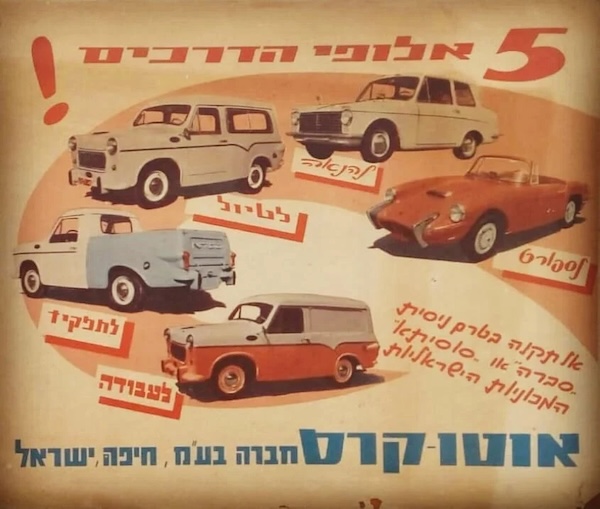
image - A Sussita Autocars Co. Ltd. advertisement in the 1960s, featuring its “5 Road Champions!”
A Sussita Autocars Co. Ltd. advertisement in the 1960s, featuring its “5 Road Champions!” (photo from Haifa City Museum)

The Sabra’s aerodynamic curves evoke the glamour of early James Bond films. Nonetheless, even though they were jump-started by foreign firms, Haifa’s car business never quite managed to compete with Detroit.

Discussing Autocars’ 1966 Sussita at carsurvey.org, one classic car aficionado noted: “What things have gone wrong with the car? 

Almost everything! It was a very cheap car made of a fibreglass body attached to a very simple welded pipes chassis, with a Triumph engine. The car was unstable, seriously dangerous, unreliable and very badly built.”

Folklore has it that camels liked to munch on the cars’ fibreglass body. But the relative paucity of dromedaries in 1960s Israel makes the truth of this story doubtful.

Founded in the mid-1950s with assistance from Britain’s Reliant Motor Co., Autocars initially assembled quirky but popular three-wheeled micro-cars. The first four-wheeled blue-and-white vehicle, the Sussita, was also designed by Reliant.

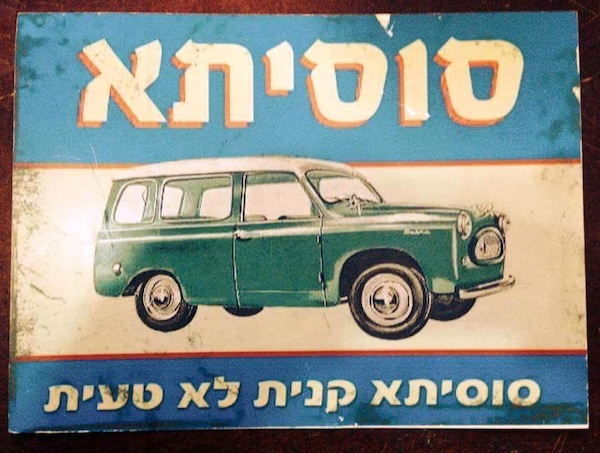
The Sussita, meaning mare in Aramaic, developed a reputation as a reliable workhorse. By 1960, Autocars was exporting the cheaply priced car – available in estate, van and pick-up models – to the United States and Canada. Rebranded as the Sabra – a genus of cactus originally from Mexico that had become a descriptor of native-born Israelis – the car sold poorly in North America due to its inferior quality.

That year, in 1960, Autocars’ owner Itzhak Shubinsky spotted the coupé Ashley GT at London’s Sports and Racing Car Show. Changing business strategy, he purchased the bodywork moulds and created the Sabra Sport, which made its debut at the 1961 New York Motor Show. The roadster car was also sold as a hardtop coupe. Fewer than 150 were exported to the United States, while a similar number were sold in Belgium. 

Reliant also launched the car in Britain. Anglicizing its moniker to Sabre, the prickly cactus morphed into a swashbuckling sword.

image - Advertising for the Sussita: “You bought Sussita, you were not wrong”
Advertising for the Sussita: “You bought Sussita, you were not wrong.” (photo from Haifa City Museum)

Expanding production, in 1961, Autocars introduced the Carmel, named for the mountain that defines Haifa. The car featured a 1,200cc Ford Cortina engine mounted in a Reliant chassis.

By 1965, Autocars declared bankruptcy and was taken over by Britain’s Leyland-Triumph. Revamping the product line, the following year it introduced the Gilboa, a four-door version of the Carmel. In 1967, it produced an off-road, front-wheel drive utility called the Dragoon.

But the red ink continued to spill. In 1971, Leyland severed its ties with its Israeli subsidiary. Three years later, Autocars was bought by Rom Carmel Industries, which brought out its Gilboa-based Rom 1300.

Sputtering along, in 1978, the company was purchased by the Netanya-based foundry Urdan Industries. Restyled again, the Rom 1300 became the Rom 1301. But declining sales could not be reversed, going from a peak of manufacturing more than 3,000 cars annually during the 1960s to just 540 cars rolling off the assembly line in 1980, the last full year of production. In 1981, the plant shut its gates.

For more about the exhibit, visit hcm.org.il/eng/exhibitions/11128/sussita. 

Gil Zohar is a writer and tour guide in Jerusalem.
Format ImagePosted on March 28, 2025March 27, 2025Author Gil ZoharCategories IsraelTags auto industry, Autocars, Haifa Museum, history, Itzhak Shubinsky, Sussita
Flights to Israel resume

Flights to Israel resume

With Air Canada’s announcement of the resumption of flights from Toronto and Montreal to Tel Aviv, it will be much faster for Canadians to fly to Israel. But will it be cheaper?

The Canadian national carrier is set to resume its routes to Tel Aviv on June 8 with four weekly flights between Pearson International Airport and Ben-Gurion Airport. From August, it will fly from YUL Montréal-Trudeau International Airport once weekly.

Since 2022, when El Al Israel Airlines halted its flights to Canada, there have been no direct flights between Toronto or Montreal and Tel Aviv. Air Canada suspended its Israel operations following Hamas’s Oct. 7, 2023, terror attack on Israel. It resumed services just before the Iranian missile attack on Israel on April 13, 2024, then again suspended flights, repeatedly extending the suspension, until announcing that flights would not be resumed until further notice.

“We are looking forward to booking direct non-stop flights from Toronto and Montreal again,” said Toby Soil of Toronto’s Peerless Travel. “During these very difficult times, we were booking flights from New York with El Al, which did an excellent job, or booking flights with Air Canada, El Al and other European airlines through Europe with a stop-over.”

Air Canada has undertaken an extensive safety analysis, which will continue leading up to and after June 8, said Soil. The airline will continue to monitor the situation in the region and adjust its schedule accordingly, including future service increases as warranted. Prices will depend on availability, class of service and season, she explained.

Other North American carriers that have announced they are resuming flying on the Tel Aviv-New York route include United Airlines, which scheduled flights beginning on March 15, and Delta Airlines, on April 1. Delta had ceased flying to Israel at the end of July 2024.

Air India resumed its long-haul flight services from Delhi and Mumbai to Tel Aviv on March 2. Similarly, China’s Hainan Airlines will resume twice weekly direct flights between Tel Aviv and Beijing starting April 10.

European airlines that have recently announced the resumption of flights to and from Israel include Air France, which resumed flying to Ben-Gurion Airport on Jan. 25; Iberia, which will start on April 1; Air Baltic, on April 2; and KLM and EasyJet both beginning on June 1.

By the summer peak season, three North American airlines will be operating flights to Israel after months in which only El Al scheduled direct flights between Tel Aviv and New York. That near-monopoly allowed El Al to raise its fares. Last November, the airline posted record quarterly profit and revenue. The Israeli airline drew criticism from customers in Israel and abroad for alleged price-gouging.

David J. Rotfleisch is a Toronto lawyer who made aliyah two-and-a-half years ago and now lives in Jerusalem, but commutes regularly to Canada.

“In October 2022, the month after I made aliyah, El Al stopped flying directly to Tel Aviv from Canada,” he said. “That left Air Canada as the only option for a direct flight. Post-October 2023, Air Canada canceled its flights, meaning there was no way to fly directly to Israel from Canada, which I need to do, both because my law office is in Toronto and to visit friends and family.

“Now, with the resumption of the Air Canada flights, a direct 12-hour return flight for the holidays, leaving in September and returning in October, is around $2,300 Cdn in basic economy. Flying Polish LOT Airlines via Warsaw will cost about $1,600 Cdn return in basic economy and will take 19 hours or longer depending on the connections.”

Last September, Rotfleisch was forced to fly Ethiopian Airlines to Addis Ababa to reach Israel for Rosh Hashanah.

With high demand and limited capacity, travel experts don’t forecast a fall in prices during the Passover holiday or summer season.

“Services by foreign airlines are going to gradually grow and we are going to gradually see prices come down, but they are not going to be down dramatically for Passover or the August period, when most Israelis are looking to book vacations with their families,” Yaneev Lanis, co-founder of online booking site Secret Flights, told the Times of Israel. “Passover period is always an expensive period to travel, and especially this year, when there is still going to be less supply than usual.”

He said, “Passover ticket prices are going to be higher, and I wouldn’t expect prices to drop, as demand will be very high and foreign airlines are planning to come back in a low capacity, which means that they will easily be able to fill up their planes and there is no reason for them to reduce prices.”

Overall, ticket prices to and from Israel have more than doubled at times since the Gaza War broke out on Oct. 7, 2023. 

Gil Zohar is a writer and tour guide in Jerusalem.
Format ImagePosted on March 14, 2025March 13, 2025Author Gil ZoharCategories Israel, NationalTags Air Canada, David J. Rotfleisch, economics, El Al, flights to Israel, Israel-Hamas war, Yaneev Lanis
US long interested in Mideast

US long interested in Mideast

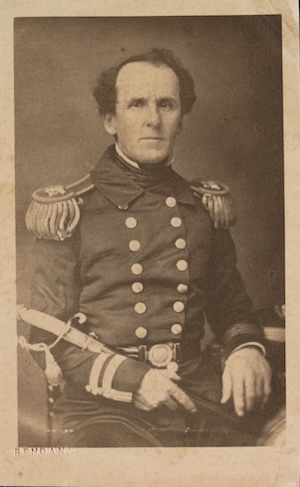
A photograph of Gen. Lewis Cass taken by Mathew Brady, circa 1860-65. In 1837, Cass dropped the anchor of the USS Constitution off Jaffa. (photo from US National Archives and Records Administration)

President Donald Trump’s unconventional proposal on Feb. 5  to annex the Gaza Strip isn’t the first time the United States has expressed territorial ambitions in the Middle East.

In 1837, Gen. Lewis Cass (1782-1866) dropped the anchor of the USS Constitution, “Old Ironsides,” off Jaffa. (Until British dynamite cleared the rock-strewn harbour in the 1920s, rowboats connected the port with the ships anchored offshore.) Together with several US Navy officers, Cass proceeded inland, planning to survey the uncharted Dead Sea – the lowest point on earth – but the poorly equipped mission was a failure. Ill from sunstroke and dehydration, the sailors barely managed to return to their vessel alive.

A decade later, Lieut. William Francis Lynch (1801-1865) of the US Navy led a better-provisioned 17-man expedition to explore the Jordan River and Dead Sea. Camels hauled the prefabricated boats specially manufactured of copper and galvanized iron overland from the Mediterranean Sea to Lake Kinneret (Sea of Galilee). Lynch then ventured down the Jordan River, which is a creek by most standards. In tandem, a party proceeded on land. The mission mapped the Jordan’s hitherto unknown 27 rapids and cascades. Though it is only 100 kilometres from the freshwater Lake Kinneret to the Dead Sea, the Jordan River’s winding course was 322 kilometres long. Lynch described the Jordan as unsuitable for navigation, calling it “more sinuous even than the Mississippi.”

photo - Lieut. William F. Lynch, circa 1861-62. In the mid 1800s, Lynch led a 17-man expedition to explore the Jordan River and Dead Sea
Lieut. William F. Lynch, circa 1861-62. In the mid 1800s, Lynch led a 17-man expedition to explore the Jordan River and Dead Sea. (photo from Naval History and Heritage Command Photograph Collection, NH 367)

While advancing “the cause of science,” Lynch was also at “the service of American commerce with the region.” He reported “an extensive plain, luxuriant in vegetation and presenting … a richness of alluvial soil, the produce of which, with proper agriculture, might nourish a vast population.”

While Congress shelved Lynch’s report recommending colonization, it helped spark the United States’s fascination with the Holy Land – and led to the establishment of American colonization projects in Jaffa and Jerusalem.

At Tel Aviv’s south end is a cluster of wooden clapboard buildings straight out of New England known as the American Colony. The story begins shortly after the American Civil War: on Aug. 11, 1866, 157 members of the Palestine Emigration Colony – including 48 children under the age of 12 – set sail from Jonesport, Me., for Jaffa on the newly built, three-masted vessel USS Nellie Chapin.

George Jones Adams (1811-1880), leader of the 35 New England families, hoped to develop the Land of Israel in preparation for the biblically prophesized return of the Jews. This would hasten the second coming of the Christian messiah. Adams had been a follower of the Mormon Church, but quit the religion following the assassination of Mormon founder Joseph Smith in 1844. Most of the congregants of the Church of the Messiah that Adams founded lived in Maine.

Departing the United States, Adams stated: “We believe the time has come for Israel to gather home from their long dispersion to the land of their fathers. We are going [to Jaffa] to become practical benefactors of the land and people, to take the lead in developing its great resources.”

Proto-Zionists, their purpose was not to missionize but to assist the Jewish people in returning to their ancestral land. However, though equipped with the latest agricultural tools, 22 pre-fab houses and religious fervour, the colonists’ mission was doomed. Arriving in Jaffa, they learned that Adams had not yet purchased the land on which they planned to settle. Instead, they pitched their tents on the beach near a cemetery where the victims of a recent cholera epidemic were buried. Within six months, 22 of the 157 settlers, including nine children, were dead.

Disease was not the settlers’ only problem. After finally buying the property for their neighbourhood, the first outside of Jaffa’s Ottoman ramparts – Tel Aviv would only be founded 43 years later, in 1909 – the pioneers quickly learned that farming in the arid Middle East was nothing like agriculture in rainy New England.

Facing starvation and soaring mortality, Adams sought solace in alcohol. Within two years after their arrival, all but two dozen or so members of the American Colony had returned to the New World. Their buildings were sold to newly arrived German evangelical Christians. Known as Templars, the Germans developed seven colonies across Palestine until being arrested by the British in 1939 as Nazi sympathizers. They were deported  to Australia or sent back to the Third Reich in prisoner exchanges.

Among the Americans who remained was Rolla Floyd (1832-1911), a pioneer of Israel’s tourism business. In 1869, he opened the stagecoach service from Jaffa to Jerusalem on the newly paved road. The journey from the coast to the mountains took 14 hours: today’s high-speed train covers the same distance in 29 minutes, with a stop at Ben-Gurion Airport.

The Maine settlers were not forgotten, thanks to Reed Holmes: in 1942, the historian met an elderly woman who had been 13 when the Nellie Chapin dropped anchor. After four decades of research, Holmes published The ForeRunners. Around the same time, he organized a tour of Israel. Among the participants was Jean Carter, a licensed contractor from Massachusetts. Touring the former American Colony, she was aghast to learn that the decrepit, historic wooden houses were about to be torn down.

Raised in a Protestant church, Carter had a master’s degree in Jewish studies and was fluent in Hebrew. She persuaded the Israeli government to declare the former colony a heritage site, received a promise that any structure that could be preserved would be spared demolition, and got the Tel Aviv municipality to erect a plaque on the beach where the Maine colonists had landed.

Holmes and Carter fell in love and eventually married. In 2002, they purchased Wentworth House – one of the remaining American Colony buildings. With the help of specialists in 19th-century building preservation techniques from Maine, the couple spent two years restoring the ruin and removing later additions. Today restored as the Maine Friendship House, it houses a museum about Jaffa’s American Colony.

The Holmes, who live in Peace Valley, Me., were honoured in 2004 by the Maine Preservation Society – the first time the group recognized a project outside of New England.

Unrelated to Jaffa’s American Colony is a Jerusalem settlement of the same name. The eponymous luxury hotel where foreign journalists like to belly up to the bar was founded in 1881 as a commune – Israel’s first kibbutz – by members of a Protestant utopian society led by Horatio Spafford of Chicago (1828-1888), who penned the Evangelical hymn “It Is Well With My Soul.”

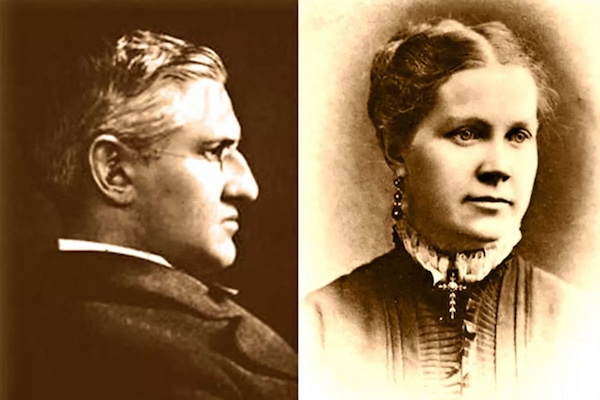
Spafford and his wife Anna (1842-1923), together with a group of 14 adults and five children, expected Jesus’s second coming imminently. While waiting, the members of the pietistic settlement of Yankees and Scandinavians served the Holy City’s many destitute by opening soup kitchens, hospitals, orphanages and other charitable ventures.

photos - Horatio Gates Spafford and Anna Spafford, circa 1873. In 1881, a Protestant utopian society led by Horatio Spafford founded the American Colony in Jerusalem
Horatio Gates Spafford and Anna Spafford, circa 1873. In 1881, a Protestant utopian society led by Horatio Spafford founded the American Colony in Jerusalem. (photos from Manuscript Division, Library of Congress)

Much of that charity was funded by the American Colony Photo Department, which became the community’s primary income. Many of those early images fall into the category of Orientalism, for which the West had a seemingly insatiable appetite. But part of that artistic achievement was due to fortuitous timing – the colony’s photographers began operating at a time when tourism to the Holy Land, especially from America and Europe, was beginning en masse.

Moreover, “with the advent of halftone printing in the 1880s, images were now becoming more accessible to the public via printed matter – books, magazines and newspapers – where they were now reproduced alongside text,” notes Tom Powers in his 2009 work Jerusalem’s American Colony and Its Photographic Legacy. (Before that, photographs could only be pasted into books by hand, as individual prints.)

A third factor was getting off to a good start, thanks to plain luck. The first sizeable project of the American Colony documentarians was the1898 state visit of Imperial Germany’s Kaiser Wilhelm II and Empress Augusta Victoria to the Holy Land.

Interested in seeing the American Colony Photo Department’s 22,000 historic photographs archived at the Library of Congress in Washington, DC? Visit loc.gov/pictures/collection/matpc/colony.html. 

Gil Zohar is a writer and tour guide in Jerusalem.

Format ImagePosted on February 14, 2025February 13, 2025Author Gil ZoharCategories IsraelTags American Colony, colonialism, history, Israel, photography, United States
Their wait to return home

Their wait to return home

Thomas Hand and the survivors of the massacre at Kibbutz Be’eri hope to return home in 2026. (photo by Gil Zohar)

Kibbutz Hatzerim, eight kilometres west of Be’er Sheva, best known for its drip-irrigation plant, also houses the newly established quarter here for the survivors of Hamas’s Oct. 7, 2023, massacre of more than 130 of Kibbutz Be’eri’s 1,071 residents. Emily Hand and her Dublin-born father Thomas, 64, are among the 200 refugees living there. In 2026, they hope to move back to rebuilt homes in their community alongside the Gaza Strip.

“We’re still in the stage of demolishing the houses beyond repair,” Hand said. A quarter of Be’eri’s housing is unsalvageable.

Some vegetation has been planted around the new temporary bungalows at Hatzerim, and the site is beginning to resemble a kibbutz neighbourhood. But little else is normal.

The Hands marked the anniversary of Emily’s release from imprisonment in the tunnels of Gaza on Nov. 26. A week earlier, the Irish-Israeli celebrated her 10th birthday. Thomas no longer allows his daughter to be interviewed by the media. The probing questions she faced raised horrific memories of captivity that she is still struggling to process, said her father. She has engaged in various therapies, including seeing a psychologist weekly, horse riding and puppy love with their pooch, Johnsey.

“She’s living day to day, enjoying every day,” her father said.

The Hands moved to their home at Hatzerim shortly before Rosh Hashanah and Emily started the new school year there. Before then, they had been sheltered at Kibbutz Ein Gedi’s hotel by the Dead Sea.

Like his daughter, Hand too is struggling. In the days after Oct. 7, he was initially informed his daughter had been murdered. After a month, that assessment was revised to missing. After more uncertainty, she was then declared a hostage – and finally released in a swap for Hamas gunmen and other terrorists.

The Hand household is still decorated with balloons from Emily’s recent birthday party. Among the guests were fellow hostages Noa Argamani, Ra’aya Rotem and Hila Rotem Shoshani, who surprised Emily with a cake and candles. Argamani, who was imprisoned with Hand, was rescued on June 8, after 245 days in captivity, in a joint operation by the Israel Defence Forces, Shabak (Israel’s security agency) and Israel Police.

Hand said Emily is adjusting “incredibly well.” But then he contextualized what that means: “She still sleeps with me. Usually in my bed.”

“She was captured from a MaMaD [safe room]. And that’s a trigger,” he said.

The constant roar of jets flying overhead to and from the nearby Hatzerim Air Base adds to their ill-ease. Hand’s conversation is punctuated by sighs and tears. “Don’t mind me,” he said. “It’s just part of the process.”

None of the kibbutz’s protected spaces had bulletproof doors, he noted. His own MaMaD wasn’t equipped with a lock, he added. “I just had to hope and pray.”

Other general tactical mistakes included storing the kibbutz’s guns and ammo in a central location rather than having them distributed among people’s homes. Half the members of Be’eri’s emergency response team were gunned down trying to reach the armoury, Hand said.

His first concern on Oct. 7 was for Emily, who was sleeping over at a friend’s house 300 metres away. With bullets flying, there was no chance to run there to attempt to rescue her, he recalled.

He left his shelter at 10 a.m. Armed with his pistol, two magazine clips and a bullet in the chamber, he positioned himself by his kitchen window, which offered a wide field of fire. The Hand family house was relatively untouched apart from shrapnel damage.

“While I couldn’t protect my daughter, I was able to protect three houses,” he said.

Hand remained at his post until 11:30 p.m., when IDF soldiers arrived.

“The amount of guilt that I felt at not going to save her [Emily] even at the risk of my own life…. But I knew I would be dead, and she would be an orphan. It was a very big thing afterwards. At the time, I was just in survival mode.”

With self-deprecating humour, Hand remembered he only had two cans of beer in the fridge that Saturday morning. It’s a mistake he has never repeated, he said, now always having a case of suds on hand.

Another cause of guilt is not being able to work. He had previously been employed at Be’eri’s printshop, and then as a painter at its toy and furniture factory. While the workshop has reopened, Hand is unable to commute the 90 minutes there, since he must stay close to his daughter. “I have to keep her normalized,” he said.

“They’ve given me a lot of leeway,” Hand said of the kibbutz secretariat.  In the meantime, he devotes a lot of time to hostage issues.

Looking wistful, he concluded: “I will not feel safe going back to Be’eri with this government in power, and without Hamas being completely crushed.” 

Gil Zohar is a writer and tour guide in Jerusalem.

Format ImagePosted on January 17, 2025January 15, 2025Author Gil ZoharCategories IsraelTags Israel, Kibbutz Be’eri, Oct. 7, Thomas Hand
Standing up to the PM

Standing up to the PM

MK Dan Illouz opposes legislation that would enshrine the exemption of Haredim from military service. (photo from Knesset)

Dan Illouz, a Montreal-born Likud rookie member of the Knesset, is making a name for himself in Israel’s Parliament by speaking against his own party’s policy of opposing the draft of Haredim (ultra-Orthodox Jews) into the Israel Defence Forces.

“Exempting such a large group of people from their obligation to serve in the IDF at such a critical time is anti-Zionist,” the freshman lawmaker tweeted recently on X. 

Responding to the challenge to Prime Minister Binyamin Netanyahu’s leadership, the Likud has taken steps to clamp down on internal dissent by party lawmakers opposed to legislation that would enshrine the exemption of members of the ultra-Orthodox community from military service.

The IDF’s personnel shortage has become acute in the wake of Hamas’s Oct. 7, 2023, surprise attack on Israeli cities and kibbutzim ringing the Gaza Strip, followed by Hezbollah’s rocket campaign against the Galilee and Central Israel that began the next day. Reservists, called miluimnikim in Hebrew, have been repeatedly called up for months at a time. But, Netanyahu must balance his party’s stability in government with military personnel considerations, not to mention growing casualties.

In a move widely seen as linked to then-defence minister Yoav Gallant’s opposition to the controversial military draft exemption legislation – which has been demanded by ultra-Orthodox coalition partners whose support Likud needs to stay in power – Netanyahu fired Gallant last month and appointed Israel Katz in his stead. The prime minister then pushed for party discipline against dissenters like Illouz, who holds the rank of captain in the IDF reserves.

Coalition whip Ofir Katz informed Illouz that he was being removed from the Knesset’s economic affairs committee and foreign affairs and defence committee due to his “statements regarding coalition discipline and his conduct in recent days,” a spokesperson for Katz said.

In a further slap on the wrist, Illouz was barred from submitting private bills for six weeks.

Illouz has long spoken out against efforts to pass new legislation regulating exemptions for yeshivah students following a High Court ruling in June that they must enlist in the IDF unless a new bill is passed.

Digging in recently, Illouz announced his opposition to the coalition’s Daycare Bill, which seeks to circumvent a High Court ruling preventing state-funded daycare subsidies from going to the children of ultra-Orthodox draft dodgers.

“Exempting such a large group from the duty to serve in the IDF in such a critical period is a non-Zionist act that is unworthy of us as a nation – whether it be called ‘the enlistment law’ or ‘the daycare law,’ whose purpose is to cancel the daycares sanction and restore the funding,” Illouz declared.

The Daycare Bill was removed from the Knesset agenda last month after it failed to garner sufficient coalition support.

A member of the Quebec and Israeli bar associations, and a former legislative adviser to the Knesset’s coalition chair, Illouz previously served in a legal capacity at Israel’s Foreign Ministry. He is a graduate of McGill University Law School and the Hebrew University of Jerusalem’s master’s program in public policy.

Drawing on his legal expertise, Illouz co-authored a law banning any Israeli interaction with the United Nations Relief and Works Agency (UNRWA), due to some of its members’ being involved with Hamas in general and in the Oct. 7 massacre in particular.

Humanitarian aid and services to the two million people in Gaza must now be based on alternative agencies such as the UN High Commissioner for Refugees, the UN International Children’s Emergency Fund and the World Food Organization, said Illouz. (More than 200,000 Gazans have fled to Egypt and elsewhere since war broke out in their coastal enclave 15 months ago.)

Born in Canada to Moroccan immigrants, Illouz made aliyah in 2009 after completing his law studies. Like all newly elected MKs holding foreign citizenship, he was required to surrender his second passport before being sworn in as a member of Israel’s Parliament.

Illouz continues to serve as the chair of the Knesset delegation to the Organization for Economic Cooperation and Development and be a member of the Knesset delegation to the Inter-Parliamentary Union, an international body that brings together parliamentarians from 180 countries. 

Gil Zohar is a writer and tour guide in Jerusalem.
Format ImagePosted on December 20, 2024December 19, 2024Author Gil ZoharCategories IsraelTags conscription, Dan Illouz, governance, Haredim, IDF, Israel Defence Forces, Knesset, law, Montreal, Parliament, politics
Photos depict Oct. 7 trauma

Photos depict Oct. 7 trauma

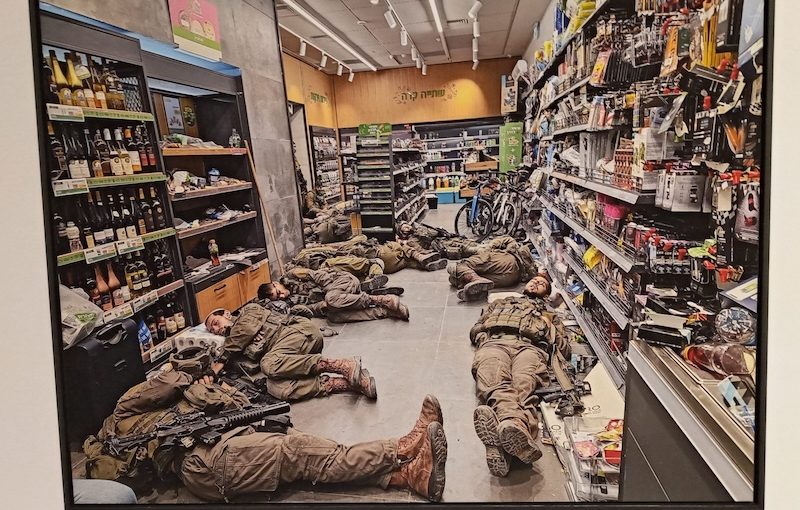
Batia Holini’s photo of Israeli soldiers sleeping on the floor of a grocery store near Kfar Aza on Oct. 8 is one of the works in the exhibit Album Darom. (photo by Gil Zohar)

Album Darom: Israeli Photographers in Tribute to the People of the Western Negev, which opened recently for a six-month temporary installation at the Petach Tikva Museum of Art, is the first group artistic endeavour in Israel to confront the tragedy of Hamas’s Oct. 7, 2023, massacre and the subsequent Gaza War, now in its 10th month. The ambitious tripartite installation Album Darom (Hebrew for Southern Album) incorporates a Facebook diary; a printed book of photographs accompanied by essays (published by Yedioth Ahronoth); and the museum exhibit.

Initiated by Prof. Dana Arieli, dean of the faculty of design at the Holon Institute of Technology, together with chief curator Irena Gordon, the project showcases 150 photographs, art installations and texts documenting the story of the western Negev region before and after Oct. 7. The exhibit includes the perspectives of 107 photographers and artists. Some of the participants in the album are world-renowned, others are amateurs. Lavi Lipshitz, the youngest featured photographer, lost his life fighting in Gaza. His mother penned the text accompanying his images.

The works in the album represent different photographic practices: artistic, personal and some staged, the intense images are upsetting. As well they should be in confronting mass murder.

Before walking around a corner to see Lali Fruhelig’s gruesome 3-D installation suggesting a corpse sprawled on the floor of a living room, a sign cautions: “The exhibition contains some potentially disturbing contents. Viewer discretion is advised.”

Arieli, a history professor and a photographer who explores remembrance culture and cultural manifestations of trauma, began the Album Darom project shortly after the Gaza war broke out.

“When something’s traumatic, you have to work or do something,” she said. 

Shocked by the murder of her friend Gideon Pauker from Kibbutz Nir Oz – who was killed just before his 80th birthday – she posted 100 daily historic and contemporary images of the Western Negev.

Initially, Arieli intended Album Darom to be exhibited at Kibbutz Yad Mordechai Museum just north of the Gaza Strip frontier. After the museum was damaged by rocket fire, this wasn’t feasible. Instead, she selected Petach Tikvah as the venue. She explained that the site – the first Yad Labanim memorial to fallen Israel Defence Forces soldiers from the War of Independence – is meant to be relevant to all Israelis. The museum offers free admission on Saturday, so observant Jews may visit on Shabbat.

Speaking to a group of journalists, Arieli compared Oct. 7 to the Nov. 4, 1995, assassination of then-prime minister Yitzhak Rabin. “Everyone is frozen in their memory of where they were,” she said.

Arieli and Gordon emphasized the intended cathartic nature of the exhibit. The two said the museum is a “safe space” and a “place for healing.” After experiencing the horrors of Oct. 7, Gordon found solace in this project, she added. “This is part of how we are coping with it all,” she said.

Miki Kratsman is one of the photographers whose depiction of his Oct. 7 nightmare is in the exhibit. Terrorists took his aunt Ophelia hostage from her home in Kibbutz Nir Oz. She was later released from Gaza in the November hostage exchange deal. 

Kratsman’s photograph, “In Aunt Ophelia’s Neighbourhood,” captures a modest kibbutz home collapsing as it is immolated in a fireball. 

“These are the kinds of things that need to be in a museum,” Arieli said of the photograph. “You’re looking at the destruction of Nir Oz.”

While vividly showing the devastation of the kibbutz, the burning home photograph is an enigma, and creates dialogue, she added.

But it is the human toll rather than the destroyed real estate that is most painful. Paradoxically, perhaps, Batia Holini’s peaceful photo of exhausted IDF soldiers sleeping on the floor of a grocery store near Kfar Aza on Oct. 8 hints at the savage warfare in which they have been engaged.

photo - “Funeral of Five Members of the Kutz Family who were Murdered in Kfar Aza,” a photo by Avishag Shaar-Yashuv
“Funeral of Five Members of the Kutz Family who were Murdered in Kfar Aza,” a photo by Avishag Shaar-Yashuv. (photo by Gil Zohar)

Avishag Shaar-Yashuv’s photograph, “Funeral of Five Members of the Kutz Family who were Murdered in Kfar Aza,” captures the searing emotion of the funeral of a family annihilated in the Hamas attack.

“I tried to focus and also wipe the tears at the same time,” Shaar-Yashuv said.

For this reviewer, the most symbolic part of the exhibit was a taxidermy display of a doe entitled “Bambi.” The exhibit references Felix Salten’s 1923 novel Bambi: A Life in the Woods and the 1942 animated movie produced by Walt Disney. Metaphorically, the hapless baby deer represents both the Six Million victims of the Holocaust and the 1,200 people murdered on Oct. 7.

Viewing Album Darom, one could conclude that the myth of the state of Israel protecting its citizens has been shattered. Arguably, Israelis today are no more secure than their ancestors were facing the Kishinev Pogrom of 1903, the Hebron Massacre of 1929 or the Farhud in Baghdad in 1941. 

Gil Zohar is a writer and tour guide in Jerusalem.
Format ImagePosted on July 12, 2024July 10, 2024Author Gil ZoharCategories Israel, Visual ArtsTags Album Darom, art, Israel, Oct. 7, photography, sculpture, South Album, trauma
Srulik, meet Handala

Srulik, meet Handala

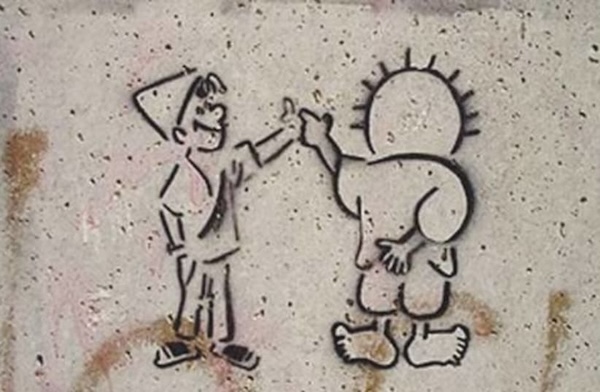
The ways in which the characters of Srulik, left, and Handala epitomize the historical and cultural narrative of the Israelis and Palestinians, respectively, imbue these cartoons with an impact stronger than words. (photo by Gil Zohar)

Driving east from Jerusalem on the winding Jordanian-built road that once led down from the Mount of Olives to the Dead Sea, one passes through a series of picturesque Arab suburbs and soon comes to a dead end in front of the grotesque West Bank barrier.

Called Geder ha-Hafrada (separation fence) in Hebrew and jidar al-fasl al-’unsuri (apartheid wall) in Arabic, the insurmountable (if still incomplete) eight-metre-high concrete barrier has no doubt contributed to a reduction in terrorism and car theft. However, my objection to it is more existential: like some of those in West Berlin who spray-painted their protest for freedom on the Bundesrepublik side of die Mauer even as armed GDR guards used deadly force to prevent anyone from approaching the wall’s eastern side, I believe all walls must fall.

It is a metaphor that has repeated itself from Joshua’s encircling of Jericho, to the Berlin Wall and its remaining East Side Gallery, to Garth Hewitt’s ballad “They’ve Canceled Christmas in Bethlehem,” about the stranglehold the wall has placed on both day-to-day life and religious pilgrimage in the place where Jesus, “the Prince of Peace,” was born 2,000-plus years ago.

The world today is caught between two conflicting ideologies: some democratic countries joining in unions with open borders, joint legal systems and a common currency, of which the European Union – notwithstanding its problems – is a great success. Then, there are other countries – many repressive and undemocratic – defending their borders with minefields and walls. Like John Lennon, I prefer the first vision – of a growing global union without barriers. Imagine that.

Thus, armed with the tools of the graffiti artist – an X-ACTO knife, cardboard stencil and spray paint – I recently made my way to Abu Dis with my friend Hajj Ibrahim Abu el-Hawa, my daughter Bareket and fellow artist Eva Feld to make our mark. Reasoning that a picture is worth a thousand words, we chose a symbolic image whose meaning is unequivocal.

The image we created depicts Handala raising hands with Srulik (see picture). The two iconic cartoon characters are respectively well known by Palestinians and Israelis – yet, each is equally unknown by the other. It is a symmetry of ignorance of the other’s narrative that will have to be overcome before true peace can be achieved.

Allow me to explain the mirror meanings of the twin caricatures.

Handala – an omnipresent image on T-shirts and key chains in the aswaq (plural of suq, market) of Jerusalem, the West Bank and Gaza Strip – was created by Naji al-’Ali in 1969. A 10-year-old child driven in 1948 from his Galilee village of ash-Shajara (14 kilometres from Tiberias) to the ‘Ain al-Hilweh refugee camp in Lebanon, al-’Ali went on to become the leading political cartoonist in the Arab world.

Before being assassinated in London in 1987, he produced more than 40,000 bitingly sarcastic cartoons lampooning Arab leaders and lamenting the stateless status of his people. His autobiographical image of Handala – a barefoot, faceless, refugee youth – remains a potent symbol of the struggle of the Palestinian people for justice and self-determination.

Al-’Ali wrote: “Handala is my signature. I gave birth to this child in the [Persian] Gulf. He was born 10 years old, and he will always be 10. At that age, I left my homeland and, when he returns, Handala will still be 10, and then he will start growing up. The laws of nature do not apply to him. He is unique. Things will become normal again when the homeland returns.”

Impish Srulik – a diminutive of Yisrael (Israel) – carries an equally rich symbolism in depicting nascent Israel and, in particular, its native-born Sabras. The illustrated character was first drawn in 1956 by the cartoonist Kariel Gardosh, better known by his nom de plume, Dosh. The Hungarian-born Holocaust survivor drew Srulik for decades in the pages of the daily Maariv, until his death in 2000.

Dosh generally depicted Srulik as a young man wearing a kova tembel hat, “biblical sandals” and khaki shorts. He drew him as a pioneering Zionist and lover of the land of Israel, a dedicated farmer who in time of need dons an Israel Defence Forces uniform and goes out to defend the state of Israel, equipped with an Uzi machine gun. In contrast to the antisemitic stereotype of the weak or cunning Jew, which appeared in the Nazi weekly Der Stürmer and other European and Arab newspapers and journals, Dosh’s Srulik was a proud, strong and sympathetic Jewish character.

Shalom Rosenfeld, editor of Maariv from 1974 to 1980, wrote: “Srulik became not only a mark of recognition of [Dosh’s] amazing daily cartoons, but an entity standing on its own, as a symbol of the land of Israel – beautiful, lively, innocent … and having a little chutzpah and, naturally, also of the new Jew.”

Introducing Srulik to Palestinians and Handala to Israelis is not a bad way to begin to redress each side’s ignorance of the other’s narrative. The ways in which they epitomize the historical and cultural narrative of their own people imbue these cartoons with an impact stronger than words.

When a peace treaty is ultimately implemented between Israel and Palestine (as I’m sure it must), perhaps the image of Handala and Srulik holding hands could be adopted as a neutral symbol of coexistence and nonviolence. Their creators, Naji al-’Ali and Kariel Gardosh, both knew firsthand of persecution and exile, and the iconic figures they bequeathed us share the hope of living in freedom and peace. When peace finally arrives, new and emotionally satisfying images and symbols will need to be created to bridge the chasm between Jews and Arabs in our broken Promised Land. 

Gil Zohar is a writer and tour guide in Jerusalem.

Format ImagePosted on June 28, 2024June 27, 2024Author Gil ZoharCategories Op-EdTags cartoons, Handala, history, Israeli-Palestinian conflict, Kariel Gardosh, Naji al-’Ali, peace, Srulik
Egypt faces many struggles

Egypt faces many struggles

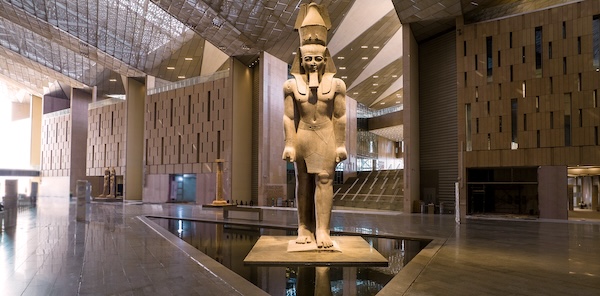
Twenty years in the making, Egypt’s Grand Egyptian Museum is in a soft-opening period, with a section of the 81,000-square-metre site open for limited guided tours. (photo from Grand Egyptian Museum)

In biblical times, the Patriarch Jacob led his family to Egypt, the granary of the ancient Near East, to escape famine in Canaan. By the Roman era, the Nile River Valley and Delta – enriched by the Nile’s annual flooding with alluvial mud – had become the breadbasket of Rome. King Herod built an artificial harbour at Caesarea to facilitate the crucial maritime shipment of wheat to the imperial capital. Today, the once fabulously wealthy country is an economic basket case.

President Gen. Abdel Fattah el-Sisi and his military-industrial kleptocracy blame the country’s high birth rate for the inability to feed Egypt’s burgeoning population of 110 million people. Taking a page from Keynesian economic theory, the regime – which toppled Islamist leader Mohamed Morsi in a 2013 coup d’état – has triggered a free fall of hyperinflation and devaluations while building mega-projects to stimulate the country’s broken finances.

The country’s annual rate of inflation soared to 36% in February, the Central Agency for Public Mobilization and Statistics (CAPMAS) said on March 31. The Egyptian pound, called the guinea, traded at 20 to the American dollar as recently as 2020. Now, one needs 52 to buy a greenback in the flourishing parallel market. In the past 24 months, a crippling shortage of foreign currency has caused prices of goods and commodities to more than triple, forcing low- and middle-income Egyptians to further tighten their belts.

The result? Strained services, a bloated bureaucracy, a huge government budget and a staggering deficit.

Compounding the economic misery, Hamas’s Oct. 7 attack on Israel and the resulting Israel-Hamas war in Gaza have driven away tourists from the land of Pharaonic wonders and spectacular coral reefs. Houthi rockets targeting shipping in the Red Sea have shrunk revenue from the Suez Canal, which is down 40% this year versus the same period in 2023. And Russia’s invasion of Ukraine two years ago has driven up wheat prices and made subsidized bread – a staple for most Egyptians – more costly.

Notwithstanding Egypt’s inability to repay its current foreign debt of about $165 billion, el-Sisi’s immediate financial problems were eased in recent weeks thanks to a bailout, more than $23 billion provided by the International Monetary Fund (IMF), the World Bank and the European Union.

At the same time, the United Arab Emirates launched a rescue plan to prop up its ally through the Ras el-Hekma deal announced last month. The vast real estate project envisions a new city on the barren shores of the Mediterranean Sea near the site of the pivotal Second World War battle of El Alamein. It was concluded in exchange for $24 billion in cash liquidity and $11 billion in UAE deposits with the Central Bank of Egypt, which will be converted into Egyptian pounds and used to implement the project, reported Reuters.

Where then has Egypt invested, or perhaps squandered, its largesse?

One expensive pet project has been to expand the quasi-governmental Egyptian Railway Authority’s network of standard-gauge train tracks. The system, the oldest in the Middle East, dating back to the 1854 line between Alexandria and Kafr el-Zayyat on the Rosetta branch of the Nile, now extends across 10,500 kilometres. A further 5,500 kilometres are currently in construction, including high-speed lines from Alexandria west to Mersa Matruh, Cairo south to Aswan, and Luxor east to Safaga via Hurghada.

Equally ambitious are plans to expand the country’s clogged highways. Transportation Minister Kamel al-Wazir, who took over the accident-plagued portfolio from Hisham Arafat following the 2019 Ramses Station train disaster, in which 25 Cairenes were killed and 40 injured, plans to complete 1,000 bridges, tunnels and flyovers this year.

Key to the plan to clear Cairo’s traffic woes is to complete an ambitious, shimmering new capital 50 kilometres east of the megalopolis, whose population is estimated to be more than 22 million people. The so-far-unnamed New Administrative Capital, under construction for nearly a decade, is located just east of the Second Greater Cairo Ring Road. It includes more than 30 skyscrapers, the most striking of which is the 77-floor Iconic Tower – the tallest building in Africa. Equally noteworthy are the 93,000-seat soccer stadium, the Fattah el-Aleem Mosque, accommodating 107,000 worshippers, and the Nativity of Christ Cathedral, which has room for 8,000 Copts.

To date, 14 ministries and government entities have relocated to the New Administrative Capital, but the city remains a largely lifeless white elephant with few residents.

Apart from these vast infrastructure projects, Egypt has been burnishing its cultural heritage. In 2022, the Ministry of Tourism and Antiquity launched the Holy Family Trail, stringing together some 25 stops along the celebrated route that Jesus, Mary and Joseph took to escape King Herod’s wrath. Last year, the government restored the medieval Ben Ezra Synagogue in Fostat (Old Cairo), the home of the Cairo Geniza. The long-delayed Grand Egyptian Museum in Giza near the Pyramids is scheduled to officially open this summer – though no date has been announced.

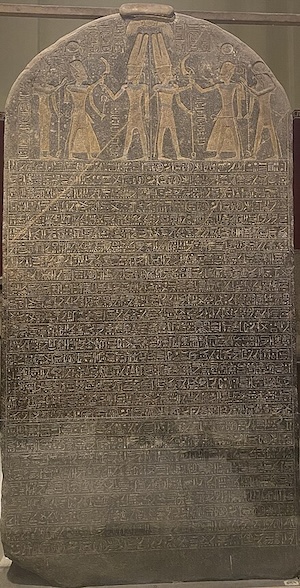
photo - The top part of the Merneptah Stele, inscribed by the New Kingdom pharaoh, dated around 1208 BCE. Line 28 reads: “Israel is laid waste – its seed is no more”
The top part of the Merneptah Stele, inscribed by the New Kingdom pharaoh, dated around 1208 BCE. Line 28 reads: “Israel is laid waste – its seed is no more.” (photo from Grand Egyptian Museum)

Twenty years in the making, the GEM is currently in a soft-opening period, with a section of the 81,000-square-metre site open for limited guided tours.

Touted as the largest archeological museum complex in the world, the GEM will house more than 100,000 artifacts. It will showcase the treasures discovered in the tomb of Tutankhamun in 1922. Other highlights will include a restoration centre, an interactive gallery for children and the Khufu Boat Museum.

King Tut’s funerary possessions had been on display at downtown Cairo’s Egyptian Museum in Tahrir Square, a hopelessly inadequate leftover from Britain’s colonial rule. There, a decade ago, I wandered in sensory overload gawping at the Aladdin’s Cave of Wonders. As if guided by divine providence, or perhaps Ra or Isis, I stumbled upon the Merneptah Stele – a three-metre-high piece of black granite inscribed by the New Kingdom pharaoh, dated around 1208 BCE, which was discovered in Thebes in 1896 by archeologist Flinders Petrie. Line 28 reads: “Israel is laid waste – its seed is no more.”

For me, it symbolizes the cold peace Israel and Egypt have enjoyed since 1979. Though few Israelis would wish to repudiate that historic agreement, many share the sentiment of Eitan Haber, the confidant of former prime minister Yitzhak Rabin, who said: “The Egyptians don’t like us and – why deny it? – we don’t like them.” 

Gil Zohar is a writer and tour guide in Jerusalem.

Format ImagePosted on April 12, 2024April 10, 2024Author Gil ZoharCategories WorldTags culture, economics, Egypt, financial crisis, infrastructure
What happens after the war?

What happens after the war?

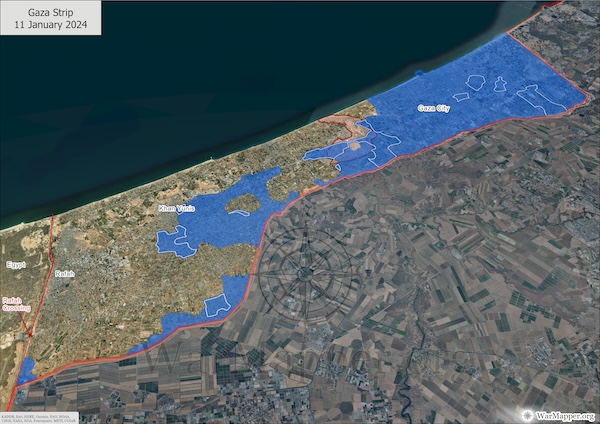
Area of Gaza controlled by the Israeli Defence Forces on Jan. 11, 2024.

While the war in the Gaza Strip continues between Hamas guerillas and the Israel Defence Forces (IDF) in the labyrinth of tunnels burrowed beneath Khan Yunis and in the alleys of the devastated city (population 205,000), another battle is being fought across Israel over the postwar fate of the coastal enclave.

Ultra-nationalist members of Knesset Bezalel Smotrich, leader of the National Religious Party, and Itamar Ben Gvir, head of Otzma Yehudit (Jewish Power), recently called for Gaza’s 2.2 million residents to be voluntarily resettled elsewhere. Congo was cited as a destination for the exodus. U.S. State Department spokesman Matthew Miller called the statements by Smotrich and Ben Gvir “inflammatory and irresponsible.”

Egypt is adamantly opposed to allowing the two million displaced Gazans to shelter in the Sinai Peninsula, lest Israel prevent the refugees from returning. Similarly, the Jewish state is no more likely to allow them to pass through its territory to fly out of Ben-Gurion Airport than it is to resettle those refugees who fled their nearby villages in the Arab-Israeli War of 1948.

photo - One controversial postwar scenario is for Israel to rebuild some of the post-1967 Gaza Strip settlements from which it unilaterally  withdrew in August 2005
One controversial postwar scenario is for Israel to rebuild some of the post-1967 Gaza Strip settlements from which it unilaterally  withdrew in August 2005. (photo by Gil Zohar)

Further limiting the options, Israel’s high-tech Erez Crossing at the north end of the Gaza Strip – similar in scale to a massive airport terminal – was destroyed during Hamas’s Oct. 7 rampage in which some 1,200 Israelis and other nationals living in cities and kibbutzim near the Gaza frontier were massacred and 240 kidnapped.

Concurrently, the black market is burgeoning for fixers with links to Egyptian intelligence; they are making a fortune in “fees” extorted from Gazans desperate to exit through the Rafah Crossing at Gaza’s south end. The bribe for being placed at the head of the legal exit list for passage across the Rafah border into Egypt and on to Cairo International Airport has now soared to $10,000.

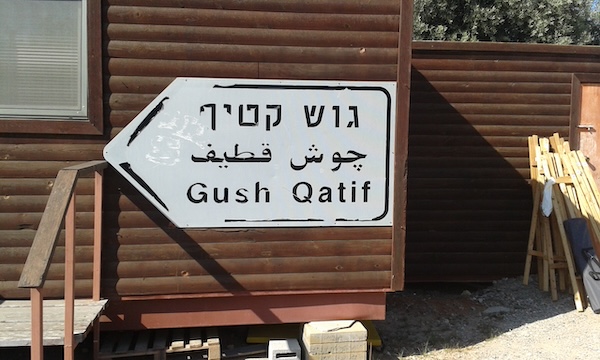
In the face of the vast human suffering, staggering damage to infrastructure and environmental catastrophe caused by the conflict, which marked its 100th day on Jan. 14, another controversial postwar scenario is for Israel to rebuild some of the post-1967 Gaza Strip settlements from which it unilaterally withdrew in August 2005. The forcible evacuation of 8,600 Jewish residents from Gush Katif (the Harvest Bloc) – a cluster of 17 villages in the southern Gaza Strip – set the stage for Hamas’s 2007 coup d’état when it seized power from Mahmoud Abbas’s Palestinian Authority, based in Ramallah in the West Bank.

On Dec. 22, 2023, a group of settlers held an organizational meeting at the agricultural village of Kfar Maimon near the Gaza Strip demarcation fence to launch their plan to create a beachfront community on the barren dunes at Gaza’s southern edge. The day was symbolic since Asarah b’Tevet (the 10th of the Hebrew month of Tevet) is a fast day in the Hebrew calendar, marking the date 26 centuries ago when Nebuchadnezzar II of Babylon began his six-month siege of Jerusalem, which resulted in the destruction of Solomon’s Temple and the downfall of the Kingdom of Judah.

Though Gaza was allocated to the Tribe of Judah in the Hebrew Bible, the ancient Israelites never vanquished their Philistine nemesis who dwelt there and in the cities of Ashkelon, Ashdod, Gat and Ekron. Jewish and Samaritan communities intermittently flourished in the territory of Gaza over many centuries. Shaken by the riots of 1929, however, the Gazan Jewish community ended in 1948. In Gaza City’s historic Zaytoun quarter, the Ottoman-style Hammam al-Sammara (the Samaritan bathhouse) bears witness to the ancient Samaritan community that was exiled in 1917 by the Turkish army during the battles of the First World War.

The group of would-be settlers – who staged a car rally just outside Gaza on Jan. 11 – are encouraged by the report that Israel’s Knesset will be hosting a conference Jan. 28 on rebuilding settlements in Gaza after the war, and will offer precise maps and plans. The news site mako.co.il says that Knesset members and other public figures are expected to speak, and thousands of Israelis have already applied to join the settlement nuclei in Gaza.

The organizers of the event stated, “We are working both on the political level and on the practical side towards the moment when they can get on the ground. There is a great demand in the public that the victory of the war includes within it Jewish settlement in the Gaza Strip.”

Meanwhile, senior ministers among Prime Minister Binyamin Netanyahu’s right-wing allies have criticized the IDF over its plans to probe Oct. 7 intelligence failures. And Israel’s future may be hurtling backward to the widespread protests over judicial reform that divided the country in the months that preceded Hamas’s devastating surprise attack. Such is public anger that calls for a spring election are becoming vociferous.

Were Netanyahu and Abbas to both step down, and Saudi Arabia and Israel to establish ties, a postwar scenario of regional integration – including high-speed trains whisking cargo from Haifa to Riyadh and Abu Dhabi – could emerge. The trauma of the Gaza War could give birth to Mideast peace.

More than 50,000 Israelis responded to the Ashkenazi and Sephardi chief rabbis’ call for a day of prayer at the Western Wall in Jerusalem to mark the new moon of Shevat.

In Judaism, the full moon of Shevat is celebrated as the New Year of the Trees. Besides the pink-white almond blossoms, which mark the beginning of spring, the blood-red anemones also carpet the fields of the western Negev by the Gaza Strip. Like the poppies in Flanders Fields, this year those wildflowers will symbolize the tragedy of war. 

Gil Zohar is a writer and tour guide in Jerusalem. A longer version of this article can be found at religionunplugged.com/gil-zohar.
Format ImagePosted on January 26, 2024January 24, 2024Author Gil ZoharCategories IsraelTags Gaza, Hamas-Israel war, postwar, settlements

Posts pagination

Previous page Page 1 Page 2 Page 3 … Page 6 Next page
Proudly powered by WordPress