

Sussita entrepreneur Itzhak Shubinsky driving a Sabra Sport car, from the newspaper Barkav, in the 1960s. (photo from Haifa City Museum)
For a trip down memory lane, cruise over to Haifa’s City Museum at 11 Ben-Gurion Blvd., in the German Colony, to see Sussita: The Exhibition. The display, which continues until May 25 (the opening was delayed by Hezbollah rocket fire from Lebanon), documents Israel’s failed automobile industry during the early decades of statehood.
Alas, the doorways of the museum’s 19th-century Templar building are too narrow to permit restored examples of the fibreglass shell cars to pass through. So, on hand is a stripped-down version of a Sussita, and a trove of fascinating documents and photos. Missing are full-size examples of the Carmel truck and Sabra Sport roadster that Autocars Co. Ltd. assembled at its Haifa workshop and then in the city of Tirat Carmel.
The exhibit was curated by Yifat Ashkenazi, together with filmmaker Avi Weissblei. The latter produced the 2020 documentary Desert Tested, which told the Sussita’s story.
Like Shai Agassi’s Better Place electric car company, which went through almost $1 billion in venture capital before declaring bankruptcy in 2013, Israel’s ultimately insolvent auto industry never thrived.
The Sabra’s aerodynamic curves evoke the glamour of early James Bond films. Nonetheless, even though they were jump-started by foreign firms, Haifa’s car business never quite managed to compete with Detroit.
Discussing Autocars’ 1966 Sussita at carsurvey.org, one classic car aficionado noted: “What things have gone wrong with the car?
Almost everything! It was a very cheap car made of a fibreglass body attached to a very simple welded pipes chassis, with a Triumph engine. The car was unstable, seriously dangerous, unreliable and very badly built.”
Folklore has it that camels liked to munch on the cars’ fibreglass body. But the relative paucity of dromedaries in 1960s Israel makes the truth of this story doubtful.
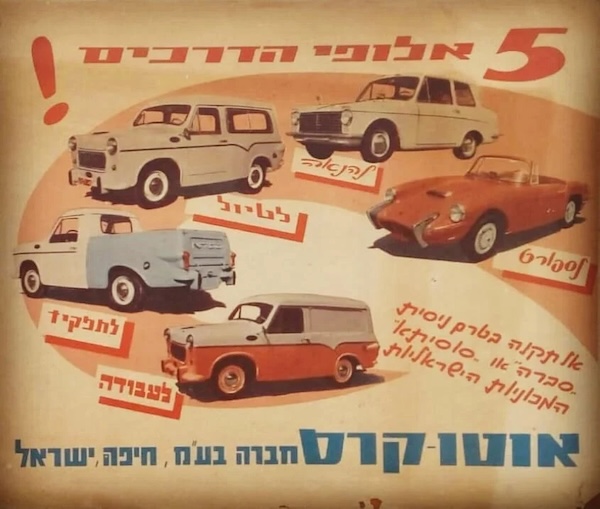
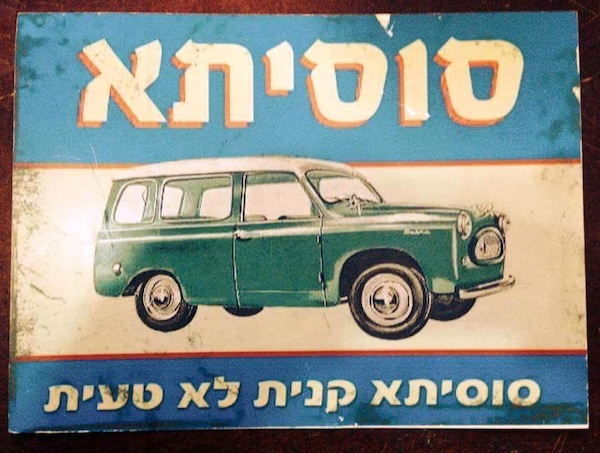
Founded in the mid-1950s with assistance from Britain’s Reliant Motor Co., Autocars initially assembled quirky but popular three-wheeled micro-cars. The first four-wheeled blue-and-white vehicle, the Sussita, was also designed by Reliant.
The Sussita, meaning mare in Aramaic, developed a reputation as a reliable workhorse. By 1960, Autocars was exporting the cheaply priced car – available in estate, van and pick-up models – to the United States and Canada. Rebranded as the Sabra – a genus of cactus originally from Mexico that had become a descriptor of native-born Israelis – the car sold poorly in North America due to its inferior quality.
That year, in 1960, Autocars’ owner Itzhak Shubinsky spotted the coupé Ashley GT at London’s Sports and Racing Car Show. Changing business strategy, he purchased the bodywork moulds and created the Sabra Sport, which made its debut at the 1961 New York Motor Show. The roadster car was also sold as a hardtop coupe. Fewer than 150 were exported to the United States, while a similar number were sold in Belgium.
Reliant also launched the car in Britain. Anglicizing its moniker to Sabre, the prickly cactus morphed into a swashbuckling sword.
Expanding production, in 1961, Autocars introduced the Carmel, named for the mountain that defines Haifa. The car featured a 1,200cc Ford Cortina engine mounted in a Reliant chassis.
By 1965, Autocars declared bankruptcy and was taken over by Britain’s Leyland-Triumph. Revamping the product line, the following year it introduced the Gilboa, a four-door version of the Carmel. In 1967, it produced an off-road, front-wheel drive utility called the Dragoon.
But the red ink continued to spill. In 1971, Leyland severed its ties with its Israeli subsidiary. Three years later, Autocars was bought by Rom Carmel Industries, which brought out its Gilboa-based Rom 1300.
Sputtering along, in 1978, the company was purchased by the Netanya-based foundry Urdan Industries. Restyled again, the Rom 1300 became the Rom 1301. But declining sales could not be reversed, going from a peak of manufacturing more than 3,000 cars annually during the 1960s to just 540 cars rolling off the assembly line in 1980, the last full year of production. In 1981, the plant shut its gates.
For more about the exhibit, visit hcm.org.il/eng/exhibitions/11128/sussita.
Gil Zohar is a writer and tour guide in Jerusalem.