Skip to content
  • Home
  • Subscribe / donate
  • Events calendar
  • News
    • Local
    • National
    • Israel
    • World
    • עניין בחדשות
      A roundup of news in Canada and further afield, in Hebrew.
  • Opinion
    • From the JI
    • Op-Ed
  • Arts & Culture
    • Performing Arts
    • Music
    • Books
    • Visual Arts
    • TV & Film
  • Life
    • Celebrating the Holidays
    • Travel
    • The Daily Snooze
      Cartoons by Jacob Samuel
    • Mystery Photo
      Help the JI and JMABC fill in the gaps in our archives.
  • Community Links
    • Organizations, Etc.
    • Other News Sources & Blogs
    • Business Directory
  • FAQ
  • JI Chai Celebration
  • JI@88! video

Recent Posts

  • טראמפ עוזר דווקא לנושא הפלסטיני
  • New rabbi settles into post
  • A light for the nations
  • Killed for being Jewish 
  • The complexities of identity
  • Jews in time of trauma
  • What should governments do?
  • Annie will warm your heart
  • Best of the film fest online
  • Guitar Night at Massey
  • Partners in the telling of stories
  • Four Peretz pillars honoured
  • History as a foundation
  • Music can comfort us
  • New chapter for JFS
  • The value(s) of Jewish camp
  • Chance led to great decision
  • From the JI archives … camp
  • עשרים ואחת שנים להגעתי לונקובר
  • Eby touts government record
  • Keep lighting candles
  • Facing a complex situation
  • Unique interview show a hit
  • See Annie at Gateway
  • Explorations of light
  • Help with the legal aspects
  • Stories create impact
  • Different faiths gather
  • Advocating for girls’ rights
  • An oral song tradition
  • Genealogy tools and tips
  • Jew-hatred is centuries old
  • Aiding medical research
  • Connecting Jews to Judaism
  • Beacon of light in heart of city
  • Drag & Dreidel: A Queer Jewish Hanukkah Celebration

Archives

Follow @JewishIndie
image - The CJN - Visit Us Banner - 300x600 - 101625

Tag: Thomas Hand

Their wait to return home

Their wait to return home

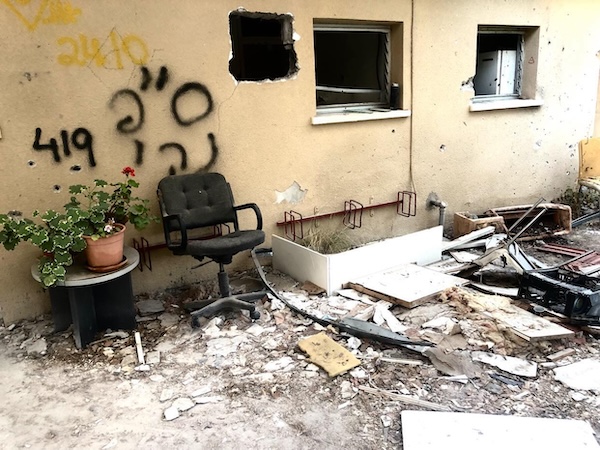
Thomas Hand and the survivors of the massacre at Kibbutz Be’eri hope to return home in 2026. (photo by Gil Zohar)

Kibbutz Hatzerim, eight kilometres west of Be’er Sheva, best known for its drip-irrigation plant, also houses the newly established quarter here for the survivors of Hamas’s Oct. 7, 2023, massacre of more than 130 of Kibbutz Be’eri’s 1,071 residents. Emily Hand and her Dublin-born father Thomas, 64, are among the 200 refugees living there. In 2026, they hope to move back to rebuilt homes in their community alongside the Gaza Strip.

“We’re still in the stage of demolishing the houses beyond repair,” Hand said. A quarter of Be’eri’s housing is unsalvageable.

Some vegetation has been planted around the new temporary bungalows at Hatzerim, and the site is beginning to resemble a kibbutz neighbourhood. But little else is normal.

The Hands marked the anniversary of Emily’s release from imprisonment in the tunnels of Gaza on Nov. 26. A week earlier, the Irish-Israeli celebrated her 10th birthday. Thomas no longer allows his daughter to be interviewed by the media. The probing questions she faced raised horrific memories of captivity that she is still struggling to process, said her father. She has engaged in various therapies, including seeing a psychologist weekly, horse riding and puppy love with their pooch, Johnsey.

“She’s living day to day, enjoying every day,” her father said.

The Hands moved to their home at Hatzerim shortly before Rosh Hashanah and Emily started the new school year there. Before then, they had been sheltered at Kibbutz Ein Gedi’s hotel by the Dead Sea.

Like his daughter, Hand too is struggling. In the days after Oct. 7, he was initially informed his daughter had been murdered. After a month, that assessment was revised to missing. After more uncertainty, she was then declared a hostage – and finally released in a swap for Hamas gunmen and other terrorists.

The Hand household is still decorated with balloons from Emily’s recent birthday party. Among the guests were fellow hostages Noa Argamani, Ra’aya Rotem and Hila Rotem Shoshani, who surprised Emily with a cake and candles. Argamani, who was imprisoned with Hand, was rescued on June 8, after 245 days in captivity, in a joint operation by the Israel Defence Forces, Shabak (Israel’s security agency) and Israel Police.

Hand said Emily is adjusting “incredibly well.” But then he contextualized what that means: “She still sleeps with me. Usually in my bed.”

“She was captured from a MaMaD [safe room]. And that’s a trigger,” he said.

The constant roar of jets flying overhead to and from the nearby Hatzerim Air Base adds to their ill-ease. Hand’s conversation is punctuated by sighs and tears. “Don’t mind me,” he said. “It’s just part of the process.”

None of the kibbutz’s protected spaces had bulletproof doors, he noted. His own MaMaD wasn’t equipped with a lock, he added. “I just had to hope and pray.”

Other general tactical mistakes included storing the kibbutz’s guns and ammo in a central location rather than having them distributed among people’s homes. Half the members of Be’eri’s emergency response team were gunned down trying to reach the armoury, Hand said.

His first concern on Oct. 7 was for Emily, who was sleeping over at a friend’s house 300 metres away. With bullets flying, there was no chance to run there to attempt to rescue her, he recalled.

He left his shelter at 10 a.m. Armed with his pistol, two magazine clips and a bullet in the chamber, he positioned himself by his kitchen window, which offered a wide field of fire. The Hand family house was relatively untouched apart from shrapnel damage.

“While I couldn’t protect my daughter, I was able to protect three houses,” he said.

Hand remained at his post until 11:30 p.m., when IDF soldiers arrived.

“The amount of guilt that I felt at not going to save her [Emily] even at the risk of my own life…. But I knew I would be dead, and she would be an orphan. It was a very big thing afterwards. At the time, I was just in survival mode.”

With self-deprecating humour, Hand remembered he only had two cans of beer in the fridge that Saturday morning. It’s a mistake he has never repeated, he said, now always having a case of suds on hand.

Another cause of guilt is not being able to work. He had previously been employed at Be’eri’s printshop, and then as a painter at its toy and furniture factory. While the workshop has reopened, Hand is unable to commute the 90 minutes there, since he must stay close to his daughter. “I have to keep her normalized,” he said.

“They’ve given me a lot of leeway,” Hand said of the kibbutz secretariat.  In the meantime, he devotes a lot of time to hostage issues.

Looking wistful, he concluded: “I will not feel safe going back to Be’eri with this government in power, and without Hamas being completely crushed.” 

Gil Zohar is a writer and tour guide in Jerusalem.
Format ImagePosted on January 17, 2025January 15, 2025Author Gil ZoharCategories IsraelTags Israel, Kibbutz Be’eri, Oct. 7, Thomas Hand
Humanizing hostages’ plight

Humanizing hostages’ plight

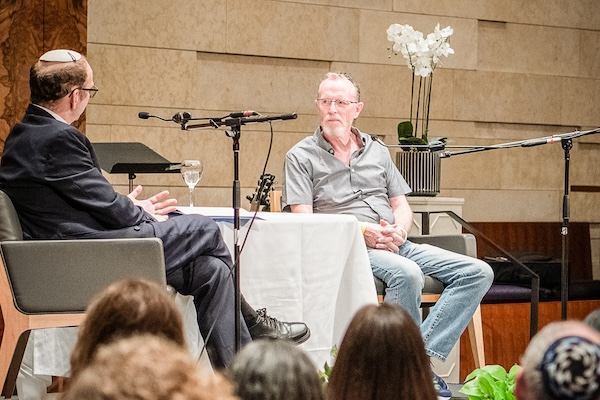
Rabbi Jonathan Infeld, left, in conversation with Thomas Hand at Congregation Beth Israel. (Adele Lewin Photography)

Emily Hand was a healthy 8-year-old girl with chubby cheeks on Oct. 7, 2023, when she was abducted by Hamas terrorists from a sleepover at a friend’s home on Kibbutz Be’eri. When she was released, 50 days later, she was a pale, gaunt 9-year-old who would not speak above the faintest whisper.

Emily and her dad, Thomas Hand, were in Vancouver this month, where the father was part of Congregation Beth Israel’s Selichot program Sept. 28. He spoke with the Independent in advance of the conversation he had with Rabbi Jonathan Infeld at the synagogue.

On Oct. 7 last year, Emily was at the home of her friend Hila Rotem-Shoshani. After the terrorists invaded the kibbutz and the murderous rampage subsided, Thomas Hand had no idea where his daughter was. It was almost midnight that evening when the Israel Defence Forces made it to Be’eri and rescued the survivors. In the chaos of the moment, Hand was told that his daughter was dead.

His immediate response was relief.

“It’s a terrible thing to say,” said Hand, “but I was more relieved and at peace that she was at peace and not being terrorized or beaten or threatened or in the hands of the Hamas.”

Eventually, it would become known that, of Be’eri’s approximately 1,100 residents, about 100 were murdered and about 50 taken hostage to Gaza. Be’eri’s surviving residents were removed to a location near the Dead Sea.

After a few days, Hand was informed that there was no evidence that Emily had been murdered. Her remains were not found and neither was any of her DNA. Hand has no explanation for how the misunderstanding occurred. His former wife, however, was found dead. (Emily’s mother died of cancer when Emily was 2.)

Now, Emily was officially missing. 

A kibbutz member mentioned to Hand that they had seen Raaya Rotem “and her two children” led away at gunpoint. Hand knew that Rotem has only one daughter – Emily’s friend Hila – and that was his confirmation that Emily had been abducted alive.

“When they told me that she was actually alive, I was in the nightmare of not knowing what the hell was going to happen to her,” he said.

It is now known that Emily, Hila and Raaya were taken to Gaza, moved from location to location for the first couple of days and then held in a house along with several other hostages.

They lived in constant terror and were given very little food – a quarter of a pita a day sometimes, though they could smell the plentiful food their captors were cooking. Their accommodations were squalid, they were watched while using the toilet and warned to remain totally silent.

Doing what he could to raise global awareness of his daughter’s situation, as well as those of the other hostages, Hand launched a campaign, beginning with a trip to Ireland. Hand had made aliyah from Ireland and Emily, as a result, is a dual citizen. Hand then traveled to the United States and appeared on American TV, further humanizing the plight of the hostages and their families.

In November last year, during the temporary ceasefire, Emily was one of 105 hostages freed. She was released along with Hila. Hila’s mother Raaya was released a couple of days later.

Hand has no clear memories of their reunion, except that he would not allow himself to believe it would happen until they locked eyes. 

“Anything could go wrong,” he said of the temporary ceasefire negotiations and promised release of the hostages. “Not until the very last second did I really believe that she was coming back, only when I saw her eyes.”

The joy of reunion was mixed with the harsh reality of what she had endured. 

“She came back a different child,” Hand said, reflecting on her transformation from an innocent 8-year-old to a much-matured child shaped by trauma. The changes were most immediately noticeable physically. “Her cheekbones were sharp, her body much thinner.”

The effects of being threatened for more than two months to remain silent did not dissipate immediately either.

“When she came back, she was whispering, just moving her lips,” he said. “Her confidence was shattered.”

Since Emily’s release, the Hands – she has an older brother, 29, and a sister, 27 – have been working to help her recover. Therapies, including horse riding, dog training, theatre and singing, have played a crucial role in rebuilding her confidence. Regular psychological support in Tel Aviv, despite being a two-hour drive, has also been essential. 

“She’s very strong, very resilient,” said her father. 

The Hand family has relocated to a semi-permanent residence near Be’er Sheva while they await the reconstruction of Be’eri, to which he is determined to return. 

“It’s been my home for over 30 years. I raised my eldest kids and Emily there,” he said. “It’s paradise. I want to go back home.”

Not all kibbutz members feel the pull to return, he acknowledged, though he estimates that 75% of the surviving members hope to rebuild there. Security, of course, is the foremost concern.

“The government needs to be different, and Hamas needs to be as weak as we can possibly make them because I need to feel safe in my own home before I would ever bring Emily back there again,” he said.

Reflecting on the international response to the crisis, Hand expressed frustration.

“Why is the UN or all the governments in the world not putting the pressure on Hamas to stop?” he asked.

To critics of Israel’s actions in Gaza, he is defiant. “We have to defend ourselves, and we will defend ourselves,” he said, “no matter what the world says or thinks.”

As Emily continues her recovery, Hand remains focused on a mission.

“Our primary concern now is getting the hostages back,” he said. 

Format ImagePosted on October 11, 2024October 10, 2024Author Pat JohnsonCategories LocalTags Beth Israel, Emily Hand, hostages, Israel, Oct. 7, Thomas Hand
Kibbutz residents returning

Kibbutz residents returning

The medical centre at Kibbutz Be’eri, where at least five people were murdered Oct. 7, 2023. (photo by Melanie Preston)

I’m sitting in the dining hall at Kibbutz Be’eri, as people begin to enter for their Sunday lunch at 11:39 a.m. Sunday is like Monday here in Israel, the work week being Sunday through Thursday.

I’d never spent time on a kibbutz until now, except for a few days on my Birthright trip, which was my introduction to Israel. But now, I’m not only on a kibbutz, but on Kibbutz Be’eri, less than five kilometres away from Gaza, less than a year after the worst terror attack on Israeli soil.

On Oct. 12, 2023, in the Times of Israel article “Be’eri’s residents are gone, but their homes attest to the horrors they endured,” there was this incredible statement by Doron Spielman from the Israel Defence Forces’ Spokesperson’s Unit: “In the same way that Auschwitz is the symbol of the Holocaust, Be’eri is going to become the symbol of the [Oct. 7] massacre. The level of inhumanity of Hamas fighters surprised even us, Israelis who had no illusions about what Hamas is.”

And, yet, here I am, bearing witness as approximately 200 kibbutz members of the 1,100 total, have returned to live here. This does not include any children, due to the war next door in Gaza, and, of course, the traumatic memories of Oct. 7. 

The majority of Be’eri’s residents have just been moved from the Dead Sea-area hotels that housed them for the past year to Kibbutz Hatzerim, 45 minutes away from Be’eri, a wonderful community who rushed to build a new section of homes to accommodate them. This is where the families with children are now settling in and where school has just begun.

But there are many residents, couples with grown children, or singles without children, who have chosen to return to Be’eri. At first, they only commuted here to work during the week, but they are now choosing to stay full-time. They are determined to be back at home, to establish new routines, care for the grounds, hang out at the local pub and prove to the world and to the enemies who tried to destroy them and their spirit that they have done anything but that. The spirit in Be’eri is hurting, yes, but it is also fierce, and it will not be extinguished.

Last week, Israel’s Channel 12 aired a new documentary showing the horror that took place here on Black Saturday. It included footage from cameras all over the kibbutz, and the camera they kept returning to was right outside the dining hall in which I am writing right now.

How different it was to watch this documentary, how odd to watch the silent camera footage, how chilling, when I knew the reality on Oct. 7 was sirens blaring the entire day, due to thousands of rockets overhead, and screams from those being attacked all over Be’eri, in neighbouring communities and all over the nearby desert and forests, as young adults ran to try and escape the Nova music festival, many meeting a violent death.

I watched the tick, tick, tick of the digital clock in the corner of the TV screen on this documentary as Hamas terrorists methodically made their way through offices and the kibbutz’s medical centre, where at least five workers were massacred, and homes and children’s rooms, trapping people together and smoking and burning people to death, shooting them if they attempted escape, like Narkis Hand was forced to do when an RPG hit her home, setting it instantly on fire.

Narkis Hand was Thomas Hand’s former wife and the mother of his older children, Natali and Aiden. Thomas Hand’s younger daughter, Emily, then age 8, was kidnapped by Hamas terrorists with her friend Hila and Hila’s mother Raaya for 50 days, though he was originally told she had been killed.

The first and only time I had been to Be’eri before now was last February, when I visited with a different resident, Adam Rapoport, whose older brother Yonatan was murdered at some point between “6:29 a.m. and the end of day,” noted the documentary, as the silent clock in the upper left-hand corner went tick, tick, tick on Oct. 7.

photo - Adam Rapoport by the Dead Sea
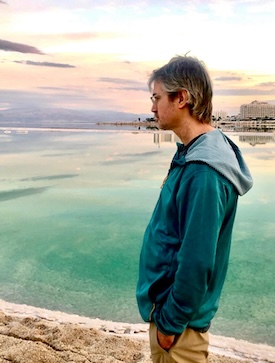
Adam Rapoport by the Dead Sea. (photo by Melanie Preston)

Like many others from these communities, Adam will never know exactly what happened to his brother that day, other than that he saved his kids’ lives by ordering them under the bed, where they would spend 11 hours listening to the horrors taking place in the peaceful community they’d grown up in. Six-year-old Aluma and 9-year-old Yosef would later tell their uncles that Dad had said he was going out to get the terrorists money at the ATM.

“There were just too many … bodies … to learn what happened, and that was just at Be’eri,” Adam told me back in February, at the Dead Sea hotel where he and other evacuees were staying, the day before he brought me here to bear witness.

This was an invasion into homes that lasted an entire day and involved such gore that I hesitate to go into detail.

It involved shooting a 3-month-old baby in the head, in front of her mother, in Kibbutz Be’eri, and burning an entire family alive from neighbouring Kibbutz Nir Oz, including all three young children.

It involved murdering parents in front of their children and then kidnapping the children – and these sons and daughters have still not returned home. Some are confirmed dead in Gaza and are bodies waiting to be brought back, like Adam’s best friend Itay Svirsky, which was how I initially met Adam and began learning about this community, while others are likely still alive in captivity, starving and suffering in ways human beings should not be permitted to suffer. But the Red Cross has done nothing for the hostages since the very beginning. 

In Israel, we have waited, prayed, hoped and fought. We have gone to weekly rallies in Tel Aviv and Kiryat Gat, saying the hostages’ names and counting the days, chanting “Achshav, achshav, achshav.” (“Now, now, now.”) 

We have had to silence our phones, as constant notifications appear, notifying us of the nonstop rockets entering our airspace and our cities from Hezbollah in Lebanon, the Houthis in Yemen and other groups in Iraq and Syria, while ongoing predictions about whether Iran will or won’t do something big (and when they will or won’t do it) are discussed and analyzed.

But, since arriving on Kibbutz Be’eri last month, I have felt a shift.

It’s a unique kind of optimism I have never quite seen. It’s pride and it’s love and it’s strength and it’s resolve and it’s “F—- you, we’re not leaving.” It’s coming from returning Kibbutz Be’eri members, it’s coming from people like myself who have come to Be’eri since Oct. 7 to help with the land and to work, to add to the life being rebuilt here and to help heal the collective broken heart of this community.

I fell in love with Israel because I fell in love with its people. I am here in Israel to tell the stories of what happened on Oct. 7, 2023, and is still happening, at every moment of every day for these incredible people, these people of Kibbutz Be’eri and elsewhere, who have come back to their lives and are attempting “normality” on their beautiful land. 

Melanie Preston is a Canadian-born, American-raised, Jewish writer and traveler who discovered Israel at the age of 26, immigrated to the country and stayed for seven years. She flew to Israel alone on Nov. 16, 2023, from her home in Charlotte, NC, and was there to March of this year. She returned to Israel last month to continue writing about the hostages and impacts of October 7th on Israeli society. She intends to spend more time with the survivors of Kibbutz Be’eri as it is rebuilt. To support her work and read more of it, go to melanie-preston.com, or visit her GoFundMe (Raising Awareness on Israel’s War).

Format ImagePosted on October 11, 2024October 12, 2024Author Melanie PrestonCategories IsraelTags Adam Rapoport, Kibbutz Be’eri, Narkis Hand, Oct. 7, Thomas Hand
Proudly powered by WordPress