Skip to content
  • Home
  • Subscribe / donate
  • Events calendar
  • News
    • Local
    • National
    • Israel
    • World
    • עניין בחדשות
      A roundup of news in Canada and further afield, in Hebrew.
  • Opinion
    • From the JI
    • Op-Ed
  • Arts & Culture
    • Performing Arts
    • Music
    • Books
    • Visual Arts
    • TV & Film
  • Life
    • Celebrating the Holidays
    • Travel
    • The Daily Snooze
      Cartoons by Jacob Samuel
    • Mystery Photo
      Help the JI and JMABC fill in the gaps in our archives.
  • Community Links
    • Organizations, Etc.
    • Other News Sources & Blogs
    • Business Directory
  • FAQ
  • JI Chai Celebration
  • JI@88! video

Recent Posts

  • Story of Israel’s north
  • Sheltering in train stations
  • Teach critical thinking
  • Learning to bridge divides
  • Supporting Iranian community
  • Art dismantles systems
  • Beth Tikvah celebrates 50th
  • What is Jewish music?
  • Celebrate joy of music
  • Women share experiences 
  • Raising funds for Survivors
  • Call for digital literacy
  • The hidden hand of hate
  • Tarot as spiritual ritual
  • Students create fancy meal
  • Encouraging young voices
  • Rose’s Angels delivers
  • Living life to its fullest
  • Drawing on his roots
  • Panama City welcoming
  • Pesach cleaning
  • On the wings of griffon vultures
  • Vast recipe & story collection
  • A word, please …
  • מארק קרני לא ממתין לטראמפ
  • On war and antisemitism
  • Jews shine in Canucks colours
  • Moment of opportunity
  • Shooting response
  • BC budget fails seniors
  • Ritual is what makes life holy
  • Dogs help war veterans live again
  • Remain vital and outspoken
  • An urgent play to see
  • Pop-up exhibit popular
  • An invite to join JWest

Archives

Follow @JewishIndie
image - The CJN - Visit Us Banner - 300x600 - 101625

Byline: Cynthia Ramsay

VICO brings artists together

VICO brings artists together

“I am very proud to be its founding artistic director,” said Moshe Denburg of the Vancouver Inter-Cultural Orchestra. “It’s like watching one’s child succeed in the world!”

But success is not something VICO takes for granted and Denburg said the orchestra team “is doing its best to keep the VICO relevant and vibrant.”

“We are a growing cultural force in B.C. and in Canada today and, in some circles, we are gaining recognition worldwide as well,” he said. “We are still one of a very few orchestral entities in the world dedicated to intercultural work. We do see our work as a window on the future, a future where there may be many intercultural orchestras in many cities…. The project is still quite young, and we need to care for it, materially and artistically, but, if we can continue to garner the support of the community in which we reside, there is every expectation that the VICO will do well for the foreseeable future.”

While Denburg “handed over the artistic reins” of VICO to co-director Mark Armanini in 2014, he still contributes compositions for performance. As well, he said, “I have acted in several capacities: artistic advisor, financial manager, diplomat without portfolio and also project manager in several areas, the main one being the Mystics & Lovers recording project.”

Released in 2016, Mystics & Lovers is a recording of two compositions that were performed by VICO and the chamber choir Laudate Singers the previous year – Ani Ma-amin (I Believe) by Denburg and Asheghaneh (Monologues Aglow) by Iranian-born Farshid Samandari.

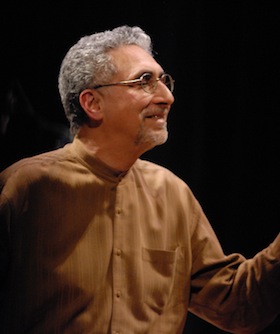
photo - Moshe Denburg
Moshe Denburg (photo from Vancouver Inter-Cultural Orchestra)

“These two works were the main pieces in the concert in May 2015, and it was decided ahead of time that we would be recording these two and making a CD from them,” explained Denburg. “The full concert program included two a capella choir pieces followed by Asheghaneh in the first half, and then two small ensemble Kurdish pieces (featuring guest soloist Jamal Kurdistani) followed by Ani Ma-amin in the second half.”

Armanini suggested that Ani Ma-amin and Asheghaneh be recorded. “The two works complement each other, and utilize vocal forces to include our collaborating choir, Laudate Singers,” said Denburg. Together, they create a recording that is about 48 minutes in length.

The collaboration between VICO and Laudate goes back to 2002, when Denburg was looking for a choir to sing one of his works. “It was suggested to me by several colleagues to get in touch with Laudate Singers and their director, Lars Kaario,” said Denburg. “This is how our first collaboration came about – in February 2003, we actually featured the world première of Ani Ma-amin.”

Since then, he said, “Laudate Singers have really felt a connection to what we are doing. The intercultural element is very striking, and gives the singers an opportunity to see and hear non-Western instruments and musicians up close and personal. For the VICO, working with choir gives us an opportunity to expand the 25-member (approximately) orchestra with 25 voices, creating a very impressive sonic and visual experience. It also helps to combine our audiences, a great synergy in the arts, where fans are often hard to find, and harder to hold onto.

“The present realization of Ani Ma-amin differs a little from the original, not musically but rather in the instrumentation,” he added. “Certain instruments that were available in 2003 were not available in 2015, so some substitutions had to be made. This is part of the intercultural process today – for example, if we want an oud (short-necked Middle Eastern lute) player, we have maybe two to choose from; if someone moves away and another is unavailable, we simply do not have that instrument at hand; this is unlike a violinist, let’s say, where you can have several hundred professional players in Vancouver.

“Also of note is that one year after the première in 2003, Laudate and VICO, with a contingent of players from the VSO [Vancouver Symphony Orchestra], performed Ani Ma-amin at the Orpheum Theatre in a tribute concert of peace for the Dalai Lama, who was visiting (April 2004). In the audience were other dignitaries as well – the late Rabbi Zalman Schachter-Shalomi, Iranian peace laureate Shirin Ebadi and Archbishop Desmond Tutu.”

The press release for Mystics & Lovers highlights the common themes of Ani Ma-amin and Asheghaneh, which Laudate Singers also premièred, in 2006.

“Both draw on the poetic best of many cultures in order to build bridges between them,” says the release. “Both strive for unity in diversity, expressing a longing for peace and understanding, and seeking connection between personal love and spiritual devotion. Both make use of the human voice and instruments from many countries, both ancient and contemporary, to highlight both the commonality and contrasting expressions of these deeply human sentiments, and both draw on centuries-old texts (by the 12th-century rabbi/philosopher Maimonides in Ani Ma-amin and the 11th-century Persian poet/philosopher Baba Tahir in Asheghaneh) that still resonate today.”

photo - Farshid Samandari
Farshid Samandari (photo from Vancouver Inter-Cultural Orchestra)

“While Moshe’s approach is more ‘orchestral’ in the sense of blending the colours to create new shades, I tend to focus on individual colours and the transformation of timbre,” says Samandari in the release. “Also, while Moshe, in creating his polyphony, draws upon the accepted Western chordal system, I explore species counterpoint, combining different musical styles and sonorities to create harmonies. Finally, Ani Ma-amin is a statement of belief in an ideal (Messiah); Asheghaneh describes a journey through trials and tribulations, reaching for the ideal (Beloved, by whatever name you call Him/Her).”

“Two aspects of our human expression are directly represented and expressed by the two works on the recording,” Denburg told the Independent. “My work is an expression of devotion to the ‘messiah idea,’ a time of peace and of goodwill, whereas the Samandari work takes as its starting point the yearning of the lover. However, both works cross over into the other’s realm: the messianic time yearned for in Ani Ma-amin will ultimately be crowned by the embrace of lovers; and the beloved who is yearned for in Asheghaneh is readily understood as the divine presence. This is the connection: the realms of the mystic and the lover come together.

“Musically speaking, Farshid and I draw upon different musical experiences – in my view, he is concerned with transformations of his experience with Persian musical ideas and modes, whereas I am coming from a Jewish modal perspective. I am also informed by my experiences in India, and this can be heard in the third movement, with the kind of melismatic singing which emulates Indian vocal technique. I would say that what unifies us is the use of modes in our works, and thus a certain melodic lyricism. To my mind, Farshid also draws upon the spirit of chanting in the Iranian Bahá’í tradition. So really, two strong sacred traditions are represented here.”

Since its founding in 2001 as a society, VICO has commissioned and performed almost 100 pieces (small- and large-scale), said Denburg, noting that there are several ways a piece gets commissioned. One way is to apply to the Canada Council “to raise funds to commission a significant new work from a particular composer.”

As well, he said, VICO holds workshops for established composers wanting to learn about writing for non-Western instruments and workshops and classes for young student composers. The established composers will create pieces using “smaller forces, perhaps one non-Western instrument with a string quartet,” while the students “are encouraged to write for small combinations of instruments, and have their pieces premièred as part of a recital; such was the case recently at our inaugural Summer Academy (June 26-July 1),” said Denburg. “Finally, directors of the VICO, in collaboration with interested composers, decide to commission a new work directly.

“The decision to commission a particular composer, in a particular style, is made once the main theme of a concert or a festival project is established. For example, we recently held a festival called Hands On (June 6-11), a series of concerts featuring percussion and drums from all over the world. It included many melodic instruments as well, and composers were sought out to write for the combinations of instruments at our disposal. When we include both large and small commissions, our recent festival, Hands On, and the Summer Academy brought about the creation of 12 to 15 new works.”

Mystics & Lovers is available for purchase on the VICO website (vi-co.org), at iTunes and at other digital music stores.

Format ImagePosted on July 21, 2017July 19, 2017Author Cynthia RamsayCategories MusicTags Farshid Samandari, inter-cultural, Moshe Denburg, music, VICO
Marketing of technology

Marketing of technology

Yonatan Avraham, student ambassador of HUstart, left, and Tamir Huberman of Yissum are two of the four speakers who will be participating in Jerusalem of Gold: Capital of Innovation & Tech on July 16. (photos from CFHU Vancouver)

“I have always loved the thrill you feel while creating your own project, seeing it grow and being responsible for the outcomes – and the satisfaction you feel while convincing a stranger to give his or her resources (time or money) for your product,” said Yonatan Avraham, student ambassador of HUstart, Hebrew University of Jerusalem’s entrepreneurship centre, about what excites him about being an innovator and entrepreneur.

Avraham is one of four speakers who will participate in Jerusalem of Gold: Capital of Innovation & Tech, which will take place on July 16 at the Jewish Community Centre of Greater Vancouver. The event is being hosted by Canadian Friends of the Hebrew University, the Jerusalem Foundation and JCCGV. Avraham will be joined by Lior Schillat of Jerusalem Institute for Policy Research; Maya Halevy of Bloomfield Science Museum Jerusalem; and Tamir Huberman of Yissum, HU’s technology transfer company. The Jewish Independent’s interviews with Schillat and Halevy appeared in last week’s issue (see jewishindependent.ca/jerusalem-a-high-tech-hub).

“All of the speakers are coming from Israel especially for this tour in Western Canada. We will be in Vancouver on July 16, Calgary on July 17 and Edmonton on July 18,” said Dina Wachtel, Western region executive director of CFHU, of the tour, which celebrates the 50th anniversary of the reunification of Jerusalem.

“Tamir is going to give a talk on Friday, July 14, at Simon Fraser University titled The Power of Social Networks: Boosting the Marketing of Innovations, organized by Fred Popowich, executive director of Big Data Initiative at Simon Fraser University,” she said. “Part of our mandate is to create these living bridges between Hebrew U and our local universities; hence, this is part of this initiative.”

Huberman is Yissum’s vice-president of business development and director of information technology. At the JCCGV, he will talk on Marketing Innovation: Changing Israel and the World.

In the press material, Huberman notes, “As the only university in Israel with a school of agriculture, research in non-GMO hybrid seeds at Hebrew U is changing the way millions of people eat now and into the future.” He also notes that Mobileye, which recently sold to Intel for $15.3 billion US, was founded by HU Prof. Amnon Shashua.

Yissum “operates on a royalty-based model which channels proceeds from successful products back to the researchers, their labs and the university itself,” he explains. It also generates funds “by attracting corporations to collaborate with Hebrew University labs to find the answers the businesses are seeking.”

About what B.C. (and other) universities could learn from HU, Huberman told the Independent, “I believe that the top lessons are how to be more effective and how to remove barriers for doing business. In most cases, tech transfer companies around the world are [viewed] as a bureaucratic entity that complicates things. The greatest lesson is making adaptations that would make things simpler for the companies that want to do business with us…. The second lesson is the realization that, for each new technology, there either has to be someone in the world that would be interested in acquiring a licence, or someone in the world that knows the technology does not have a chance. It is the ‘job’ of the tech transfer to find that ‘someone’ and, from my experience, the best way to do that is by using social networks. The revolution of social media allows getting fast replies from people all around the world, even if you’ve never met them.”

Huberman has always loved innovation and, he said, “it was a big dream of mine to be an inventor and work with new inventions.”

While working for the company Medis from 1996 to 2002, he was exposed to the world of patents and the process of writing patents as an inventor. “After my own experience as an inventor,” he said, “I knew I had to find a place that works with new patents at a massive scale.”

It was his “strong passion for new patents and ideas that was the top reason for joining Yissum,” he said. “Second was the opportunity to work with some of the most brilliant researchers in their fields. Third was my realization that there was something missing at the time before I joined Yissum, which had to do with the very low use of the internet in order to expose the technologies from the universities to the world.

“Before I arrived at Yissum, I made a simple search using freely available patent databases and saw that only a small fraction of the patents I found [were] on the tech transfer websites. When I realized this, I had a vision of changing how tech transfer companies worked…. My dream materialized when I created the first portal for all the technologies at Yissum and later created the ITTN website (Israel Technology Transfer Organization). ITTN was the first website in Israel that allowed all of the inventions from academic institutions in Israel to be found in one central portal.”

He added, “I believe that there is a lot that can be done to make a better and faster connection between companies seeking talent or innovation to the offerings of universities…. [B]uilding a portal that connects more universities in Israel and the world could help make that matching much more efficient.

“Another realization is that tech transfer companies traditionally showcase technologies and I believe that this is not the best approach…. [T]he portals should focus on the researchers and their capabilities, rather than just the patents that a small portion of them invented. We have multiple examples of companies that were interested in researchers that we did not even know [because] they never had any patents.”

One of the jobs of HUstart – of which Yissum is part, along with HU’s science faculty and business school – is to provide “practical education, support, mentorships and connections needed” for students and others “to become effective entrepreneurs.”

Avraham is a third-year physics student at Hebrew U and is in the first cohort of the new Physics and Entrepreneurship program, which connected him – during his second year of study – with his business partners. Avraham and fellow students Michael Levinson and Tom Zelanzy co-founded the start-up Gamitee, which “links social media and shopping websites, making it possible for friends to easily invite others to join them in a shopping experience.”

Avraham has other ideas, such as one for an “infant sleeper that monitors a baby’s vital signs, a technology that could potentially prevent SIDS.” And he and his wife – who is an archeologist – also run a tutoring business. In Vancouver, he will speak on The Making of a Serial Entrepreneur.

“I think they have a lot of similarities,” he said about physics and building a tech start-up. “In both, you need to solve complex questions and problems that are comprised of several independent factors. Both of them are professions that people rarely choose. And they are both very, very hard to understand. I think my physics background [increased] my range of abilities needed [to be] an entrepreneur.”

Jerusalem of Gold: Capital of Innovation & Tech is open to the public. Tickets are $45, though students who register at the CFHU office can receive a free ticket. For tickets and the speakers’ bios, visit cfhu.org, email [email protected] or call 604-257-5133.

Format ImagePosted on July 7, 2017July 17, 2017Author Cynthia RamsayCategories LocalTags CFHU, entrepreneurship, Hebrew University, Israel, Jerusalem, technology
An out-of-hand hobby

An out-of-hand hobby

Si Kahn plays at the folk festival, which runs July 13-16. (photo from sikahn.com)

While Charlotte, N.C.-based folk musician Si Kahn – who’s coming to play at the Vancouver Folk Music Festival next week – may have called the United States home for most of his 73 years, he spent about 12 of his first 16 months of life in Canada. His father, Rabbi Benjamin Kahn, was sent to Montreal by B’nai B’rith in 1944 to help set up the Hillel Foundation at McGill University, which he did for just over a year before being called back to Pennsylvania State University.

“I like to say that I don’t have a single negative memory of my time in Montreal,” said Kahn, whose father eventually became the international director of B’nai B’rith Hillel Foundation (1959-1971).

And Kahn’s Canada cred goes back further.

“After my paternal grandfather, Gabriel Kahn, deserted the czar’s army and walked across Europe, he was a pick-and-shovel labourer for the Canadian Pacific Railway, helping build the ‘northern spur’ through the [Canadian] Shield towards Timmins,” Kahn told the Independent. “He was also a hod carrier in Winnipeg, helping build the Royal Alexandra Hotel, carrying 100 pounds of bricks or mortar up 10 or more storeys on his shoulders.”

Kahn tells his grandfather’s story – and that of many other members of his family – in the musical Hope. The song “Crossing the Border” highlights the border-crossings of his grandfather’s journey from Russia: “He got passage to Nova Scotia / Got married in Manitoba … Then he moved down south of the border / By the mills on the Merrimack River / He pumped gas and kept store for a living / Raised up his daughter and sons.”

Gabriel and his wife, Celia, settled in Lowell, Mass., said Kahn, who wrote about his Jewish roots and their influence on his music in an article called “The Chords that Bind.”

“When I was growing up … our family sang together,” he writes. “On the Sabbath and on holidays, we would stay at the dinner table long after the food and dishes had been cleared, and we would sing. Because musical instruments were not allowed on the Sabbath, we sang without instrumentation – but not without accompaniment.”

From his paternal grandfather, he learned “the fine points of creating a rhythm section, using only two basic variations (closed fist and open palm) of the basic hand-on-table technique.” From his parents, he and his sister, Jenette – whose career in the comic book industry included being president of DC Comics for more than 20 years – learned “the rudiments of high and low harmony, made up as you go along.”

The songs they sang were mostly prayers. “We sang a little bit in Yiddish, too, folk and story songs from the Old Country, which in this case meant almost any place in Europe,” he notes. And, despite his not understanding most of what he was singing, he did understand “what the songs really meant to us as Jews, as a family, as people in the world. They were our bond, our unity, our affirmation, our courage. They were our way of claiming our rhythmic and harmonic relation with each other and with our community. Our songs reinforced our solidarity, our sense that we could overcome the obstacles in our path.”

As for when his musical career began, Kahn told the Independent, “You might say I ‘turned professional’ in 1974. I had just turned 30 years old a few months before I recorded my first album, an LP titled New Wood, which was released in 1975 on June Appal Records.

“One of my first paid public performances was in 1979 … at the second-ever Vancouver Folk Music Festival. I’d led traditional labour and civil rights songs at rallies and demonstrations and on picket lines, but Vancouver was one of the first times I played my own original songs in public.

“While I do consider myself a professional musician, and while I’m a longtime member of the American Federation of Musicians (AFM), music has always been a very part-time vocation for me. My lifetime identity and work since I was 21 years old has been as a civil rights, labour and community organizer.

“I once told a reporter that my music is ‘a hobby that got out of hand.’ That’s really an accurate description. I typically do no more than three festivals and a dozen concerts each year at most. Most of my appearances are benefits for progressive nonprofits,” he said, adding that he’d be performing at the Vancouver Folk Music Festival house-party fundraiser on July 12.

Kahn heads to Orillia, Ont., for a July 7 performance at the Mariposa Folk Festival. From there, he’ll come to Vancouver for the folk festival, but also “to do some organizing work for Musicians United to Protect Bristol Bay.” It’s a cause he’s been helping on a volunteer basis since 2010 – the campaign’s goal is “to stop the Pebble Mine, and to protect permanently Alaska’s Bristol Bay, a cultural and environmental treasure, and one of the world’s last remaining great wild salmon fisheries.” He has donated all of the income from his 18th CD, called Bristol Bay, to the musicians’ group.

About combining music with activism, Kahn said, “The defining moment for me came when I was working with the Student Nonviolent Coordinating Committee (SNCC) on the Arkansas side of the Mississippi River Delta in the summer of 1965, when I was 21 years old, during the Southern Civil Rights Movement, which was very much a singing movement. That was when I first began to understand the usefulness of music in movements for social justice.”

Among Kahn’s many achievements in the social justice arena was being, in the early 1980s, an initial organizer and the founding national board chair for the Jewish Fund for Justice, the predecessor to Bend the Arc: A Jewish Partnership for Justice. He has written three books on community organizing.

“I see myself as an organizer, which I consider a specific type of activism, rather than as an activist,” he explained. “Organizers work to bring people together so that they can use the power of numbers to counter the power of money, authority and/or force.

“In any organizing campaign, in any campaign for justice, there will be competing sets of ‘facts.’ Whether our facts are more accurate/truthful than their facts isn’t nearly as important as whether, through organizing, we can build enough collective power to persuade those who have the ability to make the change, or changes, we’re asking for to meet our demands.”

On the topic of truth, Kahn said, “For me, there’s a difference between accuracy and truthfulness. Take, for example, the story of Moses receiving the Ten Commandments on Mount Sinai. Is that story accurate in the literal sense? But it should be told and retold truthfully, meaning that it’s our responsibility to transmit the story as it was told to us, whether verbally or in written form.

“My question is whether, in the real world, it’s even possible to differentiate,” he said. “If someone believes something passionately, it’s more than likely that no amount of either ‘facts’ or ‘alternative facts’ is going to persuade them to change their mind.

“Minds are more likely to be changed by experience. One of an organizer’s roles is to help the people she/he is working with have experiences through which they achieve a sense of possibility, that the world might be different for them and for others like them.

“This is also one of the places where storytelling can be useful. Years ago, I was in an audience listening to former U.S. senator Paul Simon. I don’t recall the specifics but, at one point, he was challenged on his support for legislation concerned with disability rights. He could have answered with facts/statistics (or, for that matter, with ‘alternative facts’). Instead, he said, ‘Let me tell you about a young man I know,’ and proceeded from there.”

In the musical Hope, there is a song called “Dreamers,” the chorus of which calls for us to “honour the dreamers.”

“I consider myself a ‘practical radical,’ someone who helps people work towards what at least appear – based on careful analysis and strategic thinking – to be achievable goals,” said Kahn. “If that’s being a dreamer, dayenu.

“There are many things I’d like to see in this world we share that I just don’t see as possible. I may be wrong in that judgment. But, if I’m going to help people organize themselves in order to achieve a goal they share, I need to believe there’s at least one and hopefully several practical paths to achieving that goal.

“The ‘dreamers’ I honour are those who not only have a dream, but who do everything they can to make it real.”

For the Vancouver Folk Music Festival’s 25th anniversary, Kahn wrote the song “For Canada,” which recalls the Underground Railway, the slaves making their dangerous way here: “When all hope was failing, think what strength it gave / To dream about a country that no longer held a slave….” A country to which, “… my own father’s father came with willing hands / To bend his back and lay the track across this wild land….”

And it was on his way home (by car) from his 1979 festival appearance that Kahn wrote “Plains of Canada,” the lyrics of which show his affection for the country – an affection that endures.

And so, too, does his love of singing and performing.

“Vancouver resident Josh Dunson, who was my agent for over 30 years until his retirement from the music business, once told me that what I bring to my musical performances is my many years’ experience as an organizer. That’s a very perceptive observation and a good description of what I try to do in the musical part of my life and work,” said Kahn. “When I’m planning a concert, when I’m on stage, I’m doing my best to help those who are listening feel that they’re not so much a passive audience but active participants. Sometimes this means singing along, sometimes it means thinking about what they’re hearing and applying it to their own lives and their own work. It’s that possibility that still excites me even after all these years.”

This year’s folk festival, once again at Jericho Beach, starts with a free concert the night of July 13, and then there are day and weekend passes that can be purchased for the performances July 14-16. For tickets and the full schedule, visit thefestival.bc.ca.

Format ImagePosted on July 7, 2017July 5, 2017Author Cynthia RamsayCategories MusicTags Bristol Bay, Si Kahn, social justice, tikkun olam, Vancouver Folk Music Festival
DOTE dances across the street

DOTE dances across the street

LINK Dance Foundation will perform Why did the Chicken Cross the Road? at a few intersections in Vancouver during Dancing on the Edge. (photo from DOTE)

As part of this year’s Dancing on the Edge festival, which takes place July 6-15, LINK Dance Foundation will explore the age-old question, “Why did the chicken cross the road?”

“The idea for Why did the Chicken Cross the Road? came about through various stages, like all things do,” said Gail Lotenberg, founding artistic director of LINK. “The germination to the actual realization was a process and it is still in development for the future.”

DOTE producer Donna Spencer invited Lotenberg to be involved in this year’s festival with a specific piece, but the timing wasn’t right. “So, I told her I had another idea for this year if she was open to it. We had a meeting and together we cooked up this piece,” said Lotenberg.

Leading up to the 2013 provincial election, she said, “I wanted to help attract young people to exercise their right to vote, so I spearheaded a dance performance at the intersection of Davie Street and Granville Street with signage from Rock the Vote BC.

“The dance did not deliver overt messages about voting (though there were subtle motifs in the choreography), rather it aimed to stop people in their daily lives to enjoy viewing a quick dance by an ensemble of dancers as they crossed a busy intersection. We had people stationed at the corners to hand out pamphlets with more specific information about voting day.”

The concept was introduced to Lotenberg in 2005 by a “close friend and colleague, Cara Siu, who came to Whitehorse, Yukon, when I used to live there. At that time, I was producing an annual festival called Dancing in the Streets. She came from Vancouver to make a dance at the intersection of two main streets in Whitehorse as part of the week of outdoor dance performances. I loved the idea and always knew I would use it again.”

For the 2017 incarnation, Lotenberg said she wanted to “include a large pool of less-well-known dancers in the community in a site-based work at intersections” and Spencer was all for it.

“In fact,” said Lotenberg, “it was her idea to involve young dancers from pre-professional training programs in the project. She also saw the benefit of having DOTE volunteers on the corners to provide more information to people about other shows they could see during the annual summer festival. Donna really helped to make the idea crystallize into what it is now, a work for eight dancers – mostly young dancers in the final stages of their training with the exception of two professionals. The two dancers who would normally be considered out of their training stage … will perform my core idea of a duet between pieces of white cloth to complete the show.”

Lotenberg, however, won’t be performing. “I will not be dancing in this work,” she said, “unless I’m wearing a chicken costume.”

She hopes “Intersection Interventions” will become “an annual part of DOTE, in the way Dusk Dances were a signature aspect of the festival for almost a decade.”

She said, “I believe in public art. I see myself as someone who evolved from the same fabric as the public frivolity movement of the 1990s – Unsilent Night, flashmobs, etc. These are acts of art that enhance our civic arena.

“I like art that engages people in community and invites people briefly into the humanizing experience of co-creating art. I don’t like art that does this by ignoring the principles of composition and virtuosity and esthetics, meaning they are inclusive but not very entertaining. So, I strive to find the duality that makes work provocative and pleasing to view, while at the same time offering some type of invitation to be an active rather than a passive participant.”

From 2008 to 2012, Lotenberg was an associated artist with Simon Fraser University’s Centre for Dialogue. The academic director of the centre then, Mark Winston, supported many of her endeavours, she said, “because he saw my work as a model for how to employ art as part of public engagement and how to construe social engagement as fertile soil for making art. I am grateful to Mark for that period of cross-pollination of ideas and expertise. He, too, is a Jewish person and together we mined the depths of what it meant to be Jewish and engaged in our mutual professions, he as a scientist and director of the CFD, me as a dance artist and director of a dance company.”

She said, “When I was a younger artist, there was a hierarchy in my mind that put work onstage above public-engaged art practice. Then I met Liz Lerman, a famous populist choreographer from the U.S., and I shifted my perspective to a less hierarchical model.

“I love seeing how dance can enter the public domain and engage people in something that lives between the opposing ends of a spectrum. On the one hand, you have pure social dancing that is non-performative but fully inclusive and, on the other end, you have very formal dance performance, which occurs on a stage with no apparent involvement from the audience except as witness. I love the in-between.”

Over the course of her dance performance and choreography career, Lotenberg has created many works that combine dance and activism.

“I’m a political person,” she said. “I grew up that way. As a Jewish person, I was taught to think in terms of how I could contribute to making the world a better place. I use my attributes as a choreographer to bring people together in a way that feels beautiful or powerful or profound or just fun.

“Take the Occupy Movement, for instance. I see something like that and I think, ‘Oh, imagine how easy it would be to occupy more space by getting people to not just stand around and chant but rather to do a square dance, which inherently takes up a lot more space.’ In occupying space with a square dance, people are using dance politically and the results are varied. People are having more fun. Authorities may not feel so threatened because the impulse is to relish life, not to be destructive, which is true of most political movements that are not hate-based. So, dance for me is an interface between the institutions we hope to shift and the people who are trying to have sway in shifting those institutions.”

Being Jewish has informed Lotenberg’s way of engaging with the world in various ways.

She said, “Being Jewish made me a political person and that feeds an aspect of my choreographic interests…. Being Jewish also surrounded me with people who embrace ritual and ritual is an important aspect of art. Being Jewish led to many opportunities to be in community through song and dance, and there is nothing more uplifting than that. In fact, I would say that these acts of sharing voice and song are what do connect me to my spirituality.

“And finally, I grew up as a New York Jew and my parents were very involved in the Civil Rights Movement of the 1960s. We moved to a town that was emerging as a leader in desegregation of schools, so I went to a school right from Grade 1 that was racially mixed.”

Lotenberg earned her bachelor’s degree at University of Michigan, was a dance teacher and skier in Crested Butte, Colo., for about five years and then did her master’s degree in history at University of Washington. In Seattle, she said, “I met a Vancouver boy, graduated, sold everything, moved here and then, within a year, we left for the Yukon.”

While Yukon was home from 1993, Lotenberg returned to Vancouver often for dancing. In 2007, she and her family moved to Bowen Island – “bad for my dancing career but otherwise wonderful,” she said.

Lotenberg took an approximately three-year break from dancing to be more present for her daughter, who has a learning disability, she said. “She’s good now. She’s strong and knows how to self-advocate for learning support that allows her to perform well in school. And, she basically is my happy place. But, I missed dance and being with other dancers – people who see and sense the world through a different lens.

“I feel gratitude at the opportunity to re-enter the dance milieu from the place I am today. I am grounded; I have a good job as a pilates instructor; I want to have my work seen and appreciated but that desire does not define me anymore. I am eager to share my work, but I feel strong and I feel confident and I trust that my work is valuable because it is honest and well-crafted and unique.”

Lotenberg is in the midst of developing a new stage work for next year’s DOTE in which she will be dancing.

“It is a piece I am challenging myself to take on because it feels important for me to step back into the dancing body to tell my story in a real and vulnerable way,” she said. “In fact, the application to show this work I’m describing is what actually led to having Why did the Chicken Cross the Road? happen at this year’s festival. Life is a beautiful journey that way. You sow seeds but you don’t always know how they will bear fruit.”

The promotional material for Why did the Chicken Cross the Road? asks the question, “Rather than walk, why not dance to get to the other side?” What can be gained from dancing, even if only across the street?

“Dancing is liberating,” said Lotenberg. “Dancing is frivolity and elemental connection (at the same time). Dancing is one of the first forms of art and, in some cultures, it is the glue that defines who they are, how they touch the earth with their feet and what is the rhythm of their heartbeat.

“I tried to leave dance and choreography to become a better mother. I did become a better mother but I also realized in that period that dance is essential to who I am.

“Dancing across the street,” she said, “is a way of celebrating life, is a way of being part of making the world a more beautiful place, is an invitation to be part of a happening that makes today just a bit more rich than yesterday or tomorrow.”

For the times and locations of Why did the Chicken Cross the Road?, visit dancingontheedge.org/program/chicken-cross-road. For the full DOTE schedule, visit dancingontheedge.org.

Format ImagePosted on June 30, 2017June 29, 2017Author Cynthia RamsayCategories Performing ArtsTags dance, Dancing on the Edge, DOTE, Gail Lotenberg, LINK Foundation, public art
Jerusalem a high-tech hub

Jerusalem a high-tech hub

Lior Schillat of Jerusalem Institute for Policy Research and Maya Halevy of Bloomfield Science Museum Jerusalem will speak at Jerusalem of Gold: Capital of Innovation & Tech on July 16. (photos from CFHU Vancouver)

“Hebrew University is probably the only university that ‘founded’ a state rather than vice versa, as the cornerstone for the university was laid on July 24, 1918, and, on April 1, 1925, the Mount Scopus campus was opened,” Dina Wachtel, Western region executive director, Canadian Friends of the Hebrew University, told the Independent. “The contemporary history of the city of Jerusalem and the story of the Six Day War is intertwined with the story of the university – what better way to celebrate that than by bringing in four of Jerusalem’s change-makers?”

The July 16 TED Talk-style event at the Jewish Community Centre of Greater Vancouver – hosted by CFHU, the Jerusalem Foundation and JCCGV – “is a celebration of the start-up nation and the role the city is playing in becoming a centre for innovation and technology,” said Wachtel. “Thus, it is also the story of how innovation improves the lives of humanity in this world regardless of boundaries of any kind: geographical, political, ethnic, religious.”

At the event called Jerusalem of Gold: Capital of Innovation & Tech, the speakers will be Lior Schillat, director general of Jerusalem Institute for Policy Research; Maya Halevy, executive director of Bloomfield Science Museum Jerusalem; Yonatan Avraham, student ambassador of HUstart, the university’s entrepreneurship centre; and Tamir Huberman, vice-president of business development and information-technology director of Yissum, the technology transfer company of Hebrew U. The Jewish Independent interviewed each of the presenters in anticipation of their Vancouver visit, and will feature Schillat and Halevy this week, and Avraham and Huberman on July 7.

Schillat will talk about Jerusalem’s Population: What Does the Future Hold? But first, what about the Jerusalem of the past – what would have inspired a Canadian Jew to make aliyah 50 years ago?

Actually, said Schillat, in the 20th century, the biggest wave of immigrants from countries such as Canada came right after the Six Day War.

“If you’re Canadian and you’re making aliyah in ’67 and you’re choosing Jerusalem for your home, I guess the main reason you would do that would be because of the spiritual effect the glorious victory of 1967 would have on you,” said Schillat.

“If you are a bit more practical, you also understand that, with this victory, Jerusalem, for the first time since 1948, became again the centre of the country … centre in the geographical meaning and also the centre of attention as to what was going on in the country.”

Fifty years later, he said, while “we still haven’t reached some kind of stability in the situation in Jerusalem,” the city “is one of the most interesting … cities in Israel, and why is that? First of all, it’s Jerusalem, meaning it’s beautiful, it has stories that are in the heart of billions of people all over the world…. I would say the Jerusalem brand is stronger than any other brand in Israel, including the Israeli brand itself…. So, if you would come to Jerusalem, it would be because you want to spend your life in a way that is a bit more meaningful than … in any other city in Israel, in any other Western country.”

In Jerusalem, he said, “from the moment you wake up until the moment you go to sleep, you live for something, for an idea. It’s true for everyone – of course it’s true for religious people, but it’s also … true for secular people. Life here just has much more meaning. You know, it’s not for nothing that Jerusalem is 10% of the Israeli population but 25% of civic society organizations are based here. And if you look at Israel’s biggest struggles or debates, many of them were generated from the Jerusalem society.”

Jerusalem is a completely different city than it was 50 years ago, said Schillat. “Jerusalem is one of the most advanced high-tech ecosystems in the world today…. When you look at the numbers, you see that, today, Jerusalem is considered among the 30 biggest ecosystems in the world. And some of the researchers even say that they would consider it for next year among the 20.”

It’s not the tech hub that Tel Aviv is, he acknowledged, but, in proportion to its population, Jerusalem rates high on the tech scene. And this shouldn’t be surprising, he said.

“People here are using their minds all the time, and high-tech is exactly that – it’s how you use your mind in order to create gain, in order to create technology that could help better the world…. The number of technological companies in this city has more than doubled in the last four years. The number of employees in high-tech is growing 15% every year for the last three years.”

Schillat gave as the best example of Jerusalem’s growing prominence in this area the recent acquisition by Intel of Jerusalem-based company Mobileye for $15.3 billion. Not only that, he said, but Intel also has decided to base in Jerusalem its international research and development centre for autonomous cars.

“I don’t see the Jerusalem of the future as being another New York or another Frankfurt or another Tel Aviv; it won’t be a financial centre. I see it as a city of knowledge; of creating fruits from thinking, from knowledge, from discussion. And I also think that Jerusalem is facing now the amazing challenge, and very hard challenge, of integrating into this group of thinkers and builders the more weak populations…. The real test for Jerusalem for the next 50 years would be, ‘Did you integrate the Charedi groups, did you integrate the Arab groups into this economic development model of a city of thinkers, or did you just go with this idea by yourself, meaning just a small elite group of thinkers went with it by themselves and left the majority of the city behind?”

One facility that is trying to integrate various population groups is Bloomfield Science Museum. Founded and operated by the Jerusalem Foundation and HU, the museum is supported by the national and municipal governments. Its website describes science “as a common language that disregards physical borders, cultural and religious differences and enables dialogue among participants with a common interest and diverse backgrounds.” Halevy will talk on the topic Raising a Start-up Nation.

“There is much research that shows that young kids love science and science classes,” she said, “but they don’t see themselves in a STEM [science, technology, engineering and mathematics] career, mainly because they believe that having a STEM career is being a scientist, which they think it is to work alone in a lab, and can be relevant only to the best scholars. Our role is to show the variety of opportunities that STEM learning can open for them in a future career.”

Bloomfield serves as a lab and hub for education programs, she said. “As a lab, we develop new approaches, new pedagogy, new tools, and we test those with a variety of people, as we are also a hub for all the communities in Jerusalem.”

The museum collaborates with institutions around the world, as well. A current exhibit that will travel to Ottawa, among other places, is the Bicycle Exhibition 2 x 200. The new Canada Science and Technology Museum is set to open in November after extensive renovations and the exhibit is scheduled to arrive there after a few other stops.

The idea for the exhibit came when Halevy was on a visit to Ottawa in October 2015, at the request of then-Israeli ambassador to Canada Raphael Barak, “who wished to develop cooperation among cultural institutions from Canada and Israel.”

Visiting the museum while it was under renovation, Halevy saw the collection of bicycles it had in storage and learned that 2017 would mark 200 years since this invention.

“So we decided to focus our cooperation on a bicycle exhibition,” she said, “to use their collection and to add interactive exhibits – we are very experienced in this field – and the idea was that we will develop and build the whole exhibition in Jerusalem and later on it will travel to Ottawa.

“We were lucky to find two more partners, from Germany and Italy, that loved the concept of the exhibition and that wished to join us, so the tour will start in Jerusalem, will move to Bremen (July 2018) and then to Naples (July 2019) and will end in Ottawa (2020). We were also approached by other museums that wish to present the exhibition after the partners’ tour ends.”

Bloomfield signed a letter of intent with Ontario Science Centre last year. “The main idea is to develop our cooperation around the culture of innovation and to start developing this culture from an early age, as the future of both our economies is based today on innovation and entrepreneurship,” explained Halevy. “We plan to develop together an interactive exhibition and special programs for young children and youth and to connect them to each other. We wish to open the exhibition and launch the programs in 2018 – 70 years to the establishment of Israel. During my time in Toronto, I will have a meeting with the CEO and president of the Ontario Science Centre, Dr. Maurice Bitran, to discuss it more in-depth.”

As for other collaborations with Canadian institutions, Halevy said, “We might develop new collaborations on my tour, as I plan to visit my colleagues from Calgary and Vancouver.”

Jerusalem of Gold: Capital of Innovation & Tech is open to the public. Tickets are $45, though Wachtel said, “Students who are interested in coming to the event are welcome to register at our office and receive a free ticket.” For tickets, the speakers’ bios and other information, visit cfhu.org, email [email protected] or call 604-257-5133.

Format ImagePosted on June 30, 2017June 29, 2017Author Cynthia RamsayCategories Israel, LocalTags Bloomfield, CFHU, Dina Wachtel, Hebrew University, high-tech, Israel, Jerusalem, Maya Halevy, museums, science, Tamir Huberman, Yissum
Join Bob Bossin at folk fest

Join Bob Bossin at folk fest

Bob Bossin as Davy in Davy and the Punk. (photo by Derek Kilbourn)

For legendary Canadian folksinger Bob Bossin, who has called Gabriola Island home since 1991, it all started with “The King.”

“It was Elvis,” he told the Independent about his start in music. Bossin is among the performers featured at this July’s Vancouver Folk Music Festival. “I loved the early rock ’n’ rollers, and asked my parents for a guitar when I was 9. They bought the cheapest one – ‘he’ll never stick with it’ – and I only stuck with it because they said I wouldn’t.

“That would have been 1955,” he said. “It only took a few years for the music industry to take over rock ’n’ roll and turn it mushy. Then, one night in 1958, I was listening to the radio and they played a spare, strange song about a man who was about to be hanged for murdering a woman, a particular woman named Laura Foster. His name was Tom Dooley. It was the damndest song I’d ever heard. I was hooked by folk music and have stayed hooked for 60-plus years.”

For Bossin, “Folk music is just the musical expression of what you might otherwise talk about or write about or argue about or read about.

“I suppose I like performing because I like the attention. I also like that you can get ideas across, sometimes profoundly, once you’ve learned the skills to do that. When I was performing Davy the Punk, my show about my dad’s life in the 1930s gambling business, I loved to show an audience that you could spark their interest and pull them into a world they knew little about, and do it with just a bare stage, a beat-up acoustic guitar and 50-odd years of learning how to tell a story.

“At this late date in my performing career,” he said, “I also realize there is a part of the history of folk music that we old fogies can share, those of us who saw or hung out with Rev. Gary Davis, Jean Carignan, Dave Van Ronk, the Seegers and so on.”

It was in 1971 that Bossin and Marie-Lynn Hammond formed Stringband. Their first album was Canadian Sunset and, with various other band members, they toured for some 15 years and recorded seven albums. They went from one end of the country to other, and back again, more than once.

Writes Bossin on his website, “We played, over the years, in the U.S., U.K., U.S.S.R., Europe, Japan, Mexico and Newfoundland. The list of musicians who sat in or recorded with us is too long to recite, though it includes Nancy Ahern, Daniel Lanois, Stan Rogers, Kieran Overs and Jane Fair. The songs we made (sort of) famous include ‘Dief Will be the Chief Again,’ ‘The Maple Leaf Dog,’ ‘I Don’t Sleep with Strangers Anymore,’ ‘La jeune mariee,’ ‘Tugboats,’ ‘Daddy was a Ballplayer,’ ‘All the Horses Running,’ ‘Lunenburg Concerto’ and ‘Show Us the Length.’”

The music industry has changed in so many ways since he began his career, said Bossin. “When we started Stringband in 1971, there was no indie music scene, virtually no indie recording. Some credit us with starting that whole movement in Canada, and there is some truth to that.

“They say it is harder to earn a living as a musician now, but it is also easier to get your music out there. There are so many more ways to reach specialized audiences like folkies. So, while it probably is harder to be a professional musician, that has never been what folk music is about at its core. I think the internet, the social networks and all that high-tech stuff have been a great boon to folk music, to people making and sharing music about what they and their communities care about.”

Bossin has certainly used technology to inform, educate and influence people on environmental issues. As examples, the video Sulphur Passage was an integral part of the campaign that saved Clayoquot Sound from clear-cut logging, and his 10-minute video laying out the potential consequences of Kinder Morgan’s Burnaby plans has more than 12,000 views since it was posted at the end of April.

“I remember thinking, when I decided to join the fight against turning Vancouver into an oil port, that I probably had one more good fight in me. And it has been a great experience, I’ve met lovely people, been learning a lot,” said Bossin. “On the other side of the ledger, my YouTube video Only One Bear in a Hundred Bites but They Don’t Come in Order, has gone positively viral. It may have even changed a few votes in the provincial election. If it helped get rid of those heartless bastards that have been in power here for far too long, hooray!”

Bossin is quite comfortable mixing music and politics. About the role of art in a society, he said it should be “to make people’s lives better, by the beauty of the sound or the freshness of the vision. Or by contributing to the struggle for a better and more just world. Or, these days, just to there being a habitable world at all.”

Born and raised in Toronto, Bossin lived in Vancouver from 1980 until he moved to Gabriola. His mother, Marcia, was an artist and his dad was “Davy the Punk” – Bossin wrote both the book Davy the Punk: A Story of Bookies, Toronto the Good, the Mob and My Dad (The Porcupine’s Quill, 2014) and the musical version. His music credits also include the records The Roses on Annie’s Table (2005) and Gabriola V0R1X0 (1994); in the late 1980s, he created the musical play Bossin’s Home Remedy for Nuclear War, which he performed some 200 times. He has written essays, articles and poetry that have been published by various outlets over the years, and his book Settling Clayoquot (1981) was part of the Province of British Columbia’s Sound Heritage Series. In 2007, he published the short story Latkes, which was illustrated by fabric artist and fellow Jewish community member Sima Elizabeth Shefrin – the two met in 2005 and were married in 2012.

When asked by the JI if he’d like to add anything else, he said, “I’m the oldest softball player on Gabriola Island. Possibly ever.”

For more on Bossin, visit bossin.com. For the full Vancouver Folk Music Festival schedule, visit thefestival.bc.ca – the festival starts with a Thursday night concert this year, running July 13-16 at Jericho Beach.

Format ImagePosted on June 30, 2017June 29, 2017Author Cynthia RamsayCategories MusicTags Bob Bossin, music, Vancouver Folk Music Festival
Saint-Paul transforms

Saint-Paul transforms

Paul Shore gets a little help from his daughter at a recent book signing. (photo from Paul Shore)

Cultural pastimes, like pétanque, “recharge our joie de vivre, our delight in being alive; they free our minds; and they fuel our chutzpah for adventure. We must protect these beautiful little gifts, tie a bow around them, love and keep them safe,” writes Paul Shore in Uncorked: My Year in Provence Studying Pétanque, Discovering Chagall, Drinking Pastis and Mangling French (Sea to Sky Books, 2016).

book cover - UncorkedThe title pretty much describes the basic content of this delightful 164-page book, and gives a hint of the light touch with which Shore writes. His story will make readers reflect on their own pivotal life journeys, if they have been lucky enough to have them. Perhaps it will also make us recommit to what we’ve learned from such experiences – the need to stop and smell the proverbial roses, for example, and the joy and fulfilment that can come from opening ourselves up to new places, people, cultures – the list goes on.

It was his job that took Shore to Saint-Paul in 1999. When the Vancouver-based software company with which he worked opened an “outpost in the Nice area” of France – with him “as its sole initial employee” – he leapt at the opportunity. Telling his firm he wanted to live in a “cute small town,” he found himself in Saint-Paul de Vence.

“Little did I realize,” he writes, “that I was about to take up residence in a village that could be best described in summer as ‘gaudy tourist central’ because it was so famous and magical…. Nor did I know that the brilliant modernist painter Marc Chagall had lived, worked and was buried in my soon-to-be-surrogate hometown. Nor did I have a clue that Saint-Paul was tantamount to a holy site for an odd game called pétanque.”

“I lived in Saint-Paul for almost exactly one year – from January 1999 to late December 1999,” Shore told the Independent. “I had visited Nice the year before on a short business trip and dreamed about the possibility of someday spending a longer stint in the region. And I had been in the south of France years earlier, in 1990, as a Euro-Railing new university grad.”

Shore grew up in Ottawa, but has called Vancouver and its environs home for many years. He, his wife, Talya, and their two children have lived in Whistler since 2003.

“We are longtime members of Temple Sholom,” he said. “In Whistler, we get together with Jewish friends for major holidays and we visit Temple Sholom and family in Vancouver from time to time, too.”

There are a few Jewish terms and references in Uncorked and a pivotal exchange between Shore and a woman named Adele, the manager of an art gallery in Saint-Paul – she is the one who informs Shore that Chagall had lived and painted in the village. She also shares with him that Chagall was a Russian Jew and that she, too, is Jewish and her family came from Russia. “Comme ma famille [Like my family],” writes Shore, who explores his heritage further in the latter half of the book.

While there are various entertaining and touching tangents, the focus of Uncorked is Shore’s quest to learn the mysteries of pétanque, which he describes “for the uninitiated,” as looking “a little like the Italian game of bocce, or the British game of lawn bowling, or even the winter sport of curling that is popular in Canada,” though, he advises readers “not to suggest such similarities out loud while standing on French soil, unless you have no desire to try to play the game, no desire to be welcomed into a café, no desire to gain the friendship of a local, and you desire to have the nickname Monsieur Con – the polite translation of which is ‘village idiot.’”

photo - Paul Shore in action on the pétanque field
Paul Shore in action on the pétanque field. (photo from Paul Shore)

Shore was determined to “gain entry into the arcane world of this ancient game with its half-understood rituals and ancient codes.” With help from a friend (Hubert) and a lot of practise, he works his way up from spectator to furtive nighttime learner to solid daylight player to confident owner-of-his-own-ball-set player. He knows he has been accepted fully into Saint-Paul life when he is invited into Le Cercle (The Circle), “the private bar that was off limits to everybody except registered pétanque players of Saint-Paul,” and receives his member card.

Unfortunately, by that time, his work was going to need him back in Vancouver. In talking with one of his friends in France a couple of weeks before his return to Canada, Shore vows, “I’ll swim in the fast lane awhile longer … but not forever … France has taught me it’s not worth the personal sacrifice.”

“When I returned to accept a new role with Broadcom in Vancouver, I unfortunately couldn’t swim in a slower lane for the seven years I stayed with the company,” Shore admitted to the Independent. “I worked ridiculously hard, traveled too much for business, while being within the core of the high-tech industry and spending a lot of time in Silicon Valley during those years. It was exciting and I learned a lot, but it troubled me that I wasn’t able to apply what I had absorbed during my year in France about living a well-balanced lifestyle…. Since I departed Broadcom in 2007, I have lived differently – working hard in intense environments at times, though not for long periods of time and with far more varied interests and time off to vacation and to help raise a young family.”

For the past year, he said, “I’ve been doing a little business consulting, while focusing on marketing my book and pursuing new interests in the renewable energy world. I also manage a vacation rental property that we own on the northern Sunshine Coast in the town of Lund – we call it ‘The Shores at Lund.’”

He has returned to Saint-Paul with his wife a couple of times. “And we plan to visit again next June – the first time with kids, ours are 9 and 5,” he said. “I will definitely bring my pétanque balls back to play there again. I have always stayed in regular contact with Hubert, even though I haven’t seen him in person since 2006. I have a couple other French friends who I speak to less often, though we also stay in touch – one now lives in Montreal and we have seen her a few times over the years.”

Shore has played pétanque in Whistler on Bastille Day, though not lately. “I will definitely teach my kids,” he said, “once they can safely handle the heavy metal projectiles.”

As for his motivation to write this book almost 20 years after his stint in Saint-Paul, Shore said, “I have wanted to try my hand at writing for ages, though I never seemed to make the time. On the flight home in 2003, I made some notes about my year in France four years earlier, just so I wouldn’t forget all the humorous and fond memories. Those notes sat in my desk drawer at home until the spring of 2015 when I had a surgery that caused me to be immobile for several weeks. My wife brought me the notes to my lawn chair in the middle of the living room and told me that now was the time to write – and so it began.

“I wrote a lot for about two months and then set it aside until the next spring, when I departed a job and had a health scare around the same time. I then picked up the writing again, determined to finish. I didn’t know if I’d ever publish it, until I was with a friend named Joel Solomon at a workshop at Hollyhock (on Cortes Island) and he encouraged me to get it out there one way or another. Joel introduced me to a small firm, named Page Two Strategies (co-founder is Jesse Finkelstein), who I hired to assist me with the pursuit of a self-publishing path.”

Shore is obviously tenacious.

“I encourage people to pursue challenges and not to accept ‘no’ for answer,” he said. “‘Why not try?’ is a philosophy that I have attempted to live by for my entire adult life.”

Format ImagePosted on June 16, 2017June 15, 2017Author Cynthia RamsayCategories BooksTags France, Paul Shore, pétanque, Provence
Urban farming in Vancouver

Urban farming in Vancouver

This photo of Sole Food Street Farms in Downtown Vancouver was almost the cover of our Summer Celebration issue, but the more colourful Gastown scene won out. (photo by Cynthia Ramsay)

image - Jewish Independent Summer Celebration issue cover 2017Co-founded by Seann Dory and Michael Ableman, Sole Food Street Farms transforms “vacant and contaminated urban land into street farms that grow artisan-quality fruits and vegetables. By providing jobs, agricultural training and inclusion in a community of farmers and food lovers, the Sole Food project has empowered dozens of individuals with limited resources who are managing addiction and chronic mental health problems.” For more information, visit solefoodfarms.com.

Format ImagePosted on June 16, 2017June 16, 2017Author Cynthia RamsayCategories LocalTags Sole Food, summer, urban farming
Caravan welcomes Vazana

Caravan welcomes Vazana

Amsterdam’s Noam Vazana will play in Vancouver and Victoria next week. (photo by Robin Daniel Fromann)

Multifaceted Jerusalem-born, Amsterdam-based musician Noam Vazana comes to Canada this month for the first time. She plays in Calgary June 6, Vancouver June 7 and Victoria June 8.

Vazana’s B.C. dates are presented by Caravan World Rhythms, whose managing artistic director is Robert Benaroya, and she will perform with local guitarist and composer Itamar Erez, who also hails from Israel.

“I heard about Itamar through a joint musician friend, Yishai Afterman, and through the presenter of the show, Robert Benaroya,” Vazana told the Independent. “We got to know each other by phone and on Chat. Our first shows together will be in Vancouver and Victoria.”

Vazana’s music has myriad influences, including classical, pop, jazz and Sephardi. She composes, and has two CDs to her credit, Daily Sketch (2011) and Love Migration (2014). Performing regularly on stages around the world, she returns to the Netherlands after her shows in Canada, but has Poland, Morocco, Germany, France and Israel also on her tour schedule.

“This is an amazing year, performing 90 concerts in 12 countries,” she said. “I consider myself very lucky to combine my two greatest passions, music and traveling. I get inspired from new people and new places. I get excited every time before I go on tour – the night before, I can hardly sleep because I can already feel new experiences at my doorstep, waiting to accompany me or take me over or be a part of who I’m about to become. Bob Dylan said once that an artist is always in the state of becoming; somehow, it seems that in order to stay creative I always have to be on the way to somewhere.”

One of the unique aspects of her performance is that she plays the piano and trombone – at the same time.

“My first encounter with the trombone was in an explanatory concert the local orchestra gave at my school,” she said of her somewhat unusual choice of wind instrument. “They were demonstrating several instruments and, the moment I heard the trombone, I fell in love with its rich tenor sound. Another thing that appealed to me is that the trombone is an orchestral or combo instrument, so mostly you play it in a formation. When playing classical piano, especially the old-fashioned way, my teachers always told me it was forbidden to try when I asked to improvise and learn chords and songs. So, I mainly kept to the scores and played alone as a child. It sounded cool to me to play in an orchestra and get to play things that were out of the classical context I was already exposed to.”

The trombone stands she uses had to be invented, she said, “and designed especially for the purpose of playing trombone and piano simultaneously.”

“I first used a model I designed myself from a tripod used to support a window-shopping mannequin,” she explained. “It was working quite well but had one main flaw: it was centred right in front of me, in the middle of the keyboard, so I had to be very creative with the piano parts and manoeuvre around it when moving between the registers.

“Then I had a second prototype designed by an engineer who had good intentions but his strength lay in theory and not in mechanical skill. I was struggling to set up the stand during a soundcheck and the owner of the venue told me he knew a blacksmith who might be able to help me. That guy is amazing, autodidact with phenomenal skill, designing motorcycle engines from scratch. He mended the flaws of the second model and eventually created a much lighter third prototype, which is the stand I use today. I have two different models, one for pianos and the other for keyboard.”

Vazana also leads a Sephardi group called Nani, and she will be performing some songs from that repertoire on her tour. While the spark for Nani was kindled in Morocco, its source lies further back.

“At our house, Israeli culture was eminent,” said Vazana. “My father grew up in a kibbutz and I was brought up part traditional, part secular. Foreign languages were forbidden at home and, although my mother spoke fluent Moroccan Arabic and French, my father insisted she talk to me only in Hebrew.

“My grandmother on my mother’s side spoke Ladino and Moroccan Arabic and never assimilated in the Israeli culture, so some of my first memories include her speaking Ladino with my aunt and singing Ladino lullabies for me. She passed away when I was 12 – you can imagine that, throughout my childhood, she was very old and I didn’t get to spend a lot of time with her.

“In both 2012 and 2013, I was invited to play at the Tanjazz festival in Tangier and I took these opportunities to explore the cities where my families originated from, Casablanca and Fez. On my second visit to Morocco, in 2013, during one of my many walks down the narrow streets of Fez’s medina, I heard people singing on the street behind me. As I made way to them, there came more and more people, singing and playing drums and wind instruments, all to a familiar melody. The procession ended in a square and, as I arrived there – I was one of hundreds of people, young and old – I suddenly realized this is a melody that my grandmother used to sing for me in Ladino. It was a special moment and the rest of my travels in Morocco called memories of my grandmother back to me. I felt drawn to a root that was longing to be rediscovered.

“When I got back home,” she said, “I started researching more and more about the Ladino language and culture and started combining a song or two in Ladino in my regular shows. Slowly, I studied the language over the course of a year and developed a substantial repertoire. It resulted in recording a new Ladino album that will be released in September 2017, and winning the Sephardic music award … at the International Jewish Music Festival in Amsterdam,” which took place last month, May 4-8.

Vazana first visited Amsterdam on tour with an orchestra, as a classical trombone player, she said. “At the time, I was a student at the music academy in Jerusalem and this was intended as a 10-day work trip and another 10 days to explore the Netherlands, as it was my first visit. I checked some information about local musicians and schools and applied for lessons with musicians from the Concertgebouw Orchestra.

“After having a lesson with their bass trombonist,” she said, “he asked me if I’d be willing to come back for another lesson with his colleague, the principal trombone player. After a 45-minute lesson, they both decided to invite me to study with them at the Royal Conservatory of Amsterdam, with an internship at the Concertgebouw Orchestra. The day later, I found myself attending a rehearsal with the orchestra, absolutely mind-blowing, because it was the best orchestra I ever heard live (and the No. 1 in Europe at the time). It didn’t take a lot more to convince me to quit my studies in Jerusalem and transfer to Amsterdam.”

This move forms the creative foundation of Vazana’s second album, which won the ACUM (Israel Association of Composers, Authors and Publishers of Musical Works) album prize, charted No. 14 on the iTunes bestselling chart and No. 2 on DPRP’s (Dutch Progressive Rock Page’s) best albums of 2015. It was financed in part by crowdfunding, through which 800 advance copies were sold. (There is a video, set to her song “Waiting,” in which Vazana personally delivers the CD to various supporters, giving each of them a hug. It can be found at youtube.com/watch?v=tW5Y2IEjgI0.)

“Love Migration is a very personal and exposed album, combining parallel stories about two migrations: my first migration to follow my heart, which is music, while longing to find a feeling of home. The second migration is the long-distance relationship I had with an Israeli guy whom I met just as my EU visa was approved, eventually resulting in him migrating to live with me so I could continue to follow my dream,” explained Vazana. “The process took three years to evolve into stories one can retell [with] perspective…. It could have turned many ways, but my personal search eventually led me (and still is leading me) towards taking the feeling of home with me wherever I go. It has been a long journey, but life is a journey and I feel that I evolve every day anew. In my song ‘Lost and Found,’ I describe that sensation: “Every time I look in the mirror / Every time I stand in the corner / Every time I knock something over / It’s a way for starting over / It’s a way to see it anew.”

Vazana and Erez’s Vancouver concert is at Frankie’s Jazz Club June 7, 8 p.m., and their Victoria appearance is at Hermann’s Jazz Club June 8, 8 p.m. Tickets to both shows are $20 at the door and $15 in advance. Visit caravanbc.com or call 778-886-8908.

Format ImagePosted on June 2, 2017May 31, 2017Author Cynthia RamsayCategories MusicTags Amsterdam, Caravan World Rhythms, Israel, jazz, Noam Vazana, Sephardi
What is after death?

What is after death?

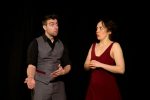
Theo Budd as CB, Eric Biskupski as Beethoven, Erika Babins as CB’s Sister and Ryan Nunez as Van in Dog Sees God: Confessions of a Teenage Blockhead, which runs June 8-11 at CBC Studio 700. (photo by Javier Sotres)

It would be interesting to know what Peanuts creator Charles M. Schultz would have thought of Bert V. Royal’s Dog Sees God: Confessions of a Teenage Blockhead, which premièred several years after Schultz passed away. Described as an “unauthorized parody” of the well-known cartoon strip, it seems more serious in its imagining of Charlie Brown, Lucy, Linus and the rest of the gang as teenagers.

photo - Erika Babins plays CB’s Sister in Awkward Stage Productions’ presentation of Dog Sees God at CBC Studio 700, which opens June 9
Erika Babins plays CB’s Sister in Awkward Stage Productions’ presentation of Dog Sees God at CBC Studio 700, which opens June 9. (photo from Awkward Stage)

Presented by Awkward Stage Productions next week, June 8-11, the show isn’t part of Awkward Stage’s regular season, said Jewish community member Erika Babins, who plays the character CB’s Sister. “This project sprung from a night of hanging out with friends and we were all lamenting the lack of opportunity to really sink our teeth into a meaty and relevant piece of theatre,” she explained. “I’m an artistic associate for Awkward Stage and I was chatting with artistic director Andy Toth, who more or less said, ‘This sounds like a show that Awkward Stage should be a part of.’ So, we’ve had the benefit of the support and connections that Awkward Stage has in the theatre community and as a not-for-profit, but we are producing it as a collective of emerging artists.”

The Wikipedia entry on the play goes into detail about the plot. In short, after CB (Charlie Brown) and his sister (Sally) hold a funeral for their dog (Snoopy), which degenerates into an argument, CB goes on a mission to determine what happens to us after we die. Among many other things, we find out that CB loves Beethoven (Schroeder) and they hook up, but Matt (Pig-Pen) can’t accept the relationship, so he harasses Beethoven, who eventually commits suicide. Also part of the story is that Van’s Sister (which would be Lucy, with Van being Linus) has been “institutionalized for setting the Little Red-Haired Girl’s hair on fire.”

“The only thing I would add,” said Babins about the Wiki synopsis, “is that the whole play is bookended within the context of CB writing a letter to his old pen pal.” The pen pal has the initials CS, referring to Schultz.

“The target audience for this play is anyone who is a teenager now or remembers being a teenager,” said Babins. “There is a lot of swearing and heavy subject matter so parental guidance is advised and it is probably not appropriate for elementary school-aged children.”

The promotional material for the Awkward Stage production notes, “Dog Sees God shines a light on homophobia, drug use, pedophilia, suicide, eating disorders, teen violence, rebellion, sex, mental illness and self-identity. And it’s funny!”

“I was taught at theatre school that comedy comes from the characters not realizing they’re doing something funny, and these characters definitely don’t know they’re being funny,” Babins said. “For them, everything that is happening to their group of friends is the worst thing ever but, for the audience, it’s an opportunity to look back and laugh at the dramatic highs and lows that are adolescence.”

photo - Theo Budd as CB and Erika Babins as CB's Sister
Theo Budd as CB and Erika Babins as CB’s Sister. (photo by Javier Sotres)

She describes her character as “a bit of an outcast herself. She’s younger than the other characters and, as such, is not included in their tight-knit group. She spends the course of the play drastically altering her persona in an attempt to figure out where she actually belongs. Without giving too much of the story away, she does find her way back to a close relationship with her brother, who she grew up admiring.”

Babins added, “One of CB’s big arcs in the play is trying to decide on what he thinks happens after you die, and each of his friends has a very different answer for him. Though none of the of the answers is expressly Jewish, it’s an interesting lens to look at how these teenagers interpret religion in a secular small town.”

Directed by Sarah Harrison, Dog Sees God previews at CBC Studio 700 on June 8, 8 p.m., and opens there June 9, 8 p.m., with performances June 10, 7 and 9:30 p.m., and June 11, 2 p.m. Tickets are $21, with $1 of every ticket sold going into the profit share for the cast and creative team (the preview is two-for-one). For tickets, visit dogseesgodvancouver.brownpapertickets.ca.

Format ImagePosted on June 2, 2017June 1, 2017Author Cynthia RamsayCategories Performing ArtsTags Awkward Stage, Erika Babins, Peanuts, teenagers, youth

Posts pagination

Previous page Page 1 … Page 61 Page 62 Page 63 … Page 84 Next page
Proudly powered by WordPress