Skip to content
  • Home
  • Subscribe / donate
  • Events calendar
  • News
    • Local
    • National
    • Israel
    • World
    • עניין בחדשות
      A roundup of news in Canada and further afield, in Hebrew.
  • Opinion
    • From the JI
    • Op-Ed
  • Arts & Culture
    • Performing Arts
    • Music
    • Books
    • Visual Arts
    • TV & Film
  • Life
    • Celebrating the Holidays
    • Travel
    • The Daily Snooze
      Cartoons by Jacob Samuel
    • Mystery Photo
      Help the JI and JMABC fill in the gaps in our archives.
  • Community Links
    • Organizations, Etc.
    • Other News Sources & Blogs
    • Business Directory
  • FAQ
  • JI Chai Celebration
  • JI@88! video

Recent Posts

  • Story of Israel’s north
  • Sheltering in train stations
  • Teach critical thinking
  • Learning to bridge divides
  • Supporting Iranian community
  • Art dismantles systems
  • Beth Tikvah celebrates 50th
  • What is Jewish music?
  • Celebrate joy of music
  • Women share experiences 
  • Raising funds for Survivors
  • Call for digital literacy
  • The hidden hand of hate
  • Tarot as spiritual ritual
  • Students create fancy meal
  • Encouraging young voices
  • Rose’s Angels delivers
  • Living life to its fullest
  • Drawing on his roots
  • Panama City welcoming
  • Pesach cleaning
  • On the wings of griffon vultures
  • Vast recipe & story collection
  • A word, please …
  • מארק קרני לא ממתין לטראמפ
  • On war and antisemitism
  • Jews shine in Canucks colours
  • Moment of opportunity
  • Shooting response
  • BC budget fails seniors
  • Ritual is what makes life holy
  • Dogs help war veterans live again
  • Remain vital and outspoken
  • An urgent play to see
  • Pop-up exhibit popular
  • An invite to join JWest

Archives

Follow @JewishIndie
image - The CJN - Visit Us Banner - 300x600 - 101625

Byline: Cynthia Ramsay

Song video showcases artists

Song video showcases artists

On Aug. 31, the video for the song “Same Girl” premièred. From the Jessica Stuart Few’s latest CD, The Passage, the song features a “girls’ chorus” that includes some of Jessica Stuart’s teenage guitar students joining her on the melody. The two-minute, 36-second video was filmed in and around Toronto, in its alleyways.

“The directing duo KAJART and I started shooting the video in late April, and shot almost every weekend until early August – over 120 hours of shooting over 1,000 locations in Toronto!” said Stuart. The stop-motion music video is her third collaboration with KAJART, “and we love each other and work incredibly well together!” she said, noting that the other two videos are for the songs “Twice” and for “Passage.”

The recent video premièred on blogTO and had more than 54,000 views and 244 shares at press time. On Sept. 1, it was released on YouTube, and has more than 1,200 views so far. On the YouTube post, watchers are invited to help tag the artists of the more than 400 urban art pieces featured in the video.

Noting that school has just started, Stuart told the Independent that the song is “pretty topical.” Its first lyrics, she said, are “Started off we were going to school – half is classes, half life lessons. I don’t care if we’re learning the rules, I’m always the same, always the same girl.”

The song itself (music, lyrics) was composed and performed by Stuart, who sings and plays the koto (a 13-stringed Japanese harp). She is joined by Charles James (double bass), Jon Foster (drums), Tony Nesbitt-Larking (backing koto), Michael Davidson (vibraphone) and the chorus of Jocelyn Barth, Michelle Willis, Alex Rozenberg, Astrid Granville-Martin, Keira Brody and Bernice Chan.

To view the video and download/order the album on which it appears, visit jessicastuartmusic.com.

Format ImagePosted on September 15, 2017September 14, 2017Author Cynthia RamsayCategories MusicTags Jessica Stuart, KAJART, Toronto, urban art
The complexities of Ruckus

The complexities of Ruckus

At first listen for a non-aficionado, Beyond the Pale’s Ruckus may sound like a klezmer CD. An excellently executed and enjoyable one, with maybe a little more swing than you’ve heard before, but klezmer – Southeastern European Jewish music, the accordion, violin and clarinet prominent. On second play, however, is that a reggae beat? Did that piece sound like a French folk song in parts? Is that a mandolin?

Beyond the Pale is known for their fusion of klezmer with jazz, bluegrass, reggae and even classical music. Ruckus is the Toronto-based group’s fourth CD. They debuted with Routes in 2001. Their live recording, Consensus (2004), won three awards and Postcards (2009) also won a bunch of awards. While too early to predict, as Ruckus was just released in June, it would not be surprising if more awards were on the way.

Ruckus isn’t a wedding dance soundtrack. Though it has upbeat pieces that make you want to whirl around your kitchen as you cook dinner – “Ispravnost Licne Vizue” and “Batuta,” for example – it evokes a range of emotions. “Moldavsky” has a stately feel, like one of those ballroom waltzes Jane Austen writes about, while “Ruckus in Ralia” has a driving beat and a sense of urgency. “Andale” slows things down and has a contemplative feel, while listening to “Shutka” will take your imagination to the patio of a Parisian café, with its mournful clarinet and accordion, delicately plucked and wavering mandolin strings, and rich violin tones – a tune resembling “My Funny Valentine” seems to make its way into this eclectic composition.

“Oltenilor” sounds like it’d be at home at a hoedown and “Batuta” has a swinging jazz feel to it for the most part, but sounds like a Chassidic niggun at times and morphs into a kind of fast-paced square dance. Both of these songs feature some wicked plucking of the mandolin.

In Eric Stein’s hands, it’s hard to believe that the mandolin is not a traditional klezmer instrument. His original contribution composition-wise on Ruckus is “The Whole Thing,” the idea for which, he told the CJN, he came up with while playing with whole-tone scales. “It’s got tonality that reflects klezmer and Eastern European folk influences, but it’s also got a funky kind of groove.” And it is definitely based on whole-tone scales.

Six of the 12 songs on Ruckus are originals, while the others are arrangements of traditional melodies. All of the musicians – Bret Higgins (bass), Milos Popovic (accordion), Martin van de Ven (clarinet) and Aleksandar Gajic (violin) – either composed an original piece or participated in the arranging. They are a tight ensemble who play around with tempo and style with such ease that the complexity of what they’ve created isn’t what you’ll first notice. And that’s what makes their music so good.

Format ImagePosted on September 15, 2017September 14, 2017Author Cynthia RamsayCategories MusicTags fusion, klezmer
Meet award-winning artists

Meet award-winning artists

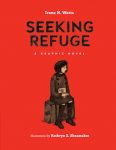
Seeking Refuge, written by Irene Watts and illustrated by Kathryn Shoemaker, has been shortlisted for the 2017 Vine Awards for Canadian Jewish Literature. Published by Tradewind Books, the graphic novel is one of the three finalists in the children’s/young adult category.

While this year’s Vine winners will be announced Oct. 3 at a luncheon in Toronto, Vancouverites can meet Watts and Shoemaker later this month at Word Vancouver, and again at the Vancouver Writers Festival in October. The multiple-award-winners, who are both founding members of the Children’s Writers and Illustrators of British Columbia Society, have worked together on several publications, including Good-bye Marianne, a graphic novel based on Watts’ play and subsequent novel of the same name, which also included Shoemaker illustrations.

In Good-bye Marianne, readers meet Marianne Kohn. Set in Berlin in 1938, a week after Kristallnacht, the 11-year-old struggles to understand and cope with the increasing restrictions placed on Jews in Nazi Germany, and the fierce antisemitism she and her family encounter, with a couple of exceptions. The story begins with Marianne not being allowed into her school – all of the Jewish students have been prohibited from attending. As well, her father has disappeared. The situation, as we know from history, worsens, and her mother makes the heartrending decision to send Marianne with “a group of 200 children who are leaving for homes in England,” one of the first groups to be rescued in the Kindertransport.

Seeking Refuge sees Marianne safely to London, arriving Dec. 2, 1938. While protected from physical harm in her new country, Marianne does not escape antisemitism and poor treatment.

In an interview with CBC, Watts commented on Shoemaker’s choice of medium for Seeking Refuge, noting how the grey of the pencil was so well-suited to the story.

“Seeking Refuge is a darker, sadder story, taking place in a time of blackouts, black-and-white films, coal-foggy London, especially the winter months, a gloomy time and place,” said Shoemaker in an interview with the Jewish Independent. “In Good-bye Marianne, Marianne is happier than in Seeking Refuge because she is with family, her home, her country, her language. So, yes, the backgrounds are light, often white. She is anxious about her being sent away but she is not yet sad about it. She is not yet a displaced refugee.”

The possibility of using Seeking Refuge as a way in which to teach younger readers about the current refugee crisis has not gone unnoticed by reviewers and interviewers.

“Stories, in whatever genre, help us to discover more about our place in the world and who we are,” Watts told the Independent. “Immersing ourselves in the lives of fictional characters and their stories, we gain insight of how others live.” While acknowledging that readers will “take whatever message they are ready to understand from the books they read,” she added, “Marianne’s story, though set in the past, is still a familiar one. There are many refugees in the world. Seeking Refuge concerns one child, and how she responds to losing home, friends, family, birthplace, language, culture. In reading about Marianne, a reader may wonder how he would cope in this situation; maybe respond with more kindness and understanding to anyone struggling to make a new life.”

Marianne’s story is similar to – but not the same as – that of Watts, who was educated in England and Wales after her escape from Berlin via the second rescue train in December 1938. Skipping ahead 30 years, she and her husband moved to Canada in 1968, she said, “to give our children a better future.” They immigrated to Alberta.

A playwright and director for Theatre in Education and a drama teacher and consultant in England, Watts taught drama in Hobbema (now Maskwacis), where they lived for a short time before moving to Edmonton. In Edmonton, she was director of Citadel on Wheels and Wings, a children’s touring company that traveled all over Alberta. “We even took our shows to schools in the Northwest Territories,” she said, noting that, among the company’s alumni are Jackson Davies and the late Susan Wright.

“After a few years,” said Watts, “my late husband accepted a position in Vancouver and our four children and I followed. This was in 1976. My base was in White Rock, B.C., and I moved to Vancouver in 2000.”

That Watts likes to write in different genres is clear from the way in which Seeking Refuge came into being.

“Good-bye Marianne began life as a play, which premièred at the Norman Rothstein Theatre in 1994,” Watts explained. “It was produced by Carousel Theatre, and toured widely. It has had many productions, both in Canada and the U.S.A., and will be touring with Theatre New Brunswick for three months in the spring of 2018. I had been a playwright long before I became a novelist. I decided to write the novel because there was still much to say beyond the confines of the play. Kathy Lowinger, then publisher of Tundra Books, rescued the manuscript from the slush pile, and published it in 1998.

“I received countless letters from children, wanting to know what happens next, and so completed both the novel and the play Remember Me, on which Seeking Refuge is based. The trilogy, which ends with Finding Sophie, was later published in an omnibus edition, to commemorate the 75th anniversary of the Kindertransport, as Escape from Berlin.”

For readers anticipating a possible third graphic novel, Watts told the Independent she has “no plans to write about Marianne and Sophie again.”

Shoemaker and Watts collaborated on Watts’ first book for Tradewind, A Telling Time, “which places the story of Queen Esther and the story of Purim in three time frames: modern-day Canada, Nazi-occupied Vienna and the biblical era of Persia. So,” said Watts, “when Kathie told me she had read my play Good-bye Marianne and suggested that it would make an interesting graphic novel, I needed no persuasion, and together we embarked on our next project – a new genre for me. Since then, we have done several other books together, for both Tundra and Tradewind Books.”

A Telling Time, which Shoemaker described as “a picture book for older children about the parallel stories of Queen Esther and how she saves her people and a 1939 secret Purim party,” was recognized by the International Youth Library in Munich, Germany, with a 2006 White Raven special mention.

“For that book,” said Shoemaker, who teaches children’s literature at the University of British Columbia, “I did a huge amount of research. As well, Irene shared many resources with me.

“While I was illustrating A Telling Time,” she said, “I was working on my MA in children’s literature at UBC. Instead of doing an academic thesis, I wrote a graphic novel. During the process of finishing it up, Irene asked me what it was like to write a graphic novel and I told her that, for her, it would be a snap, as it is very much like writing a play or screenplay, as you write primarily dialogue, and, similarly to writing a play scene by scene, a graphic novel is written panel by panel. In response to my answer, Irene told me that Good-bye Marianne had been a play before it was a novel.”

Shoemaker said she drew up several pages of Good-bye Marianne for Watts to send to Tundra as a proposal for a graphic novel. “It was about to have its 10th anniversary, so it was good timing,” said Shoemaker. “Tundra had never done a graphic novel before but they agreed to it.”

Graphic novels were still a relatively new phenomenon at that time. “Other than Chester Brown’s Louis Riel and books for adults, there were almost none,” said Shoemaker. “It was a bit of challenge working with an editor who did not understand the form and also who didn’t seem to understand how closely Irene and I work.

“You will often hear that editors like to keep writers and illustrators apart. I hate that. Irene and I work closely on everything that we do.”

Their creative process begins with Watts writing a rough draft. “She doesn’t number the panels but she describes all the key actions she wants to see occur along with the dialogue,” explained Shoemaker. “From that version, I go back into the manuscript to visualize the sequence of panels. When I do that, I create panel numbers and add in additional panels that may be close-ups, wordless images and additional panels to handle complex conversations. After I’ve done that, I begin a visual dummy, drawing out the entire book panel by panel. When that is complete, I sit down with Irene and go through it panel by panel. As we go through it, we decide what stays, what goes and what more we might need. The best thing about our working together is that we highly respect each other’s ideas and we both listen, consider and change things without any kind of ownership because we consider the work ours. It is our book, not mine, not hers, but ours.”

Watts and Shoemaker will be at Word Vancouver on Sept. 24, 12:45 p.m., at the main branch of Vancouver Public Library in the South Plaza (the Quay) and the Writers Fest on Oct. 18, 1 p.m., at Revue Stage on Granville Island. For more information on both of these festivals and for tickets to the latter ($17), visit wordvancouver.ca and writersfest.bc.ca, respectively.


Format ImagePosted on September 8, 2017September 5, 2017Author Cynthia RamsayCategories BooksTags children's books, Holocaust, Irene Watts, Kathryn Shoemaker, kindertransport, refugees
What does future hold?

What does future hold?

Jewish community member mia amir is the dramaturg of Wypsa, which is at the Fringe Festival until Sept. 16.

While the plot of Wyspa may bring to mind William Golding’s Lord of the Flies, the book was not a direct inspiration for this work, co-writer and director Julia Siedlanowska told the Independent.

The creation of the play, which opened at the Vancouver Fringe Festival Sept. 7, began with the reading and discussion of an original story written by Siedlanowska and Kanon Hewitt.

“Our team includes five collaborators between the ages of 11 and 16,” said Siedlanowska. “They have all been involved directly in the creation of this piece through world-building, research, writing text, improvisation, creating soundscapes, costumes and props. They are all also performing in the piece.”

Siedlanowska and Kanon’s story “tells the tale of a walled-in community that has sustained itself through oil extraction for centuries,” Siedlanowska explained. “When fires start raging within the walls, the mothers of the community make the decision to send their children away through the only opening to the outside world – an opening to the ocean.

“After days of drifting, they finally arrive on an island. Here, they must decide whether they will live by the rigid rules of their old society or create their own.

“We separated the experience into three worlds,” she continued. “The home world, the world of the boat and the world of the island. From there, we collectively decided the specific circumstances of each of these, including what rules apply in the home world and the island world. The youth created their own characters and decided on each of their relationships to each other. Text and movement were all generated by the collaborators, with myself and Kanon making decisions about the show structure with the help of our dramaturg mia amir. There are some improvisational aspects – much of the show takes place within an improvised structure with scenes changing depending on the audience.”

The end result came from research of instances in which children were removed from their homes during the Second World War, said Siedlanowska, “including Japan after the Tokyo bombings and the Kindertransport of Jewish children in Europe, as well as the Sixties Scoop in Canada.

“One piece of literature that I did directly mention in the initial phases of brainstorming was the story of King Matt the First, written by Polish-Jewish playwright Janusz Korczak. Korczak ran an orphanage in Second World War Poland. He was a pedagogue, writer and children’s rights activist. The orphanage was called Our House, and the children living there published their own newspaper and held their own court when conflicts arose among them. King Matt the First was about a child who becomes king, and what might happen if children were rulers.”

However, the idea of the story first arose, she said, “from questions around the rise in domestic violence in Alberta as a result of the economic downturn and job loss in the oil and gas industry. This violence is predominantly towards women.

“This then led to questions around how raising youth within rigid gender identities might enforce these patterns of violence. Instead of writing what we think youth might have to say about these themes, we decided to ask directly. In relation to climate change, we also wanted to ask the question, how do we – as an adult audience – react to dialogue around the climate crisis when those who will inherit the planet stand directly in front of us?”

Wyspa is being presented as part of Generation Hot, a mentorship initiative of the Only Animal and the Fringe Festival, which presents the work of seven writer-directors between the ages of 17 and 24. This year’s program is called Waterborne. “Each participant has found a personal response to a chosen site on Granville Island and the theme of water,” explains the press release. “Two programs of these short works will run in rep during the 2017 Vancouver Fringe Festival…. Wyspa is paired with Citlali: A Fantastic Tale About Water by a Mexican Poet by Brenda Muñoz.”

Wyspa runs Sept. 8, 10, 13-14 and 16, 8 p.m., at Ron Basford Park on Granville Island. For tickets ($12) and the full Fringe schedule, visit vancouverfringe.com.

Format ImagePosted on September 8, 2017September 5, 2017Author Cynthia RamsayCategories Performing ArtsTags domestic violence, Fringe Festival, Julia Siedlanowska, theatre, Wyspa
Talmud Torah celebrates 100

Talmud Torah celebrates 100

Vancouver Talmud Torah’s expanded new campus includes many collaborative spaces. (photo from VTT)

On Sept. 17, Vancouver Talmud Torah will mark its centenary, celebrating “its humble beginnings as an afterschool cheder to the VTT of today – a modern, state-of-the-art facility with the capacity to educate generations of Jewish children in the decades to come, just as we have been doing for the past 100 years,” head of school Cathy Lowenstein told the Independent.

The focal point of the celebratory evening is the documentary Vancouver Talmud Torah Onward: The 100-Year History, written and directed by Adam Bogoch. The event sold out in three hours, said David Bogoch, Adam Bogoch’s father and chair of the VTT Alumni Fund, which supported the project.

David Bogoch was on the VTT board for seven years. He served as alumni chair when he was a board member and it’s a position he retains.

“It is my hope that anyone who attended the school could reconnect with the school and their classmates through the alumni organization,” he said in an interview with the Independent. “It is not an association, nothing formal, just a large family of friends, past students and parents of students.”

The alumni fund, he said, “receives donations and, in turn, makes gifts to the school. Over the last few years, the alumni fund installed an alumni garden at the corner of Oak and 26th, purchased band instruments for the students of the school, and purchased display cases for use in the hallway of the school.

“In an effort to get more people excited about reconnecting with the school, I felt it was necessary to document the 100-year history of the school, and to celebrate the 100th anniversary of the school appropriately. It is important for future parents, board members, staff and administration, and the community at large, to know how much of a struggle it is to keep the school open, paid for, able to properly care for and educate the children who walk in the door. It takes great effort from many individuals, and the full support from the entire community to keep Talmud Torah doing its best.

“We must also recognize all of the leaders of the past and the people who helped the school become what it has become,” he added, “so the documentary was a natural fit. The film is a permanent reminder and a wonderful gift to the school.”

The film was produced independently from the school, said Lowenstein. While they knew an historical piece was being made, she said, “the fact that it was completed to coincide with VTT’s 100th anniversary year was sheer good fortune. Many of us were interviewed, but we actually had no idea how and when it would all come together.”

photo - Vancouver Talmud Torah head of school Cathy Lowenstein
Vancouver Talmud Torah head of school Cathy Lowenstein. (photo from VTT)

Lowenstein said the production of the film “is close to the heart of David and Adam, who are the son and grandson of the late Dr. Al Bogoch, z’l, a former VTT board chair who, through passion and conviction, single-handedly engaged our community to burn our last mortgage. Adam is a wonderful storyteller and he does his family proud through the recounting of Talmud Torah’s fascinating story. VTT Onward is a vitally important historical record of our school.”

Some members of the VTT leadership team were shown a rough cut of the film and, said Lowenstein, “while we might not endorse everything that’s said in the film, it would be an honour to kick off VTT’s 100th year by showing it to our community.”

The title of the film, she said, captures “the very essence of what our school is about. We are always looking to fulfil our mission of academic excellence and nurturing lifelong learners. We have a responsibility to look ahead, to plan and vision forward to ensure that we are offering the best possible in core academics and Judaic studies to our students and families.”

But looking back is also necessary. “The film relies on archival photographs and live interviews with some of the very community leaders who ensured that the school remained strong and viable through some exceedingly difficult periods,” she said. “I appreciated learning about different perspectives from many community stakeholders. It is not often that one has the opportunity to hear so many different points of view from those who have been intimately connected to the school.

“The challenges our predecessors faced are the very same challenges we also face today – and that Jewish day schools across North America confront as well. I found it encouraging to see the ebb and flow and highs and lows of this institution, yet with the reassurance that VTT is a treasured community asset that is vital to the growth, strength and future of our community.”

Stressing her pride in the school’s faculty, Lowenstein said, “Although our expanded new campus allows us to do things we never imagined possible, what happens inside the four walls of the classroom (and now in our many collaborative spaces) is still our top priority. I have a team of key professionals dedicated to ensuring that the academic and Jewish experience at VTT remains relevant and vibrant. We are continuously looking to improve our offerings, and each new school year brings new ideas and new innovations. This, to me, is the hallmark of a responsive and reflective school.”

As for some of the current challenges, Lowenstein said, “As the community knows, we have just completed the building of a magnificent new campus and now we must finish paying for it. Paying down the interest on our loan is one of our key priorities to remain financially sustainable. One of our greatest challenges – and it applies to almost every independent school on Vancouver’s West Side – is the decreasing number of school-age children in the catchment due to Vancouver’s high housing costs. This is an issue that VTT, [Jewish] Federation and so many other Jewish community agencies are exploring and trying to address. Our board of directors is also committed to ensuring VTT remains an affordable option to middle-income families.

“Ultimately, our goal is to ensure we meet the diverse needs of our VTT families. We want students to receive their Jewish education at VTT from the early years until they become proud graduates in Grade 7.”

“For 100 years,” said David Bogoch, “the school has been a focal point of the Jewish community. Students make lifelong friends from their years there. They learn so much about being Jewish and what that means. The students become successful leaders throughout the entire community as they grow up, and the entire community benefits from the school.”

Format ImagePosted on September 1, 2017August 30, 2017Author Cynthia RamsayCategories LocalTags Cathy Lowenstein, David Bogoch, education, Vancouver Talmud Torah, VTT
The making of VTT Onward

The making of VTT Onward

Adam Bogoch and Cynthia Ramsay at Main Street Brewery, where they discussed, among other things, Adam’s documentary film about Vancouver Talmud Torah. (photo by Adam Bogoch)

As I watched filmmaker and writer Adam Bogoch briefly consider jaywalking across Main Street to meet me at Brassneck Brewery, I held my breath. Thankfully, he decided to cross at the lights and, together, all body parts intact, we headed into the crowded tasting room and found two places at the bar.

We had lots to talk about that sunny, humid day in July – he was excited to share with me, and Jewish Independent readers, news of a commercial project he was just completing. The final product, Vancouver Talmud Torah Onward: The 100-Year History, will première on Sept. 17 at Rothstein Theatre. While the event has sold out, there will be other opportunities for community members to see it.

“… there have always been community-minded individuals who have been ready to step forward and guide the Talmud Torah onward, and keep the light of Jewish learning alive.”

Adam chose to frame the work with an article from the Jewish Western Bulletin, the predecessor of the JI. Written by Harry Wolfe, the short item appeared in the Sept. 2, 1948, issue of the JWB, which was dedicated to the imminent opening of the then-new building at 26th Avenue and Oak Street, and featured a lengthy history of the school’s first 30 years. What is interesting about Wolfe’s quote – and Adam’s decision to use it – is that it recognized both the numerous (recurring) problems that faced the school, as well as the fact that “there have always been community-minded individuals who have been ready to step forward and guide the Talmud Torah onward, and keep the light of Jewish learning alive.” Hence, the name of the film.

“It’s extremely challenging to create a documentary on an institution that doesn’t feel like a puff piece. Honestly, that was the first obstacle to overcome,” said Adam in an email interview. “I have my own personal perspectives on religion and community politics that I didn’t want clashing with the mission of the movie. So, the only way I could get around this was to locate the heart, that something that we can all relate to.

“Luckily, this was almost instantaneous. While going through the archives, I found a superb article in the Jewish Western Bulletin … written by Harry Wolfe in 1948…. It perfectly encapsulated the trials and tribulations of the school and how the success or failure of the institution was, and still is, solely on the backs of the community. It also stated that, despite major setbacks, there have always been those willing to put their tucheses on the line for VTT.

“The reasons they did this were numerous and we explore some of them in the movie,” he said. “But, even when I went to VTT, there was a love that pervaded the halls of the school. No matter where you fell on the religious, financial or political spectrum, there was a place for you. That’s an institution worth talking about and one worth fighting for.

“That’s not to say that it’s perfect. Nothing is, and the movie doesn’t shy away from that, which, aside from being a vital part of storytelling, is part of the fun of it. But, hopefully, the film helps to keep the school (and the community) on the right track.”

It certainly kept Adam on track, making “sifting through hundreds of hours of footage far easier. If it didn’t fall under the umbrella idea, it got cut.”

The film project was funded, said Adam, “by the generosity of Syd Belzberg and by multiple donations made to the VTT Alumni Fund.” It took more than three years to complete – and that was after years of discussing the idea of a documentary. It was a concept for which his father, David Bogoch, in his capacity as alumni chair, advocated “with many different boards.”

“Frankly, it took awhile for excitement to build,” said Adam. “At first, only my dad, who’s a wealth of information on the topic, truly saw a story worth telling. By the time we knew the school would be celebrating its 100th anniversary, things really began to take shape. Past board members and individuals in the administration embraced my dad’s ideas and he convinced me to helm the project.”

In addition to funding the documentary, the VTT Alumni Fund has been financing the digitization of the archives, said Adam.

“I spent the first two years of this project doing research. This included the expansive VTT archives, the Jewish Western Bulletin, the Jewish Museum and Archives of B.C. and Rozanne Feldman Kent’s book The Vancouver Talmud Torah: 1913-1959 and Beyond.”

While he did most of the legwork himself, he received “some significant assists” from his dad. “As well,” he said, “I was lucky enough to work with a small crew on certain days. So much visual content came from [VTT’s] Jennifer Shecter-Balin, and she simply must be praised.” He gave a lion’s share of the credit to film editor Thomas Affolter. “The broad strokes of the project may have been due to my experience as a writer,” said Adam, “but he has a director’s mind that added a real sense of professionalism and cleanliness that is immediately evident on screen.”

The decision of who to interview was a collaboration between Adam and his dad. “We had suggestions given to us by [VTT head of school] Cathy Lowenstein, as well as by staff members, but most of the 46 faces featured were our decision,” said Adam.

“… we have an all-star lineup of community members of all different ages, occupations, experiences and perspectives. It’s like the Ocean’s Eleven of the Jewish community.”

In his 1948 article, Wolfe wrote, “We have attempted to give credit where it is due, but many will have to remain unmentioned because of modesty or because research could not uncover names.” Adam said he faced the same challenge and is expecting to receive “a few remarks on missing faces. But, it’s important to note that some people were unavailable or had no interest in being on camera. The movie also couldn’t be unbearably long, so we had to cap at a certain number of individuals. But, we have an all-star lineup of community members of all different ages, occupations, experiences and perspectives. It’s like the Ocean’s Eleven of the Jewish community.”

This is Adam’s favourite aspect of the documentary, “that it provides voices from all corners of the community. Sure, we could have always featured more. There will always be factions that we didn’t include. However, we have 46 featured faces. Each with their own perspective. Some of which are in conflict with one another. But all of them are shooting for the same goal – a prosperous Jewish day school that welcomes everyone.”

Adam gave the school credit for its hands-off approach to the content. “Some of these opinions [in the film] are not what the school endorses. But they understand that they are just opinions. Informed discussion is vital for growth, and we can’t shy away from it. At the end of the day, we had very little interference from the school; and what little we did have made the project stronger, kinder and still just as honest.”

He added, “The board and admin have been so supportive of this journey, and they must be acknowledged for their bravery in embracing something that wasn’t completely shiny and beautiful. That tells me that they’re confident in the quality of their school.

“Another thing that interested me about VTT Onward,” he said, “was that I was honouring my family roots. My grandfather, Dr. Abraham (Al) Bogoch was a giant in the community, especially when it came to VTT. My dad has followed in his footsteps in a way that I think exceeds my grandfather’s influence. My connection is different, but this is one way that I can contribute to something that’s been integral to the Bogoch family.”

Adam himself is a VTT alumnus – class of 2005. By the time I first met him, he had moved to the next level of his Jewish education and was at King David High School. The reason for that meeting, in 2009, was the screening of his first feature film, Avoid Confrontation – he was 17!

From April 2010 through March 2011, we ran a series in the JI that that followed the production process of his second feature film, Complexity, from concept to completion. And I interviewed Adam in July 2011 about the short film Eye of the Beholder, co-written by David Kaye and Vanessa Parent, which he directed.

When we were organizing our beer-tasting and informal interview this summer, I was shocked how long it had been since I’d written about his work. It wasn’t like we hadn’t kept in touch. We get together every so often to catch up on each other’s lives, though generally over coffee and pastry.

The idea for the beer-tasting interview originated in the spring, while we were at Thomas Haas café on West Broadway. There, Adam made an offhand comment about having to come back another time to take a proper photo of the cappuccino (it might have been a latte). Lo and behold, he writes about coffee for the food blog Hidden Gems Vancouver.

While he initiated that blogging gig, and does enjoy content writing immensely – blogs, websites, ghost-writing – he said, “ultimately, I do it to supplement my other works.”

His resumé includes “writing and rewriting film outlines and treatments, as well as penning works for the visions of others,” but his passion remains screenwriting.

“Writing and directing two feature films as a teenager, before I could truly comprehend what story really is, was the best training for what I do now. But it’s a constant learning experience,” he said. “I’ve also been lucky to have been trained by some of Hollywood’s most influential writers and professors. Experiences I’ll never forget.”

At Brassneck, we discussed how to construct a plot, as well as successful and not-so-successful adaptations of books to the screen. Our beer choices oddly echoed our personalities, with me tending toward the darker beers, only accidentally ordering the aptly named Klutz Kolsch, a blonde ale, and Adam ordering the likes of Hibiscus Wit (which he has in abundance), Wingman (I’m sure he makes a great one) and Sunny Disposition (which he also has, both in temperament and in looks, with his broad smile and ginger locks).

image - Vancouver Talmud Torah Onward: The 100-Year History film screening posterAs we took our interview and beer-tasting to Main Street Brewing on East 7th Avenue – and had some much-needed food – we talked about VTT Onward, the Jewish Independent’s upcoming Chai Celebration (don’t make any other plans for the night of Dec. 6!), more about film adaptations and a bit about the challenges we each face being self-employed in the arts.

“At the end of the day,” said Adam, “I’ve picked a profession that is highly competitive and doesn’t operate in any way like ‘mainstream’ careers. It’s a constant barrage of rejection and uncertainty. But I’ve been extremely fortunate to have signed with a tornado of a manager, Liz Hodgson. She’s been responsible for the careers of some notable A-list talent, both in front of and behind the camera. She’s been mentoring me consistently – one of the most common ways for writers to break into the industry on a significant level – and is currently representing my next two projects, one of which I’ve been rewriting for over six years.”

This latter script has almost been made four times, and has received multiple offers, said Adam. “I’ve taken none. This is because there’s always been something that has kept me from releasing it. That, or the deals haven’t been right.

“Recently, I’ve been working with my manager on a rewrite that will hopefully allow me to let it go…. Without over-talking it, Between Me (current title) is about a teenager battling his three personality projections who seek to push and pull him towards utterly catastrophic directions.”

We decided that Brassneck’s Bivouac Bitter could possibly represent the teenager’s negative id, its Raspberry Changeling (which was sour, not sweet) his super ego. To describe his whole character, Adam thought Main Street’s Old Knights Pale might be appropriate. We found the teen’s positive id at 33 Acres Brewing on East 8th Avenue, in Nirvana, appropriately enough.

Despite having a little more to eat at 33 Acres, the beer-tasting was having an effect on me. After more discussion about life, the VTT film screening, which was then only in the planning stages, and the JI, which Adam described at one point as the “printed record of history,” we parted ways. He was decidedly more peppy, but I slowly made my way safely home. When I looked at my watch, I couldn’t believe that six hours had gone by.

A real tête-à-tête had obviously been overdue and the beer-tasting a good idea – at least for deep conversation. As for an interview, not so much. While I took the odd note, all of the material for this article comes from an email interview after the fact.

I will next see Adam at the Sept. 17 première of VTT Onward. Even though I’ve seen it, I’m looking forward to it. I’m not the only one who was impressed by the rough cut. A few others have seen it.

“I’m blown away by the response,” said Adam. “I had no clue it would be received as well as it has been so far. I’m now confident that the community at large will find something in it that moves them and, therefore, I’m thrilled to be able to share it.

Format ImagePosted on September 1, 2017August 30, 2017Author Cynthia RamsayCategories TV & FilmTags Adam Bogoch, education, Vancouver Talmud Torah, VTT
Delving into the past

Delving into the past

Lillian Boraks-Nemetz’s newest book, Mouth of Truth (Ekstasis Editions, 2017) is not an easy, escape-from-reality read, but it’s an interesting and important read. What does it mean to be a survivor? How does one person’s trauma affect those around them? Is healing possible? These are but a few of the many questions that Mouth of Truth elicits.

The novel is based on the experiences of Boraks-Nemetz, who is a Holocaust survivor. Born in Warsaw, Poland, she escaped the Warsaw Ghetto, and survived the war by hiding under a false identity.

“My life’s story is, of course, similar to the book’s,” Boraks-Nemetz told the Independent. “I suffered in childhood, in adolescence, girlhood and womanhood. It is only now, in my senior years, that I have found some degree of peace.”

The protagonist of Mouth of Truth is Batya, who still struggles with Beata (Bea), her wartime identity, even though she has been in Canada for decades. Her Canadian-born husband, Joseph, and their children, Sam and Miriam, have no idea of the trauma with which she is attempting to deal. She drinks to suppress her more feisty Bea personality and their memories – not only of the ghetto, but of abuse by the man entrusted with her care, and others. Though this method of coping isn’t working, Batya manages to keep her nose above water until she accompanies her friend Antonia on a visit to see Antonia’s brother in prison. The visit unleashes recollections of her tragic childhood and Batya can no longer hide from herself or her past. She must confront her dueling identities – and rumours about her father.

Batya finds out that her father might have been one of the Jewish police in the ghetto; not only that, but one who did some awful things, including helping the Nazis round up Jews for deportation. On his deathbed, her father apologizes. But for what? Batya’s mother will not talk about what happened in the ghetto and Batya must find out for herself of what her father was guilty, if anything.

The investigation, as well as Batya’s healing, requires that she leave her family and home in Vancouver. She travels first to Toronto, then to Italy and Poland. In Italy, she meets Grisha, with whom she has an affair, and experiences passion and desire. She initially confuses her feelings with love, but comes to realize the difference as she and Grisha travel together in Poland.

Between her research in Toronto and in Europe, Batya learns much about her father. She is also helped by her mother. When Batya first arrives in Toronto, her mother – who has never wanted to talk about the war – sends Batya a package of her father’s writings. Batya receives a second package when she returns from Europe.

With the first package, her mother writes, “I had always thought that because you were a mere child when all that happened to us, it would not touch you. Could I have been wrong?” Her mother also clearly states, “I have chosen to forget the past and start a new life. I don’t want to go back there either.”

In the note accompanying the second package, her mother concedes, “By shielding you, I may have done more harm than good. No matter what you might think of your father, he was a good man.” She also writes, “It never occurred to me before that I owe you the truth. Maybe I have kept secrets from you for too long.”

Batya, too, has secrets. Though she tried several times, she was not able to tell her children what happened to her during the war. As for her father’s actions, she had no idea herself, until Antonia told her the rumours. In addition to being the bearer of the news, however, Antonia opens the door for Batya to start facing her past, connecting Batya with the son of the woman who supposedly witnessed the actions of Batya’s father.

It is through her relationship with the son, Julian, who lives in Toronto, that Batya comes to tell her story – and start living. He encourages her to give a survivor testimony – “Survivors are no longer silent,” he tells her – and she does. Despite her fears, and with Julian’s support, she invites her children to watch her videotaped testimony. Afterward, they have a much-needed, overdue discussion. “One or even two conversations cannot erase the years of accumulated unhappiness and poor communication,” acknowledges Batya. “But today was a start.”

To read the first chapter of Mouth of Truth, visit lillianboraks-nemetz.com. To buy the book ($26.95), visit ekstasiseditions.com. Boraks-Nemetz will read from the novel and participate in a Q&A on Sept. 14, 2 p.m., at Waldman Library. She will also be participating in this year’s Cherie Smith JCC Jewish Book Festival, which takes place Nov. 25-30.

Format ImagePosted on September 1, 2017September 3, 2017Author Cynthia RamsayCategories BooksTags Holocaust, Lillian Boraks-Nemetz, survivor
Dramatic Fringe work

Dramatic Fringe work

Jewish community membersGina Leon and Michael Germant co-star in Island Productions’ presentation of Gruesome Playground Injuries at the Vancouver Fringe Festival Sept. 8-17. (photo by Jayme Cowley)

Playwright Rajiv Joseph describes Gruesome Playground Injuries as being “about missed love, it’s about pain and regret. These are things that almost everyone in humanity has some experience with.”

Jewish community member Michael Germant, who co-stars in Island Productions’ presentation of Gruesome at the Vancouver Fringe Festival with fellow community member Gina Leon, also highlights the universal elements of Joseph’s play.

“Everyone has either wanted to be in, or has been in, or has come out of a relationship, therefore, there is something for everyone to relate to,” Germant told the Independent. “The show is rich in humour, empathy and tenderness. Internal and external pain are a measure of everything vulnerable when it comes to intimacy, timing and love.”

Gruesome Playground Injuries is part of the Fringe’s Dramatic Works Series celebrating playwrights of Asian descent. Germant said that he and Leon – who together produced and performed the play A Weekend Near Madison in the 2015 Fringe’s Dramatic Works Series – “had read Gruesome Playground Injuries a few years ago and I think it’s always been in the back of our minds to do it one day, and so this turned out to be the perfect opportunity.”

The press material calls the play “a harrowing and humorous story about love.” The description reads, “Over the course of 30 years, the lives of Kayleen and Doug intersect at the most bizarre intervals, leading the two childhood friends to compare scars and the physical calamities that keep drawing them together.”

It seems like pretty heavy fare for the Fringe, or is it?

“The foundation of the Fringe usually is to do experimental and challenging work,” said Germant. “Gruesome Playground Injuries’ non-linear structure, raw subject matter, and bloody and bruised characters – both figuratively and literally – we feel are representative of the aims of the festival. We chose the play because of the way we felt about this unique perspective of a love relationship. The play is realized through humour and drama.”

The humour, which is dark, “is expressed through the naivety of the characters and the comedy of misconnection,” he said.

In his remarks on Island Productions’ website, director Mel Tuck notes that the play “demanded much from the actors.”

“The demands of the play are numerous, reconnecting with a prism of memories,” Leon told the Independent. “What’s it like to be a child, a teenager, a young adult; how does one authentically play it? This part is close to the bone for me, and giving myself permission to be vulnerable – really vulnerable, and go to all the places I need to, to bring Kayleen to life – that’s scary and exciting.”

For Germant, “I’ve never experienced the physical injuries of Doug, but I do have emotional and psychological parallels. My challenge has been to open myself up to express these psychological and emotional injuries.”

Working on his character, said Germant, “has caused me to confront my own behaviour and address some of my foibles. I’ve learned to laugh at myself.”

Both Leon, who was born in Johannesburg, and Germant, who was born in Moscow, know what it is like to be an immigrant, to straddle more than one culture. They can relate to Gruesome’s theme of alienation.

“Growing up in Montreal as a Russian-Jewish immigrant, I realized very early how different and apart I was,” said Germant. “As such, I viscerally know alienation and separateness. Doug is experiencing being separate and alienated throughout the play – we play these characters from ages 8 to 38 – and he suffers from self-esteem issues because of it. He feels obligated to perform for approval, which, in his case, causes gruesome injuries.”

Gruesome Playground Injuries runs at the Cultch’s Vancity Culture Lab Theatre Sept. 8-17. For tickets ($14) and the whole Fringe lineup, visit vancouverfringe.com.

Format ImagePosted on September 1, 2017August 30, 2017Author Cynthia RamsayCategories Performing ArtsTags Fringe Festival, Gina Leon, mental health, Michael Germant, relationships
The Fringe is coming soon!

The Fringe is coming soon!

Seattle comedy couple Clayton Weller and Sophie Lowenstein are bringing Naturally to the festival. (photo from Amanda Smith)

Fear of death, making comedy and fighting prejudice are but a few of the topics Jewish community members will be exploring in their productions at this year’s Vancouver Fringe Festival, which runs Sept. 7-17.

Seattle comedy couple Sophie Lowenstein and Clayton Weller are bringing Naturally to the festival. It’s not one show, but two, with audiences deciding which they want to see: the one about grief, which also contains a dating scene, “the worst theatrical audition ever” and more; or the one about what sketch comedy is, how to make it – and why to bother making it.

“We have a variety of choosing activities at the top of the show, which culminates in the audience throwing paper airplanes at the stage for the show they’d most like to see. It’s going to be bonkers,” explained Weller. “As far as seeing both shows – how flattering would that be?! – the final two performances we’re locking in which show will happen.” So, Good Grief (Heart) will be on Sept. 14 and Understanding Sketch (Head) on Sept. 16; for the other performances, you’ll have to take your chances. Though, having seen them on video in preparing for this interview, it’s not much of a risk – both shows will have you laughing, and crying. There is a reason they dub Naturally “serious comedy.”

“As a duo, this has always pretty much been our style,” said Weller. “We’ve both done a bunch of plays, both serious and completely frivolous…. We thought that a laugh never feels as good as after you’re done crying. The contrast makes both the dark and light pop out more.”

“I would also say that we find a lot of beauty in that line between joy and pain because it’s not a very thick line. It’s blurred and sometimes nonexistent,” added Lowenstein, who is part of the Jewish community. “When you’re working with comedy, experiencing other emotions besides happiness while you laugh is sort of taboo – at least rare. We play in that playground. I think, individually, we are both curious about people’s emotions and we investigate them in our own ways, so we came together to run a joint study.”

According to the press material, Lowenstein and Weller have been performing comedy together for more than 12 years.

“Sophie and I went to the same college, University of Puget Sound, and both got cast in our college sketch comedy group,” Weller told the Independent. “We performed in several shows before we actually started living together as roommates, then we started living together, with feelings and stuff. Humour and comedy definitely permeate every part of our lives. Lots of laughter keeps our hearts light.”

With the comedy group Ubiquitous They, the couple produced about 15 shows. However, said Weller, the group “is more of an alumni network at this point. Several members have moved on to work in L.A., or across the country. We produced really regularly from 2007 to 2014, but, for the most part, it’s more of a club that hangs out every couple of months, and goes, ‘Wow, it’s tough to be an adult, am I right?’”

For the past few years, Lowenstein and Weller have been focusing on their performances as a duo. “Basically, Naturally is the only comedy project Sophie and I do now,” said Weller. “We’ll do a variety show or small play here and there on our own, but, because our lives are so crazy, we’ve pared the work we do down and this is where we put our real artistic push. I’ve never made work I’m more proud of than what I’m currently making with Sophie. She’s awesome. (Secret: This is all just an excuse for me to hang out with her more!)”

“Other secret: I feel the same way about him,” added Lowenstein. “He makes this process happen.”

In addition to Naturally, Weller runs two performance venues – the Pocket Theatre and the Slate Theatre – and Lowenstein works as a nurse practitioner.

“I look at it like this: some NPs have kids and they can do it. I have theatre and I can do it,” said Lowenstein about balancing her careers. Her recipe for success? “Save as many of your nights for rehearsals as possible. Dinner no earlier than 10 p.m. most nights. Make sure the other member of your group does all the administrative stuff and keeps you motivated when you’re dragging your butt and snarling. And, if the project doesn’t give you deep joy, don’t do it.”

In one of the Naturally shows, Weller mentions that he once had a lucrative high-tech job that he gave up for comedy. Does he have any regrets?

“I started a company called Freak’n Genius in 2012,” he said. “We made animation software, and we raised over half a million dollars in financing. At first, I was working with cool creative people and helping them make awesome things – then we slowly turned into an iPhone app for tweens. I learned a ton, but I 100% do not regret leaving. I give about three hours a week’s worth for tweens. Not the 60 hours a week I was putting in. Artists are who I really care about!”

About how he became one, or at least got into comedy, Weller said he had terrible stage fright until eighth grade. “I decided I was tired of being scared, and did improv comedy. After the first laughing crowd, I got bit by the bug, and I’ve been doing it ever since. There’s no better way to make friends than to make art together. Our relationship is proof to the point! I’m super lucky.”

For her part, Sophie said she first got into comedy “by loving that feeling of making my friends laugh. So, I practised how to do that more and more. I also had very funny friends. Now, I’m friends with the funniest human I know, and he also has a heart and mind. Bonus. As for the theatre part, I started performing when I was a little kid then throughout school: musicals, Shakespeare, etc. Stuck with it.”

The couple has been doing Naturally for a couple of years now. “After every performance,” said Weller, “we can’t help but do the ‘Oh man, next time why don’t we blah blah blah.’ The script is never permanent, and every remounting of the material we go through a rewrite and punch up all the scripts. Also, finding new ways to fit it together is a whole other way to make the thing new for us. Mostly, we just like hanging out and this is a great excuse.” Lowenstein agreed.

Naturally runs Sept. 8-16, at various times, in the gym at False Creek Community Centre on Granville Island. The 55-minute show is rated 14+ for coarse language and sexual content. Running Sept. 7-17 at the Firehall Arts Centre, also at various times, is the Canadian première of Cry-Baby: The Musical!, which is being presented by Awkward Stage Productions. It, too, is rated 14+ for the same reasons.

Jewish community member Erika Babins, who is artistic associate of Awkward Stage, choreographed the Fringe production, which features “a cast of 16 emerging artists” and runs 90 minutes.

photo - Erika Babins choreographed Awkward Stage’s production of Cry-Baby: The Musical!
Erika Babins choreographed Awkward Stage’s production of Cry-Baby: The Musical! (photo from Awkward Stage)

“It’s 1950s Baltimore, the conservative squares face off against the leather-clad delinquents in this rockabilly musical based on John Waters’ cult film,” reads the press release. The 2008 Broadway show was nominated for four Tony Awards, including best choreography, and won a Drama Desk Award for outstanding choreography. So, where does Babins begin?

“I start my choreographic process by obsessively listening to the music of the show so that it can live in my body,” Babins told the Independent. “Before we start rehearsals, I’ll meet with the director and we’ll talk through the shape of the show so that we know what purpose each song serves in the show, where we’re coming from and where we’re going, and how we’re going to get there.

“Then, when I get the cast in the room, I can take the story I know I’m going to tell and use them to tell it, using movement and music as my storytelling techniques. If I’m really stuck about how to tell a part of the story, I might look up a video or two on YouTube to see how a different company made something work, but I’m careful to only watch it once so that it only ever is for inspiration and I don’t accidentally steal something.”

Awkward Stage decided to mount Cry-Baby for several reasons. “Awkward has made a tradition out of presenting hilarious, and culturally relevant, full-scale musicals at the Fringe Festival,” said Babins. “Cry-Baby: The Musical came to us via artistic director Andy Toth. He brought it forward as a show that features a mostly young cast, great music and a lot of interesting and fleshed out female characters. Not only that, the messages in the show about systematic prejudices, classism and living your own truth so long as it’s not hurting anyone else, are still so relevant today.”

This is Awkward’s eighth musical at the Fringe Festival. “In that time,” noted Babins, “we’ve won three Pick-of-the-Fringe’s and the Joanna Maratta Award. We are committed to bridging the gap for emerging artists coming into the professional theatre scene in Vancouver and paying our artists for their efforts.”

For the full Fringe schedule and tickets ($14), visit vancouverfringe.com. (Note: a $5 Fringe membership is required for all shows.)

Format ImagePosted on August 25, 2017August 22, 2017Author Cynthia RamsayCategories Performing ArtsTags Awkward Stage, Clayton Weller, dance, Erika Babins, Fringe Festival, improv, musical theatre, Sophie Lowenstein, Vancouver
One of best TUTS seasons

One of best TUTS seasons

Man in Chair (Shawn Macdonald) with the cast of The Drowsy Chaperone. (photo by Tim Matheson)

“Look, I know it’s not a perfect show: the spit-take scene is lame and the monkey motif is laboured. But none of that matters. It does what a musical is supposed to do: it takes you to another world, and it gives you a little tune to carry with you in your head. A little something to help you escape from the dreary horrors of the real world. A little something for when you’re feeling blue. You know?”

The irony of Man in Chair’s comments is that the spit-take scene and the monkey motif are hilarious in The Drowsy Chaperone and, for the lover of musicals, this parody is perfect. Or, as Mary Poppins would say, “practically perfect.”

Theatre Under the Stars is presenting both The Drowsy Chaperone and Mary Poppins this summer and, without a doubt, this is one of the best TUTS seasons yet. Both shows are excellent – the scripts, the acting, the sets, the music, the choreography, the directing, the costumes, the lighting, etc., etc. Both shows will take you to another world, escaping the real one for a few hours.

photo - Ranae Miller as Mary Poppins and Victor Hunter as Bert have a magical song and dance in the park
Ranae Miller as Mary Poppins and Victor Hunter as Bert have a magical song and dance in the park. (photo by Tim Matheson)

The season opened with Mary Poppins on July 11. I saw it a couple of days later and, while there were still some sound issues to be sorted out with individual actors’ microphones, the performance was spot on. Led by Victor Hunter as Bert the chimney sweep (artist, lamplighter and an assortment of other jobs) and Ranae Miller as the magical, stern-yet-loving nanny with great posture who puts all other nannies (and caregivers) to shame, the TUTS production is in more than capable hands. Both of these performers are fantastic actors and singers, and the rest of the cast matches their talent and energy.

Lola Marshall, 11, and Nolen Dubuc, 9, deserve a shout-out for their portrayals of Jane and Michael Banks, the two unruly children Mary Poppins ostensibly comes to help. But Mary arrives at their house on Cherry Tree Lane as much for their parents – their mother, a former actress who is having trouble adapting to life in high society, and their father, a banker whose work consumes him, neither of whom has time for their kids.

As The Drowsy Chaperone’s Man in Chair notes – he’s a wealth of pithy and astute observations – “Everything always works out in musicals,” and Mary Poppins is no exception. However, a lot of effort goes into making everything work out onstage and the TUTS team really added their own unique touch to both musicals.

For Mary Poppins, the Cherry Tree Lane house that Brian Ball built is like a huge Fisher Price toy that opens and closes to reveal the kids and Mary’s bedrooms on one side and the kitchen and dining room on the other, plus various hidden compartments. The other sets – that take the audience to the park and its statues that come alive, to a kitchen in which a broken table and shelves can fix themselves, and to the rooftops of London – invite the audience into Mary’s world. The starry nights and Mary’s flights elicit awe, not to mention the flying kites.

The choreography is also inspired, with the problem of how to have dancing penguins join Bert in “Jolly Holiday” smartly solved, with the crowd-pleasing flag-less semaphore in “Supercalifragilisticexpialidocious” that reaches a feverish pitch and the raucous rooftop tap-dancing in “Step in Time.” It was sometimes a wonder how music director and conductor Wendy Bross Stuart kept the cast and orchestra in sync, but she did.

While the energy slowed a bit as the musical neared its end – the child behind me wondered, with about two songs remaining, “How long is this musical?” – for the most part, director Shel Piercy has done a masterful job of pacing. He takes the audience on an emotional journey, with many laughs but also many touching moments. No one will be unmoved by Cecilia Smith’s performance (as Bird Woman) of “Feed the Birds” – the lessons of compassion and seeing beyond appearances that Mary teaches the Banks children are lessons we cannot learn often enough.

Joining Bross Stuart in this production are fellow Jewish community members Kat Palmer, as part of the talented and enthusiastic ensemble, and Andrea Minden in the orchestra. In The Drowsy Chaperone, community member Stefan Winfield plays Broadway producer Feldzieg, while his and wife (choreographer) Shelley Stewart Hunt’s 5-year-old son Wesley plays a couple of adorable, if superfluous, parts near the musical’s end in an over-the-top number that pokes fun at the extravagant finales of many musicals, not just Man in Chair’s favourite, The Drowsy Chaperone.

Having just come home to his rundown apartment, this lonely bachelor – played extremely well by Shawn Macdonald, as if the role was written for him – announces, “I hate theatre,” and proceeds to tell us why. It’s really current works that he dislikes; once upon a time, “you knew that when the show began you would be taken to another world, a world full of colour and music and glamour.”

“Remember?” he asks the audience of the (fictitious) “musical within a comedy,” as The Drowsy Chaperone is described. “Music by Julie Gable, lyrics by Sidney Stein. It’s a two-record set, re-mastered from the original recording made in 1928. It’s the full show with the original cast including Beatrice as the Chaperone. Isn’t she elegant? And this is a full 15 years before she became Dame Beatrice Stockwell. Can you believe it? Let me read to you what it says on the back – it says, ‘Mix-ups, mayhem and a gay wedding!’ Of course, the phrase gay wedding has a different meaning now, but back then it just meant fun. And that’s just what the show is – fun. Would you … would you indulge me? Would you let me play the record for you now? I was hoping you would say yes.”

And, with that, Man in Chair puts the record he has just unsleeved onto the player and, as the static sounds, he introduces us not only to his beloved musical but its actors and the era. Throughout the show, which he imagines (and that we can see) taking place in his apartment, he gives a running commentary, sharing a little about his life, factoids about the actors in the play and explanatory notes about certain scenes. He both extols the virtues of the musicals of the 1920s and exposes their weaknesses, including some poor writing – the aforementioned spit-take scene and monkey motif, as examples – and some not-so-subtle racism. An example of the latter is the incomparable first scene of Act 2 – Oriental Palace, Day – which the TUTS cast performs superbly.

Man in Chair’s dialogue is absolutely brilliant and Macdonald delivers it with such excitement, as if he – and not just his character – so wants you to love the musical as much as he does, despite its flaws. He seems to barely contain his joy when certain songs come up and when he just can’t stay in his chair and joins the dancing, it is almost contagious. (Though the incredible closeness of the rows at this year’s TUTS barely allows you to reach your seat, let alone get up and dance.)

As with Mary Poppins, there isn’t a weak link in The Drowsy Chaperone. The entire cast – leads and ensemble – bring everything they have to the stage, and it shows.

Ball’s set design once again amazes, as people pop in and out of almost anywhere, and Stewart Hunt’s dance numbers use every inch of the apartment’s kitchen and living room space. Music director and conductor Kevin Michael Cripps does double duty as the Chaperone’s bartender and director Gillian Barber delivers a fast-paced, larger-than-life contemporary musical that would even please Man in Chair.

Chris Sinosich was the costume designer for both The Drowsy Chaperone – which seems to have countless costume changes – and Mary Poppins. She is to be commended for the period dress in both, evoking the late-1920s and silliness of the former and the Edwardian period of the latter; as well as the stark contrasts, with Man in Chair obviously of a different era than his favourite musical and Mary Poppins’ colour-rich realm standing out from the darker, more sombre tones of the bankers’ reality.

While the Chaperone may stumble along, martini glass in hand, there is no stumbling in either TUTS production this year. See both if you can. They alternate nights, with Mary Poppins closing Aug. 18 and The Drowsy Chaperone Aug. 19. For tickets and more information, visit tuts.ca.

Format ImagePosted on July 21, 2017July 19, 2017Author Cynthia RamsayCategories Performing ArtsTags Drowsy Chaperone, Mary Poppins, musical theatre, Theatre Under the Stars, TUTS

Posts pagination

Previous page Page 1 … Page 60 Page 61 Page 62 … Page 84 Next page
Proudly powered by WordPress