Skip to content
  • Home
  • Subscribe / donate
  • Events calendar
  • News
    • Local
    • National
    • Israel
    • World
    • עניין בחדשות
      A roundup of news in Canada and further afield, in Hebrew.
  • Opinion
    • From the JI
    • Op-Ed
  • Arts & Culture
    • Performing Arts
    • Music
    • Books
    • Visual Arts
    • TV & Film
  • Life
    • Celebrating the Holidays
    • Travel
    • The Daily Snooze
      Cartoons by Jacob Samuel
    • Mystery Photo
      Help the JI and JMABC fill in the gaps in our archives.
  • Community Links
    • Organizations, Etc.
    • Other News Sources & Blogs
    • Business Directory
  • FAQ
  • JI Chai Celebration
  • JI@88! video

Recent Posts

  • Story of Israel’s north
  • Sheltering in train stations
  • Teach critical thinking
  • Learning to bridge divides
  • Supporting Iranian community
  • Art dismantles systems
  • Beth Tikvah celebrates 50th
  • What is Jewish music?
  • Celebrate joy of music
  • Women share experiences 
  • Raising funds for Survivors
  • Call for digital literacy
  • The hidden hand of hate
  • Tarot as spiritual ritual
  • Students create fancy meal
  • Encouraging young voices
  • Rose’s Angels delivers
  • Living life to its fullest
  • Drawing on his roots
  • Panama City welcoming
  • Pesach cleaning
  • On the wings of griffon vultures
  • Vast recipe & story collection
  • A word, please …
  • מארק קרני לא ממתין לטראמפ
  • On war and antisemitism
  • Jews shine in Canucks colours
  • Moment of opportunity
  • Shooting response
  • BC budget fails seniors
  • Ritual is what makes life holy
  • Dogs help war veterans live again
  • Remain vital and outspoken
  • An urgent play to see
  • Pop-up exhibit popular
  • An invite to join JWest

Archives

Follow @JewishIndie
image - The CJN - Visit Us Banner - 300x600 - 101625

Byline: Cynthia Ramsay

Orthodox and in love?

Orthodox and in love?

Kosher Love’s director Evan Beloff, left, with Michael Gamliel, his wife, Miriam. (photo from cbc.ca/firsthand/episodes/kosher-love)

To all those who believe in marrying for love, Montreal-based matchmaker Rabbi Yisroel Bernath asks, “What happens when the romance fails?”

Bernath is spiritual director at Chabad of Notre-Dame-de-Grâce and a chaplain at Concordia University. Known by some as “the Love Rabbi,” he is at the centre of the documentary Kosher Love, which can be see at this year’s Vancouver Jewish Film Festival on Nov. 5, 4 p.m., at Fifth Avenue Cinemas.

The film’s mostly light tone and creative compilation, which includes animation, make for an interesting peek into the ultra-Orthodox world and how its members meet one another, marry and start a family. Bernath seems like an affable man, even though he divides North America’s Jews into only three groups – those who watch Seinfeld and eat bagels, those who are Orthodox and those who are Chassidim – never mind the scores of other affiliations and levels of observance.

What is particularly compelling is that Bernath is open to hearing, if not being swayed by, different points of view. There is one scene between the rabbi and a married couple he matched, in which the woman is comfortable and confident enough to strongly present her opinion that love is a vital part of a relationship. She doesn’t back down when Bernath accuses her of being overly romantic, but rather digs her heels in and tells him, with some vehemence, that she doesn’t agree with him.

Viewers also meet a nightmare mother and son. The mother, whose daughters have both married, is quite obnoxiously desperate to marry off her 33-year-old son. But the man-child YoNatan, a DJ, is clearly more in love with himself and his music than he could ever be with anyone else. YoNatan was never going to add to Bernath’s total of 50-plus successful matches.

As the Montreal Gazette noted in its review, “Regardless of the personalities in Kosher Love, it really transcends religion in touching on universal themes. It is the view of Bernath that love develops over time, but that in today’s fast-paced world, few have the patience to wait.” When and how love develops, and how it can be nurtured, are all worthwhile ideas to consider, and director Evan Beloff offers a charming and engaging introduction to some Jewish thoughts on the subject.

Beloff will be at the film festival’s Nov. 5 screening. For tickets and the festival schedule, visit vjff.org.

Format ImagePosted on October 20, 2017October 19, 2017Author Cynthia RamsayCategories TV & FilmTags Chassidim, Judaism, ultra-Orthodox, weddings, Yisroel Bernath
A novel born of heartbreak

A novel born of heartbreak

Nathan Englander will be in Vancouver on Oct. 22 to discuss his latest novel, Dinner at the Center of the Earth, at a salon hosted by the Cherie Smith JCC Jewish Book Festival. (photo from Cherie Smith JCC Jewish Book Festival)

You won’t have to travel to the centre of the earth to meet award-winning, bestselling American author Nathan Englander. On the afternoon of Sunday, Oct. 22, he will be in Vancouver for a writers salon hosted by the Cherie Smith JCC Jewish Book Festival.

The Jewish Independent spoke to Englander by phone last week. He had just arrived in Seattle by train, his flight there having been canceled. In the midst of a tour for his latest novel, Dinner at the Center of the Earth (Alfred A. Knopf, 2017), he spoke to the JI between back-to-back events.

Englander’s novel is a compelling read in which he explores the Israeli-Palestinian conflict via five characters. To simply quote from the publishers, who sum it up succinctly: “A prisoner in a secret cell. The guard who has watched over him a dozen years. An American waitress in Paris. A young Palestinian man in Berlin who strikes up an odd friendship with a wealthy Canadian businessman. And the General, Israel’s most controversial leader, who lies dying in a hospital, the only man who knows of the prisoner’s existence.”

Each of these characters is fascinating, and Englander displays a remarkable talent for being able to put himself inside people’s heads, to clearly and realistically explain their feelings, their motivations. The characters both set events in motion and are carried along by events out of their control. One of the main characters, “the General,” lies in a coma and yet Englander fully develops him as a living, breathing human being.

The General is obviously based on former Israeli prime minister Ariel Sharon, who died in 2014 after having been in a coma since 2006. Englander’s character is a large man, he has been in a coma for years, he once ruled the country and was a tough, controversial military figure (“an unrelenting warrior”), his wife was named Lily, one of his sons was shot and killed, etc., etc. Nonetheless, Englander was adamant that the character not be seen as Sharon, but as “inspired” by him.

Englander said he knew people would come “locked and loaded with [their] politics to this story…. I thought it was really important that, wherever the parallels are [from] one reality to my fictional reality, that my general be his own character … so that I could fully empathize and fully get into his head. Even for me, I needed to build my own person, whatever the warring personal parallels are.”

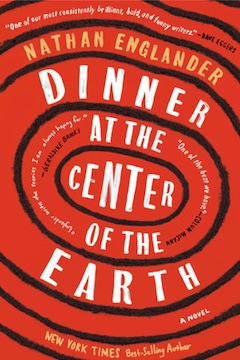
book cover - Dinner at the Center of the EarthReading Dinner at the Center of the Earth, one does get the impression that Englander was trying to sort out his own views about the conflict, rather than make any pronouncements or come down on any particular side.

“It was imperative to me that this not be didactic and not be a big lecture,” he said. “I have a 500-page version of the book that I cut in half. I just wanted it to be story-driven and character-driven, for people to be able to enter into the discussion or to reflect on where they entered the book and where they left it, on their own positions.”

For his part, he said he’s learned a lot about the book from being on the road. One of his first tour events was with fellow writer Jonathan Safran Foer, who commented on the parallels between the dinner of the book’s title and a dinner that takes place between the guard and the prisoner; an aspect that Englander hadn’t considered. “I wish I had been smart enough to consciously think of it,” he said, “but the subconscious takes care of that for you.”

While Englander insists that “there’s no position in this book,” one woman, after a tour event, argued that it takes “a position on peace,” that it’s hopeful about the prospect. From this and other exchanges, Englander admitted, “I really do believe that the more it [peace] seems impossible, the more I believe we have to make it possible.” But, he said, about writing any messages into the book, “I can’t tell you how much of it was conscious intent versus subconscious work. For me, all my conscious intent was this idea of it to land on no side, for us to explore.”

For Englander, two lessons learned from being a reader himself helped shape this novel. One is that a well-functioning book represents a shared experience between an author and a reader. “I used my brain to write it and then there’s this physical thing that you can pick up and read,” he said, and so, in writing Dinner, he fought “against all punditry and ‘mansplaining’ and lecturing and … didactic” inclinations.

The other aspect he keeps in mind while writing, he said, is all the unanswered questions he had as a boy growing up in a religious environment. “It’s the books where people were brave enough to wrestle with the questions that changed me. All of the books that changed my life, that saved me, none of them had answers, they just were by authors who truly were willing to wrestle with terrifying questions. So, for me, I really wanted to structure this [novel] to swing back and forth and back and forth…. I wanted to mirror the circles of the conflict, these unending cycles.”

The story of Dinner at the Center of the Earth had been percolating since Sharon became prime minister of Israel in 2001. About the Second Intifada and Sharon’s election win, Englander said, “That was my first adult political heartbreak of that size…. All those years of work [on peace], it was right there.”

The more distant we get from peace, he said, the more “you may think it’s impossible, but it was really right there for the taking. I just couldn’t shake it. I was desperate to explore this unending conflict. So, yes, it may be just the tiniest glimmer of optimism [in the novel] but I do think it’s optimistic in the end, however dark some of the turns are.”

He hasn’t been writing the novel for 16 years, of course. He had the idea and needed a structure for it, which he found on his last book tour, while in Israel. The front page of the newspaper he was reading had a story on “Prisoner X, this Australian guy [who had a life] so similar to my life in a lot of ways – maybe he got more Zionism and I got more Bible but [he was] a religious, Anglo Jew who ends up moving to Israel.” This man not only “adopted an ideology” but joined Mossad, did “scary deep undercover stuff and then becomes a traitor.” His situation made Englander wonder, “What would it take to flip someone for empathy, out of feeling for the other side? That’s what would interest me,” so Prisoner X became Dinner’s Prisoner Z.

The other notion about Prisoner X that intrigued Englander was that the public only found out about Prisoner X’s existence after the man hanged himself. “He only lived in the moment he died, and there was no X and no cell until the moment he hanged himself.”

Englander’s imagination seems to know no bounds. His stories and novels are set in various countries (Russia, Israel, United States, Argentina, to name a handful) and his characters range from an Orthodox rabbi who supplements his income by being a mall Santa Claus – one of the many people readers meet in Englander’s first book, the collection of short stories For the Relief of Unbearable Urges (Alfred A. Knopf, 1999) – to the General of Dinner, his fourth book. Englander is also working on a second play because, he joked, with 10 years between his first and second book, he had to tell people he “wrote book” for a living and, since his first play in 2012, he’s been writing “books and play.”

One theme that runs through all his work, regardless of form, topic or setting, he said, is that they explore “grey space, or Schrödinger’s cats, multiple realities.”

“As the books go by, I see that I’m clearly … obsessed with this grey space, which I think is probably from having a black-and-white education and growing up in a black-and-white reality,” he said. “Especially now, I can’t understand people who can’t see the other side.”

By way of example, he said, “I learned that in Israel, where I was a Jew living in Jerusalem, whose holy site was the Temple Mount … it became clear to me this wasn’t a disagreement, or something on a spectrum, that my Palestinian neighbour, she is living in Al-Quds and Haram al-Sharif is her holy site. We were living in the same physical space but in literally separate realities.”

This is also the case in the United States now, he added. “There are regular citizens that, because of the dual realities we now have here … you could show them two pictures of an inauguration, one with more people and one with less, and you’d have regular folks say, yes, the picture with less people has more people in it. That’s not an opinion, that’s inhabiting a different reality.”

Human beings can make anything happen, said Englander. “We’ve sent people to the moon and brought them back,” he said, and our cellphones have far more power than did any Apollo mission. So, you want to make peace? “Everyone knows the math there. Don’t anybody pretend they don’t know who’s going to trade what. There are some very minor, tweakable things. Don’t tell me everybody doesn’t know what they need to do to make that peace happen tomorrow, if they wanted it to happen.”

Englander immerses himself in his work. For The Ministry of Special Cases (Alfred A. Knopf, 2007), a novel about Argentina’s Dirty War, he did years of research. “You need to own that world,” he said, in order “to drop my own ministry on top of that city [Buenos Aires].” He said it is akin to being an artist in, say, Cubism: “You need to know how to paint before you can put both eyes on one side of the face.”

With Dinner at the Center of the Earth, Englander said he was returning to familiar ground, which required much less research.

“I’ve had so many different sides of the experience, from the Jerusalem of the Bible that I had my whole life, to living in Israel in the First Intifada to getting a degree in Judaic studies to living in Israel for another five years, to watching the news a million hours a day to reading the papers.” He’s also on the faculty of New York University, which has taken him to cities like Paris and Berlin, both of which are integral places in his latest novel. “I was very interested in exploring territories that felt like ‘my territories,’ including historical [ones],” he said.

For things he didn’t know, he sought advice, such as speaking to a doctor friend about what it means to be in a coma and learning about boats and the mechanics of sailing from people who knew about those things.

As for the writing of the book and how it came out, he said that he reworked the rough draft of the novel for almost a year, while he and his family were in Zomba, Malawi, where his wife, Rachel, was doing research for her PhD. “It was an extraordinary place for me to be, somewhere so far and so radically different from my own realities and where I’d lived…. It was a very special place from which to imagine these places and draw off memory.”

The pre-book festival salon will take place Oct. 22, 2-4 p.m., at a private residence (address will be given to ticket buyers). Tickets are $72, which includes copy of Dinner at the Center of the Earth and a reception. Visit jewishbookfestival.ca to reserve your place at the salon and for more information about this year’s festival, which takes place Nov. 25-30.

Format ImagePosted on October 6, 2017October 5, 2017Author Cynthia RamsayCategories BooksTags fiction, Israel, Israeli-Palestinian conflict, Nathan Englander, peace
“M” magicians will mystify

“M” magicians will mystify

Illusionist Vitaly Beckman can make people’s images disappear from their driver’s licences. Beckman will take part in “M” – The Magic Show at Michael J. Fox Theatre Oct. 21. (photo from eveningofwonders.com)

Vitaly Beckman can make objects levitate. He can transport the image of a person in a photograph to another photograph. And he can predict the future. I know this because I’ve seen him do all those things, and more.

In 2014, the Jewish Independent participated with Beckman in what he would probably call an illusion, but what seemed magical to me. On March 21, 2014, at Havana restaurant, he locked his predictions of what the news would be a few weeks hence – and what I and co-witness Mia Zimmerman, a radio and TV host, would be wearing – in a small box. I held the key to the box, which remained chained up in public view at the restaurant. At Beckman’s April 10 show, the vast majority of his predictions were proven correct, including my and Zimmerman’s chosen outfits.

Beckman is a consummate performer, and his busy schedule and numerous accolades are proof of that. But the best proof is to see one of his shows. He uses humour and charm to involve as many audience members as possible, and even the shy among the crowds seem to want to join in, though many may not get the chance at his next show, just for its sheer size – and that he’ll be one of five performers.

At “M” – The Magic Show on Oct. 21 at Michael J. Fox Theatre, Beckman will be sharing the stage with four other acclaimed and award-winning magicians: Kel, Wes Barker and the team of Trevor and Lorena Watters. The promotional material assures “cutting-edge illusions, mystery, music, comedy, audience participation (you’ve been warned!) and precision sleight of hand.”

It’s not very often that there’s a performance of this magnitude, Beckman told the Independent. “We all have our own shows but this is the first time we have a chance to collaborate,” he said. “Each of us has a different style and it’s exciting to combine into one show.”

In addition to the illusions already mentioned, Beckman’s An Evening of Wonders show includes “Super Vision,” where he reads books and newspapers from a 50-feet away. He writes all of his material and has invented all of his tricks.

“The latest illusion involves turning back time, as an old branch becomes young and fresh again, while I become old,” he shared.

Beckman has been practising magic since the age of 14, when he was inspired, he said, “by a David Copperfield special and started performing for friends and family, and inventing my own illusions. I felt like magic brings out all of my strengths and talents and that I can express myself in the best possible way by creating and performing illusions, by bringing my imagination to life and sharing it with an audience.”

However, notes his bio, it would only be years later, that Beckman “would abandon a career in engineering to focus on rebuilding people’s childlike sense of wonder and bridging the gap between dreams and reality.”

“I am naturally an optimist but also a realist,” he told the Independent. “I believe in good news but also stay grounded. Every new idea I conceive seems impossible at first, but then I can find a way to achieve it. I think that makes me think that it can be true for anything and, with effort and imagination, anything is possible.”

Partial proceeds from “M” – The Magic Show will be donated to the YMCA; funds will go to helping people of all ages access community programs, including swimming, childcare and education. “M” starts at 8 p.m. on Oct. 21 and Michael J. Fox Theatre is at 7373 Macpherson Ave., in Burnaby. Tickets are $39 (plus tax and service charges) from vtixonline.com or 604-241-7292.

Format GalleryPosted on October 6, 2017October 5, 2017Author Cynthia RamsayCategories Performing ArtsTags illusionist, magician, tikkun olam, Vitaly Beckman, YMCA
Magic to amaze and educate

Magic to amaze and educate

Partial proceeds of Randy Charach’s Oct. 14 show at the Rothstein will be donated to the Canadian Mental Health Association. (photo from Randy Charach)

Anyone who has seen Randy Charach perform will swear he can read people’s minds. He certainly is attuned and sensitive to his audience, and those brave and lucky enough to become part of his high-energy, humour-filled show, which he will be bringing to the Rothstein Theatre Oct. 14, at 7 and 9 p.m.

“It has been five years since I’ve done a public show in Vancouver,” Charach told the Independent. “Most of my work is in the United States, as a corporate speaker and entertainer. The performances I’ll be doing at the Rothstein Theatre on Oct. 14th is my newest show. I’ll be blending my life’s work as a comedian, mentalist, magician and hypnotist. I’m looking forward to providing a memorable experience for my Vancouver audience.”

According to the press material, Charach has been entertaining people since he was 5 years old, “inspired by his uncle, a Las Vegas magician.” He has performed around the world, including on major television networks and even in film. A certified practitioner of neuro-linguistic programming and a certified hypnotist, Charach invites people to join him on stage: “As the excitement grows, the crowd watches in amazement as other audience members enter a hypnotic state and become stars of the show.”

“I love to amaze people,” said Charach about what he enjoys most about performing. “The art of magic has been a passion since childhood, and something I see as analogous to life. As a society, we constantly thrive to have our expectations met. When we are surprised, delighted and amazed, we often become elated. This feeling occurs in performance, in personal interactions and in business. When we surprise people, we become memorable.

“I write of this in my latest business growth book on Amazon, Client Centric,” he said. “I teach it in the book and at my corporate presentations, All Business is Show Business and All Life is Show Business. When we continue to amaze others by exceeding their expectations, it’s not magic, but it works like magic. This is an example of how art imitates life and my analogy of how magic is present in all our lives.

“Performing magic has evolved for me to the point where I have taken my interpretation of the art to a new level. While on stage, I am in a heightened state of consciousness, which I am unable to replicate any other way. Magic is present in every aspect of my life, and it pleases me to share it during my performances.”

Despite this love of entertaining, Charach said there were years when he didn’t perform at all.

“My decision to return to the stage,” he said, “was made at a group event hosted by Rabbi Yechiel Baitelman of Chabad in Richmond. The rabbi stated we must share our talent with others. It was at that moment I looked at my wife Chana and said I would be performing again. I suppose it’s in my blood. Entertaining and educating is part of my life’s purpose.”

Partial proceeds of the Oct. 14 show will be donated to the Canadian Mental Health Association.

“Mental illness is prevalent in our society, and I don’t feel this condition receives the attention it requires,” said Charach. “I’ve personally dealt with depression over the years, and am aware I am not alone. I do my best to raise awareness and plan to do more. I hope the stereotypes, prejudice and discrimination stop.”

For more information, videos and to reserve your seats at one (or both) of the Oct. 14 shows at the Rothstein, visit randytickets.com or call 1-800-838-3006. Tickets are $36 (plus service charge).

Format ImagePosted on October 6, 2017October 5, 2017Author Cynthia RamsayCategories Performing ArtsTags CMHA, magician, mental health, Randy Charach, tikkun olam
Relatable dysfunction

Relatable dysfunction

The Beacham family. Back row, left to right: Seth Little as Guy, Nick Beacham’s partner; Jordon Navratil as Nick; Mia Ingimundson as Norris Beacham, the daughter; and Chris Walters as Kevin, Norris’ husband. Seated are Howard Siegel as the patriarch of the family, Glen, and Anna Hagan as the matriarch, Bonnie. (photo by Ellie O’Day)

Homeward Bound by Elliott Hayes is about death and relationships. And family dynamics. Jewish community member Howard Siegel plays the father, Glen Beacham, in Western Gold Theatre’s production that opens today, Oct. 6, and runs until Oct. 29 at Pal Studio Theatre.

Set in 1990, Glen and Bonnie Beacham have invited their adult children (a son and a daughter) and their respective partners for dinner – and an announcement, publicist and Jewish community member Ellie O’Day told the Independent. Homeward Bound “is a dark comedy,” she said, “but also plays with the ways we talk to each other but don’t always really listen.”

“Every family has a time when they get together. Ours was Shabbat,” said Siegel. “No matter where we were or how busy our week was we had to be home Friday for dinner. We ate at the dining room table instead of our usual place in the kitchen, and talked, or argued, but that was our family time. If there was chicken soup, we were having roast chicken; if it was vegetable soup, it was brisket. While the Beachams are getting together on a Sunday and it may not be as regular as my childhood was, dinner with the family is no less important and the news of the week is going to change all their lives.”

Of the plot, O’Day added, “Dad, who happily distracts himself with crossword puzzles, is apparently not well…. Mother distracts herself by constant chatter (where will they go on their next holiday? Dad is totally noncommittal)…. Meanwhile, the gay son’s partner is late for this Sunday dinner … and the daughter is trying unsuccessfully to hide the deterioration of her marriage.”

Siegel described the character of Glen as a “glib, funny, highly educated” man who “has provided a substantial middle-class standard of living for his family.” He said, “My father aspired to these qualities, but it was his struggle, so I wasn’t able to model Glen after my dad. However, finding the love for his family that perhaps isn’t so clear in the text is important to me and to the play. That was very apparent in my experience in my parents’ home.”

He added about the Beachams, “This is a family like so many families we know or grew up in. The parents have to accept choices their children make whether they like or understand them; they accept them out of love and perhaps duty. The kids bicker, but would defend their sibling to anyone if push came to shove. Deep in this family’s dysfunction is a connection that we all should be able to understand.”

Homeward Bound runs Oct. 6-29, Tuesday-Saturday, 7:30 p.m.; Saturday-Sunday, 2 p.m.; and Oct. 19, 2 p.m., at Pal Studio Theatre, 581 Cardero St. Tickets are $32/$27 from 604-363-5734 or homeward. brownpapertickets.com.

Format ImagePosted on October 6, 2017October 5, 2017Author Cynthia RamsayCategories Performing ArtsTags Ellie O’Day, family, Howard Siegel, theatre
Help finish new thriller

Help finish new thriller

Richard Harmon stars in Crypto, written and directed by Jon Silverberg. (photo from Red Castle Films)

Enjoy watching a psychological thriller? Well, now you can help make one. At least, finance one. Starring Vancouver actor Richard Harmon – most recently John Murphy in the Warner Brothers series The 100 – and written and directed by local Jewish community member Jon Silverberg, the feature film Crypto has been shot but needs funding for the finishing touches.

“Crypto is my first feature film, and has been a struggle to complete on personal and private resources so far – this is why we’re now turning to crowdfunding to help finish it!” wrote Silverberg in an email to the Jewish Independent.

“We’ve shot and edited the film, but need the completion funds for VFX [visual effects], sound design and our festival and marketing rollout,” he said in an interview. “We have some really awesome perks to give back to fans in exchange for their donations – from a production diary, to merchandise, to an advance screening gala planned for early 2018.”

The film is described as “a psychological thriller, which follows drug-addicted photojournalist Jake (played by Harmon) who, after taking a job at a wilderness lodge, sets up a darkroom where the photos he develops begin to reveal unsettling apparitions of the future.”

“I enjoy watching lighter films, but the stories that I revisit in my mind long after I watch them are the ones that explore the darker more mysterious aspects of life – especially inside the human mind,” said Silverberg. “In Crypto, we explore the effects of isolation on an already troubled soul, and even the fantastical elements of the story are as much an allegory for the main character’s internal struggle,” as they are entertaining.

The crowdfunding press release talks about the film being Harmon’s “passion project,” but it is also Silverberg’s. “It’s been a longtime goal of mine to direct a feature film and I felt strongly about developing my own material,” he said. “I had been writing the script for Crypto for nearly three years by the time the cameras started rolling.”

Filming took place in Port McNeil, on Vancouver Island, over 11 days in February 2017, with a crew totaling 16, said Silverberg. “My producer, Andy Hodgson, was the other main driving force behind the film, and also served as cinematographer and camera operator on set.”

In the press release, Hodgson notes, “We need about $20,000 to finish the film and get it out to international festivals, which, comparatively speaking, is a very small amount in a world of multimillion dollar movies.”

Born in Montreal and raised on Vancouver Island, Silverberg moved to Vancouver in the early 2000s for film school, “and also for the overall film industry infrastructure. There wasn’t much happening for film on Vancouver Island at the time,” he said.

Silverberg is co-owner of Red Castle Films with producer/cinematographer Hodgson and business manager Nolan Smith. His bio on the site notes that he “grew up fascinated by cinema, and began to shoot photos and develop them in the darkroom by age 6. He attended Capilano University’s film program in 2003, and went on to shoot hundreds of episodes of internationally broadcast documentary television – from the waters of Alaska to the jungles of Mexico – before he settled in Metro Vancouver. More recently, Jon premièred his short film Disappeared at the 2015 San Francisco Indie Fest and is currently preparing to shoot his first feature film Crypto, a sci-fi/thriller set in the Haida Gwaii.”

Silverberg shared with the Independent that, not only was he raised in a semi-observant Jewish home, but that his company’s name, Red Castle Films, and its logo “was chosen in honour of the regional flag of my family’s former home in Poland.”

Crypto is scheduled for release in 2018 through festivals and other distribution. To see a trailer of the film, visit redcastlefilms.com/project/features-crypto. For more information and to donate – perhaps becoming a producer yourself – visit crypto-movie.com.

Format ImagePosted on October 6, 2017October 5, 2017Author Cynthia RamsayCategories TV & FilmTags Andy Hodgson, Crypto, Jon Silverberg, Red Castle Films, Richard Harmon, thrillers
A mythical Haida love story

A mythical Haida love story

In The Mountain of SGaana, sea hunter Naa-Naa-Simgat is abducted by a killer whale and his lover, Kuuga Kuns, must try to save him. (image from National Film Board of Canada)

One of the highlights at this year’s Vancouver International Film Festival will be the animated short The Mountain of SGaana, presented by the National Film Board of Canada.

In The Mountain of SGaana, Haida filmmaker Christopher Auchter tells the tale of two lovers, sea hunter Naa-Naa-Simgat and Kuuga Kuns. When Naa-Naa-Simgat is abducted by a killer whale (SGanna, in Haida), Kuuga Kuns must negotiate a supernatural undersea world in order to save him. If she doesn’t succeed, they will both become part of the spirit world forever.

The film starts in the present-day, with a thoroughly modern fisherman, Skipper, ignoring all that is around him; his focus being solely on his cellphone, until a small mouse catches his attention and, literally, knits the supernatural tale. Auchter notes in an interview on the NFB website that SGaana also means “supernatural” in the Haida language.

“The Haida are an indigenous people whose island territories lie off the West Coast of Canada and in the southern regions of Alaska,” explains Auchter in the interview. “The modern name for the archipelago is Haida Gwaii, which best translates to “people’s island.” There was a time when the islands were called Xaadlaa gwaayee, which means ‘coming out of concealment,’ appropriately named for its location in the world’s largest remaining temperate rainforest.

“Haida Gwaii was formerly named the Queen Charlotte Islands, after the ship of a British explorer who landed there in 1787. The lands of the Haida nation were re-named in 2009.”

Auchter first read the story told in The Mountain of SGaana years ago in an anthology. In subsequent research, he encountered various versions of the tale, but all contained the same fundamental elements.

In addition to directing the 10-minute short, Auchter co-wrote the film with Annie Reid and the film’s vivid and magical animation was created by Auchter, Tara Barker, Marco Li and Sitji Chou. Jewish community member Michael Mann is listed as compositor, VFX and after-effects animator.

“Chris Auchter designed and created this beautiful world of The Mountain of SGaana, which had this beautiful Haida iconography and told a really wonderful story,” Mann said in a phone interview with the NFB. “What I did is, I took this 2-D animation and basically added lighting, camera moves and visual effects. Say, I get a flat image of water, I make it feel more watery and rippley.”

Mann also colour-graded the film. He explained that certain parts of it needed to look aged, as the film contrasts an older world with a more modern one. He said, “My reading of the story is, it’s a modern-day character [Skipper] who’s lost connection with his stories…. For a long time, they’re very separate and by the end they connect.”

And Mann also had to unite the characters that inhabit the different worlds. “One thing that’s really fun,” he said, “is playing with sunlight and darkness and rain. And all these mythical characters, how do you make them feel they’re all in the same world?”

He said, “I think of myself as a visual sandwich maker sometimes because, basically, someone gives me one layer of the sandwich and then I add all those other layers up to it so that it looks like it’s all one meal, like it’s all one world.”

Mann mostly worked on The Mountain of SGaana remotely from his studio on Salt Spring Island, but came to the NFB offices in Vancouver at the end for an intense 36-hour session with Auchter to finalize all the film’s effects.

Mann’s work as a visual storyteller – using animation, illustration and graphic design – has been featured in the opening ceremonies of the 2010 Winter Olympics in Vancouver, on Nickelodeon, on PBS, in advertising campaigns, in documentaries, in video games, at Ontario’s Stratford Festival, the list goes on.

“Whether working on documentaries, commercial projects, government initiatives or collaborations with other artists,” reads his bio, Mann “loves using creativity to translate cultural concepts to new audiences.”

And The Mountain of SGaana certainly communicates, if only in a small way, something about Haida culture.

“I used Haida art to help frame the action and highlight key moments in the story, and to give those important moments an exclamation mark,” explains Auchter in the online interview. “I also use the Haida art as symbolism: at the beginning of the film, the character of Skipper is surrounded by multiple frames featuring various scenes from his environment. He ignores what’s going on around him, and doesn’t engage with his world. These scenes that surround Skipper are framed with black lines. This works in contrast with the other more complex multi-panel Haida formline shots we see throughout the course of the film. Skipper doesn’t get this more complex visual treatment until later in the story when he actively begins to engage with the world around him. His biggest moment comes when he throws the rope to Kuuga Kuns and Naa-Naa-Simgat and pulls them in. This symbolizes that he is pulling his culture closer to him.”

The Mountain of SGaana won the Young Audiences 6-12 Official Competition at this year’s Ottawa International Animation Festival and was an official selection for ImagineNATIVE 2017 and the Vancouver International Film Festival. It screens at VIFF on Oct. 5, 9:15 p.m., and Oct. 12, 3:15 p.m., at International Village 8, as part of the Strangers in Strange Lands shorts program. For tickets and the full festival lineup, visit viff.org. The festival runs Sept. 28-Oct. 13.

Format ImagePosted on September 22, 2017September 21, 2017Author Cynthia RamsayCategories TV & FilmTags Haida, National Film Board, NFB, Vancouver International Film Festival, VIFF
Leadership tips from Moses

Leadership tips from Moses

Much has been written about Moses as a leader – a Google search for “Moses leader” yields more than 16 million results. However, in Religion and Contemporary Management: Moses as a Model for Effective Leadership, local community member Dr. Arthur Wolak not only explores what contemporary leaders (at least in title if not in fact) could learn from the man who led the Israelites out of slavery, but also examines how Moses’ traits and actions fit into different theories of leadership. Readers will learn as much about leadership in general as they will about Moses and, of course, will take away some pointers on how to improve their skills in this area.

It may or may not come as a surprise, but being a good leader is an awfully hard task, requiring a wide-ranging multitude of abilities. Add to that the importance of a person’s character, and it seems nigh impossible. There are no guarantees. Even if you master the top attributes of a good leader, you may not become one. Sure, you might be innovative, original, empathetic, humble, tenacious, attentive, ethical, patient and have a clear vision – that doesn’t mean people will necessarily follow you.

But there is hope to be found in reluctant, flawed Moses, even if he didn’t really exist. Whether or not one believes there was ever such a person in the world, Wolak notes, “there is still no denying Moses’ influence on Jewish identity, group leadership and Western civilization as a whole.” In addition to being the greatest prophet in Jewish tradition, Moses is a respected figure in Christianity and Islam, Wolak points out.

book cover - Religion and Contemporary ManagementIn the first few chapters of Religion and Contemporary Management, Wolak discusses the different types of leadership, how leadership and management differ, and the benefits and drawbacks of charisma. The next chapters focus on Moses and the ways in which he displayed empathy, possessed humility and was a visionary leader. He also knew his limitations and how to delegate. For example, explains Wolak, when Moses first objects to God choosing him to lead the Israelites, Moses says it’s because he is “slow of speech,” but God brings him round, assuring him that his brother, Aaron, speaks well and can be Moses’ spokesman.

Wolak puts some fun – and educational – twists on things, such as proposing that the Ten Commandments were God’s mission statement to the Jewish people and that Moses “assumed the role of biblical CEO, of sorts, because he became a leader entrusted with transforming God’s mission statement into a viable entity….” Wolak is also very clear that, despite his use of Moses as the model leader and the patriarchal aspects of the Torah and Judaism (and all religion, pretty much), excelling at leadership “is not gender based but built on good character and leadership abilities,” and that “there have been effective female leaders since biblical times.” He gives several examples of such women from the Tanakh and the modern era.

Another part of Wolak’s book that will particularly interest today’s readers is a nine-page section called “Modesty and Holiness,” which mainly contrasts real estate developer rivals Paul Reichmann and Donald Trump, who was not yet president when Wolak was writing his book.

While academic in style, Religion and Contemporary Management is accessible to lay readers. It is well researched and the analysis is well supported with evidence from religious texts, academics, theoreticians and a range of other voices, from Maimonides to Sigmund Freud and Winston Churchill. Published by Anthem Press (2016), the hardcover has an academic text price, at more than $100, but the Kindle version is only $30.50.

As Wolak concludes, “anyone who wishes to learn how to lead, and to learn what characteristics are beneficial for effective leadership, would do well to study the example of Moses.” Then all you need to find is the energy and wherewithal.

Format ImagePosted on September 15, 2017September 14, 2017Author Cynthia RamsayCategories BooksTags Arthur Wolak, leadership, Moses
Trying to foster community

Trying to foster community

Two things will immediately strike readers of From the Outside In: Jewish Post & News Columns, 2015-2016 by Joanne Seiff – Seiff’s knowledge of Judaism and her empathy. She really knows her Jewish texts, as well as a thing or two about human nature. Yet, she doesn’t criticize from on high. She’s right in there in the muck, so to speak, not just making suggestions for others to carry out, but trying to play a positive role herself in whatever transformations she thinks might engage more Jews in Judaism and in community. Her heart is in the right place, and it shows.

Readers of the Jewish Independent were introduced to Seiff’s writing earlier this year, thanks to the JPN’s Bernie Bellan, who thought her work might be a good fit for the JI as well. He was correct. Her columns mix Torah lessons, everyday life moments and community-building ideas seamlessly, in an uplifting manner that invites contemplation rather than merely prescribing answers. She is not dogmatic, but rather is struggling herself to see what works in her and her community’s life.

book cover - From the Outside InWhile Seiff writes about the Winnipeg Jewish community, pretty much every issue she brings up – from involving younger congregants in synagogue life to getting more out of the weekly Torah portion to countering antisemitism to making communal activities more inclusive – can be found in our community. No doubt other communities will also see themselves in Seiff’s writing. And each of us will see a bit of ourselves, how we define our identity and how we move in the world.

And though you might not know it from her casual writing style and humble approach, Seiff has the education to back up her commentary. She has a master’s degree in religious studies from the University of North Carolina at Chapel Hill and a master’s in education from the George Washington University; she earned her bachelor’s cum laude in Near Eastern studies and comparative literature from Cornell University. Even so, she doesn’t have all the answers, and she doesn’t pretend to. She calls on many sources, from Jewish traditions and writings, to rabbis who have visited her community with advice, to lessons she has learned from family (her parents and as a mother of twins), community members and others. She brings in her own experiences of living in places where there weren’t many Jews – Kentucky, for example – and that of being a relatively recent immigrant to Winnipeg. She and her husband moved to the city in 2009 and the title of her collection reflects this perspective. As she writes in the introduction, “As a newcomer to Canada, I often see things differently than someone who was born and raised in Winnipeg.”

There is a lightness and energy to Seiff’s writing, which makes the book easy to read, even though she’s tackling some heavy topics and, often, the lethargy of a well- and long-established communal structure. It takes a delicate touch to be constructively critical and not disrespectful to those who either helped set up or maintain the way things “always” have been done. Her solutions-oriented outlook and can-do attitude will inspire anyone who would like to see change but thinks that anything that’s well-established – from our identity, to our Jewish community, to our larger world – is immutable. We may not have a huge amount of control over most things in life, but there are ways in which we can make things better. For ideas of where to start, From the Outside In can be purchased online. To read more of her writing, visit joanneseiff.blogspot.ca.

Format ImagePosted on September 15, 2017September 14, 2017Author Cynthia RamsayCategories BooksTags community, Joanne Seiff, Judaism, Winnipeg
It’s never too late to find love

It’s never too late to find love

It takes a brave, confident person to lay themselves bare before others, to openly analyze their choices in life and share what makes them happy, sad and concerned. In the essay collection Hero in My Own Eyes: Tripping a Life Fantastic, local writer Max Roytenberg – with whom Jewish Independent readers should be familiar – is at turns funny, wistful, belligerent, humble, egotistical and sentimental. He’s everything we all are. In reading his stories, we learn about ourselves, as well.

book cover - Hero in My Own EyesThe collection is divided into three parts – “Looking Back,” “Living the Life” and “Looking Forward.” In the first section, Roytenberg recounts stories from his childhood in Winnipeg, outlines the various jobs he had during his career and the cities in which he lived, and touches upon his first two marriages and some of their challenges. It ends with “The Kiss,” about how he – a widower in his early 70s by that time – finally managed to connect with the woman he had loved since his youth; she had long been an widow, too, and was about the same age. The second section is focused on their life together, and it is obvious from his writing that he is smitten and he is happy. While still upbeat and energetic in the third section, the pressure of time is ever-present, as he is now an octogenarian, and he is contemplating who he has become, what impact he has made in the world and how he should spend the rest of his life.

Roytenberg seems to be quite a character. He often refers to himself in the third person, as Maxie, and calls his wife Cookie, my Bride, rather than by her name. There are times when you want to pat him on the back – such as when he manages to push through a regulation change that was being held up by an official who may have been corrupt – and times when you want to shake him, such as when he is basically dismissive of a 28-year-long marriage. But then you want to hug him, because he stayed with and supported his second wife, Ruth, during her eight-year fight with cancer, and you want to jump for joy when he does make the move on his lifelong love, Cookie, and she says yes. By the third section, when he’s so honestly discussing whether he lived up to his own expectations, about winding down (though he also talks about the benefits of not having the time to dilly dally anymore), his children and grandchildren, his gratitude and what he might do tomorrow, it’s quite moving. He touches universal chords in many of his musings and, by the end of the book, you may or may not consider him a hero, but you’ll thank him for sharing a bit of himself with you. And maybe that bit will help you to see the hero in you.

Format ImagePosted on September 15, 2017September 14, 2017Author Cynthia RamsayCategories BooksTags Max Roytenberg, memoir

Posts pagination

Previous page Page 1 … Page 59 Page 60 Page 61 … Page 84 Next page
Proudly powered by WordPress