Skip to content
  • Home
  • Subscribe / donate
  • Events calendar
  • News
    • Local
    • National
    • Israel
    • World
    • עניין בחדשות
      A roundup of news in Canada and further afield, in Hebrew.
  • Opinion
    • From the JI
    • Op-Ed
  • Arts & Culture
    • Performing Arts
    • Music
    • Books
    • Visual Arts
    • TV & Film
  • Life
    • Celebrating the Holidays
    • Travel
    • The Daily Snooze
      Cartoons by Jacob Samuel
    • Mystery Photo
      Help the JI and JMABC fill in the gaps in our archives.
  • Community Links
    • Organizations, Etc.
    • Other News Sources & Blogs
    • Business Directory
  • FAQ
  • JI Chai Celebration
  • JI@88! video

Recent Posts

  • Story of Israel’s north
  • Sheltering in train stations
  • Teach critical thinking
  • Learning to bridge divides
  • Supporting Iranian community
  • Art dismantles systems
  • Beth Tikvah celebrates 50th
  • What is Jewish music?
  • Celebrate joy of music
  • Women share experiences 
  • Raising funds for Survivors
  • Call for digital literacy
  • The hidden hand of hate
  • Tarot as spiritual ritual
  • Students create fancy meal
  • Encouraging young voices
  • Rose’s Angels delivers
  • Living life to its fullest
  • Drawing on his roots
  • Panama City welcoming
  • Pesach cleaning
  • On the wings of griffon vultures
  • Vast recipe & story collection
  • A word, please …
  • מארק קרני לא ממתין לטראמפ
  • On war and antisemitism
  • Jews shine in Canucks colours
  • Moment of opportunity
  • Shooting response
  • BC budget fails seniors
  • Ritual is what makes life holy
  • Dogs help war veterans live again
  • Remain vital and outspoken
  • An urgent play to see
  • Pop-up exhibit popular
  • An invite to join JWest

Archives

Follow @JewishIndie
image - The CJN - Visit Us Banner - 300x600 - 101625

Byline: Cynthia Ramsay

The art of creative criticism

The art of creative criticism

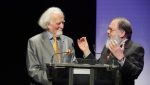
Dr. Rabbi Yosef Wosk, right, presents Max Wyman with the inaugural Max Wyman Award for Cultural Commentary. (photo by Fred Cawsey)

In the program of the inaugural Max Wyman Award for Cultural Commentary, Dr. Rabbi Yosef Wosk describes Max Wyman as “a cultural paragon whose clear vision, incisive writing and fearless voice have both grounded and encouraged us. In his half-century here in British Columbia, he has been an unparalleled personality, a cultural critic and midwife of creativity whose influence is sure to be modeled by future generations.”

In establishing the biennial, province-wide award – which will include a $5,000 honorarium and allow the recipient to choose an emerging commentator, who will receive $1,000 – Wosk will help ensure Wyman’s continuing influence, as well as “catalyze the art of creative criticism.” The award will be “presented to a writer for an outstanding piece or body of work that will raise the level of cultural conversation and, ultimately, human creativity.”

Wyman was the first recipient of the award that bears his name. He received the honour at a gala at Vancouver Playhouse on April 18 – 50 years plus a day after Wyman’s first shift at the Vancouver Sun. “Pure, lovely serendipity,” Wyman told the Independent about the timing.

Born in England, Wyman immigrated to Canada in 1967. He was a longtime arts columnist, dance and theatre critic, and books editor with the Sun and with the Province. He is an actor, radio and television personality; cultural commentator; arts policy consultant; author of several books; educator and arts advocate; former mayor of Lions Bay; and an Officer of the Order of Canada. Among other things, he was involved with the Canadian Conference of the Arts, Canada Council for the Arts and the Canadian Commission for UNESCO. He was a juror for numerous competitions, chair of several cultural committees and served on the board of the British Columbia Achievement Foundation.

That Wosk wanted the cultural commentary award to be in Wyman’s name “brought a tumult of responses,” said Wyman.

“I was astonished, deeply touched, profoundly humbled and, of course, delighted,” he said. “Delighted not just for the personal recognition (every ego likes to be stroked, after all), but, more importantly, because the award would lead us to a clearer understanding of how serious and intelligent criticism – creative criticism, the informed observation and contextualization that is an essential tool of the examined life – could best function in these momentously changing times.

“My joy, astonishment and gratitude have not diminished now that the project is up and running. I have been in awe of Yosef’s social activism for years: he seems to live the essence of the Hebrew phrase tikkun olam, the notion that we should perform acts of kindness to repair the world. He puts his resources where his idealism is.”

The idea for this type of an award was first raised some years ago at a dinner at Wosk’s home, said Wyman. “The topic came up again more recently at the inaugural meeting of another of Yosef’s initiatives, the SFU [Simon Fraser University] Jack and Doris Shadbolt Community Scholars, and, early in 2016, Yosef brought forward the proposal to establish a prize to stimulate and recognize creative criticism in various disciplines.”

“I have thought about championing the idea and the ethical practice of criticism for many years,” Wosk told the Independent.

Shying away from criticism when he was younger, Wosk said, “In our tradition, we are told that God created the world through words. Rabbinic teachings emphasize guarding our tongues, not speaking badly about others and not spreading rumours. Life and death, we are reminded, is often controlled by words. Just look at the prevalence of bullying in schools and the tragedy of so many youth who are driven to suicide in an effort to escape the unbearable embarrassment of verbal abuse. I had to work through numerous stages of emotional and intellectual maturity before learning that intellectual opinions or personal preferences were not the same as lashon ha’rah, derogatory speech about another, nor was it the same as moral rebuke.

“Criticism, I learned, could be a gift. It involved courage, clear sight and expression. Saying ‘no’ to one thing also means saying ‘yes’ to something else. I rejected mean-spirited criticism but embraced creative criticism.”

Wosk first heard of Wyman when Wyman was at the Sun. “I admired his work,” said Wosk. “From the sound of his name, I thought he was probably Jewish. Later, I found out that he wasn’t but, as I got to know him, I realized that he certainly had ‘a Jewish soul’: he was kind, smart, sensitive, humble and active in helping the world be a better place. I got to know him better when we were both involved in the Canadian Academy of Independent Scholars at Simon Fraser University. When I was appointed a Shadbolt Fellow at SFU in 2015, I invited Max and his wife, Susan Mertens – also a critic and a brilliant scholar of esthetics with a doctorate from Cambridge – to be in the first cohort of Shadbolt Community Scholars, with a mandate to knit together the academy, the arts and the community.”

Wosk said he approached Scotiabank Dance Centre with the idea for the Wyman Award because, although “Wyman was recognized as a culture critic in general, he was most famously known as a dance critic.”

Wosk sought the advice of the centre’s executive director, Mirna Zagar, and was introduced to associate producer and chair of the Dance Foundation, Linda Blankstein, who was hired to research the feasibility and nature of a possible award.

“Not only did Linda produce an excellent report that became the basis for future planning,” said Wosk, “but we also subsequently hired her to produce the inaugural event. With considerable advice from the organizing committee, she assembled a professional team from the Dance Centre, the British Columbia Alliance for Arts + Culture, a filmmaker to produce a video on Max, found the appropriate venue, worked with a graphic designer, publicist, assembled mailing lists, arranged for media interviews, and so on.”

In addition to the award presentation, the program at the Playhouse featured Bard on the Beach’s Christopher Gaze as the emcee, various speakers, video greetings and several dance performances.

Among Wyman’s publications is the first on Canadian dance history, Dance Canada: An Illustrated History (1989), as well as The Royal Winnipeg Ballet: The First Forty Years (1978), Evelyn Hart: An Intimate Portrait (1991) and Revealing Dance (2001).

“If you only knew me to look at me, and tried to work out what I did for a living, a career in dance is of course the first conclusion you would jump to,” said Wyman. “In fact, when they hear that I spent my life writing about dance, the first thing people say to me is, well, of course, you must have been a dancer. And I’m reduced to explaining that, in fact, no, I have only ever danced once. But it was for the Queen.

“I was 8 or 9, living in Nottingham, where I grew up. She was Princess Elizabeth, and she was on a visit to the city to open a gasworks or cut a cake – anyway, every kid for miles around was rounded up and taken to a clearing in Sherwood Forest, where we were made to do country dances around the maypole as part of her program of entertainment. I can still remember her vividly: coming down a slope into the clearing in an open car, beautiful pink dress, big pink hat, the famous wave. The memory has stayed with me all my life, so you can imagine how disappointed I was when I finally got to meet her – she had no memory of me at all.”

Wyman believes that “dance is the most moving and communicative of all the artforms.”

“It crosses the borders of language and logic, lets you see beyond the interacting bodies on the stage and, through the interplay of rhythm and pattern and energy, to an idea, or an emotion, or an intuition within yourself that the dancing has provoked – puts you in touch, at the best of times, with the intuitive, the spiritual, the transcendental, and you go away refreshed, thoughtful, energized.

“What makes all this so hugely poignant, at least to me,” he said, “is the transience of it all. The body, such an impermanent scrap, moves, and the dance is gone. No other artform speaks so directly about the fragile, temporary quality of life, or about the human instinct to cast off its physical bonds and aim for that perfect moment of self-realization. It exists in the realm of the transcendent and the truly brave.”

On May 14, Wyman turned 78. He has been intermittently writing his memoirs over the last few years, he said. They are “currently at 325,000 words and counting – and I post bits quite often to my website, Notes Toward a Life: essays, diary entries, pen-portraits, maxwyman.com.”

He is also working on a variety of other projects. At the time of his interview with the Independent, he was preparing a paper for a conference at the University of London. In an interview with the Sun in the days leading up to the award ceremony on April 18, he reminisced about his early years at the paper.

“We covered everything,” he told writer John Mackie. “Everything professional in theatre and music, dance, visual arts. It was a wonderful time. The Sun sent me off to Stratford and Shaw (in Ontario) every summer for the opening weeks. They sent me to Europe for the summer festivals one summer.”

The industry has changed since then, but Wyman is optimistic about the future of newspapers.

“The steady coarsening of public discourse, the shallowness of what passes for debate, the polarizing of political thought, the pernicious crudeness of public taste mean that our need for mediated, trustworthy information and informed opinion can only intensify,” he told the Independent. “Traditional media are flailing around to find their footing and their market in the shifting digital landscape … but I believe this is an interim period. What will emerge will be a leaner, cleaner delivery service that will give informed context to events and issues that affect their readers. However, the splintering of reader interests will mean that the one-paper-fits-all model is over. Given the way technology is evolving, it’s not hard to envision tailored-to-the-individual e-publication at a workable price.”

And the future need for cultural commentary – that which the Wyman Award hopes to perpetuate?

“The whole point of engagement with art, it seems to me, is to expose yourself to something that has the possibility to change you,” said Wyman, whose books include The Defiant Imagination: Why Culture Matters (2004). “I always want to come out of a theatre or a gallery or a concert hall a different person, even just slightly: I hope to have been shown a different perspective on how the world works, understand better the ways other people think or feel or express themselves. Many of us have stood before a painting, listened to a piece of music or watched a play and felt – along with the pleasure of the experience itself – a sense of inexplicable, even inexpressible, understanding or revelation.”

He acknowledged, “Cultural commentary will not produce a cure for cancer. It will not take us to Mars: not physically, at least. But, in its constant probing of new ideas and its ceaseless explorations of the human spirit, it gives us ways to rethink who we are and contemplate how we can be better. We are privileged and passing occupiers of this marvelous earth: books, plays, paintings, ballets, music – they guide us to the hidden truths of our daily being.

“So it is time – beyond time – to relocate creative activity and engagement at the heart of the social agenda, with an imagination-based education as the keystone. Engagement with arts and culture, the humanities, helps develop the flexible thinking that lets us see our world in fresh ways. In ways that allow us to build resilience, vision, innovation and generosity into our thinking so that we can cope with the unpredictable and adapt to rapid and complex change. If society is the Petri dish, culture is the, well, the culture that catalyzes change: makes us a better society, makes us more empathetic people, lets us understand our neighbours, civilizes us. It is the way we realize and communicate our shared humanity.”

Format ImagePosted on June 2, 2017May 31, 2017Author Cynthia RamsayCategories LocalTags cultural commentary, dance, Max Wyman, Yosef Wosk
Continuing to bring hope

Continuing to bring hope

Fantaye, Gary Segal and Tesfaye in 2015, on a return visit by Segal to Gojam, Ethiopia. (photo from Gary Segal)

Thirty-seven spine surgeries, six nursing/midwifery scholarships, development of Sebi Sarko Rural Health Centre and the establishment of a pediatric program reaching more than 14,000 children living in rural areas. That’s part of what has been accomplished with the $1 million-plus that was raised in Vancouver five years ago at An Evening to Bring Back Hope.

The 2012 event honoured Dr. Rick Hodes, medical director of Ethiopia for the American Jewish Joint Distribution Committee (JDC) and senior consultant at Mother Teresa Mission. It also established a partnership between JDC in Ethiopia and the University of British Columbia Branch for International Surgical Care. With the monies raised in 2012, UBC Branch has developed curriculum with Hodes and engaged in spine-disease research in Ethiopia; as well, there have been physician and nurse exchanges between UBC-Vancouver General Hospital and Ethiopia’s Gondar Hospital.

This year, on June 8, An Evening to Bring Back Hope honours both Hodes and spine surgeon Dr. Oheneba Boachie-Adjei, and raises funds for the continuation and expansion of their work, as well as that of JDC and UBC Branch. Boachie, president and founder of FOCOS (Foundation of Orthopedics and Complex Spine) in Accra, Ghana, has performed most of the complex surgeries on Hodes’ spine patients since the two doctors starting working together in 2006.

The fundraising event includes a symposium and lunch at Congregation Beth Israel, at which attendees will be able to ask JDC staff questions about JDC’s humanitarian work and philanthropy, and a gala dinner at Vancouver Convention Centre-East. Event partners are JDC, UBC Branch and the Jewish Federation of Greater Vancouver. As in 2012, gala chairs are Gary and Nanci Segal.

“I am very pleased that Dr. Boachie will also be a focus of attention at the event,” Gary Segal told the Independent. Hodes, an observant Jew, and Boachie, a devout Baptist, “together work tirelessly to treat the sick and poor of all religions and ethnicities.”

“I truly believe that in today’s world filled with negativity, intolerance and discord, this cause and message of inclusion and multiculturalism resonates louder than ever,” said Segal.

Segal first met Hodes as part of a Federation/JDC trip to Ethiopia in 2007. He spent more time with Hodes on a family trip in 2008. “The more time I spent with Rick in clinic and at his home with his very large family of adopted and fostered children that all needed Rick’s help, the more heroic and inspiring Rick and his life story became to me,” said Segal. When hosting Hodes and his extended family of 18 children (at the time) for dinner, Segal learned that Tesfaye – whose spine had collapsed from tuberculosis – could not be operated on in Ghana, and thought, “I knew that I had to do whatever I could to save Tesfaye’s life.”

According to the fundraiser’s website, Segal “spent almost a year pursuing the possibility of bringing Tesfaye to Vancouver for spine surgery and, finally, on his 18th birthday, May 20, 2009, Tesfaye arrived in Vancouver and was welcomed into the Segal home. On June 12, ‘Team Tesfaye,’ led by surgeon Dr. Marcel Dvorak at VGH … successfully perform[ed] delicate 14-hour life-saving surgery.”

“For decades,” Segal told the Independent, “I have always given of my time and money to help a variety of community organizations and causes – I grew up with wonderful examples of this in both my mother and father. Helping Tesfaye was a unique experience, where the ‘giving back’ became such an intimate, personal and integral part of my life.

“On my 2010 trip back to Ethiopia after Tesfaye’s surgery, I retraced and revisited what his life was like before surgery. Understanding Tesfaye’s courage, dignity, perseverance and optimism – that he kept in the direst, most uncomfortable and debilitating of situations – motivates and inspires me daily, and always keeps my problems in perspective.

“Seeing the transformation in Tesfaye’s life and what it has meant to his family and entire village, further inspired me to found this Bring Back Hope initiative,” he continued. “One of the highlights of my life was that 2010 trip to Tesfaye’s remote village in Gojam – a typical village with mud huts, no electricity or running water – as the entire village celebrated his miraculous rebirth for three days, with feasting, chanting and Agew shoulder dancing. Seeing ‘up close and personal’ the impact of changing even one individual’s life, it became my vision to introduce Rick’s story to more people by holding a large dinner of caring people from different faiths and backgrounds, and to hopefully raise a lot of money to change more lives. Thus, the Bring Back Hope initiative was launched through the inaugural Evening to Bring Back Hope 2012.”

But his efforts extend beyond the events. “I never imagined before meeting Tesfaye that, one day, I would have a whole extended family in Ethiopia become part of my family,” he said.

It was hoped that Tesfaye’s sister, Fantaye, would be joining her brother at this year’s Bring Back Hope. Unfortunately, she won’t be able to make it – but for “good news” reasons, said Segal, “as she is about to graduate from Grade 12 at a high school in Ethiopia’s capital city Addis Ababa and the national exams she has to write to qualify for university only end on June 8.”

“I met Fantaye in February of 2010,” explained Segal, “when I flew over to Ethiopia to accompany Tesfaye on the journey out to his remote village in Gojam to be with him to experience his family and village seeing him standing upright for the first since he was crippled with TB of the spine at 8 years of age…. Tesfaye, living in the capital Addis Ababa since he was 12, heard that his mother wanted Fantaye to get married; he was concerned she was too young, being only 12 years old, and feared the husband’s family would force her, once she was married, to stop going to the village school. At his request, I asked his mother, Yeshi, to wait until Fantaye was older and completed school, but, sure enough, she was married a few months later, at the age of 12.”

When Segal returned to Ethiopia in December 2012 on a Bring Back Hope-related trip, he found, to his “surprise and delight,” that, “through Tesfaye’s persistence and insistence, Fantaye had left her husband and village to join her brother in Addis Ababa and live with him and go back to school. This took a lot of courage on the part of a then 14-year-old girl, going against the wishes of her family and entire village. At the same time, it took Tesfaye’s courage of conviction as to what was right for his sister for this to happen; I attribute this to Tesfaye understanding the greater world outside the village and Fantaye seeing the transformation of Tesfaye.”

Even after 27 years working with JDC in Ethiopia, Hodes still finds inspiration from his patients.

“The courage which Ethiopians live with who have spinal deformities is simply inspiring,” Hodes told the Independent. “Kids who are in pain but still go to school, kids who are teased at school but persist, kids who have no parents and are self-supporting as young teens but go to school and come for treatment.

“And the love which they show for each other is exemplary. I have a single mom who has a paralyzed son who has simply devoted her entire day – every day – to caring for this boy, who is now improving. In fact, I just brought him to Ghana five days ago for intensive physical therapy to see if we can jump-start his improvement.

“I bought a bag of cookies for a young boy with a bad back. He put them in his pocket. ‘Why don’t you eat it?’ I asked. ‘Later,’ he said, ‘I want to share it with my brother.’

“I have another mom who has a son who had a complex heart problem giving him very little oxygen. This boy could not walk more than three steps and the mom has made sure that he moves forward in life by carrying him, piggy-back, everywhere. She carried him to school, carries him home, brought him to Addis Ababa every month for phlebotomy, to remove the extra blood his body produces. And now he’s able to walk, after corrective heart surgery in India.

“I had an orphan boy with no relatives at all,” continued Hodes. “He came to Addis Ababa, supported himself by shining shoes, went to school and slept in a taxi at night until someone took him into their home. He, too, has had surgery and is now back in school.

“When I’m having a tough day – I frequently feel overwhelmed – it’s patients like this who keep me going, and remind me why I’m here.”

Hodes’ International Life-Saving Surgery Program 2016 annual report describes that year as “game-changing.”

“This was the first year that the Ethiopian government gave us support – they paid for the air tickets of 22 patients to Ghana for spine surgery,” explained the doctor. “They are continuing the air ticket support this year.”

Also in 2016, he said, “Our contract with the Ethiopian government ended its standard, three-year period and the program closed for evaluation. It was given an unprecedented five-year renewal.

“We have moved into new facilities at a government trauma hospital called AaBET [Addis Ababa Burn Emergency Medicine and Trauma] Hospital, where we see patients five days a week. We have started discussions to send two Ethiopian doctors to Canada for spine training. We now have several teams coming to Ethiopia to operate – in fact, we have three different spine teams coming this month, and will get at least 40 surgeries done inside Ethiopia!”

In addition to treatments, there have been discoveries. “We have described some new deformities, which we are now defining with Greek letters,” said Hodes. And, he added, “We believe we’ve made a major discovery about spine deformities caused by neurofibromatosis.”

In 2016, Hodes said there were 359 new spine patients, with 111 surgeries conducted on 105 patients. “We got two spines done in the U.S., and helped two patients go to India for heart care,” he said. “So far this year, we have 101 new spine patients.”

Hodes said the price for spinal surgeries ranges from $13,000 (or a little less) to $21,000, averaging about $18,000. For hearts, he said, “some patients need procedures (done in the catheterization laboratory) where a balloon is blown up to expand a narrowed valve or close a hole in the wall of the heart. Those cost around $2,000. Surgery costs depend on the complexity of the case, and generally run from $5,000-$10,000.

“If we get surgery done in North America, it’s at no cost to us, other than an air ticket. We just had two boys return from complicated surgery in Texas, and another from California.”

Hodes stressed, “I cannot sufficiently thank the people of Vancouver who are helping me. Their help is, quite literally, life-saving.”

For tickets to the gala ($500, with tax receipts issued for eligible portion) and sponsorship information, call Mercedes Dunphy at 604-710-4491 or Nanci Segal at 604-813-5550. For more information on the initiative, visit bringbackhope.com.

Format ImagePosted on May 26, 2017May 24, 2017Author Cynthia RamsayCategories LocalTags Boachie, Bring Back Hope, Ethiopian, Gary Segal, health care, JDC, philanthropy, Rick Hodes, tikkun olam
Negev a family affair

Negev a family affair

Left to right, Negev Dinner 2017 honourees Michael Averbach, Gary Averbach and Shannon Gorski (née Averbach). (photo from Jewish National Fund, Pacific Region)

“The important thing that I want to say is that I’ve accepted this honour because I’m sharing it with my kids,” Gary Averbach told the Independent about this year’s Jewish National Fund of Canada, Pacific Region, Negev Dinner, which will pay tribute to Averbach, his son Michael Averbach and daughter Shannon Gorski.

“Ultimately, it came down to my father being recognized,” said Michael Averbach. “He was apprehensive. Initially, he didn’t want to do this. He’s a very humble man and doesn’t like to be in the spotlight; in fact, he’s quite the opposite. But, he also understands it’s for a greater good and it will help build JNF, help fundraise and go towards a need in Israel.”

Even though the dinner on June 4 is sold out, community members can still support the Averbachs’ chosen project: the Tzofei Tzamid, the Israeli Scouts.

The Israeli Scouts run programs for kids 9 to 21. Their 80,000-plus members include more than 2,500 children and youth with disabilities.

Gorski and her father visited Israel in late February. She described the Scouts as “a rite of passage for Israelis.” In the program, she said, children with severe Down syndrome, kids with visual or hearing impairments or who are on the autism spectrum, “all of these children are being able to work side-by-side with their Israel Scouts’ peers and fully participate in the programs the Israeli Scouts offer. And that is what my family, alongside the JNF Vancouver community of supporters, are funding – the ability of the Israeli Scouts program in Raanana, to ensure that they have the proper resources and equipment when they take the Israeli scouts into the wilderness, as well as their own facility, to make it accessible for all.”

She said the organization’s mission “really resonated with my own philosophy, and that is one of inclusion … providing opportunities so that kids can develop skills, and leadership opportunities and life-preparedness. I see Israel already as such a leader in a lot of innovative ideas … and, when I got to see what they were doing in the area of youth services, they also are [excelling in that]…. When my father and I were there – to be able to see firsthand how happy these children were and how they were included, and listening to the testimonies of the parents, who are so appreciative and happy themselves, because what makes a parent happy is to see their child happy.”

Gorski, Gary and Diane Averbach’s eldest child, and Michael, their youngest, live in Vancouver, while their middle son, Blake, splits his time between Israel and Quebec City. The three Negev honourees are being celebrated for their many local community contributions.

Born in Vancouver to Louis and Betty Averbach, Gary Averbach – who is chief operating officer of Belmont Properties – has been involved in various capacities with JNF, the Jewish Community Centre of Greater Vancouver (JCCGV), the Jewish Federation of Greater Vancouver, the Jewish Community Foundation of Greater Vancouver (JCF), Congregation Beth Israel and the Jewish Museum and Archives of British Columbia, among others.

Shannon Gorski, managing director of the Betty Averbach Foundation, has worked with marginalized people and at-risk youth for most of her life. In the Jewish community, she has served on the boards of JCCGV, Hillel BC and Richmond Jewish Day School (RJDS); chaired galas and events, such as JCCGV’s Israel at 60, Beth Tikvah’s 40th anniversary and RJDS’s 18th gala; and sat on committees of JCF, King David High School and the Bayit.

Michael Averbach, who owns Averbach Mortgages and also works with Belmont Properties, has chaired the JCC Sports Dinner for many years (he co-chaired it this year with James Dayson), has co-chaired a Vancouver Talmud Torah Gentleman’s Dinner, is on the executive board of the Ohel Ya’akov Community Kollel and is active with Federation.

“We had a reception last night,” Gary Averbach told the Independent the morning after a Negev Dinner-related cocktail party at his home, “and I heard it enough times, that people understand, it’s so great your kids are carrying on your tradition. That’s the message I want to go out: how lucky I am to have kids that have carried forward what I believe in.”

The first Jewish organization Averbach got involved with was JNF, he said, and it is the only Israeli organization with which he has been heavily involved. “The local community, and especially things involving Jewish youth, means the most to me,” he said.

“I think it’s great what the JNF is doing now,” he added. Funding groups such as the Israeli Scouts, he said, “is a great step and it really makes the JNF more relevant to a lot more people all over, but certainly in Vancouver.”

Gorski said she has spoken to Israelis now living here about how integral the Israeli Scouts were to them. “In fact,” she said, “one individual in the community, who’s very active with youth in the community, said to me, ‘The Israeli Scouts saved my life.’ I was so, so moved by that.”

After she and her father visited the Israeli Scouts, Gorski joined JCCGV’s Bagel Club in Israel as a chaperone on their Birthright-style mission – “for many of these Jewish persons with different abilities and challenges,” she said, it was their first trip to Israel.

While she’s never been formally connected to the Bagel Club, Gorski said she has a step-uncle who is a participant and she was on the hiring committee for the current leader of the program, Leamore Cohen.

Worried about being away from her two children for so long, she asked them if they were OK with her leaving. She said her older son said, “What are your talking about? I’m excited for you. You’re going to Israel, and you’re going to do something that’s so important.

“That’s another reason why I get connected,” she said. “My father has been such a mentor to me and has instilled in me the importance of modeling behaviours of tikkun olam and just giving generously of your time. He used to say, when I was first asked to be on different boards, which he had been on, i.e. the JCC and involved with Federation, I basically said to him, ‘My biggest concern, Dad, is that I don’t have the capacity, the deep pockets that perhaps they think I do because of yourself,’ and he said, ‘You know what, the community, when they look at people to sit on their board and to participate and to volunteer … they look for the three Ws: wealth, wisdom and work. It’s not all three, it can be one…. They don’t just want the wealthy people.’ And he used to say it’s easy for somebody to write a cheque.

“He’s so humble,” she continued. “Every time that they would ask him to speak, he would always put the credit to those who were the worker bees, the people who were behind the scenes, who were doing the work, they were the ones who deserved the accolades…. For me, that’s been a lot of why I have focused on the Jewish community, but not just the Jewish community…. The fear among the older generation, which I’m entering into, is that, will the next generation be able to carry on and give with the three Ws … is Vancouver in good hands, is the Jewish community in good hands, is Israel in good hands?”

For his part, Michael Averbach – who has four children – has focused his attention mostly on the Jewish community. He was inspired, in his early 20s, by his father’s work on the campaign for JCCGV’s redevelopment. Achieving the goal, Averbach said his father “was so elated, so excited. He screamed out, ‘Yabadabadoo!’ It was the first thing that came to his mind, he was so happy.” Witnessing this reaction, he said, “I caught the bug. I got involved.”

Calling the JNF tribute “a huge honour,” he added, “If we can encourage other young philanthropists and people in the community who are thinking about getting involved to get off the fence and push forward, find something that resonates with them, then this is all very much worthwhile.”

Gorski echoed these sentiments. She said many of her peers “thought the JNF was restricted to selling trees … and, if you go to the Negev Dinner, you see a large demographic of the older generation and not a lot of young people.” With her brother and her joining their father in being honoured, she said, they have managed to share with their peers more about what JNF does – in Israel and around the world – and many “are coming to the Negev Dinner for the first time.”

While in Israel, Gorski organized a get-together for the Bagel Club with madrichim (counselors) from the Israeli Scouts. “They made friendship bracelets, they made pita over an outdoor fire, they were all conversing. It was a really fun evening,” she said. And, as it turns out, some of the Israeli Scouts will be in Vancouver around the time of the Negev Dinner, and some of them will be joining the festivities.

She also shared that it is JCCGV head Eldad Goldfarb’s hope that, along with Cohen of the Bagel Club, which is for adults, and Shirly Goldstein, who is the centre’s youth director, they will be able “to create a program of the two different groups – youth, and adults with special needs – working together with the same sort of philosophy that the Israeli Scouts follow, doing similar types of activities.”

The June 4 Negev Dinner at Four Seasons Hotel will also see Richmond Jewish Day School head of school Abba Brodt presented with JNF’s Education Award. For more information or to donate, contact JNF Pacific Region at 604-257-5155 or [email protected].

Format ImagePosted on May 26, 2017May 24, 2017Author Cynthia RamsayCategories LocalTags Averbach, Israel, Jewish National Fund, JNF, Negev Dinner, tikkun olam
Caring for our seniors

Caring for our seniors

Louis Brier Home and Hospital. (photo from cjnews.com)

“Louis Brier offers our residents variety in programming and services, as well as safe and quality care. Residents and families remain the primary decision-makers for the care received, as resident and family-centred care is at the core of our goals. All care is governed by our Jewish and professional values and standards of excellence,” Angela Millar told the Independent.

Millar is the director of quality and risk management, accreditation and resident experience for the Louis Brier Home and Hospital and Weinberg Residence. She was responding to questions from the Jewish Independent about the 2017 British Columbia Residential Care Facilities Quick Facts Directory, published by the Office of the Seniors Advocate (OSA). The directory “lists information for 292 publicly subsidized facilities in British Columbia that offer residential care services to seniors,” including Louis Brier.

The information was “gathered primarily from residential care facilities, health authorities, the Ministry of Health and the Canadian Institute for Health Information.” The data on licensing incidents and complaints is from the 2015-16 fiscal year, while the “inspection data was a snapshot taken on Dec. 7, 2016.” The 2017 OSA report can be found at seniorsadvocatebc.ca and the most recent inspection information from Vancouver Coastal Health at inspections.vcha.ca.

Millar explained, “Louis Brier is an affiliate of Vancouver Coastal Health, providing residential care for seniors. Vancouver Coastal Health provides an annual operating budget and Louis Brier Home and Hospital also receives donations from the Louis Brier Jewish Aged Foundation, which provides music and art therapy, Jewish culture and synagogue, kosher food and supplementation of medical equipment.”

The OSA directory mentions the Louis Brier Jewish Residence Society, as well as separate resident and family councils.

“The resident council represents the seniors who live at Louis Brier, ensuring they have a voice in how their home is run,” said Millar. “The council is supported by staff and meets monthly to discuss concerns, develop suggestions and plan activities. The executive director of resident care services and the chief executive officer attend meetings to provide updates, answer questions and develop plans to address concerns where needed.

“The family council is an independent group of family members and friends who meet monthly to support each other and advocate for the seniors residing at Louis Brier. A staff member liaises with the council and senior management team, who are often invited as guests. The family council acts as a forum to share experiences, learn and exchange information.”

In the 2017 OSA directory’s statistics on care services and quality, Louis Brier performed better than the B.C. average in percent of residents receiving physical therapy (34.3% versus 13.2%) and occupational therapy (10.3% versus 7.6%) but not in percent of patients receiving recreation therapy (1.1% versus 27.9%). With different percentages, Louis Brier fared similarly in the OSA’s 2016 report.

Noting that the data collected for the OSA report is “a snapshot at one time in a period,” Millar said, “I believe that the data is collected utilizing a seven-day observation tool throughout only one week in a quarter. Of course, my personal concerns are related to the validity and reliability of the data that is reported and thus the ability to generalize or glean valuable information from that data.

“My concerns aside, data collection is only looking at therapeutic interactions of the rehab team with residents – one PT/OT [physical or occupational therapist] per four residents and one rec therapist per eight residents – unfortunately rehab and rec resources [do] not abound, and our aim is to maximize the outcome and benefit to as many residents as possible given the resources that we have. As such, many of our programs and interventions are designed to accommodate larger groups of residents and most likely beyond the guidelines of the seniors advocate data collection parameters. It would help to understand how these parameters have been established and whether they have been evaluated for reliability in terms of producing valid data to help draw conclusions in relations to quality of care and residents’ outcomes.”

Millar emailed the home’s May recreation calendar, which can be found at louisbrier.com/events, “as an example of the plentiful and very rich programming that we are proud to provide our residents.”

In the 2017 directory, Louis Brier fares better than the provincial average in many areas: there were no substantiated licensing complaints and no reported incidents of disease outbreak or occurrence, abuse or neglect, food poisoning, medication errors or missing or wandering persons. With respect to falls with injury or adverse event, there were 5.1 per 100 beds, compared to a B.C. average of 11.9; and, in the category of other injury, 1.4 per 100 beds at Louis Brier compared to a provincial average of 1.6.

There is only one measure in which Louis Brier fared lower than the provincial average in the 2017 directory. In the year examined, there were nine reported incidents of aggression between persons in care at Louis Brier, or 4.2 per 100 beds, as compared to the provincial average of 1.5 per 100 beds; the 2016 OSA directory lists zero such incidents at the home.

With respect to four other quality measures, Louis Brier fared better or comparable to the provincial averages in three areas – percentages of residents diagnosed with depression, residents receiving depression medication and use of daily physical restraints. However, with respect to the percent taking antipsychotics without a diagnosis of psychosis, 40.8% of Louis Brier residents who were taking antipsychotic medications had not received a diagnosis of psychosis, compared with the B.C. average of 26.9% in the 2017 report, and 41% versus 31% in the 2016 report. As well, the OSA directory reports that, while 16.2% of Louis Brier residents had been diagnosed with depression, 48.1% of residents were receiving depression medication; in the 2016 directory, the respective figures were 21.1% diagnosed and 52.3% receiving depression medication.

“Your specific question with regards to prescription of specific treatments, medications and diagnoses is not something that can be responded to in a simple way…. While nursing staff are responsible to deliver care to the residents every day of the year, they, however, have limited control on what and how medications are prescribed and why,” said Millar. “Nurses advocate on behalf of the residents and may raise questions and awareness, however, changing physician practice or implementing best practices as it is related to the medical field and residential care are an entirely different area for discussion and attention. To understand and evaluate whether medications and treatment are prescribed appropriately requires a comprehensive approach by both the nursing and medical staff. We are certainly committed to ensure our residents receive safe, quality care and are continually monitoring medications and treatments as possible.”

Millar explained, “Louis Brier is regulated by the Community Care and Assisted Living Act, as well as the Hospital Act, which is enforced by Community Care Facilities Licensing.

“Currently the facility is showing its commitment to quality care by preparing for an Accreditation Canada Survey in May of 2018. Accreditation Canada will assess our organization against standards of excellence with regards to leadership, long-term care, medication management, infection control and governance.”

She described Accreditation Canada as “a significant wealth of information and resource for organizations in their quest to improve and achieve the highest level of care and quality possible within the industry” and invited the Independent and its readers to the Louis Brier Accreditation Fair on May 23 “to learn more and see how you can get involved.”

Millar noted that Louis Brier also has “just developed a quality and risk portfolio including a director of quality and risk management [QRM], manager of QRM, an infection control practitioner, as well as a QRM coordinator. Within this team, there are also individuals responsible for resident experience, including social work, volunteer coordinator and the manager of the companion program.”

As for staffing levels overall, Millar said, “I believe that there could never be enough staff and resources; however, we do have to work within our funding boundaries, given what we have. We can say with great confidence that Louis Brier has, most likely, more resources in terms of rehab and recreation staff than many other organizations (mainly because we are so greatly supported by the Louis Brier Foundation): we have over 300 volunteers and over 100 companions that help us deliver outstanding care to all of our residents. To that end, Louis Brier shares a common goal with the seniors advocate – of providing safe, quality care to our elders. Furthermore, Louis Brier certainly supports the efforts and intention of the seniors advocate in evaluating and advocating for additional resources to be allocated to the long-term care sector to help providers support and deliver excellent care to our seniors.”

Format ImagePosted on May 19, 2017May 19, 2017Author Cynthia RamsayCategories LocalTags Angela Millar, health care, Louis Brier, residential care, seniors
Diverse selection of artwork

Diverse selection of artwork

Johanan Herson is coming from Israel to Art! Vancouver. (photo from Johanan Herson)

“I am very much looking forward to seeing all the new artwork coming from around the world,” Lisa Wolfin told the Independent. “We have some giant heads coming from Miami, some art made out of spider webs, metal sculptures and some really crazy stuff – can’t wait to see it all together under one roof.”

Wolfin is the founder and director of Art! Vancouver, which this year takes place May 25-28 at Vancouver Convention Centre-East. She is also an artist herself and will be bringing recent work to the fair.

“Over the past year,” she said, “I have contemplated what to make for the show that is new and unique and have come up with my new series called I Feel. It is a portrait series made from different materials: oil on canvas, mixed media on wood panel, and photography.”

Her current work is contemporary, she said. “What I have found in the many art fairs that I have attended is that artists are using recycled materials and making them into creative art forms. My newest series is made out of my kids’ things they used when they were young. Sometimes, it feels like I am back in kindergarten being free to just play with materials, not thinking what you are trying to make out of it, just doing. Who doesn’t want to be a kid again?”

photo - “Golden Hour,” acrylic on canvas, by Michael Abelman, one of several Jewish artists whose work is part of Art! Vancouver, which runs May 25-28
“Golden Hour,” acrylic on canvas, by Michael Abelman, one of several Jewish artists whose work is part of Art! Vancouver, which runs May 25-28. (photo from Art! Vancouver)

As more people have become aware of the art fair – this is its third year – inquiries have come from around the world, said Wolfin. And CBC Arts’ Amanda Parris “is flying out from Toronto to host the show and speak in a panel talk on Saturday at 3 p.m. Joining Amanda on the panel is Barrie Mowatt, who presently runs the Vancouver Biennale.”

Art! Vancouver opens on May 25, 7 p.m., said Wolfin, with “The Face of Art, where the artists walk down the runway carrying their artwork, so the attendees can put a face to the art to know who the artist is. People are curious as to who are the makers of the art – at this show, the artists are mostly in attendance, where people can come to meet them.”

Among those artists are several from the Jewish community, including Wolfin. Also presenting their work will be Johanan Herson, who is coming to the fair from Israel, and local artists Michael Abelman, Lauren Morris, Taisha Teal Wayrynen and Skyla Wayrynen.

“I will be showing mostly the soft art, textile art, but will have some of the sculpture works and acrylic paintings as well,” Herson told the Independent about what he’s bringing with him. “Le Soleil Gallery [on Howe Street] is showing the full range of my work and will continue after the fair to handle my artwork.”

Herson said he’s been to Vancouver a couple of times before, when he was a student at Banff School of Fine arts. He is originally from Montreal.

“I grew up in Montreal and visited Israel on various occasions before making aliyah,” he said. “In fact, I had come to study at the Bezalel Academy just after the Six Day War and hated it. I traveled the world before coming back to Montreal and the Canadian sense of pluralism and diversity. I came back later [to Israel] to understand the meaning of my Jewishness and fell in love with an Israeli woman, of a 10-generation family, and find myself part of this dynamic society.”

In terms of his artwork, Herson said, “I know that my soft art is a product of being at the right time and the right place, where this technique evolved, and I did look into the possibility of doing it in Quebec, but … the soft art is definitely an Israel discovery and development.

“My Canadian identity is one of respect for everyone, the celebration of diversity and acceptance of the other, and I cherish my Canadian roots and heritage and am proud of my citizenship. My work in Israel and my Jewish identity has always been part of who I am wherever I am and was part of who I am as a Canadian and an Israeli. I hope that my commitment to making the world a better place for everyone would have guided me if I had never left Canada, although perhaps the intensity of living and creating in the Middle East has challenges that are unique to Israel.

“I believe in the good in humanity,” he continued, “and have always sought to defend the less-privileged and suffering … whether they are in Montreal, Tel Aviv, Ramallah or Africa, and seek global communication as a platform to making the world a healthier and safer place of love, respect and opportunity for a better life for everyone. I do so as a Canadian Jewish Israeli artist.”

photo - "Welcome to my World," latex on canvas, by Skyla Wayrynen
“Welcome to my World,” latex on canvas, by Skyla Wayrynen. (photo from Art! Vancouver)

He gave the example of an exhibit of his work that just closed at the University in Minnesota. The exhibit, he said, was “part of encouraging dialogue between the Jewish student and Islamic student bodies. The message is that we must pray and work for a better world, that tikkun olam is to wake up every day and say that the world has been created for me alone, and that I must make it a better place for everyone.”

Teal Wayrynen is working toward a similar goal – making the world a better place – in a different way.

“I received my associates degree in psychology from Capilano University and am graduating this year with my bachelor’s degree from Simon Fraser University,” she told the Independent. “I will then combine my art with my counseling and do a master’s program for art therapy after I travel for half a year.”

At last year’s Art! Vancouver, Teal Wayrynen featured her Pop Icon collection. This year, she said she is “experimenting with charcoal and acrylic paint and drawing female bodies.”

Right now, her favourite medium is acrylic paint mixed with spray paint, she said. “I just started to mix mediums and use molding paste, acrylic paint and charcoal on top,” she added.

Morris has also been delving into new methods and media.

“I have continued predominantly working on flowers, however, I have introduced a new colour palette, as well as more abstraction within my floral pieces,” she told the Independent. “I’ve also continued with my free, fluid style and introduced some abstract landscapes using the new colours. My inspiration comes from the beautiful flowers that seem to surround me every day. Every season brings on something new and I am inspired by their shapes and colours.”

She has been working on a new series for Art! Vancouver, Morris said, “experimenting with a couple of new techniques and colours. They will be mainly florals and will all coordinate in style so that there is consistency within my pieces. I work predominantly in acrylic.”

She added, “I am hoping that my growth as an artist is shown in my new pieces and that my work continues to evoke my viewers’ emotions through visual imagery.”

Art! Vancouver opens May 25 at the convention centre with a VIP preview at 6 p.m. and the gala at 7 p.m. The show runs May 26-27, noon to 8 p.m., and May 28, noon to 5 p.m. A one-day pass is $15 (online) or $25 (at the door); $8 for children under the age of 14. A multi-day pass is $40 and a VIP pass is $100. Tickets to the opening gala are $30. Visit artvancouver.net.

Format ImagePosted on May 12, 2017May 9, 2017Author Cynthia RamsayCategories Visual ArtsTags Art! Vancouver, Johanan Herson, Lauren Morris, Lisa Wolfin, Michael Abelman, Skyla Wayrynen, Taisha Teal Wayrynen
A little music … a few trysts

A little music … a few trysts

Katey Wright and Warren Kimmel co-star in A Little Night Music, which opens at Anvil Centre Theatre on May 13. (photo by David Cooper)

“The end of Act One may just be the most brilliant piece of musical theatre writing ever,” actor Warren Kimmel told the Independent when asked about Stephen Sondheim’s A Little Night Music, which will have a limited run at the Anvil Centre Theatre, starting next week.

And Jewish community member Kimmel knows of what he speaks when it comes to musical theatre. To name only some of the super-well-known musicals he’s been in – Billy Elliot, Fiddler on the Roof, Les Misérables, My Fair Lady, Mary Poppins, Sound of Music, Beauty and the Beast.

In A Little Night Music, which takes place around the turn of the last century, Kimmel plays Fredrik Egerman, who has just married 18-year-old Anne, many years his junior. One problem is that Fredrik’s son also loves Anne. Two other problems are that Anne is reluctant to give herself to Fredrik and Fredrik hasn’t quite doused the fire that exists between him and Desiree, a former girlfriend. Then there’s Desiree’s jealous (and married) lover. “All of these trysts and twists come to a head,” reads the promotional material, “when Desiree convinces her mother to host Fredrik and his family for a weekend on her lavish estate – where the count [Desiree’s lover], with his wife … crash the party.”

“Apart from its sheer entertainment value – the incredible music and genius lyrics of Stephen Sondheim – A Little Night Music is based on a film by Ingmar Bergman – Smiles of a Summer Night – so the themes are eternal,” said Kimmel. “How do you find love? How do you find the right person to love? How do you love the person you are with? How do you get the person you are with to love you? How do you remain faithful? Should you remain faithful? Like all great works of art, it doesn’t so much speak to a modern audience as whisper and shout!”

“I don’t know if I can adequately state the importance of Stephen Sondheim and his work,” director Peter Jorgensen told the Independent. “No other single artist has thought more deeply about composition as a tool for telling stories. No other lyricist gives characters such distinctive, rich language. As a musical dramatist, he has set the gold standard for artistry and craftsmanship.”

“Sondheim has a special place in the heart of all singer/actors,” agreed Kimmel. “His material is, without doubt, the most challenging and also the most satisfying to perform of anyone in the musical theatre canon. It’s really hard to get right but thrilling every time you do. Fredrik has some particularly complicated and expressive songs, and that’s the best and worst thing about this role.”

The Broadway musical – with music and lyrics by Sondheim and book by Hugh Wheeler – won six Tony Awards, a Golden Globe and a Grammy. In the local Patrick Street Productions mounting of the show, Kimmel co-stars with Katey Wright, who plays Desiree.

Real-life husband-wife team Wright and Jorgensen founded Patrick Street Productions in 2007. Their mandate: “to offer great productions of great plays and musicals for Metro Vancouver, with an emphasis on contemporary musicals that have not yet been professionally produced in the region.”

“For Patrick Street Productions,” said Jorgensen, “it is important for us to program musicals that challenge conceptions of what a musical is and what a musical can do. That aspiration is never better matched than with a Sondheim musical.

“As to why A Little Night Music,” he continued, “in many ways it is similar to why Hal Prince (the show’s original director) and Sondheim chose to create the show: we wanted to program something romantic and light that had a broad appeal, but that was still sharp and biting. Hal Prince described the show as ‘whipped cream and knives.’ There is no better statement that sums up the show’s appeal than that.”

Kimmel added, “Apart from ‘Send in the Clowns,’ which is perhaps Sondheim’s best known song, A Little Night Music is not as well-known as some of his other stuff, and certainly not as well known as Phantom of the Opera or something like that, but this piece is a real gem. The end of Act One may just be the most brilliant piece of musical theatre writing ever. The brilliance of the material forces you to really step up – and everyone has. From the costumes to the lighting, from the orchestrations to the casting, the level of work and attention to detail in this production are quite wonderful. It’s just worth seeing on every level.”

A Little Night Music opens at Anvil Centre Theatre in New Westminster on May 13, 8 p.m., with previews on the nights of May 11 and 12. Show times are Wednesday through Saturday, 8 p.m., with 2 p.m. matinées May 14, 20-21. Tickets are $25.50 for the previews and range from $25.50 to $39.50 for the run; they can be purchased at ticketsnw.ca or 604-521-5050.

Format ImagePosted on May 5, 2017May 3, 2017Author Cynthia RamsayCategories Performing ArtsTags musical theatre, Peter Jorgensen, Sondheim, Warren Kimmel
Our sense of reality and self

Our sense of reality and self

Chuck Wilt and Rebecca Margolick in birds sing a pretty song. (photo by Maxx Berkowitz)

Social media has changed the way in which we work, play and shop. It has changed how we communicate, access information, and even how we define ourselves.

A new work by Rebecca Margolick and Maxx Berkowitz, called birds sing a pretty song, “explores how surveillance and confinement through our digital and physical surroundings affect one’s sense of reality and self.” The full-length piece will have its world premiére in New York City next week. It will then arrive in Vancouver for its Canadian première at Chutzpah!Plus May 13-14.

Birds sing a pretty song was created during a year-long fellowship at New York’s 14th Street Y Theatre’s LABA: A Laboratory for Jewish Culture and two Chutzpah! Festival creation residencies.

LABA describes itself as a program “that uses classic Jewish texts to inspire the creation of art, dialogue and study.”

“After learning about LABA in 2015, we decided to take our shared vision and esthetic to create a piece together that would leverage our differing backgrounds and skill sets of dance and music, design and tech,” said Margolick and Berkowitz in an email interview. “Through the year of study and support from the LABA fellowship, our original concept, revolving around the loss of physical self in a hyper-social world, evolved through the varied conversations about beauty and imagery seeded by the provocative ideas in the ancient texts we studied.

“We had two work-in-progress showings at the 14th Street Y in April 2016 and, this past year, we were fortunate to be able to continue to develop the full-length piece through the support of two creation residencies from the Chutzpah! Festival, in Vancouver and Sointula, B.C., where we refined the choreography and brought in live music. The roots of last year’s showing are still present; however, the movement, sound and film have all changed.”

“Some of the most memorable moments in the development of the piece were when Maxx and I would have moments of clarity between us,” said Margolick. “After coming up with complex ideas, we would realize that staying true to our core goal for this piece, being that simple and raw, can be the most impactful, and that technology should be used as a means to enhance the narrative of the work, rather than a means of distraction or excess.”

As for Berkowitz, he said, “One of the most memorable conversations Rebecca and I had during the development of this piece was walking home after a LABA study session where we had read the story of a rabbi who was known as one of the most beautiful people of the time. His beauty led a princess who loved him without reciprocation … to the point of losing touch with what his beauty meant to her, coveting his beauty to the point of taking the skin off of his face to make a mask for herself. This horrifying story led us to discuss the parallels with how one can lose themselves in their online personas, seeking fame, beauty and recognition to the point of losing their sense of self.”

Birds sing a pretty song involves two dancers, whose wanderings the audience follows “through a world manipulated and influenced by the ‘curators’ … and projected light structures that move and direct the world onstage. Throughout the piece, they encounter an attempt at a relationship, fleeting glimpses of memory, and a fight for connection.”

Dancers Margolick and Chuck Wilt are joined by guitarist/media/composer Berkowitz, guitarist/composer Jake Klar and percussionist Bruno Esrubilsky (the curators) and Israeli author and scholar Ruby Namdar.

“The idea of ‘curators’ came from our exploration of how, in our social media platforms, it is easy to forget that everything you see is carefully selected for you based on the computer-crafted picture of you, that you can get trapped in a sounding room where the news, information and even advertising is targeted at your historical tastes and how that can be harnessed to manipulate your choices and decisions and fixes you into a stereotype of yourself,” explained Berkowitz. “This has become even more [relevant] in the current political climate and the ‘post-truth’ world, in which social media has played such a heavy role, and surveillance is an ever-increasing fact of life.”

“We wanted to play with the idea of the dancers being trapped in a curated space (the stage), where the musicians subtly manipulate the dancers’ movement and reactions,” added Margolick. “The dancers are also aware of the audience’s gaze, subconsciously at first but, as the piece goes on, they become aware of the audience and curators and are left exposed.

“As a performer, I was always intrigued by the fact that you’re in an enclosed space together with the audience, where you are aware that the audience is watching you as you are also watching them. This feeling of being observed while also observing is something I wanted to explore in this piece.”

Margolick has family connections in Vancouver, and has given of her time to the Jewish Community Centre of Greater Vancouver’s Festival Ha’Rikud, which she will do again when she is here in May. She also has connections to the Metro Vancouver dance community.

“I trained at Arts Umbrella from 6 to 18 years old and, through that program, I was introduced to both local and international dance artists and choreographers,” she said. “Over the past couple years, I’ve traveled between New York City and Vancouver and have been involved in dance projects with Donald Sales’ Project20 and Shay Kuebler’s Radical System Art. As for the Jewish community, through growing up attending Temple Sholom, working at the JCC summer day camp and dancing with Or Chadash, I was immersed into the local Jewish community.”

Berkowitz, too, has local ties.

“I was fortunate,” he said, “to be involved with the Chutzpah! Festival in the past, joining Shay Kuebler’s Radical System Art’s residency in Sointula to document their process and teach photography to local residents. And, in 2015, my up-and-coming band Twin Wave had two performances in Vancouver, at the Imperial Theatre and the Red Room.”

Among the major supporters of birds sing a pretty song are the Jewish Foundation of Greater Vancouver, Phyliss and Irving Snider Foundation, Diamond Foundation, Betty Averbach Foundation, Canada Council for the Arts, B.C. Arts Council and the City of Vancouver.

Birds sing a pretty song is at the Rothstein Theatre May 13, 8 p.m., and May 14, 7:30 p.m. Tickets are $29.50, $25.50 (senior) and $23.50 (student) and can be purchased at chutzpahfestival.com, 604-257-5145 or in-person at the JCCGV, as well as from Tickets Tonight, 604-684-2787.

Format ImagePosted on April 28, 2017April 26, 2017Author Cynthia RamsayCategories Performing ArtsTags Chutzpah! Festival, dance, LABA, Maxx Berkowitz, Rebecca Margolick
A night for your imagination

A night for your imagination

In The Fifth Season, Shadi Habib Allah focuses on Palestinian writer and teacher Ziad Khadash, who wants his students to know what freedom feels like. (photo from Vancouver Jewish Film Centre)

The Sir Jack Lyons Charitable Trust Student Film Prize is awarded annually to two students from Jerusalem film schools. Selected by a jury, the winners receive a monetary prize and the opportunity to present their films and meet industry professionals in Canada. This year, Shadi Habib Allah and Alex Klexber are coming to Vancouver and Toronto with their award-winning short films.

The event Celebrate Jerusalem, hosted by the Jerusalem Foundation with the Vancouver Jewish Film Centre, will take place at Congregation Beth Israel on May 8, 7 p.m. It will feature the screening of Habib Allah’s The Fifth Season and Klexber’s HaYarkon Street and a Q&A with both filmmakers. It will also feature the screening of Avi Nesher’s The Wonders, a “mystery, comedy, psychological thriller, political intrigue and romance” all rolled into one.

photo - Shadi Habib Allah
Shadi Habib Allah (photo from VJFC)

Born in Nazareth, Habib Allah received his bachelor’s from the Jordan University of Science and Technology, where he studied architecture. He began his studies at the Sam Spiegel Film and TV School in 2015, and the 15-minute The Fifth Season is his first-year film. In it, Palestinian writer and teacher Ziad Khadash wants his charges to know what freedom – physical and intellectual – feels like.

At first, Khadash just wants his class to be over; he has lost his enthusiasm for teaching. He asks his students at Amin al-Husseini boys school in Ramallah to write about the difference between summer and winter, not really caring what the assignment might bring. But, for whatever reason, when a student asks why there are only four seasons, not five, Khadash becomes inspired.

Having grown up in Jalazone refugee camp, Khadash knows what it means to not be free. He notes that his mother, 68, has not ever seen the sea – his students will be more fortunate. He leads them in a mini-rebellion at the school, in which they state, “We come here as a creative generation, a democratic generation, to take over the school, to take it over for a few minutes – a cultural, intellectual, creative takeover, not a violent, armed takeover.” Their demands include “no more school uniforms,” “tear down the school wall,” “a monthly field trip to the beach,” “the right to express ourselves freely in class.”

Khadash is an odd bird – for example, he doesn’t believe in marriage, as it leaves no room for the imagination – but he seems like a good person, a positive role model for his students.

About The Fifth Season, the Lyons film prize jury wrote, “The film brings to the screen a teacher and educator with a unique educational approach, which the director manages to translate into a complex and rich cinematic language. Effective editing weaves together narration with staged and illustrative scenes that represent the film’s protagonist, who wishes to release his students from the shackles of reality and thought, using unlimited imagination.

“The visual boldness, and the expression of freedom and liberty as universal values by cinematic means, indicate that a promising talent is evident in this debut film.”

photo - In HaYarkon Street, Alex Klexber tries to recreate his childhood memories of the neighbourhood in which he grew up
In HaYarkon Street, Alex Klexber tries to recreate his childhood memories of the neighbourhood in which he grew up. (photo from VJFC)

Childhood is also the focus of Klexber’s four-minute film HaYarkon Street.

Born in Ukraine, Klexber is now a fourth-year animation student at the Bezalel Academy of Arts and Design. He moved with his parents to Israel at the age of 6 and grew up in Rishon Lezion, south of Tel Aviv. His short film recalls his younger days – with images drawn both from his memory and from his artwork of those early years.

With animation and other techniques, Klexber tries to recreate the HaYarkon Street neighbourhood of old, and it is both fun and touching to watch. Viewers will most certainly remember their own youthful sketches and wonder from where some of those ideas came.

“Klexber’s short film movingly combines the world of imagination and reality,” wrote the film prize judges. “He manages in a few minutes to create a unique world, rarely seen in Israeli cinema. With sensitivity and imagination, the director depicts a specific memory of his, but the theme and approach are universal. This is a personal story related to the Israeli experience of immigration and affinity to the place. The simple name given to the film is in fact the basis for a host of memories, ambitions and dreams.

“The prize is awarded to the film in order to encourage the director to continue exploring this world.”

photo - Alex Klexber
Alex Klexber (photo from VJFC)

According to his bio, Klexber “created his first stop-motion short, Junkyard Episodes, while attending high school and also started making live action YouTube videos with his friends that became popular in Israel.” During his army service, in his free time, he “continued making YouTube videos and animation shorts, including the short film The Paintbrush (2010), that combined live action and stop motion.” And, he “composed original music on all his videos and short films.”

Celebrate Jerusalem also features, appropriately, a film that casts the city as one of its main characters, The Wonders.

“For me, Jerusalem was a great city for film noir, for something that explored the darkest side of the human experience while trying to reach for the higher element of the human experience,” said Nesher in an interview at London, England’s 2014 Seret film festival, where The Wonders screened.

The Wonders ponders the secular – via graffiti artist and bartender Arnav – and the (un)holy – Rabbi Shmaya Knafo, the leader of a cult-like group, who is kidnapped. Among the other characters are “a hard-boiled investigator,” “a gorgeous mystery woman” and Arnav’s former girlfriend. Animation helps bring to life Arnav’s active imagination and the film blurs the lines between fact and fiction.

Celebrate Jerusalem is a free event. To register, visit vjff.org/events/event/the-wonders.

Format ImagePosted on April 28, 2017April 26, 2017Author Cynthia RamsayCategories TV & FilmTags Alex Klexber, Jack Lyons, Jerusalem Foundation, Shadi Habib Allah, Vancouver Jewish Film Centre
Ballet BC trio of firsts

Ballet BC trio of firsts

Choreographer Emanuel Gat, who was in Vancouver for a few weeks at the beginning of the year, will return for the Ballet BC world première of his new work. (photo by Wendy D Photography)

Ballet BC finishes this season May 11-13 with Program 3, which features a world première by choreographer Emanuel Gat, an almost world première by Emily Molnar and the Ballet BC première of Minus 16 by Ohad Naharin.

“I have long admired the works of Emanuel Gat and Ohad Naharin and have been eager to bring them to our artists and audiences,” says Molnar, artistic director of Ballet BC, in the press release announcing the program. She isn’t the only one to admire the creativity of choreographers Gat and Naharin, and many dance fans will be excited to see their work performed. Professional dancers age 16 and over will even have a chance to learn with Gat in person on May 6, when he teaches excerpts from the 30-minute piece he created for the full Ballet BC company (balletbc.com/choreographic-workshop-emanuel-gat).

Both Gat and Naharin started their dance careers relatively late, in their 20s, but have more than made up for any lost time. Born in 1952 in Kibbutz Mizra, in northern Israel, Naharin has been artistic director of Batsheva Dance Company since 1990 and is the creator of the movement language called Gaga – it is not an exaggeration to say he is an icon of contemporary dance. Born in Netanya in 1969, Gat is artistic director of Emanuel Gat Dance, which he established in 2004, and his works have been performed around the world.

Gat’s career trajectory changed when, at age 23, he attended a workshop led by another Israeli choreographer, Nir Ben Gal.

“I was studying music at the time,” Gat told the Independent in an email interview. “I’d just started a first year at the Rubin Academy of Music, and intended to be a conductor. I stopped a few months after starting to dance.”

Within a couple of years, Gat was working as an independent choreographer. When he founded his company, it was at the Suzanne Dellal Centre in Tel Aviv, which Batsheva Dance Company also calls home. However, after about 15 years in Tel Aviv and a few in the south of Israel, Gat moved to France in 2007, where he lives in a small village near Aix-en-Provence.

One of the aspects Gat most likes about being a choreographer is that “you work with a group of people, that it’s not a solitary process, and that it’s always full of surprises and insights.”

In various interviews, he has stressed the importance of process in the creation of a work.

“Time, space and eager dancers, basically,” he said of the elements needed for a creative environment. “All the rest is a result of an ongoing process of examining different questions regarding these elements, the way in which they come together and affect each other.”

While the Ballet BC program doesn’t name Gat’s new work, his website lists it as Lock.

“It comes from a certain task I gave [the dancers] on devising ways of joining two separated phrases,” he said about the title. “One of the strategies they came up with, they named ‘lock,’ which I liked the sound of.”

Gat was in Vancouver for a few weeks at the beginning of the year to create the piece, he said, and he will be returning “to finalize the work and create the light[ing] for it.”

“I’m very happy about this project,” he said, “and it was a lot of fun creating together with this talented bunch.”

Heading the talented bunch at Ballet BC since 2009 has been Molnar. The National Arts Centre in Ottawa commissioned her latest work as part of ENCOUNT3RS. The NAC presentation paired “three Canadian choreographers with three Canadian composers to create works with original scores, in celebration of Canada’s 150th anniversary,” notes the Ballet BC release. Molnar’s creation, set to a score by Canadian composer Nicole Lizée, saw its world première in Ottawa at the NAC April 20-22 and local audiences will see it as part of Program 3.

Rounding out Program 3 is Naharin’s Minus 16. Unfortunately, the choreographer won’t be able to make it to Vancouver for the performance. For just over two months now, he and Batsheva Dance Company dancers have been developing Venezuela, a full evening work set to start its première run at the Suzanne Dellal Centre May 12. But Batsheva personnel will be helping Ballet BC rehearse their first Naharin work.

“I have a team that can do it without me, though I would love to join all the premières,” Naharin told the Independent in a phone interview from Tel Aviv. “I trust them,” he said. “They have done it before without me many times.”

photo - Ballet BC will perform Ohad Naharin’s Minus 16 as part of Program 3
Ballet BC will perform Ohad Naharin’s Minus 16 as part of Program 3. (photo from Ballet BC)

At the start of his career, he said, “I didn’t have the safety net of people I can trust and that knew how to do it; I didn’t have the skill myself to teach other people how to do it. Over the years, and especially with Minus – because Minus has been done by a lot of companies and also it’s a work that we do, or we do versions of it – my assistants have become experts at doing it and teaching it. It’s true that still, given the control freak that I am, it’s an exercise of letting go each time, but it’s a good exercise.”

The Ballet BC program description of Minus 16 mentions its “mesmerizing use of improvisation.”

“The idea is to give dancers as much information as possible, because it’s not about free form or do whatever you want,” explained Naharin about how improvisational aspects are “written” into a piece of choreography. “It’s about basing your intention, dynamics, texture, volume on very clear ideas, and those ideas are shared with the dancers, then they improvise and they get feedback. Usually, it’s not about what not to do. Feedback usually will highlight what was weak or what was right, what was the moment that produced what it needed. What is nice about the situation is that it can offer a [dimension] that I didn’t write that can be just as good, if not better sometimes.”

But, he said, about Minus, “There is very little improvisation in the piece, actually. What has made the piece easy to teach … is that it is very structured. Also, some of it is built on repetition and accumulation; it is not crowded with a lot of steps. Some of my work has a more complex structure, many different people doing different things and different movements, and that takes a lot of time and also skills and experience to learn and to teach. With Minus, a lot of it is unison and a big chunk of it is about repetition and accumulation, and very clear counts – so many times, my work is done to music that doesn’t have a groove or a beat, and the manic of the movements comes from listening to each other and understanding the essence of the creative pulse of the movement. With Minus, almost all the movements are counted and based on a particular rhythm that also comes from and is supported by the music. The improvisation part of Minus is meaningful, but it’s not the big part of it.”

Originally created in 1999, Minus 16 is “set to a score ranging from Dean Martin to mambo, techno to traditional Israeli music.” Of what ties its elements together, Naharin said, “I think, in balance, what ties things together in a right way is not how different the ingredients are from each other or how similar they are, but it’s how you try to create the right tension between all the elements.

“It’s just like if you go and look at the landscape. Sometimes it can be just desert and sky, and sometimes it can be a landscape that’s crowded with a lot of elements, including bridges or houses or the sun or clouds or birds or animals or people or machines, and it can still create something that is coherent and clear. It can also create, potentially, the sensation of ‘wow!’ And the reason it’s all connected is not because of what the ingredients are but how they are all organized.”

While there are no rules about what music can go with another music, he said, “a choreographer has his own rules, or his own code.” He explained that a choreographer could set an evening-length work to only the music of Mozart and still the work’s elements may not connect well, whereas shorter pieces set to vastly different music could work together well as a whole – “you could put John Zorn with Vivaldi and it can be magnificent,” he said. “It has to do with creating the right tension and the right mix.”

Naharin has been creating that balance since his choreographic debut in 1980.

“There are a few things I can think of immediately,” he said about what he loves about his work. “One of them is the pleasure of research and finding things that I didn’t know existed before I found them, couldn’t even imagine before I found them, and I find them in the process.

“Another thing is the pleasure of working with a brilliant, generous, beautiful, creative group of people that I love; learning from them and sharing with them what I learn.

“I love what the dancers offer me. Not when they show me my choreography but when they show me their interpretation of my choreography, and when they can offer a narrative that I didn’t write. That can be very moving.

“I like to dance. I love to move. I love to make up movements. I need to dance. It’s something that, if I don’t do it, I’m unhappy.”

He added, “For me, to dance is not about performing. I don’t need an audience to dance.”

One of his favourite places to dance? “I love to dance in the shower.”

Anything else he’d like Jewish Independent readers to know? “Just not to forget to dance a little bit every day.”

Program 3 runs May 11-13, 8 p.m., at Queen Elizabeth Theatre. Tickets range from $21.25 to $91.25 and can be purchased from 1-855-985-2787 (855-985-ARTS) or ticketmaster.ca. For more information, visit balletbc.com.

Format ImagePosted on April 28, 2017April 26, 2017Author Cynthia RamsayCategories Performing ArtsTags Ballet BC, Batsheva Dance Company, dance, Emanuel Gat, Emily Molnar, Ohad Naharin
Diverse DOXA festival offerings

Diverse DOXA festival offerings

In the very talented ensemble of The Road Forward by Marie Clements are Michelle St. John, left, and Jennifer Kreisberg. (photos from National Film Board of Canada)

This year’s DOXA Documentary Film Festival features several films with Jewish community connections. They explore a wide range of topics: First Nations activism, Fort McMurray and the oil sands, real-life mermaids, bigotry against larger people, and being a freelance journalist in the Middle East. They will make you question your assumptions, ponder the various ways in which humans find connection, and introduce you to ideas, people and places you probably didn’t know existed.

Opening the festival, which runs May 4-14, is The Road Forward. In the very talented ensemble of this musical documentary by Marie Clements are Michelle St. John and Jennifer Kreisberg. As many of us do, St. John and Kreisberg have multiple cultural heritages that form their identity; in their instances, First Nations and Jewish are among them. In addition to performing, Kreisberg also composed and/or arranged many of the songs; the main composer is Wayne Lavallee.

The Road Forward began as a 10-minute performance piece commissioned for the Aboriginal Pavilion at the 2010 Olympics, and premièred as a full-length theatre show at the 2015 PuSh Festival. The documentary has mostly traditional components – interviews, archival footage, news clips – but these are broken up by a number of songs, which add energy and emotion to the film.

The documentary uses as its starting point the Native Brotherhood and Sisterhood, which were established in the 1930s, when First Nations people were not permitted to meet and organize. The groups’ “official organ,” the Native Voice, was the first indigenous-run newspaper in Canada.

“The idea was to honour B.C.’s history, so I started researching and reading online and came across the archives of the Native Brotherhood and Sisterhood, the oldest Native organization in the country. Their parent organization, the Native Fishing Association, is located in West Vancouver, close to me,” explains Clements in the press material.

The Road Forward touches on many issues along its journey to current-day First Nation activists, who carry on in their ancestors’ paths. Though their goals are varied – some fight for particular legal or policy changes, others for restitution and reconciliation, yet others for their own voice and place in the world – they are all seeking justice, equality, understanding.

The songs highlight the immense struggles. As but two examples, “1965” is about the decades upon decades that First Nations have been denied the basic rights that most other Canadians have long enjoyed, and “My Girl” is a heartbreaking tribute to the aboriginal women who have been murdered along British Columbia’s Highway 16, the “Highway of Tears.” The Indian Constitution Express, a movement organized by George Manuel in 1980-81 to protest the lack of aboriginal rights in then-prime minister Pierre Trudeau’s plans to patriate the Canadian Constitution, receives somewhat more attention than other activist achievements, and the song “If You Really Believe,” based on a speech by Manuel, is quite powerful.

The May 4 gala screening of The Road Forward is the official launch of Aabiziingwashi (#WideAwake), National Film Board of Canada’s Indigenous Cinema on Tour. For the length of 2017, NFB is offering films from its 250-plus collection to all Canadians via [email protected]. The film also runs on May 10 and Clements will participate in a Q&A following both screenings.

* * *

Limit is the Sky follows a handful of 20-somethings who have moved to Fort McMurray to follow their dreams. A few years before the price of oil plummeted in 2015 and the 2016 wildfire decimated the northern Alberta city, the average family income in “Fort Mac,” was $190,000 a year, according to the film. Working on the oil sands was where the real money lay, but others were drawn to the college or to places that serve the oil workers (and others), such as hairdressing salons and restaurants.

photo - The seven young dreamers featured Mucharata, from the Philippines, who had to leave her 2-year-old son behind initially (for fours years)
The seven young dreamers featured Mucharata, from the Philippines, who had to leave her 2-year-old son behind initially (for fours years). (photo from NFB)

Most striking about the population we meet in Limit is the Sky is their diversity: they not only come from other Canadian provinces and the United States but from much further afield. The seven young dreamers featured include Max, from Lebanon; Mucharata, from the Philippines, who had to leave her 2-year-old son behind initially (for fours years); and KingDeng, a former child soldier from South Sudan, who had to help support his wife and children (in Edmonton) while at school in Fort McMurray.

“I was looking for young people who’d just recently arrived in Fort Mac, full of hopes, dreams and naïveté,” says filmmaker Julia Ivanova in the press material. “I wanted to walk the viewer through their ups and downs in a place where the men seem tough and the women even tougher. I wasn’t looking for tough characters, though: sensitivity and beauty – both inner and physical beauty – were important to me.”

Ivanova, who has Jewish roots, migrated to Canada from Russia many years ago.

“Being an immigrant myself,” she notes, “I could feel what was at stake for these young people and the challenges they face on a very intimate level.”

The main filming ran from fall 2012 to spring 2015. She felt welcomed by the people in the city, though not by the industry. “That was a brick wall I hit over and over again,” she says. “There was no filming of anyone allowed, anywhere, period.”

By the end of the film, most of the millennials featured had left the city, along with many others. “The town felt almost deserted, compared to how I had seen it in 2012 and 2013,” says Ivanova. “So many people were leaving. There was so much anxiety. I went to all the places I loved – and they’d all changed.”

Ivanova’s film shows the hope, the drive, the challenges, the loneliness of her interviewees. The dynamics are much more complex than one might assume of a city that relied on the oil sands for its prosperity. The environment is of crucial importance, obviously, but people matter, too, and this documentary shines a necessary light on that fact.

Limit is the Sky screens May 5.

* * *

Falling into the who-ever-would-have-thought category, Ali Weinstein’s Mermaids introduces viewers to real-life mermaids, of a sort.

photo - Rachel’s underwater job at the Dive Bar in Sacramento, Calif., helps her deal with a family tragedy
Rachel’s underwater job at the Dive Bar in Sacramento, Calif., helps her deal with a family tragedy. (photo from DOXA)

Rachel’s underwater job at the Dive Bar in Sacramento, Calif., helps her deal with a family tragedy. Vicki and a group of former Weeki Wachee Resort (in Florida) swimmers recall their mermaid days, including a show for Elvis and a 50th anniversary performance. Being a mermaid helps Cookie, who was abused as a child and has mental health issues, manage life, and she and her soulmate, Eric, who makes her mermaid tails, are married in a mermaid wedding, after being together for some 30 years. Last but not least, Julz, a transgender woman who was bullied as a child and disowned by her father, discovers acceptance and love in a Huntington Beach, Calif., mermaid group.

Weinstein intersperses these stories with brief summaries of long-told mermaid tales, “from the 3,000-year-old Assyrian figure of Atargatis to the Mami Wata water spirits of West Africa.”

It really is a fascinating documentary, showing just how resilient and resourceful the human spirit is.

Mermaids plays twice during DOXA, on May 6 and 13, and Weinstein will be in attendance at both screenings.

* * *

Think of the cartoon villains and the hapless sidekicks. How are they often portrayed? As fat, dumb and/or oversexed? If those weren’t your first thoughts, think again. The documentary Fattitude convincingly shows how widespread bigotry against larger people is – so much so that it can be overlooked, until pointed out. Then, you wonder how you ever missed it.

image - From the age of 3, the film notes, we are already programmed with negative stereotypes
From the age of 3, the film notes, we are already programmed with negative stereotypes. (image from DOXA)

From the old woman in the candy house that eats Hansel and Gretel, to Star Wars’ Jabba the Hut, to the evil squid in The Little Mermaid, these are just a few of the villains. Then there is the heavyset and dumb Hardy, sidekick to thin, smart Laurel; the stereotypical chubby best friend in so many movies; and the archetypal black nanny, forever cast in the caring, subservient role. Miss Piggy is a more complex character, both strong and confident in herself, but also sex-crazy over Kermit. And, in the entire Star Trek franchise – where have the larger people gone?

From the age of 3, the film notes, we are already programmed with negative stereotypes. When all put together, it’s quite depressing. However, Fattitude is a rather upbeat documentary, as its interviewees are spirited, determined and intelligent enough to effect some change, mainly via social media.

Filmmakers Lindsey Averill and Viridiana Lieberman speak to almost 50 people and, to a person, they provide an interesting perspective, connecting the body images depicted in films, television shows, cartoons, magazines and advertisements with their effects on viewers and on our perceptions of ourselves and others. The film discusses the links between race, socioeconomic status and weight, as well as the reasons why Michelle Obama’s campaign to end childhood obesity was misguided.

Fattitude screens May 9.

* * *

Being a journalist in a war zone seems dangerous and frightening, and it is. But it is also tedious and lonely. At least this is what it seems from watching Santiago Bertolino’s Freelancer on the Front Lines.

photo - Jesse Rosenfeld with peshmerga combatants, Santiago Bertolino and Ayar Mohammed Rasool
Jesse Rosenfeld with peshmerga combatants, Santiago Bertolino and Ayar Mohammed Rasool. (photo from NFB)

Bertolino follows Toronto-born, Beirut-based freelance journalist Jesse Rosenfeld as Rosenfeld hustles to get story ideas and budgets approved, waits in sparse hotel rooms for fixers to connect him with interviewees, and ventures into Egypt during its post-Arab Spring elections, the West Bank during an Israeli-Palestinian conflict, a Syrian refugee camp in Turkey and to Iraq, where they witness the fight against ISIS from the front lines.

Some of the more disturbing images are of the bodies of Palestinians gunned down in a home by undetermined executioners and the corpses of dead ISIS fighters dumped in the back of a truck, as well as tied to its back bumper. In another memorable part, Rosenfeld yells questions to a caged Mohamed Fahmy, when Fahmy and two fellow Al Jazeera journalists were on trial in Cairo. (Fahmy, who holds both Canadian and Egytian citizenship, spent almost two years in jail of a three-year sentence.)

Rosenfeld has strong views and isn’t afraid to share them, though he struggles to make eye contact with the camera when he makes his pronouncements. Some of the best exchanges in the film are between him and Canadian-Israeli journalist Lia Tarachansky, who hold different opinions on the Israeli-Palestinian conflict.

Freelancer on the Front Lines screens May 13 at Vancity and will include a post-film discussion.

For tickets and the full DOXA Documentary Film Festival schedule, visit doxafestival.ca.

Format ImagePosted on April 21, 2017April 20, 2017Author Cynthia RamsayCategories TV & FilmTags activism, culture, documentaries, DOXA, First Nations, journalism, mermaids, Middle East, National Film Board, NFB

Posts pagination

Previous page Page 1 … Page 62 Page 63 Page 64 … Page 84 Next page
Proudly powered by WordPress