Skip to content
  • Home
  • Subscribe / donate
  • Events calendar
  • News
    • Local
    • National
    • Israel
    • World
    • עניין בחדשות
      A roundup of news in Canada and further afield, in Hebrew.
  • Opinion
    • From the JI
    • Op-Ed
  • Arts & Culture
    • Performing Arts
    • Music
    • Books
    • Visual Arts
    • TV & Film
  • Life
    • Celebrating the Holidays
    • Travel
    • The Daily Snooze
      Cartoons by Jacob Samuel
    • Mystery Photo
      Help the JI and JMABC fill in the gaps in our archives.
  • Community Links
    • Organizations, Etc.
    • Other News Sources & Blogs
    • Business Directory
  • FAQ
  • JI Chai Celebration
  • JI@88! video

Recent Posts

  • Sharing her testimony
  • Fall fight takes leap forward
  • The balancing of rights
  • Multiple Tony n’ Tina roles
  • Stories of trauma, resilience
  • Celebrate our culture
  • A responsibility to help
  • What wellness means at JCC
  • Together in mourning
  • Downhill after Trump?
  • Birth control even easier now
  • Eco-Sisters mentorship
  • Unexpected discoveries
  • Study’s results hopeful
  • Bad behaviour affects us all
  • Thankful for the police
  • UBC needs a wake-up call
  • Recalling a shining star
  • Sleep well …
  • BGU fosters startup culture
  • Photography and glass
  • Is it the end of an era?
  • Taking life a step at a time
  • Nakba exhibit biased
  • Film festival starts next week
  • Musical with heart and soul
  • Rabbi marks 13 years
  • Keeper of VTT’s history
  • Gala fêtes Infeld’s 20th
  • Building JWest together
  • Challah Mom comes to Vancouver
  • What to do about media bias
  • Education offers hope
  • Remembrance – a moral act
  • What makes us human
  • המלחמות של נתניהו וטראמפ

Archives

Follow @JewishIndie
image - The CJN - Visit Us Banner - 300x600 - 101625

Author: Rebeca Kuropatwa

Alberta’s Jewish home

Alberta’s Jewish home

On the 14th floor of Edmonton’s Our Parents’ Home, one can enjoy panoramic views. (photo from OPH)

In 2015, Edmonton opened Our Parents’ Home (OPH), still the only kosher seniors home between Winnipeg and Vancouver. OPH offers 80 independent living suites and 50 Alberta Health Services supportive-living units.

Lesley Jacobson assisted Irving Kipnes on the project for more than a decade, until recently retiring.

Jacobson grew up in Sydney, Australia. She made her way to Calgary in the early 1970s, a place she called home for 27 years, before moving to Edmonton some 20 years ago. “I was always involved in [Jewish] federations in some way or the other,” she told the Independent.

About 12 years ago, Jacobson began working for Delcon Development, which was founded by Kipnes.

“Irv is one of the major proponents of this [OPH] project, and has been on the committee working to develop this facility for over 20 years,” said Jacobson.

The project was incorporated as a nonprofit organization under the Society Act of Canada in 1996, and obtained a charitable number from Revenue Canada that same year.

“It wasn’t until about a dozen years ago, after fundraising and much discussion about what the project should entail that the committee determined to move ahead,” said Jacobson. “Irv took the lead in that, and started investigating sites and plans seriously.”

The committee included Jewish community members who felt it was important that Edmonton have a facility that caters to the needs of Jewish seniors.

It took several false starts before a site was secured, detailed drawings were developed and a $6 million grant was secured under the Affordable Supportive Living Initiative of the Alberta government at the time. Construction began in 2012 in a prime location on Jasper Avenue, at the corner of 119th Street, next door to Beth Shalom Synagogue.
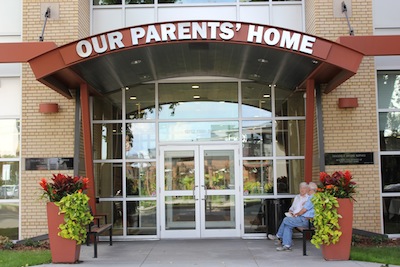
photo - Our Parents’ Home in Edmonton opened in 2015
Our Parents’ Home in Edmonton opened in 2015. (photo from OPH)

The original name chosen was the Hebrew, Beit Horim, which means Our Parents’ Home. “Once we started building and dealing with contractors, banks, etc. … many of the non-Jewish professionals who we were working with had trouble with the pronunciation…. So, we dropped the Beit Horim and just became Our Parents’ Home,” said Jacobson.

While the residence caters to Jewish seniors wanting a place to live where they can keep kosher, the home does offer menu options for people of all religions and has a non-kosher kitchen as well.

At press time, there were 17 independent living suites available (one- and two-bedroom apartments), while the supportive-living space – the units overseen by Alberta Health Services – was running at full capacity.

“They have a two-year waiting list of people trying to get into the supportive-living space,” said Jacobson. “If someone needs to be in assisted living, wants to be at OPH and they are Jewish, we try to get them to the top of the list. But, we have no control over that, because it’s mandated and controlled by Alberta Health Services…. On the independent living side of things, people are self-sufficient. The rent includes 20 meals per month, so people have that option … while those living in supportive care are provided with all meals and snacks.”

The home’s 50 supportive-living units cover three floors, which are staffed by care personnel 24/7. The two memory care floors are secured, so residents cannot leave those levels unless accompanied by someone with a fob. A third floor is for residents in need of care but with no memory issues.

Since the facility is open to the general public, regardless of religion, there are varied faith-based offerings. While there is a rabbi-led Shabbat service offered on the third Friday of each month, there is also hymn singing once a month led by a non-Jewish chaplain and a variety of other programs.

“We had beautiful seder [last] year and several non-Jewish residents of our community came, because they were interested,” said Jacobson. “People can come to whatever program they wish.”

Jacobson, while not on staff at OPH, worked with the staff to ensure the place became all that it was intended to be by the other committee members.

“It was exciting to be on the committee designing the building, to sit with the architects and interior designers,” said Jacobson. “We chose designs and fabric for the furniture, picked colours and selected the china and silverware. It was a pleasure to facilitate meetings with such dedicated and enthusiastic board members.”

According to Jacobson, when you walk into the OPH building, “it’s like walking into a boutique hotel. It doesn’t look like an old folks’ building. We have modern art on all the walls and, from the common rooms on the 14th floor, one can enjoy panoramic views of downtown Edmonton and the beautiful river valley. You walk into the dining room and it’s like walking into a first-class restaurant … linens on the tables to complement the china – no paper napkins.

“Seniors come here to live, not to die,” she stressed. “During the summertime, we take people from the memory care floors to walk in the neighbourhood, through the green streets. There are many activities designed to physically, socially and intellectually stimulate our memory care residents.

“Our independent residents live the lives they’ve always lived – they go to the opera or ballet, the gym, to their friends and to family. If they need a ride, we have a car that will take them. They live independent lives and, as a plus, enjoy all the extra activities provided – the book club, bridge club, fitness room, movies, social programs, etc.

“The people who have been involved are to be commended for their vision and enthusiasm,” said Jacobson. “Special credit needs to go to Tulane Rollingher, who conceived the idea in the very beginning, way back in the 1990s, of having a Jewish home. She was the very first person to start getting this group together.”

Rebeca Kuropatwa is a Winnipeg freelance writer.

Format ImagePosted on March 9, 2018March 7, 2018Author Rebeca KuropatwaCategories NationalTags Alberta, assisted living, Beit Horim, healthcare, Lesley Jacobson, Our Parents’ Home, seniors
A sapling grows in Jerusalem

A sapling grows in Jerusalem

A sapling seeded by Anne Frank’s horse-chestnut tree in Amsterdam is growing at Yad Vashem, near its International Institute for Holocaust Research. (photo by Gil Zohar)

treJerusalem and its environs have many historic trees, including the grove of gnarled olives in the Garden of Gethsemane, under which Jesus may have sheltered two millennia ago; the looming cypress planted by Godefroy de Bouillon, today the site of Hôpital Saint Louis, but where French knights camped in 1099 during the first Crusade; and the 700-year-old Kermes Oak that stands alone in Gush Etzion, south of the city. And now, there is another – a sapling seeded by Anne Frank’s white horse-chestnut tree in Amsterdam, which is growing at Yad Vashem, near its International Institute for Holocaust Research.

Initially, Yad Vashem was concerned that the chestnut tree would not acclimate to Jerusalem’s long, dry summers, but it is doing well.

For more than two years until her arrest on Aug. 4, 1944, Frank (1929-1945) hid in her family’s secret annex at Prinsengracht 263-265. Through a window in the attic that was not blacked out, she admired the chestnut tree, planted around 1850, that stood in the courtyard of a neighbouring residential block, at 188 Keizersgracht just north of the landmark Westerkerk. The tree was her only connection to the outside world and the changing seasons.

Frank wrote about the tree three times in her diary. On the last occasion, on May 13, 1944, she observed: “Our chestnut tree is in full bloom. It’s covered with leaves and is even more beautiful than last year.”

A month earlier, on April 18, 1944, she wrote: “April is glorious, not too hot and not too cold, with occasional light showers. Our chestnut tree is in leaf, and here and there you can already see a few small blossoms.”

The first reference was on Feb. 23, 1944, when Frank noted: “The two of us [Peter van Pels and Frank] looked out at the blue sky, the bare chestnut tree glistening with dew, the seagulls and other birds glinting with silver as they swooped through the air, and we were so moved and entranced that we couldn’t speak.”

For decades, the storied tree was cared for by Amsterdam’s Pius Floris Tree Care at the behest of the city’s Central Borough Council. In 2005, it was determined that the tree was ailing, and valiant efforts were made to save it.

In the meantime, Anne Frank House asked permission of the tree’s owner to gather and germinate chestnuts. The saplings – grown and cared for by Bonte Hoek Nurseries – were donated to schools around the world named after Anne Frank, and other organizations. In 2009, 150 saplings of the tree were donated to Amsterdamse Bos woodland park.

A sapling was recently planted in Vienna’s 2nd district – a neigbourhood that had many Jewish residents before the Anschluss in 1938. Another was planted in Ajaccio, Corsica, to honour the Righteous Among the Nations there. And 11 chestnut trees are growing in the United States, including one at Manhattan’s Liberty Park commemorating 9/11, thanks to the sapling project of the New York-based Anne Frank Centre for Mutual Respect.

As for the original tree, in 2008, the Support Anne Frank Tree Foundation placed iron struts around it to prop it up, hoping the tree would remain standing for further decades. But it was already too rotten. During a violent rainstorm on Aug. 23, 2010, the tree collapsed together with the girders supporting it, leaving a one-metre high stump.

On its website, the Dutch-based Support Anne Frank Tree Foundation responds to the question, was the battle to save the tree all for nothing?

“The answer is a resounding no!” they say. “The tree and the struggle to preserve it … has fulfilled an important task in an extraordinary manner: the reawakening of the world’s collective memory of the Holocaust and a call for tolerance and mutual respect. The seedlings planted all over the world will continue to spread the message, a grand and dignified final stage in the life of this tree. This would not have happened were it not for the battle for its preservation.”

Gil Zohar is a journalist based in Jerusalem.

Format ImagePosted on March 9, 2018March 7, 2018Author Gil ZoharCategories WorldTags Amsterdam, Anne Frank, continuity, history, Holocaust, Jerusalem, sapling
The wrap dress began it all

The wrap dress began it all

Diane von Furstenberg was born Diane Simone Michelle Halfin in Brussels, Belgium. (PR photo)

Character. Intelligence. Strength. Style. That makes beauty.” These timeless words of wisdom were expressed by the iconic Diane von Furstenberg.

Born Diane Simone Michelle Halfin in Brussels, Belgium, 18 months after the liberation of Auschwitz – where her mother, Lily Nahmias, was among those interned – von Furstenberg was taught from a young age, “Fear is not an option.” Following this motto has helped her become a legendary designer, with a business that was worth some $300 million in mid-2017, according to Forbes.

image - Diane von Furstenberg made the cover of Newsweek, among other publications, in 1976
Diane von Furstenberg made the cover of Newsweek, among other publications, in 1976.

Von Furstenberg married Austro-Italian Prince Egon von Furstenberg in 1969. Soon thereafter, in 1972, she introduced her blueprint classic wrap dress. She made the cover of Newsweek, among other publications, in 1976, after selling five million dresses worldwide. Today, the quintessential wrap dress is on display at the Costume Institute at the Metropolitan Museum of Art, as von Furstenberg has been a major contributor to women’s fashion.

It was crucial, on a personal level, for von Furstenberg to be financially independent. She never wanted to rely on a husband or anyone else to pay her bills. Divorcing in 1972, she was determined, as a single mother of two, to make her dreams come true. A degree in economics helped her land a job as an apprentice in a textile house, which was where she learned the art of fabrics.

Von Furstenberg’s passion for prints began when she received the gift of a Pucci-designed outfit from a lover. And the idea of the silk, jersey wrap dress came to her when she saw Julie Nixon Eisenhower on television donning a wrap top with a skirt.

The wrap dress was considered both ageless and timeless: worn by women of varying cultures and sizes, from working women to the more wealthy. The wrap dress became a symbol of independence and power for a generation of women.

During this time, while ascending in her career, von Furstenberg lived a vibrant life. She had relationships with both men and women, she dressed the famous and traveled the world. She found love again with her present husband, Barry Diller. Though she had to relinquish the title of princess, she was still deemed royalty in the fashion business.

And her empire extended through the years to other domains. She wrote several books, including the memoir The Woman I Wanted to Be. She started a collaboration with the Gap, designed rooms and suites for Claridge’s hotel in London and starred in her own reality show, House of DVF.

Life was not without its challenges. She has battled cancer and, at one point, almost lost her business, but von Furstenberg prevailed.

The importance of her Jewish heritage became publicly apparent in the 1980s. It was then that she began her longtime commitment to preserving the memory of the Holocaust, and she became a prominent fundraiser for the United States Holocaust Memorial Museum in Washington, D.C.

Von Furstenberg is a philanthropist, giving back through various initiatives. For her, the empowerment of women has always been at the forefront – “Every woman can be the woman she wants to be!”

Ariella Stein is a mother, wife and fashion maven. A Vancouverite, she has lived in both Turkey and Israel for the past 25 years.

Format ImagePosted on March 9, 2018March 7, 2018Author Ariella SteinCategories Arts & CultureTags business, Diane von Furstenberg, DVF, fashion, women
VR is coming to your home

VR is coming to your home

Inception’s collaboration with FashionTV brings viewers backstage. (photo from Inception)

Netflix has become the go-to service for finding the latest and greatest movie and television programming. An Israeli startup called Inception wants to do the same for virtual reality.

The Tel Aviv-based company operates as both a production studio and an aggregator of curated virtual reality (VR) content. On Feb. 6, it announced the launch of a new channel to introduce more VR into the news experience, offering 360 top Associated Press (AP) videos across a broad spectrum of historical, cultural and social topics. The channel can be downloaded from the Inception app across platforms including Oculus Rift, HTC Vive, Microsoft MR, Samsung Gear, Google Daydream, iOS and Android.

Inception, which first caught Israel21c’s attention at the launch of the Tower of David Museum’s Innovation Lab last fall, received a $15 million investment in August 2017 from European television conglomerate RTL Group. The Series A round also included angel investors James Packer, Gigi Levy-Weiss and iAngels.

RTL’s FreemantleMedia owns the rights to dozens of big-name television shows, which helps explain where Inception is going. For example, Inception wants to use VR to transport viewers truly behind the scenes of the reality TV program The X Factor. Imagine standing beside the singer – or sitting with the judges watching the performance – in a 3-D immersive and interactive environment. Right now, that experience has to be pre-recorded but, someday, VR users will be able to jump into a program as it happens.

Live streaming is “already technically available today and we believe that, with the right content it will become mainstream,” Inception chief executive officer Benny Arbel told Israel21c.

Or, here’s another scenario. Imagine exploring in virtual reality the Shadow Monster’s tunnels in the Upside Down on the hit Netflix show Stranger Things.

“The beauty of VR is that it lets you actually enter a new location or scene,” said Arbel, “whether you’re a spectator or a participant.”

Inception’s focus on serialized TV sets it apart from other VR companies like Within and Here Be Dragons, which produce beautiful but mostly one-off VR experiences. Among the dozens of VR entries on Inception’s website are collaborations with Time Out for virtual walks through exotic locations (from Thailand to Tel Aviv) and FashionTV, where you can sidle up to a super-model as she heads down the catwalk.

Inception has standalone projects, too: a partnership with Pitchfork is the driving force behind the pop culture magazine’s new VR Music Channel. And Inception is developing a VR experience that transports visitors to the world of medieval knights at Jerusalem’s Tower of David Museum.

It’s the episodic content that gets Arbel most excited. With Time Out, he said, “we continuously add new content about different city locations and venues. We hope users will start using these channels for their city updates instead of existing TV or the web.”

If and when they do, it’s likely to start with a “360” experience, which Arbel called “the biggest enemy of VR.” He explained that 360s are flat, non-interactive videos that allow you to explore VR on your computer, often via YouTube. While Inception makes 360 video versions, too, Arbel said, “It’s a necessary evil, a way of promoting what we do to everyone.”

photo - Inception’s collaboration with Time Out brings virutal reality to virtual tours
Inception’s collaboration with Time Out brings virutal reality to virtual tours. (photo from Inception)

Inception’s VR content is video-based. Depending on which way you turn your head or make a gesture, a new video will be triggered. This is a bit reminiscent of Israeli pop-star-turned-startup-maven Yoni Bloch’s Interlude, now renamed Eko, which develops tools for making interactive (though not VR) videos.

Inception was founded in 2016 by Arbel, Dana Porter, Effi Wizen and Nitzan Shenar. The company’s 30 employees are spread out in offices in London, New York and Los Angeles, in addition to the Tel Aviv headquarters.

Inception is “platform agnostic,” Arbel stressed. That means its content “will play well with all the different kinds of headsets out there,” including Oculus, which Facebook acquired for some $3 billion in 2014, as well as Samsung’s Gear, the HTC Vive and Microsoft MR.

Some of these devices operate by placing one’s mobile phone into the headset, but those aren’t so popular or user-friendly. “People don’t like giving their phone to someone else,” said Arbel. “The most interesting segment is the standalone headsets, where there’s no phone or computer required; the graphic engine is built into the device and it’s connected to the cloud via wi-fi.”

Arbel added that new and improved headsets come out every few months and the next generation of the Oculus may be the “hero device that changes things for everyone.” According to Statista, the installed base of VR headsets is projected to grow to 37 million by 2020.

What about the kind of virtual experiences made terrifying by science-fiction TV shows such as Black Mirror, where the VR is broadcast directly into a user’s mind without the need for goggles or other external hardware?

“We know for a fact that what we are seeing today is just early days of VR form factors,” Arbel said. “We are sure hardware will change dramatically and become much easier for us to include as part of our daily lives. Precisely because of this, we make sure that our content can be viewed on any type of device – even the futuristic ones.”

In the meantime, and for those without a headset, Inception’s VR experiences are available on the Apple and Android app stores. For more information, visit inceptionvr.com.

Israel21c is a nonprofit educational foundation with a mission to focus media and public attention on the 21st-century Israel that exists beyond the conflict. For more, or to donate, visit israel21c.org.

Format ImagePosted on March 9, 2018March 7, 2018Author Brian Blum ISRAEL21CCategories Visual ArtsTags high-tech, Inception, Israel, technology, television, virtual reality
Finding the future in the past

Finding the future in the past

Left to right: Michael Rubenfeld, Mary Berchard and Katka Reszke in We Keep Coming Back, which plays March 13 and 14 as part of the Chutzpah! Festival. (photo by Jeremy Mimnaugh)

At first, we expected the piece to focus mainly on the past and how sad the absence of Jewish life in Poland is. After going and also spending more time in Poland, we now propose that it is through focusing on the present and future, with an aim at building positive perspectives, that will ultimately lead to transformation and genuine healing,” said Michael Rubenfeld about We Keep Coming Back, which plays at the Chutzpah! Festival March 13 and 14.

Rubenfeld created the multimedia work with Sarah Garton Stanley, as well as his mother, Mary Berchard, and filmmaker and translator Katka Reszke. Rubenfeld and Garton Stanley are co-directors of Selfconscious Theatre. We Keep Coming Back is based on a trip that Rubenfeld and his mother took to Poland in 2013.

“It was always our intention to make a piece of theatre and the trip was connected to a desire to explore intergeneration trauma and, also, more specifically, the problems in my relationship with my mother that stem from unresolved trauma and disconnect from our family’s roots in Poland,” said Rubenfeld. “So, the trip was an experiment of sorts; to see if going to Poland with my mother, visiting her mother and father’s hometowns and going to Auschwitz, would give us the opportunity to mourn together, which might also bring us closer together.”

According to a blog on Selfconscious Theatre’s website, after surviving the Holocaust, “Berchard’s family moved from Poland to Sweden, where she was born. They then immigrated to Canada in 1951, where she grew up and eventually had a son, Michael.”

Rubenfeld and Berchard were in Poland for about two weeks. “My mother has since been back three or four more times, and I now have a home in Poland with my wife,” said Rubenfeld – the couple lives in both Krakow and Toronto. “We’ve toured We Keep Coming Back to Poland three times,” he added.

The project has worked to bring mother and son closer.

“It’s been really nice for us to have a piece that we do together,” said Rubenfeld. “It gives us an excuse to spend time together to do something we know we’re going to enjoy. It’s also given us commonality, which has been really essential for our relationship.

“My mother has always been very supportive, though we don’t always have a lot in common. This project has changed that. We also now have Poland in common, and our mutual interest. My mother really loves it in Poland. She’s also become quite interested in uncovering more about our history and has started researching and archiving our family tree. It’s brought her a lot of happiness and has been a really healing thing – which, in general, has been good for our relationship as well.”

We Keep Coming Back “speaks so openly and honestly about what it means to love a parent, or to be loved by a child, and how so many of the resources for a good and enduring love were torn apart by the Holocaust and all of the horrors, throughout the generations that linger,” said Garton Stanley, who is also associate artistic director of English theatre and interim facilitator for indigenous theatre at the National Arts Centre in Ottawa.

“Honestly, as someone on the ground since the get-go, I was most curious about Michael’s developing love for Poland and how, over the course of the play’s creation, he not only fell in love with a Jewish woman from Poland but that he now lives there,” she said. “Michael and I are very interested in the line between fiction and reality and the space for realizing possible worlds through dramatic form. Michael now speaks some Polish. He’s making deep-rooted reconnections and helping contribute to a vibrant Jewish life in Poland.”

Garton Stanley and Rubenfeld met just over 10 years ago, after she saw him in a show. “He was performing in it with my partner at the time,” she said. “He was amazing. We became fast friends shortly thereafter.”

At Selfconscious Theatre – which they started together – the two have also co-created The Book of Judith; Mother, Mother, Mother; and The Failure Show.

For We Keep Coming Back, Garton Stanley is not only co-creator but the director. “My co-creation,” she explained, “was part facilitator, part conceiver, part devisor, part writer, part mediator, part friend and always enthusiast.”

How Reszke became involved in the production is a little more circuitous and fortuitous.

“Once we decided to take the trip to Poland, we connected with a producer named Evelyn Tauben, who was doing research around contemporary Jewish Poland,” explained Rubenfeld. “Through Evelyn initially, we started learning about the renaissance of Jewish culture in Poland, which, at the time, I knew nothing about. Once learning about it, we determined that it was important to us that we engage with it on our trip, and that’s when Katka came into the picture.

“We knew we needed a translator to join us, and we also knew we wanted to document the process. We joked that it would be incredible if we could find someone who could both translate, film and be a Polish Jew who might want to collaborate with us artistically. On a lark, we Googled ‘Polish, Jewish, filmmaker,’ and that’s how we discovered Katka. We sent her an email, and one thing led to another.”

“Mary Berchard and Katka Reszke,” added Garton Stanley, “are fascinating performers and neither of them has any training in this area. Their stories and their curiosity combine with Michael’s to create a new family. And this feels like one of the piece’s hidden successes.”

As for what has most surprised her about the project, she said, “That we are still doing it and learning from it. And learning from the audiences whose histories intersect with Michael’s, Mary’s and Katka’s own generational challenges and traumas. And that the piece resonates as deeply as it does. It has a beautiful heart and this is always surprising, in the best way.”

“I believe that, in our desire to never forget what happened during the Holocaust, we have also forgotten that Poland was one of the most important contemporary homelands for the Ashkenazi Jewish people for over 500 years,” said Rubenfeld. “So much of our contemporary culture was bred in this land, and we forget that the Jewish people were happy living in Poland before the war. We are raised to think of Poland as only the place of tragedy. While I understand why, I think that it’s essential to remember and celebrate a time when there was such vibrant Jewish culture. Most was destroyed because of the war, and it’s impossible to not feel sad. But, as we move into the future and the pain continues to recede, it is just as important to remember the incredible prewar Polish Jewish world of Poland. It was very profound.”

For tickets to We Keep Coming Back at the Rothstein Theatre, and for the full Chutzpah! schedule, visit chutzpahfestival.com.

Format ImagePosted on March 2, 2018March 1, 2018Author Cynthia RamsayCategories Performing ArtsTags Chutzpah! Festival, family, Holocaust, intergenerational trauma, Michael Rubenfeld, Poland, Sarah Garton Stanley, Selfconscious Theatre
Music to say thank you

Music to say thank you

Anna Levy  (photo from Yarilo Contemporary Music Society)

My mother’s maiden name was Levy, my dad’s surname was also Levy. My story is about life. None of my family was killed during the Holocaust. I am alive because I grew up in a small European country, Bulgaria, that – despite being Nazi-aligned – managed to save all its Jews during the Second World War. And I – and many others – will be saying thank you through music this spring in a major concert marking the 75th anniversary of this historic series of events, for which we are so grateful.

During the Holocaust, Bulgaria had a complex record. While it is responsible for deporting 11,000 Jews from Bulgarian-occupied territories, most of whom were murdered at Treblinka, it defied Hitler and saved all 50,000 of its Jews, among which was my family.

In 1943, the complicated diplomatic manoeuvres of the Bulgarian parliament, led by Dimitar Peshev, along with civil disobedience and the strong official opposition of the Bulgarian Orthodox Church, resulted in the cancellation of the deportation that was planned for March of that year.

In June 1943, then German ambassador to Bulgaria, Adolf Heinz Beckerle reported to Berlin, “The Bulgarian society doesn’t quite understand the real meaning of the Jewish question … so the racial question is totally foreign to them,” and he complained that the Bulgarian people lacked “the ideological enlightenment that we [Germans] have.”

In 1996, Jewish National Fund named a forest in honour of Bulgaria, with memorial plaques dedicated to Peshev, the Bulgarian Orthodox Church and to King Boris.

This year marks the 75 years since the salvation of Bulgarian Jews during the war and preparations are underway in Bulgaria, Israel and in other countries to mark this anniversary.

In Vancouver, on May 27, Project Tehillim will take place at the Orpheum Annex. Twenty-three professional musicians will participate in the program featuring Tehillim, which was written by one of the most famous living Jewish American composers, Steve Reich. This event should occupy a central place in Metro Vancouver’s cultural life, as the work is unique, rarely performed and difficult to put together.

“Tehillim,” explains Reich, “is the original Hebrew word for Psalms. Literally translated, it means praises, and it derives from the three-letter Hebrew root ‘hey, lamed, lamed’ … which is also the root of halleluyah.”

In his notes on the website of classical music publishing company Boosey & Hawkes, Reich also writes, “One of the reasons I chose to set Psalms as opposed to parts of the Torah or Prophets is that the oral tradition among Jews in the West for singing Psalms has been lost. (It has been maintained by Yemenite Jews.) This meant that I was free to compose the melodies for Tehillim without a living oral tradition to either imitate or ignore.”

That said, he notes, “The rhythm, of the music here comes directly from the rhythm of the Hebrew text and is, consequently, in flexible changing meters.”

Tehillim is deeply rooted in ancient Hebrew traditions from biblical times. This is not music of contemporary daily life, but instead conjures the timeless and eternal. This work is a deep reflection of Jewish tradition presented in a modern way.

The budget for this large-scale project is more than $20,000: for musicians’ fees, theatre rental, scores, instrument rentals and other expenses. To help raise these funds, the Yarilo Contemporary Music Society – of which I am co-artistic director with Jane Hayes – is holding the concert Lest We Forget, on Sunday, April 8, 3 p.m., at Pyatt Hall, with the support of the Peretz Centre for Secular Jewish Culture.

The fundraising concert features classical masterpieces. The centrepiece of the program – which will be performed by Angela Cavadas (violin), Rebecca Wenham (cello), Johanna Hauser (clarinet) and me on piano – is Tchaikovsky’s Piano Trio in A Minor, written in memory of his Jewish friend Nikolai Rubinstein. In addition, there will be music by Jewish composers Srul Irving Glick (Suite hébraïque) and Ernest Bloch (Prayer).

Both concerts – Tehillim and Lest We Forget – highlight the spiritual qualities of the Jewish people. In the words of the non-Jewish author Milan Kundera about the importance of Jews in Europe: “Indeed, no other part of the world has been so deeply marked by the influence of Jewish genius. Aliens everywhere and everywhere at home, lifted above national quarrels, the Jews in the 20th century were the principal cosmopolitan, integrating element in Central Europe: they were its intellectual cement, a condensed version of its spirit, creators of its spiritual unity. That’s why I love the Jewish heritage and cling to it with as much passion and nostalgia as though it were my own.”

I love the Jewish heritage with a passion, as well, and it is “our own.” I hope that other members of the Jewish community will become Yarilo’s partners, and help us make Project Tehillim a worthy thank you. To contribute to the project, visit gofundme.com/2018-my-jewish-story-is-for-life; the campaign includes a third concert, which is planned for October. For tickets to the April 8 fundraising performance at Pyatt Hall, visit yarilomusic.com.

Format ImagePosted on March 2, 2018March 1, 2018Author Anna LevyCategories MusicTags Bulgaria, Holocaust, Judaism, Tehillim, Yarilo

Partisan decision

Andrew Scheer was two days old when Joe Clark was elected prime minister of Canada in 1979. In that election campaign, then-Progressive Conservative leader Clark promised to move the Canadian embassy in Israel to Jerusalem from Tel Aviv.

Cabinet documents recently released help explain why that promise was never fulfilled. There were diplomatic and, yes, commercial considerations though, at the time, the government claimed potential backlash from Arab states and businesses was not a factor.

Andrew Scheer is now leader of the Conservative party, facing a different Prime Minister Trudeau, and this week he promised to, well, you guessed it.

“Canada’s Conservatives led by Andrew Scheer will recognize Jerusalem as Israel’s capital when we form government in 2019,” declares a pledge on the party’s website. It describes the party as “a strong voice for Israel and the Canadian Jewish community.”

The Conservative government under Stephen Harper was indeed a strong voice for Israel – at times the only government in the world to be so – and for the Jewish community in Canada. There is no reason to believe that a Conservative government under Scheer would be any different, but the politics around this pledge are disappointing.

The statement came in the form of a petition-type pledge on the party’s website. That is, for those unschooled in the modern art of email harvesting, a strategy – legitimate and legal, certainly – of inviting people who agree with a topic to sign their name (and share their email address). The party can then target that voter, knowing they have a particular interest in the topic.

Again, there is nothing untoward about this, in general. But if a party that wants to form government chooses to issue a significant platform plank or promise dealing with one of the most contentious diplomatic issues in the world, perhaps a speech in Parliament or other suitable venue would be a more appropriate medium than a partisan webpage unabashedly accumulating names of voters for future political solicitations.

It is also so blatantly an imitation of the U.S. president’s shameless move on the issue. As we wrote here at the time, Donald Trump’s actions were not motivated by principle, but by sheer political calculation. Or, inasmuch as that president is not given to overthinking matters, more intended as a slap in the face to his political enemies.

We will leave aside here whether the embassy move is a good idea, a fair one, timely or otherwise merited or unmerited on substance. The point here is that the Conservatives are exploiting this issue for political purposes – and that is not good for Israel or for Jewish Canadians.

When Justin Trudeau became prime minister and effectively adopted the same policy approach vis-à-vis Israel as his predecessor, it was clear that a Canadian consensus was essentially in place. The New Democratic Party, in convention a few days ago, managed to put a lid on most of whatever dissent there was on this topic. Elizabeth May, the leader of the Green Party, put her leadership on the line in the summer of 2016 to let her members know she would not lead a party with an extremist agenda toward Israel.

This consensus is not a result of stifling free expression or of Zionist power or of anything other than a fair Canadian reading of important world events. In other words, for whatever else we disagree on, Canadians, by and large, accept Israel’s right to exist free from terrorist attacks.

Scheer’s move this week is cynical. It turns the legitimate consideration of the embassy’s location into a partisan one, when it should be entertained within the broader consensus we have developed. That is not the kind of voice Israel or Jewish Canadians want from our elected representatives.

Posted on March 2, 2018March 1, 2018Author The Editorial BoardCategories From the JITags Andrew Scheer, Canada, Conservatives, embassy, Israel, Jerusalem, politics

Stressing action over just being

Rabbi Deborah Waxman, PhD, president of Reconstructionist Judaism, recently released a statement about rebranding. Instead of calling the rabbinical college and umbrella congregational movement the Reconstructionist Rabbinical College and Jewish Reconstructionist Communities, the header now is “Reconstructing Judaism.” The tag line below it reads, “Deeply rooted. Boldly relevant.”

Why do this? Well, in Rabbi Waxman’s statement, this sentence jumped out: “A critical path forward is shifting from a focus on ‘being’ Jewish – important but insufficient for providing substance and structure – to a focus on ‘doing’ Jewish.”

This is of central importance as we reshape 21st-century Jewish life. If you’re modifying Jewish by saying Reconstructionist, or Reform, Orthodox, Conservative, etc., you define your Jewish identity as a state of being. That is, “this is who I am.” It is akin to saying “I have brown eyes” or “I have freckles.”

However, in an era when people aren’t participating in group or congregational activities as often, it’s useful to go back to our tradition itself. We practise Judaism. Judaism doesn’t rely on a theological belief system as do some evangelical Christians. Or, as my husband jokes, when somebody needs a 10th body for a minyan, no one asks what you believe. There’s no extended questioning or exam. In that moment, we’re defined by what we do – the person showed up when needed, ready to “do Jewish” in a Jewish space.

If you’re wondering why anyone should care about this, it’s because Rabbi Mordecai Kaplan, the founding thinker of Reconstructionism, significantly affected North American Judaism as a whole. His concept of Jewish peoplehood affected every form of 20th- and 21st-century Judaism. Kaplan, while raised Orthodox, was a professor at the Jewish Theological Seminary (Conservative movement) until he retired. His son-in-law founded the Reconstructionist Rabbinical College. So, even if you don’t consider yourself a Reconstructionist, many aspects of how North American Jews understand their belonging to the Jewish people stem from Kaplan’s mid-20th century work, which was conceived of as “radical” at the time.

Around the same time that I read about rebranding Judaism, I had a strange “blast” from the past. I was contacted by someone who had once been a dear close friend. How close? I’d lived with her for a year on a kibbutz in Israel. I ate dinner with her the night I got engaged. She stood up for me under the chuppah at my wedding – we were friends for 15 years. We often saw each other on a weekly basis, if not more often. This person was an essential part of my life.

As an aside, I’ll stop to say it’s just not in my nature to ditch a longtime friend or, as some say, ghosting. I wouldn’t disappear or ignore someone on purpose. I take to heart the part of Pirkei Avot (Sayings of Our Fathers) 1:6 – “Find yourself a mentor, acquire for yourself a friend.” While learning opportunities are a lifelong interest, I also understood the rabbis’ interpretation of “acquiring” a friend. You have to invest and work on friendship. It takes time and effort. You have to show interest and concern about friends, and try to “pay them” that attention so that they will like you back.

What happened with my dear friend? In 2003, she was going through some life changes, as was I. We had a disagreement. Instead of discussing it and resolving things, or even fighting, she just dumped me. She wouldn’t respond to me at all. For many years, it tore me apart. I missed her terribly, but, what’s more, I felt as though if I’d just done something differently or been a better friend, this wouldn’t have happened.

I sought her forgiveness several times. I tried to contact her on holidays and wish her well. I even emailed her brother to make sure she was healthy and OK, because the absolute silence and rejection seemed so unlike the previous 15 years of our friendship. In short, I tried hard to be her friend, to invest in repairing any wrongs, long after she’d left the partnership.

This was a painful life lesson. I eventually learned that no matter how hard I tried to fix things, friendships take two people. I couldn’t do it on my own.

At first, I was thrilled to hear from this person again. I showed my husband the note I’d received, and I responded eagerly. My husband was more dispassionate and worried about me. He showed me something I’d overlooked. While clearly she’d laboured over the note’s wording, it didn’t look like it was personally sent to me. It might have been sent to multiple people she’d wronged over the years. While a group teshuvah (apology) is sometimes necessary, it’s not the personal reconnection and friendship I’d craved.

My old friend is professionally affiliated with Jewish Reconstructionism. The rebranding of Reconstructing Judaism pushed me to reflect. One of her online statements says she embraces rachamim (compassion), gemilut hasadim (acts of lovingkindness) and ethical living – but there’s sometimes a distance between what we “believe in” and what we do. I’m impressed that Reconstructing Judaism has taken a strong, active step. They’re doing Jewish in an era when North America Judaism needs this leadership.

Corporations rebrand all the time. It boosts sales and changes their public images. It might be time that Judaism does the same. As for me, I’ve had an internal emotional rollercoaster – the loss of a long friendship perhaps made me a more cautious, distant person when it came to building new connections. I don’t throw myself into friendships with the joie de vivre that I did as a teenager. In my rush to respond, my note to this old friend was still wary, with clichés. “Life is long. It’s good to have friends.”

Relearning this Jewish notion of acquiring friendship helped me put this episode in perspective. I wish I’d included it in my note. Could we learn together, invest in each other, do right by people, and create a rooted and relevant future? If that’s what she’s up for, I hope she writes back.

Joanne Seiff writes regularly for CBC Manitoba and various Jewish publications. She is the author of three books, including From the Outside In: Jewish Post Columns 2015-2016, a collection of essays available for digital download or as a paperback from Amazon. See more about her at joanneseiff.blogspot.com.

Posted on March 2, 2018March 1, 2018Author Joanne SeiffCategories Op-EdTags friendship, Judaism, Reconstructionist

Reflections on first meeting

This academic year marks the second session of Writing Lives, a two-semester project at Langara College, coordinated by instructor Dr. Rachel Mines. Writing Lives is a partnership between Langara, the Vancouver Holocaust Education Centre and the Azrieli Foundation. Last fall, students learned about the Holocaust by studying literary and historical texts. In January, students began interviewing local Holocaust survivors and will write their memoirs on the basis of the interviews. Students are keeping journals of their personal reflections on their experiences as Writing Lives participants. Students used their most recent journal entry to reflect on their first meetings with the survivor with whom they are partnered. Here are a few excerpts.

Prior to meeting our survivor partner, one of our group members spoke to him on the phone, and she described him as a person “who doesn’t let anything past him.” It seems he’d tested her on her ability to say the word “Holocaust” without shuddering an apology.

It is clear that our partner refuses to spend his time telling his story to anyone who cannot handle it. On one hand, his attitude is a comfort; I believe we will be able to show him that not only are we unafraid to hear his story, but also that we care deeply about helping him tell it authentically. On the other hand, this adds to the building anxiety about our interviews and our worries about writing the memoir. Producing a memoir that our survivor is 100% proud of is my biggest goal and also my biggest fear. I feel that telling the story of another person’s life is a tremendously huge responsibility, and I do not take it lightly.

– Chelsea Riva

We actually met D. before our first meeting: he came to our class to give a talk last semester. Our first interview was arranged at his home, and D. was as warm and friendly as before. So was his wife, and they took good care of us. They helped us with our coats and insisted that we did not have to take our shoes off. D. said we must have walked a long way, and it was the shoes that kept us walking comfortably; therefore, we should not take them off. I immediately recalled what Primo Levi wrote in his book Survival in Auschwitz. Yes, shoes are of the utmost importance, and D. has experienced that. However, we quickly realized that the house was immaculately clean, and so was the light beige carpet that we were stepping on with our shoes! Anyway, while I was worrying about the carpet, the meeting began.

– Bonnie Pun

When I first met D.S., I was apprehensive. The culmination of the past four-and-a-half months was finally at hand, and I was set to be the lead interviewer for our group – not a task that fell lightly on my shoulders.

Moira and he came into the room and she introduced him (she had met him previously). D.S. smiled so widely that his eyes crinkled, and he shook each of our hands in turn. When we were done, D.S. said a few words about himself and then quickly launched into a very compressed, detailed story about his life.

We had been expecting a more casual, getting-to-know-you first interview, and none of us had been expecting to take in such a massive amount of information – although, in hindsight, I’m glad we did. At the end of the interview, after D.S. had given us advice about meeting deadlines and making sure we had enough time to edit and rework parts of his story, we breathed a sigh of relief – it had gone well.

The opportunity to have a question-and-answer session with a person who has survived such great personal trauma is incredible. D.S. is a wonderful storyteller, and the interviews so far have been a continuously rewarding experience.

– Susan Scott

Some of the stories that D.S. shared with us at that first meeting were hard to absorb. I think I didn’t really want to understand what he was saying, as a way of protecting myself, so I wouldn’t show I was affected while I was in the room with him. It was only after I listened to the recorded interview that I could even start to imagine the events that he had endured. It sunk into me that this was a real thing that had happened to a real man, one who sat in front of me, ready to share his pain and perseverance with us. For that, I am grateful and honoured.

What D.S., the other survivors, the Vancouver Holocaust Education Centre, the Azrieli Foundation and Langara College are doing through the Writing Lives program is so immensely important – something I have come to understand on a new level after that meeting. I think the point is to affect others in the way that this one meeting affected me. It’s to try and understand people’s suffering as best we can, though we will never feel their pain, and to use that understanding to become better people, and not be complicit in others’ suffering in the future.

– Moira Henry

Posted on March 2, 2018July 2, 2020Author Writing Lives studentsCategories LocalTags Azrieli Foundation, Holocaust, Langara College, memoir, survivors, VHEC
A decade at KDHS

A decade at KDHS

Russ Klein recently marked his 10th year as head of school at King David High School. (photo by Pat Johnson)

Russ Klein resisted becoming King David High School’s head of school. Ten years ago, he was a vice-principal in the Vancouver school district, an 18-year veteran of the public system. One of his colleagues – Ben Lubinizki, a teacher at Prince of Wales, where Klein was VP – was a King David parent and on the search committee for a new head of school.

Klein was on track to become a principal in Vancouver and, besides, after attending Vancouver Talmud Torah, becoming bar mitzvah at Beth Israel and volunteering on kibbutzim as a young adult, he hadn’t had much to do with the Jewish community. But Lubinizki was persistent and encouraged Klein to just drop by the school and check it out.

“I saw what things were like,” Klein recalled. “I saw the potential. I also saw lots of things that I thought they needed a little bit of guidance on at that point.”

It turned out that the Vancouver School Board thought a time at King David could be a good experience for Klein before he became a principal, so offered him a two-year leave of absence.

“I thought it was going to be a temporary position,” he said. He is now celebrating his 10th year at the school and, as he reflects on the past decade, he says the move not only altered his career path, it changed his life.

A year into the two-year “temporary” gig, the VSB called with a principalship for him.

“I had to think hard about it because, in a little over a year, I had quite fallen in love with this particular place,” he told the Independent during an interview in his office at King David. “I loved everything about it, from its size to the people I was working with, to the mission that it had.”

But, while job security in the public system is assured, he said, “In the private system you don’t have any.”

The King David board offered him a 10-and-a-half year contract and Klein now hopes to retire – eventually – from a role he loves.

“I think it’s worked out quite well,” he said.

In May, at a major celebration, KDHS will celebrate 13 years – its bar mitzvah year – in the current purpose-built building. The school’s history dates back to 1986, when it was founded as Maimonides High School. It was called Vancouver Jewish High School in 2000/01, then Vancouver Talmud Torah High School until 2004, when it was renamed King David. It has always been a Grade 8 to 12 school.

As head of school for a decade, Klein has seen plenty of change.

Almost all Grade 8 students now travel to Israel on an 11-day experience, spending most of the time in the Galilee, Vancouver’s partnership region. Some of the kids in Har Vagai school – King David’s partner school there – live on Kibbutz Shamir, where Klein volunteered a couple of decades ago. In Grade 9, the Israeli students come to Vancouver.

In recent years, KDHS has changed its Grade 9 trip, which used to go to the U.S. Holocaust Memorial Museum in Washington, D.C., to an alternative trip to Los Angeles, where students visit the Museum of Tolerance and the Los Angeles Museum of the Holocaust. The time difference – and the need to change planes – made the Washington trip difficult.

“We thought we could get more out of the trip,” said Klein. “L.A. is a much shorter, easier [trip], it’s less expensive. But it added another feature, which is that we have a shomer Shabbat weekend in Los Angeles.” (The trip didn’t happen this year as they are moving it to Grade 10.)

A group of King David students are also going to Guatemala to volunteer in a community where women and children from disadvantaged and often abusive backgrounds access support and skills.

In all these offerings, financial ability is never a factor in participation, Klein said.

In the classrooms, change also has been constant. New options have been added to electives, and the school has added advanced math and science programs as well as a Grade 10 outdoor experience program. King David students take all the core subjects public school students do, plus Judaics.

“In a typical Vancouver high school, most students will enrol in eight classes,” Klein explained. KDHS students take two more courses in various aspects of Jewish studies, including (in most cases) Hebrew language, Jewish history and “what we would call Jewish values: ethics, Torah, what does it mean to be Jewish?”

On top of an intense academic load, Klein said, “Our participation in athletics is outrageously high for a school of our size. Probably 70% of our kids are on one athletic team or another – or more.”

Challenges remain, Klein acknowledged. The school has pretty much met its student capacity and, while expansion seems unlikely in the near future, the redevelopment of the Jewish Community Centre of Greater Vancouver, a few steps west of the school, could present opportunities for a dedicated gym and shared use of space for classes, drama and music performances.

The changes in Klein’s career have been accompanied by changes in his personal life.

“As a person who didn’t have community, coming to a community that is so kind and caring has been absolutely amazing. It has been the best thing that could have happened from my point of view,” he said. “This has given meaning to my life, aside from the fact that, as a divorced person, I now have a very committed relationship with a former King David parent [Deborah Youngson] who is very traditional herself, which has brought more Jewish meaning to my life.”

Another change is also evident. He’s grown what he jokingly calls “the rabbinical beard,” which he says leads people to assume he is very wise.

“I do have a good chuckle every time I get an email that says ‘Dear Rabbi Russ.’”

Format ImagePosted on March 2, 2018March 1, 2018Author Pat JohnsonCategories LocalTags education, KDHS, King David High School, Russ Klein

Posts pagination

Previous page Page 1 … Page 393 Page 394 Page 395 … Page 667 Next page
Proudly powered by WordPress