Skip to content
  • Home
  • Subscribe / donate
  • Events calendar
  • News
    • Local
    • National
    • Israel
    • World
    • עניין בחדשות
      A roundup of news in Canada and further afield, in Hebrew.
  • Opinion
    • From the JI
    • Op-Ed
  • Arts & Culture
    • Performing Arts
    • Music
    • Books
    • Visual Arts
    • TV & Film
  • Life
    • Celebrating the Holidays
    • Travel
    • The Daily Snooze
      Cartoons by Jacob Samuel
    • Mystery Photo
      Help the JI and JMABC fill in the gaps in our archives.
  • Community Links
    • Organizations, Etc.
    • Other News Sources & Blogs
    • Business Directory
  • FAQ
  • JI Chai Celebration
  • JI@88! video

Recent Posts

  • Sharing her testimony
  • Fall fight takes leap forward
  • The balancing of rights
  • Multiple Tony n’ Tina roles
  • Stories of trauma, resilience
  • Celebrate our culture
  • A responsibility to help
  • What wellness means at JCC
  • Together in mourning
  • Downhill after Trump?
  • Birth control even easier now
  • Eco-Sisters mentorship
  • Unexpected discoveries
  • Study’s results hopeful
  • Bad behaviour affects us all
  • Thankful for the police
  • UBC needs a wake-up call
  • Recalling a shining star
  • Sleep well …
  • BGU fosters startup culture
  • Photography and glass
  • Is it the end of an era?
  • Taking life a step at a time
  • Nakba exhibit biased
  • Film festival starts next week
  • Musical with heart and soul
  • Rabbi marks 13 years
  • Keeper of VTT’s history
  • Gala fêtes Infeld’s 20th
  • Building JWest together
  • Challah Mom comes to Vancouver
  • What to do about media bias
  • Education offers hope
  • Remembrance – a moral act
  • What makes us human
  • המלחמות של נתניהו וטראמפ

Archives

Follow @JewishIndie
image - The CJN - Visit Us Banner - 300x600 - 101625

Tag: Bulgaria

Music to say thank you

Music to say thank you

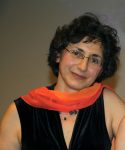
Anna Levy  (photo from Yarilo Contemporary Music Society)

My mother’s maiden name was Levy, my dad’s surname was also Levy. My story is about life. None of my family was killed during the Holocaust. I am alive because I grew up in a small European country, Bulgaria, that – despite being Nazi-aligned – managed to save all its Jews during the Second World War. And I – and many others – will be saying thank you through music this spring in a major concert marking the 75th anniversary of this historic series of events, for which we are so grateful.

During the Holocaust, Bulgaria had a complex record. While it is responsible for deporting 11,000 Jews from Bulgarian-occupied territories, most of whom were murdered at Treblinka, it defied Hitler and saved all 50,000 of its Jews, among which was my family.

In 1943, the complicated diplomatic manoeuvres of the Bulgarian parliament, led by Dimitar Peshev, along with civil disobedience and the strong official opposition of the Bulgarian Orthodox Church, resulted in the cancellation of the deportation that was planned for March of that year.

In June 1943, then German ambassador to Bulgaria, Adolf Heinz Beckerle reported to Berlin, “The Bulgarian society doesn’t quite understand the real meaning of the Jewish question … so the racial question is totally foreign to them,” and he complained that the Bulgarian people lacked “the ideological enlightenment that we [Germans] have.”

In 1996, Jewish National Fund named a forest in honour of Bulgaria, with memorial plaques dedicated to Peshev, the Bulgarian Orthodox Church and to King Boris.

This year marks the 75 years since the salvation of Bulgarian Jews during the war and preparations are underway in Bulgaria, Israel and in other countries to mark this anniversary.

In Vancouver, on May 27, Project Tehillim will take place at the Orpheum Annex. Twenty-three professional musicians will participate in the program featuring Tehillim, which was written by one of the most famous living Jewish American composers, Steve Reich. This event should occupy a central place in Metro Vancouver’s cultural life, as the work is unique, rarely performed and difficult to put together.

“Tehillim,” explains Reich, “is the original Hebrew word for Psalms. Literally translated, it means praises, and it derives from the three-letter Hebrew root ‘hey, lamed, lamed’ … which is also the root of halleluyah.”

In his notes on the website of classical music publishing company Boosey & Hawkes, Reich also writes, “One of the reasons I chose to set Psalms as opposed to parts of the Torah or Prophets is that the oral tradition among Jews in the West for singing Psalms has been lost. (It has been maintained by Yemenite Jews.) This meant that I was free to compose the melodies for Tehillim without a living oral tradition to either imitate or ignore.”

That said, he notes, “The rhythm, of the music here comes directly from the rhythm of the Hebrew text and is, consequently, in flexible changing meters.”

Tehillim is deeply rooted in ancient Hebrew traditions from biblical times. This is not music of contemporary daily life, but instead conjures the timeless and eternal. This work is a deep reflection of Jewish tradition presented in a modern way.

The budget for this large-scale project is more than $20,000: for musicians’ fees, theatre rental, scores, instrument rentals and other expenses. To help raise these funds, the Yarilo Contemporary Music Society – of which I am co-artistic director with Jane Hayes – is holding the concert Lest We Forget, on Sunday, April 8, 3 p.m., at Pyatt Hall, with the support of the Peretz Centre for Secular Jewish Culture.

The fundraising concert features classical masterpieces. The centrepiece of the program – which will be performed by Angela Cavadas (violin), Rebecca Wenham (cello), Johanna Hauser (clarinet) and me on piano – is Tchaikovsky’s Piano Trio in A Minor, written in memory of his Jewish friend Nikolai Rubinstein. In addition, there will be music by Jewish composers Srul Irving Glick (Suite hébraïque) and Ernest Bloch (Prayer).

Both concerts – Tehillim and Lest We Forget – highlight the spiritual qualities of the Jewish people. In the words of the non-Jewish author Milan Kundera about the importance of Jews in Europe: “Indeed, no other part of the world has been so deeply marked by the influence of Jewish genius. Aliens everywhere and everywhere at home, lifted above national quarrels, the Jews in the 20th century were the principal cosmopolitan, integrating element in Central Europe: they were its intellectual cement, a condensed version of its spirit, creators of its spiritual unity. That’s why I love the Jewish heritage and cling to it with as much passion and nostalgia as though it were my own.”

I love the Jewish heritage with a passion, as well, and it is “our own.” I hope that other members of the Jewish community will become Yarilo’s partners, and help us make Project Tehillim a worthy thank you. To contribute to the project, visit gofundme.com/2018-my-jewish-story-is-for-life; the campaign includes a third concert, which is planned for October. For tickets to the April 8 fundraising performance at Pyatt Hall, visit yarilomusic.com.
Format ImagePosted on March 2, 2018March 1, 2018Author Anna LevyCategories MusicTags Bulgaria, Holocaust, Judaism, Tehillim, Yarilo
Bulgaria: more than cheese

Bulgaria: more than cheese

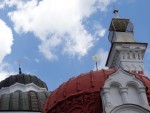
The roof of Sofia’s synagogue. (photo by Deborah Rubin Fields)

Until recently, if someone had asked me what I knew about Bulgaria, I would have said, “Isn’t that the name of a cheese?” Now having visited Bulgaria, I realize how limited was my perspective.

Bulgaria’s colorful Jewish history dates back to antiquity. According to Elko Hazan’s comprehensive 2012 book The Concise Illustrated Encyclopedia of Jewish Communities and their Synagogues in Bulgaria, over the centuries Jews had a presence in some 40 Bulgarian cities and towns.

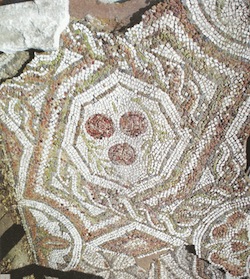
scan - Part of an ancient mosaic synagogue floor found in Plovdiv. This photo is from The Concise Illustrated Encyclopedia of Jewish Communities and Their Synagogues in Bulgaria (Kamea Design, 2012).
Part of an ancient mosaic synagogue floor found in Plovdiv. (photo from The Concise Illustrated Encyclopedia of Jewish Communities and Their Synagogues in Bulgaria (Kamea Design, 2012)).

For example, near Plovdiv’s Maria Luiza Boulevard, archeologists uncovered a third-century CE synagogue. Its proximity to ancient Philippopolis’ Roman forum suggests that wealthy Jews in good standing with the Romans built the structure. The accomplishment of these well-placed Jews is all the more remarkable when you consider that Philippopolis had an estimated population of 100,000. Archeologists discovered two mosaic synagogue floors, one over another. The stunning mosaic featured both the Four Species (lulav, etrog, myrtle, willow) and a menorah. The second floor may have had geometric patterns. That more than one floor was found probably indicates the synagogue was renovated in the fifth century and destroyed in the sixth century. (See The Jewish-Greek Tradition in Antiquity and the Byzantine Empire, edited by James K. Aitken.)

Greek inscriptions commended the synagogue’s donors or founders. The east and west mosaic panel read: “‘From the gifts of Providence … Cosmianus, also called Joseph, executed the decoration (of the building). Blessing to all!” The central panel read: “From the gifts of Providence … El … also called Isaac made decoration of 120 feet (mosaic).” The adoption of a Roman-sounding second name attests to adaptation by Jews to the Greek and Roman culture. (See Negotiating Diaspora: Jewish Strategies in the Roman Empire, edited by John M.G. Barclay.) Ironically, as the synagogue remains are in storage, the only way to get a sense of how grand the floor was is to visit the impressive new museum of the (fifth-century) Small Basilica.

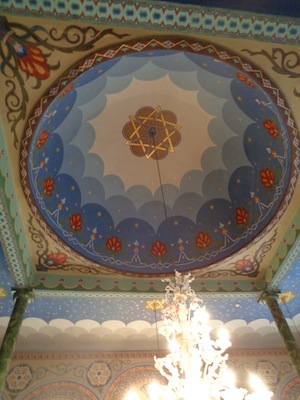
The ceiling of Plovdiv’s Zion Synagogue
The ceiling of Plovdiv’s Zion Synagogue. (photo by Deborah Rubin Fields)

But Plovdiv’s charming Zion Synagogue (13 Tsar Kaloyan St.) is still up and functioning (one of two still active in Bulgaria). It was first built in 1886-1887. In 2003, the extensive five-year renovation of the starry-sky ceiling and the colorful geometric-paneled walls was completed. The building is only open for Kabbalat Shabbat prayers, so visitors should contact Eva Mezan (at +359-87-944-8675) to verify hours.

Although there is seating for 250 worshippers, some 20 local men and women attend this service. The second floor ezrat nashim (women’s section) is not used. Instead, an invisible mechitza (divider) has men sitting on one side of the aisle, women on the other. The congregation’s lay cantor leads services from the raised bima adjacent to the aron ha-kodesh (Torah ark). The congregation uses a Bulgarian-Hebrew siddur. Vocal congregants despair over the sad state of their community, with its high rate of intermarriage.

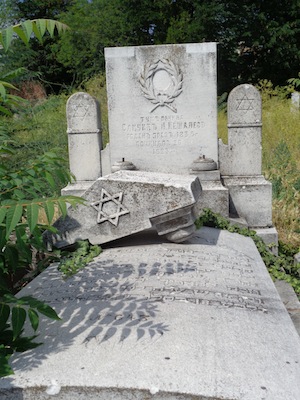
photo - The Jewish cemetery in Plovdiv
The Jewish cemetery in Plovdiv. (photo by Deborah Rubin Fields)

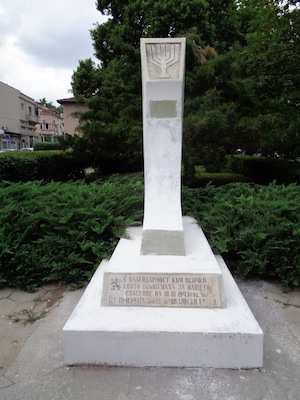
Plovdiv’s small Jewish community likewise has difficulty managing the graves in the Jewish section of the municipal cemetery (73 Knyaginya Maria Louisa Blvd.). While there is upkeep of “new” graves, headstones laid as recently as 1923 are somewhat neglected. Near the corner of the Sixth of September and Russki boulevards, Plovdiv’s Jews, however, do maintain a Bulgarian/Hebrew/English thanksgiving monument to the Bulgarian people for their help during the Second World War.

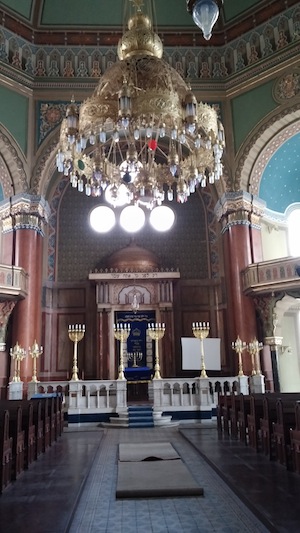
Sofia’s opulent 1,170-seat, 100-year-old Central Synagogue (16 Ekzarh Joseph St.) is also struggling, with barely enough people to hold daily morning prayers. The small on-site Jewish nursery school and the tiny, underdeveloped Jewish museum strikingly contrast with the enormous octagonal-shaped synagogue sanctuary. (Note: museum hours are limited, and not necessarily in accordance with posted times.)

photo - The Jewish community’s Bulgarian/Hebrew/English monument to the Bulgarian people for their help during the Second World War
The Jewish community’s Bulgarian/Hebrew/English monument to the Bulgarian people for their help during the Second World War. (photo by Deborah Rubin Fields)

Within walking distance of the synagogue, visitors may see (upon receiving special written permission from Dr. Lyudmil Vagalinski, [email protected]) another example of Bulgaria’s ancient Jewish history in the National Institute of Archeology with Museum’s (2 Saborna St.) lapidarium. A Latin marble pedestal from Oescus – a first- to fifth-century CE Roman town near the Danube – mentions the lay synagogue head Archisinagogus, according to Hazan.

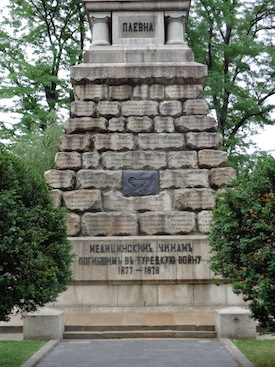
Sofia’s 131-year-old Doctors’ Garden (located close to the National Library and Sofia University) memorializes the 531 fallen medics of the Russo-Turkish War (1877-1878), most of whom died in battles at Pleven, Plovdiv, Mechka or Shipka. A good number of these Russian medical personnel were Jewish, a credit to the reforms established by Russian Emperor Alexander II.

A few blocks away is the street named after biochemist Asen Zlaratov. The street plaque mentions he helped to set up the Committee for the Protection of Jews. Even beforehand, Zlaratov published a newspaper article critical of Germany’s book burning.

photo - Sofia’s Doctors’ Garden memorializes the 531 fallen medics of the Russo-Turkish War
Sofia’s Doctors’ Garden memorializes the 531 fallen medics of the Russo-Turkish War. (photo by Deborah Rubin Fields)

More than 51,000 Jewish Bulgarians (most of the community) moved to Israel in the mid- to late-1940s. Between 1967 and 1990, Communist Bulgaria had no diplomatic relations with Israel. Today, estimates are that 5,000 Jews live in Bulgaria. Chabad Rabbi Yosef Salamon and Rabbi Yossi Halprin and their spouses supervise Jewish educational, social and religious functions for the small remaining Bulgarian Jewish population. According to the Hebrew language Chabad Bulgaria website, Bulgaria has more than 15 organized Jewish community centres or Shalom organization representation. In Sofia, Chabad runs King David, a kosher restaurant offering take-outs and hotel deliveries.

photo - The interior of Sofia’s synagogue
The interior of Sofia’s synagogue. (photo by Deborah Rubin Fields)

Over the centuries, Bulgarian Jews have influenced both their own community and the larger non-Jewish community. Here are some of the “big names”:

  • For his second wife, Tsar Ivan Alexander married the formerly Jewish Sarah (born in Tarnovgrad in the early 1300s). As the Empress Theodora, she was an ardent supporter of Eastern Orthodox Christianity. She provided for many churches. Unfortunately, her religious zeal may have motivated her to set up a church council against her former coreligionists.
  • Rabbi Joseph Caro (1488-1575), author of the Shulchan Aruch, considered the standard legal code in Judaism, lived in Nikopol for 13 years before eventually settling in Safed. Nikopol has a monument dedicated to Caro, as well as a permanent exhibit in its city museum, notes Hazan in his encyclopedia.
  • Nikopol-born Eva Frank and her father Jacob Frank tried to pass themselves off as messiahs in the late 1700s.
  • Modernist painter Jules Pascin (1885-1930) was the son of a Bulgarian Sephardi father. Ernest Hemingway recounts his relation with the sociable, but depression-driven, painter in A Moveable Feast.
  • Nobel Prize-winning writer Elias Canetti (1905-1994) was a Bulgarian-born Sephardi Jew. In his book The Tongue Set Free, Canetti describes his early Jewish home life in pre-First World War Bulgaria. In his Ruse birthplace, there is a square named after him, and the Technical Institute has a commemorative plaque.
  • Andrei Luka-nov was one of the few communist Jews to hold a central position of power. He served as Bulgaria’s prime minister from February 1990 to December 1990, resigning when the country’s economy went into a tailspin. He was the son of another Bulgarian communist, Carlo Lukanov, a Russian Jew who was Bulgaria’s foreign minister from the late 1950s to the beginning of the 1960s. In 1992, he was held in custody for allegedly taking money from public coffers. No charges were filed against him. He went on to head up the Russian-Bulgarian gas company Topenergy. Mysteriously, he left the company shortly before his Oct. 2, 1996, assassination by unknown assailants. At the time of his murder, the media reported that “Red Baron” was supposedly the eighth richest man in Europe.Apropos, thousands of other Bulgarians who fell out of Communist favor ended up in 100 internal forced labor camps. For a taste of this period, visit Sofia’s Museum of Soviet Art (7 Lachezar Stanchev St.).
  • Solomon Passy, PhD, was Bulgaria’s foreign minister in the early 2000s. Today, he is president of Bulgaria’s Atlantic Club. Passy campaigns for public access to wifi for the whole European Union, an option he regards as a universal human right and the EU “fifth freedom.”

Many more signs of the once vibrant Jewish community still exist, but it takes experts like Elko Hazan to guide us to them.

Deborah Rubin Fields is an Israel-based features writer. She is also the author of Take a Peek Inside: A Child’s Guide to Radiology Exams, published in English, Hebrew and Arabic.

Some additional facts

  • The Bulgarian equivalent to Israeli-made Bulgarian cheese is “sirene,” a dairy product usually derived from cow’s milk, but may also be made from sheep or goat’s milk. Unlike Israeli-made Bulgarian cheese, it does not have a salty taste.
  • While for many years Bulgaria was an agricultural country, today it is the world’s ninth “most preferred” outsourcing destination in consultancy. Experts, however, contend that Bulgaria must make it easier to hire foreigners, stop a brain drain, attract natives who graduated abroad and improve quality of life. (Financial Times of London)
  • Several years ago, the Bulgarian Ministry of Culture attempted to find funding to refurbish the once beautiful, abandoned Vidin synagogue, but apparently nothing came of these efforts.
  • King Boris III (whose heart is interred at the famous Rila Monastery), the Bulgarian Orthodox Church (including Archbishop Stefan of Sofia and bishops Neofit of Vidin and Kyril of Plovdiv) and several brave Bulgarian parliamentarians (such as Dimitar Peshev) saved the country’s Jewish population from deportation to Nazi death camps. Yet, 11,343 Jews from Serbian Pirot, Greek Thrace and Yugoslavian Macedonia – countries Nazi Germany ceded to the Bulgarian government – were brutally hauled off to Treblinka. (See ushmm.org and yadvashem.org.)
  • For more on Bulgaria during the Holocaust, read “The little country that defied Hitler” by Anna Levy.
  • For more information about Bulgarian Jewish cemeteries, see the 2011 online report of the United States Commission for the Preservation of America’s Heritage Abroad.
Format ImagePosted on September 11, 2015September 9, 2015Author Deborah Rubin FieldsCategories TravelTags Bulgaria, Elko Hazan
Proudly powered by WordPress