Skip to content
  • Home
  • Subscribe / donate
  • Events calendar
  • News
    • Local
    • National
    • Israel
    • World
    • עניין בחדשות
      A roundup of news in Canada and further afield, in Hebrew.
  • Opinion
    • From the JI
    • Op-Ed
  • Arts & Culture
    • Performing Arts
    • Music
    • Books
    • Visual Arts
    • TV & Film
  • Life
    • Celebrating the Holidays
    • Travel
    • The Daily Snooze
      Cartoons by Jacob Samuel
    • Mystery Photo
      Help the JI and JMABC fill in the gaps in our archives.
  • Community Links
    • Organizations, Etc.
    • Other News Sources & Blogs
    • Business Directory
  • FAQ
  • JI Chai Celebration
  • JI@88! video

Recent Posts

  • Story of Israel’s north
  • Sheltering in train stations
  • Teach critical thinking
  • Learning to bridge divides
  • Supporting Iranian community
  • Art dismantles systems
  • Beth Tikvah celebrates 50th
  • What is Jewish music?
  • Celebrate joy of music
  • Women share experiences 
  • Raising funds for Survivors
  • Call for digital literacy
  • The hidden hand of hate
  • Tarot as spiritual ritual
  • Students create fancy meal
  • Encouraging young voices
  • Rose’s Angels delivers
  • Living life to its fullest
  • Drawing on his roots
  • Panama City welcoming
  • Pesach cleaning
  • On the wings of griffon vultures
  • Vast recipe & story collection
  • A word, please …
  • מארק קרני לא ממתין לטראמפ
  • On war and antisemitism
  • Jews shine in Canucks colours
  • Moment of opportunity
  • Shooting response
  • BC budget fails seniors
  • Ritual is what makes life holy
  • Dogs help war veterans live again
  • Remain vital and outspoken
  • An urgent play to see
  • Pop-up exhibit popular
  • An invite to join JWest

Archives

Follow @JewishIndie
image - The CJN - Visit Us Banner - 300x600 - 101625

Author: Dvora Waysman

A counselor’s import

At sleep-away camp, the camp counselor is the person your child is going to turn to as a replacement for you. Even if it’s a day camp, it is the counselor who will be there to comfort, encourage, discipline and befriend your child. Therefore, you need to understand the counselor’s role before you drive away, looking in the rearview mirror at the teary-eyed or over-excited son or daughter you are leaving behind – especially if it’s their first experience of going to camp.

While it can be wonderfully rewarding, camp counseling is a 24-hour-a-day commitment and the job requires a lot of skills. Most camps have training sessions, sometimes very intensive ones, before the start of the summer sessions, and only the most qualified are chosen, as they can make or ruin kids’ experiences.

New counselors who think that camp will be a long, outdoor holiday for themselves are mistaken – they are being paid to work. Theirs is a leadership role, and having fun is only part of the equation. They may have to deal with all kinds of personal problems, such as homesickness, or a child who feel inadequate at or left out of various activities.

The most dedicated counselors make time to get to know their campers. They explore why the kids came to camp and what they are looking forward to doing. They need to keep up with their charges’ accomplishments and help them get involved in whatever activities are being programmed. The object is to spend quality time with each child so that, in the new world they are in, the campers feel that there is at least one person on their side and available to help them if the need arises.

Parents should make sure to inform the camp of any special occasions or events in their child’s life that will take place while the child is at camp, such as a birthday.

A counselor has many roles to fulfil. Sometimes, if a child is homesick, for example, a counselor will need to remind them of the reasons they came to camp, get them enthused about the good times they will have once they settle in, and the great friends they will make. It’s often a good idea for counselors to discuss their own experiences when they were young campers, such as funny incidents, exciting adventures, or pranks that were played on them.

In talking to camp counselors, some of the adjectives they used about the experience were “exciting,” “rewarding,” “memorable,” “fun.” They also said, “I hated leaving my new friends”; “I felt so proud of the kids”; “it was a fantastic time.”

Most of these counselors lived in a cabin or tent with three to eight kids for whom they had full responsibility over the camp sessions. Sometimes, they had to be referee or an impartial adviser, if any disputes arose between the children.

For kids, camp is about trying new things, becoming independent and widening their horizons. Try and confirm that the counselors responsible for your child are sympathetic, conscientious, have a sense of humour and are concerned with security and safety before you wave goodbye to your child.

Dvora Waysman is a Jerusalem-based author. She has written 14 books, including The Pomegranate Pendant, which was made into a movie, and her latest novella, Searching for Sarah. She can be contacted at [email protected] or through her blog dvorawaysman.com.


Posted on January 24, 2020January 22, 2020Author Dvora WaysmanCategories Op-EdTags camp, education, kids
In the unlikely event that …

In the unlikely event that …

Most issues that arise at camp can be solved so that your child enjoys the experience, and perhaps learns that problems can be overcome. (photo from flickr.com)

The moment most working parents dread is when they discover, halfway through, that the summer camp they chose is not a good fit for their kid. The money is often already spent. How can this best be resolved for the child, the parent and the camp itself?

The first step is easy. If you’re relying on your child to relay all the issues, it’s possible you aren’t getting the whole story. The moment something seems to be going wrong, speak to your child’s counselor or the supervisor in charge of their daily activities. This could be something simple. Is your kid too hungry, too tired or getting too much sun? Is there a personality conflict between kids in the bunk? Sometimes it is possible to catch things before they get out of hand, such as separating the kids who are having difficulties, or to find solutions to the problems causing discomfort.

Next, keep communication lines open and keep abreast of the problems. How are the solutions working? Keep evaluating how things are going on a day-to-day basis. If it doesn’t change at all, don’t dally. Camp sessions don’t last long. It can be hard to find out exactly what’s happening to your kid if communication isn’t good.

If things don’t improve, it’s time to talk to the camp director. This can be a quick conversation in a hallway or a formal meeting. It’s important to air your concerns and see how they can be addressed. This is an opportune moment to figure out exactly what’s going on. Does the director seem concerned? Hopefully, the director will want to seek solutions, instead of explaining defensively that things should stay as they are.

In some cases, your kid might need extra help or to spend less time at camp. In these cases, a smart director can evaluate on the spot what might help. One year, I figured out which camp activity days sounded too hard for one of my kids to manage. On those days, he went to work with me while his twin was at camp. He didn’t drop out entirely, and I had a back-up plan that worked out.

A quick example here of when you know it’s time to bail. When my twins were in preschool, I signed them up for a Jewish community centre summer camp. I was surprised to find that there was little Jewish content. Further, they spent a part of every Friday watching movies at the day camp for 3- to 5-year-olds. When I asked about it, I was told that no one else saw the movies as a problem, but that they would switch the movies to the afternoons, since my children attended the morning half-day session.

What followed was a big show each week about how careful they were to adjust the movie activities – solely on my behalf. I was also told that the camp consisted of 50% non-Jews. They wouldn’t provide more Jewish flavour (blessings before meals, songs or activities) at the Jewish community centre where we were living at the time, for fear of alienating non-Jews.

The director then told me that, if I really wanted to iron this out, I would need to wait until after the summer camp season so he could have time to explain how his camp functioned. (This wasn’t the right place for us – I didn’t set up the mansplaining follow-up meeting.)

There are times when it’s immediately necessary to withdraw your kid from a camp, perhaps due to safety issues. This is a case of triage. You must find alternate childcare or summer activities and bounce back from a trying situation.

In these cases, it is unlikely that you’ll get your money back. The camp has already committed to paying its staff, buying equipment, paying rental fees and more. Further, unless they have done something illegal or egregiously wrong, it’s hard to prove that your difficulties require reimbursement.

Yes, it’s a bad feeling, but often we need to model moving on from bad experiences for our kids. It’s important to meet your child’s needs and get that kid back to enjoying the summer. If it’s possible to offer fair feedback about the camp to the director, sponsoring organization or agency, that is a worthwhile step. If another parent asks, you can explain what went wrong. But, on no account is it helpful to smear the camp through social media – avoid the lawsuit! Instead, focus on making things right with your children.

Our summers are short. Sometimes a bad camp experience is a good example of how to make the best of things. Learning to seek solutions and closure when problems arise are great life lessons to learn.

Joanne Seiff has written regularly for CBC Manitoba and various Jewish publications. She is the author of three books, including From the Outside In: Jewish Post Columns 2015-2016, a collection of essays available for digital download or as a paperback from Amazon. Check her out on Instagram @yrnspinner or at joanneseiff.blogspot.com.

Format ImagePosted on January 24, 2020January 22, 2020Author Joanne SeiffCategories Op-EdTags kids, parenting, problem-solving, summer camp
Building of community

Building of community

Originally, the only focus of Jewish camp was to offer Jewish children an opportunity to spend some time in a woodland environment. (photo from pxfuel.com)

Camping and camps may have been around forever. But Jewish camps, at least those in North America, have a contemporary history.

In 1893, a group called the Jewish Working Girls Vacation Society organized a camp for Jewish children in New York. These women sought to create a place to give their children a break from life in the industrialized city where they worked. The initial focus of Jewish camps was on the children of Eastern European immigrants, and there was a drive to use the camps to Americanize participants. Jews were not the only ones to take an interest in this vehicle for integration. By 1900, there were 100 camps of all kinds and, by 1915, there were more than 1,000.

Originally, the only focus was to offer Jewish children an opportunity to spend some time in a woodland environment, perhaps with access to water. Camps also offered children opportunities to interact with their peers from various backgrounds, without parental oversight, something they might not find in their home environment. Over time, Jewish camp programs expanded to include acculturation into things Jewish, along with athletics, social skills-building, the arts and related activities. Among the Jewish camps, there was the development of those that promoted a particular religious observance, or Zionism, Hebrew usage, socialism and the like. Zionist camps were given a special impetus with the worldwide effort to establish a Jewish state.

What Jewish organizers found over time was that camp experiences were crucial in binding young people to the Jewish community. The relationships forged among young people through camp have played an important role in this area. Anyone who has lived through the camping experience understands the powerful emotional connections this activity can carry with it, particularly when it occurs year after year. Many community leaders believe that sleep-away camps were (and are) an important element in the maintenance of a Jewish identity in the face of all the forces that encourage assimilation into the general population.

The summer camp has become a feature of Jewish life wherever the numbers are available to support this community service. In addition to private ventures, over time, Jewish communities have invested substantial resources into these programs and see them as an important part of Jewish communal activity. Some synagogues have camps as part of their program.

Interest in this aspect of Jewish camp has increased over time. For some parents, Jewish camps are an alternative to expensive primary schooling at Jewish educational institutions.

As a reflection of the growing appreciation of the importance of sleep-away camps in maintaining strong communities, philanthropic groups funded, in 2014, an organization in the United States to assist Jewish camps in carrying out their work. The Foundation for Jewish Camp now works with more than 180 Jewish summer camps, assisting in the training of personnel and providing other services and resources. Among other things, it assists Jewish camps in recruiting professionals, offers grants to first-time campers and helps fund upgrades for camps to accommodate participants with special needs.

An estimate published in January 2019 reported that there were 77,000 attendees at Jewish camps in the United States, and the foundation reports that there are 195 Jewish camps in North America. In Canada, there are Jewish camps in Ontario, British Columbia, Manitoba, Quebec and Nova Scotia.

Max Roytenberg is a Vancouver-based poet, writer and blogger. His book Hero in My Own Eyes: Tripping a Life Fantastic is available from Amazon and other online booksellers.

Format ImagePosted on January 24, 2020January 22, 2020Author Max RoytenbergCategories Op-EdTags camp, FJC, Foundation for Jewish Camp, history, Judaism, kids, Zionism
טיסת שבע חמש שתיים – חלק א’

טיסת שבע חמש שתיים – חלק א’

רוג’ה אומידבקאש, שניספתה באסון המטוס באיראן

רוג’ה אומידבקאש (בת עשרים ושלוש) היא אחת ממאה שבעים ושישה הנוסעים, בהם חמישים ושבעה מקנדה, שנספו בהתרסקות המטוס הנוסעים של חברת התעופה הבינלאומית האוקראינית, שלוש דקות לאחר שהמריא משדה התעופה בטהרן בדרכו לקייב, לפני יותר משבועיים. זאת על ידי מערכת ההגנה האווירית של משמרות המהפכה האיראניים. לממשלה האיראנית לקח מספר ימים להודות באחריות למעשה שטיל צבאי הוריד את המטוס האזרחי – דבר שהביא להפגנות של אלפים בטהרן ובערים אחרות נגד ראשי המשטר ובראשם המנהיג העליון, עלי חמינאי.

אומידבקאש הגיעה מטהרן ללמוד בקנדה בחודש ספטמבר האחרון. היא החליטה ללמוד מסחר אלקטרוני בבית הספר לכלכלה ועסקים ‘גוסטבסון’ של אוניברסיטת ויקטוריה (עיר הבירה של מחוז בריטיש קולומביה). כיוון שכמו סטודנטים זרים אחרים התגעגעה הביתה, לפני מספר שבועות היא ניצלה את חופשת הסימסטר (לקראת חג המולד), וטסה למספר שבועות לטהרן לשהות עם בני משפחתה. לאחר מכן אומידבקאש עזבה את איראן במטוס שכאמור התרסק, ולחברתה הטובה מובינה רפיפור (בת שמונה עשרה) יש רק זכרונות טובים ממנה.

“רוג’ה הגיעה לכאן ללא משפחה וחברים וגרה עימנו באותו חדר במגורי אוניברסיטת ויקטוריה. אנחנו היינו בעצם המשפחה שלה או יותר נכון להגיד האחיות הטובות שלה” אומרת לידיעות אחרונות רפיפור שלומדת ביולוגיה. החברה הצעירה השנייה של רוג’ה היא נאסים הדדי (אף היא בת שמונה עשרה) שלומדת בפקולטה למדע.

אומידבקאש ורפיפור הגיעו מטהרן ישירות לוויקטוריה אך לא הכירו אחת את השנייה. הן שנפגשו במקרה אצל אותו משרד עורכי דין לענייני הגירה, שעזר להן להשיג את אשרת הלימודים בקנדה. בקמפוס של אוניברסיטת ויקטוריה הן הכירו את הדדי שגם היא ילידת טהרן, אך גרה קודם לכן למשך שנתיים בטורונטו.

מה היו התוכניות לעתיד של אומידבקאש?

“לצעירים כמונו קשה לחשוב בשלב זה על התוכניות שלנו לעתיד אך הבנתי מרוג’ה שהיא רוצה עם סיום הלימודים לחזור לטהרן ולהצטרף לעסק של אביה שעוסק ביבוא ויצוא. נדמה לי שיש לו גם משרדים בדובאי”.

איזה טיפוס היא הייתה?

קודם כל אני חייבת לציין שכולם אהבו את רוג’ה. היא יצרה לה כבר חברים חדשים כאן ובמקביל לחברים הרבים שהיו לה באיראן, עימם היא שמרה על קשר מאז ימי בית הספר היסודי. היא באמת הייתה חברה טובה. כמובן שהיא הייתה גם בקשרים עמוקים וחמים עם בני משפחתה. רוג’ה הייתה חכמה, קולית ומאוד נחמדה וכן עזרה לכולם בעת הצורך. תמיד חיממה את הלב של כולנו. אני יכולה להוסיף שאם היו עוד אנשים בעולם כמו רוג’ה העולם היה מקום טוב יותר לחיות בו”.

מיד עם הפרסום הידיעה על הפלת המטוס לאחר שקיבלה את החדשות הרעות שגם רוג’ה אומידבקאש חברתה נהרגה, התקשרה רפיפור למשפחתה בטהרן והם אלה שיצרו קשר עם משפחתה של רוג’ה. לרפיפור עוד לא יצא לדבר עם ההורים של רוג’ה, מריאם ואומיד אומידבקאש, אך היא יודעת מהוריה שהם ממש בשוק ומאוד קשה להם להתמודד עם האסון הכבד. לרוג’ה יש אחות צעירה בשם רוז’ינה (בת תשע). לדברי רפיפור זה מאוד מאוד קשה להסביר לה שאחותה הגדולה והאהובה לא תחזור עוד לעולם.

כיצד את מתמודדת עם מותה של חברתך הטובה?

“אני משתדלת להיזכר בזכרונות הטובים שהיו לי והיו לנו עם רוג’ה. אני חושבת כל הזמן מה היה קורה אם היא הייתה כאן עימי בוויקטוריה.

Format ImagePosted on January 22, 2020June 30, 2020Author Roni RachmaniCategories UncategorizedTags Flight 752, Iran, Roja Omidbakhsh, Ukraine, אוקראינה, איראן, טיסת שבע חמש שתיים, רוג'ה אומידבקאש
Opera urges “never forget”

Opera urges “never forget”

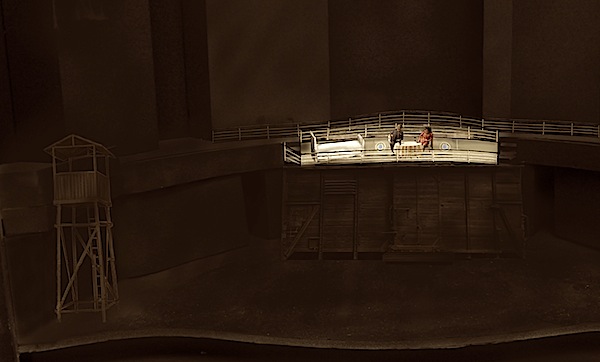
The ship’s cabin in Pasazerka (The Passenger), as envisioned by UBC Opera’s creative team. The opera is part of a series of events at the University of British Columbia marking the 75th anniversary of the liberation of Auschwitz. (photo from UBC Opera)

UBC Opera presents the Canadian première of Mieczyslaw Weinberg’s Pasazerka (The Passenger). Opening Jan. 30 at the Chan Centre for the Performing Arts on the University of British Columbia campus, this will be the first time the work has been presented on any university stage in the world.

The Passenger opens on a luxury liner bound for Brazil. A newly married German woman, Lisa, who, earlier in life, had been an aufseherin, camp guard, at Auschwitz, thinks she recognizes a fellow passenger. The passenger is Martha, a Polish Auschwitz prisoner who was thought to have died at the camp. The effect that their meeting (either actual or imaginary – it’s never made clear) has on the two women, and on Lisa’s marriage to the German ambassador to Brazil, is the subject of this dramatic and powerful opera.

UBC Opera’s production is being created from scratch. The opera has proven so popular no sets or costumes are available for rent; consequently, new sets are being constructed and, at this writing, the students were sewing together dozens of striped prison pajamas for the Auschwitz prisoners’ chorus.

After receiving its world première in 2010 at the Bregenzer Festspiele in Austria, The Passenger has seen frequent performances in various German venues, a highly acclaimed production at the English National Opera in 2011 and, more recently, it has been performed successfully in the United States at the Houston Grand Opera and at the Lyric Opera of Chicago. In spring of last year, it was performed at the new Tel Aviv Performing Arts Centre, and it will be performed in Spain later this year.

The UBC production has received funding from various sources, including the Adam Mickiewicz Institute, which promotes Polish culture around the world, and the Consulate General of the Republic of Poland, as well as Poland’s Department of Public and Cultural Diplomacy and Ministry of Foreign Affairs.

When the president of UBC, Dr. Santa Ono, heard about the project, he committed further funding for the production. Other funding has come from UBC’s dean of arts, Gage Averill, and the David Spencer Endowment Encouragement Fund. The production also has received support from the Vancouver Holocaust Education Centre, Temple Sholom and UBC Hillel House.

“In our time, antisemitism and neo-Nazism has become shockingly prevalent again. Even our own neighbour to the south has witnessed a growing social and political climate which has encouraged disrespect for other human beings and blatant racism,” said Prof. Nancy Hermiston, head of the Voice and Opera divisions at UBC and the director of this production of The Passenger, in a recent interview with the Independent. “In my opinion,” she said, “this has, in part, been released as a result of the behaviour and actions of President Trump. His attitude has given those elements of the world’s population promoting discrimination, hatred, antisemitism and neo-Nazism, a sense that they have a licence to do so. Our opera highlights the consequences of this hatred and racism. Now is the time to remind ourselves of respect and tolerance for others and of our humanity. It is the exact time to remind ourselves of the horror of the systematic extermination of millions of innocent people. Genocides continue to plague our world. Have we learned nothing from the past?

“We can never forget the tragic deaths of those millions of innocent souls nor can we forget those who survived that crime against humanity,” she said. “We cannot let another Holocaust occur.”

The Passenger is sung in Polish, Russian, Czech, French, Yiddish, German and English, which offers a particular challenge to the young singers at UBC. Equally challenging for the singers, according to Hermiston, is the difficulty of dealing emotionally with the subject matter, which, in rehearsal, has led to periods of weeping and feelings of deep sorrow, both for the singers and “even for me,” admitted Hermiston, “especially at the end, when the chorus of prisoners comes downstage and challenges the audience to ‘never forget, never forget.’” (Hermiston has engaged a counseling team to help the singers through their own trauma as they reenact this emotional narrative.)

Performances of The Passenger are set for Jan. 30 and 31 and Feb. 1 at 7:30 pm, and Feb. 2 at 2 p.m. Tickets are available online at music.ubc.ca/opera-pasazerka-the-passenger.

The opera is part of a larger commemoration of the 75th anniversary of the liberation of Auschwitz that is being undertaken by UBC Opera; the UBC Modern European Studies program; the UBC department of Central, Eastern and Northern European studies; the UBC Witnessing Auschwitz International Seminar; and UBC Go Global. During a symposium that runs Jan. 27-30, there will be various symposia and exhibits, and school-outreach programs featuring local survivors and UBC professors and students, as well as the opera The Passenger.

Guest speakers for the symposium include Dr. Michael Berenbaum, Dr. Bozena Karwowska, Dr. Piotr Setkiewicz, Dr. Chris Friedrichs, Aleksander Laskowski, Dr. Richard Menkis, Dr. Dorota Glowacka, Dr. Rima Wilkes, Dr. Anja Nowak, Dr. Peter Suedfeld, Dr. Tricia Logan, Dr. Ilona Shulman Spaar, Janos Benisz, Amalia Boe-Fishman and David Ehrlich, among others. For more information, visit auschwitz75.arts.ubc.ca.

Graham Forst, PhD, taught literature and philosophy at Capilano University until his retirement and now teaches in the continuing education department at Simon Fraser University. From 1975 to 2010, he co-chaired the symposium committee of the Vancouver Holocaust Education Centre.

Format ImagePosted on January 17, 2020January 15, 2020Author Graham ForstCategories Performing ArtsTags Auschwitz, education, Holocaust, Nancy Hermiston, opera, theatre, UBC, UBC Opera, University of British Columbia
Searching for a safe harbour

Searching for a safe harbour

Ben Caplan is narrator and co-creator of Old Stock: A Refugee Love Story, which runs Jan. 24-30 at Frederic Wood Theatre, as part of the PuSh festival. (photo by Stoo Metz Photography)

The 2020 PuSh International Performing Arts Festival opens next week. Among the highlights is Old Stock: A Refugee Love Story, which follows Chaim and Chaya from the pogroms in Romania they are fleeing, to Halifax’s Pier 21, where they meet in 1908, to Montreal, where they end up living. The show, which runs Jan. 24-30 at Frederic Wood Theatre, is narrated and co-created by Halifax-based musician and performer Ben Caplan, with whom the Jewish Independent recently spoke.

JI: How and when did you become involved in the production?

BC: It all started with a phone call from 2b Theatre Company’s artistic co-director Christian Barry in mid-2015. Christian was familiar with my work as a songwriter and performer in the music world and he wondered if I would be interested in collaborating on creating a theatrical production featuring new songs that we would write together.

To be honest, I was skeptical at first. I tend to be a very solitary writer and, though I had a lot of experience in theatre many years ago, it had been a decade since I had performed in theatre. The first few writing sessions were pleasant enough and Christian and I got along great, but we were struggling to find the story that we wanted to tell. As we were searching and exploring to find the substance of what the work would consist of, a confluence of events conspired to show us the story that would become Old Stock.

The first thing was our growing consciousness of the scale of the human tragedy emerging in Syria as a growing number of refugees started trying to find their way out of the violence. Next came Prime Minister Stephen Harper’s comments about “Old Stock Canadians” during the 2015 leadership debate. This othering of “non-Old Stock Canadians” seemed to be vile and absurd. At what point does one get to call themselves “Old Stock”? I am the great-grandson of Jewish immigrants who came to Canada fleeing violence in their own home countries. Was I supposed to think of myself as “Old Stock” or did I fit into some other category in our [then] prime minister’s logic.

Around this time, Christian’s wife, who happens to be the celebrated playwright Hannah Moscovitch, gave birth to their first child, Elijah, and came across the immigration records of her own great-grandparents who immigrated to Canada in 1908 through Pier 2 in Halifax. She realized that, if her great-grandparents hadn’t made the journey to Canada, she would not exist, let alone her infant child. It was then that Hannah asked if she could write the scenes for the show we were trying to create.

With Christian’s vision of the artistic whole, my work as composer and lyricist, and Hannah’s work as playwright, we were off to the races and we worked together to create the show. We thought that the Jewish story from 110 years ago had a striking and tragic resonance with the tragedy unfolding in our own time. I should mention that, of course, the originating cast, musical director Graham Scott, our production manager and designer Louisa Adamson, and many others played a huge role in realizing the vision and bringing the music and the play into the world.

JI: In broad strokes, could you describe how the co-writing process worked?

BC: Christian Barry created the structures and conditions that made it possible for any of these songs to be written. I was probably not always the easiest artist to work with – I tend to desire quiet and solitude when I am writing.

The way it usually worked is that Christian would book a time and a space in whatever city we were able to meet up in (we did writing in Halifax, Montreal, Stratford and Banff) and the day would start with conversations and questions. We would talk, share ideas, listen to music, read texts, Google things, etc.

Out of our conversations and questions, the idea for a song would emerge. The first one we wrote was something for their arrival at Pier 2. We didn’t have a scene or a broader context to work with but, after awhile, Christian would say something like, “We know they are going to come through Pier 2, let’s start there.” I sat at the piano and started mashing out some chords and throwing words into the air. Christian had a wonderfully delicate touch after I got rolling, and would provide helpful comments, critiques, and throw ideas into the room.

JI: What is it about the production that drew you back to performing?

BC: I had stopped performing in the theatre after I became somewhat disillusioned of the possibilities of making a career in theatre. In 2005, the year I did my last theatre performance, I was working on academic pursuits, theatre and my hobby as a singer-songwriter. My life was over-full and something had to give. My logic was something like, in theatre, you need to rely on finding a lot of talented people who are willing to work on a project that takes a lot of time and resources to complete. As a singer-songwriter, there is more room to work solo and bring other people into the project as interest and resources permit. So, that’s the path I chose to express my artistic impulses. I gave up the dream of becoming an actor to focus on the more reasonable and safe path of becoming a songwriter. Ha!

When Christian called me to ask me to make a piece of theatre with him, it was a no-brainer. Being a part of this show has been one of the great privileges of my life. Not only did I get to collaborate with a crazy good team on writing the thing, but I had the opportunity to perform on stages that I wouldn’t have dared to dream of stepping onto when I was making theatre 10 years ago. It’s been an amazing learning experience and one that is sure to influence my work as a performer for the rest of my career.

JI: In what ways does the story and/or themes of Old Stock speak to you as a Canadian in 2020?

BC: What is most meaningful for me about the story and themes of the show is the humanization of the character of the refugee. It has been disturbing to see the ways in which migrants have been portrayed by so many politicians and media outlets around the world. They are often spoken of as hordes, masses and statistics. What is lost are the individual human lives – people with hopes, dreams, fears and trauma searching for a safe harbour.

In Old Stock, we tell the story of Hannah Moscovitch’s great-grandparents coming to Canada. We see their struggles to overcome their past and to generate new and complicated identities. I think that we all, as human beings, have complicated and multi-layered identities. I think that, among other things, this show is about demonstrating layered and sometimes tragic identities with compassion and a healthy dose of humour. That’s basically the most Canadian thing I can think of.

For tickets to Old Stock: A Refugee Love Story and other PuSh shows, visit pushfestival.ca. The soundtrack to Old Stock is available on Spotify, YouTube and elsewhere.

Format ImagePosted on January 17, 2020January 15, 2020Author Cynthia RamsayCategories Performing ArtsTags Ben Caplan, Christian Barry, Hannah Moscovitch, immigration, music, Old Stock, PuSh International Performing Arts Festival, refugees, theatre
Last Cabaret almost sold out

Last Cabaret almost sold out

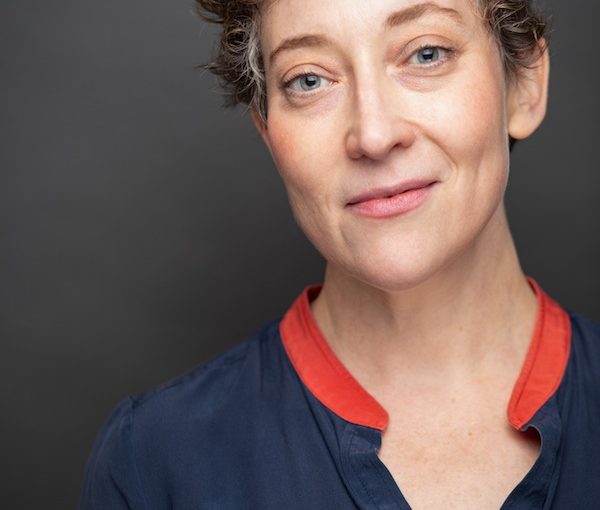
Joanna Garfinkel is part of the creative team behind the world première production of Berlin: The Last Cabaret, part of the PuSh festival. (photo from the artist)

The world première of Berlin: The Last Cabaret, presented at Performance Works Jan. 23-26 by City Opera Vancouver in association with Sound the Alarm: Music/Theatre, is almost sold out. Part of the PuSh International Performing Arts Festival, the only tickets that remain will be sold at the door, though writer and Jewish community member Joanna Garfinkel told the Independent, “I hope we are able to add more presentation opportunities, as well, since this is truly becoming an exciting and rich production.”

Set in Nazi Germany in 1934, a group of artists must decide whether or not to perform their new political show – which, reads the press release for Berlin, “challenges state media, calls out the Nazi classification of gay individuals as ‘degenerates’ and includes parodic inflection that women are being marginalized” under the new regime – or save themselves.

The opera takes place “two weeks after ‘the Night of Long Knives,’” said Garfinkel, “when the future had been cast, but many were not yet seeing it, including my own family. One thing that interested me a great deal is how people are forced to make compromises under oppression, and even make excuses for what’s happening around them.”

The “Night of the Long Knives” was the June 30, 1934, purge by Hitler of more than 85 members of the Sturmabteilung, the Nazi party’s initial paramilitary wing.

Rather than being a satire itself, Garfinkel explained that Berlin: The Last Cabaret “is more an unearthing of the under-heard Jewish and queer artists who flourished in the Weimar era and were crushed by the Holocaust. The humour we employ is their urgent satire, which feels fresh and relevant with all that is going in the world right now.

“My own family escaped from Berlin to Winnipeg (eventually), so I am both bound to respect and honour the history, and also privy to the dark humour we employ about it.”

City Opera Vancouver approached Garfinkel last spring, she said. They had “heard about me from my dramaturgical work with Playwrights Theatre Centre and the historically based Japanese Problem for my own company, Universal Limited. I was excited by the opportunity to work with an opera company, which would be new to me, but on something quite close to my heart, history and interest.”

The relevance of the opera was one of the reasons she joined its creative team. In regard to choosing projects in general, she said, “Right now, it feels like art must be speaking to the world and on behalf of marginalized voices. Theatre is too much work, and the world too messed up, to work on projects that don’t resonate on an activist level. I am lucky right now to get to choose to work on things that are so resonant.”

Garfinkel, who is billed as librettist for the production, clarified that categorization.

“I contributed story, structure and additional dialogue for this piece,” she said, “but it’s important to note that the songs themselves are historical, written by composers Eisler, Spoliansky, Hollaender and Weil, so I am not, technically, the librettist. However, building a story and play around preexisting songs presents its own challenges. It was of central importance to me that the Jewish/queer and other marginalized artists of the time were centred in our story.

“We were working with excellent (but unavailable!) collaborators in our composers and, together with director Alan Corbishley, music director and historian Roger Parton and choreographer Tara Cheyenne Friedenberg, tried to honour their work and build a vital story around it.”

Cheyenne Friedenberg is also a member of the Jewish community.

Berlin: The Last Cabaret stars actors with a background in music and spoken theatre, rather than traditional opera singers, and each performer, according to the press release, “was involved in the creation of their on-stage characters and storylines.” The production features a live four-person band.

For more information on PuSh, visit pushfestival.ca.

Format ImagePosted on January 17, 2020January 15, 2020Author Cynthia RamsayCategories Performing ArtsTags Berlin, free speech, Hitler, Holocaust, Joanna Garfinkel, LGBTQ+, Nazis, PuSh International Performing Arts Festival, satire, theatre

Let’s be more Jewish

It’s an inflammatory question. When attacks against Jews occur, as they are in increasing and alarming numbers in North America – including an incident of hateful graffiti at Camp Miriam on Gabriola Island recently – people ask why. Why Jews?

The problem with the formulation is that it suggests there is a justifiable answer to that question. It would be akin to asking, upon seeing statistics of domestic violence, why women?

Throughout the ages, scholars, pundits and philosophers have listed factors in Jewish theology and culture that confound, scare or irk others and contribute to antisemitic ideas and acts. The steadfast refusal to accept more dominant “successor” religions invites theological reactions. Adherence to cultural practices make Jews outsiders, to varying degrees, in every society. Jewish success in a range of fields invites envy.

But these explanations are all largely nonsense when it comes to the sorts of antisemitic acts we are seeing today. The primary explanation why, for so many people, it is all about Jews is counterintuitive – it is not about Jews at all.

For the most part, probably, the core motivation for engaging in racist and antisemitic acts has less to do with the victims than it does with the perpetrators. The definition of scapegoating is the assignment of sin or guilt onto an empty vessel that is then sacrificed. The hate and violence we are witnessing are almost certainly acts of scapegoating that reflect something amiss in the worldview of the perpetrators. These are people who identify problems in their lives or their world and seek an external entity to blame. Jews are history’s greatest scapegoat, regardless of our actual presence in any particular place. Notably, studies indicate that antisemitism is greatest in places where there are no Jews and it has perhaps always been thus. Shakespeare created the character Shylock hundreds of years after Jews were expelled from England, for example.

This is not comforting. If there were something more discrete motivating these incidents, perhaps they could be rationally contested. That the motivations are based on irrational projections makes them difficult to fight.

It is routinely said that Jews are the canaries in the coal mine of a society. The dehumanizing imagery this employs aside, it is undeniable that Western society today is experiencing some deeply troubling trends, from the emergence of “illiberal democracy” in the erstwhile democracies of Eastern Europe and Turkey to the stark chasms between partisans in still-healthy democracies. Rapid economic changes spark social and political reactions. The greatest migration of people on the planet in generations causes real or perceived threats to the status quo in the countries where these migrants are headed. And this is to leave aside the geopolitical dangers we face in relations with Iran, North Korea and many other flashpoints, as well as from decentralized terror groups that defy international boundaries. We are perhaps more surprised than we should be that, in the face of these developments and uncertainties, a number of people seek out that scapegoat of first resort: Jews.

As a result, stories are emerging of Jews going “undercover,” of being less inclined to be identified as Jewish in places like New York. There are other stories of Jews increasingly learning self-defence skills. Self-protection is primary in any situation and no one should be condemned for taking short-term measures in the midst of danger.

In the longer-term, though, there is an alternative to being (or appearing) “less Jewish.” If the root of this problem is not Jews, but disordered responses to a troubled world, then the answer, while not easy and most certainly idealistic, would be to be more Jewish, to embrace even more energetically a Jewish way of being and doing. We may not be able to change the distorted perspective of an antisemitic individual. But if, through our agency, we can promote fairness, tzedek (justice) and chesed (lovingkindness), we will advance a world in which people will not need to seek scapegoats.

Is it a fair burden that this labour should fall to Jews? Perhaps not. But maybe this is what we have been chosen to do in this moment in history.

Posted on January 17, 2020January 17, 2020Author The Editorial BoardCategories From the JITags antisemitism, culture, democracy, violence
Cohen’s clay defies gravity

Cohen’s clay defies gravity

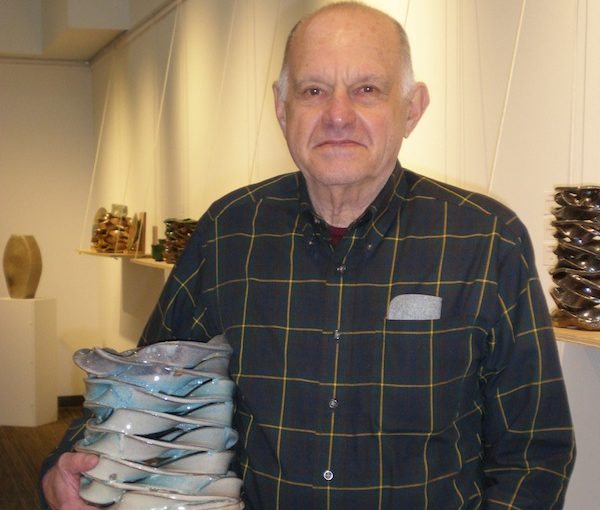
Larry Cohen’s new ceramic exhibition at the Zack Gallery runs until Jan. 25. (photo by Olga Livshin)

Larry Cohen’s new ceramic exhibition at the Zack Gallery is called This and That. The name is symbolic for the artist. His show consists of two entirely different types of pottery: whimsical woven sculptures and functional crockery. “I wanted to explore the relationship between pure art, like my sculptures, and functional things, like my bowls, vases and cups,” said Cohen in an interview with the Independent.

“There is a continuum that stretches from pure functional to pure art, and every object fits somewhere along that continuum,” he explained. “The closer to the artistic end, the less functionality the object has, except for people to look at it and think about it. On the other end, there is pure functionality: you can use a bowl for fruits or a mug for your coffee, but it also has a shape and a colour; something to look at, too.”

In his long artistic life, Cohen has worked in many different mediums, creating sculptures from metal and wood, but clay is his material of choice. “Clay is a wonderful thing to work with. It feels good in my hands,” he said. “And it could be found anywhere in the world. Here, in British Columbia, in Europe, in China, in Japan, in Latin America.”

In the past decade, Cohen has won a couple of month-long residencies as a clay master, one in China, another in Japan. “The clay is different everywhere. Its chemically different compositions provide different visual and textile effects in the objects made of it,” he said. “It could be the same colour when unfired and painted with the same glaze, but, if made from different types of clay, after firing, the resulting pottery would look and feel different.”

Cohen travels a lot and, everywhere he goes, he searches for the local potters and their art, trying to absorb as much as he can from the various traditions. “As clay is different everywhere, so the traditions are different, but, in most of the places I have visited, the history of pottery goes back thousands of years,” he said. “People made things of clay in ancient China and ancient Mexico. Not so much in Europe – it had to import the technique from China, but it is still very old. The only place in the world I know that didn’t have pottery is here, in British Columbia. The local clay is wonderful, but the indigenous people here didn’t use it. They made everything out of wood. Only in the past 200 years, since the Europeans settled in B.C., pottery has been on the rise.”

To a degree, Cohen is a local clay pioneer, like other local potters. It is important to him that everything he creates is unique, that no object repeats another. He is as much a craftsman as an artist, which makes even his utilitarian bowls and vases works of art. His woven sculptures are really one of a kind; they are akin to wicker baskets, but made of clay.

“Some of them look like vases, but there are holes,” he said with a smile. “You can’t pour water inside. No functionality except to look at and admire. It is a new technique for me. I always try something new, always think: what is another way to use clay?”

This particular technique looks like ceramic ribbons lying on top of one another, or interwoven. “Clay is forgiving,” Cohen said. “You can make all kinds of different shapes from it, but, even so, it took me awhile to develop this technique. I had to figure out how to overcome the softness of clay and how to combat gravity, so the upper layers wouldn’t squish the lower ones.”

photo - On display are works he has made using a technique that creates dynamic, ribbon-like clay structures
On display are works he has made using a technique that creates dynamic, ribbon-like clay structures. (photo by Olga Livshin)

He cuts clay in strips and then twists them in various ways to create the dynamic shapes. “Sometimes, I repeat the same shape multiple times, sometimes make them different,” he said. “I dry them before firing, so the whole sculpture doesn’t collapse under its own weight. Sometimes, I make two or three layers together. Other times, every layer is dried separately, and then they come together in the kiln, held to each other by the glaze. Once or twice, I made the full sculpture before firing, and you could see the lower layers sort of melting together.”

Unlike a painter, who sees the immediate result of his labours, a potter doesn’t see what he creates until it’s fired in the kiln. Cohen fires every piece twice, first without glaze, the second time with glaze.

“Once a piece goes into the kiln, you never know what will come out,” he said.

Cohen makes his pieces in bunches before firing them all together. “I have three large kilns in my studio on Cortes Island,” he said. “I fire them four or five times a year. One is electric, for lower temperatures. It is the first one I use. Whatever I’ve made by the time I fire the kilns goes in. Then everything has to cool down before I paint on the glaze and use the other two kilns – one for regular glaze, for the smooth surfaces, and another with salt for the special textures.”

This and That opened on Jan. 9 and continues until Jan 25.

Olga Livshin is a Vancouver freelance writer. She can be reached at [email protected].

Format ImagePosted on January 17, 2020January 15, 2020Author Olga LivshinCategories Visual ArtsTags art, clay, Larry Cohen, pottery, Zack Gallery
Victoria hosts Klondike

Victoria hosts Klondike

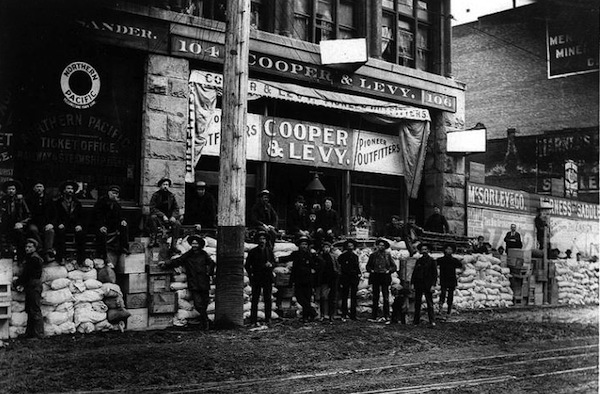
Cooper & Levy store, 104-106 1st Ave. S. near Yesler Way, Seattle, 1897. The store was one of the major outfitters of the Klondike Gold Rush. (photo from Asahel Curtis Collection, University of Washington UW 4770)

The archival images and newspaper headlines contained in the Gold Rush exhibit now on display at the Jewish Community Centre of Victoria (JCCV) evoke a sense of the hysteria that gripped the West Coast more than century ago, in spite of the risks involved in traveling to a severe and treacherous terrain. And Jews were not immune from the mania, as the three-panel display, entitled “The Jewish Presence During the Klondike Gold Rush 1897-1918,” distinctly demonstrates.

The exhibit will be at the JCCV through January. It brings with it a number of revisions from the one that toured Canada from 2016 to 2018 and included a stop in Vancouver.

“During its previous run, we received a lot of additional information from people who visited the exhibit, so much so that we couldn’t include it all in the current display. We are seriously thinking about doing a book starting later this year,” Rick Karp, president of the Jewish Cultural Society of Yukon (JCSY), told the Independent.

Once the previous display returned to Whitehorse, Karp followed up on the input he received and updated the three panels and the booklet accompanying the exhibit.

“As well, we revised the video that details the finding of the Jewish cemetery from the Gold Rush in Dawson, the cleaning and bringing it back to its original condition, and the rededication ceremony,” Karp said. “All the information about the cemetery in the accompanying booklet has been added, as well as the section entitled ‘The History of the Jews in the Klondike Gold Rush’ and the ‘Stories of the Gold Rush.’”

A significant addition to the Gold Rush stories is that of Joseph Barron, one of the first to open a mercantile store in Dawson. Barron came from Winnipeg and followed the stampede of 1898. He mushed into the Yukon via the White Pass route, bringing with him a stock of merchandise.

His beginnings in the north were not the most fortuitous. He lost his supplies on three occasions to fire between 1899 and 1901. Undeterred by adversity, he restocked and started over.

The Barrons would become a prominent Calgary family. Joseph’s son Abe founded the law firm Barron & Barron, which is still operated by the family today. His other son, Jacob (J.B.), was a leading businessman and theatre owner in the city, building Calgary’s first high-rise, the Barron Building, and breaking ground on its first Modern Orthodox synagogue, Shaarey Tzedec (which was demolished in 2013).

Joseph Barron’s wife and children did not come to Dawson until 1902. The younger Barrons only stayed for two years before they left to complete their education. The senior Barrons eventually left Dawson to join their children in Calgary in 1915.

Henry Isaacs was another entrepreneur who ventured north. He earned the moniker “the Butter King of the Klondike” upon learning about a technique using sea water to re-churn a shipment of what others had considered rancid butter into something edible.

Among the most enterprising adventurers was David Gross, a Russian immigrant and dropout trained as tailor, who, not yet 20 years of age when he made the journey north, found ways to make money selling groceries, stoves and other provisions, though his primary business was a clothing store. His ingenuity led him to see opportunities where others did not. For example, if butter had turned rancid and was unsalvageable for food purposes, he would sell it as axle grease for squeaky wheels. After learning that water can only penetrate an inch or two into flour, he would purchase large sacks of flour other merchants thought had been drenched and, therefore, ruined and then sell the flour that the water had not reached at a much higher price. Gross also became active in the nascent movie theatre business in Dawson City.

Yet the prize for the most daring Jewish seeker of fortune would have to go to Max Hirschberg. After losing his supplies en route and then finding, in 1890, that many of the good claims in Dawson had been staked, Hirschberg pushed on to Nome, where more gold was reported to be, on a bicycle!

Later in life, before his passing in 1964, he recounted the 11-week journey in which he made his way along a two-inch trail, confronting snow-blindness, exposure and exhaustion, nearly drowning in the Shaktoolik River and losing $1,500 in gold dust. When his bike chain broke, he made a sail from his coat and rigged it to his bicycle, then crossed the Norton Sound to Nome.

Interest in the Jewish community during the Gold Rush was ignited after the discovery of the aforementioned Jewish cemetery in Dawson City in 1995, and its ensuing restoration in 1997 and 1998. “The discovery of lives lost inevitably leads to questions about lives lived,” the exhibit booklet reads.

“The Jewish Community Centre of Victoria is excited to host the mobile exhibit. We would like to thank Rick for making it possible,” said Larry Gontovnick, president of the JCCV.

After it completes its current tour around Canada, the exhibit will be on permanent display at the Dawson City Museum in the Yukon. A duplicate copy will tour various communities in the United States.

Sam Margolis has written for the Globe and Mail, the National Post, UPI and MSNBC.

Format ImagePosted on January 17, 2020January 15, 2020Author Sam MargolisCategories LocalTags Gold Rush, history, JCSY, Jewish Cultural Society of Yukon, Klondike, Rick Karp, Victoria, VJCC, Yukon

Posts pagination

Previous page Page 1 … Page 280 Page 281 Page 282 … Page 661 Next page
Proudly powered by WordPress