Skip to content
  • Home
  • Subscribe / donate
  • Events calendar
  • News
    • Local
    • National
    • Israel
    • World
    • עניין בחדשות
      A roundup of news in Canada and further afield, in Hebrew.
  • Opinion
    • From the JI
    • Op-Ed
  • Arts & Culture
    • Performing Arts
    • Music
    • Books
    • Visual Arts
    • TV & Film
  • Life
    • Celebrating the Holidays
    • Travel
    • The Daily Snooze
      Cartoons by Jacob Samuel
    • Mystery Photo
      Help the JI and JMABC fill in the gaps in our archives.
  • Community Links
    • Organizations, Etc.
    • Other News Sources & Blogs
    • Business Directory
  • FAQ
  • JI Chai Celebration
  • JI@88! video

Recent Posts

  • BGU fosters startup culture
  • Photography and glass
  • Is it the end of an era?
  • Taking life a step at a time
  • Nakba exhibit biased
  • Film festival starts next week
  • Musical with heart and soul
  • Rabbi marks 13 years
  • Keeper of VTT’s history
  • Gala fêtes Infeld’s 20th
  • Building JWest together
  • Challah Mom comes to Vancouver
  • What to do about media bias
  • Education offers hope
  • Remembrance – a moral act
  • What makes us human
  • המלחמות של נתניהו וטראמפ
  • Zionism wins big in Vegas
  • Different but connected
  • Survival not passive
  • Musical celebration of Israel
  • Shoppe celebrates 25 years
  • Human “book” event
  • Reclaiming Jewish stories
  • Bema presents Perseverance
  • CSS honours Bellas z”l
  • Sheba Promise here May 7
  • Reflections from Be’eri
  • New law a desecration
  • Resilient joy in tough times
  • Rescue dog brings joy
  • Art chosen for new museum
  • Reminder of hope, resilience
  • The national food of Israel?
  • Story of Israel’s north
  • Sheltering in train stations

Archives

Follow @JewishIndie
image - The CJN - Visit Us Banner - 300x600 - 101625

Author: Zack Gallery

Artists explore, soar, create

Artists explore, soar, create

Theresa Kinahan’s “The Fallery Garden That I Love Like My Friends” is part of the Roots and Wings exhibit at the Zack Gallery until March 2.  (photo from Zack Gallery)

The eighth annual Inclusion Art Show returns to the Sidney and Gertrude Zack Gallery at the Jewish Community Centre of Greater Vancouver in celebration of Jewish Disability Awareness, Acceptance and Inclusion Month (JDAIM). The exhibit’s theme, “Roots and Wings,” reflects the grounding strength of heritage and community alongside the freedom to explore, soar and create. The displayed works highlight inclusion, diversity and the creative talents of artists at every stage of their artistic journey.

This year’s Roots and Wings exhibit features Theresa Kinahan, Kevin Lee (Kevo), Mark Li, Gabriel López Demarco, Mariane Stifelmann and Matthew Tom-Wing. 

Art has always been a part of Kinahan’s life. She started to draw when she was just a little girl, and her media have included photography, acrylic, fabric art, enamel, wood-cut printing, charcoal, pastel, watercolour, metalwork, welding and pottery. She taught art in Vancouver high schools for many years, but epilepsy and an ensuing brain injury forced her to retire early. She turned to painting for therapy, drawing inspiration primarily from nature, notably for her acrylic fern series. She signs her paintings with her initials and a heart, which is reflective of the love she feels all around her. 

Kevo was born with Trisomy No.18 and was unable to make a sound until he was 6 years old. Art became a way to communicate and express his creativity and emotions; a way to share his delight with the world. Today, Kevo channels his creativity and love of art into painting, music, dance and clay work. He loves colour and the physical act of painting. Every one of his pieces has a thoughtful story or a kind wish.

Li, who creates at the Art Hive, is a visual artist whose narrative-focused work creates a whimsical world filled with colour and imagination. Every one of his paintings is a tale of friendship and depicts acts of kindness: a bear might be best friends with a cat; a T-Rex smiles with shy humour and sweetness at the viewer; a ladybug and a cat might go dancing in the sunlight; a walk in the park with a friend and his dog is a delightful adventure. 

photo - Gabriel Fernando López DeMarco’s “I Am Born from Desire”
Gabriel Fernando López DeMarco’s “I Am Born from Desire.” (photo from Zack Gallery)

López Demarco, who was born in Buenos Aires, joined his first art workshop at the age of 5. At the age of 13, he entered the Villa Mecenas art school and, at 18, the National University of Art.

During university, López Demarco continued attending painting, sculpture, engraving and printed art workshops, making artistic and conceptual trips through Argentina. In 2013, he traveled through South America and, in 2015, he went to Mexico, where he studied fresco painting. At the same time, he expanded his studies of engraving and printed art.

Since then, he has traveled around Central America, the United States and Europe, carrying out murals and other artistic activities. In 2023 and 2024, he worked as a muralist on the public art team of the municipality of Morón, Argentina. In 2025, he went to China to study calligraphy and Chinese painting. He currently works as a freelance muralist around the word.

Stifelmann was born in Brazil and moved to Vancouver in 2000. She is a former kindergarten and Grade 1 teacher, and studied at the Pan-American School of Arts in São Paulo. 

photo - Mariane Stifelmann’s “The Couple”
Mariane Stifelmann’s “The Couple.”  (photo from Zack Gallery)

On display at the Zack is Stifelmann’s “The Couple,” one of her first paintings. It is created in a caricature style with acrylic paint, and expresses her deep love for her family – the work depicts her grandparents, Eda and Jacob Koin, who emigrated from Poland.

Over the years, Stifelmann has evolved her technique and style and has worked with artist Nati Saidi for more than a decade. Her art embraces vibrant colours and evokes feelings of joy, freedom and nostalgia. Through her work, she invites viewers into a world where light and happiness are always in season.

Tom-Wing is an active member of the Bagel Club and part of the JCC Art Hive. “I am an artist and have sold paintings and ceramic pieces,” he said. “I love music. I play the drums and am also the drummer in the Vancouver BFF band.”

Tom-Wing also enjoys acting and being involved in the theatre world. His roles have included the character Magwitch in the play King Arthur’s Night.

Roots and Wings is on display until March 2. One hundred percent of the proceeds from artwork sales goes directly to each artist. 

– Courtesy Sidney and Gertrude Zack Gallery

Format ImagePosted on February 13, 2026February 11, 2026Author Zack GalleryCategories Visual ArtsTags art sale, artwork, diversity, inclusion, painting, Roots and Wings, Zack Gallery
Life’s full range of emotions

Life’s full range of emotions

Bonny Reichert will be in Vancouver on March 4 to talk about her new memoir, How to Share an Egg, as an epilogue to the JCC Jewish Book Festival, which runs Feb. 21-26. (photo by Kayla Rocca)

When Bonny Reichert was a kid, living in Edmonton, her baba, who had come to Canada as a teen on her own in the early 1900s to escape pogroms in Ukraine, would come to stay with her family for the weekend and “the house brightened,” writes Reichert in How to Share an Egg: A True Story of Hunger, Love and Plenty. “She arrived as though she were fleeing all over again, with parcels and packages and a giant soup pot wrapped in a tea towel, knotted to make a handle. Things were hot or cold or frozen. I didn’t know to wonder if she’d stayed up all night rolling and pinching and stuffing for us. Pekeleh, she called her bundles, little packages. Pekeleh also means burdens. Yiddish is like that.”

As with pekeleh, meaning both treats and worries, there have been many contrasts in Reichert’s life, opposite things or states of being existing simultaneously. Her memoir is fascinating for the challenges she has faced and the way in which she has dealt with them. Readers can hear the award-winning writer in conversation with Marsha Lederman on March 4, 7:30 p.m., at the Jewish Community Centre of Greater Vancouver, in a JCC Jewish Book Festival epilogue event. 

image - How to Share an Egg book coverHow to Share an Egg is the telling of Reichert’s dad’s survival story – a story he so wanted her to share. Experiencing years of difficulty putting pen to paper, she approaches it through her own journey with intergenerational trauma, which she has felt deeply from childhood. Her mother grew up with “a dad who was quick to anger” and an “exacting” mother who taught there was only one way to do things. “That this was the same person who rubbed my feet as I fell asleep seemed impossible,” writes Reichert about her efforts to reconcile her beloved baba with her mother’s mother.

Reichert’s maternal grandfather, who had come to Canada in 1913, died before she was born. On her paternal side, she had no grandparents – her dad was a 17-year-old orphan when he came to Canada in 1947. His parents and five sisters were all killed in the Holocaust. He was one of the 1,123 war orphans Canadian Jewish Congress helped enter the country when the doors were only just starting to open again for Jews.

The Jewish Independent spoke with Reichert by email about her memoir.

JI: You were 9 when your dad first mentioned the possibility that you would write his story. Then there was the trip to Poland in 2015 that was a breakthrough. When did you actually write the first words and, from that point, about how long did it take for you to write How to Share an Egg?

BR: The very earliest work on the book started on that first trip to Warsaw with my dad. I took a few notes and some important photos, but I didn’t yet know where I was headed. After the second trip to Poland, in 2016,  I had even more research and notes, but I still wasn’t sure I had a book. The more formal outlining and writing began in late 2020, in the depths of the pandemic. Including the time I spent waiting for my editor’s feedback and the editing, the book took about four years to write. I was earning a master’s degree at the same time.

JI: You write about your personal journey with inherited trauma, and you share some of the healing milestones on that journey. In what ways was the process of writing the book cathartic?

BR: When you write a memoir like How to Share an Egg, your job is to look at yourself very closely, but with objectivity, because the self becomes the central character of the book. In that close examination, you come to name feelings you previously couldn’t name, and evaluate experiences and situations that your younger self might not have understood. All of this leads to greater understanding and greater self-compassion. This, coupled with the relief of finding a way to write this book my dad always wanted me to write, has indeed led to healing and catharsis.

JI: What does your dad think of the book?

BR: He loves it and says that it has given new meaning to his life at 95. A wonderful outcome.

JI: One theme of How to Share an Egg is you finding your voice, being able to stick up for yourself when bullied, to be yourself in the face of others’ expectations (notably, your father’s). From where did you get the courage to be this open?

BR: You can’t decide to write a memoir and then hide from the personal. Readers want to see all of that raw emotion on the page. For the memoir to be successful, the true, honest person in the book should resonate with the true person inside the reader. At a certain point, I realized all of this, and I came to see I was writing about the universal human experience and there is no shame in being human. In other words, I practised radical self-acceptance to get the job done.

JI: You comment in the book about pekeleh meaning both bundles and burdens. Judaism is full of those instances, holding joy and sorrow at the same time. Can you speak about that, in the context of How to Share an Egg?

BR: People often hold a pretty stereotypical idea of what Holocaust survivors and their families are like – severely traumatized, loaded down with psychological and emotional problems, etc. I wanted to address that – to challenge it and expand on it. There is sorrow and trauma, of course, but there is also so much joy and gratitude and celebration. So, the book is meant to express this fuller range of emotion. Part of my decision to write it as a food memoir was to offer the reader pleasure and comfort, even against the backdrop of the Holocaust. A Jewish approach, for sure.

JI: Hedy Bohm, who you mention in your memoir, just had her own survivor memoir published by the Azrieli Foundation. What is the importance of having these stories out in the world?

BR: Yes, I’m so happy for Hedy. She is a wonderful person. Preserving these stories has always been of the utmost importance – firsthand testimony is obviously critical. I also believe a plurality of stories and approaches brings the humanity back into the unfathomable numbers and statistics.

JI: How often have you been to Vancouver, and what are you looking forward to most about your March visit?

BR: I was just there in the fall for the Vancouver Writer Fest! I have friends I’m looking forward to seeing and I’m hoping for some nice weather so I can walk and admire your beautiful city.

For the full schedule and tickets to the book festival, go to jccgv.com/jewish-book-festival.

Format ImagePosted on February 13, 2026February 11, 2026Author Cynthia RamsayCategories Books, LocalTags Bonny Reichart, food, history, JCC Jewish Book Festival, memoir, survivors

Community needs survey closes March 29

Twice Blessed 2.0: The Jewish LGBTQ2SIA+ Initiative 2026 is an ongoing partnership between JQT Vancouver and JFS Vancouver that began with conversations between the two organizations in 2020 regarding diversity education and ensuring that JFS supports the social, physical and emotional wellness of all people and is a welcoming and inclusive organization for the Jewish LGBTQ2SIA+ community. As part of this initiative, JQT and JFS conducted a community needs assessment in 2022: jqtvancouver.ca/twice-blessed-2.

It has been a handful of years since this assessment was conducted, and JQT is now updating its survey to understand what progress has been made on the group’s 13 Calls to Action for BC Jewish community organizations, what still requires improvement, and what may be completely new needs for the Jewish LGBTQ2SIA+ community in 2026. JQT wants to update the Calls to Action to reflect any changes.

The survey link went live on Feb. 1 and will remain open until March 29. It is open to all members of the Jewish LGBTQ2SIA+ community residing in British Columbia. In 2022, several allies participated as well, and allies are once again invited to fill out this survey, too. JQT also wants to include parents and caregivers of Jewish LGBTQ2SIA+ people. 

Please share the survey links widely in your professional and personal networks, social platforms, “watercooler” channels, etc. so that it can reach as many people as possible across the province’s diverse Jewish community.

The survey can be found at s.surveyplanet.com/h44tdqiv and jqtvancouver.ca. 

– Courtesy JQT Vancouver

Posted on February 13, 2026February 11, 2026Author JQT VancouverCategories LocalTags community needs assessment, JFS Vancouver, JQT Vancouver, LGBTQ+, LGBTQ2SIA+, surveys, Twice Blessed 2.0
Jerusalem marathon soon

Jerusalem marathon soon

Last year’s International Jerusalem Winner Marathon. (Sportphotography)

The International Jerusalem Winner Marathon returns for its 15th year and will take place on March 27, with tens of thousands of runners participating from across Israel and around the world.

“The marathon is much more than a sporting event, it is an expression of strength, mutual responsibility, unity and the Jerusalem spirit,” said Moshe Lion, mayor of Jerusalem. “This year, we once again salute the IDF soldiers, security and rescue forces, and reserve personnel who protect all of us every day, and we invite them to be part of an international celebration of sport, community and hope.”

The International Jerusalem Winner Marathon is organized by the Jerusalem Municipality Sports Division in collaboration with the Jerusalem Development Authority, Ministry of Culture and Sports, Ministry of Tourism, Ministry of Jerusalem and Heritage, and other partners. Sponsors include Toto Winner, the main sponsor, as well as Azorim Ltd., and others. The marathon is produced by Electra Target.

Registered runners will receive a participant package including an official marathon shirt, bib number, timing chip, and a variety of additional benefits. For more information and registration, visit jerusalem-marathon.com. 

– Courtesy International Jerusalem Winner Marathon

Posted on February 13, 2026February 11, 2026Author International Jerusalem Winner MarathonCategories IsraelTags athletic events, Israel, Jerusalem, marathons
Historic contribution

Historic contribution

The Roadburg Campus of Tel-Hai College, which is soon to become the University of Kiryat Shmona in the Galilee. Vancouver’s Ronald S. Roadburg Foundation has donated $50 million Cdn to the institution. (photo from Tel-Hai)

Tel-Hai College – soon to become the University of Kiryat Shmona in the Galilee – has received a transformational $50 million Cdn gift from Vancouver’s Ronald S. Roadburg Foundation. The historic contribution is the largest ever received by the institution and the largest single commitment in the foundation’s history. It expands on the decades-long partnership between the Galilee and Canadian Jewish federations and communities in Vancouver, Edmonton, Calgary, Winnipeg, Ottawa and Halifax. It is designed to be the first steppingstone on Tel-Hai’s path after acquiring its new status as the first university in the Galilee in late January.

The investment comes at a critical juncture as the region transitions from two years of war and widespread displacement toward comprehensive renewal and growth. The university and the Roadburg Campus will meet the needs of the community, as the school prepares to take in thousands of new students, researchers and faculty members. The university is positioned as a global hub for applied research, addressing global challenges in sustainable agriculture, artificial intelligence, psychological resilience and social work, fields where Tel-Hai has gained international recognition for its field-tested expertise.

“THU is more than an academic institution; it is the heartbeat of the Galilee and a beacon of coexistence,” said Prof. Eliezer Shalev, president of the university. “Our classrooms are a tapestry of Jews, Muslims, Druze and Christians studying together. This gift from the Ronald S. Roadburg Foundation ensures that our academic excellence remains inclusive and that we continue to serve as the region’s primary engine for socioeconomic growth.”

The Roadburg Foundation’s partnership with Tel-Hai reflects the foundation’s belief that learning is the ultimate tool to bring people together, foster peace and create shared opportunities. This $50 million gift, expanded from an initial $8 million commitment to Tel-Hai’s computer science facilities, will serve as a cornerstone investment as the university continues to be a catalyst for social and economic renewal in the Galilee.

“We chose to make this landmark investment now because we believe in the resilience of the people of the Galilee,” said Stephen Gaerber, the foundation’s director. “By helping Tel-Hai elevate to a university, we are investing in a future where world-class science and social cohesion go hand-in-hand to build a stronger Israel.”

“Over the course of the war, we were involved in emergency efforts, especially in this region,” Mark Gurvis, chief executive officer of the Roadburg Foundation, told eJewish Philanthropy. “We started focusing on Tel- Hai as part of the solution for the period after the war, when people would focus on reconstruction efforts. We knew that Tel-Hai was already the major economic and social driver of the region. We focused on positioning Tel-Hai – as it was becoming a university – to be able to fulfil that potential.”

There has been a steady Canadian partnership with Tel-Hai for years, led by the Jewish Federations of Canada-UIA (JFC-UIA) together with local federations and donors.

JFC-UIA and Federations across the country collectively helped move forward the transition of Tel-Hai to a university with significant support for Israel’s north, including approximately $25 million Cdn toward strengthening the region and advancing Tel-Hai.

Israel’s Council for Higher Education approved the transformation of Tel-Hai into the University of Kiryat Shmona in the Galilee, with university recognition beginning in the 2026/27 academic year. The plan includes a 570 million NIS (nearly $200 million Cdn) investment over five years; proposals for new PhD programs in biotechnology, education, psychology and nutritional sciences; a faculty of engineering focused on precision agriculture, knowledge engineering and AI; and a veterinary school in the Golan Heights.

To read eJP’s interview with Gurvis, go to ejewishphilanthropy.com. 

– Courtesy Tel-Hai College and Jewish Federation of Greater Vancouver

Format ImagePosted on February 13, 2026February 11, 2026Author Tel-Hai College & Jewish Federation of Greater VancouverCategories IsraelTags donation, Israel, Mark Gurvis, philanthropy, Ronald S. Roadburg Foundation, Stephen Gaerber, Tel-Hai College, universities

Chronicle of a community

The past and future of Jewish journalism were on the agenda when Cynthia Ramsay addressed the Jewish Seniors Alliance of British Columbia, Jan. 27. 

In a Zoom presentation that was part of the alliance’s Empowerment Series, the publisher of the Jewish Independent spoke on the history of the newspaper and discussed the future of Jewish newspapers in general and the Independent in particular.

photo - Ramsay spoke about the history and future of the Jewish Independent at the Jewish Seniors Alliance of British Columbia Empowerment session Jan. 27
Ramsay spoke about the history and future of the Jewish Independent at the Jewish Seniors Alliance of British Columbia Empowerment session Jan. 27. (photo by Karen Ginsberg)

While the paper celebrated its 95th anniversary last year, Ramsay said it could be a century old, depending on how one begins the count. 

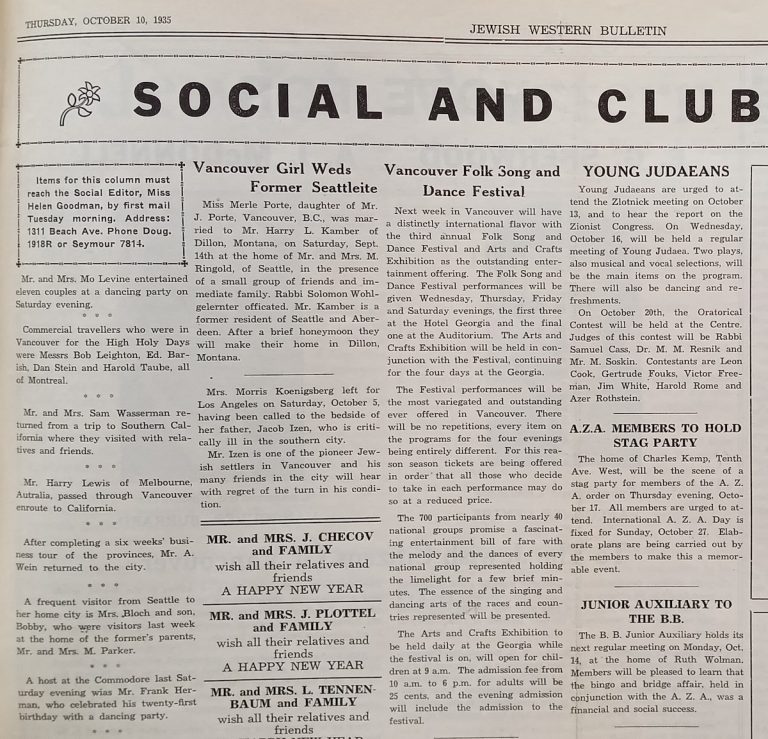
A Vancouver Jewish Bulletin was published in 1925, printed by Dr. J.I. Gorosh and this was succeeded by a mimeographed newsletter produced by the Jewish Community Centre and dubbed the Jewish Centre News. The name Jewish Western Bulletin dates to the 1930s.

Publishing transitioned to the Jewish Community Council of Greater Vancouver, a forerunner of today’s Jewish Federation, though it appears to have evolved a degree of independence under publisher Abraham Arnold, who took the helm in 1949, in conjunction with his wife Bertha.

The newspaper became formally separate from other institutions a decade or so after Sam and Mona Kaplan took over in 1960. 

The Kaplans were very much committed to advocacy journalism, Ramsay said, most notably advocating freedom for Soviet Jewry.

The Kaplans ran the paper for 35 years and, after a period when it was contracted to an American Jewish media chain, it was sold to Ramsay and two partners, Kyle Berger and Pat Johnson. The latter two later left the business but Ramsay says she is happy that they remain friends and that Johnson is on the editorial board and still writes for the paper (including this story).

The new leadership brought fresh policies, including accepting notices of interfaith and same-gender weddings, as well as coverage of a broader range of topics that were previously considered off limits. The paper opened up to a wider range of opinions, including on Israel.

In 2005, Ramsay renamed the paper the Jewish Independent.

“I changed it because I didn’t think Bulletin really said ‘newspaper,’” she explained. “We got rid of the word ‘western’ also. By that point we were online … and it wasn’t just people from BC who were reading it.” 

The paper walks a line between supporting the community and providing a critical eye where necessary, she said.

“I think there are concerns that should be played out in public, but then there’s others that really should be dealt with privately,” she said. “We’re not a gossip rag and we’re also not sensationalist or alarmist. 

“We don’t ignore the bad stuff that goes on in our community or in the world, but we do try to cover stories in a way that doesn’t depress or paralyze,” said Ramsay, quoting from an article she wrote in the paper’s anniversary issue last May. “We want, rather, to open the door for solutions and at least positive attempts at change. We don’t want you to put down the paper in despair, but rather [consider] what you can do to contribute to making the world a better place.” 

Above all, she said, the paper tries to provide a record of the community, a role it has played for most of a century. 

image - The first issue of the Jewish Western Bulletin, Oct. 9, 1930
The first issue of the Jewish Western Bulletin, Oct. 9, 1930.

“The Jewish Western Bulletin, the Jewish Independent, has been the only consistent historical record of the community since 1930,” she said. 

“Now, of course, we miss a lot of stuff,” she acknowledged. “We have a very small staff. We have a limited number of pages every issue, we’re not going to cover everything.”

She provided an insider view of how the paper operates in terms of the amount of advertising determining the size of each issue, and how decisions are made about what is covered in each issue and on what page things appear.

The pandemic was deeply challenging to the economic viability of the paper, said Ramsay, and it was at that time that the publishing schedule shifted to twice monthly from weekly. 

image - The Jan. 23, 2026, issue of the Jewish Independent
The Jan. 23, 2026, issue of the Jewish Independent.

The Independent has survived when other Jewish newspapers in Canada and across North America have not, she noted, even including Federation-owned publications that have gone under in some cities. She wants the paper to reach 100 and she also has her own retirement in mind, tentatively at age 60.

“I’m 56,” she said, noting that almost 30 of those years have been devoted to the paper.

“I’m already starting to think about succession plans,” she said. “I’ve kind of got a five-year window at this point where I’m looking and wanting to responsibly pass over [the paper].”

Innovation could make the publication more sustainable, perhaps a monthly format, she said. 

All in all, she takes pride in her achievements and the longer history of the paper’s contributions to the community.

“I think we’ve been a great success, not just because we’re 96 years old, but … [almost] every year we’ve won an American Jewish Press Association Rockower Award for Excellence in Jewish Journalism, mostly for our editorials, but occasionally for other articles,” she said.

The Jewish Seniors Alliance session was opened by Jeff Moss, the organization’s executive director. Fran Goldberg introduced Ramsay. 

Posted on February 13, 2026February 11, 2026Author Pat JohnsonCategories LocalTags history, Jewish Independent, Jewish journalism, Jewish Seniors Alliance, Jewish Western Bulletin, JSABC
Late-in-life cartoonist

Late-in-life cartoonist

Beverley Kort is a therapist who brings a psychological perspective to her worldview – and to her cartoons. (illustration by Beverley Kort)

At 75, Beverley Kort is just getting started with her second career as a cartoonist. A frequent contributor to the Jewish Independent, Funny Times and Grand Magazine, Kort is a therapist who brings a psychological perspective to her worldview – and to her cartoons.

“I was always told I was a lousy artist,” she admitted in a recent conversation with the JI. “So, when I was looking for a new, more sedentary hobby, I thought to myself, ‘let me take up something that I know I’m not good at, and perhaps I can get mediocre at it!’”

image - snakes trying skins on in a dressing room cartoonShe began with art classes and quickly gravitated towards cartooning five years ago. Since it was a hobby and something she wasn’t taking too seriously, she submitted her work in myriad directions just to see what would happen. To her surprise, the response has been positive, resulting in publication in magazines, newspapers and a 2023 book, Hold That Thought, edited by David Endelman. 

“In the art world, you don’t get seen until you’re somebody, but, in the cartoon world, if you’re willing to take a risk, you can get seen,” she explained. “With cartoons, it’s the idea that matters, not the art.”

Kort has two separate stations at her home office, one for therapy and one for cartooning. These days, she carries a notebook to record ideas, reads newspapers and listens to podcasts for inspiration.

image - person wanting to know worst of best case scenario in investing cartoon by Beverely Kort“I give myself three hours each week just to sit and play with cartoons,” she said. “I’m having so much fun! I’m in touch with many creative people I’d never have otherwise met and, while I don’t ever want to take cartooning too seriously, I am improving.” 

Her work as a therapist has a strong influence on her cartoons, and her examination of the human condition and its quirks is great for generating ideas. Her topics range from life’s frustrations to aging, parenting and grandparenting, and the fresh, lighthearted perspective Kort brings is unequivocally humourous.

“Arriving at cartooning late in life has been liberating for me, but I still get a thrill each time an editor accepts my work,” she said. “There’s a fearlessness that comes with no longer needing to build a career or impress others, though I hope my sense of humour connects with as many people as possible. What’s more, I’ve discovered that new passions can find you at any age.” 

Lauren Kramer, an award-winning writer and editor, lives in Richmond.

Posted on February 13, 2026February 11, 2026Author Lauren KramerCategories LocalTags art, Beverley Kort, cartooning
Cashflow vs growth portfolio

Cashflow vs growth portfolio

If your retirement income plan depends primarily on selling capital to meet ongoing spending needs, it may be worth asking whether your portfolio is truly designed for retirement. (photo from elevatefinancial.ie)

For many Canadians approaching or living in retirement, the constant market gyrations create a lot of anxiety. They wonder, is a recession around the corner? Will the next market meltdown delay my retirement or reduce my retirement income? 

When you are young, market volatility is what you want. It allows you to invest more when markets are down to capture more upside potential when markets rebound. But what if you are no longer building up your portfolio and need to draw income in retirement? Market volatility feels very different when it directly affects your retirement and your need for income. 

In retirement, actual income – not “annualized returns” – pays the bills. Monthly expenses such as housing, travel, medical goods and services, family support and charitable giving continue regardless of market conditions. What’s worse, the cost of living goes up every year.

Many retirees don’t realize this vulnerability until after retirement begins. The plan looked solid on paper, but, once withdrawals start, the pressure changes. Income becomes personal when you no longer have employment income to rebuild, and more fragile if your retirement plan depends on regularly selling investments to generate cash.

Importance of an income strategy

A growth portfolio often generates very little in the way of cashflow. An investment plan that relies on selling capital to fund ongoing spending is not truly an investment plan. It is a liquidation plan. While selling assets occasionally may be appropriate, a portfolio that requires ongoing sales to meet cashflow needs introduces structural risk. Timing matters – particularly during market downturns, when selling can permanently impair future outcomes.

Beyond market timing, assets sold to fund today’s spending are no longer available to generate income, recover in future markets or provide flexibility later in retirement. Over time, this can narrow options and increase dependence on market conditions when stability matters most. This is why effective retirement planning focuses on cashflow by design, built around spendable income, not assumptions that require the markets to always rise. 

Tax-smart investing

Just as important as how income is generated is how it is taxed. In Canada, retirement income can arrive in many forms – interest, dividends, capital gains, return of capital, and registered withdrawals – and each is treated very differently for tax purposes. 

Two retirees receiving the same cashflow can experience materially different after-tax results depending on how income sources are structured. Strategic changes can make an enormous difference in allowing retirees to keep more in their pocket each month. 

The bottom line

Many portfolios are built successfully for growth. But a portfolio designed for growth is not automatically designed for retirement. When the objective shifts from building wealth to funding life, portfolio structure must evolve.

If your retirement income plan depends primarily on selling capital to meet ongoing spending needs, it may be worth asking whether your portfolio is truly designed for retirement – or is it a growth portfolio disguised as a retirement portfolio? 

Shay (Shy) Keil is a senior wealth advisor at Scotia Wealth Management who works with established retirees and business owners, helping them structure sustainable, tax-efficient retirement income through strategic cashflow planning.

Format ImagePosted on February 13, 2026February 11, 2026Author Shay KeilCategories LocalTags cashflow, finance, income strategy, investing, retirement planning, taxes
My new best friend is Red

My new best friend is Red

The author made RecipeTin’s Quick and Dirty Focaccia using her hands, giving her new best friend, Red, the night off. (photo by Shelley Civkin)

News flash: diamonds are not a girl’s best friend. They’re certainly a welcome acquaintance, but are they always there when you need them? No. Sometimes, they’re hiding out in a safety deposit box. I have something better than diamonds – a new BFF. And her name is Red. Full name: KitchenAid Artisan Stand Mixer in Empire Red. She’s the culinary equivalent of an Alfa Romeo convertible. Let me put my gushing admiration of her in context with this bit of background info. 

I am on the cusp of turning 70 and my sweet husband thoughtfully and preemptively bought me something I’ve thought about for a long time: a KitchenAid stand mixer. I know, I know, who doesn’t already own a KitchenAid stand mixer? Me, that’s who. And it’s not for lack of encouragement on Harvey’s part. I have, for the better part of the last 50 years, always used an entry-level electric hand mixer. And it’s served me just fine. Mostly. Until the motor blew on my original Sunbeam, circa 2000.

Reluctantly, I transitioned to a KitchenAid electric hand mixer and, while flashy, it was not nearly as powerful as my good old $20 Sunbeam. It wasn’t bad. It was just a bit too delicate for my baking needs. I required something that could take a licking and keep on ticking. Sort of like a Timex, the kind they strapped onto the propeller of an outboard motor and dragged through a lake by a speedboat. And, if you remember that commercial, you are officially ancient. (You’re in good company though.) Realistically, a hand mixer has got to be able to go mano a mano with a good, stiff cookie dough. If it can’t manage that without slowing down and making weird noises, it’s not worth its weight in salt.

photo - KitchenAid Artisan Stand Mixer in Empire Red – aka Red
KitchenAid Artisan Stand Mixer in Empire Red – aka Red. (photo by Shelley Civkin)

But I no longer have those worries. I have Red. Since receiving this early birthday present, I have made dozens of cookies, countless cakes, muffins and meatballs. I must admit that the wire whisk still scares me a bit, but I’m certain I’ll warm up to it over time. 

Like those people whose gardens get overrun by zucchini and end up going around at night dropping off bags of them on people’s doorsteps, I, too, am sharing. My new condo neighbour, Nancy, is the cheerful recipient of my KitchenAid labours of love. Especially the cookie variety. Turns out, it’s a great way to make friends. I mean, who doesn’t love free cookies on the regular?

I recently had a craving for focaccia, but gave my KitchenAid the day off and made Quick and Dirty Focaccia by hand (recipe courtesy of Instagram by RecipeTin). The recipe made a small batch, which saved me from over-indulging. Full disclosure: I have no self-control when it comes to fresh, warm focaccia. This was unlike any other focaccia I’ve ever made, though. Apparently, it’s all the rage on Instagram.

I wasn’t used to working with a wet, jiggly dough, but that’s the ticket to a legit fluffy focaccia. Other recipes I found called for the stretch-and-fold method, but I didn’t employ that here. It does look like a great way to get lots of air bubbles in the final product, but my batch of dough was small and didn’t really require it. I will definitely try that next time I make a bigger batch of dough.

QUICK & DIRTY FOCACCIA

2 cups bread flour
1 1/8 tsp instant yeast
3/4 tsp kosher salt
1 cup plus 2 tbsp very warm water
1 1/2 tbsp olive oil
1/4 tsp (heaping) sea salt flakes or kosher salt
kalamata olives, rosemary or za’atar (optional)

Preheat oven to 425˚F. Mix flour, yeast and salt. Make a well and pour in water and mix. Cover with plastic wrap and rise in a warm place for 2 hours, until doubled in size. The dough will be very wet and jiggly.

Generously grease a 10.5” x 8” x 2” metal or glass pan with oil. Press a scrunched-up piece of parchment paper into the pan and leave an overhang. Drizzle the parchment paper generously with olive oil, too. (Scrunching the parchment ensures that it will lay flat and that the dough will get into every crevice of the pan.)

Scrape the focaccia batter into the pan. Do not punch or deflate the dough beforehand. Coax it into the corners with your oiled fingers as best you can. Cover with something heavy (a cast-iron pan or cutting board) and leave it to rise by 50% (about 45 minutes).

Drizzle olive oil on the surface of the dough and spread it with your oiled fingers. Dimple the dough vigorously with your fingers and sprinkle with the sea salt and any other toppings you like (optional, but think kalamata olives, rosemary, za’atar, etc.).

Bake for 25 to 30 minutes, rotating the pan after 15 minutes. Cool on a rack for about 10 minutes.

It should turn out crunchy on top, but airy and fluffy on the inside, perfect for dipping in a plate of olive oil and balsamic vinegar. It’s a quick and easy way to elevate a meal and makes a nice between-meals snack or sandwich. And, of course, you can’t overlook the therapeutic benefits of getting your fingers all oily and your nails all full of dough. If you’re someone who doesn’t like to get down and dirty when you bake, then this isn’t for you. I, however, am a full-contact baker.

I make a more traditional focaccia where kneading is required, and it’s made in a cast-iron fry pan, but it’s an altogether different process. The end results are different, for sure, so it’s really a matter of taste. Either way you cut it, focaccia is delicious and lends itself to all sorts of varieties and toppings. Believe it or not, I’ve seen a recipe for chocolate focaccia, but that’s a bit too out there even for me. Enjoy your bread and be sure to share. 

Shelley Civkin, aka the Accidental Balabusta, is a happily retired librarian and communications officer. For 17 years, she wrote a weekly book review column for the Richmond Review. She’s currently a freelance writer and volunteer.

Format ImagePosted on February 13, 2026February 11, 2026Author Shelley CivkinCategories LifeTags Accidental Balabusta, appliances, baking, cooking, recipes

ישראלים רבים ממשיכים לתמוך בטראמפ ועדיין אינם מבינים במי מדובר

 נשיא ארה”ב דונלד טראמפ, מכהן בתפקידו כבר שנה מלאה וקשה לאמוד את מידת הנזק שהוא גורם כל יום. למרות זאת ישראלים רבים ממשיכים לתמוך בו ללא עוררין וכנראה שהם עדיין לא מבינים במי מדובר. תופעה זו מזכירה את התמיכה בראש הממשלה של ישראל בנימין נתניהו. כבר מזמן הוכח שהתמיכה במנהיגים פוליטיים מושחתים כמו טראמפ ונתניהו, נובעת ממניעים פסיכולוגיים ולא הגיוניים. זה מזכיר כמו אמונה בדת, או חברות בקאלט

טראמפ הוא נוכל סדרתי במשך למעלה מחמישים שנות חייו כאיש עסקים בניו יורק. וכן בבית הלבן. בקדנציה הראשונה שלו הוא נמצא משקר למעלה משלושים אלף פעם. במדינה מתוקנת נוכל מדופלם שכמוהו לא היה נבחר לקדנציה שנייה. לצערנו ארה”ב כיום היא כבר מדינה לא מתוקנת כפי שבמערב מרגישים זאת. בישראל לא רואים זאת באותו אופן וכאמור התמיכה בטראמפ היא גדולה

בדומה לנתניהו שהשתלט על ישראל והוא עושה בה כרצונו טראמפ השתלט על ארה”ב וגורם נזק לה נזק אדיר מדי יום. ההשלכות החמורות של מעשיו משפיעות לרעה על כל המערב ובעיקר על קנדה השכנה מצפון

טראמפ הוא נרקסיסט מטורף שחושב רק על עצמו וחבריו העשירים. רבים מבוחריו בטיפשותם חשבו שהוא ידאג לכלכלת ארה”ב ומצבם הכספי ישתפר. במציאות זה בדיוק הפוך: הכלכלה בארה”ב לא טובה, האבטלה גדלה והמחירים ממשיכים לעלות. טראמפ כמו טראמפ מאשים את נשיא ארה”ב לפניו ג’ו ביידן, במצב הכלכלה. לדעתי הוא צריך להאשים גם את הנשיאים הדמוקרטיים הקודמים ביל קלינטון וברק אובמה. טראמפ לעולם לא יקח אחריות על מעשיו החמורים ומחדליו. מבחינתו הוא גאון והוא עושה עבודה מעולה לטובת ארה”ב ותושביה. וזה ידוע שטראמפ מנותק מהמציאות והוא אינו מנסה אפילו להבינה

מומלץ לשמוע את האחיינית שלו מארי טראמפ (פסיכולוגית במקצועה) כיצד היא מנתחת את הדוד החולה שלה. טראמפ משחרר עבריינים מהכלא, והוא מינה לא מוכשרים בעליל לתפקידים הבכירים בממשל, כי אלה רק נאמנים לו. ממש בדיוק כמו נתניהו. טראמפ מתלהב בעולם רק ממנהיגים דיקטטורים כמו נשיא רוסיה ולדימיר פוטין, נשיא צפון קוריאה קים ג’ונג-און, יורש העצר של ערב הסעודית מוחמד בן סלמאן אאל סעוד, נשיא טורקיה רג’פ טאיפ ארדואן וכו’. מי שלא מבין זאת לא מבין מה זו דמוקרטיה או שלא אכפת לו מדמוקרטיה. אוי למדינות המאפשרות למנהיגים אסוניים כו טראמפ ונתניהו לשלוט. זו בושה וחרפה לתושבי מדינות אלה

הנזק שטראמפ ונתניהו גורמים למדינותיהם הוא כה גדול ועמוק כך שיקח שנים רבות לתקנו אם בכלל, לאחר שהם יעלמו מהמפה. שני מנהיגים אלה מושחתים ברמות גבוהות מאוד, ובתגובה חולנית דומה, הם מאשימים את חוקריהם וראשי אכיפת החוק בשחיתות. מעניין עד כמה ימשך “המשחק” הזה כאשר המושחתים טראמפ ונתניהו טוענים כל העת כי הם חפים מפשע ומתנגדיהם מחפשים להפילם

הגיע הזמן שהמפלגה הדמוקרטית תצא מההלם בה היא שרויה מאז ההפסד בבחירות לטראמפ, ותתחיל לתפקד ולעורר את מיליוני האמריקנים לצאת לרחובות ולהפגין נגד המנהיג המושחת ביותר בתולדות ארה”ב. לא יתכן שבארה”ב יקבלו את מעשיו החמורים של טראמפ “כנורמה” שאפשר לחיות עימה. במדינה מערבית זה לא הגיוני

במקביל הגיע הזמן שבישראל מפלגות האופוזיציה יתאחדו ביחד עם המפלגות הערביות כדי לנסות לנצח את נתניהו בבחירות שיערכו בעוד כתשעה חודשים. זה לא הגיוני שגם בישראל יקבלו את המנהיג הנוכל ביותר בתולדות המדינה כדבר שאפשר לחיות עמו

Posted on February 12, 2026Author Roni RachmaniCategories עניין בחדשותTags Israel, Netanyahu, politics, Trump, United States, ארה"ב, טראמפ, ישראל, נתניהו, פוליטיקה

Posts pagination

Previous page Page 1 … Page 11 Page 12 Page 13 … Page 665 Next page
Proudly powered by WordPress