
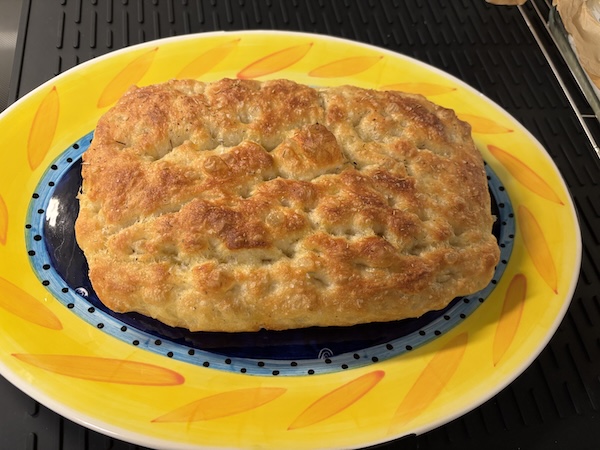
The author made RecipeTin’s Quick and Dirty Focaccia using her hands, giving her new best friend, Red, the night off. (photo by Shelley Civkin)
News flash: diamonds are not a girl’s best friend. They’re certainly a welcome acquaintance, but are they always there when you need them? No. Sometimes, they’re hiding out in a safety deposit box. I have something better than diamonds – a new BFF. And her name is Red. Full name: KitchenAid Artisan Stand Mixer in Empire Red. She’s the culinary equivalent of an Alfa Romeo convertible. Let me put my gushing admiration of her in context with this bit of background info.
I am on the cusp of turning 70 and my sweet husband thoughtfully and preemptively bought me something I’ve thought about for a long time: a KitchenAid stand mixer. I know, I know, who doesn’t already own a KitchenAid stand mixer? Me, that’s who. And it’s not for lack of encouragement on Harvey’s part. I have, for the better part of the last 50 years, always used an entry-level electric hand mixer. And it’s served me just fine. Mostly. Until the motor blew on my original Sunbeam, circa 2000.
Reluctantly, I transitioned to a KitchenAid electric hand mixer and, while flashy, it was not nearly as powerful as my good old $20 Sunbeam. It wasn’t bad. It was just a bit too delicate for my baking needs. I required something that could take a licking and keep on ticking. Sort of like a Timex, the kind they strapped onto the propeller of an outboard motor and dragged through a lake by a speedboat. And, if you remember that commercial, you are officially ancient. (You’re in good company though.) Realistically, a hand mixer has got to be able to go mano a mano with a good, stiff cookie dough. If it can’t manage that without slowing down and making weird noises, it’s not worth its weight in salt.
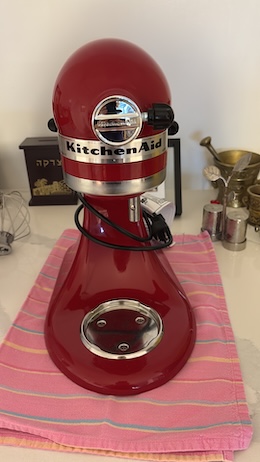
But I no longer have those worries. I have Red. Since receiving this early birthday present, I have made dozens of cookies, countless cakes, muffins and meatballs. I must admit that the wire whisk still scares me a bit, but I’m certain I’ll warm up to it over time.
Like those people whose gardens get overrun by zucchini and end up going around at night dropping off bags of them on people’s doorsteps, I, too, am sharing. My new condo neighbour, Nancy, is the cheerful recipient of my KitchenAid labours of love. Especially the cookie variety. Turns out, it’s a great way to make friends. I mean, who doesn’t love free cookies on the regular?
I recently had a craving for focaccia, but gave my KitchenAid the day off and made Quick and Dirty Focaccia by hand (recipe courtesy of Instagram by RecipeTin). The recipe made a small batch, which saved me from over-indulging. Full disclosure: I have no self-control when it comes to fresh, warm focaccia. This was unlike any other focaccia I’ve ever made, though. Apparently, it’s all the rage on Instagram.
I wasn’t used to working with a wet, jiggly dough, but that’s the ticket to a legit fluffy focaccia. Other recipes I found called for the stretch-and-fold method, but I didn’t employ that here. It does look like a great way to get lots of air bubbles in the final product, but my batch of dough was small and didn’t really require it. I will definitely try that next time I make a bigger batch of dough.
QUICK & DIRTY FOCACCIA
2 cups bread flour
1 1/8 tsp instant yeast
3/4 tsp kosher salt
1 cup plus 2 tbsp very warm water
1 1/2 tbsp olive oil
1/4 tsp (heaping) sea salt flakes or kosher salt
kalamata olives, rosemary or za’atar (optional)
Preheat oven to 425˚F. Mix flour, yeast and salt. Make a well and pour in water and mix. Cover with plastic wrap and rise in a warm place for 2 hours, until doubled in size. The dough will be very wet and jiggly.
Generously grease a 10.5” x 8” x 2” metal or glass pan with oil. Press a scrunched-up piece of parchment paper into the pan and leave an overhang. Drizzle the parchment paper generously with olive oil, too. (Scrunching the parchment ensures that it will lay flat and that the dough will get into every crevice of the pan.)
Scrape the focaccia batter into the pan. Do not punch or deflate the dough beforehand. Coax it into the corners with your oiled fingers as best you can. Cover with something heavy (a cast-iron pan or cutting board) and leave it to rise by 50% (about 45 minutes).
Drizzle olive oil on the surface of the dough and spread it with your oiled fingers. Dimple the dough vigorously with your fingers and sprinkle with the sea salt and any other toppings you like (optional, but think kalamata olives, rosemary, za’atar, etc.).
Bake for 25 to 30 minutes, rotating the pan after 15 minutes. Cool on a rack for about 10 minutes.
It should turn out crunchy on top, but airy and fluffy on the inside, perfect for dipping in a plate of olive oil and balsamic vinegar. It’s a quick and easy way to elevate a meal and makes a nice between-meals snack or sandwich. And, of course, you can’t overlook the therapeutic benefits of getting your fingers all oily and your nails all full of dough. If you’re someone who doesn’t like to get down and dirty when you bake, then this isn’t for you. I, however, am a full-contact baker.
I make a more traditional focaccia where kneading is required, and it’s made in a cast-iron fry pan, but it’s an altogether different process. The end results are different, for sure, so it’s really a matter of taste. Either way you cut it, focaccia is delicious and lends itself to all sorts of varieties and toppings. Believe it or not, I’ve seen a recipe for chocolate focaccia, but that’s a bit too out there even for me. Enjoy your bread and be sure to share.
Shelley Civkin, aka the Accidental Balabusta, is a happily retired librarian and communications officer. For 17 years, she wrote a weekly book review column for the Richmond Review. She’s currently a freelance writer and volunteer.