Shul heritage sign replaced

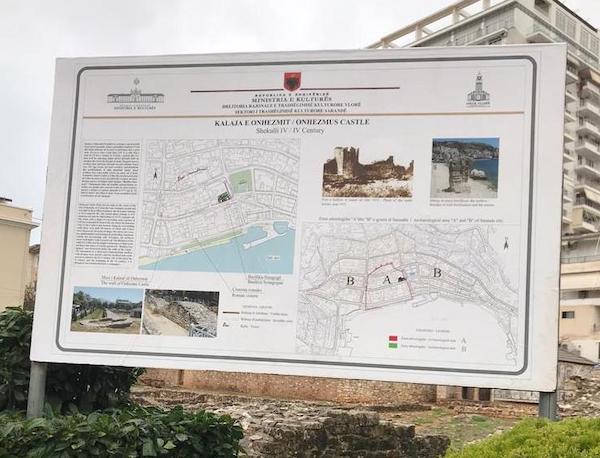
The signage at the site of 1,700-year-old synagogue ruins in Albania was recently replace after a Canadian tourist informed the municipal government of the old signs’ illegibility. (photo from Dave Gordon)

During a trip to Albania in September 2022, Toronto-based Jewish journalist Dave Gordon visited the city of Saranda with a couple of friends. They especially wanted to see the 1,700-year-old synagogue ruins.

As Gordon describes it, the site is roughly the size of two side-by-side tennis courts. What remains are myriad roofless stone walls of just a couple feet tall, which once separated various rooms, including a study and two mikvaot (Jewish ritual baths). A representative of Albania’s culture ministry happened to be at the site when Gordon was there, handing him a leaflet with information about the site’s history and background. It said Israeli archeologists unearthed floor mosaics – now buried with a foot of sand, to protect them from the elements – that displayed a menorah and a deer, regarded in Judaism as a symbol of beauty, majesty and God’s mercy.

Additionally, the literature said the synagogue likely crumbled after either an earthquake or a Slavic invasion, and was abandoned in the last quarter of the sixth century. In the 21st century, there was more deterioration – this time, with the printed panels describing what is on the site.

Gordon was “shocked and disappointed” to see that the signage was in disrepair, faded by neglect. Two panels, each measuring some four feet wide by two feet deep, were blanched by the sun, so white that the lettering and imagery were illegible.

“My face turned the same colour as these signs,” Gordon told the Jewish Independent, for which he has written many articles. “This is part of my heritage, my history and people, and it was like it was another Jewish landmark sadly disappearing from memory.”
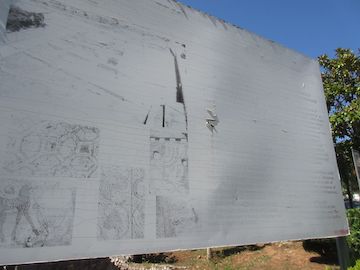
photo - The signage at the site of the synagogue ruins in Albania when Dave Gordon visited
The signage at the site of the synagogue ruins in Albania when Dave Gordon visited. (photo from Dave Gordon)

On Dec. 12, 2022, Gordon took action. He Googled the Saranda municipality offices’ emails.

“This is shameful for two reasons: your tourists will not be able to obtain much knowledge about the important landmark, and it shows little care from your city’s cultural department to maintain the signage,” he wrote.

“This is highly disrespectful, and I cannot understand why the two signs were permitted to deteriorate,” he continued, adding that he hoped to bring others to Saranda and “would love for them to take photographs of the new signage and publicize this wonderful jewel of archeology.”

A representative from the municipal offices wrote back, two days later: “For the problem in question, we have reported the need for scientific reconceptualization, the preparation and installation of information panels, and we have contacted the Directorate of Cultural Heritage … a copy of your complaint will be sent to the responsible institution and we hope that very soon we will have a better presentation of this monument.”

In the beginning of January, Gordon followed up with an email, asking if the inquiry had landed in the right hands. To his great surprise, on Jan. 20, the Ministry of Culture of Albania sent him this reply: “In response to your email, we inform you that the new information boards have been installed to the Synagogue of Saranada…. Please find attached the photos of the new signage.”

Esmeralda Kodheli, the ministry’s representative, added, “Thank you, too, for promoting our cultural and historical heritage.”

“Quite amazing!” Gordon told the JI. “To print detailed signs and place them, inside of 30 working days – and during the Christmas season, no less. And who was I? Just some guy from Canada writing some emails.”
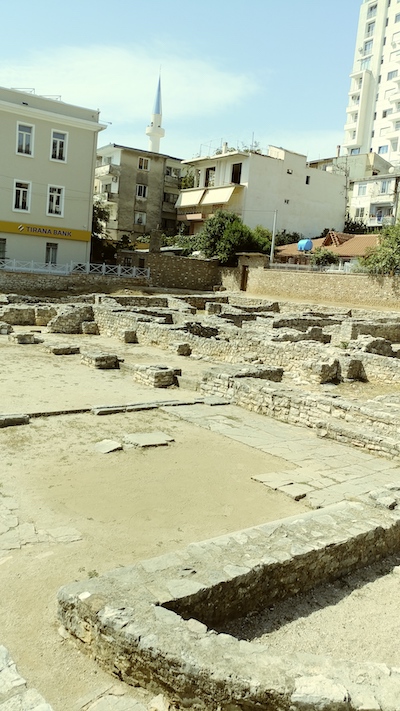
photo - The site of the synagogue ruins in the city of Saranda
The site of the synagogue ruins in the city of Saranda. (photo from Dave Gordon)

Gordon said he felt “disbelief, delight and honoured, all at the same time,” and felt like his “little bit of activism” made a tangible difference, reminding him that anyone can enact change.

“I am pleased as anything that this amazing site of Jewish history now has dignity restored,” he said.

Dr. Ruki Kondaj, one of the friends who accompanied Gordon on his trip, is an Albanian-Canadian. He said about Gordon: “He’s done great work through his lobbying to restore the signage, and I’m so happy with his passion and determination. Together we discovered traces of Jewish history that tourists will know more about.”

Albania has various sites of Jewish interest, including the Solomon Museum in Berat, as well as an upcoming Holocaust museum in Tirana and a future Jewish history museum in Vlora, which also is home to “Jewish Street,” marked by a plaque on a home in the city centre, marking the one-time bustling Jewish area. Albania refused to cooperate with the Nazis, deciding as a nation to save its Jews, and even welcoming Jewish refugees from neighbouring countries. For more on Albania’s Jewish history, visit jewishindependent.ca/albanias-many-legends.

Jonathan Wasserlauf is a freelance writer, and a political science major and law student based in Montreal.
Diaspora voices its concerns

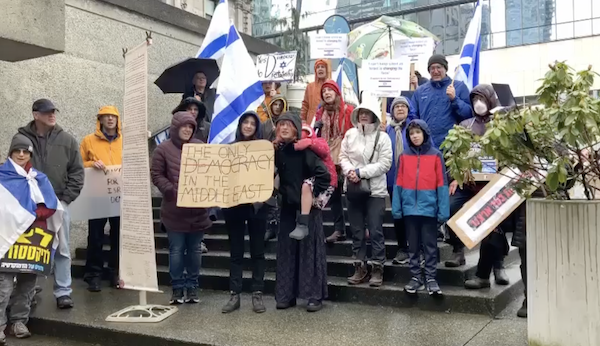
The message on the Facebook post of this video from UnXeptable, who have been gathering weekly at Robson Square to protest the Israeli government’s proposed judicial reforms, reads: “Rain never stops Vancouver 🇨🇦 from supporting you in your struggle ❤️🇮🇱” (screenshot from Facebook.com/DefendIsraeliDemocracy)

Reverberations from the political tumult in Israel continue to rumble across the Diaspora, including here in British Columbia.

For 10 weekends in a row now, a few dozen Vancouver-area residents, many of them Israeli expats or Israeli-Canadians, have gathered in downtown Vancouver. On March 30, an “emergency meeting” took place at Or Shalom synagogue, titled Saving Israeli Democracy.

Daphna Kedem, one of the organizers of unXeptable, which is behind the rallies, told the group at Or Shalom that similar events are now taking place in more than 50 Diaspora communities.

“There is a point to going out in the street and saying we are here and we care and we want a lot of others to share what we feel,” she said, noting that between 20 and 50 people tend to show up at the weekly gathering at Robson Square.

“It would be great to be 200,” she said, adding that the masses of Israelis taking to the streets have forced a delay in the government’s proposals, but the fight is far from over.

The protests in Vancouver, in Israel and around the world centre on so-called “judicial reforms,” which would remove an existing multifaceted process of appointing Supreme Court justices and centralize it in the hands of the government executive, the cabinet. Among the reams of related proposals is a bill that would allow the Knesset to overturn Supreme Court decisions by majority vote.

Dr. Erez Aloni, an associate professor at the Allard School of Law at the University of British Columbia, said the proposals are “not a legal reform” and that it is “not a joke” to call what the government of Binyamin Netanyahu is attempting to do “a revolution.” Aloni is one of some 200 signees to the “Statement by Canadian jurists on proposed transformation of Israel’s legal system,” which was issued Feb. 9.

“A democracy needs checks and balances and these checks and balances include checks and restrictions on the government so we can enforce laws against the government, so we make sure that the government doesn’t abuse its right, in particular against minorities,” he said. “In Israel, the only checks, the only restrictions on the government, on the executive, is the Supreme Court.”

The power of the cabinet, the lack of a second chamber of parliament, the strictness of party discipline, the absence of a presidential veto, and the lack of a written constitution all combine to put extraordinary reliance on the Supreme Court to rein in any potential overreach by elected officials, said Aloni.

The proposals, which would give the government effective veto power over Supreme Court appointments, is a dramatic step, he said.

“The coalition, the executive, is going to be almost solely responsible for selecting judges by themselves,” Aloni explained.

Not only would this impact the Supreme Court, he argued, but any lower court judge with aspirations of appointment to the highest judicial body would presumably consider political repercussions when handing down decisions.

In addition to the proposals to alter the judiciary, Aloni told the audience that the government is also threatening “independent public broadcasting, control of academia, immunity for IDF soldiers and police actions, increasing jurisdiction of the rabbinical courts and so forth.”

Video-recorded remarks from Achinoam Nini, the well-known Israeli singer commonly known as Noa, were aired at the meeting, with portentous background music.

“The situation is not good,” said Nini. “In fact, Israel is on the verge of the worst tragedy in her short history, worse than any war so far: the death of her democracy and a total system breakdown. The so-called judicial reform … is no such thing. It is rather an antidemocratic coup, a grab for limitless power by a democratically elected government composed of convicted criminals, messianic zealots, corrupt opportunists and ultranationalists, turning democracy against itself and against the citizens of Israel.”

Dr. Lisa Richlen of the David Abraham Centre for International and Regional Studies at Tel Aviv University spoke of the impacts the proposals would have on nongovernmental organizations, especially those she works with that serve non-Jews, non-citizens and asylum-seekers. She addressed the apparent absence of Arab citizens of Israel in the demonstrations.

“I want to make the point that, for them, they haven’t felt that it’s a democracy since even before this,” she said, adding that the apparent attack on minorities has struck a chord with mainstream Israelis.

“When you start with weaker social groups,” said Richlen, “what you have is what you see today, where the mainstream of Israeli society is starting to feel increasingly threatened.”

Dr. Itai Bavli of UBC’s School of Population and Public Health echoed Richlen’s concerns for the rights of those outside the Green Line. He also disputed the idea that opponents of the government’s proposals are overstating the threat to democracy.

“Democracy is disagreeing and I get it that you have political differences, that’s the idea of democracy,” he said. “But these people, they don’t want democracy.… We have to oppose, we have to fight against these forces and support democracy in Israel.”

Rabbi Hannah Dresner, spiritual leader of Or Shalom, spoke and David Berson emceed.

The gathering was only one of many discussions in Jewish communities worldwide, some more public than others, around events in Israel and their impacts inside and outside that country. A February poll commissioned by JSpaceCanada and the New Israel Fund of Canada showed that, while three-quarters of Canadian Jews are emotionally attached to Israel, 73% oppose the judicial reforms (jewishindependent.ca/opposition-to-policies).

“Tensions that had been brewing for months in Israel came to head earlier this week, with the prime minister ultimately postponing the judicial reforms until the next legislative session,” wrote Jewish Federation of Greater Vancouver chief executive officer Ezra Shanken in his March 31 community email. “It is a very welcome decision, and, if our calculations are correct, it gives all parties until sometime in the summer to work out a compromise. A pause is not a halt and we implore the parties to come to the table with President [Isaac] Herzog, which is what we have advocated for since the start.”

The Jewish Federations of North America, the umbrella of 146 Jewish federations and more than 300 communities, released a brief open letter to Israel’s prime minister and opposition leader in February, stating, in part: “[W]e urge you to make clear that a majority of just 61 votes of the Knesset is not sufficient to override a decision of the Supreme Court. The essence of democracy is both majority rule and protection of minority rights. We recognize that any system of checks and balances will be different than those in our own countries, but such a dramatic change to the Israeli system of governance will have far-reaching consequences in North America, both within the Jewish community and in the broader society.”

On March 27, the Centre for Israel and Jewish Affairs, the advocacy voice of Jewish federations in Canada, lauded the Israeli government’s decision to delay the judicial reform legislation and urged more consensus on any changes.

Shimon Koffler Fogel, president and chief executive officer of CIJA, issued a statement, which noted, “The government’s decision must be met with a good faith effort on the part of the opposition parties, engaging in a constructive dialogue and ensuring people feel part of the policy process. Israel was founded on the principle of inclusion and must reaffirm those values at every opportunity. While there may not be uniformity around every decision, Canadian Jews must express unity around the existence of Israel and her contributions to the world, and acknowledge healthy debate is part of a continually evolving and growing democracy.”

Creating opportunities

The Jerusalem Business Development Centre (MATI) helps people create or expand businesses in Jerusalem. Two leaders of the Israeli organization visit Vancouver on May 11 as part of a Canadian tour. (photo from CFHU Vancouver)

Every year, the Jerusalem Business Development Centre, known in Hebrew by the acronym MATI, helps thousands of people create or expand businesses in Jerusalem. It does this through a range of services – from personal mentoring to training in various fields to the granting of loans – focusing its efforts on new immigrants, the ultra-Orthodox and residents of East Jerusalem.

On May 11, as part of a Canadian tour, Michal Shaul Vulej, deputy chief executive officer of MATI, and Reham Abu Snineh, MATI’s East Jerusalem manager, will be in Vancouver for “a conversation about shared living in Jerusalem, about mentoring and creating entrepreneurial opportunities for women and promoting diversity as strength.”

Abu Snineh joined MATI in 2011, as a project coordinator for a program to promote women’s entrepreneurship in East Jerusalem. Today, she heads the East Jerusalem branch, leading a team of seven employees.

“The beginning was challenging,” she told the Independent. “The decision to join an Israeli organization was inconceivable. I was afraid of the reactions and criticism of those around me. It also took me awhile to get comfortable with the staff. In addition, I did not speak Hebrew. I grew up in East Jerusalem and studied for my law degree and, later, further degrees in Jordan. All of my studies were in Arabic and I had never considered working with an Israeli organization. I realized that, if I ever wanted to really be able to help my community, I had to find a way to move forward and, over time, things settled down and today I feel completely part of the team.”

For Abu Snineh, it’s the social impact of MATI that most excites her – “The feeling that I am helping people in a difficult socioeconomic situation; helping individuals, families and women to improve their economic situation in general.”

For Shaul Vulej, it’s the “combination of social welfare and the entrepreneurship and business development – the stories of the women who manage to start a business, make a living and be financially independent, and even employ other women.”

MATI measures success by the number of participants, the number of businesses that develop, the number of businesses that expand and the number of new jobs that are created in Jerusalem because of its activities. All MATI’s programs include participant feedback, an annual review and an evaluation process.

Abu Snineh and Shaul Vulej shared one of MATI’s success stories with the Independent, that of Hiba, a fashion design instructor. They said Hiba, 36, grew up in East Jerusalem in a traditional Muslim family and was married at age 16. Despite various factors hindering her progress, she studied fashion design and proceeded to hold several jobs. She wanted to establish a sewing and fashion design school, so she joined some of MATI’s programs: the business establishment and management course, a digital marketing workshop and, recently, a program for import/export from Turkey, which will allow her to import fabrics herself. Together with her artisan husband, she rented an apartment and currently trains several groups, as part of a professional training project for teenagers, and promotes her business.

About 60% of MATI’s clientele are women, who have a range of educational backgrounds. The organization focuses on residents of East Jerusalem who are looking for employment, people who want to start a business, and existing business owners who need assistance to take the next step.

Abu Snineh described some of the challenges people living in East Jerusalem face. Difficulty communicating in Hebrew contributes to a “difficulty in being able to develop entrepreneurship and businesses that can be relevant also in Western Jerusalem, a barrier in the ability to market and sell goods and services to the Hebrew-speaking public, a barrier in dialogue with institutions and authorities in the business framework.”

A lack of trust in the Israeli government system, which does not recognize many of the East Jerusalem businesses as legal entities, has “created a situation where legal business owners in the country received grants, [while] many of the businesses in East Jerusalem (mainly small and medium-sized ones) were left without the financial security granted to others,” said Abu Snineh.

Other factors include the political and security situation, digital barriers that make it difficult to market outside of East Jerusalem or online, insufficient knowledge about business laws, “which blocks the ability to make the business legal and granting rights alongside obligations,” and “a lack of domestic and foreign tourism.”

When asked how Vancouverites could help or participate in MATI, Abu Snineh and Shaul Vulej said, “To help us establish the first hub in East Jerusalem…. A hub would provide the appropriate and technology atmosphere similar to other areas in the world.”

Also needed, they said, is support for “all the ongoing programs that provide for the progress of Arab society in East Jerusalem” and for “a program for the advancement of women in East Jerusalem.”

The May 11 event is presented by the Jerusalem Foundation in partnership with Canadian Friends of Hebrew University, and it is sponsored by the Asper Foundation, as well as the Canadian Memorial United Church. It takes place at the Canadian Memorial Centre for Peace, 1825 West 16th Ave., starting at 7 p.m. To reserve a spot, visit cfhu.org/upcoming-events or call 604-257-5133.

Measuring happiness

Amid the miasma of glum news from Israel is a light to be celebrated.

A scan of the headlines reveals existential worries. Proposals from the governing coalition of Israel are derided as threatening the democratic foundation of the country, an overthrow of the rule of law and a move that gestures to a dictatorship. The strife, which includes hundreds of thousands of Israelis protesting in the streets for more than 14 weeks, now is piled upon by more conflict – a resurgence of the intermittent terrorism that plagues the country and its peoples. Individual acts of terror against civilians, as well as cross-border violence in the form of rocket fire from Syria, Lebanon and the Gaza Strip, have unsettled Israelis already distressed by domestic affairs. Conflict in Jerusalem between the Israel Defence Forces and Muslims who barricaded themselves inside the Al-Aqsa Mosque disrupted Passover, Ramadan and Easter commemorations over the weekend.

And yet, when an annual report on the happiness measurements of citizens around the world was released last month, Israelis had spiked to become the fourth happiest people in the world, up from ninth last year. Admittedly, the data were from 2020-2022, and so were not collected during the current upheavals, but they do cover the worst years of the pandemic and implicitly take into account other periods of terror, political turmoil and challenging times.

“The happiness movement shows that well-being is not a ‘soft’ and ‘vague’ idea but rather focuses on areas of life of critical importance: material conditions, mental and physical wealth, personal virtues and good citizenship,” according to Prof. Jeffrey D. Sachs, who is director of the Centre for Sustainable Development at Columbia University and is involved with the study. (Simon Fraser University’s Dr. Lara Aknin is also part of the World Happiness Report team.)

For the sixth year in a row, Finland topped the list as happiest in the survey, which measures life expectancy, GDP per capita, social support, corruption levels, generosity, people looking after each other, and freedom to make key life decisions. Canada came 13th.

One of the world’s foremost academic experts in the science of happiness is the Hebrew University’s Prof. Yoram Yovell, who is a well-known figure on Israeli TV and who visited Vancouver in 2019. Canada ranks high (though not as high as Israel), along with the Nordic countries, Switzerland, the Netherlands, Canada, New Zealand and Australia, he explained during his visit here, in part because they share a developed world economy with social stability, fundamental freedoms, basic infrastructure like clean water, and supportive social welfare and healthcare systems.

Happy people, Yovall has noted, also tend to experience a sense of social cohesion and purpose. In Israel, some of that cohesion comes from the shared experience of military and national service and, for many, the decision to live in the Jewish state, which reinforces membership in a collective identity.

There may be something reassuring to Diaspora Jews about the happiness of our Israeli cousins. Many of us read the news and fret over the well-being of our family and friends overseas. It is a curious comparison to see Jewish Canadians wringing our hands while the objects of our concern are leaving us in the dust when it comes to the annual happiness rankings. Of course, it is not quite so clear-cut. A sense of well-being, happiness and overall contentment are slightly varying concepts and are not the same as carefree bliss. The meaning of life is a life of meaning, it has been said, literally or in effect.

As we celebrate the 75th anniversary of renewed Jewish self-determination in the state of Israel, despite all the concerning news, we can be happy that Israelis – and Canadians – consider themselves, overall, to be happy. And we can contemplate the conditions that contribute to happiness – and what changes are needed to improve those measures in other countries. Everyone has a right to well-being.

Multiple membership models

Years ago, I briefly served on a synagogue board and did some research into membership dues. Some congregations had flat rates. Others had scales according to income or age. Others had no set dues, members gave according to what they felt they could give, with the congregation merely offering suggested amounts. There are plenty of articles on this topic, and even a book by rabbis Kerry Olitzky and Ari Olitzky. Synagogues cost money to run: salaries, buildings and activities are expensive. If we want Jewish life to continue, we need to consider this because synagogues offer us education, community, lifecycle events and more. However, there is no one size fits all when it comes to membership models.

Just as there are many models for dues, there are different ideas about new members. Some congregations post their membership application forms online and indicate where to submit the finished paperwork. Others offer membership information via email or post when it’s requested. Still others insist that the potential congregant meet with the executive director to gain access to the paperwork or the requirements for membership.

My husband and I have moved a lot in nearly 25 years of marriage. That has included “shul hopping” within communities sometimes. We’ve formally belonged to seven congregations, and attended services at many other places. Our experience hasn’t been limited to one North American movement. Due to our families’ diverse affiliations, geographic limitations and shifting needs, we’ve been members at Reform, Conservative, Modern Orthodox and unaffiliated congregations. We joke, when asked, that “we get around.”

All this resurfaced while I read about Toronto Congregation Beth Tzedec’s recent experiment with membership. This congregation saw that members under age 40 paid only 5% of their total operating income. By waiving dues for members under 40, Beth Tzedec gained 900 members in eight months, according to a recent JTA article. This remarkable leap in membership shows just how much of an obstacle membership dues are for many younger Jewish people in Canada.

For years, when I joined a congregation in a new place, I was asked to join committees, lead services, teach, volunteer or provide other services. Only very rarely did any of these congregations ask first, “What can we do to meet your needs?” or “What are you hoping to gain from this experience?” While it sounds crass to see this as a solely “transactional” experience, it can be painful to spend a lot of money to support a place that sees no obligation to create a relationship or a meaningful experience with its new and/or younger members.

Few congregations have new members start by meeting with a rabbi or cantor or other engagement professional. The first interaction is almost always with an executive director who is essentially asking, “How much can you pay us?” While congregations almost always state that they don’t turn down anyone due to lack of funds for membership, in practice, many people are turned away. They’re turned away or turned off because they don’t even make the embarrassing first appointment where they must admit they cannot afford the full costs of membership.

We just signed on the dotted line at a big, established congregation because our twins are nearing b’nai mitzvah age. We’ve been regular synagogue attendees for years. We had asked about membership when I was pregnant and, at the meeting with the executive director, we felt as though we were being interviewed to join a country club. As older first-time parents, we saw the membership cost was delineated by age and we fell into a more expensive category. Our roof was leaking, we were expecting twins. Our decision was easy – we fixed the roof. Synagogue membership could wait.

Over the years, we briefly joined two other congregations to access their educational opportunities or community events. In the end, though, we faced the same process over a decade later, with a different executive director. He told us that no one was turned away. However, the paperwork indicated that, unless we paid the building fee plus membership dues plus b’nai mitzvah charge, we couldn’t have a lifecycle event at the congregation. That upfront cost was about 4% of our gross annual income, which is a large chunk of change. That’s before paying for a Kiddush luncheon or family celebration.

There’s no one answer to this challenge. Here are some ideas based on our anecdotal experience.

Make synagogue membership paperwork and financial information easily available on a website or via email. It shouldn’t be a secret, offered only in a face-to-face meeting with the executive director. This isn’t a good first impression. Potential members might also want to meet with a rabbi, cantor or other professional rather than the executive director.

Second, consider a membership model that provides multiple options based on income rather than age or a flat fee. There will always be older members who earn less income and younger people who can afford more.

Third, create an environment where members will not begrudge further donations. If the membership fee is a suggestion, and is affordable enough so that people can manage it, then a happy member may want to donate more money in the future. A supportive congregation and positive community experience is worth a lot!  Members who sense that level of support are willing to pay for it.

Finally, recognize that many “middle-class” incomes don’t cover the cost of living the way they used to. Due to inflation, a professional who, for instance, works as a teacher or at a nonprofit may not have much expendable income. Find ways in which professionals might volunteer hours in lieu of part of their membership fees. Despite education and experience, these professionals have often been asked to volunteer for work in a Jewish context that one would have paid for elsewhere. They pay for membership that they perhaps couldn’t afford – for the privilege of also volunteering expertise.

We need each other for many reasons. Membership dues are not just for a minyan but also for the building where the minyan meets. Our tradition teaches us that every person is valuable, that embarrassment should be avoided at all cost, and that Jewish communities are essential. Synagogue membership models should reflect those teachings, too.

Joanne Seiff has written regularly for CBC Manitoba and various Jewish publications. She is the author of three books, including From the Outside In: Jewish Post Columns 2015-2016, a collection of essays available for digital download or as a paperback from Amazon. Check her out on Instagram @yrnspinner or at joanneseiff.blogspot.com.

JNF welcomes Noa Tishby

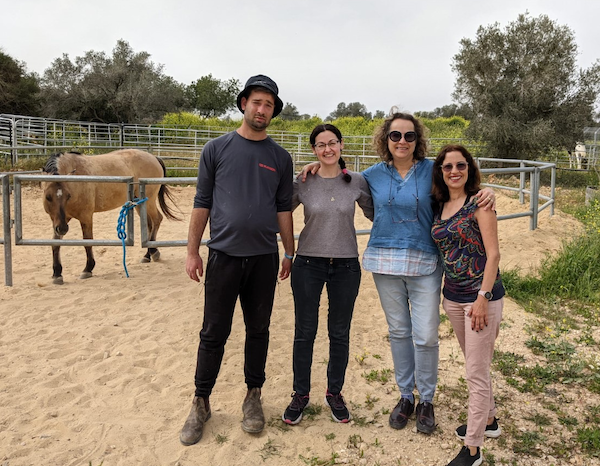
At the therapeutic horse farm in Meir Shfeya Youth Village are, left to right, Yuval Perry, Moran Nir, Rachel David and Orly Sivan. Perry is a horse groomer at the farm, and David and Sivan are two of its four founders. Nir is manager of campaign and operations for JNF Pacific. (photo from JNF Pacific)

Noa Tishby, the Hollywood-transplanted Israeli actor and activist who was just stripped of her special envoy position for weighing in on the political crisis there, is headed to Vancouver.

Tishby, author of the 2021 book Israel: A Simple Guide to the Most Misunderstood Country on Earth, had been Israel’s special envoy for combating antisemitism and the delegitimization of Israel. Appointed a year ago by then-prime minister Yair Lapid, Tishby was summarily ejected from the role this month after she criticized the proposed judicial reforms of Binyamin Netanyahu’s government. She will be the keynote speaker at the 2023 Negev event of the Jewish National Fund, Pacific Region, June 29.

“We are sad to hear the news that Noa is now the former special envoy against antisemitism and the delegitimization [of Israel] as she has been an important voice for Israel and Jewish communities around the world in the face of antisemitism/anti-Israel sentiment,” Michael Sachs, executive director of JNF Pacific, told the Independent. “Her years of service, both officially and non-officially, have only benefited world Jewry and we are ecstatic to welcome her with open arms on June 29th.”

Sachs explained that this year’s Negev event is a break with decades of tradition, following the pandemic shutdown of community gatherings. The annual tradition had generally featured a gala dinner with an honouree.

The centrepoint of this year’s event, which will take place at Beth Israel, is a theatre-format presentation with no meal, and tickets at an accessible price, which, Sachs said, is intended to allow the largest number of community members to hear Tishby’s message. A reception for larger donors will generate the revenue to realize the project that this year’s Negev is sponsoring.

That initiative is a therapeutic horse farm in Meir Shfeya Youth Village, located south of Haifa near Zikhron Ya’akov. Moran Nir, manager of campaign and operations for JNF Pacific, was at the facility several weeks ago.

“It’s a beautiful farm,” she said. “I met with two of the [four] founding mothers and it’s just incredible to see how they dedicate their lives and they give their heart and soul to this farm.”

The horse farm has two riding areas, one uncovered and the other only partly covered. Completing the facility to protect riders from sometimes intense Israeli weather is part of the JNF initiative.

“We want projects that are going to be impactful to the people in Israel but that are also taking a grassroots project and helping get it to the next level,” said Sachs. There is also a crucial local connection to this project, he added.

“There is no shortage of people in our community that understand the importance of equestrian therapy for kids with special needs, but also adults with stress and anxiety and PTSD,” he said. In a relatively new twist on the organization’s commitment to Israel, 10% of this year’s Negev revenues will be held back for a local partnership with STaRS, Southlands Therapeutic Riding Society. Leaders from the Southlands group will mentor those at the Israeli facility, “creating a lifelong connection between these like-minded organizations,” said Sachs.

The Meir Shfeya farm currently has six horses and six horse groomers. Groomers are hired from among youth and young adults who benefited from the equestrian therapy as kids, said Sachs. Therapeutic riding has been demonstrated effective for a range of cognitive conditions, including autism, attention-deficit / hyperactivity disorder, and post-traumatic stress disorder.

About 90 kids per week come to the farm from all over the area and demand is growing. Allowing them to meet the demand is the reason for the support from JNF Pacific.

The fundraising goal for the June 29 event – which is co-chaired by Michael and Lisa Averbach – is $350,000, Sachs said, emphasizing the dual objective of generating funds to support the equestrian programs and of drawing the largest number of people possible to hear Tishby’s message.

“If you want to buy a ticket, buy four,” he said. “Buy four tickets, find three friends and bring them. We want more people hearing her. And, if you buy four tickets and can’t find three friends, let us know because we want to bring students. We want kids from the community to be able to hear her.”

Tishby will be in conversation with Danielle Ames Spivak, executive director of the American Friends of the Israel Philharmonic Orchestra, a born-and-raised Vancouverite who is a friend of Tishby’s.

The event will also feature the bestowing of the Bernard M. Bloomfield Medal for Meritorious Service on Harvey Dales.

“Harvey’s been a member of our board, he’s on the national board, he is the past president,” said Sachs. “For us, the opportunity to honour Harvey for his dedication and everything he’s given to JNF and Israel, we are really excited about that.”

The JNF Educator Award will also be presented. It will be given to teachers from the four Vancouver-area Jewish day schools.

“We’re coming out of the worst pandemic in 100 years,” said Sachs. “Teachers were frontline … so each school is going to be choosing a teacher-representative to accept an award on behalf of the teaching body in their school.”

Reflecting on her visit to the Israeli horse farm and meeting some of the mothers who launched it, Nir is inspired to share what she witnessed.

“It’s always nice to see the impact of JNF in Israel,” she said, “to actually be there and see the impact. Every parent wants their kids to be healthy and happy. We will keep doing this job and build Israel together for the people of Israel.”

Creating a life of inspiration

Near-fatal war injuries led Anat Yahalom to decades of mutual support for injured soldiers and others. (photo from Jewish Federation)

In 1973, when the Yom Kippur War broke out, Anat Yahalom was a young Israel Defence Forces recruit in the Battle of the Sinai.

“I was 18-and-a-half years old and the state of Israel was 25,” she said. “We were both young and at the beginning of our lives.”

A sudden Egyptian air attack changed her life forever.

“When they rushed me to the rescue helicopter, badly injured and bleeding, hovering between life and death and begging for my life, I used my last remaining strength to mumble, ‘Don’t let me die,’” Yahalom recounted in an email interview with the Independent. “That desire to remain alive and to live has always been with me. Over the years, every time that I’ve faced a crisis, I am reminded of that moment, and again I have that incredible desire to live – to never give up.”

Yahalom is to share her story of near-death, recovery and a life of dedication to others as part of the Israel@75 celebration in Vancouver. She will speak at Congregation Beth Tikvah, in Richmond, on Friday, April 28, 6 p.m., with an Israeli-style Shabbat dinner.

“Being wounded in battle is very different to being injured in an accident,” said Yahalom. “Many of the shrapnel pieces and explosives that caused my injuries have remained inside my body and will accompany me for the rest of my life. Being wounded in battle causes injuries that are external and internal, resulting in a complete breakdown of the body’s system, and to extensive scar tissue that needs a long, slow and complex rehabilitation.”

Shrapnel that remains in her body can cause recurring infections that require regular treatments to allow her to function.

In the decades since her injuries, Yahalom has founded Etgarim, an association supporting the integration of disabled children through sports, and the IDF women with disabilities forum. She is an athlete, hand-bike marathon rider for people with disabilities, wife and mother of three sons.

“Israel has a large proportion of people who have been wounded in battle and disabled,” she said. “Because of this, Israel’s healthcare system has developed the most innovative and effective medical treatments that have allowed many of the injured to return to society, to their families, to work. This is the essence of rehabilitation. Rehabilitation is not only physical, but also emotional. While these are very different, they are equally important. Most of the time, society doesn’t differentiate between the two. Emotional injuries are often initially expressed in the form of depression, anger, impatience. Later on, they are also expressed by smaller things such as slamming doors, raised voices, threatening language, or senses that recall the battlefield. For me, the height of this was when my sons joined the IDF. I began experiencing an endless and overwhelming anxiety. Every small thing could trigger a huge reaction in me – from deep anger, to complete withdrawal.”

Yahalom said that those, like her, who were injured in battle found that the best way to deal with challenges and thrive was through social rehabilitation.

“We came to support and rely on one another like family,” she said. “We involved each other in all the small details, offered and received help of any and every kind. But, mostly, we made sure to meet regularly, to talk, to listen, to offer and seek advice. It was this process and this starting point that the idea of establishing centres for wounded IDF veterans was born, recognizing that social rehabilitation was the very essence of our strength.”

The messages of her life and of the organizations she has founded, she said, are unequivocal: “We can recover from any crisis if we stand together.”

“War is a terrible crisis, being injured is an endless struggle, and being disabled is with you forever,” she said. “Sometimes it is extremely difficult, and sometimes a little easier. But it is always there, a companion for life. A reminder for me that life and the desire to live is more important and can conquer anything.

“My family, the one that I created following my injury, my friends that are my chosen family, and the family of Eretz Israel, all accompany me throughout my life,” said Yahalom. “They allowed me to return to the world of the living, they help with the rehabilitation of my friends, and it is them that makes me continue to want to help in every way possible, to embrace, to encourage and to fill my heart and theirs with hope and faith that every crisis will pass.… This is the message that I bring to your community. In these stormy days of upheaval and crisis at home in Israel, I know that even this storm will pass and we will still be there. We will remember that life is more important, more precious and stronger than anything else. I’ve known this since that fateful day, Oct. 6, 1973, when I was given my life back – and I received it as a gift.”

Yahalom’s visit is one of many events taking place through May marking Israel’s 75th anniversary. The celebrations culminate in the Yom Ha’atzmaut, Israel Independence Day, concert May 14 at Queen Elizabeth Theatre, featuring the band Teapacks. Full details of all events are at jewishvancouver.com.

Designing the 12 tribes

Artist Anna Marszalkowska stands in front of “Levi,” which is part of her Tribes series, which is on exhibit at the Zack Gallery until May 4. (photo from Anna Marszalkowska)

The challenge of visually depicting the tribes of Israel has attracted many famous artists over the centuries. For example, on the 25th anniversary of the state of Israel, Salvador Dali, inspired by descriptions in the Torah, created a series of watercolours, “The Twelve Tribes of Israel.” Before that, in 1962, Marc Chagall made his famous stained-glass windows, “The Twelve Tribes,” for a synagogue in Jerusalem. Anna Marszalkowska, a local Vancouver artist of Polish origins, fits easily into this august company. Her solo show, The Tribes, opened at the Zack Gallery on March 29.

Marszalkowska grew up in Poland, but studied graphic design and worked as a graphic designer in London, England. “Diversity is what made my design path exciting,” she said in an interview with the Independent. “I started my career as a freelance web and graphic designer and then moved to video design and editing, as well as motion graphics and animation.”

Five years ago, she and her husband moved to Canada, but they lived and worked in the eastern part of the country. They relocated to Vancouver two years ago.

“We came here during the pandemic,” she said. “We wanted to try something different. For an outdoor person like myself, this is a great place. The nature is beautiful, and everyone is very friendly.”

She also changed the direction of her professional life. “I work with artists in the movie industry, but not as an artist myself,” she said. “I understand artists because of my past as a graphic designer, but I wanted less time at the computer screen. I wanted to free my creativity for more personal projects, which was hard to do while working as a graphic designer. Then, my creativity was fully engaged in my professional activity, but, on the other hand, I was limited by clients’ requirements. After a full day of work … I was often tired, I wanted to relax. Now, my creativity is freed. I have more time for my artistic experiments. I started abstract painting and I love it. Just me and a painting – it calms me.”

But even while working full time as a graphic designer, she still found energy to search for her individual style and themes. One of them was her Tribes series. “In 2010, I completed a print production course, and this series was the result.”

The series consists of 12 large digital prints, each one corresponding to one of the tribes of Israel. Although Marszalkowska’s version is an entirely modern take, it involves ancient symbolism, which originated in the Hebrew Bible. The artist conducted deep research for this project, and the end results are simultaneously stunningly simple and visually compelling.

“I had a blog before and, when I put the images online, many people expressed their interest. They wanted to buy one or several or all of the images.”

For the artist, this body of work has meaning beyond its commercial success. “It was a personal journey. I was searching for my Jewish ancestry. My grandmother grew up in a town in Poland where most citizens were Jewish before the war. She might have been part Jewish herself, but after the Holocaust, I had no one to ask.”

Instead, she studied the Bible and tried to interpret the narratives within a cultural context. “The symbols of the tribes are by no means fixed,” she explained. “Every artist could have their own interpretation, as the biblical texts describe the sons of Jacob allegorically.”

In her interpretation, the traditional symbols are given a contemporary, stylized appearance. “I explored the relationship between geometric shapes and lines,” she said. “I used repetition and symmetry to keep balance in each individual design and all 12 together.”

She also leaned towards a minimalistic approach, where a symbol of the tribe is centred on a one-colour background, with no other embellishments to attract a viewer’s attention. “In the original design, I had an ornamental frame around each image, but I got rid of them. I think less is more,” she said. “COVID made me realize that my focus should be the meaning, not the decorations.”

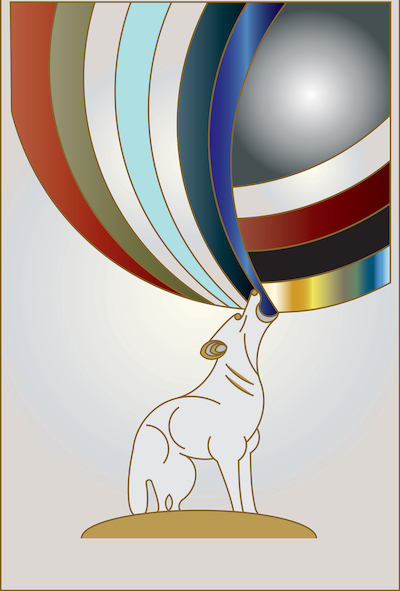
“Benjamin” by Anna Marszalkowska.

In most images, the background colour palette reflects that of the tribe, except for Benjamin, the youngest. “His symbol is a wolf,” Marszalkowska said. “He represents all colours of all tribes. To reflect that, I placed a ‘rainbow’ above the wolf. I think it is his spirit or maybe his song, Or his breath. It would depend on your own interpretation.”

In some of the designs, she incorporated photography for texture. “I used Adobe Illustrator to combine my photographs with my digital illustrations,” she said. For Simeon, her symbol is a tower, and she put her photos of bricks to good use in her pictorial tower construction. For Zebulun, whose symbol is a ship, she employed photos of water. “Issachar’s symbol is a donkey with a burden,” she said. “I used my photos of wood for the donkey’s load.”

When different sources offered different visual symbolisms for a tribe, the artist’s scholarly touch led her towards her own esthetic. For example, in the case of Levi, some documents don’t count him as a tribe and don’t offer any symbols for him. Historically, the Tribe of Levi wasn’t given any land, but its men served as religious leaders and teachers. Maszalkowska decided that Levi’s description as God’s Chosen Tribe warranted its own image: a breastplate of a high priest. The breastplate is embedded with 12 gemstones, each inscribed with the name of one of the tribes in Hebrew.

“Overall, the series is an invitation for everyone to embark on their own journey, to reflect on their own purpose and fulfilment,” said Maszalkowska. “Ultimately, I hope that my art will connect with the viewers and inspire them.”

Tribes runs until May 4.

Olga Livshin is a Vancouver freelance writer. She can be reached at olgagodim@gmail.com.

Part of New Wave’s Season 3

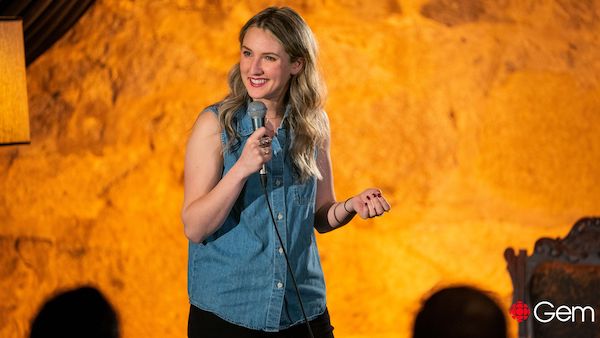
Laura Leibow is one of the 14 comics featured on The New Wave of Standup, now streaming on CBC Gem. (photo by Emily Cooper)

The whole thing was a highlight really! I still kind of had that post-COVID ‘I can’t believe I get to take the stage again’ sense of wonder in me at that time,” comedian Laura Leibow told the Independent. “Combine that with getting to see comics I respect and love do their thing made the whole experience very cool. Plus, I love staying in hotels.”

Leibow was speaking about the taping of the latest season of The New Wave of Standup, a Just For Laughs Vancouver and CBC original series, which is now streaming on CBC Gem. Leibow and fellow Jewish community member Jacob Balshin are two of the 14 comics featured on the show.

“I try really hard to approach taped sets in the same way I’d approach ones that are not being taped because, ultimately, it’s just about that live experience between you and the crowd and, hopefully, the tape will capture that,” said Leibow. “The only major difference is I mind the subject matter I cover a little more when I’m being filmed, so my mommy and daddy don’t get mad at me!”

Balshin went into the New Wave set having worked out more of what he was going to say than he usually does. “I love writing and try and work every day on my comedy. I do not like repeating the same set over and over again though,” he said. “It can make me depressed. Leading into the taping, I only ran the set a few times. I was just getting back into comedy after the last COVID lockdown in Ontario and did not want to take a break from having fun to repeat the same jokes over and over. I try not to overthink things. Comedy is the easy part of my life. The rest is the struggle.

“After I got off stage that night, I went to another show,” he said. “It was next door to where we were shooting and was actually part of a tour I was on…. I was able to make it in time to do my spot. I bombed trying new stuff. No one in the audience knew I had just filmed for TV 20 minutes earlier. Both sets held the same weight to me – I just want to make people laugh, and get better. I do not think any one set matters that much. And, if it does, I will be prepared because I know I have put in the work.”

It took Balshin time to find his comedic voice. “I did not know my own voice when I started comedy, so I would speak like other people who I was a fan of,” he said. “Now, it is not something I think about. Everything I do is naturally me. And that feels like a really good place to be – and something I always wanted. To me, the goal is to be yourself. Anyone can be funny, but only you can be yourself. So, over the years, it has been more about actually living a life and less about what happens on stage.”

While Leibow seems to have experienced a less drastic evolution, she, too, has reached the point where, she said, “I’m far less concerned now with trying to impress certain people than I am with just talking about what I think is funny.”

Leibow said, “My comedic voice is driven largely by my ADHD [attention-deficit / hyperactivity disorder], friendship, laughter, feminism, silliness, clay, and Jews. No, I don’t know if I can really nail down my comedic voice other than saying that it really is largely driven by my scattered brain and throwing spaghetti at the wall. If something really tickles me, and it seems to be making other people laugh, then that’s great!”

Both Leibow and Balshin have topics they won’t cover in their acts.

“I won’t tell a joke that denigrates or harms a marginalized group and I prefer to stay in my lane when it comes to certain issues,” said Leibow. “I’m not going to boldly speak out of turn on a topic about which I’m not well informed. I also try not to violate the privacy of my family members. Unless I think of a good joke that would require me to do so.”

Balshin only writes material that is about him. “I only have my own story to tell,” he said. “I hope my comedy makes you feel good when you watch it. And I always feel bad when someone has a bad night. If any joke I ever tell hurts someone, I am interested to know why and am willing to listen.”

On stage, Balshin interacts with the audience quite a lot.

“It is a part of my comedy that naturally developed from doing comedy in rooms in Toronto, where the audience … [wants] you to feel present and talk to them,” he said. “I struggle with social anxiety off stage and rarely talk to people. It is pretty fun to have a space where that seems to not exist for me at all. And I love when the audience opens up to me. It feels like the reward I get for being so open with them. And to know they trust me sometimes is really special.”

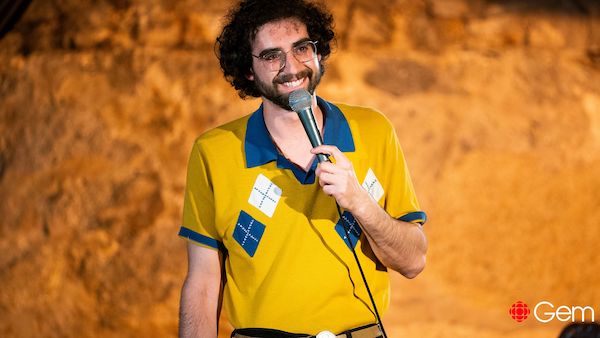
photo - Jacob Balshin
Jacob Balshin (photo by Emily Cooper)

Balshin tours the country regularly. “I’ve performed in places with populations in the hundreds many times in my career. For many, I am the first Jewish person they have ever met,” he said. “From my own experience, I would say there is a big difference between hate and ignorance. I would say the vast majority of what I have encountered firsthand is ignorance. Most people though do not care that I am Jewish. We are all just people.

“I hope to be funny and genuine enough on stage so that anyone who came in with any misconceptions or hate towards Jewish people can recognize someone who has nothing but love to give. Even though we are different, we can all relate to the weird experience that is living.”

In addition to being part of The New Wave of Standup, Balshin’s debut standup comedy special will be airing on his YouTube channel in the next few months. “It’s called 30 and Breathing Funny,” he said. “It was recorded on my 30th birthday and it would mean a lot if you gave it a watch. It better showcases my style of comedy and includes some material about being Jewish that is not in the CBC taping.”

Balshin moved to Vancouver last year, after a breakup. “When I arrived at the airport, friends Bobby Warrener and Malik Ellassal [also on New Wave this season] picked me up and immediately helped the move feel far less lonely. Getting to do my first TV taping with both them a few months later helped relieve me of that same feeling of loneliness,” he said. “And getting to watch them both kill, knowing how hard they both work and how much they deserve it, was definitely a highlight. Go watch their episodes! They are two of the funniest young comics in Canada.”

Rounding out The New Wave of Standup lineup are Brendan D’Souza, Travis Lindsay, Rachel Schaefer, Courtney Gilmour, Charles Haycock, Seán Devlin, Dino Archie, Heidi Brander, Jackie Pirico and Mike Green. To watch, go to gem.cbc.ca/the-new-wave-of-standup.

Uncovering Israel’s wonders

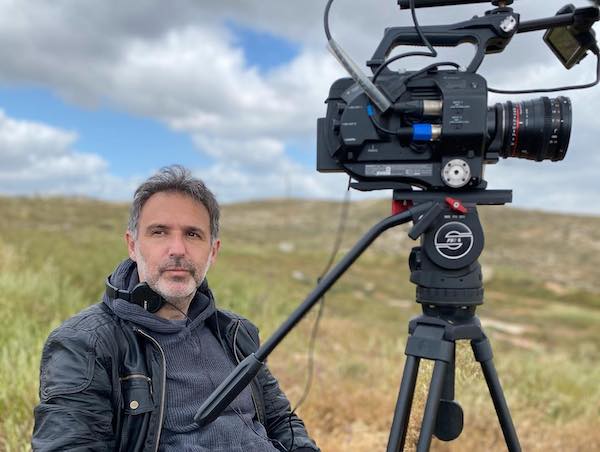
Igal Hecht filming Secrets of the Land. (photo from Chutzpa Productions Inc.)

The Western Wall area, with thousands of metres of subterranean space, contains much that is yet to be discovered. The latest find in this space is a market. While not open to the public, people can get a glimpse of the ancient market on the new Yes TV documentary series Secrets of the Land, directed, produced and written by Israeli-Canadian filmmaker Igal Hecht.

Each episode of Secrets of the Land, which is presented by Chutzpa Productions Inc., takes viewers behind the scenes of substantial excavations in Israel, and features some of the region’s top archeologists and most historically significant sites. The series debuted March 15, and runs each week for 13 episodes.

In addition to on-site discoveries, Hecht visits the labs that explore the meanings of each artifact.

“I realized that the way archaeology is explored today is very CSI,” said Hecht, referring to the popular television series. “The excavations themselves might be low-tech, but everything that comes after, such as carbon dating and things along those lines are very high-tech.”

One of many examples is when archeologists found grape seeds in 2,000-year-old donkey feces and, through that, determined the types of people who lived in the area.

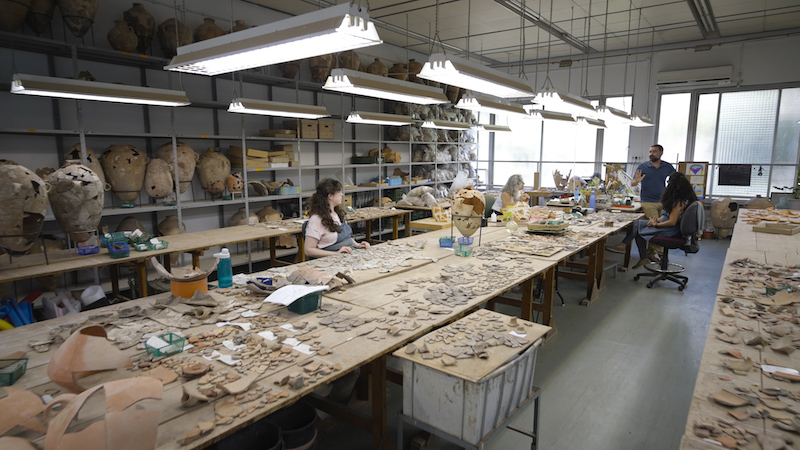
photo - Prof. Erez Ben-Yosef speaking with colleagues in the archeology lab at Tel Aviv University
Prof. Erez Ben-Yosef speaking with colleagues in the archeology lab at Tel Aviv University. (photo from Tel Aviv University / Chutzpa Productions Inc.)

Hecht and his crew – which included Lior Cohen, Gabriel Volcovich, Nikki Greenspan and Julian Hoffman – take viewers on a journey through various parts of the Holy Land. Hecht said he learned something every step of the way.

“I had very little knowledge [of archeology],” Hecht told the Independent. “In fact, in the show, I don’t pretend that I do. That makes the show work. I am there experiencing the discoveries in the same manner that the audience does, as they watch at home.”

Among many sites, the crew visited Timna, the location of Solomon’s Mines, where Hecht was awed by the landscape. “The rock formation is something you’d see in Petra in Jordan or the Grand Canyon,” he said. “There’s so much beauty and history to explore there.”

Other locales included Tower of David, also known as the Citadel, located near the Jaffa Gate entrance to the Old City of Jerusalem. There’s also an episode about Shiloh, in Samaria, or the West Bank, where the Israelites, prior to King David’s time, set up a sanctuary and city, and where the Ark of the Covenant was housed for hundreds of years. Meanwhile, Magdala is home to an ancient city from the first century, where recent excavations revealed the Migdal Synagogue, dating from the Second Temple.

Over the past quarter-century, Hecht has been involved in the production of more than 50 documentary films and more than 20 television series. His projects have appeared on Netflix, BBC, Documentary Channel, CBC, HBO Europe, and others. Secrets of the Land is the latest in a string of Jewish-themed films, such as A Universal Language, which taped six comedians performing in Israel. An upcoming project includes The Jewish Shadow, a documentary that explores the lives of Soviet Jews in 1970s Ukraine.

For Hecht, Secrets of the Land wasn’t merely a project, but very much a passion to do his part to help the Jewish people.

“I think the biggest takeaway for Jewish audiences is the historical and unbreakable connection of the Jewish people to that land,” he said. “That archeology truly proves that the Jews were, in fact, living in Judea and Samaria, Jerusalem and all over the Fertile Crescent thousands of years ago.”

Dave Gordon is a Toronto-based freelance writer whose work has appeared in more than 100 publications around the world. His website is davegordonwrites.com.