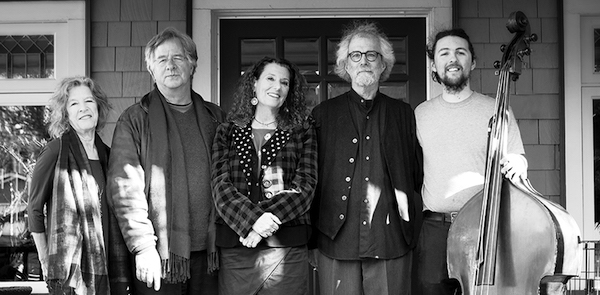
Harriet Frost and the Universal Band (photo from Harriet Frost)
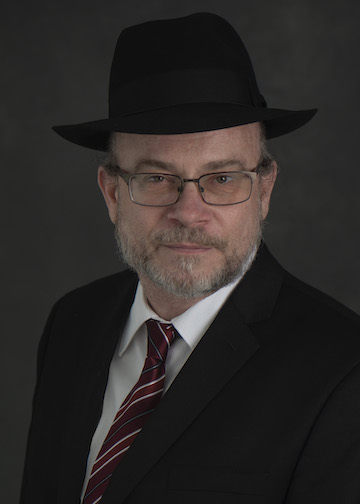
Harriet Frost and the Universal Band are holding an album release party on April 15, 8 p.m., at Or Shalom. The Universal Band is Martin Gotfrit (strings, vocals), Wendy Rubin (keyboard, flute, vocals) Andréas Kahre (percussion, cello) and Noah Gotfrit (basses). Tickets – for the live show and for the stereo livestream on YouTube – are available from eventbrite.ca.
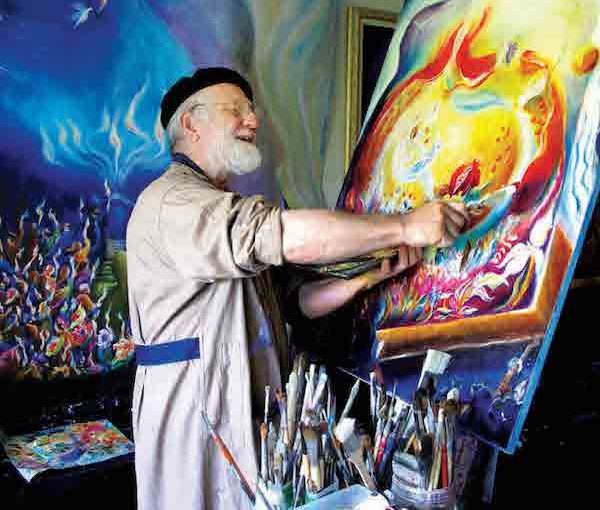
Mordechai Edel is among the artists featured in the latest edition of The Scribe, which will be released April 19 at VanDusen Botanical Garden. (photo from JMABC)
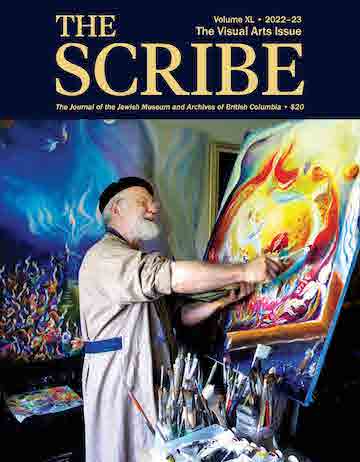
The Jewish Museum and Archives of British Columbia (JMABC) is releasing its 40th issue of The Scribe, which celebrates the lives of B.C. Jewish residents by focusing on one sector each edition. The official release of the Visual Arts Issue will take place on April 19, 7 p.m., at VanDusen Botanical Garden, in the Floral Hall.
The 2022/23 issue features a cross-section of the province’s Jewish visual arts community, including painters, sculptors, mixed media artists, illustrators, textile artists, art educators, art consultants, an art curator and a gallery owner. Features are based on interviews recently documented for the JMABC and interviewees represent several cities and many islands. They include Ron Appleton, Miriam Aroeste, Hinda Avery, Suzy Birstein, Tanya Bub, Olga Campbell, Janis Diner Brinley, Mordechai Edel, Janet Essevia, Jessica Freedman, Linda Frimer, Monica Gewurz, Lori Goldberg, Pnina Granirer, Barbara Heller, Jeannie Kamins, Stacy Lederman, Julia Lucich, Anna Lutsky, Cynthia Minden, Suzy Naylor, Joyce Ozier, Nora Patrich, Marcia Pitch, Jack Rootman, Sidi Schaffer, Phyllis Serota, Elizabeth Shefrin, Carla Stein and Mia Weinberg.
“The Visual Arts Issue of The Scribe is surely one of the most dynamic and visually stunning publications in its 40-issue history,” said Daniella Givon, JMABC president. “Jewish individuals have made significant contributions to our province’s arts and culture sector throughout our history in B.C., and 2023 is a fitting time to take an historical snapshot of artists who are working and thriving here.”
Carol Crenna, managing editor of The Scribe Visual Arts Issue, added, “It’s been an extraordinary experience to meet this group of talented Jewish artists, many internationally known. They are fearlessly innovative, inspiring individuals with the strength and ability to push boundaries and bridge beliefs. They’re also wonderful storytellers with rich life experiences. I found their personal stories fascinating, and often entertaining, but, most important, they made me think differently.”
The publication’s launch will include a silent auction of artworks donated by many of the artists highlighted in the issue. The keynote speaker of the event will be journalist Marsha Lederman, Western arts correspondent for the Globe & Mail. Refreshments will be served. All proceeds are in support of the JMABC.
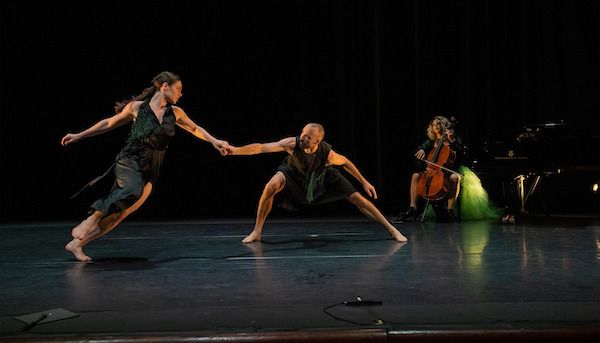
Grass is Green is at the Rothstein Theatre on April 25. (photo from Una Productions)
B.C. Movement Arts and Chutzpah!PLUS present the Canadian première of Grass is Green in Vancouver and several other B.C. locations, starting April 25.
Grass is Green is an evening-length work from San Francisco- and New York City-based UNA Productions. Performed by six dancers and drag queen/cellist/pianist Rose Nylons, Grass is Green considers cycles of destruction and renewal both within humanity and the land of which humanity is a part. The highly physical and exuberant work embodies a cycle of rebirth, representations of queer intimacy, and moments of communal joy, grief and connectivity.
The choreographer of Grass is Green is Chuck Wilt, in collaboration with the performers, who are Wilt, Nylons, Kira Fargas, Dominica Greene, Dasol Kim, Rebecca Margolick and Hadassah Perry. The music is by Nylons, Donna Summer, Sylvester, DJ Koze and Nils Frahm, Julia Wolfe and Matthew Welch, and Michael Nyman.
Grass is Green is the first partnership of B.C. Movement Arts (BCMA) and the Chutzpah! Festival. BCMA was founded by artistic and executive director Mary-Louise Albert, the former director of Chutzpah!, which is now led by artistic managing director Jessica Gutteridge, who has been at the helm since 2020.
Grass is Green takes place at the Rothstein Theatre on April 25, 7:30 p.m. For tickets, go to chutzpahfestival.com or call 604-257-5117.
It moves on to Sointula April 27-28, Alert Bay April 29, Port Hardy April 30 and Campbell River May 2. For more details on and tickets for these shows, visit bcmovementarts.com or call 604-970-3206.
Into the Little Hill is a multi-disciplinary re-telling of the classic Pied Piper tale. Performances take place May 19 and 20 at SFU Goldcorp Centre for the Arts, Fei and Milton Wong Experimental Theatre. (photo by Flick Harrison)
In partnership with Simon Fraser University’s Woodward’s Cultural Programs, Astrolabe Musik Theatre presents the Canadian première of the chamber opera Into the Little Hill, a contemporary re-telling of the Pied Piper tale, with direction and choreography by Idan Cohen of Ne.Sans Opera and Dance, and musical direction by conductor Leslie Dala. Performances take place May 19 and 20, 7:30 p.m., at SFU Goldcorp Centre for the Arts, Fei and Milton Wong Experimental Theatre.
Into the Little Hill – by composer and classical musician George Benjamin with libretto by playwright and theatre translator Martin Crimp – is an unflinching look at our response to the “Other.” A mysterious stranger rids a town of its rats, only to also make its children disappear when his promised payment is withheld. The story evokes many questions. Who do we deem as “rats” in our society? Who gets to decide? What are we willing to do to get rid of them? And what are the consequences when we refuse to “pay the piper,” i.e. refuse to accept responsibility for the outcomes of our actions?
All six characters (the Crowd, the Stranger, the Narrator, the Minister, the Minister’s Wife and the Minister’s Child) are sung by mezzo-soprano Emma Parkinson and soprano Heather Pawsey. The orchestration for this production includes bass flute, basset horns, mandolin and banjo. And, in a multi-disciplinary staging, Astrolabe’s production incorporates dancers Juolin Lee, Daria Mikhalyluk and Hana Rutka.
“It has always been my vision to have dancers as part of this intensely dramatic opera,” said Pawsey, Astrolabe’s artistic director.
Lighting design for the production is by Victoria Bell; the costume design, by Elena Razlog.
Ne.Sans Opera and Dance’s Cohen was born and raised in Israel, on Kibbutz Mizra. After being trained as a classical pianist, he studied theatre and fine arts at the Art Colony, in Israel. At the age of 20, he participated in a video-dance project by Batsheva dance company dancer Lara Bersak before joining, in 1998, the Kibbutz Contemporary Dance Company, where he danced for seven seasons. Since 2005, Cohen has been creating, performing and teaching.
Residents of Prince George might be forgiven for thinking there is more than one person named Eli Klasner in their midst. Among his many concurrent pursuits, the Toronto native is directing the Community Arts Council of Prince George, leading a fundraising initiative for Ukrainian refugees and serving on the board of the Jewish Museum and Archives of British Columbia.
Living in Prince George is the fulfilment of a lifelong dream for Klasner. Since childhood, he had entertained the notion of living on the Canadian frontier or the Far North. When he was younger, he also made a commitment to himself that, by the time he celebrated his 40th birthday, he would do whatever it was that excited him.
For philanthropist Eli Klasner, living in Prince George is a dream come true. (photo from Eli Klasner)
As events unfolded, he was able to do just that after running businesses in Toronto and Vancouver. In 2017, while Klasner was working for a nonprofit, the possibility of moving to Prince George presented itself.
“I was just charmed by the roughness and climate adversity and, significantly, by the opportunities I saw both as a participant in arts and culture but also to identify that there are Jewish people here and in this area,” Klasner told the Independent.
The friendliness and accessibility of locals reaffirmed his desire to stay. “Soon after I was here, I visited City Hall and asked who is the mayor? ‘Well, that’s his office there. If you want to say hello, just go on in and introduce yourself.’ I like that. Coming from Toronto, you don’t just walk in and put your feet up on the mayor’s table. I thought that was very appealing,” Klasner recalled.
His executive director position with the arts council quickly transformed into a full-time schedule as he came to realize that the city could use support with its arts facilities. Klasner’s role in Prince George’s artistic rejuvenation includes working on a new creative hub, a new performing arts centre and, in March, the gala opening of a retired heritage church that was turned into a concert hall.
“Taking the executive director job here helped solidify that I need to settle down and find a place to live permanently. At that point in my life, I thought a lovely arts council with a lovely little gallery and gift shop would be a lot of fun,” said Klasner, who during his youth studied music in various European capitals.
For two years of his stay in Prince George, Klasner lived in a cabin in the woods, along with two hound dogs and two cats. “I moved a little off the grid,” he said. “That, for me, was the boyhood dream of living in the woods, chopping wood, growing a garden in the summer and being close to wildlife and nature. It was an amazing experience.”
Then came 2020. Klasner contracted the coronavirus at the outset of the pandemic. “COVID is an interesting part of the journey of being up here in this odd, unusual place,” he said. “It was certainly a challenge, but, also, when you live through something like that, you really come to appreciate life when you have good health, and the bounty that comes with good health.”
From a Jewish cultural perspective, one of Klasner’s recent projects has been the performance of Different Trains, a piece written for string quartet, with pre-recorded tape, by American Jewish composer Steve Reich that revolves around the Second World War and the Shoah. After being approached last year by the Prince George Symphony Orchestra, Klasner was able to arrange to have the work performed to mark Holocaust Remembrance Day this past January.
“I found it to be a remarkable process of respect and inclusion and terrifically ambitious for a small-town symphony to want to take on such a challenging and groundbreaking piece of music,” Klasner said.
Afterwards, several members of the local Jewish community were invited on stage to say a few words. The crowd, according to Klasner, was very moved by the event. “People got to sit, ask questions and talk about Holocaust and persecution. I found it a unique thing to happen in a place like Prince George. Where else is something like this done in Canada that does not have a significant Jewish population?”
Prince George, like other parts of northern British Columbia, Klasner noted, used to have a thriving Jewish community, starting with the immigrants who arrived in the 1880s. Many of the first local businesses were started by Jews, and the first Jewish female elected to public office in Canada was in Prince George, when Hanna Director became chair of the city’s school district.
From the Second World War to the 1970s, the community dwindled. The Sefer Torah that was in Prince George was sent down to Vancouver and is in storage.
However, there has been a resurgence in Jewish life, Klasner said. “What we started to do is hold community events around holidays and festivals, wanting to expose the young generation to the culture and history of Jewish celebrations and milestones, holidays and festivals. We are quite open to people who might want to come but who are not Jewish to see a Hannukah celebration and what kind of foods we eat around Rosh Hashanah, etc. There has been a lot interest in the community.”
The Jewish Museum and Archives, Klasner said, helped him understand some of the history and heritage of the Jewish community in the area. This, in turn, helped Klasner get other members of the community involved to share stories about what life in Prince George was like at one time or another. For example, there were photos of a seder in Prince George just after the war, when so many Jews wanted to be involved that a community hall had to be used.
“When there was an opening on the board of the Jewish Museum and Archives, I thought it was an opportunity to help them have province-wide representation, rather than just the Lower Mainland, the Island and the Okanagan,” he said.
Jewish values were integral in Klasner’s recent efforts to assist Ukrainian refugees in his community. When a new endowment fund was created to help the newcomers, he reached out to the organizers to help propel their fundraising.
“I was overwhelmed at the possibilities of life when people open up their hearts to strangers in their land and by the idea of opening up one’s heart and mind and wallet to people in the community – and what a Jewish attribute as well. Our families were once accepted here as refugees,” he said. “Our life on earth depends on the fact that Canada accepted refugees.”
From June 9 to 11, Prince George will host another of Klasner’s ventures, the B.C. Gourmet Arts Festival. Now in its second year, the event features scores of local artisans and presents culinary delights of the region and country.
“I love life and the opportunity to be busy and creative and help people and get involved,” Klasner said. “Life is awesome.”
Sam Margolishas written for the Globe and Mail, the National Post, UPI and MSNBC.
Khalid Aziz got out of Afghanistan about six weeks before the government fell. Eighteen months later, he has a job here at a local café/bakery and works part-time with a local advisory group on refugees called Diverse City. In his spare time, he volunteers with Jewish Family Services, who he considers family, and attends JFS events.
“Khalid is amazing. He just lights up the room when he walks in,” said Emi Do, former supervisor of the Community Kitchen.
Recently, Aziz planned and led a JFS Community Kitchen event, where he taught participants to cook Afghan dumplings.
“It’s all about community building, celebrating and sharing skills and knowledge about food,” said Stacy Friedman, director of food security at JFS, about Community Kitchen events, where people meet and cook together. She hopes the program will pick up again later this spring.
“Khalid has a very warm presence and is a good communicator,” she said.
But how did Aziz connect with JFS in the first place?
When he was still new to Vancouver, Aziz found the JFS and Jewish Federation of Greater Vancouver websites. He also heard on the news that Israel was taking in 150 to 200 Afghan refugees. That caught his attention and he wanted to find out more about the local Jewish community, so he contacted JFS and spoke to case manager Corrina Frederick. He was going through a rough time and Frederick was happy to listen to him.
“She showed so much empathy towards me … it was unbelievable,” Aziz said.
Soon after, Aziz was invited to a JFS Community Kitchen event, where he chatted with one of the other volunteers.
“While having our coffee, my friend asked me whether I was a Jew. I replied with Muslim. She was surprised and happy that I was among them, sitting next to each other in a beautiful atmosphere, with no hesitation, which was quite amazing to me,” he said.
Since then, Aziz has learned a lot about the Jewish people.
“Obviously, Judaism believes in one God. And its history is phenomenal. And what I learned and liked about the Jewish people is that they practise fasting, almsgiving and follow the dietary laws.” He also learned that Judaism uses the word kosher in the same way that Muslims use the word halal.
Aziz’s gratitude to JFS knows no bounds.
“The JFS assisted me with employment sources and invited me to their educational programs, as well as different events, to have the utmost experience in B.C. It really gives me pleasure to be a part of the Jewish Family Services, which helps others to achieve their goals and live peacefully.”
This is in stark contrast to his life in Kabul, where he received letters containing death threats from the Taliban for his work at the National Bank of Afghanistan, on U.S. embassy projects and at the United Nations, where he supervised and led 16 staff members involved in agriculture projects.
“Definitely, like many others, my life was in danger, without a doubt,” he said. And so were the lives of most of his family members, who were working with other organizations.
While most of his family are now living safely in different countries around the world, Aziz, 30, is still reeling from his experience getting here, and finding food and shelter.
To escape from Kabul, in July 2021, Aziz traveled to Pakistan to apply for a student visa in the United States. He successfully passed his interview at the U.S. embassy and was granted a visa one week before the Afghan government fell. With the help of family and friends, he traveled to the United States to live with his sister.
Due to the financial crisis in Afghanistan, his bank account was frozen. He waited five months for support from the American government. When that fell through, he decided to come to claim asylum in Canada.
It was nightfall and Aziz was able to avoid the U.S. border guards.
“Luckily, I made it to the border and entered Canada with happiness and hope for a better life and leaving all my stress and anxiety behind the crossing line,” he said.
The Canada Border Services Agency stopped him and cuffed him, but told him not to be afraid. They also told him that there was homelessness in Canada and he had better be prepared for that.
Aziz has no ill feelings towards the CBSA, saying they were kind in changing his handcuffs around so that he could have a drink of water.
Even though he had $1,000 when he reached Vancouver, all the hotels he found would only accept debit or credit cards. “After one hour of roaming and looking around for hotels, I ended up spending my night on a footpath downtown in the cold weather of February,” he said.
It was a tough month for Aziz, staying at shelters. “I wasn’t able to sleep well in my first month due to the inappropriate place, with no privacy and I was emotionally and mentally disturbed and stressed about what was going to happen next,” he said.
Aziz finally was able to rent a room and he bought job interview clothing while managing at the same time to volunteer for the Muslim Food Bank as a case worker and translator for refugees – he speaks several languages, including Pashto, Farsi, Urdu, Hindi and basic Arabic.
After about four months, Aziz found a job and, today, lives in a two-bedroom apartment with a roommate in Burnaby.
Aziz hopes to engage in more refugee-related work locally, as well as with the United Nations High Commissioner for Refugees.
Cassandra Freemanis an improv teacher and performer living in Vancouver.
With the help of a $10 million donation from the Al Roadburg Foundation, a four-storey apartment building has been purchased that will allow Tikva Housing Society to offer more affordable housing in Vancouver’s Jewish community.
Situated on West 41st Avenue in the Kerrisdale neighbourhood, the 20-unit building will be home to nearly 30 individuals. Tikva currently provides housing solutions to more than 300 people, in 128 rental units in Vancouver and Richmond. With this recent addition and 20 new units in Burnaby to be completed by summer 2023, Tikva will expand its portfolio to 168 units in seven housing developments. However, the need for affordable housing is enormous – there are 302 applicants on the Jewish Housing Registry waiting for affordable homes, including 65 people with disabilities.
“This addition will be a huge step forward to providing more people with safe, secure and affordable homes,” said Anat Gogo, executive director at Tikva Housing Society. “The building was acquired through an extraordinary and unparalleled donation of $10 million by the Al Roadburg Foundation. It is the single largest donation received by Tikva and is critical to address housing insecurity.”
In gratitude for the donation, Tikva has named the building the Al and Lola Roadburg Residences.
“Secure housing is essential for individuals and families to thrive,” said Robert Matas, chair of the Al Roadburg Foundation. “We’re deeply honoured to be part of a broad network of Tikva Housing Society supporters who contribute to making housing within the Jewish community more accessible for individuals and families throughout Greater Vancouver.”
“By acquiring an existing apartment building, we are preserving a property that still has many years of life, rather than demolishing and building new,” added Alice Sundberg, director of housing development at Tikva. “Also, we are protecting rental affordability for the future. Al and Lola Roadburg Residences will be a long-term community asset protected from the pressures of our escalating real estate market.”
Al Roadburg (1913-2002) and Lola Roadburg (1922-2011) had a lifelong commitment to Israel and to Jewish organizations in Vancouver. The Al Roadburg Foundation aims to ensure their estates are used to create a legacy that benefits the community where they lived and raised their family.
The harrowing history of Ukraine’s past was recounted recently in the annual lecture honouring Rudolf Vrba, the late Vancouver scientist whose 1944 escape from Auschwitz brought the most concrete proof of the Nazi “Final Solution” to the world.
Dr. Nataliia Ivchyk delivered the 2023 Rudolf Vrba Memorial Lecture, titled The Holocaust in Ukraine: Violence, Gender and Memory. Ivchyk is at the University of British Columbia on a visiting fellowship that was created by Dr. Richard Menkis and Dr. Heidi Tworek to bring to Vancouver a Ukrainian scholar at risk. Ivchyk is associate professor in the department of political sciences at Rivne State University for the Humanities in her hometown of Rivne, Ukraine, and her work is focused on public history and memory politics.
Ivchyk’s presentation was based on survivor testimonies held at the USC Shoah Foundation, and narrowed in on the experiences of Jews in the western Ukrainian region of Volhynia and Podilia. Of the approximately 27,000 Jews who lived in Rivne (then known as Rovno) in 1937, it is estimated that just around 1,200 survived to the 1944 liberation by the Red Army. In a single day, on Nov. 6, 1941, about 21,000 Jews were murdered by Einsatzgruppe C and Ukrainian collaborators. The surviving Jews were imprisoned in the Rovno Ghetto, which was created the following month. In July 1942, remaining Jews, about 5,000, were transported to a stone quarry and murdered.
About 1.5 million Jews died in Ukrainian territory during the war years, most of them shot in what has been called the “Holocaust by bullets.”
“The Holocaust has long remained on the margins of collective memory in Ukraine,” said Ivchyk. Babyn Yar, a ravine outside Kyiv where more than 33,000 Jews were murdered over two days in 1941, has become a national symbol of Holocaust remembrance, she said. “However, the local level of remembrance remained low.”
There are many other sites of atrocities that were committed in Ukraine. “Some are marked by monuments, others are still forgotten and lost,” she said.
Of the several thousand Jews who survived the initial mass executions, anyone over the age of 13 was forced into slave labour.
“Nobody wanted to work for the Germans,” Ivchyk quoted one survivor, “but we had to. We hoped it would somehow balance our relationship with the Germans and would help us survive.”
Violence against women was mainly carried out by Ukrainian collaborators, she said, though Nazis also took part.
“I remember many times Germans came at night, knocked on the windows, took away beautiful girls,” Ivchyk quoted a survivor. “Sometimes, they raped and killed them right away. Sometimes, they said we will come again.”
Rabbis became a particular target of violence against men, given their social and symbolic status, and their role as spiritual leaders.
In the Soviet era, historical memorialization was subordinated to the priorities of the regime.
“The Holodomor [the deliberate Soviet famine that killed millions of Ukrainians], the deportation of Crimean Tatars, the Holocaust and the genocide of the Roma – all of these events were suppressed in collective memory by the Soviet regime,” she said.
Today, support in Ukraine for Holocaust memorialization is ambivalent.
“The activities of the state today do not prohibit academic, educational or public activities in the field of Holocaust remembrance, but neither does it act as a financial or ideological initiator,” she said.
The Vrba event was funded by the Holocaust education committee of UBC’s department of history, which is responsible for the annual lecture, as well as a number of other organizations, including the Vancouver Holocaust Education Centre and the Diamond Chair in Jewish Law and Ethics.
Menkis, associate professor of modern Jewish history at UBC and chair of the Holocaust education committee, noted that the event recognizes Vrba’s contributions to two primary areas to which Vrba’s life was devoted: Holocaust education and science, particularly pharmacology. The annual lectures alternate between these topics.
Menkis told the audience how Vrba and his friend Alfréd Wetzler made the momentous decision to escape from Auschwitz after overhearing conversations around the planned deportation of Hungarian Jewry. After a difficult and dangerous trek, the pair reached northern Slovakia, where they compiled a report documenting the layout of Auschwitz and the extermination process there.
“Although the report is credited with saving many lives,” said Menkis, “Vrba and Wetzler were keenly aware that more decisive action could have saved more. After the war, Dr. Vrba continued to speak about Auschwitz and his experiences. His book, I Cannot Forgive, written with Alan Bestic, was first published in 1963 and has been issued in a number of translations and re-editions since. He is also well known for his unforgettable testimony in Claude Lanzmann’s [documentary film] Shoah and perhaps less well-known but also important was his effective testimony in the Canadian trials against Holocaust denier Ernst Zundel.”
Vrba’s widow, Robin, attended the event virtually. Vrba died in 2006.
According to one tour guide, an hour spent walking around the Aida Refugee Camp in Bethlehem and talking to the residents there is the best way to gain an understanding of the complex conflict that has caused so much suffering. (photo from Gil Zohar)
The throngs of foreign journalists parachuted into Israel to cover the judicial reform debacle – and the many more correspondents based here on a semi-permanent basis – do a poor job explaining basic facts of life in the Jewish state. A case in point is the West Bank.
Most English-speaking tourists I encounter as a licensed tour guide/journalist are woefully ignorant about the legal status and history of the territory Israel captured from the Hashemite Kingdom of Jordan in the June 1967 Six Day War. The term West Bank is a neologism King Abdullah invented in 1948, when his Arab Legion crossed the Jordan River from the east bank to occupy the area known in Mandatory Palestine as Judea and Samaria.
Apart from those traveling with companies like Abraham Tours, which offers a dual narrative tour of Hebron, or Green Olive Tours, which also promotes travel to the Palestinian Authority provisional capital Ramallah and other key Palestinian cities, most tourists avoid the Area A cities of Bethlehem, Ramallah, Nablus, Jenin, Tulkarm, Qalqilya and Hebron. The latter city, divided into PA-ruled H1 and IDF-controlled H2, is the only city in the West Bank with both Jewish and Palestinian residents.
Car rental companies like Hertz or Shlomo Sixt don’t offer insurance to visit Area A. The exception is Middle East Car Rental, located in East Jerusalem’s Wadi Joz neighbourhood, which provides twin insurance policies for those PA-controlled Area A cities, Israel-ruled areas B and C, and the pre-1967 remainder of the country.
What, then, are areas A, B and C? And what should a tourist know about visiting them?
First, the West Bank is safe for tourists – mostly. On March 18, two German nationals were surrounded by angry youths in Nablus, who slashed the tires of the tourists’ Israeli rental car. Notwithstanding that the two knew their car insurance was void in Area A, the pair – who were mistaken for Jewish settlers – drove to the city to enjoy Turkish coffee and the local goat cheese and rosewater pastry delicacy called knafeh nablusiyya. They were rescued by an Arab-Israeli who himself was shopping in Nablus in violation of the Israeli law barring its citizens from visiting Area A.
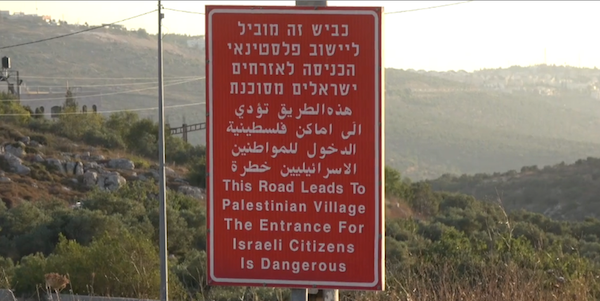
Looming trilingual signs painted red warn Israelis that entering Area A is dangerous. Nonetheless, hundreds of thousands of Israelis from Nazareth and elsewhere in the Galilee routinely shop in Jenin, where prices for food and vegetables are strikingly lower than in Israel, and where the 17% value-added tax is not paid.
Similarly, some Jerusalem Israelis illegally buy granite and marble products and furniture from factories in nearby Bethlehem, thus saving the 17% VAT. Trucks with yellow Israel licence plates, rather than the green and white ones used in the PA, routinely pass through the Israel Defence Forces roadblocks that ring the West Bank. These soldiers are not customs officers, so they don’t inspect waybills from those trucks, whose bilingual drivers have tuned their radio to Hebrew stations to blend in should they be stopped.
Apart from the aforementioned signs, nothing prevents anyone from driving into Area A. Under the bilateral Oslo Accords signed by Israel and the Palestine Liberation Organization in Washington, D.C., in 1993, Israel divided the West Bank into Areas A, B and C, and withdrew from the first. Area A is mostly composed of non-contiguous municipalities and villages, and Israel’s roads and bypass highways gerrymander around Area A cities.
Despite trilingual signs painted red, warning Israeli citizens that entering Palestinian Authority-controlled Area A is dangerous, hundreds of thousands of Israelis routinely travel to Area A cities. (photo from Gil Zohar)
Areas B and C are under the control of the Coordinator of Government Activities in the Territories (COGAT), a unit in Israel’s Ministry of Defence that coordinates civilian issues between the Israeli government, the IDF, international aid and nongovernmental organizations, diplomats, and the PA. Following the Oslo Accords, COGAT replaced the defunct Civil Administration, which had governed the West Bank and the Gaza Strip between 1981 and 1994. (Israel unilaterally quit Gaza in 2005.)
Returning from Area A to Israel can be trickier. The main difficulty is not the 800-kilometre-long incomplete wall and fence that partially encircles the West Bank. For example, while Palestinians with the correct documents and biometric ID card are required to pass through the Qalandiya checkpoint between Ramallah and Jerusalem, five kilometres to the east is the Hizma checkpoint used by Israelis living in the West Bank. Under normal security procedures, cars with yellow licence plates simply drive past the IDF troops. Bored-looking soldiers wave drivers through. Mostly, cars just slow down for perfunctory profiling.
But how does a scofflaw who scarfed hummus at Bandali in Ramallah’s Lower City get back to Jerusalem? Ditto for Rukab’s Ice Cream in the city centre, which has been dishing up its unique, stretchy gelato since 1941? Or the Vanilla café, renowned for its divine cakes? Having had a culinary respite from the Israeli-Palestinian conflict, one hails a cab and asks to be taken to the Rami Levy supermarket in Geva Benyamin, east of Ramallah. The driver – wink, wink – will drop you off on Route 60 at a slight distance from the settlement’s gate, which is guarded by an armed security officer. Should the guard ask you where you are coming from, the response “From Route 60” will be sufficiently vague that he will allow you past the barrier. There, at the bus stop, one waits for the bulletproof bus that drives back to Jerusalem through Hizma. No ID documents are checked.
Similarly, no documents are required for the 25-minute ride on Bus 231 from Jerusalem’s Damascus Gate Bus Station to central Bethlehem via Beit Jala. Like traveling from Ramallah back to Jerusalem, the return from Bethlehem requires some fudging of the truth. Bus passengers disembark at the checkpoint on Route 60 between Beit Jala and Jerusalem. Some Israeli citizens holding a foreign passport pretend to be tourists. When asked for the visa they received at Ben-Gurion Airport (which is issued on a sheet of paper rather than stamped in one’s passport), they play the “stupid card,” claiming they don’t have it. The guards may scowl but routinely let the faux-tourists re-board the bus rather than create ill-will.
Israel’s porous approach to security similarly applies on the West Bank’s highways. Today, all the permanent army roadblocks that once cut up the West Bank have been removed, allowing freedom of movement. “Z,” an intrepid tour guide who routinely takes tourists to all three sectors in the West Bank, points out where the decommissioned IDF posts once stood.
Jeff L., a lawyer from Los Angeles who volunteered with the Israeli army’s Sar-El program, recently went with Z on a day-long tour across the northern West Bank, including Nabi Musa (a shrine Muslims revere as the mausoleum of Moses), the oasis of ‘Ain Mabu’a, the all-Christian village of Taybe (with its renowned brewery), the all-Muslim village of Turmus Ayya, and the model city of Rawabi. Rawabi and Taybe are in Area A.
Stuck outside Ramallah in an L.A.-style traffic jam in the late afternoon, the two abandoned their plan to pose for a selfie outside Yasser Arafat’s tomb in the Muqata government compound.
In an email, Jeff wrote, “It was an awesome day. I will do my best to become an ambassador for peace.
“My day in the West Bank began at Wadi Qelt / Nahal Prat. The beautiful nature reserve was full of blooming wildflowers. Muslim women and their families from Hebron were enjoying the rushing water and lush surroundings. We were greeted warmly by all with big smiles.
“Visiting Taybe, Tarmus Ayya and Rawabi, again, everywhere we went we were warmly greeted. Fortunately, Z speaks Arabic and was able to communicate with everyone we met. My impression of the day in the West Bank was one filled with hope for the future.
“There was a genuine interest in everyone we met to talk and to make us feel welcome.
“All the people we met who live in the West Bank want the same peace and prosperity for their families as we [Jews] do.”
Z – who has a permit from the Israel Ministry of Tourism to enter Bethlehem and Jericho – has never encountered a problem in Area A or elsewhere in the West Bank. During the pandemic, he was stopped by a PA policeman en route to the Mar Saba monastery east of Bethlehem. The officer, who was carrying an AK-47, didn’t have an issue with a car full of tourists in a vehicle with yellow licence plates driving in Area A, but instructed them to return to Jerusalem because of the threat of COVID.
Should tourists to Israel also visit the West Bank and Area A?
Z insists that an hour spent walking around the Aida Refugee Camp in Bethlehem and talking to the residents there is the best way to gain an understanding of the complex conflict that has caused so much suffering. Moreover, tourist sites like Hisham’s Palace in Jericho or Jacob’s Well in Nablus, where Jesus is said to have chatted with a Samaritan woman, are all exceedingly interesting and photogenic. But Z recommends going with a seasoned tour guide, lest you end up like the two German tourists who were attacked going to Nablus’s al-Aqsa pastry shop.
Gil Zohar is a writer and tour guide in Jerusalem.
When we think about Israel’s prominence now, with its population approaching 10 million, and its contributions in so many fields being far out of proportion to its size, it is sobering to recall its early beginnings, and its fragility, when it issued its Declaration of Independence 75 years ago.
On the day that Israel’s independence was declared, May 15,1948, forces from five Arab countries invaded to join internal resistance to Israel’s existence, which had begun in November 1947 with the United Nations declaration of the Partition Plan. The war continued until January 1949, through multiple calls for a ceasefire by the United Nations, as the Arab side saw their hopes for a quick victory reversed.
The government of Israel changed its stance during this time. Initially concerned only with preserving the UN Partition Plan, which involved non-contiguous pieces of territory, as its forces gained the initiative, it sought to establish borders having a greater chance of being more defensible in a hostile neighbourhood.
During the early period, Israel managed to establish the beginnings of a standing army, navy and air force, as well as a commando unit, assembled by bits and pieces from around the world. With unleashed immigration, available soldiery increased every day during the war period. As the war proceeded, every man, and every unmarried woman, in Israel over the age of 25 was eventually subject to mobilization. It has been said that the Jews’ secret weapon in the face of the existential threat they confronted was that there was no other place for them to go.
Many of the indigenous Arabs fled the country during the hostilities, sometimes at the urging of the invading troops, but there were also populations expelled, where Israeli forces faced hostility. Jews in the country had faced increasing violence from their Arab neighbours and, during the war, in areas occupied by Arab forces, particularly in the Old City, but also in the West Bank, there were Jewish residents who were summarily murdered.
Many of the battles were fierce and bloody, with substantial losses of people and material on both sides. Attacks on isolated settlements by Arab units were often aimed at overcoming the resistance of poorly armed residents living in strategic locations. The strength of their commitment to defending their homes often carried the day.
By the end of the struggle, more than 6,000 Israelis had been killed – one-third of the fallen were individuals who were survivors of the Holocaust. Estimates of the number of Arabs/Palestinians killed in the war vary from 5,000 to 10,000.
In the end, Israel retained its allocated portion under the partition and won some of the territory that had been ascribed to the Arab side by the UN plan. Israel withdrew from territories it still occupied in the Egyptian Sinai and in southern Lebanon when hostilities were ended by a ceasefire.
Israel inherited a de-facto Egyptian presence in the Gaza Strip and a Jordanian annexation of the Old City of Jerusalem, and what was ancient Judea and Samaria became the West Bank and under Jordanian control. These were a portion of the areas that had been allocated to the Palestinians by the UN Partition Plan. It was at great cost that control of West Jerusalem was retained.
Israel was attacked again in 1967 and in 1973, successfully defending itself and extending Jewish occupation in further areas that were a part of the country’s historic past, including the Old City and the West Bank. In the 1967 war, Israel seized and, in 1981, annexed Syrian territory, the Golan, high ground from which it was constantly being bombarded.
Under the later Oslo agreements, the Palestinian Authority (PA) was established to allow Palestinian self-government in the heavily populated areas of the West Bank. Israel unilaterally withdrew from the Gaza Strip in 2005. In a 2006 Palestinian election, the Hamas terrorist group became the elected government, but the PA (led by Fatah) refused to relinquish power. Hamas seized control of the Gaza Strip by force, and remains a continuous source of violence. In Lebanon, the terrorist group Hezbollah remains a factor, while Israel has managed to contain Iranian efforts to establish themselves in Syria.
In recent years, there have been alliances made with neighbouring Arab countries. Some of these countries recognize their common cause with Israel to counter efforts by Iran for hegemony. Many of these countries are seeking benefits from the technological advances made in Israel in sectors like agriculture, medicine, cybersecurity and defence. Research and development has been a priority investment by the succession of Israeli governments since its adoption of the private enterprise model for its economy. Foreign investment has poured into Israel, helping fund economic growth, and placing Israel among the world’s highest in GDP per capita.
The standard of living of Israel’s Arab citizens has also risen with increasing integration and exceeds that of citizens in neighbouring Arab countries, or those under PA administration. Perhaps this is another reason for the move to normalize relations with Israel by several Arab countries under the Abraham Accords.
As Israel’s 75th anniversary approaches, several problems remain to be tackled. Concerns over security and increased Jewish settlement in disputed areas are among the factors that led to the election of a government coalition many consider extremist, with some policy proposals, such as the judicial reforms, raising alarm among centrist and left-leaning elements. These have led to mass protest demonstrations in Israel and abroad. Demands from the ultra-religious sector who have gained political power, if realized, could impair the lifestyles of many in the general population. As well, there has been a wave of terrorist attacks recently and there is concern that this may lead to revanchist policies targeting Palestinian citizens.
At 75 years old, the state of Israel continues to be a happening place.
Max Roytenberg is a Vancouver-based poet, writer and blogger. His book Hero in My Own Eyes: Tripping a Life Fantastic is available from Amazon and other online booksellers.

 Harriet Frost and the Universal Band are holding an album release party on April 15, 8 p.m., at Or Shalom. The Universal Band is Martin Gotfrit (strings, vocals), Wendy Rubin (keyboard, flute, vocals) Andréas Kahre (percussion, cello) and Noah Gotfrit (basses). Tickets – for the live show and for the stereo livestream on YouTube – are available from eventbrite.ca.