If we forget, thee, Jerusalem

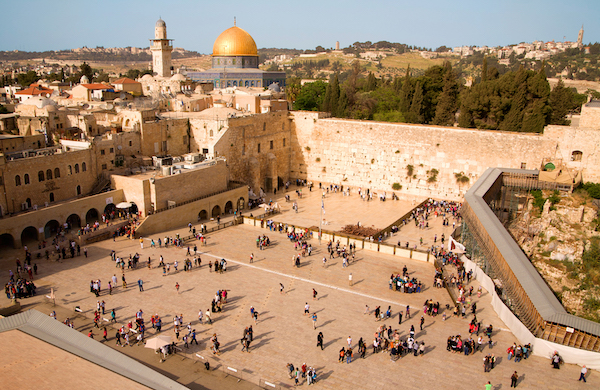
The Western Wall, Jerusalem, Israel. (photo from Wikimedia Commons)

When I was a teenaged member of the Zionist youth group Young Judaea in Saskatchewan, we recited this pledge: “If I forget thee, O Jerusalem, may my right hand lose its cunning; may my tongue cleave to the roof of my mouth.”

Well, I haven’t forgotten, and I’ve learned that, as never before, Jerusalem needs our help. In my Israel today, governmental criminal corruption and disinformation is so bad that citizens can’t have a rational discussion about politics without getting angry. Fear and anger at the government has brought hundreds of thousands of demonstrators into the streets of Israel’s major cities.

The fear and despair has spread to us here in the Diaspora. Our lovely ideals about our lovely, peaceful, democratic Israel are being systematically extinguished by a band of radical religious politicians, some with criminal records. Some of us here are going so far as to wonder that, if Israel is now being led by a covey of self-serving rascals, why should we ever repeat the age-old hope, “Next year in Jerusalem”? Now that I am an older man, I remember my pledge and I issue a warning. We’re in danger of losing our Israeli democracy.

Israel’s government today can be compared to a dog being wagged by its tail. The tail in this case is a small alliance of ultra-Orthodox Jews who hold the balance of power in the Netanyahu government. Two small political parties – Jewish Power and Religious Zionists – call the shots and their chief target is the Supreme Court. They want to gain control over it. And for what reasons would they promote such a radical step in the name of “judicial reform,” and why would they so endanger Israel’s democracy?

There has been a history of battles between the Supreme Court and the ultra-Orthodox community about who has the power to regulate religious law in Israel.

Round One: Supreme Court versus the Government of Israel on the thorny question of which converts are legally Jewish citizens of Israel. For years, the Orthodox rabbinate ruled that you had to be converted in Israel by an Orthodox rabbi.

Bring on the Supreme Court. In 2021, after more than 15 years of debate, the Court ruled that non-Orthodox converts to Judaism in Israel are Jewish and thus entitled to become citizens. The decision includes those who convert to Judaism through the country’s Reform and Conservative movements. “Jews who during their stay in Israel were legally converted in a Reform or Conservative community must be recognized as Jews,” the Court wrote in its majority decision.

Despite that this ruling would only affect some 150 Israelis, Aryeh Deri, leader of the ultra-Orthodox Shas party, who, at that time, was interior minister, condemned the decision. He said it constitutes “a mortal blow to the Jewish character of the state. I promise to fix the law to ensure that only conversions under Orthodox religious law will be recognized in the state of Israel.” Deri was a minister in the current coalition, but was fired earlier this year because the Supreme Court ordered Netanyahu to do so, as Deri has a criminal record.

Round Two: As far back as 2007, women were being beaten on buses for refusing to sit at the back, as the ultra-Orthodox community ruled. In response to a petition submitted against the ultra-Orthodox Mehadrin sect, the Supreme Court ruled that you can’t tell a woman where to sit on a bus.

Round Three: The battle over chametz (foods with leavening, products not kosher for Passover). Recently, the ultra-Orthodox got even with the Supreme Court, which had struck down another religious law. This one forbade hospitals to allow chametz to be brought into hospitals on Pesach. Hospital visitors had to open their bags to be searched by security guards, and there was public outrage at being treated as criminals for concealing food.

The Supreme Court declared the law unnecessary and as offensive to non-Jews as well as Jews. Then, in March this year, the ultra-religious parties snuck in a new chametz law just before Passover. This time, the law allowed hospitals to decide whether or not to search bags or to reprimand people, and the bill passed the Knesset. Score one for the ultra-Orthodox alliance.

Round Four: Military exemption for ultra-Orthodox yeshivah students and the birth of the idea of “judicial reform.” As a condition for joining the Netanyahu government coalition, the ultra-Orthodox wanted to pass a law exempting yeshivah bochers from the military service that all Israelis are obligated to make. And they want to ensure that the Supreme Court can’t strike down the law. The Knesset, they maintained should be able to reverse the Supreme Court’s decisions if they rule against the law. Enter the idea of “judicial reform.”

When they talk about “judicial reform,” what the ultra-religious group really wants strikes at the very heart of Israeli democracy. They want the Knesset to be able to pick and choose which laws the Supreme Court can overturn. They want to give the government the power to make any laws they want without restrictions. They want the Supreme Court to be impotent.

This fearsome, anti-democratic power grab is what sends shivers down the spines of democracy-loving Jews everywhere, and brings thousands into the streets to protest “judicial reform” planned by the Netanyahu government.

In Canada, all the laws passed by Parliament must go through several hoops. First, the law must be approved by the House of Commons. After that, it goes up for debate at the Senate, which can send it back to the House of Commons for revision. Third, the law must be signed by the governor general, who can withhold signature if she feels that the law is repugnant to democracy. Finally, our Supreme Court can either demand that the law be changed or strike it down totally if it finds that it contravenes our Bill of Rights.

Israel has only the Supreme Court to protect its citizens from religious fanatics or rogue governments. Legal scholars are agreed:

allowing any government to reverse judgments of the Supreme Court would not only remove the protections of the Court; it would make Israel a dictatorship.

Rogue government? Look who Netanyahu hired to help him govern.

• The most dangerous and outrageous appointment is a man with a long criminal record, Itamar Ben-Gvir. The army refused to draft him because of his extremist ideas. To secure Ben-Gvir’s support, Netanyahu appointed this ultra-Orthodox Jew with a criminal record to the job of minister of national security and, incredibly, he now oversees police forces in Israel. He also holds the balance of power in the Netanyahu government. Anything that Netanyahu wants to do has to go through Ben-Gvir, who, in the face of widespread demonstrations gave his permission to temporarily halt progress on judicial reform.

• Haim Katz, a former minister of labour who was given a six-month suspended sentence for graft has been given the job of tourism minister.

• As stated above, Aryeh Deri, leader of the ultra-Orthodox Shas party, was appointed minister of health despite going to prison for taking bribes as interior minister and, earlier this year, being given a suspended sentence and a fine for tax offences.

• Netanyahu himself faces charges of corruption.

Is it any wonder that hundreds of thousands of people have taken to the streets to oppose the government’s judicial reform plan? Is it any wonder that the majority of Canadian Jews are also against the reform proposals?

Like them, I know that Israel needs me and that is why I write about it. Neither should you “let your tongue cleave to the roof of your mouth.” Join the Jews around the world who are speaking out for Israel’s democracy. And, while you’re at it, say a prayer for the state of Israel; she needs all the help that she can get.

Stan Goldman is a retired English teacher who lives in Richmond.
Look on bright sides of earth

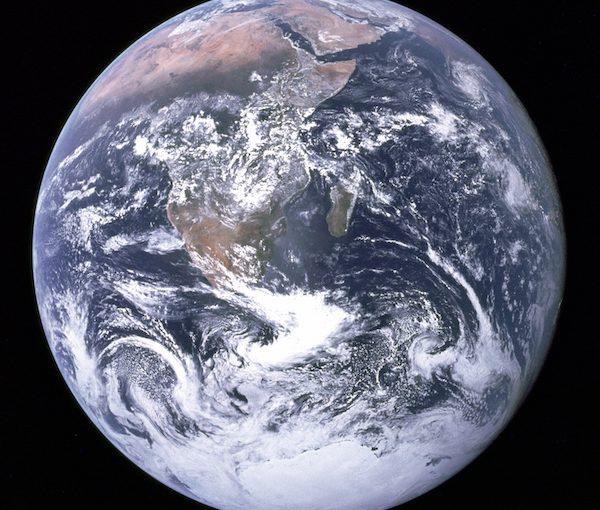
The southern and northern hemispheres look equally bright in this iconic image of earth, titled “The Blue Marble,” which the crew of the Apollo 17 spacecraft took on Dec. 7, 1972. (photo from NASA)

Why do earth’s hemispheres look equally bright when viewed from space? Weizmann Institute scientists offer an answer to this decades-old question.

When looking at the earth from space, its hemispheres – northern and southern – appear equally bright. This is unexpected because the southern hemisphere is mostly covered with dark oceans, whereas the northern hemisphere has a vast land area that is much brighter than these oceans. For years, the brightness symmetry between hemispheres remained a mystery. In a new study, published in the Proceedings of the National Academy of Sciences (PNAS), Weizmann Institute of Science researchers and their collaborators reveal a strong correlation between storm intensity, cloudiness and the solar energy reflection rate in each hemisphere. They offer a solution to the mystery, alongside an assessment of how climate change might alter the reflection rate in the future.

As early as the 1970s, when scientists analyzed data from the first meteorological satellites, they were surprised to find out that the two hemispheres reflect the same amount of solar radiation. Reflectivity of solar radiation is known in scientific lingo as “albedo.” To better comprehend what albedo is, think about driving at night: it is easy to spot the intermittent white lines, which reflect light from the car’s headlights well, but difficult to discern the dark asphalt. The same is true when observing earth from space: the ratio of the solar energy hitting the earth to the energy reflected by each region is determined by various factors. One of them is the ratio of dark oceans to bright land, which differ in reflectivity, just like asphalt and intermittent white lines. The land area of the northern hemisphere is about twice as large as that of the southern and, indeed, when measuring near the surface of the earth, when the skies are clear, there is more than a 10% difference in albedo. Still, both hemispheres appear to be equally bright from space.

In this study, the team of researchers, led by Prof. Yohai Kaspi and Or Hadas of Weizmann’s earth and planetary sciences department, focused on another factor influencing albedo, one located in high altitudes and reflecting solar radiation – clouds. The team analyzed data derived from the world’s most advanced databases, including cloud data collected via NASA satellites (CERES), as well as data from ERA5, which is a global weather database containing information collected using a variety of sources in the air and on the ground, dating back to 1950. ERA5 data was used to complete cloud data and to cross-correlate 50 years of this data with information on the intensity of cyclones and anticyclones.

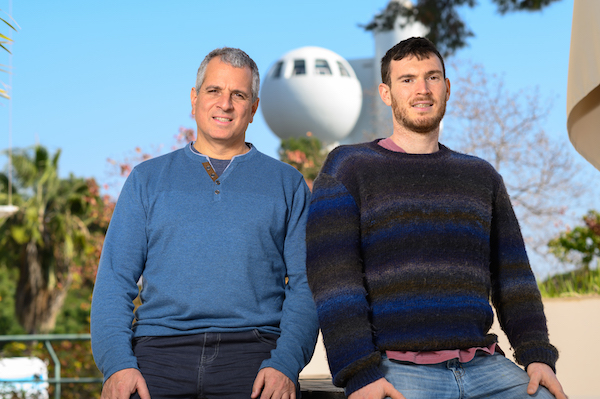
photo - Prof. Yohai Kaspi, left, and Or Hadas of the Weizmann Institute of Science
Prof. Yohai Kaspi, left, and Or Hadas of the Weizmann Institute of Science. (photo from Weizmann Institute)

Next, the scientists classified storms of the last 50 years into three categories, according to intensity. They discovered a direct link between storm intensity and the number of clouds forming around the storm. While northern hemisphere and land areas in general are characterized by weaker storms, above oceans in the southern hemisphere, moderate and strong storms prevail. Data analysis showed that the link between storm intensity and cloudiness accounts for the difference in cloudiness between the hemispheres.

“Cloud albedo arising from strong storms above the southern hemisphere was found to be a high-precision offsetting agent to the large land area in the northern hemisphere, and thus symmetry is preserved,” said Hadas, adding: “This suggests that storms are the linking factor between the brightness of earth’s surface and that of clouds, solving the symmetry mystery.”

Will climate change have an impact?

Earth has been undergoing rapid change in recent years, owing to climate change. To examine whether and how this could affect hemispheric albedo symmetry, the scientists used CMIP6, a set of models run by climate modeling centres around the world to simulate climate change. One of these models’ major shortcomings is their limited ability to predict the degree of cloudiness. Nevertheless, the relation found in this study between storm intensity and cloudiness enables scientists to assess future cloud amounts, based on storm predictions.

Models predict global warming will result in a decreased frequency of all storms above the northern hemisphere and of weak and moderate storms above the southern hemisphere. However, the strongest storms of the southern hemisphere will intensify. The cause of these predicted differences is “Arctic amplification,” a phenomenon in which the North Pole warms twice as fast as earth’s mean warming rate. One might speculate that this difference should break hemispheric albedo symmetry. However, the research shows that a further increase in storm intensity might not change the degree of cloudiness in the southern hemisphere because cloud amounts reach saturation in very strong storms. Thus, symmetry might be preserved.

“It is not yet possible to determine with certainty whether the symmetry will break in the face of global warming,” said Kaspi. “However, the new research solves a basic scientific question and deepens our understanding of earth’s radiation balance and its effectors. As global warming continues, geoengineered solutions will become vital for human life to carry on alongside it. I hope that a better understanding of basic climate phenomena, such as the hemispheric albedo symmetry, will help in developing these solutions.”

Other collaborators in conducting this study include Dr. George Datseris and Prof. Bjorn Stevens of Max Planck Institute for Meteorology, Germany; Dr. Joaquin Blanco and Prof. Rodrigo Caballero of Stockholm University, Sweden; and Dr. Sandrine Bony of Sorbonne University, France. Kaspi is head of the Helen Kimmel Centre for Planetary Science; his research is supported by the Yotam Project and Rene Braginsky.

– Courtesy Weizmann Institute

BGU moving to solar

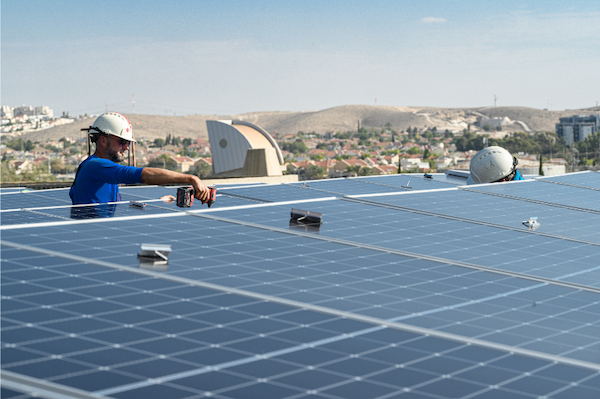
(photo from BGU)

Ben-Gurion University of the Negev will soon produce 20% of its energy needs on the Marcus Family Campus from solar energy. Recently, solar panels were installed on the roofs of three buildings on campus in the first stage of the initiative.

The project is estimated to cost NIS 2 million (approximately $736,000 Cdn). Once completed, it will replace more polluting fuels that are typically used to power buildings. The university is expected to recoup this investment within a few years as it reduces its energy expenses.

Dr. Daniel Farb has donated a small wind turbine called the Tulip, developed by his company, which will charge laptops and phones from wind energy.

In April 2022, BGU announced it would stop investing in companies that produce oil and coal and move those investments and all future investments into alternative energies and investment vehicles governed by ESG (environmental, social and governance) principles.

The university was awarded Green Campus status by the Israeli Ministry of Environmental Protection in 2010 and has been among the top universities worldwide in green rankings. Bike racks, electronic recycling and solar and wind-powered charging stations can be found all over campus.

BGU’s Jacob Blaustein Institutes for Desert Research have been studying environmental issues for 50 years. Leveraging these strengths, the Goldman Sonnenfeldt School of Sustainability and Climate Change was dedicated in May 2022. It brings together more than 150 labs on the university’s three campuses to tackle these issues.

 – Courtesy Ben-Gurion University of the Negev, BC & Alberta Region