
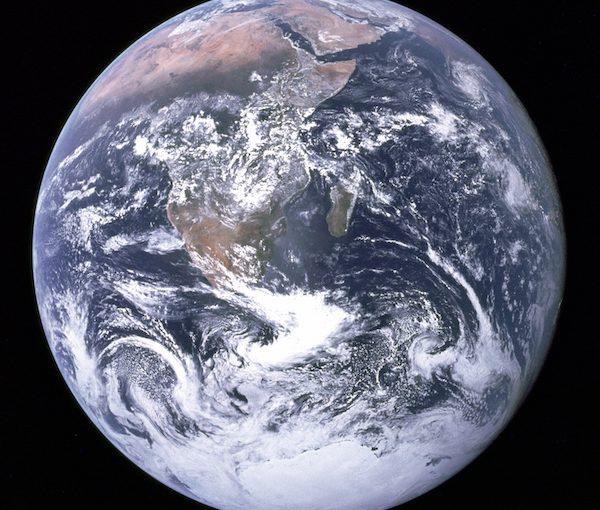
The southern and northern hemispheres look equally bright in this iconic image of earth, titled “The Blue Marble,” which the crew of the Apollo 17 spacecraft took on Dec. 7, 1972. (photo from NASA)
Why do earth’s hemispheres look equally bright when viewed from space? Weizmann Institute scientists offer an answer to this decades-old question.
When looking at the earth from space, its hemispheres – northern and southern – appear equally bright. This is unexpected because the southern hemisphere is mostly covered with dark oceans, whereas the northern hemisphere has a vast land area that is much brighter than these oceans. For years, the brightness symmetry between hemispheres remained a mystery. In a new study, published in the Proceedings of the National Academy of Sciences (PNAS), Weizmann Institute of Science researchers and their collaborators reveal a strong correlation between storm intensity, cloudiness and the solar energy reflection rate in each hemisphere. They offer a solution to the mystery, alongside an assessment of how climate change might alter the reflection rate in the future.
As early as the 1970s, when scientists analyzed data from the first meteorological satellites, they were surprised to find out that the two hemispheres reflect the same amount of solar radiation. Reflectivity of solar radiation is known in scientific lingo as “albedo.” To better comprehend what albedo is, think about driving at night: it is easy to spot the intermittent white lines, which reflect light from the car’s headlights well, but difficult to discern the dark asphalt. The same is true when observing earth from space: the ratio of the solar energy hitting the earth to the energy reflected by each region is determined by various factors. One of them is the ratio of dark oceans to bright land, which differ in reflectivity, just like asphalt and intermittent white lines. The land area of the northern hemisphere is about twice as large as that of the southern and, indeed, when measuring near the surface of the earth, when the skies are clear, there is more than a 10% difference in albedo. Still, both hemispheres appear to be equally bright from space.
In this study, the team of researchers, led by Prof. Yohai Kaspi and Or Hadas of Weizmann’s earth and planetary sciences department, focused on another factor influencing albedo, one located in high altitudes and reflecting solar radiation – clouds. The team analyzed data derived from the world’s most advanced databases, including cloud data collected via NASA satellites (CERES), as well as data from ERA5, which is a global weather database containing information collected using a variety of sources in the air and on the ground, dating back to 1950. ERA5 data was used to complete cloud data and to cross-correlate 50 years of this data with information on the intensity of cyclones and anticyclones.
Next, the scientists classified storms of the last 50 years into three categories, according to intensity. They discovered a direct link between storm intensity and the number of clouds forming around the storm. While northern hemisphere and land areas in general are characterized by weaker storms, above oceans in the southern hemisphere, moderate and strong storms prevail. Data analysis showed that the link between storm intensity and cloudiness accounts for the difference in cloudiness between the hemispheres.
“Cloud albedo arising from strong storms above the southern hemisphere was found to be a high-precision offsetting agent to the large land area in the northern hemisphere, and thus symmetry is preserved,” said Hadas, adding: “This suggests that storms are the linking factor between the brightness of earth’s surface and that of clouds, solving the symmetry mystery.”
Will climate change have an impact?
Earth has been undergoing rapid change in recent years, owing to climate change. To examine whether and how this could affect hemispheric albedo symmetry, the scientists used CMIP6, a set of models run by climate modeling centres around the world to simulate climate change. One of these models’ major shortcomings is their limited ability to predict the degree of cloudiness. Nevertheless, the relation found in this study between storm intensity and cloudiness enables scientists to assess future cloud amounts, based on storm predictions.
Models predict global warming will result in a decreased frequency of all storms above the northern hemisphere and of weak and moderate storms above the southern hemisphere. However, the strongest storms of the southern hemisphere will intensify. The cause of these predicted differences is “Arctic amplification,” a phenomenon in which the North Pole warms twice as fast as earth’s mean warming rate. One might speculate that this difference should break hemispheric albedo symmetry. However, the research shows that a further increase in storm intensity might not change the degree of cloudiness in the southern hemisphere because cloud amounts reach saturation in very strong storms. Thus, symmetry might be preserved.
“It is not yet possible to determine with certainty whether the symmetry will break in the face of global warming,” said Kaspi. “However, the new research solves a basic scientific question and deepens our understanding of earth’s radiation balance and its effectors. As global warming continues, geoengineered solutions will become vital for human life to carry on alongside it. I hope that a better understanding of basic climate phenomena, such as the hemispheric albedo symmetry, will help in developing these solutions.”
Other collaborators in conducting this study include Dr. George Datseris and Prof. Bjorn Stevens of Max Planck Institute for Meteorology, Germany; Dr. Joaquin Blanco and Prof. Rodrigo Caballero of Stockholm University, Sweden; and Dr. Sandrine Bony of Sorbonne University, France. Kaspi is head of the Helen Kimmel Centre for Planetary Science; his research is supported by the Yotam Project and Rene Braginsky.
– Courtesy Weizmann Institute