Skip to content
  • Home
  • Subscribe / donate
  • Events calendar
  • News
    • Local
    • National
    • Israel
    • World
    • עניין בחדשות
      A roundup of news in Canada and further afield, in Hebrew.
  • Opinion
    • From the JI
    • Op-Ed
  • Arts & Culture
    • Performing Arts
    • Music
    • Books
    • Visual Arts
    • TV & Film
  • Life
    • Celebrating the Holidays
    • Travel
    • The Daily Snooze
      Cartoons by Jacob Samuel
    • Mystery Photo
      Help the JI and JMABC fill in the gaps in our archives.
  • Community Links
    • Organizations, Etc.
    • Other News Sources & Blogs
    • Business Directory
  • FAQ
  • JI Chai Celebration
  • JI@88! video

Recent Posts

  • BGU fosters startup culture
  • Photography and glass
  • Is it the end of an era?
  • Taking life a step at a time
  • Nakba exhibit biased
  • Film festival starts next week
  • Musical with heart and soul
  • Rabbi marks 13 years
  • Keeper of VTT’s history
  • Gala fêtes Infeld’s 20th
  • Building JWest together
  • Challah Mom comes to Vancouver
  • What to do about media bias
  • Education offers hope
  • Remembrance – a moral act
  • What makes us human
  • המלחמות של נתניהו וטראמפ
  • Zionism wins big in Vegas
  • Different but connected
  • Survival not passive
  • Musical celebration of Israel
  • Shoppe celebrates 25 years
  • Human “book” event
  • Reclaiming Jewish stories
  • Bema presents Perseverance
  • CSS honours Bellas z”l
  • Sheba Promise here May 7
  • Reflections from Be’eri
  • New law a desecration
  • Resilient joy in tough times
  • Rescue dog brings joy
  • Art chosen for new museum
  • Reminder of hope, resilience
  • The national food of Israel?
  • Story of Israel’s north
  • Sheltering in train stations

Archives

Follow @JewishIndie
image - The CJN - Visit Us Banner - 300x600 - 101625

Month: June 2022

Reflections upon being presented with the Freedom of the City, Vancouver, May 31, 2022

Mayor Stewart, councilors, laureates of awards of excellence, family and friends, in contemplating the idea of Freedom of the City, I asked myself, “What is the city?” and “What is the nature of freedom?”

A city – characterized as an amalgamation of buildings – is also a social contract wherein a large number of people agree to live relatively close to one another. The price we pay is giving up some of our freedoms. They are restricted in return for other mutual benefits such as law enforcement, culture, infrastructure, education, health and social services. However, in the very act of abdicating our individual freedoms, civilization fills us with discontents[1], for we resent – consciously or unconsciously – having been so domesticated.

The metropolitan fair, however, is occupied by more than just humans adorned in the robes of their constant drama. We may be a poem of our city, defined by the parenthesis of mountain and sea; we may be wandering pilgrims and humble hermits, thieves and lovers among the woods and waters of Lotus Land, but we are only one species, a minority in the midst of many.

Remember the moss and the mushroom thriving in lavish rainforest where each drop is a diamond and morning-dew a jewel of the resurrected dawn.

Ours is a garden city: every garden has its rose; each rose, its thorn.

The city is a living organism; the atmosphere dynamically charged.

The land itself knows our name.

This evening, let us celebrate our urban oasis, embrace its wholeness, the cornucopia of all existence.

What then is freedom and where does it dwell?

It is a mosaic of principles that are frequently taken for granted: they guarantee the ability to express ourselves, to elect politicians and critique society.

We must also consider what it is not. Freedom does not give others the right to steal our property or invade our privacy. Anti-hate speech and libel legislation protect us from the abuse of freedoms by others.

The fullness of freedom – the insecurity borne of its great responsibilities – can prove too much for some to bear. We speak of “free will” but generally act as if by habit or according to the doctrines of others. Authentic free will is not without cost. It is among the rarest of phenomena.

While freedom is often expressed as a declaration of independence, ironically it also implies discipline. When paired with imagination, the one who is disciplined is the most emancipated of all. Such is the trained dancer, champion athlete, or master musician. The hands of a skilled surgeon save lives; a critical thinker solves problems; the voice of confidence banishes despair.

In the course of my life, I was given much, strove to increase what I could, and gave away even more. I have risen and fallen with the tides; been lost and found ten thousand times. I explored much, found wondrous things, and tried to integrate teachings from every corner of the world.

And yet, after a lifetime of labour, I recognize there is still much to accomplish: trees to plant and minds to cultivate, libraries to build, souls to heal and words to compose. Every moment is precious; each day a treasure.

My quest has been long and arduous. Over the years, after too many opportunities that ended in regret, I, along with Kierkegaard, learned to dare greatly: “Have I dared wrongly? (Oh) well, then life will help me with the punishment. / But if I have not dared at all, who will help me then?”

I fear that although I worked hard and studied until time abandoned its clock, although I chased sleep from my eyes and rest from my exhausted body, dreamt with the stars and traveled to the very ends of the earth in search of wisdom, I still feel empty, aware there is so much more to learn, to know, to be.

What was achieved is only a small percentage of what could have been implemented. Regarding this, King Solomon affirmed that “No one dies with even half their desires fulfilled.”[2]

However, when I look back upon my life, I am filled with gratitude and wonder that my few and fleeting years have been an offering to a rather astonishing journey of unrelenting adventure here on Spaceship Earth.[3]

I would have liked to share with you further reflections about “freedom and the city” but my allotted time has expired. I trust that you listened in stereo and intuited more than I could ever express.

In conclusion, I thank city council for this recognition. I am deeply grateful for this profound honour, one before which I tremble.

And thank you to my family, teachers, colleagues and friends for their unwavering love and inspiring support, for their tears and laughter, for their lessons in the art of living.

Allow me to close with a blessing for Vancouver:

Oi, Yehi ratzon milfa’nekha, El Melekh hie ve’kayam: May those who care for our city – citizens and volunteers, professional staff and elected officials – be guided with wisdom and compassion as they administer to all that is necessary. May your dedication result in peace and security, happiness and healing, creativity, prosperity, justice and freedom for all.

Hee’nai mah tov u’mah Nayim, shevet ahim gam yahad: How good and how pleasant it is for all of us to dwell together.

Amen.

******************************************************

1. Sigmund Freud.
2. Midrash on Ecclesiastes 1:13.
3. R. Buckminster Fuller, Operating Manual for Spaceship Earth (Zurich: Lars Muller Publishers, 1969)
Format ImagePosted on June 24, 2022June 22, 2022Author Dr. Yosef WoskCategories LocalTags Freedom of the City, Vancouver
Park Board honours McCarthy

Park Board honours McCarthy

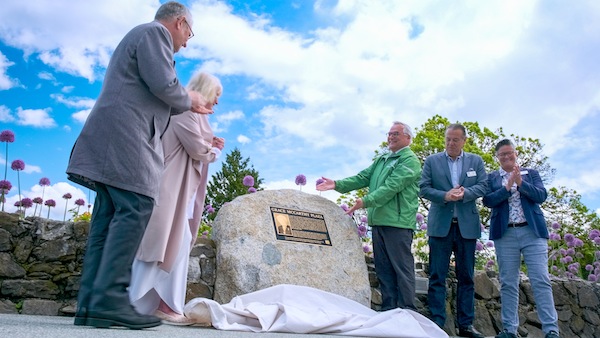
Grace McCarthy Plaza in Queen Elizabeth Park was dedicated on May 27. Left to right are Mark Weintraub (family friend); Mary McCarthy Parsons (Grace’s daughter); Stuart Mackinnon (Park Board chair); John Coupar (Park Board commissioner); and Donnie Rosa (general manager, Parks and Recreation). (photo from Vancouver Board of Parks and Recreation)

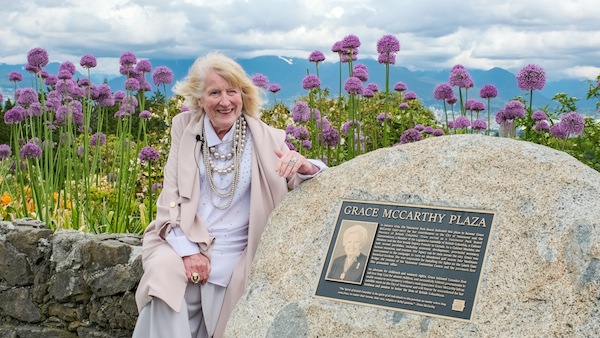
On May 27, the Vancouver Board of Parks and Recreation commemorated politician, former Park Board vice-chair and lifelong ambassador for the city’s greenspaces Grace McCarthy with a new plaque and plaza in Queen Elizabeth Park, by Bloedel Conservatory.

“Grace McCarthy was a true Park Board pioneer and her passion for her hometown of Vancouver can be seen across the city,” said Park Board chair Stuart Mackinnon in a release. “VanDusen Botanical Garden, Stanley Park Christmas Train, the lights of Lions Gate Bridge, we can enjoy these cherished landmarks today thanks to Grace’s unwavering drive and commitment.

“Grace was instrumental in seeing the Bloedel Conservatory opened in 1969 and I can’t think of a more appropriate place to celebrate her legacy. Grace McCarthy Plaza is a fitting tribute to a proud public servant of the city.”

During her three terms on the Park Board between 1960 and 1966, McCarthy led efforts to secure open spaces for park development and coordinate recreational activities for people with disabilities. She was elected as the first female vice-chair in 1966 and successfully ran for provincial election the same year.

A former florist, McCarthy’s love and appreciation for horticulture influenced some of her most noteworthy work with the Park Board. She worked tirelessly to ensure that Bloedel Conservatory was completed as a Canadian Centennial project, and campaigned throughout the 1960s for part of the abandoned Shaughnessy Golf Course to become what is now known as VanDusen Botanical Garden. Once elected to the legislative assembly, she continued her fight to fund the garden and, in 1970, made the announcement that the province would provide $1 million to its development.

photo - Mary McCarthy Parsons sits in Grace McCarthy Plaza, beside the plaque that briefly describes her mother’s contributions to the city and the province
Mary McCarthy Parsons sits in Grace McCarthy Plaza, beside the plaque that briefly describes her mother’s contributions to the city and the province. (photo from Vancouver Board of Parks and Recreation)

In her time as member of the legislative assembly for the Vancouver-Little Mountain constituency, she successfully lobbied provincial and federal governments to enable women to apply for mortgages without a male guarantor. Her appointment as the first female deputy premier in Canada paved the way for generations of women in provincial politics. As deputy premier, her portfolios included economic development, provincial secretary, human resources, social services and tourism, and she initiated the province’s bid to host Expo ’86.

Following McCarthy’s passing in 2017, the Park Board directed staff to identify an appropriate space to recognize her legacy. One of the non-family members involved in that five-year process was Jewish community member Mark Weintraub, Q.C., a partner at the law firm Clark Wilson. He spoke at the May 27 ceremony.

“I did not personally know Grace well,” he said, “but I have felt her presence almost my entire life and, therefore, I am gratified to be here for all of the British Columbians who may not have known her well but who were very much aware of her as an exemplary model of public and community service.”

Weintraub’s first encounter with McCarthy’s reputation “was in the 1960s,” he said, “when I would walk to school and pass the family home. Somehow I knew it was the McCarthy house. How I knew it was the McCarthy house I don’t really know – my parents must have pointed it out one day and I have no idea how they knew. But somehow as a young boy, I had absorbed that there was a very important woman living close to us and that whoever Grace was and whatever she did, my parents thought I should know about her.

“Fast-forward about 25 years, when I became involved in Jewish community advocacy, I had the opportunity to meet with her on several occasions on political issues of concern. It was during this time that I began to realize why Grace had this almost celebrity heroic aura around her that I had somehow absorbed as a young boy. With these few community encounters, I, in fact, learned that her reputation as a dynamic, forward-thinking, compassionate woman of extraordinary action was well-earned.

“I saw firsthand that Grace listened carefully to the Jewish community’s deep concerns about antisemitism and was seen as a strong community supporter, friend and advocate,” said Weintraub. “With passage of time it is very apparent to me that she was one of the modernization forces within the B.C. political system advancing equality and human rights. I became involved in this dedication project in part to show my gratitude to Grace for her unshakeable friendship with many members of the Jewish community; her dedication to public service; her trailblazing of gender equality and her enthusiastic embrace of new Canadians.”

McCarthy was in the Jewish Independent newspaper and its predecessor on numerous occasions – with respect to activities concerning, among others, Jewish National Fund, Pacific Region; Jewish Women International, B.C. chapter; and Lubavitch BC. She also was in the paper for the CH.I.L.D. Foundation, which she founded in 1995; the organization raises money for research funds to help children suffering from Crohn’s disease, ulcerative colitis and liver disorders. The Jewish Museum and Archives of British Columbia’s oral history project contains a 2011 interview with McCarthy.

Weintraub shared with the JI a letter from Monsignor Gregory Smith, pastor of Christ the Redeemer Parish in West Vancouver. It confirms that McCarthy’s impact extended beyond the secular and across religions. Smith, who attended the plaza dedication, commended Weintraub on his remarks and said, “In particular, I could not help but think that if I substitute ‘Catholic’ for ‘Jewish’ I could have delivered your text with equal conviction! Grace was a remarkable supporter of people of faith, and on many occasions she was also a great help to our church.”

“Grace modeled optimism and hope in the face of adversity and she was a rock,” said Weintraub at the dedication. “How fitting that we remember her on this hard plaza surface built on rock quarry and now so beautified.

“This plaza overlooking her beloved parks, her Shaughnessy home of many decades, the ocean and mountains – the highest point in the city – is so appropriate for one who achieved pinnacles and, as importantly, mentored the way for so many of us to achieve our best.”

– Jewish Independent, Vancouver Board of
Parks and Recreation, and Mark Weintraub

Format ImagePosted on June 24, 2022June 22, 2022Author JI-Board of Parks-Mark WeintraubCategories LocalTags Grace McCarthy, Queen Elizabeth Park, Vancouver Board of Parks and Recreation
Learning about First Nations

Learning about First Nations

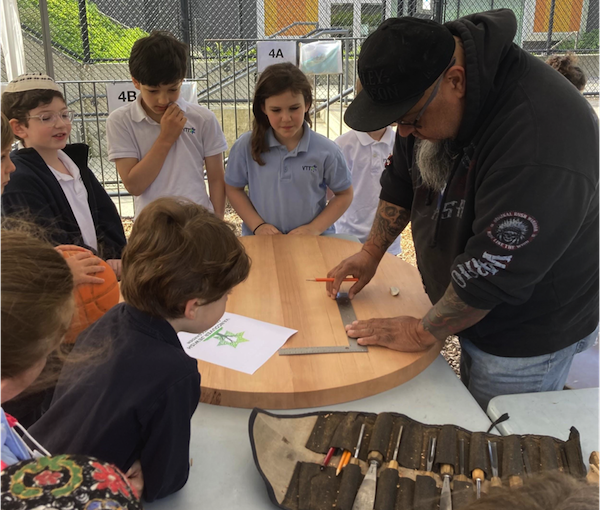
Gerry Sheena shows students his method of carving. (photo from Vancouver Talmud Torah)

Vancouver Talmud Torah invited Interior Salish Nation carver Gerry Sheena and his son Matthew Sheena for a week-long program where each grade participated in a session to learn about the history of Indigenous carving, the tools used and the process of carving and design.

Gerry Sheena has been carving for more than 17 years and his work is shown in galleries throughout British Columbia. He describes his carving style as “traditionally Salish, informed by modern painting techniques and innovative use of colour and design.”

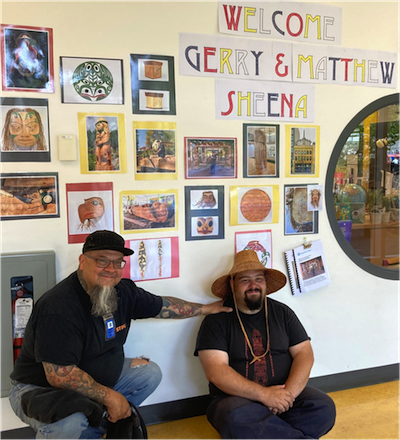
The Sheenas’ visit related to the applied design, science and technology curriculum, notably the woodworking aspect. However, VTT has been working on creating a more meaningful implementation of First Peoples’ education, which sparked the idea of integrating the two areas and having presenters from the First Nations community educate students on carving, drumming and storytelling. The timing for the presentation was matched with the month of June, which is National Indigenous History Month. Teacher-librarian Nicolle Wade created a display of Indigenous books and shared Learning to Carve Argillite by Sarah Florence Davidson and Robert Davidson, to give students an idea of what they would be seeing. She also installed a welcome display shining the light on Gerry Sheena’s art.

photo - Matthew Sheena at Vancouver Talmud Torah
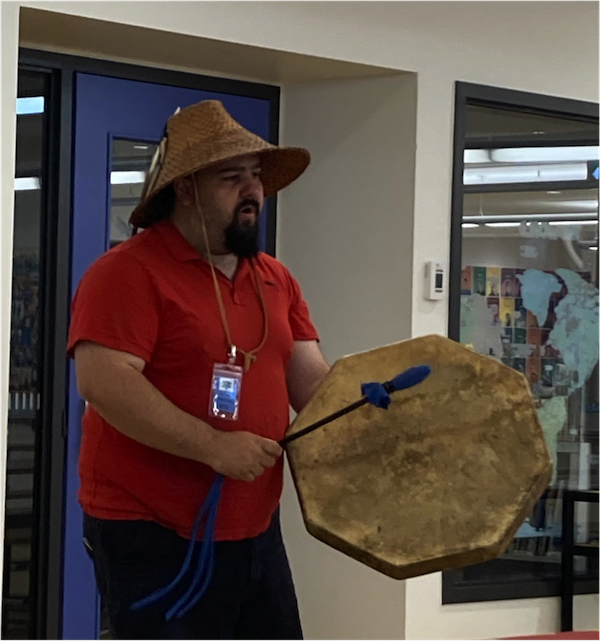
Matthew Sheena at Vancouver Talmud Torah. (photo from VTT)

The program was unique in that the Sheenas were at the school for an entire week, not only presenting but also working in the playground, carving a welcome sign for the soon-to-come community garden. Students were able to come out every recess and lunchtime to watch Gerry Sheena carve and listen to Matthew Sheena drum, and additional Q&As took place organically. Teachers had the opportunity to bring their classes out to watch the carving take place firsthand.

“Having an Indigenous carver join our VTT community for one whole week has helped us to organically elevate Indigenous education and ensure that our students are engaging in meaningful learning about the Indigenous peoples and their traditions. We are honoured to have Gerry and Matthew Sheena join us from the Interior Salish Nation as we find ways to recognize National Indigenous History Month now and moving into the future,” said Emily Greenberg, VTT head of school.

Gerry Sheena shared how he got started in carving, his love for art and his happiness when creating totem poles, masks, paddles and many other ceremonial carvings. Matthew Sheena is a passionate drummer and graced the school with his drumming and singing of a Squamish Nation song, “Snowbird,” acknowledging the land and sending a powerful message to love and to lead “through your heart, spread love to others around you and to be kind.”

Among the many lessons learned from the week were:

• The power of passing on knowledge through storytelling.

• The connection to the land being the foundation of Indigenous ways of knowing and practices. The land, plants, animals and sky are all teachers, and taking care of the land and everything living is of utmost importance.

• Honouring language. The Sheenas taught students how to say thank you, and the importance of respecting elders and cherishing their roots.

• Older students had questions about residential schools that the Sheenas approached in a gentle and meaningful way.

• Matthew Sheena spoke to the students about always reaching for the stars, never giving up no matter what life throws at you, and being the best you can be every single day. Also, he encouraged them never to give up on art, drawing, singing and dancing – and to do things that bring them joy and will help them tell a story. He said his favourite tool when carving is a pencil and spoke about the power of the pencil to create.

photo - During their week at Vancouver Talmud Torah Gerry Sheena and his son Matthew Sheena taught students and teachers about carving, drumming and storytelling
During their week at Vancouver Talmud Torah Gerry Sheena and his son Matthew Sheena taught students and teachers about carving, drumming and storytelling. (photo from VTT)

VTT was so grateful to spend time with Gerry and Matthew Sheena, both of whom inspired students and faculty through their presentations. The themes of building community, recognizing that everyone can be a potential source of inspiration and knowledge, and fostering respect by encouraging students to speak honestly, listen to one another, be active in problem-solving, take care of the land and value their surroundings were a few of the key takeaways from the week.

VTT aims to grow in the area of Indigenous education and make links to Jewish history, cultures and traditions, as the Sheenas’ presentations revealed that there are many similarities. The week’s activites and interactions left students with more knowledge and understanding of First Nations peoples, and it is hoped that students will continue to reflect upon questions like, What do I know about Indigenous education and First Nations communities? How can I contribute to changing the world we live in by storytelling and passing on knowledge? How can I learn more about Canada’s relationship with Indigenous people? How can I build meaningful relationships? How can I protect the world we live in; the land,  animals and people? and What connections does First Nations education have to Jewish education?

Jessie Claudio is director of learning and innovation at Vancouver Talmud Torah.

Format ImagePosted on June 24, 2022June 22, 2022Author Jessie ClaudioCategories LocalTags carving, drumming, education, Gerry Sheena, Indigenous culture, Matthew Sheena, Vancouver Talmud Torah, VTT

Still time to save earth

Indigenous activist, scholar and farmer Dr. Randy Woodley was the keynote speaker on May 24 for the Vancouver School of Theology conference Religious Responses to Climate Change. Based in Yamhill, Ore., Woodley addressed the assembled Zoom audience on the topic Indigenous Spirit: Weaving Justice and Peace in a Wounded Land.

“The West has largely failed in its mandate to till and keep the soil; that is, to serve the community of creation, the whole community of creation,” Woodley began, introducing the concept of humankind’s responsibility to assure the well-being of those in its care, namely, the land and all the creatures that reside on it and in it.

Humans are co-sustainers of the earth, he stressed, showing a slide that highlighted the billions of bacteria, millions of protozoa, metres of fungi and thousands of nematodes in just one cup of soil.

Woodley gave examples of the unflattering views Western scholars have often had of Indigenous cultures and how such scholars (and others) have overlooked “many things that ‘primitives’ still know.” While North American curricula contain lessons on Greek, Egyptian and Chinese civilizations, for example, education on ancient American civilizations is lacking.

Indigenous American societies brought about such things as micro-agriculture and macro-environmental management, including botany, agronomy, forestry, raised beds and naturally self-sustaining fertilized gardens, said Woodley. Further, there was sustainable architecture that incorporated passive solar design, solar heating, water capture systems and mass water transport.

“I would argue that the Western worldview has been a failed experiment,” he said. “We need to dump it and we need to adopt a more Indigenous approach.”

He said the “faster, bigger, cheaper” method of food production in the Western world is depleting soils and leading to the loss of crop varieties. At the same time, forests are shrinking, species are going extinct and droughts are increasing. Blame for water waste could be placed on big agriculture, he asserted.

Meanwhile, Indigenous people have lived in North America for more than 20,000 years without permanently endangering the land. He said, “The earth has had enough and is not going to let humans get away with knocking things out of balance forever.

“Nature’s chaos, which we’re understanding now, is actually stable because it continues to adapt. If there’s one thing true about all of creation … it will adapt. Human beings are the only ones who resist that. Adaptation is stability.”

The nature of a closed system is to collapse in on itself or be consumed by other more adaptive systems, he argued. Therefore, he said, the religious response to climate change should be to adapt as well. Within adaptation, there is an order that builds open systems of unity and diversity. The West, on the other hand, introduced chaos and continues to maintain it.

“Lots of different diseases we have are because we have not lived in the way we should with the animal kingdom. We only have a short time to come back from our own unsustainable chaos and back to the Creator’s sustainable order,” Woodley said.

A handful of human generations has accelerated consumption exponentially. Mother Earth is now trying to rebalance the overuse through “random acts of nature,” he said. The planet is reclaiming its territory and “spitting out the inhabitants in order to restore harmony, the top of the food chain temporarily is now Mother Earth herself.”

It was a particular kind of human being, Woodley reiterated – the Europeans and Americans, and not the species itself – that brought us to this perilous stage. Woodley sees a connection between the way Europeans and Americans treat both creation and people, especially women, immigrants, the poor and other marginalized groups – with respect to nature and fellow humans, they have a need to control, exploit, expect production from and objectify, he said.

Practical steps forward, in Woodley’s view, include a critical examination of the Western world approach, the shedding of unhealthy paradigms, and the adoption of a more Indigenous perspective, such as sustainable ecosystems, a respect for the wisdom found in nature and an acknowledgement of the interconnectedness of all living things.

Woodley quoted environmentalist and economist Winona LaDuke as saying, “Food for us comes from our relatives, whether they have wings or fins or roots. That is how we consider food, food has a culture, it has a history, it has a story, it has relationships.”

And he cited a Shoshone elder: “Do not begrudge the white man his presence on this land. Though he doesn’t know it yet, he has come here to learn from us.”

Together with his wife Edith, Woodley runs Eloheh Indigenous Centre for Earth Justice, an organization that focuses on developing, implementing and teaching sustainable and regenerative earth practices. Eloheh is a Cherokee word meaning harmony, wholeness, abundance and peace.

Woodley has written several books, including Indigenous Theology and the Western Worldview: A Decolonized Approach to Christian Doctrine, and Shalom and the Community of Creation: An Indigenous Vision.

Director of the VST conference was Rabbi Dr. Laura Duhan-Kaplan.

Sam Margolis has written for the Globe and Mail, the National Post, UPI and MSNBC.

Posted on June 24, 2022June 22, 2022Author Sam MargolisCategories LocalTags climate crisis, education, environment, Indigenous culture, Randy Woodley, Vancouver School of Theology, VST, Western culture
Milestones … Chief Dr. Robert Joseph, KDHS students, Zac Abelson

Milestones … Chief Dr. Robert Joseph, KDHS students, Zac Abelson

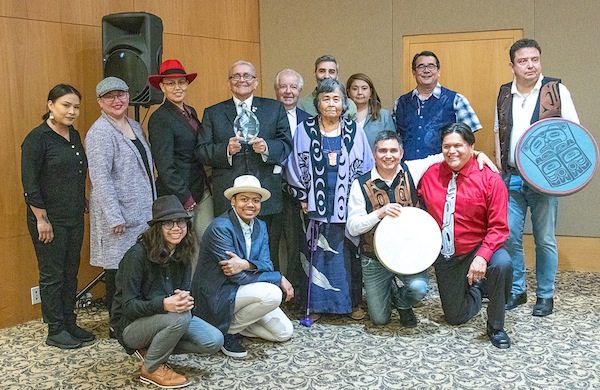
On May 25, the Centre for Israel and Jewish Affairs honoured Chief Dr. Robert Joseph (holding the sculpture) with the Victor Goldbloom Award for Outstanding Interfaith Leadership. (photo from CIJA)

On May 25, the Centre for Israel and Jewish Affairs honoured Chief Dr. Robert Joseph with the Victor Goldbloom Award for Outstanding Interfaith Leadership.

In memory of the late Dr. Victor Goldbloom, the Victor Goldbloom Award recognizes the contributions of leaders from various faith communities in advancing interfaith relations.

Joseph is a hereditary chief of the Gwawaenuk First Nation and the founder and current ambassador for Reconciliation Canada, an Indigenous organization dedicated to dialogue with multifaith and multicultural communities. He is also the former executive director of the Indian Residential School Survivors Society and a member of the National Assembly of First Nation Elders Council. As a result of his work, he has received numerous awards and recognition for bringing people of different faiths together.

Joseph is a dear friend to the Jewish community who has worked with Robbie Waisman, a Holocaust survivor, to make connections between survivors of the Holocaust and the residential schools.

On May 26, representatives from the Sikh, Roman Catholic, Evangelical, Ismaili, Muslim, Ahmadiyya, Ukrainian Catholic, Anglican, Baha’i and Black-Canadian communities, as well as Indigenous leaders, joined to celebrate Chief Joseph’s lifetime of work serving British Columbia, urging people of all faiths toward truth and reconciliation, and renewing relationships between Indigenous people and all Canadians.

***

photo - Left to right: Emmett Simkin, Max Koenigbaur, Zachary Bordan, Joseph Gabay, Ezra Heayie, Sierra Brosgall and Ziv David
Left to right: Emmett Simkin, Max Koenigbaur, Zachary Bordan, Joseph Gabay, Ezra Heayie, Sierra Brosgall and Ziv David. (photo from KDHS)

The Maccabiah Games take place every four years in Israel, and the 21st Maccabiah will take place July 12-26, with some 10,000 athletes from 80 countries competing in more than 40 sports. Seven King David High School students were selected to play in a variety of sports and faculty member Matt Dichter is the coach for a basketball team. KDHS is so proud and wishes them all a successful time in Israel!

***

On May 31, Birthright Israel Excel selected 60 college students worldwide for its fellowship in business and technology, which began on June 7 and runs in Israel for 10 weeks. Forty participants are from the United States, while 20 come from Argentina, Brazil, Canada, Ecuador, France, Mexico, South Africa, Spain and the United Kingdom. Thirteen of them will be visiting Israel for the first time.

photo - Zac Abelson
Zac Abelson (photo from Birthright Israel)

One of the participants is University of British Columbia Sauder School of Business student Zac Abelson, 21, who is majoring in commerce, with a double minor in operations and logistics, and entrepreneurship. He will be doing his internship with Deloitte.

Since 2011, the Birthright Israel Excel Fellowship has selected top students from hundreds of applicants for summer internships with leading business and tech companies in Tel Aviv. This year’s cohort features an equal number of women and men and the most first-time visitors to Israel. Their internships will be in such areas as environmental sustainability, software development, consulting, finance, venture capital, engineering, marketing, cybertech, biotech, business development and startup development. Students will intern each Israeli workweek, Sunday through Thursday, and attend an evening series of speakers from across Israeli society.

A core component is the one-on-one pairing between each Excel fellow and an Israeli, enabling the foreigners to acclimate quickly to the local culture and see the country through a more authentic lens than as typical tourists. Many peer-to-peer relationships grow into long-term friendships. Some have invested in each other’s business ventures.

Birthright Israel Excel fellows enjoy free time to explore Israel with their peers, and three weekend trips as a group bring them throughout the country: the north, typically including the Golan Heights, a winery tour and a rafting trip down the Jordan River; Jerusalem, including the Western Wall and the Machane Yehuda outdoor market; and the south, for a desert trek, a mud bath in the Dead Sea and a sunrise hike on Masada.

After their return home, the Excel fellows enter a network that provides resources for professional and personal development, Israel engagement and encouraging them as philanthropists.

Birthright Israel Excel fellows have gone on to positions at companies such as J.P. Morgan Chase, Bain & Company and Google. Others have developed strategic partnerships with Israeli companies and started their own companies, often hiring other fellows.

Format ImagePosted on June 24, 2022June 22, 2022Author Community members/organizationsCategories LocalTags Birthright Israel Excel, Centre for Israel and Jewish Affairs, CIJA, interfaith, KDHS, King David High School, Maccabiah Games, Robert Joseph, Zac Abelson

The importance of attribution

There’s a story in the Babylonian Talmud, in Tractate Yevamot 96b, that cut close to home when I studied it. It’s a brief episode but it addresses modern interpersonal issues. It features Rabbi Elazar, who goes to the beit midrash (study hall) and quotes halachah (Jewish law). However, Elazar makes a big mistake – he doesn’t attribute this teaching to Rabbi Yohanan, who taught it. This news gets back to Yohanan. And it doesn’t sit well.

Now, the backstory. Rabbi Yohanan, according to Rabbi Dan Ornstein’s My Jewish Learning summary online, is seen as “dangerously oversensitive” and quick to anger. Yohanan also apparently had (at least) 10 sons and they all died. He is so sad that, in Tractate Berakhot 9b, he is carrying around a tooth (or a bone?) from his youngest child who died.

Back to the current story: rabbis Ami and Asi, Yohanan’s students, try to calm him. They say anger isn’t good and offer a story about Elazar and Rabbi Yosei, who get so angry with each other that they tear a Torah. Yohanan becomes angrier, because they are comparing Yohanan and Yosei (teachers) with a student (Elazar).

Along comes Rabbi Yaakov bar Idi, who takes a different approach. He explains that everyone knows that all of Elazar’s teachings come from Rabbi Yohanan, who is, in their time, “our iteration of Moses.” In fact, “Everyone knows Elazar is quoting you, even when he doesn’t quote you by name. You have nothing to fear.”

This diplomacy soothes Yohanan, who then corrects Ami and Asi, pointing out this was a great way to manage the situation.

There was so much in this story that affected me. First, there’s the matter of, in modern terms, “copyright.”  Everybody deserves credit for their work. It’s not right to just claim somebody else’s ideas, images or innovations as your own.

There’s also the issue of context. Rabbi Yohanan had great personal tragedy and loss. People with this much trauma might be sensitive or angry – and that’s entirely understandable.

It’s also awful to try and “teach” your instructor through the example of one of their poorly behaved students. It disregards Yohanan’s wisdom and authority. Recognizing this trauma and honouring elders means treating them with respect instead of talking down to them, as rabbis Ami and Asi did.

The talmudic story continues: the teachings of a great person speak to us from beyond the grave. Yohanan’s legacy is his teaching of Jewish law and Torah. It’s erased if Elazar fails to acknowledge where it came from. When a person loses their children and hopes that his students will help his name live on? It’s demoralizing and infuriating when his students “erase” him instead.

OK, yes, but this is just an old story, why did it matter to me?

As an author, I care about copyright issues. Most authors don’t earn more than, at most, a dollar when each book is sold. Most writers (myself included) cannot make a living on their books or other writing. So, seeing bootlegged downloads of my books on the internet is infuriating – it’s just another way to “erase” a person’s value and intellectual property.

Then, there’s the issue of our personal story and how it affects our work. We’ve all known people who’ve suffered losses or struggled. Rabbi Yohanan is a good example. Perhaps some learn from this suffering and gain wisdom. Yet Yohanan’s students condescend to him and belittle his anger because “he might tear a Torah” like one of his students? This is not consolation. It’s demeaning.

Rabbi Ornstein uses the word “flattery” to describe what Yaakov bar Idi did, saying that everyone knew Elazar got everything he knew from Yohanan. I think that’s the wrong take. In trying to soothe Yohanan, Yaakov bar Idi gives him respect and credit. This shows how much our work means to us. As a good teacher, when calm, Yohanan made the experience a lesson for his other students. In other words, everything is Torah – we can learn how to be better people from any situation, no matter how upsetting or demeaning.

Occasionally, work situations pop up that “put us in our place” or give us context about what we do. Recently, I opened up my work email to discover I’d lost seven-plus months of emails from my inbox. Now, of course, an organized person would have addressed every issue, filed every email, and had an empty inbox. I hang on to things, I don’t spend enough time on tidying, and I keep things so I can think about them. Mea culpa.

After trying every technical solution available, it became clear that those emails were gone forever. No idea what happened. I had to let go of the panic and the upsetting situation. I hope my work has value, and that people will get in touch if they want to work with me.

Losing my emails this way felt like being erased. Middle-aged women, who are also caregivers, often earn less for the hours we work. We earn nothing for the hours of household labour we do to take care of those around us. It’s natural to feel angry about this. Rabbi Yohanan’s anger reminds that we all want to be acknowledged, have our work valued and respected. It’s not hypersensitive or unreasonable to want to leave a legacy to others. Taking on someone else’s teaching without attribution, as Elazar did, is the erasure that happens to many of us, and Rabbi Yohanan shows us that anger is a human response. Yaakov ben Idi suggests that acknowledging his teacher with respect is the compassionate way forward.

In a perfect world, my inbox would magically repopulate. I’d get offers from new clients showing my value as a writer and editor. My elementary school twins would suddenly acknowledge and thank me for all those meals and chauffeur moments. In reality, we all have to remind ourselves to reach out, acknowledge others, and treat them with respect. It doesn’t always happen automatically. Yohanan’s students valued his wisdom but they had to learn to acknowledge his work and recognize that his feelings mattered, too.

In this way, Rabbi Yohanan’s wisdom teaches us from beyond the grave. We must not erase others’ contributions. An erasure or even an empty inbox doesn’t make anybody’s life fulfilling. We must validate and value each other.

Joanne Seiff has written regularly for CBC Manitoba and various Jewish publications. She is the author of three books, including From the Outside In: Jewish Post Columns 2015-2016, a collection of essays available for digital download or as a paperback from Amazon. Check her out on Instagram @yrnspinner or at joanneseiff.blogspot.com.

Posted on June 24, 2022June 22, 2022Author Joanne SeiffCategories Op-EdTags copyright, Judaism, lifestyle, Talmud

מסחר עולמי

הישג ישראלי: ‘איי.טו.זד’ מדורגת בין עשר חברות הטכנולוגיות של בורסת טורונטו

החברה הישראלית לעגלות סופרמרקט חכמות ‘איי.טו זד’ התברגה בין עשרת החברות הטכנולוגיות המובילות בבורסה הקנדית. החברה נכנסה לרשימת המדדים המובילים בבורסה בזכות ביצועיה האיכותיים מאוד

קבוצת הטכנולוגיה הישראלית – חברת הטכנולוגיות החכמות ‘איי.טו.זד’ יכולה לרשום לעצמה הישג משמעותי נוסף, בענף העגלות החכמות, עם כניסתה לממד החמישים של חברות בינלאומיות מובילות, של הבורסה לניירות ערך בטורונטו שבקנדה. על חמישים החברות נמנות אלה שיש להן ביצועים איכותיים יוצאי דופן בחמישיה מגזרים עיקריים: טכנולוגיה, אנרגיה, תעשייה, כרייה ומדעי החיים. וזאת על פי על פי מספר קריטריונים שעליהם נמנים: צמיחת החברה ביחס לענף שלו היא שייכת, וכן ביצועי המניה של החברה בשנה האחרונה

בנוסף למסחר בבורסה לניירות ערך של טורונטו חברת הטכנולוגיות החכמות ‘איי.טו.זד’ נסחרת במקביל גם בבורסת ‘נסד”ק’ האמריקנית, שמיועדת לחברות היי טק טוכנולוגיה. ‘איי.טו.זד’ זוכה אפוא להמלצות קנייה חמות וטובות לאור איכות המוצרה שלה – העגלות החכמות

חברת הטכנולוגיות החכמות ‘איי.טו.זד’ שממציאה ומפתחת פתרונות חדישים לאתגרים מורכבים שונים, היא זו שעומדת מאחורי העגלה החכמה. בשלב זה העגלה החכמה היא מוצר הדגל שלה והוא זוכה לחשיפה גדולה. מדובר במוצר המתקדם מסוגו בעולם בשלב זה. העגלה החכמה מתפקדת גם כקופה עצמאית לכל דבר, וכן יש לה אף מסך מגע ומערכת ראייה ממוחשבת. העגלה החכמה שנקראת ‘קסטומייט’ מייעלת את חוות הקנייה על ידי שימוש באלגוריתם חכם והיא נחשבת מאוד ידידותית למשתמש. בעזרת העגלה שיש, לה מסך מגע ומערכת ראייה ממוחשבת, אפשר לסרוק את המוצרים שנרכשו וכן יש אף אפשרות לשלם באמצעותה. וחאיר כן יכולים הקונים לעקוף פשוט את התור הארוך בקופה ולצאת עם העגלה החוצה. או רק עם המוצרים שנרכשו. ובכך נחסך זמן רב מצדם של הקונים שכידוע בדרך כלל מתלוננים על התורים הארוכים בקופות. כן נחסך כוח אדם רב, בזמן שלמנהלי החנויות יש שליטה ובקרה מלאים על כל התהליך של הרכישה והמכירה

העגלה החכמה ‘קסטומייט’ מאפשרת למנהלי החנויות להפעיל גם פרסום ממוקד למי שמשתמש בה, כולל שיווק ישיר וכן מבצעים מיוחדים. כך שהכנסות חנויות יכולות לעלות בזמן ששהוצאות שלהן יקטנו שמעותית

לדברי מנכ”ל פרוייקט ‘קסטומייט’ של חברת הטכנולוגיות החכמות ‘איי.טו.זד’, רפי ים, העגלה החכמה נמצאית בתהליכי שיפור מתמיד, מבחינת החומרה והתוכנה. זאת כדי להשיג פתרונות משלימים, אפלקציות ויכולות שונות שיתנו ערך מוסף ללקוחות, לחנויות ולמשקיעים בחברה הנסחרת בבורסאות כאמור של טורונטו ‘ונסד”ק’ האמריקנית. ים מוסיף כי פלטפורמת העגלה החכמה ‘קסטומייט’ תופץ ותשווק בחנויות שונות בכל רחבי העולם. ים מציין עוד שהחברה גאה להיות בימים אלה חלק ממדד החברות האיכותיות של בורסת טורונטו שבקנדה

הישג קנדי: ביקושי ענק לדגנים ותבואות מכל העולם

המלחמה הבלתי נתפסת של נשיא רוסיה, ולדימיר פוטין, באוקראינה המיסכנה, שינתה משמעותית את מפת אספקת הסחורות העולמית. רבים במערב לא האמינו שפוטין הדיקטטור יחרחר מלחמה ברמה כזו ויחליט שיום אחד הוא רוצה לחסל את אוקראינה על תושביה. מקביל מדינות המערב בהן קנדה יעשו מעט עבור אוקראינה וזה מצער

ולפיכך משבר חמור זה יצר מחסור עולמי גדול בדגנים ותבואות, בין היתר כיוון שרוסיה מקשה על אוקראינה ליצא חיטה באמצעות חסימת המעבר בים השחור. רוסיה עצמה אף נתקלת במחסומים קשים ביותר לייצא את החיטה שלה, לאור הסנקציות הכלכליות הקשות שהוטלו עליה מצד מדינות המערב השונות. המרוויחה הגדולה מכך היא קנדה שהפכה לספקית חילופית טובה למדינות רבות בעולם

העולם מגיע לקנדה לאור המשבר הארוך הזה, וקנדה מצידה שולחת דגנים ותבואות של החקלאים המקומיים לכמאה ועשרים מדינות שונות. על רשימת המדינות שפנו לאחרונה לקנדה לקבל את התוצרת החקלאית שלה נמנות: טורקיה, אלגי’ריה, תוניסיה וברזיל. במקביל מדינות אחרות שלא סובלות בשלב זה ממחסור ביבולים השונים, פונות כל הזמן לקנדה ומבקשות להגדיל את היבוא החקלאי. זאת, כדי לבסס את מאגרים שלהן לשעת חירום כי כידוע משברים לא חסרים בעולם: מגיפת הקוביד, פגעי אקלים שונים, סיכסוך ומתיחות בין מדינות שונות ועוד ועוד

ההתחממות הגלובלית העולמית לא פוסחת על קנדה וגם היא יוצאת נפסדת מכך משמעותית ביותר. הבצורת הקשה בקנדה בשנה שעברה, פגעה קשה ביצוא של חיטה וקנולה למדינות העולם השונות. בשלב זה קשה לקנדה לסגור את החוזים בהיקפים שהיא רגילה להם. זה יקרה רק אם אספקה של היבולים השונים תחזור לרמות הרגילות בשנה הנוכחית

בנוסף למשבר הגלובלי הנוכחי שנולד ממלחמתה הקשה של רוסיה באוקראינה, גם מגפת הקוביד הנמשכת כבר כשנתיים ויותר “עזרה” ליצור שיבושים קשים באפסקת סחורות בכל רחבי העולם. עתה מכולות ריקות במספר גדול מאוד נשלחות לסין כדי לסייע בסגירת העיכובים באספקה, שנוצרו במהלת המגיפה. לכן מובילי דגנים קנדיים מתקשים להשיג מכולות להעביר את סחורותיהם למדינות שונות ברחבי העולם

חרף האתגרים הקשים הללו, קנדה ויצרני הסחורות והחקלאים שלה עדיין נמצאים בעמדת יתרון. מחירי הנפט והאשלג הגואים כל הזמן הגדילו את הרווחים וסייעו באיזון התקציב הציבורי של קנדה. מחוז אלברטה שבמערב המדינה, שרוב הכנסותיו מגיעות מתעשיית הנפט והגז, צופה עודף תקציבי בשנה הפיסקאלית הנוכחית, לראשונה זה שמונה שנים. זאת לאחר שנים של מיתון קשה באלברטה, שגרם לרבים להפוך למובטלים ובמקביל חברות רבות בתחום האנרגיה הפסיקו את פעילותן במחוז

לאחר המחסור הגדול בנפט בעיקר בגלל הסנקציות הכלכליות שהופנו כנגד רוסיה, הסכימה קנדה כמו ארה”ב, להגדיל משמעותית את יצור משלוחי הגז הטבעי והנפט שלה. מדובר על גידול ביצור של כמאתיים אלף חביות נפט ביום, וכן גידול ביצור של כמאה אלף חביות גז טבעי ביום

במדינות המערב סוף סוף הגיעו למסקנה שיש “להיגמל” מרכישת אנרגיה מרוסיה, שנחשבת ליצואנית הנפט והגז הגדולה ביותר למדינות ביבשת אירופה. המשבר הנוכחי עם הרוסים מויח שוב ושוב, שכדאי ואף מומלץ למערב לנתק כל תלות ברוסים. השאלה המשמעותית עתה כי כמה זמן זה יקח למדינות אירופה השונות ובעיקרן גרמניה, למצוא תחליפים לנפט ולגז של הרוסים

קנדה נחשבת לאחת מיצרניות האשלגן הגדולות בעולם. חברת נוטריין הקנדית שהיא יצרנית האשלגן הגדולה בעולם, הגדילה רק לאחרונה את הייוצר שלה בעשרה אחוזים לרגל פניות רבות מברזיל

השר למשאבי הטבע בממשלה הפדרלית הליברלית, ג’ונתן ווילקינסון, מציין כי כי גורמים רשמיים מטעם מדינות שונות פנו אליו במהלך כנס סוכנות האנרגיה הבינלאומית ,שנערך לאחרונה בפריז, כדי לבחון היתכנות להחלפת האשלג, אורניום וסחורות חקלאיות רוסיות, בקנדיות. במהלך הפסגה הבינלאומית אמר ווילקינסון, כי קנדה, שהיא הרביעית בגודלה בעולם מבחינת עתודות נפט, תוכל להגדיל בהדרגה את המשלוחים בשלוש מאות אלף חביות ביום. בנוסף גם יצרנית האורניום הגדולה במדינה ‘קמקו’ (בסיסה במחוז סיסקצ’ואן) צפויה להגדיל את ייצור האורניום במכרות שלה, בקנדה ובארה”ב. ‘קמקו’ הנחשבת ליצרנית האורניום השנייה בגודל בעולם, מפיקה כשמונה עשר אחוז מכמות האורניום שבעולם

במסגרת הסנקציות נגד רוסיה, הודיעה קנדה לאחרונה כי היא מטילה סנקציות נגד האוליגרך רוסי-ישראלי, ויקטור וקלסברג, הנחשב למקורב לפוטין

Posted on June 8, 2022June 1, 2022Author Roni RachmaniCategories עניין בחדשותTags agricultural goods, Canada, global shortage, grains, Israel, Russia, stock exchange, technology, Ukraine, אוקראינה, חסור עולמי, סחורות חקלאיות, קנדה, רוסיה, תבואות
New havens amid war

New havens amid war

The Masorti synagogue in Chernivtsi Ukraine has become a refuge for Ukrainians fleeing the war. Its new aron kodesh, built by grateful refugees, has become a symbol of the partnership being forged between small, out-of-the-way communities and those fleeing for safety. (photo from Schechter Institutes Inc.)

As the war in Ukraine continues, educational and religious organizations that helped support the country’s fledgling Jewish communities are finding they have a new mandate these days: to help the millions of refugees that have been left homeless by the Russian invasion.

More than 12 million people have fled their homes in Ukraine, eight million of whom are internally displaced. According to a May 5 report by the United Nations Office of the High Commissioner for Human Rights, most of those affected are women and children. In many cases, the refugees have either lost family members in the bombings or have been separated from loved ones. A significant number are struggling to find shelter, food and resources.

Schechter Institutes Inc. president Rabbi David Golinkin told the Independent that synagogues and Jewish day schools have become refuges for Jews and non-Jews alike in recent months. The institute’s educational program, Midreshet Schechter Ukraine, which partners with Masorti Olami, provides funding and educational services for Conservative communities in Ukraine. Golinkin said three of the four Masorti (Conservative) synagogues are located in regions that have been hit by bombing, including in Kyiv, where Schechter had just opened a facility in January.

Golinkin said the two nonprofits had spent more than a year finalizing the purchase of a building that would be big enough to house a sanctuary, as well as a full array of youth programs and services. Two weeks after purchasing the property, however, Russia invaded Ukraine, forcing the community to suspend the opening. As Russian troops advanced toward Kyiv, community members were urged to leave the city. Some congregants sought refuge at the Masorti synagogue in Chernivtsi, near the Romanian border, while others headed out of the country to Poland, Moldova or Romania.

Three months into the war, the Chernivtsi synagogue, tucked away in southern Ukraine, has become known for its hospitality toward those fleeing the conflict. A steady flow of refugees fills the city every day, many turning up at the Masorti facility looking for a bed or a meal. Others head to the Chabad House located nearby. Golinkin said the two organizations have learned to work together, and will refer refugees to the other community when their own facility is full. No one is turned away, whether they are Jewish or not.

Schechter and Masorti Olami also work with partners across Western Europe, Israel and North America to help Ukrainians who are seeking refuge outside of the country. Rabbi Irina Gritsevskaya, who serves as the executive director for the educational programs of Midreshet Schechter and oversees programs in Ukraine, said hundreds of refugees have relocated to Israel, Berlin and other places with the help of Masorti congregations across Europe. She said the most moving example was the rescue of a teenage boy from eastern Ukraine whose parents had died. Volunteers made the 1,000-kilometre trip through war zones to bring him to Chernivtsi.

“[It] was a terrifying experience for him,” Gritsevskaya said, “since it took three days without basically sleeping or eating [to reach Chernivtsi]. Finally, with a lot of help from the Israeli government, we managed to bring him [to Israel].” She said he seems happy with his new home and his new school. “He always wanted to come to Israel,” she said.

Cities in eastern Ukraine are still hemorrhaging populations, driven by the escalating war in border cities and villages. Yuri Radchenko, who leads the Masorti synagogue in Kharkiv, is the director and co-founder of the Centre for Inter-Ethnic Relations in Eastern Europe, a think tank of researchers who specialize in Eastern European and Jewish history. He said most of the members of his small synagogue were able to flee the city. A few chose to remain behind.

“Some teachers [have] elderly parents who are … unable to move from the city,” said Radchenko. He estimates that 30-50% of Kharkiv’s two million residents escaped before the Russians captured parts of the city, which has been heavily damaged from Russian shelling. Many residents sought cover for months in Kharkiv’s fortified subway and other makeshift shelters. Recent estimates suggest at least a quarter of Kharkiv’s residential housing has been destroyed, along with crucial infrastructure.

Still, Radchenko said many who fled the country hope that they may one day be able to return home. “People understand that it is hard to make a change,” he said, noting that immigrating to another country often means starting at a lower employment level in an unfamiliar culture. He speculated that some residents will follow the example of other postwar populations and return to rebuild their city if Ukraine wins the war. And, indeed, many of the residents who sought shelter in Kharkiv’s underground shelters are gradually returning home to repair their apartments and clean up the rubble.

Radchenko said he can empathize with them. Much of his own work was put on hold when he was forced to flee. “I would come back to Kharkiv,” he said definitively. “[If] I could move back, I would not wait. I think I would visit to see how it looks like, but I would come back if my apartment and the district where it’s located were safe.”

For now, Schechter and Masorti are taking the long view of the war. Russia’s continuing attacks mean increased risk to civilian populations, more refugees on the run and more uncertainty. The conflict also means an even greater need to bolster resources at the Chernivtsi synagogue, so that Jews can continue to come and pray, learn and find a good kosher meal there, and refugees can find support. But Schechter and Masorti know that a significant number of Jewish communities in Ukraine will need to be rebuilt. And that will take both time and money.

photo - The Masorti synagogue in Chernivtsi Ukraine has become a refuge for Ukrainians fleeing the war. Its new aron kodesh, built by grateful refugees, has become a symbol of the partnership being forged between small, out-of-the-way communities and those fleeing for safety
The Masorti synagogue in Chernivtsi Ukraine has become a refuge for Ukrainians fleeing the war. Its new aron kodesh, built by grateful refugees, has become a symbol of the partnership being forged between small, out-of-the-way communities and those fleeing for safety. (photo from Schechter Institutes Inc.)

Schechter’s director of development Michal Makov-Peled said the Cantors Assembly will be hosting an hour-long telethon of music and stories on June 12 to raise money for Schechter and Masorti Olami’s emergency campaign. She said the funds will go toward assisting Jewish communities in Ukraine, as well as increasing support for refugees, which is expected to be an ongoing need, for now.

“We have 11 apartments that we are renting [to refugees in Chernivtsi],” Makov-Peled said, adding that they also distribute food to Jewish communities in Kyiv and Odessa, where residents are slowly returning, but which have been economically impacted by the conflict.

In Chernivtsi, communities are also finding rhythm and a new way of life. Some are exploring ways to expand the small synagogue’s services, others want to pay back the generosity they have been shown. Gritsevskaya said the synagogue now has a new aron kodesh (ark) to house its Torah, built by grateful visitors who saw a need. “Many aren’t members of the Chernivtsi community, but were just passing through,” said Gritsevskaya.

The June 12 Cantors Assembly performance, Mivtza Ukraine, will be aired around the world on YouTube and Facebook. To make a donation or for more information, log on to cantors.org/mivtzaukraine.

Jan Lee is an award-winning editorial writer whose articles and op-eds have been published in B’nai B’rith Magazine, Voices of Conservative and Masorti Judaism and Baltimore Jewish Times, as well as a number of business, environmental and travel publications. Her blog can be found at multiculturaljew.polestarpassages.com.

Format ImagePosted on June 3, 2022June 1, 2022Author Jan LeeCategories WorldTags Cantors Assembly, Conservative Judaism, David Golinkin, Irina Gritsevskaya, Masorti Olami, Michal Makov-Peled, Midreshet Schechter, Mivtza Ukraine, refugees, Russia, Schechter Institutes, tikkun olam, war, Yuri Radchenko
Inclusivity curriculum

Inclusivity curriculum

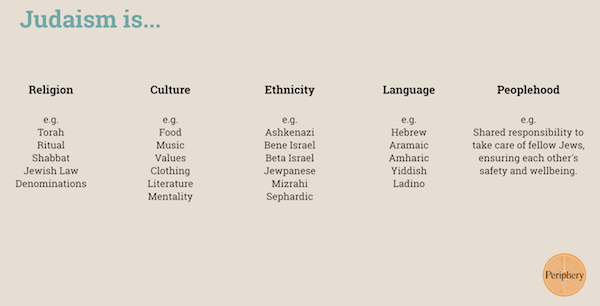
A page of the Intro to Judaism booklet that can be downloaded as part of the Periphery curriculum, which offers a framework to talk and learn about diversity within the Jewish community.

“Make space for a productive and respectful conversation” – this is the first suggested action to frame the use of the recently released Periphery curriculum.

Periphery – a film and photography exhibit exploring the ethnic diversity of Toronto’s Jewish community (jewishindependent.ca/discussing-jewishness) – came out last fall. The new curriculum builds on that 27-minute documentary. It comprises another nine short videos, all under eight minutes each, and lesson guides for students in grades 8 through 12 in both the Jewish and public school systems. There is also a guide for Jewish groups and organizations, which could be used for non-Jewish groups.

Launched by the Toronto-based nonprofit No Silence on Race and the Ontario Jewish Archives (a department of UJA Federation of Greater Toronto) with the organization Facing History and Ourselves (an American group with a Toronto branch), the curriculum is Ontario-focused. That said, most of the information is broadly based and relevant to Canadians no matter where they live, and no matter their age.

There are differences in the curricula for each of the three grade groupings (Grade 8, grades 9 and 10, and grades 11 and 12), the Jewish versus public school content, and the community dialogue package. However, the basic format and information is similar, with appropriate adaptations for probable starting points in knowledge and experience.

The common learning aims include “a greater awareness and understanding about who Jewish people are and the ethnic diversity within Jewish communities”; “Possess a stronger framework for understanding the complexities of intersectional identity, using their own identities as a foundation”; “Understand the difference between individual and group identity with a focus on belonging and recognition”; and the role of students and community members in creating inclusive community spaces. In addition, for example, the Jewish community curriculum also suggests that participants: “Discuss the intersections of race, privilege, mobility (i.e Jewish professional opportunities), power as it relates to Jewish identity and ashkenormativity.”

Before delving into the films and lesson suggestions, the curriculum offers a few activities that help frame what viewers are about to watch and discuss – beginning with making “space for a productive and respectful conversation.”

The most extensive part of the guides is the screening prompts and activities. They are organized by topics based on those of the videos, such as “Hyphenated Identities,” “Immigrating to Canada” and “Finding Strength in One’s Heritage.” They include pre-screening and post-screening questions for each film and topic, and these questions elicit self-evaluation and the sharing of stories and views on identity, race, multiculturalism, sexuality, antisemitism and social justice, as well as discussion of the experiences and opinions of the interviewees featured in the films.

The final part of the guide attempts to have participants take what they have learned out into the world, beyond the classroom or boardroom or office. For example, the title of the last section of the Jewish community dialogue is “Now What?: Social Justice within the Jewish Community and Beyond.” It begins with discussion from a global perspective – using a quote from Canadian anthropologist Wade Davis to talk about questions like, “What does it mean for us to hear from different voices of humanity?” It then highlights a quote from the Mishna and one from Pirkei Avot to further reflect on the idea that repairing the world, tikkun olam, begins within the community.

In addition to the curricula, there are related materials available to download, from worksheets to help understand the concepts being discussed and organize one’s thoughts, to an introduction to Judaism, to a glossary of terms. The poem “Unpacking the Periphery,” by Akilah Allen-Silverstein, can also be downloaded. It concludes “For each other as allies, I pray we can stand tall / Diminish the fine lines, deepen our understanding, / Listen with compassion / Listen with empathy / Act with courage / Act with reason / Because this is the season / To do better / To act on the Open Letters / To be more than trend setters / But intentional change makers.”

All of the Periphery curricula and resources are free and downloadable at peripheryexhibit.org.

Format ImagePosted on June 3, 2022June 1, 2022Author Cynthia RamsayCategories NationalTags curriculum, diversity, education, Facing History and Ourselves, high school, inclusivity, Judaism, No Silence on Race, Ontario Jewish Archives, Periphery

Yom Yerushalayim tainted

Yom Yerushalayim took place Sunday, commemorating the reunification of the city during the 1967 Six Day War. The liberation of the Western Wall, a moment captured so powerfully through an iconic photo of three awe-struck young soldiers, is an unforgettable part of Jewish history.

The reunification of the city was by no means merely a symbolic or administrative event. Neither was it solely a national victory. In the millennia-long history of the Jewish people’s connection to the Second Temple, there have been just two decades when Jewish prayer at the Western Wall has been interrupted – the years between 1948 and 1967, when Jordan occupied East Jerusalem and refused freedom of religious observance at Judaism’s holiest site.

Put mildly, the reunification of the city and its spiritual implications, as well as its political ones, represent a massive historical event. So, it is hardly surprising that emotions run high on the subject. Now, at a time when political extremism is sadly on the rise in so many places in the world, including in Israel, it is likewise hardly surprising that Yom Yerushalayim would be a lightning rod for the worst elements in Israeli society.

On Monday, top Israeli leaders condemned some of the words and deeds of a minority of participants in Sunday’s Yom Yerushalayim parade. Some of the men who marched through the Old City’s Muslim Quarter wore T-shirts with phrases like “Rabbi Kahane was right” and images of a machine gun emerging from a Star of David. Some marchers chanted calls for death to Arabs and slapped racist stickers on the shutters of Muslim storefronts that had wisely closed for the afternoon. Young men shouted “Whores” at a group of Arab women watching the passing spectacle.

Yom Yerushalayim is a day for celebration. While imperfect, Israel ensures freedom of worship at holy sites under its jurisdiction, something occupying Arab forces (that is, Jordan) refused to do. Most of the celebrants Sunday did not exhibit xenophobia and hatred.

Still, the best are tainted by the worst. In this space several weeks ago, in relation to the appearance of Nazi flags and other atrocities at the “truckers” protest in Ottawa, we said: “It is no less abhorrent to march alongside people carrying a swastika flag than it is to carry a swastika flag.”

To march alongside evil is to condone it.

To their credit, top Israeli leaders responded strongly, albeit a day after the abhorrent actions took place. Benny Gantz, the defence minister, said it is time to declare several of the groups involved in the mayhem as terrorist groups. Among them are extremist groups like La Familia and Lehava.

Israelis – and Jews – are very often held to a higher standard than other nations. This is a phenomenon with deep, discriminatory roots. Put simply, it may be a natural, though cynical, human reaction to adherents of the original form of ethical monotheism, i.e. if Jews cannot exemplify superhuman virtue, the justification presumably goes, why should the rest of humanity feel compelled to behave any better?

Conversely, though, the fact that critics (or enemies) of the Jewish people are hypocrites should not affect Jews’ own striving for ethical conduct. The bad behaviour of others is not an excuse for bad behaviour by anyone. Israel as a state – and Jews as a people – must roundly condemn the perpetrators of xenophobia and violence last Sunday.

And Gantz is right. It’s time to call out these perpetrators for what they are.

Posted on June 3, 2022February 1, 2023Author The Editorial BoardCategories From the JITags Benny Gantz, extremism, history, Israel, racism, terrorism, xenophobia, Yom Yerushalayim

Posts pagination

Previous page Page 1 Page 2 Page 3 Page 4 Next page
Proudly powered by WordPress