Neighbours help out RJDS

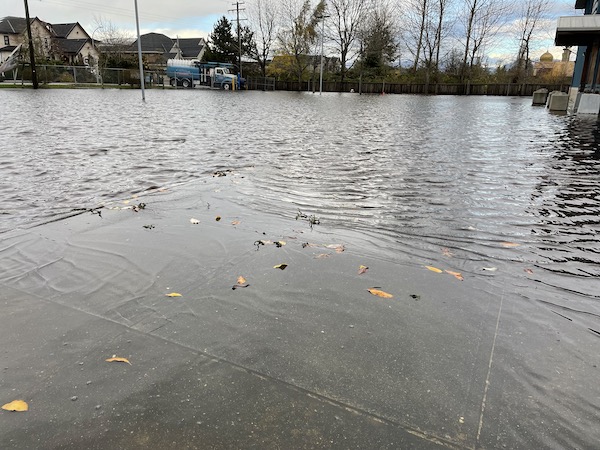
Neighbours provided Richmond Jewish Day School with parking and more when the school’s parking lot and front entrance area flooded. (photos from RJDS)

Last month, amid the heavy rains, Richmond Jewish Day School had to close for two days because its parking lot was flooded. Despite working with city crews and independent contractors to pump out the water, the area still looked like a small lake on the third day – but the school could reopen because of the kindness of its neighbours along No. 5 Road.

photo - Flooded RJDS parking lot RJDS staff and visitors were granted permission to park at the Gurdwara Nanak Niwas temple on the north side of the school building, RJDS principal Sabrina Bhojani told the Independent. On the south side, she said, Subramaniya Swamy Temple allowed the school to use their parking as a pickup and drop-off point, and the gate that joins the two properties was used to access the school building, which was undamaged by the flooding.
Neighbours along the “Highway to Heaven” – called that because of the number and diversity of faith organizations in that stretch of No. 5 Road – come together both at times of adversity and celebration, Bhojani said, and RJDS hosted Celebration of Light on the Highway to Heaven on Dec. 5. The outdoor event was a “communal expression of solidarity in calling out and combating antisemitism and racism,” she said in an email before the event took place.

Invitees included, among others, members of the Christian community, celebrating Christmas; the African community, celebrating Kwanzaa; the Hindi community, who celebrated Diwali in early November; and the Chinese community, who will celebrate Teng Chieh in February.

– Courtesy Richmond Jewish Day School

xwƛ̓əpicən’s fall open house

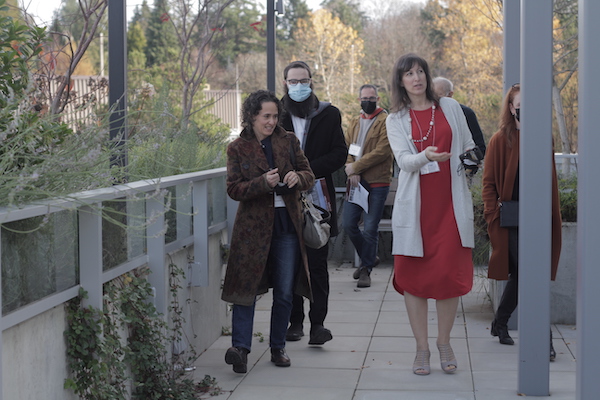
Anat Gogo, manager of programs and donor relations, Tikva Housing Society, leads a tour at the xwƛ̓əpicən (Arbutus Centre) open house Nov. 21. (photo from Tikva Housing)

Tikva Housing Society held an open house at the Arbutus Centre – xwƛ̓əpicən, pronounced “hook la’pitzen”) – on Nov. 21. The name in the Musqueam language means “Hollow,” which represents safety and warmth. Showcased last month were some of the 37 new one-bedroom and studio suites that Tikva Housing operates, providing homes to people in the Jewish community who need affordable, safe and stable housing.

The project is the result of a collaboration between the City of Vancouver, the YWCA, Association of Neighbourhood Houses and Tikva Housing. The building as a whole has 125 new units of affordable homes.

The open house, hosted by Tikva board members and staff, greeted more than 40 people, at various times, to accommodate the COVID-19 protocols. By all accounts, those who participated in the day-long event were “blown away” by the quality and attention to detail of the units, which all include washer and dryers; some are totally accessible for mobility devices such as wheelchairs. There is an amenities room for community gatherings, a central courtyard shared by all tenants and a rooftop patio.

After a process of identifying people who qualified, and then help with “move-ins” over the past two months, all the Tikva units are filled. The society is grateful to the many donors who make its work possible and especially to the Diamond Foundation, who gave Tikva the initial donation to assist with rent subsidies for new tenants, for the first five years.

For more information about Tikva Housing Society, visit tikvahousing.org.

– Courtesy Tikva Housing Society

JFS marks 85 years

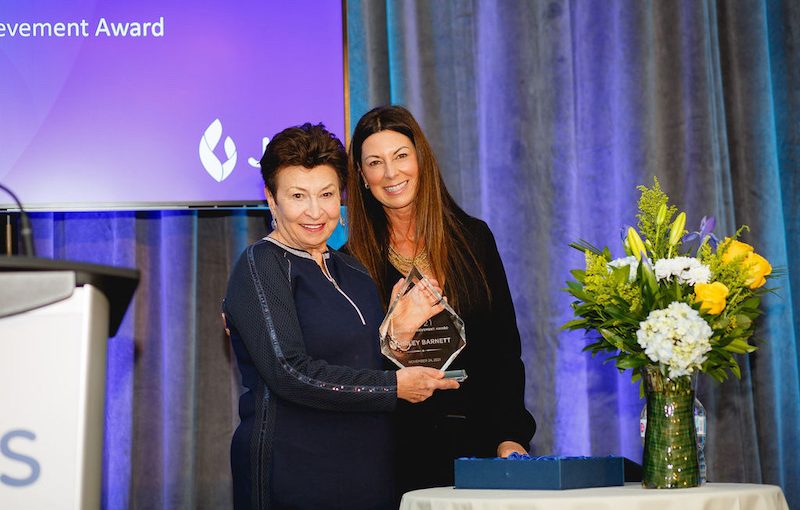
Shirley Barnett holds the JFS Lifetime Achievement Award, which was presented to her by Jody Dales on behalf of the agency. (photo from JFS)

On Nov. 24, Jewish Family Services Vancouver celebrated its 85th anniversary with a mini party at the 110-year-old Heritage Hall on Main Street. It was a fitting occasion and venue to launch the organization’s inaugural Lifetime Achievement Award.

Tanja Demajo, chief executive officer of JFS Vancouver, welcomed guests to the evening’s celebration, which had the theme “SustainAbility: The Power of Local.” Starting off the proceedings was Rabbi Adam Stein of Congregation Beth Israel, who explained some of Judaism’s blessings for the miracles of nature before making a blessing for good health and “for now, a bit less rain,” in recognition of the damage and displacement caused by flooding in the province.

JFS board member Jody Dales then presented the JFS Lifetime Achievement Award, which was established this year, in celebration of the agency’s 85th anniversary. “Its purpose is to honour someone who has demonstrated exceptional leadership over a significant period of time, who has displayed wisdom and depth of service and who has made a [major] difference to the course of our agency,” she said. “The first person who came to mind for this award was Shirley Barnett.”

When Barnett joined the board as president and executive director almost 40 years ago, said Dales, the agency was going through a rough time. Serving on the board – on a volunteer basis – for nearly 15 years, Barnett introduced several new programs, expanded the services available, and increased the fundraising capacity.

In a video about the award, Barnett notes that she joined the board in 1973. She says she was in awe of the older women who were her fellow board members. “We started a newsletter, we started a group of volunteers, we started an employment program, we started an organization that lent people money,” she says, referring to the reestablishment of the Hebrew Free Loan Association.

JFS board chair Bill Kaplan was unable to join the anniversary celebration, but sent remarks that were read by Dales. “JFS is all about service to community and so is Shirley,” he said. “It’s perfectly fitting that she’s honoured on this special birthday because she epitomizes what we strive to be – a difference-maker, uplifting lives in our community.”

Dales spoke of some of the ways in which Barnett has made her a better person, including being a better daughter, community activist and philanthropist, all through Barnett’s example. “I accessorize better because of Shirley,” Dales added, laughing.

On a more serious note, she shared how, on a recent community organization trip to Cuba, while they were having a relaxing moment, Barnett said to Dales, “You know what I’ve learned? I need to laugh more.”

“And that was so incredibly profound, and honest, and vulnerable, and I admire her for being the kind of woman who says things like that very openly,” said Dales.

In accepting the award, Barnett said her connection to JFS began before she was born – her mother’s sister, Sonja (Sara) Victor, was a founder, in 1936, of the organization, then known as the Jewish Family Welfare Bureau of Vancouver.

Barnett shared some of the challenges the Jewish Family Services Agency was facing when she joined them. “We finally hired a remarkable executive director,” she said, referring to Barry Corrin, who was ED for 12 years – “and those years were formative.”

Many of the concerns remain the same today, said Barnett. Food banks and food security, poverty, housing – “these are exactly the same issues we dealt with years ago,” she said.

In addition to honouring Barnett for her service, JFS also recognized several other community members for theirs. Maya Dimapilis, JFS director of development and communications, announced the Community Leader Awards, which went to Michael Cossever, Ewa Gersin, Kerstin Melusin, Laureen Teperson, Sherri Wise, Tamar Bakonyi, Shannon Ezekiel, Candice Thal and Todd Thal. The Community Partner Award was given to the Hebrew Free Loan Association and the Paula Lenga Award for outstanding volunteer service to Stan Shaw.

Keynote speaker Karen Malone, founder of LitPark, a Toronto organization that helps businesses with environmental, social and governance (ESG) solutions, spoke of JFS in the context of sustainability. She lauded the agency for how it has managed to meet the needs of the community for 85 years and counting, operating in an evidently sustainable manner.

Malone framed each of her three main takeaways around the history of JFS, using it as an example of a group that operates according to sound ESG principles, and one that has shown that “small, consistent, local adaptations can add up to significant progress in creating a sustainable future, and they’ve been doing it for 85 years.” From its beginnings, JFS has, among other things, been helping new immigrants integrate into life here, offered employment-finding services and provided programs for seniors who would otherwise be socially isolated. During the pandemic, JFS expanded the food bank into food delivery,  and increased counseling services and housing supports, said Malone.

“It may not have been thought of in 1936 or in the ’60s or ’70s, but this just-in-time response to a change in community has a name: locally led adaptation … [which] recognizes that local communities are best placed to understand their own needs and to develop the most effective solutions.”

Malone’s third main point revolved around the 17 United Nations Sustainable Development Goals, which were adopted in 2015. “The goals encompass a holistic view of sustainable development, recognizing the intersectional nature of poverty alleviation, environmental sustainability, gender equality and systemic justice,” she explained.

She said, “It is inarguable that the challenges faced by the world today are a complicated, interconnected web. Building a sustainable society relies on adopting a holistic approach that embraces this interconnectedness rather than trying to compartmentalize it. JFS has shown they understand this assignment. This is an organization that is deeply connected to its community, that understands that ‘ability’ is the operative part of sustainability – the ability to see the emergent needs of the population it serves and to welcome new populations when they need help, too; the ability to provide just-in-time services in moments of crisis; the ability to learn from a rich history and apply these lessons in new ways to meet modern challenges.”

Who stops the hate?

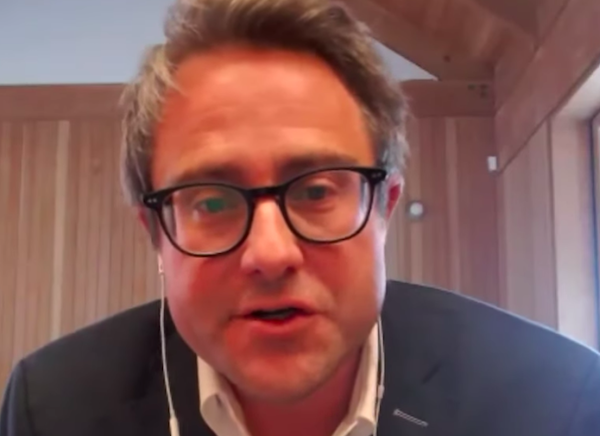
Taylor Owen speaks at the third annual Simces and Rabkin Family Dialogue on Human Rights, Nov. 9. (screenshot)

Canada, like most of the world, is behind in addressing the issue of hate and violence-inciting content online. In attempting to confront this challenge, as the federal government will do with a new bill in this session of Parliament, it will be faced with conundrums around where individual freedom of expression ends and the right of individuals and groups to be free from hateful and threatening content begins.

The ethical riddles presented by the topic were the subject of the third annual Simces and Rabkin Family Dialogue on Human Rights, Nov. 9, in an event titled Is Facebook a Threat to Democracy? A Conversation about Rights in the Digital Age.

The annual dialogue was created by Jewish Vancouverites Zena Simces and her husband Dr. Simon Rabkin. It was presented virtually for the second year in a row, in partnership with the Canadian Museum for Human Rights.

The featured presenter was Taylor Owen, who is the Beaverbrook Chair in Media, Ethics and Communications, the founding director of the Centre for Media, Technology and Democracy, and an associate professor in the Max Bell School of Public Policy at McGill University. He presented in conversation with Jessica Johnson, editor-in-chief of The Walrus magazine.

The advent of the internet was seen as a means to upend the control of a society’s narrative from established media, governments and other centralized powers and disperse it into the hands of anyone with access to a computer and the web. Instead, as the technology has matured, online power has been “re-concentrating” into a small number of online platforms like Facebook, Twitter and YouTube, which now have more global reach and cultural power than any preexisting entity.

“Understanding them and how they work, how they function, what their incentives are, what their benefits are, what their risks are, is really important to democratic society,” said Owen.

These are platforms that make money by selling ads, so it is in their interest to keep the largest number of people on the platform for the longest time possible, all while collecting data about users’ behaviours and interests, Owen said. These demands prioritize content that is among the most divisive and extreme and, therefore, likely to draw and keep audiences engaged.

The sheer volume of posts – in every language on earth – almost defies policing, he said. For example, in response to public and governmental demands that the company address proliferating hate content and other problematic materials, Facebook has increased resources aimed at moderating what people post. However, he said, 90% of the resources dedicated to content moderation on Facebook are focused on the United States, even though 90% of Facebook users are in countries outside of the United States.

A serious problem is that limitations on speech are governed by every country differently, while social media, for the most part, knows no borders.

Canada has a long precedent of speech laws, and Parliament is set to consider a controversial new bill intended to address some of the dangers discussed in the dialogue. But, just as the issues confounded easy answers in the discussion between Owen and Johnson, attempts to codify solutions into law will undoubtedly result in fundamental disagreements over the balancing of various rights.

“Unlike in some countries, hate speech is illegal here,” said Owen. “We have a process for adjudicating and deciding what is hate speech and holding people who spread it liable.”

The United States, on the other hand, has a far more libertarian approach to free expression.

An example of a country attempting to find a middle path is the approach taken by Germany, he said, but that is likely to have unintended consequences. Germany has decreed, and Owen thinks Canada is likely to emulate, a scenario where social media companies are liable for statements that represent already illegal speech – terrorist content, content that incites violence, child exploitative content, nonconsensual sharing of images and incitement to violence.

Beyond these overtly illegal categories is a spectrum of subjectively inappropriate content. A single media platform trying to accommodate different national criteria for acceptability faces a juggling act.

“The United States, for example, prioritizes free speech,” he said. “Germany, clearly, and for understandable historical reasons, prioritizes the right to not be harmed by speech, therefore, this takedown regime. Canada kind of sits in the middle. Our Charter [of Rights and Freedoms] protects both. The concern is that by leaning into this takedown regime model, like Germany, you lead platforms down a path of over-censoring.”

If Facebook or YouTube is threatened with fines as high as, say, five percent of their global revenue if they don’t remove illegal speech within 24 hours, their incentive is to massively over-censor, he said.

Owen said this will have an effect on the bottom line of these companies, just as mandatory seatbelts in cars, legislation to prevent petrochemical companies from polluting waterways and approval regimes governing the pharmaceutical industry added costs to those sectors. Unfortunately, the nuances of free speech and the complexities of legislating it across international boundaries make this an added burden that will probably require vast resources to oversee.

“It’s not like banning smoking … where you either ban it or you allow it and you solve the problem,” said Owen. There are potentially billions of morally ambiguous statements posted online. Who is to adjudicate, even if it is feasible to referee that kind of volume?

Rabkin opened the dialogue, explaining what he and Simces envisioned with the series.

“Our aim is to enhance the understanding and create an opportunity for dialogue on critical human rights issues, with the hope of generating positive actions,” he said.

This year’s presentation, he said, lies at a crucial intersection of competing rights.

“Do we, as a society, through our government, curtail freedom of expression, recognizing that some of today’s unsubstantiated ideas may be tomorrow’s accepted concepts?” he asked. “Unregulated freedom of speech, however, may lead to the promulgation of hate towards vulnerable elements and components of our society, especially our children. Do we constrain surveillance capitalism or do we constrain the capture of our personal data for commercial purposes? Do we allow big tech platforms such as Facebook to regulate themselves and, in so doing, does this threaten our democratic societies? If or when we regulate big tech platforms, who is to do it? And what will be the criteria? And what should be the penalties for violation of the legislation?”

Speaking at the conclusion of the event, Simces acknowledged the difficulty of balancing online harms and safeguarding freedom of expression.

“The issue is, how do we mitigate harm and maximize benefits?” she asked. “While there is no silver bullet, we do need to focus on how technology platforms themselves are structured. Facebook and other platforms often put profits ahead of the safety of people and the public good.… There is a growing recognition that big tech cannot be left to monitor itself.”

The full program can be viewed at humanrights.ca/is-facebook-a-threat-to-democracy.

Two modern-day Maccabees

On Nov. 24, Chabad UBC invited two former Israel Defence Forces soldiers to the Nest on the University of British Columbia campus to speak about their personal stories and life lessons from serving in the army.

Amit Shmuel, a former soldier in the elite Palchan unit, and Matan Roettger, a former soldier in the Kfir Brigade, shared some of their experiences in service; stories of their courage and the sacrifice they made protecting and defending the state of Israel, and especially of their perseverance in the face of suffering and adversity. Both suffered career-ending injuries in the line of duty, and their strength and resilience to mentally and physically recover from their trauma were remarkable.

The two soldiers were at UBC as part of a larger tour of college campuses all across North America, along with Belev Echad, an organization dedicated to providing financial and moral support to IDF veterans wounded in action and to easing their transition back into civilian life.

The local event was sponsored by Hasbara Fellowships, which helps train young student leaders to become Israel ambassadors and activists on campus. As a Hasbara Fellow myself and having firsthand experience in Israel, I found the stories of Shmuel and Roettger to accurately represent the victory of hope over despair, the value of the sanctity of life, freedom and dignity that have been deeply encoded in the fabric of Israeli society and the Jewish community worldwide.

Just as the Maccabees 2,000 years ago rededicated the Second Temple from destruction to restoration, so too did these two modern-day Maccabees rededicate their lives from tragedy to triumph. They inspire us to not focus on what we cannot control, but rather on what we can: to elevate our attitude and response toward life’s misfortunes by sharing with others our light of faith and hope for a brighter future.

Eitan Feiger is a student at the University of British Columbia, class of 2024.

The effects of isolation

How technology can connect people and reduce social isolation was the topic of the Jewish Seniors Alliance’s fall symposium. (photo from pixnio.com)

At the fall symposium of the Jewish Seniors Alliance, which took place on Zoom Nov. 21, attendees heard from experts on the topic Triumphs and Trials Using Technology: Social Isolation Among Older Adults.

Dr. Kristen Haase, assistant professor of applied science at the University of British Columbia School of Nursing, and Dr. Megan O’Connell, professor of geriatric psychology at the University of Saskatchewan, were welcomed by Gyda Chud, co-president of Jewish Seniors Alliance. Chud pointed out that this session related to the key pillars of JSA:

  1. Outreach: to seniors in the community.
  2. Education: we can learn from the professors’ study results.
  3. Peer support: JSA has projects that help combat loneliness and isolation.

Of their study on social isolation among older adults during the pandemic, Haase said they wanted to explore how the inability to interact in person during the pandemic has impacted seniors. She mentioned that two scientific publications – The Lancet and The Journal of the American Medical Association – had commented on the detrimental effect of isolation on seniors. Haase and O’Connell wanted to look at the effects and what could be done to alleviate them.

There is empirical evidence that social isolation impacts mental, physical and cognitive health. Since technology can facilitate social connection, the idea was to train older adults to use these facilities to lessen their isolation. Use of both the telephone and Zoom was embraced by many older adults, and even those people with some cognitive impairment could be trained to use Zoom and other such tools.

Haase and O’Connell reached out to groups and individuals in British Columbia and Saskatchewan for participants. Four hundred individuals and 41 seniors groups were involved in the study, including JSA. Two of the questions were: How did they change their programs? and How did they maintain social connections?

Some groups opted to meet outdoors. The advent of a vaccine helped alleviate some fears. One of the findings was that introverted people, as well as those who lived in rural areas and those who had family nearby, fared better than more extroverted people.

Many community groups rose to the challenge and introduced new technology to their members. In addition to providing training, they also kept in touch with frail members. In rural areas, where broadband access was problematic, groups had to make major use of the telephone. A 1-800 line was purchased to facilitate contact in these areas. These types of disparities in access were highlighted by the pandemic.

A few community groups closed during COVID, but many rose to the occasion by staying in regular contact, providing iPads to clients and helping them learn how to use them.

Haase and O’Connell then turned to the audience for any questions or other information that would help with their research.

One question was how do we find the truly isolated, as we usually rely on people to self-identify if they are in need. The poser of that question, Larry Shapiro, pointed out that, in the United Kingdom, they use the postal service to check on isolated individuals.

Another issue raised was whether groups should continue with a hybrid model of services – this would involve in-person events plus a Zoom possibility. Hybrid models make programming more accessible for those who are ill or who have a disability that impedes mobility. As well, many older adults are still fearful and need help to re-enter society. Funding would be needed to facilitate such programs.

Tammi Belfer thanked the speakers for their research, which was helping improve the lives of older adults.

Shanie Levin is program coordinator for Jewish Seniors Alliance and on the editorial board of Senior Line magazine.

Finding the goddess in the Torah

(photo by Yochi Rappeport)

Rabbi Gila Caine of Edmonton’s Temple Beth Ora was the lead-off speaker in November for Kolot Mayim’s six-part 2021/22 series Building Bridges: Celebrating Diversity in Jewish Life. Her talk, Toratah / Her Torah: Women Rabbis Revealing the Goddess in Torah, looked at the Tanakh (Hebrew Bible) from a less patriarchal perspective.

“It’s not new to have women involved in Jewish life. Women have always been involved in Jewish life in the home and in the family,” Caine began. “The new thing about recent generations is that women are publicly active. That’s a big difference.”

For the last few decades, she said, scholars have gone back into the text and started digging to find hints and remains of ancient goddesses. By goddess, Caine means the “sacred feminine.” The scholars search the texts to see if they can unveil clues, much like archeology, which will allow them to tell different stories than the ones that have already been told.

“It’s not that the researchers find the old stories useless; rather, they see it as just one part of the whole. To expand the story, the researchers pose questions, such as what did women believe in, how did they worship, and what were their lives like and what did God look like to them at that time?” Caine explained. The text is reinterpreted, and turned into commentaries and midrashim. As an example, she introduced the audience to two recent books: Dabri Torah: Israeli Women Interpret the Torah (published this year, in Hebrew) and Torah: A Women’s Commentary (WRJ Press, 2008).

Throughout her talk, Caine wove connections of Asherah, the mother goddess in ancient Semitic religions, to the heroines of the Torah, such as Sarah and Eve (Chava). Asherah is perceived as hiding within the texts. (Asherah, too, was connected to the Tree of Life, which, in images shown during Caine’s presentation, resembled a menorah.)

One midrash highlighted in the talk related to the Binding of Isaac. In it, Sarah goes and spends the night with King Abimelech. She does not sleep with him but still comes back pregnant, leaving Abraham furious. He hears voices telling him he must kill his son. As he raises his hand to slaughter Isaac, suddenly he sees a deer in the bushes.

This is interpreted as the moment of transition into patriarchy. The deer represents the mother goddess who wants to save her son. “As Sarah dies right after the Akedah, she perhaps does so to save her son,” Caine said.

On the subject of Eve, Caine quoted Rabbi Rachel Adler: “the world of patriarchy cries out for mending. A mending world would commit itself to equality and power sharing, to working collectively to fulfil needs and solve problems. Reunited again with the rest of Creation, men and women could learn again to be loving friends as the traditional rabbinic wedding blessing portrays them.”

Caine pointed out that Adler – through her rereading of the text and reinterpreting what a Jewish relationship is about – restructured the Jewish wedding ceremony. She took the Jewish language of covenant into the ceremony and not kinyan, which implies taking ownership, and created a brit avuhim, or lovers’ covenant. (See ritualwell.org/ritual/brit-ahuvim-lovers-covenant.)

Lastly, Caine spoke about a project, led by Israeli-American artist Yael Kanarek, to rewrite and regender the Torah, i.e., a male in the traditional text is now referred to as female and vice versa. Though the story remains the same, there would now be, for example, a female Jacob with 12 daughters and four husbands. “Suddenly, we have a mirror image of Torah,” said Caine. “It’s very interesting to read it and the immense midrash that it creates for Torah, as well as for our own understanding of who is telling the story and who is part of the story.”

When looked at this way, Caine said, new things come up and are discovered in Torah. By finding the sacred feminine in the texts, she said she is able to understand how she relates and could be part of the process of studying Torah.

“It’s part of a larger question of how do we heal our tradition and take a Judaism that seems at times very disconnected from the earth. By being able to access the language of goddess, it has enabled me to reimagine and to rethink how I do ritual and Judaism, and how I do everyday life – that aims not at the goddess at all – and create a Judaism that speaks to us now in our lives today.”

Born and raised in Jerusalem, Caine graduated the Hebrew University with a master’s in contemporary Judaism and received her rabbinic ordination at the Hebrew Union College-Jewish Institute of Religion’s Israeli program in 2011. Her rabbinic thesis explored liturgical, spiritual and ceremonial aspects of birth in Jewish tradition and contemporary practice. Stemming from that, as well as her years as volunteer at a rape crisis centre, she is one of the founders of the Israeli rabbinic women’s group B’not Dinah, creating a female and feminist rabbinic tradition of healing after sexual trauma.

For more information about Beit Toratah visit beittoratah.org. To register for the next Building Bridges lecture, go to kolotmayimreformtemple.com.

Sam Margolis has written for the Globe and Mail, the National Post, UPI and MSNBC.

Community support valued

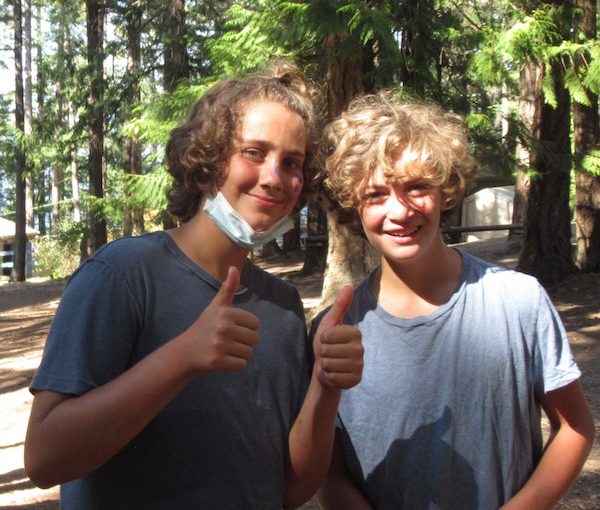
Camp Hatikvah donors are not only helping ensure the quality of the camp but its inclusivity. (photo from Camp Hatikvah)

Camp Hatikvah is well known for its program offerings, as well as its facilities and its spectacular natural setting in the Okanagan Valley. What many people may not know, however, is that the camp is only the place that it is because of community backing. Camper fees cover things like counseling staff, food, insurance and site maintenance. Everything else – including every building and almost every piece of equipment – has been donated by supporters who want to ensure that Camp Hatikvah can continuously improve without passing on the cost of doing so to the young families whose children attend.

Camp Hatikvah was established in 1937. Its donor base understands the unparalleled value and impact of a Jewish camping experience. They know that today’s campers are tomorrow’s Jewish leaders and that a donation is not a gift to just the organization but an investment in the future of the Jewish community.

More than 20% of campers attend Hatikvah’s program with the help of financial assistance and it is estimated that another 25% are on the cusp of needing to do so as well. Donors appreciate that many camp families are struggling with the affordability of Jewish life in Metro Vancouver and want to help control fee increases without the camp having to compromise program growth or site improvements. By funding program enhancements, equipment upgrades or capital improvements, donors are not only helping ensure the quality of the camp but its inclusivity. While summer camps are expensive – and Camp Hatikvah is no exception – it is because of donors that, on a per-day basis, Camp Hatikvah is one of the least expensive Jewish camps in North America.

Donors have also played an instrumental role in getting Camp Hatikvah through the pandemic. Not able to operate in 2020, the camp was facing a financial crisis. Similarly, in 2021, while the camp was allowed to open, it had to dramatically reduce its capacity in order to manage the COVID protocols. The financial toll of both these summers had the potential to financially devastate the organization for years to come. Yet, as they always have, donors stepped in and stepped up immediately – they covered all the financial losses the camp was facing. The level of generosity and support not only got the camp through the financial challenges caused by the pandemic, but also gave the camp a renewed sense of purpose, determination and passion for serving the community.

The board and staff of Camp Hatikvah thank each and every donor who has played a role in helping the camp become – and remain – one of the best Jewish camps. To learn more about the camp’s programs and the donors who make them possible, visit camphatikvah.com. 

– Courtesy Camp Hatikvah

COVID-free camp summers

Camp Miriam offered both day and overnight camping experiences this past summer. (photo from Camp Miriam)

Camp Miriam is celebrating that, for the past two summers, its youth leadership has pulled out all the stops to provide programming for hundreds of campers despite the challenges of the pandemic.

“Coming into June of this year, we were all set to hold Kaytana [day camp] again in Vancouver and Victoria because at that time the provincial health restrictions did not allow overnight camp,” said Leah Levi, the camp’s registrar. “Then, in early June, the health orders changed and we learned that there was the potential to go back to our site on Gabriola Island.”

At that point, the camp – and especially its youth leaders who are responsible for everything from programming to logistics – had a decision to make. Would they continue with the plan they had been working on for months and hold six weeks of day camp, or would they try to quickly pivot and add overnight camp to the program?

“Honestly, if it had been up to the adults on the camp committee, I think we would have stuck with our original plan. The logistics of organizing overnight camp on Gabriola, with only a few weeks’ notice and at a campsite that had been empty for over a year was really overwhelming,” said committee chair Trilby Smith. “Camp needed to be cleaned from top to bottom, there were ferries to book, cooks, medics and lifeguards to hire, food to order and so, so many more details.”

But the young leaders knew that, as great as day camp is, overnight camp was what their campers needed after 18 months of pandemic living. However, they didn’t want to disappoint parents who had already planned for day camp. In the end, they voted to host two weeks of day camp in both Vancouver and Victoria – and three weeks of overnight camp on Gabriola.

The camp committee and many Miriam alumni supported the decision and volunteered hundreds of hours to help get the campsite in shape and assist in all kinds of other ways. In addition, Miriam’s donor community also rushed to help support Jewish camping in 2021.

In the end, 271 kids and 70 youth staff got to experience a COVID-free 73rd summer of “Miriam magic,” in a summer when the magic was needed possibly more than ever.

The effects of the pandemic on youth mental health have been well documented. The Canadian Mental Health Association notes, “Social isolation, removal from school and daily routines, as well as isolation and loss associated with illness are some of the top stressors children are facing.”

This fact was not lost on Miriam’s youth leaders, who reported that both campers and staff arrived at camp this past summer with greater mental health challenges than they had seen in previous years. However, they also saw that, after just 10 days of unplugged, in-person experiences in an inclusive environment, there was a noticeable change for the better in the mood of many campers.

“It was like someone released a pressure valve,” said camp director Marina Levy. “As the campers made friends, processed events going on in the world through our educational programming, and got to just be kids without the constant distraction from their phones and screens, we saw many of them settle and become less anxious.”

Parents noticed a change in their kids, too. One parent who responded to Miriam’s post-summer survey said, “My kid was soooooo excited that there was a sleepover camp this year. It felt like an oasis of near normality in an otherwise dystopian year. She came back so much more relaxed, with strong connections to the kids in their kvutzah [group].”

According to Project L’Chaim’s fall edition of Self-Care for Caregivers, it’s not surprising that camp would provide a balm to its campers and staff. Many of the suggestions offered by mental health experts in the booklet are embedded into Camp Miriam’s programming. For example, Miriam campers are immersed in nature and enjoy daily “forest showers” under the fir and cedar trees on the Gabriola site. They also receive a healthy dose of spirituality and mindfulness, especially through Shabbat and Havdalah traditions.

Finally, the experts say that feeling like you’re a part of something larger than yourself and forming meaningful social connections are keys to good mental health. Above all else, Camp Miriam prides itself on its focus on inclusion, community and tikkun olam – all of which contribute to many campers reporting that they have made lifelong friends at camp and that they feel more comfortable being themselves at Miriam than they do anywhere else in their lives.

Levy knows the respite of camp will not solve all the pandemic-related mental health challenges facing youth, but she believes it’s a start. “And, hopefully, next summer will be even more normal,” she said.

Apparently, many families are hoping the same. Miriam’s registration, which just opened last month, is already almost full. Anyone hoping to register their children for Camp Miriam’s 2022 session can get more details at campmiriam.org. To learn more about Miriam’s 2021 summer, the camp’s newly released annual report is also available on the website.

Vancouver-based writer Kelley Korbin is a Camp Miriam alum and Camp Committee member.

Seven summer camp benefits

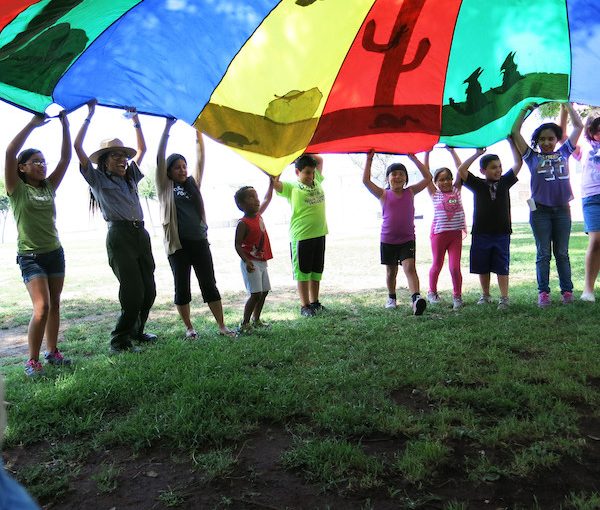
(photo from flickr)

There’s a single destination that gets kids outside having fun, experts say, while teaching them lifelong skills. It’s called camp.

The benefits of camp are plenty, from life lessons beyond the classroom and the value of playtime to appreciating nature and building confidence and leadership skills.

“The major changes in [campers’] growth speaks tremendously of the summer camp experience,” said Troy Glover, the director of the University of Waterloo’s Healthy Communities Research Network.

Glover spearheaded the Canadian Summer Camp Research Project, a nationwide study on the effects of camp on kids. The results demonstrated that for “bubble-wrapped” youth who have been over-programmed and overprotected, camp provides a safe environment to freely learn, grow and develop their capabilities. Summer camp, according to the study, fosters emotional intelligence (or EQ), self-confidence, independence, healthy living, environmental awareness, learning, leadership and other skills that prove beneficial long into adulthood.

The core benefits of camp include building friendships and social skills; developing resiliency and confidence; becoming and staying physical; overcoming nature deficit disorder; learning the values of leadership; continuing education in the summer; and carving time for “active play.”

 Friendships & social skills

It may seem scary at first to enter a whole new social world at camp. However, camp offers a crash course on meeting new people – helping children build social skills, explore their independence and improve their self-esteem, said Stephen Fine, research chair for the Ontario Camps Association. “Teamwork, cooperation and negotiation are inherent to the camp experience,” Fine explained. “Kids’ confidence levels and their ability to be in social situations increase.”

At camp, children boost their self-esteem and develop risk-taking and conflict-resolution skills as they learn to make their own decisions without their parents’ help.

Camp provides children with a “blank slate,” allowing them to try on different behaviours and identities. And the relatively short duration of a camp session decreases the cost of making mistakes.

One of the Canadian Summer Camp Research Project’s most significant findings was in the area of emotional intelligence, often referred to as EQ (emotional quotient). With EQ, which involves recognizing, understanding and managing emotions, children learn how to work, play, relate, get along, empathize and connect with others.

“It’s not just about IQ in children,” Glover said. “Research supports how EQ is more important in terms of future success…. This is an essential component of the maturation process and a skill that camp is successfully developing.”

Resiliency & confidence

Saturated with 24-hour news highlighting crimes in their communities, many parents today are overprotective of their children, “bubble-wrapping” them in order to keep them safe and sheltered. While Glover said it’s safer now, statistically, than it was when he was a child, parents are not as willing to let their kids out of their sight.

At camp, children are encouraged to go outside their comfort zone through activities such as high ropes courses, dramatic and musical performances, or wilderness camping. By allowing children to take risks and face challenges, camp helps children build their independence, resiliency, and self-esteem in a safe, supervised and supportive environment, the study found.

These invaluable life skills often translate into improvements at home and at school, said Mike Pearse, director of Camp Tawingo, a traditional overnight camp in Muskoka, Ont.

Pearse said the camp experience can be divided into the hard skills – for example, learning how to paddle a canoe, tie a knot, identify an edible plant and play a team sport – and accompanying soft skills, such as perseverance, creativity, responsibility and courage.

“At camp, every child has an opportunity to succeed,” he said.

This translates into increased self-confidence and, in many cases, an improved school experience. “I’ve had parents come to me and say, ‘My child is doing so much better in math class this year because of the confidence boost he got from camp,’” Pearse said.

Becoming & staying physical

With video games, Facebook and smartphones all vying for a young person’s attention, the national epidemic of obesity and inactivity won’t be easy to overcome. One Statistics Canada study found that only seven percent of youth aged 6 to 19 got the recommended hour a day of exercise they need.

Enter summer camp, where physical activity is well disguised in the form of fun and games, allowing youth to adopt a healthy lifestyle, often without even realizing it.

“Our study found that campers’ attitudes toward physical activity really improved toward the end of the camping session,” Glover said. “When given a choice, these campers will now choose physical activity because they realize it makes them feel good and contributes to their well-being.”

Along with banning the use of electronics, many camps provide a daily routine that involves waking up early, getting lots of physical activity, eating regular meals and spending extended periods of time outdoors.

“At camp, you’re always on your feet, always on the move, even if you’re just walking to a meal,” Glover said. “So, it’s not about forcing kids to spend 20 minutes on a treadmill, but rather easing them into an active lifestyle that includes lots of walking, engaging in team sports and playing outside with other kids.”

Nature deficit disorder

A bond with nature is sorely missing in the lives of many children today unlike a generation ago, Richard Louv writes in his book Last Child in the Woods: Saving Our Children from Nature-Deficit Disorder. It’s a world where kids may be all too aware of environmental problems, yet rarely venture out to experience the natural world, he writes.

“Camps have their own pressures, but the healing quality of nature is always there, just beyond the screen door,” Louv said.

At camp, kids are given the opportunity to see what they’re missing, and form lifelong bonds and connections with the natural world they may have never experienced before. “Even camps in the city usually have an outdoor dimension to them,” said Glover.

“Children need nature for the healthy development of their senses and, therefore, for learning and creativity,” Louv added.

Values of leadership

A leader isn’t always the loudest person in a group, or the most active. Many leaders share a range of skills and qualities that help him or her take charge: confidence, creativity in their decision-making and an understanding of teamwork, to name a few. It takes practise to become a good leader, too.

That’s where camp comes in, said Moira MacDougall, who heads teen and young adult strategies for the YMCA of Greater Toronto, a charity providing community support programs. Camp helps gradually build leadership skills, MacDougall said.

“You’re often having to rely on your teammates or cabinmates to complete an activity,” said MacDougall. “That builds in-group bonding and, in that process, what you hope the young person’s learning is either to have some voice within that group … or how to be persuasive.”

According to the Canadian Summer Camp Research Project, most campers demonstrated an increase in emotional intelligence and self-confidence, both characteristics attributed to good leaders.

As campers enter their teenage years, there are more opportunities to obtain explicit leadership skills. Most camps offer an LIT (leader-in-training) or CIT (counselor-in-training) program that walks young people through the skills they need to plan activities and programs, care for younger campers and communicate effectively.

Whether it’s by cleaning their cabins without being asked, helping younger campers find their way to the dining hall, or contributing their talents to a play or talent show, youth of all ages learn to take initiative at camp.

Learning how to take the lead essentially teaches youth how to be good citizens. “They learn that we all have a role to play to contribute to a better society, and nothing happens if you sit back and wait for someone else to act,” said Glover.

Continuing education

“It’s not only cognitive learning, it’s emotional learning,” said Tom Potter, associate professor at Lakehead University in Thunder Bay, Ont. Potter has been involved in outdoor adventure education for more than 30 years.

Camp is the kind of place where children can learn canoeing, archery, life skills such as teamwork, and apply the lessons they learned during the school year in many enjoyable activities. Geocaching lessons offered at some camps, for example, teach kids scientific and math skills.

“They’re getting instant and immediate feedback, so if they do something well, they’ll get feedback; if they’re sailing a sailboat and it’s going in the right direction, they’ll get feedback on that,” Potter said. “But if the boat turns upside down, that’s OK … it’s all part of it.”

Time for “active play”

Many children today simply don’t get enough of unstructured playtime. “If you look at time in school, time at home, time watching TV, those things have either stayed consistent or gone up,” said Michelle Brownrigg, chief executive of Active Healthy Kids Canada. “But active playtime has decreased.”

Canadian children are reportedly spending an average of four to six hours a day with TVs, computers and cellphones.

Camp gives children the playtime they need while encouraging creativity and social engagement. Play not only offers children the tools to entertain themselves, it also builds their imagination.

“Kids learn to set their own boundaries, to develop in an environment that’s not necessarily focused on a competitive end, to interact with one another, to determine how to win and lose, and to trade roles and be involved in an active way with their peers,” she said.

This article is a shortened version of the original, which is ourkids.net/camp/benefits-of-summer-camp.php.