Happy Purim!

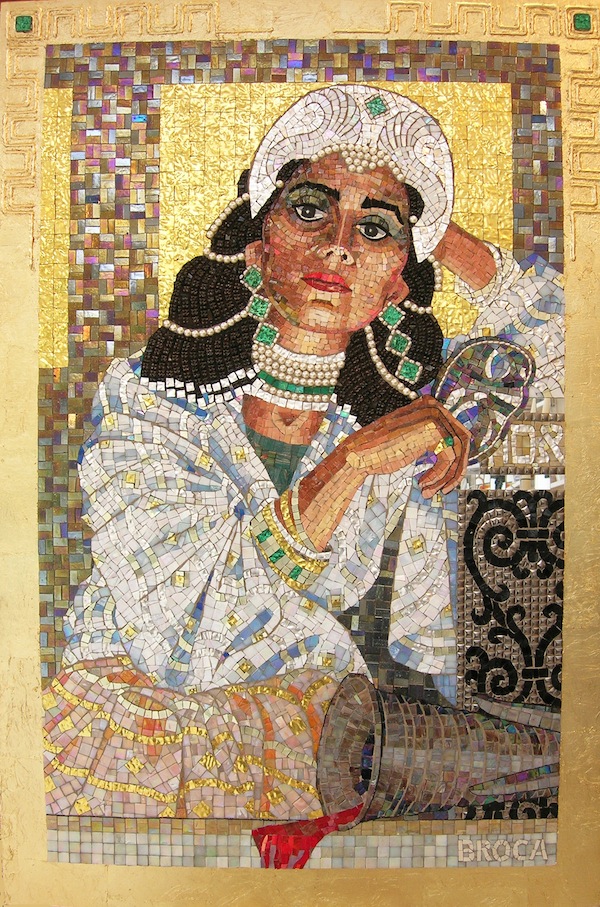
“Queen Esther Revealing Her True Identity” by Lilian Broca.

“Queen Esther Revealing Her True Identity” by Lilian Broca
“Queen Esther Revealing Her True Identity” by Lilian Broca.

“Queen Esther Revealing Her True Identity” is the last mosaic of artist Lilian Broca’s Queen Esther Mosaics Series in chronological order. A mature and confident Queen Esther in her most expensive and beautiful attire is removing the mask – the symbol of her secret identity – revealing an intelligent and self-assured leader. On the table, a rhyton (Persian gold or silver drinking vessel) is knocked over, spilling its red wine contents; the wine symbolizing the spilled blood of the Hebrew people as planned by Haman. The plotted genocide is now averted, however, through Queen Esther’s disclosure to her husband, King Ahasuerus, of Haman’s evil design. In this mosaic, Broca notes that it is her intention to “iconize” Queen Esther as a paragon of supreme leadership, loyalty, wisdom and vision. In a patriarchal society, this unique female figure succeeded in bringing peace through accommodation, cooperation and negotiation. Her hero status enables her to become a role model for all women, then and now.

For more information on Broca and her art, visit lilianbroca.com.

בעידן המגפה הקשה

את הלוויות של אבי ראיתי עם עוד מספר בני משפחה וחברים באמצעות “הזום” בשעה שתיים לפנות בוקר לפי שעון ונקובר.

הפעם הרגשתי מקרוב את הנזקים האיומים שמגיפת הקורונה עושה לנו, לחיינו, לקרובים כמו גם לרחוקים. אבי, משה רחמני, בן התשעים ואחד נדבק בנגיף בבית החולים איכילוב שבתל אביב, ולאחר פחות משבועיים נפטר מסיבוכים קשים. אני לצערי לא הצלחתי לעזוב את ונקובר והגיע להלוויתו שהתקיימה ביום ראשון האחרון, בבית הקברות האזרחי של קריית ענבים, בגלל שקשה מאוד לטוס מכאן בעת הזו. לפחות שתיים-שלוש עצירות בדרך ואני הייתי צריך לקבל בנוסף אישור מיוחד ממשלת ישראל להגיע להלוויה. לאחר מכן היה עלי להיכנס לסגר באיזה שהיא מלונית בישראל למשך כשבועיים ימים. ובחזרה לקנדה הייתי צריך לעבור הליך סיוטי דומה. החלטנו לכן במשפחתי שלא אטוס. זו היתה החלטה קשה אך מתבקשת בימים אלה.

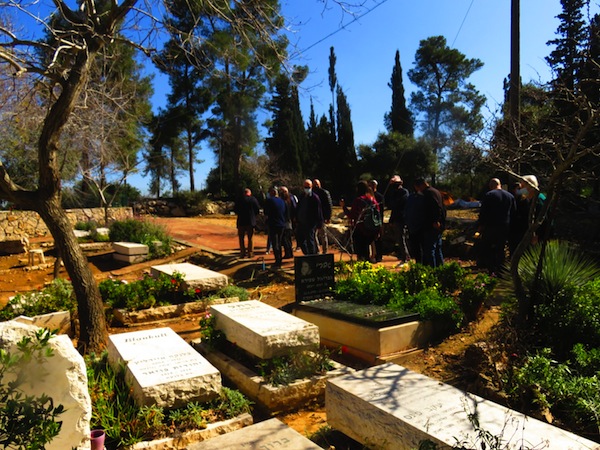
את הלוויות של אבי ראיתי עם עוד מספר בני משפחה וחברים באמצעות “הזום” בשעה שתיים לפנות בוקר לפי שעון ונקובר. בקריית ענבים השעה הייתה שתיים עשרה בצהרים, וכארבעים איש הורשו להגיע לבית הקברות, בראשות אמי, לוצי רחמני שגם היא בת תשעים ואחת, ואחי, אמיר רחמני, שניהל את הטקס הקשה הזה. זה לא פשוט לראות איך קוברים את אבא שלך כל כך מרחוק – באמצעות הטכנולוגיה המתקדמת, במקום פשוט להשתתף בטקס צנוע עם חברי משפחה וחברים קרובים. זה מאוד מוזר ויוצר הרגשה של ניכור ומרחק המאוד אופיינית לעידן מגיפת הקורונה, ששינתה את חיינו לחלוטין.

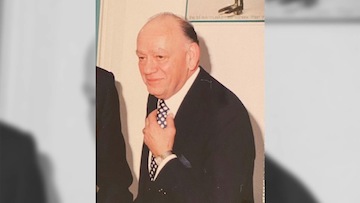
photo - My father, Moshe Rahmani, ninety-one years old, contracted the virus at Ichilov Hospital in Tel Aviv, and after less than two weeks died of serious complications
אבי, משה רחמני, בן התשעים ואחד נדבק בנגיף בבית החולים איכילוב שבתל אביב, ולאחר פחות משבועיים נפטר מסיבוכים קשים

אני נפגשתי עם אבי לאחרונה רק לפני קרוב לשנה. היה זה בחודש מארס אשתקד, שבוע לפני שקנדה הכריזה על סגר לאור המגפה שהחלה לתפוס תאוצה בכל רחבי העולם. הגעתי לישראל למספר ימים כדי לפגוש את הורי בביתם בתל אביב. הם חששו קצת מהחלטתי לטוס כי אולי אני אדבק ואז גם אסכן אותם. הביקור עבר בשלום ובשלווה. הספקתי לשבת עם הורי ערב ערב ולשוחח שעות על שלל נושאים. אחרי שבוע טסתי בחזרה לוונקובר ולא ידעתי אז (כמובן) שאלו יהיו הפגישות האחרונות שלי עם אבי.

אבי נולד בירושלים. הוא גדל בבית דתי אך כבר כתלמיד תיכון החליט לבחור בדרך אחרת – חילונית. אמי ילידת אוסטריה הגיעה עם משפחתה לישראל עת הייתה בת שמונה. תחילה לנהלל ולאחר מכן המשפחה התיישבה בירושלים. הורי הכירו איפוא בירושלים ולאחר שלוש שנות חברות התחתנו ונשארו ביחד למשך שבעים שנה עד למועד פטירתו של אבי. הם הספיקו לגדל את אחי ואותי בביתם ברחוב המלך ג’ורג’ שבמרכז העיר. לאחר שעזבנו את הבית, הורי עברו לשכונת בית הכרם. לבסוף הם מאסו בירושלים ולפני כשבע עשרה שנה עזרו אומץ ועברו לתל אביב ופתחו בחיים חדשים.

אבי עבד כל חייו בתחום הביטוח בתקופת מגוריו בירושלים. הוא יצא לפנסיה עם המעבר לתל אביב. בעת שגר בירושלים נחשב לאוהד שרוף של קבוצת הכדורגל בית”ר ירושלים, וצפה במשחקים רבים מהיציעים במגרשי הכדורגל ברחבי הארץ. בשנות השמונים המיר את המגרשים בטלוויזיה ועד לאחרונה צפה במרבית המשחקים של בית”ר.

אבא נחלש בתקופה האחרונה ולפני שלושה שבועות הוא אושפז לטיפול מאסיבי בבית החולים איכילוב. שם לתדהמת כולנו נדבק בקורונה ומטבע הדברים מצבו החמיר מיום ליום. אמי, אחי ושתיים מהנכדות הספיקו לבקר אותו יום לפני מותו. התמונה הייתה קשה מנשוא. עכשיו הוא לא סובל יותר.

היום אני יכול להביו היטב את המשפחות שאיבדו את יקיריהם שנדבקו בקורונה.

COVID relief delivered

Alex Cristall, Jewish Federation of Greater Vancouver board chair, arrived early at the Jewish Community Centre of Greater Vancouver on Jan. 26 to sign community recovery cheques for grant recipients. (photo by Rob Trendiak)

On Jan. 26, the Jewish Federation of Greater Vancouver released the first round of community recovery funding to address the urgent needs arising from the pandemic’s impacts. A total of $416,000 in grants was distributed among 21 partner agencies and community organizations.

“When COVID first hit, we immediately developed a comprehensive strategic approach to address its impact,” Ezra Shanken, chief executive officer of Jewish Federation, told the Independent. “We met with our partner agencies to learn firsthand about how they were coping, and we released $505,000 in emergency funding just days into the initial lockdown.

“We then worked closely with major donors to launch the Community Recovery Fund, which became a key focus of the annual campaign. We also established the Community Recovery Task Force, comprised of well-respected and experienced community leaders, to work with us to respond effectively to the immediate and long-term consequences of COVID that are affecting our community agencies. During the annual campaign, we asked donors to make an additional gift to support community recovery, if they could.

“We have always been fortunate to have an extremely generous community, and the depth of giving this year has been extraordinary,” he said. “Community members have responded to the call to help in unparalleled ways, however they can. They understand the breadth and scope of need, the immense challenges facing organizations, individuals and families, and that recovery will take some time. Most of all, they appreciate that we are all partners in recovery, and have really stepped up to play their part.”

The initial relief grants were distributed to 19 of Jewish Federation’s partner agencies, as well as to the Louis Brier Home and Hospital and the Hebrew Free Loan Association.

“For the first round of grants, all Jewish community organizations were invited to apply for up to $25,000, regardless of their size,” explained Risa Levine, chair of the Community Recovery Task Force. “Our priority was to meet organizations’ urgent needs resulting from the pandemic, and to ensure they could continue to deliver their programs and services. In the next few weeks, as part of this initial round of funding, we will be recommending grants for synagogues and other places of worship. These grants will be awarded in late February.

“The task force expects the two rounds of funding after that will focus on longer-term needs,” she said. “For example, are there organizational changes that would substantially increase an agency’s capacity to deliver their programs? We also recognize that the pandemic has gone on longer than anyone anticipated, and that the uncertainty of what lies ahead continues. New needs may emerge and COVID-related government subsidies, which have helped a lot of our agencies, may end. So, ensuring organizations’ ongoing sustainability in the face of pressures created by the pandemic will continue to be a priority.”

When the task force met with community organizations last summer and fall, the focus was on understanding how the pandemic had affected the programs and services they offer. While the details differed, said Levine, “they all had been impacted by COVID in similar ways.

“Based on this information, the task force identified six themes, which ultimately became funding categories for the recovery grant application: technology upgrades; critical social services; COVID-related expenses; revenue and rental losses; mental health support for staff and community members; and organizational capacity. Community organizations were invited to apply for a grant to meet urgent, COVID-related needs in two of these six categories.”

The recovery grants comprise but one of three funding streams being distributed in the next couple of months. Other financial assistance will come from the Jewish Community Foundation’s Unrestricted Grant Program, and allocations from the Federation’s annual campaign.

“The Jewish Community Foundation’s Unrestricted Grant Program is designed to complement Jewish Federation’s annual campaign allocations by providing charitable organizations with seed money to support new, innovative programs and services,” explained Shanken.

Grants awarded through the program “give charitable organizations the opportunity to pilot initiatives that address the community’s evolving needs, or to launch startup and capital projects,” he said. “Once the programs demonstrate success over several years, they may then qualify for ongoing funding through Jewish Federation’s allocations.

“This year,” he added, “the foundation adapted some conditions of the program to be as responsive as possible to organizations challenged to deliver their programs and services in new and innovative ways. In this way, the Unrestricted Grant Program is complementing the work of Jewish Federation’s Community Recovery Task Force, which has identified areas of critical need through its consultation process with community organizations.”

The Unrestricted Grant Program funds for 2021 will be awarded in mid-February.

“Jewish Federation has always been proactive and strategic about preparing for crises, so that we can lead a coordinated community response,” said Shanken. “And, while this is unlike anything the community has ever been through, we are in a strong position to respond. We have in place the infrastructure, the community planning expertise, and the staff and team of experienced leaders needed to respond swiftly and effectively to the enormity and ongoing uncertainty of COVID’s impact.

“We know how vital it is to get funds working in the community, and this involves so much more than fundraising,” he noted. “As the pandemic evolves, we will continue to adapt our strategic approach so that we are well-positioned for today and tomorrow, and to convene with all of our stakeholders so that we have our finger on the pulse of the community and can problem-solve together. We’re also collaborating with Jewish federations across North America to leverage their collective knowledge and capacity.”

Levine acknowledged the board and staff of our local Jewish Federation “for their vision and professionalism in organizing the task force and leading the recovery process, as well as the many generous donors who have supported this crucial work.”

She said, “I have been inspired and buoyed by the commitment and passion of everyone involved in the task force’s work to ensure that our community continues to function effectively: by the task force members for their dedication to the work, and by the community organizations for their candour and resilience in adapting their operations to meet the needs of community members.

“The biggest challenge,” she said, “has been to focus and refine our work to be able to respond effectively to the needs we learned about. Hearing firsthand about the challenges that organizations faced revealed the enormity of COVID’s impact through a sharper, more personal lens that added another layer of urgency to our work.”

Despite the challenges, Shanken said, “I remain positive because of the tremendous fortitude and the outpouring of compassion and generosity that I see every day. I am incredibly proud of how this community has pulled together to tackle the road to recovery, and am convinced that we will emerge stronger.”

For more information, visit jewishvancouver.com.

Jewish film fest runs in March

Niv Nissim, left, and John Benjamin Hickey co-star in Sublet, one of the Vancouver Jewish Film Festival’s many offerings this year. (photo from facebook.com/subletfilm)

The Vancouver Jewish Film Festival will take place exclusively online March 4-14. And, while you might think that COVID’s continued presence would necessitate a trimmed-down festival lineup, there are as many high-quality and diverse films being offered this year as in previous years. We give JI readers a small teaser of what’s to come, with more reviews in our next issue.

Sublet explores divides

In the film Sublet, a New York Times travel writer whose shtick is to get a feel for a city in just five days arrives in Tel Aviv. Michael (John Benjamin Hickey) has booked the apartment of film student Tomer (Niv Nissim) but, realizing the student has nowhere to go, the pair end up as temporary roommates.

The somewhat uptight middle-aged Ashkenazi American, standing out like a sore thumb in his semi-casual blazer, is contrasted with the hot-tempered, in-your-face young Sabra. The differences between the two men – and, by extension, between two generations of Jews, of gay (or, in Tomer’s case, possibly bisexual) men, of Israelis and Diaspora Jews – form the heart of the leisurely paced film. Just as Tomer ridicules Michael’s touristy ideas of Tel Aviv’s highlights, the cinematography captures the city at some of its grittiest best.

Is it a generational divide or a cultural one that has Tomer and Michael adopting wildly different sensibilities toward the tragedies of recent Jewish history and the experiences of gay men in the AIDS crisis, which Michael’s first book explored?

“It’s so depressing,” Tomer says of the AIDS pandemic. “Why does everything always have to go back to that?”

A more stark response – and one that is darkly humorous but startlingly confusing to Michael and perhaps many viewers – comes when one of Tomer’s friends is discussing fleeing Tel Aviv for a more successful artistic life in Berlin.

“It’s a bit odd that you’re moving to Germany, the place that symbolizes Jewish tragedy,” Michael observes. The Israeli pair pauses for a moment, then burst into hysterical laughter.

“Berlin’s, like, the coolest place,” Tomer assures Michael.

The theme of patrimony runs through the drama. Michael and his partner are struggling to find a surrogate for a baby they want to parent. Tomer, it turns out, is himself the product of a mother who chose the path of artificial insemination. Michael is wondering if he is getting too old to start afresh as a father. Tomer, in his clumsy way, may be struggling with the absence of his own paternal influences.

The bonds and divisions between generations, between conceptions of the past, between Israel and exile are explored but unresolved in this pleasant (if sometimes PG) film. The brief glimpse of Tomer’s hilariously awful horror film is just a bonus.

A shiva from hell

photo - In Shiva Baby, Danielle (Rachel Sennott) gets her comeuppance.
In Shiva Baby, Danielle (Rachel Sennott) gets her comeuppance. (photo from tiff.net/events/shiva-baby)

When her parents browbeat her into attending a shiva, Danielle does not expect to run into Maya. The two young women have an entwined past, so much so that other attendees can’t remember which one is which. The film Shiva Baby quickly turns into a subtly riotous adventure in the joys and drawbacks of tight-knit communities and the challenges of keeping secrets in a yenta-intensive environment.

Though their shared history is a source of immense awkwardness and brilliantly snarky sparring, for Danielle (Rachel Sennott), this shiva is a house of horrors. Having told so many lies to cover her failure to launch successfully into adulthood, every turn, every new face at the shiva, is an opportunity for sequential interrogations and fresh humiliation. It becomes an unintentional parlour game to piece together the variety of stories Danielle has told of changing majors, areas of specialization and plans for the future. Family, friends and acquaintances compare conflicting tales Danielle has woven over the years, creating an elaborate narrative of mostly imagined endeavours.

Her parents Debbie (Polly Draper) and Joel (Fred Melamed) seem both oblivious dupes and co-conspirators in Danielle’s web of deceptions. The loving but exasperatingly overbearing parents add to their daughter’s discomfort time and again, leading to an understated climax that literally shoves Danielle’s bad choices in her own face.

This “comedy of discomfort” is a masterpiece of interfering adults and world-weary youth. The unifying bond between generations is a shared art for the backhanded compliment and straight-up insults. After Danielle spills coffee all over herself and a friend’s baby, her mother offers solace: “Well, thank God Sheila’s coffee is always lukewarm.”

Shiva Baby, a Canadian-American co-production, features a musical score that amusingly invokes the horror genre to emphasize the nightmare scenario in which Danielle finds herself, almost exclusively of her own design. Any awkwardness on the part of the viewer is alleviated by schadenfreude that whatever she has coming is probably well overdue.

For tickets to the festival, visit vjff.org.

Novel journeys shared

Ilana Masad participates in the Cherie Smith JCC Jewish Book Festival on Feb. 23. (photo from the JBF)

Women are at the forefront of two new books. Specifically, how we perceive their (our) roles. Especially, with regard to motherhood.

photo - Myriam Steinberg participates in the Cherie Smith JCC Jewish Book Festival on Feb. 24
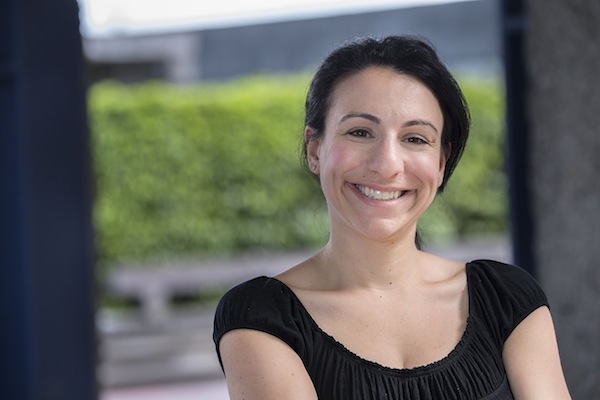
Myriam Steinberg participates in the Cherie Smith JCC Jewish Book Festival on Feb. 24. (photo from the JBF)

Ilana Masad’s debut novel, All My Mother’s Lovers, is told from the perspectives of a daughter and her mother, and highlights how much we cannot know about the people close to us, while Myriam Steinberg’s graphic novel, Catalogue Baby: A Memoir of Infertility, is a no holds barred sharing of her challenge to become a mom. Both Masad and Steinberg are participating in this year’s Cherie Smith JCC Jewish Book Festival, which takes place online Feb. 20-25.

While the premise is a stretch to my worldview, All My Mother’s Lovers is an extremely relatable read on many levels. Twenty-something Maggie’s mother, Iris, dies in a car crash and Maggie must return home for the funeral and shiva. But, along with her will, Iris has left behind six letters – all addressed to men Maggie hasn’t heard of – and Maggie quickly flees the communal mourning to deliver these missives.

Leaving behind her grief-addled father, who has been the emotional-support parent for her, and her younger brother, with whom she has an older-sister-bossy relationship, Maggie attempts to track down the unknown men. The space from her family and from her current partner, with whom there might actually be a substantial, meaningful relationship brewing, allows Maggie to deal with her long-held insecurities and naïve perceptions of what it means to be married, what it means to be a parent; basically, what it means to be a loving and reliable person. We get to know Iris through the letters and, though Maggie doesn’t get to benefit from these personal musings, she does learn more about her mom, which allows her to connect more deeply with her father, as well as to others in her life.

image - All My Mother’s Lovers book coverMasad’s writing is crisp, intelligent, wry and sensitive. The novel starts with a bang – Maggie answering her brother’s call (telling her about their mother’s death) while having sex with her girlfriend. The pace emphasizes Maggie’s confusion as she tries to understand her mother, and herself. Iris’s letters offer slower moments of reflection, but also were a way for Iris to try and better understand her own missteps and successes.

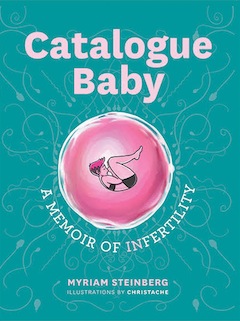
Steinberg’s Catalogue Baby also took me into a world I’ve never personally experienced, though I do know people who have so wanted to have a child but either could not conceive or had great difficulty conceiving. Steinberg’s refreshing openness on a topic that is often spoken about in whispers, if at all, is most welcome. And her voice is amplified by the colour-bursting, energetic and imaginative illustrations by Christache Ross, which take readers right close up into the physical and emotional upheaval and turmoil that Steinberg has lived.

image - Catalogue Baby book coverCatalogue Baby takes readers from Year One (starting January 2014), and Steinberg’s admission that her dedication to work, organizing the In the House Festival for 11 years, only occasionally gave her the time to put her “loneliness and unrequited motherhood” front of mind. Almost 40 years old at this point, she “didn’t have time to waste with someone who didn’t eventually want a family.” But, people being who we are, Steinberg nonetheless tries to make an unsatisfying relationship work, all while her biological clock (which follows her throughout the novel’s journey) ticked away. From when she finally decides to go it alone to when she gives birth to twins in late 2018, she goes through much. The list includes 123 blood draws, 31 ultrasounds, multiple fertility treatments, five pregnancies, thousands of supplements, about $100,000, help from dozens of family and friends, etc., etc. – and “25 litres of tears.”

To hear more about and from Steinberg, Masad and many other fabulous writers, check out this year’s Jewish Book Festival: jccgv.com/jewish-book-festival.

What makes people happy?

Simon Fraser University Prof. Lara Aknin (photo from SFU Communications & Marketing)

There are several paths to finding happiness, according to Prof. Laura Aknin. “But a central theme that rises above the rest is that a lot of happiness comes from our relationships with other people, and how we help and give to others.”

Aknin will deliver the talk A Reality Check, for Good: A Talk on Happiness via Zoom on Feb. 22.

“Guest speaker Lara Aknin is a distinguished associate professor of psychology at Simon Fraser University, and director of the Helping and Happiness Social Psychology Lab at SFU,” said Rabbi Yechiel Baitelman, director of Chabad Richmond. Born and educated in Vancouver, Aknin became interested in social psychology and human emotions while studying as an undergrad and graduate student at the University of British Columbia. According to Aknin, “Human emotions colour our existence, and bring meaning to a lot of what we do.”

Among Aknin’s research interests are well-being, happiness, social relationships, prosocial behaviour and altruism. She established the Helping and Happiness Social Psychology Lab, which studies the predictors of happiness and what makes people happy, the emotional consequences of kind and generous behaviour, and the well-being outcomes of specific spending choices. The lab also looks at how people can increase their happiness.

“Happiness is broadly universal, yet religious people tend to report higher levels of happiness,” said Aknin, when asked how happiness relates to Judaism. “One of the major lessons emerging from our helping and happiness lab and our study of well-being is that it’s not just what we do for ourselves, it’s what we do for others. When we help others and give to others, that’s when we find happiness.”

While not overtly connected, it appears that happiness aligns with Judaism’s emphasis on giving tzedakah and doing mitzvot.

“Helping others is a pretty clear and reliable path to experiencing greater well-being,” confirmed Aknin.

While acknowledging that religion is not her specific area of research, Aknin said, “The notion, or central message that giving to others, whether it be G-d or other people in your community or beyond is a meaningful source of finding joy, reward, value and meaning in life, is certainly aligned with the evidence in the literature.”

A fundamental concept in Judaism is the importance of serving G-d with joy.

“The emotional rewards of giving are a psychological universal, not just particular to the Jewish faith, but it might align with many of the teachings of the Jewish faith and others,” said Aknin. “Researchers see this not just in North America, but in rich and poor countries around the globe. We see it in kids under the age of 2 … we see it in ex-offenders. People experience emotional rewards when they engage in kind behaviour. Many religious principles regularly espouse the value and virtue of giving to others … these ideas have been around for centuries, but the evidence is now documenting the importance of this.”

The topic of helping and happiness resonates with people.

“At some level,” said Aknin, “our intuition says that giving to others is emotionally rewarding but, in real life, people are spending more on themselves – out of necessity, for things like paying their bills, [but] we often overlook opportunities [to give] and would be better off spending the money in our pocket on someone else, rather than on an extra coffee.”

Is it always about our own sense of well-being or is happiness a byproduct of something more altruistic? Is it selfish, for example, to donate clothes to a homeless shelter because it makes us feel good? Is it wrong to have a sense of well-being when we give to others?

“Those questions are central to the work that I do,” Aknin said. “It’s important to distinguish what the motives are for giving in the first place, versus how do you feel afterwards. There’s no question that there are emotional benefits for the giver, and that donating one’s time or money to others promotes well-being and increases life satisfaction. Sometimes, people give to feel good but, by and large, people are giving because they think it’s the right thing to do, and they want to help the person in need. Feeling good about it afterwards isn’t a bad thing. On the contrary, I think that’s a beautiful feature of human behaviour. It serves a purpose to help inspire us to do it again. It’s indicative of a care for humanity. Feeling indifference after giving would be more surprising.”

Aknin said happy people tend to have strong social relationships, they tend to be individuals who donate. and they tend to be relatively comfortable with where they are in life, not only financially, but also proud of what they’ve accomplished. Happy people also tend to live in a safe environment, she said, so being able to trust your neighbours is important.

Aknin is working on a commission that’s studying the trends around happiness and physical/mental health. Findings show that, during the COVID-19 pandemic, most people’s physical and mental health has suffered.

“Negative emotions are up, mental distress is up, depression and anxiety are up. Yet, despite all that, there is still some resilience and stability,” she said. The pandemic has given people time to evaluate their lives, and there is still much stability to be seen.

Aknin said some behaviours that are “protective,” such as exercise, make us feel better. “But people still feel better when they’re helping others,” she said.

According to Aknin, most people are happy, because “we’re very adaptive”; even though we think we aren’t, we are.

When asked if she’s happy doing what she’s doing, Aknin replied: “Yes, there’s great meaning and purpose in what I do.”

To register for Aknin’s Feb. 22, 8 p.m., talk, go to chabadrichmond.com/happiness.

Shelley Civkin is a happily retired librarian and communications officer. For 17 years, she wrote a weekly book review column for the Richmond Review. She’s currently a freelance writer and volunteer.

What’s in a definition?

The International Holocaust Remembrance Alliance, in 2016, adopted a so-called Working Definition of Antisemitism. Given the complexity and pervasiveness of this ancient bigotry, the statement itself is remarkably succinct at a mere 38 words.

It reads: “Antisemitism is a certain perception of Jews, which may be expressed as hatred toward Jews. Rhetorical and physical manifestations of antisemitism are directed toward Jewish or non-Jewish individuals and/or their property, toward Jewish community institutions and religious facilities.”

It is innocuous and hardly debatable. Where controversy has arisen is in the accompanying 11 examples, seven of which make reference to Israel. Examples provided of antisemitic manifestations include: accusing Jews as a people, or Israel as a state, of inventing or exaggerating the Holocaust; accusing Jewish citizens of being more loyal to Israel, or to the alleged priorities of Jews worldwide, than to the interests of their own nations; applying double standards by requiring of Israel a behaviour not expected or demanded of any other democratic nation; drawing comparisons of contemporary Israeli policy to that of the Nazis; and holding Jews collectively responsible for actions of the state of Israel.

Opponents of the definition, including a majority of Vancouver’s city council, which voted against adopting the definition in 2019, claim it could stifle free expression in the form of criticism of Israel – this despite the fact that the definition self-defines as “non-legally binding.” In a world where any individual with access to a computer has more power than even the most powerful figures in history to disseminate their views to a global audience, it is notable that “Zionists” are imagined to have the power to control what others think, do and say. The criticism is perhaps, ironically, a manifestation of the problem itself.

To their credit, the new U.S. administration has said it “embraces and champions” the definition. The previous administration also endorsed the definition. (Canada and 28 other countries, as well as scores of cities and other jurisdictions and organizations have similarly endorsed it.) But the Trump administration’s support was a component of a broader politicization of ostensible support for the Jewish community. By allowing Israel’s right to exist in peace to become a partisan tool, we risk polarizing politicians and the public, driving supporters to their corners on a topic where less polarization should be encouraged.

If there are problems inherent in the terminology, it is perhaps in the chutzpah of attempting to define it at all. It is almost universally acknowledged that antisemitism is uniquely capable of metastasizing as required by the perpetrator. It is, above all, a pathology of the antisemite, with more to do with the eye of the beholder than with Jewish people themselves. Antisemitism is very often (if not always) a projection of someone’s (or some society’s) own problems directed toward an empty vessel in the form of “Jews.” Note that antisemitism is most rampant in the places where Jews are fewest – or nonexistent.

Antisemitism differs from other prejudices and bigotries as well in the typical responses it engenders. We have unlearned a tendency to deflect blame for misogyny back onto its victims; we do not accept that violence against women is in anyway justified by, say, what a victim was wearing. We recognize racism as a flaw of it perpetrators and we do not accept that racism against people of colour is based on the behaviour or innate characteristics of the victims. Homophobia is a pathology of the homophobe; it is not nurtured or provoked by LGBTQ+ people. Yet how many times do we see people respond to antisemitic violence or words with a variation on the question: What did the Jews do to deserve it?

Last week, that formulation was hinted at by a Democratic member of the U.S. Congress, Rep. Andy Levin, of Michigan. “Injustice anywhere is an injustice everywhere,” Levin said during a webinar. “Unless Palestinian human rights are respected, we cannot fight antisemitism.”

This false equivalency and conflation – coming from a Jewish elected official, no less – is a picture-perfect illustration of why the IHRA was created.

As the new administration in Washington begins repairing the unprecedented social and economic damage done to the country over the past four years, it is encouraging to see one of its first acts being an explicit and enthusiastic commitment to the battle against antisemitism.

Celebrate Jewish power

I watched inauguration day with great emotion, for numerous reasons, including the fact that a Black Indian woman is in the White House for the first time in history. I was equally excited not only about the corollary fact that there is a second gentleman for the first time in history, but that he is a Jew – the first in history to enter the White House. And yet, I noticed that the very same media outlets celebrating

Kamala Harris’s mark on history failed entirely to mention her husband’s mark on history. If Doug Emhoff were of African, East Asian, Middle Eastern or Latino descent (as, for the record, a critical mass of Jews are), I believe it would have been another story entirely.

Case in point: there was fanfare over the fact that Alejandro Mayorkas, appointed to head of Homeland Security, is the first Latino and the first immigrant to fill the position. There was nary a peep, however, about the fact that he is also the first Sephardi Jew in American history to serve in a cabinet. Given the fact that Sephardi Jews are invisible not only in the American mainstream but even in the Jewish mainstream, his appointment is a significant milestone.

But still, silence.

I believe this silence is rooted in the deeply embedded, twisted and, for the most part, unexamined brand of racism against Jews – namely, that Jews are rich, all-powerful and controlling the world. Over the millennia, across the globe, this ideology has been used to fuel and justify anything from discrimination to genocide of Jews – ironically underscoring the lack of Jewish power, given how easy it has been to beat down and upend Jews, no matter what leadership positions or financial assets we may have accumulated under our collective belt.

Despite the many obstacles to Jewish power and wealth, in this country as elsewhere, Jewish accomplishment in either realm is typically put under a microscope, resented and/or derided. At best, it is envied, with an undertone that Jews don’t deserve it, and that there is something dirty or sinister about Jewish money and power.

Take a personal example from the late 1980s, when I was a student at Columbia University, and Professor Griff from Public Enemy came to campus: speaking to a packed audience, he launched a pointed attack on Jews – among other things, referring to the school as Columbia Jewniversity. This, despite the fact that a scant 50 years prior, Jews were barred admission at Columbia and throughout the Ivy League, simply for being Jews.

Another example: Hollywood routinely comes under attack as being run by Jews, instead of getting recognized and celebrated as a hallmark of Jewish creativity and survival. And yet, as documented in the film Hollywood: An Empire of Their Own, Jewish immigrants created the industry from the ground up, specifically because, as Jews, they were barred from the spectrum of other professions in America.

“RichJewish” mindlessly rolls off people’s tongues like one word, and people routinely ascribe supernatural business powers to anyone with Jewish blood. But how many are aware of the historic racism and persecution behind each of these ideas? While the particulars varied according to time and place, in Christian- and Muslim-dominated societies alike, throughout the millennia, Jews were prohibited from owning land, banned from most or all established professions, and barred entry into schools from elementary to university levels. Jews thus were forced into entrepreneurship and innovation, in the interest of survival, leveraging whatever scraps or cracks in the system that were available at the time.

Of particular note, for centuries in Christian Europe, Jews deliberately were banned from all professions except that of the despised userer – effectively forcing Jews into a “dirty business,” then punishing Jews for it, through genocide. While times have changed, the image of the crooked Jew persists, if only through a vague sense of distaste or mistrust.

As a colleague once noted, “Religion creates culture.” While we live in a predominantly secular society today, American ideas and values are shaped by a primarily Christian legacy, including the embedded notion that Jews are all-powerful. So, it’s understandable, albeit questionable, that most Americans could not comprehend the significance of the first Jew in the White House or the first Sephardi Jew in the cabinet.

I, however, did. So, after watching Harris and Emhoff walking down Pennsylvania Avenue, with Ella Harris in tow, sporting a classic JewFro, I took matters into my own hands and wrote a song, “Jew in the White House,” blending an ancient Iraqi Jewish prayer with original music and lyrics, celebrating Emhoff’s stamp on history. It was telling that a number of Jewish friends – in real life and on social media – were distinctly uncomfortable with my song airing on YouTube, afraid that calling attention to a Jew in power might stir the rancour of racists and lead to a wave of anti-Jewish violence. After all, Proud Boys and QAnon ideology is rooted in classic tropes of Jews running the world, so why add fuel to the fire?

Exactly my point.

At its best, Jewish power is conditional, tenuous and fragile. It is neither handed over nor readily available to Jews. It is not a privilege. It is hard-won – the outcome of scrappiness and sacrifice over the course of generations, in the face of overwhelming odds. And it is high time that we not only recognize it as such, but full-on celebrate it.

Loolwa Khazzoom (KHAZZOOM.com) is an Iraqi-American Jewish musician, writer and educator. Her work has been featured in top media, including the New York Times, Marie Claire and Rolling Stone. This article was originally published by jewthink.org.

Rejoice or slog? You choose

Over the past two weeks, we’ve dealt with one of the worst household chores during Canadian winter: car repair. We’ve got two old cars. No, I don’t mean gorgeous restored antique cars, stored lovingly in a garage. We’ve got two cars that sit out in the back lane parking area in all kinds of Manitoba weather. We don’t have a garage.

The “younger” car is already 16 years old. This car, inherited from a family friend long ago, was having issues. We needed a new engine or a new car. Shopping for a new car during a pandemic didn’t seem wise. My husband opted for the engine.

While the car waited for its new engine to be installed at the auto repair shop, we had cold weather, as one does during Manitoba’s winter. Nobody at the garage plugged in the block heater or kept the car warm. Three thousand dollars later, while the new engine worked fine, the battery froze. The car had a good 10 kilometres of trouble-free driving back to our house before the battery died entirely. I spent a few days fielding Canadian Automobile Association calls and driving back and forth to the repair shop, accompanied by our kids – at home for remote school – and my husband.

On Jewish topics, well, we’ve just read the Shirat Hayam (Song of the Sea) Torah portion, which is in parashat Beshallach, Exodus 13:17-17:16. This is where we celebrate miracles, like crossing the Sea of Reeds, but not only that. It also details how G-d gave the people water, quail and manna, too. There were a lot of amazing gifts offered to the Israelites. There’s a message of hope here, and of life beyond the drudgery they encountered in Egypt, if they can see it.

There’s also an interesting confluence in that those who study Daf Yomi (a page of Talmud a day) are working through Pesachim right now. This is the tractate where the rabbis debate a lot of rules around Passover. As I learned from both the Torah portion of the week and Talmud, I saw a similarity that gave me pause.

The Israelites escaping from Egypt were in a time of great upheaval, including a plague that had just struck down all of the Egyptian firstborn. The rabbis in Tractate Pesachim are also in an unsettling time – the Temple in Jerusalem was long gone, and they were trying to understand how the Pesach sacrifices were done at the Temple and apply that ritual to a new vision of Jewish life.

Meanwhile, we’re in the middle of a pandemic, with more upheaval, trying to find our way through unrest and difficulties. It’s 2021, Passover is coming, and this will be yet another Zoom holiday, full of unexpected experiences.

When faced with all this, we have choices. We can, of course, complain and grumble, as the Israelites did in the desert, in Exodus 16:2-3. We sure have heard complaining during the COVID-19 pandemic, even among people lucky enough to have food, safety, warm housing and stable income.

In Exodus, Moses told the people that enough manna would be provided each day and how to gather it. The Israelites didn’t believe it, and some of the food got maggots because they didn’t follow the rules. Our Canadian public health officers have been leaders. They have told us how to stay safe and well and, sure enough, (surprise!) some of us haven’t followed the rules and have gotten into trouble.

Finally, we get to that whole “dead car in winter” routine. Could I draw a parallel here between our poor car and Pharaoh’s chariots, maybe? No. Instead, I saw the message the Israelites offered when they crossed the Sea of Reeds. “Who is like you, O Holy One, among the ones who are worshipped?” There is an expression of hope, joy and grateful acknowledgement there.

The thing is, our cars do a lot for us, getting us to work, school and the grocery store. This is essentially the plodding that is just a part of our lives, whether we complain or acknowledge it or not. We can find that drudgery everywhere, in schoolwork, in chores and in our careers. However, we can make a choice here, too.

In Tractate Pesachim, as the rabbis go through every part of Passover, they pause on page 68. In that pause, they reflect on what they are doing in studying Torah. Rabbi Elliot Goldberg, in his introduction to page 68 on the My Jewish Learning website, points it out: “Every 30 days, Rav Sheshet would review what he had learned over the previous month and he would stand and lean against the bolt of the door and say: Rejoice my soul, rejoice my soul, for you I have read scripture, for you I have studied Mishnah.”

In all good Jewish texts, there is a counterargument. Here, the Gemara responds: “But didn’t Rabbi Elazar say: If not for the Torah and its study, heaven and earth would not be sustained, as it is stated: If not for My covenant by day and by night, I would not have set up the laws of heaven and earth. (Jeremiah 33:25)

In other words, study isn’t just a slog. It benefits and nurtures us, and that causes us to rejoice. Also, Jewish tradition and Rabbi Elazar say that our study and work and, therefore, our Jewish action and rituals, uphold the world and keep it running as we know it.

We can see the car dying and its subsequent repairs as a struggle, and it is. We can also rejoice at how long the car has served us, how nice it is to have a break outside, even if it’s to drive back to the shop.

I won’t lie. It would be wonderful if, like manna, a new car appeared instead, but, since that isn’t happening right now, I need to rejoice in what does appear – a new engine, a free replacement battery and an opportunity to pause in the middle of the slog to see how lucky we are. The car died in our back lane, not on a highway. We were warm inside the house, and able to pay for repairs.

We need these ancient narratives – the Shirat Hayam story, rejoicing in freedom and full of hope, as well as the Pesachim reminder about the joys of study. They serve as a much-needed attitude adjustment. In the midst of a truly scary pandemic, in sickness and death, many of us are very lucky souls. It would benefit us to remember it. If a dead car battery or an engine replacement is the worst thing happening to us? We’re lucky indeed.

Joanne Seiff has written regularly for CBC Manitoba and various Jewish publications. She is the author of three books, including From the Outside In: Jewish Post Columns 2015-2016, a collection of essays available for digital download or as a paperback from Amazon. Check her out on Instagram @yrnspinner or at joanneseiff.blogspot.com.

Welcome, newcomers

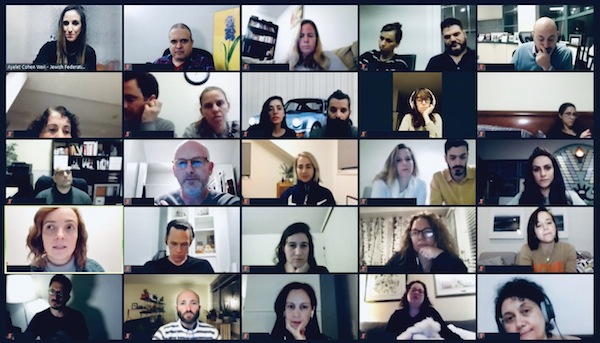
A screenshot of the recent BeyachadBC welcome event’s main room.

The types of immigration that Vancouver’s Jewish community is experiencing right now differ from those of 10 or 20 years ago. Community leaders recognized that these different demographics call for changed approaches in the way the community welcomes and integrates newcomers.

On Jan. 20, a virtual event took place, representing the launch of a new community partnership called BeyachadBC – beyachad means “together” in Hebrew. No fewer than 80 devices tuned in to join the event, many with more than one participant.

BeyachadBC is really an evolution of Shalom BC, Gesher Welcoming Services and other initiatives over the years meeting the needs of new community members, said Ayelet Cohen Weil, who, as associate director, community engagement, at the Jewish Federation of Greater Vancouver, spearheaded development of the group. (On Feb. 1, Cohen Weil began a new role, as executive director at the Louis Brier Jewish Aged Foundation.) Operating under the auspices of Federation, BeyachadBC was created with the Jewish Community Centre of Greater Vancouver, Jewish Family Services (JFS), Aleph in the Tri-Cities, Mamatefet and Women’s Empowerment (WE). The latter two groups are organizations primarily of Israeli-Canadian women, WE to network for career opportunities and Mamatefet to support mothers, especially of newborns.

Cohen Weil undertook consultations, including roundtables with community professionals who work with newcomers and with people who have experienced what newcomers face.

For many years, Vancouver has been one of North America’s fastest-growing Jewish communities. Breakout rooms at the virtual event included sessions in Spanish, Portuguese, Hebrew and English. The largest group was of Israelis, followed by those from Spanish-speaking Latin America. About equal numbers of participants joined the English and Portuguese breakout rooms. A couple of decades ago saw waves of immigrants from the former Soviet Union and, while there are still a number of new Canadians who originated in the FSU, almost all of those are now arriving via Israel, having spent years there. They communicate primarily in Hebrew, making Russian-language services less necessary than they were a few years ago.

Another noticeable change from the past is that many of the newcomers are arriving with work at the ready, not landing here in hopes of finding a career path. A sizeable number of immigrants from Israel and elsewhere have been drawn here by jobs at Amazon’s Vancouver hub, for example.

The different character of newcomers means that, rather than requiring some of the basic needs that earlier migrants required – housing assistance, social services – many are now seeking professional networking and connections for their families. (New arrivals who do require those additional services are, of course, served by various organizations, including Federation and JFS.)

When the pandemic is over, in-person social gatherings will take place with opportunities for mingling in each participant’s preferred language. Meanwhile, those who want it can be paired with a longer-established family based on criteria they determine, such as the ages of kids in the family or the professional track of the parents.

Of course, there is no one at the airport directing Jewish newcomers to BeyachadBC. Identifying Jewish immigrants is a matter mostly of word-of-mouth. This was aided by the fact that Cohen Weil’s portfolio at Federation also included regional community development. Given the cost of housing in Vancouver, many Jews are settling in the Tri-Cities or other suburban areas of Metro Vancouver. While geographic diffusion is a challenge long addressed by Federation, BeyachadBC plays an added role in reducing isolation and encouraging inclusion by explicitly targeting newcomer families outside the traditional “Jewish neighbourhoods” of the city.

BeyachadBC is envisioned as a service for those who have arrived in the past three years. “But I can tell from the faces that I saw, they were from the last year mostly,” Cohen Weil said. “They had to be newcomers during COVID, which created another layer of difficulty and challenges.”

Another fact struck Cohen Weil – there were young couples, families with kids, single young adults, seniors and middle-aged participants on the Zoom event.

She knows herself what it is like to live in different places. Cohen Weil arrived in 2005 as a student at the University of Victoria, having grown up in Mexico and having served as a volunteer in the Israel Defence Forces. She worked at Hillel in Victoria beginning in 2008 and returned to Israel in 2012 to continue her education before returning to Vancouver in 2017. Returning with a husband and a 10-month-old daughter was an entirely different experience that came with many challenges, even though she had connections and friendships from the past.

A more typical experience might be that of Yael Mayer, an individual and family therapist and a postdoctoral research fellow in the faculty of medicine at the University of British Columbia. She came to Vancouver five years ago, after her husband, an engineer, took a job here. Having left an established counseling career in Israel, Mayer was in a new country, at home, with two kids, including a 6-month-old baby.

“It’s very lonely and very hard to start everything again, to build a career again, to find a network,” she said. She set about cofounding Mamatefet and then founding WE because she realized that many women were in a similar boat. “Like me, there were many, many Israeli women who come here with academic backgrounds, with a lot of experience, and they struggle to rebuild their life here.”

If BeyachadBC had existed just five years ago, she said, her landing here might have been softer. “I think it could have been really different because BeyachadBC will provide a platform to easily connect and find information about different topics, about education, about synagogues, about activities, about social life,” she said. “It is all centred in one place, in one resource.”

Mayer was inspired by the initial BeyachadBC event, an enthusiasm she believes was shared by many based on the fact that everyone who signed up to attend actually showed up – and then stayed for the entire event. Registrations were coming in even after the event began.

“The beautiful thing about it is it really answers a need in our community and I think it is a very special project,” she said. “It identifies the common needs of the Jewish community but, at the same time, it also allows people to maintain some of their culture and their language so, in this way, it connects but it also makes everybody feel like they belong there. That’s the beautiful way that this project is built.”

The central clearinghouse for resources is beyachadbc.com and, Mayer added, while the site is intended for newcomers, longtime residents are also encouraged to explore it because assistance and social connections are welcome among the entire community, new arrivals and B.C.-born alike.