Some Chanukah trivia

  1. What does the word Maccabee mean?
  2. Who were the five sons of Mattathias?
  3. What is a Chanukah lamp called?
  4. What are the letters on a dreidel outside of Israel? Inside Israel?
  5. In which book of the Bible do we read the story of Chanukah?
  6. Who was Judith and why is she mentioned on the Shabbat of Chanukah?
  7. What was Mattathias’s wife’s name?
  8. How many candles are in a box of Chanukah candles?
  9. Why do we give gelt on Chanukah?
  10. How many years occurred between the desecration of the Temple and the killings in Modiin by Mattathias and the Maccabee uprising?
  11. According to Jewish custom, what kind of oil should be used for the Chanukah lights?
  12. Why were the schools of Hillel and Shammai in disagreement about Chanukah?
  13. What is unique about the mitzvah of kindling Chanukah lights?
  14. How should one popularize the mitzvah of lighting the candles for Chanukah?
  15. What king ordered the people of his kingdom to become Greek in religion and culture?
  16. Why don’t Jews celebrate the things really done by the Maccabees?
  17. Why did Judah Maccabee want this holiday celebrated for eight days?
  18. Who were the Hasmoneans?
  19. How long did the war continue after the Temple was rededicated?
  20. How did each of the Maccabean brothers die?

 Trivia answers

  1. One tradition says it means hammer and was applied to the Maccabee family because of their strength. Another says it stands for Mi kamocha baelim Adonai, Who is like you among the great ones, O G-d?
  2. Judah, Jonathan, Jochanan, Eleazar, Simeon
  3. Chanukiyah
  4. Nun, gimmel, hay, shin; nun, gimmel, hay, po
  5. The story does not appear in any book of the Bible. It is found in Maccabees I and Maccabees II, part of the Apocrypha, books not included in the Bible.
  6. Judith was a Hasmonean woman, whose story is a book of the Apocrypha. She saved her town from destruction by killing the general in charge.
  7. No one knows because she is never mentioned in the books of Maccabees.
  8. 44
  9. During the Middle Ages, adults began to play games on Chanukah. In the 1700s, children began to play dreidel and were given coins for playing.
  10. One year
  11. Olive oil
  12. Hillel wanted one light on the first night and additional lights added each night. Shammai wanted eight lights on the first night and one subtracted each night.
  13. Even if one does not have food to eat, one should beg or sell their clothing to buy oil and lamps to light for Chanukah.
  14. Place the lights at or near the outer part of the door facing the street or in a window facing the street.
  15. Antiochus Epiphanes
  16. The rabbis did not want military battles commemorated, so they created the story of the oil being found by the Maccabees and lasting eight days.
  17. Because the men had been fighting at the time of Sukkot and had not celebrated it, they decided to commemorate that holiday by observing this one for eight days.
  18. The Maccabees were part of the House of Hashmon and called Hasmoneans, a title of honour that denoted its high standing.
  19. The war continued 127 more years.
  20. Judah was in battle and his unit became sandwiched between two enemy divisions. Eleazar was under attack by a unit on elephants – he thought the king or general was on a particular elephant so he thrust a sword into the elephant and it fell on him and crushed him. Yochanan was attacked by a tribe near the Dead Sea. Simeon was entertained by his son-in-law, made drowsy from wine and assassinated by the son-in-law’s accomplices. Jonathan was put to death by the Syrian king Tryphon.

Sybil Kaplan is a journalist, lecturer, book reviewer and food writer in Jerusalem. She created and leads the weekly English-language Shuk Walks in Machane Yehuda, she has compiled and edited nine kosher cookbooks, and is the author of Witness to History: Ten Years as a Woman Journalist in Israel.

Brisket recipes for holiday

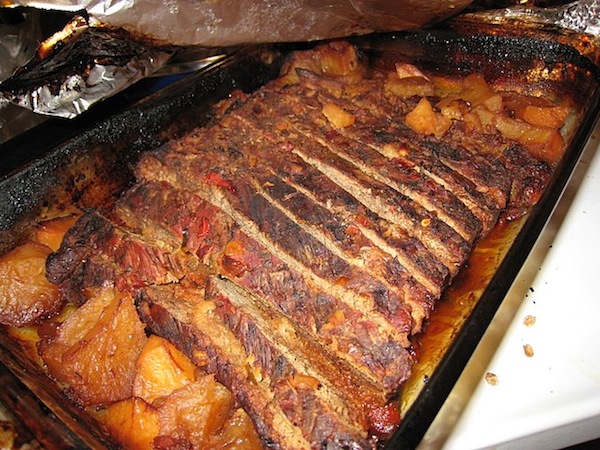
(photo by Josh Evnin)

In traditional Jewish cooking, brisket is most often braised as a pot roast, especially as a holiday main course, usually served at Rosh Hashanah, Passover and on the Sabbath. For reasons of economics and kashrut, it was historically one of the more popular cuts of beef among Ashkenazi Jews. Brisket is also the most popular cut for corned beef, which can be further spiced and smoked to make pastrami. But why not try it for Chanukah? It’d make a great holiday main dish.

First, some background. Brisket is a cut of meat from the breast or lower chest of a cow. It is one of the nine primal cuts of beef, though the precise definition of the cut differs internationally. The brisket muscles include the superficial and deep pectorals. As cattle do not have collarbones, these muscles support about 60% of the body weight of standing or moving cattle. This requires a significant amount of connective tissue, so the resulting meat must be cooked correctly to tenderize the connective tissue. The term brisket is derived from the Middle English brusket, which comes from the earlier Old Norse brjósk, meaning cartilage.

MOM’S EASY-TO-MAKE BRISKET
6-8 servings

4-pound brisket
2/3 package onion soup mix
paprika
parsley flakes
dill
6 carrots
8 potatoes

  1. Preheat oven to 350°F.
  2. Place the brisket in a foil-line baking pan. Sprinkle onion soup mix, paprika, parsley flakes and dill on top. Add carrots and potatoes. Seal in foil.
  3. Bake for one hour per pound of meat.

BRISKET AND FRUIT
8-10 servings

2 sliced onions
1 3- to 4-pound brisket
1 1/2 cups beer or wine
1 cup pitted prunes
1 cup dry apricots
3 tbsp brown sugar
2 tbsp orange marmalade
1 tsp brandy
1 tsp grated lemon peel
juice of 1 lemon
3/4 tsp ground ginger
1/2 tsp cinnamon
1/2 tsp Worcestershire sauce

  1. Preheat oven to 350°F. Line a baking pan with foil to cover brisket.
  2. Sprinkle half the onions on foil, place brisket on top; place remaining onions on top of brisket and seal. Roast three hours.
  3. Combine beer or wine, prunes, apricots, sugar, marmalade, brandy, lemon peel, lemon juice, ginger, cinnamon and Worcestershire sauce in a bowl and blend.
  4. Spread mixture on top of brisket. Reduce heat to 300°F. Cover pan and cook one hour, adding more beer or wine if sauce appears dry.

Sybil Kaplan is a journalist, lecturer, book reviewer and food writer in Jerusalem. She created and leads the weekly English-language Shuk Walks in Machane Yehuda, she has compiled and edited nine kosher cookbooks.

Trio of cheesy pastas

(photo from Umbe Ber/Pixabay)

Every time I do a food column, I look up its history, and I am continually fascinated by what I learn. We all know what is pasta – unleavened semolina mixed with water or eggs and formed into various shapes. It was not until 1874 that the word pasta came into popular use, from the Italian. However, there is mention, as early as the first century CE of fried dough as an everyday food.

Lagana is mentioned in a fifth-century cookbook as an ancient version of lasagna. A kind of boiled dough is mentioned in the Jerusalem Talmud, common in ancient Israel from the third to fifth centuries CE. Dry pasta became popular in the 14th and 15th centuries; tomatoes came to Italy in the 16th century and to Italian cuisine in the 17th century. Pasta became popular in North America with the Italian immigration at the beginning of the 20th century.

How many kinds of pasta do you think there are – long, medium length, short cut, stretch, soup, with fillings and gnocchi? There are 163!

Here are some recipes, which use different kinds of pasta.

MY FAVOURITE LO-CAL FETTUCCINE ALFREDO
4 servings

8 ounces fettuccine noodles
4 cups pareve chicken soup
1 cup low-fat sour cream
2 tbsp low-fat margarine
2 minced garlic cloves
3 tbsp chopped parsley
2 tbsp Parmesan cheese

  1. Cook noodles in chicken soup 12 minutes. Drain. Place in a bowl.
  2. In a frying pan, melt margarine. Sauté garlic one minute. Reduce heat and add sour cream and blend. Add noodles.
  3. Serve with parsley and Parmesan cheese.

CHEESY FETTUCCINE ALFREDO
4 servings

1/3 cup butter or margarine
8 ounces cooked, drained egg noodles
1/2 cup grated Parmesan cheese
1/2 cup grated Swiss cheese
1/2 cup half and half

  1. Melt butter or margarine in a frying pan.
  2. Add noodles and toss well.
  3. Sprinkle with cheese and toss gently until cheeses are melted and blended.
  4. Add half and half just to heat. Serve at once.

PENNE WITH EGGPLANT, OLIVES AND FETA
4-5 servings

3 tbsp olive oil
2 1/2 diced medium red bell peppers
3 chopped garlic cloves
1/2 pound eggplant, cut into 1//2-inch cubes
1 1/2 tsp oregano
1 1/2 cups canned tomatoes in juice diced or 1 pound regular diced tomatoes
1/2 cup thinly sliced fresh basil or 1/4 cup dry
1/4 cup pitted Kalamata or other black-brine cured olives
2 tbsp tomato paste
1 tbsp red wine vinegar
2 3/4 cups crumbled feta cheese

  1. Spray a rectangular baking dish with vegetable spray. Preheat oven to 350°F.
  2. Heat oil in a large pot. Add bell peppers and garlic. Sauté three minutes. Add eggplant and oregano. Reduce heat, cover and cook until eggplant is soft (about 15 minutes).
  3. Add tomatoes, 1/4 cup fresh basil (or 1/8 cup dry), olives, tomato paste and vinegar. Cover and simmer about 12 minutes.
  4. Cook pasta in boiling salt water until just tender. Drain well.
  5. Stir pasta into vegetable mixture. Transfer to baking dish and bake for 20 minutes. Sprinkle with feta and 1/4 cup fresh (or 1/8 cup dry) basil.

Sybil Kaplan is a journalist, lecturer, book reviewer and food writer in Jerusalem. She created and leads the weekly English-language Shuk Walks in Machane Yehuda, she has compiled and edited nine kosher cookbooks.

Sweetness of chocolate chips

(photo by Kimberly Vardeman)

Chocolate chips were created when chocolate chip cookies were invented in 1937 – Ruth Graves Wakefield of the Toll House Inn in Whitman, Mass., added cut-up chunks of a semi-sweet Nestlé chocolate bar to a cookie recipe.

The cookies were a huge success, and Wakefield reached an agreement in 1939 with Nestlé to add her recipe to the chocolate bar’s packaging in exchange for a lifetime supply of chocolate. Initially, Nestlé included a small chopping tool with the chocolate bars. In 1941, Nestlé and at least one of its competitors started selling the chocolate in “chip” (or “morsel”) form.

Originally, chocolate chips were made of semi-sweet chocolate, but today there are many flavours of chips, including bittersweet, peanut butter, butterscotch, mint chocolate, white chocolate, dark chocolate, milk chocolate, and white and dark swirled chips.

Here are some of my favourite recipes.

MOM’S CHOCOLATE CHIP COOKIES
5 dozen small cookies

1/3 cup oil (Mom, z”l, used 1/2 cup shortening)
1/4 cup brown sugar
1/2 cup white sugar
1 egg
1 package chocolate chips
1/2 tsp baking soda
1/2 tsp salt (I eliminate this)
1 1/8 cups flour
1/2 cup chopped nuts
1/2 tsp vanilla

  1. Preheat oven to 375°F. Spray cookie sheets with vegetable spray or cover with parchment paper.
  2. Combine oil, sugars and egg in a mixing bowl or food processor.
  3. Add chocolate chips, baking soda, flour, nuts, vanilla (and salt). Blend well.
  4. Spoon on cookie sheets with a teaspoon or tablespoon. Bake for eight to 10 minutes. Remove from oven and let cool on a rack.

ELISHEVA’S CHOCOLATE CHIP OATMEAL COOKIES
I tasted these at a Hadassah Israel meeting. They were made by one of our members and I had to have the recipe.

1 cup margarine or butter, softened (I use 3/4 cup oil)
1 1/4 cups firmly packed brown sugar
1/2 cup white sugar
2 eggs
2 tbsp milk (I use Rich’s non-dairy creamer or soy milk)
2 tsp vanilla
1 tsp baking soda
1 3/4 cups flour
pinch of salt (which I don’t add)
2 cups uncooked oatmeal
1 package chocolate chips
1 cup coarsely chopped nuts (optional)

  1. Preheat oven to 475°F. Place parchment paper on cookie sheets.
  2. Beat margarine or butter (or oil) and sugars until creamy in a bowl. Add eggs, milk and vanilla. Beat well.
  3. Add flour and baking soda (and salt). Mix well.
  4. Stir in oatmeal, chocolate chips and nuts. Mix well.
  5. Drop by rounded tablespoons onto cookie sheet. Bake for nine or 10 minutes for a chewy cookie, 12 to 13 minutes for a crispy cookie.

DIABETIC (SPLENDA) CHOCOLATE CHIP COOKIES
30 cookies

2 cups flour
1 tsp baking powder
1 tsp baking soda
1/4 tsp salt (I never add salt)
1 cup melted butter (I use 1/4 cup + 2 tbsp vegetable oil)
1 cup Splenda brown sugar blend
2 large eggs
1 tbsp vanilla extract
2 cups semi-sweet chocolate chips

  1. Preheat oven to 375°F. Line cookie sheets with parchment paper.
  2. Combine flour, baking powder and baking soda in a bowl. Set aside.
  3. Mix butter (oil) and Splenda in a large bowl. Stir in eggs. Add vanilla and mix. Stir in flour mixture. Fold in chocolate chips.
  4. Drop dough by tablespoon onto cookie sheets. Bake for 11 to 13 minutes. Allow to cool before moving to racks to cool completely.

Sybil Kaplan is a journalist, lecturer, book reviewer and food writer in Jerusalem. She created and leads the weekly English-language Shuk Walks in Machane Yehuda, she has compiled and edited nine kosher cookbooks.

רשת פייק ניוז ישראלית

רשת פייק ניוז ישראלית ניהלה קמפיין אנטי-מוסלמי בינלאומי נגד טרודו

על פי תחקיר של העיתון הגרדיאן, בשנתיים האחרונות קבוצת משתמשים ישראלית, ובראשה סוחר יהלומים מלוד, הפיצה ידיעות מזויפות על פוליטיקאים מוסלמים ואף טענה כי ראש ממשלת קנדה ייבא למדינתו את חברי דאע”ש

רשת פייק ניוז ישראלית ניהלה קמפיין אנטי-מוסלמי בפייסבוק – שמשך אליו יותר ממיליון גולשים בארבע יבשות. כך על פי תחקיר שפורסם בעיתון הגרדיאן הבריטי.

לפי התחקיר כמה משתמשי פייסבוק פעלו בשיטה קבועה: ראשית הם פנו לעשרים ואחד עמודי ימין קיצוני וביקשו מהם הרשאה לניהול העמוד. לאחר שקיבלו את הגישה לעמודים הם הפיצו סימולטנית ידיעות שקריות. בשנתיים האחרונות הופצו בשיטה זו למעלה מחמשת אלפים ושש מאות ידיעות מזויפות. הן זכו ללמעלה משמונה מאות אלף אלף לייקים.

אחד ממנהלי העמודים סיפר לגארדיאן כי פנתה אליו אישה שהציעה לו סיוע ביצירת תכנים לעמוד שהוא מנהל. האישה הזו שכנעה אותו שהיא עורכת טובה, ושתוכל לספק לו תכנים איכותיים שיעלו את החשיפה והלייקים. כך אמר רון דה-ויטו מניו יורק. הוא חשב לעצמו שהוא יכול לתת לה את הזדמנות לפרסם את התכנים שלה.

קמפיין הפייק ניוז כאמור, שם לו למטרה להשמיץ פוליטיקאים מוסלמים ומחוקקים ליברליים. זאת במטרה להשפיע על השיח, בעיקר בתקופות בחירות. כך למשל, חברות הקונגרס האמריקני המוסלמיות רשידה טליב ואילהאן עומאר נפלו קורבן למתקפות אנטי-מוסלמיות. על ראש עיריית לונדון המוסלמי, סאדיק קאן, הופץ כי טען לאחר פיגוע בעיר בשנת אלפיים ושבעה עשרה – שפיגועי טרור הם חלק מעסקת החבילה של המגורים בעיר, ומי שלא מעוניין לחוות אותם יכול לעזוב אותה.

לא רק פוליטיקאים מוסלמים סבלו מדיווחים מזויפים, אלא גם מחוקקים ליברליים. על יו”ר מפלגת הלייבור הבריטית, ג’רמי קורבין, נטען כי אמר שהיהודים הם מקור הטרור הגלובלי. ואילו ראש ממשלת קנדה הנוכחי, ג’סטין טרודו, הואשם כי ייבא לקנדה את חברי ארגון הטרור הסוני דאע”ש.

עיתון הגרדיאן הצליח לאמת כי מקור אחד עמד מאחורי הפרסומים בדפים השונים, ואף אימת את זהותו. מדובר אחד האנשים שעומדים מאחורי הקמפיין ושגר בישראל אריאל אלקרס. הוא סוחר יהלומים בשנות השלושים לחייו ומתגורר כיום בלוד. מנהלי העמודים העידו כי היו בקשר עם משתמשים נוספים, בהן שתיים שהציגו את עצמן בתור רוחל’ה ותהילה (לא בטוח שהשמות אמיתיים), אך העיתון לא הצליח לאמת את זהותן.

כתבת העיתון הגיעה במסגרת התחקיר לביתו של אלקרס, והוא הכחיש מכל את מעורבותו ברשת הפייק ניוז. כאשר הוא נשאל על מתשמש בשם אריאל אלף מאתיים שלושים ושמונה איי, שנחשד כי הוא זה שהפיץ חלק מהידיעות, השיב אלקרס כי איננו יודע דבר וסגר את הדלת בפניה של הכתבת. בהמשך אלקרס יצא אחריה לרחוב וביקש ממנה לדעת הכיצד היא איתרה אותו.

בעקבות פניית הגרדיאן הסירה הנהלת פייסבוק חלק מהעמודים הקשורים לרשת הפייק ניוז. בפייסבוק ציינו שכנראה שמאחורי פעילותם של עמודים אלו עומדים מניעים פיננסיים. עמודים וחשבונות אלו הפרו את המדיניות של פייסבוק נגד ספאם וחשבונות מזויפים באמצעות פרסום תוכן קליקבייט – שנועד למשוך אנשים לאתרים חיצוניים. כך נמסר על הנהלת פייסבוק. בהנהלת האתר החברתי ציינו עוד כי היא לא תתיר לאנשים להתחזות בפייסבוק. הנהלת האתר עדכנה את מדיניות ההתנהגות הלא-אותנטית שלה, כדי לשפר את יכולתה להגיב לטקטיקות חדשות. החקירות של פייסבוק נמשכות ובהנהלת החברה אמורים עוד כי הם ינקטו בפעולות נוספות אם יאתרו הפרות נוספות.

Doing work he believes holy

Irwin Keller will share some of his eclectic interests at Limmud Vancouver in March. (photo from Limmud Vancouver)

Irwin Keller is the kind of person most of us would like to be: curious about everything, smart, creative, always learning, always teaching. As one of the invited presenters for Limmud Vancouver ’20, he’ll be sharing some of his interests with the local community.

Keller’s first career was a long stint as a human rights lawyer specializing in AIDS and HIV-related discrimination. But, as a lifelong amateur musician, he also co-created the drag group the Kinsey Sicks. In 2006, he ended up serving as a lay leader for his congregation, which finally pushed him to go to rabbinical school, where he is now finishing up his training.

“I had always wanted to be a rabbi. When I had finished my undergraduate and was looking at applying to rabbinical school, in those days, there were no seminaries that accepted openly gay students,” Keller said. “I couldn’t do it unless I was willing to go back in the closet that I had just come out of – the closet was still warm – and I wasn’t willing to. It felt wrong. It was important for me to be in the rabbinate as who I was.”

Within just a year of deciding he couldn’t be a closeted rabbi, the AIDS epidemic began to tear through the gay community, and Keller began working on civil rights cases.

“Things can happen to people whether they’re legal or not. Often through some sort of ruse, or subterfuge,” he said. “As long as people didn’t want people with AIDS renting from them or working for them, they were going to find some way to get rid of them. That was our work.”

This work, which Keller describes as both holy and harrowing, led to the creation of the Kinsey Sicks. “Our community needed to laugh, needed to be delighted out of what we were experiencing every day.”

Momentum built and, after a few years, the group had an offer to produce their show off-Broadway.

“That was the point when we all quit our jobs. That was the last I ever practised law,” he said.

In all, Keller performed with the group for 21 years. Along the way, he taught himself enough Yiddish to be able to bring Yiddish music into the show, to both hilarious and touching effect. He had a recording of his great-grandmother singing the heart-tugging “Papirosn,” about an orphan boy trying to get by selling cigarettes on a street corner. Usually sung by women performers to mimic a child’s voice, Keller performed it in his drag persona Winnie, channeling the spirit of his great-grandmother and Yiddish theatre divas of a bygone era. You can watch it on YouTube: Keller playing a much older Jewish woman playing a young boy – gender collapses à la Victor/Victoria.

“Over the course of the maybe 18 years that I performed it, it was the most commented-on piece of music that we performed,” he said. “People were so moved – including non-Jews – that they were getting a window into Jewish culture that they were not getting from modern American culture.”

Keller’s U-turn into the rabbinate is perhaps long in coming, but not surprising. He describes both his civil rights law career and his drag performing career as holy work: the yin and yang of what a gay community needed at a devastating moment in its history. Moving onto the pulpit only took that energy to a different place.

“I moved to Sonoma County and joined a synagogue whose rabbi was in the process of leaving and there was a lot of turmoil. I volunteered to do some of the rabbinical work while they were searching,” he said. “But what came out of me was a lifetime of longing.”

And the congregation needed his brand of leadership, too. “I think my being the singing drag queen rabbi gave people a different kind of welcome,” he said.

At Limmud Vancouver, Keller will be sharing two more of his interests: Yiddish poetry, and queer readings of Torah. In a session on the Yiddish poet Itsik Manger, Keller will lead discussion on the playful Bible-inspired poem cycle known as the “Khumesh lider.”

“The way he plays with the looping of time, the anachronisms, in a way that is also invited by rabbinic tradition – there is no before or after Torah, everything can take place in any order,” explained Keller. “So you can get the Turkish sultan visiting Hagar, you can get Ruth and Polish peasants, and it’s still Torah.”

Keller’s other Limmud seminar will examine the story of Joseph.

“I try to identify where there are queer currents running through Torah,” he said. “I don’t specifically mean exclusively gay-themed moments, but moments that seem to suggest a certain kind of outsiderness and outsider outlook and alternative biography from what you’ve come to expect from ancient tales.”

Joseph falls into this category because of his distance from the normative family. Joseph spends most of his life at odds with a family that made him unsafe. His power comes when he is able to be away from this family and incognito, and his unmasking is both dangerous and liberating.

“What’s interesting to me here,” said Keller, “is that the rabbinic tradition finds him to be problematic. They have a tendency to locate his problematicity in his gender and sexuality. So, it’s not like we as modern people are for the first time noticing that there might be a queer angle to this story. For 1,000 years he’s been alarming the rabbis.”

Keller speaks of human rights, Jewish drag, Yiddish poetry and queer Torah with unflagging energy. But this isn’t even all. Get Keller talking about angels in the Jewish imagination, and it’s off to the races again: “There is a tradition around angels who densely populate all our mystical texts, as well as running rampant through Torah,” he said. “It’s interesting to me the worldview that holds angels as present in every space and every function. Every natural force is controlled by an angel, every period of time. Every hour of the day has an angel that oversees it.”

Perhaps another year, Keller will share more at Limmud about angels. In the meanwhile, his joyous brand of learning and thinking will be available in two presentations on March 1 at Limmud Vancouver, held at Congregation Beth Israel. Registration is now open at limmudvancouver.ca.

Faith Jones is a librarian and Yiddish translator in Vancouver. She is a regular teacher and attendee at Limmud Vancouver.

A book about Operation Ezra

Operation Ezra in Winnipeg has expanded to include farming and selling local produce. (photo from Operation Ezra)

When the Operation Ezra committee in Winnipeg decided to produce a book about the efforts of Yazidi-Winnipegger Nafiya Naso and Operation Ezra, the local Yazidi community was very excited about the idea, about passing down their story in writing to future generations, as their tradition is largely oral.

Operation Ezra: Winnipeg’s Jewish Community-Led Interfaith Response to Survivors of the Yazidi Genocide was launched on Sept. 24 at the JCC Berney Theatre. The event included a few words from the author, Chana Thau, as well as from Operation Ezra (OE) leaders, and a panel discussion. The 71-page paperback includes photographs, interviews and various facts about the Yazidis and how OE came to be, among other things.

“When I first held the book in my hands,” said Naso, “it felt really special and I felt really proud of everything we had accomplished. Having it all in one text to give to people in the community and outside the community, to show what a small group of individuals was able to accomplish in the span of four-odd years, I’m very proud of it.”

Belle Jarniewski, director of the Jewish Heritage Centre of Western Canada (JHCWC), who has been involved in OE since its inception, said it was a grant from the Jewish Foundation of Manitoba that allowed the book to be published.

“By the time the book was written, there was so much more that we had done, but we thought it would be a nice way to let more people know about this wonderful multifaith initiative,” said Jarniewski.

Each of the families that OE brought to Winnipeg was given a book, including the most recent new-to-Canada family of 10, who had arrived just before the book launch.

Apart from OE’s ongoing efforts to bring more refugees to safety in Winnipeg, the endeavour has been helpful in settling the families already there. Both Nafiya and her sister, Jamileh, were invited to separate events in Europe over the summer to share the story of OE and some insight as to why it is so successful.

“We don’t really know if Operation Ezra can really be done anywhere else,” said Nafiya Naso. “Just because the community here is so welcoming and open, and it would be ideal if every city and every country in the world was like this … realistically, it’s not. Within the larger spectrum of the refugee crisis, a lot of people have very negative perceptions of refugees, without knowing the different types and layers of what refugees are, who they are, and things like that. So, even for us, education was a huge piece – letting people know who the Yazidis are and what’s happening.”

A group of individuals in Germany has been eager to incorporate some of the OE approaches. Naso said one of the main things that has made a huge difference is that OE is multifaith. She suggested that people wanting to undertake similar initiatives start by reaching out to faith-based communities and local businesses to find out who might want to become involved.

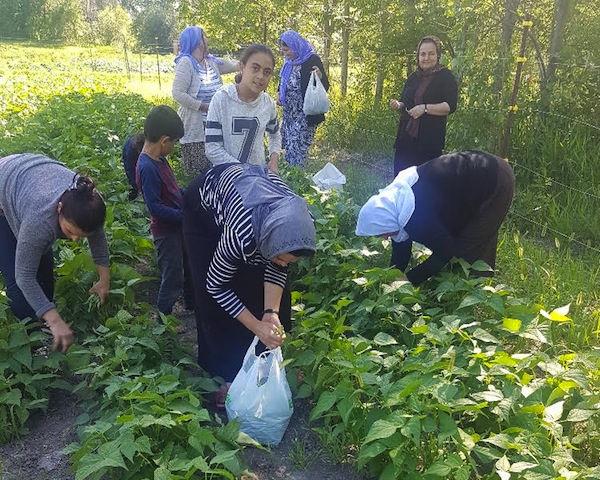
One of the more recent aspects of OE that has caught the attention of other communities around the world has been the farming project that started up two summers ago on a small plot of land.

“We had one of our volunteers whose father was a farmer with a lot of land, a potato farm, so some of the community went and helped out and got huge bags of potatoes after, and we had media coverage of it,” said Naso.

“The pastor from Charleswood United Church connected us to the owner of Shelmerdine Garden Centre,” she added. “He donated about five acres of land this summer and the community was harvesting it and they were able to sell some of the leftover produce and make money, and that money then came back into the community.

“This is not only a way for them to work and be involved in the community, but it’s also very therapeutic, especially for the women who have gone through the brunt of what ISIS committed and is continuing to commit.”

The land is located just outside of Winnipeg’s city limits. The families worked together and carpooled there to grow and harvest the produce and sell the excess at Shelmerdine, the Rady Jewish Community Centre and Charleswood United.

“Almost all of our families have vehicles, so everyone will go pick up a couple people, and that’s how we transport everyone,” said Naso. “A couple of times, too, we’ve used a bus, bringing the whole community out there – the kids and everyone – renting a bus or two to get everyone out there.”

“This has been just such a wonderful experience for them,” Jarniewski said, “because this is what most of them already knew, what most of them did in Iraq. Not only have they grown food for themselves, but they have been selling the produce. So, this has been a very positive project and we hope to expand it more next year. They will be able to feed the Yazidi community all winter with the kinds of vegetables you can put into cold storage, like beets and potatoes.

“Now, it’s an exponential growth. They really grew all kinds of things. I would see them here, at the Rady, when they were selling celery, beets, onions, zucchini, you name it … even mint and basil.”

Operation Ezra: Winnipeg’s Jewish Community-Led Interfaith Response to Survivors of the Yazidi Genocide explains the background of the Yazidis, a monotheistic religious minority in northern Iraq that was displaced and persecuted by the Islamic State group in 2014. It also goes into the efforts of the Jewish community to lobby the federal government to bring Yazidis to Canada and to resettle families in Winnipeg via private sponsorship. Sales of the book ($10 each) support the ongoing Operation Ezra efforts – it can be ordered from Jewish Child and Family Service Winnipeg by calling 204-477-7430.

Rebeca Kuropatwa is a Winnipeg freelance writer.

Time to face ourselves

Actor and comedian Sacha Baron Cohen delivered the keynote address last month at an Anti-Defamation League conference. His words quickly went viral because he pinpointed fears and challenges shared by millions about the power of social media. He hit many nails on the head.

“Democracy, which depends on shared truths, is in retreat, and autocracy, which depends on shared lies, is on the march,” he said. “Hate crimes are surging, as are murderous attacks on religious and ethnic minorities. All this hate and violence is being facilitated by a handful of internet companies that amount to the greatest propaganda machine in history.”

He was referring to social media like Facebook and Twitter and platforms like YouTube and Google, whose algorithms, he said, “deliberately amplify the type of content that keeps users engaged – stories that appeal to our baser instincts and that trigger outrage and fear.”

Had Facebook existed in the 1930s, he went on, it would have run 30-second ads for Hitler’s “solution” to the “Jewish problem.”

Baron Cohen acknowledged that social media companies have taken some steps to reduce hate and conspiracies on their platforms, “but these steps have been mostly superficial.”

“These are the richest companies in the world, and they have the best engineers in the world,” he said. “They could fix these problems if they wanted to.” The companies could do more to police the messages being circulated on their sites, he suggested.

He’s correct about the problems. But the first problem with his solution is that he is asking a couple of corporations to judge billions of interactions, making them not only powerful media conglomerates, which they already are, but also the world’s most prolific censors and arbiters of expression. Of course, by abdication, they are already erring on the side of hate speech, but is the alternative preferable? If we think Facebook chief executive officer Mark Zuckerberg has too much power now, do we really want to make him the planet’s censor-in-chief?

Yes, the platforms benefit from and, therefore, promote, the most extreme viewpoints. But, even if we could, would forcing those voices off the platforms make the world a safer place? There are already countless alternative spaces for people whose extremism has been pushed off the mainstream sites. Just because we can’t hear them doesn’t mean they’ve gone away.

Marshall McLuhan, the Canadian philosopher who declared “the medium is the message” died four years before Zuckerberg was born. He could have predicted that social media would change the way we interact and communicate. But has it fundamentally changed who we are? Or has it merely allowed our true selves fuller voice? Perhaps a little of both. Facebook, Twitter and the others are not agnostic forces; they influence us as we engage with them. But, in the end, they are mere computer platforms, human-created applications that have taken on outsized force in our lives. And all the input is human-created. Since the dawn of the industrial age, we have imagined our own inventions taking over and controling us, from Mary Shelley’s Frankenstein to 2001: A Space Odyssey’s Hal to Zuckerberg’s Facebook.

In all these cases, fictional or not, the truth is that the power remains in human hands. This is no less true today. We could, if the political will existed, shut down these platforms or apply restraints along the lines Baron Cohen suggests. But this would be to miss the larger point.

We live in a world filled with too much bigotry, chauvinism, hatred and violence. This is the problem. Dr. Martin Luther King said: “Darkness cannot drive out darkness; only light can do that. Hate cannot drive out hate; only love can do that.” And there are plenty of sites on social media that advance mutual understanding and love over hate. Are their messages as likely to go viral? Probably not. But that, ultimately, is determined by billions of individual human choices. A small but illuminating counterrevolution seems to be happening right now with a renaissance of the ideas of Mister (Fred) Rogers and his message of simple kindness. While much of the world seems alight in hatred and intolerance, a countermovement has always existed to advance love and inclusiveness. This needs to be nurtured in any and every way possible.

If Facebook were a country, its “population” would be larger than China’s. Bad example when we are discussing issues of free speech and the accountability of the powerful, perhaps, but illuminating – because an entity of that size and impact should be accountable. As a corporate body, it has few fetters other than governmental controls, which are problematic themselves. Concerned citizens (and platform users) should demand of these companies the safeguards we expect. We are the consumers, after all, and we should not ignore that power.

But neither should we abstain from taking responsibility ourselves. Social media influences us, yes. But, to an exponentially greater degree, it is merely a reflection of who we are. It is less distorted than the funhouse mirror we like to imagine it being. If what we see when we look at social media is a depiction of the world we find repugnant, it is not so much social media that needs to change, it is us.

Similar needs across cultures

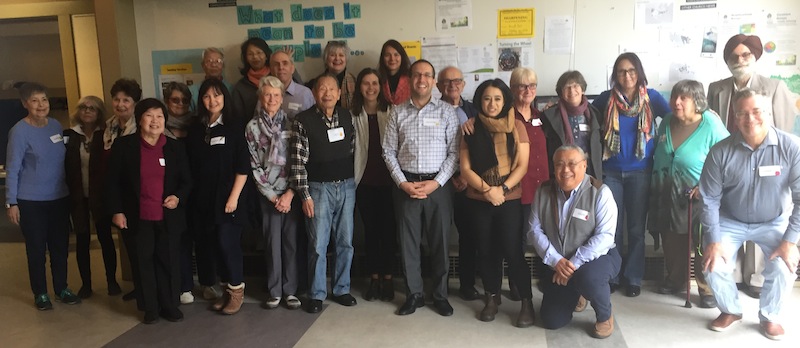
On Oct. 30, members of different cultural groups gathered to discuss issues facing seniors. (photo from JSA)

Aging Across Cultures Dialogue Tables included an Oct. 30 gathering hosted by Jewish Seniors Alliance of Greater Vancouver at the Unitarian Centre.

The B.C. Ministry of Tourism, Arts and Culture has provided funding for a focused review of services, concerns and challenges faced by organizations providing help to multicultural seniors in the Lower Mainland. In addition to the JSA, Jewish Family Services and the Kehila Society were among the groups represented, which also included ASK Friendly Society, B.C. Community Resources Network, Kitsilano Neighbourhood House, United Way-Better At Home, Collingwood Neighbourhood House, COSCO, 411 Seniors Centre Society, Gordon Neighbourhood House, Marpole Neighbourhood House, Simon Fraser University Gerontology Research Centre, Vancouver Seniors Advocate, Seniors Brigade Society of British Columbia, Seniors First B.C., South Granville Seniors Centre, Tonari Gumi, Vancouver Native Health Society, and West End Seniors Network.

On Oct. 30, Gyda Chud, co-president of JSA, welcomed participants, emphasizing advocacy, reflection and rejuvenation as illustrated in a new JSA video outlining its community services. Grace Hann and Charles Leibovitch, from JSA’s peer support services, were the facilitators for the multicultural dialogue tables. Liz Azeroual of JSA documented on flip charts the ideas and concepts put forth by the participants.

Whatever the needs of seniors in general, discussants agreed that the situation is worse for immigrants and for women; many must choose between either eating or taking their medications. Immigrant women are less likely to be accepted for financial aid. Literacy is an issue, especially when applications for help are online, and navigating the system is more difficult when English is not your first language.

Without family advocacy, many seniors are left to fend for themselves. They need places to meet other seniors who have similar language, customs and experiences. In care facilities, many immigrant seniors are forced to eat unfamiliar foods. Immigrant seniors, especially women, need advocates to get their needs met, but community-based organizations working with seniors often are not well-funded, so help is minimal. The medical system is not structured to treat the multiple problems of seniors.

Loneliness and isolation are among those issues. Family groupings are now much smaller, and young families do not live in the same area as their parents or grandparents. Some seniors are abandoned by their families, or by the death of friends and colleagues. There is a lack of social support, transportation and financial aid to address these problems. Health issues such as depression, fractures that limit mobility, and degenerative hearing and sight increase isolation. LGBTQ+ seniors may also be underserved and isolated. There is a need for better communication all round.

Low-income seniors often move into single-room facilities, if they are available, or some become homeless, living in cars or couch surfing, as they cannot afford higher rents.

Paid caregiver turnover and the deteriorating quality of some care facilities has led families to care for their loved ones at home without adequate financial support. Caregiver burnout is a major concern and accessing certain types of care is a huge challenge: palliative care, for example, requires a physician’s referral.

Population movement and growth, and changes in the healthcare industry, are taking place without adequate planning for the changing needs of the senior population. For all workers, including professionals, who come from a non-English-speaking country, language training is necessary and difficult. Families need paid work in stable jobs and so do seniors. Volunteers are hard to recruit and retain, even though it is meaningful work and can lead to other jobs. In addition to language, many new Canadians need to learn more about technology and Canada’s corporate and general culture. In many areas, discrimination is an issue faced by new Canadians.

All Canadians need to plan for retirement, which is becoming costlier, as the population ages and services become more expensive. Various healthcare agencies need adequate funding to keep the elderly out of hospitals, and the links between different levels of health care and social services (clinics, hospitals and nonprofit agencies) need to be strengthened in order to keep this population from falling through the cracks. Access to transportation is a big part of this, and caregivers should be remunerated for providing home care for seniors. Cultural and ethnic care facilities could play a larger role in reducing isolation, offering spaces where language, food and culture are familiar and where families of seniors can meet.

Seniors housing was considered the highest priority. The need for more single-room affordable housing units, more cooperatives, more roommate pairing services and stricter legislation for affordable-housing vacancy rules were discussed. It was also believed that immigrants and 55-to-65-year-old seniors needed more access to Canada Pension Plan and Old-Age Security.

At the end of the discussion, Dr. Gloria Gutman, from Simon Fraser University’s Gerontology Research Centre, stressed the needs for groups to keep communicating at all levels to help resolve these major seniors’ issues.

Pamella Ottem, MSN, worked for many years in the field of gerontology. As a retired nurse, she has volunteered in the Fraser Health Authority hip replacement program. At Jewish Seniors Alliance, she is a member of the board and chairperson of the peer support services committee.

Taali writes, sings heart out

Taali’s EP Were Most of Your Stars Out? was released last month.

“Kol ha’olam kulo gesher tzar me’od, veha’ikar lo lifached k’lal” – “The entire world is a narrow bridge, and the main thing is to not be afraid.” Taali’s recently released EP Were Most of Your Stars Out? begins with “The Main Thing Is,” and, it seems, the singer-songwriter and producer has followed Rabbi Nachman of Breslov’s advice from more than 200 years ago, and made the prayer her own. While there are countless versions, Taali’s a cappella take showcases her rich, full sound and sets the mood for the entire recording.

The name of the EP comes from J.D. Salinger’s novella Seymour: An Introduction, which Taali (née Talia Billig) highlights as her favourite book. On her Facebook page, she cites the passage from which the album title comes: “Do you know what I was smiling at? You wrote down that you were a writer by profession. It sounded to me like the loveliest euphemism I had ever heard. When was writing ever your profession? It’s never been anything but your religion. Never. I’m a little over-excited now. Since it is your religion, do you know what you will be asked when you die? … I’m so sure you’ll get asked only two questions. Were most of your stars out? Were you busy writing your heart out?”

Were Most of Your Stars Out? comprises acoustic versions of seven songs. It was produced by the label Rainbow Blonde Records, a collective she co-founded with her partner, singer-songwriter and producer José James, and engineer and producer Brian Bender. Released last month, the EP follows almost on the heels of Taali’s full-length record I Am Here, which came out in March.

Taali describes her music as Jewish contemporary pop, but, while Jewish melodies and/or concepts permeate her compositions, the sound is definitely more pop than liturgical, though she likes her minor keys. And all listeners, regardless of religious or secular affiliations, will find something to connect to in the lyrics. In an extensive interview with the now-defunct online publication Arq, Taali – whose stage name is a family nickname – talks about music being communal. “If I’m promoting it,” she said, “it has to be in the service of community.”

That philosophy, combined with her appreciation for the Jewish tradition of storytelling, which was instilled in her growing up, and her musical skill and knowledge, makes Taali’s songs eminently listenable and relatable. That Were Most of Your Stars Out? is an acoustic recording adds to the intimacy. The use of synthesizer on “This Is What Love Is” and “Wayward Star” takes away some of that atmosphere, but one nonetheless gets the feeling that Taali doesn’t put on airs, and would put as much heart into singing off the cuff at a small gathering as she does performing on a concert stage.

Born in Manhattan, Taali has lived most of her life in New York City, with the exception of a couple of years in Los Angeles. One of the narrow bridges she has had to cross is vocal cord surgery, in 2016, which meant months of being unable to speak or sing. She turned her focus to songwriting for other performers during this period of recovery but, she told Billboard, there was one song she “couldn’t conceive of just giving” to another singer, and that was “Hear You Now.”

“I have quite a bit of trauma myself that I’ve never really felt safe enough to address,” she said about the song in that interview. “It was really wrenching, but I tried to do justice to those feelings. It’s the beginnings of talking to myself rather than an on-the-nose accounting of what happened, and what I tried to do, lyrically, was apologize to myself for the years I didn’t have the words or strength to name or push away these people who were treating me badly.”

“Hear You Now” is about finally saying “all the words you haven’t said,” “the words that you swallowed down” – “You held it in, now lay it all to rest…. Lift away the weight of everything you couldn’t say” and “Make them hear you now.”

The song “Snowfall on Orchard,” which closes Were Most of Your Stars Out?, also has special meaning. It was written about five years ago with José James, who provides some lovely vocals and beautiful harmony on the track.

“It’s the first original song that we wrote together,” says Taali in her bio, “and I think it’s a little postcard of a very, very optimistic moment in our lives, and a very in love moment.”

Were Most of Your Stars Out? is available from several online music services, including Spotify, iTunes and Amazon.