I recently heard some difficult news. A good
friend of mine from university has been diagnosed with a serious form of
cancer. Over time, we’d moved, had children and fallen out of touch, but I was
able to reach her quickly. She is well enough for emailing, and we’ve fallen
right back into the dear friendship we had 20-some years ago. Some of her more
recent pathology reports are slightly more hopeful. Even so, it’s a very
serious diagnosis and she’s in her mid-forties with kids in elementary school.
During university, this friend and I were part of
a trio of busy young women. Often the only time we could spend together was
breakfast. We’d have bagels and coffee at a sunny warm spot, the Ithaca Bakery.
The snow was piled high outside and the windows were steamed with humidity as
we laughed and complained together. It was the third friend who told me about
the brain cancer. She and I each, within moments, had come up with medical
resources for our dear friend. We felt lucky to be able to say, “I know
something about this,” or “I know someone if you need medical information or
another opinion.” We wanted to support her from far away.
I was reminded of this when looking at the
Torah portion Yitro (Exodus 18:1-20:23), which starts out with a story about
Jethro, Zipporah’s father, and Moses. Jethro is Moses’ father-in-law. When
Moses tells him how the Israelites have escaped Egypt and what has happened,
Jethro responds in Exodus 18:9: “And Jethro rejoiced over all the kindness that
the Lord had shown Israel when He delivered them from the Egyptians.”
Rashi responds to this by saying that Jethro
rejoicing is the literal meaning, but that Sanhedrin 94A (a talmudic midrash)
suggests that Jethro’s skin prickled, or crept with horror. He felt upset about
Egypt’s destruction. Rashi explains further that “people say” that one should
not speak negatively about non-Jews in front of someone who has converted to
Judaism, even if the family converted 10 generations ago.
Jethro is called a Midianite priest, and is
considered a “non-Hebrew.” The Druze consider Jethro an important prophet and
ancestor. No matter – Moses was close with him, and married his daughter. This
text and the commentary is laden with meaning. Just on its surface: Jethro
celebrates and is grateful that his daughter and son-in-law and the Israelites have
come through a terrible experience. Yet further still, the midrash explains
that Jethro knew the ramifications of the experience. Egyptians suffered and
were destroyed to bring about this event. Finally, there are valued connections
between people. It doesn’t matter where you come from – we shouldn’t cause
distress to those we love, if at all possible, even if they aren’t part of our
“in-group.” Things in life are complex. We should celebrate and be grateful,
but not cause further harm, either. Jethro intertwines these concepts.
Jethro goes on to help Moses learn to delegate
and do “leadership development.” He encourages Moses to rely on the Israelites
to lead and take care of one another, as well.
What does this have to do with hearing of my
friend’s terrible illness?
It was a wake-up call and a reminder to be
thankful, as Jethro was, and celebrate what we have – we can’t take our health
for granted.
The good news is I am back in touch with
someone I care about. It’s also an opportunity to look at how a third friend
told me this news, and that my friend with cancer has a rich community to lean
on. She can delegate, too, regarding communication, help with her family, and
maybe even finding medical advice and explanations.
It’s also a reminder that we’re all connected,
regardless of religion. As Rashi shows us, treating people with care extends
beyond the team with which you daven (pray).
Finally, smart people realize that real-life
situations are complicated. It’s simplistic to have a one-size-fits-all approach
to nationalism, for example. Moses supported and shepherded the Israelites, but
he also cared deeply about people who were not, strictly speaking, part of his
crowd. Yes, we’re Jewish, but we often love people who aren’t, and that is part
of our tradition, too.
We’re lucky to have a tradition that values
complication. As Jews, we face a lot of complex concepts in the world, whether
it’s our own personal observances or how we apply those values to the world at
large. We could choose a simplistic response, such as a tirade or blanket
objection to a view different than our own. Many people do this – face it, it’s
easier. Or, we could acknowledge the complexity of our choices instead.
Jethro wasn’t Jewish, and he wasn’t a one-issue
guy. He could celebrate and express gratitude while wrestling with other
feelings: concern, loss, sadness and worry. I hope to be like Jethro and do the
same.
Joanne Seiffhas written regularly for CBC Manitoba and various Jewish publications. She is the author of three books, including From the Outside In: Jewish Post Columns 2015-2016, a collection of essays available for digital download or as a paperback from Amazon. See more about her at joanneseiff.blogspot.com.
Some people hate birthdays. They don’t want to
hear about them. They refuse to tell you their age, or even discuss such
matters. What’s that about? Other people are different about such things. I am
one of those.
When we were kids, birthdays were all about
celebrations. There was the cake, the gaudier the better. And the presents!
Didn’t we look forward to all that? There was all the fuss about getting
friends to attend. And even hard feelings if someone you thought was a friend
didn’t attend. Parents got into it and it could get all political. The “keeping
up with the Joneses” adage raised its ugly head and your party had to be as
spectacular as those of your friends. I remember once we had a small pony to
ride at a birthday. Some kids had a clown come to entertain the kids at their
party. When we were teens, they were just an excuse for a dance, with all the
to-ing and fro-ing between girls and boys. And getting money from the relatives
so we could add to the bank account for college was a very serious business.
In our parenting years, it was more about the
kids. Birthdays, if they were marked at all, were something quiet between
parental partners. At least, that’s the way it was for me. There had to be a
special something between the partners for fuss to be made on birthday
occasions. Many years of our lives went by with no conscious notice taken to
the passage of time. All of a sudden we were at 20-year anniversaries. Pity!
There is a lot to be said for marking occasions with some ceremony. There were
a lot of occasions we missed that should have been celebrated. Too bad about
that as I look back. Maybe things were better for you.
I find things are so much different for me
these days. I try to linger consciously on the special events, the birthdays
and other milestones as well. Like when we do yoga, we really concentrate on
feeling the now, our presence in the instant. Birthdays are great moments for
that. I track the dates and give advance notice to those who may have the
faintest of interest, sending out blindcopied email messages to all and sundry
alerting them to the occasion, so they can jump on the computer, the telephone,
or any other communication vehicle. They can pretend that they have known about
the matter all along, so the object of the interest will feel really
appreciated. It helps draw all of us closer together, reinvigorating our ties.
If we can be present for a birthday, that takes
the cake. Thinking of my own experience as the one being fêted, don’t we all
feel good when somebody makes a fuss over us, doing something that we wouldn’t
think of doing for ourselves? After all, we usually think of others. We would
feel too self-absorbed, even conceited, to make a fuss about ourselves. It’s so
much nicer when somebody else goes to the trouble of doing it. Doesn’t that
make us feel great! It does me.
And, know a secret? I’m no longer shy about
that stuff. I am totally obnoxious. I had a birthday when I was 75 and invited
everybody I could think of, especially those I really wanted to see. And I made
them travel, hundreds, even thousands, of miles to attend. Of course, I
insisted I wanted no other present than their presence. (And I graciously
accepted gifts from those who ignored my request.) All the cards and letters I
received were great. And one of my daughters assembled a book of my poems, with
pictures and comments, that is among my treasures today.
I held my 75th in my old hometown, thousands of
miles from where I lived. I went to a place where they had a chocolate fountain
for the kids. It was wonderful to see all those chocolatey faces. And my
son-in-law stepped in and picked up the tab. Wow! What a gift! Yes, I remember,
and am grateful. I would have been very happy to pick up the bill just the
same, but it makes one feel so appreciated. It was an orgy of
self-satisfaction. Aren’t I a brat! I know that. My Bride reminds me I am all
the time.
I did the same thing for my 80th in Dublin,
where my Bride and I were living at the time. I knew then that we would be
leaving to come back to Canada, so it was a great occasion to invite a few thousand
of my favourite people to say goodbye. A couple of my kids even came across the
big water to be there. It was another indulgence to my ego and I enjoyed it
thoroughly. We only live once, right? We have to celebrate survival. We may not
be around too much longer to do it.
So, I believe in indulging in all the things
now that I never gave a thought to during the years I was slugging it out,
making my way through life. Many of us are too busy during those years putting
one foot in front of the other. When younger, we did things the quickest way,
the most economical way. We shrugged off the sentimentality we might have felt,
that might weaken our resolve to forge ahead. In doing so, we surrendered a lot
of what might have been very good times, but we remember the few times we
weakened, now some of the best of our memories.
These days, I make a great fuss about every
birthday – even when it’s not mine!
Max Roytenbergis a
Vancouver-based poet, writer and blogger. His book Hero in My Own Eyes:
Tripping a Life Fantastic is available from Amazon and other online
booksellers.
Saturn’s main rings, along with its
moons, are much brighter than most stars. As a result, much shorter exposure
times (10 milliseconds, in this case) are required to produce an image and not
saturate the detectors of the imaging cameras on Cassini. A longer exposure
would be required to capture the stars as well. (photo from NASA/JPL-Caltech/Space
Science Institute)
Grand Finale was the official name of Cassini’s
last act: a risky orbit between Saturn’s rings and atmosphere in an attempt to
explore the planet up close, right before the craft went up in flames.
Prof. Yohai Kaspi and Dr. Eli Galanti of the Weizmann
Institute’s earth and planetary sciences department led one of the studies on
Cassini’s final mission, revealing the depth of Saturn’s jet streams – the
strongest measured in the solar system, with winds of up to 1,500 kilometres
per hour – and found them to reach a depth of around 9,000 kilometres. Teaming
up with research partners in Italy and the United States, their study also
helped reveal the age of the planet’s rings. The findings of these studies were
published this month in Science.
Cassini was one of the more successful
planetary missions, orbiting and returning information on Saturn and its moons
for the last 20 years. As the mission was approaching its end, it was decided
to end its life with a non-circular orbit swinging in very close to the planet,
followed by a final plunge into the gaseous mass. Kaspi and Galanti joined the
Cassini team following their work as part of NASA’s Juno science team, which
had employed a similar orbit to produce the most reliable measurements yet of
Jupiter’s atmospheric depth. The Cassini scientists thought it would be
possible to do the same for Saturn, and the Weizmann scientists were called in
to apply their methodology to the Saturn measurements.
Kaspi described the challenge: “We detect small
variations in the gravity field as the craft orbits Saturn, and translate these
into the atmospheric wind that produces them. There was no guarantee it would
work for Saturn, as the gravity signal on Saturn is more difficult to interpret
than what we had on Jupiter. We discovered that not only did it work for both
planets, but that same physical processes control the depth of the flows on
these two planets.”
To calculate the depth of the winds, the
gravity measurements undertaken by Cassini were analyzed with the theoretical
model developed by the Weizmann researchers. “We also teamed up with a second
group investigating the internal structure of the planet,” said Galanti.
“Together, we calculated that the depth of the atmosphere is up to around 9,000
kilometres. That is three times deeper than that of Jupiter. We also found
that, just as on Jupiter, a strong internal magnetic field is what limits the
depth of this layer of the atmosphere. Our theory worked twice, which provides
strong support for its validity.”
In the same study, the researchers analyzed the
Grand Finale data from Saturn’s rings, finding they are at most 100 million
years old. That is quite recent in the 4.5-billion-year history of the solar
system. The planet in the night sky at the time of the first dinosaurs was,
apparently, without the rings we know today.
For more on the research being conducted at the Weizmann Institute, visit wis-wander.weizmann.ac.il.
– Weizmann Institute
Saturn losing its rings
New NASA research confirms that Saturn is
losing its iconic rings at the maximum rate estimated from Voyager 1 and 2
observations made decades ago. The rings are being pulled into Saturn by
gravity as a dusty rain of ice particles under the influence of Saturn’s
magnetic field.
Saturn’s northern hemisphere in 2016, as that part of the planet nears its northern hemisphere summer solstice in May 2017. Since NASA’s Cassini spacecraft arrived at Saturn in mid-2004, the shifting angle of sunlight as the seasons march forward has illuminated the giant hexagon-shaped jet stream around the north polar region, and the subtle bluish hues seen earlier in the mission have continued to fade. (photo from NASA/JPL-Caltech/Space Science Institute)
“We estimate that this ‘ring rain’ drains an
amount of water products that could fill an Olympic-sized swimming pool from
Saturn’s rings in half an hour,” said James O’Donoghue of NASA’s Goddard Space
Flight Centre in Greenbelt, Md. “From this alone, the entire ring system will be
gone in 300 million years, but add to this the Cassini-spacecraft measured
ring-material detected falling into Saturn’s equator, and the rings have less
than 100 million years to live. This is relatively short, compared to Saturn’s
age of over four billion years.” O’Donoghue is lead author of a study on
Saturn’s ring rain appearing in Icarus Dec. 17.
Scientists have long wondered if Saturn was
formed with the rings or if the planet acquired them later in life. The new
research favours the latter scenario, indicating that they are unlikely to be
older than 100 million years, as it would take that long for the C-ring to
become what it is today assuming it was once as dense as the B-ring. “We are
lucky to be around to see Saturn’s ring system, which appears to be in the
middle of its lifetime. However, if rings are temporary, perhaps we just missed
out on seeing giant ring systems of Jupiter, Uranus and Neptune, which have
only thin ringlets today,” O’Donoghue added.
Various theories have been proposed for the ring’s
origin. If the planet got them later in life, the rings could have formed when
small, icy moons in orbit around Saturn collided, perhaps because their orbits
were perturbed by a gravitational tug from a passing asteroid or comet.
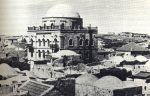
The landmark synagogue before being
dynamited by Jordan’s Arab Legion in 1948. (photo from Wikipedia)
A cornerstone laying ceremony was held May 29,
2014, for the rebuilding of the Old City of Jerusalem’s Tiferet Yisrael
Synagogue, which was dedicated in 1872 and dynamited by Jordan’s Arab Legion in
1948.
Speaking nearly five years ago, then-Jerusalem
mayor Nir Barkat declared, “Today we lay the cornerstone of one of the
important symbols of the Jewish community in Jerusalem. The municipality
attaches great importance to the preservation and restoration of heritage sites
in Jerusalem, and we will continue to maintain the heritage of Israel in this
city.”
Citing Lamentations 5:21, Uri Ariel, housing
minister at the time, added, “We have triumphed in the laying of yet another
building block in the development of Jerusalem, a symbolic point in the vision
that continues to come true before our eyes: ‘Renew our days as of old.’”
The two politicians symbolically placed a stone
salvaged from the ruined building, and construction was supposed to take three
years, according to the Company for the Reconstruction and Development of the
Jewish Quarter in the Old City of Jerusalem Ltd. (JQDC), a public company under
the auspices of the Ministry of Construction and Housing.
Fast forward to Dec. 31, 2018, and the exercise
was repeated, this time with the participation of Jerusalem minister Zeev
Elkin, construction minister Yoav Galant, deputy health minister Yaakov Litzman
and Jerusalem Mayor Moshe Leon. But, this time, according to the JQDC, much of
the project’s NIS 50 million (approximately $18 million Cdn) budget has been
secured, in part thanks to anonymous overseas donors. With the Israel
Antiquities Authority’s salvage dig of the Second Temple period site headed by
Oren Gutfeld completed, work can now begin in earnest.
Fundraising to purchase the land for the
Tiferet Yisrael, also known as the Nisan Bak shul, was initiated in 1839 by
Rabbi Israel Friedman of Ruzhyn, Ukraine, (1797-1850) and his disciple Rabbi
Nisan Bak, also spelled Beck (1815-1889). While der Heiliger Ruzhiner
(Holy Ruzhyner), as his Chassidim called him, purchased the hilltop in 1843,
the mystic didn’t live to see construction begin.
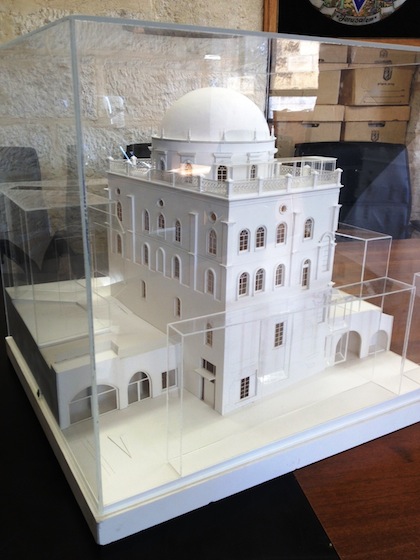
A model of Tiferet Yisrael. (photo from Jerusalem Municipality)
His ambitious plans in Jerusalem reflected his
grandiose lifestyle in Sadhora, Bukovina, in Galicia’s Carpathian Mountains,
pronounced Sadagóra in Yiddish. There, he lived in a palace with splendid
furnishings, rode in a silver-handled carriage drawn by four white horses and,
with an entourage, dressed like a nobleman, wore a golden skullcap and clothing
with solid gold buttons, and was attended by servants in livery. This unusual
manner was accepted and even praised by many of his contemporaries, who
believed the Ruzhiner was elevating God’s glory through himself, the tzadik
(righteous one), and that the splendour was intended to express the derekh
hamalkhut (way of kingship) in the worship of God.
In one incident, described in David Assaf’s The
Regal Way: The Life and Times of Rabbi Israel of Ruzhin (Stanford
University Press, 2002), the Ruzhiner’s Chassidim noticed that, notwithstanding
that their rebbe was wearing golden boots, he was leaving bloody footprints in
the snow. Only then did they realize that the gold was only a show and his
shoes had no soles. Indeed, he was walking barefoot in the snow.
Rabbis Friedman and Bak were motivated by a
desire to foil Czar Nicholas I’s ambitions to build a Russian Orthodox
monastery on the strategic site overlooking Jerusalem’s Temple Mount. Bak
consulted with architect Martin Ivanovich Eppinger. (Eppinger also planned the
Russian Compound, the 68,000-square-metre fortress-like complex erected by the
Imperial Russian Orthodox Palestine Society west of the Jaffa Gate and outside
the Old City, after the czar was outmanoeuvred by the Chassidim.)
Bak, who both designed the massive synagogue
and served as its contractor, spent more than a decade fundraising and six
years building it. Inaugurated on Aug. 19, 1872, he named the three-storey
landmark in honour of his deceased rebbe.
According to a perhaps apocryphal story, the
quick-witted Bak was able to complete the ornate synagogue thanks to a donation
from Kaiser Franz Joseph of Austria-Hungary. In 1869, while visiting Jerusalem
en route to dedicate the Suez Canal, the emperor asked his subjects who came
from Sadhora in the remote Austrian province of Bukovina why their synagogue
had no roof. (In 1842, having spent two years in Russian prisons on charges of
complicity in the murder of two Jewish informers, Rabbi Friedman fled to
Sadhora and reestablished his resplendent court.)
Seizing the moment, Bak replied, “Your majesty,
the synagogue has doffed its hat in your honour.” The kaiser, understanding the
royal fundraising pitch, responded, “How much will it cost me to have the
synagogue replace its hat?” and donated 1,000 francs to complete Tiferet
Yisrael’s dome, which was thereafter referred to by locals as “Franz Joseph’s
cap.”
Tamar Hayardeni, in “The Kaiser’s Cap”
(published in Segula magazine last year), wrote that, while the kaiser
made a donation, the dome was in fact completed with funds provided by Rabbi
Israel of Ruzhyn’s son, Rabbi Avrohom Yaakov of Sadhora (1820-1883).
In the winter and spring of 1948, the dome
served as a key Haganah military position and lookout point for the Jewish
Quarter’s outgunned defenders.
Children were recruited for the battle for
Tiferet Yisrael. Some as young as 9 built defence positions. The “older” ones –
12 or so – carried messages, food, weapons and ammunition. Some were killed,
including Grazia (Yaffa) Haroush, 16, and Nissim Gini, 9, who was the youngest
fallen fighter in the War of Independence. Like the others who fell in the
defence of the Jewish Quarter and were buried there, his remains were exhumed
after 1967 and reinterred on the Mount of Olives.
Badly damaged by heavy shelling, the synagogue
was blown up by Jordanian sappers on May 21, 1948. A few days later, following
the neighbourhood’s surrender on May 25, the nearby Hurva Synagogue – the main
sanctuary of Jerusalem’s mitnagdim (anti-Chassidic Ashkenazi followers
of the Vilna Gaon) – met the same fate.
With the rebuilding of the Hurva completed by
the JQDC in 2010, Tiferet Yisrael became the last major Old City synagogue
destroyed in 1948 not rebuilt.
Hurva is a stone-clad, concrete and steel
facsimile of its original structure, updated to today’s building code and
equipped with an elevator. The same is planned for Tiferet Yisrael.
The reconstruction of faux historic synagogues
has not been without critics. Writing in the Forward in 2007 as the
Hurva was rising, historian Gavriel Rosenfeld, co-editor of Beyond Berlin:
Twelve German Cities Confront the Nazi Past (University of Michigan Press,
2008), noted the manifold links between architecture, politics and memory.
“The reconstruction of the Hurva seems to
reflect an emotional longing to undo the past. It has long been recognized that
efforts to restore ruins reflect a desire to forget the painful memories that
they elicit. Calls to rebuild the World Trade Centre towers as they were before
the Sept. 11, 2001, attacks represent a clear (if unrealized) instance of this
yearning. And the recently completed reconstruction of Dresden’s famous
Frauenkirche – long a heap of rubble after being flattened by Allied bombers in
February 1945 – represents a notable example of translating this impulse into reality.
“And yet, the reconstruction project is
problematic, for in seeking to undo the verdict of the past, the project will
end up denying it. Denial is inherent in the restoration of ruins, as is
frequently shown by the arguments used to justify such projects. In Dresden,
for example, many supporters of the Frauenkirche’s restoration portrayed
themselves as the innocent inhabitants of a city that was unjustly bombed in
1945, thereby obscuring the city’s longtime support for the Nazi regime and its
war of aggression during the years of the Third Reich. Similarly, the physical
appearance of the restored Frauenkirche – despite its incorporation of some of
the original church’s visibly scorched stones – has effectively eliminated the
signs of the war that its ruin once vividly evoked.
“In the case of the Hurva,” writes Rosenfeld,
“the situation is somewhat different. If many Germans in Dresden emphasized
their status as victims to justify rebuilding their ruined church, the Israeli
campaign to reconstruct the Hurva will do precisely the opposite – namely,
obscure traces of their victimization. As long as the Hurva stood as a hulking
ruin, after all, it served as a reminder of Israeli suffering at the hands of
the Jordanians. [Mayor Teddy] Kollek said as much in 1991, when he noted: ‘It
is difficult to impress upon the world the degree of destruction the Jordanian
authorities visited upon synagogues in the Old City…. The Hurva remnants are
the clearest evidence we have today of that.’ Indeed, as a ruin, the Hurva served
the same kind of function as sites such as Masada and Yad Vashem – which, by
highlighting the tragedies of the Jewish past, helped to confirm the Israeli
state as the chief guarantor of the Jewish people’s future.
“At the same time, however, it seems the
Hurva’s existence as a ruin conflicted with the state of Israel’s Zionist
master narrative: the idea that, ultimately, heroic achievement triumphs over
helplessness. In fact, in the end, it may be the project’s ability to confirm
the national desire to control its own destiny that best explains its appeal.
Israel faces many intractable problems that make present-day life uncertain.
But, in the realm of architecture, Israelis can indulge in the illusion that
they can at least control and manipulate the past. In this sense, the Hurva’s
reconstruction may express deeper escapist fantasies in an unpredictable
present.”
Rosenfeld’s theorizing about architectural
authenticity made little impression on the JQDC chair, Moti Rinkov. Indeed the
JQDC, together with the Ben-Zvi Institute, recently published High Upon High,
in which 12 historians trace Tiferet Yisrael’s history. Rinkov noted at the
second cornerstone ceremony: “The renovation and restoration of the Tiferet
Yisrael Synagogue in the Jewish Quarter is one of the most important and
exciting projects I’ve taken part in. Rebuilding the synagogue is, in fact,
raising the Israeli flag in the Jewish Quarter. It’s truly a work where they’re
restoring the crown to its former glory and restoring glory to the Jewish
people.”
The rebuilt Tiferet Yisrael, together with the
Hurva, will engage Jerusalem’s skyline not as authentic landmarks but, as
Rosenfeld noted, “postmodern simulacrum.”
The other Tiferes Yisroel
In 1953, Rabbi Mordechai Shlomo Friedman, the
Boyaner Rebbe of New York, laid foundations for a new Ruzhiner Torah centre in
west Jerusalem to replace the destroyed Tiferet Yisrael. Located on the western
end of Malkhei Yisrael Street between the current Central Bus Station and
Geula, the downtown of the Charedi city, the Ruzhiner yeshivah, Mesivta Tiferes
Yisroel, was inaugurated in 1957 with the support of all of the Chassidic
rebbes descended from Friedman, who was the first and only Ruzhiner Rebbe.
However, his six sons and grandsons founded their own dynasties, collectively
known as the “House of Ruzhin.” These dynasties, which follow many of the
traditions of the Ruzhiner Rebbe, are Bohush, Boyan, Chortkov, Husiatyn,
Sadigura and Shtefanest. The founders of the Vizhnitz, Skver and Vasloi
Chassidic dynasties were related to the Ruzhiner Rebbe through his daughters.
A grand synagogue built adjacent to the new
Ruzhiner yeshivah also bears the name Tiferes Yisroel. The current Boyaner
Rebbe, Nachum Dov Brayer, leads his disciples from there. The design of the
synagogue includes a large white dome, reminiscent of the original Tiferet
Yisrael destroyed in 1948 and now being rebuilt.
חברת ואוו אייר האיסלנדית תפעיל לראשונה במהלך
הקיץ הקרוב טיסות ישירות בין ריקאוויק לוונקובר. חברת הלואו-קוסט תפעיל שש טיסות
עונתיות בשבוע בקו ריקאוויק-ונקובר – בין החודשים יוני עד אוקטובר. ישראלים
שמעוניינים להגיע לוונקובר יכולים לטוס בוואו אייר מתל אביב לריקאוויק ומשם להחליף
מטוס שיטוס עד ונקובר. הטיסות של ואוו אייר מתל אביב יפעלו גם כן בחודשים יוני עד
אוקטובר, ארבע פעמים בשבוע (ראשון, רביעי, חמישי ושישי).
ואוו אייר מפעילה כבר טיסות בקו
ריקאוויק-טורונטו ובקו ריקאוויק-מונטריאול. ישראלים יכולים להגיע עם ואוו אייר
לצפון אמריקה (עם עצירה בבירת איסלנד) בין היתר לערים הבאות: ונקובר, טורונטו,
מונטריאול, ניו ג’רסי, וושינגטון די.סי, בוסטון, דטרויט, שיקגו, סן פרנסיסקו, לוס
אנג’לס, דאלס, פיטסבורג, סנט לואיס, סינסינטי, קליבלנד ובולטימור. הם ישלמו לפי
הערכה כאלף ומאתיים דולר. בין יעדי החברה באירופה: ברלין, קופנהגן, ורשה, בריסל,
פריס, אדינבורו, לונדון, דיסלדורף, קורק, טנריף ודבלין.
ואוו אייר פועלת מזה כשמונה שנים והיא מגיעה
לשלושים ושישה יעדים בצפון אמריקה, אירופה ואסיה. החברה הטיסה בתחילת דרכה כארבע
מאות אלף נוסעים בשנה. ואילו כיום היא מטיסה קרוב לארבעה מיליון נוסעים בשנה. בחברה
מועסקים כיום למעלה מאלף עובדים והיא מפעילה ארבעה עשר מטוסים.
קרן הקיימת בקנדה מגיבה לפרשת העברת התרומות
לפרוייקטים צבאיים בישראל
מנכ”ל קרן קיימת קנדה לאנס דיוויס החליט
להגיב על החלטת הארגון להפסיק להעביר תרומות לפרוייקטים צבאיים בישראל, לאור חקירה
של רשות המיסוי הקנדית (סי.אר.איי).
רשות המיסוי הקנדית בודקת מזה מספר שנים את
פעילותה של קרן קיימת קנדה, לאור מידע שהתקבל לידיה כי הארגון עבר על כללי החוק
הקנדי למתן תרומות מצד קרנות צדקה. קרן קיימת קנדה כך התברר תרמה כספים לפרוייקטים
הקשורים לצה”ל בניגוד לכללי המס בקנדה. במקרה כזה קרן קיימת קנדה לא זכאית
לפטור במס. כן גם התורמים שלה עצמם לא זכאים לפטורים במס.
דיוויס אמר לאתר החדשות בנושאי היהודים בקנדה
(סי.ג’י.אן) את הדברים הבאים: “קרן קיימת קנדה תמשיך לעבוד במשותף עם רשות
המיסוי הקנדית לבדיקת כל הפעילויות שלנו. לכן בשלב זה אנו מוגבלים במה שאנחנו
יכולים להגיד בנושא. השליחות של קרן קיימת קנדה היא להטיב את איכות החיים בישראל.
בעבר היינו מעורבים בפעילויות צדקה הקשורות בעקיפין בצה”ל. רבים מהפרוייקטים
היו לטובת בין היתר איכות חיים של ילדים ובני נוער, כמו תרומות למגרשי משחקים
ופארקים. כל הפרוייקטים האלה נמצאים על שטחים השייכים לצה”ל והכסף לא הועבר
לצבא. בסך הכל היקף התרומות הקשורות בפרוייקטים צבאיים נמוך והגיע לכאחוז מסך כל
התרומות שלנו במשך כעשור. אז האמנו שקרן קיימת קנדה עומדת בדרישות החוק הקנדי,
משום שמדובר בתרומות לצדקה שנועדו לעזור בעיקר לילדים. אנו לא ידענו שהפרוייקטים
שלנו יהיו מטרה לחקירה של רשות המיסוי הקנדית, כיוון שהם נמצאים על אדמה בבעלות
צה”ל. מייד שקיבלנו מידע על כך לפני מספר שנים הפסקנו את התמיכה בפרוייקטים
אלה. כאמור מזה מספר שנים אנו לא תורמים יותר כספים לפרוייקטים על אדמת
בצה”ל”.
לפי פרסומי קרן קיימת קנדה הארגון תמך
בפרוייקטים רבים הקשורים בצה”ל. בהם: פיתוח כיתות לימוד, אולמות אירועים, חדרי
הקרנות, מועדוני חיילים, הקמת מגרשי משחקים עבור ילדים (שמתגוררים עם בני
משפחותיהם בבסיס), שידרוג מרכזי מבקרים, שיפוץ כיכרות מרכזיות, הקמת מתקני נוחות
לחיילים, בניית נקודות מפגש לאפשר לחיילים לראות את בני משפחתם וכן תמיכה פרוייקט הגדנ”ע.
“Open Doors” by Marcie Levitt-Cooper.
(photo by Daniel Wajsman)
The group show Community Longing and Belonging,
which opened Jan. 15 at the Zack Gallery, marks Jewish Disability Awareness and
Inclusion Month (JDAIM).
“I heard about community art shows in
celebration of JDAIM in other communities,” said Leamore Cohen, inclusion
services coordinator at the Jewish Community Centre of Greater Vancouver, who
was the driving force behind the local exhibit.
“I thought an unjuried exhibit would be a
fabulous way to honour our community-wide commitment to remove barriers, to
celebrate our community members’ creative capacities,” she said.
The main idea was to open up participation to
everyone – professional artists and amateurs, people of different skill levels,
abilities, perspectives, faiths and socioeconomic status.
“To make participation truly inclusive,” said
Cohen, “we provided each artist with a 12-by-16 wood panel. We have also been
taking direction from Kickstart Disability Arts and Culture and its artistic
director, Yuri Arajs, as we wanted to ensure that this event is fully
accessible.”
The JDAIM inclusion initiative and month of
advocacy began throughout North America in 2009, explained Cohen. The idea for
the art exhibit started to take form last spring, when Cohen approached Zack
Gallery director Linda Lando.
“Linda was really receptive to the idea of the
show.… Once I had the green light from her, the support and use of the
gallery,” said Cohen, “I began to focus more on the theme.”
The theme of community and inclusion prompted
her next steps. She reached out to many different organizations and communities
and invited artists from all over the Lower Mainland to participate. The call
for submissions went out in late September, and the response was remarkable.
Fifty-two artists are included in the show.
“We have artists from Vancouver, Burnaby,
Richmond, North Vancouver, and even as far out as Cloverdale,” said Cohen.
“I’ve had the good fortune to meet all these new and amazingly creative people,
welcome them to our community centre, and make new friends along the way. It’s
been a joy. It broke my heart that I had to turn many away because of the
limited space in the gallery. I have artists who want to sign up for the next
year. There is so much excitement and so much more to say on this issue.”
“Embrace” by Evelyn Fichmann. (photo by Daniel Wajsman)
To frame this exhibit, Cohen posed two
questions, which are being used in its promotional materials: “How do we make
meaning of the concept of community, the real and the imagined spaces we
inhabit? What does community longing look like and what are the possibilities
for belonging in an ever-changing world?”
“This show was a challenge and an invitation to
look at social problems creatively and critically,” Cohen told the Independent.
“It was also an opportunity for artists living with diverse needs to exhibit
their work in a professional venue and to receive exposure.
“I don’t think we are going to resolve the
problems of longing and belonging, or longing for belonging, any time soon. I
think we’ll always have people who are better situated and people whose social
networks are more tenuous. We should just keep having the conversations and
build up those connections. We create new platforms and new access points, new
opportunities for people to engage and tell their stories, whatever they look
like and from whatever lens, whether it be through mental health, sexual
identity, ability or socioeconomic status. We all have a story to tell.”
Cohen shared one example of how the show’s
theme relates to her own life.
“The ‘longing’ part of the theme resonates with
a lot of people,” she said. “It resonates with me as well. It emerges from my
own story of disconnection from the Jewish community during my youth and young
adulthood. Fortunately, so, too, does the ‘belonging’ part of this show. The
JCC is a wonderful place, a place for belonging.”
“Veselye u Selu” by Daniel Malenica. (photo by Daniel Wajsman)
The theme allowed for a number of different
approaches, and the skill of the various participating artists varies widely,
but the utter diversity becomes its main attraction. Although the size and
shape of the canvases – the wooden boards provided by the organizers – are
universal, the content is anything but, and so is the media. Some pieces are
oils, others acrylic; still others, mixed media. There are abstracts and
figurative compositions. Some have narratives. Others evoke emotions. Some have
Jewish connotations. Others don’t. Some artists participated solo, while others
enrolled as a family group.
Marcie Levitt-Cooper represents one such
family. Her painting “Open Doors” depicts a colony of colourful birdhouses.
Every door of every birdhouse is open, creating a welcoming avian village, a
festive metaphor that makes you smile. No birds appear in the image, but you
can almost hear them sing. The artist’s three daughters – Rebecca Wosk, Teddie
Wosk and Margaux Wosk – also exhibit in the show.
Another family of artists is mother Elizabeth
Snigurowicz and son Matthew Tom Wing. “They regularly come to the Jewish
Community Centre inclusion services Art Hive drop-in program, a low-barrier,
free art program,” said Cohen.
Daniel Malenica doesn’t have a family in the
show, but her charming, pastel-toned piece is a jubilation of the artist’s
Croatian roots and her LGBTQ+ community. Two girls embrace each other in the
painting, both wear Slavic costumes. The title, “Veselye u Selu,” is the
English phonetic spelling of a phrase in the artist’s mother tongue, meaning
“Celebration at the Village.”
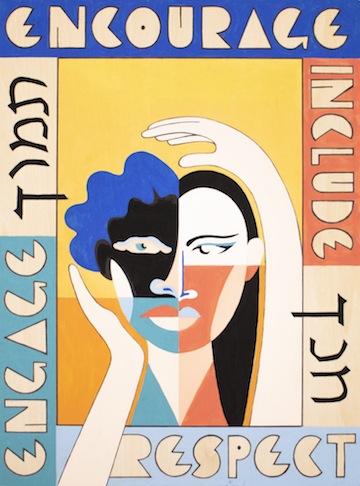
In Evelyn Fichmann’s painting “Embrace,” the
artist, a recent immigrant from Brazil, has incorporated words in English and
Hebrew. “Encourage,” “include,” “educate,” “respect,” “engage” and “support”
surround the image, all fitting descriptors of what we should strive to do in
our communities.
Community Longing and Belonging runs until Jan
27.
Olga Livshin is a Vancouver freelance writer. She can be reached at olgagodim@gmail.com.
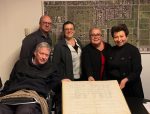
Left to right are Sam Sullivan, Glen
Hodges, Cynthia Ramsay, Margaret Sutherland and Shirley Barnett with one of the
Mountain View Cemetery ledgers. (photo by Lynn Zanatta)
“When we were restoring the Jewish cemetery at
Mountain View, we spent two years going through City of Vancouver material
trying to determine if the city actually had something in writing to prove the legitimacy
of this Jewish section since 1892,” Shirley Barnett, who led the Jewish
cemetery restoration project, told the Jewish Independent in an email.
The committee couldn’t find anything in the city records.
While this lack of documented history lengthened
the restoration agreement process significantly, it did not halt it. Barnett,
as chair, opened the first meeting of the restoration advisory committee on
Feb. 13, 2013, and the Jewish cemetery at Mountain View was officially
rededicated on May 3, 2015. However, if the committee were to have started its
work today, the information it sought would have been found, and the process
would have moved much more quickly.
Sam Sullivan, member of the Legislative
Assembly (Vancouver-False Creek) and former mayor of Vancouver, founded the
Global Civic Society in 2010. As part of its mission to encourage “a
knowledgeable and cosmopolitan citizenry to make strong connections to their
community,” the society leads several initiatives, including Transcribimus, “a
network of volunteers that is transcribing early city council minutes and other
handwritten documents from early Vancouver, and making them freely available to
students, researchers and the general public.”
Transcribimus project coordinator Margaret
Sutherland has transcribed at least 155 sets of Vancouver City Council minutes.
It was she who found what Barnett and her committee were looking for – in the
council minutes of June 6, 1892. On page 32 of the minute book, it is recorded
that correspondence had been received, “From D. Goldberg asking the council to
set aside a portion of the public cemetery for the Jewish congregation,” and
was “Referred to the Board of Health.”
Two weeks later, the minutes of June 20, 1892,
note that the health committee had resolved, among other items, “[t]hat the
piece of land selected by the Jewish people in the public cemetery be set aside
for their purposes.”
In addition to the transcribed council minutes, transcribimus.ca includes photos of the minute book pages. This image is of the June 20, 1892, minutes, which note that the health committee had resolved, among other items, “[t]hat the piece of land selected by the Jewish people in the public cemetery be set aside for their purposes.”
The cemetery first appears to have come up a
few years earlier. In the July 29, 1889, council minutes, there is reference to
a letter: “From L. Davies on behalf of the Jewish congregation of the city of
Vancouver requesting council to set apart about one acre and a half in the
public cemetery for members of the Hebrew confession. Referred to the Board of
Works.”
In an email to Barnett, Sutherland wrote,
“There doesn’t seem to be any indication from city council minutes that the
Board of Works ever followed up on the above request. Although [Jewish
community member and then-mayor] David Oppenheimer was on the Board of Works
for that year, so was his opponent, Samuel Brighouse.”
On Dec. 7, 2018, the Jewish Independent
met with Barnett, Sullivan, Sutherland, Lynn Zanatta (Global Civic Policy
Society program manager) and Glen Hodges (Mountain View Cemetery manager) at
Mountain View. In documents she brought to that meeting, Sutherland explains
that Oppenheimer “declined to serve as mayor again at the end of 1891, citing
poor health as his reason for retiring. Fred Cope was elected mayor in 1892 and
served till the end of 1893.” So it was Cope who was mayor when the Jewish
cemetery was established; Oppenheimer was Vancouver’s second mayor (1888-1891)
and Malcolm Maclean its first (1886-1887).
The first interment at Mountain View Cemetery
was Caradoc Evans, who died at nine months, 24 days, on Feb. 26, 1887. The
first Jew interred in the cemetery is thought to be Simon Hirschberg, who “died
of his own hand” on Jan. 29, 1887, and was, according the plaque erected by the
cemetery in 2011 (the cemetery’s 125th year), “intended to be the first
interment,” however, “rain, a broken carriage wheel on a bad road and his large
size all contributed to him being buried just outside the cemetery property,”
where he was “long thought to have been left near the intersection of 33rd and
Fraser” until his body was moved into a grave on cemetery property. Oddly
enough, the first Jew to be buried in the Jewish section was Otto Bond (Dec.
19, 1892), who also took his own life.
This page from a Mountain View Cemetery ledger shows the entry for Otto Bond, the first Jew to be buried in the cemetery’s Jewish section.
So far, since its inception in 2012,
Transcribimus has seen more than 300 transcripts produced by almost 40
volunteers, although a handful of them are responsible for the lion’s share to
date. Many people have donated their time, technical advice and, of course,
funds to the project. Barnett sponsored the transcribing of the city council
minutes for 1891, and fellow Jewish community member Arnold Silber sponsored
the transcription of the 1890 minutes. A few other years have also been
sponsored, including 1888, by the Oppenheimer Group.
About nine years’ worth of minutes have been transcribed
(1886-1893 and 1900), leaving much more work to be done, as the city kept
handwritten minutes until mid-1911. After that, minutes were typewritten and
these documents can be scanned and read with OCR (optical character
recognition), said Sutherland.
The Transcribimus website (transcribimus.ca) is one of the best-designed sites the Independent has come across. It is both visually appealing and incredibly easy to use. In addition to the transcribed council minutes, it includes photos of the minute book pages. As well, it features letters from Vancouver’s early years, historical photographs and a few videos, including a film by William Harbeck of a trolley ride through Victoria and Vancouver in 1907, which has had speed corrections and sound added by YouTuber Guy Jones. (Astute viewers will see that the trolley is driving on the lefthand side of the road. British Columbia didn’t switch to the right until 1921-22.)
In the material Sutherland brought to the
December meeting at the cemetery office, she included the transcription of the
short letter that city clerk Thomas McGuigan wrote on June 23, 1892, in
response to Goldberg’s letter that was mentioned in the council minutes. In it,
McGuigan confirms “the grant made by council to the people of the Jewish faith
of a piece of land in the public cemetery,” but adds that “they will be unable
to give you title for the same, as the land was set apart by an Order in
Council of the provincial government for burial purposes and they refuse to
give any other title.”
Sutherland hadn’t come across Goldberg’s
letter, that of Davies or any response to Davies. It’s likely that these
letters have been lost or destroyed, but they might turn up in another file,
she said.
However, Sutherland did find a brief letter to
the editor of the Vancouver Daily World newspaper, dated Nov. 1, 1898,
from L. Rubinowitz, which she emailed to the Independent. Rubinowitz
wanted the application for the Jewish cemetery by “a certain number of Jews of
this city” to be refused. In his view, “all the Hebrews of this city are not
combined as one body” and “To avoid trouble between them and for the sake of
peace, as one party will claim that they have the sole right to it, the other
party will claim that they have the sole right to it, therefore, as it is now
under the control of the city, we are well satisfied to let it remain so, as in
my opinion the city will have no objections for us to make any improvements if
necessary.”
The old joke comes to mind of the Jewish man
who, when stranded on a deserted island by himself, builds two synagogues – the
one he’ll attend and the one he won’t set foot in. Community cohesiveness is a
heady task; always has been, and definitely not just for the Jewish community.
As more council minutes, letters, photographs and other documents are found, transcribed and shared, the holes in our understanding of the past and how it has formed the present will be filled. To support or participate in Transcribimus or other Global Civic Society projects, visit globalcivic.org.
Rahaf Mohammed al-Qunun, an 18-year-old Saudi
woman, was publicly welcomed to Canada Saturday. She had spent a week in a
hotel in Thailand, asking for asylum in a Western country, saying that she did
not want to return to her allegedly abusive family, whom she says have
threatened to kill her.
Whether her family is indeed abusive has not
been proven. But two factors make that issue somewhat moot. First, guardianship
laws in Saudi Arabia require women to get permission from a father, husband,
brother, son or other male relative in order to work, travel, marry, receive
certain medical treatments and even to leave the house. This is codified
inequality and abuse against about half the population of the country. In
principle, that law alone should make all Saudi women eligible for refugee
claims in democratic countries. Additionally, al-Qunun renounced Islam, which
is an offence punishable by death in Saudi Arabia.
The teen’s arrival was a bit of a media
festival, with Foreign Affairs Minister Chrystia Freeland embracing al-Qunun at
Toronto’s airport.
The ostentatious greeting was extra-weighted
because Canada is in an ongoing diplomatic spat with the Saudis. After Freeland
tweeted a criticism of Saudi arrests of civil and women’s rights activists last
year, the Saudis threw Canada’s ambassador out of the country and threatened to
withdraw thousands of Saudi medical students from Canada, among other
responses. The public greeting of a now-prominent Saudi dissident by a senior
Canadian government official will be seen as a provocation, and perhaps it was
intended as such.
Some commentators note that al-Qunun jumped the
queue, not only flown to Canada to make a refugee claim, but accepted
immediately as a refugee. The global visibility of her case resulted in a
country – ours – leaping to accept her, even while one percent of refugees are
resettled in a given year.
Also, some diplomats with Saudi experience are
warning that the young woman should not be used as a political football – both
because that could put her safety at risk and because it could unnecessarily
enflame existing tensions.
David Chatterson, a former Canadian ambassador
to Saudi Arabia, told the CBC that he worried about precedents.
“What happens the next time a teenage girl or
adult woman from Saudi Arabia flees her family and declares herself to no
longer be a Muslim, does that mean automatic sanctuary?” he asked.
Of course, diplomatic idealism is always
tempered by economic and other realities. The CBC obtained, through an Access
to Information request, evidence that the federal government heard concerns
from Canadian businesses about their interests being jeopardized when
Freeland’s tweets to the Saudis raised the ire of the kingdom’s rulers. On the
flip side, Canada does not have as many economic ties to the Saudis as many
European and other democratic countries, and this might give us a little more
freedom to criticize. The U.S. president has already stated explicitly that he
will not endanger American economic interests by contesting Saudi treatment of
dissidents – including the murder and dismemberment of Washington Post
writer Jamal Khashoggi.
Of 149 countries rated by the World Economic
Forum in its annual report on gender equality, Saudi Arabia came 141st. Canada
cannot free every one of the 16 million or so Saudi women, but we can ensure
freedom for this one.
Yes, al-Qunun did effectively “jump the queue.”
But, at the moment when the whole world was watching, that queue-jumping
allowed Canada to take a principled stand for gender equality and for the
freedom of – and from – religion.
My family recently traveled to northern
Virginia for a bar mitzvah. We did it in a long weekend. We left Thursday
afternoon and returned on Tuesday. It was the farthest we’ve ever gone in a
weekend with kids. Afterward, I felt bleary and fuzzy around the edges.
However, wandering through three airports in each direction and attending five
or six big family events and meals exposes you to things you might not have
noticed before.
My nephew became a bar mitzvah at my childhood
congregation. Each weekend, they print a bulletin or program with information
about services and upcoming activities. When services ended, my husband tucked
his program into his tallis bag as a memento. I also took one for safekeeping,
but I saw it as primary source material. Proof that, indeed, all these
activities could happen at a healthy congregation.
Awhile back, I wrote a column describing a
slate of weekend Jewish events, for every age group, at North American
congregations. As one template, I used Temple Rodef Shalom, in Falls Church,
Va. I’ll never forget some of the feedback I got. The loudest responses were
from older men. One told me I must be making this up. Why would any
congregation cater to special interests (children, teenagers, those with
disabilities, women, Jews of colour, the needy, Jews by choice, and others) the
way these ones did? This man stopped just shy of telling me I was writing fake
news.
I don’t consider myself a journalist. I wasn’t
trained as one. I usually write clearly marked opinion pieces, how-to articles
and features. I don’t go to war zones, report on famine or natural disasters,
but, apparently, that didn’t matter either. In a reply, I linked to two
congregations’ calendars, including ones that had served as my template. The
somewhat virulent response from this man targeted Reform Judaism, liberals and
… no need to go on, you get the picture. No amount of valid information would
likely sway him.
While going through the Winnipeg, Minneapolis
and Washington National airports, I glimpsed newsstand magazine covers. Time
magazine’s Person of the Year was not Trump. No, the 2018 people of the year
were journalists killed or imprisoned for doing their job.
Journalists and, more generally, writers, have
a job that requires them to observe, hear and listen to what’s going on around
them. In a fast-moving world, a well-written piece can help readers absorb
information or perceive a different point of view – ideally to help us
understand a bigger worldview than we can find on our own.
I thought about this “fake news” response while
I read the synagogue bulletin from the bar mitzvah. The congregation’s name,
chosen in the 1960s – Rodef Shalom, Pursuer of Peace, referencing Psalm
34:15 – was carefully selected: “Depart from evil and do good. Seek peace and
pursue it.” And, indeed, the congregation was doing many good activities in
December. They examined issues concerning gun violence, Torah, politics and the
life of the synagogue. On Dec. 25, they had a Mitzvah Day scheduled, working on
creating “care kits” for the homeless, cooking and delivering hot meals and
sandwiches to homeless shelters, and collecting, sorting and distributing
winter clothing for those who needed it.
There are many Jewish angles to being a good
journalist, writer or observer. Jews are People of the Book. We’re also primed,
in the Sh’ma, to “hear these words, to speak them, to write them and to teach
and listen to them.” In our efforts to understand who we are as Jews, we also
must learn to hear, listen and communicate with others. We should know what it
means to be a witness to events, whether we are journalists or not.
If one wants to, you can really shelter
yourself these days into consuming (watching, hearing and reading) just the
“feed” that caters to your sensibilities. That is, you can believe there is a
border wall already being built between the United States and Mexico to keep
out dangerous criminals instead of refugees. You can provide yourself a fake
news narrative that somehow allows you to think that the white person who shot
at synagogue-goers in Pittsburgh, or the one who killed so many in Las Vegas,
is not as threatening as Al Sharpton or American Muslims.
I choose a different approach. In the airport,
we smiled at others – no matter their skin colour or religious beliefs. We
chatted with a young woman who attends Howard University (an historic and
respected African-American institution) and I told her how great the campus was
when I once took a teacher licensing exam there. One of my kids pulled a book
out of a backpack for me to read them while we waited: a Scholastic book on
Viola Desmond (who’s on Canada’s new $10 bill, by the way).
Time said they chose
these journalists “for taking great risks in pursuit of greater truths, for the
imperfect but essential quest for facts, for speaking up and for speaking out.”
Part of being Jewish is taking the time to hear
and listen to what is around us, and to take risks to pursue truth and peace.
We’re known as people who speak out for those who need compassion (Joseph
helped the Jews in Egypt in time of famine) and justice (Moses spoke out
against slavery). In that tradition, we have had modern leaders like Abraham
Joshua Heschel, who spoke out on civil rights.
I take this one step further when I write it
down and it gets sent to you in the newspaper. We’re lucky – as we start 2019,
we have the power to choose to read, listen, learn and treat each other with
love and an open heart and discern what is real. I have an actual printed
bulletin to prove that synagogues can and do provide programming for many
constituencies. I do fear hatred,
lies, violence and fake news, but I don’t spread a blanket of fear where it
doesn’t belong – not on top of people of colour (Jews or non-Jews) or others
with predominantly moderate religious traditions like Islam.
Christians may talk about witnessing but, every
day, Jews recite in the Sh’ma an obligation to hear and to listen, to read and
communicate our values. When we truly pursue peace, we don’t accuse each other
of making up the news. Instead, we make news for doing good things and being
upright and honest with one another.
Let’s lift a glass to tolerance and good
communication, too. Here’s to a loving, peaceful, civil and truthful 2019.
L’chaim.
Joanne Seiffhas written regularly for CBC Manitoba and various Jewish publications. She is the author of three books, including From the Outside In: Jewish Post Columns 2015-2016, a collection of essays available for digital download or as a paperback from Amazon. See more about her at joanneseiff.blogspot.com.
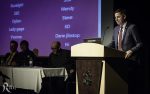
Winnipeg Mayor Brian Bowman speaks at
the Nov. 22 forum Wide Awake. According to Ivy Kopstein of Jewish Child and
Family Service of Winnipeg, he “is advocating to all levels of government for
resources to deal with this health crisis.” (photo by Nik Rave)
“It is a significant issue in both Winnipeg and
Vancouver,” Dr. Ruth Simkin told the Independent. “In Vancouver, it has
been overshadowed by the opioid crisis, but is a significant problem there,
too. It is seen in the Winnipeg Jewish community. I don’t have stats on its
prevalence in this particular group, but it is likely similar to other
populations.”
Simkin is a family physician working at a
community health clinic in Winnipeg and part-time with the addictions
unit/addictions consult service at the Health Sciences Centre (HSC) and Rapid
Access Addictions Medicine (RAAM). The JI recently interviewed her about
addiction; in particular, to methamphetamine, in light of a Nov. 22 forum in
Winnipeg on the topic.
Wide Awake – An Eye-Opening Look at
Methamphetamine in Winnipeg was held at the Asper Jewish Community Campus. It
was co-presented by Jewish Child and Family Service (JCFS) of Winnipeg, Gray
Academy of Jewish Education and the Rady Jewish Community Centre.
Amphetamines were developed in the late 1900s
and used commercially from about 1930 for various reasons, including nasal
congestion and to keep soldiers awake. Because of their adverse effects and
addictive properties, however, their use became legally restricted in the
1970s.
Methamphetamine (crystal meth) belongs to the
amphetamine class of drugs – stimulants that speed up the body’s central
nervous system. Although not legally available in Canada, crystal meth has been
used recreationally for a very long time.
“The initial effects of methamphetamine on the
user are a sense of well-being or euphoria, increased energy and alertness,
increased confidence and little need for food or sleep,” said Simkin. “Unwanted
potential side effects include racing heart, dry mouth, nausea and vomiting,
anxiety and restlessness. It can also produce paranoia, delusions and
aggressive and violent behaviour.”
“Methamphetamine comes as a powder that can be
used by ingesting, snorting, smoking or injecting,” explained Dr. Erin Knight,
medical director of the HSC’s addictions program, who was a Wide Awake panelist.
“It also comes in a crystal form (crystal meth). It is produced in illegal labs
with fairly inexpensive and sometimes toxic ingredients. It may be made with
ingredients from antifreeze, batteries and cleaning fluid.”
It is estimated that one percent of students in
Manitoba from grades 7 to 12 have tried methamphetamine over the last year. It
is easily accessible and inexpensive. Its price has dropped significantly in
the last few years, from approximately $30 per gram to $10 per gram.
In her work at the HSC, it is common for Simkin
to see patients who use meth, usually along with other drugs.
“It is a growing problem,” said Simkin about
the use of the drug. “It is very accessible, cheap, has a prolonged effect on
the user – six to eight hours if injected and 10 to 12 hours if smoked – and it
is very reinforcing (addictive).
“As well, its effects are more unpredictable
than other drugs. The number of users has doubled over the last few years. And,
we’re also seeing a shift from individuals smoking meth to them injecting
meth.”
According to Sheri Fandrey of the Addictions
Foundation of Manitoba – who also was a Wide Awake panelist – drug mixing
increases the potential for challenging behaviours and the possibility of a
serious overdose. That meth is bought and sold in an unregulated market
increases the risk that it may contain adulterants and contaminants that can
cause further harm.
“There is no specific treatment in terms of
medication,” said Simkin regarding addiction to meth. “There is some evidence
for the use of motivational interviewing (MI) and rewards-based treatment.”
A recent Winnipeg Regional Health Authority
(WRHA) report stated that, in the 2014-2015 fiscal year, 682 people who sought
treatment at the Addictions Foundation
had used meth over the prior 12 months. A year later, that number had
increased to 1,198. Meth was no longer being reported to be an occasional drug,
and women were using more than in the past.
“As far as we know, meth use crosses all lines:
rural/urban, high/low income and male/female,” said Simkin. “However, as with
other substances, there are higher risk groups. These higher risk groups are
students, low-income, rural, homeless, disenfranchised groups and people with
co-occurring mental health disorders.”
Last year’s theme for Addictions Awareness
Week, chosen by the Canadian Centre for Substance Use and Addiction, was “All
Walks of Life.” Substance use issues and addiction do not discriminate by age,
gender, class or religion.
Simkin said this is a complex and difficult
issue, but suggested that having education programs in schools would be
helpful, as are forums such as Wide Awake.
As a community, Simkin said there are several
things that can be done to improve the situation:
1. Reduce the stigma around substance use in
general, so people who need help aren’t afraid to seek it.
2. In terms of government, increase funding for
detox beds and addiction treatment, including harm-reduction services.
3. Work on other determinants of health, like
poverty, housing and education, as well as mental health, to try to prevent
addiction in the first place.
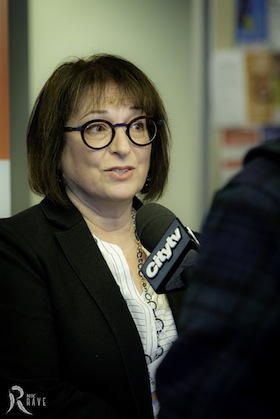
Ivy Kopstein, coordinator of the substance use and addictions program at Jewish Child and Family Service of Winnipeg, answers a question from CityTV at the forum Wide Awake. (photo by Nik Rave)
Another resource now available in Winnipeg are
the RAAM clinics that have been instituted recently by the WRHA to provide
low-barrier access to resources for individuals needing help with substances
abuse issues, including crystal meth.
“The City of Winnipeg and law enforcement are
responding to the crisis on the streets and have included public education
programs in all areas of the city,” said Ivy Kopstein, coordinator of the substance
use and addictions program at JCFS Winnipeg. “Our mayor is advocating to all
levels of government for resources to deal with this health crisis.”
“Emergency Medical Services (EMS) has now been
given the authority to give meth users the antipsychotic drug Olanzapine,”
Simkin offered by way of an example.
When a loved one has a substance abuse issue,
it impacts the whole family, she said. Family members may feel stressed and
anxious and it’s important for them to also seek support.
In British Columbia, the B.C. Centre on Substance Use (bccsu.ca) “is a provincially networked organization with a mandate to develop, help implement and evaluate evidence-based approaches to substance use and addiction.” Other resources include Crystal Meth Anonymous (crystalmeth.org), which is similar to Alcoholics Anonymous and lists a meeting place on Hornby Street in Vancouver, and Jewish Addiction Community Services (778-882-2994 or info@jacsvancouver.com).






![photo - In addition to the transcribed council minutes, transcribimus.ca includes photos of the minute book pages. This image is of the June 20, 1892, minutes, which note that the health committee had resolved, among other items, “[t]hat the piece of land selected by the Jewish people in the public cemetery be set aside for their purposes.”](http://www.jewishindependent.ca/wp-content/uploads/2019/01/jan-18-cov.18.cemetery-1892-06-jun-20-vancouver-city-council-minutes_page-50-cropped-w-oval.jpg)