Raphael Lemkin, a Polish-Jewish lawyer, coined the term “genocide” in 1944. (photo from Arthur Leipzig Estate, courtesy of Howard Greenberg Gallery, via ushmm.org)
Anna-Mae Wiesenthal was in the United Kingdom recently and passed a table in Dublin that was accusing Israel of perpetrating genocide against Palestinians in Gaza. She engaged the people at the table in conversation.
It was a small act of dialogue between a few individuals, but it reflects what Wiesenthal views as a vital act in mutual understanding.
Encouraging conversations like these is one of the reasons the Vancouver educator recently led a course at Temple Sholom on the definition of genocide.
Wiesenthal holds a master’s degree in Holocaust and genocide studies and is about to defend her PhD dissertation in the same discipline. Both degrees are from Gratz College, in Pennsylvania. She retired last year as a teacher at Vancouver’s King David High School.
The three-class course at Temple Sholom addressing the emotionally and academically challenging topic of genocide comes at a time when
Israel is being accused of perpetrating crimes against humanity in Gaza. The topic has immediate resonance. Wiesenthal’s intention, however, was to take a more nuanced approach to the subject.
“My goal when I retired is to continue to be an educator in different capacities,” she said. After discussions with Temple Sholom’s Rabbi Dan Moskovitz, she put together the course, which ran on three consecutive Wednesdays, ending March 19.
The focus, she said, was an examination of the concept, introducing students to when and why the term “genocide” was coined, in 1944, by Raphael Lemkin, a Polish-Jewish lawyer, and looking at its definition, examining the wording and identifying problematic components.
In 1948, the United Nations Genocide Convention defined “genocide” as: “Any of the following acts committed with intent to destroy, in whole or in part, a national, ethnical, racial or religious group, as such: killing members of the group; causing serious bodily or mental harm to members of the group; deliberately inflicting conditions intended to destroy the group in whole or in part; imposing measures to prevent births within the group; forcibly transferring children of the group to another group.”
“The word ‘intent’ in the definition is problematic,” Wiesenthal said, as an example of the exploration the class undertook. “How do you prove intent?”
The goal of the course, she said, was “to come out possibly with more questions or appreciation for the complexity of the definition.”
The small group of students analyzed the 10 Stages of Genocide, a framework developed and introduced in 1996 by Dr. Gregory H. Stanton, the founder of Genocide Watch, to help identify the warning signs of genocide and prevent it before it escalates.
These steps include classification (dividing people into “us” versus “them” based on ethnicity, race, religion or nationality); symbolization (assigning symbols or names to distinguish groups, such as the yellow Star of David for Jews in Nazi Germany); discrimination (dominant groups deny rights to a specific group, often through laws or policies); dehumanization (the targeted group is compared to animals, vermin, insects or diseases to strip them of their humanity); organization (genocidal acts are planned and coordinated, often by governments, militias or extremist groups); polarization (propaganda and hate speech are used to drive society further apart, making violence seem justified); preparation (authorities or groups begin making lists, planning logistics and even building camps or weapons for mass killing); persecution (victims are identified, isolated and deprived of rights, for example, forced deportation, concentration camps, starvation); extermination (the mass killing of the targeted group begins, often justified as “cleansing” or necessary for national security); and denial (perpetrators cover up evidence, deny crimes, blame victims or rewrite history to avoid accountability).
“It’s not always linear,” Wiesenthal said of the 10 stages. “Some of the stages can overlap, some of the stages may not necessarily be present, but it’s a way to identify and help you predict. If we see conditions of the stages unfolding then perhaps we can predict more accurately that there is groundwork being laid for genocidal actions.”
While Wiesenthal wanted to encourage depth of understanding on the topic, its immediacy – with Israel being accused of genocide by groups including Amnesty International and Human Rights Watch – led some students, and the Independent, to pressure her to comment on current events.
“What do we say when somebody says Israel is committing genocide?” Wiesenthal asked. “I could ask a question like: What is your understanding of genocide? What does that mean to you?”
If Israel wanted to commit genocide, Wiesenthal noted, they have the military capacity to have done so on the first day of the war. This is perhaps the most immediate, if not entirely nuanced, response.
“You can make all kinds of arguments about how there was or wasn’t enough humanitarian aid and food trucks entering Gaza,” she said. “The fact is there were food trucks entering.”
There could be legitimate discussions about what Hamas did with that aid once it entered Gaza. But, she said, the larger issue is that governments that plan on committing genocide do not provide victims with humanitarian aid, nor do they provide vaccines for children, as Israel has done.
Military experts, such as John Spencer, who specializes in urban warfare, has said that the civilian casualty ratio in Gaza is “historically low for modern warfare” and cites Israeli Defence Forces estimates that 50-60% of Gazans killed have been civilians, well below the 80-90% of civilian casualties typical in modern conflicts.
Spencer has praised the Israeli military’s efforts to minimize non-combatant harm, citing mass warnings to Gazan civilians, providing evacuation and relocation directives to reduce casualties, and the use of “roof knocking” techniques before airstrikes.
While Israel has been condemned for using 2,000-pound bombs in urban areas, Spencer has claimed that these are standard for penetrating fortified underground structures, like Hamas’s extensive tunnel networks, and contends that their use is not intended to cause unnecessary destruction but to legitimately and effectively serve military objectives.
Wiesenthal turns the genocide narrative around, noting that Hamas has explicitly dedicated itself to committing genocide against Israelis and Jews, both in writing and in its repeated expressed statements.
“It is part of Hamas’s charter and something they verbally repeated, that their goal is to get rid of Jews, and their readiness to commit Oct. 7 over and over again,” she said.
This goes to the challenging issue of intent on the part of both Israelis and Hamas, she added.
“If given the opportunity, Hamas [has said it] would kill every Jew in Israel and destroy Israel,” said Wiesenthal. “Israel is not targeting the Palestinian people or the Palestinian population in Gaza. Their campaign is solely directed at the terrorist organization Hamas, which is existentially threatening Israel. Israel is responding to a genocidal attack.”
Author Israel Ellis with his new book, The Wake Up Call, after a Feb. 10 talk at Beth Tikvah Synagogue in Toronto, where he joined journalist Dave Gordon in conversation. (photo by Dave Gordon)
In his new book, The Wake Up Call: Global Jihad and the Rise of Antisemitism in a World Gone MAD, author Israel Ellis brings the events of Oct. 7, 2023, into a compelling, fact-based and easy-to-read focus.
Backed up by scores of footnotes and references, the book is a no-nonsense look at the Hamas terror attack of Oct. 7 and, poignantly, the attack on democracy Ellis believes happened in the months prior to them. The addition of personal stories from Oct. 7 survivors and family members adds another level of documentation to an already all-encompassing book.
Ellis weaves in his own lived experience and perspective as a Jewish Canadian in the diaspora with firsthand accounts of contemporary antisemitism and his reflections on being the father of an Israel Defence Forces lone soldier fighting in Gaza. His personal observations allow the reader to connect with him, as well as better understand the interconnectedness of Jews, no matter where they live, and Israel.
For non-Jews, it can be daunting to begin learning about what happened on Oct. 7, and the global repercussions. Many non-Jews do not know the history of the Middle East, how the state of Israel fits into this history, or what the definition of “antisemitism” is. Ellis helps fill in these blanks, and this is why I am so excited to introduce this book to my friends.
Since Oct. 7, 2023, Canadians (and people from other countries) have seen large pro-Palestine protests in the streets of all the major cities and in academic spaces, with large university encampments set up across the country. Most people in the Jewish community see these protests for what they are: pro-terror and anti-democratic. But, for a Canadian with little knowledge of what the Israeli/Palestinian conflict is, these protests and encampments can look like a fight for human rights. No doubt, some individuals believe they are marching for human rights while chanting“intifada revolution,” but many are there to show support for Hamas, to some degree or another. This is why the knowledge, geopolitical insight and historical context Ellis brings with his writing is so vitally important.
I read a lot of books on Israel, as a non-Jewish Canadian interested in educating myself, and Ellis’s new book has become a favourite. One of the reasons is that Ellis writes about many protests and political events that are still fresh in our minds. He discusses protests that took place in Toronto and the encampments at McGill University (and others). He shows the utter incompetence of Canadian politicians, such as Toronto Mayor Olivia Chow, in handling the rise of radical Islam. He strongly condemns Canada’s minister of foreign affairs, Mélanie Joly, who shook the hand of Mahmoud Abbas, leader of the Palestinian Authority, in what is a now-famous Ramallah photo-op. These events, along with many others, are documented in Ellis’s book, illustrating a pattern of political complicity and complacency that he says has contributed to the eroding of Canada’s moral backbone.
As a Canadian university student, I have experienced firsthand my peers sympathizing with and rallying for terrorist organizations. The university institutions have been complacent in protecting neutral academic spaces, allowing terrorist propaganda to infiltrate our lectures and giving some professors the ability to promote hatred of Israel and the Jewish people.
A quote from The Wake Up Call that gave me chills reads: “There is no coming invasion. It is already here. Jihad has already been invited into our universities, professions, communities and public institutions. October 7 was a wake-up call. It is an example of the hunger for Global Jihad, and what can happen if it is allowed to be satiated. To think that these events are restricted to a narrow strip on the Mediterranean is a complete miscalculation of reality.”
The Wake Up Call should be read by anyone – uninformed or well-informed, Jew or non-Jew – who wants to better understand the political, social and historical context behind the current rise in anti-democratic, pro-terror narratives that have taken over many Western spaces.
Zara Nybo, a fourth-year student at the University of British Columbia, is a StandWithUs Canada Emerson Fellow. Connect with her via Instagram: @zaranybo.
Light projections on the internal walls of the Tower of David, in Jerusalem, part of the Night Spectacular. (photo by Pat Johnson)
Tourism to Israel plummeted after Oct. 7, 2023. For example, January 2024 saw an 80% drop in visitors from a year previous. Those who did travel to Israel were often on solidarity missions or volunteer programs.
In March, I visited for 10 days, speaking with scores of Israelis about the situation, their grief, determination and changed attitudes, among other things. During that period, there was not a single siren in central Israel, though, days after my departure, the ceasefire ended and war in earnest began again.
It may seem frivolous or disrespectful to speak of “tourism” or “sightseeing” in moments such as these. The example of Israelis, however, is, as ever, resilience and getting on with it. Museums are open and, no matter what brings you to Israel, making time for recreation is necessary and, in many cases, adds depth to the understanding of what is happening now. A few of my destinations and choices are a bit odd – not what every visitor might choose – but others, like the Tower of David, should be on your must-see list.
Story of Jerusalem
The Tower of David Museum tells the story of Jerusalem. With a multimillion-dollar investment in new technologies upgrading the experience, the centrality of the city of Jerusalem in multiple traditions is underscored by the imagery of the city as the “navel of the world.”
From 5,000-year-old idols and 3,000-year-old stamps indicating a thriving bureaucracy, to Theodor Herzl and the modern state, the museum tells the story of a place with more history than geography.
A not-to-be-missed component is the immersive, after-dark sound and light show called the Night Spectacular. Perhaps less informative than just, well, spectacular, the 40-minute program projects the epochs of the city’s history (that is, its litany of invasions) onto the interior walls of the imposing citadel. Combo tickets to the museum, permitting evening entry for the show, are available. The effect is all-immersing, more powerful and moving than I could have anticipated. It will captivate visitors of every age.
History of Jewish militias
Like the Haganah Museum in Tel Aviv (see below), the Museum of the Underground Prisoners Jerusalem takes a politically ecumenical approach to the history of Jewish militias fighting the British in pre-state Israel.
Located in the former British Mandate-era jail, the museum tells the story of resistance fighters from the Haganah, the main defence force of the pre-state Jewish community, the Revisionist Irgun (Etzel) and the more radical Lehi (“Stern Gang”).
Jewish prisoners were captured and punished for sabotage against the British, including the smuggling of Holocaust survivors and others into Palestine. Some of the prisoners were executed in the prison yard and these lives are commemorated movingly.
Holocaust remembrance
Yad Vashem: The World Holocaust Remembrance Centre is always a moving pilgrimage. The primary exhibit space – an A-frame hall with windows at the peak, reminding us that the events took place in full view of the world (and, arguably, God) – provides a chronological history of the Shoah. The slash across the top of the Moshe Safdie-designed building also represents the permanent scar this history has left on humankind.
Like the Tower of David, Yad Vashem has had a huge infusion of money to update the exhibits and add high-tech components.
The eternal flame, at Yad Vashem. (photo by Pat Johnson)
A simple, but crucial, aspect of the exhibit is at the start, after visitors traverse the “bridge to a vanished world,” and a short film loops the story of the pre-Shoah Jewish civilization that was destroyed. This contextualizing of what was lost is an irreplaceable part of the experience.
The permanent exhibit, including the emotional Hall of Names, is what the public most often sees and it provides the history of the Holocaust for people of all levels of knowledge. The vast work of the centre remains mostly out of sight, with archives, research, recording and publication being a less visible but no less important component of Yad Vashem’s mandate.
Har Herzl Pathway
For a British Columbian, it is hard to fathom what Israelis call “mountains.” The Mount of Remembrance (home to Yad Vashem) and Mount Herzl (or Har Herzl) are hardly recognizable as distinct geographic places, let alone mountains.
Monument to Israeli victims of terror, part of the many cemeteries on Mount Herzl, final resting place of soldiers, leaders and the fallen. (photo by Pat Johnson)
In any event, from Yad Vashem, it is a relatively short walk to the Herzl Museum, which is adjacent to the grave in which the founder of political Zionism was reinterred in 1949 from his original resting place in Vienna.
Between these two destinations are the resting places of most of Israel’s leaders, as well as cemetery after cemetery filled with soldiers and civilians killed in Israel’s successive wars and terror attacks.
It was only by happenstance – well, if you are arriving by foot, you can’t miss it, but those arriving by vehicle might – that I discovered a memorial walking path between Yad Vashem and the Herzl Museum, snaking through these sad, chronological rows of graves.
The trail, as a distinct entity, is a bit of a mystery. A post-trip web search indicates there is seemingly not even an agreed-upon name for the path. The information at the entryway says that it was developed by Jewish youth movements but the specific groups go unnamed. The signage is likewise a bit perplexing, without always clear directions or explanations. The larger message, though, does not require plinths: Israel and thousands of Israeli families have paid an enormous price for the country’s existence.
Learning about Herzl
Having meandered through the sombre cemeteries of Israel’s war dead and the resting places of most of the country’s prime ministers, presidents and other historical greats, you arrive at the imposing grave of Theodor Herzl. Nearby, the museum bearing his name tells the story of the man with the crazy dream of a Jewish state.
Replica of Theodor Herzl’s office, including his original desk and other artifacts, at the Herzl Museum, Jerusalem. (photo by Pat Johnson)
Museum-goers are given a guided tour from room to room, following a cheesy video of a pair of dramatic impresarios didactically directing an actor preparing for the role of Herzl but who has no idea who the man was. The actor (and, not at all subtly, the visitor) is educated on the Dreyfus Affair, which was the polarizing moment when the secular, assimilated Herzl concluded the Jews would never be free without a state of their own. The displays take visitors through his activism, and we eventually join delegates at the First Zionist Congress.
The museum includes the re-creation of Herzl’s home office and many important relics of his life.
Connecting past, present
Gush Katif Museum is an unexpected little museum in Jerusalem’s Nachlaot neighbourhood, which tells the story of the 17 Jewish settlements that were evacuated during the “disengagement plan” from Gaza in 2005.
The Israeli government withdrew from Gaza two decades ago in hopes of allowing a sort of pilot project in Palestinian self-government. In the process, and amid (yet another) emotional national dialogue, Jewish settlements in the enclave were evacuated.
With a decidedly political agenda, the museum finds relevance today, as many Israelis look at the situation in Gaza and, with 20/20 hindsight (or something like it), question every decision that may have led to today’s realities.
In an interesting thought experiment, a Jewish resident evacuated from Gaza, speaking in the museum’s introductory film, inverts the common perception of Jewish settlements in the area. Rather than the probably prevailing view of Jewish settlements as an imposition on Palestinian land, he makes the case that Israel gave 90% of Gaza to the Arabs and some still wanted to erase the Jewish presence entirely. (Ignoring the ideological point and contesting the details, Jewish settlements in the Gaza Strip took up something around 20% of the land in the small area.) It’s a perspective that challenges the idea that, even absent a negotiated two-state solution, the Palestinians deserve 100% of the occupied territories. Presumably, it is just this type of questioning the museum hopes to engender.
The Gush Katif Museum explores more than modern history, of course, going back to the earliest Jewish settlement in the area, and the successive expulsions by the Romans and the Turks.
Origins of the IDF
Moving on to Tel Aviv, the Haganah Museum tells the story of the Jewish militia that morphed, upon statehood, into the Israel Defence Forces.
The museum is located on Rothschild Boulevard, in one of Tel Aviv’s oldest buildings, originally the home of Eliyahu Golomb, a founder and ideological leader of the Haganah.
The home of Eliyahu Golomb, founder and ideological leader of the Haganah. This was the site of many clandestine and pivotal meetings of the underground resistance. (photo by Pat Johnson)
While there were other military operatives, the Haganah was the de facto militia of the Yishuv, the pre-state Jewish community. The museum, though, takes a broader view, beginning with the role of “tower and stockade settlements” on the peripheries of the proto-state, through the First World War Zion Mule Corps, the Jewish Legion (which helped the rise to prominence of Revisionist leaders like Ze’ev Jabotinsky), and touches on the roles of Revisionist Etzel (the Irgun) and its breakaway group Lehi (the “Stern Gang”) in taking the fight to the British. In an ideological and military skirmish after independence, these groups would be forcibly unified into the IDF.
The museum includes the crucial role the Haganah played in the Aliyah Bet, the illegal migration of Jews into pre-state Israel during the period of British blockade of Jewish refugees.
At the entry to the building is a relief mural by Israeli sculptor Moshe Ziffer, with figures in traditional kibbutz-style clothing, linking the movement to the pioneering Zionist ethos, as well as fighters shielding and defending Jewish families. There are also ancient symbols in the artwork, implying the Maccabean revolt, and including modern symbols of the transition to statehood, in 1948.
Statues of David Ben-Gurion and his wife Pola, by artist Ruth Kestenbaum Ben-Dov, on Tel Aviv’s Independence Trail. (photo by Pat Johnson)
Independence Trail
The Haganah Museum is a central part of the cobbled-together tourist route branded “Independence Trail.” What would ostensibly be the centrepoint of the trail – Independence Hall, the home of Tel Aviv’s first mayor, Meir Dizengoff, and the place where David Ben-Gurion read aloud Israel’s Declaration of Independence on May 14, 1948 – is surrounded by scaffolding amid ongoing renovations without a set date for reopening.
An easy-to-follow map of the ambling tour is available at the tourism kiosk in the pedestrian boulevard between the Haganah Museum and Independence Hall. The tour begins (if you want to do it in un-Israeli orderly fashion) at the city’s first kiosk, a restoration of which still serves refreshments to Tel Avivians and tourists.
The site of the first kiosk in Tel Aviv. The location is still a destination for refreshments. (photo by Pat Johnson)
The walk continues past the Nahum Gutman Fountain, which depicts the history of Jaffa and its sister-city-come-lately Tel Aviv, from the setting-off place of Jonah on his way to the fish’s belly, through Egyptian invaders, Crusaders, Napoleonic forces on up to Herzl and to the Declaration of Independence that took place a few steps away.
Other stops on the trail include the site of Herzliya Hebrew Gymnasium, the world’s first modern Hebrew-language high school; the Palatin Hotel, the resting stop for famous names of the 20th century; Tel Aviv’s Great Synagogue; several buildings that are notable more for being examples of the Bauhaus or International Style of architecture than for historical import; the Tel Aviv Founders Monument; a statue of Dizengoff, astride his horse; and several others. The map and trail provide a quick and easy guide to important sites that you might otherwise overlook in a small area of central Tel Aviv.
Tragic walking tour
An unusual, if not terribly uplifting, activity is the Tragic Tel Aviv Walking Tour, which visits sites in the city centre where terror and even Second World War attacks killed civilians.
Easily missed: A monument to one of Tel Aviv’s many terror attacks. (photo by Pat Johnson)
On Sept. 9, 1940, Italian war planes operating from the island of Rhodes, made sorties over Haifa and Tel Aviv, killing 137 people, with many more injured. The attacks targeted no Allied (that is, British) military infrastructure and shattered what, to then, had been a feeling of relative isolation from the European war among the residents of pre-state Palestine. The monument to the bombing in Mikhoels Square, at the corner of Levinsky and Aliyah streets, is modest and easily overlooked if you are not explicitly seeking it – or even if you are.
Led by former Torontonian Jeffrey Levi, the tour then proceeds through sadly seemingly endless locations of suicide bombings and other terror attacks, many of which took place during the Second Intifada. In some cases, the historical events that left Israelis dead or wounded are not commemorated at all, or are marked by likewise inconspicuous markers.
If there is an uplifting message in this tour, it is in the innocuous manner in which most of these historical tragedies are commemorated (or not). As Levi recounts the devastations of the past, Tel Avivians hustle by, literally and figuratively moving past the past.
Left to right: Haleema Sadia, Emily Schrader, Christine Douglass-Williams and Goldie Ghamari formed the panel of the Dec. 4 event in Toronto called The Head of the Snake, the Islamic Republic of Iran. (photo by Dave Gordon)
American-Israeli journalist Emily Schrader believes it took years for Canada to designate the Islamic Revolution Guard Corps a terror group, as it did in June, because of “moral cowardice.”
She said other Western countries have “refuse[d] to stand up for moral values and their countries and civilizations” and that is “all the reason to vote for those who will protect democracies and freedoms in Canada.”
Schrader spoke in Toronto at the Lodzer Centre on Dec. 4. She was part of a panel with cofounder of TAG TV Haleema Sadia, Iranian-born Ottawa-area Member of Provincial Parliament Goldie Ghamari, and journalist Christine Douglass-Williams, in a talk called The Head of the Snake, the Islamic Republic of Iran.
Schrader is an anchor on ILTV in Israel, co-hosts a panel show on Jewish News Syndicate, and is a contributor to ynetnews.com. In her opening remarks, she spoke of growing up “nominally pro-Israel” until her time at the University of Southern California as an undergrad student. “I didn’t realize how much people passionately hateIsrael and Jews until I went to university,” she said.
Her first time “really seeing this visceral, irrational obsession with the Jewish state, which really is an obsession with Jews,” was during an Israel Apartheid Week, held by Students for Justice in Palestine. She said she was “irritated” by the “lies they spread across campus.” She joined Students for Israel in response to “this obsessive hatred towards Israel.”
“I always joke that Students for Justice in Palestine – the best thing they ever did was make me the biggest Zionist in the world,” said Schrader. “I would not be Israeli today if it was not for Students for Justice in Palestine. So, I guess I have them to thank for that.”
It was only after making aliyah that Schrader became aware of the historical connection between Iranians and Jews, going back to Cyrus the Great (circa 590 – 529 BCE), who allowed the Jewish exiles to return to the Holy Land. Iranians and Israelis are “really fighting the same evil,” she said.
American-Israeli journalist Emily Schrader spoke in Toronto on Dec. 4. (photo by Dave Gordon)
In 2024, Schrader founded the Israeli Iranian Women’s Alliance (IIWA) to promote women’s advancement and democratic values.
She said Iran’s human rights violations have gotten worse. “There are more restrictions and gender apartheid than we have ever seen before.” She added: “The world is not paying attention because of everything else that’s been going on.”
Ghamari said Canada has been “courting the Hamas votes,” meaning immigrants from countries with “fundamentally different values than Canada.”
Schrader added that “the left overestimates the values of these voters” and “they are against the West – whether it’s a right or left government – so courting them is a fundamental mistake.”
“One of the best ways to support Iranians is to support our king,” Ghamari said of exiled Crown Prince Reza Pahlavi – son of the late, deposed shah – who visited Israel in April 2023. “He is the one true voice of the Iranian people. He has 90% support,” she said.
A way to battle the anti-Israel forces is to build connections with like-minded allies, said Douglass-Williams. “They want the outreach just as much as the Jewish community.”
Ghamari seconded that: “All your support gave me the motivation to speak out and speak up.”
Sadia’s advice to win hearts and minds was to “multiply the voices” on social media.
Douglass-Williams alerted the audience that Venezuela has now sold a million hectares of land to the Iranian regime. “The IDF says they are developing weapons there that could reach America and Israel,” she said.
The Dec. 4 talk was organized by the Canadian Antisemitism Education Foundation, OneGlobalVoice, Allied Voices for Israel, Tafsik, and Canadians for Israel.
In an exclusive interview with the Jewish Independent, Schrader said the new Trump administration will be “excellent” on cracking down on Iran. She believes that moral-minded countries need to “de-recognize” the Islamic regime and ramp up sanctions. “It’s going to be a tall order,” she said of countries who have economic ties.
As for the wave of anti-Israel protests, they are primarily concerned with “support for terrorist organizations and an attempt to infiltrate and undermine Western values and the West,” Schrader told the JI.
If they cared about Palestinians, she said, they would protest the estimated 4,000 Palestinians killed in Syria by the Assad regime during that country’s civil war, she said. The Islamic regime’s “vast majority of the victims” are Arab and Muslim, but again, these protesters are silent.
Law enforcement, she believes, is to blame for allowing “multiple antisemitic assaults and attacks,” because “there’s zero accountability for these crimes that are being committed with a racist, hateful, pro-terror agenda.”
“You have to deter it, or it will only grow,” said Schrader. “And we see that happening. It’s a year after Oct. 7 and, I would argue, that it’s worse.”
Dave Gordonis a Toronto-based freelance writer whose work has appeared in more than 100 publications around the world. His website is davegordonwrites.com.
Hanukkah is a holiday made joyous by its origins in the victory of the Jewish people over our oppressors and the liberation by the Maccabees of the Second Temple in Jerusalem. Now, thousands of years later, over eight nights, we light candles to honour our brave ancestors and to recognize the fortitude, across the millennia, of the Jewish people.
The meaning of Hanukkah has acquired a new relevance: the bravery demonstrated by the people of Israel – especially since Oct. 7, 2023.
It has been more than 15 months since, in the most shameful and grievous fashion imaginable, Hamas deliberately started a war, placing the people of Israel – and of Gaza and the entire region – in jeopardy. Israel continues to defend its residents and citizens from terror on multiple fronts, facing both assaults from Hamas and unprecedented attacks by hundreds of rockets from Iran-backed Hezbollah. Israelis and the global Jewish community continue to call for the release of 101 hostages who remain captive in Gaza. Families across Israel and the world continue to adjust to life without the 1,200 Israelis – and victims from 30 other nations – systematically murdered on Oct. 7.
Yet, amid the chaos and terror of daily rocket attacks, the spirit and fortitude of the people of Israel remains as strong as ever.
This year, as we light our candles over the eight nights of Hanukkah, we contemplate the history and symbolism of our Jewish traditions, and we have an opportunity to consider their meanings in our current reality. Just as we light our hanukkiyah with its eight, equally proportioned candles, we remember Jews have an admirable track record in fighting for social equality, and we consider where, today, there are inequalities to be addressed.
This year, as we light our Hanukkah candles, we contemplate the history and symbolism of our Jewish traditions, and we have an opportunity to consider their meanings in our current reality. (photo from pexels.com)
As we add candlelight to our homes, we remember our age-old obligation to bring light to our families, friends and neighbours. We encourage well-rounded education, free from hate, for all children; we advocate for a safe and welcoming learning environment for our post-secondary students and faculty; and we support the most vulnerable among us.
There is much to do – what will your focus be over the coming year? To what cause will your efforts be directed?
Can we hope that Gaza will be freed from the terrorist influence of Hamas? Will Lebanon emerge from under the sway of Iran-backed Hezbollah? Will Israel’s adversaries stop their war against the Jewish state?
Will our focus be on our own family, our close friends, our community, a charitable cause? Will we share the Jewish values we cherish, the triumph of light over darkness, freedom over oppression, and the importance of upholding one’s identity and beliefs?
And can we help our fellow Canadians uphold the values we hold dearest? How much light can we share this Hanukkah season?
Let’s find out.
Chag sameach.
Judy Zelikovitzis vice-president, university and local partner services, the Centre for Israel and Jewish Affairs (CIJA).
Noa in conversation with Rabbi Dan Moskovitz at Temple Sholom Oct. 30. (screenshot)
Israeli singer/songwriter and peace activist Achinoam Nini (Noa) was in British Columbia recently to do a Vipassana meditation. While here, she stopped at Temple Sholom Oct. 30 for a conversation with Rabbi Dan Moskovitz (which is on YouTube) and at Congregation Emanu-El Nov. 4 for a talk with Rabbi Harry Brechner.
Noa was born in Israel in 1969. She’s the fifth generation of her family in Israel, their presence dating back to the mid-1800s. They immigrated from Yemen.
“They came because they were persecuted at the time and they came to the only place they knew, that their heart drew them to, and that was Jerusalem and the Kinneret,” she said. “That was the two places. They walked across the desert and took boats and were smuggled by Bedouins. It’s a very dramatic story, how the family made it to the Holy Land.”
Noa’s father got a scholarship to study at the University of Rochester, so she spent the first couple of years of her life in Rochester, NY.
“When I went into first grade, my family moved to the Bronx, NY. My dad was now doing his PhD in Columbia University. And my parents decided to send my brother and I to yeshivah…. I was the only dark-skinned kid in the school, the only Israeli kid in the school, the only family that didn’t live in something that looked like a mansion.
“My way of dealing was in two ways,” said Noa. “First, fortunately, I was a gifted student, so I had a scholarship to school that helped my parents…. And music. I started writing songs at a very young age…. I was interested in physics and mathematics, I loved history. I wanted to go to Harvard and do a PhD in physics and history, but that didn’t happen, obviously. Music … chose me.”
At age 17, on a summer vacation in Israel, Noa met a soldier on leave.
“I went back home,” she said. “I told my parents, I’m making aliyah. I said, you raised me to be a Zionist. We love Israel. I want to live in Israel.”
To this day, Noa is married to that man (Asher Barak, now a medical specialist and entrepreneur), and they have three children, two of whom are in the Israel Defence Forces, one in service, the other in the reserves.
Noa did her army service in a military entertainment unit, then started her music career. While at the Rimon School of Music, she met Gil Dor, who was one of her teachers. “He’s an extraordinary and amazing, brilliant musician and we’ve been working together now for 34 years,” said Noa.
They caught the attention of guitarist Pat Metheny, who produced Noa’s first album and brought it to David Geffen, who then signed Noa at Geffen Records.
“I started performing abroad and foreign journalists started asking me my opinion about the Palestinian-Israeli conflict and I’m like, I’m an artist, I don’t speak about things like that, don’t ask me questions like that.”
But she didn’t feel good about not responding. “And so, I started learning more and reading more and I became more and more depressed,” she said. “And then came Yitzchak Rabin and he started talking about peace. And I was like, yes, this is great!”
A believer in the Oslo Accords, Noa was the only leading Israeli musician to agree to perform at the peace rally where Rabin was murdered.
“I saw Rabin and I hugged him … and I walked down the stairs. Ten minutes later, he walked down the stairs and was killed…. I remember the rush and the cry and everybody running, and panic, and myself running and pushing to see what had happened,” Noa shared. “It was a trauma. I haven’t recovered, absolutely not. I haven’t recovered – and neither has Israel.”
At that moment, said Noa, “I said, OK, well, if this guy just paid with his life for our future, the future of Israel, the future of my children, then I, too, can do something. And then, maybe, I’ll pay a price and that’ll be OK because it’s the right thing to do. And that’s when I started becoming an activist for peace.”
There were two other life-changing events for Noa in the 1990s. She was invited to sing at the Vatican for Pope John Paul II and she was asked to write the lyrics and sing the theme song of the film Life is Beautiful (La Vita e Bella), which won an Oscar.
Among her many achievements, Noa represented Israel in the Eurovision Song Contest in 2009. She did so with Palestinian-Israeli singer/songwriter Mira Awad. “I wrote a song called ‘There Must Be Another Way,’ and we sang it in English, Hebrew and Arabic,” said Noa. “It made a lot of waves around the world and I have to say that, until today, it is taught in schools around the world.”
She related a story about that experience.
“Mira, her mother is from Bulgaria and her father is Palestinian. She’s quite fair-skinned, with green eyes. My family is from Yemen…. I’m an Arabic Jew. And so, when we sat in front of media, I remember there was one day where they had BBC Iran, they had Al Jazeera, they had all kinds of media…. All the Arab media immediately came up to me in Arabic and to her in English, [assuming] she’s the Jew. And so, I told them, you see, that is the role of art – our role is to shake you up a little. You think you understand everything. Maybe you don’t. Maybe there’s another way of looking at it…. You can’t think that you understand everything about everything. No, it’s not black and white. And that’s, of course, very relevant to where we are today.”
That said, there has been progress towards peace, she contended.
“There’s a huge polemic about whether there should be or there shouldn’t be a Palestinian state,” she admitted, “but there is a conversation being had about it…. In the past, it was not even talked about at all. It was underground.”
She also pointed to the many organizations that work with and/or are staffed by Arabs and Jews. Noa is on the boards of the Arava Institute and the Umm el-Fahem Museum of Art, for example. She’s also involved with the Parents Circle – Families Forum.
“The world in general is not a great place for people who believe in peace right now,” she acknowledged. “I think that we are under attack by forces, if you like, forces of darkness from everywhere. But, like I always say, that’s not reason enough not to continue raising the voice…. I believe in peace. I don’t see any other way to live. Has the peace camp changed? It has transformed in many ways.”
She gave the example of a WhatsApp group called Voices of Solidarity. She said a lot of young people are doing things – “it’s either art, it’s underground theatre, it’s alternative music.” She mentioned the organization Standing Together.
“Yitzhak Rabin, when he started talking to [Yasser] Arafat, the terrorist, everyone was like, what, no way, forget it. Seventy-five percent of the Israeli public were against any kind of interaction with Palestinians but then he came [along] with his charisma and his leadership and his integrity and his honesty and his track record, and he started saying, we’re going to be doing this and this is the right thing and this is for Israel’s future, for our children, we’ve made enough wars…. And then, it was like a month later, the entire public opinion, it shifted towards being positive about the chances for peace.”
That could happen again. A change in circumstances, a particular leader’s personality, the right timing, she said.
For Noa, Israel is in a worse situation now than immediately after Oct. 7.
“The hostage situation … is a nightmare beyond words. I go every week, sometimes I go twice a week, three times a week, to stand with them [the families and others calling for the hostages to be brought home]…. They’re desperate. I don’t know how they are still sane…. And the fact that that their children are still there [in Gaza], that they haven’t been brought back, that not everything has been done to bring them back, is not anything that Israel will ever recover from.”
She is appalled that the government is still in power.
“Not only did they not resign,” she said, “they then turned around to blame everybody that saved Israel, including Brothers and Sisters in Arms, including all the organizations that volunteered, [and] to blame the hostage families for daring to want their children back…. It’s beyond words.”
She advised diaspora Jews to distance themselves from the government: “separate the Israeli government from the Israeli people, it’s not the same thing,” she said.
“If you are going to look at a lot of consistent polls, you’ll see that people – even people that voted for the present government – feel betrayed by what the government has eventually done. They don’t understand how the government is not taking responsibility. They don’t understand how the dictatorship coup keeps moving forward when we’re in such a stressful situation. They don’t understand how our relationship with the entire world has come to a complete collapse under the auspices of this government. The Israeli government right now is the enemy of the Israeli people. And you can say that…. We support the Israeli people, we support the country of Israel, but we do not support the government of Israel.”
She warned of the dangers extremists pose in any country, and asked people to “strengthen the moderates in civil society in any way you can.”
She added, “Throughout history, countries have fallen into terrible situations of leadership. Italy, my favourite country in the world after Israel, became a fascist country at some point, with Mussolini, and there was Franco [in Spain] and there were other people, other countries that came into [similar] situations. Does that delegitimize the country? No. It means that a certain combination of events led to the fact that a country was now held hostage by leadership that did not work in her benefit. That is what is happening right now to Israel, and we have to work through it together with the help of our friends, and you are our friends.”
Noa doesn’t just fault the Israeli government. “In my opinion,” she said, “everybody in the region is to blame for the horrible situation we’re in. Nobody made the efforts. The leadership did not make efforts to make peace, not Israeli leadership, definitely not Palestinian leadership.”
She believes Israel had to defend itself after Oct. 7.
“What were we supposed to do? Sit around [twiddling our thumbs] while our kids were being massacred and our women were being raped? Yes, Israel needed to go in. The war was legitimate. But – it was legitimate to the extent that there was a plan. There needs to be a plan. Say, we have to fight, but now, let’s see, we’ve attacked, we’ve retaliated, we’ve done this, we’ve shown that, we’re there for our people. But we have to bring the hostages back…. Second, we have to see, who are our allies? We’re a small country, we’re nine million people – whoa, we want to attack the entire world? No. Who are our allies? Who are our friends? How can we start progressing towards a solution to this? Not endless warfare. Who are the people that want to talk to us? The UAE, the Saudis, the Americans, the Europeans, let’s reach out to them. This is what the Israeli government should have done immediately.”
While acknowledging that Israel needs a strong army, Noa said, “at the same time, parallel institutions need to come in and do their job, the diplomatic job, to reach out to our friends … and make sure that Israel is secure. Our security will come with peace, only with peace, and we have to look at this as an opportunity to make peace. And are there partners? There are.”
She said, “As a woman who lives in Israel, loves Israel and sends her kids to the army…. We need to be able to look forward to a time when we will not be sending our children to the army. Is it possible? Yes.”
Last week, the Israeli government announced that it would ban the operation of the United Nations Relief and Works Agency from operating in Israel, including in East Jerusalem.
For Arab citizens in East Jerusalem, this would mean an end to civic services like garbage pickup, three UNRWA-operated schools, and some health care and social services.
The laws passed by the Knesset would not preclude UNRWA from operating in Palestinian territories, but they would impede their work substantially. And they would eliminate any privileges or assistance UNRWA staff receive from the Israeli government, including easy passage across borders and through checkpoints.
UNRWA is a problematic organization. Begun in 1949, it has been criticized for perpetuating the Palestinian refugee crisis it was ostensibly created to resolve. By preventing Palestinian refugees from being resettled in host countries, UNRWA ensures that the refugees stand as living testament to the presumed injustice of Israel’s founding – the original sin in the anti-Israel narrative.
Through permissions granted by a bloc of Arab, Muslim and nonaligned states at the United Nations, UNRWA has expanded seemingly beyond the control of its larger parent body.
In the most illuminating example of UNRWA exceptionalism, the organization changed the definition of “refugee,” so it applies to Palestinians in ways it applies to no other people on earth. Palestinian refugee status is a heritable right, meaning descendants of the original refugees – now down to the third and fourth generations – are designated refugees when they may never have set foot in their ancestral homeland and may be second- or third-generation, for example, Jordanian- or Lebanese-born non-citizen residents. The objective of this strategy is clear: make the problem grow. The approximately 700,000 refugees of the 1948 war have grown exponentially, to 5.9 million people.
Operating in Gaza, the West Bank, Jordan, Lebanon, and Syria, UNRWA operates more than 700 schools, teaching about 500,000 Palestinian students. UNRWA clinics provide primary health care, mental health support and referrals to specialized medical services. The agency provides food assistance, welfare and other forms of support. During times of war and other crises, UNRWA provides emergency food, shelter and medical services to affected populations. They respond to needs created by violence, displacement and natural disasters. UNRWA is responsible for the most fundamental services in the refugee camps where generations of Palestinians live, including sanitation, water supply and housing.
So why is Israel banning this agency that is so clearly a lifeline to the Palestinian people – especially in a time of catastrophic war?
Israel has provided to the United Nations evidence that some of UNRWA’s 30,000 employees were involved in the Oct. 7 terror attacks and have collaborated with the terrorists before and after that dark day.
There are also older, systemic complaints. For decades, Israelis and others, including the European Union, have complained that the UNRWA-operated Palestinian education system is as much about inculcating antisemitism and a radical political agenda as it is inculcating the three Rs.
As a politicized arm of the United Nations, UNRWA is both a weapon in the decades-long global campaign against Israel and an agency that provides desperately needed services to Palestinian civilians, never more than in a war that is wreaking destruction and death on the people of Gaza.
Israel’s move looks punitive and vindictive in a moment when the world sees the humanitarian tragedy in Gaza. This is a bad PR move on the part of a country with a bad PR history. But PR should be among the last concerns in situations where thousands are dying. Banning UNRWA could have disastrous consequences on some of the most vulnerable people.
The Knesset’s vote to ban the organization is set to take place in 90 days. That is not a long time, certainly, but it is a window during which UNRWA and the larger UN apparatus has an opportunity
to demonstrate goodwill. To date, they have effectively ignored Israel’s decades-long protestations that UNRWA is, for whatever necessary social services it provides, also a provocative source of incitement that promotes dependency rather than initiative and fosters antisemitic and anti-Israel activism and even terrorism.
After years of Israeli complaints and warnings, the Knesset finally put a time-limited threat to their concerns. The UN, NGOs, commentators and much of the world are up in arms over the announcement. Instead, they could be diverting those substantial energies into cleaning up the mess at UNRWA.
Perhaps the Knesset vote is an empty threat. Or rather, it could be an empty threat, if it’s primarily intended to make the larger UN body and the world take seriously the systemic problems UNRWA has exhibited through its long and troubled history.
If UNRWA demonstrates it is willing to take seriously the rot at the heart of its operation, we hope that Israel will not enact the ban. No one can clean up the panoramic mess in three months, but we hope that evidence of goodwill would be met with flexibility on Israel’s side.
If, in the worst case scenario, the UN does not do what it should have done long ago, Israel has an obligation – humanitarian, moral and legal – to ensure that the necessities of life are provided to the people in territories it occupies. In the absence of the UN behaving responsibly, Israel must. And Israel should absolutely be able to call upon a community of humanitarian nations to assist in that process. The world’s leaders have had a great deal to say about the well-being of Palestinian civilians in the past year. This would be a moment for them to put their money where their mouths are.
Pro-Israel activist Eylon Levy speaks with an audience member before his Oct. 30 talk at Schara Tzedeck, which was presented by StandWithUs Canada. (photo by Pat Johnson)
The terrorists who perpetrated the Oct. 7 attacks were products of schools paid for in part by the Canadian government, according to Eylon Levy, a former Israeli government spokesperson who addressed an audience at Schara Tzedeck Synagogue last week.
“The Oct. 7 terrorists all went to Canadian-funded schools,” he said. “That is outrageous. It’s disgusting. You need to hold [the Canadian government] accountable and say there are consequences.”
Most schools in Gaza are run by the United Nations Relief and Works Agency (UNRWA), which is funded by UN member-states, including Canada.
Levy spoke here Oct. 30 as part of a cross-Canada tour sponsored by StandWithUs Canada, a pro-Israel educational organization focused on campuses.
Levy said Israel’s recent announcement that it was banning UNRWA from operating in Israel was the right move because the agency exists to perpetuate the Palestinian refugee problem, not resolve it, to keep the Israeli-Arab conflict alive, to indoctrinate Palestinian children and to provide the financial safety net terrorists need to engage in violent attacks like Oct. 7.
Israel has been widely condemned for the imminent ban, which came after Israel repeatedly informed the UN that UNRWA’s staff includes known terrorists, some of whose names were provided to the UN by Israel.
“They just don’t care,” Levy said of the UN’s response that terrorists are on their payroll. “Now they claim UNRWA is irreplaceable. Well, you should have thought about that when Israel gave you the evidence that it is riddled with terrorism and you chose to deny that it was a problem.”
According to Israeli authorities, 12 UNRWA staff members actively participated in the Oct. 7 attacks, with allegations that more than 30 additional UNRWA workers were involved in activities such as facilitating hostage-taking and looting. Israel’s Defence Minister Yoav Gallant has alleged that, of the 13,000 UNRWA employees in Gaza, at least 12% are affiliated with Hamas and Palestinian Islamic Jihad terror groups.
In conversation with Michael Sachs, Western regional director for Friends of the Simon Wiesenthal Centre, Levy said many people are inverting right and wrong when it comes to the Israel-Hamas war and they are trying to sway young people especially.
“The world is trying to tell them that the cause of their generation, the great cause of this century, is the fight for Palestine, which means the destruction of the state of Israel,” Levy said.
Contesting these messages is tough, he said, especially when the agencies that represent the moral high-ground are on the wrong side.
Levy recalled a debate he had against broadcaster Mehdi Hasan.
“I knew he was going to come on the stage and say, ‘Well, the UN agrees with me, Oxfam agrees with me, Save the Children agrees with me, Red Cross agrees with me. How is it possible the whole world is wrong and you are right?’” Levy said. “That’s Jewish history: the courage to look around and say, ‘You’re all crazy. This isn’t right.’”
Levy noted that UN Secretary-General Antonio Guterres issued a statement on social media mourning the death of Muhammad Abu Atawi, who was killed by the Israel Defence Forces.
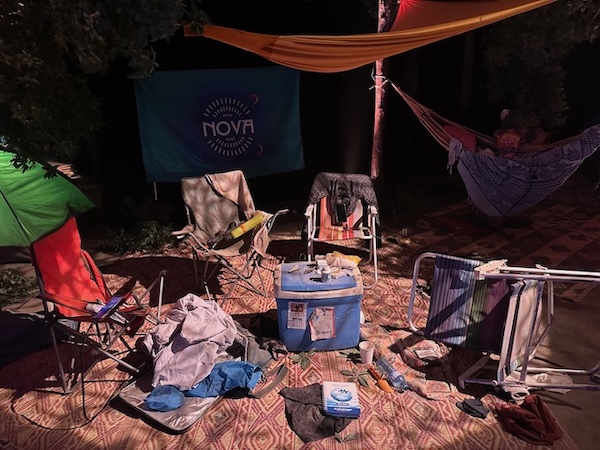
Atawi was an employee of UNRWA but, according to Israel, he was also a Hamas terrorist who led the attack on the bomb shelter near the Nova music festival, in which Hersh Goldberg-Polin and others were sheltering.
“This is a leader I’m supposed to take seriously?” Levy asked. “The Red Cross that hasn’t lifted a finger to try to save the hostages is an organization that I am meant to take seriously? The NGOs that wouldn’t even shed crocodile tears on Oct. 7, that never tried to do any sort of campaign for the hostages, they are the ones I am meant to take seriously?”
Young people and other activists in the West who insist they are anti-Zionist and not antisemitic are deluding themselves, Levy suggested.
“You are expressing a hatred and a prejudice against the same people,” he said. “The fact that they believe that they hate the same people that their grandparents hated but it’s a complete coincidence shows a tragic lack of self-awareness.”
Getting the pro-Israel message out is especially challenging on social media, said Levy, but Jews and their allies can’t give up the battle.
Social media is problematic at the best of times – even when it is not a platform controlled by the Chinese regime, as TikTok is – because it maximizes engagement by provoking outrage and amplifies the most extreme viewpoints.
“We’re not going to win the social media battle,” he said. “But we can’t afford not to fight it.”
If the only thing that people see on social media are anti-Israel messages, what conclusion will people come to? he asked.
“But what if their friend, the person they know is a good, decent person, stands up and presents a contrary view?” said Levy. “Then at least you’ve made that person think this is complicated and there’s a case to be made on the other side. So, it requires all of us to be there, to fight the fight, to be as loud and vocal and produce as much stuff as possible.”
That battle of ideas also needs to be taken offline, he said.
It is further complicated, he added, because the Israeli government has effectively given up communicating to the world.
Levy, who was born in England to Israeli parents and made aliyah as a lone soldier, was effectively conscripted to serve as an English-language spokesperson at the beginning of the war. He was fired after a social media spat with Britain’s then-foreign secretary David Cameron. Levy cofounded the Israeli Citizen Spokespersons’ Office, which tries to fill the information gap he said the Israeli government has left.
Pro-Israel voices in the West need to change tack, according to Levy. Rather than being on the defensive and explaining Israel’s actions, Canadians and others should be calling out governments and NGOs.
“Other people owe us answers,” he said. “UNRWA owes us answers. The Red Cross owes us answers. The UN owes us answers. I think we have to go on the offensive and demand those answers from other people instead of constantly trying to defend ourselves and say, ‘I can explain.’”
Levy dismisses calls for a ceasefire. The war needs to end in the defeat of Hamas – and it’s all over but the surrender, he argued.
“Hamas has lost,” he said. “It’s game over.”
But Hamas needs the world to help it understand that fact.
“The problem is, when international actors step in to demand a ceasefire, as opposed to Hamas’s surrender, they tell Hamas to keep fighting,” he said. With Hamas on its knees, “It’s outrageous that some countries are trying to get it back up on its feet.”
Hezbollah has also been largely eliminated, according to Levy.
“All of its top leadership are dead,” he said. “The infrastructure along the border has been destroyed.”
Iran, of course, remains unbowed, even in the face of the damage Israel has inflicted on its proxies.
Levy said one outcome from the current crisis is that Jewish communities have come together. In Israel, individuals instantly mobilized on Oct. 7 to do whatever they could and, in the diaspora, Jews have united as they rarely have before.
“That sense of responsibility, that sense of solidarity, being there for each other and having each other’s backs, I find incredibly inspiring,” he said. “That awakening of responsibility and self-reliance and leadership in Jewish communities around the world has been an inspiration to people in Israel.”
Jesse Primerano, executive director of StandWithUs Canada, which brought Levy to Vancouver, said his group has 106 interns and fellows on campuses across Canada this year – an increase over past years and a happy surprise for Primerano. He was afraid for the organization’s programs this year, he said, concerned that they wouldn’t be able to recruit students to stand for Israel on campuses. The opposite happened.
“Numbers skyrocketed,” he said. “The truth is that they are not scared. They are empowered. They are emboldened … and they are so brave and ready to stand up.”
SWU has also hired more staff across Canada, including a full-time position in Vancouver funded by the Diamond Foundation.
Three students from Vancouver-area campuses who are part of the SWU Emerson Fellowship program spoke to the audience, drawing ovations.
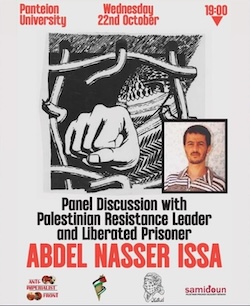
Samidoun was an organizer of an Oct. 7 rally celebrating Hamas’s terror attacks on Israel ayear earlier. Protesters tried to burn the Canadian flag while shouting that Israel should burn. They also chanted “death to” Canada, the United States and Israel. (screenshot Global News)
Last week, the Government of Canada designated Samidoun, a not-for-profit corporation based in Canada, as a terrorist entity under the Criminal Code. At the same time, the United States Department of the Treasury announced Samidoun is now a “specially designated global terrorist group.”
Also known as the Palestinian Prisoner Solidarity Network, Samidoun has close ties to the Popular Front for the Liberation of Palestine (PFLP), which has been designated by Canada and other countries as a terrorist group for many years.
At rallies in Vancouver and throughout Canada, Samidoun’s international coordinator, Charlotte Kates, has expressed open support for the Oct. 7 attacks on Israel. On the one-year anniversary of the attacks, she led a rally where chants of “death to Canada, death to the United States and death to Israel” were heard. Videos show rally participants setting fire to the Canadian flag, while shouting “Israel, burn, burn,” among other things.
“We’re very thankful for today’s decision by the Government of Canada to designate Samidoun as a terrorist entity under the Criminal Code,” said Nico Slobinsky, vice-president, Pacific Region, Centre for Israel and Jewish Affairs (CIJA). “For the past year, they’ve organized some of the most vicious protests in Canada, openly and explicitly celebrating the Oct. 7 attacks and, just last week, they were chanting ‘we are Hamas, we are Hezbollah’ at their rally.”
Kates was arrested after an April 26 rally, at which she called the Oct. 7 terrorist attacks “heroic and brave” and led chants of “Long live Oct. 7.” The conditions of her release order – which prohibited her participation or attendance at any protests, rallies or assemblies for a period of six months – expired Oct. 8 because the Crown had yet to file charges against her.
Slobinsky said CIJA called for the BC Prosecution Service (BCPS) to charge Kates under hate speech laws four months ago, so that she face the full consequences of her actions for glorifying terrorism. But just how long it will take for the BCPS to make a decision is unknown.
Damienne Darby, communications counsel for the BCPS, confirmed that the BCPS had received a Report to Crown Counsel in relation to Kates. “We are reviewing it for charge assessment, and I am unable to provide a timeline for completion,” she wrote in an email, declining to provide further comment.
In a statement, Shimon Koffler Fogel, president and chief executive officer of CIJA, said, “Listing the group as a terrorist entity means they will no longer be able to use our streets as a platform to incite hate and division against the Jewish community; this is a significant step toward ensuring the safety and security of Canada’s Jews.”
But, while the designation as a terrorist group will affect Samidoun’s ability to fundraise, recruit and travel, it is unclear whether it will affect their ability to hold rallies and further promulgate hatred.
CIJA has asked the federal government to re-examine whether Kates and her husband, Khaled Barakat, obtained Canadian citizenship fraudulently by failing to fully disclose their affiliation with the PFLP. The United States has put Barakat on a terrorism watch list for his connections with the PFLP.
Public Safety Canada notes that one of the consequences of being listed as a terrorist organization is that the entity’s property can be seized or forfeited. Banks and brokerages are required to report that entity’s property and cannot allow the entity to access their property. It’s an offence for people to knowingly participate in or contribute to the activity of a terrorist group. Including Samidoun, there are now 78 terrorist entities listed under the Criminal Code, according to Public Safety Canada.
This terrorist designation is long overdue, said Rabbi Jonathan Infeld, chair of the Rabbinical Association of Vancouver. “To have an organization that creates chaos, hatred and threatens the Jewish community operating freely in Vancouver and Canada was terrible,” he said. “When Samidoun burned the Canadian flag and called for the destruction of the US and Canada on Oct. 7, they demonstrated who they truly are. I hope this decision will give the Canadian government and the police the ability to prevent Samidoun from operating in the manner they have and to prosecute.”
Lauren Kramer, an award-winning writer and editor, lives in Richmond.
(Editor’s Note: For the CJN Daily podcast host Ellin Bessner’s conversation with NGO Monitor’s Gerald Steinberg about Samidoun’s terror links and more, click here.)
Gerald Steinberg, founder of the pro-Israel research institute NGO Monitor, recently spoke with Ellin Bessner, host of The CJN Daily podcast, about Samidoun being listed as a terrorist organization. (screenshot thecjn.ca)
Canada’s federal government has now formally listed Samidoun as a terrorist entity, effective Oct. 11.
“Violent extremism, acts of terrorism or terrorist financing have no place in Canadian society or abroad. The listing of Samidoun as a terrorist entity under the Criminal Code sends a strong message that Canada will not tolerate this type of activity, and will do everything in its power to counter the ongoing threat to Canada’s national security and all people inCanada,” read the Oct. 15 statement from Public Safety Minister Dominic LeBlanc.
Dominic LeBlanc, Canada’s minister of public safety, democratic institutions and intergovernmental affairs. (photo from pm.gc.ca)
The decision was formally announced as a joint action with the US Department of the Treasury, which called Samidoun “a sham charity” in a statement from its Office of Foreign Assets Control.
Jewish leaders had long been arguing that the Vancouver-based nonprofit organization has direct ties to known militant terrorist entities, including the Popular Front for the Liberation of Palestine (PFLP), which pioneered airplane hijackings, suicide bombings and assassinations of Israelis, and were directly involved in the Oct. 7, 2023, attacks on Israel.
The week prior to the government’s announcement, Pierre Poilievre, leader of the federal Conservatives, demanded Ottawa declare Samidoun a terrorist organization – as several other countries have already done. Doing so would block Samidoun’s ability to fundraise and would make it a crime for anyone to help it.
The PFLP is outlawed in Canada, the United States, the United Kingdom, Germany, Israel and many other countries, and some countries, including Germany and Israel, have banned Samidoun, too. The Netherlands has voted to consider doing the same.
Samidoun’s status in Canada fell under scrutiny after the group organized protests to coincide with the anniversary of the Oct. 7 Hamas terror attack on Israel. Some supporters in Vancouver tried to set fire to a Canadian flag, calling, “Death to Canada, death to the United States and death to Israel.”
Meanwhile, authorities in British Columbia were forced to lift bail conditions that had preventedSamidoun’s Vancouver-based international coordinator, Charlotte Kates, from participating in any protests for a period of six months. Vancouver police arrested Kates after she gave an antisemitic speech in April that praised the Oct. 7 massacre, but charges had not yet been laid before the bail deadline expired on Oct. 8. Kates is married to Khaled Barakat, suspected of being a high-ranking member of the PFLP, who also was granted Canadian citizenship.
Gerald Steinberg founded the pro-Israel research institute NGO Monitor, and is a professor emeritus at Bar-Ilan University. A former columnist for the Canadian Jewish News, he spoke to me earlier this month to explain more about Samidoun’s terrorist ties, including how they operate on Canadian campuses.
Gerald Steinberg: I stumbled into the world of NGOs, nongovernmental organizations, about 20 years ago, when Canada was one of the main funders of something called the UN Conference on the Elimination of Racism around the world – that’s the infamous Durban Conference. A lot of antisemitism there. They didn’t care about racism. It was about labeling Israel as an apartheid, genocide state.
That was in September 2001, 23 years ago. I began to see nongovernmental organizations as important players and nobody was looking at that. Why are they allowed to be? What is the reason that they have gained so much political influence? And I began to do research. We look at the impact, the capabilities, the funding … [of NGOs that advocate against Israel]. We do look at some other cases, for comparative purposes.
Samidoun was not high up on our radar. Samidoun was something that gradually we began to understand the importance of. It’s officially called the Palestinian Prisoner Solidarity Network. They’re a branch, as they make quite clear, and unusually clear, of the Popular Front for the Liberation of Palestine, which is a banned terror organization in the United States, in a number of European countries, in the UK and elsewhere.
So, what is this organization doing? Organizing these kinds of rallies and mob actions that label Israel as a genocidal state and call for the destruction of Israel, as we’ve seen around the world. And, as I began to look further and further into them, the Canadian connection became more dominant.
It wasn’t always like that. Samiduon operated out of Germany for a number of years. Khaled Barakat, who was the head of Samidoun, lived in Germany. Partly or significantly because of the work that NGO Monitor did vis-a-vis the German government – we said, “Look, they’re a terrorist front. Israel has officially labeled them a terrorist front and the evidence is clear, they’re connected to the PFLP” – the Germans then expelled Khaled Barakat and made Samidoun unable to function in Germany. They are banned. They can’t raise money. They can’t hold rallies. They can’t do anything in Germany.
There are other countries in Europe that are, at some level, looking at this, and have restricted their capabilities. Belgium is one of them. In Canada, they’re operated out of Vancouver, where Charlotte Kates lives. Basically, they went from Germany to Vancouver. Both Kates and Khaled Barakat, the two people who run Samidoun, are Canadian citizens. We don’t know anything really about how they became citizens or what they said in their application. Did they claim refugee status? At least, did he claim refugee status as a Palestinian who left Israel and is labeled as a terrorist agent by Israel?
Canada’s become the base of operations. And the question is, how did that happen? And what are Canadians doing about that? And then we began to look more and more at this network.
It’s important to understand that Samidoun is a worldwide network. They have branches that runanti-Israel public events, vicious anti-Israel public events, and recruit people and raise money in Brazil and other countries in South America, throughout Europe. They have operations in the United States – the United States has not banned them. Spain is a prominent place where they operate.
We mapped for the first time Samidoun’s international operations. And then the question comes up: who funds them? It has come up, particularly since Oct. 7, in the US Congress. And, just as there is a process in Canada, there is also a process in the United States, although less acute, because they are based out of Vancouver and not in the US.
Ellin Bessner: What evidence has your NGO monitor seen of what they’ve actually been doing here?
GS: The evidence is clear to everybody. You see the rallies that they are organizing. You see their posters. You see their events. I see a lot of them in Vancouver and I’ve talked to a number of people in Vancouver, and the Jewish community feels the threat there. They’ve had some very violent demonstrations in the last year…. I call them mob violence.
They’re quite visible and they’ve also had visibility in Toronto, I think in Montreal as well. They are on campuses where there are encampments, [and you see] Samidoun flags, Samidoun posters, and there is a Samidoun presence. That’s throughout North America, both in the United States and in Canada. They’re very visible.
EB: What are the benefits to them of operating in Canada?
GS: Well, they have citizenship. I’m not sure that Khaled Barakat would have gotten any kind of resident status in the United States. I think the rules for entry are tighter in the US if there is a possible terror connection. I think maybe that’s understated, but I’ll let you deal with that. Being in Canada as citizens gives them protection, gives them a place to operate from.
EB: Obviously that’s important for an organization like this. How much money do they get? And where does it come from?
GS: We have no idea. Either question. Because of the PFLP connection, because they run a lot of events, because this is what they live off of – there are other people as well, but Barakat and Charlotte Kates are the two most visible ones, this is their life – so, therefore, they must be drawing salaries. They must be able to get funding, and there’s probably more. Plus, they do a lot of traveling.
Maybe the Iranian government paid for Charlotte Kates to go to Tehran to do what she just did. [In August, she received an Islamic Human Rights and Human Dignity Award from the Islamic Republic of Iran.] It’s most likely. But they could be getting money from Qatar. There’s a lot of speculation.
The United States’s members of Congress have put Samidoun, as well as Students for Justice in Palestine and a few other groups, on a sort of watch list. And they’ve asked the Internal Revenue Service, which is the equivalent of the Canada Revenue Agency, to provide information that up until now Samidoun and other organizations have been allowed to hide – their anonymous donors. But it must be a significant amount of money to be able to pay for all these activities and their salaries and everything else.
Charlotte Kates, Samidoun’s Vancouver-based international coordinator, appeared on Iranian television in August. (screenshot MEMRI REPORTS)
EB: You mentioned the trip to Iran. We should remind our audience that the Iranian government issued an award on state television to Charlotte Kates, who had to wear a hijab over her hair to appear on television…. And so, she went and she was talking about how she was arrested in Canada, in Vancouver….And they were glorifying the words that she had said on the steps of the Vancouver Art Gallery. Do you want to remind us of some of the things they have been quoted as saying, that your NGO Monitor has kept track of?
GS: If we’re looking even in the last year, the very virulent attacks against Israel, against the right ofIsrael to exist, has been a repeated theme in all [their remarks], including what we heard from Kates in Tehran, what they call the right of resistance. Particularly, they make it very specific – they use the term that Hamas used, the Al-Aqsa Flood resistance operation.
And they condemned “The Zionist retaliatory strikes against Palestinian civilians in Gaza.” This is from Oct. 10, 2023. Just one example of many others. They talk repeatedly about the right of the Palestinians, the brave Palestinian people and their resistance movement, stop the Israeli genocide of Palestinians, support Palestinian resistance and revolution. There are many, many variations on that theme. That is very prominent in their, I was going to say propaganda, but it’s probably their hate campaigns.
One other aspect that I want to raise here is the connection to the PFLP that’s important. What is the PFLP? Some may remember that the PFLP was involved in airplane hijackings. They were the original airplane hijackers – the Entebbe hijacking of 1976.
And, even before that, the hijacking of planes in 1970, and blowing them up. There are a whole series of events, including just taking machine guns and going into synagogues in Jerusalem and killing people. There are a series of terrorist events. They are a terror organization. They are also members of the PLO [Palestine Liberation Organization]. They were founded probably in the 1960s, maybe earlier, as a Marxist, revolutionary, Palestinian movement, which means they’re not Islamic, they’re not Muslims.
Most of the people who are involved in the positions of power of the PFLP are Christian, they come from Christian families. They call themselves Marxists, but they are not part of the Fatah movement, which is the main part of the PLO, they are the Marxist liberation element and they’ve developed very close relationships – personal and political and ideological – with radical Christian groups across Europe and also, after that, they went out to North America. I think one of the questions is, who are their supporters and do they have those kinds of connections? We actually have those documented in Europe, less well known in Canada.
But they’ve been able to build on this. We usually associate the Palestinian terror movements with Hamas and, before that, the Fatah movement with [Yasser] Arafat, with fanatic Muslims who want to wipe Israel off the map. But this is a different organization and they were supported by the East Germans when East Germany existed, until 1990, and the West German far-left radicals who were connected to them. That’s the type of people that get attracted to this framework.
They are revolutionaries, and revolutionaries in the sense of blowing everybody up, not distinguishing between anybody, civilians, women, children, they kill everybody. And that’s the PFLP. And this [Samidoun] is one of their front organizations, maybe the most important front organization – they do the political aspect, they may also be involved in recruiting, they may also be involved in planning. We don’t know that, but that’s one of the reasons Israel banned them.
EB: It’s anarchy? And, the other day in Vancouver, on Oct. 7, I’m sure you may have seen the video now – Vancouver police are investigating – they were desecrating and ripping up a Canadian flag. It wasn’t just Israel that they were going after, and Zionists and Jews. It was also Canada. And I think that has crossed the line for people for whom going after Jews in Israel wouldn’t have crossed the line.
GS: That’s part of being this radical, Marxist organization. The term sounds so 1950s and Stalinist, but a radical Marxist, Palestinian liberation organization, that’s their name – the Popular Front for the Liberation of Palestine. The 1950s and ’60s were filled with popular fronts for the liberation of X, Y and Z, all supported by the Communist Bloc, in this case going through East Germany. Of all the organizations that the East Germans supported, one to eliminate Israel in the post-Shoah, post-Holocaust period, tells you quite a bit about that whole history.
Charlotte Kates was arrested after a Vancouver protest during which she praised the Oct. 7 terror attacks on Israel. Charges have not yet been laid. (screenshot facebook.com/FriendsofSimonWiesenthalCenter)
EB: Do you have any evidence that there is Russian money, Russian support going to Samidoun people anywhere else, but also in Canada?
GS: No.
EB: We’re having our own foreign influence problems right here in Canada.
GS: Yes. And it’s possible, but it’s much more likely to be the Muslim Brotherhood with Qatar and that part of the support group. Qatar supports Hamas. Qatar is, of course, Al Jazeera and all the other media platforms as well. But it’s the Muslim Brotherhood that’s so central here…. And then the PFLP is the other half of that formula. By the way, there are reports, and I’ve seen the reports, there are some connections to Iran. And then, the fact that Charlotte Kates got this award in Tehran makes one, I think, more than speculate that some of their funding may also come through, maybe a lot of it, comes through Iran.
EB: It walks like a duck, talks like a duck, must be a duck.
GS: So, here you have the strange situation, this very weird, absurd situation where you have what are essentially Christian, Marxist, radical Palestinians being allied with the Islamic Republic of Iran. Put those pieces together and explain to me how there’s any kind of logic except for the hate – hate of the West and hate of Israel. And the anarchy is very much part of that process.
EB: I want to bring it back to Canada because, earlier this month, the opposition leader, Pierre Poilievre, had a press conference in Ottawa on Oct. 8 [before the government’s Oct. 15 announcement] and vowed to, if he is elected as prime minister, one of his priorities will be to ban Samidoun, [have it] designated as a terrorist organization. The Canadian government’s been asked to do that by B’nai Brith [Canada], by many organizations, [Member of Parliament] Anthony Housefather, that’s one of his big priorities as [the federal government’s special advisor] on antisemitism, Vancouver’s Jewish community, CIJA [Centre for Israel and Jewish Affairs]. So many people have said it’s beyond time. What is the difficulty in your experience for a government to actually do something like that? Because, if it was easy, they would have done it a long time ago. And I’m just going to put in a caveat – it took the Liberals six years to ban the Iranian Revolutionary Guard in Canada. They just did so, but it took six years.
GS: I’m going to give you a generic answer. Each country has some specific aspects which make the process appropriate for its own legal and political system. But, generally, you start by having a member, usually an appointed official – it could come from a government minister, it could also come from a member of Parliament or a group of members of Parliament, particularly if it’s both parties. So, you have Anthony Housefather, then you have members of the Tories, including the leader, raising this issue and then getting somebody in the RCMP, the appropriate investigatory framework, to put together the evidence and to present it and reach a conclusion or a recommendation: this organization violates Canadian law in this way. Incitement to terror, support for terror, links to terror organizations, those are the questions that have to come up.
EB: For promotion of antisemitism is another one, Section 319 of the federal Criminal Code, right?
GS: Which is different from the United States, where there is no specific ban on antisemitism in the legal process. But that gets to the other aspect.
EB: There’s also hate symbol legislation. There’s a whole flag thing. You can’t be displaying Nazi flags or Confederate flags. They didn’t talk about these kinds of flags, but I wonder if that’s not far off. Of Hamas, which is a designated terror organization, or Hezbollah.
GS: All those questions are open questions. But there is also the issue of free speech. And that is something that is very important in the Western ideological political framework. The United States, in many ways, is slower and more reluctant to put limitations on organizations than Canada has been. I think that it’s pretty close, but the issue of free speech is very holy in the United States and that keeps coming up. Where does the line stop between allowing them to speak, hold rallies, which is part of free speech, and crossing over into support for terrorism, incitement and, in the case of Canada, antisemitism and the other aspects of the legal process? There’s always this balance.
And then there’s the question of constituencies. I would be surprised, maybe I could be naive on this, I don’t know enough about Canadian politics, but the constituency of support for Samidoun is not the same as, in terms of Canadian political support for the Liberals, is not nearly as deep and as wide as the general support for the Palestinian cause. They are a niche terror-linked organization and, politically, it should not be that difficult for a Liberal government to be able to say, “This crosses our red lines.”
You have the investigatory aspect of it, which is always done in Israel, too. I think there are at least three different levels of prosecutors and officials responsible for the process in Israel to designate an organization like Samidoun as a terror-linked organization. They all have to sign off on it and there have to be evidentiary processes. They don’t have to be made public, but there have to be people that can say, “We looked at the evidence, our job is to do that, and we are convinced.” There must be something similar in Canada. It takes somebody to start that process, to say we’re going to do this, we’re going to do it seriously, and we’re not going to take six years to do it, because, then, it’s meaningless.
EB: Lastly, what role, if any, did the PFLP play on Oct. 7 or is it playing now? Are they mostly in the West Bank and not in Gaza, or are they also in Gaza?
GS: The PFLP is strong, not in numbers, but in adherence, which means the terror agenda, both in Gaza and the West Bank. There were PFLP participants on Oct. 7. We have the details. We have names. We have the aspects. Some of them were killed. There was at least one case of an Israeli hostage that was held by people in the PFLP.
EB: Do you know the name?
GS: There was at least one case [the Bibas family] where it was acknowledged. There was at least one case where Israeli forces went in and found evidence that it was a PFLP [person] that was holding [a hostage] … and there were probably more. So, they are very much part of that broader terrorist process. We usually attribute it to Hamas, but there were others that joined on Oct. 7.
EB: And, in the West Bank, is there a constituency?
GS: They’re not a dominant organization. Again, they are a far-left non-Muslim, Christian [organization]. They do not come from the Muslim wing of the Palestinian liberation movement, but they are part of the PLO, so the terror links are also very much cemented in that framework. And I’ll just add that, when the Oslo Accords were signed in 1993 and a lot of people celebrated the beginning of peace, they [PFLP] condemned [former PLO leader Yasser] Arafat for having any kind of recognition of the Zionist entity. They did it loudly and clearly, and they sought to gain, and they probably did gain, recruits and support among Palestinians for having that position. So, they’re more radical than the Fatah movement. They are the opposition in the PLO to any kind of agreement or rapprochement or recognition of Israel.
EB: Is there anything that NGO Monitor has been doing recently to send briefs or information or papers to the Canadian government to share your information and call for changes?
GS: We share our information. We update our file on Samidoun whenever there’s something new … usually every two weeks worldwide, but specifically in Canada, including Charlotte Kates’s trip to Tehran. We put it all together in one package and we send it to a very broad list – to journalists, including the Canadian Jewish News, and also to members of Parliament, both sides … [for] anybody in Canada that’s interested, we make that information available…. Usually, [people will] have bits and pieces of it on their own, but, to see the bigger picture, all the things we just talked about, that’s part of our role.
EB: We should do another interview on all the other groups that are operating on campus.
GS: And the Toronto [District] School Board. There’s a whole bunch of NGOs doing [things]. They’re there. They’re pushing from behind, or not so from behind.
I’m going to give you one more sentence. It goes back to the basic question that Samidoun was expelled from Germany, Khaled Barakat was expelled from Germany – his visa was not renewed. Why is it that, in Canada, this process seems to be, not just taking so long, but it seems like the Canadian officialdom didn’t say, “Well, wait a minute, if the Germans are banning them, then maybe there’s something that we need to look at in more detail. Not just Israel, but the Germans as well, and other countries in Europe are also putting limitations on and opening investigations.”
EB: It wouldn’t be the first time in recent weeks that the Canadian immigration department came under fire for allowing terrorists in who claim asylum…. It’s very disturbing and disconcerting.