Skip to content
  • Home
  • Subscribe / donate
  • Events calendar
  • Business Directory
  • FAQ
  • News
    • Local
    • National
    • Israel
    • World
    • עניין בחדשות
      A roundup of news in Canada and further afield, in Hebrew.
  • Opinion
    • From the JI
    • Op-Ed
  • Arts & Culture
    • Performing Arts
    • Music
    • Books
    • Visual Arts
    • TV & Film
  • Life
    • Celebrating the Holidays
    • Travel
    • The Daily Snooze
      Cartoons by Jacob Samuel
    • Mystery Photo
      Help the JI and JMABC fill in the gaps in our archives.
  • Community Links
    • Organizations, Etc.
    • Other News Sources & Blogs
  • JI Chai Celebration
  • JI@88! video

Recent Posts

  • SFU honours Gloria Gutman
  • Lifting people’s spirits
  • Wedding a ray of light
  • Indigeneity and Zionism
  • Rule of law broken: councilor
  • Football and its roles
  • The burden of defence
  • Fish Café returns after fire
  • All right in what goes wrong
  • Nuns & mermaids at TUTS
  • Camp offers holiday retreat
  • Students and mentors inspire
  • Once-in-a-lifetime trip
  • 100 dancers, one heart
  • Money for the sciences
  • What “Jewish food” means
  • Have a cookie, schnitzel too
  • Federation now across BC
  • Israel fighting for its existence
  • Deal strengthens Iran
  • Patriotic belonging diminishes
  • A campaign to engage
  • Upstanders’ first live event
  • Responding to Carney
  • Having your own home
  • Music a family tradition
  • Musical to warm heart
  • Community milestones … June 2026
  • Sharing her passion for Israel
  • Or Shalom reopens its doors
  • JFS from past to future
  • Need holistic approach
  • Sharing stories, advice
  • Journalist shares fears
  • Skills to live together
  • Road to independence

Archives

Follow @JewishIndie
image - CJN box ad Rockowers 2026

Tag: philanthropy

Making aging healthier

Making aging healthier

Shira Haas is the featured guest at the July 7 event organized by Canadian Associates of Ben-Gurion University of the Negev. (photo from CABGU)

Israeli actress Shira Haas, star of the popular Netflix series Shtisel and Unorthodox, has been busy in recent months. Not only is she preparing to take on the role of a young Golda Meir in the upcoming series Lioness, executive produced by Barbra Streisand, but she is also the featured guest at the Canadian national virtual gala in support of Ben-Gurion University of the Negev (BGU) on July 7.

An “Unorthodox” National Virtual Gala for Brain Research, organized by Canadian Associates of Ben-Gurion University (CABGU), BGU’s Canadian fundraising arm, will raise money for the Canada Fund to Advance Brain Research.

“We are thrilled to share this exciting announcement with our community,” said Mitchell Oelbaum, national president of CABGU.

“According to the World Health Organization, there are approximately 50 million active cases of dementia worldwide, with an estimated 10 million new cases being added each year. Ten million people battle Parkinson’s each year globally. And, according to the World Stroke

Organization, 13 million people suffer from stroke annually. We wanted to do our part to help improve the chances of finding a cure for these debilitating diseases.”

The numbers are large, and there are no signs of a slowdown. That is why the fund was established by CABGU, with the goal of supporting groundbreaking and cutting-edge research for neurodegenerative diseases at the university’s Zlotowski Centre for Neuroscience.

“We are getting closer to determining the causes of age-related neurodegenerative diseases,” explained Dr. Debra Toiber of the department of life sciences in the faculty of natural sciences at BGU. “It’s an exciting time to be a scientist and uncovering the mechanisms of aging.”

Toiber is one of 67 researchers at the Zlotowski Centre. Her lab recently discovered that the SIRT6 protein is critical for the prevention of neurodegeneration, which can lead to Alzheimer’s and Parkinson’s diseases. Colleague Dr. Shelly Levy-Tzedek’s lab studies the impact of age and disease on the control of body movement and how best to employ robotics to facilitate a fast and efficient rehabilitation process. Meanwhile, Dr. Claude Brodski, also with the Zlotowski Centre for Neuroscience, is currently conducting a study, albeit in its early stages, that may offer a disease-modified drug target to address the impact of Parkinson’s. While these findings are encouraging, more research needs to be conducted.

“CABGU launched the Canada Fund to Advance Brain Research at BGU in April,” said CABGU chief executive officer Mark Mendelson. “Our team has been hard at work ever since, and there is a strong appetite for this subject matter here in Canada. The sad reality is that we all know someone, whether it is a relative, a friend or a neighbour, who is struggling with one of these devastating brain diseases.”

The national virtual gala is already more than 50% sold out. To learn how to become a sponsor or to purchase tickets, head to bengurion.ca.


Format ImagePosted on May 28, 2021May 27, 2021Author Canadian Associates of Ben-Gurion UniversityCategories LocalTags aging, Ben-Gurion University, BGU, brain research, CABGU, Canadian Associates of Ben-Gurion University, Debra Toiber, fundraising, healthcare, Israel, Mark Mendelson, medicine, neurodegenerative disease, philanthropy, science, Shira Haas, Zlotowski Centre
$100K raised for Sheba

$100K raised for Sheba

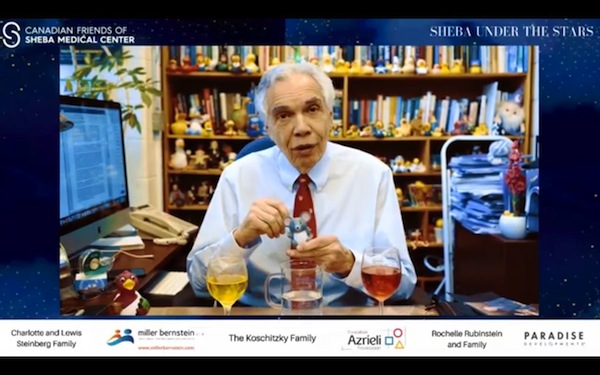
Dr. Joe Schwarcz, director of the Office for Science and Society, McGill University, presented on The Chemistry of Wine and Its Many Benefits, at Canadian Friends of Sheba’s virtual event on May 2. (screenshot)

Canadian Friends of Sheba hosted Sheba Under the Stars on May 2, raising close to $100,000 for Israel’s Sheba Medical Centre. More than 100 guests attended the virtual evening featuring live entertainment, wine tasting and presentations on lifestyle choices from leading world experts.

Guests received a complimentary gift bag of wine and chocolates, and were treated to numerous performances from host Stacey Kay, Juno Award-winning singer/rapper and finalist on America’s Got Talent. The hour-long show also featured live wine tasting with Michael Avery, winemaker at Galil Mountain Winery, in Israel, as well as a presentation on The chemistry of Wine and Its Many Benefits, by Dr. Joe Schwarcz, director of the Office for Science and Society at McGill University.

Prof. Yitshak Kreiss, director general, Sheba Medical Centre, opened the event by highlighting Sheba’s global fight against the coronavirus through its recent support of missions to India, northern Italy, Cyprus and Uruguay, and called on the guests to be “inspired by Sheba’s vision to transform into the city of health.”

Presentations from “Sheba’s stars” included Redefining the Field of Lifestyle Medicine by Dr. Rani Polak, founding director of Sheba’s Centre of Lifestyle Medicine, and from Prof. Michal Schnaider Beeri, director of Sheba’s Joseph Sagol Neuroscience Centre, who shared tips on how wellness and lifestyle affects the brain.

To watch the full recording of the show, visit youtube.com/watch?v=QE2TRvm3G4Q.

Format ImagePosted on May 28, 2021May 27, 2021Author Canadian Friends of ShebaCategories NationalTags fundraising, Israel, medicine, philanthropy, science, Sheba Medical Centre, Sheba Under the Stars
Joe Segal receives Rix

Joe Segal receives Rix

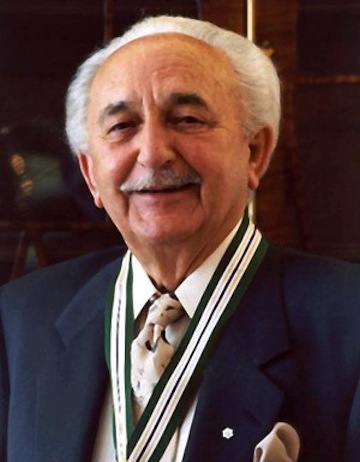
Joe Segal accepting the Greater Vancouver Board of Trade’s Rix Award for engaged community citizenship in an April 7 online celebration. (screenshot)

The Greater Vancouver Board of Trade paid tribute to Joe Segal on April 7, honouring him with its Rix Award for engaged community citizenship, in recognition of his many philanthropic endeavours and decades of community service.

The postponed 2020 Governors’ Banquet & Rix Awards was reimagined for the virtual gathering, which was dubbed the Governors’ Gala and Rix Awards. The event also saw the board’s Rix Award for engaged corporate citizenship bestowed on CN, and its immediate past chair, Lori Mathison – who currently serves as president and chief executive officer of Chartered Professional Accountants of British Columbia – inducted into its council of governors, along with Kari Yuers, president and CEO of Kryton International Inc. Gala co-chairs were Lorne Segal and Brent Cameron.

Born in Vegreville, Alta., in 1925, Joe Segal’s early years included losing his father at aged 14, stretches of financial hardship and hard labour building the Alaska Highway. He fought in the infantry in the Second World War, where, along with his compatriots, the Calgary Highlanders, he participated directly in the liberation of the Netherlands.

Following the war, he arrived in Vancouver with $1,500 in his pocket and set to work on more entrepreneurial pursuits. While he started small in war surplus goods, his hard work and tenacity led him to found the Fields department stores and, ultimately, take over Zellers before launching Kingswood Capital Corp., a conglomerate with interests in real estate, manufacturing and financing.

Despite his success, Segal has remained firmly grounded in the community where he built his businesses and raised his family. It is a tribute to his character that his impact and life in the city are perhaps most marked by his generosity – both with his time, as a mentor, and philanthropic endeavours.

A recipient of both an Order of Canada and an Order of British Columbia, Segal’s more recent years have been defined mainly by his philanthropy.

He served on the board and as chancellor of Simon Fraser University for six years. And, in perhaps one of his most visible contributions in Vancouver, Segal donated the historic Bank of Montreal building at 750 Hastings St. to SFU, creating a home for the Segal Graduate School of Business.

In 2010, he and his wife Rosalie donated $12 million to the VGH and UBC Hospital Foundations to create the Joseph and Rosalie Segal and Family Centre, a 100-private-room acute care centre serving the mental health needs of people in crisis. The substantial gift, made prior to mental health concerns being mainstream, is just another demonstration of his strong connection to the needs of the community. There are countless other organizations who are recipients of the Segals’ work and philanthropy.

Together with his partner Rosalie, the Segals have passed along the philanthropic genes to their children Sandra, Tracey, Gary and Lorne. The Segal family has supported mental health charities for more than 20 years. Their awareness was sparked after they were invited to attend the Coast Mental Health’s Courage to Come Back Awards, which honours individuals who have overcome major life challenges. The event has been chaired by their son, Lorne, for the past 15 years.

In a complex world, Joe Segal’s life offers a clear example for leaders today and the leaders of tomorrow. Simply put, a life well-lived will be most marked by the ways in which we give back to our community and contribute collectively towards a brighter future.

The Rix Awards are an initiative of the Greater Vancouver Board of Trade, presented in honour of the late Dr. Don Rix, who served as chair of the organization in 2008-09. Award recipients are chosen each year by a special selection committee of the board of directors, based on a number of criteria.

Watch this year’s event at boardoftrade.com/events/individual-events/1656-6471.

Format ImagePosted on April 23, 2021April 22, 2021Author Greater Vancouver Board of TradeCategories LocalTags Board of Trade, business, community service, Joe Segal, philanthropy, Rix Awards
Shalhevet annual gala

Shalhevet annual gala

Shalhevet Girls High School will honour Shelley Rivkin at its gala on April 11. (photo from Shalhevet)

On April 11, at its annual gala, Shalhevet Girls High School will honour Shelley Rivkin as a Guardian of the Flame.

“Every year, we honour a Jewish woman who is passionate and dedicated to the Jewish community,” Vivian Claman, president of the Shalhevet board, told the Independent. “Shelley personifies the kind of woman we inspire our students to become – independent thinkers and leaders in their communities. Shelley not only works hard for the Jewish community but for the Vancouver community, as well.

Rivkin is the third woman to be so honoured by Shalhevet. Anita Silber was the first, in 2019, and Sarah Berger was recognized last year.

Rivkin is vice-president of planning, allocations and community affairs for the Jewish Federation of Greater Vancouver. She is an adjunct professor of social work at the University of British Columbia and at Langara College, and she is a member of British Columbia’s Multicultural Advisory Committee.

“My parents were a significant influence,” said Rivkin about her choice of career and her participation in community. “My mother was a social activist and early feminist who introduced me to many of the ideas that contributed to my decision to go into social work, while my father was deeply connected to Jewish values and traditions. Both believed in the value of volunteer work and had me volunteering for a variety of causes from an early age.

“My Jewish education at Schara Tzedeck and involvement in both NCSY and BBYO also provided me with a deeper understanding of Judaism and Jewish life that I have carried with me throughout my career.

“There have also been some amazing women who have inspired me along the way,” she noted. “The late Rosemary Brown, who I had the privilege of meeting when I was in university, really opened my eyes to the barriers and obstacles that many women were facing and continue to face in our society.”

Rivkin’s specific areas of responsibility at Jewish Federation include community planning, local grants distribution, Jewish education, partner agency relations and community security. While she was hired in 2007, she had volunteered with the organization for a couple of years before that.

“In 2005, I was asked to chair the poverty coalition,” she explained. “This connection brought me closer to the work of Jewish Federation and, as I took on more volunteer responsibilities, I became more intrigued by the work that Federation did on a daily basis. In 2007, Federation went through a restructuring process to move toward a closer alignment between central planning and financial resource development. A new senior position was created, and [then-Federation head] Mark Gurvis asked me to apply. This was an opportunity to connect my Jewish values to my day-to-day work.

“The most rewarding aspects of the job are when you can move from project inception to project completion,” she said. “The most recent example was the establishment of the Food Security Task Force in 2017. I was responsible for staffing the task force. The task force released their report in late 2018. The report had an important impact in raising awareness about the depth of food insecurity in our community. Through the hard work of Jewish Family Services and many generous donors, we have seen the implementation of one of the key recommendations of that report, the establishment of an integrated food hub. This has been very rewarding.”

Rivkin feels strongly about the benefits of a Jewish education.

“I am setting up an endowment with the Jewish Community Foundation that I hope that Shalhevet supporters will contribute to,” she said. “Over time, the interest earned on the capital can enable Shalhevet to support special projects that are not covered through their general operations.

“I am setting this up because I believe strongly that young Jewish women should have full access to quality general studies and Judaics education. As an Orthodox woman myself, I am committed to ensuring that young Orthodox women living in Vancouver have the best educational opportunities available.”

Currently, Shalhevet has 14 students enrolled for the 2020-2021 school year, and they anticipate around the same number of students for the next year, Meira Federgrun, head of school, told the Independent. “What we lack in student numbers, we definitely make up in enthusiasm and involvement,” she said.

About how the school has been coping with COVID-19, Federgrun shared, “As with all schools in B.C., Shalhevet had to craft a safe return-to-school document that was approved by the Ministry of Education before the start of the school year last September; we have been doing full-time, in-person learning since then. We have sanitizing products available throughout the school and high-touch surfaces, as well as equipment, are sanitized several times a day. Our staff and students wear masks in all areas of the school, including the main room and classrooms, and remove them to eat or drink.

“Because Shalhevet is a small school,” she said, “our entire staff and student body is considered one cohort, so we are fortunate in that we don’t have to worry about a lot of the restrictions and traffic flow that larger schools with multiple cohorts have. As a result, we’ve been able to provide our students with as ‘normal’ a daily school experience as possible.”

The annual gala is the only way the school raises money. “It’s our once-a-year fundraiser,” said Claman. “It’s also a way to bring awareness of Shalhevet’s great contribution to the community and its importance in maintaining a thriving Orthodox community.”

Part of the virtual celebration will be a piece performed by the Israel Philharmonic Orchestra, which was organized by Danielle Ames Spivak, chief executive officer of the Friends of the Israel Philharmonic Orchestra.

It will include “an introduction from [Irit Rub] the director of KeyNote, the musical education department of Israel Philharmonic, talking about the relevance of education and music,” said Claman. “Every year, we offer some form of entertainment, like comedians, a magician, etc., but we had to find something that would be conducive to online entertainment.”

Also part of this year’s gala, said Claman, “For the first time ever, we will be showing a video taking an inside look at Shalhevet.”

For her part, Rivkin said, “I am so grateful to the Shalhevet community to be honoured this way. It has been so uplifting for me to know about this honour, especially following such a challenging year.”


Format ImagePosted on April 2, 2021March 31, 2021Author Cynthia RamsayCategories LocalTags coronavirus, COVID-19, education, fundraiser, gala, Guardian of the Flame, Jewish Federation, Meira Federgrun, Orthodox, philanthropy, Shalhevet, Shelley Rivkin, Vivian Claman, volunteerism
JNF Pacific’s fresh face

JNF Pacific’s fresh face

Michael Sachs, the new executive director of Jewish National Fund of Canada, Pacific region, with his wife Shira, a Hebrew and Judaics teacher at Vancouver Talmud Torah, and their children Izzy, 8, and Desi, 5-and-a-half. (photo by Michael Sachs)

The Jewish National Fund, founded by Theodor Herzl in 1901, is inextricably tied up in the history of the land and the state of Israel. Associated in the minds of generations of Diaspora Jews with planting trees in Israel, the agency – and its Canadian arm – have expanded into almost every area of civil infrastructure in that country.

The Jewish National Fund of Canada raises awareness and funds for projects that still include planting trees, but many years ago expanded into constructing water reservoirs, preserving natural habitats and building parks and bicycle trails. More recently, the focus has included social service infrastructures for vulnerable populations, such as at-risk youth, victims of domestic abuse, children with special needs, veterans and those with economic disadvantages.

For many years, JNF was represented in British Columbia by a shaliach, an emissary, sent here to advocate and raise funds for projects in Israel. Ilan Pilo was the last shaliach appointed and, when the Israeli office of JNF decided to stop funding the position, Jewish National Fund of Canada hired him and he continued in the role as executive director. Pilo and his family returned to Israel permanently this year after eight years in the community here.

Immediately after Passover, on April 5, Michael Sachs becomes the first non-Israeli to helm the Pacific region office. “I’m making history without doing anything,” he joked.

Sachs has spent the past decade working in the wholesale diamond sector as vice-president of sales at ERL Diamonds. In his off hours, he has been involved in an array of community organizations, including serving as president of the Bayit, a Richmond synagogue, during a time of exponential growth in membership. He has also served on the boards of the Kehila Society of Richmond, Vancouver Hebrew Academy, Tikva Housing, and on the development committee of Jewish Family Services. His efforts have been recognized both with a Jewish Independent 18 Under 36 Award, as well as a Jewish Federation of Greater Vancouver Young Leadership Award.

Although his community work has been extensive, Sachs may be familiar to most as a member of the family that ran Kaplan’s Deli for years. His mother and stepfather, Sally and Marshall Cramer, owned the restaurant and young Mike worked the counter.

“I always joked that one of the best sitcoms ever written would be something about being behind the counter of a Jewish deli because you hear everything that’s going on in the community, you meet everybody and it’s like watching a show,” he said.

In his early 20s, Sachs traveled to Israel on Birthright and he was transformed. “I came back and I longed for that connection,” he said, “because, when you’re there, it is electrifying through the soles of your feet; the energy, the buzz.”

Taking a leadership role in JNF may be a direct legacy of the impact of that visit.

Sachs refers to his new position as “an absolute dream.” He said, “Something like this is a once-in-a-lifetime opportunity.” And added, “JNF is, in my eyes, the global Jewish community’s hand in building Israel.”

Sachs and Pilo have been in contact and the former executive director will be on hand from his new home in Israel to assist virtually in the transition. Meanwhile, Sachs has set his sights on expanding the geographic reach of the Pacific region office. He aims to increase the agency’s presence in the Okanagan, on Vancouver Island and in the outlying Metro Vancouver communities.

Speaking before he formally takes on the role, Sachs said he doesn’t want to prejudge what changes might come, but he guarantees two things: “Excitement and energy.”

The staff of two in the regional office – Liisa King and Moran Nir – “do the work of five people,” he said.

“I don’t think I’ve ever seen such a group of dedicated community members as I have on the board of JNF,” he added, specifically citing Pacific region president Bernice Carmeli and vice-president Shannon Gorski.

Carmeli and Sachs would like to not only reach a broader geographic area, but a larger demographic. Just before the pandemic hit, Carmeli told the Independent, they were about to launch in earnest a new young adult division called JNF Future. As the reopening continues, both she and Sachs hope to develop that cohort and build a strong base of support among the next generation.

Carmeli sees Sachs, who turned 40 on March 27, as the ideal fit for expanding JNF’s message to wider audiences. She shares Sachs’ overt enthusiasm for the future.

“Onward and upward,” she said. “We have a new ED, a lot of exciting things are going to happen.”

Format ImagePosted on April 2, 2021March 31, 2021Author Pat JohnsonCategories LocalTags Jewish National Fund, JNF, Mike Sachs, milestones, philanthropy

Help increase affordable housing

I recently was appointed board chair for Tikva Housing Society. When I was asked to join the board three years ago, I knew nothing about Tikva or their invaluable work. However, as a real estate professional, I did have a keen understanding of the housing affordability crisis in the Lower Mainland, and knew that our Jewish community was not immune to the crisis. Hence, I understood the importance of Tikva Housing, which is why I joined the board.

Tikva is a charitable, nonprofit society providing access to affordable housing for low- to moderate-income Jewish individuals and families. Every year, in March, the society turns to the generosity of the community to support its mission and now, more than ever, Tikva needs that help.

The widespread effects of COVID-related job loss have placed many members of our Jewish community at risk of homelessness. Tikva offers short-term rent subsidies for those living in market rental housing who are facing a temporary crunch and are unable to afford their rent. The demand for this kind of assistance has increased greatly in the last 12 months. The amount of subsidies that we can provide is directly in correlation to the amount that we can raise from private donations and foundations, and donations are urgently needed to help people stay in their homes. There are already more than 200 Jewish people on a waitlist for affordable housing, and the demand is only growing.

With all levels of government focused on affordable housing in general, we are seeing numerous initiatives being considered and Tikva is in conversation with government agencies and housing developers to explore new partnerships. Currently, Tikva owns and/or operates 61 affordable housing units in the Lower Mainland: 11 units at Dany Guincher House in Marpole; 18 units at the Diamond Residences (Storeys) in Richmond; and, thanks to the Ben and Esther Dayson Charitable Foundation, 32 townhomes were added last summer. The Ben and Esther Dayson Residences in Vancouver’s River District form a family-oriented community with more than 60 children.

This coming summer will see Tikva tenants occupying 37 units at the Arbutus Centre on Yew Street. The cost to Tikva will be a nominal $1,500 per unit annually, and the Diamond Foundation has pledged to cover this expense for all 37 units for the first five years.

In 2022, 20 units on the third floor of a five-storey building will be home to Susana Cogan Place. In partnership with Polygon, BC Housing will provide full financial support for this project, which is named in memory of Tikva’s founder and affordable-housing trailblazer, Susana Cogan, z’l.

Expanding Tikva’s affordable housing portfolio means that more low- to moderate-income Jews can stay close to their synagogues, schools and the multitude of Jewish community amenities. While Tikva Housing will operate a total of 98 units by the end of summer 2021 and 148 by the end of 2022, it’s still not enough to meet the needs.

Housing is the cornerstone and foundation of a dignified life. The Hebrew word tikva means hope. Please support Tikva Housing Society’s current campaign, which runs to March 22, and help us bring hope – and housing – to those most in need in our Jewish community.

Visit tikvahousing.org or call 778-998-4582 to donate and for more information.

Rhonda Sacks is board chair, Tikva Housing Society.


Posted on March 19, 2021March 18, 2021Author Rhonda SacksCategories Op-EdTags affordability, fundraising, housing, philanthropy, tikkun olam, Tikva Housing
Angels deliver despite COVID

Angels deliver despite COVID

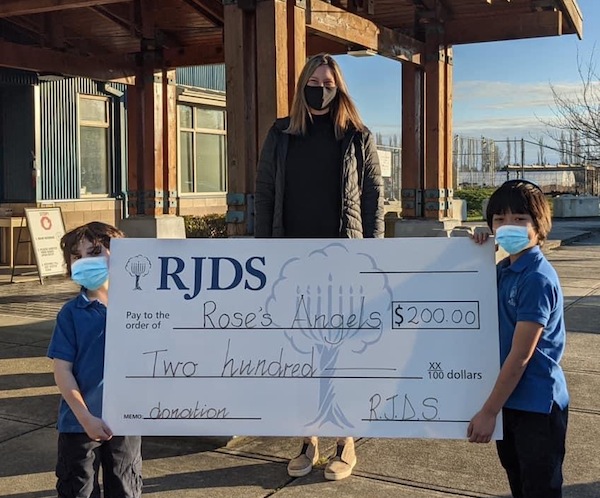
Outside Richmond Jewish Day School, Courtney Cohen accepts a donation to Rose’s Angels, which was collected by RJDS students and staff. (photo from Rose’s Angels)

This past February, the eighth annual Rose’s Angels event took place, although it looked very different from that of previous years, due to COVID-19.

photo - Courtney Cohen outside the Richmond Food Bank, delivering donations
Courtney Cohen outside the Richmond Food Bank, delivering donations. (photo from Rose’s Angels)

Rose’s Angels, which is under the umbrella of the Kehila Society of Richmond, was founded in memory of Courtney Cohen’s grandmothers, Rose Lewin and Babs Cohen. It was established after Courtney Cohen and family friend Lynne Fader came together to discuss how to best honour the grandmothers, while giving back to the community – Rose Lewin and Babs Cohen were both very philanthropic and instilled this value in their families. Since its inception in 2013, Rose’s Angels has donated more than 6,000 care packages to not-for-profit organizations within the City of Richmond.

With the pandemic impacting not-for-profits around the city, Cohen and Fader knew it was essential to push forward and fundraise for donation items and monetary gifts for recipient agencies. Gift cards, slippers, non-perishables, toiletries and feminine hygiene products were among the donations received from the community.

“We adapted and innovated this February’s event to allow for volunteers to still play an integral role,” said Cohen. “Volunteers assisted with pickup and delivery of the bulk donation items to our recipient agencies. Volunteers are an essential part of Rose’s Angels and we truly appreciate their support and dedication year after year.”

photo - A donation of hygiene products
A donation of hygiene products. (photo from Rose’s Angels)

Rose’s Angels donated to 12 Richmond not-for-profit agencies servicing those most vulnerable. Among these agencies were Turning Point Recovery Society, Light of Shabbat (Chabad of Richmond), Richmond Family Place, Tikva Housing, Richmond Food Bank, Pathways Clubhouse, and Nova Transition House (Chimo Community Services).

“Although we were unable to host our large community care-package event in person this February, our community came together in another wonderful way,” said Cohen. “People donated generously and this allowed us to purchase specific items that were both needed and wanted by our recipient agencies.”

She added, “We look forward to 2022, when we can have our amazing volunteers together again to safely assemble the Rose’s Angels care packages.”

For more information about Rose’s Angels, or to make a donation, contact Cohen or Fader at the Kehila Society of Richmond, 604-241-9270, [email protected] or via kehilasociety.org.

Format ImagePosted on March 19, 2021March 18, 2021Author Rose’s AngelsCategories LocalTags coronavirus, Courtney Cohen, COVID-19, Kehila Society, Lynne Fader, philanthropy, Richmond Jewish Day School, RJDS, Rose’s Angels, tikkun olam, volunteerism
Anti-racism fundraiser

Anti-racism fundraiser

Olga Campbell is raising money for the Vancouver Holocaust Education Centre’s anti-racism programming. (photo from Olga Campbell)

Half of all sales during March of Olga Campbell’s multiple-award-winning A Whisper Across Time: My Family’s Story of the Holocaust Told Through Art and Poetry will be donated to the Vancouver Holocaust Education Centre’s anti-racism programming, engaging youth and teachers in promoting human rights, social justice and genocide awareness. Campbell’s goal is to raise $5,000. Her objective is to raise “concerns about the fragility of democracy and the rise of white nationalism, racism and antisemitism in the world today.”

In A Whisper Across Time, Campbell – whose mother lost all of her family during the Second World War – writes, “This is the story of one family out of millions of families who went through the Holocaust.”

As quoted in the Jewish Independent when the book was published in 2019, “It is ‘the story of survival and death,’ ‘of how trauma of such magnitude is passed from one generation to another to another….’ It is also an ardent call for readers to remember Rwanda, Rohingya, Bosnia, Syria, Afghanistan, Sudan, Iraq, Cambodia.” Campbell notes in the book that, “by the end of 2016, there were 65.6 million refugees, asylum seekers and internally displaced people in the world.” She pleads, “eighty years ago, the world looked away / we must not look away now.” (Read more at jewishindependent.ca/a-story-told-in-art-and-poetry and jewishindependent.ca/whisper-across-time.)

Campbell will be giving away five signed copies of her book. Everyone who wins or buys a book before the end of March will also receive a signed miniature print – images from the book.

Winners of the book giveaway will be announced on March 21, which is the International Day for the Elimination of Racial Discrimination.

To buy the book ($32), visit olgacampbell.com/new-book-whisper-across-time.


Format ImagePosted on March 5, 2021March 4, 2021Author JI staff with information from Olga CampbellCategories BooksTags anti-racism, education, fundraiser, Holocaust, Olga Campbell, philanthropy, tikkun olam, VHEC
COVID relief delivered

COVID relief delivered

Alex Cristall, Jewish Federation of Greater Vancouver board chair, arrived early at the Jewish Community Centre of Greater Vancouver on Jan. 26 to sign community recovery cheques for grant recipients. (photo by Rob Trendiak)

On Jan. 26, the Jewish Federation of Greater Vancouver released the first round of community recovery funding to address the urgent needs arising from the pandemic’s impacts. A total of $416,000 in grants was distributed among 21 partner agencies and community organizations.

“When COVID first hit, we immediately developed a comprehensive strategic approach to address its impact,” Ezra Shanken, chief executive officer of Jewish Federation, told the Independent. “We met with our partner agencies to learn firsthand about how they were coping, and we released $505,000 in emergency funding just days into the initial lockdown.

“We then worked closely with major donors to launch the Community Recovery Fund, which became a key focus of the annual campaign. We also established the Community Recovery Task Force, comprised of well-respected and experienced community leaders, to work with us to respond effectively to the immediate and long-term consequences of COVID that are affecting our community agencies. During the annual campaign, we asked donors to make an additional gift to support community recovery, if they could.

“We have always been fortunate to have an extremely generous community, and the depth of giving this year has been extraordinary,” he said. “Community members have responded to the call to help in unparalleled ways, however they can. They understand the breadth and scope of need, the immense challenges facing organizations, individuals and families, and that recovery will take some time. Most of all, they appreciate that we are all partners in recovery, and have really stepped up to play their part.”

The initial relief grants were distributed to 19 of Jewish Federation’s partner agencies, as well as to the Louis Brier Home and Hospital and the Hebrew Free Loan Association.

“For the first round of grants, all Jewish community organizations were invited to apply for up to $25,000, regardless of their size,” explained Risa Levine, chair of the Community Recovery Task Force. “Our priority was to meet organizations’ urgent needs resulting from the pandemic, and to ensure they could continue to deliver their programs and services. In the next few weeks, as part of this initial round of funding, we will be recommending grants for synagogues and other places of worship. These grants will be awarded in late February.

“The task force expects the two rounds of funding after that will focus on longer-term needs,” she said. “For example, are there organizational changes that would substantially increase an agency’s capacity to deliver their programs? We also recognize that the pandemic has gone on longer than anyone anticipated, and that the uncertainty of what lies ahead continues. New needs may emerge and COVID-related government subsidies, which have helped a lot of our agencies, may end. So, ensuring organizations’ ongoing sustainability in the face of pressures created by the pandemic will continue to be a priority.”

When the task force met with community organizations last summer and fall, the focus was on understanding how the pandemic had affected the programs and services they offer. While the details differed, said Levine, “they all had been impacted by COVID in similar ways.

“Based on this information, the task force identified six themes, which ultimately became funding categories for the recovery grant application: technology upgrades; critical social services; COVID-related expenses; revenue and rental losses; mental health support for staff and community members; and organizational capacity. Community organizations were invited to apply for a grant to meet urgent, COVID-related needs in two of these six categories.”

The recovery grants comprise but one of three funding streams being distributed in the next couple of months. Other financial assistance will come from the Jewish Community Foundation’s Unrestricted Grant Program, and allocations from the Federation’s annual campaign.

“The Jewish Community Foundation’s Unrestricted Grant Program is designed to complement Jewish Federation’s annual campaign allocations by providing charitable organizations with seed money to support new, innovative programs and services,” explained Shanken.

Grants awarded through the program “give charitable organizations the opportunity to pilot initiatives that address the community’s evolving needs, or to launch startup and capital projects,” he said. “Once the programs demonstrate success over several years, they may then qualify for ongoing funding through Jewish Federation’s allocations.

“This year,” he added, “the foundation adapted some conditions of the program to be as responsive as possible to organizations challenged to deliver their programs and services in new and innovative ways. In this way, the Unrestricted Grant Program is complementing the work of Jewish Federation’s Community Recovery Task Force, which has identified areas of critical need through its consultation process with community organizations.”

The Unrestricted Grant Program funds for 2021 will be awarded in mid-February.

“Jewish Federation has always been proactive and strategic about preparing for crises, so that we can lead a coordinated community response,” said Shanken. “And, while this is unlike anything the community has ever been through, we are in a strong position to respond. We have in place the infrastructure, the community planning expertise, and the staff and team of experienced leaders needed to respond swiftly and effectively to the enormity and ongoing uncertainty of COVID’s impact.

“We know how vital it is to get funds working in the community, and this involves so much more than fundraising,” he noted. “As the pandemic evolves, we will continue to adapt our strategic approach so that we are well-positioned for today and tomorrow, and to convene with all of our stakeholders so that we have our finger on the pulse of the community and can problem-solve together. We’re also collaborating with Jewish federations across North America to leverage their collective knowledge and capacity.”

Levine acknowledged the board and staff of our local Jewish Federation “for their vision and professionalism in organizing the task force and leading the recovery process, as well as the many generous donors who have supported this crucial work.”

She said, “I have been inspired and buoyed by the commitment and passion of everyone involved in the task force’s work to ensure that our community continues to function effectively: by the task force members for their dedication to the work, and by the community organizations for their candour and resilience in adapting their operations to meet the needs of community members.

“The biggest challenge,” she said, “has been to focus and refine our work to be able to respond effectively to the needs we learned about. Hearing firsthand about the challenges that organizations faced revealed the enormity of COVID’s impact through a sharper, more personal lens that added another layer of urgency to our work.”

Despite the challenges, Shanken said, “I remain positive because of the tremendous fortitude and the outpouring of compassion and generosity that I see every day. I am incredibly proud of how this community has pulled together to tackle the road to recovery, and am convinced that we will emerge stronger.”

For more information, visit jewishvancouver.com.

Format ImagePosted on February 12, 2021February 12, 2021Author Cynthia RamsayCategories LocalTags coronavirus, COVID-19, economy, Ezra Shanken, Jewish Federation, philanthropy, Risa Levine, tikkun olam
Asper donation to HU

Asper donation to HU

Left to right: Richard Leipsic, David Asper, Leonard Asper and Gail Asper. (photo from CFHU)

The Canadian Friends of Hebrew University has received $5 million from the Asper Foundation. This gift upholds a tradition of exceptional philanthropic support and collaboration between the Asper Family, based in Winnipeg, Man., and the Hebrew University of Jerusalem Israel (HUJI). It will allow Asper HUJI Innovate to expand its footprint and professional-led startup accelerators to develop significant external partnerships.

The Asper Foundation was founded in 1983 by Israel Asper (1932-2003) and Babs Asper (1933-2011), who believed that philanthropy is a driving force behind positive change in people’s quality of life. It supports major initiatives in the areas of Jewish charity, as well as culture, education, community development and human rights locally, nationally and internationally.

A portion of the recently donated funds will be used to establish an annual Asper Innovation Prize, valued at $35,000 US. The prize will be awarded during a juried competition, intended to encourage and recognize outstanding and promising student-led startups. The public event will also be used to showcase the university as a central force for global innovation within the Jerusalem ecosystem. (Jerusalem is currently ranked sixth in the new Global Startup Ecosystem Report).

“It was the entrepreneurial spirit and wisdom of our late parents, Israel and Babs, that established ties with the Hebrew University close to 60 years ago. We are very proud of our longstanding partnership and connection to innovation that began with the creation of the Asper Centre for Entrepreneurship in the Jerusalem School of Business Administration, in 2001,” said Gail Asper, president of the Asper Foundation. “We are excited to witness, through Asper HUJI Innovate, new generations of students and academics lay the groundwork for advancing ideas, for generations to come.”

The Asper HUJI Innovate platform encourages the entire university community, including students, faculty and alumni, and the Jerusalem community at large to develop their innovation and entrepreneurial capabilities. Established in 2018, it was created as a platform to ensure that graduates are best prepared for the challenges brought about by disruption, inherent in an evolving workplace.

“The HUJI Innovate program is highly prized by the entire university, and the Asper Foundation’s agreement to name and support the centre will surely lead to a great leap forward in the Hebrew University’s entrepreneurial enterprises,” said Prof. Asher Cohen, HU president.

The Hebrew University itself was founded in 1918, and officially opened its doors in 1925. It is ranked internationally among the 100 leading universities in the world, with six campuses, 200 majors and programs, and more than 5,000 courses.

“For over 100 years, the Hebrew University of Jerusalem has upheld the vision of its founders, including Albert Einstein, Martin Buber and Sigmund Freud, being at the forefront of creating Israel’s most significant and cutting-edge research, leading to inventions that serve our global community,” said Rami Kleinmann, president and chief executive office of Canadian Friends of Hebrew University, which was founded in 1944 by Canadian philanthropist Allan Bronfman.

CFHU provides support for the Hebrew University of Jerusalem to maintain its standing as one of the world’s leading academic research institutions, as well as aid in its continual pursuit to impact real change. CFHU is headquartered in Toronto and has six chapters across Canada, including here in Vancouver.

“This incredible gift will positively impact thousands of students, faculty and alumni,” said Kleinmann, “essentially shifting the course of research and engagement between the university and myriad business communities at large – it is extraordinarily profound.”

Format ImagePosted on January 29, 2021January 27, 2021Author CFHUCategories NationalTags Asper Foundation, CFHU Vancouver, Gail Asper, innovation, philanthropy, Rami Kleinmann, technology

Posts pagination

Previous page Page 1 … Page 9 Page 10 Page 11 … Page 19 Next page
Proudly powered by WordPress