Unflaggingly supportive

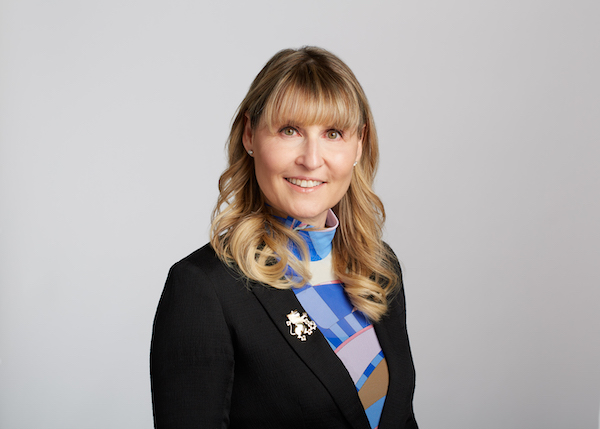
Lana Marks Pulver, Jewish Federation of Greater Vancouver annual campaign chair. (photo from JFGV)

The Jewish Federation of Greater Vancouver’s annual campaign is entering the homestretch with an ambitious set of goals. This year, the theme is “strengthened by where we have been, inspired by where we can go.”

“The goal for this year’s campaign is both quantitative and qualitative,” campaign chair Lana Marks Pulver told the Independent. “We aim to raise a minimum of $9.5 million, and we want to strengthen the culture of gratitude within the Federation organization, that affects all constituents, including donors, volunteers and staff.”

As has often been said in the past 21 months, these are times like no other in recent memory. The pandemic has touched us all, yet, for some, the campaign points out, it has “caused a cascading effect of challenges.”

“The goals haven’t shifted due to the pandemic, but the needs have certainly increased because of it. Therefore, we hope to raise more than our financial target to ensure all our partner agencies survive the current uncertainty in which everyone is operating and all community needs are being met,” Marks Pulver said.

“The past year-and-a-half was extremely tough on our community and our partner agencies. However, with the incredible show of support from donors and volunteers, our community proved to be resilient. Our partner agencies were able to survive the uncertainty and continue to provide their much-needed services because of the support from Jewish Federation and our donors.”

Groups within the community that were already vulnerable have faced more challenges. Among the groups Federation is helping are low-income individuals, the elderly and youth struggling with mental health concerns.

Well before COVID-19 hit, the region was one of the most expensive places in the world in which to live and it has become increasingly unaffordable; many, as a result, are left with hard choices regarding paying for rent, bills and food. Meanwhile, most seniors in the community are eager to reconnect socially and spiritually after extended separations from their families and communities.

Increasing numbers of youth, too, are contending with anxiety and depression as they encounter isolation from their peers and continued disruptions to their routines. At one local Jewish school this past year, the demand for counseling services doubled. In light of such statistics, Federation has formed a committee of local professionals and volunteers to develop a comprehensive approach to assist both youth and their families.

The basic plan involves employing a community mental health professional to offer counseling at community locations; collaborating with other mental health organizations in supplying professional development to those working directly with children and youth; and encouraging youth to take leadership roles in raising awareness among their peers about the importance of accessing appropriate support.

The pandemic has had a negative impact on youth mental health globally, including in Federation’s partnership region in Israel. The Mervo’ot HaHermon Regional Council has witnessed a rise in troubling behaviour among youth, especially those whose routines and social opportunities have been disrupted and who may not have supportive adults in their lives. Demand for services in the Israeli municipality has grown by 35%, according to Federation. Because of the need, and based on a successful pilot program in the spring of 2021, Federation is helping efforts to enhance counseling services and create new educational and social programming, in the hope that early intervention will lead the youth in this region along a healthier path.

Marks Pulver concedes that, while there are hurdles to overcome in organizing a campaign in the midst of a pandemic, the community response has been unflaggingly supportive.

“Typically, the campaign goes hand-in-hand with community gatherings,” she said. “A big part of campaign is the opportunity to connect with other community members at events. The pandemic has prevented us from having these gatherings in person and, instead, we have resorted to virtual ones. However, people are ‘Zoomed out’ and tired of the online events; therefore, making it more challenging to get people together.

“Recent experiences, however, have demonstrated the strength of our community and how we come together to help others in a time of need,” she stressed. “This show of support, both financially and with volunteerism, is beyond inspiring and I, personally, am incredibly grateful to be part of this community, that steps up and makes a difference.”

Marks Pulver, who has served as women’s philanthropy chair at Federation and was major donors chair for the past few years, sees her role as campaign chair as a natural progression and feels honoured to lead this year’s effort.

“I am proud to be serving alongside women chairs of both Federation and the Jewish Community Foundation. I believe you get out of life what you put in, and it is this belief that inspires me to volunteer. I also thoroughly enjoy working with others in the pursuit of helping others, and feel grateful for the opportunity to be able to make a difference.”

To donate to the campaign, go to jewishvancouver.com.

Sam Margolis has written for the Globe and Mail, the National Post, UPI and MSNBC.

Choices’ women inspire

Jill Zarin is the keynote speaker at Choices on Nov. 7. (photo from Twitter)

Philanthropist and entrepreneur Jill Zarin – most recognized for having been on the reality TV show The Real Housewives of New York City – is the featured guest at this year’s Choices, which will be held virtually on Nov. 7.

Zarin is also the author – together with her mother, Gloria Kamen, and sister, Lisa Wexler – of Secrets of a Jewish Mother, a 2010 book full of recipes, advice and parenting tips. She will join Vancouver-area speakers to talk about how they were able to support community during the pandemic.

The Jewish Federation of Greater Vancouver’s Choices is the largest women’s event within the community. This is the 17th annual gathering and the Independent interviewed 2021 co-chairs Sherri Wise, Leanne Hazon and Courtney Cohen by email about what to expect.

“Jill Zarin is an amazing speaker!” they said. “Attendees will also hear from so many inspiring women in our own community who give of themselves to keep our community strong and connected.

“Although Jill Zarin is most well known for being a television personality, she is in fact an extremely philanthropic person,” they added. “After almost two years of COVID, the committee wanted to have a program filled with humour and uplifting stories and Jill was a perfect match.

“As co-chairs, we have always found we learn something from the women who speak, which inspires us to continue supporting our wonderful community.”

The pandemic has impacted everyone around the world in many ways, said the co-chairs, and so many people have stepped up to try to help their communities navigate this very challenging time. Zarin is but one of the many “who have pitched in their time and tzedakah and ideas to help our Jewish community stay strong,” said the Choices co-chairs.

Ideally, the organizers had wanted to be together in person for Choices 2021. Yet with the uncertainties and changing regulations around COVID, they have once again decided to hold the event virtually, while trying to provide the experience in a way that is still meaningful to people.

Given the ongoing reality of the pandemic, the women said they are “really happy and really lucky” that Choices can be offered online. One of the benefits of a virtual event, they pointed out, is making it more accessible to women province-wide.

Choices is a celebration of the impact of women’s philanthropy.  Rather than fundraising, the goal is to get more women involved in the community through giving to the campaign and volunteering. The organizers stress that there are many ways of being involved in philanthropy and making a difference, such as connecting with Jewish Federation or one of its many partner agencies.

The 2021 Federation annual campaign is focusing on the theme of being strengthened by what we as a community have been through in the past year-and-a-half and inspired by where we can go together. This year, Choices is recognizing specifically how women in the community came through the pandemic and made the community stronger with their time and donations.

In a non-pandemic year, Choices would have 500 people in attendance. Past speakers have included musicologist Judy Feld Carr, the Canadian responsible for bringing thousands of Jews from Syria to freedom; Talia Leman, the founder of RandomKid, an organization that empowers youth to do good deeds; Talia Levanon, the director of the Israel Trauma Coalition; and Jeannie Smith, who shared the story of her mother, Irene Gut Opdyke, who rescued Jews during the Holocaust.

The Choices 2021 co-chairs lauded the efforts of Sue Hector and Shawna Merkur, the co-chairs of women’s philanthropy at Federation.  They also noted the contributions of Ricki Thal (campaign manager), Kate Webster (campaign director) and the Jewish Federation staff for their invaluable support.

To attend Choices, a person must give to the Federation’s annual campaign or make a donation by purchasing a ticket of the suggested amount. There is a suggested minimum donation of $154 to support the campaign and a suggested minimum donation of $36 for first-time attendees.

To register for the Nov. 7, 5 p.m., event, visit jewishvancouver.com/ choices2021.

Sam Margolis has written for the Globe and Mail, the National Post, UPI and MSNBC.
Keys to happiness

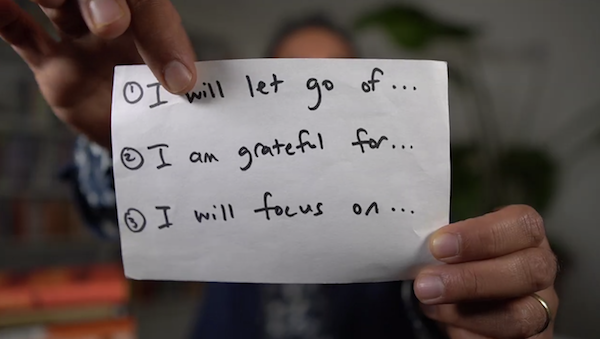
Neil Pasricha, the keynote speaker at Jewish Federation of Greater Vancouver’s The Community of Awesome event Oct. 3, contends that people can be more content in their lives if they take two minutes every morning to finish these three thoughts: “I will let go of … I am grateful for… I will focus on….” (screenshot)

In lieu of the traditional large in-person event that launches the Jewish Federation of Greater Vancouver’s annual campaign, a livestream broadcast from Hillel House at the University of British Columbia Sunday night highlighted the successes and challenges of the pandemic year.

“Donors have given more generously than ever before,” said Lana Marks Pulver, chair of the annual campaign. “Organizations have innovated faster and better. Volunteers have dedicated countless hours pitching in wherever they are needed – that includes more than 200 volunteer canvassers for the annual campaign.

“The pandemic has shown us that we are really good at overcoming challenges,” she said. “We know that, whatever the future holds, we can be there for one another and we will be there.”

Ezra Shanken, chief executive officer of the Jewish Federation, thanked sponsors, in particular Air Canada, which has provided five tickets to anywhere in North America, one for each of the five Jewish day schools in the region, to give to an educator to reconnect with family.

Candace Kwinter, chair of the Federation board, noted that, early in the pandemic, a think tank had predicted that 25% of B.C. nonprofits would not survive the economic and social consequences of the crisis.

“We are very proud that no local Jewish organization has folded,” said Kwinter. “And thank goodness, because demand for their programs and services has only grown.”

A video highlighted the work of Jewish Family Services Vancouver, one of 32 partners supported by the annual campaign. Their services include the Jewish Food Bank, a crisis line and programs for seniors to use iPads to connect with one another.

In the last fiscal year, Kwinter said, Jewish Federation distributed $11.8 million, including $3 million through the Jewish Community Foundation. In addition, the foundation distributed more than $270,000 through their unrestricted grant program, to allow community organizations to adapt.

The Oct. 3 event’s keynote presenter was Neil Pasricha, who is the bestselling author of seven books, including You are Awesome, The Happiness Equation and The Book of Awesome. He is one of the most popular TED Talks presenters. After obtaining his MBA from Harvard, he worked as director of leadership at Walmart for a decade.

photo - Neil Pasricha
Neil Pasricha (photo by Leia Vita)

The Toronto-based speaker focused on how to be happy, noting that the pandemic has resulted in higher rates of anxiety, loneliness and suicide than ever. With the enthusiastic energy of a 1950s disc jockey, Pasricha disputed what he called the assumption that happiness flows from great work, which leads to big success and then to happiness.

“It’s the opposite,” he said. “You have to be happy first, then you do great work and the big success follows.”

Happy people, he said, are 31% more productive, have 37% higher sales and are 300% more creative.

“Happy people get promoted 40% more often,” he added. “More importantly, happy people live an average of 10 years longer.”

He suggests that everybody take two minutes in the morning to write down three commitments.

“When you wake up, I want you to spend two of the 1,000 waking minutes a day doing a little exercise,” Pasricha said. “You write down these three things. I will let go of … I am grateful for… I will focus on.…”

When we consciously think about and write down the things that bother us, he said, we live life with greater contentment and happiness.

“Saying something that is bothering you, writing it down, actually helps you get it off your chest.”

Opening of Dayson Residences

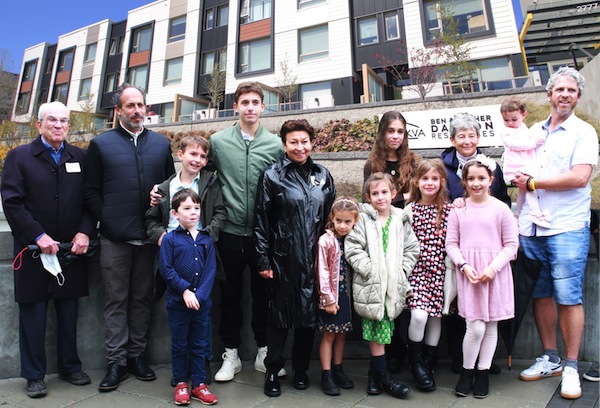
The Dayson and Barnett families were on hand to celebrate the opening of Tikva Housing Society’s Ben and Esther Dayson Residences. (photo from Tikva Housing)

Although the weather was not ideal, almost 100 people attended the opening of Tikva Housing Society’s Ben and Esther Dayson Residences on Sept. 26.

Due to COVID-19 restrictions, the event had to be held outside under tents. Rhonda Sacks, chair of Tikva, welcomed everyone and thanked the Ben and Esther Dayson Charitable Foundation and the Dayson and Barnett families for their ongoing generosity and support. She acknowledged the three generations of the Dayson and Barnett families who were present and the importance of the younger ones to witness this momentous occasion.

Sacks recognized the Jewish Federation of Greater Vancouver for understanding the immediate need for affordable housing in the Jewish community and thanked them for their leadership and advocacy. Ezra Shanken, chief executive officer of the Jewish Federation, brought greetings and reiterated the importance of not only saying thank you but also showing the younger generation how, because of their great-grandparents, the community is taking care of those in need of affordable housing.

Philip Dayson spoke on behalf of the family and mentioned that it was the desire of his mother, Esther Dayson, to help those less fortunate and to have a lasting legacy, like these townhomes.

photo - The younger generation of the Dayson/Barnett family cut the ribbon at the opening of Tikva Housing Society’s Ben and Esther Dayson Residences
The younger generation of the Dayson/Barnett family cut the ribbon at the opening of Tikva Housing Society’s Ben and Esther Dayson Residences. (photo from Tikva Housing)

Many of the residents in attendance took the opportunity to personally thank the donors and their families.

Hannah Amar, one of the residents at the Dayson Residences, spoke on behalf of the 32 families who live there. She spoke of the importance of having safe and secure accommodation, especially during COVID, and how grateful she is to Tikva and to its donors for her beautiful home.

This housing development is part of a partnership of the City of Vancouver and the Vancouver Community Land Trust; there were many donors and partners on the project.

More than 100 people live in the residences, including almost 60 children. As one of the residents said, “The sense of community and Jewish life is beyond what we could have imagined. We are so fortunate to be living here.”

The event also paid tribute to Susana Cogan, z’l, who was the driving force behind Tikva Housing from 2009 to 2017. Cogan was instrumental in developing these residences, as well as others that Tikva owns and/or operates. A commemorative bench in her memory sits adjacent to the children’s playground.

For more information about Tikva Housing, call the office at 778-998-4582.

– Courtesy Tikva Housing

Brian Jessel BMW turns 35

Brian Jessel has loved cars since he was a kid. (photo by Alfonso Arnold)

Brian Jessel chose one of the most consequential years in Vancouver’s history, 1986, to embark on his self-named BMW dealership. Since Expo 86, both the city and Brian Jessel BMW have changed, but, according to Jessel, one thing remains constant.

“We take a personal approach to the car business. We cherish our relationships with our clients and like to spoil them and treat them as VIPs. This is how I want to be treated, so this is how I grow my business relationships,” Jessel said in a recent interview.

And he also works to grow community. Among the organizations that have benefited from his philanthropy are Jewish Federation of Greater Vancouver, Jewish Family Services, Congregation Schara Tzedeck, Lubavitch BC, the Jewish Museum and Archives of British Columbia and the Isaac Waldman Jewish Public Library.

In the general community, Jessel’s Cabriolet Charity Galas, started in 2004, are among the premier philanthropic events of the year in Vancouver. The annual galas, which raise money for pancreatic cancer research, have brought in more than $2 million and have seen the likes of talk show host Jay Leno and blues singer Colin James perform in the past.

Enthusiasm for the automobile runs in Jessel’s family. His father, Bernie, a leading figure the Toronto car market, instilled a fascination with the industry – an excitement that has carried through to future generations.

“I loved cars from the time I was a toddler; it’s probably in my DNA. I now have a 4-year-old grandson who is exactly the same; he sleeps with cars in his bed and won’t let go of the steering wheel if he gets into the driver’s seat. I bought him and his 6-year-old brother cars – yes, real cars. I just need to wait 12 years to give them to them,” he related.

The desire to be in the car business maintained such a strong pull for Jessel that other career possibilities did not stand much of a chance.

“I went to university (in Michigan) but never graduated – I wanted to get to work. I interviewed at a prestigious Bay Street stock firm and was accepted for the position, but I never started. A couple of weeks later, I was selling cars at a classy GM dealership on the west side of Toronto,” he recalled.

Eventually, in 1972, he made it out west, opening his first used car lot with six automobiles on a leased space at Burrard and 1st Avenue. Jessel sensed the appeal of foreign cars, even back in the 1970s, and turned that first car lot into a Fiat dealership – along with selling pre-owned vehicles, specializing in imports.

“These were days when, if a Jag went down the road, people stopped and looked,” said Jessel, who also attributes his success to having the gumption to take a chance when opportunity comes calling.

Before establishing itself at its current location in Vancouver in 2004, Brian Jessel BMW operated out of locations in Langley and Coquitlam. Today, it occupies a 66,000-square-foot new-car facility on Boundary Road, with an additional 36,000 square-foot pre-owned-car space nearby. Brian Jessel BMW sells more than 5,000 cars a year.

Jessel gives much of the credit to his staff for his thriving business. “Our people are knowledgeable but also warm and engaging,” he said. “And we are laser focused on all things BMW. We aren’t using a cookie-cutter format that works for selling everything from Bentley to Hyundai, like large dealership groups need to be. Yet we are the size of five dealerships, so we still have all the economies of scale of the multi-brand.”

When asked about the differences in running a dealership now as opposed to 35 years ago, he said, “As with everything in the world, the computer has changed how cars operate. Twenty years ago, I went to Europe and drove the upcoming BMW 7 Series. It had a dial in the centre console that controlled many of the car’s functions. Auto journalists hated the iDrive System when they first saw it. Now, almost every manufacturer has followed BMW’s lead and has a similar operating system.”

And there is the move to electric vehicles as well.

“The new frontier is the electric car. There is a mystique I like about electric cars,” he said. “They are so quiet and have amazing low-end power. I still love the feeling of an internal combustion engine, however, it is inevitable that electric vehicles will dominate by the end of this decade.”

Brian Jessel BMW has started taking orders for the new BMW iX, as well as the four-door sedan version, the BMW i4 – both of which are fully electric.

Sam Margolis has written for the Globe and Mail, the National Post, UPI and MSNBC.
CHW empowers victims

COVID-19 isn’t the only global pandemic to worry about; the worldwide increase in domestic violence has been coined a “shadow pandemic” by the United Nations. Globally, an estimated one in three women lives with violence and fear. But the number of domestic violence complaints in Israel, for example, has increased by 800% since the beginning of COVID. True to its mission, Canadian Hadassah-WIZO (CHW) is leading the way to empower women by stepping up emergency support and services at this critical time.

CHW strongly believes that every human being deserves the right to achieve their full potential, while living in safety and security. CHW appointed its first chief executive officer, Lisa Colt-Kotler, who is spearheading a transition and new direction for the 100-year-old organization, with a history of support for women and children in Israel and Canada. This summer, CHW is launching a quadruple matching 24-hour crowdfunding campaign and proceeds will help empower victims of domestic violence.

image - S.O.S. – Starting Over Safely logoCHW’s summer campaign, S.O.S. – Starting Over Safely, has three priorities for projects in Israel: CHW Youth Villages, which provide a safe haven for at-risk adolescents and supports mental health through a variety of outlets; Essential Kits for Families, which provides the basic necessities needed to help each family start over safely after they leave an emergency shelter; and the Safety Net Program, which will empower women and their children by providing housing, financial help, social and personal support, employment support, and a network of other women in similar circumstances. Safety Net has nearly a 100% success rate of breaking the cycle of violence and preventing victims from re-entering a domestic abuse relationship.

Aug. 24-25, funds donated will be matched three more times by a loyal community of donors recognized as “Matching Heroes.” During the 24-hour campaign, which kicks off at noon in each centre across Canada, each gift donated on the website chwsos.ca will be quadrupled.

And, on Aug. 24, at 5 p.m. PST, CHW is hosting a free, star-studded, 90-minute virtual telethon experience during which viewers will learn more about how to help empower victims of domestic violence. To watch, just click on the link from the campaign website.

For more details, contact Irena Karshenbaum, CHW development officer for Western Canada, at irena@chw.ca or 403-253-4612.

– Courtesy CHW

JNF supports ALUT

(screenshot)

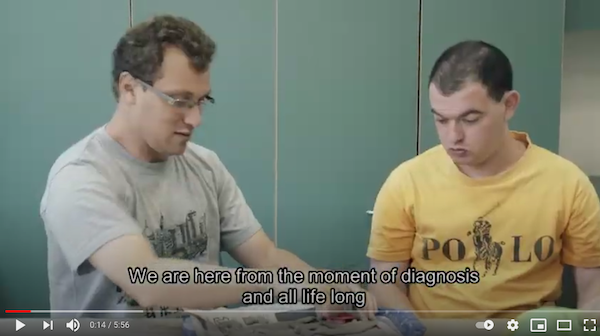
For this year’s Negev campaign, JNF Pacific Region has partnered with ALUT, the Israeli Society for Autistic Children, to renovate Aviv House, one of the first lifetime living facilities established by ALUT. ALUT has built and operates 18 “Homes for Life” in Israel, residences for individuals with autism who require supported living, that allow the residents to become integrated into the community to the greatest degree possible and provide for lifetime care in a family-type setting.

Aviv House (Beit Aviv) was established in 1992 in Jerusalem and the 14 residents have been living there since its inception. Their ages currently range from 35 to 49, and they all require assistance in almost all aspects of everyday life.

The physical house, now well over half-a-century old, is showing its age and has reached the point of risk. For example, the walls are crumbling and the sewage lines are regularly clogged; the building is not wheelchair accessible.

For more information and to watch a video from the campaign’s honorary co-chairs, Penny Sprackman and David Goldman, visit facebook.com/jnfvancouver. You can also contact the JNF office at 604-257-5155 or van@jnf.ca.

Haas talks acting and BGU

Israeli actor Shira Haas was the featured guest at the Canadian Associates of Ben Gurion University of the Negev’s virtual gala July 7. (photo byShula Klinger)

On July 7, the Canadian Associates of Ben Gurion University of the Negev held their second virtual fundraising gala. More than 1,200 participants logged on to the An “Unorthodox” National Virtual Gala event, which raised $850,000 for brain research at BGU’s Zlotowski Centre for Neuroscience.

The Zlotowski Centre is a group of researchers dedicated to finding cures and management tools for neurodegenerative diseases including Parkinson’s, Alzheimer’s, ALS and epilepsy.

photo - As part of the gala event, attendees received a special dinner package
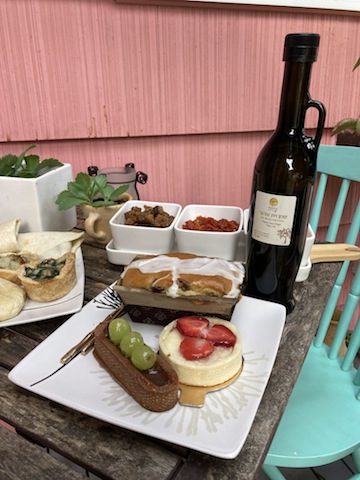
As part of the gala event, attendees received a special dinner package. (photo by Shula Klinger)

Months in the making, the virtual gala was the work of a countrywide team of BGU staffers and numerous volunteers. Every participating household in Metro Vancouver received sweet and savoury kosher treats from Café 41. The accompanying gift box also brought olive oil from the Negev, a copy of Deborah Feldman’s memoir, Unorthodox: The Scandalous Rejection of My Hasidic Roots (Simon & Schuster, 2012), appetizer dishes and a commemorative cutting board.

Danny Chamovitz, BGU’s president, spoke about the work of BGU’s academics in general, in disciplines ranging from public health to brain research. Canadian Senator Linda Frum conducted the feature interview – with multiple-award-winning actor Shira Haas.

Describing herself as “very, very shy” as a young person, Haas said she had considered psychology or graphic design as professions, until a casting director approached her on Facebook. Sixteen years old at the time, she said, with respect to that first project, “I understood that this is what I want to do, it was like the door to Narnia.”

Haas does not take her success or popularity for granted. “It was always a dream to work internationally, in different languages, for different audiences, but I never imagined it,” she said. “It was always about the work. I am very, very lucky to be in this position.” She added, “My parents deserve to be talked about! They are the most supportive and amazing parents.”

Known for taking on demanding roles, Haas approaches acting in a scholarly fashion. She studied musculoskeletal diseases to play a terminally ill woman in the film Asia, and researched Russian, Yiddish and Charedi culture for the series Shtisel and Unorthodox. She said she finds beauty in hard work, explaining that Asia was “challenging in the most beautiful way. It was a lot of physical and emotional work, and very personal for me.”

When playing a part, Haas said she is motivated by two things. First, she must be passionate about the role because “that’s what brings everything alive.” About Shtisel, she said, “I fell in love with it immediately.”

Her second principle is to portray “subjects that matter to me.”

Haas’s idealism was evident in the way she spoke about Asia. “It’s not really about death,” she said. “It’s about relationships, about appreciating the time we have and what we do with it. The highest form of art is to bring light to the darkness.”

About Unorthodox, she said, “It didn’t occur to me that it is about the Orthodox world. It was just a story about people who want to be loved, their doubts, desires and failures.”

And Shtisel, she noted, had a huge impact on people all over the world. The show helped change people’s view of Orthodox communities, she said: “It’s universal.”

Of her forthcoming portrayal of Golda Meir in her early years, Haas described a woman with “a very interesting life. She was very passionate, with many dreams and desires.”

Since David Ben-Gurion and Golda Meir were friends, she laughed, “this event was meant to be!”

Haas spoke of her personal connection to BGU. Her sister studied at the university and a close friend is there now. Haas wanted to participate in the gala for several reasons, including, she said, “I am Jewish, I am an Israeli. I want to keep on doing events like this! I am even more proud to do it for Ben-Gurion.”

As for the brain research being conducted at BGU, which the gala funds will support, there has already been groundbreaking progress. Claude Broski’s group has identified a protein that can slow down the degeneration brought on by Parkinson’s. The social robots developed by Shelley Levy-Tzedek and her team will have an impact on stroke patient recovery – the robots offer motivation, feedback and performance-tracking during the rehabilitation phase. Epilepsy researchers are developing wearable hardware and software that could alert patients to an oncoming seizure, an hour before it happens. And Deborah Toiber’s Alzheimer’s team is exploring questions about brain aging, such as, Why does the disease affect so many of us, when only 5% of cases are genetic?

David Berson, executive director of CABGU, British Columbia and Alberta, said, “It has been very gratifying to see how the Metro Vancouver community has embraced BGU students and faculty in recent years. Many new supporters have stepped forward during the last year to engage with us. We are especially grateful to our community partners, who helped us promote this Unorthodox event.”

Among the many contributors to the gala were board members Jay Eidelman and Si Brown. Rachelle Delaney helped Berson with the goodie boxes at the crack of dawn on July 7, while volunteer drivers delivered the boxes. Adrian Cantwell and I were co-chairs for the Metro Vancouver team.

Shula Klinger is an author and journalist living in North Vancouver. She was Metro Vancouver co-chair of the CABGU gala with Adrian Cantwell.

Community milestones … Federation, Koerner, Broca

The annual general meeting of the Jewish Federation of Greater Vancouver took place on June 21. Welcomed were five new directors: Gil Kimel, Dean Lederman, Lana Pulver (chair of the annual campaign), Michelle Pollock (chair of the Israel and global engagement committee), David Porte and Daniel Steiner. They join Bruce Cohen, Alex Cristall, Catherine Epstein (vice-chair), Jessica Forman (chair of the HR committee), Sue Hector, Hodie Kahn, Shay Keil, Rick Kohn, Candace Kwinter, Shawna Merkur, Kyra Morris, Lianna Philipp, Lisa Pullan, Stan Shaw and Diane Switzer.

Kwinter is the new board chair and, as such, her central challenge mirrors that of the community: how to navigate recovery and reopening in a time of great uncertainty.

“Over the past year, I have held a dual role as vice-chair of the board and chair of the Israel and global engagement committee, which has immersed me in our work,” said Kwinter in her remarks in the June 25 Federation Shabbat message. “And, through my position on our Community Recovery Task Force, I’ve gotten to know the organizations in our community and see how our community planning, convening, facilitating and fundraising functions create a valuable synergy. The health and strength of our local community is paramount, and it will continue to be a focus throughout my term.

“Israel also holds a very special place in my heart, and I am actively involved with our partner, the Jewish Agency for Israel’s board of governors, where I serve on three committees: antisemitism; unity of the Jewish people; and aliyah. In 2018, I was privileged to be part of a group of community leaders who traveled to Far East Russia to see the impact of our overseas work. As travel restrictions begin to ease, I hope we will have the opportunity to visit our partnership region in the Upper Galilee Panhandle and resume our Israel experience programs for young adults.

“At the same time,” she continued, “I remain connected to the work we do across the continent as part of JFNA [Jewish Federations of North America]. I have attended several General Assemblies over the years, and now is the perfect time for you to experience this epic gathering of Jewish leaders, because you can participate without the time and expense of traveling.

“Looking ahead, I know we have challenges to face, but this is also an exciting time in many ways. COVID has accelerated change and has prompted us all to look at new ways of strengthening our community. Rather than looking ahead to the ‘new normal,’ we need to work together to create the ‘next normal.’ That will be our collective journey over the next two years, and I am looking forward to the future we can build together.”

At the AGM, four community leaders were honoured. Jonathon Leipsic, who chaired the Federation annual campaign from 2018 through 2020, received the Harry Woogman Award, for his consistent and conscientious leadership and his long-standing and diligent campaign involvement. Yael Segal and Becky Glotmanreceived the Lou Zimmerman Award for their integral role in the revitalization of the Ben Gurion Society, a recognition society for young donors who give $1,000 or more to the Federation annual campaign. And Enav Zusman received the Young Leadership Award.

The 2020/21 annual report can be found at jewishvancouver.com/news-and-publications/annual-reports. In 2020, Federation raised $12.2 million from 2,600 donors: $8.8 million in the 2020 annual campaign; $2 million for community recovery; and $1.4 million in special project funding.

COVID-19 was a crisis that affected – and continues to affect – every aspect of the community. Because of donors’ generosity, Federation this year was able to direct more funding to its partners than ever before.

(British Columbia’s record-breaking heatwave has had devastating effects across the province. The tragic fire in Lytton was not the first that we’ve seen and likely will not be the last. With growing concerns for another wildfire season, Jewish Federation of Greater Vancouver has set up an emergency B.C. Wildfire Relief Fund to assist those affected by wildfires in our province. To donate, visit jewishvancouver.com/bcfire.)

* * *

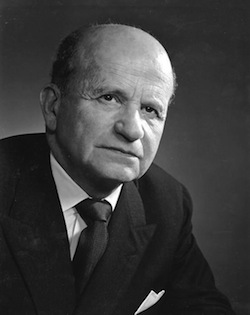
On May 20, Junior Achievement British Columbia (JABC) inducted new members into its Business Laureates of British Columbia Hall of Fame, including Gordon Diamond. There was also the posthumous induction of 10 Pioneer Laureates, including Morris Wosk, z”l. Diamond and Wosk were featured in the June 25 Jewish Independent article “JA’s newest laureates.” The article accidentally overlooked another posthumous honouree, however: Dr. Walter Charles Koerner, z”l. Here is what the JABC highlighted of Koerner’s life.

Koerner was born in 1898 in what is now the Czech Republic. He developed his expertise in the forestry industry there, through his family’s lumber business.

photo - Dr. Walter Charles Koerner
Dr. Walter Charles Koerner (photo from alchetron.com)

Koerner and his brothers immigrated to Canada in 1939 and founded the Alaska Pine and Cellulose Co., of which he was president. In 1957, the company became Rayonier Canada Ltd. and Koerner became president and later chairman of the board until his retirement in 1973.

Shortly after his arrival in Canada, Koerner made the University of British Columbia (UBC) a focal point of his philanthropy. He believed that a strong university was critical to building an engaged and successful society. He served as a member of the board of governors of UBC, as well as the chair. Not only that, he was the founding chair of UBC Hospital.

Koerner was also committed to preserving Indigenous art forms and supporting the re-emergence of Pacific Northwest Indigenous art. His multiple initiatives included supporting Indigenous carvers, repatriating Indigenous works from abroad and negotiating with then-prime minister Pierre Elliott Trudeau for financial support for the construction of the Museum of Anthropology, to which he donated his extensive collection. In recognition of his efforts in supporting Indigenous culture, the Haida Nation celebrated Koerner as an honorary chief of their nation.

Koerner was a notable philanthropist, who donated millions of dollars to educational institutions and other public organizations and endeavours. Among his many honours, he was a Companion of the Order of Canada, and held an honorary doctor of laws from UBC.

Koerner passed away in 1995.

* * *

Vancouver’s Lilian Broca is among the artists whose works comprise the From Canada exhibition at La Maison de la Mosaïque Contemporaine in Paray-Le-Monial, France.

Every year, La Maison de la Mosaïque Contemporaine organizes and hosts an international mosaic exhibition. The 2021 edition, the 24th, is uniquely devoted to a single country, Canada, through the works of 12 artists whose origins reflect the vast expanse of the territory. This is the first time in Europe that a mosaic exhibition has been dedicated to a North American country, and it is supported by the Canadian embassy in Paris, as well as several other organizations, government agencies and communities.

Joining Broca are artists Maria Abagis, also from British Columbia; Margo Anton, Chris Sumka and Erin Pankratz, all from Alberta; Sophie Drouin, Valerie McGarry, Heather Vollans and Julie Sperling, from Ontario; Suzanne Spahi and Ginette Lussier of Quebec; and Terry Nicholls of Newfoundland.

The exhibit was arranged by Sophie Drouin and Chantal Demonchaux. It opened this month and runs to Sept. 19. For more information, visit maisondelamosaique.org.

Hands-on learning at farm

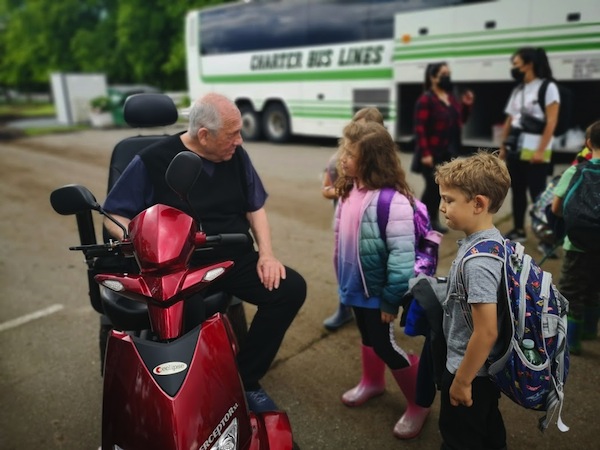
Syd Belzberg talks with Vancouver Talmud Torah kids at Stable Harvest Farm. (photo by Shira Sachs)

“The children loved to take their harvest home to share with their families. Many children helped to prepare the family meals, including washing, chopping and plating their meals. There was so much to learn – how healthy food can taste so yummy, how I can help my family make dinner, how the food can make my body feel good.”

“This is from some cute kid, and I see his picture in front of me,” Syd Belzberg told the Jewish Independent in a recent phone interview. “That’s heart-warming. That’s where it’s all at. That’s beautiful.”

photo - Vancouver Talmud Torah Grade 1 students have a plot on Syd Belzberg’s farm, where they grew scallions and other vegetables
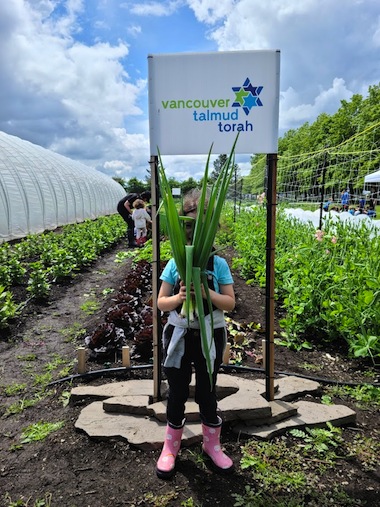
Vancouver Talmud Torah Grade 1 students have a plot on Syd Belzberg’s farm, where they grew scallions and other vegetables. (photo by Jessie Claudio)

The note came after Vancouver Talmud Torah Grade 1 students visited Belzberg’s Stable Harvest Farm in Langley last month.

Belzberg got the idea for the farm about a half dozen years ago. He read a newspaper article about Vancouver Sun reporters who had started a breakfast program for schoolchildren in the 1980s. “I got in touch with them and got involved a bit, supporting some of the schools with money,” said Belzberg.

But he wanted to have more of an impact and, after he retired a couple of years ago, he decided to reinvent his Langley acreage, which had been home to his many horses several decades ago, but had laid empty for some 17 years. He based his concept on that of Coastal Roots Farm, “a nonprofit Jewish community farm and education centre” located near the home he has in California. “They do a lot of wonderful things,” said Belzberg, “and I thought this would be a heck of a thing to try and copy in a way.”

He hired Kristjan Johannson to manage the farm and the first crop was planted in January 2020. Despite flooding on the property, they gave away about 90,000 pounds of organic vegetables to a half-dozen food banks, as well as to community meals programs.

“This year, we decided to try and double it,” said Belzberg. And they more than doubled it, giving away an estimated 250,000 pounds of food, while continuing to work on the property.

Belzberg established the Stable Harvest Farm Society, he said, “to make this a legacy for my family.” Of his five kids, only one lives in Vancouver, and that daughter, Tammi Kerzner, “has been a massive help to me to build this,” he said.

“There are many facets to what I want to do,” said Belzberg, “but I wanted to get the food thing right because I didn’t know what we’d have to go through to be successful.”

Belzberg’s approach with this project has been similar to that which he has taken with his other endeavours.

“When I started in the car business [Budget Rent a Car] in ’62, I had trucks and other things in mind, but I wanted to rent cars and learn about that first,” he said. “It’s the same thing here. I wanted to prove we can get the vegetables right before I started to do anything else.”

Educational programming is a main component of the farm. “David Bogoch had a lot to do with teaming up with TT. He is such a supporter of it,” said Belzberg about collaborating with the school. “And my children went there. I have a great-granddaughter now who goes there. So it was a natural [fit]. The part that really put us over the top was Emily [Greenberg], because she’s fantastic. She’s so on top of it, and she’s got Jessica [Claudio] there, who goes to another level.”

“Mr. Belzberg has been a very generous supporter of VTT,” said Greenberg, who met Belzberg for the first time when he first saw the school’s rooftop soccer pitch that he funded. That was in her second week as head of school, she said.

“And we’ve had close relationships with David Bogoch, who is quite close to Mr. Belzberg, and he kept talking to me about this farm that Mr. Belzberg was creating … that Mr. Belzberg had a dream to make this farm a centre for Jewish education and Jewish values and the Jewish community and that he would love to see children using this farm, in addition to how it supports the needy in Vancouver.”

Belzberg eventually invited Greenberg for a visit and they spoke about his vision and she “went away and thought about how we could make that happen from our end and, ultimately, bring kids out there.”

The first thing that happened, said Greenberg, was that Johannson came to the school and helped the kids plant seedlings. “Then we had, basically, a little nursery there at the school and watched them grow and supported them.” The plan was for the kids to plant the adolescent seedlings in April at the farm but COVID restrictions had increased, “so we weren’t able to bring the kids to Langley because it was cross-boundary.” But the planting was filmed and a multi-series educational video was made.

“Thankfully, the regulations changed again and we were able to go in the third week of June and send all of our Grade 1 kids out there,” said Greenberg. “They were able to help reap the harvest and they each brought home a bag of veggies from Mr. Belzberg’s farm and made the most amazing salads and soups and all sorts of things and we’ve got some great pictures of what they made that night. We had parents who were ecstatic, watching their kids eat raw vegetables – including scallions.”

The kids had grown the scallions, as well as lettuce and radishes, and their bags were supplemented with some other vegetables from the farm, such as tomatoes and carrots.

On their visit, the kids also got to see the part of the property that will become a bird sanctuary – “there’s a hundred and some odd different types of birds and owls that feed there and it became a natural habitat,” said Belzberg.

Another aspect of Stable Harvest is bees. Belzberg works with beekeeper Carolyn Essaunce, who owns the Honest to Goodness Farm Co. Essaunce also made a trip to VTT and spoke to each senior kindergarten class.

photo - Beekeeper Carolyn Essaunce speaks to VTT senior kindergarteners about bees and honey
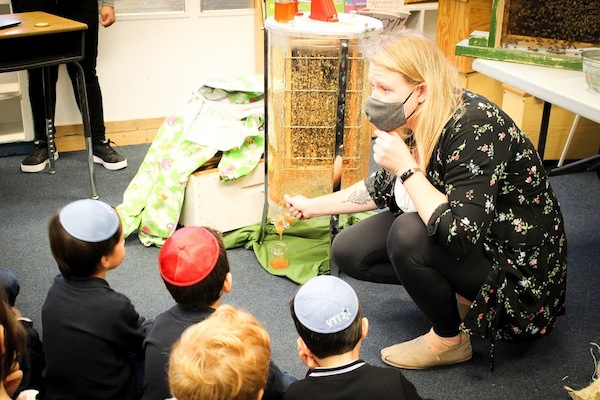
Beekeeper Carolyn Essaunce speaks to VTT senior kindergarteners about bees and honey. (photo from VTT)

“She brought a whole honeycomb with live bees,” said Greenberg. “She helped them understand how, when you take a honeycomb and you put it in a machine and spin it, how you get the honey out…. They understood what it was to produce honey and then they all went home with some of Mr. Belzberg’s honey…. That is definitely something we hope to repeat yearly.”

Experiential learning is the future of education, said Greenberg. “For us, we want to prioritize learning through nature and to exposure to nature, but also, of course, finding ways to make sure that Jewish values are part of that…. So this has been a tremendous opportunity for us. It’s only the beginning – we look forward to bringing many more of our grades out to Stable Harvest Farm next year. There’s obviously a science aspect but we also want our kids to be shomrei adamai, guardians of the earth, and understand the power of nature. There’s an empowerment that happens when they’re part of growing a plant and the excitement that happens. And the understanding of the life cycle and how that eventually nourishes us and nourishes those in need – it’s a tremendous marriage of all of the values we have as educators, but also as a Jewish day school.”

VTT has invested a lot of time in iSTEAM over the last two years, she said, “integrating the innovations that have been coming out of Israel and using that as the platform from which to explore science, technology, engineering, art and math. A great example that you have at Mr. Belzberg’s farm is drip irrigation, which is an Israeli innovation…. We love the fact that our kids can be proud of a technology that’s come out of Israel and understand how innovation can revolutionize an entire industry and, ultimately, help people live a better, healthier life.”

photo - All the workers show off the produce reaped during the VTT schoolchildren’s visit to Stable Harvest Farm
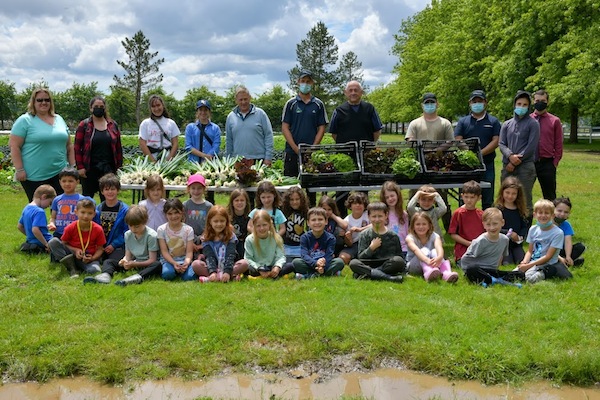
All the workers show off the produce reaped during the VTT schoolchildren’s visit to Stable Harvest Farm. (photo by Galit Lewinski)

Greenberg’s goal is to get all of the VTT students out to the farm at least once over a two-year span. “We have a lot of ideas,” she said, “and Mr. Belzberg, thankfully, is very flexible. He just says, ‘Tell me what works for you and we’ll make it happen.’ He always says that: ‘We’ll make it happen.’”

And there is lots that Belzberg plans to make happen. Next year, for example, he hopes to build a large kitchen on the farm for cooking classes, education and other activities. Already, the farm has had its first stand, on June 19, and joined its first farmer’s market, in White Rock, on June 20.

“It’s a helluva way to give back and it fills a vast need and I can afford to do it,” said Belzberg when asked why the farm is important to him. “It’ll hopefully continue forever,” he said.

“When I sat there with the TT kids, and they’re coming up to me and shaking my hand, and when I see the letters that are coming back, the salads, the fact that these kids are into food, I give TT all the credit in the world,” said Belzberg. “It was one of the 10 happiest moments of my life when I sat there a week or so back and watched the kids being in the ground, getting their hands dirty. What could be better than that? And the smiles on their faces.”