This year, the High Holidays fall later than usual, with Rosh Hashanah just a few days before the anniversary of Oct. 7, 2023 – the most tragic date in the history of modern-day Israel.
The High Holidays offer special opportunities for reflection and renewal, reaffirming what matters most, pursuing positive change and strengthening our connections with others.
As we look back on 5784, we should examine our own actions, reflecting honestly on our challenges and successes, and seeking lessons we can take from our experiences to carry into the year ahead. It’s a time to consider which elements of our lives and our relationships with others need improvement.
This leads naturally to an opportunity to contemplate our intentions and priorities and plan for the future. It is a means of charting a course that aligns with our values and contributes to the strength of our families and our communities.
While Canada remains one of the safest places for Jewish communities, the Centre for Israel and Jewish Affairs’ advocacy – especially since Oct. 7 – has been fueled by a profound dedication to tackling the disturbing rise in antisemitism.
The alarming surge in antisemitism, both online and on the streets, has been deeply shocking. Yet, it has also driven us to forge essential connections with all levels of government, law enforcement, educational institutions and community organizations representing the majority of Canada’s Jewish population and other vulnerable minorities.
Just as the High Holidays are arriving late this year, so too are long-awaited protections from the government. We have seen some progress, but there is much to be done to ensure “bubble legislation” (safe-access laws to protect defined areas from protests, harassment and hate) becomes common, if not ubiquitous, across Canada. Vaughan, Ont., has adopted an encouraging example, and many other municipalities have expressed serious interest in following suit, but there is still much work ahead.
Federal online hate legislation has been in development under various ministries for years, and we are not backing down on contributing to and securing this fundamental legislation that will enhance security measures.
The accusations against Israel of war crimes from the International Court of Justice (ICJ) are both absurd and detrimental to Canada and the West’s long-standing policies aimed at achieving peace in the Middle East. If the Canadian government wants to rescue the reputation of the ICJ, it must denounce this evidence of its politicization.
Antisemitism is not a “Jewish” problem. Jew-hatred poses a grave danger to all who cherish our core Canadian values. We know from history that, wherever antisemitism is allowed to thrive unchecked, social malaise and political oppression follow. Its defeat requires a concentrated, multi-pronged approach involving many cultural, political, ethnic and faith organizations, as well as individuals from across the country. Together, we are working to combat antisemitism while building relationships with many partner groups, promoting the Canadian values of dialogue and understanding, tolerance and respect.
As Canada’s special envoy on preserving Holocaust remembrance and combatting antisemitism, Deborah Lyons, wrote in a July op-ed in the National Post: “Jews did not create antisemitism and … it is not on them to fight it alone.”
As we approach the sad and sombre anniversary of the Oct. 7 massacre, many will join us in honouring the memories of those murdered by Hamas and in praying for the safe return of the hostages and for the restoration of peace to the region. And, if we are so blessed to have welcomed home the hostages by the time you are reading this, we’ll have more to celebrate as we begin the new year.
In the meantime, I wish you a sweet, healthy, peaceful and happy 5785.
Judy Zelikovitzis vice-president, university and local partner services, at the Centre for Israel and Jewish Affairs.
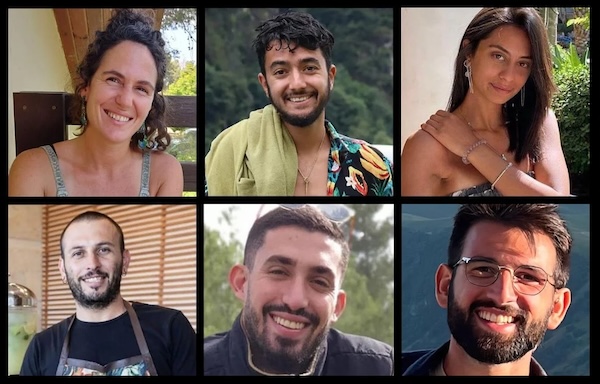
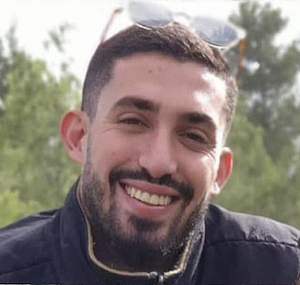
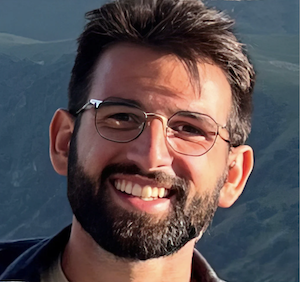
Clockwise from top left: Carmel Gat, Hersh Goldberg-Polin, Eden Yerushalmi, Alex Lubanov, Ori Danino, Almog Sarusi. (photos from internet).
This article is an edited version of a blog posted on Sept. 2, 2024.
Carmel Gat, Hersh Goldberg-Polin, Eden Yerushalmi, Alex Lubanov, Ori Danino, Almog Sarusi. The cursor has been blinking below these six names and faces.
I haven’t known where to begin because there are so many emotions swirling, yet, despite the tears of devastation and despair that come to the surface and back away again, my predominant emotions are rage and frustration.
Rage at the savage and violent ends for these beautiful men and women, and frustration that, even in Israel, many have assumed that so few hostages could possibly still be alive, that only 30 or 40 are likely still alive. Well, here we had six, who were all held in tunnels, where just oxygen is tough to find, surviving a Middle Eastern summer with practically no food or water or personal hygiene for close to a year, and they are not dead because they couldn’t survive – they did survive. They are dead because they were murdered by Hamas at close range and, although it is customary in Judaism not to say details that will hurt the families or the memories of their loved ones, due to the level of urgency of this situation for now close to a year, I feel it is crucial to state that it is known that these particular six hostages were tortured badly before they were shot.
It is important to point out the brutality of Hamas. It was an incredibly bold move for Hamas to select two young women and an American man, whose mother was on the cover of Time magazine and whose parents just gave an electrifying speech on Aug. 21 at the Democratic National Convention, as hostages to murder so savagely. This speaks volumes to me. Hamas is fearless – and why shouldn’t they be? All of the pressure for a ceasefire has been on Israel. All of the pressure for the war to end has been on Israel. How about: “Give us back our people” instead of “Bring them home now,” why not, “Send them home now”?
The tunnel these hostages were found in was located less than a mile from the tunnel in Rafah from which Farhan al-Qadi, a Bedouin-Israeli hostage, was rescued, so it is possible that the Israel Defence Forces’ proximity led Hamas to make this horrific decision, but, had the IDF been “permitted” to enter Rafah sooner and more aggressively, perhaps more could have been done to save these human beings and the rest of the hostages months ago.
The anger I feel is complicated. I traveled alone to Israel last November to write about the hostages and got so involved there that I stayed until March. It is hard being in the diaspora right now, as I am realizing more and more regularly that Jews outside of Israel aren’t understanding how Israeli Jews feel right now and what they need so badly from us. I’ve tried to communicate this through my piece about Alon Ohel which can be read at melanie-preston.com. (His mom’s words put it so perfectly.)
The vast majority of Jews in the diaspora love Israel, and so they visit and they donate and they believe that if there ever were an emergency in the world, Israel would welcome them. But this isn’t something that can be taken for granted – that Israel will always be the safest country for Jews. It has not felt that way for Israelis since Oct. 7.
If such a brutal attack can happen in Israel, and the government won’t do everything in its power to bring the hostages home alive, then Iran can perhaps win this war because Israelis will start to leave. This is something Hezbollah’s Hassan Nasrallah has said in his speeches lately. He has said Israelis will lose faith in their own government, tourism will stop and the economy will be destroyed. We already know that Iran is winning the propaganda war.
If Israelis no longer have faith in their system and feel they are not cared for as the top priority, which was happening before Oct. 7, and which many feel led to the Oct. 7 attack in the first place, then they won’t want to continue risking their lives or their children’s lives for the ideals of the Zionist state.
It is the belief of many in Israel that these six beautiful souls did not need to die, and these six are beautiful souls. I knew a lot about two of them and have spent the past days learning about the other four. My eyes are swollen from crying.
The hearts of Israelis have been shredded for close to a year, and there is still no healing in sight. Rarely do they ask for help from the diaspora, but, more than any other time in modern Israel’s history, they need us. They need all the Jews of the world putting all the pressure we can muster to get a deal done to bring the remaining hostages home alive. Anything else we need to do for the country’s security can still be done after this first priority – life – is once again prioritized.
***
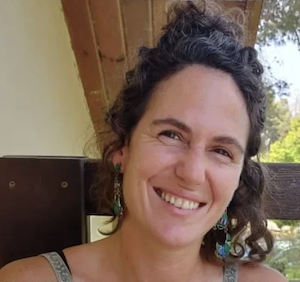
I am going to start with Carmel Gat from Kibbutz Be’eri, the woman with the infectious smile, because I feel like I have gotten to know her through her friend Adam Rapoport, who took me to see Be’eri after I met him when I was writing about a different hostage who was murdered in Gaza back in January (Itay Svirsky). Adam, Itay and Carmel went to the same school.
Carmel Gat (photo from internet)
Carmel was raised on the kibbutz but lived in Tel Aviv and worked as an occupational therapist.
“She was such a loving person, such a peace-loving person. She has friends who speak all languages and are from all backgrounds,” said her cousin, Gil Dickmann, on CNN. “She was always looking for ways to treat others, and to take care of them during their most horrible phases and times of their lives. We know that, in captivity, she actually took care of two youngster hostages who were with her, and she practised yoga with them and meditation with them to make sure that they came through this horrible experience OK, and … when they came back, we were so glad to hear this because this is exactly what Carmel is, and she managed to stay herself in captivity and to take care of others … that was such an amazing thing for us to hear. And, to know that after all this, after 11 months in captivity, she lost her life in such a horrible way and we missed getting her back by so little, is devastating.”
Imagine mastering a practice with such grace that you could be stolen by a terrorist group and manage to not just sustain your own light but spread it, teach it, bringing light into the darkest tunnels of horror – that is nothing short of holy work.
On Oct. 7, Carmel was in Be’eri visiting her parents, and witnessed the murder of her mother before she was ripped away from her life and taken to Gaza. Throughout her time in captivity, “Yoga for Carmel” was done all over the world, with people not knowing if she was alive or not, but choosing to send her strength through yoga.
Well, she was alive. She was alive in a tunnel. For almost 11 months. Not only was Carmel slated to be released on day one of any new deal, but she was on the list to be released at the end of November. Had the ceasefire not been broken by Hamas, she would have been out at the beginning of December.
Carmel turned 40 years old in Gaza, in May, a couple of days after my own birthday, and I felt this strong connection and kept wondering if that meant she was alive. How I wanted her to come back. How I wanted to meet this woman of strength when I returned to Israel, when I would spend more time on Be’eri. Instead, the number of dead from Be’eri has increased to 102.
May the memory of Carmel be a blessing to all who were lucky enough to have known her, and especially to the children she taught yoga to in Gaza to help them during their two months of terror. May they find someone with Carmel’s light to get them through this.
***
Hersh Goldberg-Polin (photo from internet)
Hersch Goldberg-Polin was supposed to embark on a globetrotting backpacking trip last December, like I did at 23. The kid who loved maps and atlases, who so many Americans feel like they know, thanks to his incredible parents, Rachel Goldberg-Polin and Jon Polin.
Through the sharing of fun facts about Hersh, we have grown to love him, and creative ideas to keep his name out there included giving the name Hersh when ordering coffee at Starbucks, just to hear “Hersh!” whenit’s ready.
His mother came up with counting the days of this war by ripping off a piece of masking tape every day, writing in marker the day number of captivity and sticking the piece of tape on her shirt. Her Instagram videos have discussed the process of the number changing from two digits to three, as well as how it feels when one roll of tape ends and another begins.
Hersh was seen on video being taken on Oct. 7. The video showed him being loaded onto a truck, and made clear that his arm was blown off. This was all his parents knew about their only son for a long time.
As Passover began, Hamas released a video of Hersh, in which you could see that his left arm – his dominant arm, his mom would always stress – was now a stub. In that video, he stated that he was living without sunlight, food or water, and that he would not have peace on the holiday, but hoped they would.
Hersh’s parents spoke clearly and strongly to those involved in the hostage negotiations: Qatar, Egypt, the United States, Hamas and Israel. “Be brave, lean in, seize this moment and get a deal done to reunite all of us with our loved ones and end the suffering in this region,” said his father, with respect to all involved. His mom added: “And Hersh, if you can hear this … we heard your voice today for the first time in 201 days … and if you can hear us, I am telling you, we are telling you – we love you. Stay strong. Survive.”
These words resonated with the hostage families and became a mantra for their loved ones. But, less than two weeks after Rachel and Jon spoke with such power and grace, they learned that Hersh came to a torturous end.
May we hold his family in the light and love that they have demonstrated to all sufferers in this conflict on both sides, since the very beginning.
May the memory of this young man, with the adventurous spirit he didn’t get to use nearly enough, be a blessing for all who knew and loved him, and for those of us who feel like we did.
***
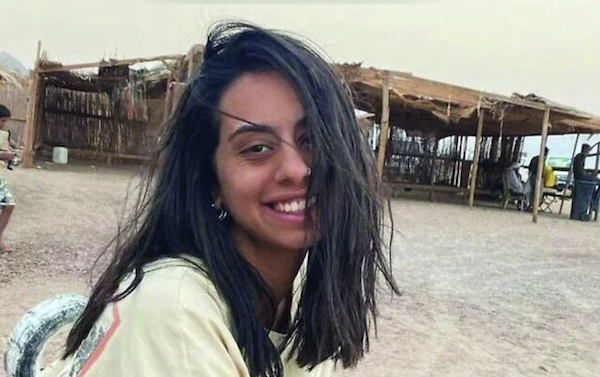
Eden Yerushalmi (photo from internet)
Eden Yerushalmi was from Tel Aviv and studying to be a pilates instructor. She was bartending at the Nova festival and sent her family multiple videos as the attack began. According to the Hostages and Missing Families Forum, the final texts she sent her family that day were “They’ve caught me,” and then “Find me, okay?” These are the chilling words they were left to grapple with.
The striking photo of her at the beach always stopped me in my tracks in Israel, whenever I came across it in Hostages Square or on a supermarket window or café wall. It forced me yet again to take in the enormity of this tragedy, and to imagine something so sick and horrifying happening to someone.
May Eden’s memory be a blessing for all who knew and loved her.
***
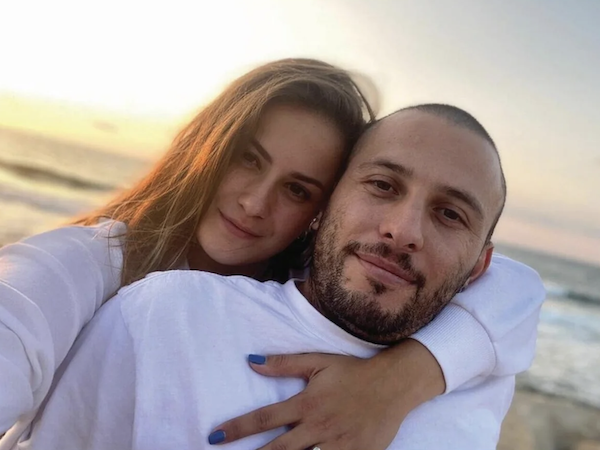
Alexander Lubanov with his wife Michal (photo from internet)
Alexander Lubanov was a bar manager at the Nova Festival and the father of a 2-year-old on Oct. 7. His wife was pregnant at the time and gave birth alone while he was in Gaza. Their baby is now five months old. May Alex’s memory be a blessing to his wife, his very young children and all who knew and loved him.
***
Ori Danino was escaping the Nova festival on Oct.7, but turned his car around to rescue more people. He was from Jerusalem and had five younger brothers and sisters.
Ori Danino (photo from internet)
He was happiest when he was out in nature and around people, and “the best partner you can imagine,” his girlfriend, Liel Avraham, told the Jerusalem Post.
Ori left the festival with his friend in separate cars, to help as many people out as possible. He phoned his friend to ask for the phone number of festival-goers they had just met. He returned to get them, and this was the last his friend heard from him. It was determined that those Ori turned around to get were also taken hostage.
May his memory be a blessing to all who knew and loved him.
***
Almog Sarusi (photo from internet)
According to the Hostages and Missing Families Forum, Almog Sarusi loved traveling around Israel in his white Jeep with his guitar. His girlfriend of five years was murdered at the Nova festival, and he stayed by her side, hoping to help her. He was captured and taken hostage into Gaza.
May Almog’s memory be a blessing to all who knew and loved him.
Melanie Prestonis a Canadian-born, American-raised, Jewish writer and traveler who discovered Israel at the age of 26, immigrated to the country and stayed for seven years. She flew to Israel alone on Nov. 16, 2023, from her home in Charlotte, NC, and was there to March of this year. She is saving to move back to Israel to continue writing about the hostages. She intends to work with the children of Be’eri at Kibbutz Hatzerim and cover the rebuilding of Kibbutz Be’eri. For more information, visit melanie-preston.com. To support her work, go to gofundme.com.
My house smells like chicken soup. That is one of the surefire ways to tell that holidays are on the horizon. It’s a cooler summer day. I have two slow cookers “working” to make that all important broth for autumn days to come. Chicken soup is a little thing but it’s one of those small details that I do in advance to make our family holidays special.
I recently read an introduction to a page of Talmud on My Jewish Learning by Dr. Sara Ronis. It examines Bava Batra 60. This page of the Babylonian Talmud resonates with what many of us are wrestling with during this past year of war. To summarize, Rabbi Yehoshua comes upon Jewish people, who, after the destruction of the Second Temple, in 70 CE, chose to become ascetics. They give up eating meat and drinking wine, because these things could no longer be offered in sacrifice at the Temple in Jerusalem. The ascetics suggested that, given the loss of the Temple, life could no longer be as spiritually rich or as physically nourishing.
Rabbi Yehoshua tries to reason with them, asking if they should stop eating bread, since the meal offerings at the Temple have also stopped. The ascetics suggested they could subsist on produce.
Rabbi Yehoshua asked if they would give up eating the seven species of produce offered at the Temple. They said they could eat other produce.
So, Rabbi Yehoshua says, I’m paraphrasing here: “We’ll give up drinking water, since the water libation has ceased.” To that, the ascetics responded with silence – of course. You can’t give up drinking water and stay alive.
Rabbi Yehoshua encourages the people to make space for mourning but to avoid extremes; he suggests that choosing to be an extremist is dangerous. Making space in our life for other things like daily pleasures and regular foods is important. Devoting all our energies to mourning will rob us of life, too.
This story came to mind when I saw the celebratory photos of Noa Argamani, a rescued hostage. She wore a yellow bikini and danced with her father atop others’ shoulders at a party. In addition to having been a hostage, her mother had passed away from brain cancer, only three weeks after Noa’s rescue on June 8. The pure, almost ecstatic joy of the images clashed in a difficult way with the ongoing war, the hostages still in Gaza, and all those suffering in the conflict. Some immediately sought to criticize this behaviour. There are those who said, “if only Jewish women were more modest, the hostages would be returned.” On the other side, some said, “Look at these Israelis celebrating even while Gazans suffer.”
I remember being told at a long ago Simchat Torah celebration that mourners, after a death of a family, shouldn’t dance or sing. Yet, maybe 10 years ago, when my twin preschoolers asked a Moroccan Jewish family in mourning for their mother, to sing with them Mipi El (a Jewish acrostic song, a piyyot, with a traditional Sephardi tune loved by my sons), these older men held up my kids, danced and sang with the Torah. It was a meaningful moment. It was full of emotion. Maybe one can dance with the Torah and celebrate a little – even while mourning. I almost felt their mother, who I never knew, who raised them to be committed and involved Jewish adults, would approve.
Rabbi Yehoshua’s logical argument and suggestion that we hold onto joy even while mourning is important. Making space for all these feelings in our lives is both powerful and hard. Smelling the chicken broth aroma filling my house makes me anticipate the New Year and holidays to come. Also, like many others, I will never be able to celebrate Simchat Torah the same way again. Yet, nothing made me happier than seeing Noa Argamani and her father make the most of every moment they have together. They deserve every happiness.
In this past year, finding ways to be grateful, to anticipate rituals, holidays and joy has felt really heavy at times. Twice in recent weeks, my family has returned home from a fun summer outing to see antisemitic graffiti in our neighbourhood. There is nothing like having to take photographs of a hate crime, call the police to make a report, and send off the photos to B’nai Brith and CIJA as well to turn a sunny family adventure into a downer. I struggle with processing all this and going on with daily life.
So, when someone I follow on Instagram showed off her Instant Pot chicken soup process, I started up my serious chicken broth production. Here’s to getting new batches of chicken soup, that liquid gold, into the freezer, ready to make new positive memories and associations for the fall holidays to come.
Joanne Seiff has written regularly for the Winnipeg Free Press and various Jewish publications. She is the author of three books, including From the Outside In: Jewish Post Columns 2015-2016, a collection of essays available for digital download or as a paperback from Amazon. Check her out on Instagram @yrnspinner or at joanneseiff.blogspot.com.
לפי נתונים אחרונים של ההסתדרות הציונית העולמית מאז השבעה באוקטובר האנטישמיות בקנדה גדלה בקרוב לשבע מאות אחוזים, לעומת התקופה המקבילה אשתקד. כשבעים אחוז מפשעי שנאה בקנדה מכוונים כנגד הקהילה היהודית המקומית. זאת בזמן שאוכלוסיית היהודים בקנדה מהווה קרוב לאחוז וחצי מאוכלוסיית המדינה
האנטישמיות שוברת שיאים בלתי נתפסים בקנדה ובעצם בכל מדינות המערב והם מדאיגים ביותר. ולמרות זאת בישראל לא מבינים בכלל מה הסיבה העיקרית לעלייה באנטישמיות נגד יהודים ואזרחי ישראל כאחד. וישראל לא מנסה להפעיל אפוא מדיניות הסברה ולימוד ברחבי העולם כדי לנסות ולהתמודד עם האתגר הקשה הזה
רובם של הישראלים מדגישים בהרחבה את העלייה באנטישמיות ברחבי העולם. זאת כדי להצדיק שהרבה יותר בטוח לחיות בישראל מאשר מחוצה לה. את הישראלים זה בכלל לא מעניין כי הסיבה לגידול המשמעותי באנטישמיות נגד יהודים וישראלים בעולם, נעוצה בתוצאות ההרסניות של פעילות צה”ל בעזה. רבים ברחבי העולם צופים ושומעים על כמות גדולה של אזרחים פלסטינים ובהם נשים וילדים שנהרגים עקב התקפות בלתי פוסקות של צה”ל. הצבא הישראלי מחפש לחסל את אנשי החמאס, הג’יהאד האיסלאמי וחברי ארגוני טרור נוספים. אך באותה עת תושבי עזה משלמים מחיר כבד מנשוא. רבים מקפחים את חייהם ומאות אלפים נותרו חסרי בית, והם נעים אנא ואנא בין איים של חורבות
לאור האובדן הגדול של חיים אדם בעזה חל כאמור הגידול המשמעותי באנטישמיות והשינאה כנגד יהודים וישראלים בכל רחבי העולם. ונראה כי לפי מדיניות ממשלת ישראל הנוכחית והעומד בראשה, בנימין נתניהו, לא יחול שום שינוי לטובה בעת הקרובה. כך שאלו שבחרו לגור מחוץ לישראל משלמים מחיר כבד שלא באשמתם
אומר יעקב חגואל, יו”ר ההסתדרות הציונית העולמית: מדובר בעלייה חסרת תקדים. בשבעה באוקטובר לא פרצה מלחמה רק נגד מדינת ישראל, אלא נגד העם היהודי כולו, עם קמפיין מתוזמן וממומן שמעורר אנטישמיות. זו תופעה שלא נראתה מאז השואה, ואנחנו יחד עם ממשלות ומדינות נוספות צריכים להילחם בתופעה הזו ולעקור אותה מהשורש. אנחנו לא ניתן לעולם לחזור לימי מלחמת העולם השנייה. כאמור חגואל לא מתייחס כלל לסוגיה מה הסיבה הישירה לעלייה באנטישמיות והיא מותם של אלפי פלסטינים בעזה בעקבות פעולת צה”ל. אי הכירה בסיבה לא תאפשר להילחם משמעותית באנטישמיות
ואילו ד”ר רחלי ברץ, ראש המחלקה למאבק באנטישמיות בהסתדרות הציונית העולמית מוסיפה: הנתונים בלתי ניתנים להכחשה. בחודשים האחרונים חל שינוי גדול לרעה ביחס אל יהודי קנדה. הדבר ניכר מאוד ברחובות ובריבוי האירועים האלימים, אבל לא פחות מכך בקרב סטודנטים, מרצים וחברי סגל בקמפוסים השונים. הרעות החולות שהפכו פופולריות במערב אירופה ובארה”ב הגיעו גם למדינה שבה מהווים היהודים פחות מאחוז וחצי מהאוכלוסייה. עם זאת, בקנדה חיים למעלה מארבע מאות אלף יהודים. מדובר בתפוצה היהודית השלישית בגודלה בעולם, וראוי שכל הגורמים הרלוונטיים יתנו את דעתם ויטפלו בתופעה חמורה זאת
לעומתם ראש ישיבת סלבודקה בבני ברק, הרב משה הלל הירש (שהוא גם חברת מועצת גדולי התורה של דגל תורה), טוען כי הניסיון לצמצם את עולם התורה, הוא זה שמביא להעצמת תופעת האנטישמיות בעולם. הרב הירש מוסיף כי עלינו שהכל מתנהל לפי פעילותו של אלוהים והכל בעצם לטובתנו. הרב מציין עוד כי אנו חיים כיום בתקופה שאינה חסרת תקדים וכלל ישראל חיות במשך מאות שנים לפני בית המקדש ולאחריו, עם אתגרים מאותם סוג של היום
Left to right are Rachel and Ezra Shanken with their children, Vancouver city councilors Sarah Kirby-Yung and Mike Klassen, and Jewish Federation of Greater Vancouver board chair Lana Marks Pulver. The City of Vancouver proclamation designated June 25, 2024, as Ezra Shanken Day, in honour of Shanken’s 10th anniversary as head of Federation. (photo from Jewish Federation)
On June 25, Ezra Shanken, chief executive officer of the Jewish Federation of Greater Vancouver, celebrated his 10th anniversary at the job and was presented with a proclamation from the City of Vancouver by councilors Sarah Kirby-Yung and Mike Klassen declaring that day “Ezra Shanken Day.” The event took place at Federation’s annual general meeting.
Earlier this month, Shanken spoke with the Independent about the past decade, and his enthusiasm looking ahead.
The Teaneck, NJ, native, who arrived in Vancouver in his early 30s, remains one of the youngest CEOs within the 140-strong network of Jewish federations. He is quick to credit those who have helped him get to where he is today.
“A lot of it has to do with fantastic people who were around, who believed and supported me,” Shanken said. “It helped me bring my unique self to the work and the journey. They took a chance on me 10 years ago, and I have felt incredibly privileged and thankful for the confidence that people put in me at a young age.”
Shanken is equally thankful to have tremendous people around him at the Jewish Federation of Greater Vancouver and feels “lucky to have incredibly talented staff at a senior level who allow for a two-speed operation. We have levels in which people are able to dig deeper into issues in a substantive way,” he said.
Shanken represents the third generation in his family to have a career in the Jewish community: his father worked for Jewish organizations and his grandfather was a Conservative rabbi. Before arriving in Vancouver, Shanken spent several years at the federation in Denver, Colo., and the UJA Federation of New York.
He likens the job of Federation CEO to that of a mayor of a small town, one that requires dealing with diverse opportunities and crises, which are presented or emerge at different times. Not to mention the myriad daily tasks he performs in his position. His work stretches through many different organizations and extends across several time zones.
A day might see him connecting with partners in Israel and others overseas in the morning, then with national colleagues. He’ll spend a portion of the day building up the community’s organizational culture, delivering what, he hopes, is a collective vision for vibrancy and care to more than two dozen partner agencies throughout Greater Vancouver and the province. He meets with community members who contribute to this vision and he engages, on behalf of the community, with allies in the public and private sectors, individuals, institutions and organizations, who work with Federation.
Looking back, he said some of his favourite memories come from Shabbat dinners over the past 10 years in which he has met with everyone from law enforcement to premiers, and countless others from various backgrounds, who have had a chance to experience and understand “who we are and, more importantly, who we are not.
“That for me has been a real blessing, now more than ever,” he said.
As it has with so many people, the post-Oct. 7 period has been a pivotal time in Shanken’s tenure at the helm of Federation. Since that tragic day, he has made three trips to Israel with public officials, parliamentarians and leaders of the local community. He plans to make a fourth trip in November.
“This has been a deeply personal journey for me and so many in my office,” he said. “I think that Oct. 7 has fundamentally changed every one of us, me included, on the soul-based level. It is part of my core responsibility to keep Ben Mizrachi’s name on the community [mind] for time immemorial. His heroic loss is one we will never forget,” he said.
Mizrachi was killed while trying to save others during the Nova music festival.
In his 20 years of working in the federation system, Shanken has been through a hurricane that knocked out power in New York and had people climbing the stairs of 40-floor apartment buildings to save the lives of elderly Jews by getting water and other supplies to them. He helped close the campaign in Seattle after the federation there was attacked in 2006. And, in the two decades, there have been multiple attacks on Israel and, of course, the pandemic.
Yet, none of his previous experiences prepared him for Oct. 7, he said.
“The sheer brutality of it and the images of it, which I have had the unenviable task of bearing witness to, has changed me fundamentally as a human being and has reinforced the need of centrality in community,” he said.
“It also reinforced for me why I am here and what we are doing,” he added. “It could not be more clear as to why Jewish community is not just important but precious. We are going to show strength, continue to do good and put light out into the world.”
Shanken believes the next decade, in many ways, will be defined by more opportunities for engagement in Jewish community, regardless of where someone might live in the province.
“I am hoping that, as we move through the next 10 years, we will be able to look back and see a much more vibrant provincial Jewish community, as opposed to a Jewish community that is set in Victoria, Richmond and Vancouver,” he said.
Among the key things he envisages in the coming years, as Federation enters a campaign season, are coming together to push back against those who would cause harm, and creating a stronger foundation for the Jewish community.
“This is going to be about how we can be positively proud Jews,” Shanken said.
Tied to this vision, he explained, is ensuring, among other goals, that people in the community have different ways to connect, that vibrancy is built into the community, that schools are as accessible as they can be and that new people feel welcomed into the community.
The JWest project is a major part of the future. The planned 200,000-square-foot, state-of-the-art community centre, the largest infrastructure project in Vancouver’s Jewish history, will serve as a hub for more than 20 organizations, including the Vancouver Holocaust Education Centre and King David High School, as well as provide housing and child-care spaces.
As Shanken describes it, JWest will be “the physical manifestation of our community’s vibrancy in the core of Vancouver’s second town centre. It is a monument of who we are projecting onto the street.”
More broadly, he added, the growth the community will see in the next decade will be game-changing. “The next 10 years will make the last 10 years seem as though were standing still,” he predicted.
Kicking off the next decade is Federation’s annual campaign launch Sept. 12. For more information and tickets ($36), visit jewishvancouver.com.
Sam Margolishas written for the Globe and Mail, the National Post, UPI and MSNBC.
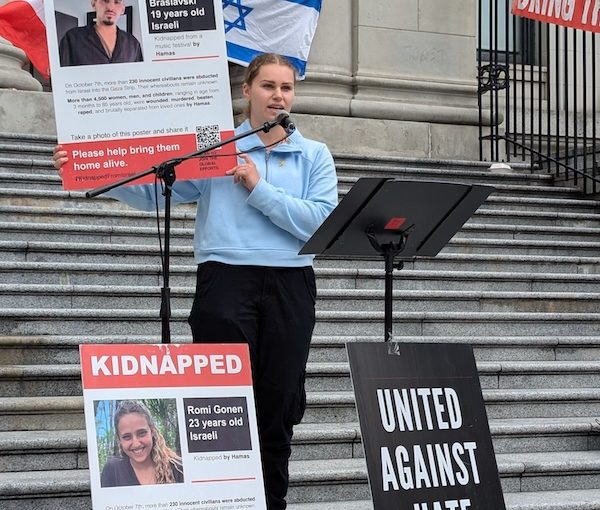
UBC student Zara Nybo, a non-Jewish ally, holds a poster of Rom Braslavski, as she speaks of his heroism before he was taken hostage to Gaza on Oct. 7. (photo by Pat Johnson)
As negotiations continued in Doha, Qatar, for the release of Israeli hostages, the weekly rallies in support of those held, their families and all Israelis continued Sunday, Aug. 18, at the Vancouver Art Gallery.
“As a university professor and as a Jew, I have been forced to witness the frontlines of a propaganda war to dehumanize and demonize Jews and to delegitimize the nation of Israel,” said Prof. Steven Plotkin, a University of British Columbia physicist.
The Hamas strategy is one of “asymmetric warfare,” he said, in which they bait Israel Defence Forces with attacks and hostage-takings, then use their own Palestinian civilians as human shields, knowing that the casualty numbers and horrible images will evoke sympathy in the West.
“And we’ve seen it,” he said. “The encampment and the protests at UBC quickly turned from advocating for the human rights of Palestinians to a call for the end of Israel.”
On campus, the messages he saw included the now familiar “From the river to the sea, Palestine will be free,” but others on the same theme, including “We don’t want your two states! Take us back to ’48” and “Resistance is justified when you are occupied.” Another common refrain, he said, is “‘Globalize the intifada.’ That means bring terrorism everywhere, including here in Canada.”
“Long live Oct. 7” was yet another slogan the professor saw on his campus.
“Let that sink in,” he said.
When reports of extensive sexual abuse by Hamas and other Palestinians who broke through the border on Oct. 7 became known, he said, “I saw posters at UBC that announced a discussion group for ‘the lies that Zionists spread about the sexual abuse that didn’t occur on Oct. 7.’”
Plotkin reflected back to the days after the 9/11 terror attacks in New York City, when people put up posters of their lost loved ones.
“Could you imagine what kind of person would think to tear one of those down? No one would have dreamed of it,” he said. “And now we’re seeing a world whose moral compass has completely lost its direction.”
Posters of Israeli hostages are routinely torn down at UBC, elsewhere in Vancouver and around the world. Plotkin shared a psychological hypothesis for why this desecration is so rampant.
In the identity-centred worldview of many activists, Plotkin said, morality is determined by one’s position in the hierarchy of oppression.
“The less powerful are pardoned, the more powerful must be guilty,” he said. Because Hamas is less powerful than Israel, Israel must be guilty, despite the evidence of Hamas murdering, raping and abducting Israeli civilians.
“A hostage poster, however, throws a wrench into that framework because it forces them to cope with the idea that the people that they thought were oppressed could actually be in the wrong,” Plotkin said. “Their whole simplistic worldview of the blameless oppressed and the evil oppressor is undermined by the ugly facts contained in the posters. A hostage poster induces a cognitive dissonance and, rather than question their own worldview, it’s easier for them to see it as pro-Israel propaganda designed to elicit their sympathy for the Jews in Israel, the bad guys, and so they feel compelled to tear the poster down.”
Eyal Daniel, a Burnaby high school teacher who specializes in Holocaust and genocide studies and who is president of the Holocaust and Antisemitism Educators’ Association, spoke about how his group was denied recognition by the BC Teachers’ Federation.
Representing close to 150 educators, the group applied to become one of the BCTF’s provincial specialist associations.
“Our application was rejected without any given reason,” he said. “Currently, there are no educational resources about the Holocaust and antisemitism for teachers in the province.”
Conversely, Daniel said, the province’s 50,000 teachers are bombarded by their union with materials promoting the elimination of the state of Israel.
The provincial government has mandated that Grade 10 students must receive Holocaust education beginning in 2025 and it is said to be working on curriculum materials.
Despite the lack of recognition from the BCTF, Daniel’s group will continue to work “as if we had been approved,” he said.
“Therefore, these days, we are in the process of constructing a new website, developing useful, meaningful professional development opportunities for teachers, assessing and developing appropriate educational materials and working with the minister of education on the upcoming Grade 10 Holocaust education curriculum framework,” he said.
Daniel spoke of his family’s recent visit to Israel, where they visited the site of the Nova music festival.
“Stepping out of the car into the desert heat, we were immediately surrounded by the haunting silence,” he said, “but, yet, 364 voices called out from the ground: Where is the humanity? The Nova memorial site is a barren killing field where humanity ceased to exist.”
Rabbi Susan Tendler of Congregation Beth Tikvah, in Richmond, spoke of the need for dialogue.
“In civic discourse … we’re yelling more than we’re listening,” she said. “So many of us will talk about the need to listen to one another but instead we’re just angry and have an inability to actually talk to one another.”
She asked people to see the humanity of others as a starting point to dialogue.
“To be a Jew means to respect and understand that every single human being was created in the image of God,” she said. “Let us continue to work for peace in the region that so, so sorely needs healing.”
Zara Nybo, a fourth-year student at UBC, is an ally to the Jewish community, president of the Israel on Campus club, and an Emerson Fellow with the international advocacy group StandWithUs. She shared recollections of a training conference in Los Angeles from which she and scores of other campus activists recently returned. At an LA rally for the hostages, she heard profoundly moving testimonies from family members of those still held in Gaza.
“Most people around me, men, women, had tears streaming down their face,” said Nybo. “We were all holding each other in collective grief.”
The mother of Rom Braslavski spoke of how her son had been a security guard at the Nova music festival and took it upon himself to hide the bodies of murdered women, both so they would not be taken to Gaza and so that they would not be posthumously raped or mutilated, as he had seen other female bodies desecrated. Braslavski was taken hostage in Gaza.
As Nybo and her fellow students prepare for the new academic year, she emphasized the training they have undergone and the determination with which they will return to campus.
“I will tell you we are committed to this fight,” she said.
Richard Lowy, who has provided vocal and guitar inspiration at almost every rally for months, spoke of the hope that a resolution will come through negotiation.
Event organizer Daphna Kedem recounted the rally in Tel Aviv the evening before and expressed hope that the hostages will be released soon and that the weekly rallies she has organized for 10 months will cease to be necessary.
Band-aids – check. Bottled water – check. Tinned foods – wait. No sooner do I buy canned tuna, pickles, corn and peas and they’re eaten. Need to refresh that one. Flashlight – check. Portable radio – check. Now, this is a cool one. While not available in the groovy colours of the 1970s – bought it in a staid brown – the small, palm-sized handheld radio conjures up fond memories of those catchy songs from Billboard’s Top 10. Although the reason for the checklist is anything but fanciful. With the Islamic Republic of Iran and Lebanon’s Hezbollah threatening a major reprisal attack.
In the Star Trek movie Wrath of Khan, the Klingons said “revenge is a dish best served cold.” I can certainly attest to that. As can my more than 9.5 million fellow Israelis. It feels like an eternity since the ayatollahs promised mighty revenge for Israel’s assassination of Hezbollah’s military chief, Fuad Shukr, and Hamas’s military chief, Mohammed Deif, and the alleged Israeli assassination of Hamas’s politburo chief, Ismail Haniyeh. When Iran’s authoritarian regime said at a place and time of their choosing, they weren’t kidding. We are still waiting…. Actually, I think the Klingons were probably quoting Pierre Ambroise François Choderlos de Laclos, the 18th-century French novelist and army general who is credited with first analogizing revenge as a cold dish.
Speaking of proverbs, I think its origin is Chinese, some claim Yiddish. Regardless, whoever said “may you live in interesting times” was certainly cursing someone. Give me boring. Give me dull. Give me mundane. Give me monotonous. Give me colourless and bland. You can keep the gripping. The riveting.The fascinating. The stimulating. I just want to wake up to another simple day.
This waiting game is immensely stressful. It has the whole world on edge, with an alliance being built between Israel, the United States, Britain, France and Italy to thwart a second potential direct attack on my little shtetl. The first attack – of some 300 drones – was launched against Israel in April. We went to bed facing potential Armageddon and, thankfully, woke up able to just go to work, as Israel, with the help of its allies, knocked each drone out of sky before they reached Tel Aviv and Haifa.
Speaking of work, I am a self-confessed workaholic. And I find myself working even more during this very stressful period, where I fear my fate is out of my control. Will Iran attack? Where? And when? And how? No idea. No authority. No power. Simply unable to influence, in any way. Whereas work, which I am pretty good at, gives me all those things. I am largely in control, able to influence within my environment. Work gives me a calming sense and, if nothing else, allows me to escape into my purchasing processes and contracts. This is my own industrial and organizational psychotherapy. As good an excuse as any for my wife, when she again finds me tapping away at my keyboard at all hours or in another early morning or late evening Teams meeting.
As for preparations, I find myself obsessed with buying bottled water, toilet paper and Ajax. The first couple of items, you probably understand. But floor cleaner? I think it’s the Jewish mother in me. I don’t want to leave behind a dirty home. Kind of like Golda from Fiddler on the Roof, who insisted on sweeping their little Anatevka farmhouse before leaving. Although – and I say this loud and clear – we ain’tgoing nowhere!
Another quirk in dealing with the stress is that I love the music from the hippie generation. For the longest time after that dreadful Oct. 7, I wouldn’t – couldn’t – listen to music. I felt a very deep sadness. Maybe a type of mourning. But now, over the last few days, I find myself blaring my tunes. One of the first songs to pop up in my feed just after Iran’s rulers made their threat of retribution was “Bad Moon Rising” by Creedence Clearwater Revival. How foreboding can you get? “I hear hurricanes a blowin’. I know the end is comin’ soon.… I hear the voice of rage and ruin. Don’t go around tonight. Well, it’s bound to take your life. There’s a bad moon on the rise, alright.”
And, I find myself listening again and again – at pretty high volume – to the dark and wonderful song by our own Edan Golan, “October Rain,” otherwise known to the world as “Hurricane”: “Every day, I’m losing my mind…. Dancing in this storm, I’ve got nothing left to hide….Baby, promise me you’ll hold me again.… I’m still broken from this hurricane….” And then, with hope: “Don’t have words. Just prayers. Even if it’s hard to see, you always leave me one small light.”
On another music note, I find myself chanting, to no one in particular, that snappy little line “From the river to the sea, Palestine will be free.” Now, why can’t we come up with something as catchy? With an impressive gene pool of great Jewish songwriters: George Gershwin, Irving Berlin, Burt Bacharach, Carole King, Neil Diamond, Leonard Cohen, Bob Dylan, Paul Simon, Amy Winehouse, Gene Simmons. Come on! And still, gornisht, nothing. No wonder we’re losing the global PR battle.
Please continue donating to the war and revival efforts. You may have given earlier, when hostilities first erupted and the Gaza war was headline news. Almost 10 months later, war continues – on several fronts. Sderot and Metula – and maybe Tel Aviv and Haifa – are Israel’s front line and Israel is the diaspora’s front line. Am Yisrael chai (yeah, that’s the extent of our solidarity anthem). Bring them home now!
Bruce Brown, a Canadian-Israeli, made aliyah more than 25 years ago. He works in high-tech and is happily married, with two kids. He is the winner of a 2019 American Jewish Press Association Simon Rockower Award for excellence in Jewish writing.
Last month, Jewish Federation of Greater Vancouver transferred $9.3 million from its Israel Emergency Campaign. Additionally, the allocations committee approved a further $1.4 million for transfer.
It has been more than 10 months since Oct. 7, and the situation in Israel remains dynamic and unstable as a full-scale war looms in the north. Rachel Sachs, director of Federation’s Israel office, provided the following update:
“Over the past few months, as the situation in the south stabilized and transitioned into rebuilding, the situation in the north has escalated, creating more complex challenges for displaced communities.
“Mutual fire along the northern border has been steady since October 2023 but has escalated over the past few weeks. This means hundreds of homes along the border have been hit and damaged. Thousands of residents, who were evacuated … are still living in temporary housing or have settled in new homes in new communities, and do not plan to return to the Galilee when the war is over. The communities that were not evacuated have been living in an active war zone since then, under the threat of rockets, drones and missiles.”
Federation was notified by Elad Kozikaro, chief executive officer of the Kiryat Shmona Community Centres, “that a rocket hit close to Beit Vancouver causing some damage to the building. Thankfully, no one was hurt, but Beit Vancouver is home to thousands of children and teens and has left the community unnerved.”
Considering these developments, the IEC Allocations Committee, chaired by Stephen Gaerber, realigned its strategy to focus on the north. The following organizations are recipients of IEC allocations from February through June 2024: Society for the Protection of Nature in Israel (SPNI), Tzafon Medical Centre, Taglit Birthright Israel, Galilee Medical Centre, Kiryat Shmona Community Centre, Kiryat Shmona High School, Upper Galilee Regional Council, Tel-Hai College, municipalities in the East Galilee Cluster, Israel Medical Association, Dror Israel, Healthy Minds, JDC and Magen David Adom Israel.
Aviva Rathbone, chair of JQT Vancouver, finds hope in the fact that “[t]here are lots of people in the community coming together right now and finding connections to heal what they can in what is a very broken world and what is a very broken situation.” (photo from JQT)
Probably all Jews have experienced emotional and mental impacts from the events of Oct. 7 and since. For LGBTQ+ Jews, these effects are often magnified by the climates in their multiple communities.
JQT Vancouver (pronounced J-Cutie), a volunteer-run Jewish queer and trans nonprofit group whose mission is “‘queering’ Jewish spaces and ‘Jew-ifying’ queer spaces,” has released the results of a survey that indicates LGBTQ+ Jews are experiencing profound pain – regardless of where they stand on an apparently vastly diverse spectrum of opinions about the conflict in the Middle East.
Titled 2024 JQT Temperature Check Report, the document collates responses from 91 individuals, including narratives of their experiences, and the overview it paints is bleak.
“There are a lot of really sad commentaries,” Aviva Rathbone, chair of JQT, told the Independent. “A lot of the folks who responded to the survey are people who are really struggling right now.”
She cautioned that the survey may not include the perspectives of others who may be having more positive experiences.
“Some people are feeling really accepted into community right now, they are feeling like they found a place,” said Rathbone. “We didn’t hear from those folks, but that’s not to say that they don’t exist.”
The results are not surprising, she said.
“We knew people were struggling,” she said. “It was a surprise, I think, the depth of anger and sadness that was there.”
Fewer than half of survey respondents indicated that they felt safe and accepted in Jewish spaces and only about a quarter said they felt safe and accepted in queer spaces. Fewer still, 14%, said they felt comfortable in both.
Since Oct. 7, approximately half of respondents indicated that actions and/or statements of queer (57%) and Jewish organizations (51%) have had a negative impact on their mental health.
A majority (57%) of respondents indicated that their safety and security felt threatened since Oct. 7 because of their Jewish identity. More than two-thirds of respondents (68%) said they experienced antisemitism online or in-person since Oct. 7.
Much of the discomfort centres on divergent attitudes toward Israel and the war against Hamas, as well as opinions around the definitions of antisemitism and what some respondents describe as exclusivist attitudes in the Jewish community, often described as overwhelmingly pro-Israel, and in the LGBTQ+ community, described by many as unwelcoming to pro-Israel Jews.
One respondent said the Jewish community should “acknowledge that anti-Zionist Jews are still Jews and should be welcome in Jewish spaces” and that “queer Zionist Jews are still queer and should be welcome in queer spaces.”
JQT serves members who self-identify as Zionist and those who self-identify as anti-Zionist.
“When the mainstream Jewish community dismisses Jews who criticize Israeli actions, it makes me feel alienated from that community, more than before,” wrote one respondent.
Two among scores of examples illustrate the chasm between the narratives shared in the report. One respondent accuses “queers for Palestine” of trying “to turn Zionism into a dirty word” and making them feel “unwelcome as a Jewish Israeli in queer spaces when not hiding myself.” Another writer says, “It makes me unsafe when Jewish organizations […] make wildly racist statements about Palestine. Conflating Judaism with Israel makes it seem like I am complicit in this genocide.”
Said another respondent: “None of the synagogues or even [Jewish queer groups] have made any statements that humanize the struggle of non-Zionist Jews and how we’ve been systematically shut out of spiritual, social and cultural Jewish spaces for far too long. In fact, the current climate within these spaces promotes a pro-war and anti-Palestinian rhetoric that pushes me and my friends away from feeling security and belonging in our identities.”
The divergence in attitudes is typified by another survey response.
“People wearing an End the Occupation T-shirt or other such slogans signal to me that the wearers believe Hamas to be righteous rather than terrorist, that all lives are not equal, makes me uncomfortable, as does the aggressivity of protesters, including [queer groups that support] Palestine. Standing in solidarity with Israel and its absolute right to defend itself, while not recognizing the numbers of non-Hamas Palestinians killed and the living conditions in Gaza during the war is also not comfortable for me,” wrote a respondent.
If there is a clear takeaway from the study, Rathbone said, it can be summed up in one word.
“Empathy,” she said. “We have the ability to hold space for our own pain and anger and for other people’s pain and anger. I fully believe that humans are expansive and the Jewish community for sure is expansive and we have done this many times. We have been able to hold space for ourselves and for other people who are suffering, even when we don’t agree with them.”
Disagreements over politics, no matter how intensely and personally held, should not erase the empathy Jewish people have for one another, she said.
It is possible to have conversations across that divide, as JQT did recently in a “listen and be heard” event, facilitated by two professionals.
That event was part of a major mental health initiative in collaboration with Jewish Family Services, with funding from the Jewish Community Foundation of Greater Vancouver, that was in the works even before Oct. 7. Among numerous projects rolled out in recent months addressing the challenges facing LGBTQ+ Jews is a 10-page resource issued last week, titled JQT Affirming Care: A Toolkit for Mental Health Providers. It was developed by care providers Hannah Zalmanowitz and Anat Kerelstein.
Carmel Tanaka, executive director of JQT, said the toolkit, which Jewish trans or queer people can give to healthcare providers, as well as friends or anyone else who might benefit from a deeper understanding of their experiences, is a direct response to expressed needs in the community.
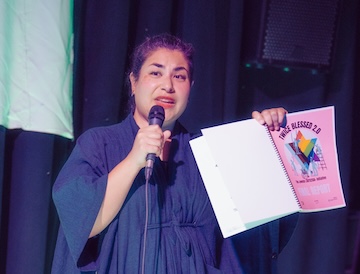
JQT Vancouver executive director Carmel Tanaka talks about Twice Blessed 2.0 at a recent event. The 2022 needs assessment includes 13 calls for action, including mental health support and being open to those who have a spectrum of opinion on Israel/Palestine. (photo by Kathryn Nickford Photography)
“We kept hearing that one of the barriers to receiving mental health support was linked directly to the lack of provider knowledge, training and competence around working with Jewish queer and trans people,” Tanaka said. “So, we created this educational toolkit aimed at reducing the burden on JQTs of having to educate their mental health providers on their lived experiences and mental health needs.”
Along with the Temperature Check report, Tanaka said, the toolkit provides tangible evidence of both the challenges and steps to improving the isolation and difficulties faced by affected individuals.
“I just really hope that leaders in the Jewish community, as well as leaders in the queer community, do take a moment to seriously read this so that they can better understand why we are doing this and why there is a need to support our community,” Tanaka said, adding that JQT continues to remain open to those who are on a spectrum of opinion on Israel and Palestine. “It really hurts to not be included in Pride events or in queer spaces, to not feel included in Jewish spaces. It’s an impossible situation to feel like you don’t belong.”
Even amid a plethora of discouraging responses, Rathbone said there is reason for hope.
“I don’t want folks to read it and to become really depressed and hopeless, because there are lots of ways to find hope,” she said. “There are lots of people in the community coming together right now and finding connections to heal what they can in what is a very broken world and what is a very broken situation. That also gives me hope, to watch people recognize that they can come together in community and do their part to heal something.”
Our short Canadian summer is full of wonder. We try to spend lots of time outdoors, finding things to marvel at on dog walks and even on errands. While we might not be out in the bush too often, we still can spot foxes, deer, woodpeckers, butterflies and moths, as well as magnificent gardens, in our neighbourhood in Winnipeg’s city core. As toddlers and preschoolers, children go through a “why?” phase. Everything is a question. Parents must come up with meaningful but short answers every time. However, as our tweens transition to teens, I have been pleasantly surprised to discover there are still a lot of “whys” being asked.
On a practical level, sometimes I end up saying “that’s a Google question” because I cannot remember every detail of European history. If our resident biology professor dad isn’t home, we’re trying to figure out flora and fauna on our own. (Hint: there’s an app for everything now.) Most of all, I am thrilled that intellectual curiosity is still a thing. Our household still finds space to wonder about how things work, what things are called and why events evolved in one way or another.
Just the other evening, I admonished our kid about being gracious about gifts. He didn’t know what I meant. We stopped to discuss the phrase “Don’t look a gift horse in the mouth” and take apart what it means. This kind of daily learning is an exciting part of life, and especially in summer, when we have hours at a stretch to talk and think about things, as well as seeing natural wonders, going to museums, meeting new people, reading and listening together. Pursuing this kind of informal learning makes a well-rounded education.
I continue to study Daf Yomi, a page of Talmud a day, and right now we’re studying the tractate of Bava Batra, one of the three Bavas (translated as “gates”) that deal in civil law. I find nuggets of wisdom in these tractates, even as some of them seem dry to other students. If you’re wondering, for instance, who pays for a fence, or making the decisions about erecting a fence across a shared courtyard? The beginning of Bava Batra will help you figure out whether this is possible, and how to get along with your neighbour in the process. Each issue is examined with a “why?” lens.
How does one decide where you’re from? If you’ve lived in many places (I have), this is a real question. Do you define home as where you were born? Where you lived the most years? Which kitchen or garden you liked best? This is examined on Bava Batra 11, which suggests that, if you’ve lived in a city for 12 months, you can be considered a resident. However, if you buy a house earlier than that, or even, according to Rabban Shimon ben Gamliel, land that would be suitable for building a house, you’re immediately considered a resident. This bit of ancient law discussion struck me as useful in an age where so many decisions are made based on where one lives: where one votes, gets health care, sends kids to school and other bureaucratic needs. Establishing residency is still often up for discussion.
There is an advantage to maintaining intellectual curiosity and nurturing critical thinking when it comes to negotiating the world. As recently as a year or two ago, I would have been upset to think that one should be getting news from social media or email newsletters. Now, however, I find access to multiple reports about the Israel-Gaza war in English and Hebrew, through Instagram and X (formerly Twitter). I then end up satiating my curiosity by clicking through to read from multiple other news sources, finding out about elections in Europe, antisemitism worldwide, or even locating (and avoiding) possibly violent protests in my own city. Asking “why? why? why?” becomes a daily necessity in trying to decipher both what’s happening and the political angle of those who write the articles, blogs or tweets.
A recent piece covering humanitarian aid distribution in Gaza on the CBC, for instance, used the word “Hamas” only once, when mentioning “Hamas-led militants” on Oct. 7. The word “Israel” could be found on the page 18 times. While 18 is a lucky number, in this case, it sounds like an uncritical reader could lay blame on one side simply through repetition. One might completely lose sight of why Gazans are in this mess in the first place. If, perhaps, Hamas chose to stop firing rockets into Israel? It might be easier to distribute supplies and return to normality. Also, the journalist mentioned Egypt only twice. Egypt also shares a border with Gaza. Egypt could choose to facilitate humanitarian aid. Whose responsibility is this? The article’s slant, and the journalist’s bio, made me suspect a bias. When examining the journalist’s X posts online, I saw only one side of this conflict emphasized. It didn’t reference anything about Oct. 7 or Israel’s experience.
It can be hard right now to maintain an even keel while facing the barrage of information about the Gaza war, Russia’s war on Ukraine, politics in Canada, the United States and Europe, and the famines and violent conflicts elsewhere in the world. Unplugging and getting out to see and do things with family, taking a vacation, exploring wild places, helps us recalibrate. It can also boost our “why?” skills so we can return refreshed, with energy to analyze all the new craziness as it erupts.
I’ve just begun Bava Batra, but one topic hit early on is where and how to donate charity to do the most good. Bava Batra 8b reminds us that money donated towards “saving captives” is a great mitzvah, the biggest commandment/good deed that one can do. Sometimes, an ancient text can remind us to readjust our priorities. Reading critically and asking “why?” are essential to Talmud and rabbinic discourse. It’s also essential for us. We must keep helping our children ask “why?” We ourselves must maintain the wonder that enables us to stay curiously critical thinkers.
Joanne Seiff has written regularly for the Winnipeg Free Press and various Jewish publications. She is the author of three books, including From the Outside In: Jewish Post Columns 2015-2016, a collection of essays available for digital download or as a paperback from Amazon. Check her out on Instagram @yrnspinner or at joanneseiff.blogspot.com.