Community marks Oct. 7

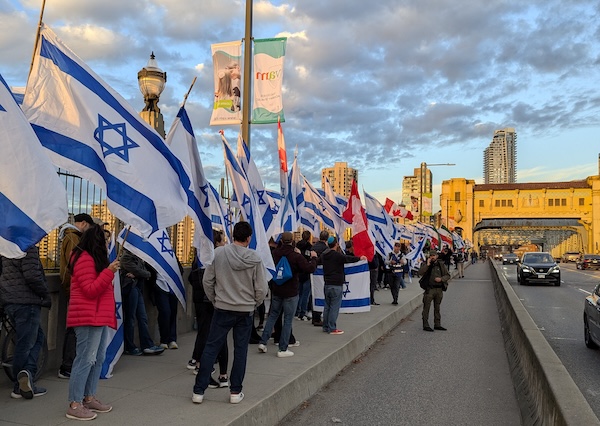
Several hundred held vigil on the Burrard Street Bridge at sundown Oct. 6. Another vigil took place at the Vancouver Art Gallery at the same time. (photo by Pat Johnson)

The youngest victim of the Oct. 7 pogrom was born and died that day.

At a moving ceremony at Schara Tzedeck Synagogue Monday night, more than 1,400 Jewish community members and allies came together to mark the anniversary of the worst terror attacks in Israel’s history. Another 700 watched a livestream online.

Rabbi Philip Gibbs of West Vancouver’s Congregation Har El shared the story of the youngest victim. 

At 5:30 a.m., Sujood Abu Karinat, a Bedouin Israeli, went into labour. Her husband Triffy began driving them to the hospital, but sirens also began.

“Two vans appeared and tried to box them in,” said Gibbs. Triffy was able to swerve and avoid the ambush but a bullet pierced Sujood’s belly. 

“Though they were able to get away, soon the car stalled before an intersection and they were able to ask for some help from some of the other local Bedouins,” he said. “But, again, the white van appeared and terrorists fired, ignoring their pleas in Arabic to leave them alone and, again, Sujood received another bullet in the stomach.”

When they finally arrived at the hospital, doctors detected a fetal heartbeat. The bullets had pierced the baby’s leg and, in the process, protected Sujood’s vital organs. The baby was successfully delivered and bandaged.

“After hearing this news, Sujood fell back asleep to recover. But, that evening, the baby passed away,” said Gibbs. 

“Sujood never saw her daughter, unable to bear the sight of her dead firstborn.”

Schara Tzedeck’s Rabbi Andrew Rosenblatt, who introduced the program and speakers, contextualized the commemoration as an opportunity to “preserve names and to preserve stories.” 

In addition, he said, the community gathers to ensure that people do not ignore a world “where children are ripped from their parents’ arms, where children and the aged are taken hostage, where young women are slaughtered and dragged through the streets to be spit upon by a jeering public.”

Rabbi Dan Moskovitz of Temple Sholom spoke of Vivian Silver, the Winnipeg-born-and-raised peace activist whose burned bones were found in her safe room. World media eulogized Silver, a cofounder of the 50,000-member Women Wage Peace, as an irrepressible force and one of Israel’s best-known advocates for peace. 

Jason Rivers remembered his cousin, Adi Vital-Kaploun, another Canadian-Israeli who was killed on Oct. 7. Vital-Kaploun received the highest marks ever attained at Ben-Gurion University, he said, and, on Oct. 7, a lab was named in her honour.

“If you believe in miracles, they sometimes do happen,” said Rivers. While Adi was murdered, her 3-year-old, Negev, and 6-month-old, Eshel, were inexplicably released. Adi was later found by the Israel Defence Forces – she had been killed by multiple bullets and her body booby-trapped with grenades.

“She was identified by her wedding ring,” said Rivers.

Daphna Kedem, who has organized weekly rallies at the Vancouver Art Gallery since the hours after the attack, said, “The past year has been unbearable.” 

She said, “It is inconceivable that 101 hostages, our loved ones, our family, our members, our children, our parents, our grandparents, remain captive in the hands of the terror organization Hamas, held in appalling conditions.”

The local community’s rabbis and cantors chanted the prayer for hostages.

Lana Marks Pulver, chair of the board of the Jewish Federation of Greater Vancouver, and Ezra Shanken, Federation’s chief executive officer, spoke of the connections between Israel and diaspora Jews. 

Pulver remembered Ben Mizrachi, the young Vancouver medic who died heroically at the Nova music festival when he returned to help a friend who had been shot. He had earned the nickname “savta” from friends, Hebrew for “grandma,” because he was always helping and caring for others. Shanken noted that a plaque in Mizrachi’s honour was unveiled earlier that day at his alma mater, King David High School, and that Federation has nominated Mizrachi for Canada’s highest civilian decoration for heroism. At Schara Tzedeck, a Torah scroll is being refurbished in his memory.

Eli Cohen, a friend of Ben Mizrachi and who accompanied the chevra kadisha to identify Mizrachi’s body, recited the Kaddish in his memory.

photo - Several hundred held vigil on the Burrard Street Bridge at sundown Oct. 6
Several hundred held vigil on the Burrard Street Bridge at sundown Oct. 6. (photo by Pat Johnson)

Flavia Markman, one of the organizers of the vigils that take place on Vancouver bridges, shared the story of Aner Shapira.

Shapira, a member of the IDF’s elite Nahal Brigade, was attending the Nova music festival and he took shelter with a group of others. He was the last to enter the shelter and told the others he was in Nahal; he assured them the military would be there soon to rescue them. Across several heroic minutes that were caught by a car’s dashcam and are available online, Hamas shot bullets and threw grenades into the shelter. 

“You can see,” Markman said of the video, “after the terrorists threw the grenades into the shelter, Aner threw them back out. One, two, three, four times, five, six, seven.…”

The eighth grenade exploded in his hand, killing him.

“At least seven people who were hiding in the shelter with Shapira survived the attack,” Markman said. One of them called Shapira an angel who saved their lives. Israeli poet Zur Erlich has written a tribute to Shapira, likening the eight grenades to the eight candles on the Hanukkah menorah.

Rabbi Carey Brown of Temple Sholom shared the story of Capt. Shir Eilat, a 20-year-old Combat Intelligence Corps commander who died alongside 14 of her female comrades at Nahal Oz surveillance outpost. Five women from her unit were taken hostage to Gaza.

“Shir was a hero in her final moments, in an unbelievable manner,” according to survivors who were there, said Brown. “Shir stayed calm, worried about everyone, protected them, and calmed them down. She put herself aside to be a presence of safety for them.” 

Rabbi Philip Bregman, rabbi emeritus of Temple Sholom, spoke of the 1,000 people he and his wife Cathy, escorted to Israel over their 33 years of service to the temple. In Israel, he said, they would pay for meals of IDF soldiers and the grateful but baffled uniformed young people would ask, Why? Bregman said it was impossible for relatively safe Canadian Jews to adequately thank Israeli soldiers for defending their people.

Rabbi Susan Tendler of Beth Tikvah noted that there were at least 1,200 people in the sanctuary – the approximate number of people murdered on Oct. 7. Each attendee had been handed a card with a victim’s name and, often, a photograph. People stood at different times, quietly reciting the prayer and invoking the name of “their” martyr while musician Eric Wilson played cello.

Rabbi Hannah Dresner of Or Shalom reflected on the El Moleh Rachamim prayer and presented an interpretation of the prayer in English before Cantor Yaacov Orzech chanted the traditional version. Her Or Shalom colleague, Rabbi Arik Labowitz, led the congregation in Oseh Shalom, the prayer for peace.

“Perhaps, like many of you, it’s been difficult to say the Oseh Shalom this past year knowing that peace and security can sometimes be at odds with each other,” said Labowitz. “Yet the hope for peace is not shaped by our feelings about the present situation and about the history behind it. The hope for peace is our moral imperative. It is the most essential prayer of our people.… May we never give up hope and may we work toward that peace in the name of those we have lost and for the sake of those who are yet to be born.”

Rabbi Jonathan Infield of Beth Israel, and head of the Rabbincal Association of Vancouver, reflected on the Zionist and Israeli anthem “Hatikvah” (“The Hope”), which was adopted at the 18th Zionist conference in Prague, in 1933 – the “chai” conference, in the year the Nazis came to power in Germany. He spoke of his hope that the grandchildren of the current generation would never have to attend a ceremony for victims of terrorism.

The Monday event was attended by many elected officials from all levels of government. 

Processing the tragedy

On Sept. 28, Temple Sholom unveiled a new group exhibition in its gallery. “This is not a regular art show,” curator Rina Vizer told the Independent. “It is a commemoration of Oct. 7, of its hope and memories.”

Vizer has wanted to organize a show that would act as a fundraiser since the horrific terror attack on Israel last year.

“It has been the theme of my art from the moment I heard about the attack. I couldn’t process it in any other way than through my painting,” she said. “Last year, in September, we couldn’t even imagine that such an atrocity was possible. I wanted the other artists to do the same, to express what was beyond words through their paintings and share it with viewers.”

image - “HaTikvah” by Rina Lederer-Vizer is part of the Memory and Hope exhibit at Temple Sholom that Vizer curated to commemorate the terror attacks of Oct. 7, 2023
“HaTikvah” by Rina Lederer-Vizer is part of the Memory and Hope exhibit at Temple Sholom that Vizer curated to commemorate the terror attacks of Oct. 7, 2023. (image from Rina Vizer)

At first, she contemplated the Zack Gallery as a venue but it had a schedule to maintain, and its shows were booked well in advance. “Then I discussed with our rabbi some other art installation, and I asked him: ‘What about a show commemorating Oct. 7?’ And he agreed that it was a great idea to reflect on this calamity through art.”  

The timeline to find other contributors was very tight. “I started the process at the end of August,” she said. “My only condition [to the artists] was: it had to be new art, created as a reaction to Oct. 7. Nothing old would work.” 

Vizer contacted several people she knew personally, including Vivienne Davicioni, Sidi Schaffer and Glenda Leznoff. “I’ve also seen the art of Olga Campbell, and I had heard about Zohar Hagbi and her intuitive art studio. I was sure both of them would be a good fit for this show. The Zack Gallery director, Hope [Forstenzer], recommended Brian Gleckman, who agreed to participate. In all, we have seven Vancouver artists in this show.”

image - “Tikun Olam” by Brian Gleckman is part of the Memory and Hope exhibit, which is at Temple Sholom until Oct. 28
“Tikun Olam” by Brian Gleckman is part of the Memory and Hope exhibit, which is at Temple Sholom until Oct. 28. (image from Rina Vizer)

Vizer and Hagbi were born in Israel, Gleckman hails from the United States, Schaffer was born in Romania, Campbell in Iran, Davicioni in South Africa and Leznoff in Canada. Regardless of their countries of origin, all of them dedicated their artwork for this show to Israel, and all of the pieces reflect the traumatic impacts of Oct. 7.

Vizer’s paintings are not large, but they pack a punch. She signs her art as Rina Lederer-Vizer. “Lederer is my family name,” she explained. “But I only have one sister. When we go, the name will disappear. This way, I hope to keep it a bit longer.” Her painting “HaTikvah” is full of hope and despair in equal measure. A woman gazes up, her palms together in prayer, but her eyes are sad, her expression stark. Is she praying for the hostages’ return? Is she a hostage herself?

Another of her paintings, similar at first glance, is called “101 Days of Awe.” The woman in the foreground is from the diaspora, but her solidarity with the suffering in Israel is unmistakable. Like the figure in her painting, Vizer stalwartly expresses her solidarity with Israel.

“I have been attending the ‘Bring Them Home’ rallies every Sunday since last October,” she said. “We meet at the Vancouver Art Gallery at 2 o’clock. At first, there were thousands of people there each week. Now, it is a hundred or so, but I go.” 

At one of the rallies, Vizer carried a banner with the name and image of one of the hostages, Carmel Gat, a therapist from Tel Aviv. Vizer was so moved by Gat’s plight she used the portrait at her family seder. “I was shocked and angry when I learned on Sept. 1 that Gat was executed in a tunnel,” she said. That was when she painted “Light in Tunnel.” There are darkness and death in those tunnels, but, contends Vizer, light always comes after darkness.

image - “I See You” by Olga Campbell
“I See You” by Olga Campbell. (image from Rina Vizer)

Like Vizer, Campbell’s paintings are mostly figurative. “I See You” depicts a face, fearful and anxious. There is a catastrophe unfolding in front of this person, and they are helpless to prevent it. Another of Campbell’s paintings, a number of shadowed figures on a foggy background, bears a fateful title: “I Didn’t Get a Chance to Say Goodbye.” Campbell’s third painting, a black and white collage reminiscent of an old-fashioned newspaper, has an even more explicit title: “October 7.” 

The same title applies to one of Schaffer’s paintings. In a short email exchange with the Independent, she said about that horrible day: “The event had and still is impacting me very much. Early every morning, the first thing I do is turn on the TV to hear what’s happening in Israel. I am a child survivor of the Holocaust, and I hoped nothing like that would happen again, but the reality of today is different.”

Schaffer has two paintings in the show, and she explained her symbolism. “The small one is titled ‘October 7.’ It’s a collage. I have done it this year, not long ago. You can see prayer hands and a memory candle for those we lost. There is a child’s wooden rocking horse left without a child. In one of the videos after the horror, I saw a house totally destroyed. Only this horse alone remained on the front lawn.

“The second work is bigger and is titled ‘The Phoenix Reborn from Ashes.’ I worked on it for a few years, but, this year, inspired by the October tragedy, I finished it. I feel it gives hope of renewal, of better days to come, of freedom and joy.”

Leznoff, who is also a writer, talked about her experience joining this show. “I was invited to participate by Rina Vizer, who I met about a decade ago at Israeli dancing. This year, I have been very active writing letters to governments and organizations about antisemitism in Canada since Oct. 7. I had an op-ed in the National Post last January, when two British Columbia theatres canceled the play The Runner. Rina knew me as both an artist and a writer. She knew I have been very moved by the events, both in Israel and in Canada, so she asked me to contribute works I’ve done in response to the war.”

Leznoff’s two pieces in the exhibit are titled “Shattered” and “Morning Light.”

“The first painting is a mixed media piece that uses black ink and paint, yellow paint, a photo, dried flowers from my garden, and charcoal. The painting is abstract, however, there is a sense of something explosive and raw with the black paint,” she said. “For me, the yellow is a sign of hope, and the falling flowers are in memory of the tragedy of the flower children at the music festival.

“The other piece,” she continued, “is connected to a poem I wrote called ‘Winter Light’ that accompanies the painting. The poem is framed with the painting, and it’s about how the hostages and soldiers are always on our minds, and we are not giving up. Ironically, although I am a published writer, I hardly ever write poetry. I think both abstract painting and poetry handle emotional issues that are sometimes difficult to convey in a straight narrative.”

The Memory and Hope exhibit will be displayed at Temple Sholom until Oct. 28. The art is for sale and all proceeds from the sales will go to Hostages and Missing Families Forum: Bring Them Home Now, and Magen David Adom in Israel. 

Olga Livshin is a Vancouver freelance writer. She can be reached at olgagodim@gmail.com.

A lesson learned anew

In the late 1990s, the collective Jewish community organizations in North America acknowledged a crisis. What had been increasingly evident anecdotally was being confirmed by statistics, research, published works and commentary. Affiliation with Jewish communities and agencies was declining precipitously – to the extent that the very future of the Jewish community, by some estimates, was in doubt.

Assimilation, intermarriage and declining religious observance were seen as factors in this decline. Counterintuitively, the almost complete disappearance of systemic antisemitism and the sidelining of social antisemitism meant that this opposition force no longer had the pull it once did to enforce cohesion among North American Jews.

This realization, and the debate it launched, were among the reasons that Jewish federations, synagogues, Hillels and other agencies engaged in a redoubling of efforts to reach Jews where they are. For example, to destigmatize intermarriage and welcome mixed families, and to entice largely assimilated Jews into Jewish community centres and synagogues and Jewish spaces on campuses, through the development of innovative programs. 

But the core “problem” facing Jews in this narrative – a decline in the defensive, if unifying, force of antisemitism in Western societies – took care of itself just three years later.

Conflict in the Middle East always results in a conflict over the conflict around the world. The launch of the Second Intifada, in September 2000, saw an upsurge in anti-Israel and antisemitic (not exactly the same; not unrelated) activities on campuses and elsewhere around the world.

By various measures, the first two decades of the 21st century saw some successes in terms of sustained engagement and growth in aspects of the community. This was a result of a confluence of events – the debate that began in earnest in the 1990s; the investment in outreach undertaken across the Jewish community; and, not at all incidentally, the rise in global antisemitism that coincided with the growing conflict in the Middle East.

Then came Oct. 7, 2023.

In response, early indications suggest, some Jews have prudently covered up Magen David necklaces, put caps over their kippot and otherwise reduced their visibility in public. This is a superficial response, but it is based on reasonable principles of safety.

Here is what Jews overwhelmingly have not done: abandoned Judaism and the broader Jewish identity that draws the hostility of haters.

On the contrary. Synagogues, Jewish advocacy organizations, Hillels and other Jewish groups are seeing spikes in engagement unknown in recent memory.

Many Jews whose lives have been comfortably lived with only tangential connections to the broader Jewish peoplehood found themselves suddenly and profoundly isolated in their various communities after Oct. 7. Some Jews who had concluded that they did not need the benefits of collective engagement found, perhaps to their dismay, that they do.

This fact (or its observation) should not be seen as an “I told you so.” It is merely a recognition that antisemitism exists and, throughout history, it has been a cyclical phenomenon that rises and falls in waves.

Let us not pretend that there are silver linings in the horrors we have experienced collectively in the past year. No one would choose this trade-off. What we are suggesting is that, in the face of this new reality, Jews are doing what Jews have always done: returned to the teachings, core values and simple togetherness that have sustained our people and traditions for millennia, realizing, as generations before have done, that these ancient assets are no less valuable today than in eras past.

We cannot foresee the future. Things may get worse before they get better. But when this cycle finally recedes, we hope we will be a stronger people. Those who had dismissed their own parents’ warnings around cyclical bigotry are conveying to their own kids the lessons they had disdained. There are reports of record synagogue attendance at High Holiday services this year, established and new ad hoc advocacy programs and organizations have been enriched by an influx of people and talent. Innovative organizations have popped up to support many non-affiliated or disaffected Jews in spiritual exploration, with racialized identities, or those who want to advocate for peace and dialogue outside of established communal structures. On campuses, Jewish students are learning advocacy and skills that will empower our community for decades to come.

This is not, to be clear, an instance of Jewishness being defined by negatives, driven by its opposites. It is a constructive, positive, heartening phenomenon in which people who did not even know that they needed community reach out, find one and, in the process, empower both themselves and the larger people.

Again, this is not a silver lining in a terrible time. This is simply an ancient lesson learned anew. 

Humanizing hostages’ plight

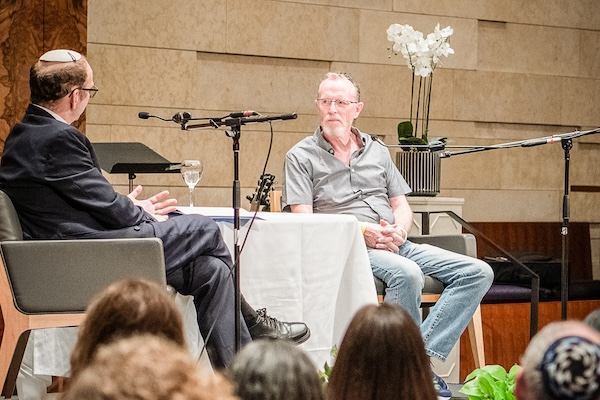
Rabbi Jonathan Infeld, left, in conversation with Thomas Hand at Congregation Beth Israel. (Adele Lewin Photography)

Emily Hand was a healthy 8-year-old girl with chubby cheeks on Oct. 7, 2023, when she was abducted by Hamas terrorists from a sleepover at a friend’s home on Kibbutz Be’eri. When she was released, 50 days later, she was a pale, gaunt 9-year-old who would not speak above the faintest whisper.

Emily and her dad, Thomas Hand, were in Vancouver this month, where the father was part of Congregation Beth Israel’s Selichot program Sept. 28. He spoke with the Independent in advance of the conversation he had with Rabbi Jonathan Infeld at the synagogue.

On Oct. 7 last year, Emily was at the home of her friend Hila Rotem-Shoshani. After the terrorists invaded the kibbutz and the murderous rampage subsided, Thomas Hand had no idea where his daughter was. It was almost midnight that evening when the Israel Defence Forces made it to Be’eri and rescued the survivors. In the chaos of the moment, Hand was told that his daughter was dead.

His immediate response was relief.

“It’s a terrible thing to say,” said Hand, “but I was more relieved and at peace that she was at peace and not being terrorized or beaten or threatened or in the hands of the Hamas.”

Eventually, it would become known that, of Be’eri’s approximately 1,100 residents, about 100 were murdered and about 50 taken hostage to Gaza. Be’eri’s surviving residents were removed to a location near the Dead Sea.

After a few days, Hand was informed that there was no evidence that Emily had been murdered. Her remains were not found and neither was any of her DNA. Hand has no explanation for how the misunderstanding occurred. His former wife, however, was found dead. (Emily’s mother died of cancer when Emily was 2.)

Now, Emily was officially missing. 

A kibbutz member mentioned to Hand that they had seen Raaya Rotem “and her two children” led away at gunpoint. Hand knew that Rotem has only one daughter – Emily’s friend Hila – and that was his confirmation that Emily had been abducted alive.

“When they told me that she was actually alive, I was in the nightmare of not knowing what the hell was going to happen to her,” he said.

It is now known that Emily, Hila and Raaya were taken to Gaza, moved from location to location for the first couple of days and then held in a house along with several other hostages.

They lived in constant terror and were given very little food – a quarter of a pita a day sometimes, though they could smell the plentiful food their captors were cooking. Their accommodations were squalid, they were watched while using the toilet and warned to remain totally silent.

Doing what he could to raise global awareness of his daughter’s situation, as well as those of the other hostages, Hand launched a campaign, beginning with a trip to Ireland. Hand had made aliyah from Ireland and Emily, as a result, is a dual citizen. Hand then traveled to the United States and appeared on American TV, further humanizing the plight of the hostages and their families.

In November last year, during the temporary ceasefire, Emily was one of 105 hostages freed. She was released along with Hila. Hila’s mother Raaya was released a couple of days later.

Hand has no clear memories of their reunion, except that he would not allow himself to believe it would happen until they locked eyes. 

“Anything could go wrong,” he said of the temporary ceasefire negotiations and promised release of the hostages. “Not until the very last second did I really believe that she was coming back, only when I saw her eyes.”

The joy of reunion was mixed with the harsh reality of what she had endured. 

“She came back a different child,” Hand said, reflecting on her transformation from an innocent 8-year-old to a much-matured child shaped by trauma. The changes were most immediately noticeable physically. “Her cheekbones were sharp, her body much thinner.”

The effects of being threatened for more than two months to remain silent did not dissipate immediately either.

“When she came back, she was whispering, just moving her lips,” he said. “Her confidence was shattered.”

Since Emily’s release, the Hands – she has an older brother, 29, and a sister, 27 – have been working to help her recover. Therapies, including horse riding, dog training, theatre and singing, have played a crucial role in rebuilding her confidence. Regular psychological support in Tel Aviv, despite being a two-hour drive, has also been essential. 

“She’s very strong, very resilient,” said her father. 

The Hand family has relocated to a semi-permanent residence near Be’er Sheva while they await the reconstruction of Be’eri, to which he is determined to return. 

“It’s been my home for over 30 years. I raised my eldest kids and Emily there,” he said. “It’s paradise. I want to go back home.”

Not all kibbutz members feel the pull to return, he acknowledged, though he estimates that 75% of the surviving members hope to rebuild there. Security, of course, is the foremost concern.

“The government needs to be different, and Hamas needs to be as weak as we can possibly make them because I need to feel safe in my own home before I would ever bring Emily back there again,” he said.

Reflecting on the international response to the crisis, Hand expressed frustration.

“Why is the UN or all the governments in the world not putting the pressure on Hamas to stop?” he asked.

To critics of Israel’s actions in Gaza, he is defiant. “We have to defend ourselves, and we will defend ourselves,” he said, “no matter what the world says or thinks.”

As Emily continues her recovery, Hand remains focused on a mission.

“Our primary concern now is getting the hostages back,” he said. 

Kibbutz residents returning

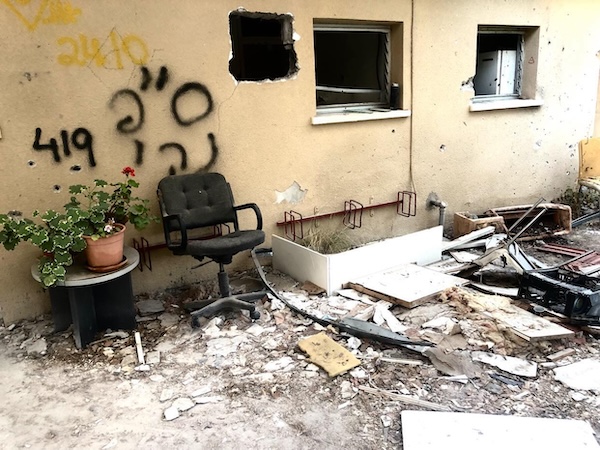
The medical centre at Kibbutz Be’eri, where at least five people were murdered Oct. 7, 2023. (photo by Melanie Preston)

I’m sitting in the dining hall at Kibbutz Be’eri, as people begin to enter for their Sunday lunch at 11:39 a.m. Sunday is like Monday here in Israel, the work week being Sunday through Thursday.

I’d never spent time on a kibbutz until now, except for a few days on my Birthright trip, which was my introduction to Israel. But now, I’m not only on a kibbutz, but on Kibbutz Be’eri, less than five kilometres away from Gaza, less than a year after the worst terror attack on Israeli soil.

On Oct. 12, 2023, in the Times of Israel article “Be’eri’s residents are gone, but their homes attest to the horrors they endured,” there was this incredible statement by Doron Spielman from the Israel Defence Forces’ Spokesperson’s Unit: “In the same way that Auschwitz is the symbol of the Holocaust, Be’eri is going to become the symbol of the [Oct. 7] massacre. The level of inhumanity of Hamas fighters surprised even us, Israelis who had no illusions about what Hamas is.”

And, yet, here I am, bearing witness as approximately 200 kibbutz members of the 1,100 total, have returned to live here. This does not include any children, due to the war next door in Gaza, and, of course, the traumatic memories of Oct. 7. 

The majority of Be’eri’s residents have just been moved from the Dead Sea-area hotels that housed them for the past year to Kibbutz Hatzerim, 45 minutes away from Be’eri, a wonderful community who rushed to build a new section of homes to accommodate them. This is where the families with children are now settling in and where school has just begun.

But there are many residents, couples with grown children, or singles without children, who have chosen to return to Be’eri. At first, they only commuted here to work during the week, but they are now choosing to stay full-time. They are determined to be back at home, to establish new routines, care for the grounds, hang out at the local pub and prove to the world and to the enemies who tried to destroy them and their spirit that they have done anything but that. The spirit in Be’eri is hurting, yes, but it is also fierce, and it will not be extinguished.

Last week, Israel’s Channel 12 aired a new documentary showing the horror that took place here on Black Saturday. It included footage from cameras all over the kibbutz, and the camera they kept returning to was right outside the dining hall in which I am writing right now.

How different it was to watch this documentary, how odd to watch the silent camera footage, how chilling, when I knew the reality on Oct. 7 was sirens blaring the entire day, due to thousands of rockets overhead, and screams from those being attacked all over Be’eri, in neighbouring communities and all over the nearby desert and forests, as young adults ran to try and escape the Nova music festival, many meeting a violent death.

I watched the tick, tick, tick of the digital clock in the corner of the TV screen on this documentary as Hamas terrorists methodically made their way through offices and the kibbutz’s medical centre, where at least five workers were massacred, and homes and children’s rooms, trapping people together and smoking and burning people to death, shooting them if they attempted escape, like Narkis Hand was forced to do when an RPG hit her home, setting it instantly on fire.

Narkis Hand was Thomas Hand’s former wife and the mother of his older children, Natali and Aiden. Thomas Hand’s younger daughter, Emily, then age 8, was kidnapped by Hamas terrorists with her friend Hila and Hila’s mother Raaya for 50 days, though he was originally told she had been killed.

The first and only time I had been to Be’eri before now was last February, when I visited with a different resident, Adam Rapoport, whose older brother Yonatan was murdered at some point between “6:29 a.m. and the end of day,” noted the documentary, as the silent clock in the upper left-hand corner went tick, tick, tick on Oct. 7.

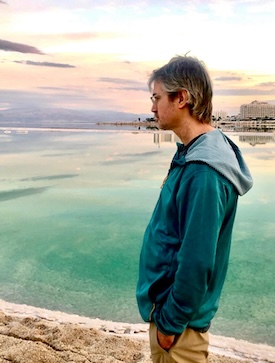
photo - Adam Rapoport by the Dead Sea
Adam Rapoport by the Dead Sea. (photo by Melanie Preston)

Like many others from these communities, Adam will never know exactly what happened to his brother that day, other than that he saved his kids’ lives by ordering them under the bed, where they would spend 11 hours listening to the horrors taking place in the peaceful community they’d grown up in. Six-year-old Aluma and 9-year-old Yosef would later tell their uncles that Dad had said he was going out to get the terrorists money at the ATM.

“There were just too many … bodies … to learn what happened, and that was just at Be’eri,” Adam told me back in February, at the Dead Sea hotel where he and other evacuees were staying, the day before he brought me here to bear witness.

This was an invasion into homes that lasted an entire day and involved such gore that I hesitate to go into detail.

It involved shooting a 3-month-old baby in the head, in front of her mother, in Kibbutz Be’eri, and burning an entire family alive from neighbouring Kibbutz Nir Oz, including all three young children.

It involved murdering parents in front of their children and then kidnapping the children – and these sons and daughters have still not returned home. Some are confirmed dead in Gaza and are bodies waiting to be brought back, like Adam’s best friend Itay Svirsky, which was how I initially met Adam and began learning about this community, while others are likely still alive in captivity, starving and suffering in ways human beings should not be permitted to suffer. But the Red Cross has done nothing for the hostages since the very beginning. 

In Israel, we have waited, prayed, hoped and fought. We have gone to weekly rallies in Tel Aviv and Kiryat Gat, saying the hostages’ names and counting the days, chanting “Achshav, achshav, achshav.” (“Now, now, now.”) 

We have had to silence our phones, as constant notifications appear, notifying us of the nonstop rockets entering our airspace and our cities from Hezbollah in Lebanon, the Houthis in Yemen and other groups in Iraq and Syria, while ongoing predictions about whether Iran will or won’t do something big (and when they will or won’t do it) are discussed and analyzed.

But, since arriving on Kibbutz Be’eri last month, I have felt a shift.

It’s a unique kind of optimism I have never quite seen. It’s pride and it’s love and it’s strength and it’s resolve and it’s “F—- you, we’re not leaving.” It’s coming from returning Kibbutz Be’eri members, it’s coming from people like myself who have come to Be’eri since Oct. 7 to help with the land and to work, to add to the life being rebuilt here and to help heal the collective broken heart of this community.

I fell in love with Israel because I fell in love with its people. I am here in Israel to tell the stories of what happened on Oct. 7, 2023, and is still happening, at every moment of every day for these incredible people, these people of Kibbutz Be’eri and elsewhere, who have come back to their lives and are attempting “normality” on their beautiful land. 

Melanie Preston is a Canadian-born, American-raised, Jewish writer and traveler who discovered Israel at the age of 26, immigrated to the country and stayed for seven years. She flew to Israel alone on Nov. 16, 2023, from her home in Charlotte, NC, and was there to March of this year. She returned to Israel last month to continue writing about the hostages and impacts of October 7th on Israeli society. She intends to spend more time with the survivors of Kibbutz Be’eri as it is rebuilt. To support her work and read more of it, go to melanie-preston.com, or visit her GoFundMe (Raising Awareness on Israel’s War).

A different new year

The experience of the Jewish calendar is ever-changing because, while the week’s parshah is the same every year, the people experiencing it have changed. This seems especially true for the year just passed.

Pesach held stark resonance this spring, as Jews worldwide held in our hearts the captives in Gaza and pain around the ongoing war. Every happy moment in the calendar was darkened by the shadow of Oct. 7. Every solemn moment seemed laden with deeper significance.

It is a rare Jew whose life has not changed dramatically since that day. Israelis and Jews had ripped from us a sense of historical, collective and personal security that the Jewish state was supposed to provide. While 75 years of conflict and insurrection have reminded us that Jews have never been entirely free from the hatred of others, the collective defence embodied in the state of Israel massively reduced the vulnerability experienced by previous generations. We also understand that this security has come at a cost and that the last 75 years have also been a source of suffering for our Palestinian neighbours and cousins. This is a juxtaposition we struggle with daily.

And then Oct. 7 ripped away our sense of communal security in a profound way. For Jews worldwide, it provoked what can be considered significant intergenerational trauma, recalling times when soldiers and their civilian collaborators could enter Jewish homes, perpetrate atrocities, annihilate families, separate us from our loved ones, loot our possessions, force conversions, exile and expel us, and take us captive.

Worldwide today, Jews have experienced a different, related trauma. In too many cases, Jews in Canada and elsewhere have been betrayed by our neighbours, let down by our ostensible friends and had our awareness wrenched open to the potential for abrupt changes in political climates.

This will be the first Rosh Hashanah since Oct. 7. It will be followed by the anniversary of the terror attacks, a commemoration that will be added to the black dates of Jewish history over millennia.

Day after day we hope for the return of the captives, and it will be a joyous moment when surviving hostages come back home. Between this writing and your reading, may that dream have become real. If not by then, let us hope for their redemption by the new year or certainly before the calendar turns on a full annual cycle since their capture. Every moment is a moment too long for their captivity. And every moment is a moment too long for continued war, and the destruction experienced by innocent Palestinians who are caught in it.

We can all well remember the holy days of just a few years ago when a global pandemic kept us from celebrating in person with our loved ones. For most of us, that forced separation has passed. That togetherness is reason enough to celebrate. Even so, it is precisely the idea of togetherness – when we know that so many families have been torn apart either temporarily or permanently – that adds sad resonance to our own sense of unity. 

While we mourn those who will never again celebrate with their loved ones and we hope and pray for the return of the hostages so that they can rejoice in freedom with those they love, we should also take special appreciation for the gifts of those with whom we gather.  

In Jewish fashion, the changed reality in which we find ourselves is already being woven into a sort of makeshift liturgy, as more than one article in this special issue of the paper describes. Thoughtful people have developed ways to memorialize and hold spiritual space for the hostages and all affected by this historical moment.

As we complete another cycle of the calendar, the immutable foundations of our tradition provide strength and familiarity. At the same time, as individuals and as a people, we are profoundly changed. 

A solemn anniversary

The Vancouver and Victoria Jewish communities will each hold a memorial ceremony Oct. 7 to honour and remember the victims of the attacks on Israel a year ago. 

Led by the Rabbinical Association of Vancouver (RAV) and in partnership with the Jewish Federation of Greater Vancouver and many others, an evening event in Vancouver will be an opportunity for people of all ages to come together.

A special gathering for young adults will take place from 6 to 7 p.m., providing a space for reflection and connection. The main ceremony will begin at 7 p.m., and will include what is being described as a poignant tribute led by our community’s rabbis. The location of the event will be emailed upon registration. Register at  jewishvancouver.com/october-7th-memorial.

Following the ceremony, Jewish Family Services will offer “living rooms,” in both Hebrew and English, where attendees can share their thoughts and find comfort. An Israeli sing-along will also take place, with the intention of helping participants find strength in unity and to support one another.

Relatives of Oct. 7 victims will present representative stories of the heroes and victims and organizers are planning interactive elements so participants can actively memorialize. There is an intention to ensure that all the victims’ names, as well as fallen soldiers’ names, can be articulated in the course of the program. 

Politics – local or international – are to be kept out of the program. Elected officials may attend but the focus is on memorializing and honouring the dead.

While Oct. 7 created an unprecedented new world, in many ways, there is a precedent for the sort of memorial event planned, according to Beth Israel’s Rabbi Jonathan Infeld, who is head of RAV.

The Yizkor service will be the template for this commemoration, said Infeld.

“We know that the Yizkor service is something that the synagogue-going Jew can relate to, but we know that not all the members of our community go to synagogue on a regular basis,” he said. “We want to make sure that it works for everyone. Yizkor is the framework, but there will be creative pieces in it as well that will work for everyone in the community.”

As the anniversary approaches, Infeld said the community should be “thinking first and foremost of the memory of those who were murdered in this horrific, horrible terror attack.”

There are 97 hostages still being held in captivity in Gaza of the more than 240 Israelis and others kidnapped by Hamas on Oct. 7. (Four other hostages have been held since 2014/15.)

People need to be reminded of the absolute necessity to support the people of Israel at this moment, and to support fellow Jews here in Canada and around the world against the rise of antisemitism, said Infeld. “We would like to see everyone really rally together and gather together to support each other and to show our support for Israel and the Jewish people, and to comfort each other as well.”

A memorial in Victoria will take place at the same time on Oct. 7, at the Esquimalt Gorge Pavilion. Pre-registration is mandatory at jewishvictoria.ca.

On Sept. 28, as part of Beth Israel’s Selichot service, Rabbi Infeld will lead a conversation with Thomas Hand, whose daughter, Emily, was a hostage in Gaza. Emily, who turned 9 in captivity, was kidnapped along with her friend and the friend’s mother. The two girls were released in November. Hand will talk about the “spiritual, emotional and moral roller coaster” of his daughter’s captivity and eventual freedom.

Israeli envoy hopeful

Iddo Moed, Israel’s ambassador to Canada, was in British Columbia to promote partnerships. (photo by Pat Johnson)

Iddo Moed, Israel’s ambassador to Canada, was in Vancouver last week, meeting with businesspeople, university administrators and the Jewish community. It was his second visit to Vancouver since his appointment as ambassador a year ago.

Moed hopes to establish and expand collaborations between Israeli and Canadian academic institutions in the fields of medicine, agriculture, artificial intelligence, cybersecurity and applied research in many disciplines, as well as introduce business leaders from both countries to one another to encourage possible partnerships. He plans to bring some of the leading figures in various Israeli sectors on a cross-Canada road show, possibly early in 2025.

In a discussion with the Jewish Independent and three other media outlets, the ambassador focused on antisemitism in Canada and especially the climate on campuses. 

“Most disturbing me at this time is the rise of antisemitism in Canada,” he said. “It’s something that is beyond what has happened in the past.… I am concerned because I see that Jewish communities feel less protected. Jewish students at universities feel intimidated. They don’t want to go to campus or they want to hide their identity and I think this is wrong.”

He has met with university administrators – he took heart in the resounding rejection of an anti-Israel motion by the University of British Columbia senate earlier this year – and discussed with them the need to balance academic freedom with security for Jewish, Israeli and all students.

Moed urges Canadian students to make a more thorough investigation of the roots of the current conflict and not mistake the current war as a battle between Israelis and Palestinians.

“At this point in time, we’re fighting against something else, against Hamas, against hatred,” he said. “I would challenge students to look at … both sides and try to understand.”

When speaking with students, Moed said, he emphasizes stories of coexistence in Israel.

On Oct. 7, he noted, many of the ambulances that day were driven by Arab first responders, because it was a Jewish holiday. 

“Those Arab drivers that were caught by the Hamas terrorists were executed because [the terrorists] felt – just like they killed Israeli Jewish [people] – these are Israelis,” he said. “The solidarity in Israel is something that passes much of media’s attention.”

The ambassador also urges students and anyone who is engaging in discussion of the conflict to understand what the combatants represent.

“Hamas doesn’t want any deviance from their core concept of how religions should be practised,” he said. “So, there is no room for LGBTQ and there is no Queers for Palestine among Palestinians. It doesn’t exist because they don’t let them. It’s forbidden to be gay there.”

Overseas activists would do well to speak to people in the region, Moed said.

“I wish that people here would communicate with peers in the Middle East, Jews and non-Jews, hear from them, to educate themselves. That’s very, very important at this time.”

The ambassador acknowledged that relations between Israel and Canada have always been strong, but that the current conflict is causing diplomatic friction.

“The relations have always been very good and strong because they are based on a very solid foundation of shared values between Canada and Israel and that has been the case since Canada officially recognized Israel 75 years ago,” he said. “What we have today … is a growing distance between how both our countries see the conflict in the Middle East. Israel is fighting for its survival. Canada has become more and more critical of, and concerned about, the situation when it comes to the Palestinians.

“We have very good channels of communication and those are very solid and strong,” he said. “Right now, a year from the massacres [of Oct. 7] and when there are still 101 hostages being held in Gaza for which we will continue to fight until they will all come back home, dead or alive, the relations are strained by the fact that both our countries don’t always see eye-to-eye on how Israel is defending itself against a concerted effort by Iran, directly through its proxies, to annihilate the state of Israel.”

Moed, who was born in Amsterdam, has had diplomatic postings in the Netherlands, the Dominican Republic, Singapore and the People’s Republic of China, and he has held senior positions in the foreign ministry in Israel.

These are unprecedented times, he said, but he is confident that the situation will improve for Israelis and Jews.

“It will take time, but I’m very hopeful,” he said. “Humanity always prevails. It takes more time, but it does prevail. So, I’m hopeful. Yes, I’m an optimist.”

Renewing a commitment to hope

If you were to write a personal “book of life” to express your aspirations for growth in the year ahead, what would its title be? (photo from thisenchantedpixie.org)

In the face of the immense sadness and devastation of the past 11 months, and the suffering that seems to know no bounds, I find it difficult to even register that Elul, the last month on the Jewish calendar, has arrived. But, as the Jewish year inevitably advances, I seek solace and meaning in two practices that have helped me prepare for new years past.

The first is writing my “book title,” for a family ritual we created years ago to facilitate the work of reflection, forgiveness and imagination that are core to themes of the High Holidays. The Rosh Hashanah and Yom Kippur liturgies tie our teshuvah, our annual returning to our best selves, to our desire to be inscribed in a celestial “Book of Life.” Using this image, my family gathers around the Rosh Hashanah lunch table each year to share the titles of our personal “books of life” and to express our aspirations for growth and desires to be held accountable by one another in the year ahead.

The second is to dust off my shofar and sound the first blast, as I will continue to do, in keeping with tradition, each morning of the month of Elul, until the holidays arrive. Each day, I will I close my eyes and coax out the sounds that the shofar has been compared to: Sarah weeping for Isaac, a call to battle, the blasts that signal God’s presence on Mount Sinai, the call of justice that cracks open the hardness of the universe, the hardness in our hearts and in the hearts of our political leaders and awakens in us a renewed sense of purpose and possibility. By doing this, I hope I will be prepared, both physically and spiritually, for the full complement of 100 blasts, short and long, that will sound over the holidays themselves.

In the past, each of these rituals has given me hope, hope that change is possible, that I can do better, that collectively we can do better and that a better future is possible.

This Elul, I am finding it more difficult, as I imagine many of us are, to muster a feeling of hope. Last Elul, we could not have imagined the challenges of the past year: the slaughter of Oct. 7; the long and devastating war in Gaza; the plight of the hostages; the loss of friends and allies; the fractious polarization within the Jewish community; the rise in antisemitism. All of this on top of the many issues we continue to work on globally, from hunger to homelessness to climate change. Hope feels at best elusive; in our most cynical moments, it feels naïve.

Hope requires of us that we allow for the possibility of a variety of better futures, futures that are as yet unexperienced and perhaps even unimaginable. Hope requires that we acknowledge that a catastrophe that may feel imminent is not a forgone conclusion. Hope demands the humility to recognize that we just don’t know what will be, and the audacity to own our role in shaping it. Human imagination, intention and action forge a line between this present and the better future for which we long.

“People often confuse optimism and hope,” said Rabbi Jonathan Sacks, z”l. “They sound similar. But, in fact, they’re very different. Optimism is the belief that things are going to get better. Hope is the belief that, if we work hard enough together, we can make things better. It needs no courage, just a certain naïvety to be an optimist. It needs a great deal of courage to have hope.… And hope is what transforms the human situation.”

In Hope in the Dark, Rebecca Solnit describes a commitment to hope as essential to the work of activism toward social change. She shares example after example of times when the future (now history) unfolded because of the powerful imagination, agency and organizing of people who held on to hope. “Hope locates itself in the premises that we don’t know what will happen,” she writes, “and that in the spaciousness of uncertainty is room to act.”

Elul reminds us that we don’t know what will happen but that we have the tools individually and collectively to shape the future. The practices of reflecting on the year past and imagining the year ahead that are built into the Jewish holiday cycle offer us the “spaciousness of uncertainty” we need that can spark hope and move us to action. I rely on my two Elul rituals to facilitate this process of reflection and imagination. Whether it’s journaling, reading, speaking to a colleague or friend, or listening to music, I’m sure that each of us has tools for creating space for the kind of reflection and imagination that makes hope, and the attendant action it demands, possible. And our hopefulness has the potential to inspire others. We can hold possibility for them when they feel discouraged and they can do the same for us.

Elul reflection pushes us to awaken ourselves to new possibilities even in the face of despair, fatigue, anger and overwhelm. And this awakening of hope makes it possible to act.

I consider my book title as I blow the shofar each morning in Elul. I’m leaning toward making it “Hope.” 

Questions for reflection

• What practices or rituals will help awaken you to new possibilities this month and coming year?

• What is your book title for the coming year, and who do you want to share it with?

Rachel Jacoby Rosenfield is chief executive officer of the Shalom Hartman Institute of North America (hartman.org.il). Earlier this month, the Hebrew month of Elul, Olam (“a network of Jewish individuals and organizations committed to global service, international development and humanitarian aid” – olamtogether.org) asked her to share her thoughts as a profoundly challenging year for the Jewish people ended.

Ways to commemorate Oct. 7

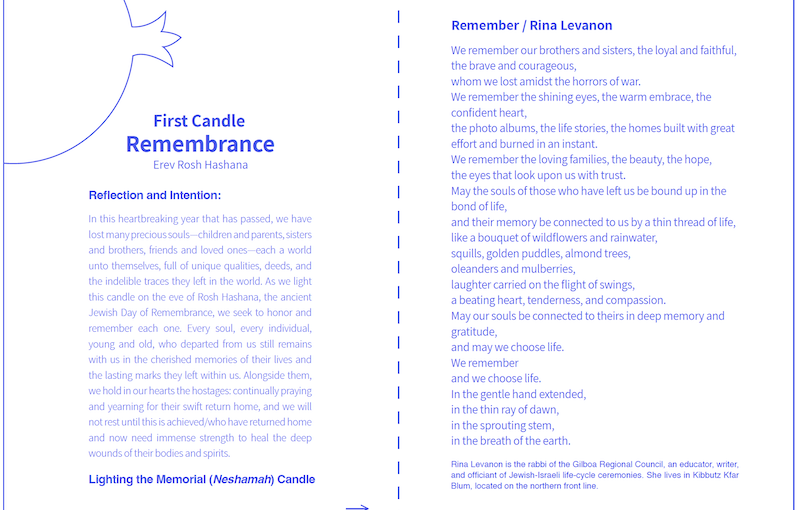
Erev Rosh Hashanah, from Shalom Hartman Institute’s Memory and Hope. For each holiday and Shabbat evening in Tishrei, the institute suggests we light a memorial candle before kindling the holiday and Shabbat lights, and offers an intention to recite before lighting this candle and a text to read afterward (both in English and in Hebrew).

Each year during Elul, the month leading up to the High Holidays, the women of medieval Ashkenaz would measure each of the graves in their community cemeteries with string. They would then dip these lengths of string in melted wax that had been collected from candles lit throughout the year in the synagogue when the community gathered to pray, to study, to cook and to connect. They would light these new candles, each made from string representing the dead and wax representing the living, on Yom Kippur as yahrzeit candles, a way of honouring and remembering deceased relatives.

On Rosh Hashanah, we will welcome a new year. And then, in the midst of the 10 days of repentance that lead up to Yom Kippur, we will reach the one-year anniversary of Oct. 7 and, with it, the anniversary of the day on which at least 1,139 people were killed by Hamas terrorists and more than 240 people were taken hostage. We will pray for the return of the remaining captives, and we will mark the start of the war that has since killed so many in Israel and Gaza.

We have struggled to fully mourn these losses as this war continues to unfold and expand; as not all the hostages have yet returned home; as, in North America, many of us navigate antisemitism in our communities and shifting relationships with local allies. And yet, we feel the need to grieve. The chaggim (holidays) offer us a pause in which we can reflect, cry and pray.

The Shalom Hartman Institute has developed two rituals for the anniversary of Oct. 7, one that spans most of the month of Tishrei, for individuals to use at home, and one for communal gatherings on Oct. 7 or on Shemini Atzeret and Simchat Torah.

Commemorating Oct. 7 at home

Every week, we begin Shabbat by lighting candles. Every Tishrei, we usher in Rosh Hashanah, Yom Kippur, Sukkot, Shemini Atzeret and Simchat Torah by lighting candles. Our ritual for commemorating Oct. 7 at home is woven into these traditions.

More specifically, for each holiday and Shabbat evening in Tishrei, we suggest that you light a memorial candle before kindling the holiday and Shabbat lights. We offer an intention to recite before lighting this candle each night and a short text to read afterward. These materials – inspired by the work of Hagit Bartuv and Rivka Rosner of the Shalom Hartman Institute’s Ritual Centre in Israel and in collaboration with Maital Friedman, Masua Sagiv and me from the Shalom Hartman Institute of North America – connect us with some of the central themes of the last year. Our hope is that the light of the memorial candle, the ner neshamah, literally a soul candle, and light of the festive candles flickering together will connect the strands of our grief and celebration.

Like the candles dipped by the women of Eastern Europe, this ritual honours both the dead and the living. It brings us back to the devastation of Oct. 7, and it also celebrates the artists, soldiers, teachers and ordinary people who helped us through a difficult year. Similarly, while memorial candles are traditionally lit to remember the dead, the ritual invites us to use these candles to light the way for the living – for peace, healing and hope.

While many Israeli Jews light candles on seven evenings from Rosh Hashanah through Simchat Torah, many diaspora Jews light candles on nine, the two additional candles marking the second night of Sukkot and for the start of Simchat Torah. As a statement of Jewish peoplehood, this home-based ritual is for seven nights of candlelighting, so that it will be used in Jewish homes around the world on the same days. If you want to use this ritual to accompany your candlelighting on the second night of Sukkot or on erev Simchat Torah, you might repeat an intention and text or offer an intention and reflection of your own.

Developing this ritual led us to ask about the meaning of memorializing Oct. 7. Is this ritual only about Oct. 7 or is it about everything that occurred that day and since? What do we mean by “heroism” at this time? Are we referring to military bravery or to the ways civilians stepped up to support and protect one another this year as well? Can the entire Jewish world share this one ritual, or have our experiences of this year been too different? What is the right balance between particularistic and universalistic yearnings?

For many of these questions, we looked to our Israeli colleagues to set the tone in creating a ritual that met their needs for their grief and vulnerability this year, as well as their sources of hope and comfort. For other elements, we offer suggestions to adapt the framing or created a slightly different version in the English that we thought might be better suited for those outside of Israel. You may want to use this resource exactly as is, but you may also find yourself adding different texts or focusing on different themes. We encourage creativity and would love to hear from you about how you adapt it to meet your needs for this moment.

Commemorating Oct. 7 in community

Many communities in North America will gather to mark the anniversary of Oct. 7, whether in synagogues, JCCs, Jewish federations, Hillels, schools or other Jewish centres. Our second resource is a collection of texts and prayers to be used in a communal ritual context, including suggestions of three different ways to use these rituals in your community.

The supplement also gave us the opportunity to add more texts, prayers, songs and perspectives, including texts with expressions of grief for the suffering of Palestinian civilians, which did not fit in the more particularistic framework of the home ritual above.

This Elul, as we reflect on the past year and gather up the wicks that measure our lives and our communities, may we continue to find ways to bind our wicks together, to find strength in community and ritual, and may all who mourn this tragic anniversary find comfort among the mourners of Zion and Jerusalem. Shanah tovah. 

Rabbi Jessica Fisher is the director of rabbinic enrichment at the Shalom Hartman Institute of North America. To read and download various Hartman Institute resources, including Memory and Hope: Rituals for Tishrei 5785 and accompanying resources for commemorating Oct.7 in community, visit hartman.org.il.