The weekly rally at Vancouver Art Gallery marked nine months since the pogrom of Oct. 7. (photo by Anna-Mae Wiesenthal)
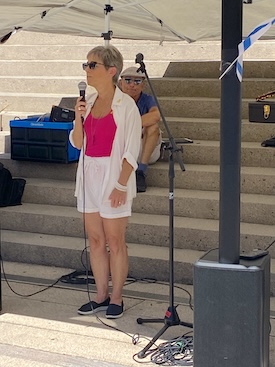
Selina Robinson, the former BC cabinet minister whose planned speech at Vancouver’s weekly rally for the hostages was canceled over security concerns earlier this year, was the surprise speaker Sunday at the vigil marking nine months since the pogrom of Oct. 7.
“I was out here nine months ago, representing government and the Jewish community … as we mourned together the slaughter of young people, the rape of women, the death of so many innocent people perpetrated by Hamas,” Robinson said. “I took it upon myself to make sure that we did right by the Jewish community and I took that honour with great reverence and commitment. I did so at the request of [then-premier] John Horgan and then I did it at the request of [current premier] David Eby and I did it diligently, as best I could. And we watched as a government what happens when hate goes unchecked. I never thought in my life, really, that I would see this level of hatred directed toward Jews.”
Selina Robinson speaks at the July 7 vigil. (photo by Anna-Mae Wiesenthal)
She lauded fellow elected officials who stand with the Jewish community and said there should be unanimity.
“On this issue, we should not be divided,” said Robinson, a former minister of finance who was minister of postsecondary education when Eby, the premier, demanded her resignation after comments she made on a webinar calling pre-state Israel a “crappy piece of land.”
She credited Jewish organizations and allies for the work they are doing, but warned of a steep road ahead.
“We have a lot of work to do, my friends,” she said. “The antisemitism that has been unleashed is going to be hard to put back in the bottle.”
Congregation Beth Israel’s Rabbi Jonathan Infeld had harsh words for Robinson’s treatment at the hands of colleagues.
“Let’s tell the truth of why Selina was kicked out of cabinet,” Infeld said. “The reason is because Selina was the one representative of the Jewish people in cabinet. Selina was the one person in cabinet, in our government, willing to stand up not for some people’s human rights but for all of our human rights. Selina was kicked out of cabinet because she was a strong woman who stood for all that our province is supposed to stand for and she was kicked out of cabinet because she is a Jewish hero.”
BC Conservative Party leader John Rustad spoke, and was joined at the rally by fellow Conservative MLA Elenore Sturko and a number of Conservative candidates standing in October’s provincial election.
“I am proud to say that I stand here with you,” said Rustad. “I stand against terrorism. I stand against Hamas and what they have done.”
The government in British Columbia needs to do more to counter antisemitism, he said.
“People who come to this province, to live here, come here with the expectation that they will live in peace,” Rustad said. “They come with the expectation to be able to raise a family, to be able to build the future, and what we are seeing today, with the antisemitism that is happening throughout our communities, I just find completely wrong.”
Ezra Shanken, chief executive officer of the Jewish Federation of Greater Vancouver, expressed pride in the community he serves. He urged elected officials to stand with the community.
“We remember who was there on day one and we see who’s there now and that’s something that we have to stand up for here in our province and in our country,” he said. “We need them side-by-side by us and you need to be the ones to continue to tell them at all levels of government that we need them now more than ever.”
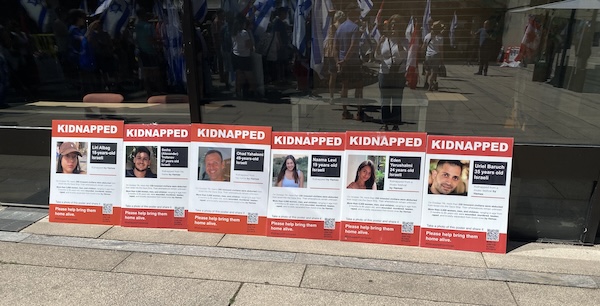
Approximately 120 hostages are still being held in Gaza, more than nine months after the Hamas attacks on Oct. 7. (photo by Anna-Mae Wiesenthal)
Lior Noyman, an Israeli-Canadian educator and filmmaker, expressed sorrow for victims of violence in Israel and Gaza. He warned the audience to be vigilant against expanding antisemitism.
“Leaders, teachers, parents, Canadians, I am calling to you all,” he said. “Don’t let them walk us back in time.”
Dov (David) Rosengarten, a Vancouverite who is chief of staff for donor communications at United Hatzalah, Israel’s network of 7,000 volunteer first responders, brought greetings and gratitude from Israel.
“Your display of unwavering solidarity every weekend here continues to give us strength through this difficult period,” he said.
Noting the nine-month period since Oct. 7, Rosengarten drew parallels with the human pregnancy term, except that these past 40 weeks have been a time of unprecedented trauma. He sees hope in news of a ceasefire plan and hopes that “these painful birth pangs will end and the citizens of Israel and the Jewish people at large, including here in Vancouver, will be reborn again. After these many painful months, these cries of sorrow will be transformed to jubilation and we will finally hold our beloved hostages and loved ones again and celebrate the victory of unity and, like with a newborn child, we will shape for ourselves a bright future full of new dreams and possibilities.”
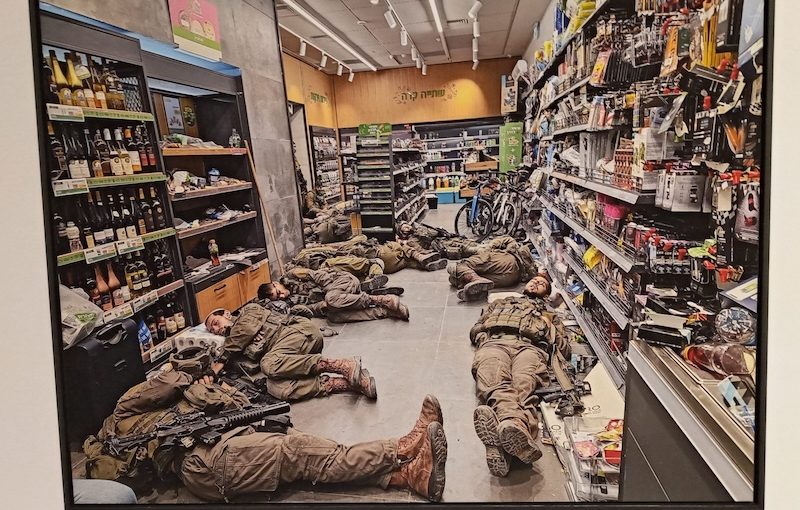
Batia Holini’s photo of Israeli soldiers sleeping on the floor of a grocery store near Kfar Aza on Oct. 8 is one of the works in the exhibit Album Darom. (photo by Gil Zohar)
Album Darom: Israeli Photographers in Tribute to the People of the Western Negev, which opened recently for a six-month temporary installation at the Petach Tikva Museum of Art, is the first group artistic endeavour in Israel to confront the tragedy of Hamas’s Oct. 7, 2023, massacre and the subsequent Gaza War, now in its 10th month. The ambitious tripartite installation Album Darom (Hebrew for Southern Album) incorporates a Facebook diary; a printed book of photographs accompanied by essays (published by Yedioth Ahronoth); and the museum exhibit.
Initiated by Prof. Dana Arieli, dean of the faculty of design at the Holon Institute of Technology, together with chief curator Irena Gordon, the project showcases 150 photographs, art installations and texts documenting the story of the western Negev region before and after Oct. 7. The exhibit includes the perspectives of 107 photographers and artists. Some of the participants in the album are world-renowned, others are amateurs. Lavi Lipshitz, the youngest featured photographer, lost his life fighting in Gaza. His mother penned the text accompanyinghis images.
The works in the album represent different photographic practices: artistic, personal and some staged, the intense images are upsetting. As well they should be in confronting mass murder.
Before walking around a corner to see Lali Fruhelig’s gruesome 3-D installation suggesting a corpse sprawled on the floor of a living room, a sign cautions: “The exhibition contains some potentially disturbing contents. Viewer discretion is advised.”
Arieli, a history professor and a photographer who explores remembrance culture and cultural manifestations of trauma, began the Album Darom project shortly after the Gaza war broke out.
“When something’s traumatic, you have to work or do something,” she said.
Shocked by the murder of her friend Gideon Pauker from Kibbutz Nir Oz – who was killed just before his 80th birthday – she posted 100 daily historic and contemporary images of the Western Negev.
Initially, Arieli intended Album Darom to be exhibited at Kibbutz Yad Mordechai Museum just north of the Gaza Strip frontier. After the museum was damaged by rocket fire, this wasn’t feasible. Instead, she selected Petach Tikvah as the venue. She explained that the site – the first Yad Labanim memorial to fallen Israel Defence Forces soldiers from the War of Independence – is meant to be relevant to all Israelis. The museum offers free admission on Saturday, so observant Jews may visit on Shabbat.
Speaking to a group of journalists, Arieli compared Oct. 7 to the Nov. 4, 1995, assassination of then-prime minister Yitzhak Rabin. “Everyone is frozen in their memory of where they were,” she said.
Arieli and Gordon emphasized the intended cathartic nature of the exhibit. The two said the museum is a “safe space” and a “place for healing.” After experiencing the horrors of Oct. 7, Gordon found solace in this project, she added. “This is part of how we are coping with it all,” she said.
Miki Kratsman is one of the photographers whose depiction of his Oct. 7 nightmare is in the exhibit. Terrorists took his aunt Ophelia hostage from her home in Kibbutz Nir Oz. She was later released from Gaza in the November hostage exchange deal.
Kratsman’s photograph, “In Aunt Ophelia’s Neighbourhood,” captures a modest kibbutz home collapsing as it is immolated in a fireball.
“These are the kinds of things that need to be in a museum,” Arieli said of the photograph. “You’re looking at the destruction of Nir Oz.”
While vividly showing the devastation of the kibbutz, the burning home photograph is an enigma, and creates dialogue, she added.
But it is the human toll rather than the destroyed real estate that is most painful. Paradoxically, perhaps, Batia Holini’s peaceful photo of exhausted IDF soldiers sleeping on the floor of a grocery store near Kfar Aza on Oct. 8 hints at the savage warfare in which they have been engaged.
“Funeral of Five Members of the Kutz Family who were Murdered in Kfar Aza,” a photo by Avishag Shaar-Yashuv. (photo by Gil Zohar)
Avishag Shaar-Yashuv’s photograph, “Funeral of Five Members of the Kutz Family who were Murdered in Kfar Aza,” captures the searing emotion of the funeral of a family annihilated in the Hamas attack.
“I tried to focus and also wipe the tears at the same time,” Shaar-Yashuv said.
For this reviewer, the most symbolic part of the exhibit was a taxidermy display of a doe entitled “Bambi.” The exhibit references Felix Salten’s 1923 novel Bambi: A Life in the Woods and the 1942 animated movie produced by Walt Disney. Metaphorically, the hapless baby deer represents both the Six Million victims of the Holocaust and the 1,200 people murdered on Oct. 7.
Viewing Album Darom, one could conclude that the myth of the state of Israel protecting its citizens has been shattered. Arguably, Israelis today are no more secure than their ancestors were facing the Kishinev Pogrom of 1903, the Hebron Massacre of 1929 or the Farhud in Baghdad in 1941.
Gil Zohar is a writer and tour guide in Jerusalem.
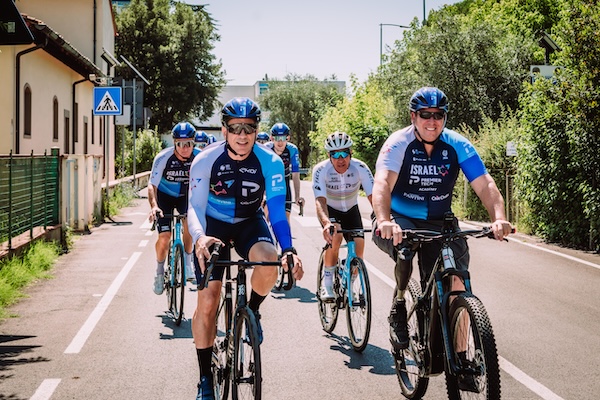
Oct. 7 survivors Sharon Shabo, left, and Avida Bachar lead Team Israel-Premier Tech riders in the team’s final training session before the Tour de France started on June 29 in Florence, Italy. (photo by Noa Arnon)
Three injured heroes from the Oct. 7 Hamas terror attacks came to support Team Israel-Premier Tech at the Tour de France. As well, they held signs bearing the names of hostages, some of whom are their close friends, and called for their release. Alongside them stood Israel-Premier Tech owners Sylvan Adams and Ron Baron.
“My friends from the kibbutz are suffering there. We can’t wait another moment,” said Avida Bachar. He lost his son and wife, who were murdered in their shelter in Be’eri on the morning of Oct. 7, while he himself was severely injured and lost his leg. Despite adapting to his prosthetic, Bachar insisted on riding his bike for the first time since his injury to lead the Israeli team in their final training session. “It was an immense moment, one of the most emotional of my life,” he said.
Joining Bachar was his good friend Sharon Shabo, who was seriously injured in a Hamas ambush on the morning of Oct. 7 while riding his bike, and 20-year-old Oded Gelbstein, a young combat engineer soldier who was critically wounded in Gaza and is currently undergoing rehabilitation in Florence.
“Avida and Sharon will be our great inspiration at the Tour de France,” said Adams to the team riders before the race started.
The Tour de France lasts three weeks, during which the riders cycle more than 3,400 kilometres. Twenty-two teams are taking part in the 21-stage race, which culminates in Nice, France, on July 21.
According to historian and former ambassador Michael Oren, on Oct. 8, 2023, one day after the terror group Hamas’s brutal assault on southern Israel, the following things happened: 80% of Israelis volunteered to help in any way they could, 360,000 Israelis reported for military duty and thousands of Israelis who were not in Israel on Oct. 7 returned to defend their country.
This remarkable resilience and dedication have also been apparent in Israel’s wine industry. Workers from wineries that could finish their 2023 harvests went to other wineries to help with harvesting and winemaking. A poignant example is the support for Kibbutz Nir Oz’s winery. When Kibbutz Nir Oz was attacked, Hamas murdered the winemaker, Gideon Fauker, z’l, and took his two partners captive to Gaza, where they remain today. In a recent Israel21c article, Andrea Samuels recounts how people in Israel’s wine industry came together to turn Nir Oz Winery grapes into wine and save the vintage, to honour their Nir Oz colleagues.
Jews have been making wine in the land of Israel for more than 3,000 years, a fact confirmed by archeological evidence. King David had vast vineyards and kept large stores of wine, and wine was a major export and economic mainstay for Jews during the time of the Second Temple in Jerusalem. Even when outsiders invaded the land and mandated pulling out the vines many centuries later, a limited number of vines remained to produce wine for sacramental purposes. Viticulture was reintroduced in the late 19th century and, by the end of the 20th century, Israel was garnering international recognition for the quality of its wines. Today, there are more than 300 wineries of all sizes in Israel, and a well-established wine culture.
Since the massacres and kidnappings by Hamas on Oct. 7, the wineries have faced tremendous obstacles due to the ensuing war with Hamas in Gaza and daily rocket and missile attacks on northern Israeli land and communities by the terror group Hezbollah. There are labour shortages, as Israelis are repeatedly called up for reserve duty and many foreign workers have left the country. In the north, some employees who have been evacuated because of the Hezbollah attacks can’t get to the wineries. Any work at the wineries and vineyards in this prized Galilee viticulture region remains a dangerous proposition and there is concern for the 2024 vintage. Vineyards in the north and south have been damaged by rockets and some in the north are inaccessible in closed military zones. Domestic wine sales, on which the wineries heavily rely, plummeted after Oct. 7 and, although they have recovered somewhat, a tourism decline and restaurant and bar closures have exacerbated the sales slump. And, of course, there is the human cost as the wars and threats continue and as many in Israel’s wine industry have lost family, friends and co-workers.
Despite these challenges, the people of Israel’s wine industry have shown classic Israeli resilience, determination, collaboration and commitment to the country and to one another. Samuels’s article noted that, since Oct. 7, Alex Haruni and his Dalton Winery team have been making Shabbat dinners for soldiers posted at the nearby Lebanon border. And, in his article “A taste of total victory,” Adam Montefiore, a 38-year veteran of Israel’s wine industry, wrote about Tom Carbone and his Be’eri Winery.
Carbone and his friend Dror Or, z’l, the Be’eri Dairy cheesemaker who was murdered by Hamas when they attacked the kibbutz, had a dream of collaborating to make Kibbutz Be’eri a food and wine tourism destination. Carbone is working to fulfil that dream for both of them, commuting to Be’eri from the hotel he and his family now live in at the Dead Sea. So far, he has produced an outstanding Be’eri Chardonnay and is continuing his friend’s work at the dairy.
We in Canada can support Israel in many ways, including by buying and enjoying the beautiful wines of her irrepressible wineries. Israeli wines available in British Columbia are highlighted below with tasting notes.
GALIL MOUNTAIN WINERY
Established in 2000 as a joint venture between Golan Heights Winery and Kibbutz Yiron, Galil Mountain Winery (galilmountain.co.il) has five vineyards in the Upper Galilee mountains, with topographical and climatic conditions well-suited to growing grapes of the highest quality for wine production.
Galil Mountain Cabernet Sauvignon 2022: A young, refreshing character with accentuated fruity aromas. No barrel aging. The wine was stored in stainless steel tanks after fermentation to preserve its fruity character.
Varietal: Cabernet Sauvignon
Colour: deep opaque purple
Aroma: pure ripe raspberry and blueberry primary fruit character, with hints of herbs and tobacco leaf
Taste: a medium-to-full bodied wine with delicate tannins; the finish is long and firm
Food: best served at 64°F (18°C) to accompany a wide range of meat dishes
Galil Mountain Rosé 2021: A dry, light rosé with refreshing acidity. A combination of two winemaking techniques – skin contact followed by cold fermentation.
Varietal: a blend of Sangiovese, Barbera, Pinot Noir
Colour: bright pink
Aroma: scents of strawberry, pomegranate and ripe nectarine with notes of blooming wildflowers
Taste: presents characters of flowers, strawberry and pomegranate; a joyful wine with invigorating and well-balanced acidity
Food: try with a fresh summer salad, with sushi or as an aperitif on its own
Galil Mountain Alon White 2020: The grapes are carefully selected at harvest, pressed gently, and half of the blend is fermented and aged in French oak barrels for three months.
Varietal: blend of Chardonnay, Viognier
Colour: pale lemon
Aroma: citrus blossom, alongside hints of fresh mint
Taste: ripe citrus, stone fruit and a hint of herbs on the palate, with refreshing acidity, light body and a lingering finish
Food: pairs beautifully with grilled fish and fresh salads
GOLAN HEIGHTS WINERY
Golan Heights Winery (golanwines.co.il) gained international recognition after releasing its first wines in 1984 and led a winemaking revolution that put Israel on the world wine map. The Golan Heights, a volcanic plateau with rich basaltic soil, is the coldest region of the Galilee appellation and considered the best for viniculture.
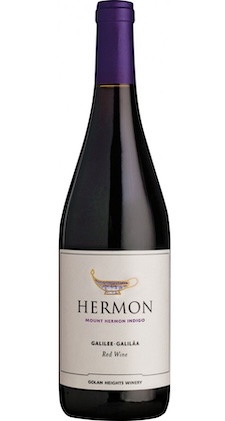
Mount Hermon Indigo 2022: Made from classic varietals, a young medium-bodied wine full of flavour.
Varietal: blend of Cabernet Sauvignon, Syrah
Colour: deep indigo-purple
Aroma: black currant, tobacco and smoke
Taste: medium bodied with notes of raspberry and black cherry, characters of aniseed and cocoa, and hints of flowers and earth
Food: beef brisket, grilled lamb shanks or a barbecued beef burger
TEPERBERG 1870 WINERY
Teperberg 1870 Winery (teperberg1870.co.il) is located in the foothills of the Jerusalem Mountains with vineyards in several growing regions. It is one of the oldest wineries in Israel, founded in Jerusalem in 1870 and, for a time, known as Efrat Winery. Efrat remains a label of Teperberg 1870. The Teperberg and Efrat wines listed are mevushal, wine that has been flash pasteurized.
Teperberg Malbec Vision 2021: The Malbec Vision undergoes stainless steel fermentation and is aged in French and American oak for five months prior to release.
Varietal: Malbec
Colour: deep red with purple hints
Aroma: black fruits and spices
Taste: a deep and layered wine that combines a wealth of fruit with vibrant acidity
Food: beef dishes, charcuterie, beet salads
Teperberg Efrat White Blend 2022: Fermentation in insulated chilled stainless steel tanks for two weeks before the final blend is composed. To retain its crispness, the wine does not undergo malolactic fermentation.
Varietal: blend of Riesling, Semillon, French Colombard
Colour: light, pleasant yellowish
Aroma: mainly citrus aromas
Taste: fresh, balanced with pleasant acidity and medium body
החברה הלאומית של קנדה אייר קנדה תחזור לטוס לישראל רק בחודש הבא. החברה הקנדית שהחלה לטוס לישראל רק בעשרה באפריל הפסיקה את טיסותיה לתל אביב ארבעה ימים לאחר מכן, לאור סגירת נמל התעופה בן גוריון לאור המתקפה האיראנית. באייר קנדה מעדכנים כ הטיסות יחודשו בין קנדה לישראל רק החל מהשישה באוגוסט
אייר קנדה נוסדה בשנת אלף תשע מאות שלושים ושבע ובסיסה בעיר מונטריאול. לחברה נוכחות מסיבית גם בנמלי התעופה הבינלאומיים של טורונטו, ונקובר וקלגרי. לאייר קנדה ארבע חברות-בנות והיא מפעילה כיום כשלוש מאות ושישים מטוסים הטסים לכמאתיים יעדים שונים ברחבי העולם. הכנסות החברה אשתקד עמדו על כעשרים ושתיים מיליארד דולר (קנדי)
צעדת התמיכה הגדולה ביותר בישראל התקיימה בקנדה בחודש יוני האחרון בטורונטו בהשתתפות כחמישים אלף איש. במצעד בטורונטו הניפו המשתתפים דגלי ישראל וקנדה, קראו עם ישראל חי ותחי ישראל ויחי צה”ל, אל מול מפגן תמיכה קטן של מפגינים פרו-פלסטינים. בצעדת התמיכה בישראל השתתפו גם איראנים מתנגדי משטר של האייטולות
בכל שנה, הצעדה למען ישראל היא האירוע היהודי הגדול ביותר בקנדה ואחת מצעדות הסולידריות עם ישראל הגדולות בעולם. חגיגה ידידותית למשפחה זו כוללת צעדה סימבולית בטורונטו ולאחריה פסטיבל לחגוג את התרבות הישראלית והיהודית
אנחנו נרגשים מהתמיכה העצומה בצעדה השנה מהקהילה שלנו ומהחברים והשכנים שלנו ברחבי טורונטו רבתי. לראות השתתפות שיא השנה מדברת רבות על הגאווה, החוסן והנחישות של הקהילה שלנו להראות לעיר שלנו מי אנחנו ועל מה אנחנו עומדים. כך אמור יו”ר אגון הגג של הפדרציות היהודית של קנדה, ג’ף רוזנטל. ואילו נשיא ומנכ”ל של הפדרציות היהודיות של טורונטו, אדם מינסקי, הוסיף כי בזמן שנאה חסרת תקדים המופנית כלי הקהילה היהודית בטורונטו, הצעדה ששברה שיאים שולחת מסר ברור שאנחנו חזקים, מאוחדים וגאים. האירוע היום הוא הפגנה חזקה לכך שיש רבים שתומכים בנו, בעד הדמוקרטיה, החברות והזכות של הישראלים ושל הקהילה היהודית לחיות בשלום ובביטחון, הוסיף עוד מינסקי
כאירוע גיוס כספים למטרות צדקה, כל התרומות לצעדה תומכות בשירותים חברתיים ומאמצים הומניטריים בישראל המסייעים לתושבי ישראל הפגיעים ביותר. השנה הכספים שנתרמו יעזרו לישראלים להתאושש מהטראומה הגדולה של השבע באוקטובר, כולל תמיכה בתוכניות לעזור לקורבנות הטרור ולאה הנאבקים בבעיות נפשיות
לאחר הצעדה, המשתתפים התכנסו בקמפוס שרמן של פסטיבל הסולידריות שכלל פעילויות ידידותיות לילדים, אוכל והופעות. האירוע כלל גם הזדמנויות לשלוח מסרים של תקווה לישראל וכיבוד קורנות השבעה באוקטובר. כן נבנתה חומת התקווה שהיא מיצג הזיכרון של פסטיבל נובה שגבה קורבנות רבים
לאור עלייה באנטישמיות בטורונטו, המשטרה הייתה נוכחת בצעדה במספרים חסרי תקדים. בקהילה היהודית בטורונטו מעריכים מאוד את המאמצים הבלתי הנאלים של משטרת טורונטו להבטיח חוויה בטוחה בצעדה
מנכ”לית הפדרציות היהודיות של קנדה בישראל, שרה מלי, אמרה שיש משהו מיוחד במינו בצעדת למען ישראל של פדרציית טורונטו השנה, מעבר להשתתפות המרשימה של חברי קהילה, תומכים ונבחרי ציבור צעדו כדי לחגוג ולתמוך בישראל. הסיבה לכך שזה כל כך יוצא דופן היא שמאז השבעה באוקטובר, הקהילה היהודית הקנדית נתונה לאנטישמיות גוברת ומתפשטת בקמפוסים ובמרחבים הקהילתיים היהודיים, ובו בזמן גייסה את סכום הכסף המשמעותי ביותר לנפש מכל הקהילות בעולם. לכן, הצעדה השנה, לא רק שהיא הגדולה ביותר, היא מייצגת את המחויבות של הקהילה היהודית בטורונטו לישראל כנגד כל הסיכויים ולכן יש לה חשיבות סמלית שאין כדוגמתה
אפשר להבין את החרדה שדבורה ליונס חשה מצפייה בחדשות מאז שמונתה לשליחה המיוחדת של קנדה על ידי ג’סטין טרודו, להנצחת זכר השואה ולמאבק באנטישמיות בסתיו האחרון. העלייה המדאיגה בשנאת יהודים בקנדה נדונה בתקשורת באופן קבוע
ברור מהנתונים שאנחנו רואים, בעיקר מאלה המגיעים ממשטרת קנדה, שיש עלייה אדירה באנטישמית במונחים של פשעי שנאה, אומרת ליונס. וזה בלי להזכיר את התקריות האיומות אבל חוקיות נגד יהודים שאנחנו שומעים עליהן לעיתים קרובות. לדעתה של ליונס רמת האנטישמיות בקנדה נמצאת עכשיו בשיא של כל הזמנים וזה חסר תקדים
ארגון בני ברית קנדה פרסם לאחרונה את הדוח השנתי שלו על תקריות אנטישמיות במדינה. לפי הדוח הארגון חלה עלייה דרמטית מאז טבח השבעה באוקטובר. על פי המקרים שדווחו לבני ברית גם באמצעות עבודה עם המשטרה, אשתקד נרשמו קרוב לששת אלפים מעשי אלימות, הטרדה וונדליזם כלפי יהודים. זאת יותר מפי שניים מאשר שנה קודם לכן
בין פשעי השנאה המוזכרים נמנים הצתת מעדנייה בטורונטו, ירי לעבר בית ספר יהודי במונטריאול, ונדליזם בחנות ספרים בטורונטו של רשת אינדיגו שמייסדה הוא יהודי, פגיעה בבתי כנסת ובשכונות ועסקים יהודיים שונים. וכן השחתה של בתים פרטיים בסמלים ובביטויים אנטישמיים
לאחרונה סיסמאות משלהבות במאהלי מחאה שהוקמו באוניברסיטאות ובייחוד בעצרות אנטי־ישראליות בוונקובר ובאוטווה הוסיפו שמן למדורה. ליונס רוצה שחברי הקהילה היהודית ידעו שהיא רואה ושומעת את החששות שלהם לנוכח ההסלמה ברטוריקה האנטישמית ובוונדליזם. ליונס מוסיפה שהיא רואה את הכאב שלהם כשבהפגנות מובילי המחאה קוראים יחי השבעה באוקטובר והקהל מריע
ליונס רואה את הייסורים שחשים יהודים קנדים כשאנשים מתייחסים בביטול או ממעיטים בעובדה שמארגני העצרות מובילים את הקריאות האלה ואחרות, כמו תחזרו לאירופה ולהפוך את האינתיפאדה לגלובלית. על רקע המציאות הזאת היא מבינה שמתנהלות שיחות בבתים ובמשרדים על עתיד הקהילה היהודית בקנדה. זה לא קביל ולא הוגן. קנדה התמודדה כבר עם עלייה בשנאת יהודים לפני הזינוק הנוכחי. יש לשקול בכלל את העלייה העצומה באנטישמיות העולמית לאור זוועות השבעה באוקטובר. עוד הרבה לפני מלחמת ישראל והחמאס הייתה רמה גבוהה של אנטישמיות בקנדה. היא התחילה לעלות בצורה די קבועה לפני כשש שנים ועוד יותר במהלך מגפת הקורונה. היא הייתה במגמת עלייה, שהפכה לנסיקה דרמטית אחרי השבעה באוקטובר. עם התמשכות המלחמה בעזה ועד שיושג פתרון, חושבת ליונס שהסביבה שלנו תמשיך להיות סוערת
זה עלול להיות התרחיש הטוב יותר אם לא יהיה שינוי בתגובת המנהיגים. ליונס מאמינה שאנחנו באמת נתונים במשבר. והיא חוששת שלא מספיק אנשים מבינים את זה, או שאם הם מבינים זאת, הם לא יודעים מה הם יכולים לעשות לגבי זה
ליונס מקווה שהגענו לשיא העגום של האנטישמיות, ושהמצב לא יחמיר עוד יותר, אבל היאי לא יודעת. זה תלוי בעיקר במידה שסה המנהיגים השונים יפעלו בהתאם לאחריות שניצבת לפניהם
ליונס, שאינה יהודייה מכירה בכך שאין פתרון קל, ואומרת שהמצב הנוכחי לא יכול להיפתר ברמת הממשלה בלבד, וגם לא על ידי לשכה של שליח בודד. תחת זאת, לדבריה, האנטישמיות דורשת את טיפולה של ההנהגה בכל הרמות, לכן לשכתה עובדת עם ראשי ערים ברחבי קנדה כדי לעודד אותם לאחד את הקהילות שלהם סביב המטרה
חצי שנה לאחר שניכנסה לתפקידה ליונס מבינה כעת טוב יותר מה צריך לעשות לאחר שדיברה עם איסנפור אנשים על המצב וקראה רבות על הנושא
Many community events, lessons and celebrations take place in the Jewish Community Centre of Greater Vancouver’s Wosk Auditorium. (photo from JCC)
A sense of family and community, somewhere to be physically active and mentally stimulated, a haven in which to socialize and relax, to have a nosh, a lifeline during the pandemic and a place to be with like-minded people after Oct. 7. The Jewish Community Centre of Greater Vancouver – “the J” – “is a warm and welcoming place for Jews and the community in general,” offered JCC executive director Eldad Goldfarb.
The Jewish Independent spoke with Goldfarb and others recently, to see how the centre has fared since the Hamas terror attacks on Israel, the Israel-Hamas war and the rise in antisemitism around the world, including in Metro Vancouver.
“The level of security has seen a noticeable increase,” said Goldfarb. “The initial shock had an effect on our entire community, which felt insecure and somewhat afraid to venture out and into Jewish community facilities. This fear quickly changed into a desire to congregate, be with fellow Jews in safe spaces, and the JCC is a place where everyone feels safe and welcome.”
He praised the Vancouver Police Department and its role in allowing the community to gather safely.
“The VPD is amazingly supportive of the Jewish community and the JCC,” he said. “They are doing above and beyond within their limited resources to provide both physical as well as emotional safety at this very difficult time for our community. The JCC staff team is very vigilant and pays close attention to anything out of the ordinary.”
Goldfarb has been the J’s executive director for 11 years, and was assistant executive director for the six years prior to that. He said the centre has “expanded its programs and services, providing substantially more scholarships and subsidies to families and individuals.” And he and the JCC board “have been involved in the conceptualization, visioning and creation of JWest, an exciting innovative community project for generations to come.”
“The JCC has been working diligently on expanding our capacity, we have made investments in recruiting top-notch staff, replacing and transforming our technology systems in order to improve customer experience, ease the registration process and create efficiencies in the organization,” said Goldfarb.
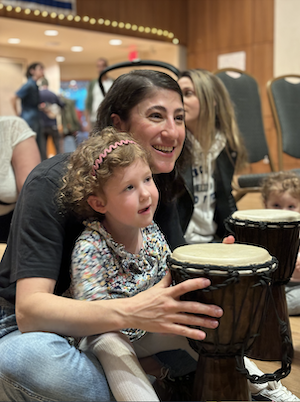
“We’re always trying out new programs,” Hila Olyan, senior director of programs, told the JI. “I’m especially excited about programming for new families, which ramps up this coming fall: pre- and post-natal yoga, baby sign and sing, stroller fitness, storytime in the library. We’re also trying out some new children’s programming over the summer. Music, Music for Littles and Music, Music for Babies will be offered on Sundays. I can say from personal experience that my toddler loves the program. He’s been taking it since April.”
The J’s many programs include ones to introduce toddlers and their families to the joys of music. (photo from JCC)
While the programming hasn’t changed much in response to Oct. 7, Olyan said “the interest in being part of programs has increased. I think, for many people, myself and my family included, the opportunity to participate in Jewish and non-Jewish programming, but in a safe space surrounded by like-minded people, is more important than we previously realized.
“We’ve also tried to be thoughtful as we plan and host our community events like the recent Festival of Israeli Culture. We are thinking about how we can honour the challenging times we are living in, but also celebrate the beautiful culture we all know and love.”
She pointed to significant participation in events such as seniors luncheons, the J’s annual Purim Party and other activities.
“The people of our community want to be around other community members and I think it’s a great thing,” said Olyan. “The atmosphere has shifted a few times. We’ve moved from shock and devastation to strength and resilience. I think it’s a real testament to the spirit of our community.”
“The JCC has and will always be a safe place for me and my family and the entire community,” said Michael Averbach, who has been going to the J since he was a kid himself. “Oct. 7 didn’t change my frequency of visits or how I feel about being at the JCC, nor should it for any current member, but my message to those considering joining – there’s no greater feeling of family than being at the J. It’s the only place where we can truly interact with all sectors of our community, from the non-observant, to the Reform, to the Orthodox and everyone in between. Furthermore, the JCC was built on the foundation where everyone is welcome, regardless of religion or race.”
In addition to being a J member, Averbach has chaired the centre’s main fundraising event, the RBC JCC Sports Dinner, for many years. Attesting to his family’s generations of involvement with the JCC, the welcome desk everyone passes on their way into the centre is called the Betty and Louis Averbach Membership Desk, named after Averbach’s grandparents. And the next generation is also involved.
“We’ve had our kids in day camp and swimming lessons over the years and, personally, I enjoy boxing sessions with Alexei to keep me sharp and on my toes and to complement my regular fitness routine,” said Averbach. “I also try and get to the J in the later evenings up three to four times a week to enjoy the sauna and steam in the men’s spa.”
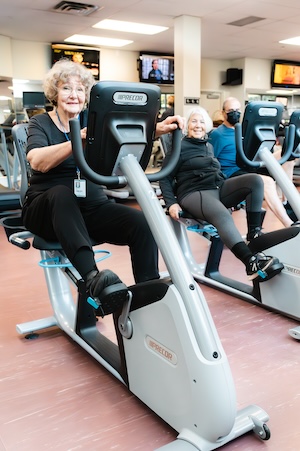
Working out at the J. (photo from JCC)
When asked what keeps him coming back to the centre all these years, Averbach said, “The warm feeling and sense of community walking through the doors.”
This is an aspect that also appeals to J member Cathy Paperny and her family, who joined the JCC in 2006 when their children began the 2-year-old program.
“I appreciate being surrounded by a Jewish community,” she said. “I have a good relationship with Eldad and we often have good talks about various topics, including the war in the Middle East. During these challenging times, it’s especially important to be surrounded by like-minded people. I feel I have that at the JCC.”
The social aspect is one of Olyan’s favourite parts of her job.
“I like the combination of interacting with members, program participants and administration. I like thinking about how we can make our programming stronger and then having the opportunity to put plans into action and see the results. Every single day I meet and talk with interesting people who are all here at the J for their own unique reason – a workout, childcare drop-off, gymnastics, music lessons, a holiday or festival.”
For Paperny, that reason was the program for 2-year-olds. She said the J was the only place that offered it. “I liked that my children were attending with other Jewish children, some of whom became lifelong friends. It was close to VTT [Vancouver Talmud Torah] for afterschool programs and convenient for me when I was working at the Holocaust Centre,” she said.
Paperny worked at the Vancouver Holocaust Education Centre, which is on the lower level of the centre, until 2019, for about four years as the symposia coordinator and as a docent for more than 10 years.
In addition to the 2-year-old program, Paperny said, “Yaelle went to ballet classes when she was young and did Israeli dancing through Talmud Torah and then performed at the Festival Ha’Rikud events at the JCC until Grade 7. Both of my children attended Camp Shalom for a couple of years.One of my children did the leadership-in-training program at Camp Shalom. They also attended other sports camps, like soccer.
“I did personal training there for years and attended some of the fitness classes, including circuit training,” she continued. “Now, I swim, do private pilates with Camila, attend yoga twice a week and attend many fitness classes.”
She also attends Jewish Book Festival events and, often, Israeli dancing on Wednesday nights.
These types of activities are exactly what the JCC mission entails.
“For our Jewish community, we continue to be committed to our mission to provide programs to enhance positive identification with Jewish life and Israel,” said Goldfarb. “This can be seen in our children’s camps, early childhood education programs (daycare and out-of-school care) and with our Israeli dance classes – to name a few.”
Nava Creative Kosher Cuisine is also on site. A popular spot to have a coffee or lunch, it is hard not to run into fellow community members when you’re there: members of the J, people visiting the latest exhibit at the Zack Gallery or going up to the Waldman Library, staff from the various Jewish organizations housed in the centre, participants in different programs, parents picking up their kids, students from King David High School, which is located across the street from the centre, and others.
“The JCC, while not without its challenges, is a place of growth and potential,” said Averbach. “I am aware of the high staff turnover and the need for building upgrades and, together, we are actively working on raising the necessary funds to address these issues. If there’s one key area for improvement, it is staff training for those with special needs and neurodiversity. By properly implementing this training, we can ensure that all our children feel comfortable and welcome.”
And it seems that the J is committed to continually improving. For example, staff review its programming often.
“Every participant in a registered program receives an email link to a quick survey,” said Olyan. “We also look at our mission statement and consider how we can continue and better meet our mission and the needs of our community. Are we offering social, educational, recreational and cultural programs for every demographic? Finally, we consider what are the emerging trends and interests within and outside the Jewish community and is the JCC the right place for [such programs]. We really try to listen to our members and find out if there are particular programs they would like to see.”
As for her feedback, Paperny said, “During COVID, the J was a lifeline for me when virtual programs were available, and then when it opened up to in-person programs. My physical health is so integral to my emotional, mental and spiritual health. The J has always been there for me.”
The late afternoon, right after school or summer camp, is go time for many parents. These are the moments where my twins have every kind of need, from taking off their outside gear and emptying lunch bags to signing permission forms, getting help on projects, and more. It is a period of chaos, usually with a desperate need for snacks as well as dinner preparation, all rolled up. There are days when things are calm, sure, but there are other times when I savour my last moments of quiet at 3:25 because from 3:35 until 6:30 or so, after dinner, I am a whirlwind doing Marathon Mom work.
Our public junior high this year presented us with Mega Options activities for the last few days of school. While the various options were hyped to students in advance, only whispers of this made it home. So, on an average Monday afternoon in June, my kids told me to be sure to open the special Mega email fast, as all the best activities would fill up. At 4:30 on the button, my inbox told me about the many Mega Options I would need to hurry to fill out to meet my twins’ expectations.
There were so many choices: Métis sash-weaving and historic cemetery trips, Inuit printmaking and Indigenous storytelling, Euro-style soccer tournaments, Pickleball, phone photography, kinesiology and nutrition lab field trips to a university, and more. There were bike treks, orienteering, the list went on. The selection was huge. Not every outing had a description or information. Some choices came with big fees. Others were free.
It was a huge rush to decide. We watched some activities fill up even as we tried to sign up – and, with twins, we had to sign up twice. In the end, my more social kid called one of his close friends. On the other end of the phone line, I heard his mom, a teacher I am friendly with, coaching him through. It was a great solace to know I was not alone in sorting through this!
Within moments, both my twins were signed up, with their friend, for one day of board games, outside games, and baking bannock and eating together. The other day was reserved for going to Assiniboine Park, Winnipeg’s version of New York City’s Central Park, and always a fan favourite. I emailed the other mom afterwards. “Sheesh!” she replied. “That was stressful – lol.” It was. She was completely right. The Mega Options format left me strung out and worried. Did we make the right choices? What does “A day at Assiniboine Park” mean? There was no description. What do we parents need to provide? Lunch? Money? Rides?
After the decisions were made and the activities secured, I was relieved. The fun warm weather choices our boys made were free, easy and uncomplicated. Sure, it wasn’t going to be a big learning experience, but the decisions were made. We no longer had to dwell on the choices themselves.
After stepping back, I realized that these late afternoon blitzes are so hard because they can be unpredictable and disorderly. There are multiple tasks thrown at parents at once, when we’re not necessarily at our best energy-wise. Both flexibility and preparedness are necessary. There’s no telling if today I’ll have to be a math whiz, an event planner, or a custodian, cleaning up after a kid is sick in the hallway. (Hey, it happens.)
The skills required to manage the late afternoon rush aren’t just relevant to kids. As adults, and as Jewish people, we are often offered “Mega Options” when it comes to making choices. We don’t have one specific menu item at restaurants, nor do we have a single kind of Jewish ritual, religious life or home observance. We face tons of choices every day. Further, while the pandemic narrowed some options, the post-pandemic world has vastly increased them. When our usual routines are disrupted, we’re forced to evaluate what we’ve done all along. Is streaming a religious service easiest?Are we healthy enough to attend in person? What is the COVID protocol (or non-protocol) these days, even as the virus still circulates? Sometimes, we crave situations where the decisions are just made for us, even as we know it would be better to make up our own minds instead.
This was our world before Oct. 7. Afterwards, the choices became even larger. Now, questions of safety and freedom from harassment also come into play. We choose whether to wear anything identifiably Jewish when out on the street. We question if we’ll feel safe attending this Jewish venue. Is attending this graduation/parade/campus/event going to force us to deal with protesters or hate speech? Then there’s: Are we still safe, wherever we live? Should we be considering a move to someplace safer? Is there somewhere safer?
We could pretend that all these choices are a part of the modern age, but we know from Torah study, the many debates of the Talmud and Jewish history that the act of making choices is an essential part of what it means to be Jewish. From the first, we were shown hard choices and real consequences: from Leviticus 10’s Nadav and Abihu, who chose to sacrifice “strange fire” and were struck down for it (a bad choice, apparently), to Deuteronomy 30:19, which summarizes a long list of choices we can make, concluding, “I have put before you life and death, blessing and curse. Choose life….”
The Mega Options presented to celebrate the end of school is nothing when compared to big decisions in life. One could just shrug it off as no big deal – but life is a series of little choices, one after another, that can affect everything. Survivors of major disasters often explain how they “just missed” the accident because they felt sick, woke up late or forgot to make their lunch. Historically, Jewish refugees described how they left at a moment’s notice, with only a suitcase, or just the clothes on their backs.
We don’t always know which choices are the big ones, or the good ones. Some of the best choices result in happy, long-lasting results, like meeting one’s life partner, discovering a passion or skill, or experiencing an amazing natural event like a meteor shower or the Northern Lights. Here’s to hoping our choices are easy and small ones, and that these options lead to all positive things. Here’s to celebrations, miracles and good deeds this summer – may we all have more “mega” pleasant choices ahead.
Joanne Seiff has written regularly for the Winnipeg Free Press and various Jewish publications. She is the author of three books, including From the Outside In: Jewish Post Columns 2015-2016, a collection of essays available for digital download or as a paperback from Amazon. Check her out on Instagram @yrnspinner or at joanneseiff.blogspot.com.
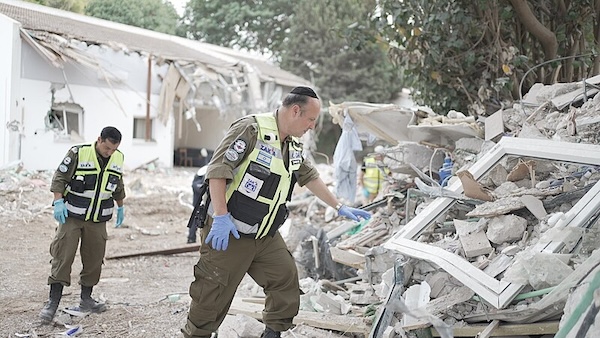
Members of ZAKA identification, extraction and rescue team search through the destruction in a Gaza Envelope community following the Oct. 7 attacks. (photo from ZAKA)
The annual Yom Hazikaron ceremony, marking Israel’s day of remembrance for fallen soldiers and victims of terrorism, took place May 12 at Temple Sholom. It was an unprecedentedly poignant ceremony, with hundreds of in-person attendees and hundreds more attending virtually, many of whom lost loved ones on Oct. 7 and in the war that began that day.
Dikla and Etsik Mizrachi, parents of Ben Mizrachi, the young Vancouver man murdered while heroically providing medical aid to others at the Nova music festival, both spoke.
“This Yom Hazikaron is different,” said Dikla Mizrachi. “This Yom Hazikaron, I can’t think of the many lives that we’ve lost. My heart can’t take the burden. The weight of my grief is too heavy to bear. This Yom Hazikaron, I can only think of one special boy, a boy who had big dreams, life ambitions.”
Ben grew up in Vancouver, she said, attended Vancouver Hebrew Academy and then King David High School.
“Ben was so proud of who he was,” his mother told the packed synagogue. “He was proud to be a Jew, he was proud to be Israeli. He had his mind set that, after high school, he would go to Israel and learn in a pre-army Mechina program to prepare him for the IDF. He couldn’t imagine himself doing anything else. And he didn’t. He did it all.”
Ben Mizrachi served three years in the parachute unit and completed a paramedic course.
“On Oct. 7, at the young age of 22, Ben was brutally taken from this world at the Nova festival in Re’im,” his mother said. “But he was not taken without a fight. His personality and moral core would not allow it. He did not run away to save himself when he had the chance. He showed tremendous courage and bravery as he tried to save others.
“We do not know everything about the last hours of Ben’s life. But we have been able to piece together some of them. What we know is that, from 6:30 a.m. to 8:10 a.m., Ben was under attack. We know that he and Itai Bausi, a friend from his kibbutz who went with him to Nova, made a choice to leave the safety of their car and their chance to flee. We know they made this choice in order to render aid to the injured,” she said.
Two brothers who survived the music festival attack have shared the story of how Ben used his medical skills to attend to the injuries of a young woman and then, with three other young men, transported her on a stretcher to the medical tent, holding her at hip level to avoid snipers.
“We know after they deposited the woman the boys then separated to run in different directions to escape their attackers,” said Dikla Mizrachi. “We know from the last voicemail message Itai’s girlfriend received from him that he was shot in his back and his leg. We know from both the phones that Itai called Ben multiple times but there was no response and we know that Ben died a hero, as did Itai.
“This past Oct. 7, our life as a family and our life as a Jewish nation changed forever,” she said. “Our collective hearts are completely shattered. Today, we are all in mourning. We all have soldiers in Gaza. We all have 132 hostages in Gaza. We all have evacuees from the north scattered all over the country. We are all suffering together.”
She told the audience that, at her son’s shiva, an army friend of Ben’s told her that he had lost a cousin in 2021, in Operation Guardian of the Walls.
“That year, on Yom Hazikaron, Ben had called him and said, ‘I know it’s your first Yom Hazikaron, so if you need or want to talk to someone, I’m here for you,’” she recounted. “This was Ben, thinking about others at every moment and being so sensitive.”
Addressing her late son, she said: “Ben, this is my first Yom Hazikaron and I need you.
“I need you to help our family choose life each day and give us strength. I know that you are still with us, but can you please send us a sign very soon, a sign that you are OK and in a good and peaceful place? Ben, we will do our best to live our lives according to your values, to be there for others, as you always were, and to cherish the things you loved. We love you. We think about you and we miss you every day a bit more.”
Later in the evening, Ben’s father, Etsik, said Kaddish for his son.
Geoffrey Druker, who has led the annual event for years, noted that this year was different.
“We have within our community families who lost loved ones in the past seven months, lost a son, a father, a brother, a sister, cousins, extended family, and friends,” he said. “Tonight, with our bereaved families here and worldwide, we remember our fallen in the establishment and the defence of the state of Israel, and all who have been murdered in terrorist attacks. We remember them all.”
Members of the BC Jewish community lit candles and spoke about those they have lost. A montage of photographs remembered friends and family of locals, from 1948 to recent months. Druker shared individual stories, a microcosm of the many stories of tragedy and heroism from Oct. 7 and the months since.
He told of the five members of the Kutz family of Kfar Aza – father Aviv, 54, mother Livnat, 49, and sons Rotem, 19, Yonatan, 17, and Yiftach, 15 – who were found hugging each other on a bed, father Aviv trying to provide a protective embrace.
In all, 64 members of Kfar Aza were murdered, and 13 soldiers killed in the battles on Kfar Aza. Among these residents was Mordechai Modi Amir.
“Modi was a creative person, always thinking outside the box,” Druker said. “So, when they built his secure room, he decided to add a small shower room, a room within a room, with its own door. At 6:30 a.m. on Oct. 7 – when the red alert siren went off, Modi, his two daughters and granddaughter entered the safe room.
“When they heard shots close by, and voices speaking Arabic, he told his daughters and granddaughter to enter the tiny shower room and to remain quiet as he closed the door behind them. He then stood waiting in front of the shower room door,” Druker said. “He most likely thought, when the terrorists enter the safe room, they will see a man standing by the wall, they will shoot him, and move on. A member of Kfar Aza later said: ‘Modi was shot several times and fell to the floor. He most likely, in his last seconds alive, saw the terrorist leave, knowing he saved his family.’ And,indeed, 13 hours later, his three family members left the tiny shower room alive, and survived.”
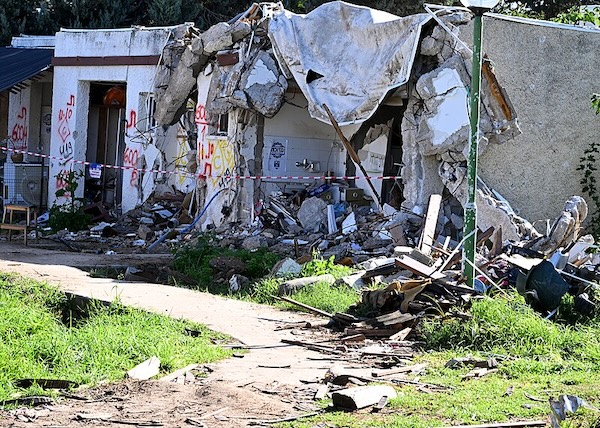
Destruction at Kibbutz Kfar Aza. (photo from US Embassy Jerusalem)
Vancouverite Amnon Kones and his family lived on Kfar Aza for 20 years and knew many of those killed. He lit a candle of remembrance, as did Sam Heller, who lived there during his military service as a lone soldier.
Adi Vital-Kaploun, an Israeli-Canadian who lived on Kibbutz Holit, was a relative of Vancouver residents Jason Rivers and Helen Heacock Rivers.
“Her husband was away that weekend,” Druker explained. “When Adi realized terrorists had infiltrated her kibbutz, she phoned her husband and asked how to operate his weapon, to defend her children.
“By some miracle, Adi persuaded the terrorists to allow her two young boys, Negev, 3-and-a-half, and Eshel, 6 months old, to be kept by her neighbour, Avital. Adi was shot and murdered in her home, and her body booby-trapped by the terrorists,” said Druker. “The Hamas terrorists then marched Adi’s neighbour, Avital, who was carrying Negev and Eshel, towards Gaza. At the Gaza border, for some unknown reason, they were released, and they survived, though 3-and-a-half-year-old Negev had been shot in the foot.”
Noam Caplan and Kessem Keidar, members of Habonim Dror Camp Miriam, lost family members and a friend on Oct. 7. Caplan spoke of his cousin, Maya Puder, 25, who was murdered at the Nova festival. Keidar remembered her cousin’s uncle, Amit Vax (Wachs), who was murdered in Netiv HaAsara.
“When he was killed, he was not aware that his brother Igal Vax was murdered earlier, while he too was fighting the terrorists on the other side of the moshav,” said Keidar.
The pair lit candles in memory of these victims, as well as Vivian Silver, another Canadian-Israeli, who lived on Kibbutz Be’eri.
It is estimated that about 120 people were murdered on Kibbutz Be’eri, among them Sylvia Ohayon. Dalia Ohayon lit a candle in memory of her sister.
Five members of the Bira family were murdered on the kibbutz: Oron Bira, 52, and his wife, Yasmin Laura Bira, 51, and their daughters Tahir, 22, and Tahel, 15, along with Oron’s elder brother, Tal, 62. Yahav, Oron and Yasmin’s son, was in another house, and is the sole survivor.
Navah Jacobs, a member of the extended Bira family, lit a candle in their memory.
Vancouverite Hofit Sabi recalled her cousin, Yinon Tamir, a 20-year-old paratrooper killed in action in the Gaza Strip in November, having earlier served among the first responders at Kibbutz Be’eri.
“Before going into Gaza, a few weeks after the battle of Be’eri, another comrade told of how Yinon comforted and guided him through his fears and anxieties to go into Gaza,” said Sabi. “Yinon promised that he would stay by his side and protect him, and he did, until his death. Yinon’s courage and leadership qualities shone through.”
Tamir had told his mother that he saw things at Be’eri that he could never unsee and that he felt a profound sense of privilege to serve and protect the right “to live as free people in our homeland.”
Itzhak Ben Bassat, a colonel nicknamed Benba, had just returned from vacation abroad at the end of a storied military career when he received a message to head for Be’eri on Oct. 7. He fought there for two days, securing the kibbutz, and survived. He died in battle two months later, age 44. His sister, Hamutal Ben Bassat, lit a candle in memory of her brother.
Nicky Wasserman Fried, whose uncle Aaron Fried died in the 1948 War of Independence, lit a candle in his memory and told the audience of casualties in Vancouver’s partnership region in northern Israel.
“Three IDF soldiers from our region were killed fighting Hamas as they infiltrated our communities surrounding Gaza on Oct. 7,” Fried said. “Since Oct. 7, an additional seven soldiers and three civilians have been killed.”
Cantor Yaacov Orzech chanted El Moleh Rachamim. The Clore & Roll Ensemble, who were the featured entertainers at the next evening’s Yom Ha’atzmaut event, performed, as did singers Mayan Molland, Shir Barzel and the Meitar Choir. Shir Barzel played piano.
The ceremony was presented by the Jewish Federation of Greater Vancouver, the Centre for Israel and Jewish Affairs, the Rabbinical Association of Vancouver and the Jewish Community Centre of Greater Vancouver.
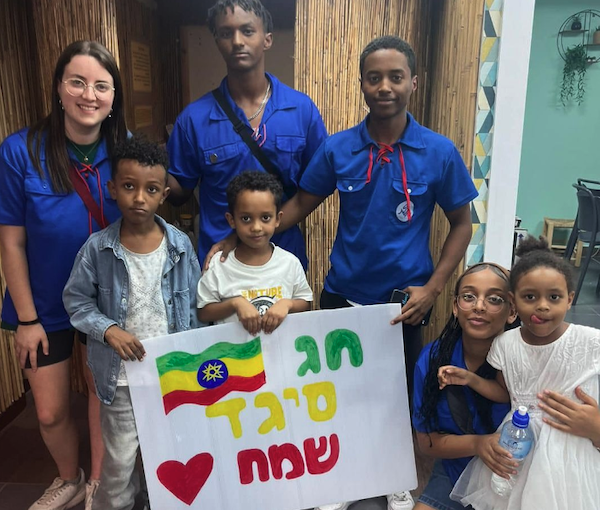
Last November, Dror Israel helped evacuees from northern Israel celebrate the holiday of Sigd. (photo from Dror Israel)
Noam Schlanger of Dror Israel is returning to British Columbia to discuss the group’s emergency response after the Oct. 7, 2023, Hamas terror attacks in Israel. He will speak at Congregation Emanu-El in Victoria on May 28, at 7 p.m., and at Congregation Beth Israel in Vancouver on June 2, at 5 p.m.
“We had been working with many of the affected communities for a long time before the attacks, so, when the war broke, we had the connections and the know-how to immediately set up educational frameworks for evacuated communities, with an emphasis on therapeutic and empowering platforms,” Schlanger the Independent.
“I will also be talking about our work with the tens of thousands of evacuees from the north, who still haven’t returned to their towns and homes. We have been providing day camps, leadership training courses and social-emotional support to many children and teens who have been living in cramped hotel rooms with their parents for seven months.”
Schlanger is an engagement director with Dror Israel, an Israeli organization that teaches leadership and responsibility for both individuals and community. Comprised of 1,300 trained educators in 16 communities on the social and economic periphery of the country, the organization promotes social activism to drive positive change. Educators live in the neighbourhoods they serve to bridge gaps and solve local problems. Through its youth movement, schools and programming in Israel, it helps an estimated 150,000 people a year.
Dror Israel educators have supported children traumatized by previous wars, the COVID lockdowns and the war in Ukraine. During the current war, the organization, in cooperation with local municipalities and the Israel Defences Forces Home Front Command, has established programs to help evacuees and residents who have been hardest hit.
Schlanger shared several stories of how Dror Israel has played a crucial role in allowing life and events in the country to continue as normally as possible under the circumstances. In November last year, they helped evacuees celebrate Sigd, a holiday celebrated by Ethiopian Jews that falls 50 days after Yom Kippur.
This past March, students from Dror Israel’s Tel Aviv high school used their skills in urban agriculture to create community gardens. The portable gardens were made at several evacuee centres for displaced communities and not only provide fresh produce but therapeutic spaces that give solace and connection.
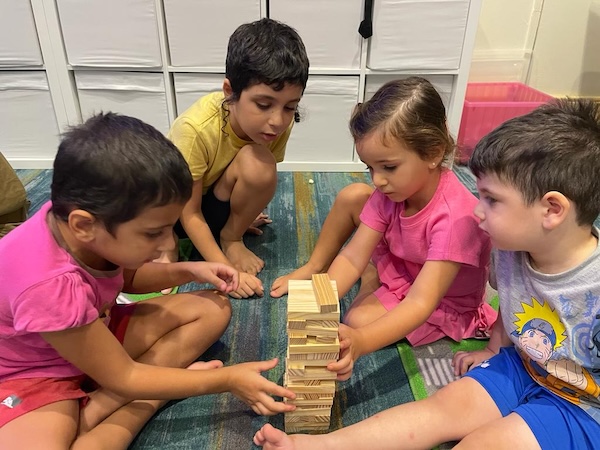
In April, 400 children from the evacuated city of Kiryat Shmona were supplied structure and some fun through a Passover day camp. The children, from grades 1 to 6, who are presently housed in Tel Aviv hotels, went bowling, visited an amusement park and had a picnic near the Alexander River.
Dror Israel has been giving evacuees the chance to have some semblance of a normal life. (photos from Dror Israel)
Dror Israel works with animals as well. Following the Oct. 7 attacks, many dogs ran away or were leftbehind. With the help and care of students in the Dog Training Vocational Course at Dror Israel’s high school in Karmiel, dogs went from being fearful and hesitant to curious and loving, and many are now ready for adoption.
Besides being an engagement director, Schlanger’s involvement with Dror Israel has included leading a youth centre in Kafr Manda, an Arab town in Lower Galilee, and working at the community garden in Akko (northern Israel).
From Schlanger’s standpoint, the essence of Dror Israel is one of an inclusive vision of Zionism that yearns to create space for everyone, and the dream of a just and equal Israel. He believes it is a welcome message amid the polarized discourse that has been prevalent in the country for many years.
Schlanger last visited British Columbia in the summer of 2022 and has maintained a close relationship with both Congregation Emanu-El and Congregation Beth Israel. In October 2023, only a couple of weeks after the Hamas attacks, he wrote to his friends in Victoria, “We will do our best to better people’s lives during these terrible days. Our educators across the country are continuing to assess the safest and most necessary next steps in our communities.”
“The sense of connection goes deep into our community and we have people there, too,” said Susan Holtz, executive director of Emanu-El, about the synagogue’s ties with Dror Israel.
Rabbi Adam Stein of Congregation Beth Israel said, “We are very excited to have Noam come here. Dror Israel is a wonderful organization that has been doing great work for Israeli civil society, especially for those who were evacuated after Oct. 7.”
“I visited Dror Israel in Akko and was very impressed at the programs they offered and the process they undertook,” Beth Israel member Penny Gurstein added. “Their commitment to social justice and partnerships between Jews, Arabs, and all sectors of Israeli society is even more needed now.”
Dror Israel was started in 2006 by graduates of the Israeli Youth Movement, Hanoar Haoved Vehalomed, who served together in the IDF and shared a belief in the founding principles of Zionism.
After his talk in Vancouver, Schlanger will travel to Portland to speak at the annual federation meeting there. For more information about Dror Israel, visit drorisrael.org.
Sam Margolishas written for the Globe and Mail, the National Post, UPI and MSNBC.